Monthly Archives: May 2024

“To err is humor”–Mangled words, gaffes, and malapropisms.

A long-time fan of Jeopardy, I have even become more interested in recent months watching popular quiz show’s championship series that pits the best against the best.

Watching it with Larry, we enjoy playing along, supplying our own questions to the clues given in numerous categories. . As was true for the two of us in our Trivial Pursuit days, I do well in the arts and entertainment areas, especially literature. Larry does well in history, geography, and sports. We don’t do as well in the sciences.

I know that I will never be a Jeopardy champion. Nor do I even have hopes to come in second. My pressing that buzzer would be similar to my pressing a self-destruct button. It’s not only because I don’t have a head for all the trivia. I would also bomb out because of my misuse of words. 

In response to the Jeopardy clue, “Company created by Steve Jobs that was sold to Disney in 1985,” I would offer “What was Pixie?” Another contestant would quickly supply the correct line. “What is Pixar.” I unfortunately would have no place to hide.

And Ken may completely lose it when my answer to “French singer famous for La Vin en Rosa” was “Who is Edith Pilaf?” Poor Ken would have to fight the urge to burst out laughing before getting the correct answer—“Who is Edith Piaf?”—from another contestant. “Yes,” Ken would comment, “We were looking for a name, not a rice dish that sings.”

I used to think my problem was mispronunciations. But it’s worse. I am guilty of using malapropisms. Malaprops, whose name come the eponymous character in Richard Brinsley Sheridan’s 1775 play The Rival, occur when one uses an incorrect word instead of another similar-sounding one, resulting in a nonsensical, often humorous sentence. An example of a malapropism is when someone says, “dance a flamingo” instead of “dance a flamenco.”

I come from a long line of “malapropists.” My father’s misuse of words bordered on Archie Bunker territory. And my poor mother was also guilty, The one that sticks with me was her using “orgasm” when she meant “organism.” 

My own history of mispronunciations started young. In high school, my fiery rant about the radical “Storky” Carmichael. brought my fellow classmates to hysterics when I talked about that radical “I think you meant “Stokely,” suggested Mrs. Clute when the laughter died down. I was in college before I realized that Sigmund Freud and Sigmund “Froid”were one and the same Austrian psychologist.

My most embarrassing transgression came as an adult, when I walked into a garden shop in Upstate New York and asked for a well known pest spray.

“Can you tell me where I can find the Spermicide?” I asked the clerk.“Sorry, lady,” the clerk responded. “You won’t find any spermicide here, but I do have Spectricide.” I wonder if my request has become one of their favorite stories to retell again and again. 

I join a long line of famous people whose malapropisms have become part of their history.Yogi Berra was so famous that his expressions ranked their own name, “Yogi-isims.” He once said, “He hits from both sides of the plate. He’s amphibious” instead of saying ambidextrous. In another instance, “Texas has a lot of electrical votes.” (electoral votes)

Yogi may have made such “errors” an art, but other legendary historical quotes were—well—hysterical.Australian Prime Minister Tony Abbott once stated that no one “is the suppository of all wisdom” instead of saying repository or depository. Chicago Mayor Richard J. Daley incorrectly referred to Alcoholics Anonymous as Alcoholics Unanimous and called tandem bicycles “tantrum” bicycles.

More recent American politicians have faced ridicule for their public gaffes. President George W. Bush famously stated “The law I sign today directs new funds… to the task of collecting vital intelligence… on weapons of mass production” (destruction). In 2022, Republican Senate candidate Herschel Walker was mocked online after claiming “this erection is about the people” (election), during an interview on Fox News. Congresswoman Marjorie Taylor Greene has also been excoriated for her misuse of words, including references to “peach tree dish”(petri dish) and “gazpacho police”(Gestapo), and “fragrantly violated. (flagrantly), among others.

President Joe Biden also has been mocked for his verbal missteps. On March 31, 2024, he asked all his guests at the annual Easter Egg Hunt say ‘hello’ to oyster bunnies.” He famously mixed up the names of world leaders with their (deceased) predecessor, referring to French President Emmanuel Macron as Francois Mitterrand and German Chancellor Angela Merkel as Helmut Kohl. But he knows it. ”I am a gaffe machine,” admitted Biden in a 2018 speech.

And then we have Donald J. Trump. In a a research paper published in 2020, Dr. Sajid Chaudhry examined 500 viral tweets posted on Twitter by the former president. Along with the hundreds of misspellings of common homonyms (waist/waste; boarder/border; taxis/taxes; eminent/imminent; Barrack/Barak), the paper cited numerous malapropisms, including references to a “Smocking Gun” and a claim that the media said that he wanted “a Moot stuffed with alligators and snake” at the Southern border. “The way he mangles words,” states Dr. Chaudhry at the end of his report, “ it looks like the ghost of Mrs. Malaprop haunts his vocabulary.”

So, it looks like I am not the only one who may experience major failures on Jeopardy. I take solace in my limited knowledge of Yiddish and Hebrew, which means I know not to call our Passover meal a “cedar,” our beautiful braided egg bread a “CHA-lah,”and our Day of Atonement “Yam KIP-per.” 

My personal favorite malapropism was spoken by a non-Jewish friend when she asked how I met Larry. 

“We met at a Purim party,” I said.

Dead silence. Long pause.

“I can’t believe you are so open about your meeting your husband at a PORN party,” my friend said incredulously. 

I wonder how Ken Jennings would react to that!

The famous Edith “Pilaf”!

Sources and links

Corny, the pandemic kitty

This story was published on May 14, 2020, but didn’t make it to my blog. Four years later, here it is!

One of the advantages in living in our community in Florida is the abundance of wildlife that surrounds us. In one week, we have seen otters frolic near our pond, crows attack a red-tail hawk, and osprey dive into the pond to catch a fish.Often, we look out our window and see several deer munched grass near the pond. 

 In one of my more harrowing moments, I barely missed hitting a male deer who decided to dash across the road in front of my bike. I thankfully stopped in time and watched two adults and one fawn continue their stampede.None of this week’s wildlife scenes, however, can compare with our encounter with a not-so-wild animal that briefly came into our lives.

 As Larry and I were finishing up one of our long walks around Solivita, we saw a friend of Larry’s from pickleball standing beside her bike and staring at the curb. As we got closer, a tiny ball of fur crossed the road, an animal so small that it took us a minute to realize that it was a kitten. We watched it dart behind some bushes in the front of a neighbor’s yard. After a few tries, I found it trembling under the shrubbery. 

Larry and I knew that we couldn’t just leave the tiny animal on its own. He (we checked!) would die of starvation or become an alligator’s dinner. We also knew we couldn’t keep him. Although we had had cats while our children were home, we had come to the realization that all of us were allergic. We had to find him a home with another cat lover who didn’t rely on Zyrtec to survive..

 I picked him up, wrapped him in the bandana that I had been using as an emergency face mask, and started walking the half mile home. It took me less than a minute to name him “Corny” for the coronavirus. 

While I gently held Corny and tried to reassure him that he was safe, Larry called friends who we knew loved animals. Kerry the dog walker. Jane the dog sitter. Doug and Barb the cat lovers. Teri who volunteers at a “cat cafe” where one can have coffee and pastries while playing with adoptable cats. In between the calls, we asked everyone whom we passed if they would like to adopt a kitten. No luck—yet

When we got home, I placed a laundry basket with an old towel on the floor of the garage and sat next to him. I took a picture of Corny and posted it on the lost and found section of our community e-bulletin. My next call was to a local veterinarian, who was not encouraging. He said that the kitten was one of many who were dumped in Solivita by outsiders. He also warned me that he probably was carrying fleas, parasites, AIDS, and/or feline leukemia and told me to call the county animal control so the stray could be picked up and—probably—put down. The Polk County contact initially provided some optimism: the shelter would take him in and try to find him a home if and only if he was weaned as they did not provide bottle feeding.

After several more phone calls, we connected with Brenda and Marty, devoted cat lovers who spend part of each year working at Best Friends Animal Society in Kaleb, Utah. The organization is leading a national effort of “No Kill By 2025,” They directed us to a woman in our community who is involved in Helping Paws, a local network whose mission was to rescue cats and find them homes. She was willing to take Corny, and the organization would ensure the cat visited a veterinarian for a check-up, shots, and neutering. 

I quickly called animal control to cancel, but I was too late as the truck pulled up to our house soon after I hung up. We explained the situation, and the person who was to take Corny away was happy we had found a home for him. 

As Larry drove, I held Corny and told him that he was going to a safe place. Diane, the cat angel, took a quick look at our kitten. She estimated that Corny was less than six weeks old, had a few fleas and an eye issue but was in good shape. She already was fostering a female cat with four kittens and was hoping Corny would be adopted by the mother cat. We gave Diane a contribution to cover the cost of the vet and said goodby. The softie that I am, I shed a few tears as we drove home. From the time we first spotted the kitten until we returned home, only 90 minutes had passed.

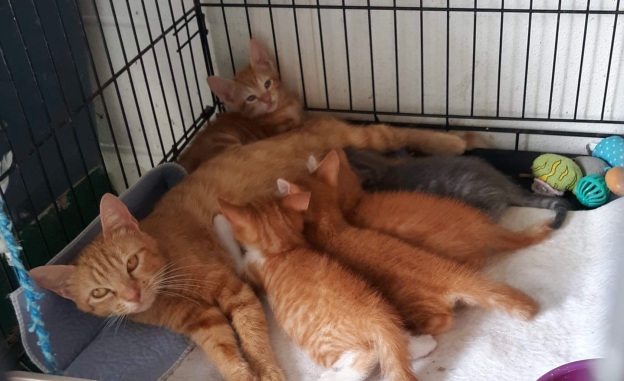
The next morning, Diane left a message on our voice mail: The mother had accepted Corny. Diane texted us a picture of all six cats. The mother was nursing three of her kittens and Corny. A fourth kitten looked on with an expression that said, “Hey! Who is this grey fur ball that took my place?”

On a check-in a week later, Corny, who Diane had renamed Snickers, was doing fine. “I overestimated his age,” said Diane. “Based on his weight, he was less than four weeks old.” While the other kittens were weaning themselves, Snickers had the mother cat all to himself.

Meanwhile, Diane shared with me her story as to how she became involved in Helping Paws. Like us, Diane and her family had a number of cats when they lived in their home outside of Boston and later outside of Orlando. When the last one passed away, Diane decided “No more pets!” 

Soon after that, Diane was diagnosed with cancer. After she recovered, she decided that she needed to do something to give back to the community. One night, she dreamed that a black and white cat showed up at her doorstep. The next morning, she found a calendar with a similar looking cat in her mailbox. And that day, a black and white cat showed up on her doorstep. Fifteen years later, Max was the “old man” in her home with two other cats as well as a string of over two hundred cats she has fostered over the years. I thought to myself, Corny now has a bright future, and we had our happy ending. 

As we celebrated Shavuot the following week, I could not help but think of the sixth commandment: Thou shall not murder. I learned that Polk County has a 50% kill rate for the animals brought to their shelter. That ranked them first in the state and tenth in the entire country. Corny wouldn’t have had a chance! In such worrisome, sad times as we encountered during the pandemic, it felt so good to be able to rescue this little fur ball. 

Unfortunately as predicted by the veterinarian, Corny did not survive. Diane emailed us a couple of weeks later to say Corny had died of an infection brought about by parasites that had overwhelmed his tiny body.

Still, looking back on our brief encounter, I never regretted our short time helping that stray kitty. We tried to help. As a result, Corny knew love and companionship before he passed over to the “rainbow bridge.” And that gives us some peace.

https://www.wtsp.com/article/news/local/polkcounty/polk-county-takes-the-first-step-towards-becoming-a-no-kill-zone/67-c8bb60b6-349f-4e5b-bf41-7649432aec7a

To learn more about Best Friends Animal Society, go to www.bestfriends.org.

Israel and Larry bonded by history

My husband Larry was born the week that the State of Israel was born. For the rest of his life, his birthday celebration would be entwined with the founding of a new country.

In 1961, Larry’s entire bar/bat mitzvah class and their families participated in a special presentation conducted by  Israeli Bond representatives. As a result, Larry’s parents, along with many other families at the presentation, purchased several bond in honor of their son’s upcoming simcha. 

While I was writing this article, Larry wondered aloud if Israel Bonds were still sold. We were surprised to learn of its interesting history and its expansive role in Israel, United States and the world today. 

The brainchild of David Ben-Gurion, the Development Corporation of Israel was developed shortly after Israel’s War of Independence. The war had wreaked havoc on the economy as well as the population—more than 1% of the country’s population was killed. Furthermore, with hundreds of thousand of immigrants pouring in from post World War II Europe and the Middle East, the country faced food and housing shortages. To seek financial assistance, Ben-Gurion turned to Jews throughout the Diaspora to become active partners in building the new Jewish State through their funding for immigrant absorption and construction of the national infrastructure.  

In September 1950, Ben-Gurion convened a meeting of American Jewish leaders in Jerusalem to explain his bond proposal, which was strongly supported. The following spring, the prime minister traveled to New York City to help launch the first bond campaign. In the next year, bond sales totaled $52 million, over twice as much as initially believed could be raised.  

By Larry’s Bar Mitzvah in 1961, Israel Bonds had expanded its network throughout US and Canada. Along with the initial targets, the bonds also funded the country’s industrial and agricultural sectors. 

In the following years, a series of wars, including the Suez Crisis (1956), the Six Day War (1967), the Yom Kippur War (11973) and Persian Gulf War (1991) brought in sales that shattered the one billion dollar mark, a benchmark that has continued through today. 

Initially, Israel Bonds offered one security. As the program became increasingly successful, multiple investment options were made available, ranging from $36 to a minimum of $25,000.

What began as a predominately Jewish investors intent on helping Israel with their financial support became more and more diversified. Investors now include over 90 US state and municipal pension funds, corporations, insurance companies, associations, unions, banks, financial institutions, universities, foundations and synagogues.

An e-commerce site was launched in 2011. Along with the initial initiatives, Israel bonds now fund investment in technology companies, including Goggle, Intel, and Apple as well as start-up companies. 

In order to counteract the Boycott/Divest/ Sanction movement, in 2016, the organization launched a new initiative to counter campus anti-Israel activism activities. The Alternative to the Boycott/Diversity/Sanctions Movement begun by Israeli bonds is called the Bonds Donated to Schools initiative and encourages donation of Israel bonds to universities. 

Simon Perez, past president and Nobel laureate, stated “The strong ties between Israel bonds and Israel has been as resilient and fruitful as the Land of Israel itself. PhilanthropistWarren Buffet recently recognized Israel Bonds as a “deserved endorsement of a remarkable country.” 

Besides the coincidence of Larry being born the week “Israel has risen,” to quote Ben-Gurion, and the push for the purchase of Israel bonds prior to his bar mitzvah, there have been other family connections that his family has to Israel that have touched him deeply.

Larry’s grandmother, Rose Applebaum, was living in Russia in the early twentieth century with her parents and several siblings.As opportunities arose, Rose and several members of her family emigrated to the US and Canada.  Those who did not immigrate were tragically  murdered in the Holocaust.                                                                                   One of Rose’s brothers Aaron had preceded her arrival in the United States. Around 1915, Aaron started moving around the country. Within a few years, all communication ceased. In the mid-1960’s, Rose received a letter from Aaron saying that he was living in New York and wanted to reunite with his sister. Larry’s parents met Aaron in New York City. After talking to Aaron and asking specific family-related questions, they were able to assure Rose that Aaron was indeed her brother. A joyful reunion followed. 

Several years later, Aaron had a stroke, and Larry’s parents relocated him from his apartment in New York City to a nursing home in Saratoga Springs. As his cognitive abilities declined, Aaron only recognized one member of his re-found family in the present time—Larry. Although the elderly man had shared none of his past history, Aaron felt a connection with his great nephew, who was attending Northeastern University in Boston. During Larry’s visits, Aaron frequently asked Larry, “How is Boston?” This made the family believe, that Aaron may have spent time there in his “lost” years. In his mind, Aaron believed Israel was still fighting the War of Independence and questioned Larry often as to how the war was going. That made Larry and his family aware how important Israeli’s independence was to Aaron.

In 2018, , when Larry and Israel turned 70, we celebrated the “Double Simcha” by sponsoring both the oneg at our synagogue and the refreshments at the Shalom Club, our community’s Jewish social club. G_d willing, Larry and I will have many more occasions to celebrate Larry’s birthday and to appreciate his connections to Israel.

Sources:

“Israel Bonds: An Investment in 70 Years of Extraordinary Achievement”https://www.youtube.com/channel/UCEp97p7f_RgYaHAGKxip-VA

Israel Bonds. https://www.israelbonds.com/Home.aspx

Israel Bonds. Wikipedia https://en.wikipedia.org/wiki/Israel_Bonds

A survivor’s story: “I live every day as a blessed person.”

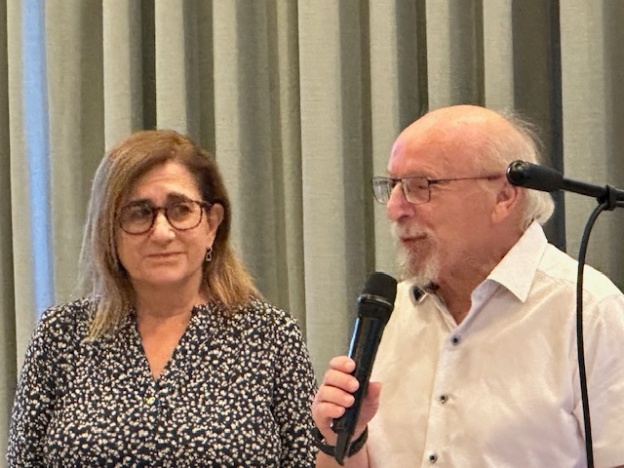
On May 5, 2024, our community’s Shalom Club held its annual Holocaust Remembrance, or Yom Ha’Shoah, event. Lou Ziemba’s story was one of the highlights of a moving, unforgettable evening.

Born  in wartime Poland, Ludwig“Lou” Ziemba is  a retired successful businessman, a polyglot a descendent of “Jewish  royalty’” and a Holocaust survivor. 

Lou’s story begins in Poland. Rabbi Menachem Ziemba, was the chief rabbi of Warsaw, a renowned holy figure in the Ger sect of the Chassidic movement, and a key player in the 1943 Warsaw Ghetto Uprising through his pleas that urged inhabitants to fight against their captors. 

“In the present we are faced by an arch foe, whose unparalleled ruthlessness and total annihilation purposes know no bounds,” Rabbi Ziemba told the Warsaw Ghetto inhabitants. “Halachah [Jewish law] demands that we fight and resist to the very end with unequaled determination and valor for the sake of Sanctification of the Divine Name.”

One of Rabbi Ziemba’s nephews was Henoch, son of his brother Moshe. Henoch was a bit of a non-conformist intellectual who spoke several languages and wandered around Europe. Henoch married a woman who was not approved of by his Chassidic family and thus he was no longer recognized by his large family in Warsaw.

As the Nazis rose to power, Henoch experienced both his wife and children being executed by the Nazis. Grief-stricken, Henoch returned to Poland and settled in the industrial city of Lodz, the second largest Jewish community in prewar Poland, after Warsaw.

With the outbreak of World War II and the German invasion of Poland, the life of Polish Jews deteriorated through a series of draconian laws imposed by the Nazis. In February 1940, after even more severe anti-Jewish measures were instituted, the Germans established a Jewish ghetto, initially trapping 164,000 Jews into a few city streets in a neglected northeastern section of Lodz. The widower Henoch Ziemba was one of those people. 

Soon after his arrival in the Lodz Ghetto, Henoch met and married 20-year-old Golda Farber, almost two decades his junior. Golda may have been small in stature, but she was, in Lou’s words “a firecracker” and “a force of nature.” Almost immediately, Golda became pregnant. For reasons lost in the family lore, Golda turned for help to Mordechai Chaim Rumkowski, who Primo Levi later wrote “morally ambiguous and self-deluded.”

To organize the local population and maintain order, the German authorities established a Judenrat,” or Jewish Council in the ghetto. The Germans appointed Rumkowski as the “kapo” of the Lodz Ghetto, whose job it was to oversee the day-to-day living as well as to decide who would live and who would die. Rumkowski was responsible for sending untold numbers to their deaths.

Known mockingly as “King Chaim”, Rumkowski was granted unprecedented powers. Rumkowski transformed the ghetto into an industrial hub for the Nazis, producing uniforms, wood and metalwork, and electric equipment. Rumkowski felt that, as long as the ghetto served a purpose by supporting the Nazi effort, the workers would avoid deportation to the gas chambers. His methods, however, were brutal: He oversaw the slave labor of anyone over 12 years old to work 12-hour days despite abysmal living conditions and near-starvation rations.

In his biography of Rumkowski, Yehuda Leib Gerst described this complex man. “Toward his fellow Jews, he was an incomparable tyrant who behaved just like a Führer and cast deathly terror to anyone who dared to oppose his lowly ways. Toward the perpetrators, however, he was as tender as a lamb and there was no limit to his base submission to all their demands, even if their purpose was to wipe us out totally.”

Furthermore, Rumkowski used his position to his own benefit. He singled out his political enemies for death and deportation to the death camps, and also deported those who had the capacity to rise up against their capturers. In contrast, those whom he favored were showered with extra provisions, medicine, rations, and safety.

For reasons lost to history, one of those receiving his benevolence was Golda Ziemba. With Rumkowski’s help, Golda was able to hide her pregnancy. A son, Ludwig, was born on September 9, 1942. 

 In late summer, Rumkowski was given orders to select 24,000 for deportation. Believing that the inhabitants’ survival depended upon their employment, he made the decision to hand over their 13,000 children under ten and their 11,000 elderly over 65 years old. He addressed the parents of Łódź as follows. “In my old age, I must stretch out my hands and beg: Brothers and sisters! Hand them over to me! Fathers and mothers: Give me your children!”

Again, for unknown reasons, Rumkowski worked with the Ziembas to save their infant son. He and Golda arranged for baby Ludwig to be hidden in a garbage truck. Once outside the Ghetto, he would immediately taken by a Polish farmer, whose family would raise him as their own in their Christian home. “It’s a miracle,” said Lou. “There were very, very few children who survived the Lodz Ghetto.”

As the war continued, conditions in the ghetto deteriorated, marked by a growing number of inhabitants being sent to the extermination camps. By summer 1944, as the Soviets came closer, the Nazis rounded up every remaining Jew they could find, including Rumkowski and his family, for mass extermination in Auschwitz’s gas chambers.Before their deaths, however, a group of Jews beat Rumkowski to death, a fitting ending for a man who many Jews regarded as bad as Hitler and his Reich. 

On January 19, 1945, the Soviets liberated the Lodz Ghetto. Over the course of last four previous years, over 220,000 had people passed through its gates. There were only 877 survivors, including Golda and Henoch Ziemba, who had managed to hide during all the deportations.

Golda and Henoch’s first stop after liberation was to reunite with their now three-year-old. son. Ludwig didn’t recognize or understand the emaciated but overjoyed strangers who spoke in Yiddish. Despite the Polish family’s reluctance to give up their “son,” his biological parents -against all odds- had returned. 

The Ziembas were the only three members of the family to survive. Rabbi Menachem Ziemba and the four hundred members of the family who had been trapped in the Warsaw Ghetto were all murdered by the Nazis.

Relocated to a German Displaced Persons camp, the Ziembas were soon a family of four. Lou’s sister Esther was born while Lou was away recovering from tuberculous in a German convent, where he learned his third language, German. 

So, to summarize Lou’s first 8 years of life, Lou was born a Jew during a period of extermination, hidden by a resourceful mother, taught Polish by a non-Jewish Polish family, taught German by nuns in a convent, recovered from TB, and taught Yiddish and right from wrong by his parents in a German DP camp. He never had to go to school, get circumcised, or even brush his teeth the entire time.

After a five year wait, the Ziembas immigrated to New York City in 1950. By the time he was nine years old, now known as “Lou,” was working alongside his mother at her small women’s shop in the Bronx that sold undergarments. His bar mitzvah was held in 1955, thus learning yet another language—Hebrew. Before Lou could be Bar Mitzvah’d, however,  there was one order of business that had to be taken care of at the local hospital, “a small snip of the tip.” Lou was heard screaming from every floor of the hospital “I DON’T WANNA BE A JEW!!!

When he was twenty-one, Lou opened a men’s clothing store down the street from his mother’s shop. As his business grew, in part because of Slax and Jax’s inventory of the newly popularly “blue jeans,” he convinced his mother to sell her store and join him in business. They soon opened three more stores.

However, as shopping malls sprang up, Lou realized the negative effect on his businesses. He sold them and went into the home construction business.  He, his wife Maxine (“Cookie”) Noble and their two children moved to “New City,” an affluent suburb of New York City. 

In 1999, the long years of his dedication to work took a toll on his marriage, and the couple divorced. Soon after, Lou met and married Beth Landa who happened to be related to his son-in-law. After the couple’s retirement in 2015, they moved to Florida, settling in Solivita, a fifty-plus active adult community in Kissimmee in 2023. 

“I’m aware of how lucky I am to be alive,” Lou says. “I live every day as if I’m a blessed person. I enjoy life too much not to do that.” 

Sources

Thanks to Lou Ziemba and Beth Landa for providing the interviews and information for this article. 

Cousins, Jill. “A Survivor’s Saga.” Lake Mary [Florida] Life.Winter 2017.

https://en.wikipedia.org/wiki/Chaim_Rumkowski

https://en.wikipedia.org/wiki/Łódź_Ghetto

https://en.wikipedia.org/wiki/Menachem_Ziemba

https://encyclopedia.ushmm.org/content/en/article/lodz

Memories Lost and Found

On February 27, 2007, my cousin Ellen called to share the sad news of the passing of her mother and my aunt, Nesbeth “Nesh” Hurwitch, The funeral was to be held in Queens, New York, on a Wednesday. My sister Laura would fly into Albany, and then my husband Larry would drive her, my mother, and me the three hours down to New York City. My father, who was 93, would not make the trip.

Nesh was my father’s younger sister, the third child of Annie and Joseph Cohen. She had always been my favorite aunt, and I think I may have been her favorite niece. She was funny and caring and generous. I had spent time with her, her husband Lou, and my cousins Ellen and Stuart in their cooperative apartment in Queens over Christmas holidays and summer vacations.I have fond memories of Freedomland, an amusement park in the Bronx; visits to Big Apple tourist attractions; and numerous times waiting in line for Radio City Music Hall events. When I had a summer job in the city between my junior and senior years in college, I stopped by for dinners and visits. 

After my Uncle Lou passed away, Nesh not only survived but flourished. She went back for her GED, her high school equivalency diploma  and even took some college classes. She traveled the country and the world. Her last few years were a slow, sad, decline, where she was confined in bed with round-the-clock aid provided by Poppy, a warm, caring Jamaican woman. To add insult to injury, she was diagnosed with pancreatic cancer, the same illness that had taken her husband several years before, and she died soon after that latest medical blow.

When my mother, sister and I got to the funeral home, Ellen approached Laura and me with a request. Would we please share a few words about our aunt?

I usually am good at putting together words on paper, but I was not great at extemporaneous speaking. What could I say? I reached into my brain for a fond or funny memory.

By the time Ellen asked me to speak, I was ready. In December  1964, I said, my mother, my younger sister Bobbie, and I met up with Aunt Nesh and our cousins in front of Radio City Music Hall for their Christmas show. Along with the showing of Father Goose, the movie starring Cary Grant and Leslie Caron, we would t: Rockettes in a line, dazzling sets, wonderful music.

We arrived by 10 am for the 12 noon show and began our two hour wait. I was, unfortunately, not a happy camper. The temperature was in the thirties, and I remember hopping from foot to foot to keep warm. I grumbled and moaned and complained as only a fourteen-year-old teenager could do. I remember everyone else holding up well, but I probably made my party miserable for the whole time. 

The irony, I shared, was that when we returned home to Keeseville, our tiny town in Upstate New York, Father Goose was playing at the Rex Theater. Less than half a block from our house, there were no lines, no wait, and, as it was the custom around the holidays, we got a plastic net Christmas stocking filled with candy with our twenty cent admission. Thirteen years later, I stood in front of a room filled with family and friends and recounted that special time with Aunt Nesh as I froze my toes off in New York City.

Laura also spoke, sharing moments with  Aunt Nesh, her humor, her kindness. Once the funeral was over, Larry began the two hour drive to the cemetery in New Jersey where Aunt Nesh would be buried. 

“You know, Marilyn,” said my mom. “That was a great story, but it wasn’t true.” 

“What do you mean?” I asked.

“Aunt Nesh wasn’t with us when we went to see Father Goose in 1964,” my mother said. “I had taken you and Bobbie down to the City for the Christmas break. We were staying with Grandma Ethel and Uncle Joe. Aunt Nesh, Ellen, and Stuart weren’t with us.”

Oh dear! I wanted to honor my aunt, and I had created a alternative universe! I was embarrassed, so embarrassed that I didn’t share my “mistake” with Ellen until years later. During the pandemic,, Ellen arranged a weekly Cousins Zoom, where my four siblings, Ellen, her brother Stuart, and our other paternal first cousin Joyce came together each Tuesday to talk about our family. It was on one of those calls, when I got on early before everyone else signed in, that I told her the truth about my “eulogy.” 

She didn’t remember joining us on that cold winter day many years ago. And it wasn’t as much a story about Aunt Nesh as it was about me. But that was okay. We were creating new memories on our Zoom calls. And that seemed to make it all right. 

Cousins Ellen and Stuart and Aunt Nesh