Author Archives: Marilyn Shapiro

Unknown's avatar

About Marilyn Shapiro

After thirty five years in education, I have retired and am free to pursue my lifelong dream of becoming a freelance writer. Inspired by my mother, who was the family historian, I am writing down my family stories as well as publishing stories my mother wrote down throughout her life. Please feel free to comment and share.

Over the rainbow for “Wicked” witch Elphaba

The usual costumes on Purim are straight from Shushan—Esther, Mordechai, Ahasuerus, or even the bad guy Haman. But some people treat Purim like Halloween, choosing their favorite from a gamut of options. This year, if I went with the “Halloween” option, I would don a black cape, a black hat, and lots of green face makeup. Yes, I would be Elphaba, the Wicked Witch of the West. 

So why would I choose to dress up as one who would be considered in Jewish tradition as one of the Amalekites? The Wicked Witch of the West is one of the most evil characters in all of literature and, thanks to Metro-Goldwyn-Mayer, one of the most hated characters on the movie screen. It comes from my childhood love of the book by L. Frank Baum and my adult love for anything Wicked.

The Wizard of Oz began its almost forty-year annual run on CBS in 1956 when I was six years old. Like most children, I hated the Wicked Witch and the monkeys, but I loved Dorothy and her companions. Her rendition of “Over the Rainbow” is as of today my favorite song of all time. I watched the televised movie at least ten times.

Soon after I saw the movie, my parents gave me a hardcover copy of the book. I read it so many times that the cover fell off, and the pages became torn and dog-eared. While doing some research for this story, I failed to locate the exact edition I had treasured, but I compromised and bought an illustrated copy for my Kindle.

Oz fell by the wayside for many years. Gregory McGuire’s novel was creative but long and dark. I would stick to Baum’s original, if you please.

Then came Wicked. In the fall of 2004, my dear friend Melanie Bleich took a chartered bus down to Times Square. As was our tradition, we had lunch at Carmine’s. Then we headed to the Gershwin Theatre for the show. Kristen Chenowith had left her role as Glinda in July 2004, but Idina Menzel still had her role as Elphaba. The story, the costumes, but especially the music swept me away. Less than two years before we saw the show, doctors had diagnosed Melanie with non-smoker’s small cell lung cancer. She had already undergone surgery, chemo, and radiation. But that was a good day. When Elphaba and Glinda sang “For Good,” a song about friendship, I cried openly. Melanie passed away in May 2015 after a ten-year battle. To this day, when I hear the lyrics, “You’ll be with me, like a handprint on my heart,” I automatically put my hand on my own. I saw the stage version of Wickedtwo more times, once in Schenectady in 2009 and a second time in Denver in July 2024 with my Colorado family. 

How does Larry feel about my passion for Wicked? He is still suffering from his experience of seeing The Wizard of Oz at the movies when he was four years old. Grudgingly, he joined me twice to see the play. And he certainly didn’t share my excitement about the news that a movie version would hit the theaters on November 24, 2024. 

Being the wonderful husband that he is, Larry agreed to go with me soon after its Thanksgiving Day opening. We settled into our seats with a huge bucket of popcorn, got through all the previews and then VOILA! The film begins by shedding light on why Elphaba was “greenified.” About ten minutes in, the opening credits flashed on the screen. Wicked. Part One. Larry literally shouted out loud, “PART ONE! You dragged me to a two-and-a-half-hour movie, and it’s only PART ONE?

I loved it. Larry conceded he enjoyed it more than the play. It took a full year for us to return to Wicked: For Good. (I promised Larry that there would not be a Part Three.) As always, I cried when the two leads sang “For Good.” Larry cried for happy because it was over.

For weeks after seeing the movie, I was totally obsessed with the music. Alexa dutifully played songs from the movie; I scoured the internet for clips related to both the stage and movie versions, including several versions of “For Good” sung by children, various choruses, and even Cantor Avi Schwartz and Julie Benko. Not surprisingly, I play “For Good,” “Defying Gravity,” and “Over the Rainbow” on the piano more than any other sheet music I own.

So yes, Elphaba would be my Purim costume of choice, my character of choice. Unlike the one portrayed by Margaret Hamilton (a former teacher who loved children and appeared on Mister Rogers Neighbor to assure children she was not the person in the 1939 movie), Elphaba is a misunderstood outcast whose intelligence, independent spirit, and strong drive to do what is right leads her to her own happy ending.  May she always defy gravity!

Photo of The Wonderful Wizard of Oz book cover, May 17, 1900. W.W. Denslow, author. Public Domain. Courtesy of Wikimedia Commons. W.W. Denslow.

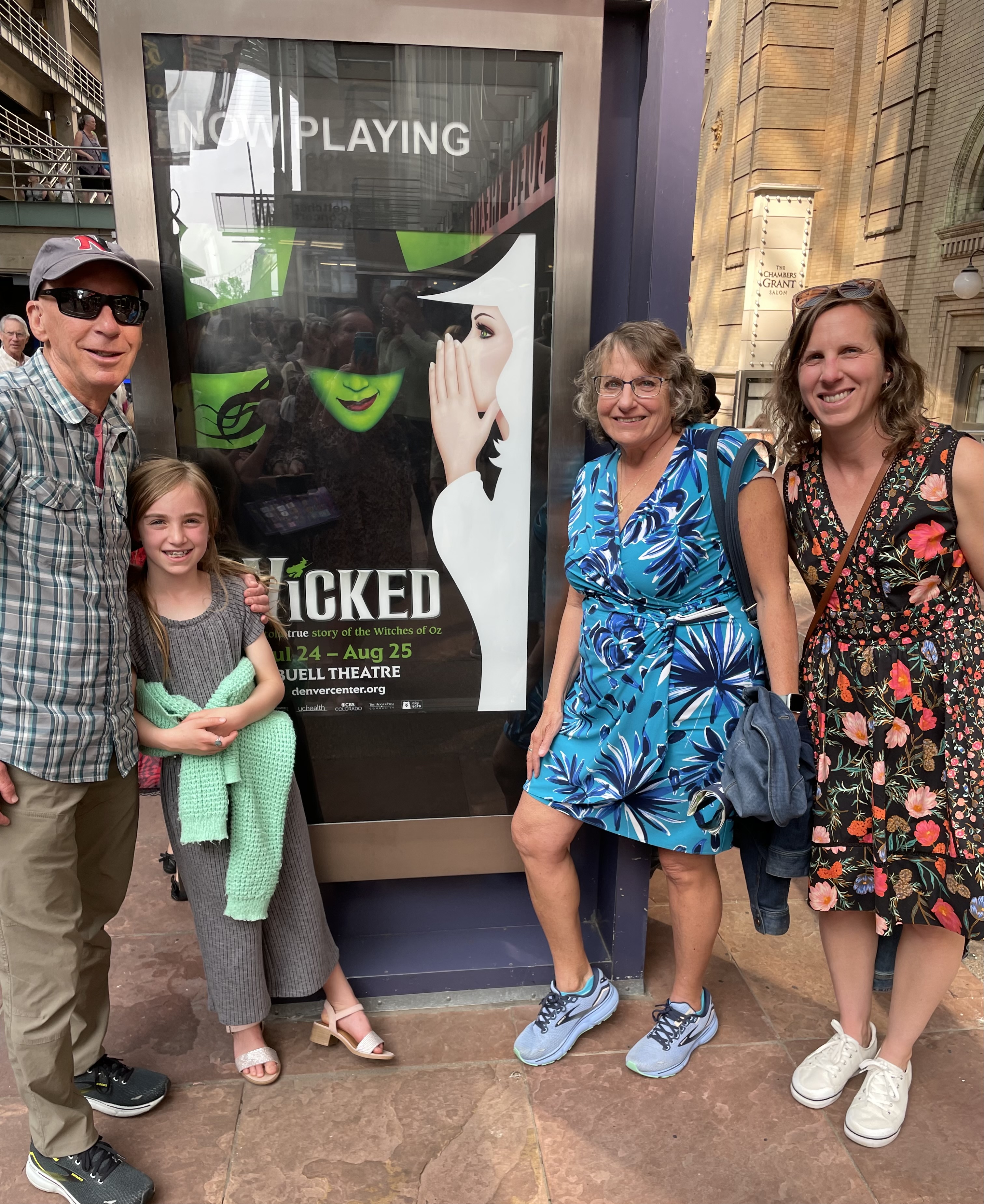
Larry, Sylvie, Marilyn and Julie at Wicked at the Buell Theatre, Denver, Colorado, on July 25, 2024.

Wicked!

From boy to man: Jewish lay leader impresses his congregants…

This article was published in the Capital Region’s Jewish World and Orlando’s Heritage Florida Jewish News in January 2026 but is just making my blog. Enjoy my story!

Services at Congregation Shalom Aleichem in Kissimmee, Florida, were almost done. Marilyn Glaser, the president, had completed the announcements, and our “rabbi” was about to lead us in Adom Olam. I rose to make an announcement. 

“I think we need to do a Shehecheyanu blessing in honor of Asher driving himself to services tonight. He’s finally old enough to make the trip on his own!” 

“Great idea,” said Marilyn. We recited the prayer in honor of living to this moment, and then even sang “Simon Tov, Mazel Tov” for good measure.

Wait! Old enough to drive himself? But Asher Tomberg, who leads our Friday night services, is a 16-year-old junior from Windermere High School. And Congregation Shalom Aleichem loves him!

Asher’s story began in March 2025. Our little shul had lost its rabbi, and the board was scrambling to find someone to lead our twice-a-month Friday night services. Louis Goldman, the Spiritual Leader at Congregation Shir Chadash, was brought in to lead services for a few months. Along with his wife Rebecca, Louis was often accompanied by Asher Tomberg, who had studied with Louis for his bar mitzvah.”

After leading services at Shalom Aleichem for several weeks, Louis decided he wanted to be home with his family for Shabbos dinner. When sharing the news with Marilyn, Louis suggested that Asher take his place. The synagogue board agreed with the understanding that the money he earned would be going into a college fund. His first service was in August of 2024. He was 15 years old.

Before his bar mitzvah, Asher certainly never thought he would be leading a congregation. Although they attended High Holy Day services, the Tomberg family were not regular participants in Friday night services. Indifferent towards his Jewish studies and Judaism as a whole, he saw little meaning in the liturgy and found little relationship between the prayers and his life.

This was confirmed by Goldman. “When I first started working with Asher, the learning was slow-going.”Then, one day, something clicked.  “There was a change, and everything that had seemed difficult was now so natural for him,” said Goldman. “The Hebrew came easy. The chanting was smooth. It was a complete transformation.” 

“I really got into it,” Asher said, adding that Louis’ teaching made the prayers become meaningful. “By the time I stood on the bima for my bar mitzvah [on November 22, 2022], I was not only prepared but also imbued with a greater pride and interest in my religion.” 

In the weeks and months following Asher’s Bar Mitzvah, he continued to regularly attend Shabbat services, leading davening with a growing strength and confidence.

“Many students never come back after their B’nai Mitzvah,” said Goldman. “He is now leading services at Shalom Aleichem. It’s really inspirational.”

In preparation for the Friday night service, Asher practices the Torah portion for an hour each evening from Tuesday through Thursday. He first uses a version that contains the reading in Hebrew with the vowels and the notes (Trope). He then moves on to a version of the text as displayed the way it appears in the Torah with no vowels and no trope.

Over the past year and a half, Asher has gained confidence and skill in both his Torah reading and his leading the service. His strong voice guides the congregation through the prayers and the transitions. During the oneg, he greets those in attendance by name and warmly exchanges pleasantries and life updates. At 16, he is already not only a talented lay leader but also a true “mench.” 

Glaser is very impressed with his maturity and how beautifully he has grown in the role he has been doing. “Asher reads the Torah portion smoothly and effortlessly, more impressive in that today we find very few lay people who have those skills,” said Glaser. “I don’t know where we would be without him.”

Dr Richard Plass, who leads the weekly Torah study, shared Glaser’s enthusiasm. “His Hebrew, which is beautifully fluid, comes from his heart,” he commented.  “It’s wonderful to see a young man come into his own with a congregation that loves him.” A sign of that love: at a recent service, Dr. Plass gifted Asher a tallit clip to tame the young man’s large prayer shawl.

Congregant Jonathan Shopiro, who provides musical accompaniment with his flute, said that working with Asher has been “a delight,” improving with every service. 

Asher said that the experiences he has encountered from his bar mitzvah to lay leader has prepared him for life. “The values I have learned have made me a kinder person, one who believes in Tikkun Olam, making the world a better place.”

Is rabbinical school in his future? Not yet. Asher hopes to become a pilot for JetBlue, a goal that he plans on reaching by attending Embry-Riddle Aeronautical University (ERAU) in Daytona, Florida, after his high school graduation in May 2027. He also plans to continue his Judaic studies and use them to lead congregations. 

Wherever life leads Asher, the members of Congregation Shalom Aleichem, as do his parents, take pride in the man he has become.

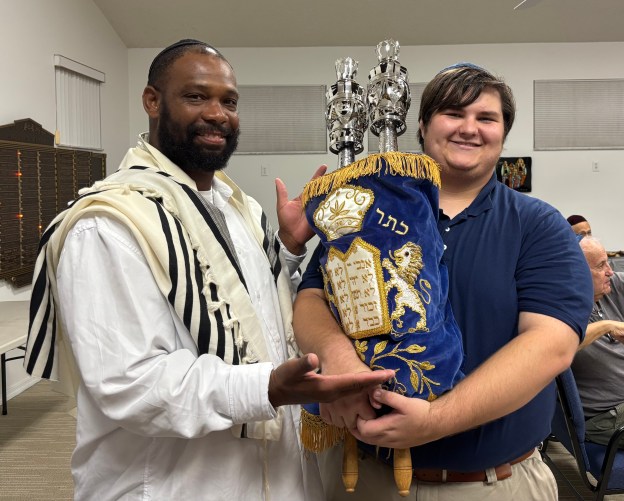
Photo of Curtis Green and Asher Tomberg at Shabbat services at Congregation Shalom Aleichem, October 2026 provided by author.

Despite his talents as a lay rabbi, Asher’s dream is to become a pilot for JetBlue! Here he is practicing for his future (Photo courtesy of Asher Tomberg).

Photo of Curtis Green and Asher Tomberg at Shabbat services at Congregation Shalom Aleichem, October 2026 provided by author.

Special Olympics coach: Finding the best in every athlete and having lots of fun.

In 2014, my husband Larry spent eight days in New Jersey as the New York State triathlon coach at the Special Olympics USA National Games, an experience he stated “incredible” and “life-affirming.” As soon as he arrived home, he tried to catch up on his sleep, as he got less than five hours a night for the entire trip. How he got to this nirvana of sleep deprivation is part of Shapiro family lore.

In 1995, Larry announced at the dinner table that he had signed up our family to volunteer at the New York State Special Olympics Summer Games, which were being held at the University at Albany in early June. Our children had been involved in sports for a long time, and Larry recognized that many volunteers had made their swimming, cross-country, and track and field meets possible. He felt the four of us should pay it forward by contributing our time to the intellectually challenged athletes at the state-wide event in the track and field competition.

We enjoyed our experience enough to sign up to volunteer again the following year. While at the games, Larry was asked to help out with the Saratoga County track and field program that met April to June at the Saratoga Springs High School track. Larry’s co-worker also volunteered, and the two of them drove up every Monday and Thursday from downtown Albany. After a couple of years, the two of them extended their time commitment to include helping at local Special Olympics meets.

As the years progressed, Larry took on more responsibilities. He became head coach and held additional practices for athletes who exhibited high levels of skill in an event. He started a cross-country running program, volunteered to coach for the Clifton Park bowling program, and conducted coaching certification classes. Larry knew that his involvement in Special Olympics would give him focus and purpose after he retired. It was shortly before his last day of work that he found out he had been chosen as one of the track and field coaches for the National Games in Lincoln, Nebraska, in July 2010. One of the athletes he coached came home with silver medals in the 1500 and 3000 meter runs. 

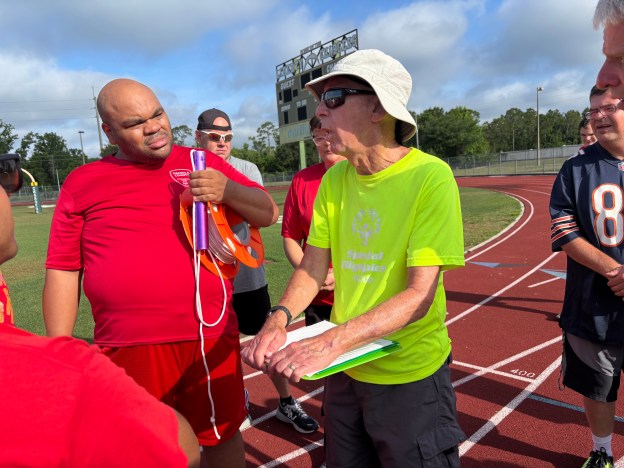
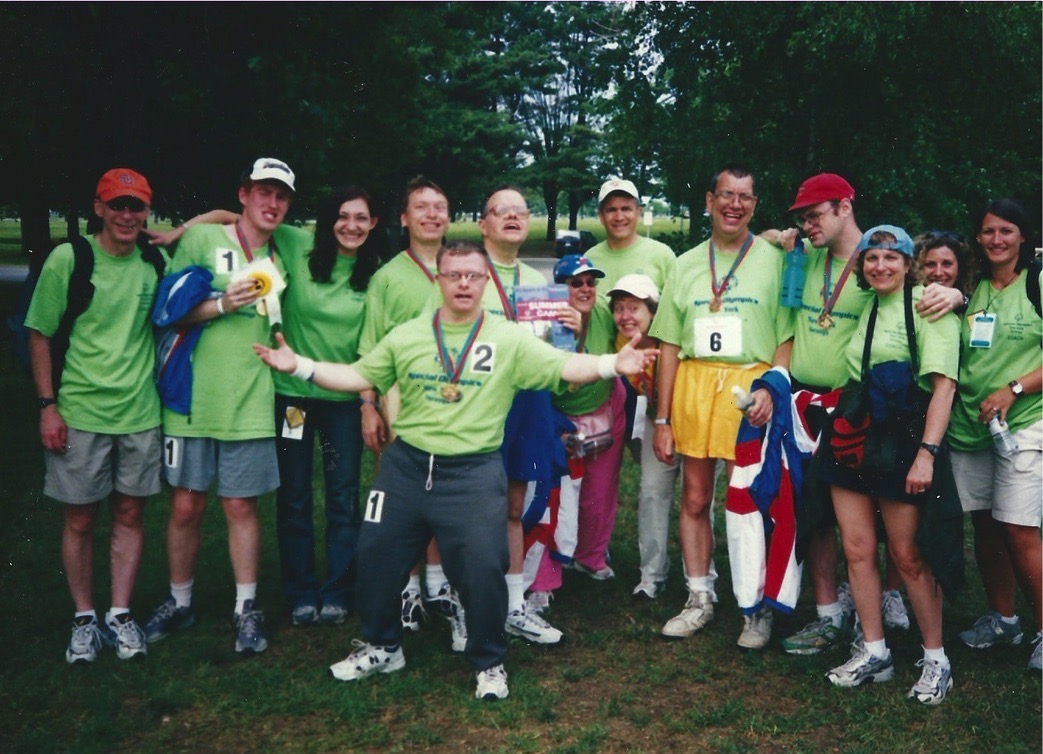
Along the way, Larry had convinced me and several friends to become track and field coaches, and we all gained much from our participation. The best part for all of us was being with the athletes at practice. Twice a week every spring, over forty athletes ranging in age from eightto seventy-five years old, several coaches, and numerous parents and group home staff would gather at six o’clock at the Saratoga High school track.  The athletes intellectual and physical challenges ranged as widely as their ages. Larry started everyone off with a team cheer: P-A-C-E-R-S! Then the activities began. On the field, some athletes threw softballs and had their distances recorded by the coaches. A group of stronger athletes worked with a coach on the turbo-javelin and the shot put. Others were practicing the standing long jump. On the track, athletes, depending on their levels and abilities, were taking part in runs, walks, and wheelchair events. The visually challenged ran twenty-five meters holding a baton strung through a rope that was held in a straight line by cheering teammates. Practice ended with Larry gathering up the athletes for one more cheer before they went home. Two or three times a season, coaches and members of the team took part in local competitions on a Saturday morning. Whether we were at practices or at our meets, our athletes’ times and distances were secondary to just having fun. The cheers were as loud for the athlete who threw the softball two meters as they were for the athlete who came in first in the 1500-meter run.

Larry took pride in the accomplishments of every athlete and was always recruiting new team members. While helping with Special Olympics bowling during fall 2013, Larry watched an athlete decimate the pins with his powerful swing. Larry persuaded Rob to join track and field and use that strength to throw shot-put and the turbo javelin. By the end of his first season, the athlete impressed officials at the state games in Buffalo enough for Rob to be chosen to compete in the Special Olympics national meet in 2014 in New Jersey. While there, Rob not only won a gold medal in his division in the shot put but also came home with gold in the turbo jab with the longest throw of anyone in the country in the turbo javelin finals.

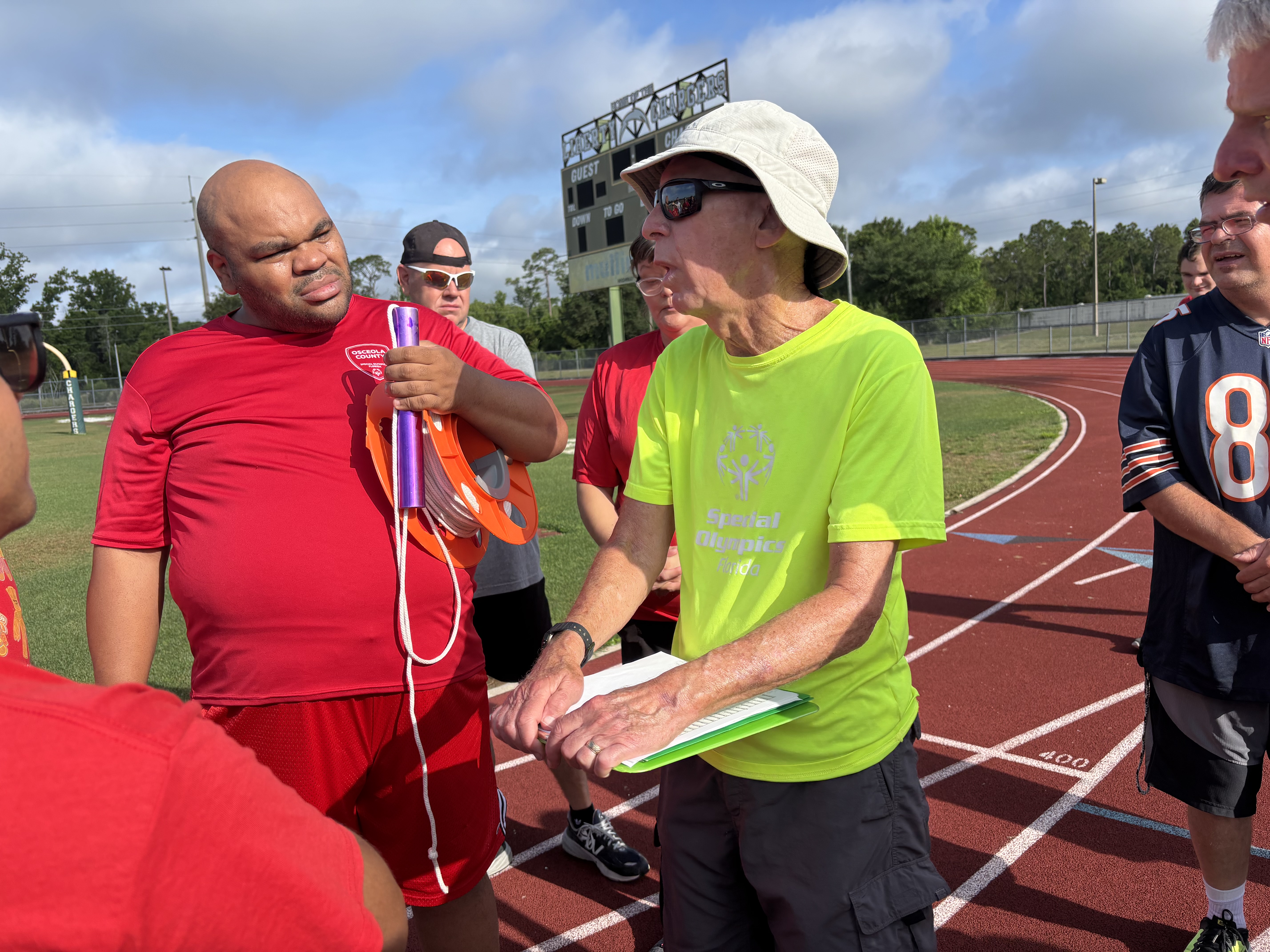
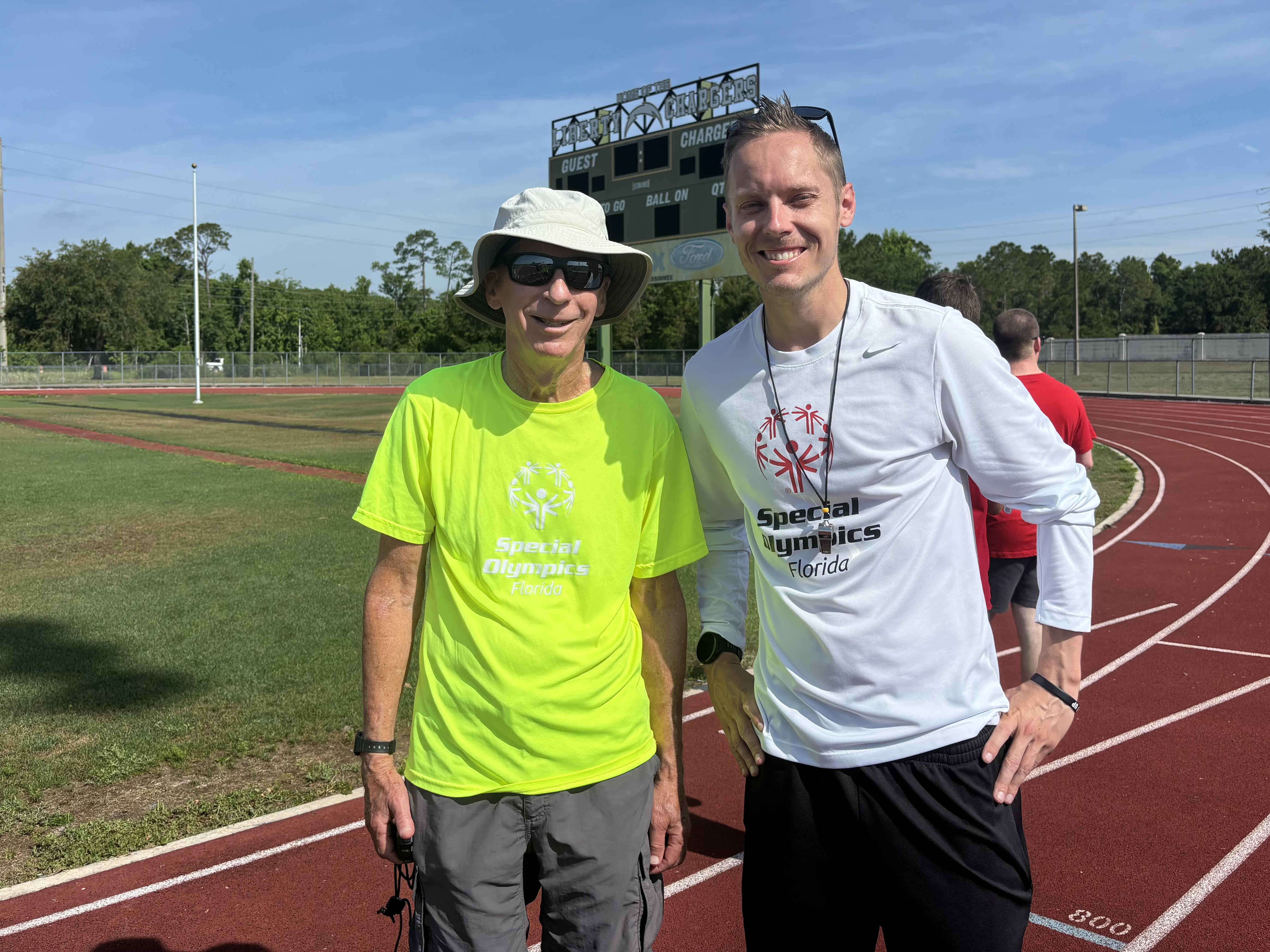
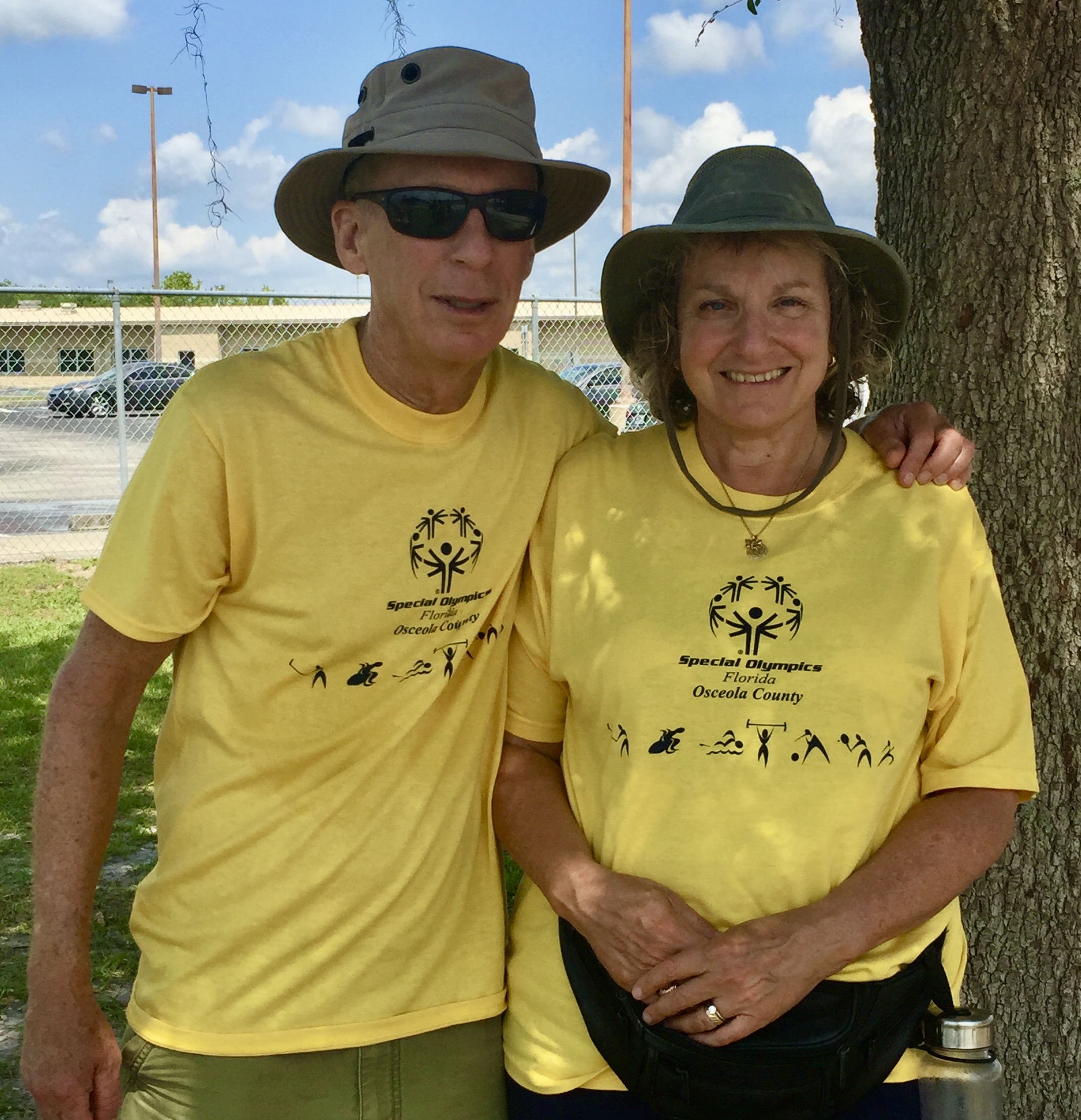
Saying goodbye to the Pacers when we moved to Florida was one of our hardest moments. (In honor of our athletes, we have named the small body of water in our backyard “Pacer Pond.) But Larry didn’t stop there. A few months after our move, Larry signed on to be an assistant coach for the 2016 Osceola County Special Olympics track and field season. By 2017, he had his own team, and Larry and I spent our Saturday mornings from mid-January to mid-May with our athletes.  He applied all he had learned from his first fourteen years of coaching—the cheers, the participation of every athlete, and the fun. With the enthusiastic help of parents and guardians, every practice had plenty of helpers that made each practice productive. 

And just as he had done in Saratoga, Larry found the best in every athlete. Seeing Karissa had done okay in the 400meter run, he stretched her to the 800 and 1500 meter, resulting in her shining at States and securing places on national teams in Seattle (2018) and Orlando (2022). Christian had participated for years in running events, but Larry recognized he was better suited to the 400- and 800-meter walk, a change that resulted in many first-place finishes for this athlete. Jo-Jo, our visually challenged athlete, got to complete when Larry set up the same rope-and-baton trick he had used in Upstate New York. At practice and at States, cheers of “Jo Jo! Jo Jo! Jo Jo!” accompanied his run. 

Ernest  initially participated in the 100-meter run and the running long jump, in which he competed at States. Then he decided he wanted to do the shot put and the 400 meter run When Ernest was not selected for States in 2025, he took it upon himself to sign up as a volunteer at the games, where he was asked to work at the awards for the track events. When track and field started up again in January, Ernest chose to continue with the shot put but asked to be moved to the 800meter walk. Larry coached him in every event, changing his form and working with him to improve. Ernest was chosen for the 2026 States, where he competed in shot put (1st place) in his heat and the 800meter walk, where he placed first with the fastest walk of the day. Both Larry and Ernest received recognition for their efforts, with their being recognized as Osceola County’s Inspirational Coach and Inspirational Athlete, respectively, at this year’s State Games. 

After twenty-five years of coaching, Larry is hanging up his stopwatch at the end of this season. He absolutely loves his athletes, but he turned 78 in May. In addition, the January through May Saturday morning commitment has resulted in our missing too many of his grandchildren’s birthdays and trips to Colorado and California to see them. We both look forward to turning over the team to a younger coach who has assisted Larry this past year.

In April, the team gave Larry a beautiful team picture with the following note: “Thank you for your years of service, support, and friendship. All your athletes are better athletes and people because you didn’t just show up for them; you invested in them! Enjoy your second retirement! Love, Osceola SO Families.” We will treasure the picture and the note forever. 

Tikkun Olam is a Hebrew expression that means “repairing the world,” a moral principle that states every individual should leave this world better than he or she found it. I take pride in knowing that Larry’s involvement in Special Olympics has been his way of making the world better for so many athletes.


Should I stay? Or should I go? A Passover dilemma

As we prepare to celebrate Passover, I contemplate my ancestors’ flight out of Egypt. If the Exodus happened today, I am not sure if I would ever make it out of Egypt. 

According to the midrash, the Pharoh commanded the Israelites to leave immediately following the tenth plague. As we all know, they had so little time that the bread had no time to rise. As a woman who loves to bake challah, I could live with whipping up the dough and foregoing the rising process.  As long as I had butter and raspberry preserves matzoh would work until the manna rained down. (Hopefully, mine would taste like vanilla ice cream.)

My first problem is that there is no way in the world I would have had time to pack. 

Friends I know who pack the night before any trip would have done well that evening. Those carefree individuals would pull out their sachets, throw everything in, and figure they could pick up whatever else they needed at the closest desert oasis.

Unfortunately, I am not one of those people. I start filling my suitcase at least a week before scheduled departure, often packing and repacking several times. Too many shoes. Too few tops. Do I need a dress in the desert? And what about my denim jacket? I love pairing it with almost everything in my closet, but maybe a fleece would be more practical and take up less room. How in the world could I pull this off before we headed out?

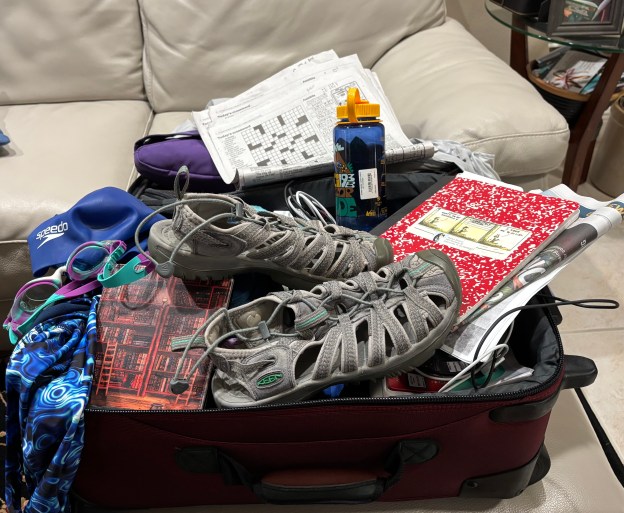
Full disclosure: I don’t even leave my house for a few hours without packing enough for an overnight stay. Along with my essentials—wallet, iPhone, sunglasses, lipstick—I need to cover all my bases. A book. My notebook and a pen in case I get hit with a writing inspiration. A phone charger. A sweater or fleece in case I get cold. Shorts in case I get hot. My water bottle. A Quest bar in case I get hungry. I stuff more into my oversized handbag for a simple errand than the Israelites grabbed in the middle of the night.

Even if I’d managed to pack my bags and prepare the challah that turned into crackers, I would have had to dash back home for the items I’d forgotten. My phone. My keys. My sunglasses. No matter my preparation, I always leave something behind when departing. The Red Sea would already close by the time I made it to the shore. I would wave to everyone while watching all of Pharoh’s soldiers being drowned.

And could I ever have left my home in the first place? 

According to scholars’ interpretation of Rashi’s comment, only one-fifth of the Israelites left Egypt. Eighty percent stayed put, out of fear of the unknown or feeling comfortable despite their inferior status in the kingdom. Eighty percent! But thinking about it, would I have been in the majority? Would I have given up freedom to stay put? Could I have left my familiar life and my stuff behind? 

As Dan Schur writes in an April 22, 2022, article for the Jewish Journal, “the overwhelming majority of the children of Israel chose a compromised but familiar existence over the potential dangers that more dramatic and assertive actions might have brought.”

Could I leave my piano? My lanai that overlooks a pond? A house that brings me so much joy? 

So, maybe I wouldn’t have left in the first place. I would have packed Larry some matzoh and lots of water, given him a kiss, and would have waved goodbye. Who knows? Maybe those 40 years of wandering would have somehow led him back to me.

Sources:

Newhouse, Alana. “The Jews who didn’t leave Egypt: A lesson from the past about choosing freedom over servitude. Tablet Magazine. April 14, 2022. https://www.tabletmag.com/sections/news/articles/the-jews-who-didnt-leave-egypt

Schur, Dan. “The Jews who stayed behind.” Jewish Journal. April 22, 2022. https://jewishjournal.com/commentary/columnist/347149/the-israelites-who-stayed-behind/

Remembrance and Legacy featured in Heritage!

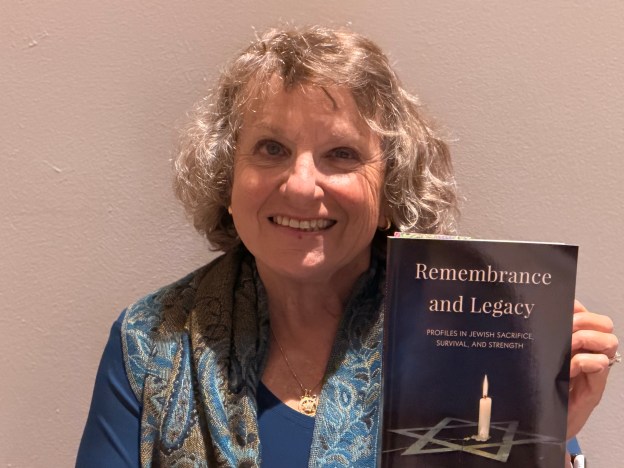
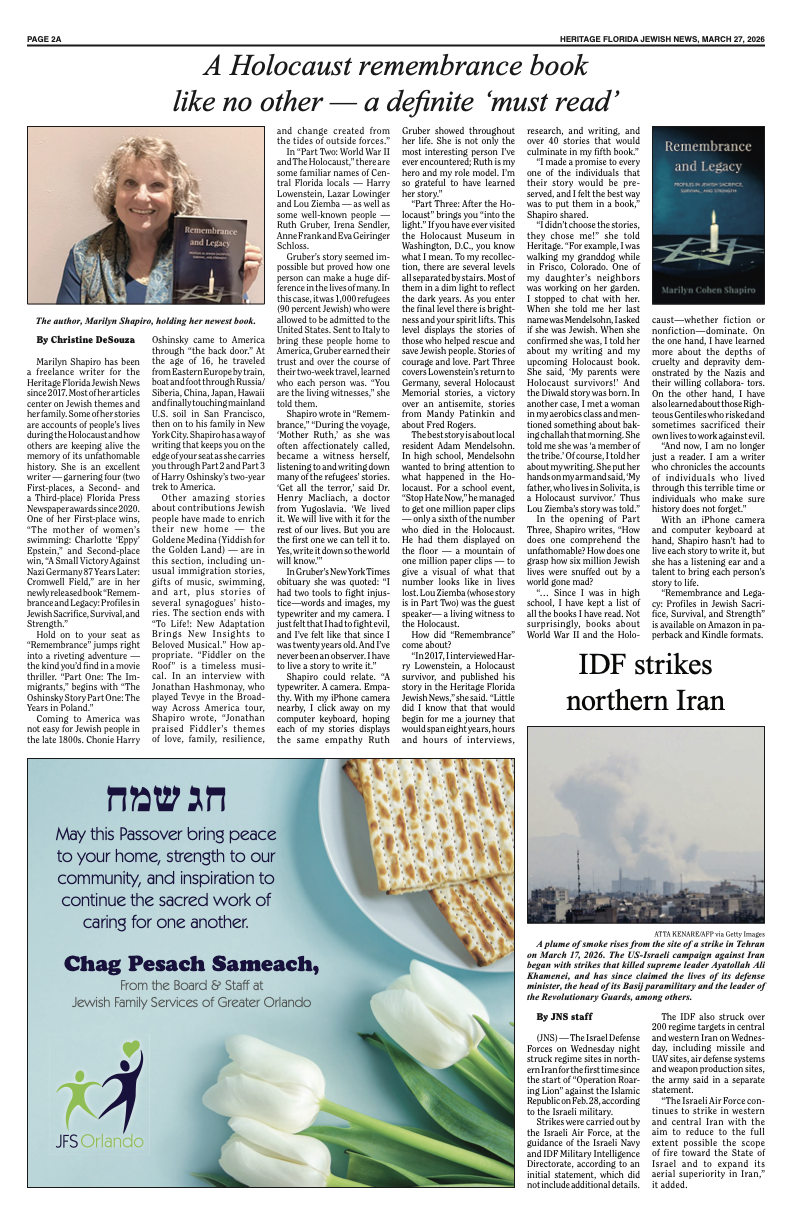
Christine DeSousa, my editor at the Heritage Florida Jewish News, wrote this article for the upcoming issue of the Orlando-based paper. Thanks so much, Christine! My book is available on Amazon in paperback and Kindle format as well as through IngramSpark.

“A place for remembrance and reflection…”

Dr. Michael Lozman’s dream of a permanent Holocaust memorial in the Capital Region of New York became a reality on December 1, 2025, when Governor Kathy Hochul signed legislation establishing a New York State memorial to honor Holocaust victims and survivors. 

“With the first ever state-sponsored Holocaust Memorial, we are honoring the victims and survivors of the Holocaust while ensuring that all visitors have a place to remember and reflect on what the Jewish community has endured,” Governor Hochul stated in a press release. “New York has zero tolerance for hate of any kind, and with this memorial, we reaffirm our commitment to rooting out antisemitism and ensuring a peaceful and thriving future for all.”

Legislation S5784/A7614 directs the state Office of General Services (OGS) to oversee the design, programming, and location on the Empire State Plaza in Albany of the New York Holocaust Memorial. The memorial will join others on the Plaza that are special sites of remembrance and tribute, offering visitors the opportunity to reflect on issues that touch the core of our society.

The late Dr. Michael Lozman was an area orthodontist and a passionate advocate for Holocaust remembrance. Lozman began his quest honoring victims of the Holocaust when he turned his attention to restoring desecrated Jewish cemeteries in Eastern Europe and, in doing so, educating future generations about the atrocities of the Holocaust. Working with several US colleges, Lozman organized and led fifteen trips through 2017 that resulted in the restoration of ten cemeteries in Belarus and five cemeteries in Lithuania.

Around 2017, Lozman began his pursuit of building a Holocaust memorial in the Capital District in New York. He had forged a friendship with Roman Catholic Diocese of Albany’s Bishop Edward B. Scharfenberger, who graciously donated two acres of land for the development of a memorial in Niskayuna. The gift from the diocese for a Holocaust project was the first known collaboration, for this type of memorial, between a Jewish community and the Roman Catholic Church. In 2018, Lozman founded the Capital District Jewish Holocaust Memorial (CDJHM). The board consisted of a group of individuals from the local community, including Scott Lewendon, Jean “Buzz” Rosenthal, Dr. Robin Lozman Anderson, Tobie Lozman Schlosstein, Warren Geisler, Gay Griffith, Howard Ginsburg, Judy Linden, and Linda Rozelle Shannon. “Michael was always grateful for each member’s sacrifice and sense of duty to the project,” recalled his wife Sharon.

Lozman’s initial concept for the physical memorial met resistance as being too literal a representation. Dan Dembling, an Albany architect, and Michael Blau, a theming solutions expert located in the Capital Region, were recruited to be part of the redesign effort that involved both the CDJHM and the Jewish Federation of Northeastern New York. Many iterations later, the Town of Niskayuna approved Dembling’s design in June 2019.

The planned memorial, as envisioned by the board, consists of walls arranged in the shape of the Star of David. Visitors will be guided around the six-sided structure, where they will be connected to significant events that occurred during the Holocaust. The six columns in the center represent the six million Jews murdered in the Holocaust. Initially estimated to cost $4.5 million, the board increased its fundraising efforts, but they were slowed down by the COVID-19 pandemic. In October 2023, Lozman decided to step back and leave the board. He asked Dembling, whom Lozman considered very capable and enthusiastic, to join the board and to become its president. After careful consideration, Dembling agreed. “Michael set the groundwork for me to think big,” said Dembling in an April 2025 Zoom call. “He was excited to transition the mission to me.”

Faced with new estimates due to inflation to $6 million, the board began exploring other locations that could provide already established restrooms and parking. Dembling proposed shifting the location from Niskayuna to the Empire State Plaza. It was felt that it would provide an ideal place for students and tourists who were visiting New York’s capital city an opportunity to learn about the Shoah. To further emphasize its expanded audience, the memorial will be renamed the New York State Holocaust Memorial (NYSHM). As the official state-sponsored Holocaust memorial, it is expected to draw contributions from the estimated 1.6 million Jews and other citizens of New York.

On October 11, 2024, one year to the day when he had called Dembling to take on the presidency, Lozman died. Continuing his work, the board sought letters of support from government, religious, and private entities. Armed with over forty letters, the board approached local legislators to establish the memorial at the Empire State Plaza. Senator Patricia Fahy and Assemblywoman Gabriella Romero drafted companion bills for their respective houses. Lozman’s vision moved closer to reality when both houses passed the bills unanimously. Governor Hochul’s signature moves the project to the NYS OGS, which must work with an “organization that provides Holocaust education services and programs” to deliver the memorial. The next step in creating the New York State Holocaust Memorial is up to the NYS OGS. The new law charges OGS with selecting an organization to work with on the memorial’s final design and location on the Empire State Plaza. The CDJHM hopes that it will be that organization.

Sharon Lozman, Dr. Robin Lozman Anderson, and other members of the CDJHM board were at the signing. Sharon received the newly signed bill from Governor Hochul as a lasting reminder of her husband’s legacy.

Along with the physical memorial, the board also added components that further incorporate Lozman’s vision of education. Under the guidance of Evelyn Loeb, a longtime Holocaust educator, the CDJHM partnered with Echoes & Reflections, an international Holocaust education program, to create an innovative educational program, which will include a historical timeline of Holocaust events and NYS Holocaust survivors’ testimonies. In addition, the CDJHM will sponsor a fleet of traveling memorials that use the same online educational program and will travel the state to schools, churches, synagogues, and other community locations. Both educational programs are scheduled to launch in the first quarter of 2026.

The Jewish Federation has been one of the many organizations that has supported the work of the CDJHM. At its annual meeting on June 17, the Federation honored three of its members. Dr. Michael Lozman was posthumously awarded the President’s Award; Buzz Rosenthal was also honored with a President’s Award; and Dan Dembling was awarded the Sidney Albert Community Service Award.

In a December 1, 2025, press release, Dembling thanked the governor for her signature. “Since our organization’s founding by Dr. Michael Lozman, we have been dedicated to creating a permanent space in the Capital Region to honor the victims of the Holocaust and educate future generations. At this time when antisemitism is so high and rhetoric is reminiscent of the Nazi era, the need to remember the Holocaust is critically important. As envisioned, this memorial will have statewide impact by helping to educate people about the consequences of prejudice left unchecked and hopefully inspire New Yorkers to stand up against hate in all its forms.”

“Michael planted the seed for all of this,” said Dembling. “His unwavering commitment to honoring the past ensures that the memories of those lost will continue to inspire and educate future generations.”

The Capital District Jewish Holocaust Memorial is a 501(c)(3) not-for-profit organization and is raising funds for the permanent memorial,  traveling memorials, and educational programming. Those wishing to donate or find more information can go to their website at https://www.cdjhm.org/ or email at info@cdjhm.org.

December 01, 2025- Albany, NY- Governor Hochul signs Bill to create a New York State Holocaust Memorial during a Hanukkah Reception at the Executive Mansion (Darren McGee/ Office of Governor Kathy Hochul)

Dr. Michael Lozman

Photograph of CDJHC vision of Holocaust Memorial courtesy of Capital District Jewish Holocaust Committee, Inc. Dan Dembling, President.

Photograph of group at bill signing courtesy of the Press Office of New York State Governor Kathy Hochul. Darren McGee, photographer.

Photograph of Dr. Lozman courtesy of USCPAHA. Tina Khron, photographer. https://www.heritageabroad.gov/dvteam/dr-michael-lozman.

“A tiny person with a big heart:” Losing our Bubbe on Thanksgiving

Thanksgiving has always been our favorite holiday. When we lived in Clifton Park, we celebrated for many years by running the Troy Turkey Trot in the morning and then joining the family for dinner at Larry’s cousins’ home in Argyle, New York. Our most memorable Thanksgiving was also our saddest. In 1974, two and a half months after we married, Larry’s beloved grandmother passed away.

Bubbe Rose was the matriarch of Larry’s family. Her tiny stature — she was under five feet and weighed less than one hundred pounds — belied her powerful presence. Everyone loved her.

Bubbe Rose was instrumental in making sure Larry and I got married. We had been seeing each other for a little over two months, but Bubbe was getting impatient and decided to intercede.

“So what is your relationship with this woman?” Bubbe Rose asked her only grandson.

“We’re dating,” Larry responded. 

“You’ve dated long enough!” Bubbe said. “She’s a nice girl. Marry her.”

Fortunately for Bubbe, Larry and I didn’t waste much more time. We got engaged on Rosh Hashanah but waited to announce our plans after the Yom Kippur break-the-fast at the Shapiro’s Saratoga Springs home. As the holiday coincided that year with Larry’s father’s birthday, we held off until Ernie blew out the candles on his cake.

“I have a special present for you this year, Dad,” Larry said.

“Another stupid tie?” Larry’s sister Anita chimed in.

“No, I am giving you a daughter-in-law. Marilyn and I are engaged!” The family was thrilled, but no one was happier than Bubbe Rose. 

Rose [née Slominsky] Hurwitz was born in 1894 in what the family believes was Russia. At a young age, she emigrated to the United States and settled in Syracuse. There she met and married Mose Hurwitz, a coal merchant. Their daughter (and my future mother-in-law) Doris was born in 1920; their son Asher was born eight years later. Rose was a true balabusta, a competent and skilled homemaker, and her home became the gathering place for family and friends for the Jewish holidays. Doris and Ernie were married in the Hurwitz living room on June 20, 1942.

Bubbe’s home in Syracuse remained the heart of the family throughout the next two decades. Immediately following their wedding, Ernie reported for duty at his army assignment in Chapel Hill, North Carolina. Doris joined him but returned to Syracuse to deliver their first child, Anita, a year later. Five years later now living in Schuylerville, New York, Doris returned to Syracuse for the birth of their second child, Larry. Mose died less than a year later, and Asher took over the coal business. In 1950, Ernie’s mother Celia died, making Rose their only surviving grandmother.

When Ernie was called back to service during the Korean War, Doris, along with the two children, waited out his return at Bubbe’s home. Once Ernie was discharged, the family moved to Saratoga Springs, where Ernie resumed his pre-military career running Shapiro’s of Schuylerville. Every Rosh Hashanah and Yom Kippur was spent in Syracuse, along with frequent visits.

By the early sixties, Doris and Ernie had added two more children to their family: Marilyn in 1953 and Carole in 1959. Rather than Doris and Ernie packing up the six Shapiros for the drive to Syracuse, Bubbe Rose and Asher came to Saratoga Springs for most of the holidays and for at least one weekend a month. If the family couldn’t be in Syracuse, Bubbe and Asher brought Syracuse with them: baked goods from Snowflake Pastry Shoppe; white fish and cold cuts from one of the city’s kosher delis; and back issues of the Syracuse Herald-Journal so Doris could catch up with her hometown news.

Larry has two favorite stories about Bubbe’s legendary cooking skills. On March 29, 1959, Larry and Asher watched their beloved Syracuse Nationals defeat the Boston Celtics in the sixth game of the playoffs in the city’s War Memorial auditorium. (Unfortunately the Nats lost the critical seventh game, a loss Larry still remembers with regret.) The next day, Larry came down with the flu, necessitating his staying in Syracuse for the following week. Bubbe Rose believed that the only way to cure him was to feed him endlessly. 

In 1971, Larry was accepted to graduate school at Syracuse University, and he moved in with Bubbe Rose and Asher. He probably did not weigh more than 126 pounds when he arrived. Along with breakfast and dinner, Bubbe insisted on packing him elaborate lunches, which Larry shared with his envious fellow students. In less than two months, he had gained sixteen pounds, some of the weight taken off before he graduated. By the time we met at a Purim party in March 1973, he had settled into his adult weight..

We were married on September 8, 1974. Bubbe Rose attended the wedding, looking beautiful in a long pink gown. On November 23, she suffered a stroke. Doris immediately went to Syracuse to be with her. As the week progressed, her condition worsened; by Wednesday, she was unconscious and unresponsive. On Thanksgiving Day, November 28, Larry and I drove to Syracuse to see her for what we knew was the last time. We walked into the hospital room, quietly shared with her that we were there, and told her how much we loved her. To our surprise, she reached out and gently touched our hands. Moments later, she passed away. In a strange way, we got to spend one last holiday with her—a holiday we will always remember.

Was Rose Hurwitz a remarkable woman? She did not write any books. She did not make any scientific discoveries. She was not a movie star. To her children and their siblings, however, she was as remarkable as anyone who had ever lived.

How do you honor a person who meant so much to you? You pass her story onto your children and grandchildren. You have a daughter, a granddaughter, and niece who all have the middle name of Rose. And you always remember that Thanksgiving Day when she touched your hand for the last time.

Bubbe Rose front and center at our wedding

Everywhere a sign….

I am not a fan of the supernatural. Except for Ghost (I love the chemistry between Demi Moore and Patrick Swayze!) and Sixth Sense (What a great ending!), I shy away from any movie that smacks of the occult. And while I respect Stephen King as a writer, I rarely read his best-selling horror novels.But there is one area in which I AM a believer: signs from the other side. 

Several times in my life, I have felt that I have had “visits” from those I had loved and lost. Six weeks after my mother-in-law passed away in 1994, I strongly felt her presence at my daughter’s bat mitzvah six weeks later, literally seeing her sitting on the bima and smiling as Julie ran the service. Thirty-six years later, soon after my mother had passed away, I woke up in the middle of the night feeling someone stroke my shoulder and smelling the powerful scent of Bengay. No, Larry had not touched me, and we didn’t even have the topical analgesic heat rub that my father used in our house. I was convinced it was a sign from my parents that they were together and that they were okay.

So, it was not a surprise that I believe my beloved sister Laura, who passed away on August 29,2025, has sent messages to me in the past two months. Yes, many would write them off as coincidences. I know better. 

On September 6, 2025, I sponsored the oneg, refreshments served after the Friday night service, at Congregation Shalom Aleichem in my sister’s memory. I had spent the week baking cookies, brownies, and challah but waited until Friday morning to order the cake. When I called Publix, the bakery told me it was too late for a special order; I would have to use what they had in the store. The two choices were one with colorful balloons and one unadorned white sheet cake. White? How boring! I texted my niece/Laura’s daughter to ask what lettering I should use for the cake. “What’s her favorite color?” I asked.

“White,” Jen wrote back. 

“OMG!” I wrote back. “That’s the only cake they had left!”. Coincidence? Maybe? Or a sign??

The next “sign” occurred when Larry and I traveled Lake Champlain to spend time with my two surviving siblings and their spouses at my brother Jay and his wife Leslie’s home. Fortuitously, Laura had sold her fully furnished cottage, only a mile down the road, a month before her death, and my sister Bobbie was getting it ready for the October closing. I took one last walk-through and took a few items to bring home. A “Wine Down” towel (Laura LOVED her white Zinfandel). An apron our mother had sewn for Laura decades before. Her favorite flannel shirt. And a green floral tote bag. After throwing out some tissues and a plastic bag filled with Tylenol, I switched the essentials from my regular pocketbook to Laura’s tote.

The next day, I was rummaging through the tote to find my comb. Deep in a side pocket were two pictures: one of six-month-old Laura smiling from her baby carriage; the second, a formal shot of Laura and Will, her significant other, who had passed away 18 months earlier. “Look what I just found!” I said with tears in my eyes. “Laura is telling us that she is happily reunited with Will, the love of her life!”

One last sign: Soon after trip to New York, I called Dan Dembling, the architect and president of Capital District Jewish Holocaust Memorial, Inc, to ask if the governor had signed the bill to establish and create the New York State Holocaust Memorial. When he said it was still being reviewed and considered by the executive chamber team, I told him that I would knead prayers into my weekly challahs that the bill would be passed quickly, in part selfishly so that I could complete the story I wrote about the project this past spring. Dan then asked me a favor: Please knead in prayers for his mother, who had passed away Friday, August 18, at the age 87 years old.

“I’m sorry to hear this, Dan,” I said. “Was she sick?” 

“No,” Dan said. “She was doing great, but she came down with what appeared to be pneumonia and was gone ten days later.”

“Oh my God,” I said. “My sister passed away on Friday, August 29, with the same scenario! I promise I will knead prayers for her when I bake my challah! What was your mother’s name?”

“Frances,” Dan said.

I gasped. “That was my mother’s name! My three-year-old granddaughter was named after her…Frances June. We call her Frannie.”

“What a coincidence!” Dan said. “I have an interesting story as to how I got my name. When my grandmother was single, she was the secretary for her synagogue. During her time working there she also typed manuscripts for the rabbi’s wife, Sadie Rose Weilerstein, a prolific author who wrote several Jewish children’s books. One book was What Danny Did, a collection of short stories about how the protagonist celebrated each of the Jewish holidays. Growing up, that was my mother’s favorite book. When I was born, my mother named me Daniel after Weilerstein’s character. I have an original first edition of the book on my shelf, and I will text you a picture of the book and Sadie’s inscription to my grandmother that is on the first inside page.”

We said our goodbyes, and minutes later, Dan, as promised, sent me a picture of the old book and the inside leaf. It read:

To Miss Spieler

In sincere appreciation

from

Sadie Rose Weilerstein

March 25, 1928

 MARCH 25, 1928, exactly fourteen years to the day before Laura was born. Another message from heaven that Laura is okay? I don’t doubt it.

“While we may lose a person we love, their love is not lost to us,” Mary Louis Kelly writes in It. Goes. So. Fast. “It just simply finds its way in different channels.” Whether it be coincidences or “signs” or b’shert, the love we share has found a life of its own, its own channels. May Laura’s memory be a blessing. 

The oneg in Laura’s memory

Climb every mountain as long as you can…Reflections on Rosh Hashanah

Are the trails getting steeper? Or am I getting older?

These were my thoughts as Larry and I climbed Shrine Ridge Trail in Summit County in early July. We had been in Colorado for ten days before we attempted the hike, so I believed I had acclimated my body to the altitude. But we started at 11,000 feet and would peak closer to 12,000. As I huffed and puffed up the trail, I never doubted I would finish. The bulldog in me would never give up. But could I do this next year? In five years? Who knows?

Larry and I DID finish our climb on that beautiful summer day. We got up to the top and took in the colorful wildflowers and the amazing vistas, grateful we could still climb mountains at our age. 

In the weeks that followed, we often chose an easier three-mile hike that we accessed with a short walk from our rental. In early August, however, Larry and I met our friends Sandie and Howie for a more challenging hike up the Herman Gulch Trail in the Ranger District of the Arapaho National Forest. During our four-mile hike, we encountered a couple of around our age descending. I posed my “Steeper or older” question aloud. 

“Neither,” the man told me. “We are experiencing geographical uplift, a phenomenon in which the earth shifts to steeper inclines as we age.” 

Okay, maybe Earth is NOT in fact shifting. But our lives have. Before we left for our summer in cooler temperatures, a close friend, a non-smoker, had just been diagnosed with lung cancer. Another friend’s cancer had returned. And a third friend, who had biked 86 miles for his eighty-sixth birthday, died a week later of a heart attack while on a shorter ride. “He was doing what he loved,” people said. But I doubt that it was sufficient comfort to the family he left behind.

Our time in the mountains changed as well. Friends we looked forward to seeing every summer developed health issues and/or “aged out” as they could no longer handle the high altitude. One of Larry’s pickleball buddies had told us last summer that he and his wife were opting out of summers in Summit County and renting a place in a mountainous region of Arizona, reducing their elevation by 4000 feet. Dear friends who had been part of our summer plans for over ten years, whether eating out, hiking, or playing cutthroat games of Mexican Train, also had to give up their beautiful home in Dillion, Colorado, and remain in Charlotte, North Carolina, at a more comfortable 671 feet above sea level. 

And then the “life can change on a dime” phenomenon hit our own family very hard soon after Larry and I returned to Florida. Two days after coming home from an incredible cruise through the British Isles with my brother, sister-in-law, and a friend, my sister Laura was hospitalized in Upstate New York with breathing problems. Doctors were trying to determine the exact cause of her symptoms when she took a turn for the worse. Diagnosis: a rare form of pneumonia. Grim news followed: Laura was on a ventilator in the intensive care unit. We had two days of optimism when she was taken off the ventilator. She was looking forward to her life after hospitalization and rehab: a highly anticipated move to San Diego, California, to be closer to her children and grandchildren. But her 83-year-old body failed. She passed away on Friday, August 29. 

The four Cohen children had been fortunate indeed. Whereas some of our friends have strained or non-existent relationships with their siblings and/or their spouses, we all had remained close—maybe even closer as we had all realized how life can change on a dime. And now one of us is gone, leaving the three of us to grieve with other family members and friends who will miss her so much.

“On Rosh Hashanah, all who enter the world pass before Him,” reads a passage in the Mishnah. One Jewish interpretation is that we march single file like sheep before God to determine whether we will be written in the Book of Life. Another interpretation is that we march like soldiers. But my favorite interpretation, reflecting on my summer in the mountains, comes from Resh Lakish, a third century BCE scholar. The rabbi envisioned this march taking place before God on a mountain, each person walking cautiously, single file, along a narrow, treacherous path. 

As I observe the High Holy Days this year, warm memories of my beloved “big sister” will be forefront in my thoughts. Prayers for those we lost and those who are ill will take on even greater significance. Will I be climbing mountains in 5786? Hopefully, I will tackle Shrine Ridge and Herman Gulch with the same vigor and determination I did this past summer. But thanks to Resh Lakish, when I am in one of those narrow and knowing me, not-TOO treacherous paths, I will hope that God is looking down and giving me the strength to move forward in my life, no matter where the path takes me. 

Sources:

Liben, Rabbi Daniel. “Sheep, Mountain Hikers, and Soldiers.” Temple Israel of Natick, Massachusetts. Rosh Hashannah 5756. https://www.tiofnatick.org/wp-content/uploads/2019/12/rh_sermon_2015.pdf

McCullough Gulch. Not sure if we will hike this one again!

Shapiro Publishes There Goes My Heart

On September 3, 2016, , I launched my first book, There Goes My Heart. This article was published in the Jewish World News. Ten years later, I am about to publish Book Five: Never Forget: Stories of Jewish Sacrifice, Survival, and Strength. Who ever thought this girl from Keeseville, who wrote her first short story when she was 16, would ever be published??

Marilyn Cohen Shapiro of Poinciana has announced the publication of “There Goes My Heart,” a collection of personal memoirs. The collection of over 40 personal essays captures special moments in a lifetime spent in Upstate New York, Florida, Colorado, and beyond. Her Amazon author page states, “Readers will empathize with these true stories of dating, marriage, raising children, and caring for elderly parents through the author’s wit edged with appreciation and love of family and friends.” The book is available on Amazon in both paperback and Kindle e-reader format. A graduate of University of Albany, Shapiro was employed for over 25 years at the Capital District Educational Opportunity Center, a division of Hudson Valley Community College, Troy, New York, first as an adult educator and later as Coordinator of Program Development and Research. Since 2013, Shapiro has been a regular contributor to The Jewish World, a Schenectady, New York,-based bi-weekly newspaper. Shapiro and her husband Larry moved to Poinciana in 2015. They are members of Congregation Shalom Aleichem in Kissimmee. Shapiro is a lifetime member of Hadassah and a recipient of a Hadassah leadership award. She is a 2008 recipient of the State University of New York Chancellor’s Award for Public Service. This is Shapiro’s first book.

Cover created by Mia Crews