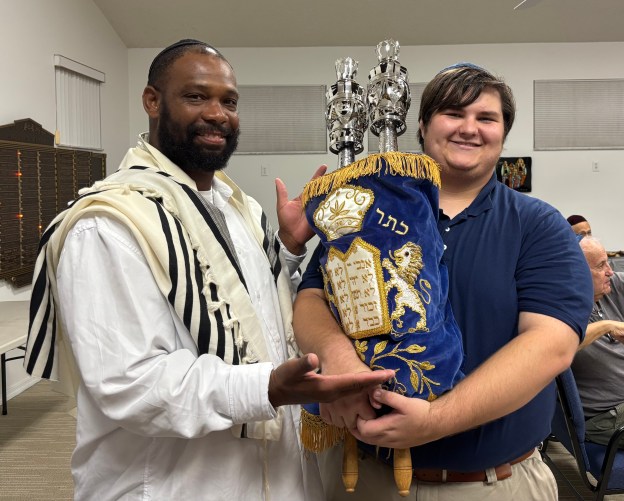
This article was published in the Capital Region’s Jewish World and Orlando’s Heritage Florida Jewish News in January 2026 but is just making my blog. Enjoy my story!
Services at Congregation Shalom Aleichem in Kissimmee, Florida, were almost done. Marilyn Glaser, the president, had completed the announcements, and our “rabbi” was about to lead us in Adom Olam. I rose to make an announcement.
“I think we need to do a Shehecheyanu blessing in honor of Asher driving himself to services tonight. He’s finally old enough to make the trip on his own!”
“Great idea,” said Marilyn. We recited the prayer in honor of living to this moment, and then even sang “Simon Tov, Mazel Tov” for good measure.
Wait! Old enough to drive himself? But Asher Tomberg, who leads our Friday night services, is a 16-year-old junior from Windermere High School. And Congregation Shalom Aleichem loves him!
Asher’s story began in March 2025. Our little shul had lost its rabbi, and the board was scrambling to find someone to lead our twice-a-month Friday night services. Louis Goldman, the Spiritual Leader at Congregation Shir Chadash, was brought in to lead services for a few months. Along with his wife Rebecca, Louis was often accompanied by Asher Tomberg, who had studied with Louis for his bar mitzvah.”
After leading services at Shalom Aleichem for several weeks, Louis decided he wanted to be home with his family for Shabbos dinner. When sharing the news with Marilyn, Louis suggested that Asher take his place. The synagogue board agreed with the understanding that the money he earned would be going into a college fund. His first service was in August of 2024. He was 15 years old.
Before his bar mitzvah, Asher certainly never thought he would be leading a congregation. Although they attended High Holy Day services, the Tomberg family were not regular participants in Friday night services. Indifferent towards his Jewish studies and Judaism as a whole, he saw little meaning in the liturgy and found little relationship between the prayers and his life.
This was confirmed by Goldman. “When I first started working with Asher, the learning was slow-going.”Then, one day, something clicked. “There was a change, and everything that had seemed difficult was now so natural for him,” said Goldman. “The Hebrew came easy. The chanting was smooth. It was a complete transformation.”
“I really got into it,” Asher said, adding that Louis’ teaching made the prayers become meaningful. “By the time I stood on the bima for my bar mitzvah [on November 22, 2022], I was not only prepared but also imbued with a greater pride and interest in my religion.”
In the weeks and months following Asher’s Bar Mitzvah, he continued to regularly attend Shabbat services, leading davening with a growing strength and confidence.
“Many students never come back after their B’nai Mitzvah,” said Goldman. “He is now leading services at Shalom Aleichem. It’s really inspirational.”
In preparation for the Friday night service, Asher practices the Torah portion for an hour each evening from Tuesday through Thursday. He first uses a version that contains the reading in Hebrew with the vowels and the notes (Trope). He then moves on to a version of the text as displayed the way it appears in the Torah with no vowels and no trope.
Over the past year and a half, Asher has gained confidence and skill in both his Torah reading and his leading the service. His strong voice guides the congregation through the prayers and the transitions. During the oneg, he greets those in attendance by name and warmly exchanges pleasantries and life updates. At 16, he is already not only a talented lay leader but also a true “mench.”
Glaser is very impressed with his maturity and how beautifully he has grown in the role he has been doing. “Asher reads the Torah portion smoothly and effortlessly, more impressive in that today we find very few lay people who have those skills,” said Glaser. “I don’t know where we would be without him.”
Dr Richard Plass, who leads the weekly Torah study, shared Glaser’s enthusiasm. “His Hebrew, which is beautifully fluid, comes from his heart,” he commented. “It’s wonderful to see a young man come into his own with a congregation that loves him.” A sign of that love: at a recent service, Dr. Plass gifted Asher a tallit clip to tame the young man’s large prayer shawl.
Congregant Jonathan Shopiro, who provides musical accompaniment with his flute, said that working with Asher has been “a delight,” improving with every service.
Asher said that the experiences he has encountered from his bar mitzvah to lay leader has prepared him for life. “The values I have learned have made me a kinder person, one who believes in Tikkun Olam, making the world a better place.”
Is rabbinical school in his future? Not yet. Asher hopes to become a pilot for JetBlue, a goal that he plans on reaching by attending Embry-Riddle Aeronautical University (ERAU) in Daytona, Florida, after his high school graduation in May 2027. He also plans to continue his Judaic studies and use them to lead congregations.
Wherever life leads Asher, the members of Congregation Shalom Aleichem, as do his parents, take pride in the man he has become.
Photo of Curtis Green and Asher Tomberg at Shabbat services at Congregation Shalom Aleichem, October 2026 provided by author.
Despite his talents as a lay rabbi, Asher’s dream is to become a pilot for JetBlue! Here he is practicing for his future (Photo courtesy of Asher Tomberg).
Photo of Curtis Green and Asher Tomberg at Shabbat services at Congregation Shalom Aleichem, October 2026 provided by author.
My sister Laura Appel passed away after a short illness on Friday, August 29, 2025. I had written an earlier version of this story but am sharing a revised post in light of our family’s recent loss.
It is a hot day in late June. I wait impatiently on the front porch of our old Victorian house in our small upstate New York town. The blue sedan finally pulls into the driveway. My father climbs out from behind the wheel. As I skip down the steps and run across the yard, Dad opens the door on the passenger side. My mother holds a bundle wrapped in pink. I gaze in wonder upon a full head of black hair and an infant’s face crunched up and bright red from crying. “Meet your little sister, Roberta Jessica,” Mom said quietly.
That was my first memory. I was four years old, turning five and starting kindergarten three months later. I was thrilled to be a big sister.
I was probably the happiest member of the Cohen family that day. My sister Laura, upon hearing before her thirteenth birthday that another child was on the way, immediately weighed in. “Why didn’t you consult me first?” she demanded. When told she was not part of the decision-making process, she stated, “Well, if you think you have a built-in babysitter, you have it all wrong!”
Jay, who was nine, only wanted a brother. When Dad woke him on the morning of June 25 to tell him he had another sister, he groaned, pulled the covers over his head, and went back to sleep. I am not sure he gave the newest addition another thought.
And I am not sure how happy my parents were when they realized that they were to be a family of six. Dad barely made enough money managing a small store to support a family of five, much less another child. Mom was thirty-six, looking forward to putting her youngest in full-day kindergarten and having a life without diapers and bottles.
But from the moment Bobbie came home (“Roberta Jessica” would forevermore be saved for formal documents), I was fascinated. When my mother filled up the old bassinet with water to bathe her, I was right there beside her to help. When she needed to be pushed in the carriage, I wanted to be the one holding the handles. And when Bobbie needed casts on her legs to correct weak, turned-in muscles, it was I who watched over her in her crib, which was set up next to the twin beds in my room.
I have heard stories about older children being jealous of their siblings when they came home from the hospital. Children who resorted to tantrums. Children who wanted to know when the baby was going back to the hospital. A five-year-old who rode her bike up and down her street crying, “Does anyone want a little girl? My parents don’t love me anymore!” But I never remember being jealous. She was my little sister, my live baby doll.
If there were any difficulties between us, it was probably because everyone who met Bobbie immediately fell in love with her. She was always smiling, always happy, always easygoing. This was in stark contrast to me — moody, anxious, and often fearful. Little Miss Sunshine could charm her way into everyone’s heart, a direct contrast to my Little Miss Worrywart personality.
And Bobbie was beautiful. I was chubby, with thick glasses that covered my only good feature, my blue eyes. On the other hand, Bobbie had black hair, high coloring, freckles sprinkled across her nose, and eyes that rivaled Elizabeth Taylor.
As we grew up, Bobbie and I continued to be inseparable. She was always part of my parties, my sleepovers, my bike rides. In every one of the few pictures we have of our childhood, Bobbie is always front and center, her smile lighting up the world. Years later, when I asked my mother what it was like to have a baby at thirty-six years old, she said, “I didn’t raise her. You did!”
The four Cohen children were fortunate indeed. Whereas some of our friends had strained or non-existent relationships with their siblings and/or their spouses, we all remained close—maybe even closer when we realized that life could change on a dime. When Bobbie called to share the news that she had breast cancer, our first thoughts were, “This can’t be happening to our little sister.” But it was her “Little Miss Sunshine” attitude that got her through surgery, radiation, chemo, and her recovery. When Laura had a stroke a few years later, she often referred to Bobbie’s spirit during her cancer ordeal and was determined to be as strong. She was.
And now one of us is gone. Laura, 83, had just completed a fabulous cruise to the British Isles with my brother Jay, his wife, Leslie, and a friend. Unfortunately, two days after she returned, she was hospitalized in Upstate New York with breathing problems. Doctors were trying to determine the exact cause of her symptoms when she took a turn for the worse. Diagnosis: a rare form of pneumonia. Grim news followed: Laura was on a ventilator in the intensive care unit. We had two days of optimism when she was taken off the ventilator. She was looking forward to her life after hospitalization and rehab: a highly anticipated move to San Diego, California, to be closer to her children and grandchildren. But her 83-year-old body failed. She passed away on Friday, August 29.
We three surviving siblings and our spouses, her children and grandchildren, and her many other relatives, and her friends will miss her terribly. As I told my 10-year-old granddaughter, who hated to see me so sad, we mourn because we experienced the privilege of loving our sister and being loved by her.
One of my parents’ favorite pictures of the four Cohen kids was taken just before Laura graduated high school. We are sitting on a couch in our house in Keeseville—Jay on the arm, followed by Laura, Marilyn, and Bobbie. In a home with few family pictures, that particular one graced my parents’ living room for the rest of their lives. We siblings all kidded my parents and each other, wondering, “Is this the best we ever looked?”
The evening after my mother’s funeral, we pulled out that picture. Bobbie’s husband Emil posed us all on my family room couch with the four of us trying hard to duplicate our fifty-plus-years-ago expressions. Then we took a more serious one, without the silly grins.
After that day, we continued the tradition. Each time we were together, whether it is at a bat mitzvah or a weekend reunion, we would line up—Jay, Laura, Marilyn, and Bobbie—snap a picture, and were grateful that the “Four Cohen Kids” were happy, healthy, and together again.
Sadly, the tradition will no longer continue. Rather than four siblings, there will be three shown and one residing in our hearts. So, I will share one word of advice: please give extra hugs to those you cherish and tell them you love them every time you speak to them. EVERY TIME. Life can turn on a dime. It did for us.
Under a hot tropical sun, Larry and I wound our way first along the Caribbean Sea and then, in a couple of zigzags to the left, up a steep hill. We stood in front of a large stone edifice with its white plaster column and point-arch windows. Robert Kunkel, the docent/educator, opened up the black iron gate and led us up a set of stairs to the large point-arch entrance doors. After several trips to the Caribbean, Larry and I finally could visit the Hebrew Congregation of St. Thomas, the second oldest synagogue building in the western hemisphere and the oldest in continuous use under an American flag.
Stepping past the threshold, we immediately noticed a carpet of sand that covered the center of the room. We then took in the beautiful architecture. A domed ceiling holding the Eternal Light soared above us. The mahogany pews, finished by nineteenth century shipbuilders, were set up in on three sides to face the ark. A striking marble slab supported its base. Above the curtained doors, artisans had engraved two tablets representing the Ten Commandments into the native stone. More pointed-arch windows let in the bright light, while thick white plaster walls helped keep the interior cool.
As we settled into the pews, Robert shared his vast knowledge of the synagogue and its important role in the history of St. Thomas, the largest of the three main islands that comprise the US Virgin Islands. But first he addresses our most pressing question: Why sand? He explained that the first Jews in the Caribbean were of Sephardic, or Spanish-Portuguese, descent. The unique floor, one of only five in the world, shows how the Spanish Inquisition (most active between 1480 and 1530) forced their Jewish ancestors in those two countries to practice their religion secretly in basements, covering the floors to muffle their footsteps and voices.
So how did these Iberian Jews land up in St. Thomas? Facing a choice of forced conversion or expulsion, victims of the Spanish Inquisition fled to European cities. Over the next four centuries, partially because of discrimination in other professions, Jews developed a mercantile trade which lead them to countries in both South America and the Caribbean, including St. Thomas. The number of Jews on this island remained small until the years after the American Revolution, when an influx of Sephardic Jews set up businesses in a climate of great tolerance and discrimination. In 1796, the Jews of St. Thomas founded B’racha V’shalom (Blessing and Peace). A fire destroyed the first structure along with several hundreds of building on the island. In 1812, the Jewish community purchased land and built a new synagogue. A growing population resulted in erecting a new expanded wooden structure with an expanded name: Congregation Beracha Veshalom Vegmiluth Hasadim, “Blessing and Peace and Loving Deeds.”
On December 31, 1831, another fire destroyed one quarter of the buildings on St. Thomas, including the shul. Not to be deterred, the Jewish community began an international fundraising effort to raise the $5000 needed to rebuild a house of worship made of stone, brick, and mortar.
The congregation and surrounding non-Jewish community had donated money, materials, and labor towards the project. In September 1833, the entire community celebrated the reconsecration of the building, which held the two Torahs and the Eternal Light that had been rescued from the fire. This was the building we were standing in almost 190 years later.
As the synagogue grew, the congregation purchased a burial ground, established a Hebrew School, and began using the services of actual clergy. Like all synagogues, the following years brought the synagogue schisms over liturgy and rabbis, and fluctuating membership. Through it all, it remained a living, vibrant synagogue connected closely to its community. Most notably, two members of the congregation served as governors the Virgin Islands: Morris Fidanque De Castro (1950-1954) and Raphael Moses (Ralph) Paiewonsky (1961-1969).
As written in the museum’s online narrative, the St. Thomas Synagogue continues to follow in the footsteps of its ancestors, preserving their heritage and honoring their traditions. Part of this renewal was the congregation’s current search for a rabbi, as its most recent spiritual leader had moved to New Jersey to be closer to his family.
After the narrative, the tour guide opened up the ark, which housed seven Torahs. The one Sephardic Torah was housed vertically in a beautiful wooden cylindrical case which followed the customs of the Spanish-Portuguese Jewry to both store and read the scrolls while standing in their cases. The six other Ashkenazi Torahs were dressed in the traditional Ashkenazi accessories each with a mantel (velvet covering); Atzei Chayim (wooden shafts) topped with keters (crowns); and a yad (pointer). They rested at an angle on the back of the ark. Because of my interest in the Shoah, my favorite was a Memorial Scrolls Trust Torah (MST #533) which was rescued from Budyně nad Ohří, a small town in Bohemia, Czech Republic. Jews had lived there from the 13th century. In 1942, the Nazis liquidated the town of its 50 Jews who still remained.
With the guide’s approval, Larry and I took turns holding the Holocaust Torah before saying our goodbyes and thanks. We spent time in the museum gift shop, where we purchased a mezuzah, Through the Sands of Time: A History of the Jewish Community of St. Thomas, US Virgin Islands by Judah M. Cohen, and a T-shirt for Larry proclaiming “I Climbed Synagogue Hill.” We headed back to our cruise ship, thankfully a downhill journey, happy to know we finally got to see this living museum of Jewish sacrifice, survival, and strength. “The sands of time may pass over our shores again and again, changing our landscape, but the soul of our synagogue and its people remains eternal,” reads the synagogue’s website. “Our history does not end. Rather, with each generation, it begins anew.”
On February 22, 2023, less than a week after our visit, the Hebrew Congregation of St. Thomas started a new chapter and welcomed Julia Margolis as its first female rabbi. Rabbi Margolis took a long, circuitous route to the shul. Born in Moscow, USSR, her family moved to Israel when she was 12. After graduating from high school and serving in the Israel Defense Forces, she completed undergraduate degrees in Jewish history, Islam, and art and a master’s degree in Jewish studies. Following in the footsteps of her mother, who was the first Russian-speaking female rabbi in Israel, Rabbi Margolis was ordained by the Abraham Geiger College in Germany. Closely connected to the Reform Movement, Rabbi Margolis was heading a synagogue in Johannesburg, South Africa, when she saw the synagogue was looking for a new leader. She submitted her application, but she was still surprised when the search committee contacted her. In the middle of their negotiations, her husband Greg tragically passed away. Following her heart, she made the move with her two children to St. Thomas, where she soon was “soaking in the beauty and the spirituality of this place.”
“God always has a plan,” Margolis shared in a March 21, 2023, article in the Virgin Islands Daily News. “It takes a lot of time sometimes to see that, but there is always a plan.”
Originally published May 25, 2023.Updated May 25, 2025.
Fun Trivia:
The Mikvé Israel-Emanuel Synagogue in Curaçao is the oldest synagogue building in the Western Hemisphere. (1730)
The Touro Synagogue in Newport, Rhode Island, is the oldest synagogue building in North America that is still standing. (1763)
The Old New Synagogue of Prague in the Czech Republic is the oldest active synagogue in the world. (1270s)
The Ben Ezra Synagogue in Cairo, Egypt is the oldest synagogue in the world and also the longest serving. The original synagogue dates back to the ninth century. When Jews fled Egypt in the 1950s, it was turned into a museum.
Temple Israel in Leadville, Colorado, holds the record for the highest synagogue in the world. Founded in 1884, the synagogue sits at an elevation of 10,152 above sea level. It is now a museum.
A version of this article originally appeared in the May 25, 2023, issue of the Jewish World News, a bi-weekly subscription-based newspaper in upstate New York.
A version of this article originally appeared in the June 2, 2023 issue of the Heritage Florida Jewish News, a weekly subscription-based newspaper in Central Florida.
“Each Memorial Scroll is a memory of the past and a messenger for the future.” Memorial Scrolls Trust
They escaped destruction by the Nazis. They survived Communism, They found their ways to new homes around the world. This is a story of three Torahs that had their roots in vanished Czechoslovakian Jewish communities.
Up until World War II, Czechoslovakia had a thriving Jewish population that first reached the area over 1000 years ago. With the rise of Hitler came increased antisemitism and eventually The Final Solution. Throughout Europe, synagogues were burned and the vast majority of Jews were murdered. Almost all Jewish artifacts—Torahs, candlesticks, prayerbooks—were destroyed.
The one exception was Bohemia and Moravia with its population of 115,000 Jews. This area in Czechoslovakia was declared a “German protectorate.” Miraculously, except for the items in Sudetenland, most of the artifacts remained unscathed during the early years of the war.
In 1942, the Nazis ordered all Jewish synagogue possessions in the region to be sent to Prague. The Jewish communities of Prague, believing the Judaica would be safer if stored in one place, worked closely with the Nazis to collect and catalogue over 210,000 items. In the end, it took 40 warehouses to store the treasure. Unfortunately, nearly every Jew who worked on the project was sent to their deaths in the concentration camps.
The Czech Torahs survived the war but almost did not survive Communism. The Torah and other scrolls lay in a musty, damp warehouse until 1963. At that point, Czech government, in need of foreign currency, sold the scrolls to Ralph Yablon, a philanthropist and founder member of Westminster Synagogue in London. On February 5, 1964, 1564 Torahs and other scrolls arrived at the synagogue. They were divided into three categories: those in usable condition, those in need of some repair; and those deemed too far damaged to be restored.
The Memorial Scrolls Trust was then set up to preserve and restore the Czech scrolls. Each one had an identity plaque fixed to one of the etz chaim, the wooden shafts onto which the Torah is rolled. They were loaned out to Jewish communities and organizations around the world in need of a Torah, with the understanding that the congregation was responsible for the scroll’s upkeep. The Torahs, as per stipulations by the MST, were never sold or donated but allocated on loan on the understanding that they would only need to be returned if the synagogue no longer operated. According to Jeffrey Ohrenstein, Chair, MST, 1400 scrolls have been allocated on loan around the world. Approximately 150 scrolls remain in the Memorial Scrolls Trust museum, which also has some 500 binders and wimples.
At least six Czech scrolls are on loan in the Capital District of New York and surrounding areas: Beth Emeth, Congregation Ohav Shalom, Gates of Heaven, Temple Sinai, Congregation Beth Shalom, and Congregation Beth El.
I first had the honor of holding a Holocaust Torah as a member of Congregation Beth Shalom in Clifton Park, New York. In1981, the synagogue requested from MST a replacement for three that had been stolen. Abbey and Richard Green, CBS congregants, helped fund the costs of shipping the Czech Torah MST#293 (circa1870) from London. A tag, dating back to the dark days of the Shoah, read “The Elders of the Jewish Community in Prague.”
At the time, Beth Shalom was less than ten years old, an irony that was not lost on one of its congregant. Yetta Fox, herself the child of Holocaust survivors, stated that having the Torah at a new congregation was “almost like a second life.”“Having lost one community,” said Yetta, “there is now a new community that can nurture this Torah.”
Early in 2007, the congregation arranged to have needed repairs done on the parchment of the 137-year-old Torah. That June, the congregation held a rededication ceremony, which included a procession from the Clifton Park town hall to the synagogue five minutes up the road. During the march, the scrolls were passed from hand to hand under a chuppah that the children of the Hebrew school had decorated with Stars of David. Upon its arrival, the Torah was wrapped in a wimple, the cloth traditionally used to wrap a boy at his circumcision. “This is our baby,” said Fred Pineau, a former president, “so we’re wrapping it on our Torah.”
David Clayman, the president at the time of the story. , reported that the Torah is still in good condition. To preserve it, however, it is left rolled to Parasah Beshalach, which contains “The Song of the Sea,” gently unrolling it only once a year as prescribed by the MST. Every year, in the month of Shevat, the Torah is brought out and Beshalach is chanted. “The scroll is so fragile, we are afraid to roll it to other parashot [Torah portions].”said David. The congregation brings out the Holocaust scroll twice more each year to be ceremonially held: On Kol Nidre, the solemn service commemorated during the opening hours of Yom Kippur; and on Simchas Torah, a holiday that celebrates the completion of the reading of Deuteronomy, and the beginning of Genesis.
In 1982, Sharon and Barry Kaufman, now residents of Florida, obtained a Czech Torah in honor of their daughter Robin’s bat mitzvah for their Spring, Texas synagogue. While awaiting completion of their new building, Jewish Community North congregation was holding services at Christ the Good Shepherd Catholic Church. Their only torah was on temporary loan from another Houston-area synagogue. The Kaufmans worked with Rabbi Lawrence Jacofsky, the regional director of the United Association of Hebrew Congregations, to obtain Torah Scroll MST#20, written circa 1850.
When their precious cargo arrived at the Houston airport in February 1982, Barry and Sharon immediately brought the Torah to the church to show Father Ed Abell, Good Shepherd’s priest and their good friend. The three of them carefully unrolled the scroll where it had last been read: Yom Kippur. 1938. The tenth of Tishri 5699 or October 4 and 5, 1938. Shortly after that service, the Jews that had worshipped in the Kostelec/Orlici synagogue were rounded up and sent to concentration camps, most—maybe all— never to return.
To commemorate the moment, Father Abell, using the yad (pointer) from the loaner Torah, read from the scroll in flawless Hebrew. That evening, Sharon and Barry brought the Torah home to show Robin. As they slowly unrolled the entire scroll on their pool table to make sure is was undamaged, they found a cardboard tag that had been attached when the scroll was catalogued by Jewish librarians and curators when the scroll arrived at the Central Jewish Museum Prague during the Shoah. Aeltesternrat der Juden Prague, it read in German Elders of the Jews of Prague.
At Robin’s bat mitzvah in May 1982, the Torah was dressed in a cover sewn and embroidered by Barry’s mother. In a moving speech to the congregation held at Good Shepherd, Barry spoke eloquently about the Torah’s history.
“If this Torah could talk—might it share with us the heart-wrenching knowledge of a prosperous people whose world had suddenly been taken from them, whose home and synagogues were gutted and destroyed for the value of their belongings? Would it tell us of the helpless terror in the fragile hearts of old men and women forced to watch their children brutally slaughtered before their own end was to come?”
After Barry spoke, the Ark was opened, and the Czech Torah was passed from the rabbi to Barry to Sharon to Robin. Clutching it tightly, Robin walked through the congregation. For the first time in two generations, a B’nai Mitzvot carried it with joy and reverence throughout a tearful congregation.
When Larry and I moved to Florida, we joined Congregation Shalom Aleichem, which was founded in 1981, ironically the same year Congregation Beth Shalom had received its Czech Torah. Initially, congregants met at the Kissimmee Women’s Club. When Harry Lowenstein, a Holocaust survivor whose parents and sister numbered among the six million Jews killed during World War II, joined with his wife Carol, he began to press for a building of their own. “I saw a synagogue burn,” said Harry, “and I was determined to build another one.” Starting with a $120,000 contributions from Sandor Salmagne, another Holocaust survivor, the Lowensteins raised another $60,000 for building expenses, including donations from Harry and Carol.
As the synagogue on Pleasant Hill Road neared completion, the Lowensteins worked to obtain the prayer books for both every day and holy days, the Torah finials, and the Yartzheit (memorial) board. Most important to the congregation, however, was to obtain a Torah.
Harry and other members reached out to the Memorial Scrolls Trust, noting in the correspondence that four of its members were Holocaust survivors. “Our Temple will be dedicated to the memory of the victims of the Holocaust,” wrote then president Henry Langer. “We would therefore deem it an honor to have you lend us a Scroll for our Temple.” With the Lowensteins’ financial support, they were able to obtain Scroll MST#408. The Torah was from Pisek-Strakonice in what was then Czechoslovakia, about 60 miles south of Prague and dated back to circa 1775.
Once they received word that they would indeed be loaned a Czech Torah, the Lowensteins asked British friends who had a vacation home near the synagogue to be responsible for getting it from Heathrow to Orlando International airport. “[Our friend] sat on the plane with the Torah on his lap for 12 hours,” recalled Carol. “He would not let it out of his sight until he could hand the Torah to Harry.”
For those who had miraculously escaped hell, welcoming the Torah was like welcoming another Holocaust survivor. “It’s like holding a piece of history” said Phil Fuerst in a 1993 Orlando Sentinel article. “You feel like you own a piece of a world that survived.”
According to Marilyn Glaser, the congregation president, the atzei chayim, which were broken, were replaced in September 2022 in accordance of the terms of the loan agreement with MST.
In November 2024, the Jewish Federation of Sarasota-Manatee commemorated Kristallnacht by celebrating the Torah scrolls that survived the Holocaust with a gathering of 24 Florida-based scrolls from the MST. Jeffrey Ohrenstein, who travelled fromLondon for the event, said “These Torahs are messengers from destroyed communities that depend on their newer congregations to assure they are remembered and the Jewish heritage is cherished.” The program ended with a parade of the Torahs. Frank Gutworth, Congregation Shalom Aleichem’s treasurer, proudly carried Scroll #408.
Three Czech Torahs. Three congregations. Thankfully, in the end, the Nazi’s plan to eradicate the Jewish people failed. As Gloria Kupferman stated in her speech at the rededication of the Congregation Beth Shalom Torah in 2007, “We are by no means extinct. We are alive. We are thriving.”
Special thanks to Jeffrey Ohrenstein, Chair, Memorial Scrolls Trust, London, U.K. Thanks to David Clayman, Yetta Fox, Marilyn Glaser, Frank Gutworth, Harry Lowenstein, Flo Miller, and Sharon and Barry Kaufman for their inputfor the article.
Originally published June 10, 2022.Updated on blog November 2024.
Published in Jewish World (Capital Region NY), June 9, 2022 and Heritage Jewish News (Orlando, Fl) June 10, 2022