Tag Archives: #Kissimmee

From boy to man: Jewish lay leader impresses his congregants…

This article was published in the Capital Region’s Jewish World and Orlando’s Heritage Florida Jewish News in January 2026 but is just making my blog. Enjoy my story!

Services at Congregation Shalom Aleichem in Kissimmee, Florida, were almost done. Marilyn Glaser, the president, had completed the announcements, and our “rabbi” was about to lead us in Adom Olam. I rose to make an announcement. 

“I think we need to do a Shehecheyanu blessing in honor of Asher driving himself to services tonight. He’s finally old enough to make the trip on his own!” 

“Great idea,” said Marilyn. We recited the prayer in honor of living to this moment, and then even sang “Simon Tov, Mazel Tov” for good measure.

Wait! Old enough to drive himself? But Asher Tomberg, who leads our Friday night services, is a 16-year-old junior from Windermere High School. And Congregation Shalom Aleichem loves him!

Asher’s story began in March 2025. Our little shul had lost its rabbi, and the board was scrambling to find someone to lead our twice-a-month Friday night services. Louis Goldman, the Spiritual Leader at Congregation Shir Chadash, was brought in to lead services for a few months. Along with his wife Rebecca, Louis was often accompanied by Asher Tomberg, who had studied with Louis for his bar mitzvah.”

After leading services at Shalom Aleichem for several weeks, Louis decided he wanted to be home with his family for Shabbos dinner. When sharing the news with Marilyn, Louis suggested that Asher take his place. The synagogue board agreed with the understanding that the money he earned would be going into a college fund. His first service was in August of 2024. He was 15 years old.

Before his bar mitzvah, Asher certainly never thought he would be leading a congregation. Although they attended High Holy Day services, the Tomberg family were not regular participants in Friday night services. Indifferent towards his Jewish studies and Judaism as a whole, he saw little meaning in the liturgy and found little relationship between the prayers and his life.

This was confirmed by Goldman. “When I first started working with Asher, the learning was slow-going.”Then, one day, something clicked.  “There was a change, and everything that had seemed difficult was now so natural for him,” said Goldman. “The Hebrew came easy. The chanting was smooth. It was a complete transformation.” 

“I really got into it,” Asher said, adding that Louis’ teaching made the prayers become meaningful. “By the time I stood on the bima for my bar mitzvah [on November 22, 2022], I was not only prepared but also imbued with a greater pride and interest in my religion.” 

In the weeks and months following Asher’s Bar Mitzvah, he continued to regularly attend Shabbat services, leading davening with a growing strength and confidence.

“Many students never come back after their B’nai Mitzvah,” said Goldman. “He is now leading services at Shalom Aleichem. It’s really inspirational.”

In preparation for the Friday night service, Asher practices the Torah portion for an hour each evening from Tuesday through Thursday. He first uses a version that contains the reading in Hebrew with the vowels and the notes (Trope). He then moves on to a version of the text as displayed the way it appears in the Torah with no vowels and no trope.

Over the past year and a half, Asher has gained confidence and skill in both his Torah reading and his leading the service. His strong voice guides the congregation through the prayers and the transitions. During the oneg, he greets those in attendance by name and warmly exchanges pleasantries and life updates. At 16, he is already not only a talented lay leader but also a true “mench.” 

Glaser is very impressed with his maturity and how beautifully he has grown in the role he has been doing. “Asher reads the Torah portion smoothly and effortlessly, more impressive in that today we find very few lay people who have those skills,” said Glaser. “I don’t know where we would be without him.”

Dr Richard Plass, who leads the weekly Torah study, shared Glaser’s enthusiasm. “His Hebrew, which is beautifully fluid, comes from his heart,” he commented.  “It’s wonderful to see a young man come into his own with a congregation that loves him.” A sign of that love: at a recent service, Dr. Plass gifted Asher a tallit clip to tame the young man’s large prayer shawl.

Congregant Jonathan Shopiro, who provides musical accompaniment with his flute, said that working with Asher has been “a delight,” improving with every service. 

Asher said that the experiences he has encountered from his bar mitzvah to lay leader has prepared him for life. “The values I have learned have made me a kinder person, one who believes in Tikkun Olam, making the world a better place.”

Is rabbinical school in his future? Not yet. Asher hopes to become a pilot for JetBlue, a goal that he plans on reaching by attending Embry-Riddle Aeronautical University (ERAU) in Daytona, Florida, after his high school graduation in May 2027. He also plans to continue his Judaic studies and use them to lead congregations. 

Wherever life leads Asher, the members of Congregation Shalom Aleichem, as do his parents, take pride in the man he has become.

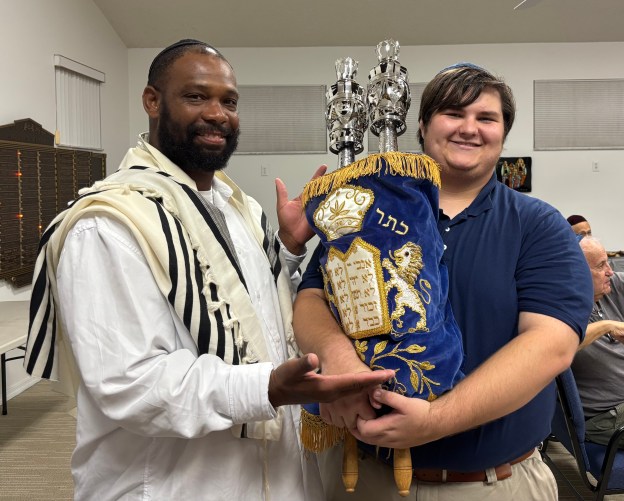
Photo of Curtis Green and Asher Tomberg at Shabbat services at Congregation Shalom Aleichem, October 2026 provided by author.

Despite his talents as a lay rabbi, Asher’s dream is to become a pilot for JetBlue! Here he is practicing for his future (Photo courtesy of Asher Tomberg).

Photo of Curtis Green and Asher Tomberg at Shabbat services at Congregation Shalom Aleichem, October 2026 provided by author.

Bud Black, Interlocutor Extraordinaire

For the past five years,  people who came to services at Congregation Shalom Aleichem in Kissimmee, Florida, were met with an unusual but wonderful treat. They were greeted by a pair of musicians—Bud Black on the guitar (and occasionally the banjo) and Bill Willner on the snare drums. They played mostly songs from the 20s, 30s, and 40’s. Bud and Bill usually packed up their instruments about fifteen minutes before services began, but on occasion they would accompany Rabbi Karen Allen on songs from the Friday night service. 

John “Bud” Black career as a musician began in the 1930s as an 8 year old in bars near Pittsburgh, Pennsylvania. Bud’s grandfather Bert loved to drink even more than he loved the Pittsburgh Pirates. So he would tell his wife he was taking his daughter’s “little buddy”  to a game. Instead he took him to local taverns. Bud would play the ukulele that his grandfather had purchased for him.

While still in high school, Bud began playing the guitar professionally and performing on WKPA, Pittsburg’s hillbilly radio station. (Was this the station? It is now listed as a ministry station out of Lynchburg, VA) After graduating, Bud went into the US Air Force, where he worked on computers. After he completed his service, he took a job at RCA working on technology. Bud realized quickly that his first love was music and began working the nightclub circuit around Philadelphia and Atlantic City. 

By the age of ten, with a minimal training from one of his grandfather’s fellow barflies, Bud not only had added the guitar to his repertoire but also helped Bert make some money. Bud had an incredible ability to remember the name, lyrics, and artist of every song he played. As William Miller wrote in a 1997 article, Bert  took him from bar to bar, challenging anyone to name a tune his grandson couldn’t play. When they couldn’t “Stump the Musician”— which was often— Bert passed the hat.

Along the way, Bud married and had two sons, Scott and John. After his divorce, he had a relationship that resulted in the birth of  third son, Wes. .In 1986, the Delta Queen steamship company hired him as the ship’s “interlocutor,” where he would be able combine his talents as a musician, a comedian, and an entertainer. 

His fellow musicians regarded Bud as a walking music encyclopedia. His favorites were songs from the 1920s and 1930s,  but he also knew songs from “as far back as songs were recorded.”   And when he got bored singing the lyrics the “right way,” he would sing them backwards.  “Chattanooga Choo Choo” became “Agoonattahc, Oohc-Oohc;” “My Wild Irish Rose,” “Ym dliw hsiri esor.”

One of his friends remembered, “Bud was full of bull**, an entertainer and wonderful story teller. He took a 15 second story and turned it into an hour. But it was a stroll down memory lane.” 

“Bud had the largest record collection I’ve ever seen,” Howard Paul, a fellow musician on the Delta Queen, posted on Bud’s Facebook page. “He told an endless stream of jokes (clean and blue). For me, Bud was the missing link between vaudeville and nightclub lounge acts.”

Tim Aucoin, a fellow musician, stated on Facebook that he remembers afternoons playing together in the Texas Lounge on the Delta Queen. “Bud would say ‘Who wants to hear some country music? Great, how about a Lithuanian love ballad?’”

In 1989, Bud was performing on the second night of a three day cruise when Wendy Demby, a young woman on vacation from her job in New York City, approached him and expressed her admiration for his show. When she disembarked in New Orleans for the remainder of her week-long trip, Bud sought her out to share a few hours during a break in his job. Those few hours developed into a long distance relationship that resulted in Wendy moving down to The Big Easy. They were married in May 1990.

For the next ten years, Wendy maintained their home in New Orleans while Bud strummed his guitar and banjo up and down the Mississippi. Once a year, Wendy went along for the ride. In 1999, Bud retired from the riverboat but not from music. They moved to St. Cloud, Florida, when Bud took a job at Disney World, playing a various parks including in a roaming band in the Magic Kingdom.

Bud also entertained nursing home residents throughout the Orlando area. His music transported many to healthier, happier days. One time, after singing a song, a woman came up to him in tears. “My husband has dementia,” she said. “ But when you started singing that song, he started singing along. It is the first time he has spoken in years.” 

Wendy was Jewish and Bud was Christian, but they shared a mutual respect and appreciation for each other’s religion. They attended Sunday services at the Church of St. Luke and St. Peter in St. Cloud and Friday night services at Congregation Shalom Aleichem.  Initially, Bud played and sang with Norm Salinsky a former president, About five years ago, Bill Willner joined them. When Norm became ill, Bud and Bill began their routine before services. Bud had a collection of yarmulkes displaying  musical notes or Jewish holiday motifs—but his favorite was one embossed with his beloved Pittsburg Pirates’ logo. 

This past December,  Bud and Bill were planning to do some Irish songs for the March 15 service, which fell two days before St. Patrick’s Day. Unfortunately, Bud became ill in January and passed away on March 9, 2019, at the age of 88. 

At the memorial service at the Church of St. Luke and St. Peter, Reverend Longbottom played and sang some of Bud’s favorite songs, including many Irish tunes. The clergyman was joined by David Royer, who played Bud’s guitar. David was one of Bud’s first friends in the Orlando area, a friendship sealed by b’shert—David’s parents had sailed the Delta Queen and had spoken highly of a banjo player named Bud Black. In honor of Bud’s close connections to Judaism  and Congregation Shalom Aleichem, Wendy’s brother,Craig Demby said the Kaddish, the Jewish mourner’s prayer.

Bud’s son John passed away in 2011 from complications of diabetes.  His oldest son Scott, a talented musician in his own right, lives in China and was unable to attend the memorial service. His youngest son Wes, sharing news that his girlfriend Daniela was pregnant with what will be Bud’s first grandchild, were there to say goodbye, along with many other friends and family members.

One of Bud’s favorite songs, “Dusty Old Dust, written by Woody Guthrie in 1940, is a fitting epithet for this talented musician. “So long, it’s been good to know ya/What a long time since I’ve been home/And I’ve gotta be driftin’ along.” Drift gently, Bud!

A version of this article originally appeared in the Jewish World News, a bi-weekly subscription-based newspaper in upstate New York.

Sources:

Miller, William. “Buddy Black, The Delta Queen’s Colorful Interlocutor.” Vantage. March/April 1997. Pages 10-11.

Lind, Angus, “Life’s a song from way back for Bud Black.” (New Orleans)  Times Picayune. September 4, 1991. Pages E1,E5.