Thanks to a wonderful tour director, a great itinerary, and perfect weather, our recent trip to Italy was all that we had hoped for and more. My husband Larry and I stayed in medieval buildings that had been converted to hotels, drove the stunning Amalfi coast, made our way through the Coliseum, tread over the ancient streets in Pompeii, enjoyed wine tasting in Umbria and Tuscany, climbed numerous stairs to churches and bell towers, and rode on a gondola in Venice. We enjoyed fabulous pasta dishes and ate gelato every day.
In each city we visited, we tried to connect with the Jewish elements of Italy, a history that dates back over two thousand years to the Roman Empire. We viewed one of the most famous reminders of the Judea-Roman connection at the Roman Forum, where we saw the Arch of Titus. I immediately recognized the seven branched menorah in the relief that depicted the Romans celebrating their 70 CE victory over the Jews as they carried their spoils of war from the gutted Second Temple.
We arrived in Rome on Simchas Torah, preventing access to its synagogue We did, however dine at Nonna Betta’s, a kosher Italian restaurant in the Jewish Quarter. We feasted on carciofo alla Giudia, the fried artichokes (Their menu read “Life is too short to have the wrong Jewish-style artichoke!”) along with delicious pasta dishes.
After lunch, I headed to the small Judaica shop adjoining the restaurant. As I paid for my purchases, I did my typical “Marilyn the Writer thing” and began asking questions. I learned that Francesca, the “cashier,” and her husband Umberto were owners of the shop and the restaurant. When I told her about my interest in Holocaust stories, Francesca told me that Nonno Betta, Umberto’s 93-year-old mother who lived above the shop and founded the restaurant, was herself a survivor. Although I was able to speak briefly to Umberto and share emails, further attempts to learn more of Nonna Betta’s individual story failed. Through the United States Holocaust Memorial Museum’s Holocaust Encyclopedia, I learned that when the Nazis occupied Rome in September 1943, they sought to include the city’s Jews in the Final Solution. As Italian police did not participate in these roundups and most Italians objected to the deportations, one out of ten Roman Jews were able to find refuge in the Vatican, which retained neutrality, or hide in Catholic homes, churches, and schools. Sadly, 1800 Roman Jews, with a total of 7600 Jews in Italy, were murdered in Auschwitz.
With only one jam-packed day in Florence, we did not time to visit The Great Synagogue. But I fulfilled a dream I had since reading Irving Stone’s The Agony and the Ecstasy in 1966: I saw Michelangelo’s David in the Accademia in all his 17 feet, six ton plus glory. Along with some discussion among our tour group his anatomy (Was he circumcised or not?*), we took twenty-one photos, about four times more pictures than we took of each other throughout the trip. Mamma Mia! David was that impressive!
In Siena, we and four of our travel companions attempted to visit its synagogue and museum. Unfortunately, we found the building shuttered with an “In ristrutturazione” (under renovation) sign posted on the door. I slipped one of my business cards into the door with (little) hope of hearing from them.
We were more successful in Venice. Our hotel was a five minute walk to the Ghetto Ebraico, and we strolled through at sunset on a Saturday evening as Orthodox Jews were ending Shabbat. I met Noa, a thirty-something very pregnant woman overseeing her other children playing soccer in the courtyard. She shared with me that she was born in Israel, but she and her husband had been part of the city’s Jewish community comprised of 400 mostly Orthodox Jews for several years.. She invited us to come to their Shabbat dinner, but hearing that the men and women sat in separate rooms, we opted for our pre-arranged dinner plans with friends later that evening.
It was in Venice that we learned the etymology of the word ghetto. The rise of Catholicism under Empire Constantine (306 to 337 CE) lead to an increasing number of restrictions on the Jewish communities, culminating in 1555 when Pope Paul IV introduced laws forcing Jews to live in a walled quarter whose two gates were locked at night. The word ghetto, according to a Smithsonian article, came from the Italian word getto (foundry) because the first ghetto was established in 1516 on the site of a copper foundry in Venice. As Germany adapted the word for their own “Jewish Quarters,” which they originally called Juddengasse, their guttural pronunciation resulted in changing the spelling to ghetto.
On our second stroll through the area on Sunday, we noticed that someone was looking down onto the sidewalk. I pulled Larry over where we saw one of the 207 pietres d’inciampo (In German Stolpersteine; in English: “stumbling stones”), the plaques commemorating victims of the Nazi regime, that are located in Italy. Now aware, we found several more that evening before we met our tour group for dinner.
What moved Larry and me the most, however, was not even on our itinerary. Sara Basile, our guide, told us she had a surprise for us that could be pulled off if and only if we all met at our appointed meeting time in Florence. Another wine tasting? I wondered. Yet another church?
As our bus pulled off the highway onto a quiet road flanked by Tuscan cypress trees, we saw the entrance gates of the Florence American Cemetery and Memorial.
“My Sicilian parents were always grateful to Americans for defeating Mussolini’s fascist government,” Sara told us. “Taking you here is my way of passing on our country’s gratitude.”
Sara introduced us to our American guide, who gave us the memorial’s history. After the liberation of Rome on June 5, 1944, the U.S. Fifth Army and British Army, supported by the Mediterranean Allied Air Forces, pushed northward. The long and bloody Allied campaign ended on May 2, 1945, when all German forces in Italy surrendered.
The 70 acre Florence memorial, the site of one of the battles, was dedicated on July 25, 1960. Next to a sculpture representing the spirit of peace is a tablet wall listing the 1409 persons missing in action. Larry and I wandered through the graves area, which contains the headstones of 4398 soldiers, of which 4322 are Latin crosses and 76 are Stars of David. As Larry and I followed the Jewish tradition of placing stones on the Jewish graves, I was overcome with gratitude to The Greatest Generation, who had fought in World War II to defeat the Nazis and their cohorts.
The most moving moment was yet to come. At 4:45 PM, as our tour group and other visitors gathered around the flagpole, taps played from the visitors’ center. Blake, a member of the Coast Guard who was on the tour with his bride of 10 months, slowly lowered the flag into the waiting arms of several members of our group who, in turn, folded the flag. A picture of our group with Blake in the center holding the red, white, and blue parcel captured the solemnity.
We are now back in the United States looking forward to sharing Thanksgiving with a group of friends. As always, we will go around the table and share for what we are grateful. Family. Friendship. Good health. And, for Larry and me, gratitude that we were able to visit Italy.
*The debate continues. Theories include a smaller form of circumcision; ignorance on the part of the Christian Michelangelo as to what it was; and attempts off the Catholic Church to erase David’s Jewishness.
O mermaid bold, long may you hold/ The wreath you’ve won by swimming,/And spoil for gents their arguments/ Regarding Votes for Wimmen! “To a Lady Swimmer,” William F. Kirk 1914.
I love to swim. So it is no surprise that I spent much of the first week of the 2024 Paris Olympics watching the swim competition. I cheered on Team USA as they won twenty-five medals in the thirty-nine events in the Paris La Défense Arena. As I yelled “Go! Go! Go!” at the screen during the 1500 freestyle, Katie Ledecky’s last race, my granddaughter admonished me. “Your screaming isn’t going to make a difference,” she said. Hey! Maybe it did! Ledecky won the fourteenth medal she had earned over four Olympics.
Ledecky, Torri Huske, Jenny Thompson, Dara Torres, Janet Evans, Donna de Varona, and every woman who dove into an Olympic pool has a Jewish woman to thank. Charlotte “Eppy” Epstein, considered the “Mother of Women’s Swimming in America,” was not an exceptional swimmer herself but believed that athletic competition was as important for women as it was for men. Her determination and leadership impacted not only the sport of swimming but also how women perceived their own bodies and their place in the world.
As Glenn Stout recounted in his 2009 book, Young Woman and the Sea, How Trudy Ederle Conquered the English Channel and Inspired the World, until Epstein transformed women’s swimming, societal norms discouraged women from swimming or, in fact, from “breaking a sweat” anywhere but in the kitchen. Social bias against women’s participation in sports was the norm. This was best represented by Olympic founder Baron Pierre de Coubertin of France, who thought women’s competition in athletics was “physically dangerous for such delicate flowers and morally offensive.”
Even if they could get in the water, the standard female bathing costumes hindered women swimmers. Kristin Toussaint described them in a 2015 Boston Globe article: “black, knee-length, puffed-sleeved wool dresses worn over bloomers with long black stockings, bathing slippers, and even ribboned swim caps.” In 1907, Annette Kellerman, an Australian competitive swimmer and vaudeville star, was arrested for indecency by Massachusetts police for wearing a one-piece bathing suit that ended in shorts above her knees. “Kellerman may have been thoroughly covered,” Toussaint said, “but to her fellow bathers, she may as well have been naked.”
Epstein changed the narrative in 1914 when she founded the National Women’s Life Saving League, which offered the “delicate flowers” a place to swim and take lessons. Using negotiating skills she learned through her job as a court reporter, she convinced the Amateur Athletic Union (AAU) to permit women to register with their organization for the first time and to sponsor competitive women’s meets. According to Stout, Epstein worked “behind the scenes … extolling the advantages of having a women’s swim association managed by women while deftly praising the example set by the AAU as an organizing body without peer —essentially killing the organization and its male overseers with kindness.”
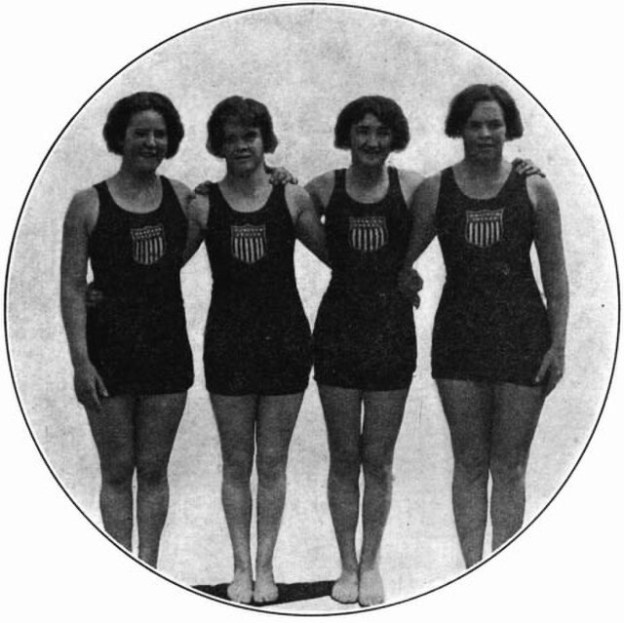
In 1917, she struck out on her own, creating the New York City Women’s Swimming Association (WSA) to further advance the sport. She successfully battled the United States Olympic Committee, enabling American female swimmers and divers to compete in the Olympics in Antwerp, Belgium. Through her efforts, swimming dresses and bloomers were replaced with outfits closer in style to Annette Kellerman’s. The success of the American women’s swim team led to the inclusion of track and field and other sports for women in future Olympic Games.
Epstein served as the women’s swimming team manager for the 1920, 1924, and 1932 Olympics. Her swimmers and divers dominated the games, holding fifty-one world records over the course of her twenty-two years of coaching. Her protégées included Eleanor Holm, Aileen Riggin, Helen Wainwright, and Gertrude Ederle. Epstein also served as chair of the national AAU women’s swimming committee.
Her Jewish roots became part of her legacy. The WSA team swam at the Young Women’s Hebrew Association of New York for national championship meets in the 1920s. In 1935, Epstein served as chair of the swimming committee of the Second Maccabiah Games. In 1936, she refused to attend the Berlin Olympic Games and withdrew from the American Olympic Committee in protest of the United States’ participation in the “Nazi Olympics.”
During her lifetime, Epstein also used her position to battle for women’s suffrage, staging “suffrage swim races” with her teammates, and fought for further bathing suit reform, distance swims, and additional competitive events for women. She continued to have a major influence on swimming until her death in 1938, just short of her fifty-fourth birthday. She was inducted into the International Swimming Hall of Fame and the International Jewish Sports Hall of Fame.
“By motivating young women to follow their passions in a sport that did not yet fully accept them, Epstein truly changed the way women thought about swimming,” according to Women in Swimming (Betsey Bennett. “Charlotte Epstein and the Swimming Suffragettes.” Women in Swimming. October 25, 2018). “And her impact did not end in the pool; once women gained freedom over their bodies in sports, they were better able to achieve liberation in other facets of society.”
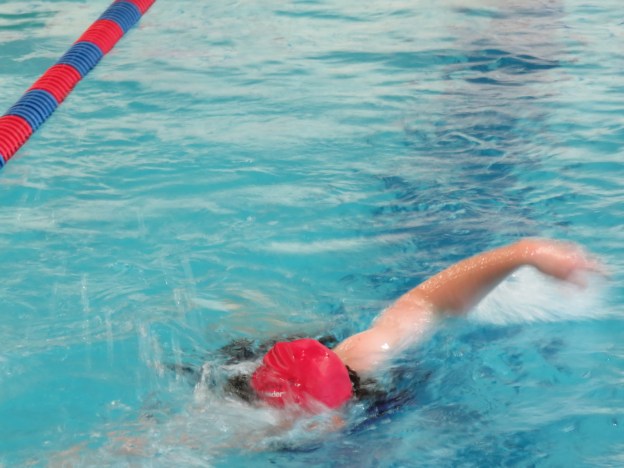
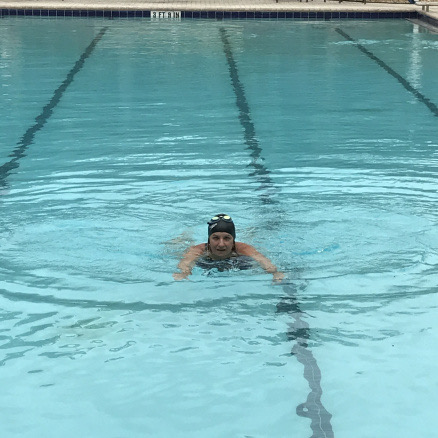
On Wednesday, July 31, after binging on a morning of Olympic events being broadcast on NBC, I headed for the small pool in our Colorado rental complex. I swam 1500 meters in over an hour, approximately four times Ledecky’s time of 15:30.02 minutes in Paris earlier that day. I may not be setting any world records, but I too am a beneficiary of efforts of the small Jewish powerhouse from Brooklyn. I did not fear being arrested for wearing a TYR swimsuit, and no one feared that this “delicate flower” could not survive the multiple laps. I tip my Speedo swim cap to you, Eppy!
In 2024, Disney+ released the film Young Woman and the Sea based on Glenn Stout’s 2009 book. The movie tells the story of Epstein’s most well-known protégé, Gertrude Ederle, the first woman who swam the English Channel. Sian Clifford, who played Epstein, said the movie is “a beautiful, inspiring story that should have been told before.”
“Charlotte Epstein serves as a symbol of the critical efforts of a Jewish sportswoman to improve the competitive opportunities and quest for physical emancipation of American women using their bodies in aquatic sports,” wrote Linda Borish in her 2004 paper. (“The Cradle of American Champions, Women Champions … Swim Champions’: Charlotte Epstein, Gender and Jewish Identity, and the Physical Emancipation of Women in Aquatic Sports.” The International Journal of the History of Sport_, Vol. 21, 2 (March 2004): 197-235.
All women swimmers—or all women athletes for that matter—have Eppy to thank.
Originally published August 16, 2024. Updated July 2025.
Note: First Place Winner, 2025 Florida Press Association’s Sports Feature Story, Category C (Small newspapers).
SOURCES
Borish, Linda. “The Cradle of American Champions, Women Champions Swim Champions’: Charlotte Epstein, Gender and Jewish Identity, and the Physical Emancipation of Women in Aquatic Sports.” www.researchgate.net. March 2004.
This story was written by my mother, Frances Cohen, in ~2006, after she and my father, Bill Cohen, moved into Coburg Village, an independent living facility in Rexford, New York. A natural storyteller, my mother joined a writing group and wrote down many of her stories for posterity. It is a joy to share them with you!
The weather plays an important part of our life. At times, we wish that we could change the weather, but as we have learned it is one of the things in life we cannot change.
Sometimes prayers help. On two occasions, our prayers were answered when we planned outdoor receptions. One was for the retirement party Bill and I planned at our cottage on Lake Champlain during the summer of 1983. The second was at the wedding reception for my granddaughter that was held on my daughter and son-in-law’s front lawn in Clifton Park in October 2007. At both parties, the weather was perfect: sunny, 72 degrees, with no wind. We considered it a miracle!
Our prayers did not work when Bill, my daughter Marilyn and I had to travel from Keeseville to Rockland County for our son Jay and our future daughter-in-law Leslie’s engagement party in December 1970. A Nor’easter started the day we were supposed to leave, so we delayed the trip until the next morning in hopes the weather would improve. Unfortunately, the snow only got heavier. By the time we arrived in Albany, the New York Thruway was closed. Determined not t miss the party, we decided to take Route Nine for the rest of the trip. The roads and visibility were terrible. Atone point, Bill stopped at a railroad crossing as the gate was down and the lights were flashing. The snow was so thick that Marilyn, who was sitting in the back seat, thought we were actually on the tracks and began screaming in fear. When we all calmed down, we continued on the trip. We arrived in Pearl River at 11 o’clock at night, sixteen hours after leaving Keeseville for what should have been a four-to-five-hour trip. It was one of the most difficult trips we ever made. In 1980, the year before we retired, our cousins invited us to visit them in Florida. When the day of our flight arrived, we left our cottage on Lake Champlain to drive to Montreal, the closest airport. When we crossed the border to Montreal, the snow was piled so deep that drifts were at places two stories high. As we crossed over a bridge near the airport, Bill lost control of the car, and we did a complete 360-degree turn, landing in a soft snowbank. Fortunately, there was no damage, so we were able to continue the trip to the airport. When we arrived in Florida, it was 85 degrees, and our cousins welcomed us in summer attire. Bill and I looked at each other and said, “This is paradise!” We couldn’t change the weather, but we could change our location. Right then and there, we decided that before next winter, we would sell our business, have a going-out-of-business sale, and spend our winters in Florida and summer at our cottage by the lake.
We were fortunate to be snowbirds for many years. It was the best of both worlds: Beautiful summers on Lake Champlain and warm, balmy winters in Florida. We thought we had it made—until Hurricane Wilma hit in 2005.
At that point, Bill and I were living full time in a condominium in Wynmoor, an over-fifty housing complex in Coconut Creek, Florida. The Weather Channel and local officials had warned us in advance of the incoming hurricane, and we had made sure to purchase water, canned food, and extra batteries. The night the hurricane hit, we did a lot of praying. The winds and rain were very strong, and we were very frightened. We were so thankful that our building had been spared any serious damage. We woke up to no electricity and no air conditioning in the 85-degree heat. For the first few days, we stayed in our condominium, living on the canned goods that we had purchased before the hurricane. When the electricity finally came back in our condominium, we decided to go food shopping for milk, eggs, and other food to restock our pantry and refrigerator. At that point, we were able to see the actual extent of the damage in the area. We saw lots of fallen trees, some of which had crashed into parked cars. With all the wires down and traffic lights out, getting to even the supermarket was almost impossible.
When we finally got to Publix, the store was dark and eerie as it was powered by back-up generators. We learned as the week went on that thousands of trees had been destroyed in our residential area. More tragically, a number of other residential areas, including Hawaiian Gardens, the original complex we had moved out of only four years before, were so badly damaged that they were unlivable and eventually had to be completely torn down.
In the middle of all this stress, when I was getting in the car to take another trip to the supermarket a week after the hurricane hit, I caught my foot on the curb while trying to get out of our parked car and broke a bone in my leg. That was the final straw. Our children felt strongly that we needed to get out of Florida and its hurricanes and move back up north. By spring, 2006, we were settled in Coburg Village, four miles from my daughter and son-in-law. At Coburg, we don’t need to drive, as the shuttle takes us everywhere. Our children are close enough so they can go shopping for us if the weather is too bad. So, when bad weather comes, we are able to just look out the window and enjoy our cozy apartment. Now we can be thankful for the snow so that grandchildren can ski, the rain that makes our flowers and gardens grown, and the beautiful sun that makes us all happy.
The photo of me with a rubber chicken was taken in Keesevile around 1954 after a bad snowstorm. No idea why I had a rubber chicken!
My mom, the storyteller, with her beloved Bill, 1990.Mom and I at Coburg Village on a beautiful fall day.






 There Goes My Heart