Monthly Archives: December 2024

Celebrating Christmas vicariously

I love Christmas. I love looking at all the lights on people’s homes and all the twinkling trees inside. I love holiday cookies. And I love how some people fill every inch of their house with Christmas decorations. That being said, I am very happy to celebrate the season vicariously.

With a name like Marilyn Cohen Shapiro, you probably have realized that I have never actually celebrated Christmas. Growing up as the only Jewish family in a tiny upstate New York town, we never had a Christmas tree or strung red and green lights across our eaves. Once I married Larry under a chuppah in 1974, I continued our own Jewish traditions in December: lighting the menorah, making potato latkes, giving gifts to each other and to our children over the eight days. And never once in my life have I had the urge to celebrate the secular elements of the Christians’ beautiful religious holiday. In honor of Hanukkah, here are my eight reasons why. 

  1. I cannot untangle the wires on my earbuds. How would I ever manage to take yards and yards of Christmas lights out of storage and unwind them to put on a tree?
  2. In 1996, Larry climbed up on a ladder to shovel snow off the roof. He slipped and fell, shattering his heel. That was the end of his running life. It was also the end of Larry ever climbing up on the roof. The idea of stringing all those lights onto the eaves is frightening prospect!
  3. I look terrible in red and green. While all my Christian friends “don their gay apparel” from Thanksgiving to January 1, I am content to pull out my Israeli blue sweater, tuck my dreidel earrings into my lobes, and enjoy the holiday season with colors that compliment my blue eyes.
  4. Remember I said I love to EAT holiday cookies? That doesn’t mean that I want to BAKE them. I have never done well making sugar cookies, which requires mixing the dough, rolling it out, and then cutting them into cute little shapes. I either made them too thin (i.e. burnt) or too thick (underdone).. And forget about decorating them with tubes of frosting. I can’t DRAW a straight line! How am I to master all those borders and curlicues? 
  5. Speaking of cookies, I gave up on cookie swaps years ago. I don’t need to start baking thirty kinds of cookies in October so I could share with friends whose cookies always looked prettier and tasted better than mine. I will stick to my yearlong custom of baking what are known as “Marilyn’s World Famous Chocolate Chip Cookies” and not share a single one. 
  6. I have friends that have bins and bins of Christmas decorations stored in their attic, garage, or expensive storage units. Every inch of their house becomes a winter wonderland. They have multiple trees, dozens of nutcrackers, Christmas towels, napkins, and even toilet paper. My friend Bonnie, who loves to decorate for every holiday,  even has a twinkling alligator holding a candy cane and sporting a Santa hat! While I love walking through their homes, I am so glad I am not responsible for putting out all the tchotchkes and then packing them up for storage in January. My single decoration—an electric menorah that sits in my window throughout the eight days of Hanukkah is just fine, thank you very much!
  7. As my readers know, I love Hallmark Christmas movies. I get to see everything I have written about above in various permutations of the standard rom-com: The setting: an idyllic small town in United States where everyone, no matter what their occupation, has thousands and thousands of dollars to spend on Christmas decorations. The Plot: either boy meets girl or or two high school sweethearts reconnect; boy and girl dance around a relationship (Think “Kiss the Girl” from The Little Mermaid;); 20 minutes before the end of the movie, boy and girl face a conflict; 20 seconds before the credits roll, boy and girl kiss as snow flakes gently fall on their perfect locks as Christmas music plays softly in the background. Perfect people. Perfect families. Perfect smiles.Why face the reality of a real family when you can kvell for a perfect one?
  8. And speaking about Christmas music, I only learned recently many of the most popular holiday tunes were written by Jews. The most famous is White Christmas by Irving Berlin [born Israel Beilin]. Here is just a sampling of my other favorites: “Chestnuts Roasting on an Open Fire” by Mel Torme [born Melvin Howard Torme]; “The Christmas Waltz” by Sammy Kahn [born Cohen] and Jule Styne; “Santa Baby” by Joan Javits and Phil Springer; “I’ll Be Home for Christmas” by Kim Gannon and Walter Kent [born Kaufman]; “It’s The Most Wonderful Time of the Year” by George Wyle [born Bernard Weissman] and Eddie Pola [born Sidney Edward Pollacsek]. Even “Rudolph the Red-Nosed Reindeer” got his shiny nose from two Jews from New York City’s suburbs. Johnny Marx, who also went on to write “Rocking Round the Christmas Tree” and Burl Ives’ classic “Have a Holly Jolly Christmas,” never—like me—actually celebrated the holiday. Marks’ co-writer Robert Louis May allegedly shared with multiple sources that the lyrics actually represented the ostracism May felt growing up as a Jew with a large nose. Hey, what better way for Jews to live vicariously through Christmas by realizing those songs you are hearing everywhere were written by members of The Tribe!

So, as Larry and I walk through the neighborhood during this surprisingly cold December in Florida, I will rejoice in the shining lights and lovely music and delicious smells of Christmas emanating from my Christian friends’ homes. Then we will go home, light our hanukkiah and enjoy some hot chocolate and chocolate chip cookies as the candles flicker and burn, content in knowing that, for the Shapiros, that is enough. Dayanu.

Source: Albert, Maddy. “11 Iconic Christmas Songs That Were Written By Jews.” Kveller. December 22, 2020.

My preferred way to celebrate! I look good in blue!

The Kindness of Strangers

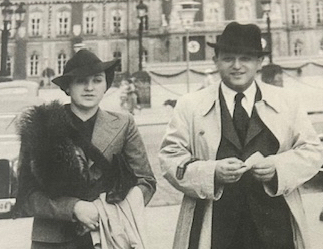
For newlyweds Erwin and Selma Diwald, getting out of Austria wasn’t a choice. It was a necessity. Thankfully, the kindness of strangers saved their lives. Their daughter, Frances “Francie” Mendelsohn, shared their fascinating story. 

Erwin Diwald was born in Vienna, Austria, in 1907, to Bettina and Sigmond, who was a successful importer of the ostrich and egret feathers used in the making of hats popular at that time. Erwin attended the University of Vienna, where he earned doctorates in both history and law. He launched a successful career in law and was sought after by many Catholic clients wishing to legally annul their marriages. 

Born in 1931, Selma Gehler was the second child of Maria and Victor Gehler. Victor, an engineer, was involved in the building of the Wiener Riesenrad ferris wheel in the Prater, still considered one of Vienna’s popular tourist attractions. Selma worked in her uncle Joel’s’ pharmacy while attending the University of Vienna’s pharmacy program, intending to step into her uncle’s business after graduation. 

Selma and Erwin met at a friend’s wedding and married in October 1937. Six months later, German troops invaded Austria. On March 15, 1938, the terrified Erwin found himself caught up in the enthusiastic crowds cheering and raising hands in the Nazi salute as a triumphant Hitler paraded through the streets of Vienna. Immediately, the Jews in Austria were in the crosshairs of the new regime. 

The newlyweds knew they had to leave their native country. Their first attempt to obtain visas took them to Stuttgart, Germany. On their first evening there, Selma and Erwin ate dinner in the hotel’s restaurant. The waiter brought over a huge tureen of soup. “Compliments of the Fuhrer,” they were told. They soon learned that their hotel was the site of the city’s Nazi headquarters. They quickly returned to Vienna to explore other options to leave Austria.

Help arrived through Erwin’s younger sister. Paula Diwald had been vocal in her dislike for the new regime. When notified that the Nazis were looking for her, she hastily made arrangements for a “ski trip” in France. As soon as she crossed the border, she ditched the skis and took up residence in Paris. 

Paula worked during the day as a salesclerk in a shop selling expensive handbags. To supplement her income, she worked as a tour guide, her ability to speak seven languages a definite asset. 

One evening, Paula overheard a couple requesting a guide who could speak English. She introduced herself and spent the next several days showing the Gregorys, a wealthy Greek Orthodox couple from Chicago, the highlights of the City of Light. At the end of their visit, they asked Paula what they could do to thank her for all she had done.

“What you can do is sponsor my brother and his wife,” Paula told them. “We have absolutely no family in the United States. Your providing them with visas is the only payment I want.” They promised to see if they could make the arrangements once they returned to Chicago. 

Paula immediately contacted Erwin. His education had included years studying classical Latin and Greek, and he decided to use this knowledge to further persuade the Gregorys.He wrote a long eloquent letter in classical Greek to plead his case. 

The Gregorys may have been Greek Orthodox but had no knowledge of its language; they brought the letter to their priest. Impressed by both the Erwin’s language and moved by their plight, the priest told the Gregorys, “You have to save these people.” The Americans complied and began the process of getting visa for the couple. They enlisted the aid of Lazarus Krinsley, a Jewish lawyer in Chicago, to obtain the paperwork. 

The Diwald flew to Paris to await the paperwork that, according to the officer in charge had not come through. It was only when the Diwalds checked in on a day the regular official was not at work. His substitute immediately “found” the missing documents.“Where have you been?” He said. “These visas have been here for months.” 

Knowing that they could not bring a great deal of money into the States, the Diwalds arranged first -class passage on the Paquebot Champlain. Built in 1932 and hailed as the first modern liner, the ship was pressed into evacuee work, transporting many Jews, like the Diwalds, who were fleeing Europe. 

Erwin remained in Paris with Paula before boarding the ship in Le Havre, France on August 29, 1938. Later that day, Selma, who had gone to England to say goodbye to her family, boarded in Southhampton. On August 31, 1938, Germany invaded Poland, marking the beginning of World War II. Erwin and Selma had made their escape just in time.The ship sailed in radio silence for the remainder of the voyage.

Meanwhile, he Diwalds found themselves in the company of many celebrities. Their travel mates included actor Helen Hayes, comedian Groucho Marx, composer Samuel Barber, Italian-American composer Gian Carlo Menotti, and Austrian-American actor/director Erich von Stroheim. It made for a very memorable voyage! 

An interesting side note: According to a Wikipedia article, the Champlain continued crossing the Atlantic Ocean for the next two years, transporting refugees, including many Jews, to safety. On June 17, 1940, on what was to be its last crossing, the Champlain hit a German air-laid mine, causing it to keel over on its side and killing 12 people. . A German torpedo finished its destruction a few days later. It was one of the largest boats sunk sunk in World War II. 

After debarking the ship in New York City, Selma and Erwin traveled to Chicago to meet their benefactors. Even though the Gregorys were responsible for getting the visas, they were not very welcoming. Lazarus Krinsley the lawyer, and his wife Rose, however, warmly embraced the couple, a friendship that was maintained throughout their lives. Upon the Krinsleys’ recommendation, the Diwalds settled in Milwaukee, Wisconsin, which had a fairly large Jewish population and offered more job opportunities.

Despite his educational background, Erwin lacked the credentials to practice law in his United States, During the war, he worked on an assembly line that polished propellers for B-29 planes. and drove trucks After the war, Erwin applied for a job as a tire salesman with Dayton Tire and Rubber Company. Initially, human resources failed to recommend him, saying he was “too intelligent.” He went on to become one of their top salesmen. 

Using the skills learned in Vienna, Selma worked in a pharmacy. She considered going to UW Madison to get certified as a pharmacist. After the birth of her two daughters Ann Frances [“Francie”) and Susan Jane, however, she gave up her dreams of further education. 

The Diwalds joined to Temple Emanuel, a reform congregation. In 1954, Francie became the first bat mitzvah in the congregation, with her sister Susan following in her footsteps three years later.

Fortunately, many of Selma and Erwin’s family were able to escape the fate of the many Jews imprisoned and murdered during the Holocaust. In 1938, the Nazis stormed into the Gehler home looking for Joel. When they could not find him, they arrested Selma’s father, Victor, who was deported to Dachau. Maria, through a possible bribe, was able to free him. They immediately fled for Haifa, in what then Palestine. They both passed away in Israel in 1951, three years after it had become the State of Israel. 

Erwin’s parents had also escaped Austrian 1940 by hiking over the Alps into France.  They emigrated to Milwaukee in 1942. Joel, who had narrowly missed arrest in 1938, fled to England, where he met the love of his life, Patricia. Joel passed away in 1986; Patricia passed in 2022. 

Selma died in 1996 at the age of 83 from cancer. Erwin died in 2008 at the age of 101, suffering from dementia in his last years. Despite all that the family had endured, Francie said that her parents were never bitter or angry. “I feel as if I been touched by God,” Erwin told his children. “We survived.”

SOURCES

Thanks to Francine Mendelsohn for sharing her parents’ story. 

“SS Champlain.” Wikipedia. https://en.wikipedia.org/wiki/SS_Champlain

A Hallmark Chanukah [Updated 12/24]

As we look forward to Hanukkah this year, which falls on Christmas Day, Larry and I are looking forward to our long-standing holiday traditions. Eating potato pancakes with applesauce. Lighting candles each night. “Betting” on which candle lasts the longest. Watching Hallmark Christmas movies.

Wait! Hallmark Christmas movies? When did that become a tradition?

For as long as I can remember, I have watched Hallmark movies. For many years, the famous card company aired shows specific to the holidays—Thanksgiving, Christmas, and of course Valentine’s Day. Each two-hour made-for television episode touched my heart. Many were based on classic novels, such as The Secret Garden or Sarah Big and Tall. Others were originals, such as What the Deaf Man Heard. And as much as I loved the shows themselves, I especially enjoyed the tear-jerking commercials (Did you know you can Google them? Watch them with a box of Kleenex next to you!)

In 2001, after the major networks dropped the specials, the company launched The Hallmark Channel. Building on its many fans during the holidays, Countdown to Christmas began in 2009, a promotion of 24/7-blast of cheer that is still running today. Cookie-cutter stories, many based loosely on more expensive big screen movies, have been churned out at an amazingly fast rate, with 136 to date. That is a great deal of Deck the Halls and Jingle Bells, their favorite songs as the movies are touted to be about the spirit of the season, not religion.

Even though Larry and I watched the movies frequently over the years, what sent me over the edge was November 2016, when the election results triggered such fear and anxiety that my doctor suggested Xanax. Dr. Larry suggested an additional remedy: Turnoff MSNBC and tune into Hallmark. I was off the anxiety medication less than three months, but I still have my weekly dose of sap and sugar.

If you have watched only one or two of the productions, you have pretty much seen them all. The Christmas plot fall into two categories. Plot One: A high powered business dynamo needs to learn the real meaning of life and that he/she  can only find in a small idyllic town inhabited by incredibly cheerful people who despite their low-paying occupations (cupcake bakers, store clerks, and staff at huge inn with no guests in sight except the small cast seem to be a favorite) still can afford enough Christmas decorations to cover EPCOT. Plot Two: A poor but kind woman finds out that the incredibly handsome mystery man she is dating is actually the king of a tiny but wealthy country named after a countertop (Cambria) or china pattern (Winshire). Just before the commercial twenty minutes before the show ends, a conflict based on a misunderstanding erupts. No worries! It will be resolved with a kiss one minute before the snow starts and two minutes before the credits roll.

Until recently, Hallmark was all about white heterosexual Christians. People of color were only  seen as the best friend or the minister who marries the happy couple. Gays and lesbians were never seen. This type casting was blown out of the water in  December  2021 when the channel first aired then immediately pulled an advertisement for an event planning site that featured two women kissing at the altar. Within hours of its removal, the incident was all over the news. Within days, the president resigned. Within weeks scriptwriters began churning out stories in which gay, lesbian, and interracial romances are highlighted. By Christmas 2021, diversity was fully integrated into the holiday story lines. 

And those holiday story lines included those about Jewish families celebrating   Hanukkah. Up until 2020, the channel’s attempts at representing a Jewish perspective were major fails for me. Holiday Date. one of three 2019 Hallmark movies with a Jewish twist, involved a Joel, a nice Jewish  boy who pretends to be the boyfriend of Brittany, a nice shiksa from an idyll small town in Pennsylvania. “Hilarity” ensues when Joel, who grew up in New York City surrounded by at least one or two Christians, has no idea how to decorate a tree or make a right-sided gingerbread house or sing “Deck the Halls.” (There is that song again!) My favorite moment is when, once the ruse is uncovered, Brittany’s mother comes out of the kitchen holding a tray full of potato latkes and wearing an “Oy Vey” apron that she managed to find on the first night of Chanukah in the town’s only store. The plots of the other two, both involving interfaith romances, made Holiday Date look like Casablanca. 

In recent years, Hallmark has redeemed itself with three great Hanukkah movies: Eight Gifts of Hanukkah (2021); Hanukkah on Rye (2022); and Round and Round (2023). These three fine movies contain with a (mostly) Jewish cast and great story lines. Sure, as are all of the channel’s movies, they are schmaltzy, but they will make you kvell with Yiddishkeit pride!

So why do I—along with many others who will not come out of the closet—love the shows? Simple. They are mindless, sweet, non-political, non-violent, and always guarantee to result in a happy ending. I still cry every time King Maximillian and Allie embrace at the end of A Crown for Christmas.(Take that, you wicked Countess!) What held true for me in 2016 holds true in 2024. I need a break from news about wars and politics and environmental disasters. Grab the dreidel shaped sugar cookies and hot chocolate. It’s time for a Hallmark Christmas movie!