Monthly Archives: January 2025

Hate Ends Now

A seventeen-year-old’s powerful stand against hate

One million paper clips are piled high on black construction paper on the stage, lit by a spotlight. Above it, the flickering black and white film of Jews walking to their deaths in a Nazi concentration camp is being shown on a theater-sized screen. And standing in front of the stage is the seventeen-year-old Edgewater High School (EHS), Florida, senior who orchestrated this scene, along with several other exhibits that make a powerful stand against antisemitism and many hate. 

The first thing you notice about Adam Mendelsohn is his hair. Standing at six feet tall, Mendelsohn adds another two inches with his wild dark brown curls, complimented with a gray yarmulke perched in the back. As the organizer of the January 9, 2025, Hate Ends Nowcommunity event, Adam radiates a confidence and maturity that is unusual in such a young man.

The previous summer, Adam had attended a meeting of the local Jewish Student Union (JSU). Founded in 2002, the organization oversees 200 Jewish culture clubs on public high school campuses to provide Jewish teens with programs that strengthen their Jewish identity and connection to Israel. On that day, Rabbi Daniel Nabatian, the co-director of the Central Florida branch, encouraged the students to make an impact—no matter how small—to fight against the rising wave of antisemitism that had gripped the world since the Hamas attack on Israel on October 7, 2023. 

 Adam was determined to bring the JSU message to Edgewater High School students and staff. Following up on his memory of a similar exhibit, he contacted Hate Ends Now, a nonprofit whose mission is to combat hatred and indifference by educating people about the history of the Holocaust and all forms of bigotry. The organization offered not only artifacts from the Holocaust but also an exact replica of a World War Two-era cattle car that was used to transport Jews and other targeted groups to concentration and death camps. A twenty-minute, 360 degree immersive presentation offers an impactful educational experience. With the support of Dr. Alex Jackson, Edgewater’s principal, and his assistant, Valerie Lopez, Adam worked with Todd Cohn, the CEO of the nonprofit, schedule the event in Orlando for January 9, 2025. 

 Adam then started a fundraising campaign to pay for the cattle car and other expenses. Thanks to the generosity of many donors, including the Ginsberg Family Foundation and Massey Services, the seventeen-year-old raised over $30,000, enough to cover most of the expenses.

 Adam’s next step was to contact local organizations whose mission aligned with the core values of the event to sign on. Participants included the Jewish Student Union (JSU); Chabad C-Teen; Shalom Orlando, the Holocaust Memorial Resource and Education Center of Florida; the Anti-Defamation League, and Central Florida Pledge, a network of community members in Florida who stand up against discrimination and hate.

Adam now began the search for a Holocaust survivor. Jasmine Flores, the community relations manager for the Greater Orlando Massey Services, connected Adam with Ludwig (Lou) Ziemba, an 82-year-old Kissimmee resident, through her involvement in Maitland Rotary.  Ziemba was born in the Lodz Ghetto on September 9, 1942, one day before 13,000 children under ten were to be sent to an extermination camp. Arrangements were made for the infant to be hidden in a garbage truck and smuggled outside the Ghetto where a Christian Polish farmer retrieved him and took him home to be raised as his own. Miraculously, his parents survived and were able to retrieve their “hidden child” when they were freed three years later. 

The paper clip exhibit was a last-minute miraculous addition to the event. On Sunday, through a conversation with Beth Landa, Ziemba’s wife, Adam learned about Paper Clips, a documentary that highlighted the 1998 efforts of middle school students from Whitwell, Tennessee, to collect six million paper clips representing the six million Jews killed by the Nazis. According to Wikipedia, at last count, over 30 million paper clips had been received.

A preliminary research of the documentary compelled Adam to see if he could locate a low-cost source of paper clips. The manufacturing plant of Bulk Office Supplies was in Tampa, but was closed for the weekend. Undeterred, he located the name of the founder and owner of the company, Alex Minzer, on Facebook. Encouraged by Minzer’s “Never Again,” hat, Adam messaged him; Minzer answered almost immediately. Alex Minzer had sold the company to Levi Haller, who was currently in Jerusalem. Alex helped connect Adam with a wholesaler in Tampa who would provide the paper clips at cost – and later that same day Levi Haller reached out to Adam to say that decided that Bulk Office Supply would donate the 1 million paper clips, inspired as he was by the project’s mission and Adam’s passion.

Next problem: how would the paper clips get from Tampa to Edgewater in time? Fortunately, Adam’s father Jason was returning from a business trip on Florida’s west coast on Wednesday. Adam quickly did the math, his favorite subject, to confirm all the boxes would fit into his father’s car. All good! The clips were successfully delivered at one o’clock, only 28 hours before the event was scheduled to open.

Adam and a group of student volunteers began the tedious task of opening the 10,000 small boxes of 100 paper clips and piling them onto a 7X7 foot square of construction paper that had been placed on the stage in the school’s auditorium. When the school day ended at 2 pm, Adam stayed on, working alone and then with his father, until 8 pm. “When I left, I looked at the pile and despaired,” said Adam. “I had no idea how the project could be completed.” 

Adam returned to EHS the next morning at 5 am. By school opening, the whole student body was aware of the urgency to finish the job. “It was crazy!” Adam said. “Students were rotating in and out of the auditorium to provide help over the next several hours.” The pile was completed at 1 pm, twenty-four hours after the initial delivery. “I now hate paper clips,” Adam said with a laugh.

At five pm, the doors opened to the public. Over 500 people attended the three-hour event. They perused the display tables, munched sandwiches provided by Kosher Grill, listened intently to Ziemba, looked over the chilling artifacts on the Hate Ends Now tables, sat in the quiet auditorium to contemplate the million paper clips, and, at scheduled times, viewed the powerful immersive presentation in the cattle car parked just outside Edgewater’s entrance. 

Dignitaries included United States Representative Maxwell Frost, Florida State Representative Anna Eskamani, staffers sent on behalf of Senator Rick Scott and United States Representative Darren Soto, and members of the EHS school board. 

“This is an incredibly powerful experience,” said Frost. “I believe that every high school student should have the opportunity to witness the horrors of this tragic time in world history through such exhibits. This event serves as a reminder that when we lead with love, we can stop hate in all forms and make sure this type of history never repeats itself.” 

Todd Cohn also commented on Adam’s project. “It’s rare to see such a young individual take on such a meaningful project with this level of commitment,” the Hate Ends Now CEO. “He made a lasting impact not only on us but on everyone who experienced the exhibit. Adam is a shining example of how one person can make a big difference.

Ziemba found sharing his story with a large and diverse audience to be exhilarating. Despite his history, Ziemba still believes love will prevail. 

“Try to accept people,” Ziemba told Orlando’s Spectrum Cable News reporter Sasha Teman. “I know I grew up loving people, and I still love people.”

Adam is grateful to all involved in making the project a success. He also plans on sharing the message with him beyond high school “Barriers which prevent love and peace can be destroyed by understanding that we are all the same,” he said. “I plan on carrying the torch of compassion, acceptance and tolerance throughout my life.” And the one million paper clips? Plans are underway for the clips to be gathered in a lucite case with signage that will be placed in the Edgewater High School’s entrance hall. Adam’s hope to make a difference and to combat hate of all kinds will now be his lasting legacy.

Originally published January 25, 2025. Updated May 26, 2026

Those who wish to make a contribution to Hate Ends Now in honor of Adam Mendelsohn and his project, please click here. 

All photos provided courtesy of Cara Dezso

Running for Katie Revisited

Katie Lynch, who would have been 47 on January 16, 2025,  tragically succumbed to cancer in 2008. The following article  was originally published in 2017. I am reposting it  to update the story and to let my readers know of Judy and Charlie’s most recent fundraising efforts ancon behalf of their beloved daughter. 

My husband Larry and I  met Judy and Charlie Lynch and their two girls in 1984. It was the first day of Clifton Park’s tee ball practice, and our two six-year-olds were assigned to the same team.  The parents and our two three-year-olds got to know each other while watching the games. Our son Adam spent most of his time in the outfield picking dandelions. Katie’s beautiful red hair couldn’t be contained under the maroon baseball caps all the pint-sized players wore.

In 1987, our families connected again at the Knolls Gang, a locally-run summer swim team. On the first day of practice, our daughter Julie brought over  “my new friend, Julia” to meet us. The two older siblings remembered each other from tee-ball. The four adults spent the next several years sharing conversation and stopwatch duties at the meets.

Larry and I left swim meets behind when Adam and Julie got involved in running. Charlie and Judy continued to breathe chlorine at various Capital District pools as their two girls continued competitive swimming. Our four children shared classrooms and proms and family get-togethers.

Meanwhile, as the years passed, Judy and Charlie became two of our dearest friends. We frequently met for dinner or a movie, a concert at Saratoga Performing Arts Center,  or a leisurely tour of the Clark Museum in Williamstown, Massachusetts.

Katie was co-valedictorian of the Shenenehowa graduating class of 1996. She went to Drew University on scholarship, where she was the captain of her swim team. In 2000, she graduated with honors, got a job with Ernst Young in New Jersey, and eventually met a wonderful man. Friends and family waited expectantly for an email announcing their engagement.

In  September 2008, Judy sent out a completely different e-mail with devastating news.  “Katie is sick” read the subject line. Katie had been  diagnosed with acute myelogenous leukemia (AML), one of the deadliest forms of blood diseases. Because of her general health and young age, she had at best a 50/50 chance of recovery, and an aggressive medical approach was needed— immediately.

Katie, always one to accept a challenge,  determinedly underwent everything the doctors threw at her: chemotherapy, numerous hospitalizations, painful side effects and biopsies, and countless blood tests, and transfusions.

While Katie was undergoing treatment, friends and family reached out to ask how they could help. Judy, a runner, had heard about Team in Training (TNT) through her many years of running, the  flagship fundraising program for the Leukemia & Lymphoma Society (LLS). LLS is the world’s largest voluntary health organization dedicated to funding blood cancer research, education and patient services. TNT volunteers, many themselves survivors,  train to complete a marathon, half marathon, cycle event, triathlon or hike adventure, while fundraising to support the fight against blood cancers.

In 2009, Judy signed up with TNT  to raise money by her participation in the New Jersey Half Marathon. Katie had gone into remission, and Judy regarded the race as a victory lap, with Katie and her now-fiancé meeting Judy at the finish line. Friends and family, including Larry and I, donated money to LLS in Katie’s honor.

Katie would not watch her mother complete the race. The cancer reoccurred, and she was in the hospital preparing for a stem cell transplant. Judy’s fundraising became her fight for her daughter’s life. She raised over $12,500.

Tragically, Katie’s positive attitude, her strong will to live, and the undergoing of every conceivable treatment were not enough. Less than fourteen months after her diagnosis, the Lynch’s beautiful, sweet, intelligent daughter died on October 26, 2009. She was 31.

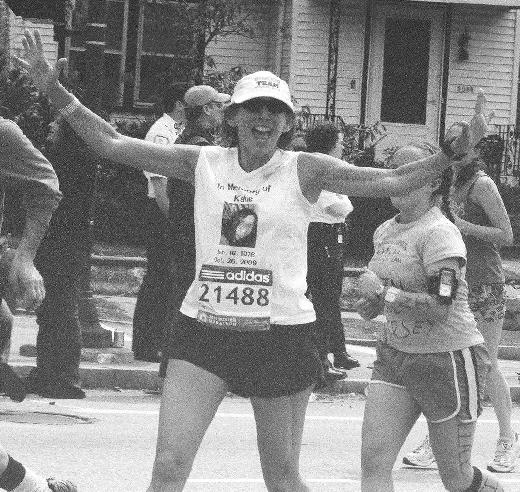
Before and during Katie’s illness, running had been Judy’s therapy, her go-to for coping and figuring things out. After Katie’s death, it was her bridge into life without her daughter, a way to move forward and memorialize Katie. She would tell the world about Katie at the marathon, wearing a shirt with her picture, her dates, and messages to fight leukemia, donate blood, and join the bone marrow registry. Immediately after the memorial service, Judy signed up for the 2010 Boston Marathon. A torn hamstring delayed that goal, but she found other races—in Atlanta, in the Capital District, and in 2011, her first Boston Marathon.

Judy felt the need for something positive to result from Katie’s tragic death.  She made a personal commitment to do one event a year for TNT, raising as much money as she possibly could each time.

With Katie as her inspiration, Judy accepted challenges she never would have considered. Along with running races ranging from 6.1 miles to 26.2 miles, she expanded her fundraising efforts to include triathlons,bike rides, and even hikes in Rocky Mountain National Park and the Grand Canyon.

Charlie has been Judy’s number one supporter, joining her on her most recent fundraiser, a hike in the Grand Canyon, or cheering from the sidelines.  Together, the Lynches have raised the amazing  total of nearly two hundred and seventy-five thousand dollars for blood cancer research. This year, Judy will  take part of the America’s Most Beautiful Bike Ride on with Team in Training  on June 1 to raise more crucial funds for the Leukemia and Lymphoma Society’s (LLS) ground-breaking research and patient support. 

“I run not only for Katie,” said Judy, “but also for the fighters, the survivors, those not yet diagnosed, and especially for those whose lives were cut short way, way too soon.”

On January 16, 2025, Katie would have turned 47. Through their tzedakah—their charity and giving, Judy and Charlie have kept Katie’s memory alive not only in their hearts but also in the hearts of their many supporters.

I often think of Katie’s determination, courage, and grace under terrible circumstances. And I deeply respect and admire my dear friends for their incredible fundraising efforts they have undertaken in memory of their daughter. Their hope is that other families can be spared the devastation of losing a child or loved one.

For more information or to donate to Judy Lynch’s cause and TeaminTraining, please  click here. 

Judy at Boston Marathon

Ratted out..

No, we didn’t have Santa Claus come down our chimney last year. First of all, we don’t HAVE a chimney. And, being Jewish, Santa doesn’t usually visit our home anyway. Instead, as we awaited the first night of Hanukah, which fell on Christmas Day this year (for only the fourth time in the last 100 years and the first time since 2005), we had another not-so-lovely visitor to our home. 

The week before the holiday, while driving our Kia Sportage, Larry and I noticed that the windshield wiper fluid wasn’t coming out when we tried to access it. A check under the hood showed what we had thought. The holding tank was completely out of the fluid. 

“That’s weird!” Larry said. “This car is not even three months old! I don’t understand why we’re already out of fluid.” 

 Later that week, my brother Jay came for a visit. That evening, Larry and I drove Jay and our two friends to Calogera’s, an Italian pizzeria in Lake Alfred. After consuming delicious gourmet pizzas (Hot Honey! Formaggi! Artichoke!), we piled back into the car for our ride home. 

As soon as Larry turned on the car, we all noticed a definite aroma, and it certainly wasn’t coming from the boxed leftover pizza. As a matter of fact, it smelled HORRIBLE! Turning on the fan only made it worse. Despite the colder-than-usual-for-Florida temperatures, we opened up the windows and made it back to our friends’ house to drop them off.. They just didn’t depart…they dashed out faster than Santa’s reindeer.

When we got home, the three of us checked the inside and outside of the car for the problem. A mouse nest under the hood? An animal stuck in the wheels? Rotting fish we had accidentally left in the trunk from our recent shopping trip? To paraphrase Shakespeare, “Something is rotten in the town of Kissimmee,” but we were unable to find the source.

First thing the next morning, Larry and Jay took the Sportage through the car wash that included under carriage treatment. The odor wasn’t any better. The next day, Larry called the dealership for an appointment We would be dropping off the car on Christmas Eve, December 24.

On Saturday, Jay, Larry, and I met friends for a concert at Bok Tower Gardens. As we waited for the concert to begin, we told the friends we planned to meet—fortunately they hadn’t ask us for a ride—our stinky saga. 

“We think it’s a dead animal caught up in the car,” I told our friend Teri.

“Gee, I hope it’s not a cat!” said Teri, who loves felines and even volunteers at a Cat Cafe.

“Whatever it is or was, it obviously didn’t have nine lives” I quipped. 

Early Tuesday morning, I followed Larry in the Sportage over to the Kia dealership. Tyler, the manager, opened up the car door and was immediately hit with the stench of rotten flesh. Yes, we had no windshield wiper fluid because the hose connecting it was chewed up.

 “Looks like an animal got into the car,” he said. “You’ll need to leave it here so we can find the animal and check for other possible damage. 

An hour after we left, Tyler called us to give us the bad news. The mechanic had found a dead rat—a HUGE dead rat— stuck in the air conditioning unit. And there was more bad news. Before succumbing, the rat had chewed through more than the windshield washer tube. They would call us when the car was fixed and they were confident that the odor had been totally eRATicated. Err, I meant eradicated.

On Thursday afternoon, Larry and I got into our second car to pick up the Sportage. As we were pulling out of the driveway, Larry clicked the lever to wash the windows. No fluid was coming out. As Yogi Berra said, “It’s déjà vu all over again!” Had the rat gotten into both cars?

Tyler met us as soon as we pulled into the service port. It seemed our car was cause célèbre. The poor mechanic, despite wearing an industrial-strength mask, had almost lost his Christmas cookies while removing the eight-inch corpse. Maintaining his sense of humor, he had taken a picture of the dead rat, photoshopped a “Merry Christmas” sticker on it, and shared the picture with the entire service department and beyond.* Yes, they had seen rat damage. But ours won the prize for the biggest one ever seen in the dealership. 

Meanwhile, a check under the hood of the other car confirmed our worst fears. The rat had obviously frolicked in that car before making its way into my Sportage. After leaving the second car for another couple of days, our garage soon housed both rat-free vehicles. 

As I had been doing over the past week, I texted everyone who had been following our rat story with the latest updates. Responses included the usual “Oh no!” “Ugh” “Crazy!” and my favorite, “Happy Ratkanukkah!” I offered to share the picture captured by the mechanic, but only my brother and my son-in-law Sam took the bait. 

“It looks like a children’s stuffy,” said Sam.

“Yes it does,” I said. “Just don’t tell that to your stuffy-loving daughter!”

Through a Google search, Larry and I learned that our experience was not uncommon. “Rats love car engines because they provide warmth, shelter, and food-like soy-based wiring in modern cars,” a pest control website explained. Suggestions to protect our cars from future infestations included peppermint oil, mothballs, Irish Spring soap, and more expensive rodent deterrent options ranging from $20 to $60 on Amazon.. For the moment, we are depending on luck.

This was not our only expensive First World Problem this year. In January, a heavy rain storm had left a puddle of water on our kitchen floor. Hours after a roofing company had completed fixing the leak, we heard intermittent moaning sounds emanating from our attic. We originally believed the noise was coming from a distressed animal that had been trapped during the repairs. Five stress-filled days later, we realized that the “culprit” was actually a water pressure issue caused by the failure of the roofers to turn off the spigot of our outdoor hose. 

From perceived pests in the attic to real rats in the garage, I am more than ready to turn my secular calendar’s page to 2025. Happy New Year!

Source: LaJaunie’s Pest Control, “How to keep rats out of your car engine.” November 26, 2024. Click here for website.

*Most people will be happier if I don’t share the actual picture. So, instead, courtesy of Wikimedia Commons, here is a picture of a rat stuffy. For those who want to see the picture in all its glory, email me at shapcomp18@gmail.com.

Rat stuffy

Making a difference in the new year

This article was originally written for Rosh Hashanah 5785 (September 2024). It may be a little late for the High Holy Days, but the message is also valuable as we begin the secular year of of 2025.

The High Holy Days is a time for us to turn inward, to reflect on our lives, not only where we have been but also where we hope to go in the coming year. So much of the world needs our help. What can one person do? How can one person make a difference? 

In the Pirkei Avot, Rabbi Tarfon writes,“It is not incumbent upon you to complete the work but neither are you at liberty to desist from it.” That quote has been in my email signature for several years and serves as a reminder to me and those that read it that we can all can make a difference. No, we cannot save the world. But our inability to do EVERYTHING does not give us a pass on doing nothing. 

This truth is found in the often-told starfish parable. An old man is walking along the beach in which hundreds of starfish have been washed along the shore during high tide. As he walked, he came across a little girl who is throwing the starfish back into the ocean. “You realize that you will not be able to make much of a difference,” the old man tells the little girl. She picked up another starfish and threw it as far into the water as she could. “I made a difference to that one.” 

It reminds me of “starfish” moment. On a recent trip to the beach, Larry and I were walking along the edge of the water. As Larry was enjoying the waves and the birds, I was picking up garbage and sticking it in a plastic bag I brought with me for that purpose. A broken styrofoam cup. A short length of cord. A lone flipflop. And a dozen or so plastic caps from water bottles. 

“You can’t pick up every bit of litter on the beach,” Larry said.

“Yes. But I can do something!”

 Yes, Larry was right. I am not going to pick up every piece of litter on a beach. But I can at least fill up a plastic bag with some of it. 

Giving away my freshly baked challahs also gives me a chance to do something . Early into the pandemic, I started baking three or four challahs a week. At least one of the challahs went to someone in our community who needed cheering. The first one went to a friend whose wife was in a memory unit at the hospital. Week after week, we delivered challahs to people who had lost their spouse, who faced illness; who got bad news from their families. My small challahs were small tokens of love and caring. My challah baking has slowed down in recent months, and I usually make extras to tuck in the freezer to pull out as needed. It just filled my need to do SOMETHING!

For the past ten years, my writing has been a way for me to feel as if I am making a difference. Initially my writing focused on my family stories. In the past eight years, I have become captivated by telling other people’s stories, the lives of Holocaust survivors. So much has been written already: fictional accounts, memoirs, graphic novels, poetry, plays. Many of have become classics: Elie Wiesel’s Night;Prima Levi’s Man’s Search for Meaning; William Styron’s Sophie’s Choice, and Anne Frank’s Diary of a Young Girl. Then why do I continue to interview Holocaust survivors and their families?

Writing these stories allows me to do my part to make the world never forget. Each story is a statement against Holocaust denial. And having each story published has brought feelings of pride, comfort, and maybe some peace to the subjects and their family. Following Rabbi Tarfon’s advice, my inability to write everything doesn’t mean I cannot continue to do something. 

And what happens when one person joins others to make a difference? Fortunately, I am surrounded by people in my 55+ community who are also doing their part to help people in the greater Poinciana area. Solivita has over 200 clubs, and many of them support the local community. The Do Unto Others Initiative (DUO) has raised over $260,000 in 11 years to support the work of the St. Rose of Lima Food Pantry. Another club, Solivita Friends Helping Those In NEED, provides similar support for St. Vincent de Paul St. Ann’s Food Pantry in Haines City. Solivita Friends of Elementary Education Schools (SoFEEs) provides nourishment, school supplies and seasonally appropriate clothing to local elementary schools. In the past nineteen years, Stonegate Women’s Golf Association (SWGA) has been able to provide over $300k to local community charities. The Solivita Performing Arts Council (SPAC, Inc.) has raised over $139,000 since its inception, providing grants to help local schools purchase and maintain instruments, fund band and choir concerts, produce school theatrical productions, fund thespian workshops and support art projects. SOLABILITY, a club consisting of individuals of varying abilities, provides activities accessible to all. Members of the Butterfly Club provide financial support for our beautiful butterfly garden; volunteers keep it weeded and in control. Our Book Circle, which has over 30 book clubs under its umbrella, donates books and financial help to Polk County Schools. The Shalom Club makes an annual contribution to the Perlman Food Pantry or Jewish organizations supporting local families. The organizations above represent only a small sample of ways individuals have joined together to help those in need. 

So, yes, one person can make a difference. Wishes for a sweet, healthy 5785. May it be a year in which each of us make a difference. 

Solivita’s butterfly garden

Published in Rosh Hashanah 2024 issues in Capital District New York’s The Jewish World and Orlando’s Heritage Florida Jewish News.

Solivita is a 55+ community for active adults in Poinciana, Florida.