After thirty five years in education, I have retired and am free to pursue my lifelong dream of becoming a freelance writer. Inspired by my mother, who was the family historian, I am writing down my family stories as well as publishing stories my mother wrote down throughout her life. Please feel free to comment and share.
This story was written by my mother, Frances Cohen. A master storyteller, Mom joined a writing group when she was 87 years old. This is one of her many tales about her life captured in Fradel’s Story, available on Amazon in both Kindle and paperback format. Click here for the link. I have posted this on August 20, 2024, which would have been my parents’ 74th anniversary.
They say that all marriages are made in heaven. My parents also had help from my Grandma Vichna.
My mother Ethel was the oldest daughter of nine children, who all eventually immigrated to the United States from a small hamlet called Rogala, which was part of Lithuania.
Joining the wave of Jewish immigrants who came to the United States at that time, Ethel, only fourteen years old, arrived at Ellis Island in 1899. It was the era of horse and buggy. Garfield was president of the United States. It was quite an ordeal for a child to leave her parents, cross an ocean by steerage and then find a way to support herself. But with the help of her older brother Sam, who had come to America a few years earlier, Ethel settled in New York City, got a job, and lived with different relatives.
Two years after Ethel arrived in America, Ethel’s older brother Sam married and moved to Baltimore. My mother was really struggling, as she worked in a factory making umbrellas for only three dollars a week. So her brother and his wife invited her to come and live with them in Baltimore. While Ethel was living in Baltimore, four more of her siblings arrived in the United States.
In 1910, Ethel’s father passed away and the six children who had settled in the United States saved up $75 to pay for steerage for Grandma Vichna and the three youngest children. The four of them settled in the Lower East Side of Manhattan.
It was a very difficult time for Grandma. She was in a new country, not knowing the language or the customs. But Grandma was an amazing woman and kept her family afloat. And with all her problems, she was most worried that her Ethel was 27 years old and not married.
Every Sunday, all the friends from the Old Country would love to congregate at Grandma’s as she was an excellent cook. One day, a young man by the name of Joseph Cohen came to visit. He told Grandma that he had a job in a factory as a tailor making $13 a week, a good wage at that time, but was lonely and sleeping at his sister’s on a cot. Grandma said, “What you need is a wife, and I have just the girl for you….my Ethel!”
The problem was that Ethel was living in Baltimore, but that situation was soon solved when Joseph courted Ethel by writing letter and traveling the long way to visit. Ethel eventually returned to New York City to live with Grandma and be closer to Joseph.
And so the romance continued to blossom. Every Sunday, Joseph came to visit to see Ethel and to feast on Grandma’s cabbage soup and other goodies. Joseph bought Ethel a warm winter coat and other presents. (Later I would tease my mother that she was a kept woman!). After courting Ethel for several months, Joseph took Ethel to the jeweler and they picked out a diamond engagement ring. Wanting to make sure the price offered was fair, Joseph left Ethel for security so he could have the ring appraised, returned soon, and purchased the ring for $100.
Soon, Grandma Vichna was busy arranging a big wedding for her Ethel. In 1912, one could rent out a banquet hall for a big event. The host didn’t pay for the hall, but everyone who attended had to pay a 25-cent “hat check.” All the friends from the Old Country helped cook up a storm, and my parents were married in January 1912.
The week after my parents were married, my mother made a cabbage soup. My father said, “Ethel, please dot no make cabbage soup. I am tired of cabbage soup. I don’t even like cabbage soup!” My mother replied, “You always thanked my mother for her delicious soup.” My father replied, “It was the proper thing to do. I didn’t like the soup! It was my way of saying thank you for giving me a lovely bride!”
Ten months after the wedding, my brother Eli was born. I followed in 1917. My parents shared over fifty-four wonderful years together until my mother passed away in 1966 at the age of 82. Bereft, my father left New York City came North to live with my family until he joined his beloved Ethel in 1968.
A version of this article originally appeared in theJewish World News, a bi-weekly subscription-based newspaper in upstate New York.
Grandpa Joseph Cohen Circa 1912Ethel Ossovitz Cohen Circa 1912Grandma Ethel and Grandpa Joe ~1950. I love the love seen in my grandfather’s eyes.
As we have done since our Mountain Girl was born in 2015, Larry and I are enjoying time in Summit County, Colorado, where we rent each summer to escape the Florida heat and to enjoy family time.
Each summer, we look forward to attending performances of the National Repertory Orchestra. Eighty young professional musicians are selected for the summer symphony orchestra. Along with performances at the Riverwalk Center in Breckinridge, the talented performers participate in free “pop-up” concerts offered throughout the county. We have fortunately been been able attend several NRO events throughout our stay.
On July 8, 2023, Larry and I brought our then eight-year-old granddaughter to her first concert performance, the NRO’s pop concert. Rather than classical music, the pop concert includes lighter fare, including songs from Broadway and the silver screen. In the days before the event, we explained to her about the protocols for the concert: her need to sit quietly, to be attentive, to applaud at appropriate times, and to avoid any actions that would distract from other concert goers. Outside of asking if there would be a ‘half time’ (she and her father are huge Denver Nuggets fans), our Mountain Girl was well prepared. She even stood up and yelled “Bravo!” at the appropriate times.
The same could not be said for the eighty-something man that occupied the seat next to her. He and his younger companion settled in moments before the concert began. During the opening number, the rousing theme from the Raiders of the Lost Ark, the gentleman opened up a plastic shopping bag, rustled some smaller plastic bags, and took out a chunk of turkey. He gnawed on it through Raiders and continued through Jaws. By the third number, my beloved theme from Schindler’s List, the smell of turkey was wafting around us. During Star Wars, he added another noisy addition to his repertoire: a chocolate chip cookie. At least its delicious aroma masked the turkey.
I was not the only audience who was annoyed. The woman in front of me had turned around several times to give the evil eye to the offender. He was oblivious.
At “half time,” I complimented our granddaughter on her behavior and also quietly explained that the turkey- touting twit to her left was NOT a typical concert goer. As she and “Zayde” headed to the concession stand, the elderly gentleman and his companion also left for a break.
Leaning forward, I tapped the shoulder of the woman in front of me. “I noticed that you too were disturbed by that man’s behavior,” I said.
“I am the conductor for a Nevada high school orchestra,” she said. “I’ve never encountered such rudeness!” She headed off to find an usher so there was no repeat performance during the second half of the program.
While she was searching for help, the two gentlemen returned. I overheard the younger man’s commenting on his companion’s ill-timed dinner, especially calling out the fact that the smell of turkey had permeated our entire section.
“No worries!” he exclaimed. “During the second half, I brought these individual apple sauce containers with pop-off tops that won’t smell as much.”
At this point, I lost it. “No!” I yelled. “You are not going to take another bite! We brought our eight year old granddaughter to her first concert with rules as to what was expected of her. Your chomping away at turkey and cookies and rattling plastic bags has set a terrible example! No more food!”
Luckily the man actually listened. He didn’t pull out as much as a breath mint during the second half. We got to enjoy the themes from The Wizard of Oz,The Lion King, and The Godfather in peace. And we were able to fully enjoy selections from Fiddler on the Roof, especially when a clarinet solo by the conductor included he sounds of the shofar— Tikiah! T’Ruah! Shevarim— the section played by the illustrious Issac Stern in the movie version. of the JerryBock/Sheldon Harnock classic.
Later in the season, we took our granddaughter along with her parents to a performance of The Lion King. The Disney animated classic was shown in its entirety on the big screen above the orchestra as 80 musicians, lead by conductor Jason Seber, performed the score in precise timing with every scene.” Once you watch a movie accompanied by the power of a live orchestra, you’ll be spoiled for life,” wrote Shauna Farnell in an NRO article in July 2023. She was right. We loved it!
During intermission, I was talking to an usher and in passing mentioned I was enjoying this concert without the disturbance of any meals outside of what Simba and Nala were eating. The usher was fully aware of the July 8th kerfuffle, as she herself was monitoring the activity in Row H after the high school music teacher had complained.
Although she was unable to attend this year’s Pops concert, our Mountain Girl was she joined us for the NRO’s showing of Star Wars: The New Hope, again replete with the symphony lead by Jason Seber replacing the entire musical score. The Force was with us, as we enjoyed every minute.
Sources
Farnell, Shauna. “The National Repertory Orchestra presents Disney’s ‘The Lion King’ in Concert Live to Film.” www.nro.org website. July 23, 2023.
When one is looking for a home in today’s market, one of the featured perks is the laundry room. Multi-functioning washing machines and dryers, fancy cabinetry, shining stainless steel sinks, and granite countertops appear to make Wash Day a joy. What a contrast to the way my mother handled the laundry in Upstate New York in the 1950s!
In 1952, my family moved into a two-story house in Keeseville that had been built at the turn of the century. Compared to the 1200 hundred square foot “box” we had lived in Potsdam, the four bedroom Victorian with its large living and dining rooms, ancient but large kitchen, office, a large unfinished room off the kitchen, and three (!) porches must have felt like a castle.
Our laundry room, however, was more like a dungeon. Out of necessity, the the wringer washer had to be set up in the basement, a dark, damp room with dirt floors, old stone walls, and a small window that looked out to the crawl space under one of the porches. A single hanging bulb provided the only light.
With two adults, three children —including one in cloth diapers—and lots of company, my mother had plenty of laundry. The wonders of polyester and wash and wear were still several years away. Either clothes were dry cleaned or “put through the ringer.” After a scare when my older sister Laura got her arm caught in the wringer mechanism, the old machine was replaced with a more modern top loading model. My mother must have thought she was in the lap of luxury.
Electric dryers had not yet found their way to Upstate New York, so all the wash had to be hung to dry. Mom carried the wet laundry up the steep basement stairs, walked through the kitchen and through the door to the back of the unfinished storage room. She opened a large window and hung the clothes from a thirty-foot clothes line that was attached by a pulley system. One end was attached to the house and the other end to oak tree that marked the far right corner of our property.
During the good weather, sunshine and warm breezes would quickly dry the sheets, pillow cases, towels, diapers, shirts, pants, dresses, and underwear that hung ten feet above our backyard. If an unexpected rain storm came through, Mom would have to quickly pull everything off the line and hang them over available chairs and radiators to finish the process. During the long winter months, cold air poured into the unheated room as Mom, fingers red and raw, pinned the laundry to the line with the wooden pins. If the snow was too frequent, she resorted to hanging the laundry in the basement.
On the good days, Mom pulled the line of dry clothes towards the house, unpinned the items, and piled them into waiting laundry baskets. The cotton fabrics would smell like fresh air and sunshine but would feel more like stiff boards of wrinkled matzoh.
As a result, almost everything had to be ironed. Mom filled an empty soda bottle with water and stuck an aluminum and cork sprinkling head into the top. She lay out each item of clothing on the kitchen table, sprinkled the material well, rolled it up, and placed it in a laundry basket. She let all the dampened clothes sit awhile so the moisture would be well distributed. If she was afraid of mildew, she stuck the clothing into the large freezer chest that was housed in the shed.
When she and the clothes were ready, Mom set up the ironing board in the kitchen, plugged in the iron, automatically licked her index finger on her tongue, quickly touch its wet tip to the bottom of the iron to check the temperature, and then pressed the steaming metal plate into the fabric. Taking each damp, rolled piece out of the laundry basket, she ironed for hours while listening to the songs of Frank Sinatra, Patti Page, and Tennessee Ernie Ford on WEAV-AM out of Plattsburgh. The kitchen would be filled with the sound of sizzling clothes and the smell of hot metal against the damp cotton.
The laundry increased with my sister Bobbie’s arrival three years after our move. By the time she was out of diapers, my parents had purchased a clothes dryer. Her lap of luxury had grown. Pink boxes of Dreft and plastic bottles of Clorox sat on a brown metal table between the two appliances, along with yellow bars of Fels Naptha soap, stray buttons, and assorted painless missing socks.
The clothes line was only used on beautiful summer days as Mom still loved the smell of sunshine and fresh air smell on the sheets.
There was still a great deal to be ironed, so my mother gave her children pressing lessons lessons at an early age. Starting with relatively easy handkerchiefs and pillow cases, we soon progressed to pants (“Make sure the seams are straight!”) to shirts and blouses (“Start with the back and progress to the front and sleeves.”) to dresses.(“First do the bottom skirt, pushing the iron gently but firmly up to the waistband.”)
I don’t recall my father never helping with laundry his entire life, but Larry has been by my soapy side since our apartment laundry room days. Once we moved into a house in Clifton Park, we set up an ironing board next to our washing machine and dryer in our basement/laundry area. To this day, he washes our bedding every week and does most of the laundry, including a weekly sheets and towel load.(Another reason I love him!)
Our Yes!-We’re Retired! Florida wardrobe doesn’t require extensive pressing. No matter, at least twice a month, I pull out the steam iron and the twenty-year-old ironing board. I spread our shirts and blouses and pants and handkerchiefs one by one on the ironing board. I wet each item with distilled water from a plastic spray bottle, automatically lick my index finger on my tongue, quickly touch its wet tip to the bottom of the iron to check the temperature, and then press the steaming metal plate into the fabric. I hear the familiar sizzle, and I breathe in the distinct aroma of cloth and water and and heat and traces of laundry detergent. I am happy knowing that our clothes will be pressed and ready to wear—just like my mother taught me sixty-five years ago.
Photo by Michael Jastremski courtesy of Wikimedia Commons.
A version of this story was originally published in The Jewish World in July 2017. As it fell throuugh the cracks, I have added it to my blog seven years later.
In ancient times, Jewish brides may have brought into marriage a nedunyah, or dowry, “those assets of the wife which she of her own free will entrusts to her husband’s responsibility.” This could take the form of money, slaves, or cattle. As Larry and I look forward to our fiftieth anniversary this fall, I reflect back on the “dowry” I brought into our marriage: a collection of Warner Brothers Looney Tunes glasses.
Larry and I announced our engagement to our families on October 6, 1973. Fresh out of graduate school, Larry was working at his parents’ store, Shapiro’s of Schuylerville, making an astounding $78 a week. Meanwhile, I was in my second year of teaching high school English in a suburb of Albany, with a starting salary of $5200
We obviously were not coming into this marriage as “well off.” But we had a plan for starting our new household. Who needed a wedding registry, where we could list china and silverware that we could never use? I just needed to stock up on free glassware from the nearby hamburger joint.
My apartment in Rensselaer, New York, was a short distance up Route 9 from a Carrols. The burger chain, which was founded in 1960 in Syracuse, New York, by Herbert N. Slotnik, was viewed as “incredibly popular as an alternative to
McDonalds,” with over 150 outlets, mostly in upstate New York and Pennsylvania.
During our engagement, Carrols was running a promotion sponsored by the Pepsi Corporation. For the price of a large soda product, each customer received a Looney Tunes glass with Warner Brothers’ characters painted on the outside. Daffy Duck! Bugs Bunny! Elmer Fudd! And, over the course of several months, fifteen more glasses were released. My quest was to get all eighteen options, which was a great deal of Diet Pepsi.
Each week, whatever day the newest one was up for sale, I would stop by, order a Diet Pepsi, slurp it up, and then bring the prize home. To be honest, I can’t even remember if I purchased the their signature Club Burger! Six glasses in, I wasn’t even bothering to drink the soda. I dumped it out, wash out the glass when I got home, and tucked it away in a cupboard.
After our September 1974 wedding, we moved into our tiny apartment in Guilderland. Thanks to a bridal shower and gifts, we had a kitchen stocked with a Corelle dinnerware set for eight, Oneida silverware, Farberware pots, and several pieces of the classical Corningware with the blue flowers. And, thanks to Carrols, we had over two dozen Looney Tunes glasses, many with duplicates.
We did receive a lovely set of glassware from Tiffany’s, with an S engraved on each one. They went onto the top shelf of our apartment’s galley kitchen. Why would we use those when The Roadrunner and Wile E. Coyote could fight it out at our tiny kitchen table? Beep! Beep!
Bugs and the Gang came with us to our first home and, two years later, to our second. By the time he was five, Adam was old enough to graduate from sippy cups to Sylvester. Julie progressed to Petunia Pig three years later. Of course, a few met their untimely death on our kitchen floor, but we managed to hold on to many of them. About fifteen years ago, I found some replacements at a secondhand store. Again, more were lost to breakage, but we still had five remaining when we made the move to Florida in 2015.
By then, the painted characters had faded, and the glasses were cloudy. The former owners of our Kissimmee home had left a set of glasses in the cupboard, and we opted to use those for every day use. Our Looney Tunes treasures only came out on special occasions, and we only lost one over eight years, until the college football playoff in January 2023.
We had met our friends Joel and JoAnn Knudson, from a tiny town in North Dakota, many years earlier at a Jamaican resort. That began a close friendship that we maintained through a few more trips to Jamaica, a visit they made to Albany just before Hurricane Sandy, and time together in Florida. We were thrilled when they purchased a home in our 55+ community.
Soon after their move, the Knudsons, lifelong fans of North Dakota State University’s football team, were looking forward to the January 5, 2023, championship match between their beloved Bisons and their arch rivals, South Dakota State University. As their television set hadn’t arrived yet, we invited them over to watch the game on our big screen.
At the end of the first quarter, the two teams were tied 7-7. By halftime, however, NDSU was behind 14-7. Time for refreshments! We replenished the chips and dip. I offered Joel a cold beer in one of our favorite Looney Tunes glasses, Bugs Bunny.
“Get that @#?$ jack rabbit out of here!” Joel yelled.
How was I supposed to know that the SDSU’s mascot was a jackrabbit??
I quickly transferred the Yuengling into a less threatening Elmer Fudd. According to Joel, however, the damage was done. The Bisons faced a blistering 45 to 21 defeat by the despised Jackrabbits. The Knudsons went home disappointed; both Bugs and Elmer went into my dishwasher to see another day.
Two days later, I was reading the newspaper on my kitchen counter.. As I turned the page, my hand brushed against my glass of iced tea. Seconds later, our beloved Bugs Bunny met his demise on my tile floor. Larry and I refer to it as “The Knudson Curse.”
Recently, with our Looney Tunes supply down to four glasses and the former owners “gift” set of glasses etched with cloudiness that no amount of Cascade or vinegar would remove, I pulled down the Tiffany glasses we got for our wedding. “What are we saving them for?” I asked Larry. After fifty years, the beautiful set are being used for everything from an orange juice to an Old Fashioned.
In retrospect, using that now collector’s set of Looney Tunes was not such a great idea. According to Tamara Rubin’s Lead Safe Mama webpage, tests run on athe paint on a sample Looney Tunes glass revealed that it contained 71,800 parts per million of lead, 800 times more than the 90 ppm considered unsafe for use! “Please do NOT let children in your life use them,” Rubin wrote in her 2/19/2019 article “I personally would not use something like this in my home for any purpose!” Yikes! For fifty years, I had been exposing my family and friends to high contents of lead, caladium, and arsenic. To quote Sylvester, “Thufferin’ Thuccotash!”
What happened to Carrols? By the mid 1970’s, Slotnick saw the writing on the wall as competition by sheer numbers from McDonalds and Burger King dwarfed his company. “He figured if you can’t beat ’em, join ‘em,” Alan Morrell wrote in a 10/25/2021 article for the Democrat & Chronicle. Slotnick cut a deal with Burger King in which all his restaurants would be converted into the home of the “Big Whopper.”
But the Looney Tunes “vintage” glassware continue to thrive on internet, where collectors can pay anywhere from $16.99 for Porky Pig on Amazon to $300 for a complete set of 18 on Ebay. I say, I say, maybe my Foghorn Leghorn still has some life in him yet!
Larry and I took a trip to Norway in 2018. Six years later, we still have wonderful memories of this magical country.
Norway was simply magical for the twenty Solivita Travel Club members who visited the country in July 2018. We toured cities but more importantly we savored Norway’s incredible countryside via bus, foot, ferries, and train.
On our first day in Oslo, our Globus group strolled through Frogner Park, that had over one with Gustav Vigaland’s extraordinary statues that captured life from birth through death.
That afternoon, many of us took an excursion to three nautical-themed museums: unearthed Viking ships; the Framm, which carried Roald Amundsen and his crew to the South Pole; and Thor Heyerdahl’s Kon-Tiki. I won’t have traveled across Lake Toho in any of those vessels—thank you!
We toured the electric plant in Vemok, scene of the daring World War II sabotage action that delayed the Nazi’s ability to develop to atomic bomb. Bungee jumping was also offered, but our leader Jane Baker refused to set an example. Chicken!
Bergen lived up to its reputation as the rainiest city on earth—it rains over 240 days a year. Before the onslaught many of us were able to take the funicular up to the top of Mt. Fløyen, giving us stunning views of the fjords.Norway is famous for its love of trolls, even known to leave treats for these fairy creatures in front of their houses. One even gave Larry and me a hug on top of Mount. Fløyen,
We then climbed aboard the Flam train ride, described as one of the most beautiful train journeys in the world. The twelve mile ride took us from tranquil views of fjords long tunnels to impressive views of wild mountainsides and streams rushing down to the river far below in the deep, narrow ravine. We glimpsed one of the remaining medieval stave churches which captured Norway’s pagan roots through its dragon steeples
In Loen, we took the new Skylyft up to the top of Mount Hoven, at over 3600 feet. While Bill Dunne and Lenny Kirschbrown took four hours to hike down the 3600 foot mountain on switchbacks, the rest of us opted to walk the trails offering jaw-dropping views. Arlene and Phil Fortsch and Larry and I ate lunch at the top, but Arlene opted out of the views from the twenty foot plate glass windows that were cantilevered over a cliff.
Our fabulous guide Peter called Norway the land of one thousand waterfalls, and we saw many of them cascading from dizzying heights throughout Norway. On the ferry wide on the Geiranger Fjord, no less than seven waterfalls tumbled down cliffs measuring over 800 feet. Near the waterfalls, Knivsflå, an abandoned farm, once housed a family that literally had to tie the children by ropes to the house so they would not fall down the cliff.
After we hopped on the bus, our wonderful bus driver maneuvered switchbacks from sea level to over 5000 feet for panoramic views on the Geriagner Skywalk.
In Lillehammer, we toured the site of the 1994 Olympics. Our guide had attended many of the events and was able to give us his first hand account—including watching downhill skiing in temperatures hovering around twenty below zero. Norway was experiencing a heat wave when we were there, but Peter also brought alive for us the long, dark winters and the isolation for many of the residents outside the cities.
Of course, we ate! We started each morning with sumptuous buffets that often including over 100 items, including numerous varieties of salmon, lox, fish, and the country’s famous brown goat cheese. Dinners were as sumptuous and always offered one free wine or beer.
“I never thought I would see scenery that would rival the Canadian Rockies,” said Mitch Carlander, a fellow traveler. “ But Norway was even more beautiful.”
And magical. We all loved Norway. And you will too!
A version of this story was originally published in Capital Region New York’s The Jewish World on August 8, 2018.
As many of you head out to family vacations, I am posting this story that was originally published in The Jewish World in July 2018.
A sherpa? Or a shlepper? When it comes to packing, I’m both!
I have a friends who has the art of packing down to a science. No matter where they go or how long they stay, they manage to fit everything into a shove-into-the-overhead bin carry-on. Part of their strategy is resourcefulness, and part is just bad experience: their luggage was lost twice on the way to their destination, and they vowed never to be in that situation again.
The proverbial schlepper,* I can’t even go to the supermarket with less than a trunkful. Shopping lists and coupons. Shopping bags. Ice packs. Light jacket. (Why do supermarkets have to keep their stores so cold?) Rain coat. Water bottle. Library books to drop off on the way home. The trunk is filled before I even back out of the driveway.
My purse alone could keep me going for a week. I am absolutely addicted to those click baits on the Internet that list everything one should carry at all times. Along with the regulars—keys, wallet, cell phone, sunglasses, regular glasses for driving, hand sanitizer, lip gloss—I come fully prepared for minor emergencies. A charger and headphones in case my phone battery dies. A small pad of paper and a pencil in case my writing mu.se hits. A tweezer and a nail file for quick fixes. A traveling toothbrush and floss. And a whistle that I purchased in Colorado to help scare away bears and to signal rescuers in case I am lost in the woods. (I bring the whistle on cruises in case I get stuck on a floating door like Rose in the Titanic. In Florida, it helps me feel safer when I am alone in a parking lot.)
So packing for a trip—whether it be a weekend in a family member’s home or eight weeks in a rental—usually results in a stuffed suitcase. You’ve probably heard the rule to “lay out everything you want to bring and then only pack half the amount?” Somehow or another my suitcase only gets heavier the closer the deadline for our departure approaches.
I wonder how my grandparents handled their trips from Eastern Europe at the beginning of the twentieth century. Did they carry a steamer trunk? Or was everything in a huge satchel? My father’s father carried brass Shabbat candlesticks and prayer books. From my research, I learned that clothes took second place to food for the journey on the boat. Fearing that kosher food wouldn’t be available, immigrants carried loafs of black bread and huge chunks of salami to sustain them until they arrived at Ellis Island. I can only imagine the odor in steerage of unwashed bodies, unwashed clothes, and smelly deli.
When I traveled to Peru and Ecuador, I schlepped a suitcase that weighed slightly under the fifty pound limit. Not only did I overpack but also I spent too much time pawing through my suitcase looking for a pair of hiking socks or the dressy top I needed for dinner. I vowed never to travel like that again. In all subsequent trips I managed to reduce the weight and the stress caused by overpacking.
Of course, this strategy only works to a point. At four o’clock in the afternoon before our recent flight out west, the zipper on my fifteen year old suitcase broke. We had to make an emergency trip to JCPenney to replace it with another the same size but with cool 360 degree wheels, which made the unexpected purchase a little sweeter. Larry invariably weighs his bag and mine at the airline’s check-in, getting some perverse satisfaction knowing that mine outweighs his by at least five pounds.
Which brings me to my sherpa role. For those unfamiliar with all the books written about treks up Mount Everest, Sherpas originally referred to a tribe in Nepal. According to Wikipedia, along with their role as humane and courageous mountain guides, they often carried necessary equipment for their foreign trekkers and mountain climbers.
Larry serves as the sherpa when it comes to the paperwork needed for the trip. But I carry the responsibility for the first-aid kit, the electric toothbrush, lotions and potions, the guide books, the contact information, extra batteries. Thanks to modern technology, some of the bulk has been reduced through cell phones and electronic readers. However, I do often remind Larry that the extra pounds in my luggage are a direct result of my sherpa role.
And I have learned some strategies for packing over the years. First of all, I have a master packing list that covers every climate, state, and country. The list is printed out two weeks before we leave, and I check off items as they get piled onto the guest bed. . With the additional use of packing blocks—the various sized zipped bags that fit neatly together—I have also been able to separate out clothes based on the needs: dressy clothes in one bag; warmer outfits when the temperature drops; my bathing suit, cover-up, and flip-flops in a small bag to grab as needed. Larry and I have also become huge fans of quick dry options that result in fewer items of clothing and less time in coin-operated laundries.
As I write this, Larry and I are between two trips. After spending a long weekend in San Francisco with our son Adam, we flew to Colorado and spent another five weeks in a rented condo a mile away from our daughter’s family home in the Rockies. We just flew back to Florida for a week, giving us enough time to turn around and head for a seventeen day trip to Norway and Iceland. Fortunately, the weather in Colorado is similar to that of these two European countries, so packing will be simple. I will leave half of the stuff I brought to the Rockies home and repack only the clothes I actually wore on the trip. Running shoes, exercise clothes, dressy tops, the heavy fleece, the jeans stay behind. Instead, I will fill my bag with lots of layers that don’t show dirt and dry quickly Who knows? Maybe it can all fit in a carry-on. And that will make Larry, me, and all the baggage handlers very happy.
*A schlepper is a Yiddish word for someone who carries things or is a servant.
On the road again!Larry and I in San Francisco cable car
A version of this article originally appeared in the June 18, 2015, issue of the Jewish World News. I am publishing this blog post as we celebrate nine years in our “new” home.
This year marks the fortieth year Larry and I have celebrated Passover as a married couple. Unlike the Israelites, we have not exactly spent it wandering in a desert wilderness. It has been a fruitful, productive life spent in the Capital District. For us, next year will not be in Jerusalem, but in Florida.
A real upstate girl, born in St. Lawrence County and raised in in Essex County (Since when is Westchester County upstate?),relocating to Albany for college in 1968. Larry also had spent all but his college years in Saratoga County. We met in Albany, married, moved to Clifton Park, raised two children, made wonderful friends, and spent holidays with our families.
When did the desire to live someplace else begin? The germ was planted twenty years ago when our parents spent six to eight months a year in Florida. Our circle began to expand geographically: our children moved to California and Colorado; my sister moved to Arizona; an aunt moved to South Carolina; a niece moved to Virginia; and a number of friends and family started living two to four months in warmer climates. Other friends were spending time with their own children, who were scattered over the country and the world. We began a nomadic life, visiting friends and family and traveling on our own to Germany, Peru, England, Greece. Although we enjoyed our numerous trips, we felt finding “our spot,” a place that fit all our criteria, would keep us more grounded.
Every place we visited raised the question, “Could we live here?” We did some California dreaming, but the high prices of real estate and the high possibilities of earthquakes ruled it out. Julie and Sam live at 9000 feet in Colorado, truly a Rocky Mountain high. Summit County is beautiful in the summer, but the winters last nine months, and you think Boston gets snow? Try twelve feet a year, every year. Other places in Colorado offered warmer temperatures, but the homes we viewed were close together, and we would still need our snow shovels.We also Arizona would be out of the mix: The desert can be lovely, but no manna—and little rain—fell from the heavens, and we were always happy to get back to “green” and water on the East Coast. Ever the English major, I even fell in love with the small villages in England, but we knew that would never be where we settled.
Once we retired four years ago, our interest in relocating intensified. The long winters and grey skies hadn’t bothered us when we were working, but once we were home all day, the weather became a factor. Our friends and family changed from asking, “Have you any trips planned?” to “Where are you going next?” And after forty years, Larry and I were ready for our next adventure.
This fall, everything fell into place. Julie told us over Thanksgiving that, after eight years of marriage, she and Sam were expecting our first grandchild in July 2015. After I stopped jumping up and down with joy, Larry and I made the decision that we would like to spend our summers in Colorado and the rest of the year someplace warm. We found that warm spot on a rainy December day in Florida, when we checked out an active adult community where we were staying near Orlando. From the moment we drove in, Larry and I were impressed with the tranquil setting and the amount of green space and lakes. We fell in love with an immaculate home for sale on a lovely piece of land overlooking a pond and bordering a wildlife preserve. The community itself offered all we were looking for: indoor and outdoor pools, Hadassah chapter, book clubs, a writing club, bike paths, pickle ball courts, movies and shows, and exercise classes.It was close to world class entertainment and an international airport with direct flights to all major cities in the country.
We came back to Albany, to grey skies, piles of snow, and sub-zero temperatures. Even with the miserable weather, we still needed time. After much research, thought, discussion, and several sleepless nights, we decided to purchase the home in Florida and spend two to three months in Colorado. So, after forty years of New York Passovers, next year we will be celebrating with the Shalom Club in our new neighborhood.
If physically packing up the house is a challenge, emotionally leaving behind family, friends, and years and years of memories will be even more difficult. For the last twenty years, I have had the following framed quote hanging in our home, “Come my love and we shall wander, just to see what we can find. If we only find each other, still the journey is worth the time.” Like our Israeli ancestors, Larry and I will be wandering far from the home we have known to begin our next adventure.
On June 12, 1942, Anne Frank was given a diary for her thirteenth birthday. Less than a month, she and her family went into hiding from the Nazis. To honor Anne and the six million Jews killed in the Holocaust, I am sharing the story of Anne’s classmate Eva Schloss Geriringer, she herself a Holocaust survivor and after Eva’s mother’s marriage to Otto Frank, Anne Frank’s posthumous stepsister.
“You see, Heinz, I haven’t forgotten you. You were frightened that you wouldn’t make your mark on the world – but you are still with us. You have made your debut.” Eva Geiringer Schloss, After Auschwitz: A story of heartbreak and survival by the stepsister of Anne Frank.
On a train to Auschwitz, 15-year-old Eva made a promise to her brother Heinz Geiringer. If he did not survive the camps, Eva promised to retrieve the paintings and poetry Heinz hid under the floorboards of his attic hiding place.
Heinz Geiringer’s story sits in the shadow of the better-known Diary of a Young Girl. After the war, Eva became the posthumous stepsister of Anne Frank when her mother married Anne’s father. While the world knows Anne’s story, this film introduces Heinz, his artistry, and his sister’s efforts to find and share his remarkable legacy. Eva’s Promise, an important addition to the annals of Jewish Holocaust history, is currently being shown on PBS stations throughout the United States.
Heinz Geiringer and Eva Geiringer Schloss’s Holocaust story is chillingly parallel to that of their classmates, Margot and Anne Frank. Faced with Hitler’s rise, Erich, Elfriede (“Fritzi”), and their two children, had fled from their home and comfortable life in Vienna, Austria, and settled in the Netherlands, hoping its history of neutrality would provide a safe haven. Their worst fears came to pass when Germany invaded Holland.
“As of 15 May 1940 we were living under Nazi occupation, and we had nowhere else to go,” Eva recalled in her 2013 memoir After Auschwitz: A Story of Heartbreak and Survival by the Stepsister of Anne Frank. Soon after, the Nazis implemented the increasingly harsh measures against the Jews that was part of their “Final Solution.” In May, 1942, Heinz received orders to report for a deportation to a Germany factory. That evening, the family made the decision to go into hiding. As no place was large enough for four people, they were forced to split up. Erich and Heinz in one apartment; Fritzi and Eva in another. For Eva, her time was to be “a mixture of two emotions – utter terror and mind-numbing boredom.”
Meanwhile, Heinz, having to give up his musical interests, spent his time painting and writing poetry. “I could hardly believe the detailed and impressive oil paintings that he showed me,” said Eva, recalling the furtive visits she and Fritzi made to the men’s apartment. “In one a young man, like himself, was leaning his head on desk in despair. In another a sailing boat was crossing the ocean in front of a shuttered window. “
On May 11, 1944, Eva’s 15th birthday, the Geiringer family was captured after being betrayed by a double agent in the Dutch underground. A train took them on an arduous three day trip across Europe, in what would be the last time they would be together as a family
During their ride. Heinz made Eva promise that if he didn’t survive, she would retrieve the paintings he had stashed under the floorboards of the house where he and his father had hidden them. “Please, Eva, please,” Heinz told his sister. “Go and pick it up and show it to the world what I achieved in my short life.” Eva reluctantly agreed.
When the trains reached the concentration camps, Erich and Heinz were sent to Auschwitz; Fritzi and Eva, to Birkinau. Through sheer luck and resourcefulness , Eva and Fritzi survived and were freed in 1945 by Soviet troops.”I never gave up hope, or the determination that I would outlast the Nazis and go on to live the full life that I, and all victims of the Holocaust, deserved.” Eva said
Tragically, Eva’s father and brother did not survive the ordeal, succumbing to exhaustion and illness in the last days of their captivity. Fritzi and Eva eventually returned to Amsterdam, and settled in their family’s apartment, which had remained untouched.
After the war, Otto Frank, their old neighbor, the only surviving member of his family and his “Annex” companions, took comfort in visits with Fritzi and Eva. In 1953, Otto and Fritzi married and dedicated the rest of their life to the publication and promotion of what would be the world’s most famous diary. In the meantime, Fritzi and Eva had retrieved Heinz’ work, which included paintings, a sketchbook, and poems, from his and Erich’s last hiding place. For many years, Eva and her mother kept the paintings and poems in the family.
Eva eventually moved to London, where she married Zvi Schloss, a German refugee, raised their three daughters, ran a successful antique store, and quietly moved on with her life despite her recurring nightmares. It was not until Otto Frank passed away that Eva, now in her late fifties, began publicly sharing her wartime experiences in person and through her memoir Eva’s Story. (1988). “As soon as I started talking, I became calmer and didn’t have nightmares anymore,” she said in Eva’s Promise. During one of her talks in Philadelphia, she shared Heinz’s work for the first time.
A chance meeting with Susan Kerner led Eva to further expand her audience. In 1994, Susan, the education director at the George Street Playhouse in New Brunswick, New Jersey, directed a production of The Diary of Anne Frank. Kerner reached out to Ed Silverberg, a friend of Anne Frank’s who had survived the war by successfully hiding, to talk to the cast about life in Amsterdam after the invasion.
Around the same time, Young Audiences of NJ reached out to Kerner with a request to work with a playwright to create a play about Anne Frank to tour schools. The Anne Frank Center in NYC suggested they create a piece about two hidden children who survived the Holocaust who had a connection to Anne Frank.
“I already knew Ed,” recounted Kerner in a 2023 article in the Jewish Standard Times of Israel. “I wanted a woman, and I wanted her to be a camp survivor.” The Anne Frank Center put her in touch with Eva Schloss. George Street Playhouse commissioned playwright James Still to write the play. The final product, And Then They Came For Me: Remembering the World of Anne Frank, is a gripping multimedia experience, which combines videotaped interviews with the two survivors playing behind the actors who portrayed scenes from their lives. Twenty-five years later, the play continues to tour around the world.
A lifelong friendship developed between Eva and Kerner, who met periodically despite the distances between them. As the success of the play grew, Eva sold her antique shop and became a full-time Holocaust educator, traveling in Europe, Asia, and United States and participating in talkbacks following performances of the play in many countries.
More importantly, Eva came to grips with the unfulfilled promise she had made to her older brother. In 2006, over sixty years after the Holocaust, Eva gave Heinz’s works to the newly established to Het Verzetsmuseum, the Dutch Resistance Museum in Amsterdam. Soon after, she published her second memoir, The Promise. (2006), followed by her final memoir After Auschwitz.(2013). She now focused on preserving Heinz’ legacy. “It became my task that people would remember who he was and what he achieved,” Eva said.
As the pandemic shut down the world, Eva realized that she wanted to do even more to preserve Heinz’s legacy. She reached out to Kerner, who suggested a documentary film. Kerner recruited Steve McCarthy, her Montclair State University colleague and an Emmy Award-winning film maker, to direct and co-produce what would become Eva’s Promise. Eva had only two requests: “Get it done. And hurry.”
Despite the pandemic, the team, which now included McCarthy’s two sons, flew to London to tape 12 hours of interviews with Eva. They also interviewed the staff of the Amsterdam museum that houses Heinz’s work. The film was completed in 2022.
Kerner and McCarthy have worked tirelessly —and without pay—to produce the film. Screenings have taken place across the United States, including a red carpet showing at the Ronald Reagan Presidential Library and Museum in Simi Valley, California.Kerner hopes that the documentary can be used as an educational tool to counteract the recent dramatic rise of antisemitism as a result of the Gaza-Israeli War. She and McCarthy recently tested the film in a school with 11-13 year old children. “The kids were very engaged and had lots of thoughtful comments and questions,” said Kerner. She also hopes that it will be shown in museums, theaters, and universities.
Until recently,Eva continued her active involvement in Holocaust education and advocacy. She has spoken around the world, with a special place in her heart with her meetings with school children. She was part of the 2018 campaign to convince Mark Zuckerberg to ban Holocaust deniers from Facebook, and she is prominently featured in the Ken Burns 2022 documentary, The U.S. and the Holocaust. In January 2023, Eva attended the screening of the film at JW3, a Jewish community center in London. Now 94, she has stepped back to rest and celebrate the birth of her first great-grandchild. Her grandson Eric, who is featured in the film, now shares her work.
Before they were forced into hiding, Eva’s father Erich gave his children the following advice: “I promise you this. Everything you do leaves something behind; nothing gets lost. All the good you have accomplished will continue in the lives of the people you have touched. It will make a difference to someone, somewhere, sometime, and your achievements will be carried on.”
Through her books, her films, and her tireless work in Holocaust education and advocacy, Eva Schloss has not only kept her promise to her brother Heinz but also has made the memory of the six million and all who have been subjected to hatred a blessing and an inspiration.
Please contact Susan Kerner at kerners@montclair.edu for information on showing Eva’s Promise in your community.
SOURCES
Photos courtesy of Eva Schloss
Thanks to Susan Kerner for providing valuable input to this article.
Schloss, Eva. After Auschwitz: A story of heartbreak and survival by the stepsister of Anne Frank.England: Hodder & Stoughton, a division of Hachette books, 2014.
Filming Eva’s Promise in London. Seated: Eric Schloss, Eva Geiringer Schloss. Standing: Susan Kerner, Steve McCarthy, Justin McCarthy, and Ryan McCarthy.
As I continue to interview Holocaust survivors and their families, I have written the story below based on information supplied by the son of one of the innumerable Danes who, who with his father, helped rescue Jews in World War II. Marilyn
Much has been written about Righteous Gentiles, the men and women who risked their lives to help save the Jews in Europe during the Holocaust. One of the most successful rescues happened in Denmark, where Danish authority and innumerable private citizens worked with Jewish community leaders to rescue thousands of their fellow citizens from certain death.
Although the Nazis had occupied Denmark in 1939, initially there had been an uneasy peace. The Germans regarded the blond, blue-eyed Danes as “fellow Aryans.” With only 7500 Jews living in the Scandinavian country, the Nazis had not even required the Jews to wear yellow stars.
As the war progressed and Allied victory was in sight, however, the Danes’ initial limited resistance had progressed to massive labor strikes and sabotage. On August 29, 1943, the day after the Danish government had resigned rather than help the Germans arrest and try members of the Resistance, the country was under martial law.
A week later, the Danish government learned through German officials who feared the political ramifications of such an action that all of Denmark’s Jews, the 6000 citizens and 1500 refugees, were to face the same fate as millions of others in occupied Europe: On October 1, they were to be rounded up and sent to almost certain death in Nazi concentration camps. The Danes immediately began a massive operation to save their Jewish neighbors, hiding them in their homes until they could be spirited out of Denmark to Sweden in fishing boats.
For Dr. Eric Erslev,the Danish rescue of the Jews came close to home in a story orally passed down by his father Allan Jacob Erslev to him and Eric’s son Brett.
Although Aage Erslev was Christian, he had been married to Anita, a Jew who had passed away in June 1943. In late September, he had welcomed Anita’s relatives in his home, hiding them as they awaited word that the fishing boat was ready for departure.
Late one evening, he and his 18-year-old son Allan were awakened to the sound of Gestapo pounding on his front door. The oldest wearing a captain’s insignia, was flanked by two much younger men.
The Kapitän announced that they were there to arrest Anita Erslev. When Aage told him that she had passed away, the Nazi, having heard this excuse many times. demanded proof.
Aage began searching his desk for the death certificate. Meanwhile, the two younger soldiers were ordered to start searching the house. Aage’s attempt to find the paper became even more frantic when the two soldiers, having finished their search of the first floor, stomped up the stairs to the second floor. where the Jewish relatives were hiding under the bed and in the closet of one of the bedrooms. Frantically, Aage whipped through the papers as he heard the soldiers’ footsteps in bedroom over his head. He knew if the Gestapo found the fugitives, they would be killed and the father and son would be jailed. At that moment, Aage found the death certificate. The German, now satisfied, yelled to his two charges to come downstairs.
As the soldiers were leaving, Aage offered the soldiers apples from the bowl of fruit on the table. They grabbed the fruit and walked out.
As soon as the two men could no longer hear the boots on the street outside their home, they went upstairs. The relatives, who were seconds from being discovered, told their rescuers how they heard the sounds of the soldiers’ breathing and saw their boots from their hiding places, one under the bed and one in the closet. They all knew if the more experienced captain had been conducting the search, they would have been found. Thankfully, the refugees did make it to the boats and found safety in Sweden.
Allan was surprised that his father had given the Nazis the apples: These were the men who would have killed his mother and her relatives and were responsible for the death of untold others. As the son of a Jewish mother, he and others with “impure blood” were targeted by the Germans later during the occupation Allan went into hiding but survived the war. Maybe Agee, overcome with relief, that the Nazis had not found the hidden Jews, impulsively offered them the fruit. Maybe, despite the horrors of war, the Dane’s generous nature prompted him to share food with the enemy? The question remains lost to history.
In the conversation he had years later with Eric and Brett, Allan said he never forgot that moment and the terrible years of the German occupation of his homeland. Of the approximately 7500 Jews living in Denmark in September 1943, only 120 Danish Jews died during the Holocaust, either in the Theresienstadt concentration camp or during the flight from Denmark. According to the United States Holocaust Memorial Museum, this relatively small number represents one of the highest Jewish survival rates for any German-occupied European country.
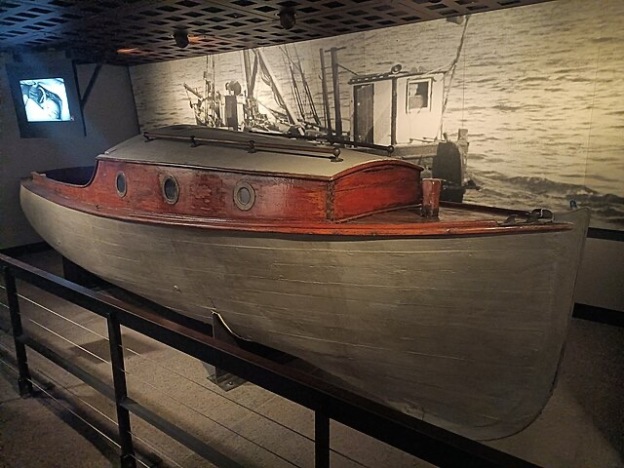
Photo: Danish rescue boat as displayed at Unitied States Holocaust Memorial and Museum, This particular example was used in the earliest operations for the evacuation of Danish jews organized by the Hilsingor Sew club know as the Kiaer Line. This boat carried 12 to 14 Jewish refugees on each trip to neutral Sweden. (USHMM; photo curtasy of Wikimedia Commons.)
SOURCES:
Thanks to Dr. Eric Erslev , professor emeritus, Warner College of Natural Resources, Colorado State University, for allowing me to share his family’s story.
A long-time fan of Jeopardy, I have even become more interested in recent months watching popular quiz show’s championship series that pits the best against the best.
Watching it with Larry, we enjoy playing along, supplying our own questions to the clues given in numerous categories. . As was true for the two of us in our Trivial Pursuit days, I do well in the arts and entertainment areas, especially literature. Larry does well in history, geography, and sports. We don’t do as well in the sciences.
I know that I will never be a Jeopardy champion. Nor do I even have hopes to come in second. My pressing that buzzer would be similar to my pressing a self-destruct button. It’s not only because I don’t have a head for all the trivia. I would also bomb out because of my misuse of words.
In response to the Jeopardy clue, “Company created by Steve Jobs that was sold to Disney in 1985,” I would offer “What was Pixie?” Another contestant would quickly supply the correct line. “What is Pixar.” I unfortunately would have no place to hide.
And Ken may completely lose it when my answer to “French singer famous for La Vin en Rosa” was “Who is Edith Pilaf?” Poor Ken would have to fight the urge to burst out laughing before getting the correct answer—“Who is Edith Piaf?”—from another contestant. “Yes,” Ken would comment, “We were looking for a name, not a rice dish that sings.”
I used to think my problem was mispronunciations. But it’s worse. I am guilty of using malapropisms. Malaprops, whose name come the eponymous character in Richard Brinsley Sheridan’s 1775 play The Rival, occur when one uses an incorrect word instead of another similar-sounding one, resulting in a nonsensical, often humorous sentence. An example of a malapropism is when someone says, “dance a flamingo” instead of “dance a flamenco.”
I come from a long line of “malapropists.” My father’s misuse of words bordered on Archie Bunker territory. And my poor mother was also guilty, The one that sticks with me was her using “orgasm” when she meant “organism.”
My own history of mispronunciations started young. In high school, my fiery rant about the radical “Storky” Carmichael. brought my fellow classmates to hysterics when I talked about that radical “I think you meant “Stokely,” suggested Mrs. Clute when the laughter died down. I was in college before I realized that Sigmund Freud and Sigmund “Froid”were one and the same Austrian psychologist.
My most embarrassing transgression came as an adult, when I walked into a garden shop in Upstate New York and asked for a well known pest spray.
“Can you tell me where I can find the Spermicide?” I asked the clerk.“Sorry, lady,” the clerk responded. “You won’t find any spermicide here, but I do have Spectricide.” I wonder if my request has become one of their favorite stories to retell again and again.
I join a long line of famous people whose malapropisms have become part of their history.Yogi Berra was so famous that his expressions ranked their own name, “Yogi-isims.” He once said, “He hits from both sides of the plate. He’s amphibious” instead of saying ambidextrous. In another instance, “Texas has a lot of electrical votes.” (electoral votes)
Yogi may have made such “errors” an art, but other legendary historical quotes were—well—hysterical.Australian Prime Minister Tony Abbott once stated that no one “is the suppository of all wisdom” instead of saying repository or depository. Chicago Mayor Richard J. Daley incorrectly referred to Alcoholics Anonymous as Alcoholics Unanimous and called tandem bicycles “tantrum” bicycles.
More recent American politicians have faced ridicule for their public gaffes. President George W. Bush famously stated “The law I sign today directs new funds… to the task of collecting vital intelligence… on weapons of mass production” (destruction). In 2022, Republican Senate candidate Herschel Walker was mocked online after claiming “this erection is about the people” (election), during an interview on Fox News. Congresswoman Marjorie Taylor Greene has also been excoriated for her misuse of words, including references to “peach tree dish”(petri dish) and “gazpacho police”(Gestapo), and “fragrantly violated. (flagrantly), among others.
President Joe Biden also has been mocked for his verbal missteps. On March 31, 2024, he asked all his guests at the annual Easter Egg Hunt say ‘hello’ to oyster bunnies.” He famously mixed up the names of world leaders with their (deceased) predecessor, referring to French President Emmanuel Macron as Francois Mitterrand and German Chancellor Angela Merkel as Helmut Kohl. But he knows it. ”I am a gaffe machine,” admitted Biden in a 2018 speech.
And then we have Donald J. Trump. In a a research paper published in 2020, Dr. Sajid Chaudhry examined 500 viral tweets posted on Twitter by the former president. Along with the hundreds of misspellings of common homonyms (waist/waste; boarder/border; taxis/taxes; eminent/imminent; Barrack/Barak), the paper cited numerous malapropisms, including references to a “Smocking Gun” and a claim that the media said that he wanted “a Moot stuffed with alligators and snake” at the Southern border. “The way he mangles words,” states Dr. Chaudhry at the end of his report, “ it looks like the ghost of Mrs. Malaprop haunts his vocabulary.”
So, it looks like I am not the only one who may experience major failures on Jeopardy. I take solace in my limited knowledge of Yiddish and Hebrew, which means I know not to call our Passover meal a “cedar,” our beautiful braided egg bread a “CHA-lah,”and our Day of Atonement “Yam KIP-per.”
My personal favorite malapropism was spoken by a non-Jewish friend when she asked how I met Larry.
“We met at a Purim party,” I said.
Dead silence. Long pause.
“I can’t believe you are so open about your meeting your husband at a PORN party,” my friend said incredulously.















 There Goes My Heart