Author Archives: Marilyn Shapiro

Unknown's avatar

About Marilyn Shapiro

After thirty five years in education, I have retired and am free to pursue my lifelong dream of becoming a freelance writer. Inspired by my mother, who was the family historian, I am writing down my family stories as well as publishing stories my mother wrote down throughout her life. Please feel free to comment and share.

Growing Up in Coney Island by Frances Cohen

I have published this blog on September 1, 2024, what would have been Frances Cohen, my mother’s 107 birthday.

I spent most of my early childhood in Coney Island. I loved living in that special section in the New York City borough of Brooklyn, especially during the summer.

We did not have many of the conveniences that we have today. Rather than a refrigerator, we had an icebox. The iceman delivered ice every other day. We
had a pan under the ice box. When we forgot to empty the pan, there would be a
huge puddle on the floor. There were no supermarkets, just local grocers. Milk,which was not homogenized, was purchased from the grocer. It was stored in a large metal buckets and ladled out. As the ladle was often left out with the milk uncovered, flies and roaches swarmed around the bucket. Mice licked the ladle until they were chased away by the store’s resident cat. When we brought the milk home, the cream was on the top, and my mother would make whipped cream with a hand beater. I grew up before radios, washing machines, dryers, and dishwashers. Even toilet paper was yet to be invented. We used orange wrappers and pages from the Sears catalog.

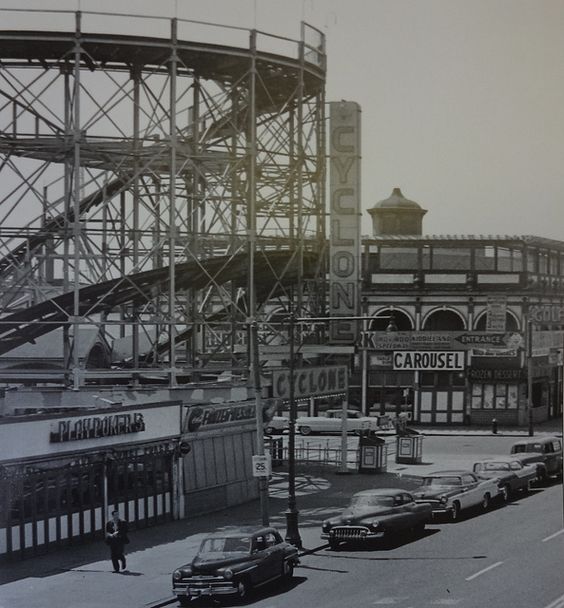
I lived two blocks from the beach and the boardwalk. I loved to go swimming in the ocean and walking the boardwalk. We had two big amusement parks within walking distance, Luna Park and Steeplechase. I preferred Luna Park as it had a circus. It was such fun watching the clowns, the animals, and especially the men and women on the trapeze. Nearby was the famous Nathan’s hot dog stand, where we could buy a hot dog with sauerkraut for five cents.

As there were no televisions, we went to the movies every Saturday. For ten cents, we saw a double feature along with newsreels, a serial, and cartoons. We bought a penny’s worth of candy and enjoyed the entertainment. On rainy days, we stayed indoors, drawing pictures with crayons and reading books from the library. We did not have as many toys as our grandchildren and great grandchildren have today, so we improvised. My brother made a train out of drawers from my father’s Singer sewing machine.

As all little girls, I loved to play with dolls. My mother had bought me a small celluloid doll with moving arms and feet that I could even bathe. I wanted a new doll carriage, but we were in the midst of the Great Depression, and my parents could not afford to buy me one from the store. So, we became creative. A shoebox became my doll carriage. My mother made a hole at the end of the shoebox and put a string through it so I could pull the carriage. The top of the box became the hood. She also gave me scraps of material which I made into a pillow, a carriage cover, and clothing for my doll. With a child’s imagination, I thought that my doll and doll carriage were the most beautiful in the world.

It was convenient to live near the beach, but my neighborhood was not the best. It was all pavement—no flowers and no lawns. One summer, my second-grade teacher thought it would be a good summer project to learn how things grow. The last week of school, she had us bring in a small wooden cheese box and a small potato. She helped us put the dirt that she supplied into the bottom of the box. We cut up the potato, placed it in the dirt, and then covered the potato with more dirt. I placed the potato plant on the fire escape and watered it every day. In July, I was happy to see some green leaves. My parents and teacher had never told me that potatoes grow underground. So, when August arrived, I got so angry that no potatoes had grown on the leaves, I just dumped the plant. I was so surprised to find four little potatoes!

Looking back, I had a very happy childhood. Although we did not have much money, I never felt deprived!

page30image60310128

My Mom the Story Teller

Ever since I could remember, my mother, Frances Cohen, was the family story teller. Give her an opening, and she would regal any audience with stories of her grandparents’ and parents’ lives in Russia, of her early years of marriage to “My Bill,” of their life in small towns and smaller apartments in the North Country, and of raising four children, watching them leave for college and for marriage, and their returning with her grandchildren to visit her and my father in their beloved cottage on Lake Champlain.

For many years, these stories were always told orally. Mom shared them when the family got together around the old oak table in the dining room, when she visited friends, and when her children’s friends came to visit. What was fascinating was that no one ever got tired of hearing them.  As a matter of fact, she was highly regarded as the family historian.  If anyone needed to know who was related to whom and how my father’s side was related to my mother’s side and what really happened between those two cousins—well, you just had to ask Fradyl, and the truth would be known.

As my parents got older, my mother realized that she needed to record these stories.  We never were one for video cameras and tapes, so she began writing them down on lined paper, usually from the six by eight notepads. .  The writing was messy, with words misspelled and whole sections crossed out, but she began to put them down on paper.  

My parents retired in 1981 and spent the next nineteen years living six months in Florida and six months on a cottage on Lake Champlain.  As it became too difficult to maintain two homes, they sold their cottage to my brother and sister-in-law, and my parents lived in Florida permanently.  When I went to visit, my mother would tell me the stories as I transcribed them onto paper.   Unfortunately, these scraps of paper remained in their original state for several years.

In 2007, after a number of health setbacks, we children insisted that my parents sell their condo in Florida and move back up North to be closer to the family.  Everyone decided that the best location would be close to Larry and me, and on May 1, 2007, they moved into Coburg Village, an independent living facility only four miles from our home.

Initially uncertain about leaving Florida, their friends, and their independence, my parents soon realized that this was an ideal living arrangement that provided nightly five-course dinners in a lovely dining room, a shuttle service that brought them to grocery stores and doctor’s appointments, live entertainment and numerous clubs.

Soon after moving in, my mother called me to tell me she was joining Coburg’s monthly writing group to polish all those stories she carried in her head and on those scraps of paper.  The night after her first meeting, however, she phoned to tell me she wasn’t sure she would fit in.  “Most of them have college educations and write beautifully, Marilyn,” she lamented.  “They will look down on my family stories as being silly and boring.” However, when she brought her first story to the group, her accounting of why she and my father moved to Coburg, she was surprised to find that the group enjoyed her writing style.  “They loved my story, Marilyn! They said I have a real flair for story telling!” After that, my mother’s voice in phone calls after the monthly Wednesday meetings was filled with pride.

Mom rarely had difficulty finding a topic and writing it down with paper in pen. However, the group leader requested that the stories be typed so they could be published in the semi-annual collection and distributed to Coburg resident.  My mother asked me, “my daughter the English major,” to type them, and, while I was at it, to do some proofing and minor revisions so that they would read more smoothly. 

Thus began our five-year collaboration.  Every month, about a week before the group met, my mother would give me her hand-written story, and I would bring over the typed version by Sunday afternoon.  If I didn’t have it done by Sunday night, the phone calls would begin.  “Marilyn, if you don’t have the time, just bring back my copy and I’ll read it from the original.”  I would assure her that it would be delivered in time for her meeting, even resorting to sending the final copy to her via the Coburg fax machine.

The oral stories evolved into written documents, always original, always entertaining. She wrote about the Old Country: how her mother’s mother died in childbirth and how the two children were raised at first by an uncaring stepmother and then by a loving women who raised them and the seven others that followed; how my father’s father escaped from Russia in a cart filled with hay; what it was like living in Regalia and Vilna at the turn of the century with the fear of pogroms always on the Jewish population’s mind.  She wrote about her mother’s family coming to America:  how her Uncle Sam saved enough money to bring over his sister Ethel; how Aunt Lil turned down a job at the Triangle Shirt Factory a month before the fire because she thought it looked unsafe; how Grandpa Joe left his future bride at the jeweler’s as collateral until he got a second opinion of the diamond ring they were purchasing.   And she wrote about our family: how she and Bill met on a blind date; how they raised four children in various small towns in the North Country, and, and how they came to buy their cottage on Lake Champlain.  The stories were funny, sad, and painful, but they were always ready the first Wednesday of every month for her meeting.

When my father passed away in November, 2008, my mother’s contribution for December was an open letter to my father. She wrote that she was moving into a smaller apartment down the hall, but “Wherever I go, you also go in spirit.” Grieving quietly, she continued with her life at Coburg, going to the concerts, visiting with friends and family who were always stopping by to see her, and continuing with her writing.  All of the children asked her to write about our birth and early childhood, but she always postponed those stories, focusing on the Old Country, her childhood, her Bill. 

On December 22, 2010, my mother had a heart attack. The doctors recommended Hospice and living her remaining time to the fullest.  She complied, enjoying visits from the children, grandchildren, her cousins, and the many friends she had made in Coburg and Clifton Park. She kept writing, and in February, with my sister Laura and I sitting close by, she shared her story: “The Birth of My First Child,” in which she described her joy in having a beautiful little girl and her fears that she would not be able to be a good mother.  The last words, written in pencil on the bottom, were “To be continued……” She died four weeks later, one day before the March meeting.

My parents were not wealthy people, and had little of material value: a wedding ring, two beautiful framed pictures of my father at thirteen and my mother at six, a few nice dishes.  As my siblings and I sadly dismantled Mom’s apartment, my daughter was surprised that I wanted so little.  “It’s ok, Julie,” I said, “We have her stories.”

And we do….Over one hundred typed pages as well as a file of her handwritten notes that she had kept over the years. What a gift to her family, her friends, and all who knew and loved this amazing woman!

Holding on tight to my Jewish roots….

Since the year that we met, my husband Larry and I have attended Rosh Hashanah—the Jewish New Year—services. We hear the shofar, listen to melodies that we only hear on the High Holy Days, and greet our friendswith L’Shana Tova—Have a good year!

Attending High Holy Day services as an adult is different from my experiences as a child growing up in Keeseville, a small upstate town of two thousand people about ninety minutes south of Montreal. My uncle Paul had opened Pearl’s, one of a chain of small department stores he had established in Vermont and Upstate New York. He hired my father to manage it. Although my parents had both grown up in New York City in Jewish neighborhoods, they had lived most of their married life in overwhelmingly Christian communities. In 1952, however, they found themselves in a town where they were the only Jewish family except for a childless couple, a lawyer and his wife. The next Jewish family didn’t move in until the mid-sixties. 

To offset the effects of our non-Jewish environment, my parents immediately joined Congregation Beth Shalom, a Reform temple in Plattsburgh. We attended High Holy Day services and, depending on the weather conditions for the fifteen-mile drive, Shabbat services on Friday night. Saturday services were only held for the boys’ bar mitzvahs; all the girls were confirmed at age sixteen.

In addition to attending services, my parents were insistent on their children getting a Jewish education. For a span of twenty years, our father made the trip up Route 9 every Sunday with whatever number of his children between the ages of five to sixteen were taking religious school lessons. We would arrive in Plattsburgh a half hour early. Then Dad would take us to the newsstand across the street from the temple on Oak Street. He purchased the New York Times for himself and comic books for us, our perk for going to Sunday School. My brother Jay chose Superman; Laura and Bobbie, Archie and Richie Rich; and I, Classics Illustrated. Dad would then wait for us in his idling car —It got cold in that parking lot in the winter—reading the paper and smoking Kents. Over the years, all of us learned Jewish history, customs, and ethics. Jay learned Hebrew for his bar mitzvah. The three of us girls’ Hebrew education was limited to the six-word Shema and blessings over bread, candles and wine. When we got home from school, Mom would have an elaborate dinner waiting for us—brisket, roasted potatoes, candied carrots, pickles, and delicious spiced apples from a jar—another perk for our going to Sunday school. 

As residents of Keeseville and members of a temple in Plattsburgh, we were caught between two worlds. As we did not live in Plattsburgh, we often viewed ourselves as outsiders at Temple Beth Israel. My mother, in particular, did not feel comfortable with many of the congregants.  A daughter of poor Russian immigrants, she often felt inferior to those who were third or fourth generation German Jews who historically regarded themselves as more educated and refined than those from the shtetls—the small towns with large Jewish populations which existed in Central and Eastern Europe before the Holocaust.

The residents of Keeseville were generally welcoming to our family, and we rarely experienced anti-Semitism. There were moments, however, that are etched in my memory. My parents were usually included, but there were occasional “lost” invitations to events, and we knew some viewed us as different. On rare occasions, the insults were more direct. When I was around six years old, I was playing on my front lawn with my doll. A teenaged boy who lived up the street came by and, giving the Nazi goose salute, yelled “Heil Hitler!” I ran inside crying. Jay, four years older than I, ran out of the house to chase him down and punch him in the nose. When Jay was in high school, the local priest advised his young female parishioners that it was best not to date “Hebrews.” Obviously, this did not help Jay’s social life.

The High Holy Days emphasized this “otherness” even more strongly. We did not attend school on Rosh Hashanah and Yom Kippur.  My father closed the store, an event worthy of coverage in the Essex County Republican. Jay, who played football for Keeseville Central, missed every game that fell on the two major fall holidays, again newsworthy enough to make the local paper. 

Everyone in Keeseville knew that the Cohens celebrated their Jewish High Holy Days, but I was still sensitive to our being the only children missing school. One Rosh Hashanah, I was pushing my doll carriage in front of the house when I was overcome with embarrassment. What if someone saw me and wondered if I were playing hooky? I went inside to avoid the potential scrutiny and a visit from the truancy officer. 

My feeling of “otherness” continued as the seasons changed. Beginning in November,  I often had to explain that Chanukah was not the “Jewish Christmas,” and no, we didn’t have a Christmas tree or a  Chanukah bush. As soon as we returned to school from the Thanksgiving break, the music classes I attended and, later, the choruses I joined in junior senior high, were filled with Christmas music. I could handle “Little Town of Bethlehem” and “Deck the Halls.” When it came to the line in “Silent Night” which stated “Christ the Savior is born,” however, I would just mouth the words. The token inclusion of the song “I Had a Little Dreidel” didn’t make me feel that the school was sensitive to my religion and culture

Other events brought their challenges. Passover often fell around Easter, and I watched my Christian friends devour bunny shaped chocolate eggs and jelly beans while I nibbled on my dry matzoh and butter. Once again, I felt different. In high school, my World History textbook reduced the Holocaust to the iconic 1943 picture from the Warsaw Ghetto of a German soldier pointing his machine gun at a little boy, clad in a coat with the yellow star, holding up his hands in terror. I can still remember looking down and crying silent tears while the teacher quietly and sympathetically moved on to the next topic. I understood clearly that the horror of the persecution of the Jews was diminished by this negligible treatment of the Holocaust in our textbook.

For many years, I saw other Jewish children mostly at Sunday School. As I got older, I joined a Jewish youth group and finally had Jewish friends. For the most part, however, our friends were our Christian classmates from Keeseville. We all dated in high school, but my parents pressed upon us their wish we would leave Keeseville after we graduated and make our lives in settings with more Jewish people. 

In part because of my desire to be with other Jews, I enrolled in University of Albany in 1968. While at college, I attended High Holy Day services at Congregation Beth Emeth, but that was the extent of my Jewish participation until I met my future husband in 1973.

Larry and I attended High Holy Day services at Congregation Shaara TFille, the then-Orthodox shul—synagogue—in Saratoga to which his family belonged. What a dramatic difference for me! Men sat in the center pews, and the women, although not behind a mehitzah, (a curtain which separated the men from the women), sat in the back or on the sides. Most of the service was in Hebrew, and everyone prayed at what seemed to be lightning speed. Page numbers that were displayed on a chart on the bima provided my only means of following along with the prayer book. The services were much longer than those at Temple Beth Israel, and even the rabbis, with their black beards, payots (side curls), and yarmulkes (skull caps), were strange to me. In many ways, it was as foreign to me as the churches I had attended on occasion with my Christian friends.

After Larry and I were married, we bought a home in Clifton Park, a suburb of Albany, New York, in part because we knew that a synagogue had recently been built in the community. We joined in 1983, and we found that the Conservative service was a good compromise between Larry’s Orthodox shul and my Reform temple. Ten years later, I celebrated my own bat mitzvah on my father’s eightieth birthday, my way of honoring his commitment to our Jewish education. 

Throughout my life, people assume that I, like many Jews, was brought up “downstate,” in New York City or Long Island. When I tell them about growing up in Keeseville, they comment, “That must have been hard!”

It had its challenges, but it also offered wonderful opportunities. I grew up in a loving, close knit family, developed lifelong friendships, and enjoyed the beauty of Lake Champlain and the Adirondacks. I proudly identify myself as an Upstate New Yorker, with roots still entwined in that tiny town an hour south of the Canadian border. 

Because of my unique upbringing, rather than losing my Jewish identity, my faith grew stronger. I could never take being a Jew for granted. And having a faith I had to hold on so tightly to maintain makes each High Holy Day, each Jewish milestone, even sweeter.

A version of this story was published in The Jewish World, August 29, 2013. I am finally posting it on my blog eleven years later!

Marilyn and Larry Rosh Hashanah 1973 (Shh! We were engaged but didn’t tell anyone yet!)

Was It the cabbage soup? How one romances a nice girl in 1912.

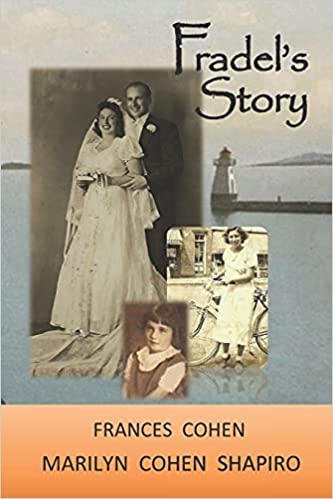
This story was written by my mother, Frances Cohen. A master storyteller, Mom joined a writing group when she was 87 years old. This is one of her many tales about her life captured in Fradel’s Story, available on Amazon in both Kindle and paperback format. Click here for the link. I have posted this on August 20, 2024, which would have been my parents’ 74th anniversary.

They say that all marriages are made in heaven.  My parents also had help from my Grandma Vichna.

My mother Ethel was the oldest daughter of nine children, who all eventually immigrated to the United States from a small hamlet called Rogala, which was part of Lithuania.

Joining the wave of Jewish immigrants who came to the United States at that time, Ethel, only fourteen years old, arrived at Ellis Island in 1899.  It was the era of horse and buggy.  Garfield was president of the United States.  It was quite an ordeal for a child to leave her parents, cross an ocean by steerage and then find a way to support herself.  But with the help of her older brother Sam, who had come to America a few years earlier, Ethel settled in New York City, got a job, and lived with different relatives.

Two years after Ethel arrived in America, Ethel’s older brother Sam married and moved to Baltimore.  My mother was really struggling, as she worked in a factory making umbrellas for only three dollars a week.  So her brother and his wife invited her to come and live with them in Baltimore.  While Ethel was living in Baltimore, four more of her siblings arrived in the United States.

In 1910, Ethel’s father passed away and the six children who had settled in the United States saved up $75 to pay for steerage for Grandma Vichna and the three youngest children.  The four of them settled in the Lower East Side of Manhattan.

  It was a very difficult time for Grandma.  She was in a new country, not knowing the language or the customs.  But Grandma was an amazing woman and kept her family afloat.  And with all her problems, she was most worried that her Ethel was 27 years old and not married.

Every Sunday, all the friends from the Old Country would love to congregate at Grandma’s as she was an excellent cook.  One day, a young man by the name of Joseph Cohen came to visit.  He told Grandma that he had a job in a factory as a tailor making $13 a week, a good wage at that time, but was lonely and sleeping at his sister’s on a cot.  Grandma said, “What you need is a wife, and I have just the girl for you….my Ethel!”

The problem was that Ethel was living in Baltimore, but that situation was soon solved when Joseph courted Ethel by writing letter and traveling the long way to visit.  Ethel eventually returned to New York City to live with Grandma and be closer to Joseph.

And so the romance continued to blossom.  Every Sunday, Joseph came to visit to see Ethel and to feast on Grandma’s cabbage soup and other goodies.  Joseph bought Ethel a warm winter coat and other presents.  (Later I would tease my mother that she was a kept woman!).  After courting Ethel for several months, Joseph took Ethel to the jeweler and they picked out a diamond engagement ring.  Wanting to make sure the price offered was fair, Joseph left Ethel for security so he could have the ring appraised, returned soon, and purchased the ring for $100.

Soon, Grandma Vichna was busy arranging a big wedding for her Ethel.  In 1912, one could rent out a banquet hall for a big event.  The host didn’t pay for the hall, but everyone who attended had to pay a 25-cent “hat check.”  All the friends from the Old Country helped cook up a storm, and my parents were married in January 1912.  

The week after my parents were married, my mother made a cabbage soup.  My father said, “Ethel, please dot no make cabbage soup.  I am tired of cabbage soup.  I don’t even like cabbage soup!”  My mother replied, “You always thanked my mother for her delicious soup.”  My father replied, “It was the proper thing to do.  I didn’t like the soup!  It was my way of saying thank you for giving me a lovely bride!” 

Ten months after the wedding, my brother Eli was born.  I followed in 1917.  My parents shared over fifty-four wonderful years together until my mother passed away in 1966 at the age of 82. Bereft, my father left New York City came North to live with my family until he joined his beloved Ethel in 1968.

A version of this article originally appeared in the Jewish World News, a bi-weekly subscription-based newspaper in upstate New York.

Grandma Ethel and Grandpa Joe ~1950. I love the love seen in my grandfather’s eyes.

A Turkey-infused Concert Experience

As we have done since our Mountain Girl was born in 2015, Larry and I are enjoying time in Summit County, Colorado, where we rent each summer to escape the Florida heat and to enjoy family time.

Each summer, we look forward to attending performances of the National Repertory Orchestra. Eighty young professional musicians are selected for the summer symphony orchestra. Along with performances at the Riverwalk Center in Breckinridge, the talented performers participate in free “pop-up” concerts offered throughout the county. We have fortunately been been able attend several NRO events throughout our stay.

On July 8, 2023, Larry and I brought our then eight-year-old granddaughter to her first concert performance, the NRO’s pop concert. Rather than classical music, the pop concert includes lighter fare, including songs from Broadway and the silver screen. In the days before the event, we explained to her about the protocols for the concert: her need to sit quietly, to be attentive, to applaud at appropriate times, and to avoid any actions that would distract from other concert goers. Outside of asking if there would be a ‘half time’ (she and her father are huge Denver Nuggets fans), our Mountain Girl was well prepared. She even stood up and yelled “Bravo!” at the appropriate times.

The same could not be said for the eighty-something man that occupied the seat next to her. He and his younger companion settled in moments before the concert began. During the opening number, the rousing theme from the Raiders of the Lost Ark, the gentleman opened up a plastic shopping bag, rustled some smaller plastic bags, and took out a chunk of turkey. He gnawed on it through Raiders and continued through Jaws. By the third number, my beloved theme from Schindler’s List, the smell of turkey was wafting around us. During Star Wars, he added another noisy addition to his repertoire: a chocolate chip cookie. At least its delicious aroma masked the turkey.

I was not the only audience who was annoyed. The woman in front of me had turned around several times to give the evil eye to the offender. He was oblivious.

At “half time,” I complimented our granddaughter on her behavior and also quietly explained that the turkey- touting twit to her left was NOT a typical concert goer. As she and “Zayde” headed to the concession stand, the elderly gentleman and his companion also left for a break.

Leaning forward, I tapped the shoulder of the woman in front of me. “I noticed that you too were disturbed by that man’s behavior,” I said. 

“I am the conductor for a Nevada high school orchestra,” she said. “I’ve never encountered such rudeness!” She headed off to find an usher so there was no repeat performance during the second half of the program. 

While she was searching for help, the two gentlemen returned. I overheard the younger man’s commenting on his companion’s ill-timed dinner, especially calling out the fact that the smell of turkey had permeated our entire section.

“No worries!” he exclaimed. “During the second half, I brought these individual apple sauce containers with pop-off tops that won’t smell as much.”

At this point, I lost it. “No!” I yelled. “You are not going to take another bite! We brought our eight year old granddaughter to her first concert with rules as to what was expected of her. Your chomping away at turkey and cookies and rattling plastic bags has set a terrible example! No more food!” 

Luckily the man actually listened. He didn’t pull out as much as a breath mint during the second half. We got to enjoy the themes from The Wizard of Oz, The Lion King, and The Godfather in peace. And we were able to fully enjoy selections from Fiddler on the Roof, especially when a clarinet solo by the conductor included he sounds of the shofar— Tikiah! T’Ruah! Shevarim— the section played by the illustrious Issac Stern in the movie version. of the JerryBock/Sheldon Harnock classic.

Later in the season, we took our granddaughter along with her parents to a performance of The Lion King. The Disney animated classic was shown in its entirety on the big screen above the orchestra as 80 musicians, lead by conductor Jason Seber, performed the score in precise timing with every scene.” Once you watch a movie accompanied by the power of a live orchestra, you’ll be spoiled for life,” wrote Shauna Farnell in an NRO article in July 2023. She was right. We loved it!

During intermission, I was talking to an usher and in passing mentioned I was enjoying this concert without the disturbance of any meals outside of what Simba and Nala were eating. The usher was fully aware of the July 8th kerfuffle, as she herself was monitoring the activity in Row H after the high school music teacher had complained. 

Although she was unable to attend this year’s Pops concert, our Mountain Girl was she joined us for the NRO’s showing of Star Wars: The New Hope, again replete with the symphony lead by Jason Seber replacing the entire musical score. The Force was with us, as we enjoyed every minute. 

Sources

Farnell, Shauna. “The National Repertory Orchestra presents Disney’s ‘The Lion King’ in Concert Live to Film.” www.nro.org website. July 23, 2023.

Photo courtesty of Wikipedia Commons

Pressing Questions

When one is looking for a home in today’s market, one of the featured perks is the laundry room. Multi-functioning washing machines and dryers, fancy cabinetry,  shining stainless steel sinks, and granite countertops appear to make Wash Day a joy. What a contrast to the way my mother handled the laundry in Upstate New York in the 1950s!

In 1952, my family moved into a two-story house in Keeseville that had been built at the turn of the century. Compared to the 1200 hundred square foot “box” we had lived in Potsdam, the four bedroom Victorian with its large living and dining rooms, ancient but large kitchen, office, a large unfinished room off the kitchen, and three (!) porches must have felt like a castle. 

Our laundry room, however, was more like a dungeon. Out of necessity, the the wringer washer had to be set up in the basement, a dark, damp room with dirt floors, old stone walls, and a small window that looked out to the crawl space under one of the porches. A single hanging bulb provided the only light. 

With two adults, three children —including one in cloth diapers—and lots of company, my mother had plenty of laundry. The wonders of polyester and wash and wear were still several years away. Either clothes were dry cleaned or “put through the ringer.” After a scare when my older sister Laura got her arm caught in the wringer mechanism,  the old machine was replaced with a more modern top loading model. My mother must have thought she was in the lap of luxury. 

Electric dryers had not yet found their way to Upstate New York, so all the wash had to be hung to dry. Mom carried the wet laundry up the steep basement stairs, walked through the kitchen and through the door to the back of the unfinished storage room. She opened a large window and hung the clothes from a thirty-foot clothes line that was attached by a pulley system. One end was attached to the house and the other end to oak tree that marked the far right corner of our property.

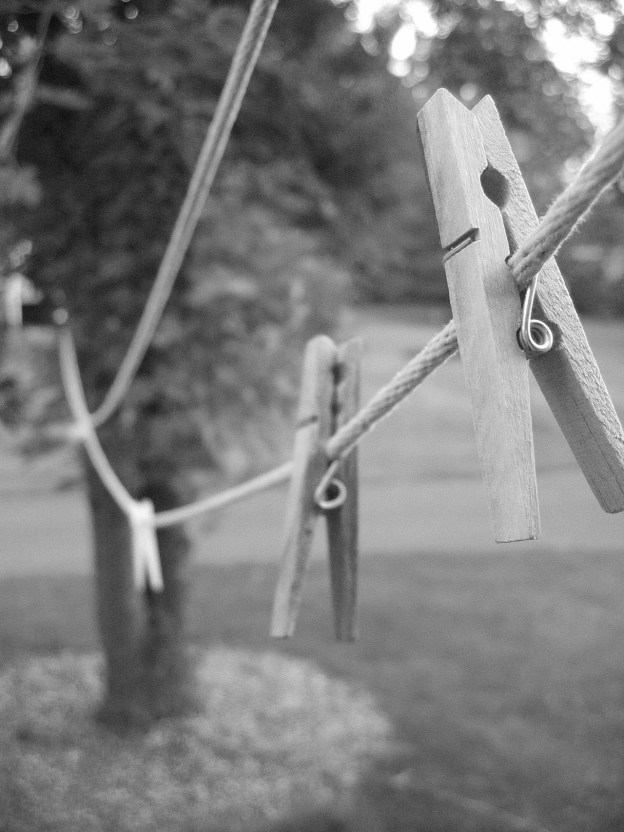
During the good weather, sunshine and warm breezes would quickly dry the sheets, pillow cases, towels, diapers, shirts, pants, dresses, and underwear that hung ten feet above our backyard.  If an unexpected rain storm came through, Mom would have to quickly pull everything off the line and hang them over available chairs and radiators to finish the process. During the long winter months, cold air poured into the unheated room as Mom, fingers red and raw, pinned the laundry to the line with the wooden pins. If the snow was too frequent, she resorted to hanging the laundry in the basement.

On the good days, Mom pulled the line of dry clothes towards the house, unpinned  the items, and piled them into waiting laundry baskets. The cotton fabrics would smell like fresh air and sunshine but would feel more like stiff boards of wrinkled matzoh. 

As a result, almost everything had to be ironed. Mom filled an empty soda bottle with water and stuck an aluminum and cork sprinkling head into the top. She lay out each item of clothing on the kitchen table, sprinkled the material well, rolled it up, and placed it in a laundry basket. She let all the dampened clothes sit awhile so the moisture would be well distributed. If she was afraid of mildew, she stuck the clothing into the large freezer chest that was housed in the shed.

When she and the clothes were ready, Mom set up the ironing board in the kitchen, plugged in the iron, automatically licked her index finger on her tongue, quickly touch its wet tip to the bottom of the iron to check the temperature, and then pressed the steaming metal plate into the fabric. Taking each damp, rolled piece out of the laundry basket, she ironed for hours while listening to the songs of Frank Sinatra, Patti Page, and Tennessee Ernie Ford on WEAV-AM out of Plattsburgh. The kitchen would be filled with the sound of sizzling clothes and the smell of hot metal against the damp cotton.

The laundry increased with my sister Bobbie’s arrival three years after our move. By the time she was out of diapers, my parents had purchased a clothes dryer. Her lap of luxury had grown.  Pink boxes of Dreft and plastic bottles of Clorox sat on a brown metal table between the two appliances, along with yellow bars of Fels Naptha soap, stray buttons, and assorted painless missing socks. 

The clothes line was only used on beautiful summer days as Mom still loved the smell of sunshine and fresh air smell on the sheets.

There was still a great deal to be ironed, so my mother gave her children pressing lessons lessons at an early age. Starting with relatively easy handkerchiefs and pillow cases, we soon progressed to pants (“Make sure the seams are straight!”) to shirts and blouses (“Start with the back and progress to the front and sleeves.”) to dresses.(“First do the bottom skirt, pushing the iron gently but firmly up to the waistband.”)

I don’t recall my father never helping with laundry his entire life, but Larry has been by my soapy side since our apartment laundry room days. Once we moved into a house in Clifton Park, we set up an ironing board next to our washing machine and dryer in our basement/laundry area.  To this day, he washes our bedding every week  and does most of the laundry, including a weekly sheets and towel load.(Another reason I love him!)

Our Yes!-We’re Retired! Florida wardrobe doesn’t require extensive pressing. No matter, at least twice a month, I  pull out the steam iron and the  twenty-year-old ironing board. I spread our shirts and blouses and pants and handkerchiefs one by one on the ironing board. I wet each item with distilled water from a plastic spray bottle, automatically lick my index finger on my tongue, quickly touch its wet tip to the bottom of the iron to check the temperature, and then press the steaming metal plate into the fabric. I hear the familiar sizzle, and I breathe in the distinct aroma of cloth and water and and heat and traces of laundry detergent. I am happy knowing that our clothes will be pressed and ready to wear—just like my mother taught me sixty-five years ago. 

Photo by Michael Jastremski courtesy of Wikimedia Commons.

A version of this story was originally published in The Jewish World in July 2017. As it fell throuugh the cracks, I have added it to my blog seven years later.

Another meaning to “Through the glass darkly”!

In ancient times, Jewish brides may have brought into marriage a nedunyah, or dowry, “those assets of the wife which she of her own free will entrusts to her husband’s responsibility.” This could take the form of money, slaves, or cattle. As Larry and I look forward to our fiftieth anniversary this fall, I reflect back on the “dowry” I brought into our marriage: a collection of Warner Brothers Looney Tunes glasses. 

Larry and I announced our engagement to our families on October 6, 1973. Fresh out of graduate school, Larry was working at his parents’ store, Shapiro’s of Schuylerville, making an astounding $78 a week. Meanwhile, I was in my second year of teaching high school English in a suburb of Albany, with a starting salary of $5200

 We obviously were not coming into this marriage as “well off.” But we had a plan for starting our new household. Who needed a wedding registry, where we could list china and silverware that we could never use? I just needed to stock up on free glassware from the nearby hamburger joint. 

My apartment in Rensselaer, New York, was a short distance up Route 9 from a Carrols. The burger chain, which was founded in 1960 in Syracuse, New York, by Herbert N. Slotnik, was viewed as “incredibly popular as an alternative to 

McDonalds,” with over 150 outlets, mostly in upstate New York and Pennsylvania.

During our engagement, Carrols was running a promotion sponsored by the Pepsi Corporation. For the price of a large soda product, each customer received a Looney Tunes glass with Warner Brothers’ characters painted on the outside. Daffy Duck! Bugs Bunny! Elmer Fudd! And, over the course of several months, fifteen more glasses were released. My quest was to get all eighteen options, which was a great deal of Diet Pepsi. 

Each week, whatever day the newest one was up for sale, I would stop by, order a Diet Pepsi, slurp it up, and then bring the prize home. To be honest, I can’t even remember if I purchased the their signature Club Burger! Six glasses in, I wasn’t even bothering to drink the soda. I dumped it out, wash out the glass when I got home, and tucked it away in a cupboard.

After our September 1974 wedding, we moved into our tiny apartment in Guilderland. Thanks to a bridal shower and gifts, we had a kitchen stocked with a Corelle dinnerware set for eight, Oneida silverware, Farberware pots, and several pieces of the classical Corningware with the blue flowers. And, thanks to Carrols, we had over two dozen Looney Tunes glasses, many with duplicates. 

We did receive a lovely set of glassware from Tiffany’s, with an S engraved on each one. They went onto the top shelf of our apartment’s galley kitchen. Why would we use those when The Roadrunner and Wile E. Coyote could fight it out at our tiny kitchen table? Beep! Beep!

Bugs and the Gang came with us to our first home and, two years later, to our second. By the time he was five, Adam was old enough to graduate from sippy cups to Sylvester. Julie progressed to Petunia Pig three years later. Of course, a few met their untimely death on our kitchen floor, but we managed to hold on to many of them. About fifteen years ago, I found some replacements at a secondhand store. Again, more were lost to breakage, but we still had five remaining when we made the move to Florida in 2015. 

By then, the painted characters had faded, and the glasses were cloudy. The former owners of our Kissimmee home had left a set of glasses in the cupboard, and we opted to use those for every day use. Our Looney Tunes treasures only came out on special occasions, and we only lost one over eight years, until the college football playoff in January 2023.

We had met our friends Joel and JoAnn Knudson, from a tiny town in North Dakota, many years earlier at a Jamaican resort. That began a close friendship that we maintained through a few more trips to Jamaica, a visit they made to Albany just before Hurricane Sandy, and time together in Florida. We were thrilled when they purchased a home in our 55+ community. 

Soon after their move, the Knudsons, lifelong fans of North Dakota State University’s football team, were looking forward to the January 5, 2023, championship match between their beloved Bisons and their arch rivals, South Dakota State University. As their television set hadn’t arrived yet, we invited them over to watch the game on our big screen. 

At the end of the first quarter, the two teams were tied 7-7. By halftime, however, NDSU was behind 14-7. Time for refreshments! We replenished the chips and dip. I offered Joel a cold beer in one of our favorite Looney Tunes glasses, Bugs Bunny. 

“Get that @#?$ jack rabbit out of here!” Joel yelled. 

How was I supposed to know that the SDSU’s mascot was a jackrabbit??

I quickly transferred the Yuengling into a less threatening Elmer Fudd. According to Joel, however, the damage was done. The Bisons faced a blistering 45 to 21 defeat by the despised Jackrabbits. The Knudsons went home disappointed; both Bugs and Elmer went into my dishwasher to see another day. 

Two days later, I was reading the newspaper on my kitchen counter.. As I turned the page, my hand brushed against my glass of iced tea. Seconds later, our beloved Bugs Bunny met his demise on my tile floor. Larry and I refer to it as “The Knudson Curse.”

Recently, with our Looney Tunes supply down to four glasses and the former owners “gift” set of glasses etched with cloudiness that no amount of Cascade or vinegar would remove, I pulled down the Tiffany glasses we got for our wedding. “What are we saving them for?” I asked Larry. After fifty years, the beautiful set are being used for everything from an orange juice to an Old Fashioned.

In retrospect, using that now collector’s set of Looney Tunes was not such a great idea. According to Tamara Rubin’s Lead Safe Mama webpage, tests run on athe paint on a sample Looney Tunes glass revealed that it contained 71,800 parts per million of lead, 800 times more than the 90 ppm considered unsafe for use! “Please do NOT let children in your life use them,” Rubin wrote in her 2/19/2019 article “I personally would not use something like this in my home for any purpose!” Yikes! For fifty years, I had been exposing my family and friends to high contents of lead, caladium, and arsenic. To quote Sylvester, “Thufferin’ Thuccotash!”

What happened to Carrols? By the mid 1970’s, Slotnick saw the writing on the wall as competition by sheer numbers from McDonalds and Burger King dwarfed his company. “He figured if you can’t beat ’em, join ‘em,” Alan Morrell wrote in a 10/25/2021 article for the Democrat & Chronicle. Slotnick cut a deal with Burger King in which all his restaurants would be converted into the home of the “Big Whopper.”

But the Looney Tunes “vintage” glassware continue to thrive on internet, where collectors can pay anywhere from $16.99 for Porky Pig on Amazon to $300 for a complete set of 18 on Ebay. I say, I say, maybe my Foghorn Leghorn still has some life in him yet!

Sources:

Morell, Alan. “Rochester loved the Looney Tunes glasses and Club Burger. Whatever happened to Carrols?” Democrat and Chronicle. October 25, 2022.

Pacheco, George. “Top 10 Most Iconic Looney Tunes Catchphrases.” Watchmojo.[Date unknown]

Rubin, Tamera. “1973 Warner Brothers Pepsi Collector Series Daffy Duck Drinking Glass: 71,800 ppm Lead (90 ppm is unsafe for kids.)” Lead Safe Mama. February 19, 2019.

Larry and I on our wedding day in 1974.. Who needs fancy crystal when we have Looney Tunes glasses?

Magical Norway

Larry and I took a trip to Norway in 2018. Six years later, we still have wonderful memories of this magical country.

Norway was  simply magical for the twenty Solivita Travel Club members who visited the country in July 2018.  We toured cities but more importantly we savored Norway’s incredible countryside via bus, foot, ferries, and train.

On our first day in Oslo, our Globus group strolled through  Frogner Park, that had over one with Gustav Vigaland’s extraordinary statues that captured life from birth through death.

That afternoon, many of us took an excursion to three nautical-themed museums: unearthed Viking ships; the Framm, which carried  Roald Amundsen and his crew to the South Pole; and Thor Heyerdahl’s Kon-Tiki.  I won’t have traveled across Lake Toho in any of those vessels—thank you!

We toured the electric plant in Vemok, scene of the daring World War II sabotage action that delayed the Nazi’s ability to develop to atomic bomb. Bungee jumping was also offered, but our leader Jane Baker refused to set an example. Chicken!

Bergen lived up to its reputation as the rainiest city on earth—it rains over 240 days a year. Before the onslaught many of us were able to take the funicular up to the top of Mt. Fløyen, giving us stunning views of the fjords.Norway is famous for its love of trolls, even known to leave treats for these fairy creatures in front of their houses. One even gave Larry and me a hug on top of Mount. Fløyen,

We then climbed aboard the Flam train ride, described as one of the most beautiful train journeys in the world. The twelve mile ride took us from tranquil views of fjords long tunnels to impressive views of wild mountainsides and streams rushing down to the river far below in the deep, narrow ravine. We glimpsed one of the remaining medieval stave churches which captured Norway’s pagan roots through its dragon steeples

In Loen, we took the new Skylyft up to the top of Mount Hoven, at over 3600 feet. While Bill Dunne and Lenny Kirschbrown took four hours to hike down the 3600 foot mountain on switchbacks, the rest of us opted to walk the trails offering jaw-dropping views. Arlene and Phil Fortsch and Larry and I ate lunch at the top, but Arlene opted out of the views from the twenty foot plate glass windows that were cantilevered over a cliff. 

Our fabulous guide Peter called Norway the land of one thousand waterfalls, and we saw many of them cascading from dizzying heights throughout Norway.  On the ferry wide on the Geiranger Fjord, no less than seven waterfalls tumbled down cliffs measuring over 800 feet.  Near the waterfalls, Knivsflå, an abandoned farm, once housed a family that literally had to tie the children by ropes to the house so they would not fall down the cliff. 

After we hopped on the bus, our wonderful bus driver maneuvered switchbacks from sea level to over 5000 feet for panoramic views on the Geriagner Skywalk. 

In Lillehammer, we toured the site of the 1994 Olympics. Our guide had attended many of the events and was able to give us his first hand account—including watching downhill skiing in temperatures hovering around twenty below zero. Norway was experiencing a heat wave when we were there, but Peter also brought alive for us the long, dark winters and the isolation for many of the residents outside the cities.

 Of course, we ate! We started each morning with sumptuous buffets that often including over 100  items, including numerous varieties of salmon, lox, fish,  and the country’s famous brown goat cheese. Dinners were as sumptuous and always offered one free wine or beer. 

“I never thought I would see scenery that would rival the Canadian Rockies,” said Mitch Carlander, a fellow traveler. “ But Norway was even more beautiful.” 

And magical. We all loved Norway. And you will too!

A version of this story was originally published in Capital Region New York’s The Jewish World on August 8, 2018.

Sherpa or schlepper?

As many of you head out to family vacations, I am posting this story that was originally published in The Jewish World in July 2018.

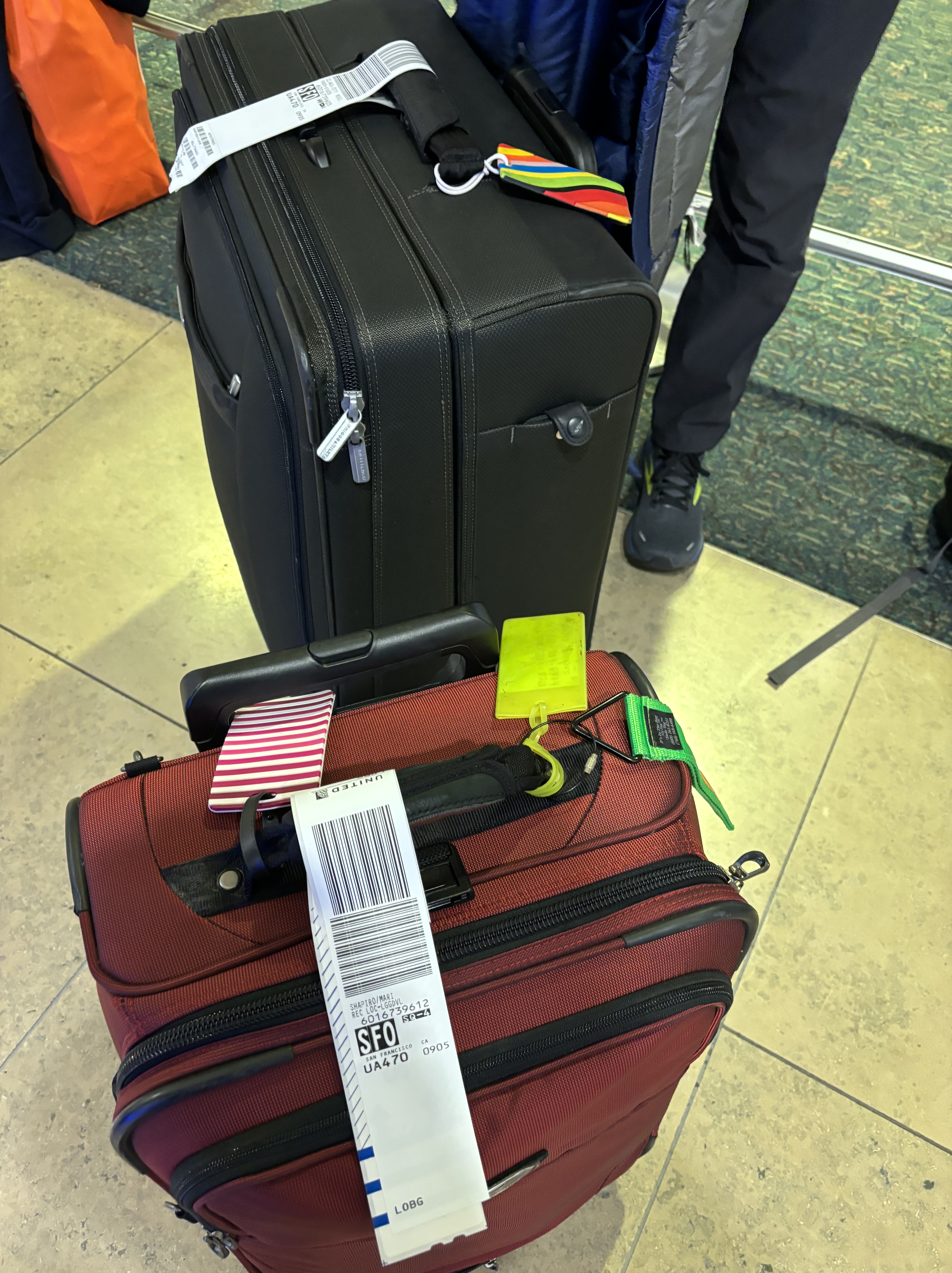
A sherpa? Or a shlepper? When it comes to packing, I’m both!

I have a friends who has the art of packing down to a science. No matter where they go or how long they stay, they manage to fit everything into a shove-into-the-overhead bin carry-on. Part of their strategy is resourcefulness, and part is just bad experience: their luggage was lost twice on the way to their destination,  and they vowed never to be in that situation again.

The proverbial schlepper,* I can’t even go to the supermarket with less than a trunkful. Shopping lists and coupons. Shopping bags. Ice packs. Light jacket. (Why do supermarkets have to keep their stores so cold?) Rain coat. Water bottle. Library books to drop off on the way home. The trunk is filled before I even back out of the driveway. 

My purse alone could keep me going for a week. I am absolutely addicted to those click baits on the Internet that list everything one should carry at all times. Along with the regulars—keys, wallet, cell phone, sunglasses, regular glasses for driving, hand sanitizer, lip gloss—I come fully prepared for minor emergencies. A charger and headphones in case my phone battery dies. A small pad of paper and a pencil in case my writing mu.se hits. A tweezer and a nail file for quick fixes. A traveling toothbrush and floss. And a whistle that I purchased in Colorado to help scare away bears and to signal rescuers in case I am lost in the woods. (I bring the whistle on cruises in case I get stuck on a floating door like Rose in the Titanic. In Florida, it helps me feel safer when I am alone in a parking lot.)

So packing for a trip—whether it be a weekend in a family member’s home  or eight weeks in a rental—usually results in a stuffed suitcase. You’ve probably heard the rule to “lay out everything you want to bring and then only pack half the amount?” Somehow or another my suitcase only gets heavier the closer the deadline for our departure approaches. 

I wonder how my grandparents handled their trips from Eastern Europe at the beginning of the twentieth century. Did they carry a steamer trunk? Or was everything in a huge satchel?  My father’s father carried brass Shabbat candlesticks and prayer books. From my research, I learned that clothes took second place to food for the journey on the boat. Fearing that kosher food wouldn’t be available, immigrants carried loafs of black bread and huge chunks  of salami to sustain them until they arrived at Ellis Island. I can only imagine the odor in steerage of unwashed bodies, unwashed clothes, and smelly deli.

When I traveled to Peru and Ecuador, I schlepped a suitcase that weighed slightly under the fifty pound limit. Not only did I overpack but also I spent too much time pawing through my suitcase looking for a pair of hiking socks or the dressy top I needed for dinner. I vowed never to travel like that again. In all subsequent trips I managed to reduce the weight and the stress caused by overpacking.

Of course, this strategy only works to a point. At four o’clock in the afternoon before our recent flight out west, the zipper on my fifteen year old suitcase broke.  We had to  make an emergency trip to JCPenney to replace it with another the same size but with cool 360 degree wheels, which made the unexpected purchase a little sweeter.  Larry invariably weighs his bag and mine at the airline’s check-in, getting some perverse satisfaction knowing that mine outweighs his by at least five pounds. 

Which brings me to my sherpa role. For those unfamiliar with all the books written about treks up Mount Everest, Sherpas originally referred to a tribe in Nepal.  According to Wikipedia, along with their role as humane and courageous mountain guides, they often carried necessary equipment for their foreign trekkers and mountain climbers. 

Larry serves as the sherpa when it comes to the paperwork needed for the trip. But I carry the responsibility for the first-aid kit, the electric toothbrush, lotions and potions, the guide books, the contact information, extra batteries.  Thanks to modern technology, some of the bulk has been reduced through cell phones and electronic readers. However, I do often remind Larry that the extra pounds in my luggage are a direct result of my sherpa role. 

And I have learned some strategies for packing over the years. First of all, I have a master packing list that covers every climate, state, and country. The list is printed out two weeks before we leave, and I check off items as they get piled onto the guest bed. . With the additional use of packing blocks—the various sized zipped bags that fit neatly together—I have also been able to separate out clothes based on the needs: dressy clothes in one bag; warmer outfits when the temperature drops; my bathing suit, cover-up, and flip-flops in a small bag to grab as needed. Larry and I have also become huge fans of quick dry options  that result in fewer items of clothing and less time in coin-operated laundries. 

As I write this, Larry and I are between two trips. After spending a long weekend in San Francisco with our son Adam, we flew to Colorado and spent another five weeks in a rented condo a mile away from our daughter’s family home in the Rockies. We just flew back to Florida for a week, giving us enough time to turn around and head for a seventeen day trip to Norway and Iceland. Fortunately, the weather in Colorado is similar to that of these two European countries, so packing will be simple. I will leave half of the stuff I brought to the Rockies home and repack only the clothes I actually wore on the trip. Running shoes, exercise clothes, dressy tops, the heavy fleece, the jeans stay behind. Instead, I will fill my bag with lots of layers that don’t show dirt and dry quickly Who knows? Maybe it can all fit in a carry-on. And that will make Larry, me, and all the baggage handlers very happy. 

*A schlepper is a Yiddish word for someone who carries things or is a servant.

Wandering, wandering!–Where do we settle?

A version of this article originally appeared in the June 18, 2015, issue of the Jewish World News. I am publishing this blog post as we celebrate nine years in our “new” home.

This year marks the fortieth year Larry and I have celebrated Passover as a married couple. Unlike the Israelites, we have not exactly spent it wandering in a desert wilderness. It has been a fruitful, productive life spent in the Capital District. For us, next year will not be in Jerusalem, but in Florida.

A real upstate girl, born in St. Lawrence County and raised in in Essex County (Since when is Westchester County upstate?),relocating to Albany for college in 1968. Larry also had spent all but his college years in Saratoga County. We met in Albany, married, moved to Clifton Park, raised two children, made wonderful friends, and spent holidays with our families.

When did the desire to live someplace else begin? The germ was planted twenty years ago when our parents spent six to eight months a year in Florida. Our circle began to expand geographically: our children moved to California and Colorado; my sister moved to Arizona; an aunt moved to South Carolina; a niece moved to Virginia; and a number of friends and family started living two to four months in warmer climates. Other friends were spending time with their own children, who were scattered over the country and the world. We began a nomadic life, visiting friends and family and traveling on our own to Germany, Peru, England, Greece. Although we enjoyed our numerous trips, we felt finding “our spot,” a place that fit all our criteria, would keep us more grounded.

Every place we visited raised the question, “Could we live here?” We did some California dreaming, but the high prices of real estate and the high possibilities of earthquakes ruled it out. Julie and Sam live at 9000 feet in Colorado, truly a Rocky Mountain high. Summit County is beautiful in the summer, but the winters last nine months, and you think Boston gets snow? Try twelve feet a year, every year. Other places in Colorado offered warmer temperatures, but the homes we viewed were close together, and we would still need our snow shovels.We also Arizona would be out of the mix: The desert can be lovely, but no manna—and little rain—fell from the heavens, and we were always happy to get back to “green” and water on the East Coast. Ever the English major, I  even fell in love with the small villages in England, but we knew that would never be where we settled. 

Once we retired four years ago, our interest in relocating intensified. The long winters and grey skies hadn’t bothered us when we were working, but once we were home all day, the weather became a factor. Our friends and family changed from asking, “Have you any trips planned?” to “Where are you going next?” And after forty years, Larry and I were ready for our next adventure. 

This fall, everything fell into place. Julie told us over Thanksgiving that, after eight years of marriage, she and Sam were expecting our first grandchild in July 2015. After I stopped jumping up and down with joy, Larry and I made the decision that we would like to spend our summers in Colorado and the rest of the year someplace warm. We found that warm spot on a rainy December day in Florida, when we checked out an active adult  community where we were staying near Orlando. From the moment we drove in, Larry and I were impressed with the tranquil setting and the amount of green space and lakes. We fell in love with an immaculate home for sale on a lovely piece of land overlooking a pond and bordering a wildlife preserve. The community itself offered all we were looking for: indoor and outdoor pools, Hadassah chapter, book clubs, a writing club, bike paths, pickle ball courts, movies and shows, and exercise classes.It was close to world class entertainment and an international airport with direct flights to all major cities in the country.

We came back to Albany, to grey skies, piles of snow, and sub-zero temperatures. Even with the miserable weather, we still needed time. After much research, thought, discussion, and several sleepless nights, we decided to purchase the home in Florida and spend two to three months in Colorado. So, after forty years of New York Passovers, next year we will be celebrating with the Shalom Club in our new neighborhood.  

If physically packing up the house is a challenge, emotionally leaving behind family, friends, and years and years of memories will be even more difficult. For the last twenty years, I have had the following framed quote hanging in our home, “Come my love and we shall wander, just to see what we can find. If we only find each other, still the journey is worth the time.” Like our Israeli ancestors, Larry and I will be wandering far from the home we have known to begin our next adventure.