Category Archives: #antisemitism

The Kindness of Strangers

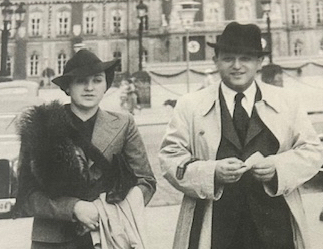
For newlyweds Erwin and Selma Diwald, getting out of Austria wasn’t a choice. It was a necessity. Thankfully, the kindness of strangers saved their lives. Their daughter, Frances “Francie” Mendelsohn, shared their fascinating story. 

Erwin Diwald was born in Vienna, Austria, in 1907, to Bettina and Sigmond, who was a successful importer of the ostrich and egret feathers used in the making of hats popular at that time. Erwin attended the University of Vienna, where he earned doctorates in both history and law. He launched a successful career in law and was sought after by many Catholic clients wishing to legally annul their marriages. 

Born in 1931, Selma Gehler was the second child of Maria and Victor Gehler. Victor, an engineer, was involved in the building of the Wiener Riesenrad ferris wheel in the Prater, still considered one of Vienna’s popular tourist attractions. Selma worked in her uncle Joel’s’ pharmacy while attending the University of Vienna’s pharmacy program, intending to step into her uncle’s business after graduation. 

Selma and Erwin met at a friend’s wedding and married in October 1937. Six months later, German troops invaded Austria. On March 15, 1938, the terrified Erwin found himself caught up in the enthusiastic crowds cheering and raising hands in the Nazi salute as a triumphant Hitler paraded through the streets of Vienna. Immediately, the Jews in Austria were in the crosshairs of the new regime. 

The newlyweds knew they had to leave their native country. Their first attempt to obtain visas took them to Stuttgart, Germany. On their first evening there, Selma and Erwin ate dinner in the hotel’s restaurant. The waiter brought over a huge tureen of soup. “Compliments of the Fuhrer,” they were told. They soon learned that their hotel was the site of the city’s Nazi headquarters. They quickly returned to Vienna to explore other options to leave Austria.

Help arrived through Erwin’s younger sister. Paula Diwald had been vocal in her dislike for the new regime. When notified that the Nazis were looking for her, she hastily made arrangements for a “ski trip” in France. As soon as she crossed the border, she ditched the skis and took up residence in Paris. 

Paula worked during the day as a salesclerk in a shop selling expensive handbags. To supplement her income, she worked as a tour guide, her ability to speak seven languages a definite asset. 

One evening, Paula overheard a couple requesting a guide who could speak English. She introduced herself and spent the next several days showing the Gregorys, a wealthy Greek Orthodox couple from Chicago, the highlights of the City of Light. At the end of their visit, they asked Paula what they could do to thank her for all she had done.

“What you can do is sponsor my brother and his wife,” Paula told them. “We have absolutely no family in the United States. Your providing them with visas is the only payment I want.” They promised to see if they could make the arrangements once they returned to Chicago. 

Paula immediately contacted Erwin. His education had included years studying classical Latin and Greek, and he decided to use this knowledge to further persuade the Gregorys.He wrote a long eloquent letter in classical Greek to plead his case. 

The Gregorys may have been Greek Orthodox but had no knowledge of its language; they brought the letter to their priest. Impressed by both the Erwin’s language and moved by their plight, the priest told the Gregorys, “You have to save these people.” The Americans complied and began the process of getting visa for the couple. They enlisted the aid of Lazarus Krinsley, a Jewish lawyer in Chicago, to obtain the paperwork. 

The Diwald flew to Paris to await the paperwork that, according to the officer in charge had not come through. It was only when the Diwalds checked in on a day the regular official was not at work. His substitute immediately “found” the missing documents.“Where have you been?” He said. “These visas have been here for months.” 

Knowing that they could not bring a great deal of money into the States, the Diwalds arranged first -class passage on the Paquebot Champlain. Built in 1932 and hailed as the first modern liner, the ship was pressed into evacuee work, transporting many Jews, like the Diwalds, who were fleeing Europe. 

Erwin remained in Paris with Paula before boarding the ship in Le Havre, France on August 29, 1938. Later that day, Selma, who had gone to England to say goodbye to her family, boarded in Southhampton. On August 31, 1938, Germany invaded Poland, marking the beginning of World War II. Erwin and Selma had made their escape just in time.The ship sailed in radio silence for the remainder of the voyage.

Meanwhile, he Diwalds found themselves in the company of many celebrities. Their travel mates included actor Helen Hayes, comedian Groucho Marx, composer Samuel Barber, Italian-American composer Gian Carlo Menotti, and Austrian-American actor/director Erich von Stroheim. It made for a very memorable voyage! 

An interesting side note: According to a Wikipedia article, the Champlain continued crossing the Atlantic Ocean for the next two years, transporting refugees, including many Jews, to safety. On June 17, 1940, on what was to be its last crossing, the Champlain hit a German air-laid mine, causing it to keel over on its side and killing 12 people. . A German torpedo finished its destruction a few days later. It was one of the largest boats sunk sunk in World War II. 

After debarking the ship in New York City, Selma and Erwin traveled to Chicago to meet their benefactors. Even though the Gregorys were responsible for getting the visas, they were not very welcoming. Lazarus Krinsley the lawyer, and his wife Rose, however, warmly embraced the couple, a friendship that was maintained throughout their lives. Upon the Krinsleys’ recommendation, the Diwalds settled in Milwaukee, Wisconsin, which had a fairly large Jewish population and offered more job opportunities.

Despite his educational background, Erwin lacked the credentials to practice law in his United States, During the war, he worked on an assembly line that polished propellers for B-29 planes. and drove trucks After the war, Erwin applied for a job as a tire salesman with Dayton Tire and Rubber Company. Initially, human resources failed to recommend him, saying he was “too intelligent.” He went on to become one of their top salesmen. 

Using the skills learned in Vienna, Selma worked in a pharmacy. She considered going to UW Madison to get certified as a pharmacist. After the birth of her two daughters Ann Frances [“Francie”) and Susan Jane, however, she gave up her dreams of further education. 

The Diwalds joined to Temple Emanuel, a reform congregation. In 1954, Francie became the first bat mitzvah in the congregation, with her sister Susan following in her footsteps three years later.

Fortunately, many of Selma and Erwin’s family were able to escape the fate of the many Jews imprisoned and murdered during the Holocaust. In 1938, the Nazis stormed into the Gehler home looking for Joel. When they could not find him, they arrested Selma’s father, Victor, who was deported to Dachau. Maria, through a possible bribe, was able to free him. They immediately fled for Haifa, in what then Palestine. They both passed away in Israel in 1951, three years after it had become the State of Israel. 

Erwin’s parents had also escaped Austrian 1940 by hiking over the Alps into France.  They emigrated to Milwaukee in 1942. Joel, who had narrowly missed arrest in 1938, fled to England, where he met the love of his life, Patricia. Joel passed away in 1986; Patricia passed in 2022. 

Selma died in 1996 at the age of 83 from cancer. Erwin died in 2008 at the age of 101, suffering from dementia in his last years. Despite all that the family had endured, Francie said that her parents were never bitter or angry. “I feel as if I been touched by God,” Erwin told his children. “We survived.”

SOURCES

Thanks to Francine Mendelsohn for sharing her parents’ story. 

“SS Champlain.” Wikipedia. https://en.wikipedia.org/wiki/SS_Champlain
A survivor’s story: “I live every day as a blessed person.”

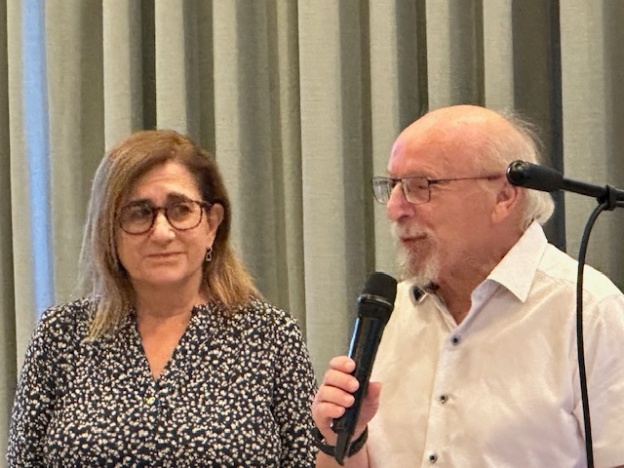
On May 5, 2024, our community’s Shalom Club held its annual Holocaust Remembrance, or Yom Ha’Shoah, event. Lou Ziemba’s story was one of the highlights of a moving, unforgettable evening.

Born  in wartime Poland, Ludwig“Lou” Ziemba is  a retired successful businessman, a polyglot a descendent of “Jewish  royalty’” and a Holocaust survivor. 

Lou’s story begins in Poland. Rabbi Menachem Ziemba, was the chief rabbi of Warsaw, a renowned holy figure in the Ger sect of the Chassidic movement, and a key player in the 1943 Warsaw Ghetto Uprising through his pleas that urged inhabitants to fight against their captors. 

“In the present we are faced by an arch foe, whose unparalleled ruthlessness and total annihilation purposes know no bounds,” Rabbi Ziemba told the Warsaw Ghetto inhabitants. “Halachah [Jewish law] demands that we fight and resist to the very end with unequaled determination and valor for the sake of Sanctification of the Divine Name.”

One of Rabbi Ziemba’s nephews was Henoch, son of his brother Moshe. Henoch was a bit of a non-conformist intellectual who spoke several languages and wandered around Europe. Henoch married a woman who was not approved of by his Chassidic family and thus he was no longer recognized by his large family in Warsaw.

As the Nazis rose to power, Henoch experienced both his wife and children being executed by the Nazis. Grief-stricken, Henoch returned to Poland and settled in the industrial city of Lodz, the second largest Jewish community in prewar Poland, after Warsaw.

With the outbreak of World War II and the German invasion of Poland, the life of Polish Jews deteriorated through a series of draconian laws imposed by the Nazis. In February 1940, after even more severe anti-Jewish measures were instituted, the Germans established a Jewish ghetto, initially trapping 164,000 Jews into a few city streets in a neglected northeastern section of Lodz. The widower Henoch Ziemba was one of those people. 

Soon after his arrival in the Lodz Ghetto, Henoch met and married 20-year-old Golda Farber, almost two decades his junior. Golda may have been small in stature, but she was, in Lou’s words “a firecracker” and “a force of nature.” Almost immediately, Golda became pregnant. For reasons lost in the family lore, Golda turned for help to Mordechai Chaim Rumkowski, who Primo Levi later wrote “morally ambiguous and self-deluded.”

To organize the local population and maintain order, the German authorities established a Judenrat,” or Jewish Council in the ghetto. The Germans appointed Rumkowski as the “kapo” of the Lodz Ghetto, whose job it was to oversee the day-to-day living as well as to decide who would live and who would die. Rumkowski was responsible for sending untold numbers to their deaths.

Known mockingly as “King Chaim”, Rumkowski was granted unprecedented powers. Rumkowski transformed the ghetto into an industrial hub for the Nazis, producing uniforms, wood and metalwork, and electric equipment. Rumkowski felt that, as long as the ghetto served a purpose by supporting the Nazi effort, the workers would avoid deportation to the gas chambers. His methods, however, were brutal: He oversaw the slave labor of anyone over 12 years old to work 12-hour days despite abysmal living conditions and near-starvation rations.

In his biography of Rumkowski, Yehuda Leib Gerst described this complex man. “Toward his fellow Jews, he was an incomparable tyrant who behaved just like a Führer and cast deathly terror to anyone who dared to oppose his lowly ways. Toward the perpetrators, however, he was as tender as a lamb and there was no limit to his base submission to all their demands, even if their purpose was to wipe us out totally.”

Furthermore, Rumkowski used his position to his own benefit. He singled out his political enemies for death and deportation to the death camps, and also deported those who had the capacity to rise up against their capturers. In contrast, those whom he favored were showered with extra provisions, medicine, rations, and safety.

For reasons lost to history, one of those receiving his benevolence was Golda Ziemba. With Rumkowski’s help, Golda was able to hide her pregnancy. A son, Ludwig, was born on September 9, 1942. 

 In late summer, Rumkowski was given orders to select 24,000 for deportation. Believing that the inhabitants’ survival depended upon their employment, he made the decision to hand over their 13,000 children under ten and their 11,000 elderly over 65 years old. He addressed the parents of Łódź as follows. “In my old age, I must stretch out my hands and beg: Brothers and sisters! Hand them over to me! Fathers and mothers: Give me your children!”

Again, for unknown reasons, Rumkowski worked with the Ziembas to save their infant son. He and Golda arranged for baby Ludwig to be hidden in a garbage truck. Once outside the Ghetto, he would immediately taken by a Polish farmer, whose family would raise him as their own in their Christian home. “It’s a miracle,” said Lou. “There were very, very few children who survived the Lodz Ghetto.”

As the war continued, conditions in the ghetto deteriorated, marked by a growing number of inhabitants being sent to the extermination camps. By summer 1944, as the Soviets came closer, the Nazis rounded up every remaining Jew they could find, including Rumkowski and his family, for mass extermination in Auschwitz’s gas chambers.Before their deaths, however, a group of Jews beat Rumkowski to death, a fitting ending for a man who many Jews regarded as bad as Hitler and his Reich. 

On January 19, 1945, the Soviets liberated the Lodz Ghetto. Over the course of last four previous years, over 220,000 had people passed through its gates. There were only 877 survivors, including Golda and Henoch Ziemba, who had managed to hide during all the deportations.

Golda and Henoch’s first stop after liberation was to reunite with their now three-year-old. son. Ludwig didn’t recognize or understand the emaciated but overjoyed strangers who spoke in Yiddish. Despite the Polish family’s reluctance to give up their “son,” his biological parents -against all odds- had returned. 

The Ziembas were the only three members of the family to survive. Rabbi Menachem Ziemba and the four hundred members of the family who had been trapped in the Warsaw Ghetto were all murdered by the Nazis.

Relocated to a German Displaced Persons camp, the Ziembas were soon a family of four. Lou’s sister Esther was born while Lou was away recovering from tuberculous in a German convent, where he learned his third language, German. 

So, to summarize Lou’s first 8 years of life, Lou was born a Jew during a period of extermination, hidden by a resourceful mother, taught Polish by a non-Jewish Polish family, taught German by nuns in a convent, recovered from TB, and taught Yiddish and right from wrong by his parents in a German DP camp. He never had to go to school, get circumcised, or even brush his teeth the entire time.

After a five year wait, the Ziembas immigrated to New York City in 1950. By the time he was nine years old, now known as “Lou,” was working alongside his mother at her small women’s shop in the Bronx that sold undergarments. His bar mitzvah was held in 1955, thus learning yet another language—Hebrew. Before Lou could be Bar Mitzvah’d, however,  there was one order of business that had to be taken care of at the local hospital, “a small snip of the tip.” Lou was heard screaming from every floor of the hospital “I DON’T WANNA BE A JEW!!!

When he was twenty-one, Lou opened a men’s clothing store down the street from his mother’s shop. As his business grew, in part because of Slax and Jax’s inventory of the newly popularly “blue jeans,” he convinced his mother to sell her store and join him in business. They soon opened three more stores.

However, as shopping malls sprang up, Lou realized the negative effect on his businesses. He sold them and went into the home construction business.  He, his wife Maxine (“Cookie”) Noble and their two children moved to “New City,” an affluent suburb of New York City. 

In 1999, the long years of his dedication to work took a toll on his marriage, and the couple divorced. Soon after, Lou met and married Beth Landa who happened to be related to his son-in-law. After the couple’s retirement in 2015, they moved to Florida, settling in Solivita, a fifty-plus active adult community in Kissimmee in 2023. 

“I’m aware of how lucky I am to be alive,” Lou says. “I live every day as if I’m a blessed person. I enjoy life too much not to do that.” 

Sources

Thanks to Lou Ziemba and Beth Landa for providing the interviews and information for this article. 

Cousins, Jill. “A Survivor’s Saga.” Lake Mary [Florida] Life.Winter 2017.

https://en.wikipedia.org/wiki/Chaim_Rumkowski

https://en.wikipedia.org/wiki/Łódź_Ghetto

https://en.wikipedia.org/wiki/Menachem_Ziemba

https://encyclopedia.ushmm.org/content/en/article/lodz

Reflections on Hanukkah, Israel, and Antisemitism

On Thursday, December 7, 2023, Jews around the world will begin celebrating Hanukkah, which commemorates a time in Jewish history where we faced the possibility of annihilation.Now, 2190 years later, Jews face yet another enemy whose covenant calls to obliterate the state of Israel and to carry its jihad against all Jews “until judgement day.” As I light my candles over the holiday’s eight days, I will reflect on the following. 

One: I stand with Israel. Absolutely. I am sad, afraid, angry and grieving for all the lives lost during this conflict. But Israel did not start this war. Hamas did. And the Israeli Defense Force (IDF), like the Maccabees, must fight with every ounce of their strength to root out the evil that is Hamas.

Two: The rise over the lawsuit and the proposed highway.of antisemitism around the around the world is terrifying, and it is hitting too close to home. Who would have thought that neo-Nazis would be marching outside the gates of Disney? That banners with swastikas would be hung on an I-4 overpass? That our Florida synagogue would have to hire a security guard so that we can attend services without fear of being mowed down like the members of Pittsburgh’s Tree of Life?

Shortly after the October 7 massacre by Hamas, Jewish community leaders and a representative from the AntiDefamation League met with Congressman Darren Soto.He opened our meeting by pledging his support for Israel and the Jewish community. “I have your back,” he said. “We must stand against all forms of hate.” He then turned the meeting over to his constituents, where we were able to voice our concerns. As the war continues, I will be in contact with my representatives on the state and national level to encourage them to continue their support.

Three: I am prouder than ever to be a Jew. For many years, I have worn a butterfly charm on a necklace, which represents to me the souls of the six million who died in the Holocaust. Soon after the war began, I dug out my Jewish star and added it to my necklace, displaying my connection to Judaism with pride and resolve.

Four: During this terrible time, attending services at my synagogue gives me a sense of community. At times it feels that it is the Jews against the world. Being in a room where I am not alone in our fears, sadness, and grief. gives me comfort. 

Five: I will continue to use my writing to bear witness to moments of Jewish sacrifice, survival, and strength.Since 2017, I have been writing down stories of Eastern European Jews escaping pogroms, Holocaust survivors, WWII Jewish soldiers, and Jews and Righteous Gentiles who fought and continue to fight against Jew-hatred and Holocaust denial. My writing has found a purpose: To make sure their stories are never forgotten.

Six: Israel needs more than hopes and prayers and words. It is in desperate need of funds to counteract the effects of this war on its economy and its citizens.The websites of the ADL and other Jewish organizations list recommended donation sites, including Magen David Adom (MDA), Israel’s national emergency medical response organization; Leket Israel, the country’s largest food bank; and Hadassah Hospital, which treats both Jews and Arabs.

Seven: I was overwhelmed by the outpouring of compassion and support from my non-Jewish friends. “My heart is broken in two,” wrote Ginny Campbell. “We all share one God. I can only believe His heart is broken too.Know my prayers are with you and all our brothers and sisters who are grieving tonight. Love can and must win out in the end.”

Eight: Following the lead of Israelis who have suffered such great loss, I will find joy and hope. “We are part of a people that sanctifies life,” Rabbi Doron Perez, reflecting on the October 23 wedding of his son, who suffered a leg injury on October 7, and another son has been declared missing “[The future] will be a new dawn and a much better time for the Jewish people”

“I am a Jew because at every time when despair cries out, the Jew hopes,” wrote French writer and thinker Edmond Fleg in 1927. Only time will tell what will happen in the future. Over eight evenings, our family will light our colorful Hanukkah candles. This year, we will add to the traditional blessings the Mi Sheberach, a prayer for physical and emotional healing for all human beings facing illness and pain; and Oseh Shalom, a prayer for peace, salaam, shalom. שָׁלוֹם

Originally published in the Orlando Sentinel, December 3, 2023.

Marilyn Shapiro, Kissimmee, is a retired educator and an author. Her blog is http://www.theregoesmyheart.me.