Category Archives: Colorado

Colorado Jewish High

img_5359

Larry and I pose outside the synagogue, now a museum in Leadville, Colorado

Rocky Mountain High: The Synagogue at 10,200 feet

While in Colorado for the summer, my husband Larry and I visited the town of Leadville, Colorado, during its Boom Day Festival, a celebration of the Old West. Gunslingers, burro races, mining skill contests, and over 100 food and craft booths filled the streets. We got ice cream cones and wandered down West Fourth Street, past a mining skills contest, where brawny men and women competed to see how many pounds of rock one could pile into a truck. And just down the street, we found the Temple Israel Foundation, a museum dedicated to a thriving Jewish community that existed in this Rocky Mountain city over one hundred and twenty years ago and the former site of a thriving synagogue.

Perched at 10,200 feet above sea level, Leadville is the highest incorporated city and the second highest incorporated municipality in the United States. It boomed in the late 1870s with the discovery of silver, resulting in an influx of migrants to this small mountain town. At its peak, the population of Leadville grew to approximately 30,000 residents.

Among the many groups of people attracted to the minefields in the high Rockies was a group of recent Jewish immigrants who migrated to the West and Colorado. Representing only 1% of Leadville’s population, the three to four hundred Jews came to Leadville for the same reasons as their non-Jewish counterparts: to improve their social and economic status, to find adventure, even to reinvent themselves. In 1879, the local opera house hosted Rosh Hashanah services, and in 1880, the Hebrew Benevolent Society purchased a cemetery for Leadville’s Jewish community. Soon after, the Jewish community built a synagogue and held its first service on September 19, 1884, the first day of Rosh Hashanah 5645.

For the next thirty-eight years, Temple Israel served a surprisingly large and active Jewish community. As a booming mining town, Leadville’s residents had amble opportunities to spend their earning on clothing and household goods, liquor, sex, and gambling. Leadville Jews provided services including dry goods stores, wholesale liquor and tobacco businesses, saloons, gambling houses, opera houses, and even brothels.

More well-known members of Temple Israel included two German immigrants, David May, the founder of May department stores; and Leopold H. Guldman, philanthropist and founder of Denver’s Golden Eagle Dry Goods Company. Benjamin Guggenheim, a first generation American and heir to the famous family’s fortune made in Colorado mines, was better known for his chivalry and death aboard the ill-fated Titanic. 

Despite its remote location, Leadville was a modern industrial city. Jewish dry goods merchants offered the latest European fashions to the ladies. The better off gentlemen often sported diamond studs to accent their wardrobe.

By the first decade of the twentieth century, the boom was over, and the town’s Jewish population declined. In 1912, the last recorded event, a wedding, took place.

From 1914 through 1937, the synagogue sat shuttered and unused. The synagogue was converted into a single family residence, and the building took on several other non-religious functions, the last as four rental apartments.

In 1983, Bill Korn, a New York City native, relocated from Boulder to Leadville to take advantage of low real estate prices and proximity to great skiing. He purchased and was in the process of renovating several properties when he learned of the former synagogue and its overgrown cemetery. Motivated by his own German Reform Judaism roots and his belief in Martin Buber’s command, “If not you then who? If not now then when?” he explored ways to obtain both properties.

In 1987, the Temple Israel Foundation was incorporated “to acquire, historically rehabilitate, and maintain” the building. Korn purchased the synagogue in 1992.

For the next several years, Korn used the four apartment rental incomes to pay off the mortgage. The Foundation obtained a grant from the Colorado Historic Fund. Finally, ninety years after the temple shut its doors, renovations to bring the building to its former glory began. The Denver chapter of B’nai Brith led volunteer efforts each June to maintain the cemetery grounds and replace markers. In 2001, the cemetery was reconsecrated, allowing Jewish burials to resume. In 2012, a permanent exhibition opened that documents pioneer Jewish life with a collection of artifacts about Leadville, its resident Jews, Temple Israel as a synagogue, and life in a mining town in the 1880s and 1890s.

While not providing regular services, the building, with its Torah and bima, is now open for special events. Today, there are, according to Korn, approximately 80 to 100 Jewish people in the entire county. Bill Korn oversees the museum, and from May through October, two full-time staff members work as both guides and researchers.

Over 3200 people visit the museum each year, said Korn. They come not only from surrounding Colorado towns but also from all over the United States and even Israel. Korn said his most special guest was the granddaughter of Leopold H. Guldman, whose emotional response to the museum brought tears to Korn’s eyes.

Larry and I celebrate Rosh Hashanah each year in Kissimmee, Florida, elevation 49 feet above sea level. During the High Holy Days, however, we pass to reflect on the lovely synagogue in the highest incorporated city in America. We will think about Bill Korn and his generous efforts to bring Temple Israel to life for future generations. And we think about the long-ago Jewish congregation in Leadville celebrating Jewish life high in the Rocky Mountains.

Originally published September 29, 2016. Updated May 26, 2025.
Bubbe Butt Paste and Other Love Stories

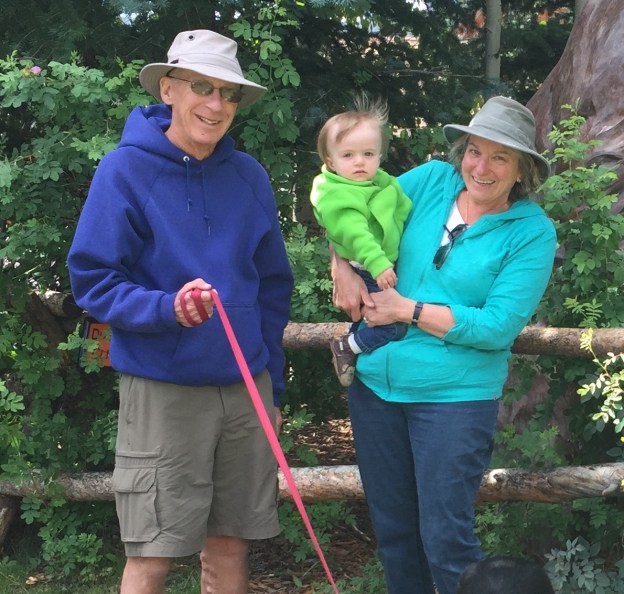
Soon after my daughter Julie and my son-in-law Sam told us they were expecting our first grandchild, my husband Larry and I discussed what grandparent name by which we each hoped to be called. 

Larry determined quickly that he would be called Zayde, Yiddish for grandfather. It was a family tradition, he stated. His father’s father was Zayde Max, and his own father was Zayde Ernie to his seven grandchildren. 

Choosing my name didn’t come as easily. My friend Lynn, whose granddaughter lived in Israel, suggested the Hebrew moniker Saftah, but I didn’t think that would work for our future grandchild, who would be living in the Rocky Mountains of Colorado at 9100 feet above sea level. The paternal grandmother, who had a four-year-old granddaughter, already had dibs on Nana. Additional members of the Grandmother Club told me about their sometimes unusual titles: MeeMaw, GG, G-Ma, CiCi, NayNay, Gemmy, and even (Graham) Cracker. Although Bubbe went well with Zayde, I dismissed it as too old fashioned. I pondered the numerous options over the next few months. 

Larry and I were in Colorado the day Julie went into labor. While waiting for the Big Moment, we took a hike up to Rainbow Lake, a lovely spot a mile up the mountain near Julie and Sam’s home. On the trail, we ran into another couple who, noticing Larry’s Syracuse University hat, told us they were also from Central New York State. After chatting with them about the Orangemen’s basketball team and the amount of snow that fell the past winter, Larry and I told them about our grandchild’s imminent birth. They congratulated us, stating how much they themselves enjoyed being grandparents. 

“What do they call you?” I asked the woman, whose name was— ironically—Julie. 

“Grandma,” she said. “I waited a long time for grandchildren, and I am proud to go by the standard name.” 

That sealed it for me. Meeting a Julie from Syracuse on a hike the day my grandchild was born was b’shert—meant to be. I would stick with the classic “Grandma.” 

Larry and I were introduced to our granddaughter an hour after she was born. When I held her in my arms in the hospital room, I was in heaven. I was finally a grandma! I enjoyed every moment of that summer and the three visits over the next year. 

By the time we returned to a rented condo for another Rocky Mountain summer just before her first birthday, our granddaughter was talking. We secretly hoped that, along with her rapidly expanding vocabulary— Dada, Mama, dog, bear, boo (blueberries), yesh, and dough (no)—she would learn and say our names before we went back to Florida. 

Happily, over the next six weeks, we spent many hours with her, not only with her parents but also without them as exceptionally willing babysitters. As she sat in her high chair eating her meals and snacks, I determinedly coached her. 

“Dog,” I said, pointing to Neva, who was waiting patiently with her tail thumping for the next dropped morsel. “Grandma!” I said, pointing to my chest. My granddaughter would smile and laugh and offer me her smashed banana or mushed piece of challah. Nothing in her babbling, however, even came close to “Grandma.” 

Four days before we were to return to Florida, Larry and our granddaughter were playing on the floor with her blocks. “Zayde!” she suddenly stated emphatically. Larry’s face lit up like the Syracuse University scoreboard. She said it again—and again. From that moment, Zayde became her favorite word. She called out “Zayde!” the minute Larry walked into the room, and she yelled it out if he disappeared behind a closed door. Talk about melting a grandfather’s heart! 

As happy as I was for Zayde Larry, I was a little—well—make that extremely jealous. My efforts to hear Grandma—any version— intensified. “Grandma!” I said every chance I got. As the hour of our departure got closer, I became desperate and switched tactics. “Bubbe,” I tried, deciding an old sounding name was better than no name at all. 

The morning before we were to fly back to Florida, I babysat my granddaughter while Julie and Sam were at work and Larry was returning the rental car. After her morning nap, I lay my granddaughter on the dressing table to change her diaper. She looked into my eyes and clearly said, “Bubbe!” “Yes! Bubbe!” I cried. My granddaughter had spoken, and I was going to be Bubbe! I was over the moon! I immediately shared the news with Larry. Our granddaughter said the magic word again after lunch and after her afternoon nap. When Sam returned home from work that evening, this 

Bubbe was bursting with joy.
“And she repeated this every time you changed her diaper?” Sam asked somewhat hesitantly.
“Every time!” I said. “She clearly said Bubbe!”
“I don’t know how to tell you this, Marilyn,” Sam said. “But she wasn’t actually calling you Bubbe. It’s her word for butt paste. She has had some diaper rash this past week, and—well—she likes to hold the closed tube after we finish applying it.” 

“Butt Paste!” Larry chortled. “She is calling you Butt Paste.” 

The day after we returned to Florida, our Colorado family FaceTimed with us. The minute our granddaughter saw our faces on the computer screen, she yelled out, “Zayde!” 

“And look who is with me!” said Larry. “It’s Bubbe Butt Paste!” 

Sigh! 

It took another two months to realize that our now sixteen month old granddaughter  could not say the “gr” sound. “How about you call me ‘Gammy?’” I asked her.  She smiled broadly and said  “‘Gammy!’”

Six years and more grandchildren later, I am now a confirmed Gammy. But I will be happy to receive their smiles, their laughs, their hugs, and their unconditional love—no matter what I am called.

First published in The Jewish World, September 1, 2016

Big Wheels and Big Hills

IMG_4834

Summer mornings on our neighborhood in Upstate New York during the 1980s were quiet—until eight o’clock  At that hour—designated by the parents to be  late enough to ‘start the engines’— the garage doors on almost every house opened one by one. A fleet of children, all sitting low on seats of their Big Wheels, flew down their driveways and began circling the ‘track’ that surrounded the grassy knoll in the middle of the cul-de-sac The Daily Devon Court 500 was officially in session.

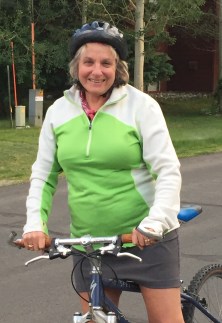
Biking had been part of  life since I was a child. I spent hours riding a second-hand three speed on rolling hills past apple orchards and Lake Champlain beaches  Larry and I pedaled through the back roads of Albany County, me on that ancient three speed and Larry on the bike he had ridden to deliver newspapers in Saratoga Springs. Once our children graduated from Big Wheels to two-wheelers, the four of us took family outings on the Mohawk-Hudson Bike Trail.

When we turned forty, Larry and I traded in our relics for lighter, more efficient ten speeds. Larry had to give up competitive running in 1996 due to an injury, and he began biking more frequently. He encouraged me to join him, and we pedaled our way around Southern Saratoga County.

Cycling became a social event.  For a couple of years, a group from Congregation Beth Shalom met on Sunday mornings in the synagogue parking lot for a ten to fifteen mile circuit. Larry and I were enjoying our biking.

And the length of our rides together increased: twenty miles, thirty miles at a clip. As a members of the Mohawk Hudson Wheelmen, we participated with several other riders in metric half centuries, one in which I rode the sixty-two miles in honor of my sixty-second birthday. Larry completed a hundred miler with a more hardy friend.

Despite all my biking, I never was totally comfortable on hills. While Larry gleefully viewed them as a challenge, I dreaded every long, steep incline. I usually made it with a great deal of effort. Once in a while, however, I had to resort to getting off the bike and pushing it to the top.

My fear of hills prevented me from taking advantage of all the all the biking trails near Julie and Sam’s home in Summit County, Larry had taken some rides with Sam, but I bowed out. On our visit in July 2012, however, I had several months of biking long distances in New York under my belt. Larry and I finally took Sam up on his offer to join him for what Sam billed as an easy, fairly flat twenty mile ride around Dillion Lake

“There is a little incline at the beginning of the trip,” Sam explained while we adjusted our seat height on our rentals and snapped on our helmets, “but I am sure you two can handle it.”

As Sam had promised, the first four miles on the bike trail, were flat and straight. Then we arrived at the bottom of Swan Mountain. I craned my neck to view the bike lane that ran along a fairly busy two lane highway. The summit appeared to me to be five miles away,

“Sam, this is not a little incline,” I said. “This is a mountain! How long is it?  And what is the increase in elevation?”

“We go from 9100 to 10200 feet, an 11,00 foot ascent over about a mile,” Sam conceded. “I promise we’ll take it slow.”

Within one half mile, I was huffing and puffing. And sweating. My shirt was stuck to my back; under my helmet, my hair was glued to my head; my socks were drenched. I even had sweat running out of my ear canals.

“I can’t do it,” I yelled to Larry and Sam, who were riding with little effort 200 yards in front of me. “I’m going to walk the rest of the way. I will meet you at the summit.”

“Are you sure?” Larry asked. They barely waited for breathless “Yes!” before they pedaled off and left me to push my bike to the top.

Fifteen minutes later, I met up with Larry and Sam at the Sapphire Point Overlook.

“I made it!” I said to Sam. “It’s all downhill from here!”

Then I took a look down the trail. Whatever goes up must come down, but this down was a steep descent on a narrow, serpentine bike path crowded with other cyclists

“What the heck, Sam?” I exclaimed. “I thought climbing up was bad, but I can’t handle going down this obstacle course!”

“Sorry, Marilyn, but it’s the only way back to our house without adding another ten miles,” said Sam. “Just take it slow.”

“Don’t worry!” said Larry. “I’ll be right behind you.”

Larry’s ‘right-behind-you’ promise lasted an even shorter time than Sam’s ‘we’ll-take-it-slow’ promise. Terrified and white knuckled, I kept hitting my brakes. Larry couldn’t bike slowly enough to follow behind and had to go ahead. I prayed all the way down to the bottom, where I caught up with Larry and Sam for the second time that day.

The remaining miles were less dramatic. And, by the end of our vacation, I had actually forgiven Sam.

Since my bike ride from hell, however, I haven’t attempted a repeat in Colorado.These days, I love riding through my mountain-free community in Florida—elevation in the Orlando area peaks out at eighty-two feet above sea level. Big hills—like Devon Court’s Big Wheels—are in my rear view mirror. And that is fine with me.

Bluebird Powder Day

10151728_10201716353926974_429979176_n

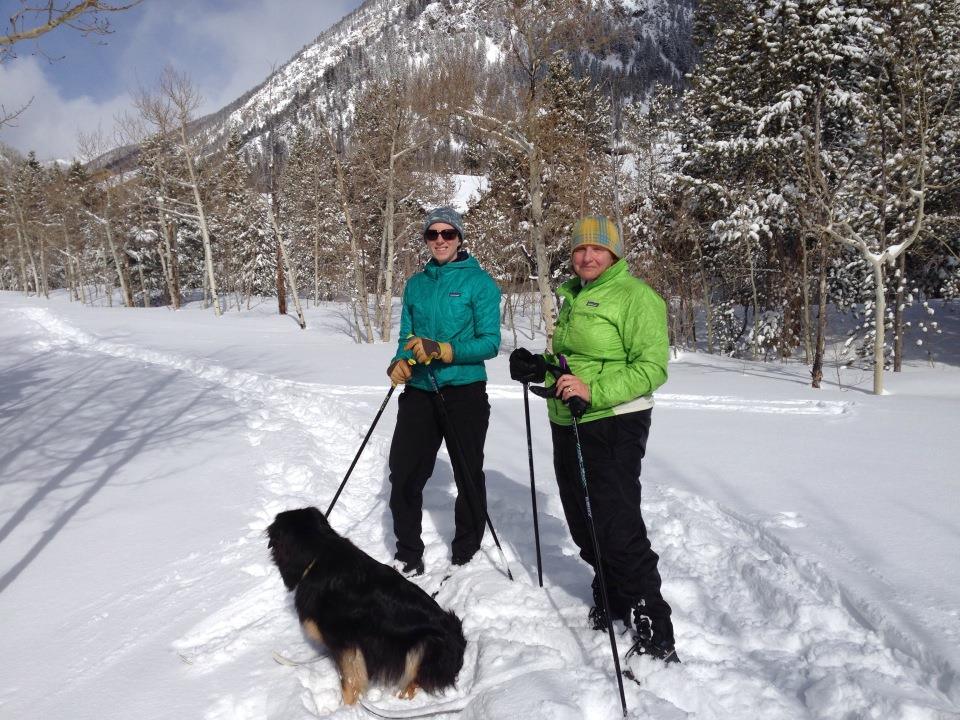
While visiting my daughter and son-in-law in Frisco, Colorado, I went cross country skiing for the first time in several years. It seemed like everything was in place. Clothes? Check. Skis and poles? Check, Beautiful snow cover? Check. Perfect temperature? Check. Ability to cross country ski? Not so good!

Julie had moved to Colorado after college for a “one year” teaching position at a science school near Vail. She fell in love with the mountains, the snow—and Sam. They were married in Moab in May 2007, and after completing master’s degrees and finding permanent jobs, they purchased a home in Frisco.

Larry and I visited Julie and Sam at least once a year, usually around the Fourth of July in time for the parade, town celebration, Julie and Sam’s annual BBQ, and the fireworks over Dillion Lake. Julie and Sam had fully embraced the Colorado winter life style and had encouraged us to visit them during the snow season. For many years, we demurred because of our work schedule. After we retired, Larry and I preferred to spend our winter months getting away from snow and cold, NOT heading in the opposite direction to 9000 feet and more snow and more cold. In 2014, as I missed my daughter, I made the decision that I would go to the mountains in the winter, even if Larry wouldn’t join me.

As soon as I entered the kitchen my first morning there, Julie asked me if I wanted to cross country ski. She and Sam live only a couple of blocks from the Frisco bike trail, and the snow was fresh enough for us to ski right from their house. I agreed to give it a try.

Julie fitted me with an extra set of boots, poles, and skis. I snapped my right foot into the right ski easily, but the left boot/left ski didn’t cooperate. Six to eight tries later, both of my skis were snapped in. By the time we finished, the bottom of Julie’s skis were stuck with snow. She took them off, went back into the house to locate scraper chipped the snow off her skis, and put them back on. Then she showed me how to lift up each ski so at a ninety degree angle and balance on the other leg while she removed the snow and ice from the bottom of my skis. Once we were done, we headed out of the driveway towards the bike path.

The snow was as beautiful as anticipated. I naively thought that cross country skiing would be like riding a bike: Once my skis were on, I would be gliding along the path like a pro. However, I was a little older, a little less flexible, and a little heavier. My progress was pathetic. Fortunately, Julie was a good teacher. She reviewed with me how to kick up my heels, how to glide, how to lean forward to get better momentum. But despite my attempts, I always was at least two hundred yards behind her.

A “Vail 11 Miles” sign soon appeared along the bike path. My mind went back to a show on the Travel Channel, where Samantha Brown did a midnight ski from Vail to Breckenridge. Watching her glide effortlessly in the moonlight, I had thought, “We should do that when we go to Colorado!” But after twenty minutes on the trail, I was bathed in sweat, breathing heavily to compensate for the altitude, and seriously questioning my ability to ski another yard, much less eleven more miles. I didn’t want to disappoint Julie. I soldiered along.

We poked along for a mile or so, and Julie suggested we scrape off the sticking snow from the bottom of my ski as we practiced at home. I kicked out my left ski, tried balancing on my right leg, and crashed to the ground. After several attempts to get up, I finally had to remove my skis and right myself. Now I had to get back into the bindings. Multiple unsuccessful tries later, Julie initial patience was wearing thin. She pointed impatiently to the spot on the binder where the boot snapped in. “Right here?” I asked.

“Yes!” she answered. I put my toe in and snapped the binding down—on my poor daughter’s finger. She spewed out a string of obscenities fit for an angry, drunken sailor.

“I’m so sorry!” I exclaimed. “But where did you learn that language?”

After a couple of more tries, I was into my bindings and on our way again. We had to stop a couple of more times to scrape our skis, but I was enjoying the experience.

Forty-five minutes later, we were home, cozy, warm, and sipping tea.

Sam came down from the home office where he had been working. “You’re back! How did it go?” he asked.

“I’m a little rusty,” I said, “but I’m catching on.”

“How far did you go?” he asked.

“Actual miles were around three,” I said. “For me it felt like we went the twenty-two miles to Vail and back. For Julie it must have felt like to hell and back.”

The next morning, I woke up feeling pain in muscles I didn’t remember I had. But when I went down to breakfast, Julie was ready to try it again. A half an hour later, we were back on the bike path. My skis had clipped in on the first try, and the wax helped me glide smoothly over the fresh tracks Julie broke in front of me. I could not stop smiling. When I fell down, I picked myself up with no trouble.

“You’re doing so much better this morning, Mom,” commented Julie. “Are you enjoying yourself?”

“Every minute!” I responded.

“This is a bluebird powder day,” Julie said.

“What does that mean?” I asked.

“It’s a Colorado expression,” explained Julie. “The sun is shining, the sky is a brilliant blue, the snow is a perfect powder, and the temperature is ideal.”

“You’re right, Jules! It is a bluebird powder day!” And we kept on gliding through the powder.