Category Archives: Holocaust

10 decades of memories: Patriarch Geisler to note 100th birthday

Southern Florida, will be rocking on May 17. On that day, Morty Geisler, a veteran of World War II and a successful businessman, will be celebrating his one-hundredth birthday. Dr. Warren Geisler, a retired Albany dentist and one of his six surviving children, shared stories about his beloved father. 

Mortimer Arthur Geisler was born on May 17, 1918, in Harlem, New York,  to Maxwell and Anna Grossman Geisler, both immigrants from Poland.Eighteen months later, Maxwell died in the Great Flu Pandemic. Life was tough for the family. Geisler grew up in a two bedroom walk-up with his mother, younger brother, and grandfather. They were supported by his grandfather and Anna’s three brothers.

Geisler, however, was bright and resourceful. After graduating high school at fifteen years old, he took a job as a stock boy in a haberdasher store. He made ten dollars a week, half which went to his mother.

In 1942, Geisler married Sylvia Sheer.  A year later, he was drafted into the army, where he, like many Jewish GI’s, Geisler encountered anti-Semitism. When some “Southern boys” began picking on him, he complained to his captain. Geisler never had any problems again. 

Geisler and six thousand other soldiers were shipped over to England. The soldiers were piled ten high in bunks in the bowels of a Liberty ship, which he remembered as a “floating cork.” Geisler and his division landed on Omaha Beach on June 9, three days into what would be known as D-Day.  He then followed General Patton’s 3rd Army through St. Low to Pont de Masson relieving Bastogne and crossed the Rhein and Ruhr Rivers on the way to Magdenburg where he joined General Simpson’s 9th Army on the way to Gottinger. His division was involved in closing the pocket in Hamm where 100,000 Nazis were captured and surrendered.

In May 1945, Geisler’s division entered Dachau concentration camp two days after its liberation. “My father witnessed the ferocity of the evil that the Third Reich had created,” his son Warren, a retired dentist from Albany, New York. ”Those images are still seared into his being until this day” 

“Thousands of corpses were scattered through out the camp,” said Geisler. “Survivors, mostlyJewish, were lice infested, walking skeletons. Still in their striped uniforms, these hollow-eyed slouched over beings managed to still smile as they thanked us GI’s for saving them.”

The war was still not over for Geisler. His division advanced to Pliessen, Czechoslovakia, where they faced off on the banks of the Elbe River against Soviet forces which kept  them from invading Czechoslovakia. Two weeks later he was transferred to Paris where he met up with his brother Maxwell and his recent French bride.

In October 1945, Geisler shipped out on the Queen Mary with 14,000 other GIs back to New York City. Five days at sea with seasickness was the tour du jour. My father never missed a meal and stayed top side for four of the days at sea. Once stateside he was honorably discharged two weeks later. The war and its battles were over.

Geisler found a job as a hosiery salesman for Ma-Ro Corporation, where he became its youngest national sales manager. In 1959, Geisler and  three other salesman opened Proudfoot Hosiery. As the eventual sole owner, Geisler licensed the first National Football League’s tube sock and the first non-slip sock. His company won the licensing for the 1980 Moscow Summer Olympics. He eventually sold the company, working for the corporations that carried his lines. He retired at 85.

Geisler and Sylvia had four children, Steven, Warren, Edward, and Jayne.  The Geisler was active in the Jewish community and were responsible, along with other Jewish World War II veterans for the founding of Temple Beth Emeth, a conservative synagogue in Hewitt, New Jersey. “They all wanted to work and provide for their families in a religious setting safe from the hell of the war’s mass murder and genocide,” said Warren. All three sons were bar mitzvahed there. Geisler was also a member of the Knights of Pythias, a fraternal organization that provides philanthropic work for numerous causes.

Sylvia passed away in 1971. A year later, he married Enid Friedman, a widow who had three children, Iris, Daniel, and Paul. While enrolled at Princeton University, Paul, a natural athlete and president of the college’s Big Brothers/Big Sisters,  was diagnosed with Ewings Sarcoma, an aggressive form of bone cancer. After his death, the devastated parents donated a library in Paul’s name at the Israel Tennis Association(ITA) in Kyriat Shemona, Israel. 

Geisler’s experiences in the war, Sylvia’s volunteer work for the American Red Cross, and Paul’s legacy instilled in the six surviving children a sense of service and provided a cornerstone for philanthropic  work for the entire family. 

Geisler now lives in an independent living facility in Tamarac, Florida. Although he himself says he is “slowing down,” he paints (a skill he learned when he was ninety years old) and watches sports and operas. He and his 94-year-old friend Evelyn Mitchell step out often for dinner, she in her stiletto heels. “She drives; I buy,” quipped Geisler.

Seventy-three years later, however, the images Geisler encountered in Dachau continue to haunt him. “When I was growing up,  I remember tapping him on the shoulder to wake him up,” recounted Warren. “I immediately stepped back in fear as he jumped up as he were still defending himself.”  When asked to be video-taped the research department of Yad Vashem the world Holocaust memorial Jerusalem, he refused. “He still has nightmares,” said Warren, and he could not relive the horrors.

Geisler is devastated by the atmosphere of hate and intolerance seen today in the world, especially his beloved United States. “I want my children and grandchildren to understand that we are a great people, a great country,” said Geisler. “I worry how the new generation will survive all the current animosity.”

Meanwhile, the Geisler family is planning a big party later this month. His six surviving children as well the eleven grandchildren and five great grandchildren will be there to celebrate the life of what one of the surviving members of The Greatest Generation.

“Many GIs did their duty and sacrificed their lives, limbs, and even their sanity as asked by this nation,” said Warren. “May those who have died either in the war or as long-time veterans rest in peace.”

Geisler himself looks back with gratitude. “I’ve lived a long, wonderful life,” the centenarian said. ”I’ve had two wonderful marriages and seven wonderful children. I am truly blessed.” 

Happy Birthday, Morty. May you live 120 years.

Jewish World, 

Pictures are available through the following link: http://jewishworldnews.org/10-decades-of-memories-patriarch-geisler-to-note-100th-birthday/

Veterans Day: A WWII Jewish Sacrifice Remembered

A body of an American solider lying peacefully in the snow in a battlefield in Belgium. A Jewish boy in Brooklyn orphaned twice by World War II. And the  world-renowned photographer who connected the two. This is their story.

Samuel Tannenbaum was born on July 10, 1942, in Washington DC to Henry and Bertha Fiedel Tannenbaum. Less than two years later, Henry was drafted into the United States Army,  Bertha and Sam moved to  Williamsburg section of Brooklyn to be closer to their families. After training at Fort Meade, Maryland, Henry was assigned to the 331st Infantry regiment, 883rd division and was shipped to England. His rifle platoon subsequently fought in battles in France and Luxembourg, which garnered Henry several medals.

Between December 16, 1944, and January 25, 1945, on the border of Belgium and Luxembourg, Allied and German troops were engaged in what would later be known as The Battle of the Bulge, one of World War II’s deadliest fights. On January 11, Tannenbaum and his division were ambushed by German soldiers. Only one person—Platoon Sergeant Harry Shoemaker—survived.

When Shoemaker escaped and returned to regimental headquarters, he told the sentry, Corporal Tony Vaccaro, the details of the massacre. Vacarro and Shoemaker returned to the site the next morning . The two stared at the horrible carnage.If the soldiers had survived,  the Germans had murdered the wounded and had stripped the corpses of their watches and other valuables. Then the Germans had rolled their tanks over the dead and dying, crushing them into grotesque, mangled shapes.

Only one figure looked peaceful and untouched by death. The prone body of a lone soldier lay face down, his boots, backpack, helmet and rifle showing through the white snow that blanketed him.  Vacarro pulled out his Argus C vintage camera and captured the scene. Afterwards, Vaccaro and Shoemaker cleared away the snow to discover the dead soldier was their army friend, Private Henry Tannenbaum.

Henry Tannenbaum was buried in Henri-Chapelle Cemetery in Belgium with plans to bring his body home. Bertha Tannenbaum. his widow, falsely believed that the transfer would adversely affect her four-year old-son Sam’s war orphan benefits. She was against reinterment. Henry’s family fought Bertha’s decision and won. Henry’s remains were returned to New York in 1946. The disagreement caused the widow’s estrangement from the Tannenbaums, isolation from her family and her growing mental deterioration. In her mind, Bertha believed that Henry was still alive and working secretly for the FBI. Sam’s childhood was filled with his mother’s shouting at the ghost of her husband, several psychotic episodes, and even an attempt to kill her son and then commit suicide. “The bullet that killed my father also destroyed my mother’s mind and ended my childhood,” said Sam.

With “my father dead and my mother crazy,” Samuel was forced at a young age to raise himself. He took care of household chores, did the shopping, and, through conniving, even paid the bills. When he was thirteen, he arranged for his own bar mitzvah, fortuitously connecting with his father’s family through a Hebrew school classmate. Upon graduating high school, he moved into his own apartment and, supporting himself with a war orphan scholarship and odd jobs, graduated  from Brooklyn College.

While Sam was in college, Bertha was evicted from her apartment and was committed to a state mental institution. The eviction resulted in the destruction of the family’s belonging, including all artifacts of Sam’s family’s history. Outside of his name and the date of his death, Sam knew nothing about his father. Sam married (Bertha didn’t come; she thought it was another FBI plot), had a daughter Lisa, and divorced. Bertha met and fell in love with Sam’s fiancee Rachel, promising her that Henry would return in time for the wedding.

Meanwhile, with the help of the extended family, Sam was putting together pieces of his father’s past. Henry was regarded as intelligent with a great sense of humor. He had graduated from the same grade school, high school, and college as his son. Henry worked for the Office of Price Administration and taught Sunday school at a local synagogue. Henry had an inherited bleeding disorder which probably caused  the private’s  quick and peaceful death in Belgium on that bitter cold January day and that unfortunate disorder was passed on to his son.

In 1986, three years after his mother died, Sam invited his father’s family to his daughter Lisa’s bat mitzvah. His first cousin, Henry’s niece, gave Sam a victory mail correspondence that identified Private Henry Tannenbaum’s regiment. Sam now had the tool he needed to further research his father’s military history.

In 1995, he and his wife Rachel journeyed to Seattle to attend the first meeting of the American World War II Orphan Network, (AWON), an organization composed of the Gold Star children and others classified by the Veterans Administration as War Orphans.

At a second  AWON meeting in Washington DC in 1996,  Sam met several people from Luxembourg who came for the express purpose to meet and thank the children of their liberators. Sam invited several to his home. One of the guests, Renee Sclhoesser, a journalist, published the Tannenbaum story in a series of articles in a Luxembourg newspaper. Another attendee, Jim Schiltz, was also impressed with Sam’s search. When he returned to Luxembourg, Schiltz found a book of photographs of World War Two and specifically, of the 331 Regiment in Luxembourg taken by the sentry Tony Vacarro.

The picture taken on battlefield in Ottre was not the only one Tony Vaccaro had taken.  Michaelantonio Celestino Onofrio Vaccaro had carried his  Argus C with him when he, along with thousands of other Allied soldiers, stormed the beaches at Normandy on D-Day. Tony —at first surreptitiously and then with his superiors’ approval—went on to take thousands of pictures of Allied campaigns in Normandy and Germany.

After the war, Tony stayed in Europe through 1949 to document post-war life in Europe. When he returned to the States, Tony became a photo journalist for Life and Look magazine, photographing famous figures including John F. Kennedy, Frank Lloyd Wright, and Sophie Loren.  Throughout his career,  “White Death: Photo Requiem for a Dead Soldier, Private Henry I. Tannenbaum” had circled the world through multiple exhibits and books and had become the iconic image of the Battle of the Bulge.

Schiltz also found out that Tony was alive and living in New York City. In 1997, the orphan and the photographer met for the first time. Tony gave Sam a professional print of the photograph.Tony’s greatest joy besides meeting Sam and his family was taking a picture of Henry’s grave in Mount Hebron Cemetery, New York City. For Tony, that picture brought him closure after more than fifty years.

In 2002, Sam and Rachel Tannenbaum and Tony Vaccaro flew to Europe as guests of the grateful citizens of Luxembourg and Belgium. The Tannenbaums met with the countries’ war orphans. They visited the Henri-Chapelle American Cemetery where Henry was originally buried.In Ottre, Belgium, Sam and Tony placed a wreath at the AWON monument, dedicated to “PVT Henry Irving Tannenbaum and other members of the 83rd Infantry Division.” For Sam, it was a “trip of a lifetime.”

Fifty-seven years after Tony first shot “White Death,” Sam Tannenbaum and Tony Vaccaro visited a beautiful tree-filled spot in Ottre, Belgium. The former battle field is now a Christmas tree farm called Salm Sapin in French. And in German? Thanks to at the famous German folk song now identified with Christmas, it would be associated by many with “O Tannenbaum.”

Sam’s home in Kissimmee, Florida, is filled with artifacts from his family’s history—pictures, books, his father’s medals, and a replica of the bracelet Henry was wearing before it was stolen by the German soldiers. “I may not have had the opportunity to tell my parents that I love them,” said Sam. “Through telling their story, I believe I am honoring them. And that, is, after all, what the Fifth Commandment tells us to do.”

Samuel Tannenbaum next to his signed picture of “White Death,” photographed and signed by Tony Vacarro. Use of picture courtesy of Tony Vacarro/Tony Vacarro Archives.

Originally published in Capital Region, New York’s Jewish World, November 9, 2017.

Sources:

DeStafano, Anthony M.  newsday.com. June 7, 2017. https://www.newsday.com/news/new-york/at-94-tony-vaccaro-looks-back-at-his-brutal-images-of-wwii-1.13710291?view=print

“Finding Hope in the Depths of War.”  Before It’s News. June 28, 2011. http://beforeitsnews.com/international/2011/06/finding-hope-in-the-depths-of-war-photos-757981.html

Henry Irving Tannenbaum’s Story. http://www.indianamilitary.org/83RD/UnUsedItems/Henry%20I%20Tannenbaum%20story.txt

Mix, Ann Bennett. Lost in the Victory: Reflections of American War Orphans of World War II. University of North Texas Press.

Hadler, Susan Johnson and Ann Bennett Mix. Lost in the Victory: Reflections of American War Orphans of World War II.

http://www.awon.org/awfather.shtml

“Pvt. Henry I. Tannenbaum and 83rd Infantry Division Memorial.” American War Memorials Overseas. http://www.uswarmemorials.org/html/monument_details.php?SiteID=503&MemID=770

Roberts, Sam. “Viewing World War II Through a Soldier’s Camera Lens”. New York Times. March 4, 2013. https://cityroom.blogs.nytimes.com/2013/03/04/viewing-world-war-ii-through-a-soldiers-camera-lens/

Tannenbaum, Samuel. Interview. Sunday, October 29, 2017. Kissimmee, Florida.

Under Fire: The Untold Story of Pfc Tony Vaccaro. HBO http://tonyvaccarofilm.com

awtannen

Profile of a mensch that I know

harry_lowenstein_category

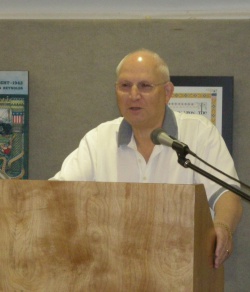
Harry Lowenstein speaking about his Holocaust experiences.

This year, for the first time in sixty years, Harry Lowenstein will be celebrating Rosh Hashanah without his beloved wife Carol. It will be a bittersweet occasion, only a few short weeks after what would have been their sixtieth anniversary. But Harry is a survivor—as well as a mensch—a person with integrity and honor.

Harry Lowenstein was born in Fuerstrau, Germany, in 1931, the younger of two children. When he was seven years old, Harry was expelled from school for being a Jew. In 1940, he and twenty members of his family were deported to the Riga ghetto in Latvia. The train carrying approximately one thousandJews left Bilefeld, Germany, on the first night of Chanukah. Someone had brought candles on the crowded compartment and started singing Ma’oz Tzur, Rock of Ages. Soon the entire train joined in. That last sweet memory sustained Harry for the next six years.

In the ghetto, his entire family was crowded into a two-room apartment. A year and a half later, the family was sent to the concentration camp of Riga-Kaiserwald, where the men and women were separated. “Return home after this is over to find us,” his mother begged before she said goodbye.

One day, Harry found a piece of bread outside a building and brought it to his father to share. “Where did you find this?” his father asked. When Harry told him, his father said, “You just took that bread away from someone who is as hungry as you were. Give it back and apologize.” When Harry returned, his father slapped him on the face. “I still can feel that slap,” said Harry. “What a lesson in ethics he gave me!”

Soon after, Harry’s father fell ill and was sent back to the ghetto, which was liquidated in November 1943. Harry never saw his father again. While in Riga-Kaiserwald, Harry remembers the constant fear of being chosen for the gas chamber and the ongoing, intentionally cruel actions by Nazi guards. When Harry stole a piece of bread from a kitchen, Nazi prison guards stood him outside in the freezing cold and blasted a water hose down his shirt. “I thought to myself, ‘I will somehow survive,” said Harry. “You learned to live minute to minute—not even hour by hour— to make sure the next day comes.”

In the fall of 1944, as the Russian front drew close, the Nazis tried to avoid the Allied forces. Harry, along with thousands of other Jewish prisoners, were shipped by boat to Danzig and then by barge to the Stuthoff concentration camp in Poland. On March 9, 1945, the camp was liberated by the Red Army. He and other survivors were brought to a makeshift hospital. For six weeks, he and fellow survivors were fed a diet of oatmeal to help them regain their strength. The next day—and freedom—had come.

Remembering his mother’s instructions from years earlier, the 14-year-old returned to Fuerstenau to reunite with his family. His trip was in vain. He was the sole survivor.

As the High Holy Days approached that fall, Harry visited a fellow survivor, and a group of them went to services in a makeshift shul. A Polish Jewish officer serving in the British army asked Harry if he had had his bar mitzvah. When Harry said no, the Polish officer said, “Then you will be bar mitzvah today, on the first day of Rosh Hashanah, the beginning of the rest of your life.”

After spending the next four years in children’s homes in Hamburg and Paris, Lowenstein emigrated to the United States in March 1949. He stayed in the Bronx with an aunt and uncle who had emigrated to the United States in 1928. He worked in a butcher shop during the day and attended school at night, trying to build on two years of schooling he had before the war.

In 1952, after serving two years in the army, Harry moved to Florida, where he got a job working in his uncle’s clothing shop. “Selling a pair of pants or some shoes was easier than hauling sixty pounds of frozen ‘trief.’” said Harry. He hung up his butcher’s apron for good.

On February 14, 1957, Harry went on a blind date with Carol Sainker, the daughter of another butcher. After only six weeks of long distance dating (they lived four hours apart), he proposed. They were married on August 18, 1957.

Harry and Carol lived in England during the 1960s, and then moved back to Florida in the 1970s with their three children, Berna, David, and Karen. In 1974, Harry and Carol took over Goolds, clothing store in Kissimmee, that had previously been run by another uncle, Luther Goold. Carol and he ran the business for thirty years, expanding the building from 1600 to 6000 square feet. As the only department store in town, it sold what everyone wore in Central Florida—jeans, cowboy shirts, and boots.

The Lowenstein’s attended Congregation Shalom Aleichem, which had met since its founding in 1981 at the Kissimmee Women’s Club.The Lowensteins began to press for a building of their own. “I saw a synagogue burn,” said Harry, “and I was determined to build another one.” Starting with a $120,000 contributions from Sandor Salmagne, another Holocaust survivor, the  Lowenstein’s—through their own and others’ contributions — raised another $60,000 for building expenses.

Once Congregation Shalom Aleichem opened, the Lowenstein continued to work tirelessly to obtain a Torah, the prayer books for both every day and holy days, the Torah rimonim (filials),  and the Yartzheit (memorial) board, most coming from their own pockets. Carol served as treasurer for over thirty years, and Harry held “every position on the board,” except president. “My language skills were not up to my standards,” explained Harry.

Rabbi Karen Allen, Congregation Shalom Aleichem’s spiritual leader, expressed her admiration for the extraordinary and exemplary hospitality that characterized the Lowensteins at home as well as in their role as congregation leaders  ” It was my privilege to be their guest on many Friday nights after services, and I will always be grateful for the kindness and generosity of their elegant graciousness,” said Rabbi Allen.”It is easy to understand how such caring and sensitive people could have created a successful business that for so many years contributed greatly to the growth of our community.”

Their daughter Karen remembered her parents as “the most loving couple” with an old school work ethic that they instilled in their children:“Be honest, put in 110%, be truthful, and remember that being on time was being late.” Karen has especially fond memories of the High Holy Days. “My mom would spend weeks cooking. On the night of the dinner, the table was set with our best china, silverware, and crystal, with flowers gracing the center.”

Unfortunately, Carol faced major health problems throughout most her life. She experienced her first heart attack at thirty-eight, and that began years of cardiac issues.  “Each time she was hospitalized,” recalled Karen, “we thought it was the end. We were blessed to have her for so long.” Carol died peacefully on February 10, 2017, at the age of eighty-one.

Despite his grief, Harry remains intensely committed to the Congregation Shalom Aleichem, its building and its spiritual aspects. He quietly continues his tzedakah—his charity—to many others.

As he has done for many years, he gives frequent talks about his Holocaust experiences to local synagogues, schools, and other public venues. Video accounts of his first person narrative are on file in both The Holocaust Memorial Resource and Education Center of Florida in Orlando and Stephen Spielberg’s the University of Southern California Survivors of the Shoah Visual History Foundation.

Harry shows no bitterness about his experiences in World War II. “The Nazis couldn’t take away from me who I am in my heart.” said Harry. “They could not change me. I was and still am a Jew.”

And most importantly, Harry is a mensch. I know many people who share this sentiment: May you live for many more High Holy days in which you make your life—and Carol’s memory—a blessing.