Category Archives: History

A Memorial Day Tribute to a Jewish Hero

Albert Gellman Circa 1944

Private Albert Gellman was mad as hell.  It was June 1944, and his United States army unit of the 34th Division had been cut off behind German lines. Two of his buddies had just been killed in the battle, and Gellman knew “someone had to do something.”

This was not exactly the life a Jewish man from Albany had imagined. The son of William and Tilli Gellman, the twenty-six year old private first class had grown up with his parents and two sisters in a house on Washington Avenue that his father, a Russian immigrant, had built in 1923.

After attending Phillip Schuyler High School, Gellman became a partner at the Modern Food Market on New Scotland Avenue. In 1940, he married Marion Rosenthal, and their son Stephen was born in December 1942. Thirteen weeks later, Gellman received his draft orders and reported to basic training with the 135th Infantry Regiment, 34th Infantry Division.

Initially stationed in North Africa, the regiment was soon sent to Italy to participate in the Battle of Anzio, a massive campaign launched in 1944 to capture Rome from the Axis Powers. Gellman and his regiment were given orders to push through the boot of Italy. “My father later told me the conditions were horrific,” his son Steve Gellman recounted. “Rain and snow impeded their path, and they often encountered mountainous terrain where the infantrymen had to climb hand over hand up cliffs.” Gellman, terrified of heights, was not comforted by his commander, whose only advice was as follows: “Don’t scream if you fall because you will expose others.” Many lost their lives falling silently to their death. 

On June 1, 1944, Gellman’s regiment was engaged in an assault against strong enemy forces in the vicinity of Castelleone, Italy. Four US tanks preceding the attack were knocked out of action by enemy anti-tank guns holed up in a group of Italian farmhouses. Gellman and fellow members of his  squad withdrew to a shallow ditch in front of area.

The  Americans shot at the enemy soldiers who were seen inside the buildings. One of the Germans hoisted a white flag of surrender, but the enemy soldiers refused to leave the safety of the farm house. 

The lieutenant asked for volunteers to take the guns out. Gellman had learned Yiddish while growing up. He believed this language skill, along with his very limited knowledge of German, would help. The 26-year-old private first class volunteered with Private Smith, another member of the regiment, to charge a machine gun emplacement guarding the left flank of the farmhouse. 

In his haste to reach the building, Gellman forgot his carbine rifle. That didn’t stop him. Brandishing a .45 revolver and loaded grenades, he ran into the yard yelling  “Komm raus Mit deinen Händen! (Come out with your hands up!)” Four Germans were so  startled that they dropped their weapons and immediately surrendered. While Private Smith was taking those prisoners back to their platoon  Gellman sprinted to the first house and told the solders in Yiddish to surrender.  By the end of the day, with the help of more Yiddish and some strategically lobbed hand grenades, Gellman had almost singlehandedly taken over thirty prisoners and had destroyed some of the German anti-tank guns.

 Using the information Gellman provided,  the army notified US navy destroyers off shore. The ships’ artillery leveled the farmhouse, taking out the remaining guns and any German soldiers who had refused to surrender.

Three days later, Gellman used the same technique to single-handedly capture an additional four German soldier who were holed up in an Italian farmhouse near their abandoned German tank. 

Gellman and his regiment saw more action in Northern Italy through the next several months. In the spring of 1945, Gellman was hospitalized with back pain and extreme battle fatigue. It was in the Italian hospital that Gellman was awarded the Distinguished Service Cross, the second highest award for combat heroism.The award included the following, “Private First Class Gellman’s intrepid actions, personal bravery and zealous devotion to duty exemplify the highest traditions of the military forces of the United States and reflect great credit upon himself, the 34th Infantry Division, and the United States Army.” He was also presented with the Italian Military Valor Cross.

Gellman returned to the United States on a hospital ship. After a brief respite in the Army’s reassignment center in Lake Placid, he finished out the war as a military policeman in Albany. 

He was later presented with New York State’s Conspicuous Service Cross, three Bronze  Stars, and numerous other awards. Asked later how he felt about his actions, Gellman downplayed his moniker as a war hero. Gellman said, “I was shaking in my boots,” he later recounted.  “After all, I’m still a civilian at heart.” 

After the war, the Gellmans had two more children, David and Toby. Gellman initially ran an open-air fruit stand on Upper New Scotland Avenue. In 1948, he opened Al’s Market, adjacent to Modern Food Market, which he operated until 1955. Gellman continued to work the wholesale food industry for Service Food Company and Archway Bakery until his retirement in 1980. The family were members of Congregation Ohav Shalom.  He was also a member of  Jewish War Veterans Albany Post 105, the American Legion, the Disabled American Veterans and Albany City Lodge of Knights of Pythias. 

His son Steve said that his father rarely talked about the war while he and his siblings were living at home. If he did, Gellman emphasized to his family his role. “I never killed them,” Gellman insisted.  “I just captured them.”

Steve, however,  clearly remembers one incidence in which he saw another side of his father. Just before his bar mitzvah, Steve was walking with his parents to synagogue when a drunk yelled an anti-Semitic epithet at his mother and then kicked Gellman. Steve watched as his father changed from the gentle man he knew to a killing machine. “Dad picked the man up, slammed him against a car, and put him in a headlock.”  The Gellmans did not press charges against the man, but Steve never forgot the expression on his father’s face. “It was like he was back in Italy,” Steve said.

It was not until forty-eight years after the war that Albert Gellman was able to confront his own demons. In 1998, the 76-year-old decorated World War II veteran entered counseling for post traumatic stress disorder.  The memories of horrors of war and the guilt and shame he carried for “leaving my buddies behind” finally surfaced and left him frequently in tears. 

It was after he had been to counseling that he was able to finally talk to his family about what he had endured. He had seen men blown up, had been begged by fellow GI’s in flames to be shot; he had killed German soldiers. These memories haunted him until his death at the age of 83 in 2001.

In 2006, Albany County Executive Mike Breslin and the Honor-A-Veteran Committee commemorated Gellman at a ceremony which included flying a flag in the late soldier’s honor. And the honors may continue. Gellman is currently one of 157 World War II Jewish War Veterans being considered for an upgrade to the Medal of Honor. Steve, who served in the US Air Force from 1960 to 1964, is working with the JWV to realize this goal. “With or without the Medal of Honor, I regard my father as a hero, a man who was bigger than life,” said Steve. “He sacrificed so much for this country, his time, his physical and emotional health. He truly represents The Greatest Generation.”

Thanks to Stephen Gellman, Albert Gellman’s son, for providing newspaper articles and other documents that were used to write this article.

A version of this article originally appeared in the Jewish World News, a bi-weekly subscription-based newspaper in upstate New York. in the May 16, 2019.

A version of this article originally appeared in the Heritage Florida Jewish News, a weekly subscription-based newspaper in Central Florida, in the May 31, 2019, issue.


Synagogue of the Summit Shabbat brings Shapiros solace

cLVTFeGCSUeeESGGf%I%Yw

Shabbat in the Rockies with Synagogue of the Summit

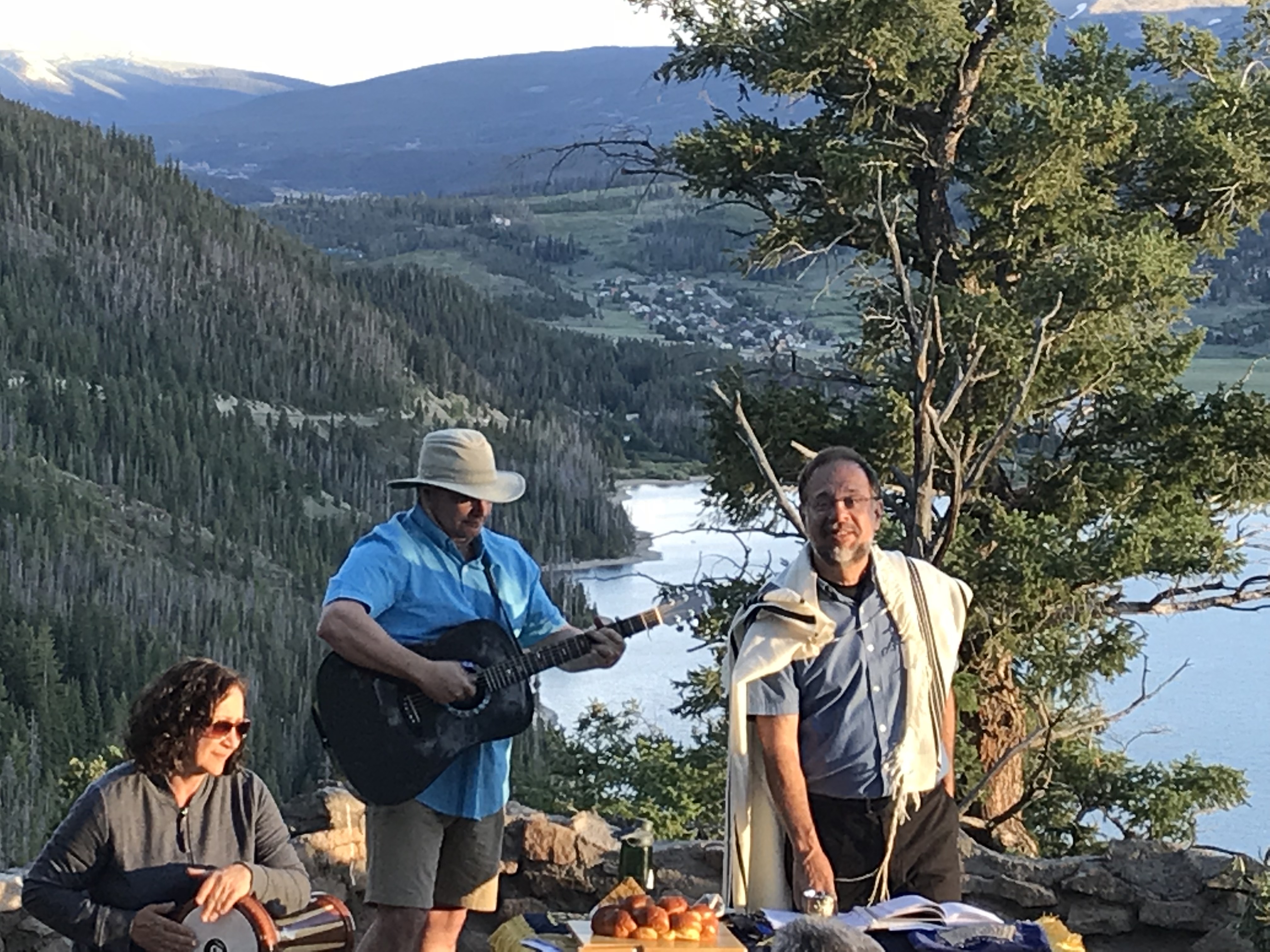
My husband Larry and I were enjoying our annual stay in the Colorado Rockies. As we had done many years before, we were hiking, spending time with our family, and taking advantage of all a summer in Summit County has to offer. The world surrounding us, however, was filled with troubling news. Both of us—especially me—needed to find peace and comfort. Fortunately, we were able to find both when we joined Synagogue of the Summit (SOS) for Friday night Shabbat service at Sapphire Point on this past June. 

The overlook sits at 9,500 feet between Keystone and Breckenridge atop of Swan Mountain Road. We placed our potluck snacks onto the waiting tables and set up our lawn chairs in anticipation of the evening service. We joined several SOS congregants for an easy hike along the half mile Old Dillon Reservoir trail, offering spectacular views of the Ten Mile Range and the Continental Divide. 

Barry Skolnick, SOS’s lay leader, began the service shortly after the hikers’ return. I will lift up mine eyes unto mountains from whence shall my help come, Skolnick said, quoting Psalm 121. My help shall come from the Lord, maker of heaven and earth. Barry swept his arms to point to a perfect blue summer sky etched with the Gore Mountain Range as Lake Dillon Reservoir sparkled below. 

Skolnick’s beautiful voice and the guitar and percussion accompaniment of musicians Ron and Betsy Cytron immediately drew me into the Shabbat service. Some of the melodies and prayers were new, but others were familiar to me from our congregations in Upstate New York and Florida. Board members and congregants were called up to light the Shabbos candles (non-flammable, to conform to the fire ban in the mountains), and take part in readings throughout the service.

Just before the Kiddish, Leah Arnold gave a short dracha—sermon—on Parashat Balak, the Torah portion for the week, The passage from Numbers recounts the story of Balak, the king of Moab, who summons the prophet Balaam to curse the people of Israel. On the way to his mission, Balaam is berated by his donkey (Yes, the donkey talks!), who realizes that an angel of God is blocking their way. Whenever Balaam attempts to pronounce his curses, his mouth instead pours out blessings.

In a moment of pure synchronicity with my own feelings, Arnold reflected that this particular week seemed to be filled with curses raining down on those who were trying to make the world a better place. “The possibility of turning back curses lies not directly with God or magical donkeys or angels,” Arnold shared with me later, “but with us, and our ability to channel the Divine within ourselves by following the prophet Micah’s words: ‘to seek justice, love mercy, and to walk humbly with your God’” 

Her closing poem was a reminder to all that calling out for God to help us do what He wants of us  is more useful and effective than simply cursing our situation. “I meant to curse you.” Arnold said, reading from a poem by Stacey Robinson. “Instead, I called out Your name.”

After the closing prayers, everyone shared challah, wine, and the food attendees had brought. Larry and I were warmly greeted by many members of SOS. One had a daughter and son-in-law moving to Frisco, four blocks from my own daughter’s family. Another sported a shirt from a golf community near us in Florida. His wife and I, both writers, found we had been impacted by a collection of children’s drawings and poems discovered after the Holocaust and captured in the book, I Never Saw Another Butterfly. Another couple owned a condo in the building next to ours. As we made our way back to our car, I told Larry we had found our summer Jewish home in the Rockies.

Over the next few days, I learned more about the congregation through research on the SOS website and conversations with its synagogue board members.

Although Denver has had a significant Jewish presence—over 40,000 in the 1970s—the Jewish population of Summit and adjacent Eagle counties was small. Religious services were held in the Interfaith Chapel at Vail, requiring a ride over Vail Pass. A beautiful drive, but treacherous during the winter months in the Rockies.

Recognizing the need for a Jewish community in Summit County,  Sandy Greenhut of Dillon organized the Summit County Jewish community and formed Synagogue of the Summit in 1990. The first years barely drew enough people for a minyan—the required ten adults over the age of thirteen. Meetings and High Holy Day services, as well as a Sunday School for children, were held in people’s homes for the diminutive but enthusiastic group. 

By the mid-1990’s the population of Summit County grew, as more people discovered life in Colorado. The Jewish population increased. Many purchased second homes or moved permanently to the mountains. “SOS membership now ranges between 120 and 140 families. About half the congregation are permanent residents, while the other half spends two to six months in Summit County,” stated outgoing SOS president Jonathan Knopf.

Jackie Balyeat, the incoming president, is optimistic about the future of the synagogue. “As newer members move into the county, they bring their previous work experiences enabling the congregation to tap into a variety of talents allowing SOS to offer different programming as well.” 

Although the majority of the congregants are retirees, young families are always welcome and SOS has several. The synagogue offers educational programming customized to the age of the children. There have been one or two Bar or Bat mitzvahs each year. 

SOS has no permanent building, a situation supported by the congregation. “This gives the congregation the opportunity to hold services in places all over Summit County,” explained Knopf.  Activities have been held in Breckenridge Library, the Frisco Senior Center and historic chapel, and the Silverthorne Municipal Building. Churches have also opened their doors to SOS, including Lord of the Mountains Lutheran Church and the Dillon Community Church, where High Holy Day services will be held this September. In August, Skolnick conducted  a Shabbat Morning service at the historic Temple Israel in Leadville.   The building dates back to the 1880’s when Jews were participating in the mining days.  Although it is no longer an active synagogue, it is open for special events like those offered by SOS. 

Rabbi Ruth Gelfarb, who lives in Boulder, Colorado, serves as the congregational rabbi six weekends a year. She also officiates at High Holy Day services, the annual Passover Seder, and special events. Whether run by “Rabbi Ruthie” or lay clergy, whenever possible, services and Torah studies are held at breathtaking outdoor locations throughout Summit County, including Sapphire Point, Keystone Mountain, and Lily Pad Lakes hiking trail. 

Along with spiritual events, SOS offers many social, cultural and outdoor programing.  Upcoming events this summer include potluck dinners, a hike to Shrine Pass near Vail, and a field trip to the Denver Museum of Nature and Science to see the Dead Sea Scrolls exhibit. 

The congregation also is connected to the greater Denver Jewish community. Several members participated in the recent 22nd Annual Leadville Jewish Cemetery Cleanup Weekend sponsored by B’nai Brith. More than eighty people of all ages, are signed up to participate in the congregation’s first Annual Mitzvah Day on July 15th. The congregation will take on four service projects throughout Summit County, including trail clean-up in Breckinridge; landscaping of the Frisco-based safe house for Advocates for Victims of Assault; a path upgrade along Lake Dillon; and repair work at the Silverthorne Blue River Horse Center.

More information about Synagogue of the Summit is available through their website http://www.synagogueofthesummit.org


Patriot Weissman was POW in World War II

548740566.520012

Staff Sargent Melvin Weissman

Melvin Weissman didn’t have to fight in World War II. 

As a machinist for an essential industry, he needed permission from his company to even enlist. He was first rejected by the army as he had flat feet. But the twenty-two year old was determined to fight for his county.

Undeterred, Melvin, along with several of his friends, tried to enlist in the United States Army Air Corp. This time, he was accepted, flat feet and all. When he said good-bye to his family, Weissman was overcome with emotion. “I knew I would never see my father again,” Weissman later told his daughter Diane Silverman. 

After basic training, Weissman was assigned as a flight engineer flying B-17s with the USAF, 94th Bomb Group, 331st Squadron, out of Bury-St. Edmunds, England.

Worries of a Jewish GI

Weissman had grown up in Brooklyn, the son of Nathan and Dora Weissman, Jewish Russian immigrants. He knew that “H” for Hebrew,  Jewish designation on his dog tags could cause a problem if he was captured by the Germans. He requested that his tag be changed to “P” for Protestant, to be worn on each bombing missions. 

Weissman and his fellow soldiers flew ten successful missions over Germany. On his eleventh mission, however, the plane was hit. He and several soldiers jumped out the plane safely; others lost their lives when the plane crashed.

When his parachute brought him into enemy territory, Weissman realized that he had accidentally worn the dog tags with the Jewish designation, the letter  “H.” He quickly tossed them away before a ten year old German boy found the scratched and bruised solider and turned him over to Nazi soldiers.

During his interrogation, Weissman was asked questions in English from a commander. In the same room, behind a screen, was another commander telling the interrogator in German what questions to ask the captured soldier.  Because his parents spoke Yiddish in their house, Weissman understood the Germans and knew the questions ahead of time. To further hide his Jewish identity, he gave his name as “Veismann,” a more German form of his Jewish name.

Weissman was sent to Stalag 17-B, where he remained a prisoner of war from January 11, 1944, to May 3, 1945. While he was in prison camp,  a neighbor of the Weissmans heard a blurb on the radio that Staff Sargent Melvin Weissman had been captured. His father, who was in failing health, said the he would believe this was true only when he heard from his older son.  A letter finally came to their Brooklyn address on April 2, 1944. Nathan Weissman died the next day.  Weissman’s premonition had come true. “My aunts told me he was just waiting to hear that Melvin was ok.” said Diane

In April 1945, as the war was coming to a close, 4,000 of the POWs at Stalag 17-B began an 18-day march of 281 miles to Braunau, Austria. The remaining 900 men were too ill to make the march and were left behind in the hospitals. These men were liberated on May 9, 1945. Those who survived the death march were finally rescued by American troops.

J is for ?

Weissman and his fellow liberated soldiers were shipped home to New York City. While sailing, Weissman was taken ill. When he arrived, he walked down the gang plank where doctors, pulling him aside, put a giant yellow J on his shirt. When he asked how they knew he was Jewish, they laughed. “We don’t know if you’re Jewish,” they said. “But we DO know you are jaundiced.”

Weissman spent three months in a hospital in New Jersey recovering from his imprisonment and subsequent illness. When a rabbi came in to tell Weissman that his father was dead, Weissman said, “I know. My mother and sisters never mentioned him in his letters, but I knew I was saying my last goodbye to him when I left for basic training.” 

Once he was healthy, Weissman returned home and got a job as a machinist for Templet Industries in Brooklyn, New York. He met Sylvia Laskowitz in January 1948. They were married six months later, on June 27, 1948. Their daughter Mona was born fifteen months later, and their second child Diane was born in 1953. 

Diane remembers a happy childhood, marred only by quirks that she attributes to his status as a POW. 

PTSD

“Dad was not a very trusting person except for his wife and two daughters,” said Diane. Although he never spoke about his war experiences while she lived home, Diane remembers hearing her father cry out in his sleep. She often found him sitting on the edge of the bed, covered in sweat. Diane did her best to soothe him, to try to help him move past his nightmares. 

By 2007, Sylvia, his wife of 58 years,  and Mona had both passed away. Weissman had severe heart problems and reoccurring bouts of  post traumatic stress disorder (PTSD) As he was no longer able to live alone, Diane and her husband Mark moved him into their home in Clifton Park, New York. More war stories started coming out. Weissman talked about his time in the camp. Conditions may have been difficult for American soldiers, but he spoke sadly of the treatment given to Russian and Polish POW’s. He also recounted his long days on the death march and his rescue. 

By 2010, Alzheimers had set in, and Weissman became very combative, “a tortured soul.” After some violent episodes in which he threatened Diane physically, Diana and Mark made arrangement to move him to Albany Stratton VA Medical Center. Three days before he was to make the move, Diane found her father dissolved in tears. “What is wrong, Daddy?” Diane asked. 

“I killed a man!” sobbed her father. 

“Do you mean in the war? Do you mean you killed a German soldier?” 

“Yes.”

“Daddy, if you didn’t kill him, he would have killed you. And you never would have been married to Mom or had your daughters, your four grandchildren, and the great-grandchild you have on the way.” 

This calmed him. It was also the last coherent conversation Diane had with her father. Hero’s Way, the hospice unit of VA Hospital, provided the care the exhausted and haunted ex-GI needed in his remaining days. Seven weeks later, on September 11, 2011, Melvin Weissman quietly passed away. His great-grandson Judah Benjamin Rome, who was given the Hebrew name Moshe Dov after Melvin and a paternal great-grandfather, was born November 22, 2011.

Noting Veterans’ Efforts

For several years, Congregation Beth Shalom had had a low-key breakfast on the Sunday before Veterans Day. Soon after his father-in-law died, Mark asked Diane if she wanted to honor her father by having them sponsor the breakfast.

Diane agreed, but only on her own terms. The danish and coffee were accompanied by huge plates of Diane’s luchen kugel, homemade quiche, and fresh fruit. Between seventy-five and one hundred members of the congregation and their guests, many themselves veterans,  attended the elaborate brunch for the next six years until the Silvermans moved to Connecticut in 2016.

Diane still has the American flag that was draped on her father’s coffin, and she proudly displays it on the wall of her living room. “I brought it to every Veterans Day brunch, and I proudly display it on the walls of our home,” said Diane. “It is my way of remembering an American Jewish GI, a former prisoner of war, and the best dad in the world!”

Originally published in The [Capital District] Jewish World on May 31, 2018 and the Heritage Florida Jewish News on June 1, 2018

Belarus Holocaust Memorial Project

How does one keep the memory alive of the 800,000 Belarusian Jews killed during the Holocaust? For two Jewish families with links to Florida., along with a couple from England, the answer was simple: One monument at a time. 

In the first half of the twentieth century, the Jews in Belarus were its third largest ethnic group in this Eastern European country. The population of cities such as Minsk, Pinsk, Mahiliou, Babrujsk, Vitsyebsk, and Gomel was more than 50% Jewish. Tragically, some 800,000 Jews—80% of the Jewish population—together with transports of Jews brought for extermination from the remaining communities in Western Europe, were killed in Belarus during the Holocaust. Many were killed by mass shootings, or “Holocaust by bullets,”  in which executioners massacred the victims in their own villages before the eyes of the neighbors.

In 2006 Dr. Michael Lozman, a Capital District orthodontist,  introduced Dr. Warren Geisler, a Capital Region dentist, to the Holocaust By Bullets in Belarus. As a one time partnership they, together with personal donations with the help of community donations as well, built a memorial to the 433 victims of the Holocaust in Grozovo, Republic of Belarus. The late Dr. Miles Kletter, a Capital District dentist and philanthropist as well as a dear friend of Geisler, generously donated to the site.

“Miles and Warren felt strongly about the injustice of the Holocaust and the tragedy of the Shoah,”said Marilyn Kletter. “They knew more needed to be done to remember the victims and serve as a warning to the future generations of what hate and bigotry can create when the people fall silent.”

Kletter researched and located Michael and Diana Lazarus in London, England, who had been building these memorials since 2003 through their Simon Mark Lazarus Foundation. After multiple discussions, Miles and Marilyn Kletter and Warren and Beverly Geisler and their respective families each formed foundations in 2008. Their donations, together with the Lazarus family, would be placed into what was called the Belarus Holocaust Memorials Project (BHMP) through the American Jewish Committee in New York City. 

These three foundations, together with Jewish communities and organizations across Belarus, established the Committee for the Preservation of Holocaust Victims’ Memory in the Republic of Belarus. The Committee, comprising dedicated and steadfast members of the community’s representative bodies, provides crucial support in identifying the locations and coordinating the construction of Holocaust memorials. 

In 2012, Cary and Joni Kletter, the son and daughter of Marilyn and Miles Kletter, took over their father’s work when Miles died of cancer. They are involved with BHMP on many levels: facilitating the foundation’s financial involvement, designing and managing the BHMP website; traveling to Belarus for ceremonies; coordinating with officials in Belarus; and working on the content and layout of the website.

The Geisler family is no longer is involved with the BHMP as Geisler is now   dealing with serious health issues. The Kletter children now manage the project. “The Geisler family was part of an incredible existential exercise into replacing the lost humanity on the ground,” said Geisler. “It was an incredible learning experience bonding with the Belarus Jewish Community. I walked the talk. No regrets.”

Beverly and Warren Geisler and Marilyn Kletter now split their time between homes in Upstate New York and Florida,  in West Palm and in Boyton Beach respectively.

Through research and the help of those individuals who lived in the area during the war, over five hundred mass killing sites have been identified. The number of Jews that died at each site ranges from 2  to thousands. Each year, the Belarus Holocaust Memorial Foundation selects up to six sites to place a memorial. As of May 2018, 110  Holocaust memorials designed by Belarussian architect Leonid Levin have been erected at Holocaust massacre sites in cities, towns and villages throughout the country. The goal of the BHMP:  To have memorials at every site.

At each killing site, a black granite tombstone, set on a flagstone platform mounted on a pedestal. Each contains inscriptions in three languages – Belarusian, English and Hebrew – stating that this monument was erected in memory of the victims of Nazism. Where known, names of the victims are noted.

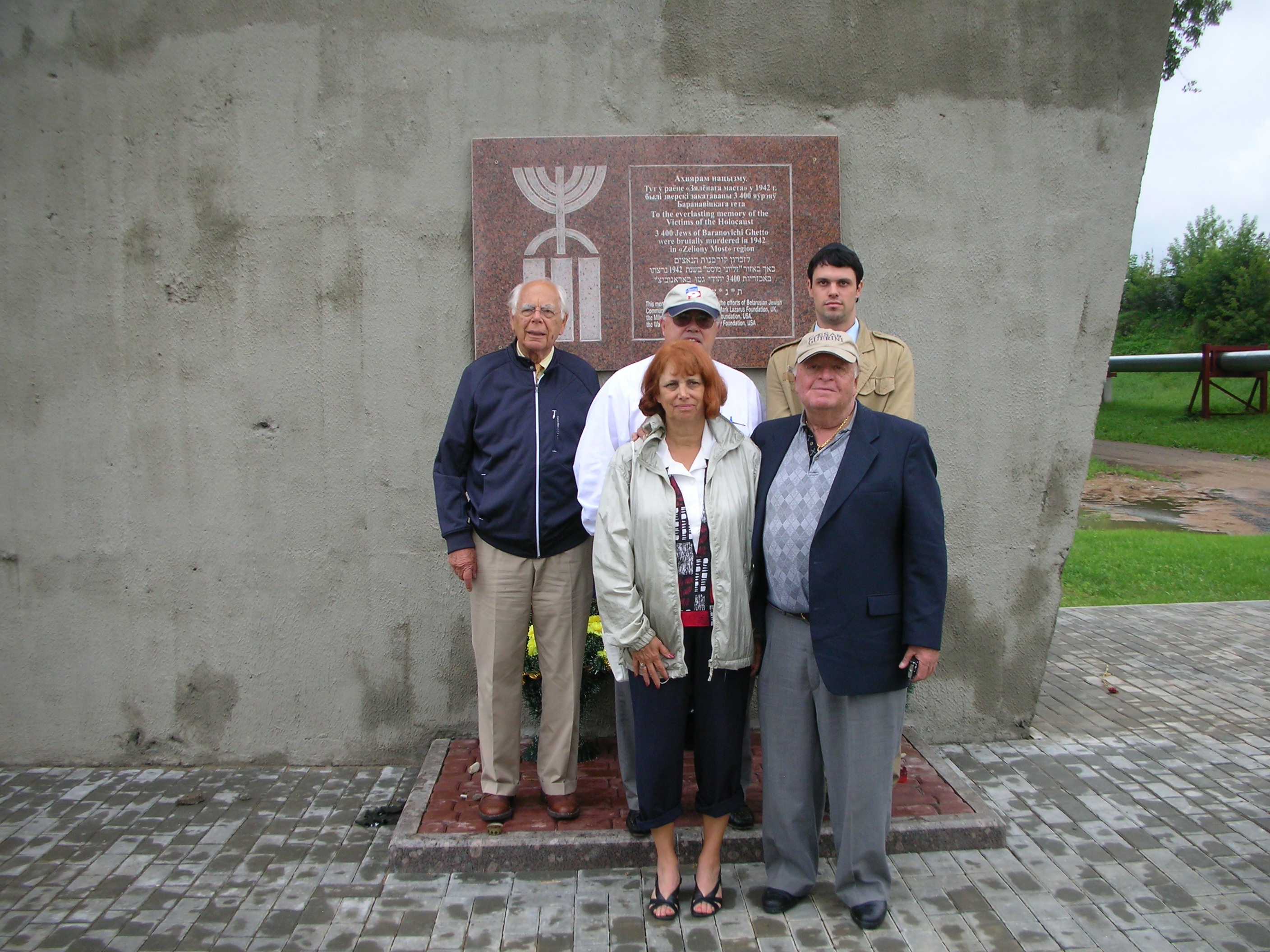
On July 26, 2009, a plaque was placed on a bridge abutment by a river  where 3,400 Jews  from the Baranovichy Ghetto were pulled off the cattle cars, shot, and dropped in the river in the Zeliony Most region. Another memorial has been placed in a rolling field near Bagerovo, Belarus, village  in which where approximately 4,670 Jews were forced to strip to their underwear, lined up, shot and buried in an anti-tank trench.

Dedication ceremonies drawing hundred of people are held at each killing site upon completion of the memorials. Many are from Belarus: representatives of the local authorities, members of the Jewish community, and representatives of Jewish  organizations functioning in the region. The Israeli ambassador to Belarus as well as ambassadorial staff members from Germany, United States, Great Britain, Israel, and the United States have also attended. Kletter said that at a dedication in 2017 the ambassador from Germany to Belarus publicly apologized to him and all the attendees for the atrocities that were committed.

Representatives of the Geisler, Kletter and Lazarus families have attended every ceremony, “Families suffered unspeakably tragic losses in Belarus during the Nazi occupation,” said Cary Kletter. “It is our earnest hope that knowledge of these memorials, in the cities, towns, villages, farmer’s fields, and forest clearings, the very sites where the massacres took place, will afford some small comfort.” 

Geisler said one his most unforgettable moments was when the last living survivor of the Minsk ghetto came to a dedication. After introducing himself, he thanked Geisler and BHMP for what they are doing to make sure that the Holocaust would not be forgotten.

Those who lost relatives or witnessed the atrocities also attend. A member of one of the grieving families said, “Now we have somewhere where we can stand to remember and mourn.”

Participants in the ceremony light candles in memory of the victims, say prayers, including Kaddish and El Malei Rachamim, and place flowers and stones on the monument. “It is a Jewish value to honor the dead,” Kletter said. “I feel like I am fulfilling a mitzvah.”

Geisler stated that there is urgency to build more of these sites as survivors and witnesses to these crimes of humanity pass on. Along with the 500 recognized sites in Belarus, more than 1,200 exist in the Ukraine alone. “There should be a memorial for the people, a memorial for where it happened,” said Kletter. “If nothing is done, these locations are lost to history.”

The rise of anti-Semitism in Europe has been disconcerting, noted Dr Geisler. In 2014, the Belarus Government requested that a memorial be placed at a site where 2,500 children from the Orsha Ghetto were killed in November 1941 soon after their brutal separation from their parents. The dedication was attended by numerous Belarus government officials and was broadcast on national television. Within a short time, the site was burnt and vandalized. Although it was rebuilt, the specter of hatred remains.  

“Let the world know this insanity must never be tolerated again,” said Geisler at one of the many dedications he has attended. “ Hundreds of years from now,  visitors of future generations coming to these  killing sites will bear witness to what happened.”

Further information regarding the Belarus Holocaust Memorials Project can be found at its website http://www.belarusmemorials.com.

Remaining part of bridge where 3,400 Jews were shot and thrown into river. Geisler and Kletter families.

10 decades of memories: Patriarch Geisler to note 100th birthday

Southern Florida, will be rocking on May 17. On that day, Morty Geisler, a veteran of World War II and a successful businessman, will be celebrating his one-hundredth birthday. Dr. Warren Geisler, a retired Albany dentist and one of his six surviving children, shared stories about his beloved father. 

Mortimer Arthur Geisler was born on May 17, 1918, in Harlem, New York,  to Maxwell and Anna Grossman Geisler, both immigrants from Poland.Eighteen months later, Maxwell died in the Great Flu Pandemic. Life was tough for the family. Geisler grew up in a two bedroom walk-up with his mother, younger brother, and grandfather. They were supported by his grandfather and Anna’s three brothers.

Geisler, however, was bright and resourceful. After graduating high school at fifteen years old, he took a job as a stock boy in a haberdasher store. He made ten dollars a week, half which went to his mother.

In 1942, Geisler married Sylvia Sheer.  A year later, he was drafted into the army, where he, like many Jewish GI’s, Geisler encountered anti-Semitism. When some “Southern boys” began picking on him, he complained to his captain. Geisler never had any problems again. 

Geisler and six thousand other soldiers were shipped over to England. The soldiers were piled ten high in bunks in the bowels of a Liberty ship, which he remembered as a “floating cork.” Geisler and his division landed on Omaha Beach on June 9, three days into what would be known as D-Day.  He then followed General Patton’s 3rd Army through St. Low to Pont de Masson relieving Bastogne and crossed the Rhein and Ruhr Rivers on the way to Magdenburg where he joined General Simpson’s 9th Army on the way to Gottinger. His division was involved in closing the pocket in Hamm where 100,000 Nazis were captured and surrendered.

In May 1945, Geisler’s division entered Dachau concentration camp two days after its liberation. “My father witnessed the ferocity of the evil that the Third Reich had created,” his son Warren, a retired dentist from Albany, New York. ”Those images are still seared into his being until this day” 

“Thousands of corpses were scattered through out the camp,” said Geisler. “Survivors, mostlyJewish, were lice infested, walking skeletons. Still in their striped uniforms, these hollow-eyed slouched over beings managed to still smile as they thanked us GI’s for saving them.”

The war was still not over for Geisler. His division advanced to Pliessen, Czechoslovakia, where they faced off on the banks of the Elbe River against Soviet forces which kept  them from invading Czechoslovakia. Two weeks later he was transferred to Paris where he met up with his brother Maxwell and his recent French bride.

In October 1945, Geisler shipped out on the Queen Mary with 14,000 other GIs back to New York City. Five days at sea with seasickness was the tour du jour. My father never missed a meal and stayed top side for four of the days at sea. Once stateside he was honorably discharged two weeks later. The war and its battles were over.

Geisler found a job as a hosiery salesman for Ma-Ro Corporation, where he became its youngest national sales manager. In 1959, Geisler and  three other salesman opened Proudfoot Hosiery. As the eventual sole owner, Geisler licensed the first National Football League’s tube sock and the first non-slip sock. His company won the licensing for the 1980 Moscow Summer Olympics. He eventually sold the company, working for the corporations that carried his lines. He retired at 85.

Geisler and Sylvia had four children, Steven, Warren, Edward, and Jayne.  The Geisler was active in the Jewish community and were responsible, along with other Jewish World War II veterans for the founding of Temple Beth Emeth, a conservative synagogue in Hewitt, New Jersey. “They all wanted to work and provide for their families in a religious setting safe from the hell of the war’s mass murder and genocide,” said Warren. All three sons were bar mitzvahed there. Geisler was also a member of the Knights of Pythias, a fraternal organization that provides philanthropic work for numerous causes.

Sylvia passed away in 1971. A year later, he married Enid Friedman, a widow who had three children, Iris, Daniel, and Paul. While enrolled at Princeton University, Paul, a natural athlete and president of the college’s Big Brothers/Big Sisters,  was diagnosed with Ewings Sarcoma, an aggressive form of bone cancer. After his death, the devastated parents donated a library in Paul’s name at the Israel Tennis Association(ITA) in Kyriat Shemona, Israel. 

Geisler’s experiences in the war, Sylvia’s volunteer work for the American Red Cross, and Paul’s legacy instilled in the six surviving children a sense of service and provided a cornerstone for philanthropic  work for the entire family. 

Geisler now lives in an independent living facility in Tamarac, Florida. Although he himself says he is “slowing down,” he paints (a skill he learned when he was ninety years old) and watches sports and operas. He and his 94-year-old friend Evelyn Mitchell step out often for dinner, she in her stiletto heels. “She drives; I buy,” quipped Geisler.

Seventy-three years later, however, the images Geisler encountered in Dachau continue to haunt him. “When I was growing up,  I remember tapping him on the shoulder to wake him up,” recounted Warren. “I immediately stepped back in fear as he jumped up as he were still defending himself.”  When asked to be video-taped the research department of Yad Vashem the world Holocaust memorial Jerusalem, he refused. “He still has nightmares,” said Warren, and he could not relive the horrors.

Geisler is devastated by the atmosphere of hate and intolerance seen today in the world, especially his beloved United States. “I want my children and grandchildren to understand that we are a great people, a great country,” said Geisler. “I worry how the new generation will survive all the current animosity.”

Meanwhile, the Geisler family is planning a big party later this month. His six surviving children as well the eleven grandchildren and five great grandchildren will be there to celebrate the life of what one of the surviving members of The Greatest Generation.

“Many GIs did their duty and sacrificed their lives, limbs, and even their sanity as asked by this nation,” said Warren. “May those who have died either in the war or as long-time veterans rest in peace.”

Geisler himself looks back with gratitude. “I’ve lived a long, wonderful life,” the centenarian said. ”I’ve had two wonderful marriages and seven wonderful children. I am truly blessed.” 

Happy Birthday, Morty. May you live 120 years.

Jewish World, 

Pictures are available through the following link: http://jewishworldnews.org/10-decades-of-memories-patriarch-geisler-to-note-100th-birthday/

Floridian Shapiro notes her Tu B’Shevat refuge and credits its creator Edward Bok

IMG_1554

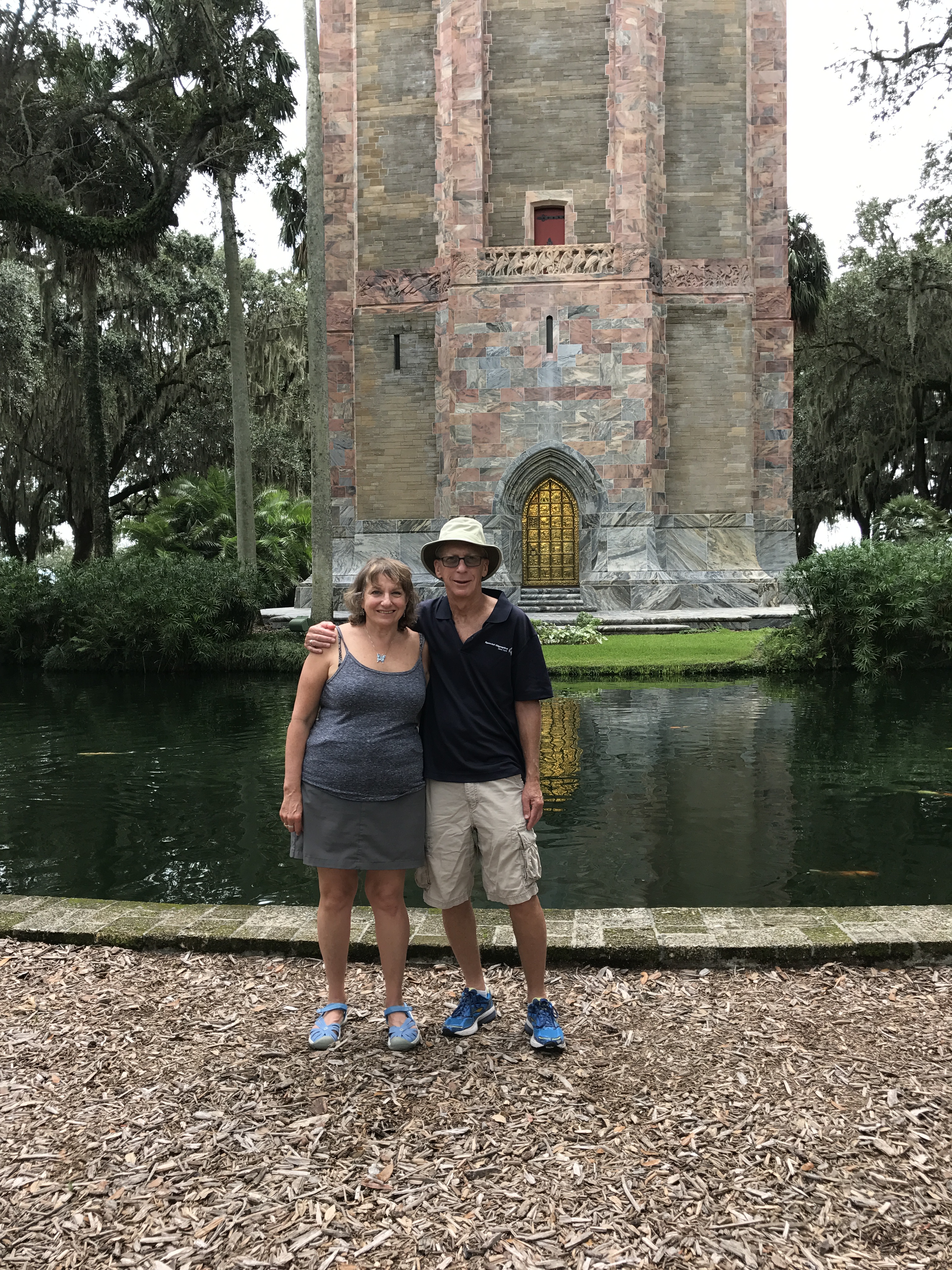
Larry and I in front of the Singing Tower carillon at Bok Tower Gardens.

Jews annually celebrate Tu B’Shevat, the day in which it is believed “trees come of age.” For those of us who live in Central Florida, there is no more fitting a place to honor the Jewish “Earth Day” than at Bok Tower Gardens. The sixty-acre sanctuary in nearby  Lake Wales was the gift of Edward Bok. Bok, the son of impoverished Dutch immigrants became a successful publisher, a Pulitzer Prize-winning author, a humanitarian and an advocate of world peace and the environment.

From Rags to Riches

Edward William Bok was born in Den Helder, Netherlands, in 1863. After a series of bad investments brought his father to financial ruin, the family immigrated to Brooklyn, New York, in 1870 to start a new life. Bok senior enrolled the children in school the day after they arrived in Brooklyn although neither of his sons could speak a word of English. 

Financial woes continued, and the family found itself in dire poverty. The two sons worked tirelessly to support their mother, who had lived most of her life with servants, by taking over all the household chores, picking up coal on the streets to light their fire and cook their food, and washing the windows of a bakery shop after school to supplement their father’s income. 

By 13, Edward Bok quit school and became an office boy for Western Union Telegraph Company.The youth used every spare minute in self-study, With his paltry savings, bought encyclopedia and studied to absorb its information.

Bok made an Horatio Alger journey in the publishing world. His rapid ascent included positions at the Henry Holt and Company, Charles Scribner’s Son, The Brooklyn Magazine and as co-founder with his brother, of the Bok Syndicate Press. In 1889, at the age of 26, he was hired as editor of Curtis Publishing Company’s The Ladies Home Journal. In 1896, he married the boss’s daughter, Mary Curtis, and they had two son. 

During his thirty year career, Bok used his position to champion causes, including social and environmental issues.

From Rags to Riches

By 1919, the 56-year-old self-made millionaire had achieved his two goals of education and achievement. He retired from the Journal, and wrote his autobiography The Americanization of Edward Bok, which won the 1921 Pulitzer Prize. It was now time to pursue his third goal: service to his country.

Throughout his life, Edward had been guided by his grandmother’s mantra to “make you the world a bit better or more beautiful because you have lived in it.” In the next several years, Bok used his wealth to create several awards, including the American Peace Award.

Edward also to help the world environmentally. During his family’s visits to their winter home in Lake Wales, Florida, he had often wandered up to nearby Iron Mountain,(a notable Florida “peak” at 298 feet above sea level) to view the vistas and the sunsets. Although acreage was initially targeted for development, Edward purchased the land to establish a place that would “touch the soul with its beauty and quiet.”

Sanctuary

In 1922, Edward commissioned Frederic Law Olmsted, Jr., an American landscape architect whose credits included the National Mall, the Jefferson Monument, and the White House grounds, to carry out the task. Under Olmsted’s direction, a year later, the barren sandhill had been transformed into a subtropical garden filled with trees, flowering bushes, flowers, and a reflecting pond that attracted squirrels and over one hundred varieties of birds. 

Not yet satisfied, Bok wanted to bring the gift of music to his garden. He commissioned architect Milton B. Medary and stone sculptor Lee Lawie to design and construct a 205-foot neo-Gothic and art deco Singing Tower carillon, one the world’s largest and, according to many carillioners, the most acoustically perfect bell tower in the world.

In December 2015, Larry and I visited Bok Tower Gardens for the first time. Impressed with its beauty, we took out a membership and have returned again and again—by ourselves or with family and friends. Sometimes we just walk through Olmsted’s well-designed garden paths, which offer hidden recesses, contemplative resting spots, picturesque vistas and breathtaking views of the Singing Tower. Each season brings its own beauty, including spectacular displays of azaleas, camellias, and magnolias.

Dutch Tikkun Olam

More often than not, we take a tour given by one of Bok Tower Gardens many volunteer guides. Each visit has brought greater appreciation for this hidden gem—its history, its flora and fauna, its music, its architecture, and more insight into the genius and generosity of Edward Bok. 

On the pathway leading into the gardens is an arch which is inscribed with Edward’s grandmother’s admonition to “make the world a bit more beautiful.” Each time I see those words, I think how closely they reflect tikkun olam, the Jewish concept that suggests humanity’s shared responsibility to heal, repair, and transform the world.

.Edward’s beautiful garden, stunning carillon, his sixty-five acres of trees and flowers and bushes and vistas, is his legacy, his gift, his way of making the world a better place. 

And in today’s political climate, I also think of how the son of impoverished Dutch immigrant contributed so very much to Central Florida and his chosen country. To Edward Bok and every other immigrant who has come to our country to find a better life and who, through their journey made our country better—I say thank you. 

Sources include The Edward Bok Legacy by Margaret Smith, Bok Tower Gardens website, and Wikipedia.

Originally published in The (Capital District)  Jewish World, January 25, 2018

Veterans Day: A WWII Jewish Sacrifice Remembered

A body of an American solider lying peacefully in the snow in a battlefield in Belgium. A Jewish boy in Brooklyn orphaned twice by World War II. And the  world-renowned photographer who connected the two. This is their story.

Samuel Tannenbaum was born on July 10, 1942, in Washington DC to Henry and Bertha Fiedel Tannenbaum. Less than two years later, Henry was drafted into the United States Army,  Bertha and Sam moved to  Williamsburg section of Brooklyn to be closer to their families. After training at Fort Meade, Maryland, Henry was assigned to the 331st Infantry regiment, 883rd division and was shipped to England. His rifle platoon subsequently fought in battles in France and Luxembourg, which garnered Henry several medals.

Between December 16, 1944, and January 25, 1945, on the border of Belgium and Luxembourg, Allied and German troops were engaged in what would later be known as The Battle of the Bulge, one of World War II’s deadliest fights. On January 11, Tannenbaum and his division were ambushed by German soldiers. Only one person—Platoon Sergeant Harry Shoemaker—survived.

When Shoemaker escaped and returned to regimental headquarters, he told the sentry, Corporal Tony Vaccaro, the details of the massacre. Vacarro and Shoemaker returned to the site the next morning . The two stared at the horrible carnage.If the soldiers had survived,  the Germans had murdered the wounded and had stripped the corpses of their watches and other valuables. Then the Germans had rolled their tanks over the dead and dying, crushing them into grotesque, mangled shapes.

Only one figure looked peaceful and untouched by death. The prone body of a lone soldier lay face down, his boots, backpack, helmet and rifle showing through the white snow that blanketed him.  Vacarro pulled out his Argus C vintage camera and captured the scene. Afterwards, Vaccaro and Shoemaker cleared away the snow to discover the dead soldier was their army friend, Private Henry Tannenbaum.

Henry Tannenbaum was buried in Henri-Chapelle Cemetery in Belgium with plans to bring his body home. Bertha Tannenbaum. his widow, falsely believed that the transfer would adversely affect her four-year old-son Sam’s war orphan benefits. She was against reinterment. Henry’s family fought Bertha’s decision and won. Henry’s remains were returned to New York in 1946. The disagreement caused the widow’s estrangement from the Tannenbaums, isolation from her family and her growing mental deterioration. In her mind, Bertha believed that Henry was still alive and working secretly for the FBI. Sam’s childhood was filled with his mother’s shouting at the ghost of her husband, several psychotic episodes, and even an attempt to kill her son and then commit suicide. “The bullet that killed my father also destroyed my mother’s mind and ended my childhood,” said Sam.

With “my father dead and my mother crazy,” Samuel was forced at a young age to raise himself. He took care of household chores, did the shopping, and, through conniving, even paid the bills. When he was thirteen, he arranged for his own bar mitzvah, fortuitously connecting with his father’s family through a Hebrew school classmate. Upon graduating high school, he moved into his own apartment and, supporting himself with a war orphan scholarship and odd jobs, graduated  from Brooklyn College.

While Sam was in college, Bertha was evicted from her apartment and was committed to a state mental institution. The eviction resulted in the destruction of the family’s belonging, including all artifacts of Sam’s family’s history. Outside of his name and the date of his death, Sam knew nothing about his father. Sam married (Bertha didn’t come; she thought it was another FBI plot), had a daughter Lisa, and divorced. Bertha met and fell in love with Sam’s fiancee Rachel, promising her that Henry would return in time for the wedding.

Meanwhile, with the help of the extended family, Sam was putting together pieces of his father’s past. Henry was regarded as intelligent with a great sense of humor. He had graduated from the same grade school, high school, and college as his son. Henry worked for the Office of Price Administration and taught Sunday school at a local synagogue. Henry had an inherited bleeding disorder which probably caused  the private’s  quick and peaceful death in Belgium on that bitter cold January day and that unfortunate disorder was passed on to his son.

In 1986, three years after his mother died, Sam invited his father’s family to his daughter Lisa’s bat mitzvah. His first cousin, Henry’s niece, gave Sam a victory mail correspondence that identified Private Henry Tannenbaum’s regiment. Sam now had the tool he needed to further research his father’s military history.

In 1995, he and his wife Rachel journeyed to Seattle to attend the first meeting of the American World War II Orphan Network, (AWON), an organization composed of the Gold Star children and others classified by the Veterans Administration as War Orphans.

At a second  AWON meeting in Washington DC in 1996,  Sam met several people from Luxembourg who came for the express purpose to meet and thank the children of their liberators. Sam invited several to his home. One of the guests, Renee Sclhoesser, a journalist, published the Tannenbaum story in a series of articles in a Luxembourg newspaper. Another attendee, Jim Schiltz, was also impressed with Sam’s search. When he returned to Luxembourg, Schiltz found a book of photographs of World War Two and specifically, of the 331 Regiment in Luxembourg taken by the sentry Tony Vacarro.

The picture taken on battlefield in Ottre was not the only one Tony Vaccaro had taken.  Michaelantonio Celestino Onofrio Vaccaro had carried his  Argus C with him when he, along with thousands of other Allied soldiers, stormed the beaches at Normandy on D-Day. Tony —at first surreptitiously and then with his superiors’ approval—went on to take thousands of pictures of Allied campaigns in Normandy and Germany.

After the war, Tony stayed in Europe through 1949 to document post-war life in Europe. When he returned to the States, Tony became a photo journalist for Life and Look magazine, photographing famous figures including John F. Kennedy, Frank Lloyd Wright, and Sophie Loren.  Throughout his career,  “White Death: Photo Requiem for a Dead Soldier, Private Henry I. Tannenbaum” had circled the world through multiple exhibits and books and had become the iconic image of the Battle of the Bulge.

Schiltz also found out that Tony was alive and living in New York City. In 1997, the orphan and the photographer met for the first time. Tony gave Sam a professional print of the photograph.Tony’s greatest joy besides meeting Sam and his family was taking a picture of Henry’s grave in Mount Hebron Cemetery, New York City. For Tony, that picture brought him closure after more than fifty years.

In 2002, Sam and Rachel Tannenbaum and Tony Vaccaro flew to Europe as guests of the grateful citizens of Luxembourg and Belgium. The Tannenbaums met with the countries’ war orphans. They visited the Henri-Chapelle American Cemetery where Henry was originally buried.In Ottre, Belgium, Sam and Tony placed a wreath at the AWON monument, dedicated to “PVT Henry Irving Tannenbaum and other members of the 83rd Infantry Division.” For Sam, it was a “trip of a lifetime.”

Fifty-seven years after Tony first shot “White Death,” Sam Tannenbaum and Tony Vaccaro visited a beautiful tree-filled spot in Ottre, Belgium. The former battle field is now a Christmas tree farm called Salm Sapin in French. And in German? Thanks to at the famous German folk song now identified with Christmas, it would be associated by many with “O Tannenbaum.”

Sam’s home in Kissimmee, Florida, is filled with artifacts from his family’s history—pictures, books, his father’s medals, and a replica of the bracelet Henry was wearing before it was stolen by the German soldiers. “I may not have had the opportunity to tell my parents that I love them,” said Sam. “Through telling their story, I believe I am honoring them. And that, is, after all, what the Fifth Commandment tells us to do.”

Samuel Tannenbaum next to his signed picture of “White Death,” photographed and signed by Tony Vacarro. Use of picture courtesy of Tony Vacarro/Tony Vacarro Archives.

Originally published in Capital Region, New York’s Jewish World, November 9, 2017.

Sources:

DeStafano, Anthony M.  newsday.com. June 7, 2017. https://www.newsday.com/news/new-york/at-94-tony-vaccaro-looks-back-at-his-brutal-images-of-wwii-1.13710291?view=print

“Finding Hope in the Depths of War.”  Before It’s News. June 28, 2011. http://beforeitsnews.com/international/2011/06/finding-hope-in-the-depths-of-war-photos-757981.html

Henry Irving Tannenbaum’s Story. http://www.indianamilitary.org/83RD/UnUsedItems/Henry%20I%20Tannenbaum%20story.txt

Mix, Ann Bennett. Lost in the Victory: Reflections of American War Orphans of World War II. University of North Texas Press.

Hadler, Susan Johnson and Ann Bennett Mix. Lost in the Victory: Reflections of American War Orphans of World War II.

http://www.awon.org/awfather.shtml

“Pvt. Henry I. Tannenbaum and 83rd Infantry Division Memorial.” American War Memorials Overseas. http://www.uswarmemorials.org/html/monument_details.php?SiteID=503&MemID=770

Roberts, Sam. “Viewing World War II Through a Soldier’s Camera Lens”. New York Times. March 4, 2013. https://cityroom.blogs.nytimes.com/2013/03/04/viewing-world-war-ii-through-a-soldiers-camera-lens/

Tannenbaum, Samuel. Interview. Sunday, October 29, 2017. Kissimmee, Florida.

Under Fire: The Untold Story of Pfc Tony Vaccaro. HBO http://tonyvaccarofilm.com

awtannen

Profile of a mensch that I know

harry_lowenstein_category

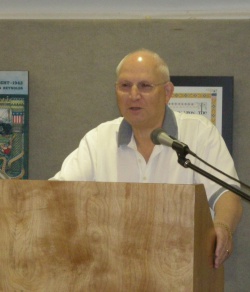
Harry Lowenstein speaking about his Holocaust experiences.

This year, for the first time in sixty years, Harry Lowenstein will be celebrating Rosh Hashanah without his beloved wife Carol. It will be a bittersweet occasion, only a few short weeks after what would have been their sixtieth anniversary. But Harry is a survivor—as well as a mensch—a person with integrity and honor.

Harry Lowenstein was born in Fuerstrau, Germany, in 1931, the younger of two children. When he was seven years old, Harry was expelled from school for being a Jew. In 1940, he and twenty members of his family were deported to the Riga ghetto in Latvia. The train carrying approximately one thousandJews left Bilefeld, Germany, on the first night of Chanukah. Someone had brought candles on the crowded compartment and started singing Ma’oz Tzur, Rock of Ages. Soon the entire train joined in. That last sweet memory sustained Harry for the next six years.

In the ghetto, his entire family was crowded into a two-room apartment. A year and a half later, the family was sent to the concentration camp of Riga-Kaiserwald, where the men and women were separated. “Return home after this is over to find us,” his mother begged before she said goodbye.

One day, Harry found a piece of bread outside a building and brought it to his father to share. “Where did you find this?” his father asked. When Harry told him, his father said, “You just took that bread away from someone who is as hungry as you were. Give it back and apologize.” When Harry returned, his father slapped him on the face. “I still can feel that slap,” said Harry. “What a lesson in ethics he gave me!”

Soon after, Harry’s father fell ill and was sent back to the ghetto, which was liquidated in November 1943. Harry never saw his father again. While in Riga-Kaiserwald, Harry remembers the constant fear of being chosen for the gas chamber and the ongoing, intentionally cruel actions by Nazi guards. When Harry stole a piece of bread from a kitchen, Nazi prison guards stood him outside in the freezing cold and blasted a water hose down his shirt. “I thought to myself, ‘I will somehow survive,” said Harry. “You learned to live minute to minute—not even hour by hour— to make sure the next day comes.”

In the fall of 1944, as the Russian front drew close, the Nazis tried to avoid the Allied forces. Harry, along with thousands of other Jewish prisoners, were shipped by boat to Danzig and then by barge to the Stuthoff concentration camp in Poland. On March 9, 1945, the camp was liberated by the Red Army. He and other survivors were brought to a makeshift hospital. For six weeks, he and fellow survivors were fed a diet of oatmeal to help them regain their strength. The next day—and freedom—had come.

Remembering his mother’s instructions from years earlier, the 14-year-old returned to Fuerstenau to reunite with his family. His trip was in vain. He was the sole survivor.

As the High Holy Days approached that fall, Harry visited a fellow survivor, and a group of them went to services in a makeshift shul. A Polish Jewish officer serving in the British army asked Harry if he had had his bar mitzvah. When Harry said no, the Polish officer said, “Then you will be bar mitzvah today, on the first day of Rosh Hashanah, the beginning of the rest of your life.”

After spending the next four years in children’s homes in Hamburg and Paris, Lowenstein emigrated to the United States in March 1949. He stayed in the Bronx with an aunt and uncle who had emigrated to the United States in 1928. He worked in a butcher shop during the day and attended school at night, trying to build on two years of schooling he had before the war.

In 1952, after serving two years in the army, Harry moved to Florida, where he got a job working in his uncle’s clothing shop. “Selling a pair of pants or some shoes was easier than hauling sixty pounds of frozen ‘trief.’” said Harry. He hung up his butcher’s apron for good.

On February 14, 1957, Harry went on a blind date with Carol Sainker, the daughter of another butcher. After only six weeks of long distance dating (they lived four hours apart), he proposed. They were married on August 18, 1957.

Harry and Carol lived in England during the 1960s, and then moved back to Florida in the 1970s with their three children, Berna, David, and Karen. In 1974, Harry and Carol took over Goolds, clothing store in Kissimmee, that had previously been run by another uncle, Luther Goold. Carol and he ran the business for thirty years, expanding the building from 1600 to 6000 square feet. As the only department store in town, it sold what everyone wore in Central Florida—jeans, cowboy shirts, and boots.

The Lowenstein’s attended Congregation Shalom Aleichem, which had met since its founding in 1981 at the Kissimmee Women’s Club.The Lowensteins began to press for a building of their own. “I saw a synagogue burn,” said Harry, “and I was determined to build another one.” Starting with a $120,000 contributions from Sandor Salmagne, another Holocaust survivor, the  Lowenstein’s—through their own and others’ contributions — raised another $60,000 for building expenses.

Once Congregation Shalom Aleichem opened, the Lowenstein continued to work tirelessly to obtain a Torah, the prayer books for both every day and holy days, the Torah rimonim (filials),  and the Yartzheit (memorial) board, most coming from their own pockets. Carol served as treasurer for over thirty years, and Harry held “every position on the board,” except president. “My language skills were not up to my standards,” explained Harry.

Rabbi Karen Allen, Congregation Shalom Aleichem’s spiritual leader, expressed her admiration for the extraordinary and exemplary hospitality that characterized the Lowensteins at home as well as in their role as congregation leaders  ” It was my privilege to be their guest on many Friday nights after services, and I will always be grateful for the kindness and generosity of their elegant graciousness,” said Rabbi Allen.”It is easy to understand how such caring and sensitive people could have created a successful business that for so many years contributed greatly to the growth of our community.”

Their daughter Karen remembered her parents as “the most loving couple” with an old school work ethic that they instilled in their children:“Be honest, put in 110%, be truthful, and remember that being on time was being late.” Karen has especially fond memories of the High Holy Days. “My mom would spend weeks cooking. On the night of the dinner, the table was set with our best china, silverware, and crystal, with flowers gracing the center.”

Unfortunately, Carol faced major health problems throughout most her life. She experienced her first heart attack at thirty-eight, and that began years of cardiac issues.  “Each time she was hospitalized,” recalled Karen, “we thought it was the end. We were blessed to have her for so long.” Carol died peacefully on February 10, 2017, at the age of eighty-one.

Despite his grief, Harry remains intensely committed to the Congregation Shalom Aleichem, its building and its spiritual aspects. He quietly continues his tzedakah—his charity—to many others.

As he has done for many years, he gives frequent talks about his Holocaust experiences to local synagogues, schools, and other public venues. Video accounts of his first person narrative are on file in both The Holocaust Memorial Resource and Education Center of Florida in Orlando and Stephen Spielberg’s the University of Southern California Survivors of the Shoah Visual History Foundation.

Harry shows no bitterness about his experiences in World War II. “The Nazis couldn’t take away from me who I am in my heart.” said Harry. “They could not change me. I was and still am a Jew.”

And most importantly, Harry is a mensch. I know many people who share this sentiment: May you live for many more High Holy days in which you make your life—and Carol’s memory—a blessing.

Colorado Jewish High

img_5359

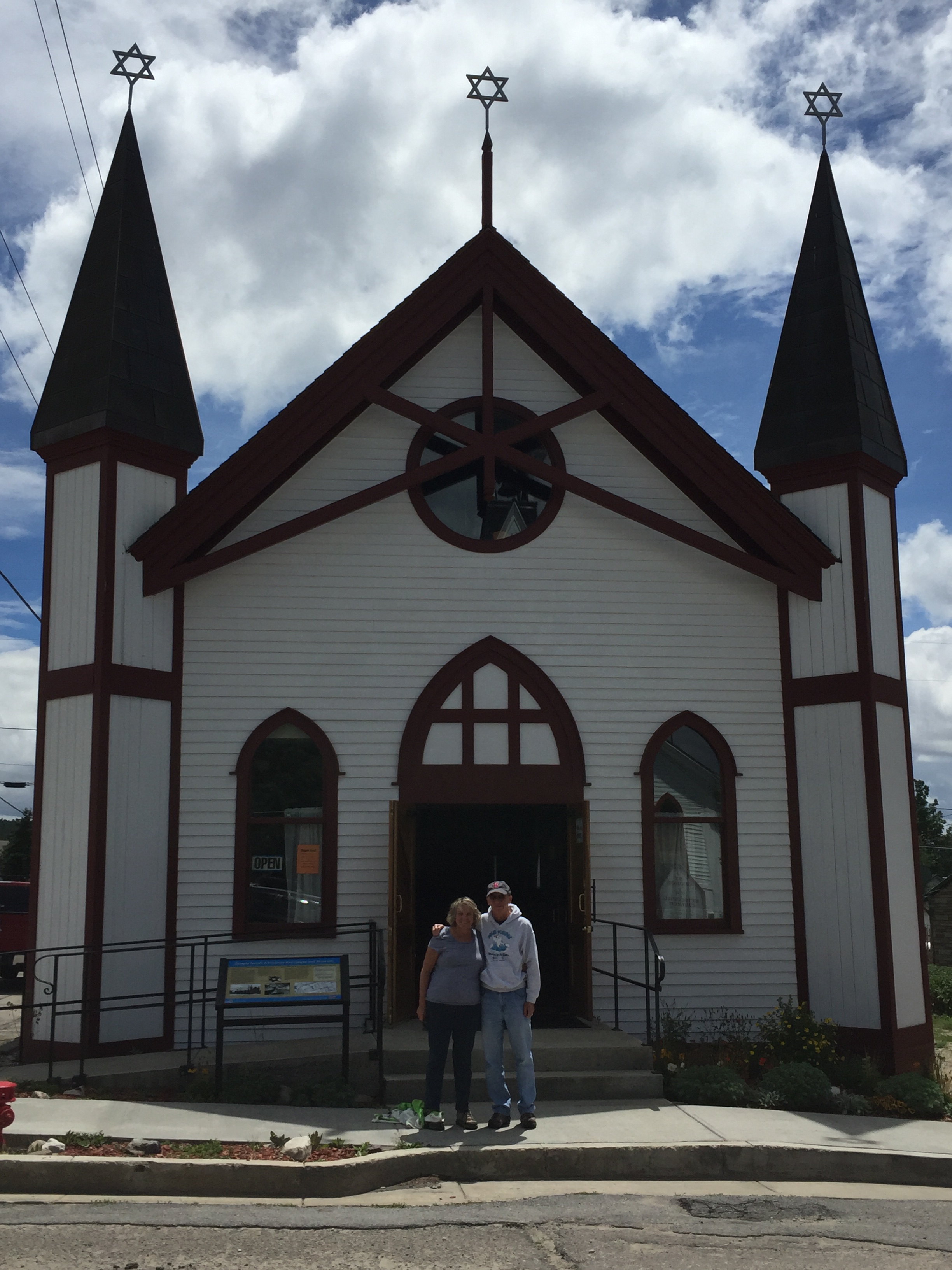
Larry and I pose outside the synagogue, now a museum in Leadville, Colorado

Rocky Mountain High: The Synagogue at 10,200 feet

While in Colorado for the summer, my husband Larry and I visited the town of Leadville, Colorado, during its Boom Day Festival, a celebration of the Old West. Gunslingers, burro races, mining skill contests, and over 100 food and craft booths filled the streets. We got ice cream cones and wandered down West Fourth Street, past a mining skills contest, where brawny men and women competed to see how many pounds of rock one could pile into a truck. And just down the street, we found the Temple Israel Foundation, a museum dedicated to a thriving Jewish community that existed in this Rocky Mountain city over one hundred and twenty years ago and the former site of a thriving synagogue.

Perched at 10,200 feet above sea level, Leadville is the highest incorporated city and the second highest incorporated municipality in the United States. It boomed in the late 1870s with the discovery of silver, resulting in an influx of migrants to this small mountain town. At its peak, the population of Leadville grew to approximately 30,000 residents.

Among the many groups of people attracted to the minefields in the high Rockies was a group of recent Jewish immigrants who migrated to the West and Colorado. Representing only 1% of Leadville’s population, the three to four hundred Jews came to Leadville for the same reasons as their non-Jewish counterparts: to improve their social and economic status, to find adventure, even to reinvent themselves. In 1879, the local opera house hosted Rosh Hashanah services, and in 1880, the Hebrew Benevolent Society purchased a cemetery for Leadville’s Jewish community. Soon after, the Jewish community built a synagogue and held its first service on September 19, 1884, the first day of Rosh Hashanah 5645.

For the next thirty-eight years, Temple Israel served a surprisingly large and active Jewish community. As a booming mining town, Leadville’s residents had amble opportunities to spend their earning on clothing and household goods, liquor, sex, and gambling. Leadville Jews provided services including dry goods stores, wholesale liquor and tobacco businesses, saloons, gambling houses, opera houses, and even brothels.

More well-known members of Temple Israel included two German immigrants, David May, the founder of May department stores; and Leopold H. Guldman, philanthropist and founder of Denver’s Golden Eagle Dry Goods Company. Benjamin Guggenheim, a first generation American and heir to the famous family’s fortune made in Colorado mines, was better known for his chivalry and death aboard the ill-fated Titanic. 

Despite its remote location, Leadville was a modern industrial city. Jewish dry goods merchants offered the latest European fashions to the ladies. The better off gentlemen often sported diamond studs to accent their wardrobe.

By the first decade of the twentieth century, the boom was over, and the town’s Jewish population declined. In 1912, the last recorded event, a wedding, took place.

From 1914 through 1937, the synagogue sat shuttered and unused. The synagogue was converted into a single family residence, and the building took on several other non-religious functions, the last as four rental apartments.

In 1983, Bill Korn, a New York City native, relocated from Boulder to Leadville to take advantage of low real estate prices and proximity to great skiing. He purchased and was in the process of renovating several properties when he learned of the former synagogue and its overgrown cemetery. Motivated by his own German Reform Judaism roots and his belief in Martin Buber’s command, “If not you then who? If not now then when?” he explored ways to obtain both properties.

In 1987, the Temple Israel Foundation was incorporated “to acquire, historically rehabilitate, and maintain” the building. Korn purchased the synagogue in 1992.

For the next several years, Korn used the four apartment rental incomes to pay off the mortgage. The Foundation obtained a grant from the Colorado Historic Fund. Finally, ninety years after the temple shut its doors, renovations to bring the building to its former glory began. The Denver chapter of B’nai Brith led volunteer efforts each June to maintain the cemetery grounds and replace markers. In 2001, the cemetery was reconsecrated, allowing Jewish burials to resume. In 2012, a permanent exhibition opened that documents pioneer Jewish life with a collection of artifacts about Leadville, its resident Jews, Temple Israel as a synagogue, and life in a mining town in the 1880s and 1890s.

While not providing regular services, the building, with its Torah and bima, is now open for special events. Today, there are, according to Korn, approximately 80 to 100 Jewish people in the entire county. Bill Korn oversees the museum, and from May through October, two full-time staff members work as both guides and researchers.

Over 3200 people visit the museum each year, said Korn. They come not only from surrounding Colorado towns but also from all over the United States and even Israel. Korn said his most special guest was the granddaughter of Leopold H. Guldman, whose emotional response to the museum brought tears to Korn’s eyes.

Larry and I celebrate Rosh Hashanah each year in Kissimmee, Florida, elevation 49 feet above sea level. During the High Holy Days, however, we pass to reflect on the lovely synagogue in the highest incorporated city in America. We will think about Bill Korn and his generous efforts to bring Temple Israel to life for future generations. And we think about the long-ago Jewish congregation in Leadville celebrating Jewish life high in the Rocky Mountains.

Originally published September 29, 2016. Updated May 26, 2025.