As we prepare to celebrate Passover, I contemplate my ancestors’ flight out of Egypt. If the Exodus happened today, I am not sure if I would ever make it out of Egypt.
According to the midrash, the Pharoh commanded the Israelites to leave immediately following the tenth plague. As we all know, they had so little time that the bread had no time to rise. As a woman who loves to bake challah, I could live with whipping up the dough and foregoing the rising process. As long as I had butter and raspberry preserves matzoh would work until the manna rained down. (Hopefully, mine would taste like vanilla ice cream.)
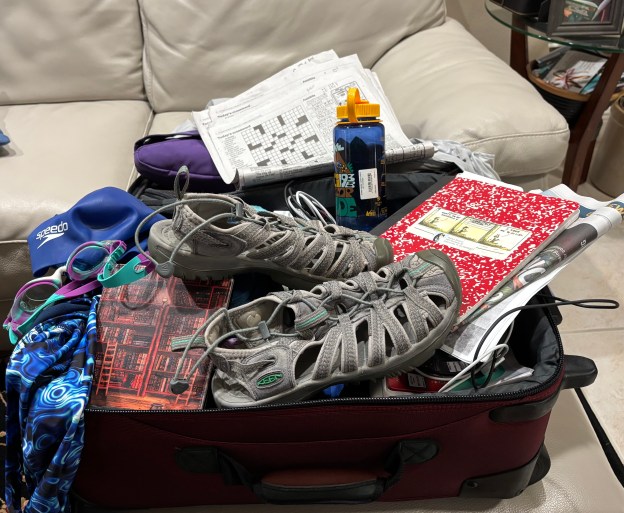
My first problem is that there is no way in the world I would have had time to pack.
Friends I know who pack the night before any trip would have done well that evening. Those carefree individuals would pull out their sachets, throw everything in, and figure they could pick up whatever else they needed at the closest desert oasis.
Unfortunately, I am not one of those people. I start filling my suitcase at least a week before scheduled departure, often packing and repacking several times. Too many shoes. Too few tops. Do I need a dress in the desert? And what about my denim jacket? I love pairing it with almost everything in my closet, but maybe a fleece would be more practical and take up less room. How in the world could I pull this off before we headed out?
Full disclosure: I don’t even leave my house for a few hours without packing enough for an overnight stay. Along with my essentials—wallet, iPhone, sunglasses, lipstick—I need to cover all my bases. A book. My notebook and a pen in case I get hit with a writing inspiration. A phone charger. A sweater or fleece in case I get cold. Shorts in case I get hot. My water bottle. A Quest bar in case I get hungry. I stuff more into my oversized handbag for a simple errand than the Israelites grabbed in the middle of the night.
Even if I’d managed to pack my bags and prepare the challah that turned into crackers, I would have had to dash back home for the items I’d forgotten. My phone. My keys. My sunglasses. No matter my preparation, I always leave something behind when departing. The Red Sea would already close by the time I made it to the shore. I would wave to everyone while watching all of Pharoh’s soldiers being drowned.
And could I ever have left my home in the first place?
According to scholars’ interpretation of Rashi’s comment, only one-fifth of the Israelites left Egypt. Eighty percent stayed put, out of fear of the unknown or feeling comfortable despite their inferior status in the kingdom. Eighty percent! But thinking about it, would I have been in the majority? Would I have given up freedom to stay put? Could I have left my familiar life and my stuff behind?
As Dan Schur writes in an April 22, 2022, article for the Jewish Journal, “the overwhelming majority of the children of Israel chose a compromised but familiar existence over the potential dangers that more dramatic and assertive actions might have brought.”
Could I leave my piano? My lanai that overlooks a pond? A house that brings me so much joy?
So, maybe I wouldn’t have left in the first place. I would have packed Larry some matzoh and lots of water, given him a kiss, and would have waved goodbye. Who knows? Maybe those 40 years of wandering would have somehow led him back to me.
Since the year that we met, my husband Larry and I have attended Rosh Hashanah—the Jewish New Year—services. We hear the shofar, listen to melodies that we only hear on the High Holy Days, and greet our friendswith L’Shana Tova—Have a good year!
Attending High Holy Day services as an adult is different from my experiences as a child growing up in Keeseville, a small upstate town of two thousand people about ninety minutes south of Montreal. My uncle Paul had opened Pearl’s, one of a chain of small department stores he had established in Vermont and Upstate New York. He hired my father to manage it. Although my parents had both grown up in New York City in Jewish neighborhoods, they had lived most of their married life in overwhelmingly Christian communities. In 1952, however, they found themselves in a town where they were the only Jewish family except for a childless couple, a lawyer and his wife. The next Jewish family didn’t move in until the mid-sixties.
To offset the effects of our non-Jewish environment, my parents immediately joined Congregation Beth Shalom, a Reform temple in Plattsburgh. We attended High Holy Day services and, depending on the weather conditions for the fifteen-mile drive, Shabbat services on Friday night. Saturday services were only held for the boys’ bar mitzvahs; all the girls were confirmed at age sixteen.
In addition to attending services, my parents were insistent on their children getting a Jewish education. For a span of twenty years, our father made the trip up Route 9 every Sunday with whatever number of his children between the ages of five to sixteen were taking religious school lessons. We would arrive in Plattsburgh a half hour early. Then Dad would take us to the newsstand across the street from the temple on Oak Street. He purchased the New York Times for himself and comic books for us, our perk for going to Sunday School. My brother Jay chose Superman; Laura and Bobbie, Archie and Richie Rich; and I, Classics Illustrated. Dad would then wait for us in his idling car —It got cold in that parking lot in the winter—reading the paper and smoking Kents. Over the years, all of us learned Jewish history, customs, and ethics. Jay learned Hebrew for his bar mitzvah. The three of us girls’ Hebrew education was limited to the six-word Shema and blessings over bread, candles and wine. When we got home from school, Mom would have an elaborate dinner waiting for us—brisket, roasted potatoes, candied carrots, pickles, and delicious spiced apples from a jar—another perk for our going to Sunday school.
As residents of Keeseville and members of a temple in Plattsburgh, we were caught between two worlds. As we did not live in Plattsburgh, we often viewed ourselves as outsiders at Temple Beth Israel. My mother, in particular, did not feel comfortable with many of the congregants. A daughter of poor Russian immigrants, she often felt inferior to those who were third or fourth generation German Jews who historically regarded themselves as more educated and refined than those from the shtetls—the small towns with large Jewish populations which existed in Central and Eastern Europe before the Holocaust.
The residents of Keeseville were generally welcoming to our family, and we rarely experienced anti-Semitism. There were moments, however, that are etched in my memory. My parents were usually included, but there were occasional “lost” invitations to events, and we knew some viewed us as different. On rare occasions, the insults were more direct. When I was around six years old, I was playing on my front lawn with my doll. A teenaged boy who lived up the street came by and, giving the Nazi goose salute, yelled “Heil Hitler!” I ran inside crying. Jay, four years older than I, ran out of the house to chase him down and punch him in the nose. When Jay was in high school, the local priest advised his young female parishioners that it was best not to date “Hebrews.” Obviously, this did not help Jay’s social life.
The High Holy Days emphasized this “otherness” even more strongly. We did not attend school on Rosh Hashanah and Yom Kippur. My father closed the store, an event worthy of coverage in the Essex County Republican. Jay, who played football for Keeseville Central, missed every game that fell on the two major fall holidays, again newsworthy enough to make the local paper.
Everyone in Keeseville knew that the Cohens celebrated their Jewish High Holy Days, but I was still sensitive to our being the only children missing school. One Rosh Hashanah, I was pushing my doll carriage in front of the house when I was overcome with embarrassment. What if someone saw me and wondered if I were playing hooky? I went inside to avoid the potential scrutiny and a visit from the truancy officer.
My feeling of “otherness” continued as the seasons changed. Beginning in November, I often had to explain that Chanukah was not the “Jewish Christmas,” and no, we didn’t have a Christmas tree or a Chanukah bush. As soon as we returned to school from the Thanksgiving break, the music classes I attended and, later, the choruses I joined in junior senior high, were filled with Christmas music. I could handle “Little Town of Bethlehem” and “Deck the Halls.” When it came to the line in “Silent Night” which stated “Christ the Savior is born,” however, I would just mouth the words. The token inclusion of the song “I Had a Little Dreidel” didn’t make me feel that the school was sensitive to my religion and culture
Other events brought their challenges. Passover often fell around Easter, and I watched my Christian friends devour bunny shaped chocolate eggs and jelly beans while I nibbled on my dry matzoh and butter. Once again, I felt different. In high school, my World History textbook reduced the Holocaust to the iconic 1943 picture from the Warsaw Ghetto of a German soldier pointing his machine gun at a little boy, clad in a coat with the yellow star, holding up his hands in terror. I can still remember looking down and crying silent tears while the teacher quietly and sympathetically moved on to the next topic. I understood clearly that the horror of the persecution of the Jews was diminished by this negligible treatment of the Holocaust in our textbook.
For many years, I saw other Jewish children mostly at Sunday School. As I got older, I joined a Jewish youth group and finally had Jewish friends. For the most part, however, our friends were our Christian classmates from Keeseville. We all dated in high school, but my parents pressed upon us their wish we would leave Keeseville after we graduated and make our lives in settings with more Jewish people.
In part because of my desire to be with other Jews, I enrolled in University of Albany in 1968. While at college, I attended High Holy Day services at Congregation Beth Emeth, but that was the extent of my Jewish participation until I met my future husband in 1973.
Larry and I attended High Holy Day services at Congregation Shaara TFille, the then-Orthodox shul—synagogue—in Saratoga to which his family belonged. What a dramatic difference for me! Men sat in the center pews, and the women, although not behind a mehitzah, (a curtain which separated the men from the women), sat in the back or on the sides. Most of the service was in Hebrew, and everyone prayed at what seemed to be lightning speed. Page numbers that were displayed on a chart on the bima provided my only means of following along with the prayer book. The services were much longer than those at Temple Beth Israel, and even the rabbis, with their black beards, payots (side curls), and yarmulkes (skull caps), were strange to me. In many ways, it was as foreign to me as the churches I had attended on occasion with my Christian friends.
After Larry and I were married, we bought a home in Clifton Park, a suburb of Albany, New York, in part because we knew that a synagogue had recently been built in the community. We joined in 1983, and we found that the Conservative service was a good compromise between Larry’s Orthodox shul and my Reform temple. Ten years later, I celebrated my own bat mitzvah on my father’s eightieth birthday, my way of honoring his commitment to our Jewish education.
Throughout my life, people assume that I, like many Jews, was brought up “downstate,” in New York City or Long Island. When I tell them about growing up in Keeseville, they comment, “That must have been hard!”
It had its challenges, but it also offered wonderful opportunities. I grew up in a loving, close knit family, developed lifelong friendships, and enjoyed the beauty of Lake Champlain and the Adirondacks. I proudly identify myself as an Upstate New Yorker, with roots still entwined in that tiny town an hour south of the Canadian border.
Because of my unique upbringing, rather than losing my Jewish identity, my faith grew stronger. I could never take being a Jew for granted. And having a faith I had to hold on so tightly to maintain makes each High Holy Day, each Jewish milestone, even sweeter.
A version of this story was published in The Jewish World, August 29, 2013. I am finally posting it on my blog eleven years later!
Marilyn and Larry Rosh Hashanah 1973 (Shh! We were engaged but didn’t tell anyone yet!)
“There are only two ways to live your life. One is as though nothing is a miracle. The other is as though everything is a miracle.” Albert Einstein
The story of Passover, more than any other Jewish holiday, is all about miracles. A burning push. A staff that turns into a serpent. Ten plaques, each one worse than the previous one. The parting of the Red Sea. Manna coming down from heaven. Moses receiving the Torah.
I have experienced what I consider miracles in my own life. Meeting Larry at a Purim party over fifty years ago. Holding our son and, three years later, our daughter, in our arms. Seeing flashes of ourselves and our children in our three beautiful grandchildren.
Just this past month, I experienced my own mini-miracle. On my fiftieth birthday, Larry gave me a pair of diamond earringsOnce I had second holes pierced into my ears, I put them on and only took them off to clean them. About ten years ago, I lost one of them when the backing came off. Six months and one earring replacement later, Larry found it when he swept our garage. I happily chalked it off to an amazing stroke of good fortune.
I thought my luck ran out on Friday, March 31, 2024. While eating dinner at a restaurant with friends, I realized that I had lost one of my diamond earring again. I had no idea when and where. In the middle of the night? During an aerobic session at the Palms, our community’s recreation center? An hour later, while doing laps in the community pool? That evening, walking into the restaurant? Or anytime in the last week, the last time I remember feeling it on my earlobe?
I made a couple of phone calls to the appropriate places and did a thorough sweep of my house, car, and garage. I then resigned myself to ever seeing it again. I tried to be philosophical. It’s only stuff, I told myself. Friends had loss their entire house to a fire a year ago and were yet to even have a roof. Other friends had lost spouses and—worse yet—children to illness and accidents and suicide. I certainly was going to get past a lost earring.
Exactly a week to almost the moment that I felt that empty space on my earlobe, as we members of Congregation Shalom were settling into our seats for the Shabbat services, my phone rang. “Marilyn, this is Anita at the Palms. I want to let you know that we found your earring!” A cleaning person, who was ironically on her last night on the job before moving an hour away, found my earring stuck in her mop. When I picked it up the next day, the backing was obviously missing and the post was bent. But my diamond was still intact. Luck? No, I consider someone finding my earring—and turning it in to lost and found— a miracle.
More importantly, through my writing, I have been able to share stories of other people’s miracles. My great aunt Lillian Waldman was fired from her job at the Triangle shirtwaist factory a week before a tragic fire snuffed out the lives of 146 garment workers. Born and raised in Bialystok, Poland, Harry Oshinsky faced innumerable obstacles as he navigated a three year journey over three continents, arriving in Brooklyn, New York in 1916.
Along with immigrants’ stories, I also shared miraculous stories from World War II and the Holocaust. United States Army soldier Melvin Weissman survived a plane crash and the subsequent sixteen months in a German POW camp, using his knowledge of Yiddish to provide needed information to his fellow prisoners. Galina “Golda” Goldin Gelfer and her father spent two years hiding in a Russian forest with Soviet partisans, living as did the real-life Jews portrayed in the 2008 movie Defiance. Seven-year-old Estelle Feld Nadel, hours away from being deported to Auschwitz after being captured by Nazis, escaped from a prison cell and found shelter and refuge in the home of Righteous Gentiles. By his own account, Albert Kitmacher credited his survival during the Holocaust with five miracles that snatched him out of the jaws of death. Eva Geringer Schloss, along with her mother, survived Auschwitz/Birkenau and recently held her first great-grandchild.
As I write this, parts of the country are now experiencing a total eclipse. Scientists can provide a logical, calculated explanation, but even they were celebrating this once-in-a-lifetime moment. Dr. Charles Liu, Graduate College/Staten Island, called the totality of the April 8, 2024, event nothing short of a ridiculous coincidence of cosmic proportions. The astrophysicist, an award winning educator who hosts the LIUniverse podcast, offered up on YouTube his own rendition of a Cat Stevens song: “We are going to see a moon shadow, moon shadow, moon shadow. Looking and laughing in a moon shadow.”
Moses and the Israelites may have experienced a solar eclipse through the ninth plague. God tells Moses, “ Hold out your arm toward the sky that there my be a darkness upon the land of Egypt, a darkness that can be touched.” (Exodus 21) to stretch forth his hand that a darkness might be placed over Egypt, a darkness that could be felt.” The darkness encompassed the Egyptians for three days, but the Israels “enjoyed light in the dwellings.” In those circumstances, the eclipse must have been viewed it as a miracle, a message from God.
No matter what, this Passover, I will hope for miracles. I hope that my friends who have been diagnosed with terminal cancer will go into complete remission. I hope that scientists will find a way to deal with climate change and global warning. And most of all, I hope for the miracle of peace in the Middle East and the world. Shalom. Chag Sameach.
Flashback to March 14, 2020. COVID-19 was the top news story. My daughter Julie and her family were leaving for the Orlando airport after a week’s stay. We had spent a few days on the beach and been delighted by news of the birth of our grandson in a San Francisco hospital. We had cancelled our planned visit to Magic Kingdom the day before Disney announced it was closing the park that weekend. Instead, we spent hours in a community pool making sure we weren’t too close to anyone else.
Julie’s last words as she got into her rental car were, “Mom and Dad, promise us you will stay safe!” She begged us to skip our plans to see Death Trap, which was being performed by our local theater group that evening. She must have called her brother, because Adam FaceTimed us an hour before we were to leave for the play. “If you stay home, I will keep the camera on your new grandson for the next hour.” Seeing our grandson won. We had no idea we would be feeling its effects—masks; sheltering in place; cancelled trips; cancelled events; hours of Netflix’s and puzzles; new variants; tragically, loss of friends to the virus—for the next two years.
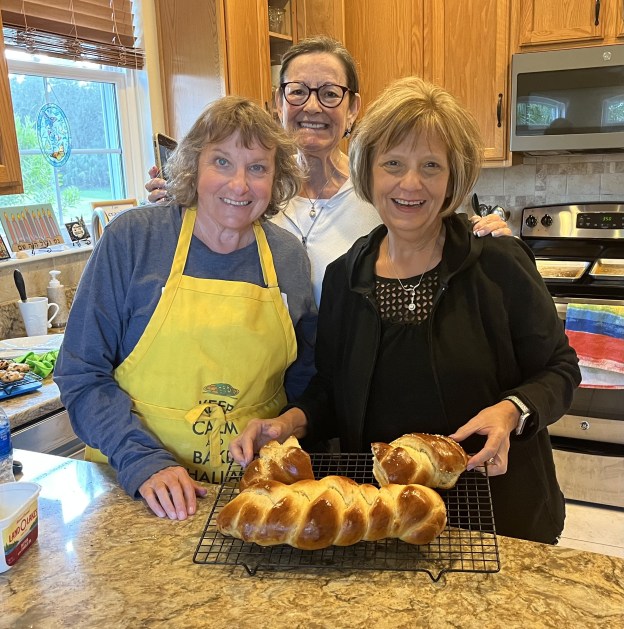
Within the first month of the pandemic, I decided that celebrating with a Sabbath dinner every Friday would bring some joy. I polished my grandparents’ candlesticks; bought a new Kiddish cup on ebay (I must have lost mine in our move); brought out my embroidered challah cover, and located a friend’s challah recipe I had always meant to try. With some difficulty—the whole world decided along with me to make bread—I purchased flour, yeast, and sugar to make the traditional Shabbat bread. And I mixed and kneaded and braided my first challahs. Delicious!
The following Friday, I was a little more confident. I made four small ones, and shared one with president of our (closed down) shul and one with a friend whose wife had just been placed in memory care.By April, I had totally embraced not only the baking process but also the spiritual elements. I learned that it was appropriate to say prayers during the kneading process, a way of feeding the body and the soul. I initially prayed for my family as well as our country and for all impacted by the pandemic. But my prayers soon extended to the sick, the grieving, the lonely. I kept a Mi Shebeirach list on my phone as reminders and often played Debbie Friedman’s version of the beautiful prayer as I kneaded the pliant, soft dough.
We developed a rhythm: Every Friday afternoon I baked the challahs, and just before sunset, Larry would head off in our car, delivering two or three still warm fragrant loaves to needy people in our community. When I couldn’t physically share them, I attached pictures of the challah onto an email with a note. “I kneaded prayers of healing into this loaf of bread. Thinking of you. Love, Marilyn.”
By the time Larry and I were finally able to travel to see our children and grandchildren in June 2021, I was a seasoned challah maker—to a point. Baking bread in someone else’s kitchen proved to be a challenge. In San Francisco, I realized the sound of the mixmaster cranking out the initial steps of challah process woke my grandson from his nap. In Colorado, the 9100 foot elevation resulted in loaves that looked more like amoebas. I had to learn to work around nap time and altitude.
Meanwhile, I was tweaking my technique. I replaced the butter in my friend’s recipe with canola oil, which meant less noise and more kneading time, my favorite party of the process. Rocky Mountain challahs, I learned, needed to go into the oven immediately after braiding to prevent over-rising. A straight egg yolk wash resulted in browner, shinier loaves, which Larry wholeheartedly approved “This is the way challah is supposed to look,” he said, biting into the harder crust.
Over the past two years, I have baked and shared dozens of challahs, many that were appearing on our shul’s Zoom services. As our world finally has begun opening up, however, finding the time to make the challahs on Friday has been more difficult. I “cheat”by making seven or eight loaves and freezing 2-4 braided unbaked challahs, to be defrosted and baked when needed. (I still feel Jewish guilt when I use that shortcut!)
Friends have asked me if they could buy my challahs or even sell them at our Farmer’s Market. I decline, telling them emphatically I am not starting a new career. Instead, I offer them my challah “recipe,” a nearly 3000 word tome with numerous tips. Recently, I even invited two friends over for a “challah workshop.” After we all enjoyed slices oof the warm loaves smothered with butter, they went home with a batch of the still-rising dough they had prepared. They sent me pictures of their finished creations, beautiful in their own right. I am just following an old Yiddish expression: “Give people a challah, and they eat for a day. Give them a recipe, and they become challah bakers!”
Initially, I was hopeful that this would be the last article I would be writing about the pandemic. Two vaccines and two boosters later, Larry and I have pretty much resumed our lives. But there are now disturbing numbers that show another upward trend. Will we have to resume mask wearing? Sheltering in place? Only time will tell.
When I wrote this mid-April, I was on a challah hiatus. Instead, Larry was enjoying sponge cake, Passover popovers, and matzo brie. But Passover ended next Friday. I soon will be pulling out the ingredients for the challah and donning my special apron. Stay safe, my friends.Better yet, Keep Calm and Bake Challah.
A version of this article originally appeared in theJewish World News, a bi-weekly subscription-based newspaper in upstate New York.
For the past two years, Passover has—well—passed over us. In 2020, My husband Larry and I had a seder for two, a quiet affair to say the least. In 2021, thanks to Zoom, we were at least able to share a Haggadah and the holiday with members of our synagogue.
Now we are back in the game. Our first night will not be that much different, in that our congregation has opted for a Zoom service for hopefully the last time. But on the second night, we will drive to Sarasota, where we will share a table with two of my siblings and their spouses. How lovely it will be to sip wine and eat matzah and charotzes with family!
And, as always, I am entering this holiday with the same feeling of gratitude I have managed to maintain since COVID closed down our world. True, Larry and I have missed much—especially a year away from our children and their families. We spent two years avoiding crowds, passing up on movies and plays, getting our boosters and wearing masks. But I feel that the worst parts of this pandemic have passed over us. It is as if our doorposts were marked with a blessing that prevented illness and sadness from touching so many that we love.
We may not have suffered all the effects of this scourge, but we have unfortunately not escaped from another inevitable issue: Aging! In a recent article in the New Yorker article, David Kemp suggests that his newly formed US Citizens for Age Forgiveness demand an “executive order that will degree the last two years do not count towards the age of an American.”
Of course, Kemp’s essay is tongue in cheek, but I agree! Any setbacks that were caused by almost two years of hunkering down should somehow be erased, given back to us as a gift from God. This is especially true regarding what Larry has affectionally called “Lifetime Achievement Awards,” all those hopefully bearable “inconveniences” that are a result of surviving into our 60s and 70s.
First example: Cataracts. I cannot turn around without bumping into someone who is in some stage of this common eye surgery. Conversations revolve around which doctor to use, which lens to be implanted (there seems to be a range from a no-frills basic version to the top-of-the line deluxe version); which drops therapy is used, how long between Eye One and Eye Two; and how long one can return to normal life. We have come to accept the fact that people are walking around with one lens popped out of their glasses, not exactly a “Lens Crafter” advertisement.
Unlike other surgeries, there is a definite benefit. After years of dealing with glasses and contact lenses, we Baby Boomers are looking at the world through our own eyes. My own journey to cataract surgery goes back almost 20 years ago when I spoke to my eye doctor about getting Lasik surgery to repair my severe myopia. He suggested I wait. “Most people of a certain age [he kindly avoided the word ‘old’] require cataract surgery,” he told me. “I can almost promise you will get the vision you want without the expense if you just wait it out.” He was correct. I patiently waited until my cataracts, first imperceptible, then ripening, then, in my mid 60s, ready to fix. My glasses went to the Lion’s Club, and my contact lenses and all the required accessories went into the trash. It took me months to break myself of the habit of reaching for my glasses the minute I woke up. To this day, if I feel something in my eye, my first thought is that something is lurking under my contacts.
Because I had been wearing contacts since I was in my 20s, my appearance didn’t change after surgery. Larry, however, had been wearing glasses for over 30 years until his recent surgery. I am still getting used to the “bare nakedness” of my un-bespectacled mate. So is my granddaughter, who burst into tears when she saw her Zayde for the first time without his usually dark frames. My sister-in-law was actually grateful that she still needs to wear glasses after cataract surgery. “I like myself better with glasses,” she told me. “They hide the lines.” (She doesn’t have wrinkles!)
Eyes are not the only body part that falls under the “Lifetime Achievement Award” category. Many of our teeth, which at one point held under the strain of hard candy and even carrots, seem to be crumblings, resulting in crowns, implants, and bridges. Hips, shoulders, and knees are being replaced at an alarming rate. Some of us have so many fake parts we rival Lee Majors’ Bionic Man.
Unfortunately, the standard devices do not imbue their owners with any super power, including super hearing. As a matter of fact, based on the number of ads for hearing aids found in AARP magazine, the inability to pick up normal conversations is one of the most prevalent signs of our aging bodies. Both Larry and I are on the cusp of needing some help. We no longer can have a conversation when we are in two different rooms. Heck, we have problems hearing each other when we are sitting next to each other on the couch doing crossword puzzles. “What did you get for 41 across?” Larry recently asked me
“Heeded,” I answered.
“Needed? It doesn’t fit. 33 down is OGH.”
“I said, ‘Heeded.’”
“Seeded?”
“No! Heeded. H as in Harry!”
“As in ‘Larry?”
No wonder it is taking us longer to do these puzzles
A friend’s pilates instructor had a different, but still flattering, spin on those of . She regards us as “classic cars,” older, still viable, very much appreciated, even if we are restored.
Unfortunately, Lifetime Achievement Awards often come in more serious forms. Cancers. Heart problems. Diabetes. Cognitive issues. Family and friends are dealing with many of these issues, a result of living a long life or of just plain bad luck.
A recent broadcast on NPR stated that with key COVID metrics trending rapidly downward, the pandemic’s third spring is already looking very different. Passover 5782 will hopefully usher in a time of hope that COVID-19—if not conquered but at least controlled. I also wish that this be a time of a “refuah shlema,” a complete, speedy healing for those suffering from all those lifetime achievement awards: And as we gather at our more crowded Seder table, let us add Rabbi Naomi Allen’s pandemic-inspired prayer, “On this Passover Night/We pray to you, God/Let it Pass Over us/Hear us God/Heal us God. Amen.”
A version of this article originally appeared in theJewish World News, a bi-weekly subscription-based newspaper in upstate New York.



 There Goes My Heart