Category Archives: Yom Kippur

“A tiny person with a big heart:” Losing our Bubbe on Thanksgiving

Thanksgiving has always been our favorite holiday. When we lived in Clifton Park, we celebrated for many years by running the Troy Turkey Trot in the morning and then joining the family for dinner at Larry’s cousins’ home in Argyle, New York. Our most memorable Thanksgiving was also our saddest. In 1974, two and a half months after we married, Larry’s beloved grandmother passed away.

Bubbe Rose was the matriarch of Larry’s family. Her tiny stature — she was under five feet and weighed less than one hundred pounds — belied her powerful presence. Everyone loved her.

Bubbe Rose was instrumental in making sure Larry and I got married. We had been seeing each other for a little over two months, but Bubbe was getting impatient and decided to intercede.

“So what is your relationship with this woman?” Bubbe Rose asked her only grandson.

“We’re dating,” Larry responded. 

“You’ve dated long enough!” Bubbe said. “She’s a nice girl. Marry her.”

Fortunately for Bubbe, Larry and I didn’t waste much more time. We got engaged on Rosh Hashanah but waited to announce our plans after the Yom Kippur break-the-fast at the Shapiro’s Saratoga Springs home. As the holiday coincided that year with Larry’s father’s birthday, we held off until Ernie blew out the candles on his cake.

“I have a special present for you this year, Dad,” Larry said.

“Another stupid tie?” Larry’s sister Anita chimed in.

“No, I am giving you a daughter-in-law. Marilyn and I are engaged!” The family was thrilled, but no one was happier than Bubbe Rose. 

Rose [née Slominsky] Hurwitz was born in 1894 in what the family believes was Russia. At a young age, she emigrated to the United States and settled in Syracuse. There she met and married Mose Hurwitz, a coal merchant. Their daughter (and my future mother-in-law) Doris was born in 1920; their son Asher was born eight years later. Rose was a true balabusta, a competent and skilled homemaker, and her home became the gathering place for family and friends for the Jewish holidays. Doris and Ernie were married in the Hurwitz living room on June 20, 1942.

Bubbe’s home in Syracuse remained the heart of the family throughout the next two decades. Immediately following their wedding, Ernie reported for duty at his army assignment in Chapel Hill, North Carolina. Doris joined him but returned to Syracuse to deliver their first child, Anita, a year later. Five years later now living in Schuylerville, New York, Doris returned to Syracuse for the birth of their second child, Larry. Mose died less than a year later, and Asher took over the coal business. In 1950, Ernie’s mother Celia died, making Rose their only surviving grandmother.

When Ernie was called back to service during the Korean War, Doris, along with the two children, waited out his return at Bubbe’s home. Once Ernie was discharged, the family moved to Saratoga Springs, where Ernie resumed his pre-military career running Shapiro’s of Schuylerville. Every Rosh Hashanah and Yom Kippur was spent in Syracuse, along with frequent visits.

By the early sixties, Doris and Ernie had added two more children to their family: Marilyn in 1953 and Carole in 1959. Rather than Doris and Ernie packing up the six Shapiros for the drive to Syracuse, Bubbe Rose and Asher came to Saratoga Springs for most of the holidays and for at least one weekend a month. If the family couldn’t be in Syracuse, Bubbe and Asher brought Syracuse with them: baked goods from Snowflake Pastry Shoppe; white fish and cold cuts from one of the city’s kosher delis; and back issues of the Syracuse Herald-Journal so Doris could catch up with her hometown news.

Larry has two favorite stories about Bubbe’s legendary cooking skills. On March 29, 1959, Larry and Asher watched their beloved Syracuse Nationals defeat the Boston Celtics in the sixth game of the playoffs in the city’s War Memorial auditorium. (Unfortunately the Nats lost the critical seventh game, a loss Larry still remembers with regret.) The next day, Larry came down with the flu, necessitating his staying in Syracuse for the following week. Bubbe Rose believed that the only way to cure him was to feed him endlessly. 

In 1971, Larry was accepted to graduate school at Syracuse University, and he moved in with Bubbe Rose and Asher. He probably did not weigh more than 126 pounds when he arrived. Along with breakfast and dinner, Bubbe insisted on packing him elaborate lunches, which Larry shared with his envious fellow students. In less than two months, he had gained sixteen pounds, some of the weight taken off before he graduated. By the time we met at a Purim party in March 1973, he had settled into his adult weight..

We were married on September 8, 1974. Bubbe Rose attended the wedding, looking beautiful in a long pink gown. On November 23, she suffered a stroke. Doris immediately went to Syracuse to be with her. As the week progressed, her condition worsened; by Wednesday, she was unconscious and unresponsive. On Thanksgiving Day, November 28, Larry and I drove to Syracuse to see her for what we knew was the last time. We walked into the hospital room, quietly shared with her that we were there, and told her how much we loved her. To our surprise, she reached out and gently touched our hands. Moments later, she passed away. In a strange way, we got to spend one last holiday with her—a holiday we will always remember.

Was Rose Hurwitz a remarkable woman? She did not write any books. She did not make any scientific discoveries. She was not a movie star. To her children and their siblings, however, she was as remarkable as anyone who had ever lived.

How do you honor a person who meant so much to you? You pass her story onto your children and grandchildren. You have a daughter, a granddaughter, and niece who all have the middle name of Rose. And you always remember that Thanksgiving Day when she touched your hand for the last time.

Bubbe Rose front and center at our wedding

Climb every mountain as long as you can…Reflections on Rosh Hashanah

Are the trails getting steeper? Or am I getting older?

These were my thoughts as Larry and I climbed Shrine Ridge Trail in Summit County in early July. We had been in Colorado for ten days before we attempted the hike, so I believed I had acclimated my body to the altitude. But we started at 11,000 feet and would peak closer to 12,000. As I huffed and puffed up the trail, I never doubted I would finish. The bulldog in me would never give up. But could I do this next year? In five years? Who knows?

Larry and I DID finish our climb on that beautiful summer day. We got up to the top and took in the colorful wildflowers and the amazing vistas, grateful we could still climb mountains at our age. 

In the weeks that followed, we often chose an easier three-mile hike that we accessed with a short walk from our rental. In early August, however, Larry and I met our friends Sandie and Howie for a more challenging hike up the Herman Gulch Trail in the Ranger District of the Arapaho National Forest. During our four-mile hike, we encountered a couple of around our age descending. I posed my “Steeper or older” question aloud. 

“Neither,” the man told me. “We are experiencing geographical uplift, a phenomenon in which the earth shifts to steeper inclines as we age.” 

Okay, maybe Earth is NOT in fact shifting. But our lives have. Before we left for our summer in cooler temperatures, a close friend, a non-smoker, had just been diagnosed with lung cancer. Another friend’s cancer had returned. And a third friend, who had biked 86 miles for his eighty-sixth birthday, died a week later of a heart attack while on a shorter ride. “He was doing what he loved,” people said. But I doubt that it was sufficient comfort to the family he left behind.

Our time in the mountains changed as well. Friends we looked forward to seeing every summer developed health issues and/or “aged out” as they could no longer handle the high altitude. One of Larry’s pickleball buddies had told us last summer that he and his wife were opting out of summers in Summit County and renting a place in a mountainous region of Arizona, reducing their elevation by 4000 feet. Dear friends who had been part of our summer plans for over ten years, whether eating out, hiking, or playing cutthroat games of Mexican Train, also had to give up their beautiful home in Dillion, Colorado, and remain in Charlotte, North Carolina, at a more comfortable 671 feet above sea level. 

And then the “life can change on a dime” phenomenon hit our own family very hard soon after Larry and I returned to Florida. Two days after coming home from an incredible cruise through the British Isles with my brother, sister-in-law, and a friend, my sister Laura was hospitalized in Upstate New York with breathing problems. Doctors were trying to determine the exact cause of her symptoms when she took a turn for the worse. Diagnosis: a rare form of pneumonia. Grim news followed: Laura was on a ventilator in the intensive care unit. We had two days of optimism when she was taken off the ventilator. She was looking forward to her life after hospitalization and rehab: a highly anticipated move to San Diego, California, to be closer to her children and grandchildren. But her 83-year-old body failed. She passed away on Friday, August 29. 

The four Cohen children had been fortunate indeed. Whereas some of our friends have strained or non-existent relationships with their siblings and/or their spouses, we all had remained close—maybe even closer as we had all realized how life can change on a dime. And now one of us is gone, leaving the three of us to grieve with other family members and friends who will miss her so much.

“On Rosh Hashanah, all who enter the world pass before Him,” reads a passage in the Mishnah. One Jewish interpretation is that we march single file like sheep before God to determine whether we will be written in the Book of Life. Another interpretation is that we march like soldiers. But my favorite interpretation, reflecting on my summer in the mountains, comes from Resh Lakish, a third century BCE scholar. The rabbi envisioned this march taking place before God on a mountain, each person walking cautiously, single file, along a narrow, treacherous path. 

As I observe the High Holy Days this year, warm memories of my beloved “big sister” will be forefront in my thoughts. Prayers for those we lost and those who are ill will take on even greater significance. Will I be climbing mountains in 5786? Hopefully, I will tackle Shrine Ridge and Herman Gulch with the same vigor and determination I did this past summer. But thanks to Resh Lakish, when I am in one of those narrow and knowing me, not-TOO treacherous paths, I will hope that God is looking down and giving me the strength to move forward in my life, no matter where the path takes me. 

Sources:

Liben, Rabbi Daniel. “Sheep, Mountain Hikers, and Soldiers.” Temple Israel of Natick, Massachusetts. Rosh Hashannah 5756. https://www.tiofnatick.org/wp-content/uploads/2019/12/rh_sermon_2015.pdf

McCullough Gulch. Not sure if we will hike this one again!

Do Something! The Gift of Giving Back

For Jews, the High Holy Days is a time for us to turn inward, to reflect on our lives, not only where we have been but also where we hope to go in the coming year. So much of the world needs our help. What can one person do? How can one person make a difference? 

In the Pirkei Avot, Rabbi Tarfon writes,“It is not incumbent upon you to complete the work but neither are you at liberty to desist from it.” That quote has been in my email signature for several years and serves as a reminder to me and those that read it that we can all can make a difference. No, we cannot save the world. But our inability to do EVERYTHING does not give us a pass on doing nothing. 

This truth is found in the often-told starfish midrash. An old man is walking along the beach in which hundreds of starfish have been washed along the shore during high tide. As he walked, he came across a little girl who is throwing the starfish back into the ocean. “You realize that you will not be able to make much of a difference,” the old man tells the little girl. She picked up another starfish and threw it as far into the water as she could. “I made a difference to that one.” 

It reminds me of “starfish” moment. On a recent trip to the beach, Larry and I were walking along the edge of the water. As Larry was enjoying the waves and the birds, I was picking up garbage and sticking it in a plastic bag I brought with me for that purpose. A broken styrofoam cup. A short length of cord. A lone flipflop. And a dozen or so plastic caps from water bottles. 

“You can’t pick up every bit of litter on the beach,” Larry said.

“Yes. But can do something!”

 Yes, Larry was right. I am not going to pick up every piece of litter on a beach. But I can at least fill up a plastic bag with some of it. 

Giving away my freshly baked challahs also gives me a chance to do something Early into the pandemic, I started baking three or four challahs a week. At least one of the challahs went to someone in our community who needed cheering. The first one went to a friend whose wife was in a memory unit at the hospital. Week after week, we delivered challahs to people who had lost their spouse, who faced illness; who got bad news from their families. My small challahs were small tokens of love and caring. My challah baking has slowed down in recent months, and I usually make extras to tuck in the freezer to pull out as needed. It just filled my need to do SOMETHING!

For the past ten years, my writing has been a way for me to feel as if I am making a difference. Initially my writing focused on my family stories. In the past eight years, I have become captivated by telling other people’s stories, the lives of Holocaust survivors. So much has been written already: fictional accounts, memoirs, graphic novels, poetry, plays. Many of have become classics: Elie Wiesel’s Night;Prima Levi’s Man’s Search for Meaning; William Styron’s Sophie’s Choice, and Anne Frank’s Diary of a Young Girl. Then why do I continue to interview Holocaust survivors and their families?

Writing these stories allows me to do my part to make the world never forget. Each story is a statement against Holocaust denial. And having each story published has brought feelings of pride, comfort, and maybe some peace to the subjects and their family. Following Rabbi Tarfon’s advice, my inability to write everything doesn’t mean I cannot continue to do something. 

And what happens when one person joins others to make a difference? Fortunately, I am surrounded by people in my 55+ community who are also doing their part to help people in the greater Poinciana area. Solivita has over 200 clubs, and many of them support the local community. The Do Unto Others Initiative (DUO) has raised over $260,000 in 11 years to support the work of the St. Rose of Lima Food Pantry. Another club, Solivita Friends Helping Those In Need provides similar support for St. Vincent de Paul St. Ann’s Food Pantry in Haines City. Solivita Friends of Elementary Education Schools (SoFEEs) provides nourishment, school supplies and seasonally appropriate clothing to local elementary schools. In the past nineteen years, Stonegate Women’s Golf Association (SWGA) has been able to provide over $300k to local community charities. The Solivita Performing Arts Council (SPAC, Inc.) has raised over $139,000 since its inception, providing grants to help local schools purchase and maintain instruments, fund band and choir concerts, produce school theatrical productions, fund thespian workshops and support art projects. Since 2006, the Solivita African Cultural Club Education Fund, Inc. as given out approximately $225,000 in scholarships to local students. SOLABILITY, a club consisting of individuals of varying abilities, provides activities accessible to all. Members of the Butterfly Club provide financial support for our beautiful butterfly garden; volunteers keep it weeded and in control. Our Book Circle, which has over 30 book clubs under its umbrella, donates books and financial help to Polk County Schools. The Shalom Club makes an annual contribution to the Perlman Food Pantry or Jewish organizations supporting local families. The organizations above represent only a small sample of ways individuals have joined together to help those in need. 

So, yes, one person can make a difference. Wishes for a sweet, healthy 5785. May it be a year in which each of us make a difference. 

My wonderful community, Solivita

Thanks to the leadership of numerous Solivita clubs and organization for providing the information for this article.

Holding on tight to my Jewish roots….

Since the year that we met, my husband Larry and I have attended Rosh Hashanah—the Jewish New Year—services. We hear the shofar, listen to melodies that we only hear on the High Holy Days, and greet our friendswith L’Shana Tova—Have a good year!

Attending High Holy Day services as an adult is different from my experiences as a child growing up in Keeseville, a small upstate town of two thousand people about ninety minutes south of Montreal. My uncle Paul had opened Pearl’s, one of a chain of small department stores he had established in Vermont and Upstate New York. He hired my father to manage it. Although my parents had both grown up in New York City in Jewish neighborhoods, they had lived most of their married life in overwhelmingly Christian communities. In 1952, however, they found themselves in a town where they were the only Jewish family except for a childless couple, a lawyer and his wife. The next Jewish family didn’t move in until the mid-sixties. 

To offset the effects of our non-Jewish environment, my parents immediately joined Congregation Beth Shalom, a Reform temple in Plattsburgh. We attended High Holy Day services and, depending on the weather conditions for the fifteen-mile drive, Shabbat services on Friday night. Saturday services were only held for the boys’ bar mitzvahs; all the girls were confirmed at age sixteen.

In addition to attending services, my parents were insistent on their children getting a Jewish education. For a span of twenty years, our father made the trip up Route 9 every Sunday with whatever number of his children between the ages of five to sixteen were taking religious school lessons. We would arrive in Plattsburgh a half hour early. Then Dad would take us to the newsstand across the street from the temple on Oak Street. He purchased the New York Times for himself and comic books for us, our perk for going to Sunday School. My brother Jay chose Superman; Laura and Bobbie, Archie and Richie Rich; and I, Classics Illustrated. Dad would then wait for us in his idling car —It got cold in that parking lot in the winter—reading the paper and smoking Kents. Over the years, all of us learned Jewish history, customs, and ethics. Jay learned Hebrew for his bar mitzvah. The three of us girls’ Hebrew education was limited to the six-word Shema and blessings over bread, candles and wine. When we got home from school, Mom would have an elaborate dinner waiting for us—brisket, roasted potatoes, candied carrots, pickles, and delicious spiced apples from a jar—another perk for our going to Sunday school. 

As residents of Keeseville and members of a temple in Plattsburgh, we were caught between two worlds. As we did not live in Plattsburgh, we often viewed ourselves as outsiders at Temple Beth Israel. My mother, in particular, did not feel comfortable with many of the congregants.  A daughter of poor Russian immigrants, she often felt inferior to those who were third or fourth generation German Jews who historically regarded themselves as more educated and refined than those from the shtetls—the small towns with large Jewish populations which existed in Central and Eastern Europe before the Holocaust.

The residents of Keeseville were generally welcoming to our family, and we rarely experienced anti-Semitism. There were moments, however, that are etched in my memory. My parents were usually included, but there were occasional “lost” invitations to events, and we knew some viewed us as different. On rare occasions, the insults were more direct. When I was around six years old, I was playing on my front lawn with my doll. A teenaged boy who lived up the street came by and, giving the Nazi goose salute, yelled “Heil Hitler!” I ran inside crying. Jay, four years older than I, ran out of the house to chase him down and punch him in the nose. When Jay was in high school, the local priest advised his young female parishioners that it was best not to date “Hebrews.” Obviously, this did not help Jay’s social life.

The High Holy Days emphasized this “otherness” even more strongly. We did not attend school on Rosh Hashanah and Yom Kippur.  My father closed the store, an event worthy of coverage in the Essex County Republican. Jay, who played football for Keeseville Central, missed every game that fell on the two major fall holidays, again newsworthy enough to make the local paper. 

Everyone in Keeseville knew that the Cohens celebrated their Jewish High Holy Days, but I was still sensitive to our being the only children missing school. One Rosh Hashanah, I was pushing my doll carriage in front of the house when I was overcome with embarrassment. What if someone saw me and wondered if I were playing hooky? I went inside to avoid the potential scrutiny and a visit from the truancy officer. 

My feeling of “otherness” continued as the seasons changed. Beginning in November,  I often had to explain that Chanukah was not the “Jewish Christmas,” and no, we didn’t have a Christmas tree or a  Chanukah bush. As soon as we returned to school from the Thanksgiving break, the music classes I attended and, later, the choruses I joined in junior senior high, were filled with Christmas music. I could handle “Little Town of Bethlehem” and “Deck the Halls.” When it came to the line in “Silent Night” which stated “Christ the Savior is born,” however, I would just mouth the words. The token inclusion of the song “I Had a Little Dreidel” didn’t make me feel that the school was sensitive to my religion and culture

Other events brought their challenges. Passover often fell around Easter, and I watched my Christian friends devour bunny shaped chocolate eggs and jelly beans while I nibbled on my dry matzoh and butter. Once again, I felt different. In high school, my World History textbook reduced the Holocaust to the iconic 1943 picture from the Warsaw Ghetto of a German soldier pointing his machine gun at a little boy, clad in a coat with the yellow star, holding up his hands in terror. I can still remember looking down and crying silent tears while the teacher quietly and sympathetically moved on to the next topic. I understood clearly that the horror of the persecution of the Jews was diminished by this negligible treatment of the Holocaust in our textbook.

For many years, I saw other Jewish children mostly at Sunday School. As I got older, I joined a Jewish youth group and finally had Jewish friends. For the most part, however, our friends were our Christian classmates from Keeseville. We all dated in high school, but my parents pressed upon us their wish we would leave Keeseville after we graduated and make our lives in settings with more Jewish people. 

In part because of my desire to be with other Jews, I enrolled in University of Albany in 1968. While at college, I attended High Holy Day services at Congregation Beth Emeth, but that was the extent of my Jewish participation until I met my future husband in 1973.

Larry and I attended High Holy Day services at Congregation Shaara TFille, the then-Orthodox shul—synagogue—in Saratoga to which his family belonged. What a dramatic difference for me! Men sat in the center pews, and the women, although not behind a mehitzah, (a curtain which separated the men from the women), sat in the back or on the sides. Most of the service was in Hebrew, and everyone prayed at what seemed to be lightning speed. Page numbers that were displayed on a chart on the bima provided my only means of following along with the prayer book. The services were much longer than those at Temple Beth Israel, and even the rabbis, with their black beards, payots (side curls), and yarmulkes (skull caps), were strange to me. In many ways, it was as foreign to me as the churches I had attended on occasion with my Christian friends.

After Larry and I were married, we bought a home in Clifton Park, a suburb of Albany, New York, in part because we knew that a synagogue had recently been built in the community. We joined in 1983, and we found that the Conservative service was a good compromise between Larry’s Orthodox shul and my Reform temple. Ten years later, I celebrated my own bat mitzvah on my father’s eightieth birthday, my way of honoring his commitment to our Jewish education. 

Throughout my life, people assume that I, like many Jews, was brought up “downstate,” in New York City or Long Island. When I tell them about growing up in Keeseville, they comment, “That must have been hard!”

It had its challenges, but it also offered wonderful opportunities. I grew up in a loving, close knit family, developed lifelong friendships, and enjoyed the beauty of Lake Champlain and the Adirondacks. I proudly identify myself as an Upstate New Yorker, with roots still entwined in that tiny town an hour south of the Canadian border. 

Because of my unique upbringing, rather than losing my Jewish identity, my faith grew stronger. I could never take being a Jew for granted. And having a faith I had to hold on so tightly to maintain makes each High Holy Day, each Jewish milestone, even sweeter.

A version of this story was published in The Jewish World, August 29, 2013. I am finally posting it on my blog eleven years later!

Marilyn and Larry Rosh Hashanah 1973 (Shh! We were engaged but didn’t tell anyone yet!)

Bye bye Boomer? Who shall live and who shall die?

Was it time for us to retire Boomer to that Stuffed Bear Den in the Sky?

A couple of days after our son was born, my husband Larry came to the hospital with a huge brown teddy bear, his first gift to Adam. We named the stuffy “Boomer,” the moniker we had given to my ever expanding stomach during my pregnancy as well as a salute to our Baby Boomer status. 

Boomer occupied a place in Adam’s room in our family home through nursery school and beyond When the shiny nose fell off, I sewed on another one with black yarn. When the paws got torn up after too many rides on Adam’s Big Wheels, I covered up the bear’s bare spots with yellow felt patches. On Adam’s first day of kindergarten, we took a picture of Adam holding on to his bear before boarding the school bus.

By his bar mitzvah, Adam relegated Boomer to the top shelf in his bedroom. When Adam headed off to the University of Rochester in 1996, he left his companion behind. [Three years later, our daughter Julie brought her lovey Rerun with her to college. It now has a place of honor on her daughter’s bed.]. We put the brown bear on the pillow on Adam’s bed in the quiet, empty, amazingly clean room. Boomer waited patiently through Adam’s grad school and first jobs and trips across country and to Israel and Belize and law school. Alas, Adam never sent for him. 

When we packed up to move to Florida, I sent texts to our children with pictures of the things they left behind with the simple request: “Toss or send to you?” Adam claimed his Star Wars action figures, Zayde Ernie’s World War II helmet, and a couple of framed pictures. Boomer got a thumbs down.

In the end, Larry and I loved Boomer more than Adam did. Larry and I didn’t have the heart to throw Boomer in the trash. After some discussion, we carted him to Kissimmee, where he earned a spot on a bookshelf with our other cherished tchotchkes: Larry’s Otto the Orange mascot, a plush toy I had given him one Chanukah that played the Syracuse University’s marching song when we squeezed his hand. My two 7 inch high dolls in Mexican attire my father had purchased for me at a gift shop in Montreal’s Chinatown after wontons and fortune cookies at the Nan King restaurant; Julie’s doll with the green dress and matching bonnet that had prompted our then-fourteen month old daughter’s first complete sentence on the way back from a shopping trip to buy her a bed: “Oh-oh! Left Baby Bobbie on mattress at Macy’s,” she cried behind me from her car seat. “Go Back!”

I thought Boomer would find his way back home to Adam when our son’s wife Sarah delivered their own little Boomer in 2020. My hopes that I could pack him up in a box and ship him to California were quickly dashed. “I really don’t want it,” Adam told me. “And after 42 years, goodness knows what germs live in that toy! Toss it!”

Taking a good look at Boomer, I almost had to agree with Adam. I took pride in the fact that the black nose and yellow felt paws and feet I had sewn on over forty years ago were still intact. After too many years dealing with Florida humidity, however, the poor stuffed animal was definitely worse for wear.His now graying stuffing was peeking out of his right leg and exploding out of a side seam. His head wobbled, held onto the body with unraveling brown thread. His “fur” had begun to resemble that of a mangy dog. Still, we put him back on the shelf.

Eighteen months later, Boomer’s future was again jeopardy. Larry and I had managed to fit all that was needed for a seven week trip to visit our children in California and Colorado in two medium sized suitcases. If we had survived all summer with so little, why were our closets and drawers still packed with all the clothes we hadn’t bothered to bring?

It wasn’t just the clothes. Despite our purge when we made the move to Florida from Upstate New York in 2015, we (especially me) had somehow again acquired too much stuff. A kitchen full of housewares. Closets filled with unworn clothing. Old books that I was finally going to read while sheltering in place. A two-foot stack of nearly untouched New Yorker magazines. I was ready for a “pandemic purge.” The day before Rosh HaShanah, while looking in my closet to find an outfit for services, I found two dresses that I had not worn in three years. I threw them onto the guest bed. I followed them up with more items to recycle—clothes, linens, books, heavy sweaters I had saved “just in case.” By Yom Kippur, the pile covered the entire double bed. It was a new year, a new start.

But some things were non-recyclable, including a tattered teddy. “Maybe it’s time to say goodbye to Boomer,” I said to Larry. 

“No way!” he cried. “Besides, we need to keep him at least until our grandson is able to come to Florida to visit. He has to meet Boomer.”

Larry was right. The idea of putting Boomer into the trash broke both our hearts. I took out my sewing kit, pushed the stuffing back into worn cloth, and stitched him up. We called Adam and Sarah and asked them to mail us a couple of our grandson’s outgrown tee-shirts to cover up all the stitches. And then  Boomer will resume his special place on our shelf. Yes, in the end, we couldn’t—forgive the pun—bear to part with him. 

Boomer at 43.

Who by water, and who by fire.


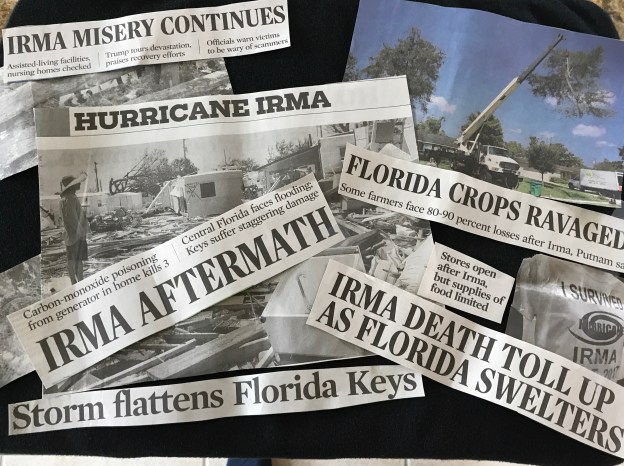
During Yom Kippur, we Jews recite the Unetanneh Tokef, a prayer in which we ask G_d to inscribe us in the Book of Life for the coming year. This prayer will take on special significance for my husband Larry and me as we look back on our experiences with our first Florida hurricane.

The National Hurricane Center had been tracking Hurricane Irma since late August. Reports of its potential destructive path through the Caribbean and Florida were headline news by Labor Day. Despite the warnings, Larry and I decided to go ahead with our planned trip to visit an elderly aunt in Myrtle Beach. On Tuesday, September 5, we drove to St. Augustine, Florida, for a day of touring before driving the rest of the way to South Carolina. We were confident that we had plenty of time to return home by Friday to prepare for Irma’s predicted landfall that weekend. 

That confidence quickly faded. News of the devastation in the Caribbean from Irma was being updated hourly. On the streets, fellow tourists and residents, some who had just recently moved back into homes that had been damaged by Hurricane Matthew in 2016, were on their cell phone making evacuation plans. We filled our car with gas moments before the pumps ran dry. We stopped at the supermarket for some basics, only to find that the bread and water aisles were picked clean. Continuing north was out of the question. We drove back home the next morning.

By that time, Larry and I were being bombarded with phone calls, texts, emails, and Facebook posts from worried family and friends. Were we okay? Were we going to evacuate? We assured them that we were fine, but we were staying put. Our homes were built to withstand hurricane winds and rain, and Central Florida was not subject to storm surges. Furthermore, we were not in the path of the storm. We were more concerned about our family and friends who lived and/or owned homes on the coasts of Florida.  Which coast? As of Saturday, meteorologists were still trying to determine where the monster storm would make landfall.

So we, like the millions of other Floridians, completed all the necessary preparations. We stocked up on water, canned goods, toilet paper and wine-lots of wine. We filled both cars with gas. We brought everything from our lanai and in our  yard into our house and garage. We pulled out our emergency crank radio, candles and matches, flashlights and batteries. We filled our bathtubs and large pots with water and our freezer with bags of ice. We prepared a “safe room” in a walk-in closet in case of extreme winds or tornadoes. We checked in with neighbors to make sure they were ready. And we watched the “spaghetti models” on The Weather Channel for hours. Stupefacente! (Amazing in Italian)

Speaking of amazing, in between all these preparations, Larry and I were still living our lives—the calm before the storm. We went to the movies, celebrated our anniversary with dinner and champagne, took long walks around the neighborhood, and even went to a Pre-Hurricane Irma party on Saturday night. 

On Sunday, we hunkered down and waited for Irma’s expected landfall on—we were told—Florida’s west coast. Winds began to pick up outside our windows in the afternoon, followed by several hours of torrential rains and strong winds. Around midnight, just when we thought the worst was over, The Weather Channel announced that Irma was changing course. She was veering farther east and going over Polk County—sixty miles from our house. The next two hours were terrifying—at least for me. Larry had gone to sleep before the warning was issued. By  two a.m., with wind gusts reaching  between 74 and 100 miles per hour, I woke Larry and begged him to join me in our safe room. Larry refused, so I spent the next hour huddled in the closet with my laptop while Larry snored ten feet away. Once the winds calmed down, I joined Larry in our now safe bed.

By late the next morning, the weather had improved enough for us to venture outside. Yes! Our house was intact. Outside of a few missing shingles and some small downed trees, it appeared that our entire community had made it through the hurricane without serious damage. We never lost power or water. We had survived Irma! We even saved a catfish that was flopping in the gutter at the end of our driveway by tossing it back into the lake. 

Our relief was short-lived. We quickly learned of the extent of destruction outside our community. Millions of people across Florida were without power and water. Homes and businesses were damaged or destroyed. In Polk County alone, eighty percent were without power. 

In the week that followed Irma, Larry and I have questioned how such different situations could exist only a few hours or even blocks apart. Disney World and Universal opened for business as usual on Tuesday while people who lived on the Florida Keys could not even get back to their homes to assess the damage until Sunday. Residents of our community were playing mah jongg, watching movies, and doing yoga while friends in Naples and Boca Raton were dealing with gas shortages, mold, extreme heat, and sewage back-up. A member of our neighborhood blog wrote a post complaining about their recyclables not being picked up when less than a mile away residents near our community were waiting in long lines for water and FEMA packages. 

Fortunately, most members of our community, as many others across the state, pitched in to help. Many opened up their homes to friends and family until the victims could return to their homes. A group is collecting food, water, and money to aid people who work in our community but live in affected areas. Many are contributing to organizations such as the American Red Cross, Habitat for Humanity, and the Jewish Federation of Florida. 

Who by water, and who by fire? We were spared from serious consequences, but others weren’t. Now it is our responsibility as Jews, as human beings, to help others through tzedakah, through charity—to relieve the burden of the thousands of others who were not so fortunate.