Category Archives: Jewish Interests

Never mind the bucket list! Just live life!

Never Mind the Bucket List! Just Live It!

One winter afternoon while living in the Capital District, Larry and I had lunch at a Chinese restaurant with a former co-worker of his who was planning on retiring in a few more months.

“Can you two give me some guidelines as to what I should do when I leave the job?” she asked. She knew that she had to do something. She couldn’t picture herself just sitting home and having no structure to her life. “I certainly don’t want to be bored!” she explained.

Four years earlier, Larry and I were both in our last months of work after long careers in public service and education. People were continually asking us what we were going to do after we retired. Larry had a simple, straightforward plan: We would travel, and we spend more time volunteering for Special Olympics. 

I, however, fearing boredom, felt the need to line up more ducks to keep me happy. What would I do with my life once I did not fill my time with a forty plus hour a week job? I too sought advice from friends and relatives who had retired before me on how I could survive all the “free time.”

“What free time?” commented a former superintendent of schools, who has spent his retirement volunteering on numerous boards and organizations. “If you want to be in control of your time, keep on working.“ 

“You’ll never look back,” a former co-worker stated. “You will wonder how you ever worked as your days will be so full.”

I wasn’t convinced.

Larry retired in May 2010, but I still headed to the office for seven more months. I left the house at 7:30 each morning after kissing my sleeping husband’s head as he nestled under the covers. He made up for it by having dinner ready for me when I arrived home. However, my desire to join him pushed me into a pre-retirement blitz at work. I confirmed my retirement date with my boss, went to a New York State Education Teacher’s Retirement System seminar to line up the paperwork, and began cleaning out my files. Then I turned my attention to creating and implementing my retirement bucket list.

First on the list were all those hobbies that had been put on the back burner. The short list, in addition to travel and Special Olympics, included the following:

  1. Read all the books on my “Read Before I Die” list;
  2. Complete the crewel piece I started twenty years earlier;
  3. Learn how to knit;
  4. Update my fifty photo albums;
  5. Organize the two drawers in my file cabinet filled with my children’s artwork, report cards, and special projects; 
  6. Relearn French;
  7. Learn Spanish;
  8. Put together all of my stories and my mother’s stories into a book. 

Yes, this woman was going to be productive in her golden years!

Although I already had a number of unread books on my book shelves, I hit a couple of used book sales and downloaded numerous classics onto my Nook. I purchased orange and royal blue yarn and needles to knit Larry a Syracuse University scarf. On impulse I also bought Red Sox theme flannel to make him a throw to commemorate his favorite baseball team.

At the office supply store, I selected new photo albums to replace the ones that were falling apart as well as file folders, labels, and markers for my home organization project. I downloaded a language app for my français redux and purchased a Spanish for Dummies for my español. Mom’s files were piled six inches thick into a drawer, ready to polish and publish.

Throughout this entire process, Larry looked on with a mix of mild amusement to outright incredulity that I needed to prepare so much. And he feared all these projects and books and anticipated classes were going to fill my dance card so much we won’t have time to just be.

After all the planning and anticipation, my last day of work arrived. On December 17, 2010, I fought the traffic on the Northway and Route 7 one last time. I completed the required written instructions to my successor, signed my exiting papers, and said my final goodbyes. Then I drove my last rush hour trip home to Clifton Park. It was time to tackle that bucket list!

I reflected on all this planning over the dinner with Larry’s co-worker. I thought of the hundreds of unread books on my shelves that had been passed over for more current ones in the local library. An added bonus: I could get them in big print, a big advantage for my “golden years” eyes.

I tried to work on the Elsa Williams crewel piece. My eyes had changed since I started it, and I doubted it would ever be finished. 

The knitting? Abandoned after four unsuccessful attempts at learning how to cast on. The Red Sox throw? I pinned it together, but I never took out the sewing machine to stitch up the sides. 

The pictures were still in envelopes, the photo albums still unwrapped. This was 2014, the digital age, and I needed to think of tossing most of them, scanning the favorites, and putting them into a digital album. My children strongly encouraged me to toss—not organize—all the childhood memorabilia I had saved. I haven’t had time to refresh my French or learn Spanish; I needed time to work on my own English as I edited and re-edited my stories and my mother’s story for The Jewish World. At least I was working on one of those items on my bucket list. 

So what did we do those first four years since we retired? We traveled to Machu Picchu, the Galápagos Islands, the Danube, Bryce and Zion. When we were home, we spent time volunteering for Special Olympics—coaching track and field and bowling. Yes, in the end, Larry’s simple, straightforward approach to retirement was the most realistic.

Most importantly, the most satisfying activities of the retirement years in Clifton Park were in many cases activities that were never on my radar. Weekly visits to a couple of friends at Daughters of Sarah nursing home evolved into my volunteering at their memory enhancement unit. After taking Zumba at a local elementary school, I realized how much I loved exercise classes and joined the YMCA. 

Over dim sum on that cold winter afternoon, Larry and I offered this advice to our friend: Yes, you can speculate as to what you would like to do once you leave your job for the last time. However, you may never get to many of them. As a matter of fact, you should just kick the bucket—the bucket list that is. Let life take you where you had only dreamed of going. And that is actually the best retirement advice of all.

A version of this article originally appeared in the Jewish World News, a bi-weekly subscription-based newspaper in upstate New York.

Melanie Gall: The Canadian songbird

 Sweet and nostalgic, [Melanie Gall] is  like a Disney princess from the Lower East Side” Uptown Magazine (2012)

My mother loved Judy Garland and Deena Durbin. She would have loved Melanie Gall.

My husband Larry and I first became acquainted with Melanie, a Canadian chanteuse, in 2019, through our friends Mike and Teri Chaves. The three had met in a Cancun resort, where Melanie was on vacation the week before her performance at the Orlando International Fringe Festival. The Chaves, with whom we had already made plans to go to the event, insisted that we join the three of them for dinner.  

Over white wine and baked trout. I learned more about Melanie and about what we had in common. We both grew up Jewish in a small town. We both loved the Great American Songbook. We both loved Judy Garland, and in her Orlando Fringe show, Melanie was going to be performing several of Garland’s songs, including “Over the Rainbow” (my favorite song of all times). Melanie was the same age as my son, and she reminded me of Adam in her adventurous and independent spirit.

That evening, we joined our friends to see her one-woman show, Ingenue: Deanna Durbin andJudy Garland. One of 150 performances scheduled across Loch Haven Park and Lowndes Shakespeare Center. Melanie’s one-hour tour-de-force told the story of the friendship and the Hollywood-created rivalry between Judy Garland and Deanna Durbin, two 1940s superstars. 

We enjoyed her performance so much that we went back the next night to watch it again. Each time I heard Melanie sing Durbin and Garland songs, I kept thinking how my mother—whose iPod shuffle contained songs by only two artists, Judy Garland and Frank Sinatra—would have loved to be sitting in the audience.

Melanie’s show not only played to sell-out performances, but won top prize for Best Solo Show, Musical.  When we hugged goodbye, I promised to write a story about her before she returned in 2020 for next year’s Fringe. Of course, that didn’t happen. Nor did it happen in 2021. But two weeks ago, Mike emailed me: “Guess who is coming to Orlando! Melanie Gall!” This May, Melanie will be back in a new production at Orlando International Fringe Festival, A Toast to Prohibition, her fourth time at the festival. 

The four of us quickly bought tickets for both her shows. Soon after, I sent Melanie an email sharing news of our purchase and asking if she was still interested in the article I had promised before COVID. Within an hour, she wrote back, “I’m so excited to see you at my show, and of course I’d love an article!” 

After some background research, I learned that Fringe Festivals are arts festivals featuring alternative or experimental performances and exhibitions. The concept of Fringe Festivals began in Edinburgh, Scotland, when eight theatre companies turned up uninvited to the inaugural Edinburgh International Festival in 1947. With the International Festival using the city’s major venues, these companies took over smaller, alternative venues for their productions. The initial Fringe Festival in Scotland established the two elements of the event: the lack of official invitations to perform and the use of unconventional venues. 

There are now over 300 festivals held across Europe, Asia, Australia, New Zealand, and North America. Edinburgh remains the largest in the world with over 55,000 performances of 3,548 different shows in 317 venues. The second largest is held in Adelaide, Australia, and features more than 7,000 artists performing in 1,300 events. Edmonton Fringe, the first in North America, was held in 1982.

No matter where they are held, all fringe festivals have some common features. Acts invited to the event are not judged or juried, often chosen by lottery if size constraints are needed. The casts of the shows are small, with one-person shows common. Shows are typically one-hour, single-act productions, and the sets and other technical theater elements are also kept simple. The shortened time frame as well as the lower priced tickets allow audiences to attend multiple shows each day.

The Orlando International Fringe Theatre Festival, the oldest fringe festival in the United States, is a 14-day annual arts festival held during the month of May at various venues including Loch Haven Park, Lownde Shakespeare Center, and  Renaissance Theatre. Although a seasoned Fringe performer around the world, Melanie first performed in Orlando in 2011 with her show My Pal Izzy, based on the early life of Irving Berlin (another one of my mother’s favorites).Melanie grew up in  St. Alberts, Alberta, the oldest child of Karen and Gerald Gall. Melanie’s grandmothers were born in Canada and the States, but her paternal and material grandfathers were immigrants from Russia and Poland, refugees from anti-Semitism and the rise of Hitler. Her parents were founding members of Temple Beth Ora in Edmonton, where Melanie became a Bat Mitzvot. Ironically, I learned during the pandemic that my cousin, Rabbi David A. Kunin, had served in her synagogue and Karen had participated in some Torah studies with him before Rabbi Kunin relocated to the Syracuse, New York, area, my husband’s family’s home.

Growing up Jewish in St. Albert was, according to Melanie, “Dire.” She recalled that only two Jewish families lived in the city, and several of her teachers were overtly anti-Semitic. “There was no reference to any culture aside from Christian/Catholic culture,” said Melanie, “And my fellow students were taught in their churches on Sundays that Jews had killed their God.”

Melanie found joy and solace in her musical family. Her great-grandfather had been a cantor, and one of her grandfathers was the frontrunner for the Jack Young Orchestra, a big band in the 1940s. Melanie’s mother, Karen, spent years as a cantorial soloist in their synagogue. “Music has always been a part of my life,” Melanie recalled, “and I could sing before I could talk.”Although her brother is not involved in music, her sister Wendy is a bassoonist. 

Her small high school did not offer ways to use her musical talents. Melanie took private voice lessons, and after graduating high school, she pursued her passion with her bachelors in music from University of Alberta. Melanie continued her musical education with professional diplomas from the University of Western Ontario, and the Glenn Gould School (formerly the Royal Conservatory of Music) in Toronto. She holds a masters of music degree from Brooklyn College and an advanced Professional Studies Degree in Opera from Manhattan School of Music. She also studied at the Mozarteum in Salzburg, Austria. 

 An internationally acclaimed vocalist, Melanie has traveled to Africa, South America and the Caribbean for both solo recitals and opera performances. Between 2013 and 2018, she performed in both English and French in several countries that had been under-represented theatrically, including Zimbabwe, Algeria, Morocco, Chad, Sudan, and Zambia. While there, she led outreach programs for children and young artists in local schools and orphanages. In addition, Melanie has worked with First-Nations Communities in Northern Manitoba, fostering a love of music and building performance skills in youth. Melanie has sung at both Lincoln Center and Carnegie Hall, and performed her Vera Lynn cabaret in London’s Royal Albert Hall. Her voice and talent has led her to performances at fringe events in Australia and New Zealand. 

Melanie has written and internationally toured in several award-winning solo shows.  These include The Sparrow and The Mouse; Piaf and Brel: The Impossible Concert; In the Mood for Love, with songs from ‘American Songbook’s women composers; and Opera Mouse, a children’s introduction to opera; In 2014, she starred in  Red Hot Mama: A Sophie Tucker Cabaret, an off-Broadway one woman tour-de-force written and produced by Eric DeWaal 

During the pandemic, Melanie’s performances were curtailed, but it didn’t stop her creative talents. Melanie’s book: Deanna Durbin, Judy Garland and The Golden Age of Hollywood, the first-ever biography of 1930s superstar Deanna Durbin and her relationship with Judy Garland, was released in July 2022 by Lyons Press. She is now working on her second book, about the history of house sparrows in North America and the people who have adopted these “wild” birds as pets.

Melanie has never specifically built a show based on her Jewish background, but she references Jewish composers and artists in every one of her shows, including Irving Berlin and Sophie Tucker. She also was pleased to make a connection between Durbin and Anne Frank, a fact she includes in her book. “Deanna was Anne’s favorite star,” Melanie said. “Anne pasted her picture on the wall of the family’s hiding place, and it can still be seen today.”

Melanie is a leading expert in historic knitting music from WWI and WWII. Her interest led to her recording several albums on the topic, as well as two shows: More Power to Your Knitting, Nell!  and A Stitch in Time. For over twelve years, Melanie and her sister Debbie hosted the popular The Savvy Girls Podcast that offered “a playful and thoughtful look at knitting, travel, and life,” with a regular listenership of several thousand.

Melanie’s goal? “My long-term goal as a recording artist is to make ‘lost’ popular historic music available once more, she said, “And to ensure that the popular music tradition from the early 20th century is not forgotten.

Sadly, I didn’t get to go to see Melanie in 2022, as I came down with COVID earlier that week. Larry, COVID negative, got to go. Larry said the show was terrific. He came home with a small table Melanie had used as a prop, and we use it every night when we eat outside on our lanai. Just a “fringe” benefit of our knowing this lovely and talented woman.

More information on Melanie Gall can be found on her website at http://www.melainegall.com. More information on Orlando International Fringe festival, can be found at orlandofringe.org.

Versions of this story were published The Jewish World and the Heritage Florida Jewish News.

Melanie Gall’s book on two of her favorite Hollywood icons.

Russian-American artist finds comfort, purpose in his paintings

Israel Tsvaygenbaum views what is happening in Israel since October 7, 2023, as a painful reminder of his own family history. His father was 29 when he fled Poland in 1939 to escape the Nazis. The Nazis murdered his remaining family members in Auschwitz-Birkenau. “I have always reflected in my paintings the theme of the Holocaust and human tragedy, the loss of people close to us,” said the Russian-American artist, whose magic realism artwork is known worldwide.

Israel has worked to find comfort and purpose in his artwork. In our interview, he cited three works that were especially meaningful to him during this time of war. In The Holocaust, two white doves join blood-red angels on a darker red background. The Tree of Weeping depicts draped hooded figures with their arms outstretched in supplication. Prayers at the Tree of Life portrays an Orthodox Jewish man praying to a tree made of bright branches. “At some point in our lives, our prayers turn to a Tree of Life where each branch represents the prayers of a generation,” Israel said. “We all have our Tree of Life that hears our prayers.”

Immediately following the October 7, 2023, Hamas massacre, Israel began work on his latest piece. The Broken Jar features a fractured vase holding red roses on a background of yellow sunflowers. “Their yellow color represents the anxiety that the Israeli people are now experiencing while waiting for their kidnapping loved ones,” he said. “The hearts of the Israelis are now broken like the jar in my painting, but their souls, like those roses, have preserved their integrity, unity, and harmony.”

Israel was born in 1961 in Derbent, Dagestan, Russia, the youngest child of a Polish Holocaust survivor and a “Mountain Jew” a mother who was a descendent of Persian Jews from Iran. As a result, the Tsvaygenbaum children were raised in a uniquely Jewish household, a mixture of Ashkenazi (Eastern and Central European) and Sephardic (Spanish) traditions and customs. Although often struggling financially, the family kept a kosher home and observed Shabbat and all religious holidays. His father, respected for his erudition and prior religious education, served as a “spiritual bridge” to fellow survivors who had settled in Derbent.

Adding to young Israel‘s cultural experiences were his interactions with both Christian and Muslim neighbors. “The memory of these people prompted me to create some of my paintings,” he said. “They were sources of my inspiration.”

Israel chronicles these events in his 2023 memoir, My Secret Memory: The Memoir of the Artist, describing how the ideas for his paintings came to him. The book outlines key events in his childhood that shaped his paintings later in life, including frank and often graphic descriptions of violence and sexual encounters. These dramatic events and the tragedies of his own family members, especially the loneliness and sadness experienced by his father because of the Holocaust, are major themes of his writing. “I pour my soul into my painting,” Israel said in his YouTube video. Most importantly, his art represents universal themes of kindness, peace, and our shared humanity. 

Israel’s artistic interests and talents began at an early age. By eight years old, he was asking his parents to purchase painting supplies so he could capture important moments on canvas. He obtained both undergraduate and graduate fine art degrees from Russian art institutions. From 1983 to 1985, he pursued an acting career, which inspired him to paint pictures of fellow thespians. In 1986, Israel organized an artist’s group called Coloring, an association of artists based in Derbent. Museums and private collections throughout Russia showcased Israel’s art.

In 1994, Israel held two successful solo shows in Moscow. This was to be his last in his home country. The escalating conflict between Russia and Chechnya, which bordered Dagestan, made it too dangerous for Israel and his family to remain in the war-torn area. In 1994, he, his wife Katerina, their three daughters ranging in age from 14 months to nine years; his mother, and his maternal grandmother immigrated to New York State’s Capital District to be close to his brother, a Saratoga County resident. The family quickly settled in Albany, New York, as he felt the bigger city would provide more opportunities to build a new life for him and his family. 

“Time has shown that I was right,” he remarked. Israel has enjoyed a successful career in the state’s capital. Russia and the United States have exhibited his extensive collection of paintings, which are also part of private collections in nine countries, including Austria, Bulgaria, France, Israel, the Netherlands, Russia, the United Kingdom, and the US. Israel’s two ink on paper graphical works—The Sarcasm of Fate and The Grief of People—are in the Museum of Imitative Arts, Derbent, Dagestan, Russia.

In 2001, Israel began a collaboration with Judy Trupin, a choreographer and poet who created dance compositions based on nine of Israel’s paintings. Worlds in Our Eyes, created to elicit memories of Jewish life in Eastern Europe and Russia while touching on universal themes, was performed in several cities in New York State. Israel dedicated the performance to the people of his home city, Derbent.

Israel also has found success and pride in his family life, especially in seeing that his love for Judaism continues in his children and grandchildren. “I always wanted to pass the baton that I got from my parents,” he said in My Secret Memory. “I am happy to realize I made it.” He and Katerina’s three daughters, all graduates of Albany High School with professional careers, have instilled Jewish values and traditions in their own families. Six out of eight attend Jewish schools. 

“Everything in this world is interconnected,” Israel wrote in My Secret Memory. He hopes what he has created from his patience, his passion for the conceived idea, and his dedication to work will make the world a little kinder place. Just like the roses in The Broken Jar, he hopes his life and legacy will reflect integrity, unity, and harmony.

Originally published December 15, 2023.Updated May 26, 2025.

Versions of this story were published The Jewish World and the Heritage Florida Jewish News.

Israel Tsvaygenbaum’s memoir

Tsvaygenbaum, Israel. My Secret Memory: The Memoir of the Artist. (2023).

www.israelartgold.com

www.wikipedia.com

Aunt Rose and Uncle Ruby by Frances Cohen

The article below was written by my mother, Frances Cohen. It is part of Fradel’s Story, a collection of stories I edited and published in book form in September 2022.

I’m so lucky that my mother had lots of siblings. I was surrounded with lots of loving aunts, uncles, and cousins. Of all the relatives, I was closest to my Aunt Rose, Uncle Ruby, and their older son Elliot.

My first memories of my Aunt Rose were when I was very young as she spent a great deal of time with me. She made clothes for me and even sewed some of the clothes for my trousseau. After Bill and I were married, Aunt Rose taught me how to cook. As the mother of two sons, she treated me as the daughter she never had.

Aunt Rose and Uncle Ruby had a wonderful marriage that lasted almost a half a century. They met under very romantic circumstances. Rose worked in New York City in a factory. One rainy day, she was walking home from work and went into a restaurant on Delancey Street to get out of the downpour. As fate may have it, Uncle Ruby was her waiter. Visiting over coffee, Ruby told the poor girl, who was drenched and disheveled, that he was to be finished very soon for the day. Since he had an umbrella, he would be glad to walk her to her home, which was just across the near-by Williamsburg bridge.

When Aunt Rose arrived home, her mother saw how infatuated Aunt Rose was with this tall, handsome guy. Her mother invited Ruby to stay for dinner. That first dinner led to many other dinners. Vichna, ready to feed everyone, would serve herring, boiled potatoes with sauerkraut, and homemade cake and challah. The romance flourished, and they were married within the year.

Soon after they were married, Uncle Ruby lost his job as a waiter. It was the Great Depression, and restaurants did not need as much help. Aunt Rose and Uncle Ruby moved up north to join the family in working at one of the many Pearl’s Department Stores. Ruby eventually opened his own store, Ruby’s, in Brushton, New York

Everyone loved Ruby as he had a wonderful sense of humor. When one of his customers complained that the underpants she bought at his store had holes in them, Ruby said that those were for ventilation. Uncle Ruby hated the Yankees, and he rarely missed their game on the radio just to cheer on the opposite team. At family get-togethers in our home in Keeseville, he would often sneak out to his car, turn on the radio, chew on Chiclets gum, and curse out “those damn Yankees!”

Aunt Rose and Uncle Ruby lived happily in Upstate New York and, although the only Jews in the town, were beloved by everyone. When Aunt Rose died just before their planned fiftieth anniversary party, her funeral was held in Burlington, Vermont. Even though that was 100 miles from their hometown, all the stores in Brushton were closed for the day so that everyone, including the local priest and the minister with his family, could attend the funeral,

Ruby missed his Rose. When he got lonesome, he would put a sign in the window of his store that stated, “Closed for Jewish Holidays” and travel to visit his children and grandchildren.

Ruby lived until he was ninety years old. His funeral, which was held in Burlington, Vermont, was also hugely attended as he was beloved by all the family and the many friends he and Rose had made during their lifetimes. During his eulogy, the rabbi said, “Ruby was not a religious man, but he took more time off for the Jewish holidays than anyone else I ever knew.”

As I mentioned before, Ruby and Rose had two sons, Elliot and Sol. I was especially close to their elder son, Elliot. When things were bad during the Depression, Elliot would spend the summers with my family in New York City. I’m forever grateful to him for introducing me to my husband. Elliot was best man at our wedding, and he drove the car that we took from New York City up north after our honeymoon. It an unforgettable trip. I sat in the front seat with Elliot and Aunt Rose. Bill sat in the back seat with all the wedding presents, including a floor lamp that Bill had to hold for the eight hours. As adults, we remained very close and have spent much time together in Florida and up north. Elliot and his wife Florence were at our fiftieth wedding anniversary. After Florence passed away, Elliot remarried. We have remained very close to Elliot and his second wife Marty. In May 2010, I went down to Staten Island to celebrate his daughter’s sixtieth birthday. I sat with Elliot and visited as if we were still children.

I am very grateful for our relationship with Ruby, Rose, and their family. They very much enriched Bill’s and my life.

Photo of Fran’s aunts and uncles is from Marilyn Cohen Shapiro’s family photo collection. Both Ruby and Rose are standing in the back row. Ruby is second from left; Rose is third from left.

The art of listening: Advice for the new year

When you talk, you are only repeating what you already know. But if you listen, you may learn something new. Dalai Lama XIV

So many stories if we just listen. Sitting next to someone on a plane, we often stick earbuds in our ears to make sure they don’t prattle on about nothing.  But sometimes there is much to be learned from hearing—and really listening—to what others have to say. 

Some of us are experts at listening. Lou, a friend and former co-worker, not only hears what the person is saying but engages his entire body: he leans forward, plants his chin in his hands and his elbows on his knees,  and looks the speaker in the eye. He nods in agreement. You know he cares about what is being said. 

I think of Lou, and I want to emulate him. I am as guilty as anyone, often not really paying attention.

How many times have I sat through a rabbi’s dracha —sermon— and spent too much of my time checking my watch? Even when I have signed up for a lecture sponsored by my community’s book circle, I often find myself thinking about what I need to do later that day rather than focusing on the topic being discussed. I have missed much by not being not more mindful.

Our failure to focus often carries into our daily conversations. We often are not listening to what the person is saying but rather waiting for the moment to express our own “pearls of wisdom.” And, what is worse,  what we want to say takes the conversation in a different direction. “That’s great,” we comment. “That reminds me of the time I…..” Note the emphasis is on the word “I.” To quote John Wayne, we are “short on ears and long on mouth.” 

We can learn from Lou and other good listeners. Young adult author Sarah Desson describes them well: “They don’t jump in on your sentences, saving you from actually finishing them, or talk over you, allowing what you do manage to get out to be lost or altered in transit. Instead, they wait, so you have to keep going.” 

How much richer our lives can be if we allow the speaker to continue talking.

Larry and I recently spent time with a group of friends in in Key West, Florida.  Before the trip, Larry had played pickleball with several people in the group, and we both had shared time around the pool and eaten lunch together. But being together for a week gave us more time to learn about each other.

Stories abounded. One woman had contracted polio when she was six, just months before the polio vaccine had come out. A very attractive woman who was visiting from England had become an actress in her sixties and is a regular on a British medical drama. A couple’s son had left his career as a graphic designer behind and became a tattoo artist. Several in the group had served in the military and regaled us with their stories about their experiences in basic training, in fighter planes, in submarines. Again and again, I thought to myself, “Who knew?”

Four days into our trip, Larry said to me, “I love hearing everyone’s stories!” And so did I. So many stories, so much to learn. And as my friend Lynn tells me about her own life, “You can’t make this stuff up!”

In the months ahead, I will be sharing people’s stories with you.  My friend’s son, who we have known since childhood, is now a rabbi in New Orleans. A friend in our 55-plus active adult community has turned his lifelong interest in the Titanic into a post-retirement career, as he travels the world giving lectures on the infamous boat and its many passengers. A friend of mine, a thirty-eight year old resident Daughters of Sarah Nursing Home, was paralyzed from the neck down in a freak motorcycle accident when he was sixteen. Each has a story to tell, and we can  all learn by listening. 

At one of the recent meetings of my writer’s group, one of the members shared a poignant story she had written about woman she had met twenty years earlier on a train stuck outside of Washington, D.C.  The writer—who was not wearing earbuds to block out conversations with strangers—learned that the woman was recently married to her childhood sweetheart. A month before the wedding, he was in a terrible accident and had suffered traumatic brain injury. Despite warnings from friends and family to back out of the wedding, the young woman realized her vow to love one another through sickness and health was sealed before the ceremony. By the time she finished reading her story, many of us were in tears. “How did you learn so much about a complete stranger?” we asked.

“I don’t know,” she answered. “She talked, I listened, and I remembered.” Good advice for all of us. 

A version of this article originally appeared in the November 10, 2016, Jewish World News, a bi-weekly subscription-based newspaper in upstate New York.

Our Chanukah traditions: No, Santa did not  come down our chimney!

I love Chanukah. I love lighting the candles in our darkened dining room. I love potato pancakes served with applesauce. I love coming up with creative gifts for my children. What I don’t love about Chanukah is trying to make it more than it is.

Chanukah is a minor festival on the Jewish calendar that just happens to usually fall at the same time as the major holiday on the Christian calendar. While I was growing up in Keeseville, my parents never tried to compete with Christmas. However I think my friends felt sorry for me and tried to make it something it wasn’t. Their first response was often, “But you still have a Christmas tree, right?” No, we didn’t’ have a Christmas tree. And no, Santa did not come down our chimney. And no, we weren’t going to have a ham on December 25th, even if it was on sale at the local A & P for thirty nine cents a pound. 

The way we handled it was to share our holiday. We invited our friends to our house to help light our candles and eat potato pancakes, and we gladly went to their house to help decorate their Christmas trees. In that way, we all got to the best of both worlds, two holidays with two very different meanings, each of us maintaining our own identity. 

The yearly school challenge was the winter concert. I participated in both Keeseville High School’s band and chorus, and all the music for the December evolved revolved around Christmas carols and songs. Playing Silent Night on my clarinet was fine, but singing the lyrics with the chorus made me very uncomfortable. I would compromise by mouthing certain parts of the song, especially phrases that referred to Jesus as “Christ Our Savior.” As much as I felt overwhelmed by all the Christian songs, I felt even more uncomfortable with the token Chanukah song that was included in the program. The music teachers always chose Dredyl, Dreydl, Dreydl or some other lightweight piece of music that completely under-valued the meaning of our holiday. I think I would have been happier if the Chanukah song was left out entirely. It wasn’t a big holiday. And the fun came in the small things, the small traditions, traditions that Larry and I have carried down to our children. 

On top of the list is making potato pancakes. The first year we were married, I decided to make them in my new blender. The chunks of potatoes kept getting stuck on the bottom so I stopped the blender and scraped, then stopped the blender and scraped, then got lazy and just scraped. The moving blade picked up the spatula, flung it to the ceiling along with half the contents of the blender, and then dropped the mess on my head. My expletives brought Larry into the kitchen. He took one look at me, my face covered with potato pancake gook, and walked out. I took out the grater.

Potato latke making became easier when my mother-in-law gave me a food processor for Chanukah the following year. Even so, I’ve had a couple of missteps over the years in my attempts to making them healthy. I’ve made them in the oven to avoid the oil, but main reason they were healthy was that my family refused to eat them, much preferring the oil-laden version that makes the holiday. For them, and even for me, the taste of a crisp, oily potato pancake melting in the mouth is worth the calories, the mess preparing them, and the massive clean-up that usually involves scrubbing down all the cabinets to get the residue oil off them.

My children have fond memories of my sugar cookies that we cut out with the six-sided cookie cutter I had gotten in the Congregation Beth Shalom gift shop back in the early eighties. I always would start out with lots of enthusiasm, happily rolling out the dough and putting them on the aluminum baking sheets. This enthusiasm would last for about two baking sheets worth. Then the dough would start to tear, the thickness of the cookies would be inconsistent, the thin stem of the menorah would break, and the little tops of the dreydls would fall off. The children would settle for the stars and Torahs and scrolls as those shapes held up the best, holiday symbol be darned.

Another tradition has been the annual candle lighting race. Larry brought this tradition in from his home, and my children caught on very quickly. Each of us would choose a candle that we thought will win the “Burning the Longest” award. No jarring or poking was allowed, and the last wick to flicker out is the winner. As the days of the holiday and number of candles progressed, there was more to watch. By the final night, we usually sat around the candles to just savor the flickering lights and to cheer on the last one for that Chanukah season.

Gifts always have been part of our Chanukah tradition. When our children were very young, however, we realized quickly that a gift each night seemed forced, so we mixed it up with a dinner out, a movie, and a volunteer opportunity that worked especially well if Chanukah and Christmas fell around the same time. As our children now live in California and Colorado, managing long-distance gift giving is a challenge. Their presents have changed from Star Wars action figures to San Francisco Symphony gifts certificates for Adam and from Cabbage Patch dolls to Colorado photography for Julie. 

Larry and I decided a few years ago that Chanukah is more about candles and potato pancakes and time with friends, and we no longer exchange gifts. For the past few years, a group of us empty nesters have gathered around Toby and Arnie Elman’s dining room table, first to light the candles on our menorahs and then to share a dinner of dairy foods, potato pancakes, and Toby’s fantastic home-made plum laced applesauce. We top it off with fruit and my homemade chocolate chip cookies, a recipe that seems much more successful and crowd pleasing than my sugar cookies. 

This year, Thanksgiving and Chanukah will occur on the same day for the first time since 1888 and, according to one calculation, an event that won’t happen again for another 77,798 years, Larry and I will be celebrating Thanksgivukkah with over thirty people at our cousins’ annual get-together in Argyle. Our “traditional” meal has always been eclectic: the traditional turkey, stuffing, potatoes, squash, and cranberry sauce; the chapchae, an Asian noodle dish that our Korean cousin makes every year; the tofurkey for the vegetarians; the Asian pears brought in from New York City; my sister-in-law’s decadent broccoli casserole; the pies from Riverview Orchards; and the Krause’s chocolates from Schenectady. This year, our celebration will include, for the first time, potato pancakes and apple sauce. And maybe, just for the fun of it, I will make the sugar cookies. Dredyls and turkeys sound a good combination, at least for a once-in-a-lifetime Thanksgivukkah celebration!

A version of this article originally appeared in the November 21, 2013, Jewish World News, a bi-weekly subscription-based newspaper in upstate New York.

Come hell or high water, the celebration goes on!

As we Floridians were waiting out Hurricane Matthew’s departure on a very rainy, windy Friday, I was thinking about those people up and down the East Coast who were more strongly impacted by the storm. Would their homes survive intact? Will family and friends be safe? Along with these worries, I thought of people who had had the misfortune to be celebrating a special event— a wedding, a bar mitzvah, a retirement party— in the middle of this major weather system. 

What do you do when bad weather creates chaos? Reflecting on our own experiences and the shared experiences of friends and relatives, I’ve learned that most people let their smile be their umbrella—or snow suit!

My brother Jay and his wife-to-be Leslie planned their engagement party on December 28, 1969, in Rockland County. My parents, my sister Bobbie, and I were scheduled to make the trip from Upstate New York the day before when a crippling snowstorm hit the Northeast.  With my father white knuckled at the wheel, we made it down the Northway to Albany only to find the Thruway was closed. Determined that the four of us would not miss the party, Dad continued the trip down Route 9.  What should have taken six hours took us twelve. The storm, which dumped over twenty-six inches of snow by the time it ended, is still recorded as the third greatest snowstorm in Albany’s history. The memories of our ride from hell were forgotten as we celebrated Jay and Leslie’s engagement the next day in sunshine and relatively warm temperatures. 

On  June 12, 1968, Betty Schoenberg was walking into Washington Square Park for   her NYU graduation when the skies opened up, and the rain fell in torrents.  Many attendees —including Betty— gave up and left, but a few hardy souls shivered under umbrellas. The storm made the front page of the next day’s New York Post:  “Soaked! “ the caption read. “The show did indeed go on despite the rain that pelted the assemblage without a letup.”

When Betty got home, she realized that the rain had soaked through her white dress, her black raincoat, and her purple graduation gown. Her clothes were ruined, and her skin had turned black from the raincoat’s dye run-off. She wrote a letter of complaint to the graduation committee, who offered to pay for her cleaning bills. She never did follow through, but almost fifty years later she still has the letter, the dry cleaning receipt, and  a clipping of the newspaper article in her memory box. 

My friend Lynn Urgenson recalls going to her daughter’s college graduation at CW Post on Long Island. The day before the event was warm and sunny, but by that morning, the temperature dropped into the low forties. Lynn wore several layers of clothing over her original outfit, but her only pair of shoes were her sandals. “ I wound up putting my feet into my purse,” said Lynn. “My teeth were still chattering hours after Caren had picked up her diploma.” 

In 2000, a spectacular mid 70-degree day preceded the largest snowfall of the entire winter season in the Capital Region and the second heaviest all time April snowstorm on record.  For the Huber family, it made Debi’s daughter Arielle’s bat mitzvah more memorable. “Some of my husband’s relatives from Florida definitely freaked out,” said Debi, “as they weren’t used to snow at that point in their lives with many years of living in the Sunshine State.” Fortunately, all of the guests had arrived before the freak storm, and the celebration went on as planned—once the parking lot of the synagogue was plowed out.

Not that the weather is always perfect in Florida. Rosanna and Norm Steele’s son and his bride were to be married on the beach near the Steele’s condo on Siesta Keys on September 25, 2004. The day before the wedding, Jeff called his parents to say that he and Julie were getting married that night as Hurricane Jeanne was bearing down on Florida the next day. Fortunately everyone— the caterer, the photographer, the florist, the violinist—worked with the wedding planner to pull the event off as planned. What was to be the rehearsal dinner became the “After Wedding Dinner,” safely held in a near-by clubhouse. The hurricane rolled in as Rosanna was bringing in the last of the food she had prepared. “Luckily, we didn’t lose power until the dinner was over,” Rosanna said. 

The Steele wedding story didn’t end there. With all flights cancelled, all of the out-of-town guests stayed longer than expected in the rented rooms—without power, cable, and air-conditioning. “ The good far outweighed the bad, “ recalled Rosanna.”   We got to spend some very valuable time together as a family.”

Jason  Freeman and Gretchen Walker’s  wedding day in the spring of 2008 was bright and sunny with one small glitch— fifty mile per hour wind gusts. The four chuppah holders  became flag bearers when the white traditional covering shredded in the wind. “The weather didn’t ruin the wedding at all,” recalled Jason, “as everyone relaxed and didn’t worry about the details.” 

Fortunately for us, Hurricane Matthew took a little hook to the right just in time for the Orlando area to miss the brunt of the storm. By Friday afternoon, I had baked a pumpkin bread and invited a group of women over to play mah jongg. Other areas of the coast were not so lucky. And some day, someone in those effected will be sharing the story of a special event in his/her life in which an unwanted guest named Matthew played a part. 

A version of this article originally appeared in the, October 20, 2016 issue of the Jewish World News, a bi-weekly subscription-based newspaper in upstate New York.

Photo: Weather hasn’t stopped me yet! Me and my rubber chicken, Winter 1953

5784 Reading List: Marilyn Shapiro Releases New Anthology

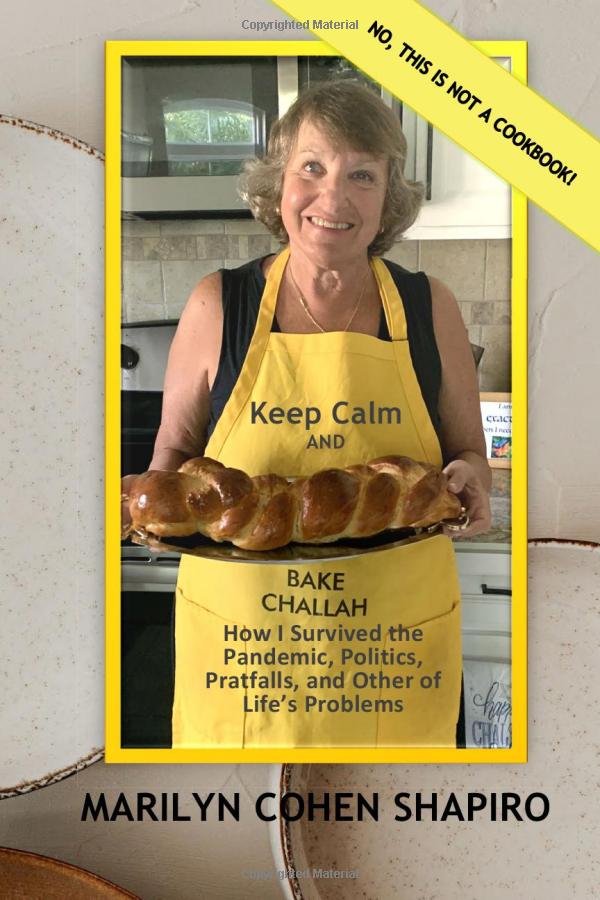
As Jews around the world herald in the Hebrew Year 5784, I am celebrating Rosh Hashanah with the release of my fourth book, Keep Calm and Bake Challah: How I Survived the Pandemic, Politics, Pratfalls, and Other of Life’s Problems.

Before you start getting out your baking pans, please be warned: No, this is NOT a cookbook! 

In March 2020, as the reality of COVID-19 hit home, I started baking challah, the delicious, braided egg bread that is typically eaten on the Sabbath and other important Jewish holidays. More importantly, I started WRITING about baking challah. Getting inspiration from England’s World War II rallying cry, I searched the internet and found Keep Calm Maker on Zazzle, an American on-line marketplace, could create an apron with a Keep Calm and Bake Challah logo embroidered on the top half. The yellow cotton pinafore arrived in June and my wearing it while baking the loaves became as necessary to the process as kneading the flour, sugar, salt, oil, and yeast. I knew that the mantra would be the title of my book. 

Over the next two and half years, I wrote about baking challah. I also wrote about adjusting to the “new normal.” Wearing masks. Zooming with family and friends. Missing in-person birthdays, bar and bat mitzvahs, graduations, weddings, and funerals. Following the news as the country was split apart. Emerging slowly back into life more closely resembling the pre-COVID years. Finally meeting my San Francisco grandson who was born days before California began its shelter-in-place orders. Resuming our summers at 9100 feet in Colorado. And dealing with our own COVID illnesses. 

In April 2023, my editor Mia Crews and I were putting the final touches on Keep Calm and Bake Challah before publication. We were going back and forth with necessary changes to the fifty-three stories as well as the cover, which featured a picture of me wearing my apron and holding a huge, braided loaf. Finally, Mia uploaded the first draft copy of the book. That Friday afternoon, I greeted the deliveryman as he handed me the brown envelope that held my new “baby.” 

“Thank you so much!” I told him. “It’s my book!” 

“That’s nice,” he said, as he turned around and started heading for his truck. 

“No, it’s not any book,” I said. “It’s my book! I wrote it. Do you want to see it?” 

Before he could answer, I tore open the envelope and showed him the proof copy. 

“That’s nice,” he said. “You wrote a cookbook.” 

“No, it’s NOT a cookbook,” I said. “It’s a collection of stories about my life during the pandemic.” 

As he left, however, I took a closer look at the cover. It DID look like a cookbook. That opinion was confirmed by several other people to whom I showed the proof. 

Over that weekend, I agonized over my dilemma. Did I need a new cover? A new title? Or did I need to throw out hundreds of hours of writing and editing, keep the cover and title, and just write a cookbook? I seriously considered a title change—Thankful? Finding a Silver Lining?—until a conversation with five of my cousins on our weekly Tuesday Zoom call. 

“Don’t change the title,” they said. “Just put a banner proclaiming, ‘No! This is NOT a cookbook!’” 

I gladly followed their advice. I had been working on this book since March 2020, and I knew that the chosen title best reflected all those months of dealing with the pandemic. More importantly, I loved the title. No matter how many people passed up on my book because it looks like a cookbook, at least the title and cover would be what I dreamt it would be from the beginning of this journey. 

So I proudly present Keep Calm and Bake Challah: How I Survived the Pandemic, Politics, Pratfalls, and Other of Life’s Problems. For all of you who hoped it was a cookbook, I hope you enjoy it anyway. And to make everyone happy, my challah recipe is included at the end of the book. Happy baking! 

Keep Calm and Bake Challah: How I Survived the Pandemic, Politics, Pratfalls, and Other of Life’s Problems is available on Amazon. Click here for more information.

Gammy making challah with her granddaughter

Torn between three places? Why we are comfortable where we are.

Larry and I have just returned from visits with our children in California and Colorado. While enjoying our time, it is nice to return to our own home in Florida. This article, which was originally published in 2019, explains why we are happy where we are.

There is always, always something to be thankful for Author unknown

When my daughter Julie headed out to Colorado in 2003, it was originally planned as a nine month adventure teaching environmental science. Soon, however, Julie fell in love with the mountains, Colorado, and Sam, not necessarily in that order. They built a life together, completed graduate degrees, got married, bought a house in Frisco, and had a child. They have  settled into the life at 9100 feet.

Meanwhile, our son Adam chose a different path in another Frisco…San Francisco. After completing a law degree, he moved into an apartment in the middle of the city. This past December, he met Sarah. In a whirlwind romance, they dated, got engaged, got married, and now are expecting their first child. They have settled into life at sea level.

In the middle of all this, my husband Larry and I decided to move from Upstate New York, to a fifty-five plus community in Florida, close to 2000 and 3000 miles from Frisco and San Francisco, respectfully. There are those who ask us when we are moving closer to our children. The answer, for now, is NOT NOW.

Feeling gratitude despite living so far away may be difficult to fathom. However, I am thankful. Both my children have chosen to settle in two of the most wonderful places we have ever visited. Recent experiences bear that out.

Frisco, Colorado is nestled in beautiful Summit County. Surrounded by mountains reaching over 14,000 feet, it is for us a summer wonderland. Trails beckon us on hikes that bring us next to flowing streams, stunning wildflowers, and expansive vista. Larry plays with Summit County pickleball league while I take long walks with my granddog. Free concerts are offered in most surrounding towns Thursdays through Sunday. 

Our favorite is the one on Main Street in Frisco every week. Hundreds of people congregate around the pavilion in the middle of Frisco Town Park. The adults settle into lawn chairs and on blankets, pulling dinners out of coolers, while their dog or dogs settle near by. Meanwhile, the children dart around the lawn and path around the pavilion. It is a slice of Americana that I hadn’t seen since growing up in our Upstate New York town. In addition to the free entertainment, the area has several theater groups and a summer residency for the National Repertory Orchestra. Because of all it offers, Larry and I have rented there for the past four summers.

One thousand miles away, San Francisco is one of the most beloved city in America. When we visited Adam, we have taken advantage of all its attractions. We have walked through Golden Gate Park and across the iconic bridge. We have visited Alcatraz, Muir Woods, Sausalito, and Point del Reyes. We have used the city as a starting point to attractions as far south as Monterey and as far north as Astoria, Oregon. 

With our children living in such wonderful places, why have we have not picked up and moved? This question has taken on new meaning now that we have The Frisco Kid in Colorado and a soon-to-be grandson in California. 

Let me start with Frisco. Everything I wrote about my favorite town in the world is during the summer. In 2019, its residents experienced snow through the end of June, enjoyed a beautiful summer, and had its first dusting of the 2019-2020 season on a nearby ski resort on August 22. By September 19, the mountains got enough to get skiers excited. 

When we visited Julie and Sam in mid-October, snow fell on five out of six days. An Upstate New York girl, I always loved the site of clean, white snow on lawns and trees and trails. Unfortunately, sidewalks are not immune. After dropping The Frisco Kid at pre-school the second full day we were there, the sun was shining everywhere, including on the black ice on the sidewalks. We had to leave for the airport a day early as a major storm was expected to bring hazardous conditions to Route 70. The Weather Channel advisory recommended travelers to pack food, water, and blankets in case one was stranded. Although the snowfall never amounted to more than 2 inches (Denver actually got more!), the temperature dipped to 16 degrees above zero, without windchill. We love Frisco but cannot see us living there through their long winters.

The weather in Adam and Sarah’s now established home town  is admittedly better. Even if you factor in the famous Mark Twain quote, “The coldest winter I ever spent was a summer in San Francisco,” we would never have to deal with snow. , The city, however, is known for its steep hills and even steeper housing prices. If we sold our home in Florida, we could maybe afford a bathroom. No, I am not talking about a one bedroom, one bath apartment. I am talking about a bathroom. No shower included. And to get to that bathroom, we would probably have to walk up four flights of stairs, as the natives seem to eschew elevators. 

There are two more reasons not to move. First of all, a number of friends have relocated to be close to their children, only to see them relocate one or two years later because of their careers. 

Finally, Larry and I love where we are. We are in a one floor home that is a perfect size for the two of us. We have activities that fit our needs: pickleball courts; fully equipped gyms, olympic sized pools, restaurants, and entertainment venues. To add to our pleasure, we have our choice of over 250 clubs and organizations with which to participate within our gates. 

Within a forty minute drive, we have all that Orlando has to offer, including world class entertainment. The Frisco Kid experienced Disneyland for the first time last year, and she is already on a campaign to make it a yearly visit. Hopefully, she will h persuade her new cousin to do the same!

So we are here to stay for as long as we can maintain our independent lifestyle. This Thanksgiving, we are grateful that both my children have chosen to settle in two of the most wonderful places we have ever experienced. We have planned visits as well as a promise to them that we can be on a plane in a moment’s notice if needed. Meanwhile, the guest room is ready for them anytime. 

A version of this article originally appeared in the November 14, 2019, Jewish World News, a bi-weekly subscription-based newspaper in upstate New York.