This story was published on May 14, 2020, but didn’t make it to my blog. Four years later, here it is!
One of the advantages in living in our community in Florida is the abundance of wildlife that surrounds us. In one week, we have seen otters frolic near our pond, crows attack a red-tail hawk, and osprey dive into the pond to catch a fish.Often, we look out our window and see several deer munched grass near the pond.
In one of my more harrowing moments, I barely missed hitting a male deer who decided to dash across the road in front of my bike. I thankfully stopped in time and watched two adults and one fawn continue their stampede.None of this week’s wildlife scenes, however, can compare with our encounter with a not-so-wild animal that briefly came into our lives.
As Larry and I were finishing up one of our long walks around Solivita, we saw a friend of Larry’s from pickleball standing beside her bike and staring at the curb. As we got closer, a tiny ball of fur crossed the road, an animal so small that it took us a minute to realize that it was a kitten. We watched it dart behind some bushes in the front of a neighbor’s yard. After a few tries, I found it trembling under the shrubbery.
Larry and I knew that we couldn’t just leave the tiny animal on its own. He (we checked!) would die of starvation or become an alligator’s dinner. We also knew we couldn’t keep him. Although we had had cats while our children were home, we had come to the realization that all of us were allergic. We had to find him a home with another cat lover who didn’t rely on Zyrtec to survive..
I picked him up, wrapped him in the bandana that I had been using as an emergency face mask, and started walking the half mile home. It took me less than a minute to name him “Corny” for the coronavirus.
While I gently held Corny and tried to reassure him that he was safe, Larry called friends who we knew loved animals. Kerry the dog walker. Jane the dog sitter. Doug and Barb the cat lovers. Teri who volunteers at a “cat cafe” where one can have coffee and pastries while playing with adoptable cats. In between the calls, we asked everyone whom we passed if they would like to adopt a kitten. No luck—yet
When we got home, I placed a laundry basket with an old towel on the floor of the garage and sat next to him. I took a picture of Corny and posted it on the lost and found section of our community e-bulletin. My next call was to a local veterinarian, who was not encouraging. He said that the kitten was one of many who were dumped in Solivita by outsiders. He also warned me that he probably was carrying fleas, parasites, AIDS, and/or feline leukemia and told me to call the county animal control so the stray could be picked up and—probably—put down. The Polk County contact initially provided some optimism: the shelter would take him in and try to find him a home if and only if he was weaned as they did not provide bottle feeding.
After several more phone calls, we connected with Brenda and Marty, devoted cat lovers who spend part of each year working at Best Friends Animal Society in Kaleb, Utah. The organization is leading a national effort of “No Kill By 2025,” They directed us to a woman in our community who is involved in Helping Paws, a local network whose mission was to rescue cats and find them homes. She was willing to take Corny, and the organization would ensure the cat visited a veterinarian for a check-up, shots, and neutering.
I quickly called animal control to cancel, but I was too late as the truck pulled up to our house soon after I hung up. We explained the situation, and the person who was to take Corny away was happy we had found a home for him.
As Larry drove, I held Corny and told him that he was going to a safe place. Diane, the cat angel, took a quick look at our kitten. She estimated that Corny was less than six weeks old, had a few fleas and an eye issue but was in good shape. She already was fostering a female cat with four kittens and was hoping Corny would be adopted by the mother cat. We gave Diane a contribution to cover the cost of the vet and said goodby. The softie that I am, I shed a few tears as we drove home. From the time we first spotted the kitten until we returned home, only 90 minutes had passed.
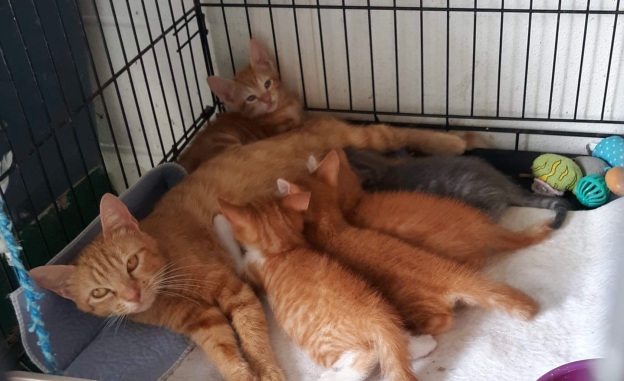
The next morning, Diane left a message on our voice mail: The mother had accepted Corny. Diane texted us a picture of all six cats. The mother was nursing three of her kittens and Corny. A fourth kitten looked on with an expression that said, “Hey! Who is this grey fur ball that took my place?”
On a check-in a week later, Corny, who Diane had renamed Snickers, was doing fine. “I overestimated his age,” said Diane. “Based on his weight, he was less than four weeks old.” While the other kittens were weaning themselves, Snickers had the mother cat all to himself.
Meanwhile, Diane shared with me her story as to how she became involved in Helping Paws. Like us, Diane and her family had a number of cats when they lived in their home outside of Boston and later outside of Orlando. When the last one passed away, Diane decided “No more pets!”
Soon after that, Diane was diagnosed with cancer. After she recovered, she decided that she needed to do something to give back to the community. One night, she dreamed that a black and white cat showed up at her doorstep. The next morning, she found a calendar with a similar looking cat in her mailbox. And that day, a black and white cat showed up on her doorstep. Fifteen years later, Max was the “old man” in her home with two other cats as well as a string of over two hundred cats she has fostered over the years. I thought to myself, Corny now has a bright future, and we had our happy ending.
As we celebrated Shavuot the following week, I could not help but think of the sixth commandment: Thou shall not murder. I learned that Polk County has a 50% kill rate for the animals brought to their shelter. That ranked them first in the state and tenth in the entire country. Corny wouldn’t have had a chance! In such worrisome, sad times as we encountered during the pandemic, it felt so good to be able to rescue this little fur ball.
Unfortunately as predicted by the veterinarian, Corny did not survive. Diane emailed us a couple of weeks later to say Corny had died of an infection brought about by parasites that had overwhelmed his tiny body.
Still, looking back on our brief encounter, I never regretted our short time helping that stray kitty. We tried to help. As a result, Corny knew love and companionship before he passed over to the “rainbow bridge.” And that gives us some peace.
To learn more about Best Friends Animal Society, go to www.bestfriends.org.

 There Goes My Heart