Tag Archives: #covid19

Remembering COVID Fatigue and some (heavenly) family support

This essay was originally published in March 19. 2021, The Jewish World. It reflects how just before Passover, the deep connections with my family and the memories we made along the way helped me get through a low point in the pandemic. It can be found in my fourth book, Keep Calm and Bake Challah: How I Survived the Pandemic, Politics, Pratfalls, and Other of Life’s Problems.

Passover will not completely pass over us this year. When the spring holiday occurred last year, we were only three weeks into the reality of the pandemic. Larry and I had a small, quiet, seder for two. On March 27, we will have a virtual Zoom seder with our Kissimmee, Florida, synagogue.

My husband Larry and I have been fortunate. As were our Hebrew ancestors, our family and circle of friends have been spared the “angel of death” in that we lost no one to this (God willing) once in a lifetime scourge. Friends who contracted the illness have survived, albeit with some lingering effects that we hope and pray will result in a r’fuah sh’leimah, a ,complete recovery.

Despite my gratitude, too many times during this year of the pandemic felt that more than Passover had passed us by. I know I share the feelings of so many others that we have lost a year of our lives.It has not only been the life events—first birthday parties, bar mitzvahs, weddings, graduations, even funerals. It has also been the small things: a restaurant dinner with friends; a movie or play, a live sporting event, a simple hug from a friend.

This feeling of ennui especially hit me when February arrived. When we lived in Upstate New York, the second month of the year had always been difficult as I was tired of the cold, the snow, the bleakness of winter. Now that we were living in Florida, we were liberated from the end-of-winter blues. Larry and I still were able to enjoy long walks and long bike rides in the sunshine. Physically, I was doing fine. But emotionally, I felt sad and cold and dark. Would this pandemic ever end? Would our children and grandchildren be able to get vaccinated? Would we be able to travel to see them this summer?When would the world begin to turn to normal?

Getting on Zoom calls was a chore; if I did sign on, I remained quiet, content to work on my crewel piece or check my text messages.Telephone calls were even more difficult; it was just too much work to talk about our endless Groundhog Day routine: morning exercise; afternoon puzzles and projects; late afternoon dinners; and evenings on the couch watching Netflix or reading a book.

In the middle of all this, I was working on my third book. When completed, Fradel’s Stories will compilation of a number of essays my mother had written in the last five years of her long life as well as essays I had written about my parents and family, many which had been published in The Jewish World. My mother had passed away on March 2, 2011, and I was determined to get the first “run” to my editor to correspond with the tenth anniversary. I devoted hours to organizing, editing, and re-editing. What should have been a labor of love was turning into just labor. Of course, that put more pressure on me, something that I certainly didn’t need in my emotionally depleted state.

On the third Saturday in February, I opted out of my usual exercise-in-the-morning routine and continued editing the second hard copy of the manuscript. When I got to the chapter that Mom had called My Romance, I brightened “The saying goes, ‘You have to kiss many frogs until you meet your true love,’” my mom had written in one of my favorite stories. “Well, I knew many frogs.” She then went on to describe the Toms, Dicks, and Harrys she dated while living and working in New York City until she was introduced to Bill Cohen, her brother and her cousin’s co-worker in an Upstate New York clothing store. 

After a whirlwind three month courtship, my father proposed over ice cream on February 14, 1940. “We had just seen Gone With the Wind,”Mom wrote. “Bill must have thought I was Scarlett O’Hara, and I must have thought he was Rhett Butler.” They were engaged!

Over the next six months, they carried on a long-distance romance. Separated by over 300 miles, they saw each other infrequently but wrote each other often. Mom had kept the letters in her dresser her entire life.“Where are they now?” I thought. Then I remembered that I had found them when my siblings and I were emptying her apartment soon after my mother had passed away. They were in a metal box that held all my treasured correspondences.

Even though I had been known about my parents’ love letters for at least sixty years, I had never actually read them until that Saturday morning. The first one I read, from my father, spoke of feeling “sad and cold and dark. “ Oh my goodness! He was describing me! His remaining letters expressed his love and excitement about their pending marriage. My mom’s letters shared some of his romantic sentiments, but the majority of them described wedding preparations and constant reminders for Bill to get his Wassermann test before the August 20 ceremony. 

After reading them all, I called all three siblings to share the emotional news of my find. That triggered more memories, more family stories. Laura reminisced how her eight-year-old self had found our parents’ love letters and decided to play post office by delivering them to each of the mailboxes on Waverly Street. Jay remembered how, while living in that same Upstate New York house, he and a fellow five year old had called the fire department to report a “blaze” so the two of them could get a first hand look at the town’s new fire engine. Bobbie remembered another letter—the one my parents had written to her in 1977 when, as a recent college graduate, she was struggling to find a job—that she still has kept over 43 years later. 

After my phone calls, I went back to the kitchen table to resume work on my book, but I was no longer alone. My siblings’ stories echoed in my mind. More strikingly, I felt my parents’ strong presence, surrounding me with encouragement to keep writing and with quiet assurance that “This too shall pass.” Recalling through their stories how they had survived the Spanish Flu, the Great Depression, World War II, and their own nine decades of ups and downs, I knew my family and I would survive COVID-19 and its resulting tsouris-troubles.

Ten days later, I felt confident enough to send my manuscript to my editor. We still have months of work ahead— more editing, picture placements, cover design. But I know that on September 1, what would have been my mother’s 104th birthday, Fradel’s Stories will be launched on Amazon. 

Soon, I will give my house a thorough cleaning, make my chicken soup and matzoh balls, chop up my apples and nuts for the charotzes, set our table for our Zoom seder. With all the recent good news of the medical front, I have faith that next year’s seder will be a more crowded, joyous, affair. Meanwhile, Passover and spring are here. Thanks to the love and memories my parents and siblings have shared with me, I no longer was sad and cold and dark. I was happy and warm and filled with light.

A version of this article originally appeared in the Jewish World News, a bi-weekly subscription-based newspaper in upstate New York.

My parents, Frances and Bill Cohen, on their sixtieth anniversary, August 20, 2000.
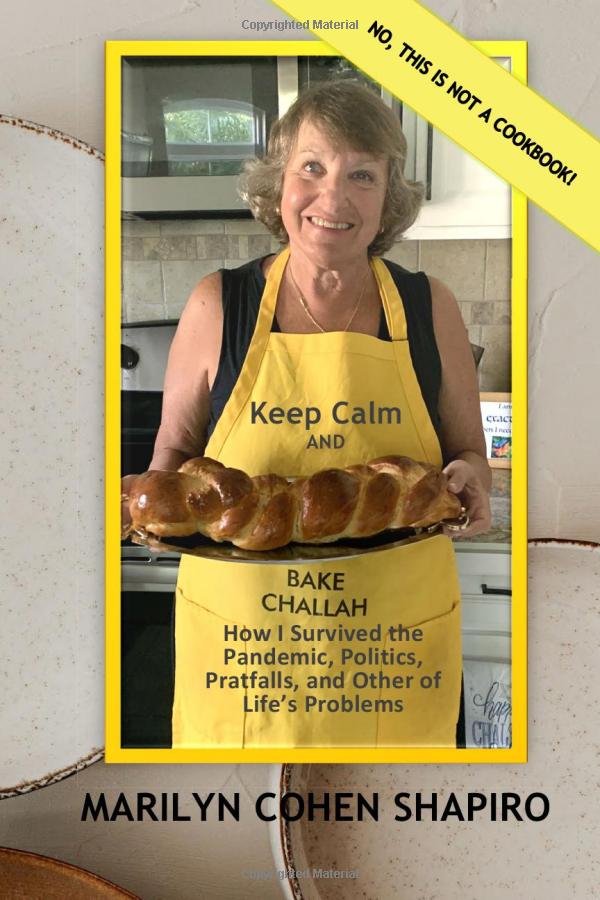
Keep Calm and Bake Challah is on Amazon!!

I am proud to announce that my fourth book, Keep Calm and Bake Challah: How I Survived the Pandemic, Politics, Pratfalls and Other of Life’s Problems,is out and available on Amazon in both Kindle and paperback formats.Hope you enjoy reading the the fifty-three articles I wrote during the pandemic as much as I enjoyed writing them! For those who have been following my blog for a while, you will now have many of those posts in one place for your reading pleasure.

Below are a sampling of the story topics:

Unmoored

Originally published in Jewish World News on June 24, 2021, the following essay reflects my feelings after fifteen months of lockdown. This is one of the essays found in my fourth book, Keep Calm and Bake Challah: How I Survived the Pandemic, Politics, Pratfalls, and Other of Life’s Problems.

Since my husband Larry and I have had our second COVID shots, our pre-pandemic life and its commitments are slowly resuming. We have waded out into the unknown, first a toe into the water with outdoor concerts and patio-only dining, then walking up to our knees with visits and in-home dinners with vaccinated friends, then plunging in with indoor restaurant dining and non-virtual club meetings. Recently, I was in a restaurant with four friends when I realized I had walked in, sat down, ordered, and hadn’t thought of COVID or even masks for a full half hour. That, I say, is progress.

Then why am I feeling shaky? Uncertain? Unmoored? 

Since March 2020, when the world shut down, my husband Larry and I filled the empty hours that stretched in front of us with small gems. I finally put together Fradel’s Story, a collection of articles written by my mother and about my family. We took long walks and longer bike rides through unexplored areas of our community. We spent hours and hours on our lanai, reading, doing puzzles, eating leisurely dinners, and watching the wildlife in our pond. Each Friday, we celebrated Shabbat with candles and wine and homemade challah. And we spent hours and hours on video conferencing sessions with family, friends, our synagogue, and our clubs. 

Now our calendars is filling up and overflowing. We have not yet given up many of the activities that kept us going for sixteen months of isolation, but we are also adding more and more semblances of our previous life. And as what happens to me whenever I try to juggle too much I began dropping balls. I missed a planned luncheon, showed up an hour late for a book club, and completely forgot to call my brother and sister-in-law to wish them “Mazel tov” on their fiftieth anniversary. For goodness sakes, I even failed to send in an article to the Jewish World for its last issue, something I had not done for years. Had I learned nothing from the pandemic?

Jodi Rudoren captured many of my feelings in a March 5, 2021, editorial in the Forward where she admitted that she didn’t want to go back to the old “normal.” “This terrible, horrible very bad year of isolation has also had an abundance of silver linings,” she wrote, “and I worry we’ll snap back to our old ways without truly learning the lessons this crisis has brought.”

So now, like Ms. Rudoren and many others, I am finding my own “better normal.” I don’t want to give up some of the things I savored: the more leisurely life, our long dinners on the lanai with cold beer or coconut rum and (Diet) cokes or wine; the challah baking, the puzzles. On the other hand, I look forward to meeting friends for dinner and plays and indoor get-together, resuming exercise classes, and, most of all, traveling to see my family. 

I am not alone in my feelings, as I found out on a ZOOM with my SOL Writers group. Ginny said that she feels as if she was emerging from a long illness, where stepping back into the world in her weakened state is difficult. “I feel untethered,” she said. “It is as if I am floating around finding my center.” Gail shared that she felt as if she were in a “waiting room,” in between her old life and her “new normal.”

Along with the difficulty of finding one’s balance, there is still the specter of COVID-19 hanging over all of us. Although all of the SOL Writers have had both vaccines, each found that she still was a “little too vigilant,” “a little too cautious,” and most importantly, “a little distrustful.” When “accosted” by a fellow shopper who demanded to know why she was still wearing a mask, Ginny avoided confrontation by calmly saying, “You care as much about what I think as I care about what you think.” After ‘losing’ what she feels has been a year of her life, Mary Ann said she no longer has the energy or patience to squander what remains of her time for “idiots” who still think that the virus was a hoax. “These people are ‘energy vampires,’” commented Aya.

The reality of a resurgence has been felt by friends in England, who now are concerned of a virus variant from India that is more contagious. “Portugal opened up, and many people flew there for a vacation,” they  told us. “Then there was a spike in cases.”Portugal’s Covid rates increased enough for England to revoked their green status, resulting in vacationers scrambling to return home before they faced a 14-quarantine. Our friends are not optimistic about traveling for a long while. 

In the States, there is more confidence, and Larry and I are ready for our next big step. We will soon be flying out to see our son and daughter-in-law and meet our grandson, who was born one day before San Francisco closed down. Then we head to Colorado, to spend time our daughter, son-in-law, and beautiful granddaughter. Extra masks and hand sanitizer are already packed, along with gifts, warm layers for San Francisco “summers” and hiking clothes and boots for Rocky Mountain trails. 

We know that COVID and its aftermath will impact our visit. Outdoor concerts, farmers markets, and indoor plays and dinners are still “To Be Determined.”

No matter, Larry and I will just be happy to finally be with our family and return to at least that piece of normalcy. We will take long walks along the ocean in San Francisco and long hikes in the woods in Colorado. Each Friday, we will sit down with them for Shabbat dinners with wine, candles, and freshly baked challah. Larry will find quiet moments to do puzzles and read. I will put the final touches on Fradel’s Story [to be completed in time for what would have been my mother’s 104th birthday on September 1] and continue writing stories about living through the pandemic. And I will savor all that I learned as I move forward into our “new normal.”

Sources:

Demony, Catarina. “Portugal halts easing of COVID-19 rules in Lisbon as cases rise.” Yahoo News June 9, 2021.

Rudoren, Jodi. “Confessions of a Lockdown Addict.” Forward. March 5, 2021.

Rudoren, Jodi. “Small Talk and Other Skills I’m struggling to re-learn as we build a better normal.”  Forward. June 11, 2021

Photo courtesy of Nick Fewings on Unsplash.

A version of this article originally appeared in the June 24, 2021, Jewish World News, a bi-weekly subscription-based newspaper in upstate New York.

Guess Who Got Covid?

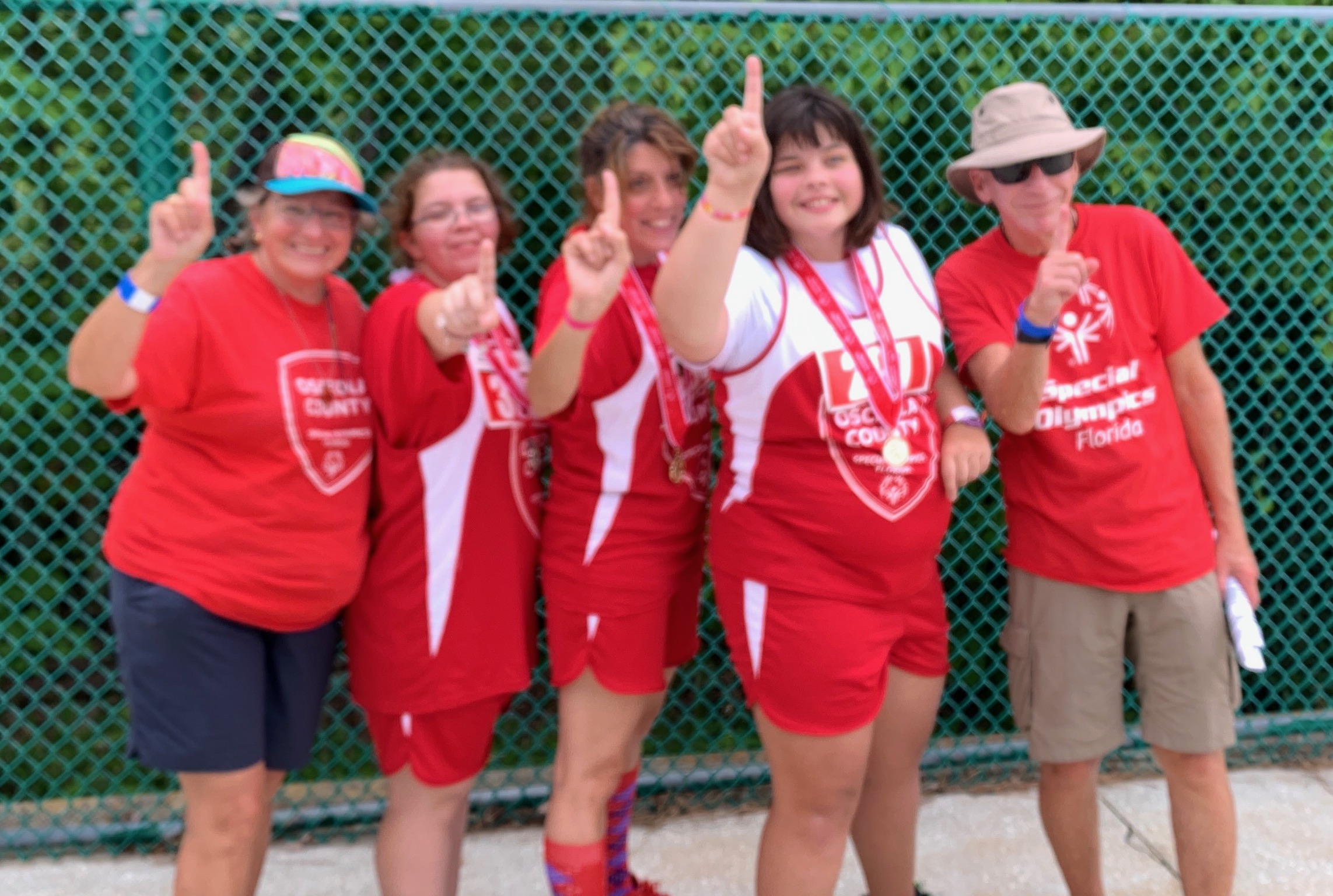
Note: As I post this article, Larry and I had just finished up our Special Olympics Florida state meet with our track and field team. We had a wonderful, exhausting, and incredibly rewarding two days with all of our “stars.” In this article, I reflect back on last year’s 2022 SOFL State Games and its aftermath.

Guess who contracted COVID?

After months and months of being careful, I had pressed my luck. As Special Olympics Track and Field coaches, Larry and I attended the Florida State Special Olympics game with eleven athletes from Osceola County on May 20 and 21, 2022. All of our events, which took place in the ESPN Wide World of Sports Complex in Orlando, were supposed to be outdoors. Plans changed quickly when torrential rains and strong winds swept in moments after we had parked our car. Our team, along with several other teams from a variety of sports, spent the first two hours sheltering in the Advent Health Building lobby. The “close encounters of the super-spreading kind” happened again that night when rain delayed and then finally resulted in the cancellation of opening ceremonies. Although Larry opted not to wear a mask, I made sure I had my KN95 covering my face whenever I was inside. Outside, however, I eschewed protection, hoping for the best. 

Fortunately, the weather improved the second day of competition. By Saturday afternoon, however, I was exhausted. I tried to hydrate, but I was totally wiped. “Maybe I’m getting too old for this,” I thought to myself. Or maybe I was just feeling the effects of two sleep-deprived nights, two mornings of 6 a.m. alarms, and my putting on at least eight miles corralling our athletes to various venues in 90 degree heat and 90% humidity.

By the time our last athlete had claimed his second place medal in the 400 meter walk, even Larry, who had shown no signs of slowing down, was ready to get out of the heat and go home. We stopped for a late lunch, drove home and collapsed on our couch. After a slow walk on Sunday morning, we went to Publix for our second booster shot. Then we spent the rest of Sunday with a repeat performance on the couch.

On Monday, I attempted my usual walk but felt as if I were plowing through mud. By Tuesday afternoon, exhaustion was accompanied by congestion and a runny nose. “Just a head cold,” I thought. It took me until Wednesday to administer the home test.

You know how it usually takes 15 minutes to see the results? Forget that. Within thirty-seconds of putting the disgusting drops into the assigned spot on the test strip, the “positive” line showed up.

“I have COVID,” I texted my husband, who was at a ROMEO [Retired Old Men Eating Out] luncheon. Unfortunately, he didn’t read the text and only learned the news on a phone call when he was driving home. His passenger quickly put on a mask. Sorry Rich! That is the proverbial “Shutting the barn door after the horse has bolted.” Fortunately Larry and he didn’t come down with it.

I never have been a good “patient” in that I have no patience for being sick. When Larry came home from his outing, he found me on the computer, a box of Kleenex and a cup of tea by my side, interviewing someone for my Holocaust Torah story while typing away. “Get off the damn computer, put on a mask, and go lie down,” he told me.

Exhausted, congested, and realizing that I couldn’t leave the house anyway, I gave up. I spent the next three days sacked out on the couch catching up on Outlander. Note: There is no better way to veg out than spending twenty hours with Jamie and Claire as they romped their way through pre-Revolutionary War America.

Later than evening, Larry made dinner for both of us, something he did every night for the next eight nights. And to top it off, he made me an ice cream sundae every night to help “soothe your scratchy throat.” At least that is the way we justified 350 calories of pure bliss. Larry, meanwhile, was earning enough “Best Husband in the World” points for a lifetime.

By Sunday, I was feeling well enough to resume my work on the Holocaust Torah story. I even had enough energy to take a short (masked) walk and to water my drooping houseplants. As was the case for so many others who contracted “the plague,” however, it took me another two weeks to get over the fatigue. 

Do I have any regrets about going to the Special Olympics State meet? Not one bit. Seeing our athletes competing in their events, coming down off the awards platform, finding their way to their parents, and beaming with pride, brings so much joy it was worth spending the two days in a sure fired “petri dish.”And how could I not hug my athletes when they finished a great race or threw the softball farther than they ever had or showed me their medal?

So where do we go from here? Yes, I may get COVID again, but having it may have helped me build up some immunity. Larry was spared this round but will he contract it in the future? Only time will tell.

On March 25, 2020, Jewish World published my first “pandemic” story. “As I write this, we are in the second week of our own national crisis,” I stated. “Larry and I worry about our friends and family—especially our own children.” Over the ensuing months, I wrote about how COVID and its forced locked-down impacted us: our first sad Passover seder for two; our hours and hours on Zoom; our trimmed down wardrobe (on my not slimming down body); our hopes for a more sensible approach to COVID with a new president; our tentative steps back into the world with masks and bottles of hand sanitizer and vaccines and boosters; our joy in finally reuniting with our children and grandchildren, and, of course, my baking dozens of loaves of challahs I baked throughout the long months.

It is now time to put all these stories, published every two weeks in Jewish World, into a book. Keep Calm and Bake Challah: Surviving the Pandemic, Politics, Pratfalls, and Other of Life’s Problems will be finished and available on Amazon in June 2023.

And it is time to move on. Yes, we will test before visiting our children. Yes, we will mask when necessary, especially in unavoidable crowded venues including planes and other public transportation. Meanwhile, I will continue to keep calm, bake challah. and learn to live in the “new normal” in the Age of Covid.

A version of this article originally appeared in the Jewish World News, a bi-weekly subscription-based newspaper in upstate New York.

From Go Fish to Rummikub

“Let’s RummiKub!” read the email blast from my friend Hedy. She and her husband Harvey loved playing the game, and she decided to start a club in our community.

RummiKub! The last time I had played the popular tiled game was with my mother, Frances Cohen, over seven years ago.  She had played weekly with a group of women friends when she lived in Florida. When she and my father moved to an independent living community four miles from our home in Upstate New York, her game set came with her. Within a month, she had found another RummiKub group. She loved the socializing, challenging her mind—and winning. My mother was very good at finding ways to dispose of all  her tiles by adding to other accepted combinations of straights and matching numbers on the game table.

Before cell phones, before computers, adults and children played games —card games, board games—with real people. My siblings and I gathered around the old oak dining room table and played Old Maid, Go Fish, War, and—my favorite—Gin Rummy. We also enjoyed beating each other at board game as Chutes and Ladders and Candy Land gave way to Clue, Scrabble, and Monopoly.

Once my parents purchased their cottage on Lake Champlain in 1966, those games became even more important. When bad weather kept us inside, my mother would pull out a deck of cards or the Scrabble set to keep us—and eventually—the grandchildren busy. One Monopoly game was good for an entire rainy afternoon.

In college, my friends and I would gather a few times a week for pinocle. We would sit around the round table in the common area outside our suites in Paine Hall at SUNY Albany. I left college and pinocle behind, but games were still in the cards for me. 

The first time I met my future husband Larry’s family, his Bubbe Rose challenged me to a game of gin rummy. She let me win almost every time those first few months.Once Larry and I were engaged, the gloves were off. I rarely won again.

Playing card and board games against each other have always been part of our marriage—with varying levels of success. When we first were married, we tried Mille Bourne, but Larry always won, and I refused to play anymore. We played Scrabble on snowy nights while the children were asleep. He once put down four tiles to spell “oije.” When I challenged him, he said it was a popular word in New Jersey as in “I had the oije to go out for a hamburger.” I urged him to remove the tiles. He still won the game.

Yahtzee is hands down our long-time favorite. The game, which requires the players to roll five die three times each turn to get one of the eleven  required combinations is part chance, part luck. Larry usually wins. (Do you see the pattern here?) No matter. I pack Yahtzee into my suitcase every time we go on vacation. If the need arises to fill in some free time, we can resort to an activity together, infinitely better than burying our heads into computers and playing Solitaire (me) or Angry Birds (Larry).

We also played games with our children. By age four, Julie was so good at Memory that Larry was the only one who enjoyed losing to her. Clue, Uno and Sorry! dominated our lives for many years. Adam and Julie pulled out Monopoly to play with friends and each other until the sets literally fell apart. 

The tradition continues. Larry and I joined Julie and her husband Sam for an overnight stay in a hut buried in the woods at ten thousand feet in the Rockies. The hut had no running water, a wood stove, and an outdoor bathroom but —it had Monopoly. Julie gleefully proclaimed victory after a two-hour marathon game. Over one Thanksgiving, I taught Adam gin rummy, and after the first hand he won the next four games against me. (Do you now see the pattern?)

When I lived in Upstate New York,  several of my friends were in Mah Jongg groups. “Do you Mahj?” they would ask. No, I didn’t. My mother-in-law Doris had played, but I didn’t have a “Clue” as to what the game entailed.

 It wasn’t until I moved to Florida and was asked again if I “Mahjed,” did I give the ancient Chinese game a try. I loved it! It had, in my mind, the best elements of every game I had had ever loved: Go Fish, Gin Rummy, Yahtzee, and RummiKub. As my sister-in-law inherited her mother’s set, I quickly purchased my own. I even brought the set with me—along with Yahtzee—on a recent cruise. I played with friends four mornings while at sea, so it was worth schlepping the three pound tote on board. 

Initially, Larry and I took Hedy up on her offer. About forty people meet every other Sunday in a community room to play RummiKub. Larry and I  realized after we had played a couple of games that Mom’s set was missing a tile, a blue three. A friend lent me her unused set, but it didn’t have the same meaning as playing with the same tiles that my mother  had used for so many years. (If anyone has  an incomplete RummiKub game with a blue three still in the bag, send it my way please! My mom and I will thank you! ) Alas, I had been spoiled by Mah Jongg. It challenged me more than Rummikub, and we haven’t returned since the pandemic closed the meetings down.

Surprisingly, Larry and I didn’t resort to games to get us through the pandemic. For the first month, we played Yahtzee every night. I was losing too many matches, however, so we switched to crossword puzzles. Larry would print out two copies of the same puzzle; we would work solo. Larry often finished first, but if we were both stuck, we worked together to complete it.

My Colorado granddaughter has also developed an early love for games. She has played with her Gammy and Zayde Pete the Cat, Fish, War, Old Maid, and Candy Land. When she turned seven, we gave her Sorry!, the the most adult game we have played with her. We love the challenge, and she is good! I recently asked her if she would like to learn Mah Jongg, and she said no.  Considering I don’t have a set up here in the Rockies, that will have to wait. Maybe we can start with Rummikub?

In the end, just like my mother and my mother-in-law, I love meeting regularly with friends and family to share a game, food, and conversation. Games not only bring people together but also bring back memories of time spent with those you love and with whom you share a history. As they say in New Jersey, I “oije” everyone to give games a try.

A version of this article originally appeared in the Jewish World News, a bi-weekly subscription-based newspaper in upstate New York.

I am exactly where I need to be!

Happy Summer!  Have you kept your New Year’s resolution?

Odds are, you haven’t. Each year, Strava, the social network for athletes, predicts the exact day when most people are likely to ditch their annual commitment to themselves. Whether it be the goal to lose weight, exercise more, or stop smoking, the majority throw in the towel (or throw out the scale) on the second Friday in January. A full 80% will have given up on it by mid-February.

If you have made it to the last days of spring, Mazel tov!

Up until this year, my list of resolutions were endless, so reflective of the person I am. On top of my list (for at least six decades) was to lose weight. Along with that annual goal, I have promised myself in the past to exercise more; read more books, watch more movies, play more piano, see more of family and friends, and write more articles, for starters.

But as I head into a third year where pandemic still hangs over our heads like the sword of Damocles, I have made peace with myself, My one and only resolution is based on an affirmation I stumbled across this past winter. Drum roll please!

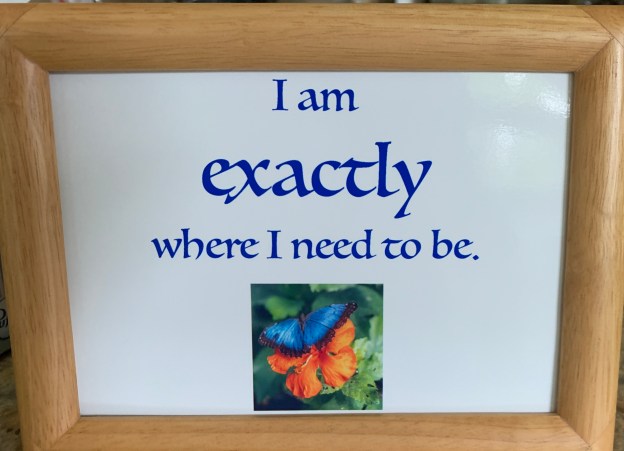
“I am exactly where I need to be.”

These eight words summarize an entire philosophy based on the idea that I can be happy where I am at this very moment. It has grounded me when I find my mind racing with what I need to do next: the challah that needs to be baked, the article I have to get to Laurie Clevenson by the Monday morning deadline; the book I have to finish before it disappears off my Kindle. 

Full disclosure: Knowing myself, I will still working on those same items I have listed in the past. (I am already looking forward to writing several biographies of Holocaust survivors.) But I understand that I can reach those milestones without the help and pressure of resolutions. I can be happy in the “now,” not the future. I have given myself permission to focus on the journey, not some numerical destination.

Since I made this resolution on November 17, I already have over two months of practice behind me. I made a copy of it which I keep on my kitchen window sill When I find myself “falling off the wagon,” I quietly recite it to myself and get grounded again. It has the making of a habit! And speaking of habits…

I cannot remember where I originally saw this quote. Facebook? A friend’s blog? A recent book? It took me a few weeks—and the help from my Catholic friend—to find out my first person quote actually came from a prayer from St. Teresa of Avila, a revered leader of the Discalced Carmelite Sisters in 16th century Spain. The opening lines of her original prayer read, “May today there be peace within you. Trust God that you are exactly where you are meant to be.”

It took a little more digging to find a Jewish connection (Yes! There IS a Jewish connection!) St. Teresa’s paternal grandfather, a wealthy tax collector, was a Jew who was forced to covert to Christianity. He was condemned by the Spanish Inquisition for allegedly returning to the Jewish faith and was punished by being forced to parade around Toledo for one day a week with other insincere converts. He was later able to assume a Catholic identity. 

St. Teresa, aware of her ancestry, did not acknowledge it publicly because of prejudice in Spain at the time against Jews and Jewish converts. It appeared, however, that her heritage impacted her career in the church. She was recognized for bring a mystical Jewish strain reminiscent of Kabbalah and for giving comfort to many converts from Judaism who struggled to maintain a connection to Jewish belief and practice. As a leader and “doctor,” she directed her convents not to comply with the “statutes of purity of blood” which excluded Jewish converts to Catholicism from most religious orders, from the military, higher education, civil and church offices. 

In the 2012 off-Broadway play, Teresa’s Ecstasy, starring the Columbian playwright Begonya Plaza as well as Linda Larkin and Shawn Elliott, the nun’s Jewish heritage was seen as a driving force in her life and work. Plaza’s character, who in the midst of a divorce, and Larkin’s character, her Jewish lesbian lover, realize how much Teresa has become their role model in her commitment to faith, compassion, and human dignity.Yes, St. Teresa is a nun with a Yiddishkeit neshome, a Jewish soul. 

So now an adaption of a prayer written by a Catholic saint is now part of this Jew’s daily routine. It is the one of last thing I tell myself each night. I follow that with Jewish prayers, positive affirmations, and reflections on things for which I a grateful. I fall back to sleep quickly, and I sleep in peace, knowing I am exactly where I need to be.

A version of this article originally appeared in the Jewish World News, a bi-weekly subscription-based newspaper in upstate New York.

SOURCES

https://en.wikipedia.org/wiki/Teresa_of_Ávila

https://finance.yahoo.com/news/quitter-day-coming-not-another-205100681.html?fr=yhssrp_catchall

https://jewishweek.timesofisrael.com/a-nun-with-a-jewish-touch/

https://news.yahoo.com/news/saint-still-changing-lives-teresas-ecstasy-002524863.html?fr=yhssrp_catchall

https://www.inc.com/jeff-haden/a-study-of-800-million-activities-predicts-most-new-years-resolutions-will-be-abandoned-on-january-19-how-you-cancreate-new-habits-that-actually-stick.html

Hat Tricks, or All’s Well That Ends Well

“I’m organized. I just can’t find anything.” Saying on CJ Bella Co. Tea Towel

Spending a good part of last summer in Colorado with our six-year-old granddaughter reaped incredibly wonderful moments for my husband Larry and me. The first hugs after a year of seeing her only on Zoom because of the pandemic. Reading her books and playing Candy Land and War and Pete’s Birthday Party. Having her knock on the door of our rental at 8 a.m. on a Sunday morning with a newspaper in her hand and her announcement, “I am here for breakfast.” Extending my stay so I was able to join my daughter Julie and son-in-law Sam in walking her to her first day of first grade. I made enough memories to almost sustain me until we can see her again.

What was not incredibly wonderful was keeping track of all the items our six-year-old dynamo left behind. Larry and I had rescued her baseball butterfly hat from the local recreational center’s lost and found. Julie found her lost raincoat at her Fun Club two weeks after my granddaughter had left it there. In the meantime, Julie had to buy another one in a larger size. It was a little big, but Summit County was getting above average rain in July, and there was no choice.

Both Julie and Sam dealt with the lost-and-found-problem quite calmly to a point. But when Julie realized that their daughter’s favorite hat was missing the day before they were to leave for their planned one-week rafting trip, well, Julie lost it—her cool that is!

The first we heard about the missing hat was on the Sunday morning before their trip.

“Come over for pancakes,” Julie’s text read. “And can you check your condo to see if you have the butterfly hat?” 

Yes, our granddaughter was wearing a hat on Friday. She had it in the car when we drove down to Main Street for some bubble tea at the Next Page Book Store. In the picture I had taken of her sitting on Zayde’s lap listening to a story in the town promenade, she was hatless. But I vaguely remember taking the floppy hat festooned with butterflies and dragon flies from her outstretched hand before she hung upside down from the ropes at the playground in Walter Byron Park. I thought I had stuffed it in my pocket and returned it safely when we drove her home.

But it wasn’t in their house. And it did not appear to be in our condo. Or in our car. Or at the condo’s pool area. When we arrived at their house that morning, Julie was flipping her oatmeal pancakes with obvious annoyance.

“I can’t believe that people don’t keep track of her things when they are responsible for watching her,” she said, digging her barbs into both her parents and poor Sam. “First one hat; then a raincoat, now another hat!.Doesn’t anyone ever check to see if she has left anything behind?”

Even though I was thinking, “Maybe the child needs to be responsible!” I kept my mouth closed. Besides, Julie’s guilt trip was working. After breakfast, I walked the two minutes back to our rental and did a second, more thorough search. I checked pockets and backpacks and drawers. I checked under the bed and under the couch and under the seats of our car. It was nowhere to be found. 

By the time I got back to their house, Julie and Sam were fully engaged in getting ready for their seven day trip. Having to limit myself to under fifty pounds of stuff for our nine weeks Out West, it actually looked easier than gathering everything they needed for camping and rafting. Larry and I entertained our granddaughter with books, puzzles, and games, trying to stay out of the way of the oars, coolers, rucksacks stuffed with clothing and towels, bottles of suntan lotion and bug spray, sleeping bags, a paddle board, and enough food and drink for a small army.

By the time we finished lunch, I needed a break and a possible chance at redemption. 

“I’m walking downtown to see if I can find the lost hat,” I said. “If that fails, I will see if I can find a replacement.”

I first checked the bookstore’s lost and found. Lots of sunglasses a set of keys, but no hat. I then walked through Walter Byron Park, Someone had hung up a slightly worn “Get high in Colorado” teeshirt on the park sign, but no hat. I then walked back to Main Street and began checking out the hat racks that were set up in front of many of the stores, another exercise in futility. Too big. Too small. Wrong print. Wrong color. I stuck on my mask and began checking out inside inventories. I finally saw a possibility. Right size. Pink (Her favorite color). No butterflies, but lots of bright flowers. I snapped a picture, texted it to Julie, and then followed it up with a phone call.

“The hat wasn’t in the bookstore or the park, so I decided to check the stores,” I said. “Look at the picture on your text. I think you will love it.”

“Mom,” Julie replied a few seconds later. “ The hat is adorable, but we are not missing the floppy dragonfly hat.We are missing the baseball butterfly cap!”

“She wasn’t wearing her baseball butterfly cap on Friday,” I said testily. “She was wearing her floppy butterfly hat.”

“That’s her dragonfly hat as it has dragonflies and butterflies,” Julie said. “We have that one!” Then she added sheepishly. “I guess you and Dad didn’t lose it after all.” Long pause. “Hey, at least you got your exercise in!”

She was right. By the time I got home, I had walked over three miles looking for a hat that we had never lost in the first place.

I also realized that we had seen a girl’s butterfly baseball cap the day before at the REI in the next town over. I called the outdoor retailer and asked the clerk to put it aside for my daughter. No longer feeling magnanimous or generous, I made no move to pick up either the hat or the cost. After realizing the Fun Club lost and found box was locked up because of a field trip, Julie drove over to Silverthorne and bought it herself.

The following Sunday night, Julie, Sam, and my granddaughter returned from their camping trip, First thing Monday morning, Mother and Daughter walked over to Fun Club, where the missing hat was waiting in the lost and found box. 

“This warrants a story, you realize,” I told her the next day while sitting at her kitchen table on my computer. Julie just shrugged. And I started typing away.

A version of this article originally appeared in the Jewish World News, a bi-weekly subscription-based newspaper in upstate New York.

Keep calm and carry on? A return to tradition

Flashback to March 14, 2020. COVID-19 was the top news story. My daughter Julie and her family were leaving for the Orlando airport after a week’s stay. We had spent a few days on the beach and been delighted  by news of the birth of our grandson in a San Francisco hospital. We had cancelled our planned visit to Magic Kingdom the day before Disney announced it was closing the park that weekend. Instead, we spent hours in a community pool making sure we weren’t too close to anyone else. 

Julie’s last words as she got into her rental car were, “Mom and Dad, promise us you will stay safe!” She begged us to skip our plans to see Death Trap, which was being performed by our local theater group that evening. She must have called her brother, because Adam FaceTimed us an hour before we were to leave for the play. “If you stay home, I will keep the camera on your new grandson for the next hour.” Seeing our grandson won. We had no idea we would be feeling its effects—masks; sheltering in place; cancelled trips; cancelled events; hours of Netflix’s and puzzles; new variants; tragically, loss of friends to the virus—for the next two years.

Within the first month of the pandemic, I decided that celebrating with a Sabbath dinner every Friday would bring some joy. I polished my grandparents’ candlesticks; bought a new Kiddish cup on ebay (I must have lost mine in our move); brought out my embroidered challah cover, and located a friend’s challah recipe I had always meant to try. With some difficulty—the whole world decided along with me to make bread—I purchased flour, yeast, and sugar to make the traditional Shabbat bread. And I mixed and kneaded and braided my first challahs. Delicious! 

The following Friday, I was a little more confident. I made four small ones, and shared one with president of our (closed down) shul and one with a friend whose wife had just been placed in memory care.By April, I had totally embraced not only the baking process but also the spiritual elements. I learned that it was appropriate to say prayers during the kneading process, a way of feeding the body and the soul. I initially prayed for my family as well as our country and for all impacted by the pandemic. But my prayers soon extended to the sick, the grieving, the lonely. I kept a Mi Shebeirach list on my phone as reminders and often played Debbie Friedman’s version of the beautiful prayer as I kneaded the pliant, soft dough.

We developed a rhythm: Every Friday afternoon I baked the challahs, and just before sunset, Larry would head off in our car, delivering two or three still warm fragrant loaves to needy people in our community. When I couldn’t physically share them, I attached pictures of the challah onto an email with a note. “I kneaded prayers of healing into this loaf of bread. Thinking of you. Love, Marilyn.”

By the time Larry and I were finally able to travel to see our children and grandchildren in June 2021, I was a seasoned challah maker—to a point. Baking bread in someone else’s kitchen proved to be a challenge. In San Francisco, I realized the sound of the mixmaster cranking out the initial steps of challah process woke my grandson from his nap. In Colorado, the 9100 foot elevation resulted in loaves that looked more like amoebas. I had to learn to work around nap time and altitude. 

Meanwhile, I was tweaking my technique. I replaced the butter in my friend’s recipe with canola oil, which meant less noise and more kneading time, my favorite party of the process. Rocky Mountain challahs, I learned, needed to go into the oven immediately after braiding to prevent over-rising. A straight egg yolk wash resulted in browner, shinier loaves, which Larry wholeheartedly approved “This is the way challah is supposed to look,” he said, biting into the harder crust.

Over the past two years, I have baked and shared dozens of challahs, many that were appearing on our shul’s Zoom services. As our world finally has begun opening up, however, finding the time to make the challahs on Friday has been more difficult. I “cheat”by making seven or eight loaves and freezing 2-4 braided unbaked challahs, to be defrosted and baked when needed. (I still feel Jewish guilt when I use that shortcut!)

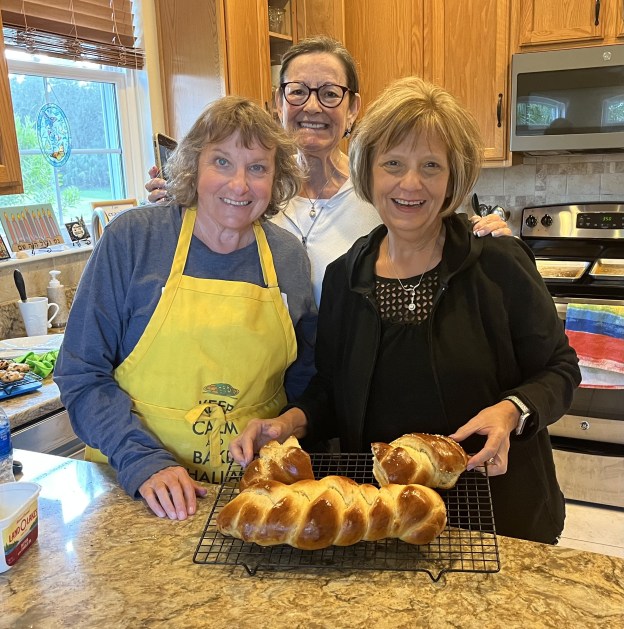
Friends have asked me if they could buy my challahs or even sell them at our Farmer’s Market. I decline, telling them emphatically I am not starting a new career. Instead, I offer them my challah “recipe,” a nearly 3000 word tome with numerous tips. Recently, I even invited two friends over for a “challah workshop.” After we all enjoyed slices oof the warm loaves smothered with butter, they went home with a batch of the still-rising dough they had prepared. They sent me pictures of their finished creations, beautiful in their own right. I am just following an old Yiddish expression: “Give people a challah, and they eat for a day. Give them a recipe, and they become challah bakers!”

Initially, I was hopeful that this would be the last article I would be writing about the pandemic. Two vaccines and two boosters later, Larry and I have pretty much resumed our lives. But there are now disturbing numbers that show another upward trend. Will we have to resume mask wearing? Sheltering in place? Only time will tell. 

When I wrote this mid-April, I was on a challah hiatus. Instead, Larry was enjoying sponge cake, Passover popovers, and matzo brie. But Passover ended next Friday. I soon will be pulling out the ingredients for the challah and donning my special apron. Stay safe, my friends.Better yet, Keep Calm and Bake Challah.

A version of this article originally appeared in the Jewish World News, a bi-weekly subscription-based newspaper in upstate New York.

Wrestle with COVID leaves survivor a changed woman

“When you come out of the storm, you won’t be the same person who walked in. That’s what this storm’s all about.” Haruki Murakami

Ever since the first cases of COVID-19 were identified, America has been divided regarding wearing masks, gathering in large groups, or, most recently, getting one of the variants of the vaccine. Heated arguments have occurred in government institutions to sports venues to houses of worship to classrooms to local bridge groups. For Kathy Glascott, a COVID-19 survivor, such protocols are not a matter of personal choice but a matter of social responsibility.

A former elementary school teacher, from Buffalo New York, Kathy Glascott was the happiest she had been in many years.  She had retired to a 55-plus community near Orlando, Florida, and, as was her style, she showed up for life. She was involved in several activities including the British Isles Heritage  Club, the Western Upstate New York club, and SOL Writers. A widow, she met her significant other Mike through the community’s Singles group, and they were having fun, going to concerts and dances and traveling to places of which she had only dreamed.“It was like being a teenager again,” she said.

Then, in February 2020, the unsettling news of a virus later identified as COVID-19 began to emerge. Heeding the early advice of medical experts, Kathy sheltered in place and tried to avoid exposure. Short on groceries, she took a risk and went for a quick supermarket run. “I didn’t have a mask because you couldn’t get them” Kathy reflected months later. “Looking back, I wish if had the damn groceries delivered.”

Soon after, Kathy began to feel unwell..One evening, exhausted and exhibiting symptom of what she thought was bronchitis exacerbated by her asthma, she had Mike take her to the nearby hospital’s ER. She had no idea that it would be  5 1/2 months until she would see anyone except through a plate glass door.

Kathy was diagnosed with bilateral pneumonia and COVID-19 and almost immediately placed in an induced coma in the ICU. She has vague memories of anything from March 27 until she woke up from anesthesia on May 5. “During that time,” she wrote months later, “my body was assaulted by machines that were surrogates for bodily organs—a feeding tube, a respirator, and catheters.”

Meanwhile, her brother Brian Joyce, a Methodist pastor in New Jersey, kept her large family and many friends abreast of Kathy’s life and death struggle through posts on her popular FaceBook page. On three occasions, Brian gave the grim news that she had been intubated and was near death. Even when the medical staff removed her from her induced coma, she was not out of the woods. She remained hospitalized for another six weeks and later continued her recovery in a rehab center where she had to learn again to hold her head up, sit, stand, walk, and swallow.

Brian warned his FaceBook followers against what he called “COVID-19 fairytales.” “It would be nice if Kathy’s story demonstrated a victory over the virus,” he posted on August 1 as his sister entered her 19th week of fighting for her life.“In reality her recovery is a daily journey through pain, loneliness, separation, therapy, small victories, and moments of great success and rising hope.”

On September 6, 163 days after she had been admitted to the hospital, Kathy was finally released. For the first two months, she stayed with her neighbor and closest friend Susan Schulman.After Kathy moved back into her own home, she continued to rely on Susan,  Mike, and others to provide a much-needed network of support. 

Over a year later, Kathy is still trying to make sense of what happened and “to fix what’s broken.” She mourns the six months of her life she lost to the virus in which her only contacts were her ever-present, albeit, wonderful medical staff members. 

Although not confirmed by her doctors, Kathy considers herself as a “long hauler,” one of unfortunate 10% of COVID-19 survivors who experiences prolonged effects of the illness. In her case, she struggles with vision problems, a chronic cough, reoccurring bronchitis, neuropathy in her feet, frequent fatigue, and bouts of PTSD. “I’m better, but I’m not the me I was before Covid,” wrote Kathy on a post in her blog This and That:Musings on Being a Writer.“I have a new normal that makes me feel diminished, stressed, joyful, discouraged, and grateful all at the same time.”

Kathy also recognizes that COVID has affected not only herself but also those with whom she is involved. This is especially seen in the impact her illness had on her daughter, Brenda Glascott, a college administrator who lives with her wife in Portland, Oregon. “Ever since I woke her in the middle of the night on March 28 to say, ‘I love you’ before I was intubated for the first time,” said Kathy, “Brenda has had to make a number of hard decisions on my behalf. And she made each one with courage and love.” Kathy has said that the hope of seeing her daughter and others who sustained her and kept her fighting in her darkest hours.

As a survivor, Kathy feels a responsibility to protect herself and others.“I try to honor the concern and love shown me by not taking unnecessary chances and by practicing safe protocols.” Those measures include limiting her exposure to others and wearing a mask even though she is fully vaccinated.

She is an outspoken opponent of those who reject such measures on the pretext of personal freedom. “If you hate wearing a mask,” reads one of her FaceBook posts, “you’re really not going to like the ventilator.” In another post, she quotes George Takei, the American actor and activist. “Telling me you are proudly unvaccinated is like telling me you’re a drunk driver. You’re not a patriot. You’re not a freedom fighter. You’re a menace.”

A writer and author of three previous books, Kathy is working on a fourth that will recount in detail her own “harrowing dance” with COVID-19. “When I think about the many people who were affected by my struggle, I am humbled by their love and concern and grateful for the outpouring of prayer and support I received,” she said. “I hope to pay it forward by sharing my own experience and encouraging others to take the necessary steps to protect themselves and help curtail the spread and continuance of this terrible pandemic.” 

A version of this article originally appeared in the Jewish World News, a bi-weekly subscription-based newspaper in upstate New York.

Realizing What I Have Missed

Up until now, I thought that maybe I hadn’t missed that much in the past 16 months. My husband Larry and I had our health, had managed to keep a level of contentment throughout the pandemic. We missed our family terribly, but we had frequent Zoom calls with our children and grandchildren.

Even throughout our two weeks in California, I had felt pretty good. Larry and I had hugged our fifteen and a half month grandson, overwhelmed with emotion. I knew I had missed a huge chunk of his first year, but I took comfort again from the hours on Zoom and FaceTime. We were starting our in-person relationship late, but I didn’t dwell on what we had missed. He knew us. He came to us. We savored every minute with our visit with our son Adam, our daughter-in-law Sarah, and the beautiful little boy who had been named after two of his great grandfathers.

But then, after our flight to Denver and an easy drive  up to Summit County, we hugged our granddaughter. (She had been warned: We would be hugging her so hard that she would squeak!) But who was this taller, more beautiful, more poised person? Where was the little girl with whom we had last hugged goodbye in Florida in March 2020? The gap between her and this person who     poured her own tea, rode a two wheeler, swam underwater in her community pool was so great. Yes, we had missed time with her, with her new cousin, with all my children that we can never make up. 

And I hadn’t realized how much I had missed our time in the mountains. On our third day, I finally made the hike up to Rainbow Lake, a short distance from our daughter’s home and our summer rental. As I walked up the trail, I took in the columbines and the wild roses and the aspens. Then I reached the lake, my happy place, the spot in which I find peace and contentment. How could I forgotten how much I love this spot over 9100 feet above sea level in the Rockies? Had it been almost two full years since I had sat on the log and drank in the beauty that surrounded me?

Larry and I had spent the Fourth of July in Frisco for at least ten years. We watched the parade down Main Street with Sam and Julie, then, six years ago, Sam and a very pregnant Julie. The next few years, our granddaughter watched from her carriage, then her father’s arms, and then as a participant on a tricycle in the Cavalcade of Children. 

This year, however, we headed out of town and, by 11:30 a.m., five humans and one dog were floating down the Colorado River. Sam manned the raft while Julie completed the entire trip, including some level 1 and 2 rapids, on a paddle board. Larry, our granddaughter and I found spots on the raft and took in the beauty surrounding us. We spotted a bald eagle perched in a tree, Canadian geese gliding along the shore, red cliffs rising above us, the Rocky Mountaineer weaving its way on the train tracks above us, fellow travelers on rafts and kayaks and paddle boards and inner tubes catch the currents with us. It was a beautiful Fourth, made even more special in contrast to last year’s isolation in our Florida home. 

The day ended with our granddaughter reading Go Dog Go, one of our favorite children’s book, to Larry while sitting on his lap on a rocking chair in her bedroom. Behind them, the window gave us a view the sun set in the aspen tree. 

As we finish our time in the mountains, Larry and I  have also been able to connect with the friends and extended “mishpacha” (family) that we had not seen since August2019. We took in outdoor lunches and evening concerts with dear friends from North Carolina. We celebrated our granddaughter’s birthday with Sam’s family by riding the Georgetown Railroad, eating lunch along side Clear Creek, and singing “Happy Birthday” over cupcakes and a candle-that-refused-to-stay-lit in a breezy park. After two full years, we are again finding our Colorado rhythm. 

Mann Tracht, Un Gott Lacht is an old Yiddish expression meaning man plans and God laughs. Recent events have shown us how unpredictable life can be, whether exemplified in a terrible pandemic that has lasted for months or a catastrophic building collapse that happened in seconds. On a personal level, these past eight weeks of my reconnecting with family and friends has made me  realize how much I  have missed, how much time I have lost, and how important it is to never take what I cherish for granted. 

A version of this article originally appeared in the Jewish World News, a bi-weekly subscription-based newspaper in upstate New York, in July 2021.