On September 3, 2016, , I launched my first book, There Goes My Heart. This article was published in the Jewish World News. Ten years later, I am about to publish Book Five: Never Forget: Stories of Jewish Sacrifice, Survival, and Strength. Who ever thought this girl from Keeseville, who wrote her first short story when she was 16, would ever be published??
Marilyn Cohen Shapiro of Poinciana has announced the publication of “There Goes My Heart,” a collection of personal memoirs. The collection of over 40 personal essays captures special moments in a lifetime spent in Upstate New York, Florida, Colorado, and beyond. Her Amazon author page states, “Readers will empathize with these true stories of dating, marriage, raising children, and caring for elderly parents through the author’s wit edged with appreciation and love of family and friends.” The book is available on Amazon in both paperback and Kindle e-reader format. A graduate of University of Albany, Shapiro was employed for over 25 years at the Capital District Educational Opportunity Center, a division of Hudson Valley Community College, Troy, New York, first as an adult educator and later as Coordinator of Program Development and Research. Since 2013, Shapiro has been a regular contributor to The Jewish World, a Schenectady, New York,-based bi-weekly newspaper. Shapiro and her husband Larry moved to Poinciana in 2015. They are members of Congregation Shalom Aleichem in Kissimmee. Shapiro is a lifetime member of Hadassah and a recipient of a Hadassah leadership award. She is a 2008 recipient of the State University of New York Chancellor’s Award for Public Service. This is Shapiro’s first book.
This story was written by my mother, Frances Cohen, in ~2006, after she and my father, Bill Cohen, moved into Coburg Village, an independent living facility in Rexford, New York. A natural storyteller, my mother joined a writing group and wrote down many of her stories for posterity. It is a joy to share them with you!
The weather plays an important part of our life. At times, we wish that we could change the weather, but as we have learned it is one of the things in life we cannot change.
Sometimes prayers help. On two occasions, our prayers were answered when we planned outdoor receptions. One was for the retirement party Bill and I planned at our cottage on Lake Champlain during the summer of 1983. The second was at the wedding reception for my granddaughter that was held on my daughter and son-in-law’s front lawn in Clifton Park in October 2007. At both parties, the weather was perfect: sunny, 72 degrees, with no wind. We considered it a miracle!
Our prayers did not work when Bill, my daughter Marilyn and I had to travel from Keeseville to Rockland County for our son Jay and our future daughter-in-law Leslie’s engagement party in December 1970. A Nor’easter started the day we were supposed to leave, so we delayed the trip until the next morning in hopes the weather would improve. Unfortunately, the snow only got heavier. By the time we arrived in Albany, the New York Thruway was closed. Determined not t miss the party, we decided to take Route Nine for the rest of the trip. The roads and visibility were terrible. Atone point, Bill stopped at a railroad crossing as the gate was down and the lights were flashing. The snow was so thick that Marilyn, who was sitting in the back seat, thought we were actually on the tracks and began screaming in fear. When we all calmed down, we continued on the trip. We arrived in Pearl River at 11 o’clock at night, sixteen hours after leaving Keeseville for what should have been a four-to-five-hour trip. It was one of the most difficult trips we ever made. In 1980, the year before we retired, our cousins invited us to visit them in Florida. When the day of our flight arrived, we left our cottage on Lake Champlain to drive to Montreal, the closest airport. When we crossed the border to Montreal, the snow was piled so deep that drifts were at places two stories high. As we crossed over a bridge near the airport, Bill lost control of the car, and we did a complete 360-degree turn, landing in a soft snowbank. Fortunately, there was no damage, so we were able to continue the trip to the airport. When we arrived in Florida, it was 85 degrees, and our cousins welcomed us in summer attire. Bill and I looked at each other and said, “This is paradise!” We couldn’t change the weather, but we could change our location. Right then and there, we decided that before next winter, we would sell our business, have a going-out-of-business sale, and spend our winters in Florida and summer at our cottage by the lake.
We were fortunate to be snowbirds for many years. It was the best of both worlds: Beautiful summers on Lake Champlain and warm, balmy winters in Florida. We thought we had it made—until Hurricane Wilma hit in 2005.
At that point, Bill and I were living full time in a condominium in Wynmoor, an over-fifty housing complex in Coconut Creek, Florida. The Weather Channel and local officials had warned us in advance of the incoming hurricane, and we had made sure to purchase water, canned food, and extra batteries. The night the hurricane hit, we did a lot of praying. The winds and rain were very strong, and we were very frightened. We were so thankful that our building had been spared any serious damage. We woke up to no electricity and no air conditioning in the 85-degree heat. For the first few days, we stayed in our condominium, living on the canned goods that we had purchased before the hurricane. When the electricity finally came back in our condominium, we decided to go food shopping for milk, eggs, and other food to restock our pantry and refrigerator. At that point, we were able to see the actual extent of the damage in the area. We saw lots of fallen trees, some of which had crashed into parked cars. With all the wires down and traffic lights out, getting to even the supermarket was almost impossible.
When we finally got to Publix, the store was dark and eerie as it was powered by back-up generators. We learned as the week went on that thousands of trees had been destroyed in our residential area. More tragically, a number of other residential areas, including Hawaiian Gardens, the original complex we had moved out of only four years before, were so badly damaged that they were unlivable and eventually had to be completely torn down.
In the middle of all this stress, when I was getting in the car to take another trip to the supermarket a week after the hurricane hit, I caught my foot on the curb while trying to get out of our parked car and broke a bone in my leg. That was the final straw. Our children felt strongly that we needed to get out of Florida and its hurricanes and move back up north. By spring, 2006, we were settled in Coburg Village, four miles from my daughter and son-in-law. At Coburg, we don’t need to drive, as the shuttle takes us everywhere. Our children are close enough so they can go shopping for us if the weather is too bad. So, when bad weather comes, we are able to just look out the window and enjoy our cozy apartment. Now we can be thankful for the snow so that grandchildren can ski, the rain that makes our flowers and gardens grown, and the beautiful sun that makes us all happy.
The photo of me with a rubber chicken was taken in Keesevile around 1954 after a bad snowstorm. No idea why I had a rubber chicken!
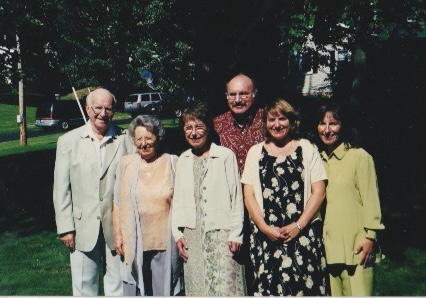
My mom, the storyteller, with her beloved Bill, 1990.Mom and I at Coburg Village on a beautiful fall day.
A version of this article originally appeared in the June 18, 2015, issue of the Jewish World News. I am publishing this blog post as we celebrate nine years in our “new” home.
This year marks the fortieth year Larry and I have celebrated Passover as a married couple. Unlike the Israelites, we have not exactly spent it wandering in a desert wilderness. It has been a fruitful, productive life spent in the Capital District. For us, next year will not be in Jerusalem, but in Florida.
A real upstate girl, born in St. Lawrence County and raised in in Essex County (Since when is Westchester County upstate?),relocating to Albany for college in 1968. Larry also had spent all but his college years in Saratoga County. We met in Albany, married, moved to Clifton Park, raised two children, made wonderful friends, and spent holidays with our families.
When did the desire to live someplace else begin? The germ was planted twenty years ago when our parents spent six to eight months a year in Florida. Our circle began to expand geographically: our children moved to California and Colorado; my sister moved to Arizona; an aunt moved to South Carolina; a niece moved to Virginia; and a number of friends and family started living two to four months in warmer climates. Other friends were spending time with their own children, who were scattered over the country and the world. We began a nomadic life, visiting friends and family and traveling on our own to Germany, Peru, England, Greece. Although we enjoyed our numerous trips, we felt finding “our spot,” a place that fit all our criteria, would keep us more grounded.
Every place we visited raised the question, “Could we live here?” We did some California dreaming, but the high prices of real estate and the high possibilities of earthquakes ruled it out. Julie and Sam live at 9000 feet in Colorado, truly a Rocky Mountain high. Summit County is beautiful in the summer, but the winters last nine months, and you think Boston gets snow? Try twelve feet a year, every year. Other places in Colorado offered warmer temperatures, but the homes we viewed were close together, and we would still need our snow shovels.We also Arizona would be out of the mix: The desert can be lovely, but no manna—and little rain—fell from the heavens, and we were always happy to get back to “green” and water on the East Coast. Ever the English major, I even fell in love with the small villages in England, but we knew that would never be where we settled.
Once we retired four years ago, our interest in relocating intensified. The long winters and grey skies hadn’t bothered us when we were working, but once we were home all day, the weather became a factor. Our friends and family changed from asking, “Have you any trips planned?” to “Where are you going next?” And after forty years, Larry and I were ready for our next adventure.
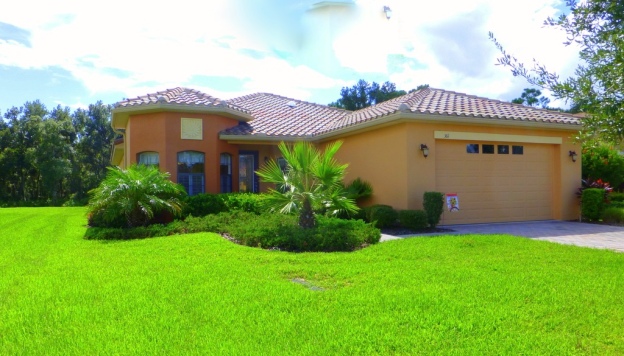
This fall, everything fell into place. Julie told us over Thanksgiving that, after eight years of marriage, she and Sam were expecting our first grandchild in July 2015. After I stopped jumping up and down with joy, Larry and I made the decision that we would like to spend our summers in Colorado and the rest of the year someplace warm. We found that warm spot on a rainy December day in Florida, when we checked out an active adult community where we were staying near Orlando. From the moment we drove in, Larry and I were impressed with the tranquil setting and the amount of green space and lakes. We fell in love with an immaculate home for sale on a lovely piece of land overlooking a pond and bordering a wildlife preserve. The community itself offered all we were looking for: indoor and outdoor pools, Hadassah chapter, book clubs, a writing club, bike paths, pickle ball courts, movies and shows, and exercise classes.It was close to world class entertainment and an international airport with direct flights to all major cities in the country.
We came back to Albany, to grey skies, piles of snow, and sub-zero temperatures. Even with the miserable weather, we still needed time. After much research, thought, discussion, and several sleepless nights, we decided to purchase the home in Florida and spend two to three months in Colorado. So, after forty years of New York Passovers, next year we will be celebrating with the Shalom Club in our new neighborhood.
If physically packing up the house is a challenge, emotionally leaving behind family, friends, and years and years of memories will be even more difficult. For the last twenty years, I have had the following framed quote hanging in our home, “Come my love and we shall wander, just to see what we can find. If we only find each other, still the journey is worth the time.” Like our Israeli ancestors, Larry and I will be wandering far from the home we have known to begin our next adventure.
In October, 2023, on a miserable, windy, rainy day, Larry and I found a puddle on our kitchen floor. Looking up, we could see water coming from one of our recessed light. Damn!
We called a roofing company the next day. After spending an hour directing a hose onto spots on the roof, the roofer found nothing. “Just call us if it happens again.”
It did. On December 23, on another miserable, windy, rainy day, we had to again pull out the buckets to catch the water dripping from the same spot.
As promised, the roofer came back free of charge. This time, he found the problem. The flashing had not been installed properly when the house was built, resulting in a spot where water had gathered. The wood in the attic was mildewed and rotting. The roofer was honest: his company specialized in shingle roofs. He couldn’t guarantee they could fix it and recommended we contact another roofer.
We called another roofing company that had been recommended by a friend. The representative confirmed the problem and said his company had seen this several times in Solivita. We signed the contract, forked over half the payment, and waited for the repair, thankful for dry weather in the meantime.
On Wednesday, February 7, 2024, the roofers came as promised. Five hours later, the job was done. Of course, we could have taken a cruise on the money we paid, but the leak problem was solved.
Less than an hour after the roofing crew left, we heard a sad, moaning sound in our attic above our bathroom. Oh no! It sounded as if an animal had gotten into the attic when the roofers were working on the problem and had gotten trapped.
We texted the roofing company.
“Oh no! So it sounds like something may have pushed through your soffit,” a representative wrote back. “I’d definitely walk the perimeter of the home and check to see if the soffit is pushed in or damaged anywhere.”
Then came the less helpful comment.
“Unfortunately we cannot get any animals out from an attic, that is something a trapper or pest control would have to do.”
We called our pest guy on Friday. Meanwhile, I put out a recommendation request on Next Door. People wrote back suggesting DYI solutions—mothballs, noise, cats. Along with the names of companies, people shared frightening stories of rabid raccoons, slithering snakes, and aggressively agile alligators.
Our bug guy finally texted us Monday. No, he didn’t do animals. Just bugs. He texted me the name of an animal control company.
“We’ll come out for a free estimate on Thursday,” we were told
And if there is an animal?
“The cost will range from $500 to thousands of dollars, depending on the animal and the damage.”
I immediately texted the roofing company again.
“Considering we noticed the sounds literally an hour after work was completed, we can assume the animal was trapped during the work,” I responded. . It’s turning into what can be a very expensive follow-up to what was already a huge expense. Would it be possible for someone to come and at least crawl into the attic, maybe releasing the animal?”
I also contacted the concierge in our community, who gave us a name of a local person who trapped animals at a more reasonable cost. “Johnnie” could come Tuesday at 2:30.
Meanwhile, the general manager of the roofing company called Monday night. He said that animals usually don’t go in with all the banging and hammering, but he was willing to split the bill.
On Tuesday, “Johnnie”, albeit three hours late, arrived at our home. Ninety minutes and $350 later, he found nothing. Nada. No animal. No droppings. No noise. No nothing. He left a trap and said he would be back the next day.
That night, while in the bathroom doing our nightly ablutions, we realized that the squeaking, moaning sounds were in synch with our turning our faucets off and on. Eureka! It wasn’t an alligator or armadillo or an anhinga in our attic. It was pressure in our pipes, Shoot! Did we now need to call a plumber?
The next morning, on a hunch, I went outside and checked the outside hoses. Yes, I had turned off the front hose when I watered the plants on Wednesday. Whew! Not my fault! Then I checked the back hose. Mystery solved! When the men were fixing the roof, they must have used the outside hose in the back of the house. Our hose attachment was in the “off” position, but the water had been left on. Because of that, there was pressure in the pipes. I turned off the water connected to the hose. Voila!! The sound stopped immediately.
Six days and a huge chunk of money later, the roof was repaired and the noise that had been driving us crazy was gone. Thankfully we figured it out before we called a plumber. But we are hoping that the roofing people will step up to the plate and pick up the entire bill for the pest guy.* Hey! I don’t mean to be a pest! But I will be badgering (Raccooning? Squirreling?) them until we get this settled.
As hurricane season ramps up in Florida, I remember last year’s Hurricane Ian.
Five days before our community in Central Florida was predicted to feel the effects of Hurricane Ian, phone calls, texts, emails, and Facebook posts expressing concern for our safety began arriving from around the country and the world.
Arizona: “Is the hurricane going to Florida near you?”
South Carolina: “Thinking of you and this crazy hurricane path.”
Vancouver: “Sounds like you guys could be getting some potentially nasty weather!!”
England: “Stay safe! Bit of a bugger these hurricanes.”
Massachusetts: “You still have time to fly to our house in Boston.”
New York: “Where shall we send the flowers?”
When my husband Larry and I left New York State, we were glad to leave snow and cold and blizzards behind. We also were fully aware that moving to Florida meant we would face the possibility of hurricanes. Therefore, when looking for a home, we decided to steer away from the Florida coasts, which historically took the brunt of these storms.
Not Our First
We immediately had fallen in love with 55+ active adult community south of Orlando because of what it offered. Furthermore, the homes were well-built, with underground electrical wires and excellent drainage.
Our first experience with Florida hurricanes was with Irma in 2017, and that had given us more confidence in our ability to withstand these mega-storms. This confidence was further boosted by experience of people who have lived in our community for over twenty years. In a text thread with fellow SOL Writers, one of the long-timers assured another member, who was experiencing her first Florida hurricane. “I’m one of those pioneers who have weathered several hurricanes here,” wrote Kathy Glascott. “Actually, that should be a selling point for Solivita – the community that survives hurricanes well! “As I learned later, all the homes were built in compliance with 2002 Florida Building Code(FBC), which mandated that new construction be able to withstand hurricane-force winds and feature shutters or impact-resistant glass in all openings.
Prep for the Storm
We also knew how to prepare for the storm. Immediately following Rosh Hashanah, we went into full “A-Hurricane-Is-Coming” mode. We made a quick run to the supermarket to add more canned food to our already full panty. We brought inside all potential flying projectiles: lanai furniture, plants, lawn ornaments, and hoses. We filled empty orange juice jugs saved just for this type of emergency with water. For extra measure, I filled the bathtub as well as several big pots. We even squeezed in our fourth COVID vaccine booster shots, figuring if we had any side effects we were already stuck inside.
Then it was a waiting game as Ian was getting larger and more ominous by the hour. The Weather Channel (TWC) showed a cone that covered all of Florida. Larry kept track of the storm in the office, switching between The Weather Channel, the local news, and some mindless programming to ease the stress. I followed Ian’s path on the television set in our kitchen, where I was working on a Mixbook family album and the final edits for my upcoming book. (Yes, I really did this. Maybe I feared that the projects needed to be completed before we lost electricity for goodness knows how long.)
Taking It In Stride
By 5 pm Wednesday, Hurricane Ian had touched down near Punta Gorda, about 120 miles away from our home, with 140 mph sustained winds.The scenes on the news in the hours that followed were terrifying to watch: massive flooding, destroyed buildings; boats piled on the shore. TWC meteorologists were in the middle of it. At one point, Jim Cantore was nearly hit in the head with flying debris. All I could think was, Is it worth losing your life to report on this? Thankfully one of the men in charge told him to find shelter. As faithinhumanity later tweeted: “I’m curious. When applying for this position of field weatherman was it the first line under job requirements or was it buried in the fine print ‘Must be Suicidal.’” (sic)
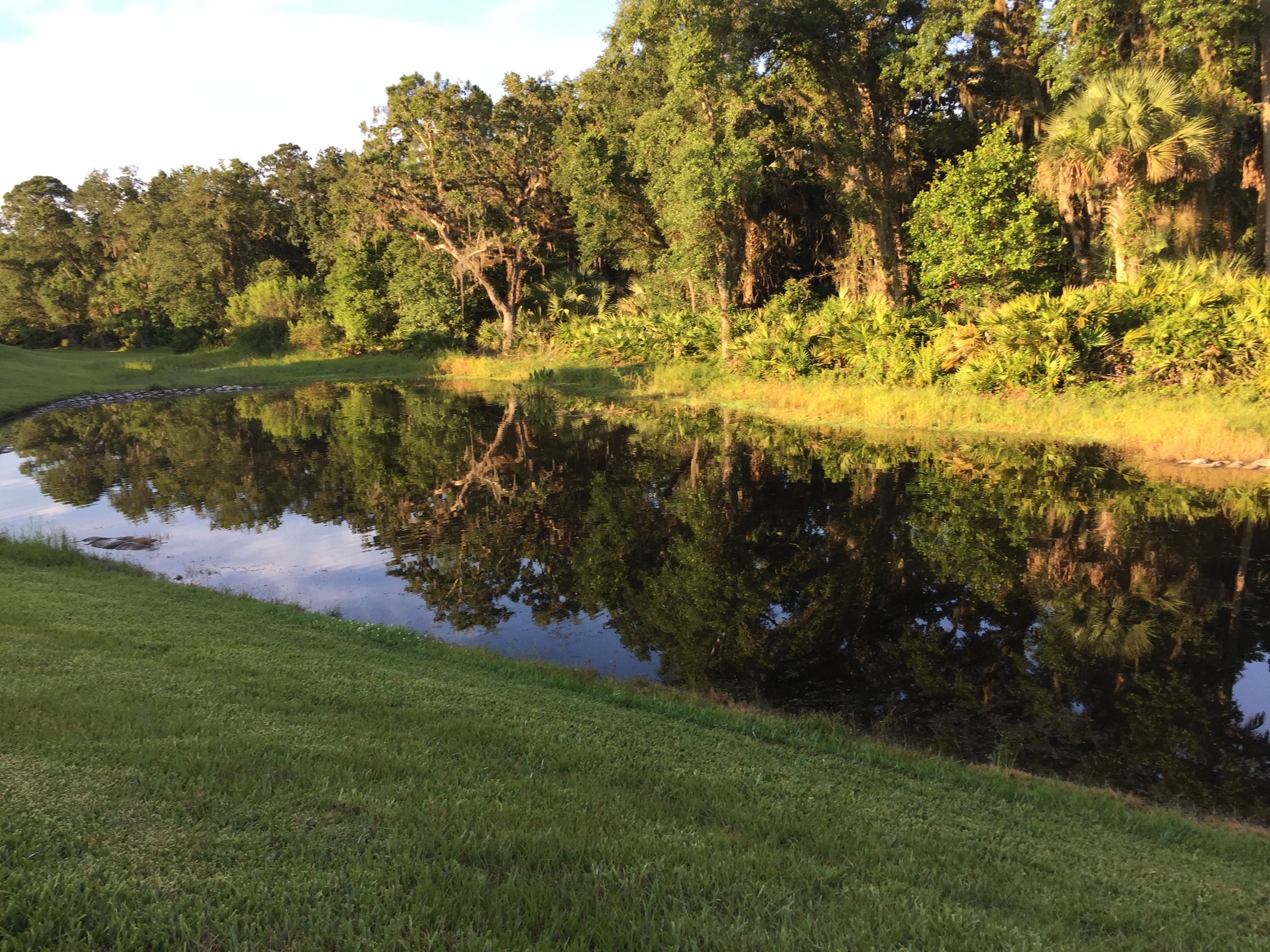
Meanwhile, our community was feeling the impact of Hurricane Ian. The rain was coming down in sheets, turning the small pond behind our house into a river. Fortunately, the water stayed well below our lanai, spreading north to south behind the homes on either side of us.
By eight p.m., darkness was closing in. We FaceTimed with our children, assuring them—especially our seven-year-old granddaughter— that we were fine and safe. Larry and I each finished off a big bowl of ice cream, reasoning that our half gallon of Breyer’s Vanilla Bean would melt if the power went off. On the last minute advice of our friends in England, we transferred a couple of bottles of white wine to the frig. We did a last minute check to ensure that all our other emergency gear—candles, matches, crank-up radios, smaller flashlights, cork screw, were in working order.
Oops
My only moment of concern was when I realized that almost every one of the ten D battery in the house was dead. Larry and I salvaged enough for our two larger flashlights and added D batteries to our shopping list.
As the wind and rain pummeled our house, we watched more television, grateful that we had not yet lost electricity. Exhausted, we went to sleep near midnight. Both of us woke up during the night for updates using both the twenty-first century method of checking the internet and the old-fashioned tried-and true-method of opening our front door. So far, so good.
Minimal Impact
Larry and I woke up at 7 a.m. to the news hat Ian had been downgraded to a tropical storm but was still producing strong rains, heavy rains, and winds up to 65 mph. Later that morning, as the storm headed northeast to wreak more destruction, we realized that we were very fortunate.Our house and immediate property was undamaged. The power had remained on. The pond remained well below our lanai. By late Thursday afternoon, the rain and wind had stopped, and the sun was peaking through the remnant clouds. We spent the rest of the day restoring our house to pre-Ian condition.
Larry and I woke up Friday morning to beautiful sunshine. A long walk through our neighborhood showed little damage. Over the next few days, we learned that a few trees had been uprooted, some houses had sustained damage to their lanais, and low-lying roads had been flooded. Our initial assessment, however, proved to be correct. Our community had been minimally impacted by Hurricane Ian.
Unfortunately, that is not true for so many others. Property data and analytics provider CoreLogic projected storm surge and flood losses from Hurricane Ian to run between $41 billion and $70 billion. As of October 17, over 117 Floridians had lost their lives. Half the deaths were attributed to individuals who chose not to leave their homes despite evacuation orders. Many others, however, lost their homes and lives in areas where experts called the flooding “unprecedented,” “historic,” and potentially ’a 500-year flood event.’
Gratitude
Exactly a week almost to the minute when we were completing final preparations for Hurricane Ian, Larry and I were observing Yom Kippur with fellow congregants of Congregation Shalom Alechiem. We recited the powerful Unetanah Tokef prayer which asks “Who shall live and who shall die, who shall perish by water and who by fire?” We had survived, and we are grateful. And we are grateful for all who were in touch with us throughout the storm. Massachusetts, we hope to visit without a hurricane! Albany, I love roses, which I will place in my still-intact dining room.
In one of my zany, punch drunk moments before Hurricane Ian hit, I took this picture with my emergency provisions: a head lamp, a half gallon of ice cream, and a bottle of wine (which we saved for AFTER the hurricane passed us by.)
In 2015, Larry and I sold our home in Upstate New York and relocated to a community in Central Florida. As Larry and I have fully embraced our new life in the Sunshine State, let us compare our retirement life near Orlando to my parents’ retirement years near Fort Lauderdale.
When the last of the Cohen children headed for college, my parents spent a couple of weeks each winter in Florida. When they retired, they sold the house in Keeseville and moved into their cottage on Lake Champlain. They escaped to Florida for two or three months in the dead of winter, splitting their time between short-term rentals and relatives’ pull-out couches. In time, they purchased a one-bedroom condo in Hawaiian Gardens, a complex in Lauderdale Lakes that they had heard about through a friend who lived at the complex.
After years of living in a community with lots of snow and with few Jewish people, they thrived in the sunshine and in the company of Yiddishkeit, fellow Jews who had moved to the Sunshine State from New York City and Long Island. Their lives fell into a pattern. They shopped at Publix and went to their doctors’ appointments in the morning. By noon, they joined all the other retirees by the small community pool. The women splashed around in the water while the men kibitzed on their beach chairs under large umbrellas. The conversation consisted of bad jokes, condo gossip, politics, and discussions as to which restaurants offered the best early bird specials. My mother had grown up speaking Yiddish to her parents, and my father knew a few expressions, so they started a popular Yiddish Club that met once a week. Dad played poker; Mom went to flea markets with friends.
Outside of my father’s occasional game of golf, my parents got their exercise walking back and forth to the pool. Deerfield Beach was only a half an hour away, but my father hated the sun, the heat, and the sand. As a result, my mother, who didn’t drive in Florida, limited her visits to the ocean to when her children could take her when we visited.
Hawaiian Gardens offered entertainment in the clubhouse, usually a singer or a comedian who had worked on the Borscht Belt. The performers weren’t paid a great deal, many were a little beyond their prime, and the audience could be downright cruel. During one of our visits, a woman singer
134
was belting out Broadway tunes. When she asked if the audience would like her to do an encore, one of the residents yelled out, “No! You’re terrible! Get off the stage!”
Larry and I flew down at least once a year and joined them in their routine. In the morning, I would take my mother to the supermarket or the flea market. At noon, we headed to the pool. At three o’clock, no matter how beautiful the weather, we all went upstairs to get ready to leave their apartment by four o’clock for that day’s early bird special. The meals varied in quality, but there were tons of food with enough leftovers, extra bread, lemon slices, and a few Sweet ’n Low packets to take home for the next day’s lunch. Even when they relocated to a larger condo, their routine remained the same. And their lives always included visits from relatives and friends from New York as well as get-togethers with new friends they had made.
Although we enjoyed our visits, Larry and I could not picture ourselves living the sedentary East Coast Florida condo life that my parents enjoyed. When we moved to our adult active community in Central Florida, we felt we had found our own slice of heaven. Our home sat on a large scenic lot with plenty of room for family and friends to visit. Our community had two community recreational centers where I could take exercise classes and swim laps. Larry could play pickleball. We had miles of neighborhood streets where we could take long walks and longer bike rides. Many clubs and groups offered us innumerable ways to meet people from around the country and the world. Many of the activities revolved around the synagogue and the Shalom Club, but we also participated in club activities offered by groups with ties to Italy, England, the Caribbean, and Western Upstate New York. We had a full, diverse life.
Once we lived here for a few months, however, I realized how much we have in common with my parents. Has it been that different? We head to the pickleball courts, the pool, and fitness classes in the morning. Then we plan our doctors’ appointments and our trip to Publix in the afternoon. Flipped schedule, but…. We often head to our favorite restaurant by four o’clock so we can beat the crowds. Recent entertainment included a headliner from the Sixties whose toupee and fancy tux didn’t cover the fact that his body and voice were not what they were fifty years ago. The ocean is only ninety minutes away, but we don’t feel like fighting the traffic. We share a great deal of time with our family and our old friends from around the country. And, like my parents, we escape the summer heat by spending time in Frisco, Colorado. It’s not Lake Champlain, but at 9100 feet it certainly beats Florida’s summers.
Both of our children have visited us in our home in Florida. They and their families have repeatedly told us they were glad that we are so happy here. However, I doubt if either of them or their families would select the lifestyle we have chosen. Our daughter Julie and her husband Sam love living in the Rockies, where they have mountains, forests, and plenty of trails available for hiking and skiing. Our son Adam and his wife love living in San Francisco, enjoying all that wonderful city and California have to offer. I hope wherever my children live, they will enjoy sunny skies, good health, and lots of
activities to keep busy. Most importantly, I hope they find joy in wherever life takes them.
In her eulogy to Grandma Fran, Julie spoke of my mother’s legacy. “She taught me about the woman I’d like to be, one filled with love, generosity, wisdom, wit, empathy, and a belief that we can create our own happiness in life by searching for the blessings.” That is the life my mother, “Frances Fradel” Cohen, lived with her “Dear Bill.” May their memories— and the memories they shared with all who knew and loved them—be a blessing.
A version of this article originally appeared in the July 2017 issue of the Heritage Florida Jewish News, a weekly subscription-based newspaper in Central Florida.
A version of this article originally appeared in the July 2017 issue of the Jewish World News, a bi-weekly subscription-based newspaper in upstate New York.
“Have money set aside and have flesh on your bones.”
This was the advice given to a friend who grew up as the daughter of Holocaust survivors. Her parents instilled in her and her brother the need for hyper-vigilance in case the unthinkable happened again. The couple’s circle of friends, fellow survivors of Nazi Germany, expanded the advice to include a ready passport and a warm coat in which money and jewels were sewn into the lining.
Since 2015, I have been researching and writing stories about Holocaust victims as told by themselves or their children. Each story relives in me the sacrifice, the terror, and the strength shown by the targets of Hitler’s Final Solution. And it comes down to this: Although they comprised a mere 1.7% of the population of Europe when Hitler came to power in 1933, over six million men, women, and children were murdered for the crime of being Jewish.
Hitler’s campaign against the Jews didn’t start with guns and ghettos and gas ovens. It started in 1933 with words: slow building propaganda effort to denigrate Jews, their accomplishments, and achievements. Those words were reinforced with images: distorted drawings of Jews as controlling octopi, fat bankers, and Christ killers. Words and images morphed into book bans and book burning. These actions grew into increasingly more restrictive laws regarding where Jews could work, shop, seek medical attention, and live. By November 10 , 1938, Kristallnacht, “Night of the Broken Glass,” Jews had neither rights nor means to escape. Trapped, two-thirds of Europe’s Jewry were murdered by bullets, beatings, starvation, or the gas chamber.
Unfortunately, the lessons of the Holocaust has done little to end Jew hatred. According to the Anti-Defamation League, antisemitic incidents in Florida have doubled since 2020, with 269 incidents of assault, harassment, and vandalism reported. This rise has been seen across the United States and the world. In a recent interview with Steven Colbert, Stephen Spielberg commented, “Not since Germany in the ’30s have I witnessed antisemitism, no longer lurking but standing proud with hands on hips like Hitler and Mussolini — kind of daring us to defy it. I’ve never experienced this in my entire life. Especially in this country.”
On June 10, 2023, neo-Nazis had held a rally not far from the gates of Disney World, in which they waved posters with swastikas, Nazi flags, the Florida state flag and posters supporting Ron DeSantis, the governor of Florida. While other Florida leaders across party lines immediately stepped up to condemn the actions, DeSantis has yet to comment. As noted in an article in the 6/12/2023 Tallahassee Democrat, “While the governor has been quick to tout his pro-Israel support and legislation, his office has in the past been slower to weigh in on public antisemitic displays.”
Books and course work pertaining to the Holocaust have been caught up in Florida’s legislators fight against “woke” education. History of the Holocaust, an on-line course, and Modern Genocide were rejectedfor including topics on social justice and critical race theory. A third book was allowed after “politically charged language” was removed.
As a result of complaints from parents in Martin County, Florida, Jodi Picoult’s The Story Teller, a novel about a friendship between a former Nazi SS officer and the granddaughter of an Auschwitz survivor, was taken off the district’s shelves for “sexually graphic scenes, including depictions of sexual assault by Nazi guards. Picoult, a bestselling author who saw 19 more of her books targeted by anti-woke advocates denounced the move. “Books bridge divides between people, said Picoult. “Book bans create them”
Florida’s current climate comes chillingly too close to what happened in Nazi Germany. Despite the fact that transgender people make up approximately 1% of the nation’s population, the Republican legislators in Tallahassee have passed bills restricting transgenders from using public bathroom, denying them gender affirming medical treatment and drugs, and limiting the rights of parents of transgender children. In response to Tallahassee’s attempts “to erase Black history and restrict diversity, equity, and inclusion programs in Florida schools.” the NAACP justifiably issued a travel advisory to African Americans, people of color and LGBTQ+ individuals
Since 2021, DeSantis and the Republican legislature have passed bills that, as reported in a 4/23/2023 Washington Post article, will give us an idea what “Make Florida America” would look like under a DeSantis presidency. Restrict third-party registration groups, which have long been in the forefront of signing up Black and other minority voters. Eliminate campus diversity programs. Prohibit state and local governments from making investments based on environmental, societal and governance (ESI) benchmarks. Ban abortions after six weeks, Expand “Don’t Say Gay” to include all grades (K-12) in public schools. Make it easier to sue news media for defamation and win. Make it harder to sue insurance companies. Allow gun owners to carry concealed weapons without permit or proof of training. Allow DeSantis to run for president without resigning the governorship and without having to disclose his travel records while campaigning around the country.
Florida residents have a choice. We can leave, finding a place—hopefully that does not require passport and a warm coat that conceals valuables—that is more accepting. Or we can stay and fight with our words and our images and our vote. Thomas Kennedy, a Florida activist, stated in a 6/27/2023 Miami Herald article that the current far-right climate may serve as a motivation for change. “If we don’t at least check these….far-right figures that are starting to create a laboratory for extremist policies in Florida,” said Kennedy, “the Florida of today could become the America of tomorrow.” Remember this as we celebrate our country’s birth and look ahead to our country’s future.
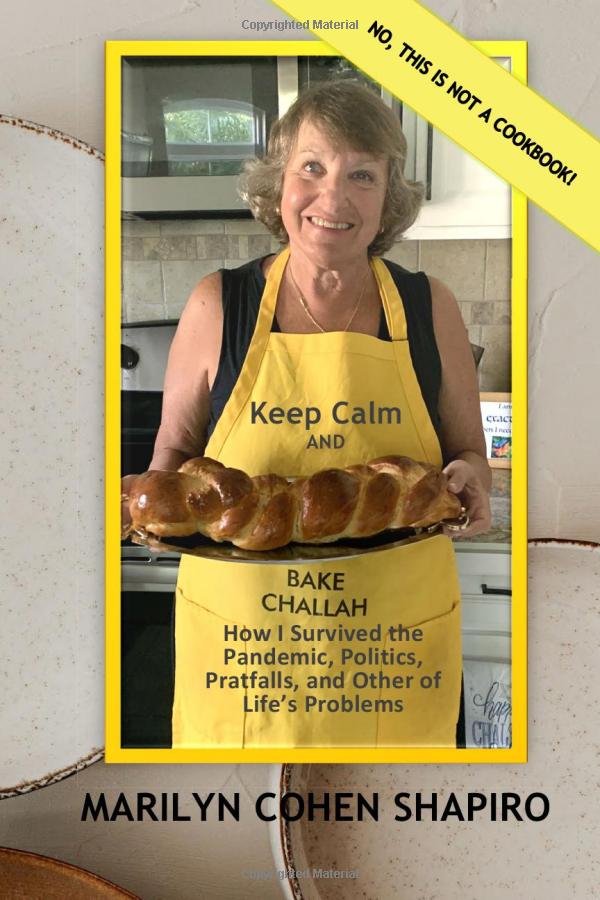
I am proud to announce that my fourth book, Keep Calm and Bake Challah: How I Survived the Pandemic, Politics, Pratfalls and Other of Life’s Problems,is out and available on Amazon in both Kindle and paperback formats.Hope you enjoy reading the the fifty-three articles I wrote during the pandemic as much as I enjoyed writing them! For those who have been following my blog for a while, you will now have many of those posts in one place for your reading pleasure.
Below are a sampling of the story topics:
Let’s here it for the girls!A pandemic Sabbath with challah, wine, and candles. WWE One Marilyn ZeroI am a pickleball putz!
Wintering through the Pandemic
On a June morning in my tiny town in New York’s North Country, Mrs. Ryan’s kindergarten class was preparing for our upcoming graduation. Parents had gotten invitations; our caps and gowns were on order.We practiced the songs and poems we were to sing together. In my eyes, a few fortunate children had solos, which they had brought home to memorize.
Eager, But For What?
Two days before the morning event, one of my classmates announced to Mrs. Ryan that she didn’t want to recite the poem to which she had been assigned. The teacher asked if anyone else would like to do it. My hand shot up like a rocket. “Me! Me!” I shouted from my tiny chair.
For the next two days, my mother patiently worked with me to memorize the piece. I honestly don’t remember the name of the poem or the words, but the short verse talked about being ‘little’ and ‘big’ and ‘growing up.’ (If any of you have a copy of this poem, please send my way!)
Wrong Lesson
That graduation morning, our class, donned in white caps and gowns, marched into the Keeseville Central School auditorium proudly marched. We recited the pledge of allegiance and sang some songs. It was soon time my big moment. I walked to the center of the stage, recited half the poem, and then —gulp!— forgot the rest. The principal, Edward Long, gracefully ended my performance. But I never forgot my first time on stage and how I blew it.
Recently, I felt I was reliving my first public performance 66 years ago when I volunteered again to fill in with a mere 48 hours to learn my part.
A few days before Rosh Hashanah, Larry and I had run into Susan and Jonathan Shopiro, fellow members of Congregation Shalom Aleichem. Both talented musicians, they both had sung in both secular and synagogue choirs. Jonathan, a competent flute player, had regularly played with our previous rabbi at temple services. Susan is an accomplished violinist who had recently inherited her grandfather’s fine century old violin.
In the course of our conversation that afternoon, I shared with them how I had reconnected with my piano after almost a year of a shuttered keyboard. What didn’t feel right during the pandemic felt almost necessary for me now that we were in the New Normal. Despite several years of lessons and countless hours of practice on the Yamaha upright that we purchased in 1982, I never considered myself as an accomplished pianist.
As Larry and I were driving home from the beach the Friday night before Rosh Hashanah, we got a phone call from Jonathan.
“Did you see the email about Rosh Hashanah services?” he asked.
“No, we have been on the beach all day. What is happening?”
Our rabbi’s wife serves as our cantor. Sadly, her father had passed away the previous day, and she needed to fly to Long Island to be with her family. Marilyn Glaser, our shul’s president, asked the Shopiros to step in to provide the music in her place. Remembering our recent conversation but obviously ignoring my personal assessment of my skill level, Jonathan asked me if I would be interested in accompanying him on the piano.
Ain’t No Stopping Her
Larry quickly weighed in. “I think she needs to pass on this,” he told Jonathan on our car’s speakerphone. “She doesn’t play in public.”
With the same bravado I had demonstrated at my kindergarten graduation, I ignored my husband’s words and expressions and plowed ahead.
“Email the music to me,” I told Jonathan. “I’ll look it over and call you later this evening. “
Once we got home, I printed out familiar songs I recognized from my years of synagogue attendance: Ki Mitziyon, Rom’mu,Shalom Rav, Avinu Malkeinu, and Debbie Friedman’s beautiful rendition of the Mi Shebeirach prayer. Most of the sheet music consisted of just the melody line.
Pinch Hitter Again
Never mind that despite years of childhood lessons, I was not an accomplished musician. Never mind that I had never played in public, preferring an empty room with only a close family member near by. But with the help of Dan Coates, who had published many easy-to-intermediate level sheet music collections, I had been banging away on the ivories with happy abandon for years. Just a week before, I had bravely played for a friend while she perused my ridiculously large stack of sheet music that dated back to my sister’s lessons in the 1950s. Her praise regarding my playing gave me the needed boost of confidence. After a couple of run-through with the music on my piano, I called Jonathan back and told him I would give it the old congregational try.
The Way to Carnegie Hall
The next day, with a couple more of hours of practice under my belt, I met with the Shopiros and we practiced together.“Do you think we can do this?” I asked Jonathan and Susan.
“Yes, we can do this!” they reassured me.
As I was already having three people for Rosh Hashanah, I extended the invitation to the Shopiros as well. Over the next twenty-four hours before the scheduled 7 p.m. Sunday service, I practiced my parts in between preparing dinner: chicken, potatoes, green beans, fresh challah, and my chocolate chip cookies.
Larry stepped right up to the task as well, serving as my last-minute sous chef, table setter, pot washer, and last minute supermarket runner
Larry and I met the Shopiros an hour before services for one last practice session. Due to some health concerns, Susan was unable to play the violin, but she would be the lead vocalist as needed. Thanks to Jonathan’s expertise and great job of covering up my mistakes, we left that evening feeling that, while no one would mistake us for professionals, we had contributed to and enhanced the service.
Monday morning’s “performance” went even smoother. I had gained confidence. I was—after all— not exactly playing Chopin’s “Etude in G Sharp minor.” I was playing a melody line in easy keys, Jonathan played harmony on the flute; the congregation readily sang along. It was—for this reluctant recitalist—pure joy.
That afternoon, as seven of us sat around our dining room table, Larry made a toast to my “first and last” public piano performance.
Or maybe not. Jonathan would love to continue contributing his talents to future services. I certainly won’t mind accompanying him on a couple of songs, especially my personal favorite, the Mi Shebeirach prayer. These fingers are itching for another congregational try.
First published in (Capital Region, New York) The Jewish World November 11, 2022.
“Should auld acquaintance be forgot and never brought to mind? Should auld acquaintance be forgot auld lang syne?” Traditional New Year’s Song
The first time Larry and I met Milt at a neighborhood pool, I thought he was one of the “tribe.” Milton? Loessberg? Sounded Jewish to me. But within ten minutes, Milt informed me that he and Kathy were newlyweds and had met through their church. So much for guessing someone’s religion by a name! Standing waist deep in water, the four of us found other things we had in common: politics, travel, enthusiasm for life, and—especially for Milt and me—a love for journalism and the news.
Milt’s father was a civilian worker for the US Army when he had a heart attack. Milt’s mother was a few months pregnant when she became a widow after her husband, a civilian worker for the US Army had a heart attack. She eventually remarried, and Milt’s step-father became the only father he ever knew.
Tapping into his strong English and writing skills, Milt decided to go into journalism. During his studies at the University of Missouri-Columbia, Milt learned how to interview people and find out about their lives. In the end, his newspaper career focused on advertising and sales, and those listening skills helped him. “People tended to open up about their own situations, their business careers, and sometimes even their personal lives,” said Milt. “My people skills made the job interesting and increased my sales.”
Milt explored all of California as he traveled through the state for his jobs with different newspapers. Wherever he went, Milt took a camera, photographed the places he visited and mailed the pictures to his mother, who always “helped me find my best traits.” She recognized that Milt had a talent for photography. When Milt came to St. Louis for a visit, she told Milt that she had gotten in touch with a company that produces post cards. “She told them that I would be very good at supplying postcard views of nature.”
Even though he didn’t get the postcard job, Milt kept taking pictures. Building on his mother’s encouragement, Milt enjoyed photography as a lifetime hobby, He had a show in a small gallery in Affton, Missouri, as well as in other venues. He also joined the Art Association of St. Louis and nature photography club. “Photography was a way to give others pleasure and fulfill a personal need,” Milt said.
Beginning in his fifties, Milt developed macular degeneration, and his eyesight deteriorated. Thanks to modern technology, he continued his photography. “It’s amazing how many pictures in my collection have been taken with my trusty iPhone,” said Milt. “Many people have been fooled into thinking that they were taken with a professional camera because they are professional grade photos. “
While living in California Milt got married, a union that lasted 25 years. When Milt got a job offer with the St. Louis Post Dispatch, however, his wife decided to stay on the West Coast while Milt returned home. He treasured those years as it gave him a chance to reconnect with his failing mother. And—eventually—to meet Kathy.
Milt and Kathy both had lamented to a mutual friend from their church how it was hard to meet people. They were introduced in 2010 and connected quickly.Their wedding on September 8, 2012, was a joyous affair, attended by all of Kathy’s nine siblings and their spouses, officiated by Reverend Sallie Fox, and preserved in a lovely video.
As they had done during their courtship, the two newlyweds traveled throughout the heartland of America. Their most influential vacation was a guided bus trip from St. Louis to Albuquerque, New Mexico, which allowed them to see the Old West. They were especially fascinated with Route 66, an interest that lasted their entire marriage. “I can come up with sixty-six reasons we love Route 66,” Milt quipped. The iconic highway was filled with American history: refurnished motels, antique shops, old cars, and quality and service reminiscent of another time. “Kitch and nostalgia doesn’t exist any other place else in the world,” said Milt.
Three years after they were married, Milt was diagnosed with pancreatic cancer. When Milt’s cancer went into remission, they made a deal that they would go to Florida for a few years, “as a four-year adventure” and would return to St. Louis when Kathy turned 65. They found a lovely home for the two of them, their cat Eddie, Kathy’s crafts, and Milt’s photos in Solivita, a fifty-five plus community near Kissimmee.
From the day they moved in, Milt and Kathy took advantage of every opportunity to soak in all Florida had to offer. Walt Disney World, Universal Studios, Bok Tower Gardens, Gatorland, St. Augustine, Sanibel Island, Captiva Island. If it was on the Florida map, they were headed to it. They bought a golf cart, and the two of them tooled around the neighborhood, checking out the best place to see alligators or catch a sunset.
And we often joined them. On December 26, 2016, the four of us took long ride on their golf cart to all the homes that were decorated in Christmas splendor. No, there wasn’t any snow. But there were plenty of lights and Santas and reindeer in between the palm trees.
By February 2017, however, Milt’s health declined as the cancer spread through his liver and kidneys. When Kathy went back to Missouri to visit her family in March, she called Milt to say she found “the perfect house.” They decided to move back to St. Louis, in part to make sure Kathy could be with family as they navigated through the last months of Milt’s illness. In June, the four of us took one last trip to City Walk at Universal. Milt was obviously in pain, but he wasn’t going to let that ruin his night. We ate Mexican food, took in the crowds, watched the roller coasters zoom over our heads.
Kathy and Milt moved back to St. Louis that July. We communicated by email and by phone. When we Face-timed, I could see that. Milt was thin and pale. But he was still cheerful. “My father died at 32,” Milt told me. “I have had so many more years than he did. How lucky I am!”
Their last trip was by car to the annual balloon festival in Albuquerque, New Mexico, in October 2017. With Kathy at the wheel, they drove on parts of Route 66. The morning of the festival, the lines to get on the shuttle buses where ridiculously long. Kathy and Milt waited 45 minutes in the freezing cold and found out they weren’t even half way to the bus. Disheartened, they finally accepted the fact that Milt physically couldn’t handle the crowd and the weather. They went back to their hotel, opened up the curtains, and—-there up in the sky were the balloons in their full glory. “The view was as good as being there,” said Kathy. The trip was a success
Even in his final days, Milt was optimistic. “I got some good news,” he told me during one phone call. “The doctor said I wouldn’t benefit from anymore treatments. I am going on pain medication, and hospice will be coming. It’s wonderful that such help exists.” The last time I spoke to Milt, he was tired and confused from the disease and the morphine. True to form, however, Milt still had an enthusiasm for life despite his weakened state. He passed away less than ten days later, on December 15, 2017.
Five years later, Kathy is settled in St. Louis. She has not been back to Route 66 but hopes to complete the trip someday. Recently, however, one of Kathy’s sister and her family recently visited Santa Monica and sprinkled some of Milt’s ashes in their bay. Milt, you finally completed your journey. May your memory be a blessing to Kathy and all who knew you.
A version of this article originally appeared in theJewish World News, a bi-weekly subscription-based newspaper in upstate New York.








 There Goes My Heart