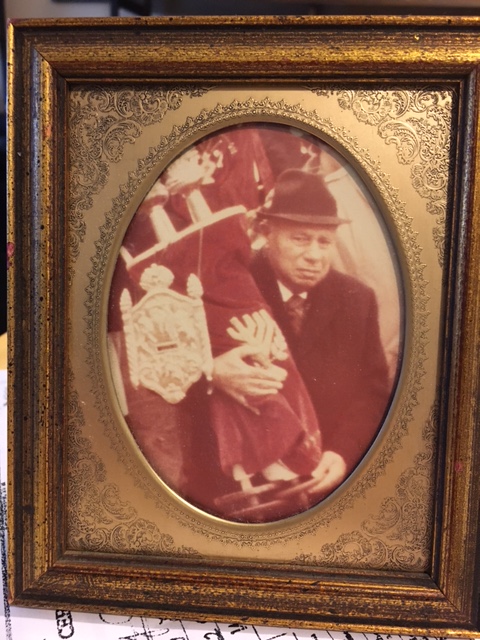
The Oshinsky Story Part Three: Making it to America
Simova, Poland ➡️ Bialystok, Poland ➡️ Minsk, Russia ➡️ Moscow ➡️ Viana, Russia ➡️ Erkutcsk ➡️ Chita, Siberia ➡️ Harbin, China ➡️ Chanzhou, China ➡️ Darien, China ➡️ Sent back to Harbin ➡️Yokohama➡️Hawaii➡️San Francisco➡️Chicago➡️Brooklyn!
Unlike most Eastern Europeans fleeing pogroms and poverty to America through ships sailing across the Atlantic Ocean, Harry “Chonie” Oshinsky took a journey over three continents. His trip took a dangerous turn in Darien, China, where he and his fellow travelers were arrested, accused of being part of a murderous gang. Here is the last installment of Harry’s incredible journey.
Harry and his two friends were thrown into a prison, where they sat on a stone floor, fed a diet of foul rice, and listened as the Chinese prisoners who shared their cell were beaten with a rope. An attempt at a hunger strike backfired, and the three hand-bound boys were taken by train back to Harbin.
Miraculously, Der Forvertz carried a story of their arrest, which triggered a protest in the Yiddish newspaper. Harry’s sister, when she herself read in New York about the arrest of Chunya Oshinsky and two other boys, she realized for the first time that her little brother was alive.
Soon after, authorities transferred Harry and the others from the Russian commandant’s office to a prison near the Jewish Committee House, a place Harry and Yankel had stayed at earlier in their journey. Although the bottom floor held hardened criminals, the three were taken to the second floor, where they joined approximately thirty other political refugees who were held. They experienced good conditions: they received food, decent beds, and daily morning access to fresh air. Ironically, some of the other prisoners were actually paying money to be there. “This was so much better than being on the front lines and risking one’s life in battle!” they told Harry. Again, Harry’s tailoring skills proved useful, as the overseer often called on him to do alterations for himself and others.
As the prison stay extended into its fourth month, Harry realized that his only chance of release was to have money sent to him from America. Not knowing the address of his four siblings, he sent a desperate plea to Yankel, whom he hoped had already made it to America. He mailed a letter to The Goldbergs, 22 Ludlow Street, New York. “Just as a bird gets lost from his home in a tree and gets caught and put in a birdcage,” Harry wrote, “so this has happened to me.”
A few weeks later, Harry again faced the Russian commandant. The officials in the consulate had never been able to confirm he was a murderer; however, they conscripted him into the army. Before reporting, he made one last trip to the Jewish Committee House. Fate shone on him again, as two hundred rubles had been sent from America for his release.
On a bitter cold winter’s night in March 1917, Harry and three other Jewish refugees began their three-day trek on foot back across China into Japan. Once over the border, they traveled by train and boat.
They arrived at the Japanese seaport of Yokohama in time to hear the news that Czar Nicholas II had been overthrown. Three weeks later, on April 10, 1917, Harry and his companions boarded the Shino Maru.
When the ship stopped in Honolulu, Harry was filled with “sheer happiness and joy” when he touched American soil for the first time. His twenty-four-hour stopover was almost extended when a tour of the island resulted in a chance meeting with a Jewish men’s clothing store owner. After hearing Harry’s story, the owner offered him a job as a tailor and salesperson. “I thanked him for his goodness,” Harry later recalled, “but I was determined to go to New York to be with my family.”
The Shino Maru arrived in San Francisco on April 29, where all immigrants were processed through Angel Island. The next morning, a representative of HIAS met with Harry to arrange for his train trip across the United States.
Harry arrived at Grand Central Station during the first week of May 1917. He heard his name being called; it was Yankel Goldberg, his friend with whom he had traveled until their separation in Yokohama. His siblings Zalman David and Leah did not recognize Harry until Yankel shouted to them, “Here! Here he is! This is your brother Chonie!” They fell into each other’s arms, kissing and crying. After a two and a half year journey, Harry was finally reunited with his siblings.
Settling in Brooklyn, Harry found employment in a factory that sewed soldiers’ uniforms. In a few weeks, he was making enough money not only to rent his own apartment but also to help support his siblings. He enrolled in night school to learn English and in dance school to improve his social life. In his spare time, he explored New York City and attended lectures about the ongoing war and politics.
The November 11, 1918, armistice brought relief to Harry. knowing he would not have to return to Europe to fight in the war. He was able to send a letter home. “I am alive and living in America.” A few weeks later, he received an answer. “Everyone is alive!” His sister reunited with her fiancé, who had been a prisoner of war; Poland was an independent country.
Eventually, Harry earned enough money to bring his younger draft-eligible brother Yitzchak from Poland to America. With Harry’s help, Yitzchak found a job as a salesperson in a Lower East Side candy store.
After Harry’s parents passed away, his sister, now married with her own family, remained in Poland. Tragically, she and her family were later killed in the Holocaust.
During the Depression, Harry supplemented his income by opening a candy store he opened with his brother Yitzchak. The business remained in the family throughout their lives.
In 1927, Harry met Frieda, a young woman from his own area in Poland, and they were married that August. Harry and Frieda had two sons, Leonard and Robert, who both shortened their surname to Oshins. Both married and had children of their own. Robert and his wife Natalie settled in Schenectady, New York, and were active members of Congregation Agudat Achim. After a career working for the post office, Lenny and his wife Bobbe moved to Clifton Park, New York, to be closer to their daughter Cindy and her family and joined Congregation Beth Shalom.
Harry passed away in 1976, but he left his legacy and his history in a 12,000 word autobiography that was originally published in Yiddish in Der Forverts in the late 1960s. Lenny Oshins gave me a copy of the document, which had been translated into English by Simon and Anne Paktor, friends of Robert and Natalie in Schenectady.
Lenny (Z”L), it took me way too long to write your father’s story. I hope you, your parents, your wife, and brother are all reading this in heaven and kvelling over a life well-lived.
Originally published March 17, 2022. Updated May 26, 2025.

 There Goes My Heart