Tag Archives: History

Tale of two survivors united by the Shoah: Jacob and Rachel Kazimierek

Two Polish Holocaust survivors from Poland. United by shared tragedies and strengthened by the love for the children they raised. Here is their story. 

Yakov “Jacob” Kazimierek was born in Mlawa, Poland, on December 10, 1926, one of the seven children of Abraham and Hannah (Granaska) Kazimierek. The family farmed and raised cattle, which they milked or slaughtered. 

After Germany’s invasion of Poland in 1939, thousands of the country’s Jews were subjected to the Nazis’ persecution, terror, and exploitation. Through the Nazi’s newly established “protective detention” orders, the Kazimierek family, along with other Jews, were moved to a Jewish ghetto. In 1942, Nazis deported the family to Treblinka. Hannah and the four youngest children were immediately sent to the gas chambers.

Physically failing under the brutal demands of forced labor, Abraham was selected for murder in the gas chamber. Another brother, Hans, eventually succumbed to disease and malnutrition.

The two surviving brothers endured years of starvation diets, forced labor, and brutal beatings.“[Jacob] had to hide his food or others would take it and he would die,” his cousin Regina Markowicz wrote in an account of his life. “He worked very hard and was treated like an animal. He slept on a wood or cement slab and endured terrible winters without adequate clothing, bedding, or shoes.” Jacob bore the physical signs of his imprisonment—scars on his back from the metal slats in his bed, one finger permanently disfigured from a beating, and of course, the tattoo number “76341,” the number tattooed on his arm—on his body—for the rest of his life.

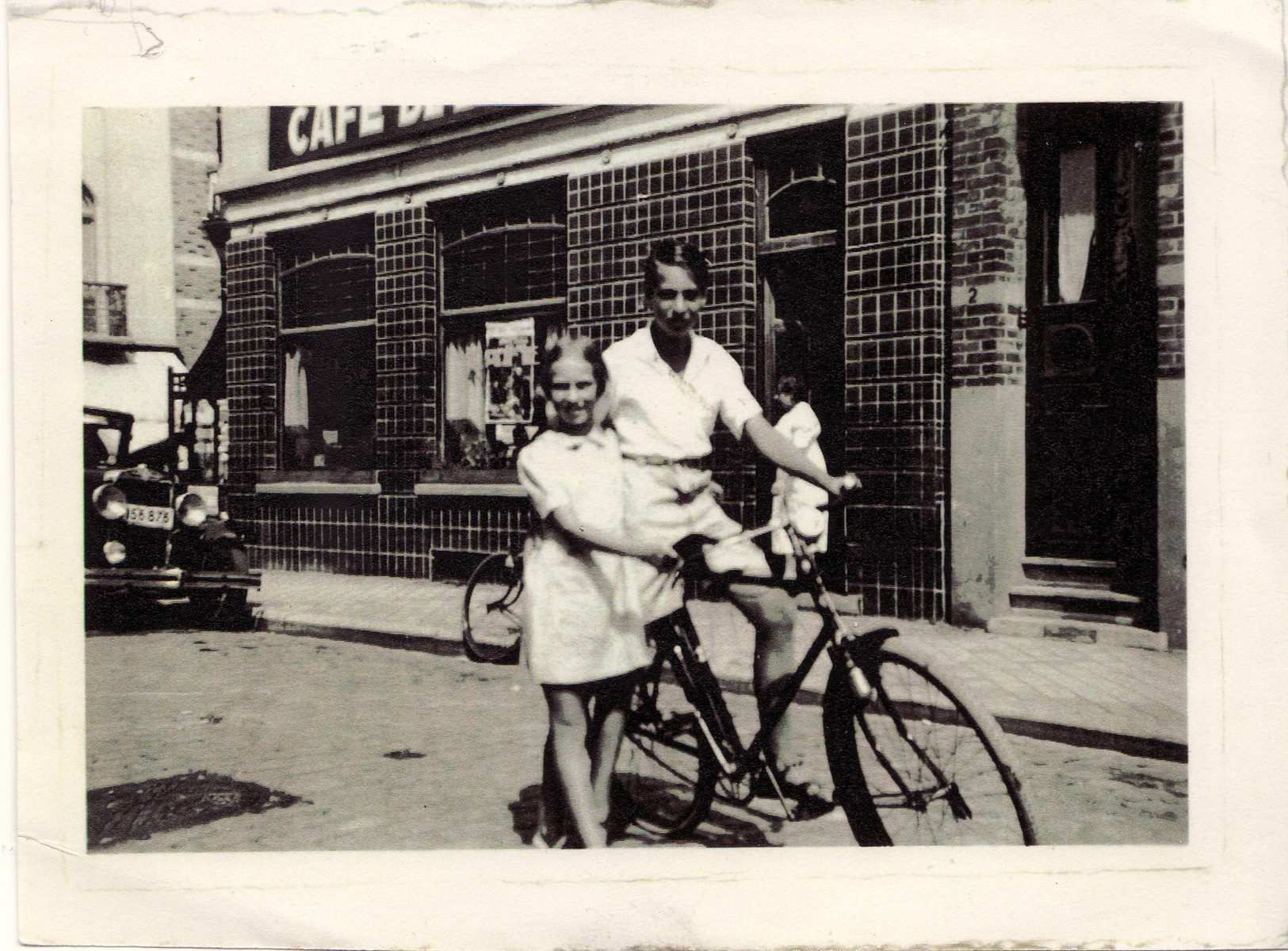
Shortly before the liberation of Auschwitz, Jacob managed to escape. Although the exact details vary in family lore—in one scenario, he escaped on a bicycle; in another telling, he and two friends escaped posing as Germans—Jacob spent the remainder of the war hiding in forests and cellars, subsisting on food foraged in the woods, stolen, or given by kind Polish Christian. After Auschwitz was freed, Jacob was reunited with his brother Aaron, leaving them as the only two of nine members of the Kazimierek family to survive. 

Sweden, a neutral country during the war, took in about 15,000 refugees, and Jacob and Aaron were among them to be sent to a displaced person’s camp in Jönköping, Sweden. Remembering the skills learned at his family’s home in Poland, Jacob worked in a slaughterhouse. In 1948, fleeing from a girlfriend who was pressing him into getting engaged, Jacob moved to Israel and enlisted in Haganah, the Zionist paramilitary organization that fought for Israel’s independence. Four years later, he returned to Jönköping, where he met a twenty-three-year-old woman, a fellow Holocaust survivor whose story was as tragic and heartbreaking as Jacob’s. 

The only child of a Jewish couple from Poland, Rachel Abromowitz Kazimierek was born on July 6, 1929. At the age of ten, she and her family were interred in the Lodz Ghetto. At the age of 13, she and her parents were among thousands of Jews deported to the concentration camps. After arriving at Auschwitz, she never saw her parents again. Rachel was placed in Bergen Belsen and assigned to work in the Wieliczka salt mines. Each day, she and other women were herded several miles each night, working in deplorable condition underground. She was freed on April 15, 1945. Her years of forced labor would have serious impacts on her visional health. 

Jacob, newly returned from Israel, and Rachel met at a dance in the displaced person’s camp. According to their daughter Hannah Lewanowski, their match was not as much born of love as of necessity. As the United States gave preference to married refugees, the couple married in November 1952. Their first child, Hannah, was born thirteen months later. Jacob’s surviving brother, settled in Sweden, where he lived with his wife and three children until his death in 1979. 

In 1954, Jacob, Rachel, and Hannah came to the United States, first settling in New Haven, Connecticut and then relocating to Waterbury. Initially working as a butcher at Bargain Food Center, he opened his own store, Brass City Beef in 1953, which he operated, with Rachel’s help, until his retirement in 1990. 

In a March 15, 2015, article in the Hartford Courant (“Holocaust survivor built new life in Waterbury”), Jacob was praised for the store’s personal service and competitive prices. “He had a good following,” said Tony Nardella, a former Waterbury police officer and customer. “He was well liked and always had a smile and a joke.”

“He came to this country with no money,” said Hannah.“He had no English. He worked seven days a week. He made it.” The Kazimiereks developed a strong community with other Holocaust survivors. They socialized with each other, often sitting around a large table sharing schnapps and pastries while the children played together. 

Meanwhile, Rachel continued to deal with eye infections, possibly a result of working in the mines. In 1961, she had her left eye surgically removed and was fitted with a prosthetic eye. In 1966, she had a detached retina, which resulted in vision loss in her right eye. From that time on, the children were cared for by a nanny. Determined, Rachel moved on with her life, using a cane to walk. Despite her initially limited English, Rachel volunteered at the local Easter Seals to help other visually impaired individuals and visited schools to share stories of her Holocaust experiences. 

Jacob passed away in 2014. Rachel, 95, remains in the home she and Jacob originally purchased in Waterbury, Connecticut. She has 24-hour-care but still prides herself in her independence and cognitive abilities. “My brain, sweetheart, is very clear and very good,” she shared during a February 2025 interview. “I still remember birthdays and anniversaries,” she said, rattling off the important dates of her children and grandchildren. Freida Winnick, a daughter who lives near her in Connecticut, provides additional support and care.

Rachel attends monthly Holocaust survivor luncheons in West Hartford, Connecticut. She also attends presentations organized by “Voices of Hope,” a non-profit educational organization created by descendants of Holocaust survivors from across Connecticut to raise social awareness. 

Rachel emphasizes that she holds no ill will despite her harrowing past. “I am not against anyone,” she said. I get along with everybody.” 

Originally published May 15, 2025

Hate Ends Now

A seventeen-year-old’s powerful stand against hate

One million paper clips are piled high on black construction paper on the stage, lit by a spotlight. Above it, the flickering black and white film of Jews walking to their deaths in a Nazi concentration camp is being shown on a theater-sized screen. And standing in front of the stage is the seventeen-year-old Edgewater High School (EHS), Florida, senior who orchestrated this scene, along with several other exhibits that make a powerful stand against antisemitism and many hate. 

The first thing you notice about Adam Mendelsohn is his hair. Standing at six feet tall, Mendelsohn adds another two inches with his wild dark brown curls, complimented with a gray yarmulke perched in the back. As the organizer of the January 9, 2025, Hate Ends Nowcommunity event, Adam radiates a confidence and maturity that is unusual in such a young man.

The previous summer, Adam had attended a meeting of the local Jewish Student Union (JSU). Founded in 2002, the organization oversees 200 Jewish culture clubs on public high school campuses to provide Jewish teens with programs that strengthen their Jewish identity and connection to Israel. On that day, Rabbi Daniel Nabatian, the co-director of the Central Florida branch, encouraged the students to make an impact—no matter how small—to fight against the rising wave of antisemitism that had gripped the world since the Hamas attack on Israel on October 7, 2023. 

 Adam was determined to bring the JSU message to Edgewater High School students and staff. Following up on his memory of a similar exhibit, he contacted Hate Ends Now, a nonprofit whose mission is to combat hatred and indifference by educating people about the history of the Holocaust and all forms of bigotry. The organization offered not only artifacts from the Holocaust but also an exact replica of a World War Two-era cattle car that was used to transport Jews and other targeted groups to concentration and death camps. A twenty-minute, 360 degree immersive presentation offers an impactful educational experience. With the support of Dr. Alex Jackson, Edgewater’s principal, and his assistant, Valerie Lopez, Adam worked with Todd Cohn, the CEO of the nonprofit, schedule the event in Orlando for January 9, 2025. 

 Adam then started a fundraising campaign to pay for the cattle car and other expenses. Thanks to the generosity of many donors, including the Ginsberg Family Foundation and Massey Services, the seventeen-year-old raised over $30,000, enough to cover most of the expenses.

 Adam’s next step was to contact local organizations whose mission aligned with the core values of the event to sign on. Participants included the Jewish Student Union (JSU); Chabad C-Teen; Shalom Orlando, the Holocaust Memorial Resource and Education Center of Florida; the Anti-Defamation League, and Central Florida Pledge, a network of community members in Florida who stand up against discrimination and hate.

Adam now began the search for a Holocaust survivor. Jasmine Flores, the community relations manager for the Greater Orlando Massey Services, connected Adam with Ludwig (Lou) Ziemba, an 82-year-old Kissimmee resident, through her involvement in Maitland Rotary.  Ziemba was born in the Lodz Ghetto on September 9, 1942, one day before 13,000 children under ten were to be sent to an extermination camp. Arrangements were made for the infant to be hidden in a garbage truck and smuggled outside the Ghetto where a Christian Polish farmer retrieved him and took him home to be raised as his own. Miraculously, his parents survived and were able to retrieve their “hidden child” when they were freed three years later. 

The paper clip exhibit was a last-minute miraculous addition to the event. On Sunday, through a conversation with Beth Landa, Ziemba’s wife, Adam learned about Paper Clips, a documentary that highlighted the 1998 efforts of middle school students from Whitwell, Tennessee, to collect six million paper clips representing the six million Jews killed by the Nazis. According to Wikipedia, at last count, over 30 million paper clips had been received.

A preliminary research of the documentary compelled Adam to see if he could locate a low-cost source of paper clips. The manufacturing plant of Bulk Office Supplies was in Tampa, but was closed for the weekend. Undeterred, he located the name of the founder and owner of the company, Alex Minzer, on Facebook. Encouraged by Minzer’s “Never Again,” hat, Adam messaged him; Minzer answered almost immediately. Alex Minzer had sold the company to Levi Haller, who was currently in Jerusalem. Alex helped connect Adam with a wholesaler in Tampa who would provide the paper clips at cost – and later that same day Levi Haller reached out to Adam to say that decided that Bulk Office Supply would donate the 1 million paper clips, inspired as he was by the project’s mission and Adam’s passion.

Next problem: how would the paper clips get from Tampa to Edgewater in time? Fortunately, Adam’s father Jason was returning from a business trip on Florida’s west coast on Wednesday. Adam quickly did the math, his favorite subject, to confirm all the boxes would fit into his father’s car. All good! The clips were successfully delivered at one o’clock, only 28 hours before the event was scheduled to open.

Adam and a group of student volunteers began the tedious task of opening the 10,000 small boxes of 100 paper clips and piling them onto a 7X7 foot square of construction paper that had been placed on the stage in the school’s auditorium. When the school day ended at 2 pm, Adam stayed on, working alone and then with his father, until 8 pm. “When I left, I looked at the pile and despaired,” said Adam. “I had no idea how the project could be completed.” 

Adam returned to EHS the next morning at 5 am. By school opening, the whole student body was aware of the urgency to finish the job. “It was crazy!” Adam said. “Students were rotating in and out of the auditorium to provide help over the next several hours.” The pile was completed at 1 pm, twenty-four hours after the initial delivery. “I now hate paper clips,” Adam said with a laugh.

At five pm, the doors opened to the public. Over 500 people attended the three-hour event. They perused the display tables, munched sandwiches provided by Kosher Grill, listened intently to Ziemba, looked over the chilling artifacts on the Hate Ends Now tables, sat in the quiet auditorium to contemplate the million paper clips, and, at scheduled times, viewed the powerful immersive presentation in the cattle car parked just outside Edgewater’s entrance. 

Dignitaries included United States Representative Maxwell Frost, Florida State Representative Anna Eskamani, staffers sent on behalf of Senator Rick Scott and United States Representative Darren Soto, and members of the EHS school board. 

“This is an incredibly powerful experience,” said Frost. “I believe that every high school student should have the opportunity to witness the horrors of this tragic time in world history through such exhibits. This event serves as a reminder that when we lead with love, we can stop hate in all forms and make sure this type of history never repeats itself.” 

Todd Cohn also commented on Adam’s project. “It’s rare to see such a young individual take on such a meaningful project with this level of commitment,” the Hate Ends Now CEO. “He made a lasting impact not only on us but on everyone who experienced the exhibit. Adam is a shining example of how one person can make a big difference.

Ziemba found sharing his story with a large and diverse audience to be exhilarating. Despite his history, Ziemba still believes love will prevail. 

“Try to accept people,” Ziemba told Orlando’s Spectrum Cable News reporter Sasha Teman. “I know I grew up loving people, and I still love people.”

Adam is grateful to all involved in making the project a success. He also plans on sharing the message with him beyond high school “Barriers which prevent love and peace can be destroyed by understanding that we are all the same,” he said. “I plan on carrying the torch of compassion, acceptance and tolerance throughout my life.” And the one million paper clips? Plans are underway for the clips to be gathered in a lucite case with signage that will be placed in the Edgewater High School’s entrance hall. Adam’s hope to make a difference and to combat hate of all kinds will now be his lasting legacy.

Originally published January 25, 2025. Updated May 26, 2026

Those who wish to make a contribution to Hate Ends Now in honor of Adam Mendelsohn and his project, please click here. 

All photos provided courtesy of Cara Dezso

The Kindness of Strangers

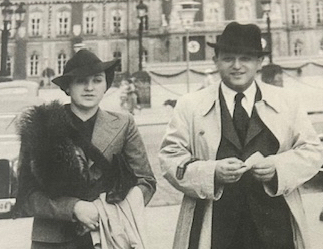
For newlyweds Erwin and Selma Diwald, getting out of Austria wasn’t a choice. It was a necessity. Thankfully, the kindness of strangers saved their lives. Their daughter, Frances “Francie” Mendelsohn, shared their fascinating story. 

Erwin Diwald was born in Vienna, Austria, in 1907, to Bettina and Sigmond, who was a successful importer of the ostrich and egret feathers used in the making of hats popular at that time. Erwin attended the University of Vienna, where he earned doctorates in both history and law. He launched a successful career in law and was sought after by many Catholic clients wishing to legally annul their marriages. 

Born in 1931, Selma Gehler was the second child of Maria and Victor Gehler. Victor, an engineer, was involved in the building of the Wiener Riesenrad ferris wheel in the Prater, still considered one of Vienna’s popular tourist attractions. Selma worked in her uncle Joel’s’ pharmacy while attending the University of Vienna’s pharmacy program, intending to step into her uncle’s business after graduation. 

Selma and Erwin met at a friend’s wedding and married in October 1937. Six months later, German troops invaded Austria. On March 15, 1938, the terrified Erwin found himself caught up in the enthusiastic crowds cheering and raising hands in the Nazi salute as a triumphant Hitler paraded through the streets of Vienna. Immediately, the Jews in Austria were in the crosshairs of the new regime. 

The newlyweds knew they had to leave their native country. Their first attempt to obtain visas took them to Stuttgart, Germany. On their first evening there, Selma and Erwin ate dinner in the hotel’s restaurant. The waiter brought over a huge tureen of soup. “Compliments of the Fuhrer,” they were told. They soon learned that their hotel was the site of the city’s Nazi headquarters. They quickly returned to Vienna to explore other options to leave Austria.

Help arrived through Erwin’s younger sister. Paula Diwald had been vocal in her dislike for the new regime. When notified that the Nazis were looking for her, she hastily made arrangements for a “ski trip” in France. As soon as she crossed the border, she ditched the skis and took up residence in Paris. 

Paula worked during the day as a salesclerk in a shop selling expensive handbags. To supplement her income, she worked as a tour guide, her ability to speak seven languages a definite asset. 

One evening, Paula overheard a couple requesting a guide who could speak English. She introduced herself and spent the next several days showing the Gregorys, a wealthy Greek Orthodox couple from Chicago, the highlights of the City of Light. At the end of their visit, they asked Paula what they could do to thank her for all she had done.

“What you can do is sponsor my brother and his wife,” Paula told them. “We have absolutely no family in the United States. Your providing them with visas is the only payment I want.” They promised to see if they could make the arrangements once they returned to Chicago. 

Paula immediately contacted Erwin. His education had included years studying classical Latin and Greek, and he decided to use this knowledge to further persuade the Gregorys.He wrote a long eloquent letter in classical Greek to plead his case. 

The Gregorys may have been Greek Orthodox but had no knowledge of its language; they brought the letter to their priest. Impressed by both the Erwin’s language and moved by their plight, the priest told the Gregorys, “You have to save these people.” The Americans complied and began the process of getting visa for the couple. They enlisted the aid of Lazarus Krinsley, a Jewish lawyer in Chicago, to obtain the paperwork. 

The Diwald flew to Paris to await the paperwork that, according to the officer in charge had not come through. It was only when the Diwalds checked in on a day the regular official was not at work. His substitute immediately “found” the missing documents.“Where have you been?” He said. “These visas have been here for months.” 

Knowing that they could not bring a great deal of money into the States, the Diwalds arranged first -class passage on the Paquebot Champlain. Built in 1932 and hailed as the first modern liner, the ship was pressed into evacuee work, transporting many Jews, like the Diwalds, who were fleeing Europe. 

Erwin remained in Paris with Paula before boarding the ship in Le Havre, France on August 29, 1938. Later that day, Selma, who had gone to England to say goodbye to her family, boarded in Southhampton. On August 31, 1938, Germany invaded Poland, marking the beginning of World War II. Erwin and Selma had made their escape just in time.The ship sailed in radio silence for the remainder of the voyage.

Meanwhile, he Diwalds found themselves in the company of many celebrities. Their travel mates included actor Helen Hayes, comedian Groucho Marx, composer Samuel Barber, Italian-American composer Gian Carlo Menotti, and Austrian-American actor/director Erich von Stroheim. It made for a very memorable voyage! 

An interesting side note: According to a Wikipedia article, the Champlain continued crossing the Atlantic Ocean for the next two years, transporting refugees, including many Jews, to safety. On June 17, 1940, on what was to be its last crossing, the Champlain hit a German air-laid mine, causing it to keel over on its side and killing 12 people. . A German torpedo finished its destruction a few days later. It was one of the largest boats sunk sunk in World War II. 

After debarking the ship in New York City, Selma and Erwin traveled to Chicago to meet their benefactors. Even though the Gregorys were responsible for getting the visas, they were not very welcoming. Lazarus Krinsley the lawyer, and his wife Rose, however, warmly embraced the couple, a friendship that was maintained throughout their lives. Upon the Krinsleys’ recommendation, the Diwalds settled in Milwaukee, Wisconsin, which had a fairly large Jewish population and offered more job opportunities.

Despite his educational background, Erwin lacked the credentials to practice law in his United States, During the war, he worked on an assembly line that polished propellers for B-29 planes. and drove trucks After the war, Erwin applied for a job as a tire salesman with Dayton Tire and Rubber Company. Initially, human resources failed to recommend him, saying he was “too intelligent.” He went on to become one of their top salesmen. 

Using the skills learned in Vienna, Selma worked in a pharmacy. She considered going to UW Madison to get certified as a pharmacist. After the birth of her two daughters Ann Frances [“Francie”) and Susan Jane, however, she gave up her dreams of further education. 

The Diwalds joined to Temple Emanuel, a reform congregation. In 1954, Francie became the first bat mitzvah in the congregation, with her sister Susan following in her footsteps three years later.

Fortunately, many of Selma and Erwin’s family were able to escape the fate of the many Jews imprisoned and murdered during the Holocaust. In 1938, the Nazis stormed into the Gehler home looking for Joel. When they could not find him, they arrested Selma’s father, Victor, who was deported to Dachau. Maria, through a possible bribe, was able to free him. They immediately fled for Haifa, in what then Palestine. They both passed away in Israel in 1951, three years after it had become the State of Israel. 

Erwin’s parents had also escaped Austrian 1940 by hiking over the Alps into France.  They emigrated to Milwaukee in 1942. Joel, who had narrowly missed arrest in 1938, fled to England, where he met the love of his life, Patricia. Joel passed away in 1986; Patricia passed in 2022. 

Selma died in 1996 at the age of 83 from cancer. Erwin died in 2008 at the age of 101, suffering from dementia in his last years. Despite all that the family had endured, Francie said that her parents were never bitter or angry. “I feel as if I been touched by God,” Erwin told his children. “We survived.”

SOURCES

Thanks to Francine Mendelsohn for sharing her parents’ story. 

“SS Champlain.” Wikipedia. https://en.wikipedia.org/wiki/SS_Champlain

Seeing Italy through Grateful Jewish eyes

Mamma Mia!

Thanks to a wonderful tour director, a great itinerary, and perfect weather, our recent trip to Italy was all that we had hoped for and more. My husband Larry and I stayed in medieval buildings that had been converted to hotels, drove the stunning Amalfi coast, made our way through the Coliseum, tread over the ancient streets in Pompeii, enjoyed wine tasting in Umbria and Tuscany, climbed numerous stairs to churches and bell towers, and rode on a gondola in Venice. We enjoyed fabulous pasta dishes and ate gelato every day.

In each city we visited, we tried to connect with the Jewish elements of Italy, a history that dates back over two thousand years to the Roman Empire. We viewed one of the most famous reminders of the Judea-Roman connection at the Roman Forum, where we saw the Arch of Titus. I immediately recognized the seven branched menorah in the relief that depicted the Romans celebrating their 70 CE victory over the Jews as they carried their spoils of war from the gutted Second Temple. 

We arrived in Rome on Simchas Torah, preventing access to its synagogue We did, however dine at Nonna Betta’s, a kosher Italian restaurant in the Jewish Quarter. We feasted on carciofo alla Giudia, the fried artichokes (Their menu read “Life is too short to have the wrong Jewish-style artichoke!”) along with delicious pasta dishes. 

After lunch, I headed to the small Judaica shop adjoining the restaurant. As I paid for my purchases, I did my typical “Marilyn the Writer thing” and began asking questions. I learned that Francesca, the “cashier,” and her husband Umberto were owners of the shop and the restaurant. When I told her about my interest in Holocaust stories, Francesca told me that Nonno Betta, Umberto’s 93-year-old mother who lived above the shop and founded the restaurant, was herself a survivor. Although I was able to speak briefly to Umberto and share emails, further attempts to learn more of Nonna Betta’s individual story failed. Through the United States Holocaust Memorial Museum’s Holocaust Encyclopedia, I learned that when the Nazis occupied Rome in September 1943, they sought to include the city’s Jews in the Final Solution. As Italian police did not participate in these roundups and most Italians objected to the deportations, one out of ten Roman Jews were able to find refuge in the Vatican, which retained neutrality, or hide in Catholic homes, churches, and schools. Sadly, 1800 Roman Jews, with a total of 7600 Jews in Italy, were murdered in Auschwitz. 

With only one jam-packed day in Florence, we did not time to visit The Great Synagogue. But I fulfilled a dream I had since reading Irving Stone’s The Agony and the Ecstasy in 1966: I saw Michelangelo’s David in the Accademia in all his 17 feet, six ton plus glory. Along with some discussion among our tour group his anatomy (Was he circumcised or not?*), we took twenty-one photos, about four times more pictures than we took of each other throughout the trip. Mamma Mia! David was that impressive!

In Siena, we and four of our travel companions attempted to visit its synagogue and museum. Unfortunately, we found the building shuttered with an “In ristrutturazione” (under renovation) sign posted on the door. I slipped one of my business cards into the door with (little) hope of hearing from them.

 We were more successful in Venice. Our hotel was a five minute walk to the Ghetto Ebraico, and we strolled through at sunset on a Saturday evening as Orthodox Jews were ending Shabbat. I met Noa, a thirty-something very pregnant woman overseeing her other children playing soccer in the courtyard. She shared with me that she was born in Israel, but she and her husband had been part of the city’s Jewish community comprised of 400 mostly Orthodox Jews for several years.. She invited us to come to their Shabbat dinner, but hearing that the men and women sat in separate rooms, we opted for our pre-arranged dinner plans with friends later that evening. 

It was in Venice that we learned the etymology of the word ghetto. The rise of Catholicism under Empire Constantine (306 to 337 CE) lead to an increasing number of restrictions on the Jewish communities, culminating in 1555 when Pope Paul IV introduced laws forcing Jews to live in a walled quarter whose two gates were locked at night. The word ghetto, according to a Smithsonian article, came from the Italian word getto (foundry) because the first ghetto was established in 1516 on the site of a copper foundry in Venice. As Germany adapted the word for their own “Jewish Quarters,” which they originally called Juddengasse, their guttural pronunciation resulted in changing the spelling to ghetto. 

On our second stroll through the area on Sunday, we noticed that someone was looking down onto the sidewalk. I pulled Larry over where we saw one of the 207 pietres d’inciampo (In German Stolpersteine; in English: “stumbling stones”), the plaques commemorating victims of the Nazi regime, that are located in Italy. Now aware, we found several more that evening before we met our tour group for dinner. 

What moved Larry and me the most, however, was not even on our itinerary. Sara Basile, our guide, told us she had a surprise for us that could be pulled off if and only if we all met at our appointed meeting time in Florence. Another wine tasting? I wondered. Yet another church?

As our bus pulled off the highway onto a quiet road flanked by Tuscan cypress trees, we saw the entrance gates of the Florence American Cemetery and Memorial. 

“My Sicilian parents were always grateful to Americans for defeating Mussolini’s fascist government,” Sara told us. “Taking you here is my way of passing on our country’s gratitude.”

Sara introduced us to our American guide, who gave us the memorial’s history. After the liberation of Rome on June 5, 1944, the U.S. Fifth Army and British Army, supported by the Mediterranean Allied Air Forces, pushed northward. The long and bloody Allied campaign ended on May 2, 1945, when all German forces in Italy surrendered.

The 70 acre Florence memorial, the site of one of the battles, was dedicated on July 25, 1960. Next to a sculpture representing the spirit of peace is a tablet wall listing the 1409 persons missing in action. Larry and I wandered through the graves area, which contains the headstones of 4398 soldiers, of which 4322 are Latin crosses and 76 are Stars of David. As Larry and I followed the Jewish tradition of placing stones on the Jewish graves, I was overcome with gratitude to The Greatest Generation, who had fought in World War II to defeat the Nazis and their cohorts. 

The most moving moment was yet to come. At 4:45 PM, as our tour group and other visitors gathered around the flagpole, taps played from the visitors’ center. Blake, a member of the Coast Guard who was on the tour with his bride of 10 months, slowly lowered the flag into the waiting arms of several members of our group who, in turn, folded the flag. A picture of our group with Blake in the center holding the red, white, and blue parcel captured the solemnity.

We are now back in the United States looking forward to sharing Thanksgiving with a group of friends. As always, we will go around the table and share for what we are grateful. Family. Friendship. Good health. And, for Larry and me, gratitude that we were able to visit Italy. 

*The debate continues. Theories include a smaller form of circumcision; ignorance on the part of the Christian Michelangelo as to what it was; and attempts off the Catholic Church to erase David’s Jewishness. 

SOURCES

“History and Culture.” Jewish Venice. Click here for website.

“Jewish Ghetto.” Lonely Planet’s Ultimate Guide. Click here for website.

“Justice for Uncompensated Survivors Today (JUST) Act Report: Italy.” U.S. Department of State. Click here for website.

“Rome.” Holocaust Encyclopedia. USHMM. Click here for website

“The Centuries-Old History of Venice’s Jewish Ghetto.” Smithsonian Journeys Travel Quarterly. Click here for website.

.

“Eva’s Promise,” a documentary about Anne Frank’s stepsister, now showing on PBS.

On June 12, 1942, Anne Frank was given a diary for her thirteenth birthday. Less than a month, she and her family went into hiding from the Nazis. To honor Anne and the six million Jews killed in the Holocaust, I am sharing the story of Anne’s classmate Eva Schloss Geriringer, she herself a Holocaust survivor and after Eva’s mother’s marriage to Otto Frank, Anne Frank’s posthumous stepsister.

“You see, Heinz, I haven’t forgotten you. You were frightened that you wouldn’t make your mark on the world – but you are still with us. You have made your debut.” Eva Geiringer Schloss, After Auschwitz: A story of heartbreak and survival by the stepsister of Anne Frank. 

On a train to Auschwitz, 15-year-old Eva made a promise to her brother Heinz Geiringer. If he did not survive the camps, Eva promised to retrieve the paintings and poetry Heinz hid under the floorboards of his attic hiding place.

Heinz Geiringer’s story sits in the shadow of the better-known Diary of a Young Girl. After the war, Eva became the posthumous stepsister of Anne Frank when her mother married Anne’s father. While the world knows Anne’s story, this film introduces Heinz, his artistry, and his sister’s efforts to find and share his remarkable legacy. Eva’s Promise, an important addition to the annals of Jewish Holocaust history, is currently being shown on PBS stations throughout the United States. 

Heinz Geiringer and Eva Geiringer Schloss’s Holocaust story is chillingly parallel to that of their classmates, Margot and Anne Frank. Faced with Hitler’s rise, Erich, Elfriede (“Fritzi”), and their two children, had fled from their home and comfortable life in Vienna, Austria, and settled in the Netherlands, hoping its history of neutrality would provide a safe haven. Their worst fears came to pass when Germany invaded Holland. 

“As of 15 May 1940 we were living under Nazi occupation, and we had nowhere else to go,” Eva recalled in her 2013 memoir After Auschwitz: A Story of Heartbreak and Survival by the Stepsister of Anne Frank. Soon after, the Nazis implemented the increasingly harsh measures against the Jews that was part of their “Final Solution.” In May, 1942, Heinz received orders to report for a deportation to a Germany factory. That evening, the family made the decision to go into hiding. As no place was large enough for four people, they were forced to split up. Erich and Heinz in one apartment; Fritzi and Eva in another. For Eva, her time was to be “a mixture of two emotions – utter terror and mind-numbing boredom.”

Meanwhile, Heinz, having to give up his musical interests, spent his time painting and writing poetry. “I could hardly believe the detailed and impressive oil paintings that he showed me,” said Eva, recalling the furtive visits she and Fritzi made to the men’s apartment. “In one a young man, like himself, was leaning his head on desk in despair. In another a sailing boat was crossing the ocean in front of a shuttered window. “

On May 11, 1944, Eva’s 15th birthday, the Geiringer family was captured after being betrayed by a double agent in the Dutch underground. A train took them on an arduous three day trip across Europe, in what would be the last time they would be together as a family

During their ride. Heinz made Eva promise that if he didn’t survive, she would retrieve the paintings he had stashed under the floorboards of the house where he and his father had hidden them. “Please, Eva, please,” Heinz told his sister. “Go and pick it up and show it to the world what I achieved in my short life.” Eva reluctantly agreed.

When the trains reached the concentration camps, Erich and Heinz were sent to Auschwitz; Fritzi and Eva, to Birkinau. Through sheer luck and resourcefulness , Eva and Fritzi survived and were freed in 1945 by Soviet troops.”I never gave up hope, or the determination that I would outlast the Nazis and go on to live the full life that I, and all victims of the Holocaust, deserved.” Eva said

Tragically, Eva’s father and brother did not survive the ordeal, succumbing to exhaustion and illness in the last days of their captivity. Fritzi and Eva eventually returned to Amsterdam, and settled in their family’s apartment, which had remained untouched. 

After the war, Otto Frank, their old neighbor, the only surviving member of his family and his “Annex” companions, took comfort in visits with Fritzi and Eva. In 1953, Otto and Fritzi married and dedicated the rest of their life to the publication and promotion of what would be the world’s most famous diary. In the meantime, Fritzi and Eva had retrieved Heinz’ work, which included paintings, a sketchbook, and poems, from his and Erich’s last hiding place. For many years, Eva and her mother kept the paintings and poems in the family.

Eva eventually moved to London, where she married Zvi Schloss, a German refugee, raised their three daughters, ran a successful antique store, and quietly moved on with her life despite her recurring nightmares. It was not until Otto Frank passed away that Eva, now in her late fifties, began publicly sharing her wartime experiences in person and through her memoir Eva’s Story. (1988). “As soon as I started talking, I became calmer and didn’t have nightmares anymore,” she said in Eva’s Promise. During one of her talks in Philadelphia, she shared Heinz’s work for the first time.

A chance meeting with Susan Kerner led Eva to further expand her audience. In 1994, Susan, the education director at the George Street Playhouse in New Brunswick, New Jersey, directed a production of The Diary of Anne Frank. Kerner reached out to Ed Silverberg, a friend of Anne Frank’s who had survived the war by successfully hiding, to talk to the cast about life in Amsterdam after the invasion. 

Around the same time, Young Audiences of NJ reached out to Kerner with a request to work with a playwright to create a play about Anne Frank to tour schools. The Anne Frank Center in NYC suggested they create a piece about two hidden children who survived the Holocaust who had a connection to Anne Frank.

“I already knew Ed,” recounted Kerner in a 2023 article in the Jewish Standard Times of Israel. “I wanted a woman, and I wanted her to be a camp survivor.” The Anne Frank Center put her in touch with Eva Schloss. George Street Playhouse commissioned playwright James Still to write the play. The final product, And Then They Came For Me: Remembering the World of Anne Frank, is a gripping multimedia experience, which combines videotaped interviews with the two survivors playing behind the actors who portrayed scenes from their lives. Twenty-five years later, the play continues to tour around the world. 

A lifelong friendship developed between Eva and Kerner, who met periodically despite the distances between them. As the success of the play grew, Eva sold her antique shop and became a full-time Holocaust educator, traveling in Europe, Asia, and United States and participating in talkbacks following performances of the play in many countries.

More importantly, Eva came to grips with the unfulfilled promise she had made to her older brother. In 2006, over sixty years after the Holocaust, Eva gave Heinz’s works to the newly established to Het Verzetsmuseum, the Dutch Resistance Museum in Amsterdam. Soon after, she published her second memoir, The Promise. (2006), followed by her final memoir After Auschwitz.(2013). She now focused on preserving Heinz’ legacy. “It became my task that people would remember who he was and what he achieved,” Eva said.

As the pandemic shut down the world, Eva realized that she wanted to do even more to preserve Heinz’s legacy. She reached out to Kerner, who suggested a documentary film. Kerner recruited Steve McCarthy, her Montclair State University colleague and an Emmy Award-winning film maker, to direct and co-produce what would become Eva’s Promise. Eva had only two requests: “Get it done. And hurry.”

Despite the pandemic, the team, which now included McCarthy’s two sons, flew to London to tape 12 hours of interviews with Eva. They also interviewed the staff of the Amsterdam museum that houses Heinz’s work. The film was completed in 2022.

Kerner and McCarthy have worked tirelessly —and without pay—to produce the film. Screenings have taken place across the United States, including a red carpet showing at the Ronald Reagan Presidential Library and Museum in Simi Valley, California.Kerner hopes that the documentary can be used as an educational tool to counteract the recent dramatic rise of antisemitism as a result of the Gaza-Israeli War. She and McCarthy recently tested the film in a school with 11-13 year old children. “The kids were very engaged and had lots of thoughtful comments and questions,” said Kerner. She also hopes that it will be shown in museums, theaters, and universities.

Until recently,Eva continued her active involvement in Holocaust education and advocacy. She has spoken around the world, with a special place in her heart with her meetings with school children. She was part of the 2018 campaign to convince Mark Zuckerberg to ban Holocaust deniers from Facebook, and she is prominently featured in the Ken Burns 2022 documentary, The U.S. and the Holocaust. In January 2023, Eva attended the screening of the film at JW3, a Jewish community center in London. Now 94, she has stepped back to rest and celebrate the birth of her first great-grandchild. Her grandson Eric, who is featured in the film, now shares her work. 

Before they were forced into hiding, Eva’s father Erich gave his children the following advice: “I promise you this. Everything you do leaves something behind; nothing gets lost. All the good you have accomplished will continue in the lives of the people you have touched. It will make a difference to someone, somewhere, sometime, and your achievements will be carried on.”

Through her books, her films, and her tireless work in Holocaust education and advocacy, Eva Schloss has not only kept her promise to her brother Heinz but also has made the memory of the six million and all who have been subjected to hatred a blessing and an inspiration. 

Please contact Susan Kerner at kerners@montclair.edu for information on showing Eva’s Promise in your community. 

SOURCES

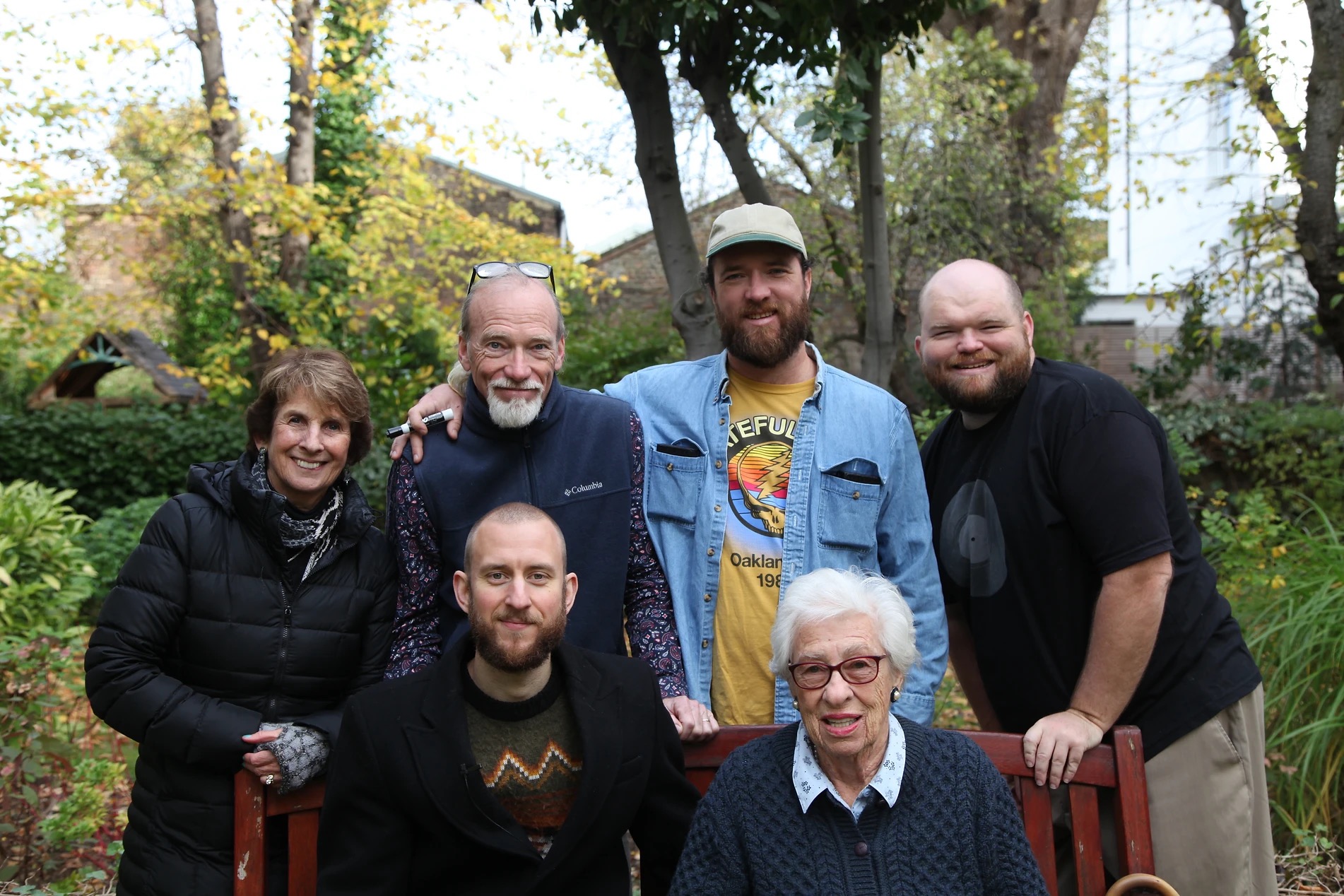
Filming Eva’s Promise in London. Seated: Eric Schloss, Eva Geiringer Schloss. Standing: Susan Kerner, Steve McCarthy, Justin McCarthy, and Ryan McCarthy.

Eva and Heinz

A survivor’s story: “I live every day as a blessed person.”

On May 5, 2024, our community’s Shalom Club held its annual Holocaust Remembrance, or Yom Ha’Shoah, event. Lou Ziemba’s story was one of the highlights of a moving, unforgettable evening.

Born  in wartime Poland, Ludwig“Lou” Ziemba is  a retired successful businessman, a polyglot a descendent of “Jewish  royalty’” and a Holocaust survivor. 

Lou’s story begins in Poland. Rabbi Menachem Ziemba, was the chief rabbi of Warsaw, a renowned holy figure in the Ger sect of the Chassidic movement, and a key player in the 1943 Warsaw Ghetto Uprising through his pleas that urged inhabitants to fight against their captors. 

“In the present we are faced by an arch foe, whose unparalleled ruthlessness and total annihilation purposes know no bounds,” Rabbi Ziemba told the Warsaw Ghetto inhabitants. “Halachah [Jewish law] demands that we fight and resist to the very end with unequaled determination and valor for the sake of Sanctification of the Divine Name.”

One of Rabbi Ziemba’s nephews was Henoch, son of his brother Moshe. Henoch was a bit of a non-conformist intellectual who spoke several languages and wandered around Europe. Henoch married a woman who was not approved of by his Chassidic family and thus he was no longer recognized by his large family in Warsaw.

As the Nazis rose to power, Henoch experienced both his wife and children being executed by the Nazis. Grief-stricken, Henoch returned to Poland and settled in the industrial city of Lodz, the second largest Jewish community in prewar Poland, after Warsaw.

With the outbreak of World War II and the German invasion of Poland, the life of Polish Jews deteriorated through a series of draconian laws imposed by the Nazis. In February 1940, after even more severe anti-Jewish measures were instituted, the Germans established a Jewish ghetto, initially trapping 164,000 Jews into a few city streets in a neglected northeastern section of Lodz. The widower Henoch Ziemba was one of those people. 

Soon after his arrival in the Lodz Ghetto, Henoch met and married 20-year-old Golda Farber, almost two decades his junior. Golda may have been small in stature, but she was, in Lou’s words “a firecracker” and “a force of nature.” Almost immediately, Golda became pregnant. For reasons lost in the family lore, Golda turned for help to Mordechai Chaim Rumkowski, who Primo Levi later wrote “morally ambiguous and self-deluded.”

To organize the local population and maintain order, the German authorities established a Judenrat,” or Jewish Council in the ghetto. The Germans appointed Rumkowski as the “kapo” of the Lodz Ghetto, whose job it was to oversee the day-to-day living as well as to decide who would live and who would die. Rumkowski was responsible for sending untold numbers to their deaths.

Known mockingly as “King Chaim”, Rumkowski was granted unprecedented powers. Rumkowski transformed the ghetto into an industrial hub for the Nazis, producing uniforms, wood and metalwork, and electric equipment. Rumkowski felt that, as long as the ghetto served a purpose by supporting the Nazi effort, the workers would avoid deportation to the gas chambers. His methods, however, were brutal: He oversaw the slave labor of anyone over 12 years old to work 12-hour days despite abysmal living conditions and near-starvation rations.

In his biography of Rumkowski, Yehuda Leib Gerst described this complex man. “Toward his fellow Jews, he was an incomparable tyrant who behaved just like a Führer and cast deathly terror to anyone who dared to oppose his lowly ways. Toward the perpetrators, however, he was as tender as a lamb and there was no limit to his base submission to all their demands, even if their purpose was to wipe us out totally.”

Furthermore, Rumkowski used his position to his own benefit. He singled out his political enemies for death and deportation to the death camps, and also deported those who had the capacity to rise up against their capturers. In contrast, those whom he favored were showered with extra provisions, medicine, rations, and safety.

For reasons lost to history, one of those receiving his benevolence was Golda Ziemba. With Rumkowski’s help, Golda was able to hide her pregnancy. A son, Ludwig, was born on September 9, 1942. 

 In late summer, Rumkowski was given orders to select 24,000 for deportation. Believing that the inhabitants’ survival depended upon their employment, he made the decision to hand over their 13,000 children under ten and their 11,000 elderly over 65 years old. He addressed the parents of Łódź as follows. “In my old age, I must stretch out my hands and beg: Brothers and sisters! Hand them over to me! Fathers and mothers: Give me your children!”

Again, for unknown reasons, Rumkowski worked with the Ziembas to save their infant son. He and Golda arranged for baby Ludwig to be hidden in a garbage truck. Once outside the Ghetto, he would immediately taken by a Polish farmer, whose family would raise him as their own in their Christian home. “It’s a miracle,” said Lou. “There were very, very few children who survived the Lodz Ghetto.”

As the war continued, conditions in the ghetto deteriorated, marked by a growing number of inhabitants being sent to the extermination camps. By summer 1944, as the Soviets came closer, the Nazis rounded up every remaining Jew they could find, including Rumkowski and his family, for mass extermination in Auschwitz’s gas chambers.Before their deaths, however, a group of Jews beat Rumkowski to death, a fitting ending for a man who many Jews regarded as bad as Hitler and his Reich. 

On January 19, 1945, the Soviets liberated the Lodz Ghetto. Over the course of last four previous years, over 220,000 had people passed through its gates. There were only 877 survivors, including Golda and Henoch Ziemba, who had managed to hide during all the deportations.

Golda and Henoch’s first stop after liberation was to reunite with their now three-year-old. son. Ludwig didn’t recognize or understand the emaciated but overjoyed strangers who spoke in Yiddish. Despite the Polish family’s reluctance to give up their “son,” his biological parents -against all odds- had returned. 

The Ziembas were the only three members of the family to survive. Rabbi Menachem Ziemba and the four hundred members of the family who had been trapped in the Warsaw Ghetto were all murdered by the Nazis.

Relocated to a German Displaced Persons camp, the Ziembas were soon a family of four. Lou’s sister Esther was born while Lou was away recovering from tuberculous in a German convent, where he learned his third language, German. 

So, to summarize Lou’s first 8 years of life, Lou was born a Jew during a period of extermination, hidden by a resourceful mother, taught Polish by a non-Jewish Polish family, taught German by nuns in a convent, recovered from TB, and taught Yiddish and right from wrong by his parents in a German DP camp. He never had to go to school, get circumcised, or even brush his teeth the entire time.

After a five year wait, the Ziembas immigrated to New York City in 1950. By the time he was nine years old, now known as “Lou,” was working alongside his mother at her small women’s shop in the Bronx that sold undergarments. His bar mitzvah was held in 1955, thus learning yet another language—Hebrew. Before Lou could be Bar Mitzvah’d, however,  there was one order of business that had to be taken care of at the local hospital, “a small snip of the tip.” Lou was heard screaming from every floor of the hospital “I DON’T WANNA BE A JEW!!!

When he was twenty-one, Lou opened a men’s clothing store down the street from his mother’s shop. As his business grew, in part because of Slax and Jax’s inventory of the newly popularly “blue jeans,” he convinced his mother to sell her store and join him in business. They soon opened three more stores.

However, as shopping malls sprang up, Lou realized the negative effect on his businesses. He sold them and went into the home construction business.  He, his wife Maxine (“Cookie”) Noble and their two children moved to “New City,” an affluent suburb of New York City. 

In 1999, the long years of his dedication to work took a toll on his marriage, and the couple divorced. Soon after, Lou met and married Beth Landa who happened to be related to his son-in-law. After the couple’s retirement in 2015, they moved to Florida, settling in Solivita, a fifty-plus active adult community in Kissimmee in 2023. 

“I’m aware of how lucky I am to be alive,” Lou says. “I live every day as if I’m a blessed person. I enjoy life too much not to do that.” 

Sources

Thanks to Lou Ziemba and Beth Landa for providing the interviews and information for this article. 

Cousins, Jill. “A Survivor’s Saga.” Lake Mary [Florida] Life.Winter 2017.

https://en.wikipedia.org/wiki/Chaim_Rumkowski

https://en.wikipedia.org/wiki/Łódź_Ghetto

https://en.wikipedia.org/wiki/Menachem_Ziemba

https://encyclopedia.ushmm.org/content/en/article/lodz

Russian-American artist finds comfort, purpose in his paintings

Israel Tsvaygenbaum views what is happening in Israel since October 7, 2023, as a painful reminder of his own family history. His father was 29 when he fled Poland in 1939 to escape the Nazis. The Nazis murdered his remaining family members in Auschwitz-Birkenau. “I have always reflected in my paintings the theme of the Holocaust and human tragedy, the loss of people close to us,” said the Russian-American artist, whose magic realism artwork is known worldwide.

Israel has worked to find comfort and purpose in his artwork. In our interview, he cited three works that were especially meaningful to him during this time of war. In The Holocaust, two white doves join blood-red angels on a darker red background. The Tree of Weeping depicts draped hooded figures with their arms outstretched in supplication. Prayers at the Tree of Life portrays an Orthodox Jewish man praying to a tree made of bright branches. “At some point in our lives, our prayers turn to a Tree of Life where each branch represents the prayers of a generation,” Israel said. “We all have our Tree of Life that hears our prayers.”

Immediately following the October 7, 2023, Hamas massacre, Israel began work on his latest piece. The Broken Jar features a fractured vase holding red roses on a background of yellow sunflowers. “Their yellow color represents the anxiety that the Israeli people are now experiencing while waiting for their kidnapping loved ones,” he said. “The hearts of the Israelis are now broken like the jar in my painting, but their souls, like those roses, have preserved their integrity, unity, and harmony.”

Israel was born in 1961 in Derbent, Dagestan, Russia, the youngest child of a Polish Holocaust survivor and a “Mountain Jew” a mother who was a descendent of Persian Jews from Iran. As a result, the Tsvaygenbaum children were raised in a uniquely Jewish household, a mixture of Ashkenazi (Eastern and Central European) and Sephardic (Spanish) traditions and customs. Although often struggling financially, the family kept a kosher home and observed Shabbat and all religious holidays. His father, respected for his erudition and prior religious education, served as a “spiritual bridge” to fellow survivors who had settled in Derbent.

Adding to young Israel‘s cultural experiences were his interactions with both Christian and Muslim neighbors. “The memory of these people prompted me to create some of my paintings,” he said. “They were sources of my inspiration.”

Israel chronicles these events in his 2023 memoir, My Secret Memory: The Memoir of the Artist, describing how the ideas for his paintings came to him. The book outlines key events in his childhood that shaped his paintings later in life, including frank and often graphic descriptions of violence and sexual encounters. These dramatic events and the tragedies of his own family members, especially the loneliness and sadness experienced by his father because of the Holocaust, are major themes of his writing. “I pour my soul into my painting,” Israel said in his YouTube video. Most importantly, his art represents universal themes of kindness, peace, and our shared humanity. 

Israel’s artistic interests and talents began at an early age. By eight years old, he was asking his parents to purchase painting supplies so he could capture important moments on canvas. He obtained both undergraduate and graduate fine art degrees from Russian art institutions. From 1983 to 1985, he pursued an acting career, which inspired him to paint pictures of fellow thespians. In 1986, Israel organized an artist’s group called Coloring, an association of artists based in Derbent. Museums and private collections throughout Russia showcased Israel’s art.

In 1994, Israel held two successful solo shows in Moscow. This was to be his last in his home country. The escalating conflict between Russia and Chechnya, which bordered Dagestan, made it too dangerous for Israel and his family to remain in the war-torn area. In 1994, he, his wife Katerina, their three daughters ranging in age from 14 months to nine years; his mother, and his maternal grandmother immigrated to New York State’s Capital District to be close to his brother, a Saratoga County resident. The family quickly settled in Albany, New York, as he felt the bigger city would provide more opportunities to build a new life for him and his family. 

“Time has shown that I was right,” he remarked. Israel has enjoyed a successful career in the state’s capital. Russia and the United States have exhibited his extensive collection of paintings, which are also part of private collections in nine countries, including Austria, Bulgaria, France, Israel, the Netherlands, Russia, the United Kingdom, and the US. Israel’s two ink on paper graphical works—The Sarcasm of Fate and The Grief of People—are in the Museum of Imitative Arts, Derbent, Dagestan, Russia.

In 2001, Israel began a collaboration with Judy Trupin, a choreographer and poet who created dance compositions based on nine of Israel’s paintings. Worlds in Our Eyes, created to elicit memories of Jewish life in Eastern Europe and Russia while touching on universal themes, was performed in several cities in New York State. Israel dedicated the performance to the people of his home city, Derbent.

Israel also has found success and pride in his family life, especially in seeing that his love for Judaism continues in his children and grandchildren. “I always wanted to pass the baton that I got from my parents,” he said in My Secret Memory. “I am happy to realize I made it.” He and Katerina’s three daughters, all graduates of Albany High School with professional careers, have instilled Jewish values and traditions in their own families. Six out of eight attend Jewish schools. 

“Everything in this world is interconnected,” Israel wrote in My Secret Memory. He hopes what he has created from his patience, his passion for the conceived idea, and his dedication to work will make the world a little kinder place. Just like the roses in The Broken Jar, he hopes his life and legacy will reflect integrity, unity, and harmony.

Originally published December 15, 2023.Updated May 26, 2025.

Versions of this story were published The Jewish World and the Heritage Florida Jewish News.

Israel Tsvaygenbaum’s memoir

Tsvaygenbaum, Israel. My Secret Memory: The Memoir of the Artist. (2023).

www.israelartgold.com

www.wikipedia.com