As we prepare to celebrate Passover, I contemplate my ancestors’ flight out of Egypt. If the Exodus happened today, I am not sure if I would ever make it out of Egypt.
According to the midrash, the Pharoh commanded the Israelites to leave immediately following the tenth plague. As we all know, they had so little time that the bread had no time to rise. As a woman who loves to bake challah, I could live with whipping up the dough and foregoing the rising process. As long as I had butter and raspberry preserves matzoh would work until the manna rained down. (Hopefully, mine would taste like vanilla ice cream.)
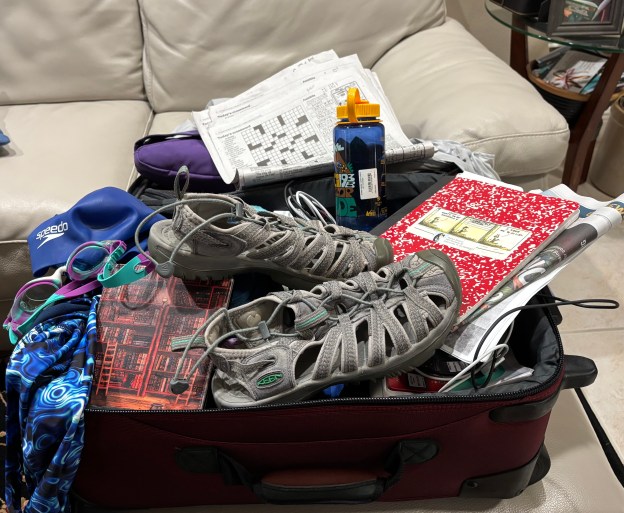
My first problem is that there is no way in the world I would have had time to pack.
Friends I know who pack the night before any trip would have done well that evening. Those carefree individuals would pull out their sachets, throw everything in, and figure they could pick up whatever else they needed at the closest desert oasis.
Unfortunately, I am not one of those people. I start filling my suitcase at least a week before scheduled departure, often packing and repacking several times. Too many shoes. Too few tops. Do I need a dress in the desert? And what about my denim jacket? I love pairing it with almost everything in my closet, but maybe a fleece would be more practical and take up less room. How in the world could I pull this off before we headed out?
Full disclosure: I don’t even leave my house for a few hours without packing enough for an overnight stay. Along with my essentials—wallet, iPhone, sunglasses, lipstick—I need to cover all my bases. A book. My notebook and a pen in case I get hit with a writing inspiration. A phone charger. A sweater or fleece in case I get cold. Shorts in case I get hot. My water bottle. A Quest bar in case I get hungry. I stuff more into my oversized handbag for a simple errand than the Israelites grabbed in the middle of the night.
Even if I’d managed to pack my bags and prepare the challah that turned into crackers, I would have had to dash back home for the items I’d forgotten. My phone. My keys. My sunglasses. No matter my preparation, I always leave something behind when departing. The Red Sea would already close by the time I made it to the shore. I would wave to everyone while watching all of Pharoh’s soldiers being drowned.
And could I ever have left my home in the first place?
According to scholars’ interpretation of Rashi’s comment, only one-fifth of the Israelites left Egypt. Eighty percent stayed put, out of fear of the unknown or feeling comfortable despite their inferior status in the kingdom. Eighty percent! But thinking about it, would I have been in the majority? Would I have given up freedom to stay put? Could I have left my familiar life and my stuff behind?
As Dan Schur writes in an April 22, 2022, article for the Jewish Journal, “the overwhelming majority of the children of Israel chose a compromised but familiar existence over the potential dangers that more dramatic and assertive actions might have brought.”
Could I leave my piano? My lanai that overlooks a pond? A house that brings me so much joy?
So, maybe I wouldn’t have left in the first place. I would have packed Larry some matzoh and lots of water, given him a kiss, and would have waved goodbye. Who knows? Maybe those 40 years of wandering would have somehow led him back to me.
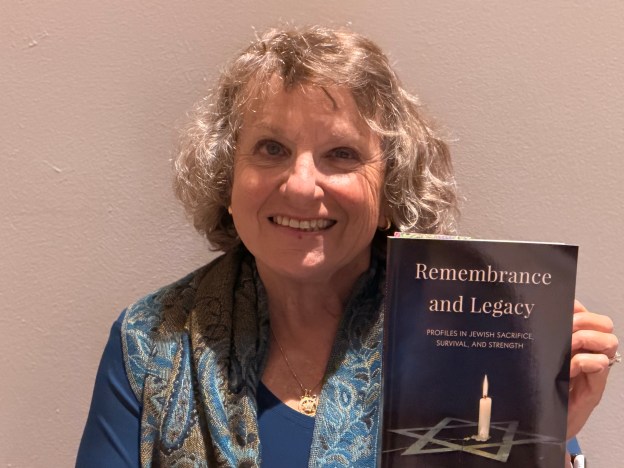
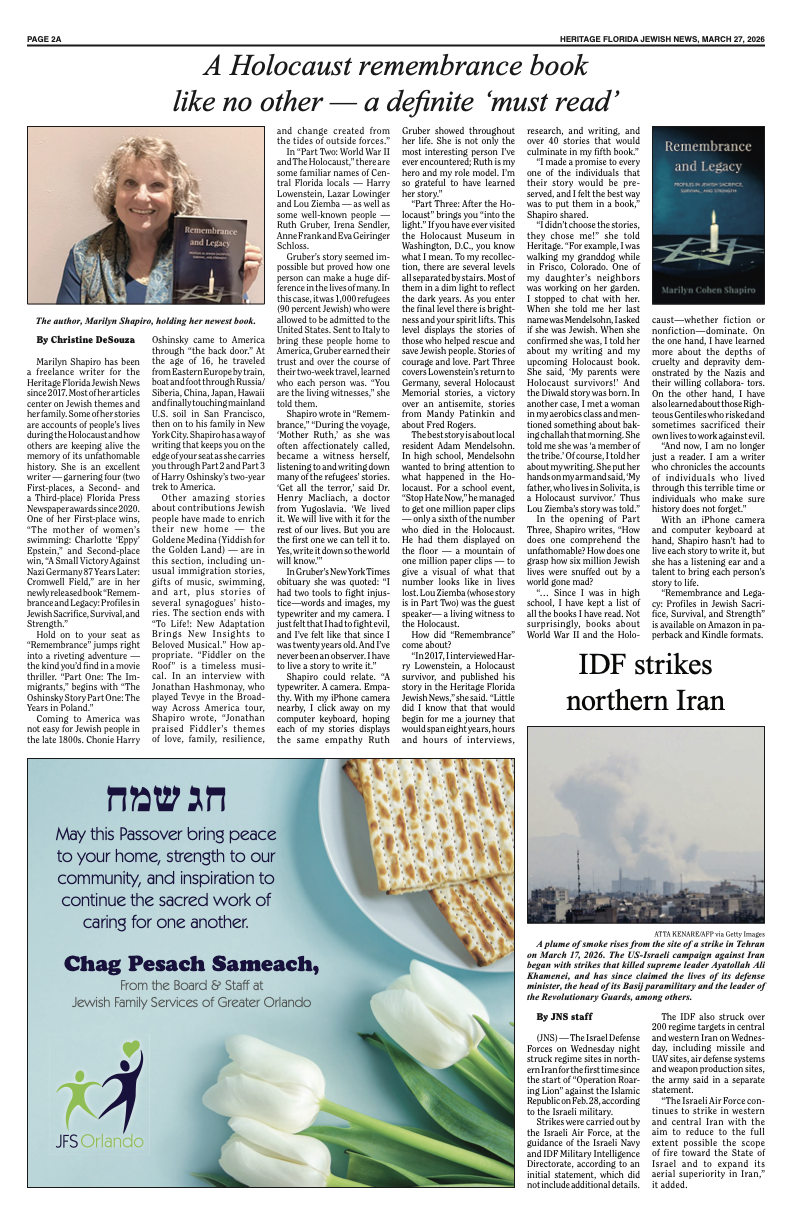
Christine DeSousa, my editor at the Heritage Florida Jewish News, wrote this article for the upcoming issue of the Orlando-based paper. Thanks so much, Christine! My book is available on Amazon in paperback and Kindle format as well as through IngramSpark.
Are the trails getting steeper? Or am I getting older?
These were my thoughts as Larry and I climbed Shrine Ridge Trail in Summit County in early July. We had been in Colorado for ten days before we attempted the hike, so I believed I had acclimated my body to the altitude. But we started at 11,000 feet and would peak closer to 12,000. As I huffed and puffed up the trail, I never doubted I would finish. The bulldog in me would never give up. But could I do this next year? In five years? Who knows?
Larry and I DID finish our climb on that beautiful summer day. We got up to the top and took in the colorful wildflowers and the amazing vistas, grateful we could still climb mountains at our age.
In the weeks that followed, we often chose an easier three-mile hike that we accessed with a short walk from our rental. In early August, however, Larry and I met our friends Sandie and Howie for a more challenging hike up the Herman Gulch Trail in the Ranger District of the Arapaho National Forest. During our four-mile hike, we encountered a couple of around our age descending. I posed my “Steeper or older” question aloud.
“Neither,” the man told me. “We are experiencing geographical uplift, a phenomenon in which the earth shifts to steeper inclines as we age.”
Okay, maybe Earth is NOT in fact shifting. But our lives have. Before we left for our summer in cooler temperatures, a close friend, a non-smoker, had just been diagnosed with lung cancer. Another friend’s cancer had returned. And a third friend, who had biked 86 miles for his eighty-sixth birthday, died a week later of a heart attack while on a shorter ride. “He was doing what he loved,” people said. But I doubt that it was sufficient comfort to the family he left behind.
Our time in the mountains changed as well. Friends we looked forward to seeing every summer developed health issues and/or “aged out” as they could no longer handle the high altitude. One of Larry’s pickleball buddies had told us last summer that he and his wife were opting out of summers in Summit County and renting a place in a mountainous region of Arizona, reducing their elevation by 4000 feet. Dear friends who had been part of our summer plans for over ten years, whether eating out, hiking, or playing cutthroat games of Mexican Train, also had to give up their beautiful home in Dillion, Colorado, and remain in Charlotte, North Carolina, at a more comfortable 671 feet above sea level.
And then the “life can change on a dime” phenomenon hit our own family very hard soon after Larry and I returned to Florida. Two days after coming home from an incredible cruise through the British Isles with my brother, sister-in-law, and a friend, my sister Laura was hospitalized in Upstate New York with breathing problems. Doctors were trying to determine the exact cause of her symptoms when she took a turn for the worse. Diagnosis: a rare form of pneumonia. Grim news followed: Laura was on a ventilator in the intensive care unit. We had two days of optimism when she was taken off the ventilator. She was looking forward to her life after hospitalization and rehab: a highly anticipated move to San Diego, California, to be closer to her children and grandchildren. But her 83-year-old body failed. She passed away on Friday, August 29.
The four Cohen children had been fortunate indeed. Whereas some of our friends have strained or non-existent relationships with their siblings and/or their spouses, we all had remained close—maybe even closer as we had all realized how life can change on a dime. And now one of us is gone, leaving the three of us to grieve with other family members and friends who will miss her so much.
“On Rosh Hashanah, all who enter the world pass before Him,” reads a passage in the Mishnah. One Jewish interpretation is that we march single file like sheep before God to determine whether we will be written in the Book of Life. Another interpretation is that we march like soldiers. But my favorite interpretation, reflecting on my summer in the mountains, comes from Resh Lakish, a third century BCE scholar. The rabbi envisioned this march taking place before God on a mountain, each person walking cautiously, single file, along a narrow, treacherous path.
As I observe the High Holy Days this year, warm memories of my beloved “big sister” will be forefront in my thoughts. Prayers for those we lost and those who are ill will take on even greater significance. Will I be climbing mountains in 5786? Hopefully, I will tackle Shrine Ridge and Herman Gulch with the same vigor and determination I did this past summer. But thanks to Resh Lakish, when I am in one of those narrow and knowing me, not-TOO treacherous paths, I will hope that God is looking down and giving me the strength to move forward in my life, no matter where the path takes me.
As we have done since our Mountain Girl was born in 2015, Larry and I are settled into our rental in Summit County, Colorado, to escape the Florida heat and to enjoy family time.
Each summer, we look forward to attending performances of the National Repertory Orchestra (NRO). Eighty young musicians are selected every year through national auditions to perform with the NRO. NRO alumni may be found in countless orchestras both the in the United States and abroad. Along with performances at the Riverwalk Center in Breckinridge, the talented performers take part in free “pop up” concerts offered throughout the county. We have fortunately been able to attend several NRO events throughout our stay.
For the past three years, we have attended the Pops concert, led by conductor, showman, and clarinet player extraordinaire Carl Topilow. Now serving as Conductor Laureate, he was Music Director and Conductor of the NRO for 42 years. In addition to his appearances with the NRO, Topilow is the Founding Conductor and Music Director of the Cleveland Pops Orchestra and has appeared as guest conductor for over 130 orchestras.
Carl Topilow, the son of first-generation Jewish immigrants, grew up in a close-knit, extended family in Bayonne, New Jersey.in Bayonne, New Jersey. His mother Pearl, the daughter of Austrian immigrants, was born on New York City’s Lower East Side. Six of his father Jacob’s eight siblings were born in Russia before the family immigrated to the United States at the turn of the 20th century. His enjoyment and appreciation of his rich family history infuse his performances.
“I’ve been told that even when I play Dixieland or jazz, a Yiddish twang seems to be part of my musical vocabulary,” Topilow shared in a 2025 email. “My eclectic musical tastes include performing Klezmer [the dance-oriented Jewish tradition from Eastern Europe] and traditional Yiddish music. Recognizing the fact that so many of the great Broadway composers were Jewish—Jerome Kern, George and Ira Gershwin, Steven Sondheim, Richard Rodgers, Irving Berlin, Alan Menken, and Jules Styne—to name just a few, is a source of pride”
A 2011 article by Violet Spevack in the Cleveland Jewish News spoke of Topilow’s performances in Jewish venues, including at Yom Kippur services and Sisterhood meetings. “Topilow is endearingly ‘one of us,’” wrote Spevack, “with his Yiddish ta’am (flavor) and chutzpadik (audacious) shticks.” He and his brother and pianist Dr. Arthur Topilow often perform together, including for a July 2016 NRO event that included klezmer music.
On July 8, 2023, Larry and I brought our then eight-year-old granddaughter to her first concert performance, billed as “Topilow Pops.” Before the event, we explained to her about the protocols for the concert: her need to sit quietly, to be attentive, to applaud at the appropriate times, and to avoid any actions that would distract from other concert goers. Outside of asking if there would be a ‘half time’ (she and her father are huge Denver Nuggets fans), our Mountain Girl was well prepared. She even jumped up and yelled, “Bravo” at the end of several numbers. Carl Topilow would be proud of her appreciation for his concert!
The highlight for us came when Topilow included the Shofar sounds into his rendition of Fiddler on the Roof.Tekiah! Teruah! Shevarim! echoed through the concert hall. The audience—especially those well-versed in the sweet sounds heard on Rosh Hashanah and Yom Kippur—clapped their appreciation.
In 2024, Larry and I again attended NRO’s pops concert.Topilow and his iconic red clarinet lead a small line of brass and wind musicians into Riverwalk with a somber rendition of “Just a Closer Walk with Thee,” a gospel song frequently played at New Orleans jazz funerals. Once on stage, he led the orchestra in a rousing “When the Saints Go Marching In.” He showed off his clarinet expertise in the final number, the Cantina theme from John Williams Star Wars soundtrack.
Okay, no traditional Jewish music at this concert. But articles about Star Wars’ link to Judaism fill the internet. In a December 16, 2015, article in the Forward, Seth Rogovoy makes an interesting case for the secret Jewish history of the George Lucas franchise. “You don’t have to be a linguist to figure out that the Jedi knights, who use “the Force”–the spiritual power of good deeds, aka the mitzvot—to do good in their battle with the “Dark Side,” the yetzer hara, or the evil urge within us all, bear the Anglicized name of a Jew. In other words, Jedi = yehudi = Jew.” And did you know that in Hebrew, Yoda means “one who knows”? And who cannot fall to compare Darth Vader and his Storm Troopers to Hitler and his SS? Or the motley ragtag band of heroes as modern day Maccabees? And John Williams’ main movie theme is eerily similar to Czech-born Jewish Hollywood composer Erich Wolfgang Korngold’s theme to “King’s Row”? (Google it! It’s amazing!) So Carl Topilow may, just may, be delving into his family’s immigrant past when he belts out the music from the Cantina scene on his iconic red clarinet. May the Force be with you, Carl!
Originally published July 20, 2024. Updated May 26, 2025.
Sources
A special thank you to Carl Topilow for his input into the article and for permission to use photos.
One million paper clips are piled high on black construction paper on the stage, lit by a spotlight. Above it, the flickering black and white film of Jews walking to their deaths in a Nazi concentration camp is being shown on a theater-sized screen. And standing in front of the stage is the seventeen-year-old Edgewater High School (EHS), Florida, senior who orchestrated this scene, along with several other exhibits that make a powerful stand against antisemitism and many hate.
The first thing you notice about Adam Mendelsohn is his hair. Standing at six feet tall, Mendelsohn adds another two inches with his wild dark brown curls, complimented with a gray yarmulke perched in the back. As the organizer of the January 9, 2025, Hate Ends Nowcommunity event, Adam radiates a confidence and maturity that is unusual in such a young man.
The previous summer, Adam had attended a meeting of the local Jewish Student Union (JSU). Founded in 2002, the organization oversees 200 Jewish culture clubs on public high school campuses to provide Jewish teens with programs that strengthen their Jewish identity and connection to Israel. On that day, Rabbi Daniel Nabatian, the co-director of the Central Florida branch, encouraged the students to make an impact—no matter how small—to fight against the rising wave of antisemitism that had gripped the world since the Hamas attack on Israel on October 7, 2023.
Adam was determined to bring the JSU message to Edgewater High School students and staff. Following up on his memory of a similar exhibit, he contacted Hate Ends Now, a nonprofit whose mission is to combat hatred and indifference by educating people about the history of the Holocaust and all forms of bigotry. The organization offered not only artifacts from the Holocaust but also an exact replica of a World War Two-era cattle car that was used to transport Jews and other targeted groups to concentration and death camps. A twenty-minute, 360 degree immersive presentation offers an impactful educational experience. With the support of Dr. Alex Jackson, Edgewater’s principal, and his assistant, Valerie Lopez, Adam worked with Todd Cohn, the CEO of the nonprofit, schedule the event in Orlando for January 9, 2025.
Adam then started a fundraising campaign to pay for the cattle car and other expenses. Thanks to the generosity of many donors, including the Ginsberg Family Foundation and Massey Services, the seventeen-year-old raised over $30,000, enough to cover most of the expenses.
Adam’s next step was to contact local organizations whose mission aligned with the core values of the event to sign on. Participants included the Jewish Student Union (JSU); Chabad C-Teen; Shalom Orlando, the Holocaust Memorial Resource and Education Center of Florida; the Anti-Defamation League, and Central Florida Pledge, a network of community members in Florida who stand up against discrimination and hate.
Adam now began the search for a Holocaust survivor. Jasmine Flores, the community relations manager for the Greater Orlando Massey Services, connected Adam with Ludwig (Lou) Ziemba, an 82-year-old Kissimmee resident, through her involvement in Maitland Rotary. Ziemba was born in the Lodz Ghetto on September 9, 1942, one day before 13,000 children under ten were to be sent to an extermination camp. Arrangements were made for the infant to be hidden in a garbage truck and smuggled outside the Ghetto where a Christian Polish farmer retrieved him and took him home to be raised as his own. Miraculously, his parents survived and were able to retrieve their “hidden child” when they were freed three years later.
The paper clip exhibit was a last-minute miraculous addition to the event. On Sunday, through a conversation with Beth Landa, Ziemba’s wife, Adam learned about Paper Clips, a documentary that highlighted the 1998 efforts of middle school students from Whitwell, Tennessee, to collect six million paper clips representing the six million Jews killed by the Nazis. According to Wikipedia, at last count, over 30 million paper clips had been received.
A preliminary research of the documentary compelled Adam to see if he could locate a low-cost source of paper clips. The manufacturing plant of Bulk Office Supplies was in Tampa, but was closed for the weekend. Undeterred, he located the name of the founder and owner of the company, Alex Minzer, on Facebook. Encouraged by Minzer’s “Never Again,” hat, Adam messaged him; Minzer answered almost immediately. Alex Minzer had sold the company to Levi Haller, who was currently in Jerusalem. Alex helped connect Adam with a wholesaler in Tampa who would provide the paper clips at cost – and later that same day Levi Haller reached out to Adam to say that decided that Bulk Office Supply would donate the 1 million paper clips, inspired as he was by the project’s mission and Adam’s passion.
Next problem: how would the paper clips get from Tampa to Edgewater in time? Fortunately, Adam’s father Jason was returning from a business trip on Florida’s west coast on Wednesday. Adam quickly did the math, his favorite subject, to confirm all the boxes would fit into his father’s car. All good! The clips were successfully delivered at one o’clock, only 28 hours before the event was scheduled to open.
Adam and a group of student volunteers began the tedious task of opening the 10,000 small boxes of 100 paper clips and piling them onto a 7X7 foot square of construction paper that had been placed on the stage in the school’s auditorium. When the school day ended at 2 pm, Adam stayed on, working alone and then with his father, until 8 pm. “When I left, I looked at the pile and despaired,” said Adam. “I had no idea how the project could be completed.”
Adam returned to EHS the next morning at 5 am. By school opening, the whole student body was aware of the urgency to finish the job. “It was crazy!” Adam said. “Students were rotating in and out of the auditorium to provide help over the next several hours.” The pile was completed at 1 pm, twenty-four hours after the initial delivery. “I now hate paper clips,” Adam said with a laugh.
At five pm, the doors opened to the public. Over 500 people attended the three-hour event. They perused the display tables, munched sandwiches provided by Kosher Grill, listened intently to Ziemba, looked over the chilling artifacts on the Hate Ends Now tables, sat in the quiet auditorium to contemplate the million paper clips, and, at scheduled times, viewed the powerful immersive presentation in the cattle car parked just outside Edgewater’s entrance.
Dignitaries included United States Representative Maxwell Frost, Florida State Representative Anna Eskamani, staffers sent on behalf of Senator Rick Scott and United States Representative Darren Soto, and members of the EHS school board.
“This is an incredibly powerful experience,” said Frost. “I believe that every high school student should have the opportunity to witness the horrors of this tragic time in world history through such exhibits. This event serves as a reminder that when we lead with love, we can stop hate in all forms and make sure this type of history never repeats itself.”
Todd Cohn also commented on Adam’s project. “It’s rare to see such a young individual take on such a meaningful project with this level of commitment,” the Hate Ends Now CEO. “He made a lasting impact not only on us but on everyone who experienced the exhibit. Adam is a shining example of how one person can make a big difference.
Ziemba found sharing his story with a large and diverse audience to be exhilarating. Despite his history, Ziemba still believes love will prevail.
“Try to accept people,” Ziemba told Orlando’s Spectrum Cable News reporter Sasha Teman. “I know I grew up loving people, and I still love people.”
Adam is grateful to all involved in making the project a success. He also plans on sharing the message with him beyond high school “Barriers which prevent love and peace can be destroyed by understanding that we are all the same,” he said. “I plan on carrying the torch of compassion, acceptance and tolerance throughout my life.” And the one million paper clips? Plans are underway for the clips to be gathered in a lucite case with signage that will be placed in the Edgewater High School’s entrance hall. Adam’s hope to make a difference and to combat hate of all kinds will now be his lasting legacy.
Originally published January 25, 2025. Updated May 26, 2026
Those who wish to make a contribution to Hate Ends Now in honor of Adam Mendelsohn and his project, please click here.
All photos provided courtesy of Cara Dezso
One million paper clips are piled on the Edgewater High School stage. Ludwig “Lou” Ziemba talks to people at the Hate Ends Now event.Rabbi Daniel Nabatian, Todd Cohn, Maxwell Frost, and Adam Mendelsohn stand n front of the cattle car replica.
This article was originally written for Rosh Hashanah 5785 (September 2024). It may be a little late for the High Holy Days, but the message is also valuable as we begin the secular year of of 2025.
The High Holy Days is a time for us to turn inward, to reflect on our lives, not only where we have been but also where we hope to go in the coming year. So much of the world needs our help. What can one person do? How can one person make a difference?
In the Pirkei Avot, Rabbi Tarfon writes,“It is not incumbent upon you to complete the work but neither are you at liberty to desist from it.” That quote has been in my email signature for several years and serves as a reminder to me and those that read it that we can all can make a difference. No, we cannot save the world. But our inability to do EVERYTHING does not give us a pass on doing nothing.
This truth is found in the often-told starfish parable. An old man is walking along the beach in which hundreds of starfish have been washed along the shore during high tide. As he walked, he came across a little girl who is throwing the starfish back into the ocean. “You realize that you will not be able to make much of a difference,” the old man tells the little girl. She picked up another starfish and threw it as far into the water as she could. “I made a difference to that one.”
It reminds me of “starfish” moment. On a recent trip to the beach, Larry and I were walking along the edge of the water. As Larry was enjoying the waves and the birds, I was picking up garbage and sticking it in a plastic bag I brought with me for that purpose. A broken styrofoam cup. A short length of cord. A lone flipflop. And a dozen or so plastic caps from water bottles.
“You can’t pick up every bit of litter on the beach,” Larry said.
“Yes. But I can do something!”
Yes, Larry was right. I am not going to pick up every piece of litter on a beach. But I can at least fill up a plastic bag with some of it.
Giving away my freshly baked challahs also gives me a chance to do something . Early into the pandemic, I started baking three or four challahs a week. At least one of the challahs went to someone in our community who needed cheering. The first one went to a friend whose wife was in a memory unit at the hospital. Week after week, we delivered challahs to people who had lost their spouse, who faced illness; who got bad news from their families. My small challahs were small tokens of love and caring. My challah baking has slowed down in recent months, and I usually make extras to tuck in the freezer to pull out as needed. It just filled my need to do SOMETHING!
For the past ten years, my writing has been a way for me to feel as if I am making a difference. Initially my writing focused on my family stories. In the past eight years, I have become captivated by telling other people’s stories, the lives of Holocaust survivors. So much has been written already: fictional accounts, memoirs, graphic novels, poetry, plays. Many of have become classics: Elie Wiesel’s Night;Prima Levi’s Man’s Search for Meaning; William Styron’s Sophie’s Choice, and Anne Frank’s Diary of a Young Girl. Then why do I continue to interview Holocaust survivors and their families?
Writing these stories allows me to do my part to make the world never forget. Each story is a statement against Holocaust denial. And having each story published has brought feelings of pride, comfort, and maybe some peace to the subjects and their family. Following Rabbi Tarfon’s advice, my inability to write everything doesn’t mean I cannot continue to do something.
And what happens when one person joins others to make a difference? Fortunately, I am surrounded by people in my 55+ community who are also doing their part to help people in the greater Poinciana area. Solivita has over 200 clubs, and many of them support the local community. The Do Unto Others Initiative (DUO) has raised over $260,000 in 11 years to support the work of the St. Rose of Lima Food Pantry. Another club, Solivita Friends Helping Those In NEED, provides similar support for St. Vincent de Paul St. Ann’s Food Pantry in Haines City. Solivita Friends of Elementary Education Schools (SoFEEs) provides nourishment, school supplies and seasonally appropriate clothing to local elementary schools. In the past nineteen years, Stonegate Women’s Golf Association (SWGA) has been able to provide over $300k to local community charities. The Solivita Performing Arts Council (SPAC, Inc.) has raised over $139,000 since its inception, providing grants to help local schools purchase and maintain instruments, fund band and choir concerts, produce school theatrical productions, fund thespian workshops and support art projects. SOLABILITY, a club consisting of individuals of varying abilities, provides activities accessible to all. Members of the Butterfly Club provide financial support for our beautiful butterfly garden; volunteers keep it weeded and in control. Our Book Circle, which has over 30 book clubs under its umbrella, donates books and financial help to Polk County Schools. The Shalom Club makes an annual contribution to the Perlman Food Pantry or Jewish organizations supporting local families. The organizations above represent only a small sample of ways individuals have joined together to help those in need.
So, yes, one person can make a difference. Wishes for a sweet, healthy 5785. May it be a year in which each of us make a difference.
Solivita’s butterfly garden
Published in Rosh Hashanah 2024 issues in Capital District New York’s The Jewish World and Orlando’s Heritage Florida Jewish News.
Solivita is a 55+ community for active adults in Poinciana, Florida.
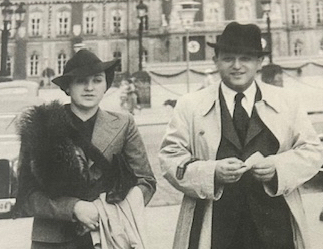
For newlyweds Erwin and Selma Diwald, getting out of Austria wasn’t a choice. It was a necessity. Thankfully, the kindness of strangers saved their lives. Their daughter, Frances “Francie” Mendelsohn, shared their fascinating story.
Erwin Diwald was born in Vienna, Austria, in 1907, to Bettina and Sigmond, who was a successful importer of the ostrich and egret feathers used in the making of hats popular at that time. Erwin attended the University of Vienna, where he earned doctorates in both history and law. He launched a successful career in law and was sought after by many Catholic clients wishing to legally annul their marriages.
Born in 1931, Selma Gehler was the second child of Maria and Victor Gehler. Victor, an engineer, was involved in the building of the Wiener Riesenrad ferris wheel in the Prater, still considered one of Vienna’s popular tourist attractions. Selma worked in her uncle Joel’s’ pharmacy while attending the University of Vienna’s pharmacy program, intending to step into her uncle’s business after graduation.
Selma and Erwin met at a friend’s wedding and married in October 1937. Six months later, German troops invaded Austria. On March 15, 1938, the terrified Erwin found himself caught up in the enthusiastic crowds cheering and raising hands in the Nazi salute as a triumphant Hitler paraded through the streets of Vienna. Immediately, the Jews in Austria were in the crosshairs of the new regime.
The newlyweds knew they had to leave their native country. Their first attempt to obtain visas took them to Stuttgart, Germany. On their first evening there, Selma and Erwin ate dinner in the hotel’s restaurant. The waiter brought over a huge tureen of soup. “Compliments of the Fuhrer,” they were told. They soon learned that their hotel was the site of the city’s Nazi headquarters. They quickly returned to Vienna to explore other options to leave Austria.
Help arrived through Erwin’s younger sister. Paula Diwald had been vocal in her dislike for the new regime. When notified that the Nazis were looking for her, she hastily made arrangements for a “ski trip” in France. As soon as she crossed the border, she ditched the skis and took up residence in Paris.
Paula worked during the day as a salesclerk in a shop selling expensive handbags. To supplement her income, she worked as a tour guide, her ability to speak seven languages a definite asset.
One evening, Paula overheard a couple requesting a guide who could speak English. She introduced herself and spent the next several days showing the Gregorys, a wealthy Greek Orthodox couple from Chicago, the highlights of the City of Light. At the end of their visit, they asked Paula what they could do to thank her for all she had done.
“What you can do is sponsor my brother and his wife,” Paula told them. “We have absolutely no family in the United States. Your providing them with visas is the only payment I want.” They promised to see if they could make the arrangements once they returned to Chicago.
Paula immediately contacted Erwin. His education had included years studying classical Latin and Greek, and he decided to use this knowledge to further persuade the Gregorys.He wrote a long eloquent letter in classical Greek to plead his case.
The Gregorys may have been Greek Orthodox but had no knowledge of its language; they brought the letter to their priest. Impressed by both the Erwin’s language and moved by their plight, the priest told the Gregorys, “You have to save these people.” The Americans complied and began the process of getting visa for the couple. They enlisted the aid of Lazarus Krinsley, a Jewish lawyer in Chicago, to obtain the paperwork.
The Diwald flew to Paris to await the paperwork that, according to the officer in charge had not come through. It was only when the Diwalds checked in on a day the regular official was not at work. His substitute immediately “found” the missing documents.“Where have you been?” He said. “These visas have been here for months.”
Knowing that they could not bring a great deal of money into the States, the Diwalds arranged first -class passage on the Paquebot Champlain. Built in 1932 and hailed as the first modern liner, the ship was pressed into evacuee work, transporting many Jews, like the Diwalds, who were fleeing Europe.
Erwin remained in Paris with Paula before boarding the ship in Le Havre, France on August 29, 1938. Later that day, Selma, who had gone to England to say goodbye to her family, boarded in Southhampton. On August 31, 1938, Germany invaded Poland, marking the beginning of World War II. Erwin and Selma had made their escape just in time.The ship sailed in radio silence for the remainder of the voyage.
Meanwhile, he Diwalds found themselves in the company of many celebrities. Their travel mates included actor Helen Hayes, comedian Groucho Marx, composer Samuel Barber, Italian-American composer Gian Carlo Menotti, and Austrian-American actor/director Erich von Stroheim. It made for a very memorable voyage!
An interesting side note: According to a Wikipedia article, the Champlain continued crossing the Atlantic Ocean for the next two years, transporting refugees, including many Jews, to safety. On June 17, 1940, on what was to be its last crossing, the Champlain hit a German air-laid mine, causing it to keel over on its side and killing 12 people. . A German torpedo finished its destruction a few days later. It was one of the largest boats sunk sunk in World War II.
After debarking the ship in New York City, Selma and Erwin traveled to Chicago to meet their benefactors. Even though the Gregorys were responsible for getting the visas, they were not very welcoming. Lazarus Krinsley the lawyer, and his wife Rose, however, warmly embraced the couple, a friendship that was maintained throughout their lives. Upon the Krinsleys’ recommendation, the Diwalds settled in Milwaukee, Wisconsin, which had a fairly large Jewish population and offered more job opportunities.
Despite his educational background, Erwin lacked the credentials to practice law in his United States, During the war, he worked on an assembly line that polished propellers for B-29 planes. and drove trucks After the war, Erwin applied for a job as a tire salesman with Dayton Tire and Rubber Company. Initially, human resources failed to recommend him, saying he was “too intelligent.” He went on to become one of their top salesmen.
Using the skills learned in Vienna, Selma worked in a pharmacy. She considered going to UW Madison to get certified as a pharmacist. After the birth of her two daughters Ann Frances [“Francie”) and Susan Jane, however, she gave up her dreams of further education.
The Diwalds joined to Temple Emanuel, a reform congregation. In 1954, Francie became the first bat mitzvah in the congregation, with her sister Susan following in her footsteps three years later.
Fortunately, many of Selma and Erwin’s family were able to escape the fate of the many Jews imprisoned and murdered during the Holocaust. In 1938, the Nazis stormed into the Gehler home looking for Joel. When they could not find him, they arrested Selma’s father, Victor, who was deported to Dachau. Maria, through a possible bribe, was able to free him. They immediately fled for Haifa, in what then Palestine. They both passed away in Israel in 1951, three years after it had become the State of Israel.
Erwin’s parents had also escaped Austrian 1940 by hiking over the Alps into France. They emigrated to Milwaukee in 1942. Joel, who had narrowly missed arrest in 1938, fled to England, where he met the love of his life, Patricia. Joel passed away in 1986; Patricia passed in 2022.
Selma died in 1996 at the age of 83 from cancer. Erwin died in 2008 at the age of 101, suffering from dementia in his last years. Despite all that the family had endured, Francie said that her parents were never bitter or angry. “I feel as if I been touched by God,” Erwin told his children. “We survived.”
SOURCES
Thanks to Francine Mendelsohn for sharing her parents’ story.
O mermaid bold, long may you hold/ The wreath you’ve won by swimming,/And spoil for gents their arguments/ Regarding Votes for Wimmen! “To a Lady Swimmer,” William F. Kirk 1914.
I love to swim. So it is no surprise that I spent much of the first week of the 2024 Paris Olympics watching the swim competition. I cheered on Team USA as they won twenty-five medals in the thirty-nine events in the Paris La Défense Arena. As I yelled “Go! Go! Go!” at the screen during the 1500 freestyle, Katie Ledecky’s last race, my granddaughter admonished me. “Your screaming isn’t going to make a difference,” she said. Hey! Maybe it did! Ledecky won the fourteenth medal she had earned over four Olympics.
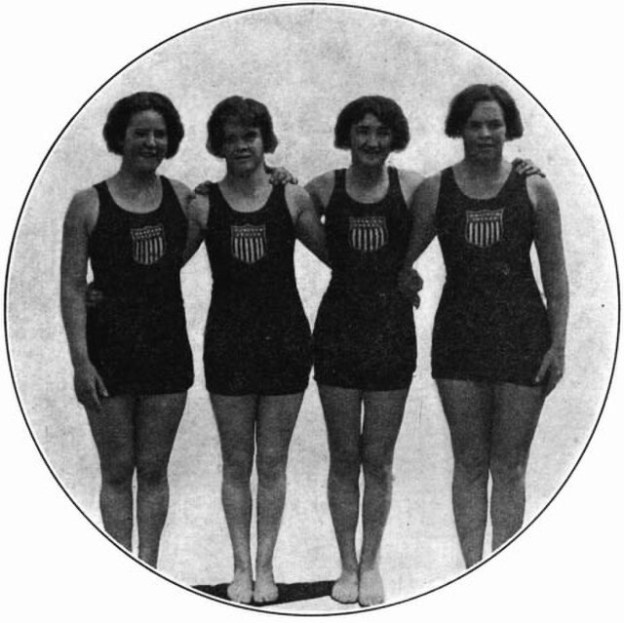
Ledecky, Torri Huske, Jenny Thompson, Dara Torres, Janet Evans, Donna de Varona, and every woman who dove into an Olympic pool has a Jewish woman to thank. Charlotte “Eppy” Epstein, considered the “Mother of Women’s Swimming in America,” was not an exceptional swimmer herself but believed that athletic competition was as important for women as it was for men. Her determination and leadership impacted not only the sport of swimming but also how women perceived their own bodies and their place in the world.
As Glenn Stout recounted in his 2009 book, Young Woman and the Sea, How Trudy Ederle Conquered the English Channel and Inspired the World, until Epstein transformed women’s swimming, societal norms discouraged women from swimming or, in fact, from “breaking a sweat” anywhere but in the kitchen. Social bias against women’s participation in sports was the norm. This was best represented by Olympic founder Baron Pierre de Coubertin of France, who thought women’s competition in athletics was “physically dangerous for such delicate flowers and morally offensive.”
Even if they could get in the water, the standard female bathing costumes hindered women swimmers. Kristin Toussaint described them in a 2015 Boston Globe article: “black, knee-length, puffed-sleeved wool dresses worn over bloomers with long black stockings, bathing slippers, and even ribboned swim caps.” In 1907, Annette Kellerman, an Australian competitive swimmer and vaudeville star, was arrested for indecency by Massachusetts police for wearing a one-piece bathing suit that ended in shorts above her knees. “Kellerman may have been thoroughly covered,” Toussaint said, “but to her fellow bathers, she may as well have been naked.”
Epstein changed the narrative in 1914 when she founded the National Women’s Life Saving League, which offered the “delicate flowers” a place to swim and take lessons. Using negotiating skills she learned through her job as a court reporter, she convinced the Amateur Athletic Union (AAU) to permit women to register with their organization for the first time and to sponsor competitive women’s meets. According to Stout, Epstein worked “behind the scenes … extolling the advantages of having a women’s swim association managed by women while deftly praising the example set by the AAU as an organizing body without peer —essentially killing the organization and its male overseers with kindness.”
In 1917, she struck out on her own, creating the New York City Women’s Swimming Association (WSA) to further advance the sport. She successfully battled the United States Olympic Committee, enabling American female swimmers and divers to compete in the Olympics in Antwerp, Belgium. Through her efforts, swimming dresses and bloomers were replaced with outfits closer in style to Annette Kellerman’s. The success of the American women’s swim team led to the inclusion of track and field and other sports for women in future Olympic Games.
Epstein served as the women’s swimming team manager for the 1920, 1924, and 1932 Olympics. Her swimmers and divers dominated the games, holding fifty-one world records over the course of her twenty-two years of coaching. Her protégées included Eleanor Holm, Aileen Riggin, Helen Wainwright, and Gertrude Ederle. Epstein also served as chair of the national AAU women’s swimming committee.
Her Jewish roots became part of her legacy. The WSA team swam at the Young Women’s Hebrew Association of New York for national championship meets in the 1920s. In 1935, Epstein served as chair of the swimming committee of the Second Maccabiah Games. In 1936, she refused to attend the Berlin Olympic Games and withdrew from the American Olympic Committee in protest of the United States’ participation in the “Nazi Olympics.”
During her lifetime, Epstein also used her position to battle for women’s suffrage, staging “suffrage swim races” with her teammates, and fought for further bathing suit reform, distance swims, and additional competitive events for women. She continued to have a major influence on swimming until her death in 1938, just short of her fifty-fourth birthday. She was inducted into the International Swimming Hall of Fame and the International Jewish Sports Hall of Fame.
“By motivating young women to follow their passions in a sport that did not yet fully accept them, Epstein truly changed the way women thought about swimming,” according to Women in Swimming (Betsey Bennett. “Charlotte Epstein and the Swimming Suffragettes.” Women in Swimming. October 25, 2018). “And her impact did not end in the pool; once women gained freedom over their bodies in sports, they were better able to achieve liberation in other facets of society.”
On Wednesday, July 31, after binging on a morning of Olympic events being broadcast on NBC, I headed for the small pool in our Colorado rental complex. I swam 1500 meters in over an hour, approximately four times Ledecky’s time of 15:30.02 minutes in Paris earlier that day. I may not be setting any world records, but I too am a beneficiary of efforts of the small Jewish powerhouse from Brooklyn. I did not fear being arrested for wearing a TYR swimsuit, and no one feared that this “delicate flower” could not survive the multiple laps. I tip my Speedo swim cap to you, Eppy!
In 2024, Disney+ released the film Young Woman and the Sea based on Glenn Stout’s 2009 book. The movie tells the story of Epstein’s most well-known protégé, Gertrude Ederle, the first woman who swam the English Channel. Sian Clifford, who played Epstein, said the movie is “a beautiful, inspiring story that should have been told before.”
“Charlotte Epstein serves as a symbol of the critical efforts of a Jewish sportswoman to improve the competitive opportunities and quest for physical emancipation of American women using their bodies in aquatic sports,” wrote Linda Borish in her 2004 paper. (“The Cradle of American Champions, Women Champions … Swim Champions’: Charlotte Epstein, Gender and Jewish Identity, and the Physical Emancipation of Women in Aquatic Sports.” The International Journal of the History of Sport_, Vol. 21, 2 (March 2004): 197-235.
All women swimmers—or all women athletes for that matter—have Eppy to thank.
Originally published August 16, 2024. Updated July 2025.
Note: First Place Winner, 2025 Florida Press Association’s Sports Feature Story, Category C (Small newspapers).
SOURCES
Borish, Linda. “The Cradle of American Champions, Women Champions Swim Champions’: Charlotte Epstein, Gender and Jewish Identity, and the Physical Emancipation of Women in Aquatic Sports.” www.researchgate.net. March 2004.
“I’m late / I’m late / For a very important date. / No time to say “Hello, Goodbye”. / I’m late, I’m late, I’m late.” White Rabbit in Alice in Wonderland, by Lewis Carroll
Lewis Carroll’s classic novel has always been one of my favorite children’s books, and I often dreamed of being Alice, falling down a rabbit hole, and meeting the Chesire Cat and the Mad Hatter.. I never realized until recently that I wasn’t Alice. I was the White Rabbit.
My epiphany came on Rosh Hashanah, while I dashed around getting ready to leave for shul. My husband, who was unable to attend services due to recent leg surgery, commented on the fact that I was still trying to leave at 10 am, an hour after services began. “You’re running late,” he commented. “You seem to be doing that a lot lately.”
Initially I was going to make some snide remark about how taking care of his needs as well as all the household responsibilities that he had not been able to do as a result of his surgery had contributed to my problem. I, being the good wife, bit my tongue and headed out to shul.
As I spent time in synagogue reflecting on my morning rush, however, I realized that my lateness was not limited to those last few weeks. Friends had been left waiting at restaurants, movie theaters, and book stores, with a quick telephone call from me saying, “I’m running a little late! I should be there in ten or fifteen minutes.” And this had been going on for a while.
The irony in this situation is that I have always been the Calendar Queen. For years, I lugged around a Franklin Planner, meticulously writing down every appointment and writing elaborate To-Do lists. I was always the person given responsibility for event planning and date tracking. For at least twenty years, I have been secretary of my book club. If anyone needs to know what book we are reading, or which member is hosting, or what date we are meeting, I am the person. Now that I have moved from the Franklin Planner to the electronic version, I drive Larry crazy with all the dings and beeps and twills that signal an upcoming event. It’s just that all these reminders don’t get me out the door when it is necessary. To paraphrase Marilyn Monroe, “I’ve been with a calendar, but I’ve never been on time!”
Lateness was not an issue for many years. For my twenty-five years of teaching, I was in my classroom on time, and I became impatient with the stragglers. It was when I moved out of the classroom into an administrative position that my ability to be on time became a question.
My new job required that I wear many hats: I was responsible for public relations, institutional research, grant writing, special events, as well as any “duties as assigned.” Although I enjoyed what I did, my job often required that I multi-task; as a matter of fact, my boss felt strongly that the ability to handle numerous balls in the air was a sign of a good administrator. As a result, I got into the habit of not only working on numerous projects at one time, but also switching quickly from one task to another. (Do you hear the sounds of balls bouncing?) In order to handle the myriad of responsibilities, I also found myself trying to complete just one more thing. As a result, I was always sweeping into a meeting a couple of minutes late. Of course, since everyone I worked with was also trying to multitask, I was not always the last one in conference room. Larry also noticed it on the home front, as my necessity to finish up something resulted in my coming home one or two hours late.
These bad habits carried into my personal life, and even when I retired, I still found myself trying to squeeze in “one more thing” before heading out the door. Whether it be making that one phone call or checking Facebook or finishing my Cryptoquote, I often was running late, just like that proverbial White Rabbit in Wonderland. Which was where I was on that Rosh Hashanah morning.
So I decided then and there that I would start the new year with the resolution to improve my track record for promptness. I would stop multi-tasking, No last minute phone calls. No checking emails. No last minute laundry folding. No, the new me would be showered, dressed, ready, and packed up ten minutes before any estimated time of departure.
Or not. Despite best intentions, it doesn’t always work out. I can try my best, but life does get in the way. Recently, I was heading out the door to the YMCA when my brother and sister-in-law called, and we chatted until I begged off, saying I had to get out the door. Pulling the car out of the garage, I realized it had started snowing, which meant it took twice as long to make the four-mile trip to the Y. Once I got there, I ran into Tim, who caught me up on his winter running woes, and Lily, who shared with me that she was celebrating the holidays with her children from Chicago.I finally got on to the elliptical, and it took me about five minutes to untangle the wires on my earbuds. I had to cut my ride short to make it to class, which, because of the snow, was comprised of the instructor and four brave souls. OK. I tried! And I did get to class on time, unlike the unfortunate woman who showed up at 11:55 (Friday start time) for our 11:30 am Tuesday class, a feat I had pulled myself on a few occasions.
One of the advantages-or maybe disadvantages-of being Jewish is that we have two opportunities a year to make resolutions: our sacred Rosh Hashanah and our secular New Year’s Day. So, for the secular New Year, my resolution is to continue working on the promise I made to myself this past September to be on time. Whoops! look at the clock! Need to cut this short to get to the Y for an 11 o’clock spinning clas……
A version of this article originally appeared in theJewish World News, a bi-weekly subscription-based newspaper in upstate New York.
I have published this blog on September 1, 2024, what would have been Frances Cohen, my mother’s 107 birthday.
I spent most of my early childhood in Coney Island. I loved living in that special section in the New York City borough of Brooklyn, especially during the summer.
We did not have many of the conveniences that we have today. Rather than a refrigerator, we had an icebox. The iceman delivered ice every other day. We had a pan under the ice box. When we forgot to empty the pan, there would be a huge puddle on the floor. There were no supermarkets, just local grocers. Milk,which was not homogenized, was purchased from the grocer. It was stored in a large metal buckets and ladled out. As the ladle was often left out with the milk uncovered, flies and roaches swarmed around the bucket. Mice licked the ladle until they were chased away by the store’s resident cat. When we brought the milk home, the cream was on the top, and my mother would make whipped cream with a hand beater. I grew up before radios, washing machines, dryers, and dishwashers. Even toilet paper was yet to be invented. We used orange wrappers and pages from the Sears catalog.
I lived two blocks from the beach and the boardwalk. I loved to go swimming in the ocean and walking the boardwalk. We had two big amusement parks within walking distance, Luna Park and Steeplechase. I preferred Luna Park as it had a circus. It was such fun watching the clowns, the animals, and especially the men and women on the trapeze. Nearby was the famous Nathan’s hot dog stand, where we could buy a hot dog with sauerkraut for five cents.
As there were no televisions, we went to the movies every Saturday. For ten cents, we saw a double feature along with newsreels, a serial, and cartoons. We bought a penny’s worth of candy and enjoyed the entertainment. On rainy days, we stayed indoors, drawing pictures with crayons and reading books from the library. We did not have as many toys as our grandchildren and great grandchildren have today, so we improvised. My brother made a train out of drawers from my father’s Singer sewing machine.
As all little girls, I loved to play with dolls. My mother had bought me a small celluloid doll with moving arms and feet that I could even bathe. I wanted a new doll carriage, but we were in the midst of the Great Depression, and my parents could not afford to buy me one from the store. So, we became creative. A shoebox became my doll carriage. My mother made a hole at the end of the shoebox and put a string through it so I could pull the carriage. The top of the box became the hood. She also gave me scraps of material which I made into a pillow, a carriage cover, and clothing for my doll. With a child’s imagination, I thought that my doll and doll carriage were the most beautiful in the world.
It was convenient to live near the beach, but my neighborhood was not the best. It was all pavement—no flowers and no lawns. One summer, my second-grade teacher thought it would be a good summer project to learn how things grow. The last week of school, she had us bring in a small wooden cheese box and a small potato. She helped us put the dirt that she supplied into the bottom of the box. We cut up the potato, placed it in the dirt, and then covered the potato with more dirt. I placed the potato plant on the fire escape and watered it every day. In July, I was happy to see some green leaves. My parents and teacher had never told me that potatoes grow underground. So, when August arrived, I got so angry that no potatoes had grown on the leaves, I just dumped the plant. I was so surprised to find four little potatoes!
Looking back, I had a very happy childhood. Although we did not have much money, I never felt deprived!







 There Goes My Heart