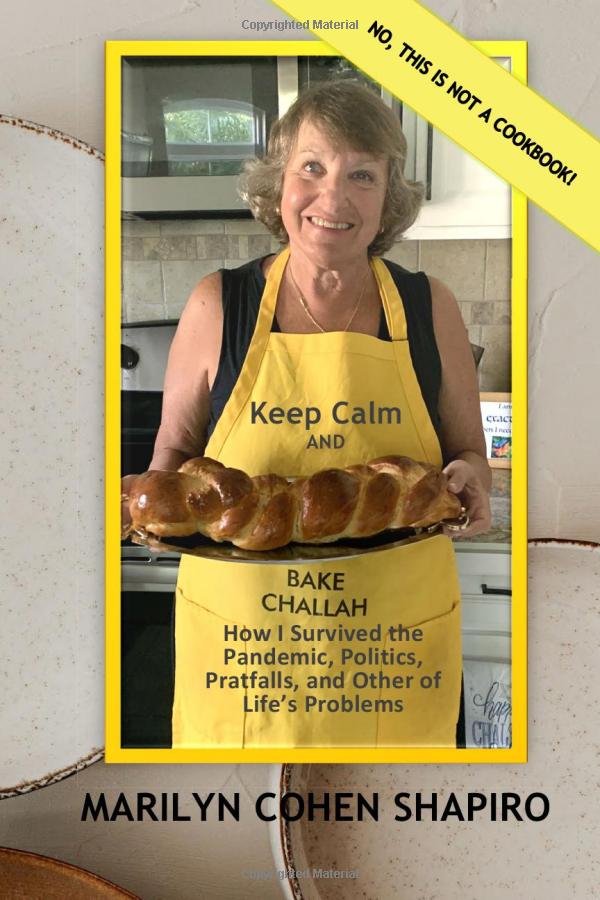
I am proud to announce that my fourth book, Keep Calm and Bake Challah: How I Survived the Pandemic, Politics, Pratfalls and Other of Life’s Problems,is out and available on Amazon in both Kindle and paperback formats.Hope you enjoy reading the the fifty-three articles I wrote during the pandemic as much as I enjoyed writing them! For those who have been following my blog for a while, you will now have many of those posts in one place for your reading pleasure.
Below are a sampling of the story topics:
Let’s here it for the girls!A pandemic Sabbath with challah, wine, and candles. WWE One Marilyn ZeroI am a pickleball putz!
Wintering through the Pandemic
Anne Frank, born on June 12, 1929, was the celebrated diarist who described her life while hiding with her family from the Nazis in an Amsterdam, Holland attic. After capture and deportation, she died in the Bergen-Belsen concentration camp in late winter 1945.The following story, first published in 2018, tells the story of another Jewish child who hid with his family in Holland during World War II and survived to share his story.
Anne Frank is one of the most well known figures from the Holocaust. But she and her family were not the only ones to go into hiding to avoid capture by the Nazis and their collaborators. While some Jews lived in the open with changed identities, others, like the Franks physically hid to avoid certain deportation and almost certain death. Dutch Nathan and his family were one of many who relied on others to help them.
Gert “Dutch” Nathan was born on January 5, 1932, in Duren, Germany, the second son of Wilhelm (“Willy”) and Hilde (nee Friesem) Nathan. Willy had a cattle hauling business which extended throughout Europe. He did not have a formal education, but he was street smart—Dutch remembers that his father could “outcalculate a calculator.” The Nathans lived a mostly secular life in Germany, with observation of major Jewish holidays and his mothers’ lighting of Shabbat candles.
In 1938, after Hitler’s rise, the family moved sixty miles west to Valkenburg, The Netherlands. “Holland had proclaimed neutrality when war broke out in September 1939, as they had done in World I,” said Dutch, “so my father thought our family would be safe.”Willy took a job with the De Valk bus company, a former competitor, where he continued his cattle business.
On May 10, 1940, Hitler’s forces invaded the self-proclaimed “neutral” country. Five days later, after the bombing of Rotterdam, the Dutch forces surrendered. By 1942, the situation began to deteriorate for fellow Jews. Willy made the following arrangements with his friend, Johan Kengen, a member of the Dutch Underground: If the Nathans were in danger of deportment. Willy would pay for the family to stay in the home of Kengen’s fiancé’s aunt and uncle for “a few days” until the Nathans could be spirited away to England. Willy also made arrangements for neighbors to move most of the furniture and bedding to the house next door. Whether the neighbors were paid or volunteered as an anti-Nazi action still remains a mystery to Dutch.
The plan was put into effect a few month later. While walking from the bus station into the De Valk building, Willy was stopped by a friend and fellow employee: Germans were waiting for him to arrest him and deport him and his family to the concentration camp.
Father quickly stole a bike and peddled the ten miles home. Dutch and his older brother Fredo were instructed to leave their house one hour apart to walk the two miles to a house “located on the right hand side just before the road crossed the railroad tracks” with a warning to “not speak to a soul.” Willy and Hilde arrived later that evening, expecting to hear soon from the Underground of their clandestine trip to England.
Unfortunately, the days turned into week, and the Nathans were still in hiding. Other people, including downed pilots, had priority in the Underground escape plan. To further cover the facts of extra activity in the “safe house,” an elaborate ruse was planned. Johan and the elderly couple’s niece Ann quickly arranged their wedding. At the reception, Johan picked a huge fight with Ann’s parents, who resolved that they would have no contact with the couple until Johan apologized. The newlyweds moved into the house by the railroad tracks, bringing the number to eight.
As weeks turned into months, tensions grew. The Nathan’s spent most of their time in a small main floor bedroom. Ann was prone to hysterical outbursts, and Willy and Johan would have to physically restrain her to keep her from running outside and giving their situation away. Meanwhile, Hilde was anguishing over the fact that she had not been able bring her parents with them. She was haunted by their deaths in the concentration camp for the rest of her life.
Johan’s government job determining the number of animals that farmers could slaughtered provided a means to get extra meat and milk, but food was still scarce. Dutch and Fredo, 10 and 12 respectively, spent most of their days quietly reading books and avoiding the shaded windows so no shadows would be seen.
Along with possible discovery, the occupants lived in fear of the potential impact of living near the railroad track.The noise from the passing trains provided an extra buffer but also an extra danger: Allies strafed German trains. They hoped that these attacks would not hit the house, either killing all of them or forcing the Nathans out into the open, thus exposing their dark secret.
In the second half of 1944, the southern half of Holland was liberated by American troops. (The remaining areas of the Netherlands were not liberated until May 1945.) The Nathans stayed inside for a few more days to make sure they were safe.
Once they realized they were actually free, the Nathans stepped into fresh air for the first time in twenty-six months. “I walked a few feet and collapsed,” remembered Dutch. When asked if he had been overcome with emotion, he said, “I hadn’t used my legs in 26 months and initially had no muscle tone to walk more than a few feet.
Before they could move back into their home, however, Americans bombed Valkenburg. One of the casualties was the Nathan’s home. “No one understood why the brick home next door burned so much,” said Dutch. “The furniture hidden in the attic acted like a tinderbox, and flames shot up in the air for hours.”
In May 1945, the remaining areas of the Netherlands were liberated. Free but homeless, the Nathan family moved into a neighbor’s home until 1946, when they obtained visas to move to United States, where several of Willy’s siblings lived. Willy built a crate the size of a truck and filled it with everything they had accumulated since the end of the war—including a piano.
Dutch, now sixteen, enrolled in City College to learn English, adding to his previous background of German, French, and Dutch. At 18, he enlisted in the army and volunteered to go to South Korea. When he returned home, he found employment in whatever “made money.”
In 1979, Dutch, who had been married twice before, met Sue Cohen. He proposed shortly after the meeting, but it took ten years for her to say yes. During this time, Dutch started the Stretch Lace, a Sharon Massachusetts-based company that manufactured and sold elastic shoe laces. (“Tie once, never Tie Again!”) Although his invention was successful, Dutch admitted that he didn’t know marketing and sales. He eventually sold the business, but Easy Laces are still available today and are worn by such celebrities as Brooke Shields. They lived in Sharon for most of their married life before retiring to Kissimmee, Florida, in 2007.
In 1982, Sue and he were invited by residents of Duren, Germany, to return to the Nathan’s original home. They were treated royally and met with church members as well as school children. Sue’s main mantra to everyone she met was “Just remember! The Holocaust DID happen.” Although their visit was supposed to last a week, Dutch felt uncomfortable. He rented a car, and the two of them toured Europe, driving over 4000 miles before returning to Massachusetts
Almost seventy-five years after his liberation, Dutch graciously shared the story that he spent most of his life trying to put those terrifying time behind him. “I try not to think about those things,” said Dutch. “It is over and cannot be undone. His story, however, as those of the fewer and fewer remaining Holocaust survivors, must be told. As Sue Nathan told the people in Germany during the 1982 visit, “Remember. The Holocaust DID happen.” And we Jews and righteous people everywhere will never forget.
A version of this article originally appeared in the November 8, 2018, issue of the Jewish World News, a bi-weekly subscription-based newspaper in upstate New York.
A shorter version of this story was published in the Orlando Sentinel on January 8, 2023. This is the full article as published in The Jewish World in its January 5 issue.
“In the end we will remember not the words of our enemies but the silence of our friends.” Martin Luther King, Jr.
On December 19, 2022, President Joe Biden used the White House’s Chanukah celebration to call out the rising anti-Semitism in the United States. “Silence is complicity,” he stated. Biden joined Second Gentleman Doug Emhoff and other notable Jews in lighting the first ever official White House hanukkiah, which was created by the Executive Residence Carpentry Shop out of wood removed from the building in 1950 during a Truman-era renovation “Today, we must all say clearly and forcefully that anti-Semitism and all forms of hate and violence in this country have no safe harbor in America. Period,” Biden said.
This theme echoed the president’s tweet earlier in December. The remarks came one day after Ye, the rapper, formerly known as Kanye West, announced “I like Hitler” during an anti-Semitic rant on right-wing conspiracy theorist Alex Jones’ InfoWars show and five days after Donald Trump dined with Ye and white supremacist Nick Fuentes. “The Holocaust happened. Hitler was a demonic figure,” stated Biden. “And instead of giving it a platform, our political leaders should be calling out and rejecting anti-Semitism wherever it hides. Silence is complicity.” Trump, meanwhile, has yet apologize or to condemn the men he dined with at Mar-a-Lago. He has hidden behind an excuse of innocence, claiming he didn’t know who Fuentes was.
Condemnation
Some Republican leaders were swift of their condemnation of Trump’s actions. “Trump was wrong to give a white nationalist, an anti-Semite and Holocaust denier a seat at the table,” stated former Vice President Michael Pence. “And I think he should apologize for it, and he should denounce those individuals and their hateful rhetoric without qualification.” Senate Minority Leader Mitch McConnell echoed Pence’s words. “There is no room in the Republican Party for anti-Semitism or white supremacy,” he said. “[A]nyone meeting with people advocating that point of view, in my judgment, are highly unlikely to ever be elected president of the United States.”
House Minority Leader Kevin McCarthy denounced Fuentes, stating that the white supremacist “has no place in this Republican Party,” but follow-up statement which supported Trump was blatantly untrue. “I think President Trump came out four times and condemned him and didn’t know who he was.” According to CNN and other reputable news sources, Trump claimed four times that he didn’t know Fuentes but never denounced him or his views.
While condemning anti-Semitism, many other Republicans who spoke out condemned the ideology but avoided invoking the former president’s name. As a matter of fact, when PBS reached out to 57 Republican lawmakers to condemn the meeting, two-thirds never responded. Many, like McCarthy, have put the blame on Ye and Fuentes for showing up.
The silence is also deafening in my own state of Florida .In January, a small band of white supremacists converged in Orlando, where they chanted “White power!” and roughed up a Jewish student. Governor Ron DeSantis’ press secretary suggested on Twitter that the white supremacists were actually “Democrats pretending to be Nazis.”The governor himself is yet to speak about the Trump/Ye/Fuentes debacle.
In March 29, 2022, article in New York magazine, Jonathan Chait opined that DeSantis’ silence may be rooted in his own strategy to obtain the 2024 Republican nod for the presidential candidate. Chait went soon to say that it may be even more deeply rooted in what Chait called the Republican presidential candidate hopeful’s “unembarrassed courtship of right-wing extremists.”
Look Who Is Talking?
So who is speaking up? Certainly the Anti-Defamation League, whose response was immediate and unequivocal. “Former President Trump’s dinner with anti-Semites Ye and Nick Fuentes underscores the ugly normalization of extremist beliefs — including anti-Semitism, racism and other forms of bigotry,” said Jonathan Greenblatt, its National Director and CEO. He went on to warn that the dinner further emboldened extremists.
And thankfully, many others have refused to be silent. Government officials, religious leaders, journalists, athletes, entertainers, and many others have raised their voices against anti-Semitism.
In November, over 200 leaders of the entertainment industry, including Mila Kunis, Debra Messing and Mayim Bialik, released a letter through the non-profit entertainment industry organization Creative Community for Peace urging Amazon and Barnes and Noble to stop its sale of the highly inflammatory book and film, Hebrews to Negros: Wake Up Black America. “At a time in America where there are more per capita hate crimes against Jews than any other minority, overwhelmingly more religious-based hate crimes against the Jewish people than any other religion, and more hate crimes against the Jewish people in New York than any other minority, where a majority of American Jews live,” the letter reads, “it is unacceptable to allow this type of hate to foment on your platforms.”
Survivors
There is another powerful but diminishing group that continues to bring the reality of the Holocaust and anti-Semitism to the forefront: Holocaust survivors. January 27, 2023, marks the 78th anniversary of the liberation of Auschwitz. Most of the survivors are in their eighties and beyond; the oldest known survivor, Yisrael Kristal, died at 113 in 2017. Through the efforts of Steven Spielberg , the Shoah Visual History Foundation has recorded over 55,000 stories Holocaust survivors in more than 50 countries and more than 30 languages. Events such as the International March for the Living and venues such as the United States Holocaust Memorial Museum and other Holocaust museums across the country and world also bear witness.
“There are very few survivors left, and I want the world to know that there was a Holocaust,” Estelle Nadel, an 88-year-old Holocaust survivor who has talked to hundreds of groups for over forty years stated. “There’s so much denial, that every time I get a chance to tell my story, I feel like I’m doing something against it.”“Justice will not be served until those who are unaffected are as outraged as those who are,” wrote Benjamin Franklin. President Biden knows this, as should all who wish to push back agains hate.
Under a hot tropical sun, Larry and I wound our way first along the Caribbean Sea and then, in a couple of zigzags to the left, up a steep hill. We stood in front of a large stone edifice with its white plaster column and point-arch windows. Robert Kunkel, the docent/educator, opened up the black iron gate and led us up a set of stairs to the large point-arch entrance doors. After several trips to the Caribbean, Larry and I finally could visit the Hebrew Congregation of St. Thomas, the second oldest synagogue building in the western hemisphere and the oldest in continuous use under an American flag.
Stepping past the threshold, we immediately noticed a carpet of sand that covered the center of the room. We then took in the beautiful architecture. A domed ceiling holding the Eternal Light soared above us. The mahogany pews, finished by nineteenth century shipbuilders, were set up in on three sides to face the ark. A striking marble slab supported its base. Above the curtained doors, artisans had engraved two tablets representing the Ten Commandments into the native stone. More pointed-arch windows let in the bright light, while thick white plaster walls helped keep the interior cool.
As we settled into the pews, Robert shared his vast knowledge of the synagogue and its important role in the history of St. Thomas, the largest of the three main islands that comprise the US Virgin Islands. But first he addresses our most pressing question: Why sand? He explained that the first Jews in the Caribbean were of Sephardic, or Spanish-Portuguese, descent. The unique floor, one of only five in the world, shows how the Spanish Inquisition (most active between 1480 and 1530) forced their Jewish ancestors in those two countries to practice their religion secretly in basements, covering the floors to muffle their footsteps and voices.
So how did these Iberian Jews land up in St. Thomas? Facing a choice of forced conversion or expulsion, victims of the Spanish Inquisition fled to European cities. Over the next four centuries, partially because of discrimination in other professions, Jews developed a mercantile trade which lead them to countries in both South America and the Caribbean, including St. Thomas. The number of Jews on this island remained small until the years after the American Revolution, when an influx of Sephardic Jews set up businesses in a climate of great tolerance and discrimination. In 1796, the Jews of St. Thomas founded B’racha V’shalom (Blessing and Peace). A fire destroyed the first structure along with several hundreds of building on the island. In 1812, the Jewish community purchased land and built a new synagogue. A growing population resulted in erecting a new expanded wooden structure with an expanded name: Congregation Beracha Veshalom Vegmiluth Hasadim, “Blessing and Peace and Loving Deeds.”
On December 31, 1831, another fire destroyed one quarter of the buildings on St. Thomas, including the shul. Not to be deterred, the Jewish community began an international fundraising effort to raise the $5000 needed to rebuild a house of worship made of stone, brick, and mortar.
The congregation and surrounding non-Jewish community had donated money, materials, and labor towards the project. In September 1833, the entire community celebrated the reconsecration of the building, which held the two Torahs and the Eternal Light that had been rescued from the fire. This was the building we were standing in almost 190 years later.
As the synagogue grew, the congregation purchased a burial ground, established a Hebrew School, and began using the services of actual clergy. Like all synagogues, the following years brought the synagogue schisms over liturgy and rabbis, and fluctuating membership. Through it all, it remained a living, vibrant synagogue connected closely to its community. Most notably, two members of the congregation served as governors the Virgin Islands: Morris Fidanque De Castro (1950-1954) and Raphael Moses (Ralph) Paiewonsky (1961-1969).
As written in the museum’s online narrative, the St. Thomas Synagogue continues to follow in the footsteps of its ancestors, preserving their heritage and honoring their traditions. Part of this renewal was the congregation’s current search for a rabbi, as its most recent spiritual leader had moved to New Jersey to be closer to his family.
After the narrative, the tour guide opened up the ark, which housed seven Torahs. The one Sephardic Torah was housed vertically in a beautiful wooden cylindrical case which followed the customs of the Spanish-Portuguese Jewry to both store and read the scrolls while standing in their cases. The six other Ashkenazi Torahs were dressed in the traditional Ashkenazi accessories each with a mantel (velvet covering); Atzei Chayim (wooden shafts) topped with keters (crowns); and a yad (pointer). They rested at an angle on the back of the ark. Because of my interest in the Shoah, my favorite was a Memorial Scrolls Trust Torah (MST #533) which was rescued from Budyně nad Ohří, a small town in Bohemia, Czech Republic. Jews had lived there from the 13th century. In 1942, the Nazis liquidated the town of its 50 Jews who still remained.
With the guide’s approval, Larry and I took turns holding the Holocaust Torah before saying our goodbyes and thanks. We spent time in the museum gift shop, where we purchased a mezuzah, Through the Sands of Time: A History of the Jewish Community of St. Thomas, US Virgin Islands by Judah M. Cohen, and a T-shirt for Larry proclaiming “I Climbed Synagogue Hill.” We headed back to our cruise ship, thankfully a downhill journey, happy to know we finally got to see this living museum of Jewish sacrifice, survival, and strength. “The sands of time may pass over our shores again and again, changing our landscape, but the soul of our synagogue and its people remains eternal,” reads the synagogue’s website. “Our history does not end. Rather, with each generation, it begins anew.”
On February 22, 2023, less than a week after our visit, the Hebrew Congregation of St. Thomas started a new chapter and welcomed Julia Margolis as its first female rabbi. Rabbi Margolis took a long, circuitous route to the shul. Born in Moscow, USSR, her family moved to Israel when she was 12. After graduating from high school and serving in the Israel Defense Forces, she completed undergraduate degrees in Jewish history, Islam, and art and a master’s degree in Jewish studies. Following in the footsteps of her mother, who was the first Russian-speaking female rabbi in Israel, Rabbi Margolis was ordained by the Abraham Geiger College in Germany. Closely connected to the Reform Movement, Rabbi Margolis was heading a synagogue in Johannesburg, South Africa, when she saw the synagogue was looking for a new leader. She submitted her application, but she was still surprised when the search committee contacted her. In the middle of their negotiations, her husband Greg tragically passed away. Following her heart, she made the move with her two children to St. Thomas, where she soon was “soaking in the beauty and the spirituality of this place.”
“God always has a plan,” Margolis shared in a March 21, 2023, article in the Virgin Islands Daily News. “It takes a lot of time sometimes to see that, but there is always a plan.”
Originally published May 25, 2023.Updated May 25, 2025.
Fun Trivia:
The Mikvé Israel-Emanuel Synagogue in Curaçao is the oldest synagogue building in the Western Hemisphere. (1730)
The Touro Synagogue in Newport, Rhode Island, is the oldest synagogue building in North America that is still standing. (1763)
The Old New Synagogue of Prague in the Czech Republic is the oldest active synagogue in the world. (1270s)
The Ben Ezra Synagogue in Cairo, Egypt is the oldest synagogue in the world and also the longest serving. The original synagogue dates back to the ninth century. When Jews fled Egypt in the 1950s, it was turned into a museum.
Temple Israel in Leadville, Colorado, holds the record for the highest synagogue in the world. Founded in 1884, the synagogue sits at an elevation of 10,152 above sea level. It is now a museum.
A version of this article originally appeared in the May 25, 2023, issue of the Jewish World News, a bi-weekly subscription-based newspaper in upstate New York.
A version of this article originally appeared in the June 2, 2023 issue of the Heritage Florida Jewish News, a weekly subscription-based newspaper in Central Florida.
For all of you who have been following my blog, There Goes My Heart, thank you so very much. For all of you who haven’t signed up yet, please give it a try. Just go to my website, theregoesmyheart.me, scroll down to where it says FOLLOW. Click on that link and enter your email address! Voila! You will now receive my posts directly to your email box! Easy Peezy!
My blog not only contains all my posts, dating back to March 2014, when my blog went live. It will also give you places to comment on my posts, links to my articles published in the media, and direct links to where you can buy my books in either paperback or Kindle on Amazon. Please consider joining my 440 followers who are enjoying my articles.
Please be patient with me! Blog is being updated!!
First of all, I realized that I never posted several of my stories, including many that I co-wrote with my mother. I am rectifying that mistake. Those articles are being developed into blog posts and scheduled to drop into your mailbox in between my usual twice a month postings.
Secondly, I have been listing all my posts on the Marilyn’s Blog Articles on the Internet. Recently, I realized that many of the links to The Jewish World have disappeared. I am in the process of going through each link and correcting them. If you get a “This is embarrassing!” note, please know I am working on fixing all the broken links.
Book Four is coming soon!
My fourth book, Keep Calm and Bake Challah: How I Survived the Pandemic, Politics, Pratfalls, and Life’s Other Problems, is undergoing its final edits. I hope to have it on Amazon in both paperback and Kindle format in June.
Again, thanks to all of my followers! If you like my blog and stories, please share the link with friends and family. If you have any suggestions or comments on how to improve my blog,, please feel free to email me at shapcomp18@gmail.com.
Throughout the pandemic, I kept calm by baking hundreds of challahs for my family and those who needed a warm, delicious bread to either get through hard times or celebrate happy one. That became my mantra to get me through COVID19. Keep Calm and Bake Challah is a collection of articles I wrote during the time, from the first days of lockdown to the joyous day when Larry and I could re-unite with our far-flung family and friends. Look for the publication date on this website.
Standing in front of the Bielefeld, Germany, railroad station in June 2018, Harry Lowenstein traced his fingers onto the all-too-familiar names etched into the Holocaust memorial. David, his father, Bernhardine, his mother, and his sister Klaere. Aunts and uncles and cousins. Friends and neighbors. During the Nazis’ terror, his family and hundreds of Jews from surrounding areas had stood on the station’s platform before being herded onto railroad cars for the journey to ghettos, concentration camps, forced labor camps, and for most, gas chambers and death.
The then 87-year- old Floridian— the last living Jew from an entire area who had survived the Nazis and WWII— had returned home to honor those whom he had lost, to thank those who risked their lives to help in his survival, and to present his message of tolerance and equality.
Surviving The Holocaust
Harry (nee Helmut) Lowenstein was born in 1931 in Fürstenau/Hoexter Germany, the second child of a cattle/horse trader and his wife. After years of mounting anti-Semitism, Kristallnacht, the “night of the breaking glass,” unleashed the Holocaust in November 1938. It demonstrated to Jews and others across Germany the brutality and determination of Hitler’s war agains the Jews. In their small rural village, the Lowensteins watched their synagogue burn and then experienced increasingly harsher restrictions. While most Christians in the town slammed the doors of their homes and businesses in the faces of their Jewish neighbors, the owners of one small bakery risked their lives by slipping Harry lifesaving loaves of bread. It was a kindness that Harry would never forget.
On Dec. 12, 1941, hundreds of Jews, including the 21 members of the Lowenstein’s extended family, were rounded up and brought to the Bielefeld train station. Hollering SS guards brandishing rifles herded the Jews into crowded rail cars, where they began the almost 1,000 mile journey to the Riga ghetto in Latvia. As it was the first night of Chanukah someone lit the traditional candles, said the traditional prayers and sang Ma’oz Tzur, Rock of Ages. The entire train soon joined in. That last sweet memory would help sustain Harry for the next six years. To this day, Harry tears up every time he hears the song.
The Next Day Comes
After several months in the crowded ghetto, groups of Jews were moved into the Riga-Kaiserwald concentration camp. Harry managed to escape the gas chambers by working in an auto repair shop housed in the complex. He still remembers the unrelenting, intentionally cruel actions by Nazi guards and the fear of beatings, punishment, and execution. “I thought to myself, I will somehow survive,” said Harry. “You learned to live minute to minute—not even hour by hour—to make sure the next day comes.”
In the fall of 1944, as the Russian army drew closer, the Nazis began to evacuate Riga-Kaiserwald. Thousands of Jewish prisoners, including Harry’s remaining family (his father had been murdered earlier) were shipped by boat to Danzig and then by barge to the Stutthof concentration camp in Poland. He lost touch with his family. On March 9,1945, as Harry remembers it, the camp was liberated by the Red Army. Harry’s “next day”—and freedom—had finally come.
The 14-year-old returned to Fürstenau in hopes of reuniting with family. The hopes were in vain. He was the lone survivor. First finding shelter for a short time with kind neighbors, Harry lived for a year with the family who had acquired the house of his family. In 1946, he was placed in a Jewish children’s home in Hamburg. In 1952, after arriving in the United States via Paris, the 21-year -old found his way to Kissimmee, Florida, where he joined his uncle’s apparel store. In 1956, he married Carol Sainker, had three children, and eventually operated his own apparel store. With fellow Jews, including many Holocaust survivors, the Lowensteins helped to found Congregation Shalom Aleichem and then build a synagogue in Kissimmee. “I saw one synagogue burn,” he said. “I wanted to build another.”
The Return
His wife Carol died in February 2017, just before their 60th anniversary. During Carol’s long illness and his year of mourning, Harry had begun to reappraise his past.
Fritz Ostkaemper, who had been a chairman of a Holocaust museum in Höxter, came across Lowenstein’s name as part of a research project tracking the Jewish families from the Westfalia area. Ostkaemper encouraged Harry to return to his childhood home. A previously planned trip to say Kaddish at his grandparents’ gravesite in Fürstenau evolved into a family trip through Europe with his daughters Karen Pridemore and Berna Lowenstein and her husband Greg Fitzgibbons.
After tours in Switzerland, the Netherlands, and Luxembourg, Harry and his family arrived in Germany and traveled to the Bielefeld railroad station. They stood silently in front of the “Each Person Has a Name” memorial. Dedicated in 1998, the monument displayed the names of the 1840 Jewish victims from Westfalia who had been murdered by the Nazis. A further inscription contains Psalm 78.6 in Hebrew and in German: So the next generation would know them, even the children yet to be born, and they in turn would tell their children.
Ostkaemper drove the visitors to Höxter in a limousine provided by the town’s mayor, Alexander Fischer. Harry, with the help of a translator, gave a 15-minute address. The evening ended with a dinner in a beer garden hosted by the community. “Most of the survivors never returned,” Fischer stated in follow-up article in a Westfalia newspaper. “Therefore it [is an] even greater honor to be able to welcome Harry Lowenstein in his former home. This way we set an example against intolerance and racism.”
The following morning, the group traveled to Fuerstenau, where Harry was born. The burned out synagogue had been repurposed into a garage/warehouse. Harry gave a tour pointing out where the bima had been and where the family pews had been located. Harry then sought out the bakery owners that had saved him from starvation. As a large crowd watched, media cameras flashed, and videotape whirled, Harry and the elderly couple hugged each other. Harry was finally able to thank them for their long-ago kindness. “Danke Schoen” he said repeatedly. “Thank you.”
Despite its modernity, the citizens of Fuerstenau had not forgotten its past. In front of each home or area previously inhabited by Jews, was a Stolperstein, a 3.9 inch cube bearing a brass plate inscribed with the name and life dates of victims of Nazi extermination or persecution. Harry found his plate:
Here lived Helmut Lowenstein. Born 1931. Deported 1941 to Riga. [Deported] 1944 to Stutthof. Rieben. February 1945: Death March. Freed. For all the rest of his family, in place of BEFREIT- freed– was the word ERMORDET– murdered.
Zachor
The Jewish cemetery was surprising well kept, according to Harry, and he recited the Kaddish at his grandparents’ graves. His final stop was in nearby Bredenborn to visit with the family with whom he had found shelter for the first year after his liberation. In speaking with local residents of Fuerstenau, Harry was told that a permanent memorial planned for a prominent spot in Fuerstenau had been stymied by uncertainty where it should be placed and by a lack of funds. Harry railed against their excuses. “After 70 years, you should have made a permanent memorial!”
Harry pledged 50% of the funds needed. The permanent bronze plaque was erected in 2021 near the foot of the church and in the middle of the town at a crossroads that everyone must use. He missed the unveiling of the memorial due to the pandemic.
What advice does Harry Lowenstein give as a Holocaust survivor? His message on parting: “Treat each human being equally, no matter who they are.That’s all.“
Sources:
Thank you to Wolfgang Mueller for translating the articles in the Westfalen-Blatt newspapers from German to English.
Over fifty years after its Broadway opening, Fiddler on the Roof returned to Broadway in 2015 with a fresh approach and a cast worthy of its long tradition of bringing smiles and tears to its audience.
Composer Jerry Bock and lyricist Sheldon Harnick’s triumphant musical is based on Tevye the Dairyman, a book by Yiddish writer Sholem Aleichem. Set in 1905 in Czarist Russia, Tevye struggles with the untraditional courtships of the three oldest of his five daughters while facing social and political changes that threaten his beliefs, community, and tradition.
In 2015, Fiddler took on a new face as Tony-award winning director Bartlett Sher brought his own vision from the opening scene: A lone man in a red parka walks onto the stage, reading the iconic first lines from an unnamed book. “A fiddler on the roof? Sounds crazy, no?” He then sheds his 21st century garment. As the first violin notes sound, he transforms into Tevye the Dairyman. Through “Tradition,” the opening number, he introduced the audience to life in his tiny village of Anatevka.
The show offered stunning new movement and dance reimagined through Israeli choreographer Hofesh Shechter. Although Jerome Robbins’ stamp remained on the key numbers, including the famous bottle dance, the Israeli’s roots and background result in earthlier, rawer dance numbers which garnered him with a 2016 Tony.
The show closed on Broadway in December 2016 but took on new life when a national tour was launched in the fall of 2018. In 2023, Fiddler played in Proctor’s, Schenectady, New York’s theater before the tour’s closing on May 17 of that year. As a writer for the Capital Region of New York’s Jewish World, I interviewed by phone the actors playing the irrepressible Bible-quoting Tevye and his loving but nagging wife Golde. Jonathan Hashmonay and Maite Uzal shared insight into the production as well as the impact the roles had on them.
Jonathan Hashmonay may have been one of the youngest actors to professionally play the role of Tevye, but he made up for his age with life experience and talent. The descendent of Polish Holocaust survivors, Jonathan grew up in Israel. Throughout his youth, he performed in many high school ensembles and bands as well as Yom HaZikaron (Day of Remembrance) and Yom Haatzmaut (Independence Day) ceremonies. Although his family moved to New Jersey when he was thirteen, he returned to his native country to serve in the Israeli Defense Force (IDF), where he was the lead singer in the IDF’s Ground Forces Band. The group performed for a wide range of audiences, from a small group of soldiers in the Negev to on a stage in front of the prime minister and world dignitaries.
Jonathan originally planned on following in the footsteps of his father, a doctor. Interest piqued by seeing musical productions, including The Book of Mormon, however, lead him to Penn State University, where he majored in musical theater.
In 2021, Jonathan joined the Fiddler tour in the role of Avram the bookseller. He also was an understudy for Tevye, which gave him the opportunity to play the role five times. When the opportunity arose for him to step into the lead in 2022, he gladly accepted the offer.
Jonathan brought his own perspective to the iconic role. “I try my best to be very truthful Tevye,” he said. “I want to portray a sweet, loving family man whose life becomes increasingly difficult.” Jonathan felt it was important that the dairyman’s gait reflected the increasing weight of family responsibilities and of the tragedies that befall the Jewish Russian family.
As many of the Tevyes before him, Jonathan enjoyed performing the show-stopping “If I Were a Rich Man.” On the other hand, he found poignancy and pathos in a second-act scene where Chava, his third daughter, first reveals her love for Fyedke, a non-Jew. The two strong-willed people engage in a fierce battle of wits. Tevye tries desperately to warn her of the consequences: “A bird may love a fish, but where would they build a home together?” Chava just as passionately defends her choice. “The world is changing, Papa!”
When Tevye and Golde learn that their daughter and the Russian were married by a priest, it is one step too far for the besieged father. It is the biggest affront to the tradition that keeps Tevye, like the fiddler on the roof, balanced in a world that is crashing around him. “We have other children at home,” he tells his wife. “Chava is dead to us.” Jonathan said “Chavalah,” the song and ballet number in which Tevye relives the special moments in his now-lost child’s life that follows that touches the actor the most.
Maite Uzal, a native of Madrid, Spain, continued in her role as Golde, which she had performed since the beginning of the 2018 tour. In order to understand her character, Maite diligently researched early twentieth century Eastern European Jewish life in which Fiddler is set. Maite grew to respect as well as pity the exhausting and sometimes back-breaking responsibilities of the women’s role keeping a “proper home, a quiet home, a kosher home.”
Maite’s realization that Golde, like most Jewish women at the time, was illiterate, “hit me like a hammer in the head,” she said. “The way you process the world when you don’t read is so different,” Maite commented. “All her information came from her religion, her superstitions, and what she heard from others.”
As Maite herself has no children, being the “mother” of five daughters was also a learning experience, bringing her to the realization that parenthood is relentless, unconditional, and all-encompassing. “I am an even better daughter to my mother,” she said with a laugh.
Personally, Maite compared her life’s experiences to Hodel, the second daughter. Maite completed law school and served as a litigator in Spain. Twelve years ago, however, her passion for theater led her to leave law, abandon her home in Spain, and live, like Hodel,“far from the home I love.” “I defied my family, especially my father and left the people, and traditions I know to follow my heart,” she said.
But her decision came at a steep price. “My father was initially very angry that I chose to leave my profession as a lawyer and my country,” Maite said. “In his eyes, I was not Golde, who followed tradition. I was Chava.” As Tevye comes around in the last moments of Fiddler, Maite and her father later reconciled.
Maite applied to the highly competitive Musical Theatre Conservatory Program at the American Musical and Dramatic Academy in New York City. “I knew if I was accepted there, I would have the background to succeed.” She found that success upon her graduation, landing roles in Les Miz,In the Heights, and Lion King.
Both Jonathan and Maite spoke of the timeless universal themes of Fiddler. “Every culture wants to define themselves by their traditions,” said Maite, “and every culture’s children wants to defy them.” They also see the plight of modern day refugees—Syrians and most recently Ukrainian—reflected in Harnock and Bock’s classic.
Jonathan praised Fiddler’s themes of love, family, resilience, and change created from the tides of outside forces. “Our world—just like Tevye’s—is changing drastically,” noted Jonathan. “Traditions that are so important are being pushed aside. How do we decide which of those changes to accept or not?”
At the end of Act II, Tevye again dons the red coat, and he, Golde, and the cast address the audience in a heartfelt speech citing the struggle of the Ukrainians and the spike of antisemitism in the world today.
“As much as The Diary of Anne Frank is not just a Jewish story, neither is Fiddler on the Roof,” wrote Barbara Isenberg in Tradition!, her chronicle of the making of the popular musical. “Fiddler’s strong themes of family, tradition, repression, prejudice, and diaspora continue to evoke common ground for its audiences wherever they are.”
L’Chaim!
Originally published April 13, 2023.Updated May 25, 2025.
Photo of Jonathan Hashamonay and Maite Uzel used with permission from Joan Marcus via Bond Theatrical Group (www.bondtheatrical.com)
A version of this article originally appeared in theJewish World, a bi-w eekly subscription-based newspaper in upstate New York, in the April 13, 2023 issue.
I listened to Trudi Wolfe-Larkin and Marilyn Wolfe tell the incredible story of their parents’ Holocaust survival. Then through the sisters’ efforts, I watched over six hours of interview that Yolie and Irving Wolfe, their parents, had recorded for Steven Speilberg’s Shoah Foundation.
I knew that their story must be written and preserved for the Wolfe family and posterity.
Trudi Wolfe-Larkin and Marilyn Wolfe learned at an early age that their parents, were Holocaust survivors.No, Irving and Yolie Wolfe did not have a number carved into their arms, but they had emotional and, for their father, physical scars of their lives under Nazi Germany.
Through their childhood, the two siblings overheard conversations Yolie had with other survivors who were their parents’ close friends. As Trudie and Marilyn learned more about the Holocaust, they would ask questions. Although Irving brushed off any inquiries with “I don’t want to talk about it,” Yolie was more forthcoming and shared more details with her children when she felt they were old enough to absorb the horrors. In 1995, when they were in their sixties, Yolie and Irving finally shared the full extent of their experiences in ten hours of combined interviews that are part of the United States Holocaust Memorial and Museum.
Irving Wolfe was born in Czestohowa, Poland, in 1926, the third of the four children of David and Gittel Wolfowicz. Although they celebrated the major Jewish holidays, they were not a religious family. David provided a comfortable life as the owner of successful women’s coat manufacturing company. When the family located to Sosnowiec, their large apartment housed their father’s business.
All of this changed in September 1, 1939, when Germany invaded Poland. Sosnowiec was one of the first towns to fall, and persecution of its 30,000 Jews was swift and brutal. The synagogue was burned, and beatings and arrests of its prominent leaders began immediately. Jews were forced to wear yellow stars and faced restrictions. Nazi round-ups ranging from small groups to thousands of Jews crammed into a local soccer stadium resulted in deportations to concentration camps.
Thirteen-year-old Irving, who many thought had Aryan features, was drafted into delivering papers and messages for the Jewish underground. As the noose tightened, Jews were forced to move into smaller Jewish areas. By June 1942, the Wolfowicz family, along with the remaining population of Sosnowiec and Jews from surrounding communities were herded into the Środula district. Soon after, Irving was caught up in a round-up. As he had no identification papers, he was arrested and sent to a forced labor camp.
Over the next three years, he and fellow prisoners dug ditches, cleaned cesspools and latrines, and built more barracks to house more Jews who would either be used for forced labor or would be sent to the gas chambers.
In all of his time in a variety of forced labor camps, Irving remembered no acts of kindness from his captors. Each day was a series of kicks, slaps, and beatings. He and fellow prisoners subsisted daily on an eighth of a loaf of bread and watery soup.Prisoners were awakened in the middle of the night and forced to run around the compounds in the bitter cold. And they were forced to watch fellow prisoners who committed even the smallest infraction executed by the Germans.
The lowest point in what were horrible circumstances came in the fall 1943. One night, an SS guard charged into the area, demanding to know who had stolen a potato. When Irving refused to name the guilty party, he was severely beaten in front of his fellow prisoners. The man he saved never forgot Irving’s kindness, and they remained fast friends throughout their lives.
The remaining years passed in a blur of pain and hunger and disease, which included a bout with typhus that nearly killed him. His final stop was the Reichenbach, which he had “helped” build. On May 9, 1945, Irving and other survivors woke up to silence. All the Germans had left the camp, but those that were left behind were afraid to leave as they didn’t know if the electric barbed wire fences was still operational. The next day, Russian soldiers, led by a Jewish captain, liberated the camps.
Irving returned to Sustevich, his former home, where he learned that the ghetto had been liquidated in 1944, and Irving’s parents and sisters had been killed in Auschwitz. His older brother, who had been arrested earlier in the war, was never heard from again.
The war had done little to curb the virulent anti-Semitism that had always existed in Sustevich, Irving reported, and he was greeted with taunts of “They should have killed you too.” He relocated to Krakow for job training, only to be witness to the first pogrom in post WWII. On August 9, 1945, false accusations of “blood libel” —Jews murdering Christian children for their religious rituals—resulted in attacks and beatings of Jews; the robbing and vandalism of their homes; the destruction of a synagogue, and the murder of a 56-year-old woman who was a Holocaust survivor.
Irving decided to find safety in the Wetzlar displacement camp in the Frankfort district of the American-occupied zone, After hospitalizations due to tuberculosis and skin infections at the site of his 1943 beating, Irving enrolled in a precision mechanics program at the Organization for Rehabilitation through Training (ORT), which provided rehabilitation for Holocaust survivors. While there, he filed the paperwork needed for his planned emigration to Israel. His plans changed, however, when he met another Holocaust survivor.
Yolie Goldstein was born in Sarospattak, Hungary, in 1927, the youngest of five children. Her father, a tailor, headed a religious family. He attended a minion each morning, and the family kept kosher.
The Nazi’s “Final Solution” came to Hungry much later than it had to Poland as Hungary had originally aligned with the Axis Powers. Hungary, which had never followed the draconian measures against its Jewish population, attempted to establish an armistice with the Allies, but in March 1944, German forces occupied Hungary and began rounding up 800,00 Jews who had previously been protected by the previous government’s policies.In June 1944, the Goldstein family, including Yolie’s parents, her brother Jack, and her sisters Dawn and Rosalie, were packed with fellow Jews in packed train cars for the three day trip to Auschwitz.
Yolie’s mother was determined to keep Yolie, her youngest, close. But
Yolie’s mother was determined to keep Yolie, her youngest, close. But during the selection process, a German guard quietly told Yolie’s mother to let her join her sisters. The three sisters were processed, shaved, showered in ice cold water with lye soap, and given raggedy dresses. Hope of seeing their mother again disappeared like the smoke from the nearby chimney that towered over the camp. “Those first weeks were the worst,” Yolie said in her Shoah Foundation interview. “We were sitting around doing nothing and waiting to die.”Yolie clearly remembers seeing the ‘angel of death,’ Dr. Josef Mengele, several times during those first months in the concentration camp.
In September 1944, the three sisters were among the 300 women selected by the Nazis to work in a munitions factory, where they built airplane parts. The living situation was similar to what Irving had experienced: sleeping conditions in barracks overseen by the SS, a near-starvation level diet, and fears of beatings and execution. The only ray of hope were rumors of Germany’s pending defeat.
In late winter, the surviving factory workers were forced to march to another munitions factory, only to find it had already been shuttered. They were then sent to Bergen-Belsen, where Yolie and others faced a nightmare many considered greater than Auschwitz.
Yolie and her sisters joined the 60,000 starving and mortally ill people who were packed together without food, water or basic sanitation. They saw with horror thousands of unburied bodies lying in the open. The long-awaited end to their captivity came when British forces liberated the camp on April 15, 1945, only a few days after their arrival.
While Yolie’s re-entry to post-imprisonment life was supported by the Red Cross, Dawn and Rosalie had contracted tuberculosis. When she visited her two hospitalized sisters a few weeks later, Yolie could barely recognize the pale skeletons under the white sheets any better than Dawn and Rosalie could recognize the young woman with the new clothes and the styled hair.
The three siblings returned to Sarospattak, Hungary, where they were reunited with their brother Jack, who had survived the Javesno concentration camp. By 1946, Abraham, the oldest, returned from his imprisonment in Russia. It was confirmed that both parents had been murdered in concentration camps. Miraculously, however, all five siblings had survived.
Soon learning that such papers were difficult if not impossible to obtain in Hungary, the three refugees relocated to the Wetzlar DP camp in Frankfort Germany. While the DP camp provided food, Yolie cooked their meals in “pots” that were re-purposed cans. Yolie enrolled in sewing classes at the nearby ORT.
Yolie and Irving met and soon “became an item.” Despite their language differences—she spoke Hungarian; he spoke German—they communicated through “the language of love.” Irving originally planned to go to Israel. As their relationship blossomed, however, Yolie persuaded him to come with her to United States. They were married in 1949.
Through her aunt’s sponsorship, Yolie, who was three months pregnant, arrived in New York City at the end of December, in time to see the ball drop on New Year’s Eve in Times Square. Six months later, and shortly before the birth of their daughter Trudi, Irving joined his wife. After a brief time in an apartment in Asbury Park, New Jersey, they eventually bought a house in nearby Bradley Beach, New Jersey. Their second daughter, Marilyn, was born in 1954. After initial employment as a salesman in Army-Navy store, he opened up WOLCO Uniforms, which specialized in school jackets and embroidery. While Abraham remained in Israel and raised a large family, Jack, Dawn, and Rosalie came to the United States through the same aunt’s sponsorship. The siblings remained close throughout their lives.
Trudi and Marilyn speak lovingly of their parents and the life they made for themselves for their daughters. They are proud that they not only survived but also provided a “normal” life free of the anger and guilt felt by many other Holocaust survivor families.
During the Shoah interview, Yolie was asked if she had ever given up and stopped believing in a future. “It was all we had,” said Yolie. “There has to be something at the other side.”
And why, after over fifty years, are the daughters willing to share their story for posterity? “It has to be told,” said Trudi, who joined in parents at the end of the Shoah interview. “By having your histories done, perhaps that will bring it into the future where the children—tomorrow’s future—can learn about it and did it exist.”
Sources
Taped testimonials for Shoah Foundation by Yolie and Irving Wolfe, 1995
A version of this article originally appeared in theJewish World News, a bi-weekly subscription-based newspaper in upstate New York, in the May 10, 2023 issue.
I am publishing this on the thirtieth anniversary of my adult bat mitzvah, which was held at Congregation Beth Shalom, Clifton Park, NY.
My education at Congregation Beth Shalom in Plattsburg, New York, was strong in Jewish history and traditions, but it was very weak in Hebrew. If I wanted to learn the language needed to follow the service, I either had to attend twice during the week, difficult with its one hour round trip, or I had to be preparing for a bat mitzvah, not something females did in the 1960’s in Upstate New York.
Our father had grown up in New York City in the Depression. His bar mitzvah ceremony was celebrated with several other boys in his Eastern Parkway synagogue, including the president of the shul’s son. The honor conferred on this golden boy was his reading most of the Torah portion and the haftorah and giving a speech while the remaining b’na mitzvoth were left with very short prayers and shorter participation. The party consisted of some sponge cake and wine back at my father’s house followed by playing sandlot baseball.
As a result of my father’s experience, his son was to have everything denied the father. Jay’s bar mitzvah was a huge celebration. Over 120 people were invited to the service, including relatives we had never seen before and never saw again. Immediately following the service, my parents hosted a lovely reception at the Cumberland Hotel in Plattsburg. We all got new clothes for the party; I remember how special I felt in the “balloon” dress that was popular in 1961.
As was the tradition in our reform synagogue, one’s Jewish education officially ended at sixteen years old with a Sunday morning confirmation service . My class consisted of three girls: Susan Singer, Andrea Siegel, and me, none of us who had had bat mitzvahs. We recited prayers and gave speeches. Mine was on anti-Semitism. How in the world my teacher ever encouraged that topic and how I ever summarized its history in less than ten minutes I’ll never know, but I felt proud in my white robe and mortar board cap. A reception followed. What I remember most was how one of my teachers gave Susan and Andrea cards with cash gifts and completely ignored my presence. Not the sweetest memories to carry from my simchas.
Despite the snub,I loved learning about Jewish history and traditions. I attended classes with the grade behind me and even helped out in the primary grade classrooms. Once I left for college at Albany State, I attended services for Rosh Hosanna and Yom Kippur at Beth Emeth, but I was not involved in Hillel nor did I take any classes in Judaic Studies that were beginning to be offered.
It was not until my children were born that I began to be interested in studying Judaic topics again. Over the years, I took some basic Hebrew and playbook Hebrew classes so I could better follow the service. In the years I stayed home with my children, I seriously considered going back to school for a second master’s in Jewish Women’s Studies. When time constraints ruled out classes, I began a self-tutorial, reading books by Anzia Yezierska, Tillie Olsen,Cynthia Ozick, Grace Paley, and other noted Jewish female writers. This all went on the back burner when I returned to a full-time teaching position in 1986.
In 1993, however, Flo Miller, one of Congregation Beth Shalom’s teachers, suggested that I take a Haftorah trope class that summer with two other interested women. The four of us met each week around Flo’s kitchen table. By the end of the summer, each of us had chosen our own Haftorah for our adult bat mitzvah. I chose Mishpatim, the Torah portion whose date for reading that year fell on the week of my father’s ninetieth birthday to honor him and, coincidentally in the year of my forty-third birthday to reaffirm my link to Judaism on what would have been the thirtieth anniversary year of my own bat mitzvah. Over the next several months, my lunch hours at work consisted of a quick bite and at least two practice sessions with the Haftorah. Once a week, Flo would call me on the phone, and I would again read the Haftorah to show her how well I had progressed. By winter, Flo, Rabbi Harry Levin and I decided that I would also read two Torah portions at the service.
My bat mitzvah, which was held on February 4, 1993, was not a huge affair. My parents and Larry’s parents could not come from Florida, and my siblings were too spread out across the country. Many members of the the synagogue attended, however, along with Larry’s sisters and brother-in-laws and a few close friends, I A Kiddish followed, and then my family and friends went to a Chinese restaurant for a celebratory meal.Meanwhile, I taped a full rendition of the Haftorah and Torah readings and sent it to my father for his birthday.
I would love to say that the experience resulted in many more Torah and Haftorah readings at Congregation Beth Shalom. Unfortunately, learning Hebrew did not come easy to me. It never flowed off my tongue, and even though I enjoyed the musicality of the tropes, I continued to stumble over the Hebrew letters and vowels. My next experience reciting Haftorah for a service proved to be even more difficult for me than the first, and I have not tried again. I continue to enjoy attending services and have high respect for the congregants who volunteer to read Haftorah and Torah portions. And through Jewish book clubs and my own independent reading, I will continue to study and appreciate my chosen faith.
A version of this article originally appeared in theJewish World News, a bi-weekly subscription-based newspaper in upstate New York, in the August 20, 2015, issue.
The following article was published as a guest commentary in the Orlando Sentinel on January 8, 2023.
On December 19, 2022, President Joe Biden used the White House’s Chanukah celebration to call out the rising anti-Semitism in the United States. “Silence is complicity,” he stated. Biden joined Second Gentleman Doug Emhoff in lighting the first ever official White House menorah. “Today, we must all say clearly and forcefully that anti-Semitism and all forms of hate and violence in this country have no safe harbor in America. Period,” Biden said.
Biden reiterated his stand one day after Ye, the rapper formerly known as Kanye West, announced “I like Hitler” during an anti-Semitic rant on right-wing conspiracy theorist Alex Jones’ InfoWars show and five days after Donald Trump dined with Ye and white supremacist and Holocaust denier Nick Fuentes at Mar-a-Lago. “The Holocaust happened. Hitler was a demonic figure,” stated Biden. “And instead of giving it a platform, our political leaders should be calling out and rejecting anti-Semitism wherever it hides.”
Some Republican leaders were swift in joining Biden in his condemnation of Trumps’ actions. “Trump was wrong to give a white nationalist, an anti-Semite and Holocaust denier a seat at the table,” stated former vice president Mike Pence. “ And I think he should apologize for it, and he should denounce those individuals and their hateful rhetoric without qualification.” Senate Minority Leader Mitch McConnell echoed Pence.”[A]nyone meeting with people advocating that point of view, in my judgment, are highly unlikely to ever be elected president of the United States.” In Florida, Senator Rick Scott stated there was no room for anti-Semitism in his party, adding “Republicans should all condemn white supremacy.”
Then-House Minority leader Kevin McCarthy denounced the ideology but avoided invoking the former president’s name. The Republican from California stated that the white supremacist “has no place in this Republican Party,” but followed up with blatantly untrue statements supporting Trump. “I think President Trump came out four times and condemned him and didn’t know who he was.” According to CNN and other reputable news sources, Trump, who infamously stated that there was “good on both sides” when the white supremacists marched in Charlottesville, Virginia, in 2017, has yet condemn the views of his dinner guests or apologize for his action.
Senator Marco Rubio decried the actions while trying to protect Trump from criticism. “I hope [Trump] will [condemn Nick Fuentes]. Because I know [Trump] is not an anti-Semite.” When PBS reached out to 57 Republican lawmakers to condemn the meeting, two-thirds never responded. Those that did called the meeting a “bad idea” and stated antisemitism can’t be tolerated but stopped short of condemning Trump directly.
Governor Ron DeSantis stands almost alone among prominent Republicans in refusing to denounce white supremacists and anti-Semitism. In January 2022, a small band of pro-Nazis converged in Orlando, where they chanted “White power!” and roughed up a Jewish student. He remained silent while his press secretary suggested on Twitter that the individuals were actually Democrats pretending to be Nazis. He remained silent when a confederate flag was flown TIAA Bank Field, home of the Jacksonville Jaguars, in November and December 2022. He remains silent about the Trump/Ye/Fuentes debacle.
In comparison, Congressman Darren Soto was much more forceful in an 11/29/2022 tweet. “In Central Florida, diversity is our strength, and all are welcome to live, visit and pursue the American Dream.I strongly condemn Fmr Pres Trump for associating with these un-American bigots.”
Many more refuse to be silent, including the immediate and unequivocal response from the Anti-Defamation League. “Former President Trump’s dinner with anti-Semites Ye and Nick Fuentes underscores the ugly normalization of extremist beliefs — including anti-Semitism, racism and other forms of bigotry,” said Jonathan Greenblatt, its national director and CEO. He went on to warn that the dinner further emboldened extremists.
Another powerful but sadly diminishing group that continues to bring the reality of the anti-Semitism to the forefront: Holocaust survivors.Through the efforts of Steven Spielberg , the Shoah Visual History Foundation has recorded over 55,000 testimonies of Holocaust survivors. Events such as the International March for the Living and venues such as the United States Holocaust Memorial Museum and other similar museums across the country and world also bear witness. And there are those that recount their stories despite the pain, including an 88-year-old Holocaust survivor from Colorado . Estelle Nadel has talked to groups hundreds of times and still cries every time. “I re-live the whole scenario,” Estelle said. “There’s so much denial, that every time I get a chance to tell my story, I feel like I’m doing something against it.”
Silence is complicity. President Biden, Mitch McConnell, and Stephen Spielberg know this, as should all who wish to push back agains hate.