I have published this blog on September 1, 2024, what would have been Frances Cohen, my mother’s 107 birthday.
I spent most of my early childhood in Coney Island. I loved living in that special section in the New York City borough of Brooklyn, especially during the summer.
We did not have many of the conveniences that we have today. Rather than a refrigerator, we had an icebox. The iceman delivered ice every other day. We had a pan under the ice box. When we forgot to empty the pan, there would be a huge puddle on the floor. There were no supermarkets, just local grocers. Milk,which was not homogenized, was purchased from the grocer. It was stored in a large metal buckets and ladled out. As the ladle was often left out with the milk uncovered, flies and roaches swarmed around the bucket. Mice licked the ladle until they were chased away by the store’s resident cat. When we brought the milk home, the cream was on the top, and my mother would make whipped cream with a hand beater. I grew up before radios, washing machines, dryers, and dishwashers. Even toilet paper was yet to be invented. We used orange wrappers and pages from the Sears catalog.
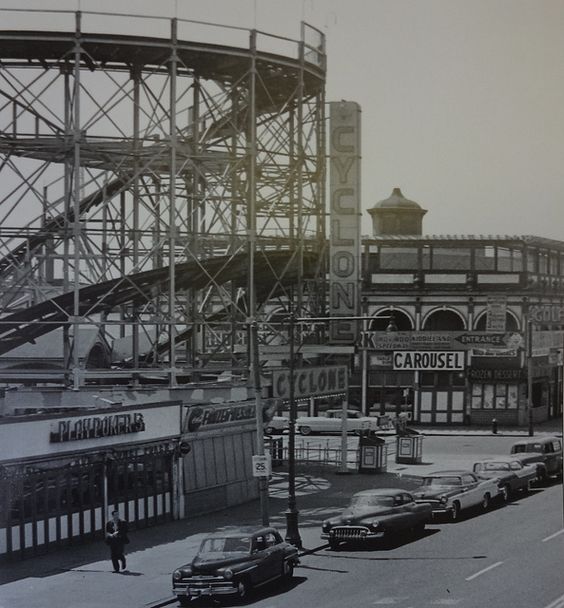
I lived two blocks from the beach and the boardwalk. I loved to go swimming in the ocean and walking the boardwalk. We had two big amusement parks within walking distance, Luna Park and Steeplechase. I preferred Luna Park as it had a circus. It was such fun watching the clowns, the animals, and especially the men and women on the trapeze. Nearby was the famous Nathan’s hot dog stand, where we could buy a hot dog with sauerkraut for five cents.
As there were no televisions, we went to the movies every Saturday. For ten cents, we saw a double feature along with newsreels, a serial, and cartoons. We bought a penny’s worth of candy and enjoyed the entertainment. On rainy days, we stayed indoors, drawing pictures with crayons and reading books from the library. We did not have as many toys as our grandchildren and great grandchildren have today, so we improvised. My brother made a train out of drawers from my father’s Singer sewing machine.
As all little girls, I loved to play with dolls. My mother had bought me a small celluloid doll with moving arms and feet that I could even bathe. I wanted a new doll carriage, but we were in the midst of the Great Depression, and my parents could not afford to buy me one from the store. So, we became creative. A shoebox became my doll carriage. My mother made a hole at the end of the shoebox and put a string through it so I could pull the carriage. The top of the box became the hood. She also gave me scraps of material which I made into a pillow, a carriage cover, and clothing for my doll. With a child’s imagination, I thought that my doll and doll carriage were the most beautiful in the world.
It was convenient to live near the beach, but my neighborhood was not the best. It was all pavement—no flowers and no lawns. One summer, my second-grade teacher thought it would be a good summer project to learn how things grow. The last week of school, she had us bring in a small wooden cheese box and a small potato. She helped us put the dirt that she supplied into the bottom of the box. We cut up the potato, placed it in the dirt, and then covered the potato with more dirt. I placed the potato plant on the fire escape and watered it every day. In July, I was happy to see some green leaves. My parents and teacher had never told me that potatoes grow underground. So, when August arrived, I got so angry that no potatoes had grown on the leaves, I just dumped the plant. I was so surprised to find four little potatoes!
Looking back, I had a very happy childhood. Although we did not have much money, I never felt deprived!
Ever since I could remember, my mother, Frances Cohen, was the family story teller. Give her an opening, and she would regal any audience with stories of her grandparents’ and parents’ lives in Russia, of her early years of marriage to “My Bill,” of their life in small towns and smaller apartments in the North Country, and of raising four children, watching them leave for college and for marriage, and their returning with her grandchildren to visit her and my father in their beloved cottage on Lake Champlain.
For many years, these stories were always told orally. Mom shared them when the family got together around the old oak table in the dining room, when she visited friends, and when her children’s friends came to visit. What was fascinating was that no one ever got tired of hearing them. As a matter of fact, she was highly regarded as the family historian. If anyone needed to know who was related to whom and how my father’s side was related to my mother’s side and what really happened between those two cousins—well, you just had to ask Fradyl, and the truth would be known.
As my parents got older, my mother realized that she needed to record these stories. We never were one for video cameras and tapes, so she began writing them down on lined paper, usually from the six by eight notepads. . The writing was messy, with words misspelled and whole sections crossed out, but she began to put them down on paper.
My parents retired in 1981 and spent the next nineteen years living six months in Florida and six months on a cottage on Lake Champlain. As it became too difficult to maintain two homes, they sold their cottage to my brother and sister-in-law, and my parents lived in Florida permanently. When I went to visit, my mother would tell me the stories as I transcribed them onto paper. Unfortunately, these scraps of paper remained in their original state for several years.
In 2007, after a number of health setbacks, we children insisted that my parents sell their condo in Florida and move back up North to be closer to the family. Everyone decided that the best location would be close to Larry and me, and on May 1, 2007, they moved into Coburg Village, an independent living facility only four miles from our home.
Initially uncertain about leaving Florida, their friends, and their independence, my parents soon realized that this was an ideal living arrangement that provided nightly five-course dinners in a lovely dining room, a shuttle service that brought them to grocery stores and doctor’s appointments, live entertainment and numerous clubs.
Soon after moving in, my mother called me to tell me she was joining Coburg’s monthly writing group to polish all those stories she carried in her head and on those scraps of paper. The night after her first meeting, however, she phoned to tell me she wasn’t sure she would fit in. “Most of them have college educations and write beautifully, Marilyn,” she lamented. “They will look down on my family stories as being silly and boring.” However, when she brought her first story to the group, her accounting of why she and my father moved to Coburg, she was surprised to find that the group enjoyed her writing style. “They loved my story, Marilyn! They said I have a real flair for story telling!” After that, my mother’s voice in phone calls after the monthly Wednesday meetings was filled with pride.
Mom rarely had difficulty finding a topic and writing it down with paper in pen. However, the group leader requested that the stories be typed so they could be published in the semi-annual collection and distributed to Coburg resident. My mother asked me, “my daughter the English major,” to type them, and, while I was at it, to do some proofing and minor revisions so that they would read more smoothly.
Thus began our five-year collaboration. Every month, about a week before the group met, my mother would give me her hand-written story, and I would bring over the typed version by Sunday afternoon. If I didn’t have it done by Sunday night, the phone calls would begin. “Marilyn, if you don’t have the time, just bring back my copy and I’ll read it from the original.” I would assure her that it would be delivered in time for her meeting, even resorting to sending the final copy to her via the Coburg fax machine.
The oral stories evolved into written documents, always original, always entertaining. She wrote about the Old Country: how her mother’s mother died in childbirth and how the two children were raised at first by an uncaring stepmother and then by a loving women who raised them and the seven others that followed; how my father’s father escaped from Russia in a cart filled with hay; what it was like living in Regalia and Vilna at the turn of the century with the fear of pogroms always on the Jewish population’s mind. She wrote about her mother’s family coming to America: how her Uncle Sam saved enough money to bring over his sister Ethel; how Aunt Lil turned down a job at the Triangle Shirt Factory a month before the fire because she thought it looked unsafe; how Grandpa Joe left his future bride at the jeweler’s as collateral until he got a second opinion of the diamond ring they were purchasing. And she wrote about our family: how she and Bill met on a blind date; how they raised four children in various small towns in the North Country, and, and how they came to buy their cottage on Lake Champlain. The stories were funny, sad, and painful, but they were always ready the first Wednesday of every month for her meeting.
When my father passed away in November, 2008, my mother’s contribution for December was an open letter to my father. She wrote that she was moving into a smaller apartment down the hall, but “Wherever I go, you also go in spirit.” Grieving quietly, she continued with her life at Coburg, going to the concerts, visiting with friends and family who were always stopping by to see her, and continuing with her writing. All of the children asked her to write about our birth and early childhood, but she always postponed those stories, focusing on the Old Country, her childhood, her Bill.
On December 22, 2010, my mother had a heart attack. The doctors recommended Hospice and living her remaining time to the fullest. She complied, enjoying visits from the children, grandchildren, her cousins, and the many friends she had made in Coburg and Clifton Park. She kept writing, and in February, with my sister Laura and I sitting close by, she shared her story: “The Birth of My First Child,” in which she described her joy in having a beautiful little girl and her fears that she would not be able to be a good mother. The last words, written in pencil on the bottom, were “To be continued……” She died four weeks later, one day before the March meeting.
My parents were not wealthy people, and had little of material value: a wedding ring, two beautiful framed pictures of my father at thirteen and my mother at six, a few nice dishes. As my siblings and I sadly dismantled Mom’s apartment, my daughter was surprised that I wanted so little. “It’s ok, Julie,” I said, “We have her stories.”
And we do….Over one hundred typed pages as well as a file of her handwritten notes that she had kept over the years. What a gift to her family, her friends, and all who knew and loved this amazing woman!
Since the year that we met, my husband Larry and I have attended Rosh Hashanah—the Jewish New Year—services. We hear the shofar, listen to melodies that we only hear on the High Holy Days, and greet our friendswith L’Shana Tova—Have a good year!
Attending High Holy Day services as an adult is different from my experiences as a child growing up in Keeseville, a small upstate town of two thousand people about ninety minutes south of Montreal. My uncle Paul had opened Pearl’s, one of a chain of small department stores he had established in Vermont and Upstate New York. He hired my father to manage it. Although my parents had both grown up in New York City in Jewish neighborhoods, they had lived most of their married life in overwhelmingly Christian communities. In 1952, however, they found themselves in a town where they were the only Jewish family except for a childless couple, a lawyer and his wife. The next Jewish family didn’t move in until the mid-sixties.
To offset the effects of our non-Jewish environment, my parents immediately joined Congregation Beth Shalom, a Reform temple in Plattsburgh. We attended High Holy Day services and, depending on the weather conditions for the fifteen-mile drive, Shabbat services on Friday night. Saturday services were only held for the boys’ bar mitzvahs; all the girls were confirmed at age sixteen.
In addition to attending services, my parents were insistent on their children getting a Jewish education. For a span of twenty years, our father made the trip up Route 9 every Sunday with whatever number of his children between the ages of five to sixteen were taking religious school lessons. We would arrive in Plattsburgh a half hour early. Then Dad would take us to the newsstand across the street from the temple on Oak Street. He purchased the New York Times for himself and comic books for us, our perk for going to Sunday School. My brother Jay chose Superman; Laura and Bobbie, Archie and Richie Rich; and I, Classics Illustrated. Dad would then wait for us in his idling car —It got cold in that parking lot in the winter—reading the paper and smoking Kents. Over the years, all of us learned Jewish history, customs, and ethics. Jay learned Hebrew for his bar mitzvah. The three of us girls’ Hebrew education was limited to the six-word Shema and blessings over bread, candles and wine. When we got home from school, Mom would have an elaborate dinner waiting for us—brisket, roasted potatoes, candied carrots, pickles, and delicious spiced apples from a jar—another perk for our going to Sunday school.
As residents of Keeseville and members of a temple in Plattsburgh, we were caught between two worlds. As we did not live in Plattsburgh, we often viewed ourselves as outsiders at Temple Beth Israel. My mother, in particular, did not feel comfortable with many of the congregants. A daughter of poor Russian immigrants, she often felt inferior to those who were third or fourth generation German Jews who historically regarded themselves as more educated and refined than those from the shtetls—the small towns with large Jewish populations which existed in Central and Eastern Europe before the Holocaust.
The residents of Keeseville were generally welcoming to our family, and we rarely experienced anti-Semitism. There were moments, however, that are etched in my memory. My parents were usually included, but there were occasional “lost” invitations to events, and we knew some viewed us as different. On rare occasions, the insults were more direct. When I was around six years old, I was playing on my front lawn with my doll. A teenaged boy who lived up the street came by and, giving the Nazi goose salute, yelled “Heil Hitler!” I ran inside crying. Jay, four years older than I, ran out of the house to chase him down and punch him in the nose. When Jay was in high school, the local priest advised his young female parishioners that it was best not to date “Hebrews.” Obviously, this did not help Jay’s social life.
The High Holy Days emphasized this “otherness” even more strongly. We did not attend school on Rosh Hashanah and Yom Kippur. My father closed the store, an event worthy of coverage in the Essex County Republican. Jay, who played football for Keeseville Central, missed every game that fell on the two major fall holidays, again newsworthy enough to make the local paper.
Everyone in Keeseville knew that the Cohens celebrated their Jewish High Holy Days, but I was still sensitive to our being the only children missing school. One Rosh Hashanah, I was pushing my doll carriage in front of the house when I was overcome with embarrassment. What if someone saw me and wondered if I were playing hooky? I went inside to avoid the potential scrutiny and a visit from the truancy officer.
My feeling of “otherness” continued as the seasons changed. Beginning in November, I often had to explain that Chanukah was not the “Jewish Christmas,” and no, we didn’t have a Christmas tree or a Chanukah bush. As soon as we returned to school from the Thanksgiving break, the music classes I attended and, later, the choruses I joined in junior senior high, were filled with Christmas music. I could handle “Little Town of Bethlehem” and “Deck the Halls.” When it came to the line in “Silent Night” which stated “Christ the Savior is born,” however, I would just mouth the words. The token inclusion of the song “I Had a Little Dreidel” didn’t make me feel that the school was sensitive to my religion and culture
Other events brought their challenges. Passover often fell around Easter, and I watched my Christian friends devour bunny shaped chocolate eggs and jelly beans while I nibbled on my dry matzoh and butter. Once again, I felt different. In high school, my World History textbook reduced the Holocaust to the iconic 1943 picture from the Warsaw Ghetto of a German soldier pointing his machine gun at a little boy, clad in a coat with the yellow star, holding up his hands in terror. I can still remember looking down and crying silent tears while the teacher quietly and sympathetically moved on to the next topic. I understood clearly that the horror of the persecution of the Jews was diminished by this negligible treatment of the Holocaust in our textbook.
For many years, I saw other Jewish children mostly at Sunday School. As I got older, I joined a Jewish youth group and finally had Jewish friends. For the most part, however, our friends were our Christian classmates from Keeseville. We all dated in high school, but my parents pressed upon us their wish we would leave Keeseville after we graduated and make our lives in settings with more Jewish people.
In part because of my desire to be with other Jews, I enrolled in University of Albany in 1968. While at college, I attended High Holy Day services at Congregation Beth Emeth, but that was the extent of my Jewish participation until I met my future husband in 1973.
Larry and I attended High Holy Day services at Congregation Shaara TFille, the then-Orthodox shul—synagogue—in Saratoga to which his family belonged. What a dramatic difference for me! Men sat in the center pews, and the women, although not behind a mehitzah, (a curtain which separated the men from the women), sat in the back or on the sides. Most of the service was in Hebrew, and everyone prayed at what seemed to be lightning speed. Page numbers that were displayed on a chart on the bima provided my only means of following along with the prayer book. The services were much longer than those at Temple Beth Israel, and even the rabbis, with their black beards, payots (side curls), and yarmulkes (skull caps), were strange to me. In many ways, it was as foreign to me as the churches I had attended on occasion with my Christian friends.
After Larry and I were married, we bought a home in Clifton Park, a suburb of Albany, New York, in part because we knew that a synagogue had recently been built in the community. We joined in 1983, and we found that the Conservative service was a good compromise between Larry’s Orthodox shul and my Reform temple. Ten years later, I celebrated my own bat mitzvah on my father’s eightieth birthday, my way of honoring his commitment to our Jewish education.
Throughout my life, people assume that I, like many Jews, was brought up “downstate,” in New York City or Long Island. When I tell them about growing up in Keeseville, they comment, “That must have been hard!”
It had its challenges, but it also offered wonderful opportunities. I grew up in a loving, close knit family, developed lifelong friendships, and enjoyed the beauty of Lake Champlain and the Adirondacks. I proudly identify myself as an Upstate New Yorker, with roots still entwined in that tiny town an hour south of the Canadian border.
Because of my unique upbringing, rather than losing my Jewish identity, my faith grew stronger. I could never take being a Jew for granted. And having a faith I had to hold on so tightly to maintain makes each High Holy Day, each Jewish milestone, even sweeter.
A version of this story was published in The Jewish World, August 29, 2013. I am finally posting it on my blog eleven years later!
Marilyn and Larry Rosh Hashanah 1973 (Shh! We were engaged but didn’t tell anyone yet!)
This story was written by my mother, Frances Cohen. A master storyteller, Mom joined a writing group when she was 87 years old. This is one of her many tales about her life captured in Fradel’s Story, available on Amazon in both Kindle and paperback format. Click here for the link. I have posted this on August 20, 2024, which would have been my parents’ 74th anniversary.
They say that all marriages are made in heaven. My parents also had help from my Grandma Vichna.
My mother Ethel was the oldest daughter of nine children, who all eventually immigrated to the United States from a small hamlet called Rogala, which was part of Lithuania.
Joining the wave of Jewish immigrants who came to the United States at that time, Ethel, only fourteen years old, arrived at Ellis Island in 1899. It was the era of horse and buggy. Garfield was president of the United States. It was quite an ordeal for a child to leave her parents, cross an ocean by steerage and then find a way to support herself. But with the help of her older brother Sam, who had come to America a few years earlier, Ethel settled in New York City, got a job, and lived with different relatives.
Two years after Ethel arrived in America, Ethel’s older brother Sam married and moved to Baltimore. My mother was really struggling, as she worked in a factory making umbrellas for only three dollars a week. So her brother and his wife invited her to come and live with them in Baltimore. While Ethel was living in Baltimore, four more of her siblings arrived in the United States.
In 1910, Ethel’s father passed away and the six children who had settled in the United States saved up $75 to pay for steerage for Grandma Vichna and the three youngest children. The four of them settled in the Lower East Side of Manhattan.
It was a very difficult time for Grandma. She was in a new country, not knowing the language or the customs. But Grandma was an amazing woman and kept her family afloat. And with all her problems, she was most worried that her Ethel was 27 years old and not married.
Every Sunday, all the friends from the Old Country would love to congregate at Grandma’s as she was an excellent cook. One day, a young man by the name of Joseph Cohen came to visit. He told Grandma that he had a job in a factory as a tailor making $13 a week, a good wage at that time, but was lonely and sleeping at his sister’s on a cot. Grandma said, “What you need is a wife, and I have just the girl for you….my Ethel!”
The problem was that Ethel was living in Baltimore, but that situation was soon solved when Joseph courted Ethel by writing letter and traveling the long way to visit. Ethel eventually returned to New York City to live with Grandma and be closer to Joseph.
And so the romance continued to blossom. Every Sunday, Joseph came to visit to see Ethel and to feast on Grandma’s cabbage soup and other goodies. Joseph bought Ethel a warm winter coat and other presents. (Later I would tease my mother that she was a kept woman!). After courting Ethel for several months, Joseph took Ethel to the jeweler and they picked out a diamond engagement ring. Wanting to make sure the price offered was fair, Joseph left Ethel for security so he could have the ring appraised, returned soon, and purchased the ring for $100.
Soon, Grandma Vichna was busy arranging a big wedding for her Ethel. In 1912, one could rent out a banquet hall for a big event. The host didn’t pay for the hall, but everyone who attended had to pay a 25-cent “hat check.” All the friends from the Old Country helped cook up a storm, and my parents were married in January 1912.
The week after my parents were married, my mother made a cabbage soup. My father said, “Ethel, please dot no make cabbage soup. I am tired of cabbage soup. I don’t even like cabbage soup!” My mother replied, “You always thanked my mother for her delicious soup.” My father replied, “It was the proper thing to do. I didn’t like the soup! It was my way of saying thank you for giving me a lovely bride!”
Ten months after the wedding, my brother Eli was born. I followed in 1917. My parents shared over fifty-four wonderful years together until my mother passed away in 1966 at the age of 82. Bereft, my father left New York City came North to live with my family until he joined his beloved Ethel in 1968.
A version of this article originally appeared in theJewish World News, a bi-weekly subscription-based newspaper in upstate New York.
Grandpa Joseph Cohen Circa 1912Ethel Ossovitz Cohen Circa 1912Grandma Ethel and Grandpa Joe ~1950. I love the love seen in my grandfather’s eyes.
This article was published in the Orlando Heritage Florida Jewish News on February 23, 2024. Thanks to Christine Sousa, Editor, for all her support!
This March, Marilyn Shapiro celebrated a milestone in her writing career: the tenth anniversary of her blog, There Goes My Heart.
Wait! You don’t know she has a blog? And if you knew, you have never typed www.theregoesmyheart.me into your browser? Well, you don’t know what you have been missing!
In 2014, with only about 10 stories published in the Capital Region, New York’s The Jewish World, Shapiro decided that she needed a blog as another way to share her stories and to appease her inner geek. After researching a few options, she chose WordPress, “a web content management systems that was user friendly for even newbies like me,” she shared.
Along with home page and contact pages, Shapiro posted her first 10 blog posts. Leading the list was “There Goes My Heart,” her very first article that was published in August 2013. Fittingly, Shapiro chose it as the name for her blog. She was in business!
When Shapiro and her husband, Larry, moved to Florida in 2015, with over 20 articles under her belt, she met with a neighbor who taught computer classes in the Shapiro’s community. Working with her, Shapiro was able to add more bells and whistles, including a Home Page menu that provided access to her increasing list of articles. A “Follow” button encouraged readers to sign up to get my blog post delivered to their email accounts.
By 2018, with two published books to her credit, she added a “Marilyn’s Book” page. Along with a summary of her essay collections, it offered the user the ability to click directly onto the Amazon website, where one could purchase a Kindle or paperback version.
Shapiro now has four books listed: “There Goes My Heart” (2016), “Tikkun Olam: Stories of Repairing an Unkind World” (2018), “Fradel’s Story” (August 2021), and “Keep Calm and Bake Challah: How I Survived the Pandemic, Politics, Pratfalls, and Other of Life’s Problems” (2023). She even offers a preview of her fifth book, “Under the Shelter of Butterfly Wings: Stories of Jewish Sacrifice, Survival, and Strength.”
Many of Shapiro’s articles are personal: her ancestors’ lives in the shtetl before immigrating to America; her childhood in a small town in Upstate New York; meeting Larry at a Purim party, their years raising two children; their retirement years, their travels and their growing family. Some are humorous: Their love affair sealed in (a kidney) stone. Her daughter’s not-so-welcoming attitude when Shapiro volunteered to chaperone her daughter’s school trip. Receiving the moniker “Bubbe Butt Paste” after the birth of their first grandchild. And some are more profound: Larry and Marilyn’s visit to a Holocaust memorial after the Pulse tragedy in Orlando; wintering through the pandemic; reflecting on the Israeli-Gaza war during the eight days of Chanukah.
In 2017, Shapiro wrote an article about Harry Lowenstein, a Holocaust survivor (published in the Heritage, “A Holocaust survivor revisits his past,” May 19, 2023).
“Its impact on me resulted in expanding my writing to include heartfelt stories about ordinary people with extraordinary stories to tell: other Holocaust survivors, righteous gentiles, Jewish immigrants, cancer survivors, and advocates for the less fortunate. The interviews and research necessary to write the articles have expanded my knowledge on many topics, which I have hopefully passed on to my readers,” Shapiro said.
Ten years later, Shapiro’s blog continues to grow and flourish. She has approximately 220 articles, many with accompanying photos. She has 447 followers, a number that I hope will continue to grow. And thanks to hashtags such as #Jewishlife, #Holocaust, #Hanukkah, #neworleans, and even #pickleball, I get “Likes” from around the world. The page “Marilyn’s published articles from around the world” now includes those from Orlando’s Heritage Florida Jewish News, as well as websites as far away as Australia.
If you are a subscriber and are enjoying Shapiro’s blog, she would love to hear from you. You can type a note in the “Comment” section at the end of the blog, and she will respond. Shapiro also encourages readers to share her posts and even her blog address with friends and family who may enjoy them.
“And for those of you who still haven’t given my blog a try, take a look!” Shapiro added.
Shapiro’s blog is at www.theregoesmyheart.me. Usually she posts every two weeks, so you will not be overwhelmed with emails from her.
Who knew that one article in 2013 would lead to so much? For this writer and computer geek, Shapiro is having fun!
In mid-December, Central Florida was experiencing a cold snap, and I decided to make chili. I had the canned tomatoes and chopped green chilis and the soy meat crumbles for the recipe, and I had all the ingredients for cornbread, a must whenever I made it.
Once I checked my pantry, however, I realized I was out for canned beans. No problem! I had been meaning use up the dried red kidney beans tucked away for a while.
What I quickly realized that the “while” was at least 9 years. Yes, as evidenced by its Price Chopper label, I had brought the beans with me when we moved here in 2015. Meanwhile, I had no idea how long ago before our move from Upstate New York to Florida when I had purchased them. I knew that archeologists had found barley and other foodstuffs in storage in Masada, and a woman in Minnesota had grown pole beens from 15,000 year old seeds. What did I have to lose?
So, on that cold Friday, as per instructions, I soaked the beans overnight. The next morning, I boiled the beans and then let them simmer for another hour. As I was going to make the chili on Monday, I put the beans in a large container, covered them with water, and placed them in the refrigerator. The beans weren’t as soft as they should be, but I figured the extra soaking would do its magic.
On Monday morning, I placed the drained beans in my slow cooker with all the other ingredients for the dish. Despite the 36 hour soak, the beans STILL were a little hard, but I reasoned ten hours in the slow cooker would resolve the issue.
That evening, I made the cornbread and assembled the shredded cheese, onions, and sour cream to top the chili. We were ready to eat. I dished out two large bowls for Larry and me.
My teeth bit into a red kidney bean. Al dente is fine for pasta, but for chili? The dish was barely edible. We picked around them and filled up on cornbread and the other chili ingredients. The glass of red wine also helped.
As we began to clean up, I realized we had made only made a small dent into the chili. “Maybe if we freeze the leftovers, they will soften a bit,” I told Larry, portioning out another meal into a frozen container. I still had another meal in the pot.
Time to consult Chef Google! The first thing I learned was those ancient beans and barley may have been found, but they had not been cooked. And nine-plus-year-old-beans were too old. Farther down the website, Chef Google suggested adding baking soda to beans to soften them.
Okay! I pulled out my Arm and Hammer and spooned out a heaping teaspoon into the still warm chili. Immediately, the mixture began to erupt like a volcano. Fearing they would explode out of the crock pot, I screamed to Larry to empty the sink so I could dump the mess down the garbage disposal. Fortunately, they stopped their explosion and even didn’t result in a clog.
I guess I should have read the instructions better. The baking soda should have been added to the “virgin” beans when I first boiled them. Adding the sodium bicarbonate to the chili mixture, which contained acidic tomatoes, replicated what happens when one combines baking soda and vinegar. Remember your childhood/children’s science experience? Yep! That kind of explosion.
Over the next few days, I shared my experience with several friends. Betty, a retired home economics teacher, suggested newer beans. Several others suggested using canned beans. Marcella, who grew up in Costa Rica and was an expert on rice and beans, suggested I trade in my slow cooker for a new appliance.
I was a little intimidated with the instruction manual, which began with 27 IMPORTANT SAFEGUARDS!!! along with two more pages of warnings that rivaled those found at nuclear power plant. A highlighted block stating “Failure to adhere to safety instructions may result in serious personal injury or property damage” was repeated five times.
After doing a test run, I spent the next few days trying out my new toy. Hard boiled eggs? Perfect! Rice? Perfect! A whole roasting chicken in 28 minutes? Perfect! Butternut squash? Perfect! The only fail was my attempt at mashed potatoes. The finished spuds were brownish grey and turned into a sticky mess when mashed. Those went in the freezer (Maybe they could serve as a base for my potato latkes later that month?) next to the container labeled “11/20/2023 Chili with Bad Beans.”
And the chili? Larry purchased a fresh, one pound package of red kidney beans on one of his recent shopping trips. They are still sitting in the pantry waiting for another cold snap.
As I write this, we are approaching the secular New Year’s Day, January 1, 2024. According to Southern tradition, eating black-eyed peas on New Year’s Day will bring a year’s worth of good luck and/or monetary gain. Google came up with over 5 million hits for “Black Eyed Peas Chili. [Black-eyed peas are also traditionally served on Rosh Hashanah. Who knew?] Maybe it’s time for another run to the supermarket to start our own tradition, hopefully sans Mount Vesuvius. I’ll keep you posted.
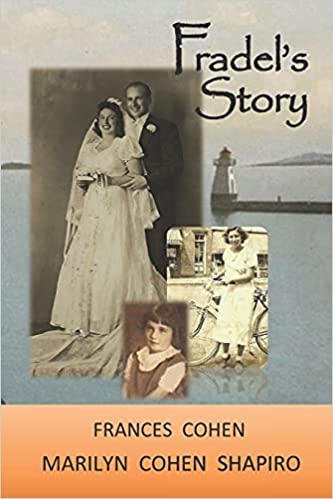
The article below was written by my mother, Frances Cohen. It is part ofFradel’s Story, a collection of stories I edited and published in book form in September 2022.
I’m so lucky that my mother had lots of siblings. I was surrounded with lots of loving aunts, uncles, and cousins. Of all the relatives, I was closest to my Aunt Rose, Uncle Ruby, and their older son Elliot.
My first memories of my Aunt Rose were when I was very young as she spent a great deal of time with me. She made clothes for me and even sewed some of the clothes for my trousseau. After Bill and I were married, Aunt Rose taught me how to cook. As the mother of two sons, she treated me as the daughter she never had.
Aunt Rose and Uncle Ruby had a wonderful marriage that lasted almost a half a century. They met under very romantic circumstances. Rose worked in New York City in a factory. One rainy day, she was walking home from work and went into a restaurant on Delancey Street to get out of the downpour. As fate may have it, Uncle Ruby was her waiter. Visiting over coffee, Ruby told the poor girl, who was drenched and disheveled, that he was to be finished very soon for the day. Since he had an umbrella, he would be glad to walk her to her home, which was just across the near-by Williamsburg bridge.
When Aunt Rose arrived home, her mother saw how infatuated Aunt Rose was with this tall, handsome guy. Her mother invited Ruby to stay for dinner. That first dinner led to many other dinners. Vichna, ready to feed everyone, would serve herring, boiled potatoes with sauerkraut, and homemade cake and challah. The romance flourished, and they were married within the year.
Soon after they were married, Uncle Ruby lost his job as a waiter. It was the Great Depression, and restaurants did not need as much help. Aunt Rose and Uncle Ruby moved up north to join the family in working at one of the many Pearl’s Department Stores. Ruby eventually opened his own store, Ruby’s, in Brushton, New York
Everyone loved Ruby as he had a wonderful sense of humor. When one of his customers complained that the underpants she bought at his store had holes in them, Ruby said that those were for ventilation. Uncle Ruby hated the Yankees, and he rarely missed their game on the radio just to cheer on the opposite team. At family get-togethers in our home in Keeseville, he would often sneak out to his car, turn on the radio, chew on Chiclets gum, and curse out “those damn Yankees!”
Aunt Rose and Uncle Ruby lived happily in Upstate New York and, although the only Jews in the town, were beloved by everyone. When Aunt Rose died just before their planned fiftieth anniversary party, her funeral was held in Burlington, Vermont. Even though that was 100 miles from their hometown, all the stores in Brushton were closed for the day so that everyone, including the local priest and the minister with his family, could attend the funeral,
Ruby missed his Rose. When he got lonesome, he would put a sign in the window of his store that stated, “Closed for Jewish Holidays” and travel to visit his children and grandchildren.
Ruby lived until he was ninety years old. His funeral, which was held in Burlington, Vermont, was also hugely attended as he was beloved by all the family and the many friends he and Rose had made during their lifetimes. During his eulogy, the rabbi said, “Ruby was not a religious man, but he took more time off for the Jewish holidays than anyone else I ever knew.”
As I mentioned before, Ruby and Rose had two sons, Elliot and Sol. I was especially close to their elder son, Elliot. When things were bad during the Depression, Elliot would spend the summers with my family in New York City. I’m forever grateful to him for introducing me to my husband. Elliot was best man at our wedding, and he drove the car that we took from New York City up north after our honeymoon. It an unforgettable trip. I sat in the front seat with Elliot and Aunt Rose. Bill sat in the back seat with all the wedding presents, including a floor lamp that Bill had to hold for the eight hours. As adults, we remained very close and have spent much time together in Florida and up north. Elliot and his wife Florence were at our fiftieth wedding anniversary. After Florence passed away, Elliot remarried. We have remained very close to Elliot and his second wife Marty. In May 2010, I went down to Staten Island to celebrate his daughter’s sixtieth birthday. I sat with Elliot and visited as if we were still children.
I am very grateful for our relationship with Ruby, Rose, and their family. They very much enriched Bill’s and my life.
Photo of Fran’s aunts and uncles is from Marilyn Cohen Shapiro’s family photo collection. Both Ruby and Rose are standing in the back row. Ruby is second from left; Rose is third from left.
I love Chanukah. I love lighting the candles in our darkened dining room. I love potato pancakes served with applesauce. I love coming up with creative gifts for my children. What I don’t love about Chanukah is trying to make it more than it is.
Chanukah is a minor festival on the Jewish calendar that just happens to usually fall at the same time as the major holiday on the Christian calendar. While I was growing up in Keeseville, my parents never tried to compete with Christmas. However I think my friends felt sorry for me and tried to make it something it wasn’t. Their first response was often, “But you still have a Christmas tree, right?” No, we didn’t’ have a Christmas tree. And no, Santa did not come down our chimney. And no, we weren’t going to have a ham on December 25th, even if it was on sale at the local A & P for thirty nine cents a pound.
The way we handled it was to share our holiday. We invited our friends to our house to help light our candles and eat potato pancakes, and we gladly went to their house to help decorate their Christmas trees. In that way, we all got to the best of both worlds, two holidays with two very different meanings, each of us maintaining our own identity.
The yearly school challenge was the winter concert. I participated in both Keeseville High School’s band and chorus, and all the music for the December evolved revolved around Christmas carols and songs. Playing Silent Night on my clarinet was fine, but singing the lyrics with the chorus made me very uncomfortable. I would compromise by mouthing certain parts of the song, especially phrases that referred to Jesus as “Christ Our Savior.” As much as I felt overwhelmed by all the Christian songs, I felt even more uncomfortable with the token Chanukah song that was included in the program. The music teachers always chose Dredyl, Dreydl, Dreydl or some other lightweight piece of music that completely under-valued the meaning of our holiday. I think I would have been happier if the Chanukah song was left out entirely. It wasn’t a big holiday. And the fun came in the small things, the small traditions, traditions that Larry and I have carried down to our children.
On top of the list is making potato pancakes. The first year we were married, I decided to make them in my new blender. The chunks of potatoes kept getting stuck on the bottom so I stopped the blender and scraped, then stopped the blender and scraped, then got lazy and just scraped. The moving blade picked up the spatula, flung it to the ceiling along with half the contents of the blender, and then dropped the mess on my head. My expletives brought Larry into the kitchen. He took one look at me, my face covered with potato pancake gook, and walked out. I took out the grater.
Potato latke making became easier when my mother-in-law gave me a food processor for Chanukah the following year. Even so, I’ve had a couple of missteps over the years in my attempts to making them healthy. I’ve made them in the oven to avoid the oil, but main reason they were healthy was that my family refused to eat them, much preferring the oil-laden version that makes the holiday. For them, and even for me, the taste of a crisp, oily potato pancake melting in the mouth is worth the calories, the mess preparing them, and the massive clean-up that usually involves scrubbing down all the cabinets to get the residue oil off them.
My children have fond memories of my sugar cookies that we cut out with the six-sided cookie cutter I had gotten in the Congregation Beth Shalom gift shop back in the early eighties. I always would start out with lots of enthusiasm, happily rolling out the dough and putting them on the aluminum baking sheets. This enthusiasm would last for about two baking sheets worth. Then the dough would start to tear, the thickness of the cookies would be inconsistent, the thin stem of the menorah would break, and the little tops of the dreydls would fall off. The children would settle for the stars and Torahs and scrolls as those shapes held up the best, holiday symbol be darned.
Another tradition has been the annual candle lighting race. Larry brought this tradition in from his home, and my children caught on very quickly. Each of us would choose a candle that we thought will win the “Burning the Longest” award. No jarring or poking was allowed, and the last wick to flicker out is the winner. As the days of the holiday and number of candles progressed, there was more to watch. By the final night, we usually sat around the candles to just savor the flickering lights and to cheer on the last one for that Chanukah season.
Gifts always have been part of our Chanukah tradition. When our children were very young, however, we realized quickly that a gift each night seemed forced, so we mixed it up with a dinner out, a movie, and a volunteer opportunity that worked especially well if Chanukah and Christmas fell around the same time. As our children now live in California and Colorado, managing long-distance gift giving is a challenge. Their presents have changed from Star Wars action figures to San Francisco Symphony gifts certificates for Adam and from Cabbage Patch dolls to Colorado photography for Julie.
Larry and I decided a few years ago that Chanukah is more about candles and potato pancakes and time with friends, and we no longer exchange gifts. For the past few years, a group of us empty nesters have gathered around Toby and Arnie Elman’s dining room table, first to light the candles on our menorahs and then to share a dinner of dairy foods, potato pancakes, and Toby’s fantastic home-made plum laced applesauce. We top it off with fruit and my homemade chocolate chip cookies, a recipe that seems much more successful and crowd pleasing than my sugar cookies.
This year, Thanksgiving and Chanukah will occur on the same day for the first time since 1888 and, according to one calculation, an event that won’t happen again for another 77,798 years, Larry and I will be celebrating Thanksgivukkah with over thirty people at our cousins’ annual get-together in Argyle. Our “traditional” meal has always been eclectic: the traditional turkey, stuffing, potatoes, squash, and cranberry sauce; the chapchae, an Asian noodle dish that our Korean cousin makes every year; the tofurkey for the vegetarians; the Asian pears brought in from New York City; my sister-in-law’s decadent broccoli casserole; the pies from Riverview Orchards; and the Krause’s chocolates from Schenectady. This year, our celebration will include, for the first time, potato pancakes and apple sauce. And maybe, just for the fun of it, I will make the sugar cookies. Dredyls and turkeys sound a good combination, at least for a once-in-a-lifetime Thanksgivukkah celebration!
A version of this article originally appeared in the November 21, 2013,Jewish World News, a bi-weekly subscription-based newspaper in upstate New York.
On a June morning in my tiny town in New York’s North Country, Mrs. Ryan’s kindergarten class was preparing for our upcoming graduation. Parents had gotten invitations; our caps and gowns were on order.We practiced the songs and poems we were to sing together. In my eyes, a few fortunate children had solos, which they had brought home to memorize.
Eager, But For What?
Two days before the morning event, one of my classmates announced to Mrs. Ryan that she didn’t want to recite the poem to which she had been assigned. The teacher asked if anyone else would like to do it. My hand shot up like a rocket. “Me! Me!” I shouted from my tiny chair.
For the next two days, my mother patiently worked with me to memorize the piece. I honestly don’t remember the name of the poem or the words, but the short verse talked about being ‘little’ and ‘big’ and ‘growing up.’ (If any of you have a copy of this poem, please send my way!)
Wrong Lesson
That graduation morning, our class, donned in white caps and gowns, marched into the Keeseville Central School auditorium proudly marched. We recited the pledge of allegiance and sang some songs. It was soon time my big moment. I walked to the center of the stage, recited half the poem, and then —gulp!— forgot the rest. The principal, Edward Long, gracefully ended my performance. But I never forgot my first time on stage and how I blew it.
Recently, I felt I was reliving my first public performance 66 years ago when I volunteered again to fill in with a mere 48 hours to learn my part.
A few days before Rosh Hashanah, Larry and I had run into Susan and Jonathan Shopiro, fellow members of Congregation Shalom Aleichem. Both talented musicians, they both had sung in both secular and synagogue choirs. Jonathan, a competent flute player, had regularly played with our previous rabbi at temple services. Susan is an accomplished violinist who had recently inherited her grandfather’s fine century old violin.
In the course of our conversation that afternoon, I shared with them how I had reconnected with my piano after almost a year of a shuttered keyboard. What didn’t feel right during the pandemic felt almost necessary for me now that we were in the New Normal. Despite several years of lessons and countless hours of practice on the Yamaha upright that we purchased in 1982, I never considered myself as an accomplished pianist.
As Larry and I were driving home from the beach the Friday night before Rosh Hashanah, we got a phone call from Jonathan.
“Did you see the email about Rosh Hashanah services?” he asked.
“No, we have been on the beach all day. What is happening?”
Our rabbi’s wife serves as our cantor. Sadly, her father had passed away the previous day, and she needed to fly to Long Island to be with her family. Marilyn Glaser, our shul’s president, asked the Shopiros to step in to provide the music in her place. Remembering our recent conversation but obviously ignoring my personal assessment of my skill level, Jonathan asked me if I would be interested in accompanying him on the piano.
Ain’t No Stopping Her
Larry quickly weighed in. “I think she needs to pass on this,” he told Jonathan on our car’s speakerphone. “She doesn’t play in public.”
With the same bravado I had demonstrated at my kindergarten graduation, I ignored my husband’s words and expressions and plowed ahead.
“Email the music to me,” I told Jonathan. “I’ll look it over and call you later this evening. “
Once we got home, I printed out familiar songs I recognized from my years of synagogue attendance: Ki Mitziyon, Rom’mu,Shalom Rav, Avinu Malkeinu, and Debbie Friedman’s beautiful rendition of the Mi Shebeirach prayer. Most of the sheet music consisted of just the melody line.
Pinch Hitter Again
Never mind that despite years of childhood lessons, I was not an accomplished musician. Never mind that I had never played in public, preferring an empty room with only a close family member near by. But with the help of Dan Coates, who had published many easy-to-intermediate level sheet music collections, I had been banging away on the ivories with happy abandon for years. Just a week before, I had bravely played for a friend while she perused my ridiculously large stack of sheet music that dated back to my sister’s lessons in the 1950s. Her praise regarding my playing gave me the needed boost of confidence. After a couple of run-through with the music on my piano, I called Jonathan back and told him I would give it the old congregational try.
The Way to Carnegie Hall
The next day, with a couple more of hours of practice under my belt, I met with the Shopiros and we practiced together.“Do you think we can do this?” I asked Jonathan and Susan.
“Yes, we can do this!” they reassured me.
As I was already having three people for Rosh Hashanah, I extended the invitation to the Shopiros as well. Over the next twenty-four hours before the scheduled 7 p.m. Sunday service, I practiced my parts in between preparing dinner: chicken, potatoes, green beans, fresh challah, and my chocolate chip cookies.
Larry stepped right up to the task as well, serving as my last-minute sous chef, table setter, pot washer, and last minute supermarket runner
Larry and I met the Shopiros an hour before services for one last practice session. Due to some health concerns, Susan was unable to play the violin, but she would be the lead vocalist as needed. Thanks to Jonathan’s expertise and great job of covering up my mistakes, we left that evening feeling that, while no one would mistake us for professionals, we had contributed to and enhanced the service.
Monday morning’s “performance” went even smoother. I had gained confidence. I was—after all— not exactly playing Chopin’s “Etude in G Sharp minor.” I was playing a melody line in easy keys, Jonathan played harmony on the flute; the congregation readily sang along. It was—for this reluctant recitalist—pure joy.
That afternoon, as seven of us sat around our dining room table, Larry made a toast to my “first and last” public piano performance.
Or maybe not. Jonathan would love to continue contributing his talents to future services. I certainly won’t mind accompanying him on a couple of songs, especially my personal favorite, the Mi Shebeirach prayer. These fingers are itching for another congregational try.
First published in (Capital Region, New York) The Jewish World November 11, 2022.
I listened to Trudi Wolfe-Larkin and Marilyn Wolfe tell the incredible story of their parents’ Holocaust survival. Then through the sisters’ efforts, I watched over six hours of interview that Yolie and Irving Wolfe, their parents, had recorded for Steven Speilberg’s Shoah Foundation.
I knew that their story must be written and preserved for the Wolfe family and posterity.
Trudi Wolfe-Larkin and Marilyn Wolfe learned at an early age that their parents, were Holocaust survivors.No, Irving and Yolie Wolfe did not have a number carved into their arms, but they had emotional and, for their father, physical scars of their lives under Nazi Germany.
Through their childhood, the two siblings overheard conversations Yolie had with other survivors who were their parents’ close friends. As Trudie and Marilyn learned more about the Holocaust, they would ask questions. Although Irving brushed off any inquiries with “I don’t want to talk about it,” Yolie was more forthcoming and shared more details with her children when she felt they were old enough to absorb the horrors. In 1995, when they were in their sixties, Yolie and Irving finally shared the full extent of their experiences in ten hours of combined interviews that are part of the United States Holocaust Memorial and Museum.
Irving Wolfe was born in Czestohowa, Poland, in 1926, the third of the four children of David and Gittel Wolfowicz. Although they celebrated the major Jewish holidays, they were not a religious family. David provided a comfortable life as the owner of successful women’s coat manufacturing company. When the family located to Sosnowiec, their large apartment housed their father’s business.
All of this changed in September 1, 1939, when Germany invaded Poland. Sosnowiec was one of the first towns to fall, and persecution of its 30,000 Jews was swift and brutal. The synagogue was burned, and beatings and arrests of its prominent leaders began immediately. Jews were forced to wear yellow stars and faced restrictions. Nazi round-ups ranging from small groups to thousands of Jews crammed into a local soccer stadium resulted in deportations to concentration camps.
Thirteen-year-old Irving, who many thought had Aryan features, was drafted into delivering papers and messages for the Jewish underground. As the noose tightened, Jews were forced to move into smaller Jewish areas. By June 1942, the Wolfowicz family, along with the remaining population of Sosnowiec and Jews from surrounding communities were herded into the Środula district. Soon after, Irving was caught up in a round-up. As he had no identification papers, he was arrested and sent to a forced labor camp.
Over the next three years, he and fellow prisoners dug ditches, cleaned cesspools and latrines, and built more barracks to house more Jews who would either be used for forced labor or would be sent to the gas chambers.
In all of his time in a variety of forced labor camps, Irving remembered no acts of kindness from his captors. Each day was a series of kicks, slaps, and beatings. He and fellow prisoners subsisted daily on an eighth of a loaf of bread and watery soup.Prisoners were awakened in the middle of the night and forced to run around the compounds in the bitter cold. And they were forced to watch fellow prisoners who committed even the smallest infraction executed by the Germans.
The lowest point in what were horrible circumstances came in the fall 1943. One night, an SS guard charged into the area, demanding to know who had stolen a potato. When Irving refused to name the guilty party, he was severely beaten in front of his fellow prisoners. The man he saved never forgot Irving’s kindness, and they remained fast friends throughout their lives.
The remaining years passed in a blur of pain and hunger and disease, which included a bout with typhus that nearly killed him. His final stop was the Reichenbach, which he had “helped” build. On May 9, 1945, Irving and other survivors woke up to silence. All the Germans had left the camp, but those that were left behind were afraid to leave as they didn’t know if the electric barbed wire fences was still operational. The next day, Russian soldiers, led by a Jewish captain, liberated the camps.
Irving returned to Sustevich, his former home, where he learned that the ghetto had been liquidated in 1944, and Irving’s parents and sisters had been killed in Auschwitz. His older brother, who had been arrested earlier in the war, was never heard from again.
The war had done little to curb the virulent anti-Semitism that had always existed in Sustevich, Irving reported, and he was greeted with taunts of “They should have killed you too.” He relocated to Krakow for job training, only to be witness to the first pogrom in post WWII. On August 9, 1945, false accusations of “blood libel” —Jews murdering Christian children for their religious rituals—resulted in attacks and beatings of Jews; the robbing and vandalism of their homes; the destruction of a synagogue, and the murder of a 56-year-old woman who was a Holocaust survivor.
Irving decided to find safety in the Wetzlar displacement camp in the Frankfort district of the American-occupied zone, After hospitalizations due to tuberculosis and skin infections at the site of his 1943 beating, Irving enrolled in a precision mechanics program at the Organization for Rehabilitation through Training (ORT), which provided rehabilitation for Holocaust survivors. While there, he filed the paperwork needed for his planned emigration to Israel. His plans changed, however, when he met another Holocaust survivor.
Yolie Goldstein was born in Sarospattak, Hungary, in 1927, the youngest of five children. Her father, a tailor, headed a religious family. He attended a minion each morning, and the family kept kosher.
The Nazi’s “Final Solution” came to Hungry much later than it had to Poland as Hungary had originally aligned with the Axis Powers. Hungary, which had never followed the draconian measures against its Jewish population, attempted to establish an armistice with the Allies, but in March 1944, German forces occupied Hungary and began rounding up 800,00 Jews who had previously been protected by the previous government’s policies.In June 1944, the Goldstein family, including Yolie’s parents, her brother Jack, and her sisters Dawn and Rosalie, were packed with fellow Jews in packed train cars for the three day trip to Auschwitz.
Yolie’s mother was determined to keep Yolie, her youngest, close. But
Yolie’s mother was determined to keep Yolie, her youngest, close. But during the selection process, a German guard quietly told Yolie’s mother to let her join her sisters. The three sisters were processed, shaved, showered in ice cold water with lye soap, and given raggedy dresses. Hope of seeing their mother again disappeared like the smoke from the nearby chimney that towered over the camp. “Those first weeks were the worst,” Yolie said in her Shoah Foundation interview. “We were sitting around doing nothing and waiting to die.”Yolie clearly remembers seeing the ‘angel of death,’ Dr. Josef Mengele, several times during those first months in the concentration camp.
In September 1944, the three sisters were among the 300 women selected by the Nazis to work in a munitions factory, where they built airplane parts. The living situation was similar to what Irving had experienced: sleeping conditions in barracks overseen by the SS, a near-starvation level diet, and fears of beatings and execution. The only ray of hope were rumors of Germany’s pending defeat.
In late winter, the surviving factory workers were forced to march to another munitions factory, only to find it had already been shuttered. They were then sent to Bergen-Belsen, where Yolie and others faced a nightmare many considered greater than Auschwitz.
Yolie and her sisters joined the 60,000 starving and mortally ill people who were packed together without food, water or basic sanitation. They saw with horror thousands of unburied bodies lying in the open. The long-awaited end to their captivity came when British forces liberated the camp on April 15, 1945, only a few days after their arrival.
While Yolie’s re-entry to post-imprisonment life was supported by the Red Cross, Dawn and Rosalie had contracted tuberculosis. When she visited her two hospitalized sisters a few weeks later, Yolie could barely recognize the pale skeletons under the white sheets any better than Dawn and Rosalie could recognize the young woman with the new clothes and the styled hair.
The three siblings returned to Sarospattak, Hungary, where they were reunited with their brother Jack, who had survived the Javesno concentration camp. By 1946, Abraham, the oldest, returned from his imprisonment in Russia. It was confirmed that both parents had been murdered in concentration camps. Miraculously, however, all five siblings had survived.
Soon learning that such papers were difficult if not impossible to obtain in Hungary, the three refugees relocated to the Wetzlar DP camp in Frankfort Germany. While the DP camp provided food, Yolie cooked their meals in “pots” that were re-purposed cans. Yolie enrolled in sewing classes at the nearby ORT.
Yolie and Irving met and soon “became an item.” Despite their language differences—she spoke Hungarian; he spoke German—they communicated through “the language of love.” Irving originally planned to go to Israel. As their relationship blossomed, however, Yolie persuaded him to come with her to United States. They were married in 1949.
Through her aunt’s sponsorship, Yolie, who was three months pregnant, arrived in New York City at the end of December, in time to see the ball drop on New Year’s Eve in Times Square. Six months later, and shortly before the birth of their daughter Trudi, Irving joined his wife. After a brief time in an apartment in Asbury Park, New Jersey, they eventually bought a house in nearby Bradley Beach, New Jersey. Their second daughter, Marilyn, was born in 1954. After initial employment as a salesman in Army-Navy store, he opened up WOLCO Uniforms, which specialized in school jackets and embroidery. While Abraham remained in Israel and raised a large family, Jack, Dawn, and Rosalie came to the United States through the same aunt’s sponsorship. The siblings remained close throughout their lives.
Trudi and Marilyn speak lovingly of their parents and the life they made for themselves for their daughters. They are proud that they not only survived but also provided a “normal” life free of the anger and guilt felt by many other Holocaust survivor families.
During the Shoah interview, Yolie was asked if she had ever given up and stopped believing in a future. “It was all we had,” said Yolie. “There has to be something at the other side.”
And why, after over fifty years, are the daughters willing to share their story for posterity? “It has to be told,” said Trudi, who joined in parents at the end of the Shoah interview. “By having your histories done, perhaps that will bring it into the future where the children—tomorrow’s future—can learn about it and did it exist.”
Sources
Taped testimonials for Shoah Foundation by Yolie and Irving Wolfe, 1995
A version of this article originally appeared in theJewish World News, a bi-weekly subscription-based newspaper in upstate New York, in the May 10, 2023 issue.