Tag Archives: #keeseville

The Weather by Frances Cohen

This story was written by my mother, Frances Cohen, in ~2006, after she and my father, Bill Cohen, moved into Coburg Village, an independent living facility in Rexford, New York. A natural storyteller, my mother joined a writing group and wrote down many of her stories for posterity. It is a joy to share them with you!

The weather plays an important part of our life. At times, we wish that we could change the weather, but as we have learned it is one of the things in life we cannot change. 

Sometimes prayers help. On two occasions, our prayers were answered when we planned outdoor receptions. One was for the retirement party Bill and I planned at our cottage on Lake Champlain during the summer of 1983. The second was at the wedding reception for my granddaughter that was held on my daughter and son-in-law’s front lawn in Clifton Park in October 2007. At both parties, the weather was perfect: sunny, 72 degrees, with no wind. We considered it a miracle! 

Our prayers did not work when Bill, my daughter Marilyn and I had to travel from Keeseville to Rockland County for our son Jay and our future daughter-in-law Leslie’s engagement party in December 1970. A Nor’easter started the day we were supposed to leave, so we delayed the trip until the next morning in hopes the weather would improve. Unfortunately, the snow only got heavier. By the time we arrived in Albany, the New York Thruway was closed. Determined not t miss the party, we decided to take Route Nine for the rest of the trip. The roads and visibility were terrible. Atone point, Bill stopped at a railroad crossing as the gate was down and the lights were flashing. The snow was so thick that Marilyn, who was sitting in the back seat, thought we were actually on the tracks and began screaming in fear. When we all calmed down, we continued on the trip. We arrived in Pearl River at 11 o’clock at night, sixteen hours after leaving Keeseville for what should have been a four-to-five-hour trip. It was one of the most difficult trips we ever made. In 1980, the year before we retired, our cousins invited us to visit them in Florida. When the day of our flight arrived, we left our cottage on Lake Champlain to drive to Montreal, the closest airport. When we crossed the border to Montreal, the snow was piled so deep that drifts were at places two stories high. As we crossed over a bridge near the airport, Bill lost control of the car, and we did a complete 360-degree turn, landing in a soft snowbank. Fortunately, there was no damage, so we were able to continue the trip to the airport. When we arrived in Florida, it was 85 degrees, and our cousins welcomed us in summer attire. Bill and I looked at each other and said, “This is paradise!” We couldn’t change the weather, but we could change our location. Right then and there, we decided that before next winter, we would sell our business, have a going-out-of-business sale, and spend our winters in Florida and summer at our cottage by the lake. 

We were fortunate to be snowbirds for many years. It was the best of both worlds: Beautiful summers on Lake Champlain and warm, balmy winters in Florida. We thought we had it made—until Hurricane Wilma hit in 2005. 

At that point, Bill and I were living full time in a condominium in Wynmoor, an over-fifty housing complex in Coconut Creek, Florida. The Weather Channel and local officials had warned us in advance of the incoming hurricane, and we had made sure to purchase water, canned food, and extra batteries. The night the hurricane hit, we did a lot of praying. The winds and rain were very strong, and we were very frightened. We were so thankful that our building had been spared any serious damage. We woke up to no electricity and no air conditioning in the 85-degree heat. For the first few days, we stayed in our condominium, living on the canned goods that we had purchased before the hurricane. When the electricity finally came back in our condominium, we decided to go food shopping for milk, eggs, and other food to restock our pantry and refrigerator. At that point, we were able to see the actual extent of the damage in the area. We saw lots of fallen trees, some of which had crashed into parked cars. With all the wires down and traffic lights out, getting to even the supermarket was almost impossible. 

When we finally got to Publix, the store was dark and eerie as it was powered by back-up generators. We learned as the week went on that thousands of trees had been destroyed in our residential area. More tragically, a number of other residential areas, including Hawaiian Gardens, the original complex we had moved out of only four years before, were so badly damaged that they were unlivable and eventually had to be completely torn down. 

In the middle of all this stress, when I was getting in the car to take another trip to the supermarket a week after the hurricane hit, I caught my foot on the curb while trying to get out of our parked car and broke a bone in my leg. That was the final straw. Our children felt strongly that we needed to get out of Florida and its hurricanes and move back up north. By spring, 2006, we were settled in Coburg Village, four miles from my daughter and son-in-law. At Coburg, we don’t need to drive, as the shuttle takes us everywhere. Our children are close enough so they can go shopping for us if the weather is too bad. So, when bad weather comes, we are able to just look out the window and enjoy our cozy apartment. Now we can be thankful for the snow so that grandchildren can ski, the rain that makes our flowers and gardens grown, and the beautiful sun that makes us all happy. 

The photo of me with a rubber chicken was taken in Keesevile around 1954 after a bad snowstorm. No idea why I had a rubber chicken!

My Unforgettable Halloween

This story was written by my mother, Frances Cohen, in October 2010. What better day to publish than on Halloween!

By 1958, Bill and I were settled with our four children in our home in Keeseville.

Bill was very civic minded and president of the town’s Chamber of Commerce. That spring, he received a letter from a young optometrist who had just completed his time in the military. Dr. Jerome Resnick was interested in opening a practice in upstate New York and wanted to know what Keeseville had to offer.

Bill immediately wrote back a glowing letter about our small town. He stated that people in surrounding communities liked to shop in Keeseville as it was a thriving community with many retail stores and a large factory that manufactured television cabinets. Many doctors had practices in Keeseville, but there were no other eye doctors. Bill also said that Dr. Resnick would love living in Keeseville’s location. It was on beautiful Lake Champlain with its opportunities for boating, fishing, and swimming. There were three golf courses nearby, and if the doctor liked to ski, Lake Placid and Whiteface Mountain were less than an hour away. “Most importantly,” Bill stated, “half the population of Keeseville wore glasses and the other half needed them.” Bill ended the letter with an invitation for Dr. Resnick to visit Keeseville and stay as a guest of the chamber in a local hotel so the young doctor could learn more about the community.

Two weeks later, Dr. Resnick arrived, and as promised, Bill and other members of the chamber showed him around. The young doctor was impressed and asked if office space was available. Only one store on the main street of town was available to be converted into an office, but Bill gave him the name of a reasonable contractor. By the end of the summer, with Bill commandeering the construction, the office was completed, and Dr. Resnick was settled in an apartment and was ready for his new patients.

By this time, “Jerry” was a friend of the family. During one of his visits to our house, Jerry confided in us that his parents, who were from the New York City area, were very unhappy about his move to what they considered a small hick town in upstate New York. Jerry was encouraging them to come for a visit and see for themselves that he was happy, business was good, and the people in Keeseville, especially the Cohens, were wonderful, friendly, refined people.

Fall came, and with it came an invitation for Bill and me to attend a Halloween costume party at friends’ house the Saturday before October 31. Since parking was difficult at the hosts’ house, Bill and I arranged for neighbors to pick us up at 6:45 p.m.Everyone, including Bill and I, invited tothe party really enjoyed putting together the outfits for the costume party. The night of the party, the two of us were upstairs in our bedroom getting into our costumes. I had chosen to dress as Sadie Thompson, a “lady of the night,” who was a main character in a popular movie of the day. I was garbed in a very tight, low-cut sweater and a very short skirt. My hair was heavily teased, and I wore tons of eye make-up and lots of cheap jewelry. Bill was dressed as a hobo complete with size 52 pants tied with a rope, a ratty shirt covered with patches, a wig with a huge bald spot surrounded by lots of orange hair, and a clown nose that honked. An empty rum bottle finished the look.

At quarter of seven, our children called up to tell us that someone was at the door. Thinking it was our neighbors, we decided to make a grand entrance. I sashayed down the stairs, swinging my hips and twirling my pocketbook to beat the band. Bill stumbled behind me, taking swigs of his “rum” and honking his nose.

When we got to the bottom of the stairs, we were mortified to realize that the “someone at the door” was not our neighbors but Jerry and his parents, who stared with utter horror at the “wonderful, friendly, and refined” Cohens!

After a long moment of stunned silence, Jerry introduced us to his folks, and we hastily explained our appearance. Our neighbors, also costumed, soon arrived, and we were whisked off to the party, but not before we invited the Resnicks to dinner the next day to meet the real Cohens.

Jerry’s parents must have been somewhat appeased. Jerry kept his office for another 30 years until his retirement. When he married, he and his wife Lil remained our friends. But every Halloween, Bill and I remember our unforgettable Halloween almost fifty years ago.

A version of this article originally appeared in the Jewish World News, a bi-weekly subscription-based newspaper in upstate New York.

Picture of Bill and Fran Cohen “out of costume” is from Marilyn Cohen Shapiro’s photo library.

Photo below is movie poster of Gloria Thompson as Sadie Thompson. Courtesy of Wikimedia Commons.

College Dreams by Frances Cohen

As high schools and college students celebrate their graduations, I reflect back on my parents’ insistence that their children, unlike themselves, graduate from college.

My husband Bill and I always regretted that we did not have a college degree, but times were different in the 1930s during The Great Depression.

 When I graduated high school in 1935, there was no way that I could afford to go to college. Immediately after I finished school, I got a job as a bookkeeper. Most of my salary went to pay the rent of my parents’ apartment. 

Bill’s grandmother promised him that she would pay Bill’s tuition at the University of Vermont in Burlington. Those plans were crushed when his grandmother died after attending his high school graduation, and she left no provisions to pay for his education. Since he did not have the advantage of a college degree, he went into the retail business and spent many years associated with Pearls Department Store a family owned business in Keeseville, New York, that sold lower end merchandise. Things changed in the late 1960s when the Northway and the big box department stores in Plattsburgh opened. We found it difficult to compete. Fortunately, we had the opportunity to open the Village Bazaar, a very nice ladies’ store that catered to career women. It was successful, and we decided to close Pearl’s and concentrate on the Bazaar.  

While our children were growing up, we kept telling them, “You are going to college! You are going to college!” Beginning in 1964, our dreams of making sure our four children had college degrees became a reality. Our daughter Laura graduated from State University of New York at Geneseo with a degree in special education, a field in education that had just recently been created. Soon, our other children followed our oldest daughter’s footsteps. Our son Jay graduated Union College in 1968, Marilyn graduated from the University of  Albany in 1972, and our youngest Bobbie graduated from State University of New York at  Plattsburgh  in 1977. Two of the children completed masters degrees. Six of our  of our eight grandchildren have also received their undergraduate degrees and even completed advanced degrees. [Update: The seventh grandchild completed an undergraduate degree in 2015 (and is enrolled in a graduate program), and the eighth is currently attending undergraduate college full-time.]

At times, however, their education almost backfired on us. When Laura came home for Thanksgiving her first year, she began swearing up a storm, using four letter words that had never come into my home before. I decided to turn the tables on her and started using them myself. When Laura expressed surprise that I was swearing, I responded, “I’m paying $2000 a year to send you to college so that you can come home and swear like a sailor. I figured I could do it for free!” Laura never cursed in my presence again.

Jay also got a lesson in humility after his freshman year. He came home for the summer after he took, along with his other courses, a three-credit business class. He began criticizing the way Bill and I ran our businesses. He peppered us with questions. “Do you really know how to run a store? Do you understand what it takes to determine what to buy? What styles to order? How to deal with the bank?” I answered, ‘Sonny-Boy, your father and I have been running a business since before you were even born. We hired a buying office from New York City to inform us of the latest fashions. We learned that in Keeseville we sell more size 14 and 16’s. We learned that we needed to buy three pair of pants and five blouses to every blazer. We learned how to best deal with our customers. We learned this by the seat of our pants, which is better than any business course they teach at your fancy school.” 

There is an old saying that states:  I was amazed at how little my parents knew when I was 17 and how much they learned by the time I was 21.” Our son Jay learned that lesson that day.

Bill and I take pride in our children and grandchildren’s education, but we also take pride in the fact that we were self-taught, sometimes the best kind of education a person can have!

A version of this article originally appeared in the August 18, 2016, Jewish World News, a bi-weekly subscription-based newspaper in upstate New York.

Four children, four college graduates, seven degrees.

My Love Affair with an Old Oak Table by Frances Cohen

My mother Frances Cohen (Z”L) wrote this story for her writing group in Coburg Village, Rexford around 2007.. It is included in the book she and I co-wrote,Fradel’s Story, available on Amazon.

For over fifty years, I’ve had a love affair with my old oak dining room table. Everyone prizes something more in his or her home than others do, and for me it is a 100-year-old piece of furniture.

Our family had recently moved to Keeseville from a tiny house in Potsdam, New York that had little furniture. One day, a customer shopping in our store told us that their parents were giving up their home on the farm and were moving in with them. They asked if we knew anyone who would be interested in buying their parents’ old oak table and chairs.

Bill and I told them that we would love to look at the dining room set. We fell in love with it the minute we saw it. The table was over fifty years old, but it was in good shape, had beautiful lion claws at the end of the legs, and would fit perfectly into the dining room of our old Victorian house. It could seat six, but when the four oak extension leaves were added, there was even more to love! We paid ten dollars for the table and five dollars for each of the six chairs. As soon as the table arrived in our home, it became part of the family.

If the table could talk, it would talk all about the wonderful times it shared with the Cohen family. Birthdays, anniversaries, Thanksgiving, Passover—all were celebrated around the oak table.

The table would also say that it felt elegant when it was dressed up in a beautiful damask tablecloth and matching napkins, and when the food was served on Bavarian china with sparking silverware and the drinks were served in stem glassware.

Even at more casual times, the table was always laden with tons of food. When anyone asks me if I was a good cook, I always said, “I’m not a gourmet cook. I just cook quantity!” With four growing children, a hungry husband, and lots of company, I had no choice. And the oak table always supported my spreads.

The table was not only for dining. The children preferred doing their homework on the table instead of the desks in their rooms. Sundays through Thursday nights during the school year, the table was buried in schoolbooks and papers. The table was also used as a game table. The children played card games like Fish, War, and Old Maid and board games like Monopoly and Scrabble. They put together 1000-piece jigsaw puzzles and set up toy soldiers in formation on its surface. On rainy days, a double sheet draped over the top turned the table into a tent, a stagecoach, or a playhouse. Bill and I played bridge and card games with couples. Several timesa year, Bill served as host for his poker game. The dining room was filled with smoke as the men drank soda and beer and snacked on Brach bridge mix and peanuts.

Our four children still talk about the birthday parties they celebrated with friends around the oak table. The menu was always the same: hot dogs and rolls, Heinz vegetarian beans, and potato chips for the meal, followed by a homemade birthday cake. The birthday child always got to help bake the cake from scratch or as the years went by, from a mix. Then the child helped frost the cake with confectionary sugar frosting and decorate it with the candies that came on a cardboard sheet that spelled out Happy Birthday and held the candles.

The table had its problems. One day there was a huge crash in the dining room. The old chandelier that hung above the table fell into the middle of the table. We were thankful that no one was hurt and that the table escaped with just a couple more scratches. Within a couple of days, the chandelier was replaced, and the table was back in service.

Time passed, and the table became the gathering place for celebrations of high school and college graduations and engagement parties. The children moved away, and we began spending more time in our cottage on Lake Champlain. In 1982, with retirement looming, we decided to sell the house in Keeseville and split our time between the cottage and Florida. We sold most of our furniture, but the oak table moved with us to the cottage. It fit beautifully in the large dining area. In the summer of 1983, we celebrated our retirement with a party of over fifty people. We set out tables and chairs on the lawn, but everyone came into the cottage for the buffet that was set up on our precious oak table.

Time passed, and grandchildren came to spend time at the cottage. The oak table again became the play table, as they loved to paint, color, and play games on the table.

By the year 2000, Bill and I were in our eighties, and we realized it was getting too much for us to maintain the cottage and decided to spend all our time in Florida. We were delighted when our son Jay and daughter-in-law Leslie opted to buy the cottage and keep it in the family. We could not make it up to the cottage for two summers. When we moved into Coburg Village in 2006, however, we finally had the opportunity to go up to the camp. When we visited, we realized that another generation is now enjoying the table. The top is a bit more worn and scratched, but the lion paws still shine and look like new. And so, our family’s romance with the one-hundred-year-old table continues.

A version of this article originally appeared in the Jewish World News, a bi-weekly subscription-based newspaper in upstate New York.

A Father’s Day story: Boats, Bugs, and Bats

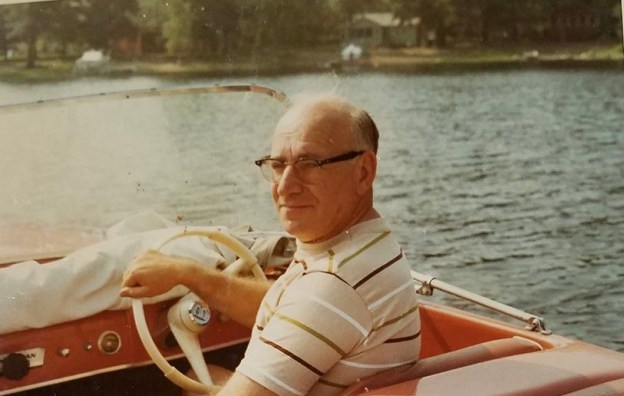
In June 2008, my father and I spent our last Father’s Day together. He and my mother had moved up to an independent living facility in Upstate New York four miles from me. Two years later, his health had deteriorated, and he passed away November 2008. People may remember Bill Cohen for his stores in Keeseville, his community service, his pride in his family. What I remember—and treasure—most about my father were the stories about him that my siblings and I share again and again. Many of them centered on boats, bugs, and bats. 

Having spent summers as a child with his grandfather Archik Pearlman on Lake Champlain, my father always dreamed of owning a boat. In 1965, he purchased a pink indoor-outdoor that my mother immediately “christened” Nisht Neytik, Yiddish for “not necessary.” During the summer, Dad rented space on a public dock in Port Kent, five miles from our house. And each Sunday, Dad would coerce us all to take a ride—when we could go. Unfortunately, the boat spent more time in the shop than in the water. And when it was in the water, Dad was always panicking about the weather or the gas situation. One time, we took a long ride out to a nearby island, and my father realized that we may not have enough gas to return. We were nervous wrecks until we finally pulled back into our slot.

In 1966, my parents bought a cottage on Willsboro Bay. Soon after, Dad purchased an outboard with slightly better reliability. Larry and I were married in 1974, and in 1975, we went up to the lake for Memorial Day. Dad gave Larry a pair of waders Dad had picked up second hand and asked him to put up the docks for the boat. Before Larry was knee deep, the waders-riddled with tiny holes filled up with water. Think Lake Champlain in May, when the water temperature barely reaches 60 degrees. Larry has never forgiven him. 

For the next several years, the boat was anchored either on the dock or on an anchor about 200 feet from shore. Dad still loved boating, but only if the weather was perfect. For hours before we were supposed to go out, Dad kept his ear near the radio next to his chair, which was set for the weather station. If there was the slightest chance of rain, he refused to go through with the ride. When we children and eventually our spouses were old enough to go on our own, Dad installed a CB radio in the outboard so he could check up on us every few minutes. In an blatant act of defiance, Larry would turn it off. Dad never forgave him.

As much as my father loved boats he DESPISED bugs. He kept a can of Raid next to his favorite chair on the back porch of the cottage and used it frequently—and liberally— to kill any passing fly or wasp. When the Raid wasn’t enough, he got a outdoor fogger which he used with the same careless abandon that he used the aerosol can. One beautiful summer night, Laura was putting food on our set table when my father passed by the outside of the window with the fogger in his hand. A potent cloud of pesticide permeated the air. Laura never forgave him. 

When the Raid and the fogger failed, Dad called in the Big Guns. He purchased an electric bug zapper and hung it on the limb of the huge oak in front of the cottage. As the sun set across the lake, we heard from inside the cottage a quick zap as the first bug hit the grid, then a second, then ten, then twenty. Before we knew it, every bug between Willsboro and Burlington five miles across the lake was headed for the bug zapper. It took about 30 minutes for the ten foot machine to become completely clogged. So much for Dad’s war against the bugs.

Dad was more successful with bats. The cottage was always a gathering place for the family. One summer weekend, Larry and I were in one bedroom; my sister Bobbie and her husband and Emil were in another; and my sister Laura was in another. In the middle of the night, I headed to the bathroom. As I reached for the toilet paper, I realized that a bat was sitting on the top of the roll. Trying not to wake anyone, I ran back into our bedroom and shook my husband Larry awake.

“There’s a bat in the bathroom!” I whispered.

Larry awoke groggily with a “Wha……t?” He climbed out of bed, checked out the bat in the dim light of the night light, and suggested we close the door and wait until morning. 

“But what is someone else has to go to the bathroom?” 

“What are you two doing?” Our whispered conversation had woken up my sister.

The bat, tired of squeezing the Charmin, flew out of the bathroom and began swooping through the cottage. 

“Damn!” I cried.

By this time, Emil, Laura, and Mom were wide awake. We watched the bat circle above us, all of us talking at once with suggestions .

“Hit it with the badminton rack?” 

“How about a broom?”

“Does Raid work on bats?”

“How about the fogger?

At that moment, my father, who can sleep through a five alarm fire a block from our house (Yes. He did. Keeseville, New York, February 14, 1964. But I will save that story for another time), finally appeared in the doorway of his bedroom in his teeshirt and boxers. Without a word, he crossed the room, grabbed the fishing net that he kept in the corner explicitly for this purpose, and in one fell swoop, caught the bat in its web. He opened the front door, shook the frightened but still alive bat out of the netting, and came back into the cottage.

“Now everyone go back to sleep,” my father stated. 

Boat lover. Bug hater. Bat rescuer extraordinaire. But most importantly, My Dad. Whether he is with me or not, I will celebrate every Father’s Day in his memory with love.

Note to my readers: While editing my blog, I realized that I had never published this story I had written in 2019 for Father’s Day about my beloved father, Wilfred “Bill” Cohen (Z’L). It’s a little late for Father’s Day, but it’s never too late to honor my father’s memory.

A version of this article originally appeared in the Jewish World News, a bi-weekly subscription-based newspaper in upstate New York.

Cohen family noted Shabbat with fish in the 50’s, but now is a different story for Marilyn. 

Friday was Fish Day.

No, we weren’t Catholic. Growing up in the Fifties, in a small predominantly Catholic town, fresh fish was often available on Friday. Looking back, I am not sure if it was really that fresh. Yes, Lake Champlain was three miles away, but I don’t think local fishermen provided the fillets that lay on top of the ice in the Grand Union. 

There was a second reason Friday was Fish Day. My father managed a department store, and Pearl’s,  along with the other stores in Keeseville, was open until 9 o’clock every Friday. Dad hated fish, so my mother would make some variety of it on that night. If it wasn’t fresh, it is a frozen block or two that my mother defrosted, covered with bread crumbs, and baked along with frozen french fries. When she wanted to save time, she heated up some Gorton’s fish sticks. 

Friday dinners were  a contrast to our Monday through Thursday, “Father Knows Best” routine. Dad would come in the back door at 5:30 and immediately sit down at our formica topped kitchen table. We children took our places, assigned after one night of our fighting who sat where.

“That’s it!” Dad said. “Wherever you are sitting tonight will be your place from now on.”

Dad sat at the head, his back to the radiator and the yellow linoleum tile on the wall. When she wasn’t putting food on the table, Mom took her place at the foot, her back to the old white Kelvinator range cook stove with its double oven. Jay, the only son, sat to his left. Laura, the oldest daughter  took her place next to Jay. Bobbie, the youngest, sat to Dad’s right. I sat in between Mom and Bobbie. 

Dinner was usually chicken, potatoes and a vegetable that had been peeled off the waxed box and boiled in a pot on the stove under done. Occasionally, we would have spaghetti with Ragu. Notice I did’t say pasta. In the 1950s, the only pasta available was macaroni for macaroni and cheese and regular old fashioned spaghetti noodles. Who knew of ziti or angel hair or cellentani?

Our dinners were usually over quickly. By 5:55, Dad had pushed himself away from the table. While the children dutifully moved to their bedrooms to do homework and Mom washed the dishes, Dad headed for the back room and the television set. The local news was followed by Huntley and Brinkley. The rest of the night was filled with Perry Mason, Checkmate, and other early television shows. In those days before remotes, Dad would rely on us post-homework to change the station. This did serve an educational purpose: When Bobbie was in kindergarten, she was having difficulty learning her numbers. It was a “Eureka” moment when our family realized that Bobbie had no problem changing the channels to Burlington’s WCAX (Channel 3) and Plattsburg’s station WPTZ (Channel 5). 

The Friday night  late closing provided another benefit to the four Cohen children. As we had no school the next night and Dad wasn’t home to dictate what programs we watched, we ate our dinners on TV trays in front of our favorite programs. This included The Mickey Mouse Club, with our favorite Musketeers, Annette Funicello and Tommy Cole and a little later, The Flintstones. By the 1960s, both my parents worked at the store, and I was old enough to look after Bobbie as we watched Rawhide, The Wild Wild West, and Route 66. 

Where did synagogue fit into this picture, especially in our Reform congregation that only had Saturday morning services for Bar Mitzvahs? Mom finally got her driver’s license in 1955, just before Bobbie was born. Driving the 30 mile round trip up and back to Plattsburgh with four children tow, especially in the winter, was out of the question. It was not until the mid-Sixties that Mom would make the trip with Bobbie and me. Although we all attended Hebrew school though Jay’s Bar Mitzvah and all of our confirmations, a traditional Shabbat dinner with challah, candles, and a Kiddish cup was not even a consideration. Dad worked, and it was Fish Friday!

In fact, it wasn’t until the pandemic that Larry and I started our own tradition. Last March, I became fully invested in baking challahs each Friday for ourselves and those friends whom we felt needed the comfort of a golden loaf straight out of the oven. We began lighting the Shabbat candles, pouring a glass of Manischewitz, and putting my cross stitched challah cover over one of  the warm loaves. How could we do all this and NOT set the table and prepare a special dinner, whether we were participating in our twice-monthly Zoom services or just enjoying a quiet sheltering-in-place meal at home?

As we and our friends are vaccinated it is time to invite a couple or two or three to share this all with us. I look forward to carrying on this tradition with my children and grandchildren this summer. Yes, I have come a long way from Friday fish sticks in front of Annette Funicello and the Flintstones

A version of this article originally appeared in the Jewish World News, a bi-weekly subscription-based newspaper in upstate New York in the May 13-May 27, 2021, issue.

Picture (Fried Fish at home.jpg) is licensed under the Creative Commons Attribution-Share Alike 4.0 International license.

How a book changed my life

Can a book change a life?

Our tenth grade English class was deep into The Scarlet Letter, the classic by Nathanial Hawthorne. I was mesmerized not only by the writing and the story, but also by its symbolism. Hester Prynne carried her shame on her chest every day, the bright red letter A which identified her as an adulterer. Things weren’t bad enough in Puritan America without her having to not only hold her beloved Pearl in her arms but to have her shame emblazoned for all to see.

Our teacher, Mrs. Frances Clute, was a friend of my parents She and her husband John had spent time with my parents, and she knew me well.

One day, after class, Mrs. Clute asked me to stay a little longer. As the rest of my classmates dashed out the door for Mr. Kennedy’s World History class, she pulled out a small book from one of her desk drawers.

“This is Catcher in the Rye, Marilyn,” Mrs. Clute told me. “I know how much you love The Scarlet Letter. This is also a book that deals with symbolism. I am giving it to you with your promise not to share it with any of your classmates.”

I was grateful for her trust. Even if I knew nothing about J. D. Salinger’s 1951classic, I knew she trusted me and saw in me the enthusiasm and the intelligence to handle its content and meaning.

I probably read it all that night, the whole story of Holden Caulfield, his depression, his flight from his private school, his trip to New York. I read how he wanted to save his sister Phoebe from any dangers that she would experience. I “got” the meaning of the “catcher in the rye,” the person who wanted to always protect those whom he loved.

I also saw why Mrs. Clute had been furtive in her gift. The book had language that was certainly not in books  usually selected by Keeseville Central School. I now don’t remember if it contained the “F” word, but it had other language and actions that were certainly not broadcast in our small upstate New York town. What made it great was the symbolism, the depth of the story behind the words.

I had already decided that I would be a teacher. After reading Salinger’s classic,  however, I knew I wanted to be an English teacher. I would spend my college years reading other classics, and then I would go on to teach others to love literature as much as I did.  I followed that dream. 

Looking back,I realize from my older eyes how shallow my understanding and appreciation of great literature was in college.There are classics that I read and hated, Moby Dick probably the most memorable. (I had to read it in one week. It was about a whale.) 

In my first teaching job, I was assigned to share Brave New World, 1984, and Night with juniors and seniors in our school small town near Albany. I realized that not only did they not understand the books’ meanings. Most of them couldn’t even read. I had been a last minute replacement for a man who decided in June to pursue his doctorate, and all the students had signed up to be in “The Cool Class with the Cool Teacher.” I was not the cool teacher.

In the years that followed, I have tried and failed to read other classics, including Les Miserables, Anna Karenina, War and Peace, One Hundred Years of Solitude. I missed the depth in so many books.

It is January, and as I have every year, I have those four books on my “To Read” books. I probably will never get to them, preferring the New York Times best sellers and ones recommended by my bookish friends. But maybe, in honor of Mrs. Clute, I will take my copies of The Scarlet Letter and Catcher in the Rye down from my shelf. While sheltering in place during this pandemic, I will revisit my friendship with Hester Prynne and Holden Caulfield. And, even though I know I have still a great deal to learn about literature and symbolism and the classics, I will accept that Mrs. Clute recognized that I had that spark in me. And for that I will be forever grateful.

A version of this article originally appeared in the Jewish World News, a bi-weekly subscription-based newspaper in upstate New York.

Picture Credit: By Mary Hallock Foote – The Scarlet Letter – edition: James R. Osgood & Co,, Public Domain, https://commons.wikimedia.org/w/index.php?curid=11264794 

Best Gift

The baby grand was the center piece of our living room in Keeseville.

The baby grand was the center piece of our living room in Keeseville.

For our family, three of the best gifts we ever received were an ugly orange spinet, a mahogany baby grand, and a walnut Yamaha upright.

After the war, my parents and my two older siblings moved from New London, Connecticut, to Potsdam, New York, so that my father could help my Uncle Eli, my mother’s brother, with his clothing business. Housing was very difficult to find in 1948, and my parents were left no option but to purchase a very small ranch on top of a very windy hill. Cramming the four of them into the two-bedroom house was difficult enough. When I arrived in 1950, things got even more crowded. The kitchen was so small that the person sitting in the kitchen chair nearest to the refrigerator would have to stand up if someone had to grab the milk. Laura and Jay shared a bedroom, and my crib was sandwiched into my parents’ bedroom. The tiny living room had a couch, two chairs, my playpen, toys, books, and, in time, a very ugly piano that was one of my sister’s best gifts.

Potsdam was not only the home of the state college but also the location of the Crane School of Music, which provided many musical opportunities to the community. My sister walked past Crane on her way home from school every day and heard the students practicing their instruments. Intrigued and inspired, she asked my parents for a piano. After proving herself by taking lessons using the neighbor’s rickety spinet, she got her wish. My parents purchased an old upright painted a hideous butterscotch orange that barely fit into the already full living room. The tiny house often reverberated with music, especially when friends gathered around the piano. My Uncle Eli, who could not read music, played any requested song by ear, so he often was on the piano bench.

In 1952, my father took a job in Keeseville, New York, managing a Pearl’s department store one of several in a chain owned by my great-uncle Paul. In order to save money, my parents hired a couple of men from Pearl’s to pack up the household belongings into the company truck and deliver them safely to Keeseville. Unfortunately, the men dropped the piano while unloading it. The piano, never in tune to start, was now hopelessly flat and sported several non-functional keys. That didn’t stop us from playing. My older siblings and I took lessons with varying degrees of mediocrity. We mixed our John Thompson piano lesson books with more popular sheet music, including such Fifties hits as “Stranger on the Shore” and “Mack the Knife.” My sister’s and my favorites were from the American Songbook. We had a healthy collection of Rodgers and Hammerstein, Cole Porter, and George Gershwin.

By the age of twelve, I had gone through a couple of piano teachers, one who retired and one who moved away. Despite the lack of lessons, talent, and a decent instrument, I still loved to play. I alternated between the classical music I learned from my former teachers and all the music my sister had left behind when she went to college. I began lobbying for a new piano. I knew, however, that getting even another second-hand one that was in a little better shape than our orange relic was probably out of financial reach for our family.

One evening before Chanukah in 1962, my parents called me into the kitchen. That afternoon, my father found out one of his customers was moving to a smaller home and was selling a used baby grand for only five hundred dollars. Was my father was interested? Yes, I was, in fact, getting my wish. I cried for joy, even more so when the beautiful instrument with its shiny mahogany finish was delivered later that week. Unlike our tiny box of a house in Potsdam, our Victorian house in Keeseville had enough room for the baby grand. With a minimal rearrangement of furniture, the piano became the centerpiece of our living room.

That January, I started lessons with the new young Keeseville Central School music teacher. Initially, I was humiliated to find out that I needed to start from the beginning level books to improve my skills. Over the next three years, I managed to work my way through the third level of the John Thompson series. My teacher, knowing my love for the movie and Broadway show tunes, also supplemented the classics with more contemporary selections such as “Sunrise, Sunset” from Fiddler on the Roof, “You’ll Never Walk Alone” from Carousel, and, my favorite, “Moon River.”

The piano again became a gathering place for family and friends. I often played while my siblings sang along. My brother even joined in with his trombone. I missed lots of the notes, my sisters were not known for their vocal talents, and my brother was no Urbie Green, but we loved the chance to be together. My Grandpa Joe played Yiddish songs after he moved in with us after my grandmother’s passing in 1966. Uncle Eli got to hammer out his share of songs when he visited us from Potsdam.

Once I left for college, I played infrequently, mostly on school breaks. When my parents moved out of their big house in Keeseville in 1982, the piano was sold as none of the children had room for it in their homes. Before my parents downsized, however, I collected all the sheet music from the house and stored it in our home “just in case” we ever got a piano. I had little chance to play—until I received my second best gift ever.

After my daughter Julie was born, I was home with the two small children. The days were getting long. Knowing how much I loved my baby grand in Keeseville, Larry encouraged me to look for one that would fit into our home. The Yamaha upright I selected from Clark Music in Latham was delivered two weeks before my thirty-second birthday. Armed with all the sheet music my family and I had accumulated since my sister started lessons in Potsdam many years before. I spent many hours playing the piano, both for enjoyment and for the peace and serenity playing gave me.

When she was a junior in high school, Julie decided to take piano lessons for the first time. I felt my musical life had come full circle when my daughter’s teacher recommended we purchase new, unmarked John Thompson lesson books. At her first and only piano recital, Julie choose Pachabel’s Canon and my old favorite, Moon River.

When Larry and I decided to move to Florida, I initially thought of selling the piano. It was expensive to ship to Kissimmee; I didn’t play that often; I could always use the piano in the Palms, the community center a mile from our house. It was Larry who insisted that we pay the moving company to bring the piano with the rest of our household. There was no repeat of the Potsdam debacle. The piano arrived safely in our new home. We placed it on an empty wall in the living room. From the moment I first touched the keys, I knew Larry was right. The tile floors and open floor plan improved the sound quality over that produced in our bi-level in Clifton Park.

Soon after we moved in, I had three couples over for a Shabbat dinner. After dessert, my friend Becky, who taught music in high schools for many years, started looking at my sheet music collection. “This is fabulous!” she commented. “Please play for us!” Not used to an audience, I played hesitantly for a few songs,then Becky graciously took over the keyboard. For the next hour, we belted out songs from Les Mis and Wicked as well as my old favorites, “Sunrise, Sunset” and “Moon River.” I had tears running down my cheeks from happiness. Thanks to my piano, our new home was filled with the sound of music.