Tag Archives: #Lodzghetto

Hate Ends Now

A seventeen-year-old’s powerful stand against hate

One million paper clips are piled high on black construction paper on the stage, lit by a spotlight. Above it, the flickering black and white film of Jews walking to their deaths in a Nazi concentration camp is being shown on a theater-sized screen. And standing in front of the stage is the seventeen-year-old Edgewater High School (EHS), Florida, senior who orchestrated this scene, along with several other exhibits that make a powerful stand against antisemitism and many hate. 

The first thing you notice about Adam Mendelsohn is his hair. Standing at six feet tall, Mendelsohn adds another two inches with his wild dark brown curls, complimented with a gray yarmulke perched in the back. As the organizer of the January 9, 2025, Hate Ends Nowcommunity event, Adam radiates a confidence and maturity that is unusual in such a young man.

The previous summer, Adam had attended a meeting of the local Jewish Student Union (JSU). Founded in 2002, the organization oversees 200 Jewish culture clubs on public high school campuses to provide Jewish teens with programs that strengthen their Jewish identity and connection to Israel. On that day, Rabbi Daniel Nabatian, the co-director of the Central Florida branch, encouraged the students to make an impact—no matter how small—to fight against the rising wave of antisemitism that had gripped the world since the Hamas attack on Israel on October 7, 2023. 

 Adam was determined to bring the JSU message to Edgewater High School students and staff. Following up on his memory of a similar exhibit, he contacted Hate Ends Now, a nonprofit whose mission is to combat hatred and indifference by educating people about the history of the Holocaust and all forms of bigotry. The organization offered not only artifacts from the Holocaust but also an exact replica of a World War Two-era cattle car that was used to transport Jews and other targeted groups to concentration and death camps. A twenty-minute, 360 degree immersive presentation offers an impactful educational experience. With the support of Dr. Alex Jackson, Edgewater’s principal, and his assistant, Valerie Lopez, Adam worked with Todd Cohn, the CEO of the nonprofit, schedule the event in Orlando for January 9, 2025. 

 Adam then started a fundraising campaign to pay for the cattle car and other expenses. Thanks to the generosity of many donors, including the Ginsberg Family Foundation and Massey Services, the seventeen-year-old raised over $30,000, enough to cover most of the expenses.

 Adam’s next step was to contact local organizations whose mission aligned with the core values of the event to sign on. Participants included the Jewish Student Union (JSU); Chabad C-Teen; Shalom Orlando, the Holocaust Memorial Resource and Education Center of Florida; the Anti-Defamation League, and Central Florida Pledge, a network of community members in Florida who stand up against discrimination and hate.

Adam now began the search for a Holocaust survivor. Jasmine Flores, the community relations manager for the Greater Orlando Massey Services, connected Adam with Ludwig (Lou) Ziemba, an 82-year-old Kissimmee resident, through her involvement in Maitland Rotary.  Ziemba was born in the Lodz Ghetto on September 9, 1942, one day before 13,000 children under ten were to be sent to an extermination camp. Arrangements were made for the infant to be hidden in a garbage truck and smuggled outside the Ghetto where a Christian Polish farmer retrieved him and took him home to be raised as his own. Miraculously, his parents survived and were able to retrieve their “hidden child” when they were freed three years later. 

The paper clip exhibit was a last-minute miraculous addition to the event. On Sunday, through a conversation with Beth Landa, Ziemba’s wife, Adam learned about Paper Clips, a documentary that highlighted the 1998 efforts of middle school students from Whitwell, Tennessee, to collect six million paper clips representing the six million Jews killed by the Nazis. According to Wikipedia, at last count, over 30 million paper clips had been received.

A preliminary research of the documentary compelled Adam to see if he could locate a low-cost source of paper clips. The manufacturing plant of Bulk Office Supplies was in Tampa, but was closed for the weekend. Undeterred, he located the name of the founder and owner of the company, Alex Minzer, on Facebook. Encouraged by Minzer’s “Never Again,” hat, Adam messaged him; Minzer answered almost immediately. Alex Minzer had sold the company to Levi Haller, who was currently in Jerusalem. Alex helped connect Adam with a wholesaler in Tampa who would provide the paper clips at cost – and later that same day Levi Haller reached out to Adam to say that decided that Bulk Office Supply would donate the 1 million paper clips, inspired as he was by the project’s mission and Adam’s passion.

Next problem: how would the paper clips get from Tampa to Edgewater in time? Fortunately, Adam’s father Jason was returning from a business trip on Florida’s west coast on Wednesday. Adam quickly did the math, his favorite subject, to confirm all the boxes would fit into his father’s car. All good! The clips were successfully delivered at one o’clock, only 28 hours before the event was scheduled to open.

Adam and a group of student volunteers began the tedious task of opening the 10,000 small boxes of 100 paper clips and piling them onto a 7X7 foot square of construction paper that had been placed on the stage in the school’s auditorium. When the school day ended at 2 pm, Adam stayed on, working alone and then with his father, until 8 pm. “When I left, I looked at the pile and despaired,” said Adam. “I had no idea how the project could be completed.” 

Adam returned to EHS the next morning at 5 am. By school opening, the whole student body was aware of the urgency to finish the job. “It was crazy!” Adam said. “Students were rotating in and out of the auditorium to provide help over the next several hours.” The pile was completed at 1 pm, twenty-four hours after the initial delivery. “I now hate paper clips,” Adam said with a laugh.

At five pm, the doors opened to the public. Over 500 people attended the three-hour event. They perused the display tables, munched sandwiches provided by Kosher Grill, listened intently to Ziemba, looked over the chilling artifacts on the Hate Ends Now tables, sat in the quiet auditorium to contemplate the million paper clips, and, at scheduled times, viewed the powerful immersive presentation in the cattle car parked just outside Edgewater’s entrance. 

Dignitaries included United States Representative Maxwell Frost, Florida State Representative Anna Eskamani, staffers sent on behalf of Senator Rick Scott and United States Representative Darren Soto, and members of the EHS school board. 

“This is an incredibly powerful experience,” said Frost. “I believe that every high school student should have the opportunity to witness the horrors of this tragic time in world history through such exhibits. This event serves as a reminder that when we lead with love, we can stop hate in all forms and make sure this type of history never repeats itself.” 

Todd Cohn also commented on Adam’s project. “It’s rare to see such a young individual take on such a meaningful project with this level of commitment,” the Hate Ends Now CEO. “He made a lasting impact not only on us but on everyone who experienced the exhibit. Adam is a shining example of how one person can make a big difference.

Ziemba found sharing his story with a large and diverse audience to be exhilarating. Despite his history, Ziemba still believes love will prevail. 

“Try to accept people,” Ziemba told Orlando’s Spectrum Cable News reporter Sasha Teman. “I know I grew up loving people, and I still love people.”

Adam is grateful to all involved in making the project a success. He also plans on sharing the message with him beyond high school “Barriers which prevent love and peace can be destroyed by understanding that we are all the same,” he said. “I plan on carrying the torch of compassion, acceptance and tolerance throughout my life.” And the one million paper clips? Plans are underway for the clips to be gathered in a lucite case with signage that will be placed in the Edgewater High School’s entrance hall. Adam’s hope to make a difference and to combat hate of all kinds will now be his lasting legacy.

Originally published January 25, 2025. Updated May 26, 2026

Those who wish to make a contribution to Hate Ends Now in honor of Adam Mendelsohn and his project, please click here. 

All photos provided courtesy of Cara Dezso

A survivor’s story: “I live every day as a blessed person.”

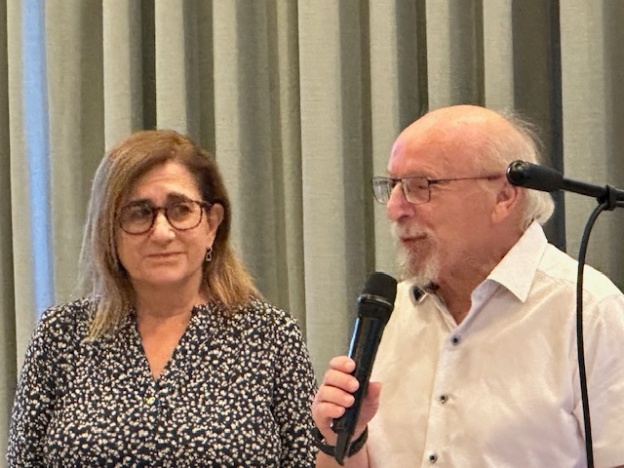
On May 5, 2024, our community’s Shalom Club held its annual Holocaust Remembrance, or Yom Ha’Shoah, event. Lou Ziemba’s story was one of the highlights of a moving, unforgettable evening.

Born  in wartime Poland, Ludwig“Lou” Ziemba is  a retired successful businessman, a polyglot a descendent of “Jewish  royalty’” and a Holocaust survivor. 

Lou’s story begins in Poland. Rabbi Menachem Ziemba, was the chief rabbi of Warsaw, a renowned holy figure in the Ger sect of the Chassidic movement, and a key player in the 1943 Warsaw Ghetto Uprising through his pleas that urged inhabitants to fight against their captors. 

“In the present we are faced by an arch foe, whose unparalleled ruthlessness and total annihilation purposes know no bounds,” Rabbi Ziemba told the Warsaw Ghetto inhabitants. “Halachah [Jewish law] demands that we fight and resist to the very end with unequaled determination and valor for the sake of Sanctification of the Divine Name.”

One of Rabbi Ziemba’s nephews was Henoch, son of his brother Moshe. Henoch was a bit of a non-conformist intellectual who spoke several languages and wandered around Europe. Henoch married a woman who was not approved of by his Chassidic family and thus he was no longer recognized by his large family in Warsaw.

As the Nazis rose to power, Henoch experienced both his wife and children being executed by the Nazis. Grief-stricken, Henoch returned to Poland and settled in the industrial city of Lodz, the second largest Jewish community in prewar Poland, after Warsaw.

With the outbreak of World War II and the German invasion of Poland, the life of Polish Jews deteriorated through a series of draconian laws imposed by the Nazis. In February 1940, after even more severe anti-Jewish measures were instituted, the Germans established a Jewish ghetto, initially trapping 164,000 Jews into a few city streets in a neglected northeastern section of Lodz. The widower Henoch Ziemba was one of those people. 

Soon after his arrival in the Lodz Ghetto, Henoch met and married 20-year-old Golda Farber, almost two decades his junior. Golda may have been small in stature, but she was, in Lou’s words “a firecracker” and “a force of nature.” Almost immediately, Golda became pregnant. For reasons lost in the family lore, Golda turned for help to Mordechai Chaim Rumkowski, who Primo Levi later wrote “morally ambiguous and self-deluded.”

To organize the local population and maintain order, the German authorities established a Judenrat,” or Jewish Council in the ghetto. The Germans appointed Rumkowski as the “kapo” of the Lodz Ghetto, whose job it was to oversee the day-to-day living as well as to decide who would live and who would die. Rumkowski was responsible for sending untold numbers to their deaths.

Known mockingly as “King Chaim”, Rumkowski was granted unprecedented powers. Rumkowski transformed the ghetto into an industrial hub for the Nazis, producing uniforms, wood and metalwork, and electric equipment. Rumkowski felt that, as long as the ghetto served a purpose by supporting the Nazi effort, the workers would avoid deportation to the gas chambers. His methods, however, were brutal: He oversaw the slave labor of anyone over 12 years old to work 12-hour days despite abysmal living conditions and near-starvation rations.

In his biography of Rumkowski, Yehuda Leib Gerst described this complex man. “Toward his fellow Jews, he was an incomparable tyrant who behaved just like a Führer and cast deathly terror to anyone who dared to oppose his lowly ways. Toward the perpetrators, however, he was as tender as a lamb and there was no limit to his base submission to all their demands, even if their purpose was to wipe us out totally.”

Furthermore, Rumkowski used his position to his own benefit. He singled out his political enemies for death and deportation to the death camps, and also deported those who had the capacity to rise up against their capturers. In contrast, those whom he favored were showered with extra provisions, medicine, rations, and safety.

For reasons lost to history, one of those receiving his benevolence was Golda Ziemba. With Rumkowski’s help, Golda was able to hide her pregnancy. A son, Ludwig, was born on September 9, 1942. 

 In late summer, Rumkowski was given orders to select 24,000 for deportation. Believing that the inhabitants’ survival depended upon their employment, he made the decision to hand over their 13,000 children under ten and their 11,000 elderly over 65 years old. He addressed the parents of Łódź as follows. “In my old age, I must stretch out my hands and beg: Brothers and sisters! Hand them over to me! Fathers and mothers: Give me your children!”

Again, for unknown reasons, Rumkowski worked with the Ziembas to save their infant son. He and Golda arranged for baby Ludwig to be hidden in a garbage truck. Once outside the Ghetto, he would immediately taken by a Polish farmer, whose family would raise him as their own in their Christian home. “It’s a miracle,” said Lou. “There were very, very few children who survived the Lodz Ghetto.”

As the war continued, conditions in the ghetto deteriorated, marked by a growing number of inhabitants being sent to the extermination camps. By summer 1944, as the Soviets came closer, the Nazis rounded up every remaining Jew they could find, including Rumkowski and his family, for mass extermination in Auschwitz’s gas chambers.Before their deaths, however, a group of Jews beat Rumkowski to death, a fitting ending for a man who many Jews regarded as bad as Hitler and his Reich. 

On January 19, 1945, the Soviets liberated the Lodz Ghetto. Over the course of last four previous years, over 220,000 had people passed through its gates. There were only 877 survivors, including Golda and Henoch Ziemba, who had managed to hide during all the deportations.

Golda and Henoch’s first stop after liberation was to reunite with their now three-year-old. son. Ludwig didn’t recognize or understand the emaciated but overjoyed strangers who spoke in Yiddish. Despite the Polish family’s reluctance to give up their “son,” his biological parents -against all odds- had returned. 

The Ziembas were the only three members of the family to survive. Rabbi Menachem Ziemba and the four hundred members of the family who had been trapped in the Warsaw Ghetto were all murdered by the Nazis.

Relocated to a German Displaced Persons camp, the Ziembas were soon a family of four. Lou’s sister Esther was born while Lou was away recovering from tuberculous in a German convent, where he learned his third language, German. 

So, to summarize Lou’s first 8 years of life, Lou was born a Jew during a period of extermination, hidden by a resourceful mother, taught Polish by a non-Jewish Polish family, taught German by nuns in a convent, recovered from TB, and taught Yiddish and right from wrong by his parents in a German DP camp. He never had to go to school, get circumcised, or even brush his teeth the entire time.

After a five year wait, the Ziembas immigrated to New York City in 1950. By the time he was nine years old, now known as “Lou,” was working alongside his mother at her small women’s shop in the Bronx that sold undergarments. His bar mitzvah was held in 1955, thus learning yet another language—Hebrew. Before Lou could be Bar Mitzvah’d, however,  there was one order of business that had to be taken care of at the local hospital, “a small snip of the tip.” Lou was heard screaming from every floor of the hospital “I DON’T WANNA BE A JEW!!!

When he was twenty-one, Lou opened a men’s clothing store down the street from his mother’s shop. As his business grew, in part because of Slax and Jax’s inventory of the newly popularly “blue jeans,” he convinced his mother to sell her store and join him in business. They soon opened three more stores.

However, as shopping malls sprang up, Lou realized the negative effect on his businesses. He sold them and went into the home construction business.  He, his wife Maxine (“Cookie”) Noble and their two children moved to “New City,” an affluent suburb of New York City. 

In 1999, the long years of his dedication to work took a toll on his marriage, and the couple divorced. Soon after, Lou met and married Beth Landa who happened to be related to his son-in-law. After the couple’s retirement in 2015, they moved to Florida, settling in Solivita, a fifty-plus active adult community in Kissimmee in 2023. 

“I’m aware of how lucky I am to be alive,” Lou says. “I live every day as if I’m a blessed person. I enjoy life too much not to do that.” 

Sources

Thanks to Lou Ziemba and Beth Landa for providing the interviews and information for this article. 

Cousins, Jill. “A Survivor’s Saga.” Lake Mary [Florida] Life.Winter 2017.

https://en.wikipedia.org/wiki/Chaim_Rumkowski

https://en.wikipedia.org/wiki/Łódź_Ghetto

https://en.wikipedia.org/wiki/Menachem_Ziemba

https://encyclopedia.ushmm.org/content/en/article/lodz