Tag Archives: #Pandemic

Too many questions! What I miss most during the pandemic is certainty.

This article was written in May but never got onto my blog. I am catching up with my posts now. When reading, think of where we all were before Summer 2020 started. Marilyn 9/8/2020.

Yes, I know the old adage that says life changes on a dime, and that you never know what will happen tomorrow. But now my life is filled with too many questions regarding the future. Will Larry, my husband, or I contract COVID-19? If we do, will we die? How about my children and grandchildren? What are their chances of getting the disease?

The Drill
We know the guidelines. Practice social distancing. Wash your hands. Avoid touching your face. Wear a mask. But will that be enough? We have gone to stores three times since March 6. The first time was to Publix, during a “senior’s only” hour. Huge mistake. The store was mobbed, most people were not wearing masks, and the wait at the checkout was a minimum of 30 minutes. We switched to Instacart. Just recently, however, we ventured out to Publix and Lowes, donned in masks and gloves, for some targeted shopping. I would estimate 80% of the people and almost all the employees (except one young woman sorting produce) were wearing masks. Were we safe? Every time we are in a public place, we reset the clock to see if symptoms occur in the next 14 days. The biggest uncertainty is “When will this end?”

End Agenda
The first thing on our end agenda will be to see our children and grandchildren.This week, we cancelled our summer plans. As we had done annually for the past five years, we had booked our plane flights and rentals in Colorado for eight weeks. Going there gave us a chance to escape the summer heat and enjoy  the beauty of the Rockies. The best part of the summer was being close to my daughter, son-in-law, and granddaughter. Along with meeting with them for dinners or concerts, we often were recruited to bring our granddaughter to pre-school or pick her up. We often watched her so that Julie and Sam could get some private time.

We have worked with our rental person so that we can use the condo at a future date. But when will that be? August? September? Next summer?

The pandemic has also put our meeting our new grandson on hold. Prior to his birth in March, we had made plans to fly out and stay at a bed and breakfast blocks from their home.

Longing For Connection
My children have been wonderful about keeping in touch through video conferencing. Adam and Sarah often arrange the screen so that our new grandson fills the picture. We have seen him poop, burp, yawn, sleep, and squirm. We have hear him cry and sigh and make what Adam calls his “pterodactyl” sounds. But we haven’t held him. When will that day arrive? Our granddaughter, with the help of her parents, also checks in often. We talk, read or tell stories to each other, and bake chocolate chip cookies together “virtually.” But—again the but—when will we be able to actually hug her and kiss her beautiful “punim” with those big blue eyes and wonderful smile?

Of course, we are not alone in this pandemic. Everyone faces an uncertain future, whether it be as trivial as getting a haircut (and a long-overdue hair color!) or as critically important as having necessary surgery. For parents working from their kitchen tables, they daily juggle their workload and their childcare and even home schooling. Will daycare resume this summer? This fall? Next January? Is it safe even to send the children?

For those working outside the home—especially those on the front lines—they wonder if they will bring the virus home with them. For those who have been furloughed or—worse—lost their jobs, they wonder when they will able to return to work. When they are, are the benefits of a paycheck worth the risk of also exposing themselves and/or their families to COVID-19? Now that Florida has eased up restrictions, a beautician told her client that her husband is battling cancer. “If I go back to work, I may bring the virus home. Do I stay safe or have money for food, rent, and other necessities?”

As most of my friends are also grandparents, they speak to me of so many missed opportunities including a Mother’s Day visit, or a high school or college graduation. Even those who live close to their families must watch their grandchildren play from10 feet away or on the other side of the fence.

What is one of the saddest parts of the virus are those whose loved ones are in assisted living or nursing homes. One friend shared with me the loss of a parent who passed away “from a broken heart” when he realized that he could not see his family in the foreseeable future. Another friend is limited to FaceTime with his wife who, even though physically two miles away, could be on the other side of the moon. My friend Allison, a member of my writing group, has her 99-year-old mother in a medical crisis in Trinidad, and she can only call her siblings to get updates. There is one certainty: many people who do not survive will die without being surrounded by their family. Many will also grieve alone.

Certainty And Control?
Before COVID-19 (BC) life had been more certain. Or was it? “The pandemic has handed out a stark reminder that the idea of us humans ever having had a locus of control is a complete myth,” Allison shared in a note to the other members of our writing group. “Now that’s a different type of loss— thinking we’ve lost something that we never really had.”

This morning’s headlines carried a glimmer of hope. The manufacturer Moderna said that the first coronavirus vaccine to be tested in people appears to “be safe and able to stimulate an immune response.” Reading further dimmed my excitement. The vaccine was tested on eight healthy volunteers ages 18 to 55. Will this be the answer? Or will several other possibilities in the queue turn out to be the answer? Meanwhile we wait and hope and deal as best we can with these very uncertain times.

A version of this article originally appeared in the Jewish World News, a bi-weekly subscription-based newspaper in upstate New York, in the May 28, 2020, issue.

Hairy tales from the pandemic become a focus

With all that has been happening in the world since February, the discussion of hair grooming, seems to take up a great deal of time and space.

Six weeks after our life went into lockdown, my husband Larry was looking more and more like Bernie Sanders. Trips to the barber were not an option, and he had purchased through the internet electric hair clippers. Larry could easily get the front and sides, but I was responsible for the “back forty.” As I held the buzzing clippers in my shaking hands, visions of a Big Bang Theory episode in which Penny accidentally shaved a chunk out of Sheldon’s hair flashed in front of my eyes. Fortunately, the clippers were fairly idiot proof. Five minutes later, and the job was done. Larry looked more like himself.

Larry, along with many of his friends, have resorted to do-it-yourself grooming. Others have used this time to grow beards and ponytails. In our retirement community, grayer and balder versions of their long haired, bearded Sixties self are a badge of honor. 

For my women friends, it is not so much a matter of length as a matter of color. More and more crowns betrayed the grey that years of Clairol had covered. The big question was not, “When will this pandemic end?” No, it was replaced by the more looming question: “Should I go natural? “When restrictions lifted in June, most women ran back to their hairdressers, begging them to do their magic. A few, however, used this opportunity to allow nature to take its course. One of my friends  consulted “a Silver Foxy” Facebook page 

Along with a number of less desirable traits, I did inherit my mother’s genes when it came to hair color. Frances Cohen maintained her dark hair into her seventies. One of her favorite stories was a bout a conversation her hairdresser had with another client. “I want the same color that Fran uses,” said the fifty-something from her perch in front of the mirror. “What Fran has doesn’t come in a bottle,” the hairdresser. Just before the pandemic, I decided to stop highlighting my hair and was surprised to see that my natural brown color had little to no gray. While I questioned my sanity for ‘blonde-that sometimes-looked grey’ treatments I had done for years, my friends just kept saying how lucky I was that I had not spent all the time and money many had expended for years to change my hair color.

In the meantime, another hair-raising adventure was happening in San Francisco. My grandson Sid was born in March with a head of fine brown hair. One month later, he lost all the hair on top, which matched his father’s own male pattern baldness. Unlike Adam, however, my grandson soon recouped the hair on top but lost it on the sides. At five months, he now sports a beautiful brown mohawk. This entire tonsilatory adventure is now captured in a series of pictures chronically the ups and downs of Sid’s hair length.

My grandson may not care about the way his hair looks, but that is not the case for my five-year-old granddaughter. Two weeks ago, Sylvie, who had not gotten more than a trim since March, asked her mother to cut her hair “short like Abigail,” a character from Spirit, her favorite animated show. Julie was hesitant as the last attempt at a shorter style resulted in meltdown. But apparently it made all the difference when it was Sylvie’s choice. Julie texted her relief soon after she lay down the scissors. “I cut it once and she made me cut it again even shorter. She’s very happy!”

Following the text was a picture of my granddaughter sitting in a laundry basket with a huge smile. It was a perfect haircut.

Less than twelve hours later, we heard the familiar ding of Julie’s text message sound. “Well crap. She loved her haircut so much and was so excited… she snuck in her room and cut more off. It was so short on one side I had to shape it into short bob/pixie cut. No pictures available as she is in tears right now.”

The tears continued the next morning through breakfast and through a sad walk to pre-school. After a twenty-minute discussion on the buildings steps, my granddaughter finally was ready to show her face and bob. Unbeknownst to Julie at the time, my son-in-law Sam promised a trip to the toy store after he picked her up that night. Sylvie returned home clutching a “wish list” unicorn that thankfully ended further tears. 

A day later, we FaceTimed with my Colorado family and made sure to tell Sylvie how much we loved her short hair. When she commented that it was “too short,” we reassured her that her hair, unlike her Zayde’s and her Uncle Adam’s, DOES grow back.

Yes, between buzz cuts and bald spots and unplanned bobs, I will always remember all the hair raising adventures from this pandemic. 

A version of this article originally appeared in the Jewish World News, a bi-weekly subscription-based newspaper in upstate New York, in the August 20, 2020, issue.

Chocolate Almond Heaven

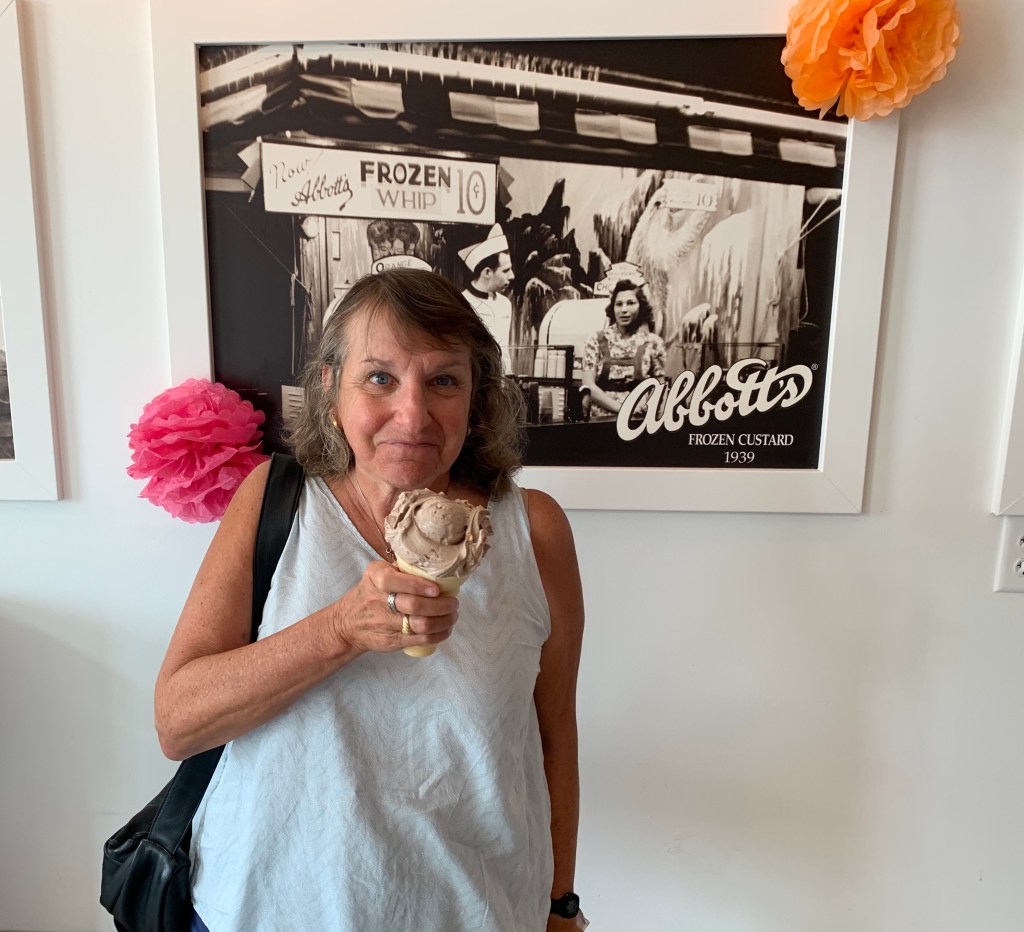
How will I celebrate a milestone birthday during the pandemic?  That hoped-for week away with my family is out. A party at my home is out. Heck! My husband Larry and I can’t even head to my favorite restaurant and indulge in a filet mignon and my free birthday brownie sundae. But there is a silver lining. An Abbott’s frozen custard stand is less than 33 miles away from our Florida home!

The history of one of my culinary favorites began in 1902 when a young and enthusiastic Arthur Abbott traveled the Eastern seaboard with summer carnivals. He eventually found his way to Rochester, New York, where opened a stand across the street from Charlotte Beach on the shores of Lake Ontario and near a bustling amusement park.  

According to Abbott’s website, as word of his frozen concoction spread, people lined up from morning to night. From his newfound success, Arthur was able to buy and train his own racehorses. When he struck it rich after Blue Man won the Preakness, Abbott, in his 70’s, retired in 1957 and turned over his scoops to fellow frozen custard lovers Lenny and Tibby Schreiber. 

For many years, Tibby’s parents owned a kosher meat market in what used to be during the 1930’s, the heart of the Jewish community on Joseph Avenue in Rochester. The franchise is now run by the Schreibers’ daughter Gail Drew and her family. To this day, Abbott’s supports  the Tibby Schreiber Scholarship at the Jewish Home of Rochester for the children of employees of the skilled nursing home who are heading off to college. 

Brenden Drew grew up in the family business where he started taking out the trashing and washing dishes. He now is responsible for business development and franchising. “Every day it is an honor and a privilege to help grow the family business,” Brenden said. “Our family loves supporting our communities and making each one of our guests happy and so do each one of our local owners who truly live the brand”

It took the Shapiros a few more years to discover Abbott’s. In the early 90’s, Larry and daughter Julie went to Western New York for a track and field competition. They spent the night before the race with Larry’s sister and her husband, who lived in Rochester. They grabbed dinner on Charlotte’s Beach, followed by dessert at Abbott’s.

Larry was hooked from the first lick of his chocolate almond cone and soon introduced the rest of us to it.  Everyone who knows me knows how much I love ice cream. But Abbott’s chocolate almond frozen custard is in a class by itself. The chocolate  custard is rich and smooth and creamy and delicious. What makes it outstanding are the roughly chopped  roasted almonds that are stuffed into the custard. As one reviewer on Yelp raved, “It is like sex in frozen form!”

Whenever we went to Rochester, we made sure Abbott’s was on our agenda. Fortunately, as our son Adam spent four years at University of Rochester, so we had plenty of chances to make a stop when we were there.

Sometimes once was not enough. In 2003, Larry and I went to a wedding that was held in a church in Rochester. On the way to the reception, Larry and I stopped at Abbott’s for a pre-dinner cone. The next day, we went with the bride’s parents to another Abbott’s for a second helping. They knew how much we loved this stuff. When Larry had surgery on a torn Achilles tendon a couple of years later, they had the company ship out a couple of quarts to him. He graciously shared it with me. 

At this point, we thought Abbott’s was only located in Rochester. In 2012, however, Larry and I were on  Naples, Florida, strolling down Fifth Avenue, when Larry began running down the street. “Come on! Come on! I have a surprise for you!” And there in front of us was an Abbott’s frozen custard! Yep! Time for another chocolate almond cone.

The Naples franchise closed. Thankfully, another one of Larry’s sisters spends their winters in Vero Beach, and every time we visit her and her husband, we hit Abbott’s. They don’t even have to be there. We celebrated Larry’s 70th birthday by going to a beach farther down the coast and stopping at Abbott’s on the way home.

Vero Beach is 100 miles away, not conducive to regular visits. And we don’t get to Rochester very often. So imagine our joy in discovering that an Abbott’s opened up in Winter Garden, only 33 miles up the road. We celebrated Father’s Day 2020 with our first visit. It was almost as wonderful as we imagined, but we think they didn’t hear our request for chocolate ALMOND, as we realized halfway through our cones that the familiar crunch was missing. Two days later, we had to get a bike tire fixed, and we were only 16 miles away from Abbott’s. So what is a thirty-two mile round trip detour for the love of frozen custard? And this time we not only got plenty of almonds, but the size small was bigger than the previous Sunday’s medium. Heaven!!

We made our third trip up a couple of weeks later. Another bike tire blew, and did another detour. I am sure we will squeeze another visit before my Labor Day weekend birthday. We are running out of bike tires, but we can find another reason.

When we make our trip up for my birthday cone, I will pack a cooler and plenty of ice and we will bring extra home, including a quart for friends in our community who previously lived in Rochester.  It may not be the celebration for which I hoped to kick off my eighth decade. But it’s a sweet start!

A version of this article originally appeared in the Jewish World News, a bi-weekly subscription-based newspaper in upstate New York, in the August 6. 2020, iissue.

A version of this article originally appeared in the Jewish Observer of Central New York, a bi-weekly subscription-based newspaper in upstate New York, in the June 2021 issue.

A version of this article originally appeared in the Heritage Florida Jewish News, a weekly subscription-based newspaper in Central Florida in its August 14, 2020 issue.

A version of this article originally appeared in the Jewish Observer of Central New York, a bi-weekly subscription-based newspaper in upstate New York, in the June 2021 issue.

My pre-birthday trial run to Abbott’s Frozen Custard in Winter Garden, Florida

“This too shall pass.” Meanwhile we sit tight and alone.

As we tread  carefully through the fourth month of the coronavirus pandemic, the emotional and physical devastation this plague has caused is felt acutely by so many. As our days of sheltering at home continue, it has become much more real, much more personal, much more frightening.

My husband Larry and I are feeling the impact, as I suspect many of you are. Our community already has had two confirmed deaths from the virus. Kathy, a friend from my writing group who had been sick with bronchitis, posted the following message on a on March 30 on her Facebook page: “I have pneumonia and am in the Poinciana Medical Center where I am getting fantastic care. Take care. Be well.” Two days later, her brother Brian Joyce posted that she had been diagnosed with COVID-19 and was on a ventilator. His daily updates report the news that she is still fighting for her life.

Friends and family are all sharing stories of people they know who have been diagnosed with the corona virus and those who have lost the battle. A longtime congregant of our synagogue in Upstate New York succumbed to the virus this week. My son’s brother-in-law’s grandfather in California died after contracting the virus from his daughter. Each day the numbers continue to climb.

Although most of my friends are retired, many have children on the front line as medical staff or first responders. They post and text pictures of their son or daughter in full protective gear or—worse yet—reused masks and garbage bags for scrubs. Originally, it was believed that the virus mostly attacked the elderly and those with underlying conditions. That “reassurance” no longer works, and my friends are worried that their children or grandchildren will contract it.

Any medical procedure becomes a cause for serious concern and even panic. A friend scheduled for cancer surgery was terrified that he would develop the virus and would be told he must cancel. Meanwhile, his wife had to drop him off at the hospital and pick him up two days later. She couldn’t physically be there for him.

Another friend, also diagnosed with cancer, was told by her Florida doctor that the surgery would be postponed until the pandemic had subsided. Fortunately, she was able to find a doctor in her home town of Pittsburgh who could operate within the week. She and her husband made a hasty trip up for the procedure. I am happy to report that her surgery was a success.

Last week,Larry was involved in a bicycle accident when he slipped on some wet pavement. His primary physician insisted Larry go to the emergency room for a tetanus shot and for potential stitches for the gash on his elbow. I freaked out, fearing he would contract the virus in the waiting room. “Please don’t go,” I begged. “Stay home. I’ll stitch it up myself.” That freaked him out. Wearing a surgical mask, he left for the hospital, where he was immediately ushered into a sterile examining room. He came home two hours later, tetanus shot administered and wounds bandaged—none requiring stitches. He had only the highest praise for the medical staff.

Two days after Larry’s ER visit, friends were anxiously awaiting the birth of their first grandchild. The impending delivery had made more stressful as it was uncertain whether their son could be in attendance as some New York City hospitals were not allowing any partners in the delivery room. Everyone was relieved to learn that he could accompany his wife during delivery, but the planned birth was still fraught with worry. If either the expectant parents had symptoms, would she have to deliver alone? And would she or the baby contract the virus while in the hospital? Thankfully, the baby was born without complications. The proud grandmother sent me a picture taken in the hospital of the father dressed head to toe in scrubs and a surgical mask gingerly holding the swaddled baby in his gloved hands. All that was visible were the father’s proud eyes. 

The coronavirus has taken much from us, but the inability to congregate, to be with those we love, to hug one another in times of joy or sadness, is the most painful. In normal times, we come together to celebrate the birth of a baby, to support ill friends, to say goodbye to a beloved friend or relative. During this time of a “new normal,” grandparents cannot hold their newborn grandchild. Friends and family cannot celebrate birthdays, weddings and bar mitzvahs. High school and college students cannot celebrate graduations. Jews cannot gather around a huge table or meet in a large room to hold a seder. Most tragically, family and friends cannot even help those who lost a loved ones to grieve, to offer hugs and human touch. 

One day, in the unforeseeable future, the corona virus will be behind us. We will gather together and hug each other tightly and even plant kisses on each other’s cheeks that are wet with tears of joy. We will hold our friends and family not only in our hearts but also in our arms.

On Friday, March 20, for the first time since serving as our spiritual leader, she did not conduct Shabbat services at Congregation Shalom Aleichem in Kissimmee. The synagogue, like thankfully churches, mosques, and other religious meeting places, were closed due to the pandemic. In a letter sent to the entire congregation, The rabbi suggested the following:  At 8:00 p.m. that evening, “when we would all prefer to be together in the sanctuary, let’s do two things that are emblematic of the worship service:recite the Sh’ma and Mi Shebeirach prayers.”

Like Rabbi Allen, Larry and I could not be together with other members of our congregation.. Instead, we set the table with white linens and good china and crystal wine glasses. We lit the Shabbos candles, said Kiddish, and ate the delicious warm challah I had made from scratch. We recited the Sh’ma. Then we prayed for all of those—too many to even count— in need of healing.

Mi shebeirach imoteinu, m’kor ha-bra-cha l’avoteinu./Bless those in need of healing with r’fu-a sh’lei-ma./The renewal of body, the renewal of spirit,/And let us say Amen.

Stay well. Stay safe. Stay home.

A version of this article originally appeared in the Jewish World News, a bi-weekly subscription-based newspaper in upstate New York, in the April 16, 2020, issue.

A version of this article originally appeared in the Heritage Florida Jewish News, a weekly subscription-based newspaper in Florida, in the April 17, 2020, issue.

Why Is This Passover Different Than All Other Passovers? Adjusting to the “New Normal”

One of Judaism’s most important holidays officially begins with the first seder onApril 8. Pesach in the Time of Corononvirus, however, will be very different.

During these difficult times, I think of my parents, Fran and Bill Cohen. .As did many of the Greatest Generation, they went through several challenging times.In 1919, the Spanish flu was raging throughout the world. My mother, born in 1917, fell deathly ill. The family doctor saved her life by making a deep incision into her right lung to drain the fluid. 

To help in her recovery, my grandmother Ethel left New York City with her daughter for Alburgh, Vermont. They stayed for several weeks with Ethel’s brother Paul and his wife Bertie at their home on Lake Champlain. One of their visitors was Ethel’s step-mother’s sister and her grandson Wilfred Cohen. Fran and Bill didn’t meet again until their blind date in 1939. They were married in August 1940. When anyone asked her as to how she got the huge scar on her back, she loved telling people how she survived the flu and met her future husband—all before her second birthday.

Several other cataclysmic events shook their world. The Great Depression, World War II, news of the Holocaust, the atomic bomb, the Cold War I am sure at times they were afraid—for themselves and later for their children and grandchildren. 

As I write this, we are in the second week of our own national crisis. Larry and I worry about our friends and family—especially our own children.Thankfully, my daughter-in-law delivered our grandson days  before the mass shutdowns in San Francisco were enforced. Adam, Sarah, and the baby are now “sheltered in place” in San Francisco. My heart broke when we had to cancel our trip out to meet the baby. It broke even more when I realized that Sarah’s parents, who only live a mile from them, have only seen him through a window when they have dropped off supplies, including a fresh baked challah for his first Shabbat. 

Summit County had the first case of the virus in Colorado. A young man who had skied in Italy before his next planned trip to the Rockies recovered in a hospital only a mile from my daughter Julie and her family’s home. They returned from a week’s vacation with us to closed resorts, schools, and businesses. They too are in mandatory “shelter in place” mode. They are telecommuting between keeping our granddaughter busy with both educational and fun activities, including learning about the height of a giraffe, the life of a butterfly, and the hands-on steps of baking a challah. 

As residents of Florida, Larry and I are not yet under the same mandatory restrictions as California, Colorado, and other areas of the country.  But restaurants, non-essential businesses, then even DisneyWorld and Universal are now closed down.In our fifty-five plus community, all activities and events have been cancelled or postponed.Most of the people here are respectful of the six foot distance rule, which we practice on our frequent bike rides, walks, and conversations with friends from one end of a driveway to the other.We give each other virtual hugs and then head home.

For the rest of the day, we do what we can to keep busy. Larry and I often sit on our lanai, reading books doing the puzzles, and watching birds dive into the pond behind our house. Larry spends a great deal of time Googling great moments in sports and watching reruns of his favorite shows. I spend an inordinate amount of time on FaceBook and watching Great Performances on PBS. We call and text with friends. We watch television. On the first Friday of the “new normal,” I made a Shabbos dinner, complete with wine and a delicious freshly baked challah—my first since moving down her from New York.

The best part of every day is FaceTiming with our family, an almost daily treat that began on March 10, just before the world changed. Larry and I were planning to go to a play that  was being put on by our local theater guild—what was to be our last outing before our own lockdown. Julie, who was very worried about our contracting the virus, begged us to stay home. She must have shared her fears with her brother. Shortly before Larry and I were to leave. Adam FaceTimed with us and offered us a sweet deal: If we didn’t go out, he would keep the camera on the baby. For the next hour, we watched our six day old grandchild poop and pee and eat and sleep and poop some more. With all due respect to my friends in Deathtrap, it was one of the best performances we had seen by a leading actor in our lifetime.

Despite the impact the pandemic has had on our lives, I feel very grateful. Grateful for good health with no underlying conditions. Grateful for the current health of extended family and friends.Grateful for our life in Florida with its abundant sunshine. Grateful for modern technology that allows us to connect with our family and friends, to stream shows and movies, to download library books onto our electronic readers. Grateful that we are retired and not dealing with working at home or—worse yet—possible unemployment.

We also feel grateful to have a fully stocked refrigerator and pantry, as not all people have that luxury. Those individuals in our surrounding neighborhoods who are losing income due to the shutdowns could especially use some help. The refund we received from the cancelled Shalom Club seder went to the local food bank. As our synagogue had already deposited the check, the board called everyone who was attending to ask if their money could go to the same place. Scott Maxwell In a recent column in the Orlando Sentinel, Scott Maxwell offers many other ways to give to veterans, hungry school children, and the homeless. My favorite of his suggestions: “Did you hoard? Pay it forward.” And we call all follow the Center for Disease Control’s guidelines and STAY HOME.

So why is this Passover different from every other Passovers? We certainly will not be emptying our house of chometz, as we have stocked up on many dry goods that certainly don’t follow strict Kosher guidelines. Community, seders have already been cancelled. Relatives and friends who usually have a houseful for the holiday will have only two or three at the table, possibly enhanced virtually thanks to FaceTime or Zoom.

No matter, I will make a seder for the two of us. In the days that follow—if we can somehow get more than the two dozen eggs per family limit at the local supermarket—we will feast on sponge cakes, matzoh brie, and Passover popovers. Most importantly, we will FaceTime with our family and give each other virtual hugs. And Larry and I will pray that the coronavirus will pass over all of our homes and leave us, like our ancestor, safe, healthy, and free from fear.

A version of this article originally appeared in the Jewish World News, a bi-weekly subscription-based newspaper in upstate New York, in the April 2, 2020, issue.