Tag Archives: #poland

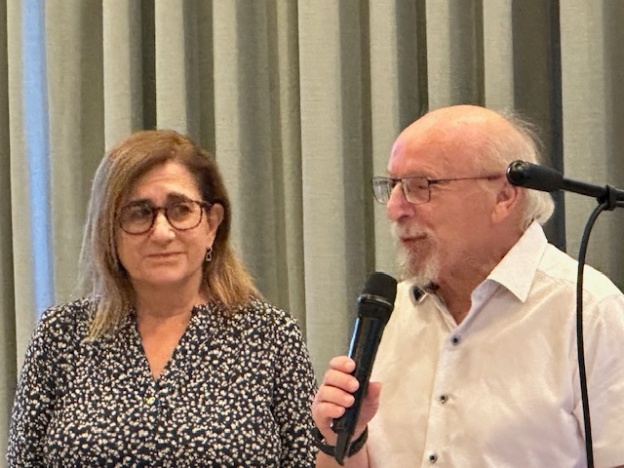
Tale of two survivors united by the Shoah: Jacob and Rachel Kazimierek

Two Polish Holocaust survivors from Poland. United by shared tragedies and strengthened by the love for the children they raised. Here is their story. 

Yakov “Jacob” Kazimierek was born in Mlawa, Poland, on December 10, 1926, one of the seven children of Abraham and Hannah (Granaska) Kazimierek. The family farmed and raised cattle, which they milked or slaughtered. 

After Germany’s invasion of Poland in 1939, thousands of the country’s Jews were subjected to the Nazis’ persecution, terror, and exploitation. Through the Nazi’s newly established “protective detention” orders, the Kazimierek family, along with other Jews, were moved to a Jewish ghetto. In 1942, Nazis deported the family to Treblinka. Hannah and the four youngest children were immediately sent to the gas chambers.

Physically failing under the brutal demands of forced labor, Abraham was selected for murder in the gas chamber. Another brother, Hans, eventually succumbed to disease and malnutrition.

The two surviving brothers endured years of starvation diets, forced labor, and brutal beatings.“[Jacob] had to hide his food or others would take it and he would die,” his cousin Regina Markowicz wrote in an account of his life. “He worked very hard and was treated like an animal. He slept on a wood or cement slab and endured terrible winters without adequate clothing, bedding, or shoes.” Jacob bore the physical signs of his imprisonment—scars on his back from the metal slats in his bed, one finger permanently disfigured from a beating, and of course, the tattoo number “76341,” the number tattooed on his arm—on his body—for the rest of his life.

Shortly before the liberation of Auschwitz, Jacob managed to escape. Although the exact details vary in family lore—in one scenario, he escaped on a bicycle; in another telling, he and two friends escaped posing as Germans—Jacob spent the remainder of the war hiding in forests and cellars, subsisting on food foraged in the woods, stolen, or given by kind Polish Christian. After Auschwitz was freed, Jacob was reunited with his brother Aaron, leaving them as the only two of nine members of the Kazimierek family to survive. 

Sweden, a neutral country during the war, took in about 15,000 refugees, and Jacob and Aaron were among them to be sent to a displaced person’s camp in Jönköping, Sweden. Remembering the skills learned at his family’s home in Poland, Jacob worked in a slaughterhouse. In 1948, fleeing from a girlfriend who was pressing him into getting engaged, Jacob moved to Israel and enlisted in Haganah, the Zionist paramilitary organization that fought for Israel’s independence. Four years later, he returned to Jönköping, where he met a twenty-three-year-old woman, a fellow Holocaust survivor whose story was as tragic and heartbreaking as Jacob’s. 

The only child of a Jewish couple from Poland, Rachel Abromowitz Kazimierek was born on July 6, 1929. At the age of ten, she and her family were interred in the Lodz Ghetto. At the age of 13, she and her parents were among thousands of Jews deported to the concentration camps. After arriving at Auschwitz, she never saw her parents again. Rachel was placed in Bergen Belsen and assigned to work in the Wieliczka salt mines. Each day, she and other women were herded several miles each night, working in deplorable condition underground. She was freed on April 15, 1945. Her years of forced labor would have serious impacts on her visional health. 

Jacob, newly returned from Israel, and Rachel met at a dance in the displaced person’s camp. According to their daughter Hannah Lewanowski, their match was not as much born of love as of necessity. As the United States gave preference to married refugees, the couple married in November 1952. Their first child, Hannah, was born thirteen months later. Jacob’s surviving brother, settled in Sweden, where he lived with his wife and three children until his death in 1979. 

In 1954, Jacob, Rachel, and Hannah came to the United States, first settling in New Haven, Connecticut and then relocating to Waterbury. Initially working as a butcher at Bargain Food Center, he opened his own store, Brass City Beef in 1953, which he operated, with Rachel’s help, until his retirement in 1990. 

In a March 15, 2015, article in the Hartford Courant (“Holocaust survivor built new life in Waterbury”), Jacob was praised for the store’s personal service and competitive prices. “He had a good following,” said Tony Nardella, a former Waterbury police officer and customer. “He was well liked and always had a smile and a joke.”

“He came to this country with no money,” said Hannah.“He had no English. He worked seven days a week. He made it.” The Kazimiereks developed a strong community with other Holocaust survivors. They socialized with each other, often sitting around a large table sharing schnapps and pastries while the children played together. 

Meanwhile, Rachel continued to deal with eye infections, possibly a result of working in the mines. In 1961, she had her left eye surgically removed and was fitted with a prosthetic eye. In 1966, she had a detached retina, which resulted in vision loss in her right eye. From that time on, the children were cared for by a nanny. Determined, Rachel moved on with her life, using a cane to walk. Despite her initially limited English, Rachel volunteered at the local Easter Seals to help other visually impaired individuals and visited schools to share stories of her Holocaust experiences. 

Jacob passed away in 2014. Rachel, 95, remains in the home she and Jacob originally purchased in Waterbury, Connecticut. She has 24-hour-care but still prides herself in her independence and cognitive abilities. “My brain, sweetheart, is very clear and very good,” she shared during a February 2025 interview. “I still remember birthdays and anniversaries,” she said, rattling off the important dates of her children and grandchildren. Freida Winnick, a daughter who lives near her in Connecticut, provides additional support and care.

Rachel attends monthly Holocaust survivor luncheons in West Hartford, Connecticut. She also attends presentations organized by “Voices of Hope,” a non-profit educational organization created by descendants of Holocaust survivors from across Connecticut to raise social awareness. 

Rachel emphasizes that she holds no ill will despite her harrowing past. “I am not against anyone,” she said. I get along with everybody.” 

Originally published May 15, 2025

A survivor’s story: “I live every day as a blessed person.”

On May 5, 2024, our community’s Shalom Club held its annual Holocaust Remembrance, or Yom Ha’Shoah, event. Lou Ziemba’s story was one of the highlights of a moving, unforgettable evening.

Born  in wartime Poland, Ludwig“Lou” Ziemba is  a retired successful businessman, a polyglot a descendent of “Jewish  royalty’” and a Holocaust survivor. 

Lou’s story begins in Poland. Rabbi Menachem Ziemba, was the chief rabbi of Warsaw, a renowned holy figure in the Ger sect of the Chassidic movement, and a key player in the 1943 Warsaw Ghetto Uprising through his pleas that urged inhabitants to fight against their captors. 

“In the present we are faced by an arch foe, whose unparalleled ruthlessness and total annihilation purposes know no bounds,” Rabbi Ziemba told the Warsaw Ghetto inhabitants. “Halachah [Jewish law] demands that we fight and resist to the very end with unequaled determination and valor for the sake of Sanctification of the Divine Name.”

One of Rabbi Ziemba’s nephews was Henoch, son of his brother Moshe. Henoch was a bit of a non-conformist intellectual who spoke several languages and wandered around Europe. Henoch married a woman who was not approved of by his Chassidic family and thus he was no longer recognized by his large family in Warsaw.

As the Nazis rose to power, Henoch experienced both his wife and children being executed by the Nazis. Grief-stricken, Henoch returned to Poland and settled in the industrial city of Lodz, the second largest Jewish community in prewar Poland, after Warsaw.

With the outbreak of World War II and the German invasion of Poland, the life of Polish Jews deteriorated through a series of draconian laws imposed by the Nazis. In February 1940, after even more severe anti-Jewish measures were instituted, the Germans established a Jewish ghetto, initially trapping 164,000 Jews into a few city streets in a neglected northeastern section of Lodz. The widower Henoch Ziemba was one of those people. 

Soon after his arrival in the Lodz Ghetto, Henoch met and married 20-year-old Golda Farber, almost two decades his junior. Golda may have been small in stature, but she was, in Lou’s words “a firecracker” and “a force of nature.” Almost immediately, Golda became pregnant. For reasons lost in the family lore, Golda turned for help to Mordechai Chaim Rumkowski, who Primo Levi later wrote “morally ambiguous and self-deluded.”

To organize the local population and maintain order, the German authorities established a Judenrat,” or Jewish Council in the ghetto. The Germans appointed Rumkowski as the “kapo” of the Lodz Ghetto, whose job it was to oversee the day-to-day living as well as to decide who would live and who would die. Rumkowski was responsible for sending untold numbers to their deaths.

Known mockingly as “King Chaim”, Rumkowski was granted unprecedented powers. Rumkowski transformed the ghetto into an industrial hub for the Nazis, producing uniforms, wood and metalwork, and electric equipment. Rumkowski felt that, as long as the ghetto served a purpose by supporting the Nazi effort, the workers would avoid deportation to the gas chambers. His methods, however, were brutal: He oversaw the slave labor of anyone over 12 years old to work 12-hour days despite abysmal living conditions and near-starvation rations.

In his biography of Rumkowski, Yehuda Leib Gerst described this complex man. “Toward his fellow Jews, he was an incomparable tyrant who behaved just like a Führer and cast deathly terror to anyone who dared to oppose his lowly ways. Toward the perpetrators, however, he was as tender as a lamb and there was no limit to his base submission to all their demands, even if their purpose was to wipe us out totally.”

Furthermore, Rumkowski used his position to his own benefit. He singled out his political enemies for death and deportation to the death camps, and also deported those who had the capacity to rise up against their capturers. In contrast, those whom he favored were showered with extra provisions, medicine, rations, and safety.

For reasons lost to history, one of those receiving his benevolence was Golda Ziemba. With Rumkowski’s help, Golda was able to hide her pregnancy. A son, Ludwig, was born on September 9, 1942. 

 In late summer, Rumkowski was given orders to select 24,000 for deportation. Believing that the inhabitants’ survival depended upon their employment, he made the decision to hand over their 13,000 children under ten and their 11,000 elderly over 65 years old. He addressed the parents of Łódź as follows. “In my old age, I must stretch out my hands and beg: Brothers and sisters! Hand them over to me! Fathers and mothers: Give me your children!”

Again, for unknown reasons, Rumkowski worked with the Ziembas to save their infant son. He and Golda arranged for baby Ludwig to be hidden in a garbage truck. Once outside the Ghetto, he would immediately taken by a Polish farmer, whose family would raise him as their own in their Christian home. “It’s a miracle,” said Lou. “There were very, very few children who survived the Lodz Ghetto.”

As the war continued, conditions in the ghetto deteriorated, marked by a growing number of inhabitants being sent to the extermination camps. By summer 1944, as the Soviets came closer, the Nazis rounded up every remaining Jew they could find, including Rumkowski and his family, for mass extermination in Auschwitz’s gas chambers.Before their deaths, however, a group of Jews beat Rumkowski to death, a fitting ending for a man who many Jews regarded as bad as Hitler and his Reich. 

On January 19, 1945, the Soviets liberated the Lodz Ghetto. Over the course of last four previous years, over 220,000 had people passed through its gates. There were only 877 survivors, including Golda and Henoch Ziemba, who had managed to hide during all the deportations.

Golda and Henoch’s first stop after liberation was to reunite with their now three-year-old. son. Ludwig didn’t recognize or understand the emaciated but overjoyed strangers who spoke in Yiddish. Despite the Polish family’s reluctance to give up their “son,” his biological parents -against all odds- had returned. 

The Ziembas were the only three members of the family to survive. Rabbi Menachem Ziemba and the four hundred members of the family who had been trapped in the Warsaw Ghetto were all murdered by the Nazis.

Relocated to a German Displaced Persons camp, the Ziembas were soon a family of four. Lou’s sister Esther was born while Lou was away recovering from tuberculous in a German convent, where he learned his third language, German. 

So, to summarize Lou’s first 8 years of life, Lou was born a Jew during a period of extermination, hidden by a resourceful mother, taught Polish by a non-Jewish Polish family, taught German by nuns in a convent, recovered from TB, and taught Yiddish and right from wrong by his parents in a German DP camp. He never had to go to school, get circumcised, or even brush his teeth the entire time.

After a five year wait, the Ziembas immigrated to New York City in 1950. By the time he was nine years old, now known as “Lou,” was working alongside his mother at her small women’s shop in the Bronx that sold undergarments. His bar mitzvah was held in 1955, thus learning yet another language—Hebrew. Before Lou could be Bar Mitzvah’d, however,  there was one order of business that had to be taken care of at the local hospital, “a small snip of the tip.” Lou was heard screaming from every floor of the hospital “I DON’T WANNA BE A JEW!!!

When he was twenty-one, Lou opened a men’s clothing store down the street from his mother’s shop. As his business grew, in part because of Slax and Jax’s inventory of the newly popularly “blue jeans,” he convinced his mother to sell her store and join him in business. They soon opened three more stores.

However, as shopping malls sprang up, Lou realized the negative effect on his businesses. He sold them and went into the home construction business.  He, his wife Maxine (“Cookie”) Noble and their two children moved to “New City,” an affluent suburb of New York City. 

In 1999, the long years of his dedication to work took a toll on his marriage, and the couple divorced. Soon after, Lou met and married Beth Landa who happened to be related to his son-in-law. After the couple’s retirement in 2015, they moved to Florida, settling in Solivita, a fifty-plus active adult community in Kissimmee in 2023. 

“I’m aware of how lucky I am to be alive,” Lou says. “I live every day as if I’m a blessed person. I enjoy life too much not to do that.” 

Sources

Thanks to Lou Ziemba and Beth Landa for providing the interviews and information for this article. 

Cousins, Jill. “A Survivor’s Saga.” Lake Mary [Florida] Life.Winter 2017.

https://en.wikipedia.org/wiki/Chaim_Rumkowski

https://en.wikipedia.org/wiki/Łódź_Ghetto

https://en.wikipedia.org/wiki/Menachem_Ziemba

https://encyclopedia.ushmm.org/content/en/article/lodz

“I want the world to know there was a Holocaust:” A survivor’s story

It was not until Estelle (nee Enia Feld) Nadel was in her forties that she could share with her grown children the full account of her experiences as a Holocaust survivor. Now, knowing that there are few left to speak out against those who deny that six million Jews were murdered in history’s most horrible chapters, she feels compelled to share her story with the world.

Estelle was five years old and living with her parents and four siblings in Borek, Poland, when World War II broke out. Her father Reuven and older sister Sonia worked in a nearby refinery; her older brother Moishe worked at an airport. Her mother Chaya supplemented their meager living by raising and selling vegetables. An excellent baker, Chaya used those skills for the weddings and christenings of their non-Jewish neighbors. 

Although life as Jews in Poland deteriorated rapidly under German occupation, Reuven, a devoutly religious man, remained optimistic. “He always told us that nothing will happen to us, that [God] will take care of us,” Estelle said. His attitude changed on a day in 1942, when the Germans ransacked the Feld home looking for weapons and valuables, of which they had none. 

Two weeks later, the Nazis began rounding up the Jews for deportation.  Chaya, Estelle, and her two younger brothers, Stephan and Mel, watched in horror as they crouched in a nearby field. Reuven, Sonia, and Moishe were herded into nearby cattle cars, taking them to places unknown. Realizing they could not return home, Chaya found a hiding place in the attic of a sympathetic neighbor’s  home. Three months later, another Polish neighbor recognized Chaya when she was on one of her nocturnal searches for food. She was arrested, brought to the local jail, and shot that morning by a German who was responsible for killing any found Jews. 

The three siblings remained together in their hiding place until Mel, who was fair and blond, left in hopes that he could pass as a non-Jew. Soon after, the Gestapo pulled Estelle and Stephan out of their hiding spot, beat Stephan, and moved them to the same jail in Jedlicze where Chaya had been killed three months earlier. The jailer threw the two into the basement, where they spent a cold, terrifying night, certain they would follow their mother’s fate in the morning.

A small barred window high up in the cell became their salvation. First Stephan squeezed through the tight opening. A few minutes later, Estelle also escaped. 

The seven-year-old found herself frightened and alone when she realized that her brother had abandoned her. She wandered into a garden in a nearby home, where a woman spotted her and furtively brought her inside. The woman, the wife of one of the Polish jailers, refused to hide her, but she agreed to Estelle’s pleas to take her through the fields to the local bathhouse. From there, Estelle found her way to where her uncle, her aunt, who was ill with cancer, and their daughter were being hidden by the Karowskis, a Polish Christian family. The following morning, Stephan joined them. The group hid for two years in an attic over a stable, where they could not even stand up. 

In 1945, Russian soldiers marched in and liberated the area where Estelle and her family had been hidden from the Germans. The group returned to Borek, and Estelle and Stephan were reunited with Mel. Her aunt died of cancer soon after the reunion. Despite their “freedom,” they knew people were still hunting down Jews. The refugees obtained false papers and left Poland first for Czechoslovakia and then Russian-occupied Hungary. The uncle, his sister with whom he had been reunited, and his daughter left for Australia upon the invitation of another relative. 

The three siblings then fled to a safer haven, American-occupied Austria, where they landed in a displaced person’s camp. An American soldier, hearing that they were orphans, suggested the three siblings go to America. The Joint Distribution Committee, part of the Hebrew Immigrant Aid Society (HIAS), agreed to sponsor the orphans. 

After two years of setbacks and red tape, and Estelle, now 12, and Stephan arrived in New York City on April 1, 1947. They reunited with Mel, who had arrived earlier and had already obtained work. “He already had a job in New Jersey and was all dressed up. He looked already like an American,” Estelle recalled in a January 27, 2022, interview with Dianne Derbey for KOAA News5 in Colorado.

While Stephan started his own job search, Estelle stayed in a hotel room watching American television to learn English. Soon after, Stephan told his sister that he could not care for her; she would be  better off in foster care. Initially crushed by her brother’s decision, Estelle was adapted by a Long Island family. They later relocated to California, where the seventeen-year-old Estelle met Fred Nadel. The couple married and spent most of their lives in the San Fernando Valley, California. Fred ran a  scrap metal business, and Estelle operated  a jewelry business while raising their three sons. 

It took many years for Estelle to talk about the six years of terror and displacement during WWII. Although she never hid the fact that she was a Holocaust survivor, it was only when her children were adults that Estelle could share her story with them. She took the advice of her daughter-in-law, who was a teacher, and began speaking about her experiences in a local school. Over the next forty years, Estelle told her story in hundreds of venues, including schools, religious organizations, and other public forums, first in California and later in Wyoming and Colorado, where she and Fred moved to be closer to their children and grandchildren. She and her two brothers also videotaped their experiences through Spielberg’s Shoah Visual History Foundation. 

Before their move to Colorado, Estelle, two of her brothers, and several other relatives visited Poland to retrace their past lives. They confronted the man who turned in their mother, who indefensibly had no remorse. The three had a tearful heartfelt reunion with members of the Karowski family. Stephan had a face-to-face with the German prison guard, who said that he had placed them in that particular cell in hopes they could escape through the barred window. 

On Holocaust Memorial Day on that same trip, Estelle and family members joined others in the annual International March for the Living (MOTL). The participants, who numbered in the thousands, walked silently from Auschwitz to Birkenau, the largest Nazi concentration camp complex built during World War II. It was there through its Book of Names that Estelle was able to confirm her father, sister, and brother had been murdered in Auschwitz. 

Estelle returned to the MOTL event four more times as both a participant and as one of the survivors through the Los Angeles-based Builders of Jewish Education (BJE), which sponsors an experiential education program for high school students to learn about their Jewish past, present, and future. In 2022, after a two-year hiatus because of the COVID-19 pandemic, the number of survivors able to attend had been so reduced that the first-person accounts were now being provided via Zoom. 

Surviving the Holocaust was a matter of faith; speaking about her experiences was a matter of truth. “It took me many, many years to be able to talk about it,” Estelle said. “I’ve talked now, hundreds of times, and things have not changed. I still cry every time. I re-live the whole scenario.” Before her death in November 2023, she completed a middle grade graphic book with co-author Bethany Strout and illustrator Sammy Savos. The Girl Who Sang: A Holocaust Memoir of Hope and Survival, describing her experiences, was published by Roaring Book Press in January 2024. 

Although her life was filled with pain and loss, she still called her survival and her life a miracle. As a witness to the Holocaust’s horrors, she felt compelled to speak out and to  rebuke those who deny that it happened. “There are very few survivors left, and I want the world to know that there was a Holocaust,” she was quoted in a May 19, 2020 article for BJE. “There’s so much denial that every time I get a chance to tell my story, I feel like I’m doing something against it.”  She also hoped that the efforts of her and other Holocaust survivors to tell their stories would prevent future holocausts. “People need to remember what can happen when others demonize races or ethnicities or religions,” she said. “When the stories remain crystalline, maybe the world will see fewer genocides.”

Originally published January 5, 2023.

From Bialystok to Brooklyn: An immigrant’s trek across three continents

The Oshinsky Story Part One: Harry’s Years in Poland

Simova, Poland ➡️ Bremen, Germany ➡️ Ostrów Mazowiecka, Poland➡️ Bialystok, Poland ➡️ Minsk, Russia

When reflecting on my family’s Jewish immigrant experience, I conjure up images of fleeing westward in hay wagons; crossing the Atlantic Ocean in crowded steerage; catching the first glimpse of the Stature of Liberty; and waiting and worrying in long lines at Ellis Island. The descendants of Harry Oshinsky, however, recall his much more circuitous—and grueling — trek. At age sixteen, Harry left his Eastern European home and traveled by train, boat, and foot through Russia/Siberia, China, Japan, Hawaii, and San Francisco before reuniting with his siblings in New York City. Harry’s amazing two year-long journey was originally published in Yiddish as a series of articles in The Forward (Der Forvertz) in the 1970s. In 2014, soon after I began writing for the Jewish World, Lenny Oshins, Harry’s son and my friend in Clifton Park, New York, handed me a 60-page manuscript—thankfully translated into English—in hopes I would shape it into a more succinct article. Although Lenny passed away in 2017, with the help of his daughter, Cindy Barnett, and his sister-in-law Natalie Oshins, I am finally fulfilling a son’s wish for his father’s story to be told to another generation.

Chonie “Harry” Oshinsky was born in 1898 in what was then known as Simova, a small Jewish community in the northeastern corner of Poland. Around 1904, Harry’s father, a hardworking but poor blacksmith, left his wife and children for more lucrative employment opportunities in New York City. He sent money and, over time, passage fare for the four oldest of seven children with plans to have the entire family reunited in theUnited States in the not-too-distant future. 

Soon after his father left, Harry began attending chedar (school)—the classroom consisted of tables and chairs set up in a barn—with several other Jewish boys in Simova. The six-year-old proved to be a bright, able student. Within a year, Harry was proficient enough in Yiddish to write the letters to be sent to America not only for his mother but also for other grateful wives who had been left behind. “I had to help keep up the romance,” Harry later wrote in his account. Relying on examples from Yiddish newspaper and texts, Harry composed missives such as, “My dear husband, I miss you so! When will you send for me?” 

As reports of pogroms in nearby villages began drifting into their town, the Oshinskys received a very welcome letter from their father “Get ready! You will be leaving soon for America!” Enclosed were instructions and tickets for their passage. 

After weeks of preparations, the mother and the three siblings piled into a horse-drawn wagon driven by a hired agent to make the trip across Poland to the seaport in Bremen, Germany. Unfortunately, Harry’s mother failed the required physical when she was diagnosed with trachoma, a contagious and potentially blinding infectious eye disease. The four, crushed with disappointment, returned to Poland, settling in Ostrów Mazowiecka, commonly called Ostroveh by Jewish residents, near the family of a maternal aunt. Despite efforts by eye specialists in the nearby city of Bialystok to stop the progression of the disease, the mother eventually lost her eyesight.

The family tried to adjust to the new normal. Harry’s older sister assumed all household responsibilities while six-year-old Yitzchak was enrolled in a yeshiva. Although their father continued to send money, Harry, now twelve years old, decided he needed to help support the family by learning a trade. After completing a six-month apprenticeship, he found work as a tailor boy, traveling with his employer to small villages where he sewed peltzes, heavy coats, in exchange for room, board, and the promise of clothing and shoes. He eventually returned to Ostroveh and found steady work sewing clothes for both civilians and the military. The skills he learned in the tailor trade and the knowledge he gained through the establishment of nascent local unions shaped both his career and his lifetime commitment to workers’ rights.

Although his “formal” education had ended, Harry used every opportunity to increase his knowledge. He read newspapers and devoured books he obtained from the town’s tiny attic library. His library card came with the commitment for him to provide community service through Bikur Cholim, a volunteer organization established to provide companionship and reading aloud to the sick, thereby strengthening his own literacy skills. He also frequently earned additional income as a scribe, writing letters and documents as needed in his community.

Just before Purim, 1914, Harry’s father wrote, “I am coming home!” Since the family could not America, he was returning to Poland. Within two weeks, Harry’s father began lecturing his son on the need for Harry to immigrate to America “where a person who sews with a needle and does tailoring can earn ten times as much as here.” At his father’s insistence, Harry found a job in Bialystok to get more tailoring experience in a larger city. Harry made a good salary and began dressing like an American with a fashionable “hat and walking stick in my hand.” By August 1914, Harry had developed enough confidence to make plans to travel to America via Bremen, Germany, to New York City, the same route he, his mother, and two siblings had tried to take over four years earlier.

Fate of global proportions interceded: “The War to End All Wars” erupted in Europe. Ostroveh was filled with “tumult and noise,” recalled Harry. German planes flew above them. Polish soldiers, followed by peasants with horse and wagons, marched through the streets on their way to the front. Harry’s younger sister’s fiancé, who had just returned after serving four years in the army, was forced to reenlist. Harry and his father were required to register to work as part of the home guard, which provided weak and ultimately ineffective attempts to stop the encroaching Germans.

As the Polish army fell and the Germans moved closer to Ostroveh, Harry, who had just turned sixteen, was in imminent danger of being drafted into the army. Harry’s father, insisting that his son find whatever way possible to the United States, to safety, gave him the family’s passport as an illicit form of identification With Europe engulfed in trench warfare and German u-boats lurking in the Atlantic Ocean, Harry and Yankel Goldberg, a friend also facing conscription, took an alternative but much more grueling route. Ellis Island was no longer their destination. Instead, the two would make their way across Russia/Siberia to China and Yokohama, a Japanese seaport, and first touch American soil on Angel Island Immigration Center in San Francisco. They boarded a train in Bialystok for Minsk, Russia, in late fall 1914. 

Although eventually reunited in New York City with Yitzchak, his youngest brother, Harry would never see his parents again, who died in Poland, or his younger sister and her family, who were murdered in the Holocaust. Harry and Yankel, the two refuges at least for the time being, were free—at least for the time—and on their way to America.

Originally published March 3, 2022. Updated May 26, 2025.

First published in (Capital Region NY) The Jewish World, February 17, 2022

Holocaust survivor Albert Kitmacher and his five miracles

Looking steadily into the camera, Al Kitmacher recounted his personal story of the Holocaust for the Bay Area [California] Holocaust Oral History Project. He told of his early life in Poland, his year with his family in the Warsaw Ghetto, and his subsequent sometimes miraculous survival in work camps, in salt mines, and on a death march.

“You have great composure,” commented Rick Levine, the interviewer.

“I could never open up and tell my story before,” said Kitmacher. “But I am in the twilight of my life, and I have to tell the story to somebody.”

Kitmacher had had the last physical scar from his horrors—a tattoo with the initials KL (Koncentration Lager, German for concentration camp), removed in the 1970s. But Kitmacher could never remove the emotional scars. The memories, the survival guilt, the nightmares were only kept at bay with a lifetime reliance on medication. It was only at the urging of his son Ira that the 74-year-old Kitmacher finally shared the horrors he and his family had endured. 

Albert Leon Kitmacher was born in Lublin, Poland in 1920, one of the four children of Miriam Naiman, a seamstress, and Gershon Kitmacher, a tailor. Gershon could not find work locally, he spent much of his time in Berlin. 

Soon after Hitler was named German Chancellor in 1933, Gershon was forced to leave Berlin because he was Jewish. The Kitmachers left their predominately Jewish neighborhood and moved to Warsaw to find employment. Al Kitmacher’s formal education ended, and he joined his father to work as a tailor.

By 1938, as things were getting more precarious for Jews, many were fleeing Poland. Gershon, however, refused to leave. “All Germans were not bad people,” he assured his family. With great reluctance, Kitmacher decided to remain with his parents; his two older sisters, Sara and Freida; and his younger brother Yitzhak. 

On September 1, 1939, Germany invaded Poland and Europe was at war. Kitmacher’s worst fears were realized when his immediate and extended family were forced to pack up whatever they could carry on pushcarts and move into the Warsaw ghetto.

Conditions in the ghetto were horrible. The family subsisted on one meager loaf of bread a day, shared a toilet with three other families, and sponge bathed only using a pot of heated water. Nights were especially frightening: they heard the sounds of German motorcycles and gunfire as people trying to escape were shot. 

Kitmacher worked for the Germans outside the ghetto where he was fed minimal amounts of food. He searched each night to make sure he brought no extras home upon penalty of death.

After a year of increasingly untenable conditions, Al and Freida made the decision to risk everything to save their family. They executed a daring early morning escape from the ghetto. Once outside the gates, they rolled down their sleeves to hide their yellow stars and boarded a train-without tickets. In what Kitmacher would later remember as his first miracle, they managed through trickery and bribes to reach Chelm, Germany, where members of their extended family were living. A second cousin, who was also a tailor, arranged for papers to be sent to Warsaw stating the need for the rest of the family to join them to sew German uniforms. Kitmacher’s parents and Yitzhak were allowed to leave, but Sara was taken away. Even the official papers could not save her.

The remaining family rented a room on a farm owned by Jews until forced into another ghetto in Jenishoff. Here, Kitmacher worked ten hours a day digging an irrigation ditch until a combination of sunburn and illness resulted in Yitzhak, taking his place. When Yitzhak was caught smuggling food back to his family, he was beaten so badly that he also could not work. He was taken away and, like Sara, never seen again.

Soon after, Jenishoff was liquidated. Kitmacher’s parents and Freida were packed into a cattle car. His last memory of seeing them alive was watching as Gershon was struck down by a guard when he tried to follow his son.

Kitmacher, now alone, was sent to Buzzyn, a concentration work camp near Treblinka, where he and fellow prisoners spent 10 to 12 exhausting hours a day digging ditches subsisting on just enough food to survive. The Ukrainian guards were brutal, and people were killed daily for the slightest infraction. 

It was at Buzzyn that Kitmacher experienced his second miracle. After a terrifying nightmare in which he struggled to overpower a large bird by pushing him out of what appeared to be his father’s Warsaw tailor shop. Kitmacher woke up bathed in sweat, feverish, and weak Despite these symptoms of typhus, he connected his dream to his survival and asked a fellow prisoner to help him get to that day’s work assignment—digging potatoes. While in the field, he shared his dream with a religious man. “That is a good sign,” Kitmacher was told. “You fought the devil and won.” That night, he returned to the barracks and learned that the over 100 men who had stayed behind had been shot and killed.

When Buzzyn was closed, Kitmacher was assigned to an underground armaments factory set up by Germans in the Wieliczka Salt Mine near Krakow, Poland.Over 1,700 prisoners worked in dark, dank conditions 1,072 feet below ground. Feeling as if he were buried alive, Kitmacher told his Polish captors that he was a sheet metal worker with hopes that a future assignment would be at least outdoors. 

Based on this new “skill,” Kitmacher was assigned to the Flossenberg camp where he and fellow prisoners a mix of Jews, political prisoners or “undesirables,” produced Messerschmitt Bf 109 fighter planes and other armaments for Germany’s war effort. When a guard threatened to kill him if he did not give him his breakfast, Kitmacher escaped death again when the known bully and murderer was discovered making moonshine with another guard and taken away. It was Kitmacher’s third miracle. 

By mid-1944, the prisoners learned through the guards that Russian troops were advancing. The prisoners were herded into a train, where Kitmacher found a spot in the lower bunk. Several miles into their journey, the train was blasted by the English Royal Air Force. People in the upper bunks were killed, but Kitmacher had again escaped. This was his fourth miracle.

The train was damaged beyond use, so the Germans gave the prisoners each a blanket and a daily ration of one small turnip and forced them to march in the rain and cold for what Kitmacher remembered as several weeks. The dead or near dead were left by the side of the road. Once, when Kitmacher could not gather the strength to move another inch, he heard a voice behind him yell,“Kitmacher, don’t stop now!” Motivated by that anonymous angel, he kept walking.

Out of the hundreds that had started the march, only fifty emaciated prisoners straggled into what was to be their final destination, Stamsried, Germany, near the Czech boarder.The mayor of the town gathered them in the village market place with plans to kill them. It was then that Kitmacher had one final miracle. At that moment, American troops rolled into town. The officials disappeared. Kitmacher, an 82-pound living skeleton, had survived the Warsaw Ghetto and four German concentration camps. 

Kitmacher spent several weeks in a hospital. Over the next several months, while working on a farm, Kitmacher recovered physically but suffered emotional scars that never heal. He was put on anti-depressants, a prescription that he continued throughout his life. 

Kitmacher searched fruitlessly for his immediate family, who tragically had all perished. His only remaining relative was a cousin, Rose, who had lost her husband and baby. 

Kitmacher moved to a former Jewish ghetto in Munich, where he did tailoring work for Jewish people who were moving to Israel. He planned to move to Israel until another surviving cousin dissuaded him as Palestinians and Jews were in the midst of fighting for control from the British.

In 1949, Kitmacher obtained U.S. immigration papers through Jewish sponsors in Erie, Pennsylvania. In 1951 he met and married Pearl Harris, who had served as a WAVE in the U.S. Naval Reserve. They settled in Pearl’s home town of Pittsfield, Massachusetts, where they raised four children, Miriam, Lois, Gary, and Ira. Although he owned his own tailor shop for a short time, Al spent most of his career working at Besse-Clarke Men’s Store.

Although Kitmacher said that his wife and children “saved my life,” he continued to suffer from nightmares and insomnia. “I am fine all day,” he stated in his 1994 interview. “But every night when I lay down it comes back to me.” He also experienced survivor’s guilt. “Why am I the only one who survived?” he stated, “My family, my parents were nice people. Why did it happen to them? It is was not fair!” 

Did Kitmacher hold anger? “After the liberation, if given a gun, I would have killed the bastards,” he said in the 1994 interview. “Today, I am too old and too tired to do anything.” He quickly aded, “I was not brought up to hate, but I will never forgive them.” 

His daughter Lois Karhinen, a resident of Queensbury, NY, recalled that growing up in the home of a Holocaust survivor was not easy. She called him a sensitive, sometimes bitter man who could not communicate well emotionally. “My mother attended to my father and sacrificed her sense of self for him,” Lois said. “We children were an afterthought.”

Like all her siblings, Lois knew little about her father’s background until he shared his story on video, which is now part of the United States Holocaust Memorial Museum collection in Washington, DC. “I am glad that I was able to hear his story while he was still alive,” said Lois, “as it makes me understand so much about the way he was when I was growing up.”It has also given her a chance to forgive.

So much has been written about the Holocaust. Novels. Memoirs. Plays. And each echos the theme of “Never Again!” But have we really learned from the past? Millions of words later, we are facing a terrifying upswing in anti-Semitism. What can we do? We can keep writing, keep recording, keep remembering. And we can make sure that the voices of the those like Albert Kitmacher who survived and his family who perished are preserved. 

Sources:

Published in The Jewish World on November 5, 2020 and Heritage Florida Jewish News November 6, 2020

An Unsung Hero Rescued by Three Teenagers

Before leaving for Colorado in 2017, my husband Larry was checking our packed bookcase for something to read during our week’s stay. He walked into the kitchen holding Life in a Jar: The Irena Sendler Project. 

“Have you read it?” Larry asked.

“I don’t even remember having it,” I responded. 

Larry opened the front cover and found a note from Cindy Smith, a friend of ours from Clifton Park who had moved to Arizona several years before. 

“Thought you would enjoy this,” the note read. “My daughter Heather is good friends with Megan Stewart, one of the people in the book.”

“You HAVE to read this book, Marilyn!” Larry repeated both on the plane and on quiet moments in Frisco. I complied, and I soon was as enraptured as Larry. As schools and colleges across the country open, the story within  a story of a high school project that brought world recognition to a virtually unknown Holocaust heroine is worthy of retelling. 

In September 1999, Norm Conard, a high school social studies teacher in the small rural community of Uniontown, Kansas, encouraged his students to participate in an extracurricular project for the annual National History Day event. Conard gave a ninth grader, Elizabeth “Liz” Cambers, a folder with a clipping from a March 1994 issue of the US News and World Report entitled “The Other Schindler.” Circled in red ink were few paragraph about Irena Sendler, a Polish social worker. “She gave nearly 2,500 children new identities, and buried their real names for safekeeping,” read the first paragraph. The article outlined how the Polish social worker successfully smuggled Jewish children out of the Warsaw ghetto and to safety. When Cambers asked Conard if Sendler was famous, the teacher said that he had never heard of her.”You could check it out,” said Conard. “Unsung heroes. Anyone can change the world, even you.”

Cambers was intrigued and decided to use the snippet of information as a springboard for a National History Day project. Conard recruited two other students to work with her: classmate Megan Stewart, and an eleventh grader Sabrina Coons. Their research in the upcoming weeks included information from The Jewish Foundation for the Righteous (JFR) and first-hand accounts from Holocaust survivors in the Kansas City area who were willing to share their stories. The team decided that they could best represent Sendler’s story in the form of a ten minute play, which they called Life in a Jar, depicting scenes of Sendler interacting with the captives in the Warsaw Ghetto.

Over the course of the next three months, the team learned more of Sendler’s story. Most Polish gentiles did little in 1940 when Hitler herded 500,000 Polish Jews behind the walls of the Warsaw Ghetto while awaiting liquidation. Sendler, a Roman Catholic, mange to obtain a permit through her job as a social worker to enter the ghetto on the pretense to look for signs of typhus. Shocked by the deplorable condition, Sendler joined ZEGOTA, an underground group dedicated to helping the Jews. Realizing the inevitable tragedy unfolding, she persuaded parents and grandparents to allow her to bring children to safety. 

Sendler and others in the network took babies and children past the Nazi guards using many means of escape—smuggling them out in carpenter’s boxes, coffins, and ambulance, Once the children were outside the ghetto, she set up adoptions in the homes of Gentile Polish families or hideaways in convents and orphans. In order to keep track of the children, she and her network made lists of the children’s real names, put them in glass jars, and buried them in her garden. 

The three teenagers’ research stopped short of finding out what had happened to Sendler. Through the JFR, they learned that a son lived in Warsaw but letters to him went unanswered. Efforts to find Sendler’s burial place were futile as well. 

In late January 2000, the three teens performed a well-received dress rehearsal in Uniontown. Soon after, the JRF: shared stunning news. Sendler was alive and living in Warsaw, Poland.The girls immediately wrote a letter to the address given describing their play, asking several questions, and sharing their admiration for her courage. “You are one of the great women of the past century,” they wrote.

In February 2000, Mr. Conard and the three girls drove to Columbus, Kansas, for the state competition, where Life in a Jar won first prize in the performance category. News of the play spread rapidly, and they were swamped with numerous requests to perform throughout Kansas. 

Soon after,Sendler responded in Polish to their initial letter. With the help of a translator, they were able to understand in her own words why y she pursued the dangerous undertaking.  “During the war, the entire Polish nation was drowning but the most tragically drowning were Jews,” Sendler had written. “For that reason, helping those who were most oppressed was the need of my heart.” 

Further correspondences unlocked the other missing pieces of the story. In April 1943, Sendler was captured by the Nazis, severely beaten, and sentenced to death. However, the Polish underground bribed a guard at Pawiak Prison to release her, and she went into hiding until the war ended. Sendler subsequently married and had three children, one who had died in infancy.Ironically, her son Adam had died of a heart attack on September 23, 1999, the exact day that Mr. Conard had handed the original folder to Cambers. 

Under the “long shadow of Communism,” almost all references to the Holocaust were buried. In 1991, when the Iron Curtain fell, public recognition of the tragedy and celebration of the rescuers was stymied “by another kind of occupation,” the resurgence of anti-Semitism. Sendler’s story, like the jars with the names of the rescued children, had been buried until the high school students uncovered it.

Cunard and the three teens traveled to Washington DC in June 2000 for the national competition. Although Life in a Jar did not win a prize, the project had already taken on a life of its own. “This is way beyond National History Day,” said Dr. Cathy Gorn, Executive Director of National History Day, soon after the awards were given “You started out as students of history and you’ve become agents of history.” 

Immediately following competition, the group was invited to New York City, where they performed in front of an emotional audience of JRF board members, staff, and Holocaust survivors. “You tell a simple story,—a simple and dramatic story,” said one survivor, “that tells a simple and dramatic truth.”

When they returned to Uniontown, the group received requests to perform their play from groups throughout the United States. It was at one of their presentation that they encountered a miracle: John Shuchart, a local businessman, was so impressed with their performance that within two days he had raised the money for the group to go to Poland to perform the play in front of Sendler. 

In May 2001, the three teens and five adults flew to Warsaw.  Throughout their visit—during their numerous tours, interviews, and meetings with international press and public and private groups, Cambers, Stewart and Coons, were treated as “rock stars.” The highlight, of course, was their emotional meetings with Irena Sendler in her small Warsaw apartment. “You are our hero—our role model,” Conard said in a toast. “We will carry on your mission—your deep commitment to respect for all people. L’Chaim!”

The group made five more trips to Warsaw before Sendler passed away on May 12, 2008. In April 2008, Hallmark Hall of Fame released a movie version of Sendler’s life. Jack Mayer’s book was released in 2010 and was listed as one of the top ten Holocaust books for The Life in a Jar students continue to share her legacy through the play, the www.irenasendler.org web site, through schools and study guides, and world media. Founders and original performers.  Liz Cambers-Hutton and Sabrina Coons-Murphy still participate in the project when possible. Megan Stewart Felt works as director of the Lowell Milken Center for Unsung Heroes, which works with students and educators across diverse academic disciplines to develop history projects that highlight role models who demonstrate courage, compassion and respect. 

Professor Michael Glowinski, who had been rescued by Sendler when he was eight, summarized the feelings of all who had been touched by the Righteous Gentile. “Now you girls—you are rescuing Irena’s story for the world. You rescued the rescuer.”

Sources: Mayer, Jack. Life in a Jar: The Irena Sendler Project. Long Trail Press, 2010.

A version of this article originally appeared in the Heritage Florida Jewish News, a weekly subscription-based newspaper in Central Florida, in the September 6, 2019 issue.

A version of this article originally appeared in the Jewish World News, a bi-weekly subscription-based newspaper in the Capital region of New York in the September 19, 2019 issue.