Tag Archives: #Solivita

Ratted out..

No, we didn’t have Santa Claus come down our chimney last year. First of all, we don’t HAVE a chimney. And, being Jewish, Santa doesn’t usually visit our home anyway. Instead, as we awaited the first night of Hanukah, which fell on Christmas Day this year (for only the fourth time in the last 100 years and the first time since 2005), we had another not-so-lovely visitor to our home. 

The week before the holiday, while driving our Kia Sportage, Larry and I noticed that the windshield wiper fluid wasn’t coming out when we tried to access it. A check under the hood showed what we had thought. The holding tank was completely out of the fluid. 

“That’s weird!” Larry said. “This car is not even three months old! I don’t understand why we’re already out of fluid.” 

 Later that week, my brother Jay came for a visit. That evening, Larry and I drove Jay and our two friends to Calogera’s, an Italian pizzeria in Lake Alfred. After consuming delicious gourmet pizzas (Hot Honey! Formaggi! Artichoke!), we piled back into the car for our ride home. 

As soon as Larry turned on the car, we all noticed a definite aroma, and it certainly wasn’t coming from the boxed leftover pizza. As a matter of fact, it smelled HORRIBLE! Turning on the fan only made it worse. Despite the colder-than-usual-for-Florida temperatures, we opened up the windows and made it back to our friends’ house to drop them off.. They just didn’t depart…they dashed out faster than Santa’s reindeer.

When we got home, the three of us checked the inside and outside of the car for the problem. A mouse nest under the hood? An animal stuck in the wheels? Rotting fish we had accidentally left in the trunk from our recent shopping trip? To paraphrase Shakespeare, “Something is rotten in the town of Kissimmee,” but we were unable to find the source.

First thing the next morning, Larry and Jay took the Sportage through the car wash that included under carriage treatment. The odor wasn’t any better. The next day, Larry called the dealership for an appointment We would be dropping off the car on Christmas Eve, December 24.

On Saturday, Jay, Larry, and I met friends for a concert at Bok Tower Gardens. As we waited for the concert to begin, we told the friends we planned to meet—fortunately they hadn’t ask us for a ride—our stinky saga. 

“We think it’s a dead animal caught up in the car,” I told our friend Teri.

“Gee, I hope it’s not a cat!” said Teri, who loves felines and even volunteers at a Cat Cafe.

“Whatever it is or was, it obviously didn’t have nine lives” I quipped. 

Early Tuesday morning, I followed Larry in the Sportage over to the Kia dealership. Tyler, the manager, opened up the car door and was immediately hit with the stench of rotten flesh. Yes, we had no windshield wiper fluid because the hose connecting it was chewed up.

 “Looks like an animal got into the car,” he said. “You’ll need to leave it here so we can find the animal and check for other possible damage. 

An hour after we left, Tyler called us to give us the bad news. The mechanic had found a dead rat—a HUGE dead rat— stuck in the air conditioning unit. And there was more bad news. Before succumbing, the rat had chewed through more than the windshield washer tube. They would call us when the car was fixed and they were confident that the odor had been totally eRATicated. Err, I meant eradicated.

On Thursday afternoon, Larry and I got into our second car to pick up the Sportage. As we were pulling out of the driveway, Larry clicked the lever to wash the windows. No fluid was coming out. As Yogi Berra said, “It’s déjà vu all over again!” Had the rat gotten into both cars?

Tyler met us as soon as we pulled into the service port. It seemed our car was cause célèbre. The poor mechanic, despite wearing an industrial-strength mask, had almost lost his Christmas cookies while removing the eight-inch corpse. Maintaining his sense of humor, he had taken a picture of the dead rat, photoshopped a “Merry Christmas” sticker on it, and shared the picture with the entire service department and beyond.* Yes, they had seen rat damage. But ours won the prize for the biggest one ever seen in the dealership. 

Meanwhile, a check under the hood of the other car confirmed our worst fears. The rat had obviously frolicked in that car before making its way into my Sportage. After leaving the second car for another couple of days, our garage soon housed both rat-free vehicles. 

As I had been doing over the past week, I texted everyone who had been following our rat story with the latest updates. Responses included the usual “Oh no!” “Ugh” “Crazy!” and my favorite, “Happy Ratkanukkah!” I offered to share the picture captured by the mechanic, but only my brother and my son-in-law Sam took the bait. 

“It looks like a children’s stuffy,” said Sam.

“Yes it does,” I said. “Just don’t tell that to your stuffy-loving daughter!”

Through a Google search, Larry and I learned that our experience was not uncommon. “Rats love car engines because they provide warmth, shelter, and food-like soy-based wiring in modern cars,” a pest control website explained. Suggestions to protect our cars from future infestations included peppermint oil, mothballs, Irish Spring soap, and more expensive rodent deterrent options ranging from $20 to $60 on Amazon.. For the moment, we are depending on luck.

This was not our only expensive First World Problem this year. In January, a heavy rain storm had left a puddle of water on our kitchen floor. Hours after a roofing company had completed fixing the leak, we heard intermittent moaning sounds emanating from our attic. We originally believed the noise was coming from a distressed animal that had been trapped during the repairs. Five stress-filled days later, we realized that the “culprit” was actually a water pressure issue caused by the failure of the roofers to turn off the spigot of our outdoor hose. 

From perceived pests in the attic to real rats in the garage, I am more than ready to turn my secular calendar’s page to 2025. Happy New Year!

Source: LaJaunie’s Pest Control, “How to keep rats out of your car engine.” November 26, 2024. Click here for website.

*Most people will be happier if I don’t share the actual picture. So, instead, courtesy of Wikimedia Commons, here is a picture of a rat stuffy. For those who want to see the picture in all its glory, email me at shapcomp18@gmail.com.

Rat stuffy

Making a difference in the new year

This article was originally written for Rosh Hashanah 5785 (September 2024). It may be a little late for the High Holy Days, but the message is also valuable as we begin the secular year of of 2025.

The High Holy Days is a time for us to turn inward, to reflect on our lives, not only where we have been but also where we hope to go in the coming year. So much of the world needs our help. What can one person do? How can one person make a difference? 

In the Pirkei Avot, Rabbi Tarfon writes,“It is not incumbent upon you to complete the work but neither are you at liberty to desist from it.” That quote has been in my email signature for several years and serves as a reminder to me and those that read it that we can all can make a difference. No, we cannot save the world. But our inability to do EVERYTHING does not give us a pass on doing nothing. 

This truth is found in the often-told starfish parable. An old man is walking along the beach in which hundreds of starfish have been washed along the shore during high tide. As he walked, he came across a little girl who is throwing the starfish back into the ocean. “You realize that you will not be able to make much of a difference,” the old man tells the little girl. She picked up another starfish and threw it as far into the water as she could. “I made a difference to that one.” 

It reminds me of “starfish” moment. On a recent trip to the beach, Larry and I were walking along the edge of the water. As Larry was enjoying the waves and the birds, I was picking up garbage and sticking it in a plastic bag I brought with me for that purpose. A broken styrofoam cup. A short length of cord. A lone flipflop. And a dozen or so plastic caps from water bottles. 

“You can’t pick up every bit of litter on the beach,” Larry said.

“Yes. But I can do something!”

 Yes, Larry was right. I am not going to pick up every piece of litter on a beach. But I can at least fill up a plastic bag with some of it. 

Giving away my freshly baked challahs also gives me a chance to do something . Early into the pandemic, I started baking three or four challahs a week. At least one of the challahs went to someone in our community who needed cheering. The first one went to a friend whose wife was in a memory unit at the hospital. Week after week, we delivered challahs to people who had lost their spouse, who faced illness; who got bad news from their families. My small challahs were small tokens of love and caring. My challah baking has slowed down in recent months, and I usually make extras to tuck in the freezer to pull out as needed. It just filled my need to do SOMETHING!

For the past ten years, my writing has been a way for me to feel as if I am making a difference. Initially my writing focused on my family stories. In the past eight years, I have become captivated by telling other people’s stories, the lives of Holocaust survivors. So much has been written already: fictional accounts, memoirs, graphic novels, poetry, plays. Many of have become classics: Elie Wiesel’s Night;Prima Levi’s Man’s Search for Meaning; William Styron’s Sophie’s Choice, and Anne Frank’s Diary of a Young Girl. Then why do I continue to interview Holocaust survivors and their families?

Writing these stories allows me to do my part to make the world never forget. Each story is a statement against Holocaust denial. And having each story published has brought feelings of pride, comfort, and maybe some peace to the subjects and their family. Following Rabbi Tarfon’s advice, my inability to write everything doesn’t mean I cannot continue to do something. 

And what happens when one person joins others to make a difference? Fortunately, I am surrounded by people in my 55+ community who are also doing their part to help people in the greater Poinciana area. Solivita has over 200 clubs, and many of them support the local community. The Do Unto Others Initiative (DUO) has raised over $260,000 in 11 years to support the work of the St. Rose of Lima Food Pantry. Another club, Solivita Friends Helping Those In NEED, provides similar support for St. Vincent de Paul St. Ann’s Food Pantry in Haines City. Solivita Friends of Elementary Education Schools (SoFEEs) provides nourishment, school supplies and seasonally appropriate clothing to local elementary schools. In the past nineteen years, Stonegate Women’s Golf Association (SWGA) has been able to provide over $300k to local community charities. The Solivita Performing Arts Council (SPAC, Inc.) has raised over $139,000 since its inception, providing grants to help local schools purchase and maintain instruments, fund band and choir concerts, produce school theatrical productions, fund thespian workshops and support art projects. SOLABILITY, a club consisting of individuals of varying abilities, provides activities accessible to all. Members of the Butterfly Club provide financial support for our beautiful butterfly garden; volunteers keep it weeded and in control. Our Book Circle, which has over 30 book clubs under its umbrella, donates books and financial help to Polk County Schools. The Shalom Club makes an annual contribution to the Perlman Food Pantry or Jewish organizations supporting local families. The organizations above represent only a small sample of ways individuals have joined together to help those in need. 

So, yes, one person can make a difference. Wishes for a sweet, healthy 5785. May it be a year in which each of us make a difference. 

Solivita’s butterfly garden

Published in Rosh Hashanah 2024 issues in Capital District New York’s The Jewish World and Orlando’s Heritage Florida Jewish News.

Solivita is a 55+ community for active adults in Poinciana, Florida.

Do Something! The Gift of Giving Back

For Jews, the High Holy Days is a time for us to turn inward, to reflect on our lives, not only where we have been but also where we hope to go in the coming year. So much of the world needs our help. What can one person do? How can one person make a difference? 

In the Pirkei Avot, Rabbi Tarfon writes,“It is not incumbent upon you to complete the work but neither are you at liberty to desist from it.” That quote has been in my email signature for several years and serves as a reminder to me and those that read it that we can all can make a difference. No, we cannot save the world. But our inability to do EVERYTHING does not give us a pass on doing nothing. 

This truth is found in the often-told starfish midrash. An old man is walking along the beach in which hundreds of starfish have been washed along the shore during high tide. As he walked, he came across a little girl who is throwing the starfish back into the ocean. “You realize that you will not be able to make much of a difference,” the old man tells the little girl. She picked up another starfish and threw it as far into the water as she could. “I made a difference to that one.” 

It reminds me of “starfish” moment. On a recent trip to the beach, Larry and I were walking along the edge of the water. As Larry was enjoying the waves and the birds, I was picking up garbage and sticking it in a plastic bag I brought with me for that purpose. A broken styrofoam cup. A short length of cord. A lone flipflop. And a dozen or so plastic caps from water bottles. 

“You can’t pick up every bit of litter on the beach,” Larry said.

“Yes. But can do something!”

 Yes, Larry was right. I am not going to pick up every piece of litter on a beach. But I can at least fill up a plastic bag with some of it. 

Giving away my freshly baked challahs also gives me a chance to do something Early into the pandemic, I started baking three or four challahs a week. At least one of the challahs went to someone in our community who needed cheering. The first one went to a friend whose wife was in a memory unit at the hospital. Week after week, we delivered challahs to people who had lost their spouse, who faced illness; who got bad news from their families. My small challahs were small tokens of love and caring. My challah baking has slowed down in recent months, and I usually make extras to tuck in the freezer to pull out as needed. It just filled my need to do SOMETHING!

For the past ten years, my writing has been a way for me to feel as if I am making a difference. Initially my writing focused on my family stories. In the past eight years, I have become captivated by telling other people’s stories, the lives of Holocaust survivors. So much has been written already: fictional accounts, memoirs, graphic novels, poetry, plays. Many of have become classics: Elie Wiesel’s Night;Prima Levi’s Man’s Search for Meaning; William Styron’s Sophie’s Choice, and Anne Frank’s Diary of a Young Girl. Then why do I continue to interview Holocaust survivors and their families?

Writing these stories allows me to do my part to make the world never forget. Each story is a statement against Holocaust denial. And having each story published has brought feelings of pride, comfort, and maybe some peace to the subjects and their family. Following Rabbi Tarfon’s advice, my inability to write everything doesn’t mean I cannot continue to do something. 

And what happens when one person joins others to make a difference? Fortunately, I am surrounded by people in my 55+ community who are also doing their part to help people in the greater Poinciana area. Solivita has over 200 clubs, and many of them support the local community. The Do Unto Others Initiative (DUO) has raised over $260,000 in 11 years to support the work of the St. Rose of Lima Food Pantry. Another club, Solivita Friends Helping Those In Need provides similar support for St. Vincent de Paul St. Ann’s Food Pantry in Haines City. Solivita Friends of Elementary Education Schools (SoFEEs) provides nourishment, school supplies and seasonally appropriate clothing to local elementary schools. In the past nineteen years, Stonegate Women’s Golf Association (SWGA) has been able to provide over $300k to local community charities. The Solivita Performing Arts Council (SPAC, Inc.) has raised over $139,000 since its inception, providing grants to help local schools purchase and maintain instruments, fund band and choir concerts, produce school theatrical productions, fund thespian workshops and support art projects. Since 2006, the Solivita African Cultural Club Education Fund, Inc. as given out approximately $225,000 in scholarships to local students. SOLABILITY, a club consisting of individuals of varying abilities, provides activities accessible to all. Members of the Butterfly Club provide financial support for our beautiful butterfly garden; volunteers keep it weeded and in control. Our Book Circle, which has over 30 book clubs under its umbrella, donates books and financial help to Polk County Schools. The Shalom Club makes an annual contribution to the Perlman Food Pantry or Jewish organizations supporting local families. The organizations above represent only a small sample of ways individuals have joined together to help those in need. 

So, yes, one person can make a difference. Wishes for a sweet, healthy 5785. May it be a year in which each of us make a difference. 

My wonderful community, Solivita

Thanks to the leadership of numerous Solivita clubs and organization for providing the information for this article.

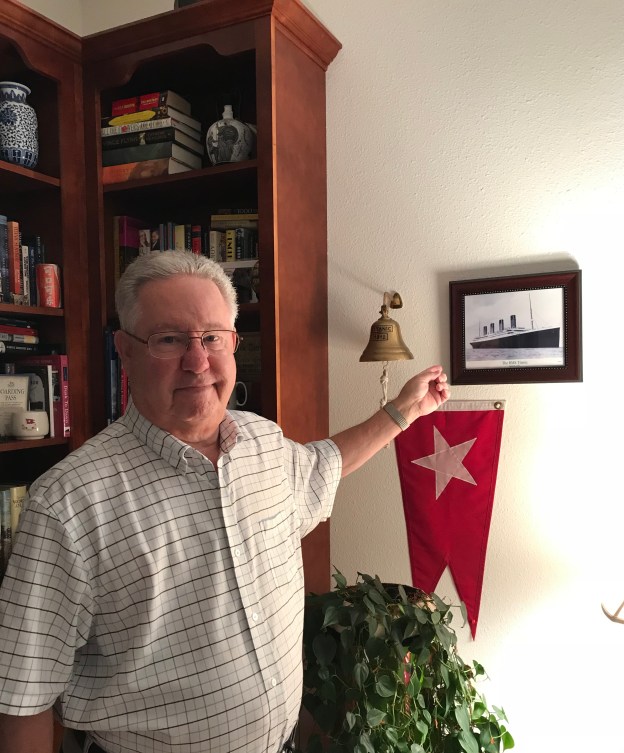
The Titanic Fanatic

On March 28, 1956, nine-year-old Steven Mattis sat mesmerized in his living room in Philadelphia as Kraft Theater’s adaptation of A Night to Remember unfolded. Based on the non-fiction book of the same name by Walter Lord, the one hour television production told the story of the maiden voyage of the RMS Titanic. At first enthralled by the beautiful ship, the glamour of the first class passengers, and the contrast to the third class passengers circumstances, Mattis’ fascination turned to horror as he viewed the shocking climax: Three hours after hitting an iceberg, the British ocean liner sank into the North Atlantic Ocean. Over one thousand five hundred men, women, and children perished. 

It was a life-changing event. That night, Mattis cried himself to sleep. “I realized that my parents could not save me from all of life’s dangers,” he remembered.

In the years that followed, Mattis spent much of his spare time reading and researching everything he could learn about the doomed voyage. His interest in the supposedly “unsinkable ship” has expanded over six decades. More recently Mattis has thrilled innumerable people who have listened to his lectures on the subject. 

The Titanic did not play into his professional career. For thirty-seven years, Mattis taught Spanish, first in Philadelphia and then for seven years in Fort Lauderdale,Florida. In 2005, Mattis moved to Solivita, an active 55+ community in Kissimmee. A seasoned traveler—he has been on 117 cruises so far—he joined Solivita travel club and  spent the next twelve years organizing and leading trips for its members. His travels have taken him and the travel club groups to China, Tahiti, Antarctica, Alaska, Hawaii, the Mediterranian, and safaris in Africa.

In April 2012, Mattis participated in the 100th Anniversary Titanic Memorial Cruise. The MS Balmoral, which sailed out of Southhampton, England, retraced the doomed liner’s fateful journey. For Mattis and many of its 1308 other passenger—seventy relatives of people who had died onboard or who had survived—the highlight was the moving memorial service. The ship sailed to the site of the sinking to be there exactly one hundred years to the hour. The commemorative ceremonies began at 11:40 p.m. on April 14 when Titanic struck the iceberg and ended at 2:20 a.m., April 15, when she sank under the sea. 

The following fall, Mattis presented a talk with accompanying slides on his “trip of a lifetime” to Solivita’s Travel Club.Before embarking on  a cruise on the Amazon the following year, Mattis posted a question to fellow cruisers: “Would any of you be interested in hearing my Titanic lecture?” The response was overwhelmingly favorable. Over forty people showed up at that first lecture. The cruise director, impressed with the depth of knowledge and passion Mattis conveyed, encouraged the “Titanic fanatic” to add additional lectures to his repertoire and offer the package on future cruises. Mattis and his best friend, Andy Miller, complied, adding three more lectures.The rest, as Mattis says, was history.  

Starting with groups in Solivita and local libraries, Mattis expanded his audience to multiple cruise lines, including Azamara, Royal Caribbean, Silversea, Princess and Celebrity. His audiences have been as large six hundred people, often growing over the length of the cruise as favorite word of mouth reviews spread throughout the ship. 

Mattis’ lectures are —no pun intended—a tip of the iceberg regarding people’s interest in the ill-fated voyage. Traveling expeditions, numerous museums, special events, television shows, and eight movies still draws crowds. (Mattis himself has seen A Night to Remember fifteen times and James Camerons’ Titanic close to fifty.) 

What brings people to Mattis’ lectures on a cruise ship when they could be sunning by the pool or learning how to fold napkins? Mattis believes that this is a story into which people can put themselves. Mattis said that the fact that the Titanic took close to three hours to go down puts people into the story.”’Who would I have been in the Titanic?’ people ask.” Mattis said. “Would I have been a hero? A villain? A first class passenger steeped in elegance? A third class immigrant in steerage?” 

The irony—the pure tragedy—also sparks peoples interest. “There was great hubris by both the designers and the captain in thinking that a ship—with a shortage of lifeboats for partly esthetic reasons—could be unsinkable and could run at full speed at night through ice fields after warning after warning of the danger.”

Mattis often  tailors his lectures to his audiences, as he did in 2015 when he gave a lecture on Jews on the Titanic for Solivita’s Shalom Club. Mattis, whose family belonged to Brith Israel, a conservative synagogue in Philadelphia, takes pride in the way prominent Jews handled their fate on the ship. 

As did many passengers, Benjamin Guggenheim, the fifth of seven sons of the wealthy mining magnate Meyer Guggenheim, initially did not realize the fatal consequences that would result from the ships’s collision with the iceberg. “We will soon see each other again! It’s just a repair,” he said to the women and children he and his valet were helping into lifeboats. Once he realized that he and many others would not survive, he returned to his cabin and donned his evening wear. “We’ve dressed up in our best and are prepared to go down like gentlemen,” said Guggenheim. Mattis said later accounts described the billionaire and his valet as last seen seated in chairs in the foyer of the Grand Staircase sipping brandy and smoking cigars, ready to accept their fate without fear or hesitation. Their bodies were never recovered.

Two other Jews who lost their lives on April 15, 1912, were German-born Isador Strauss, politician and the owner of Macy’s Department Store, and his wife Ida Strauss. The couple were on the Titanic traveling back from a winter in Europe. Once it was clear the Titanic was sinking, Isador refused to get into a lifeboat, stating firmly, “I will not go before the other men.”  Ida handed her fur coat to her maid, Ellen Bird, as she left the lifeboat, said, “As we have lived, so will we die, together.” In what eye witnesses later described as a”most remarkable exhibition of love and devotion.” Isidor and Ida were last seen on deck arm in arm.

Broadway producer Henry Birkhardt Harris was more successful in convincing his wife, actress Renee Harris to board a lifeboat without him. Earlier that day, Renee had broken her arm in a fall on the Grand Staircase. Convincing her that he could not save himself as well as his disabled wife, Henry refused a seat and also perished. His widow, who became New York City’s first woman theatrical producer, remarried three times and lived until 93. 

Not all Jews were first class passengers.Leah Rosen Aks, emigrating to America from London, was on the Titanic with her infant son Phillip. Leah and her son were separated in the confusion when they were being loaded on the lifeboats. “Filly” was thrown into another lifeboat; the inconsolable Leah was soon placed on Lifeboat 13. Soon after Carpathia rescued the survivors, Leah was walking on the deck when she recognized her son’s cry. However, the woman who had caught Phillip, regarding the baby as a “gift from God,” claimed it to be her own. In a scenario rivaling King Solomon, Leah pleaded her case to the Carpathia’s captain. Only when Leah was able to identify a distinguishable birthmark on his breastbone was Phillip returned to his birth mother. Leah and Phillip were reunited with her husband Sam in New York. They later had a second son, Harry, and a daughter, Sarah Carpathia—named after the rescue ship.

Mattis also related another note of Jewish interest: The Titanic had a kosher kitchen. On board was a “Hebrew” chef, a non-Jew from South Africa, who had trained with a rabbi in Southhampton on previous White Line cruises. A kosher option was available to all passengers, including those in third class.

Over one hundred years later, all the passengers are gone, not only those that died but those who survived. Millvina Dean, who was two months old when the vessel hit the iceberg, died in 2009 at the age of 97. 

Mattis regards the time he spends sharing the Titanic’s stories as his contribution to the legacy of the ship. “The fact that this story stays alive and is of interest to so many brings me joy,” says Solivita’s own Titanic Fanatic.

Originally published April 19, 2018. Updated May 26, 2025.