Tag Archives: #travel

Wandering, wandering!–Where do we settle?

A version of this article originally appeared in the June 18, 2015, issue of the Jewish World News. I am publishing this blog post as we celebrate nine years in our “new” home.

This year marks the fortieth year Larry and I have celebrated Passover as a married couple. Unlike the Israelites, we have not exactly spent it wandering in a desert wilderness. It has been a fruitful, productive life spent in the Capital District. For us, next year will not be in Jerusalem, but in Florida.

A real upstate girl, born in St. Lawrence County and raised in in Essex County (Since when is Westchester County upstate?),relocating to Albany for college in 1968. Larry also had spent all but his college years in Saratoga County. We met in Albany, married, moved to Clifton Park, raised two children, made wonderful friends, and spent holidays with our families.

When did the desire to live someplace else begin? The germ was planted twenty years ago when our parents spent six to eight months a year in Florida. Our circle began to expand geographically: our children moved to California and Colorado; my sister moved to Arizona; an aunt moved to South Carolina; a niece moved to Virginia; and a number of friends and family started living two to four months in warmer climates. Other friends were spending time with their own children, who were scattered over the country and the world. We began a nomadic life, visiting friends and family and traveling on our own to Germany, Peru, England, Greece. Although we enjoyed our numerous trips, we felt finding “our spot,” a place that fit all our criteria, would keep us more grounded.

Every place we visited raised the question, “Could we live here?” We did some California dreaming, but the high prices of real estate and the high possibilities of earthquakes ruled it out. Julie and Sam live at 9000 feet in Colorado, truly a Rocky Mountain high. Summit County is beautiful in the summer, but the winters last nine months, and you think Boston gets snow? Try twelve feet a year, every year. Other places in Colorado offered warmer temperatures, but the homes we viewed were close together, and we would still need our snow shovels.We also Arizona would be out of the mix: The desert can be lovely, but no manna—and little rain—fell from the heavens, and we were always happy to get back to “green” and water on the East Coast. Ever the English major, I  even fell in love with the small villages in England, but we knew that would never be where we settled. 

Once we retired four years ago, our interest in relocating intensified. The long winters and grey skies hadn’t bothered us when we were working, but once we were home all day, the weather became a factor. Our friends and family changed from asking, “Have you any trips planned?” to “Where are you going next?” And after forty years, Larry and I were ready for our next adventure. 

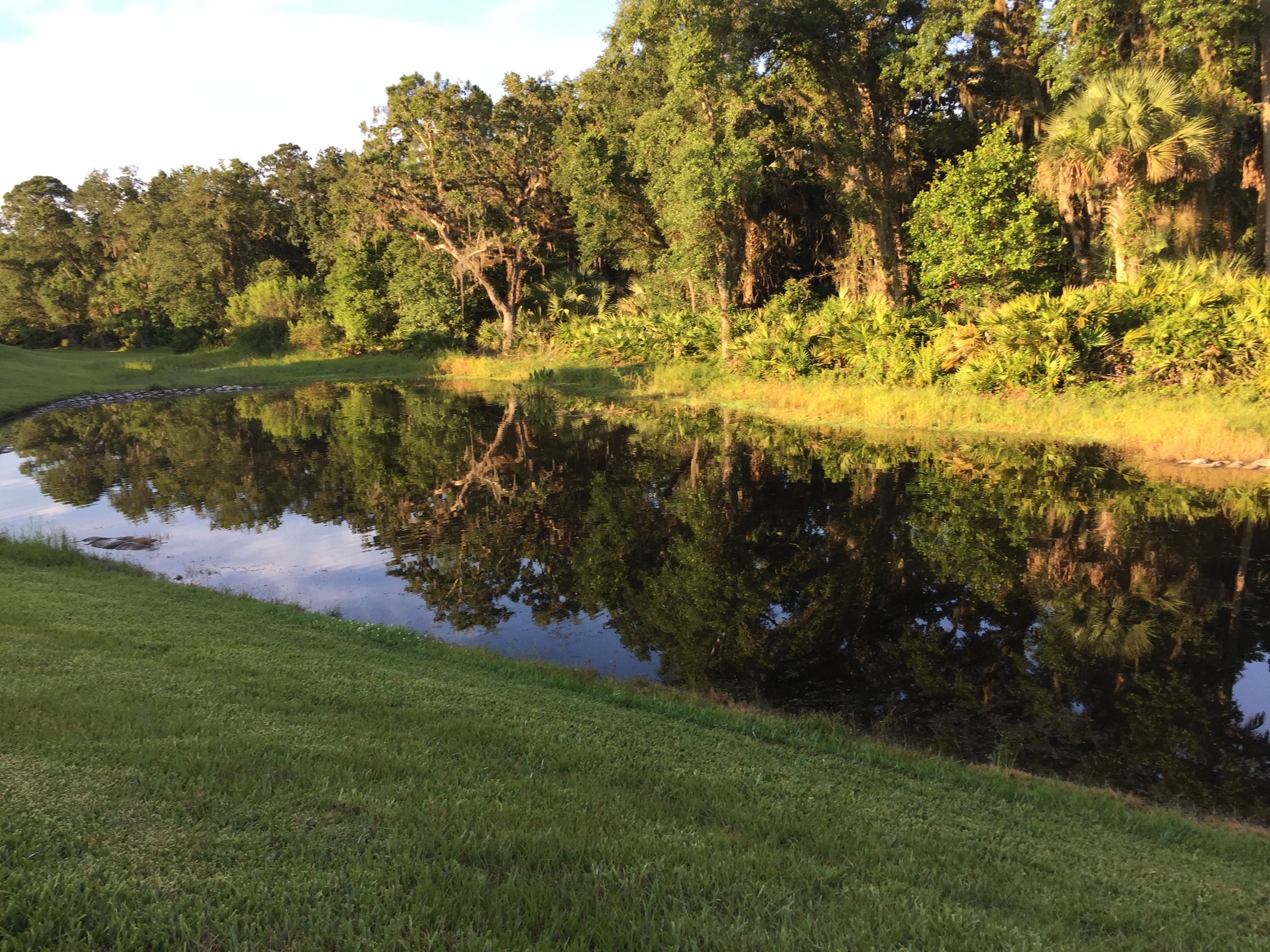
This fall, everything fell into place. Julie told us over Thanksgiving that, after eight years of marriage, she and Sam were expecting our first grandchild in July 2015. After I stopped jumping up and down with joy, Larry and I made the decision that we would like to spend our summers in Colorado and the rest of the year someplace warm. We found that warm spot on a rainy December day in Florida, when we checked out an active adult  community where we were staying near Orlando. From the moment we drove in, Larry and I were impressed with the tranquil setting and the amount of green space and lakes. We fell in love with an immaculate home for sale on a lovely piece of land overlooking a pond and bordering a wildlife preserve. The community itself offered all we were looking for: indoor and outdoor pools, Hadassah chapter, book clubs, a writing club, bike paths, pickle ball courts, movies and shows, and exercise classes.It was close to world class entertainment and an international airport with direct flights to all major cities in the country.

We came back to Albany, to grey skies, piles of snow, and sub-zero temperatures. Even with the miserable weather, we still needed time. After much research, thought, discussion, and several sleepless nights, we decided to purchase the home in Florida and spend two to three months in Colorado. So, after forty years of New York Passovers, next year we will be celebrating with the Shalom Club in our new neighborhood.  

If physically packing up the house is a challenge, emotionally leaving behind family, friends, and years and years of memories will be even more difficult. For the last twenty years, I have had the following framed quote hanging in our home, “Come my love and we shall wander, just to see what we can find. If we only find each other, still the journey is worth the time.” Like our Israeli ancestors, Larry and I will be wandering far from the home we have known to begin our next adventure. 

Through the sands of time: A shul in St. Thomas?

Under a hot tropical sun, Larry and I wound our way first along the Caribbean Sea and then, in a couple of zigzags to the left, up a steep hill. We stood in front of a large stone edifice with its white plaster column and point-arch windows. Robert Kunkel, the docent/educator, opened up the black iron gate and led us up a set of stairs to the large point-arch entrance doors. After several trips to the Caribbean, Larry and I finally could visit the Hebrew Congregation of St. Thomas, the second oldest synagogue building in the western hemisphere and the oldest in continuous use under an American flag.

Stepping past the threshold, we immediately noticed a carpet of sand that covered the center of the room. We then took in the beautiful architecture. A domed ceiling holding the Eternal Light soared above us. The mahogany pews, finished by nineteenth century shipbuilders, were set up in on three sides to face the ark. A striking marble slab supported its base. Above the curtained doors, artisans had engraved two tablets representing the Ten Commandments into the native stone. More pointed-arch windows let in the bright light, while thick white plaster walls helped keep the interior cool. 

As we settled into the pews, Robert shared his vast knowledge of the synagogue and its important role in the history of St. Thomas, the largest of the three main islands that comprise the US Virgin Islands. But first he addresses our most pressing question: Why sand? He explained that the first Jews in the Caribbean were of Sephardic, or Spanish-Portuguese, descent. The unique floor, one of only five in the world, shows how the Spanish Inquisition (most active between 1480 and 1530) forced their Jewish ancestors in those two countries to practice their religion secretly in basements, covering the floors to muffle their footsteps and voices.

So how did these Iberian Jews land up in St. Thomas? Facing a choice of forced conversion or expulsion, victims of the Spanish Inquisition fled to European cities. Over the next four centuries, partially because of discrimination in other professions, Jews developed a mercantile trade which lead them to countries in both South America and the Caribbean, including St. Thomas. The number of Jews on this island remained small until the years after the American Revolution, when an influx of Sephardic Jews set up businesses in a climate of great tolerance and discrimination. In 1796, the Jews of St. Thomas founded B’racha V’shalom (Blessing and Peace). A fire destroyed the first structure along with several hundreds of building on the island. In 1812, the Jewish community purchased land and built a new synagogue. A growing population resulted in erecting a new expanded wooden structure with an expanded name: Congregation Beracha Veshalom Vegmiluth Hasadim, “Blessing and Peace and Loving Deeds.”

On December 31, 1831, another fire destroyed one quarter of the buildings on St. Thomas, including the shul. Not to be deterred, the Jewish community began an international fundraising effort to raise the $5000 needed to rebuild a house of worship made of stone, brick, and mortar. 

 The congregation and surrounding non-Jewish community had donated money, materials, and labor towards the project. In September 1833, the entire community celebrated the reconsecration of the building, which held the two Torahs and the Eternal Light that had been rescued from the fire. This was the building we were standing in almost 190 years later. 

As the synagogue grew, the congregation purchased a burial ground, established a Hebrew School, and began using the services of actual clergy. Like all synagogues, the following years brought the synagogue schisms over liturgy and rabbis, and fluctuating membership. Through it all, it remained a living, vibrant synagogue connected closely to its community. Most notably, two members of the congregation served as governors the Virgin Islands: Morris Fidanque De Castro (1950-1954) and Raphael Moses (Ralph) Paiewonsky (1961-1969).

As written in the museum’s online narrative, the St. Thomas Synagogue continues to follow in the footsteps of its ancestors, preserving their heritage and honoring their traditions. Part of this renewal was the congregation’s current search for a rabbi, as its most recent spiritual leader had moved to New Jersey to be closer to his family. 

After the narrative, the tour guide opened up the ark, which housed seven Torahs. The one Sephardic Torah was housed vertically in a beautiful wooden cylindrical case which followed the customs of the Spanish-Portuguese Jewry to both store and read the scrolls while standing in their cases. The six other Ashkenazi Torahs were dressed in the traditional Ashkenazi accessories each with a mantel (velvet covering); Atzei Chayim (wooden shafts) topped with keters (crowns); and a yad (pointer). They rested at an angle on the back of the ark. Because of my interest in the Shoah, my favorite was a Memorial Scrolls Trust Torah (MST #533) which was rescued from Budyně nad Ohří, a small town in Bohemia, Czech Republic. Jews had lived there from the 13th century. In 1942, the Nazis liquidated the town of its 50 Jews who still remained. 

With the guide’s approval, Larry and I took turns holding the Holocaust Torah before saying our goodbyes and thanks. We spent time in the museum gift shop, where we purchased a mezuzah, Through the Sands of Time: A History of the Jewish Community of St. Thomas, US Virgin Islands by Judah M. Cohen, and a T-shirt for Larry proclaiming “I Climbed Synagogue Hill.” We headed back to our cruise ship, thankfully a downhill journey, happy to know we finally got to see this living museum of Jewish sacrifice, survival, and strength. “The sands of time may pass over our shores again and again, changing our landscape, but the soul of our synagogue and its people remains eternal,” reads the synagogue’s website. “Our history does not end. Rather, with each generation, it begins anew.” 

On February 22, 2023, less than a week after our visit, the Hebrew Congregation of St. Thomas started a new chapter and welcomed Julia Margolis as its first female rabbi. Rabbi Margolis took a long, circuitous route to the shul. Born in Moscow, USSR, her family moved to Israel when she was 12. After graduating from high school and serving in the Israel Defense Forces, she completed undergraduate degrees in Jewish history, Islam, and art and a master’s degree in Jewish studies. Following in the footsteps of her mother, who was the first Russian-speaking female rabbi in Israel, Rabbi Margolis was ordained by the Abraham Geiger College in Germany. Closely connected to the Reform Movement, Rabbi Margolis was heading a synagogue in Johannesburg, South Africa, when she saw the synagogue was looking for a new leader. She submitted her application, but she was still surprised when the search committee contacted her. In the middle of their negotiations, her husband Greg tragically passed away. Following her heart, she made the move with her two children to St. Thomas, where she soon was “soaking in the beauty and the spirituality of this place.”

“God always has a plan,” Margolis shared in a March 21, 2023, article in the Virgin Islands Daily News. “It takes a lot of time sometimes to see that, but there is always a plan.”

Originally published May 25, 2023. Updated May 25, 2025.

Fun Trivia:

 The Mikvé Israel-Emanuel Synagogue in Curaçao is the oldest synagogue building in the Western Hemisphere. (1730)

The Touro Synagogue in Newport, Rhode Island, is the oldest synagogue building  in North America that is still standing. (1763)

The  Old New Synagogue of Prague in the Czech Republic is the oldest active synagogue in the world. (1270s)

The Ben Ezra Synagogue in Cairo, Egypt is the oldest synagogue in the world and also the longest serving. The original synagogue dates back to the ninth century. When Jews fled Egypt in the 1950s, it was turned into a museum. 

Temple Israel in Leadville, Colorado, holds the record for the highest synagogue in the world. Founded in 1884, the synagogue sits at an elevation of 10,152 above sea level. It is now a museum. 

A version of this article originally appeared in the May 25, 2023, issue of the Jewish World News, a bi-weekly subscription-based newspaper in upstate New York.

A version of this article originally appeared in the June 2, 2023 issue of the  Heritage Florida Jewish News, a weekly subscription-based newspaper in Central Florida.