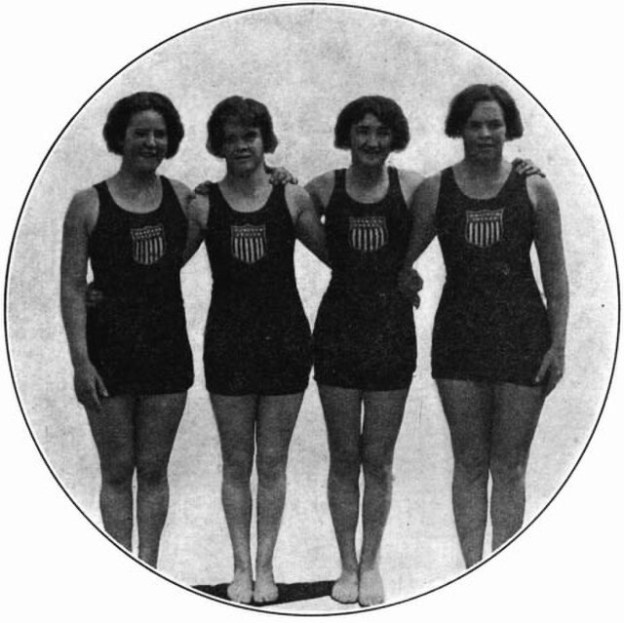
O mermaid bold, long may you hold/ The wreath you’ve won by swimming,/And spoil for gents their arguments/ Regarding Votes for Wimmen! “To a Lady Swimmer,” William F. Kirk 1914.
I love to swim. So it is no surprise that I spent much of the first week of the 2024 Paris Olympics watching the swim competition. I cheered on Team USA as they won twenty-five medals in the thirty-nine events in the Paris La Défense Arena. As I yelled “Go! Go! Go!” at the screen during the 1500 freestyle, Katie Ledecky’s last race, my granddaughter admonished me. “Your screaming isn’t going to make a difference,” she said. Hey! Maybe it did! Ledecky won the fourteenth medal she had earned over four Olympics.
Ledecky, Torri Huske, Jenny Thompson, Dara Torres, Janet Evans, Donna de Varona, and every woman who dove into an Olympic pool has a Jewish woman to thank. Charlotte “Eppy” Epstein, considered the “Mother of Women’s Swimming in America,” was not an exceptional swimmer herself but believed that athletic competition was as important for women as it was for men. Her determination and leadership impacted not only the sport of swimming but also how women perceived their own bodies and their place in the world.
As Glenn Stout recounted in his 2009 book, Young Woman and the Sea, How Trudy Ederle Conquered the English Channel and Inspired the World, until Epstein transformed women’s swimming, societal norms discouraged women from swimming or, in fact, from “breaking a sweat” anywhere but in the kitchen. Social bias against women’s participation in sports was the norm. This was best represented by Olympic founder Baron Pierre de Coubertin of France, who thought women’s competition in athletics was “physically dangerous for such delicate flowers and morally offensive.”
Even if they could get in the water, the standard female bathing costumes hindered women swimmers. Kristin Toussaint described them in a 2015 Boston Globe article: “black, knee-length, puffed-sleeved wool dresses worn over bloomers with long black stockings, bathing slippers, and even ribboned swim caps.” In 1907, Annette Kellerman, an Australian competitive swimmer and vaudeville star, was arrested for indecency by Massachusetts police for wearing a one-piece bathing suit that ended in shorts above her knees. “Kellerman may have been thoroughly covered,” Toussaint said, “but to her fellow bathers, she may as well have been naked.”
Epstein changed the narrative in 1914 when she founded the National Women’s Life Saving League, which offered the “delicate flowers” a place to swim and take lessons. Using negotiating skills she learned through her job as a court reporter, she convinced the Amateur Athletic Union (AAU) to permit women to register with their organization for the first time and to sponsor competitive women’s meets. According to Stout, Epstein worked “behind the scenes … extolling the advantages of having a women’s swim association managed by women while deftly praising the example set by the AAU as an organizing body without peer —essentially killing the organization and its male overseers with kindness.”
In 1917, she struck out on her own, creating the New York City Women’s Swimming Association (WSA) to further advance the sport. She successfully battled the United States Olympic Committee, enabling American female swimmers and divers to compete in the Olympics in Antwerp, Belgium. Through her efforts, swimming dresses and bloomers were replaced with outfits closer in style to Annette Kellerman’s. The success of the American women’s swim team led to the inclusion of track and field and other sports for women in future Olympic Games.
Epstein served as the women’s swimming team manager for the 1920, 1924, and 1932 Olympics. Her swimmers and divers dominated the games, holding fifty-one world records over the course of her twenty-two years of coaching. Her protégées included Eleanor Holm, Aileen Riggin, Helen Wainwright, and Gertrude Ederle. Epstein also served as chair of the national AAU women’s swimming committee.
Her Jewish roots became part of her legacy. The WSA team swam at the Young Women’s Hebrew Association of New York for national championship meets in the 1920s. In 1935, Epstein served as chair of the swimming committee of the Second Maccabiah Games. In 1936, she refused to attend the Berlin Olympic Games and withdrew from the American Olympic Committee in protest of the United States’ participation in the “Nazi Olympics.”
During her lifetime, Epstein also used her position to battle for women’s suffrage, staging “suffrage swim races” with her teammates, and fought for further bathing suit reform, distance swims, and additional competitive events for women. She continued to have a major influence on swimming until her death in 1938, just short of her fifty-fourth birthday. She was inducted into the International Swimming Hall of Fame and the International Jewish Sports Hall of Fame.
“By motivating young women to follow their passions in a sport that did not yet fully accept them, Epstein truly changed the way women thought about swimming,” according to Women in Swimming (Betsey Bennett. “Charlotte Epstein and the Swimming Suffragettes.” Women in Swimming. October 25, 2018). “And her impact did not end in the pool; once women gained freedom over their bodies in sports, they were better able to achieve liberation in other facets of society.”
On Wednesday, July 31, after binging on a morning of Olympic events being broadcast on NBC, I headed for the small pool in our Colorado rental complex. I swam 1500 meters in over an hour, approximately four times Ledecky’s time of 15:30.02 minutes in Paris earlier that day. I may not be setting any world records, but I too am a beneficiary of efforts of the small Jewish powerhouse from Brooklyn. I did not fear being arrested for wearing a TYR swimsuit, and no one feared that this “delicate flower” could not survive the multiple laps. I tip my Speedo swim cap to you, Eppy!
In 2024, Disney+ released the film Young Woman and the Sea based on Glenn Stout’s 2009 book. The movie tells the story of Epstein’s most well-known protégé, Gertrude Ederle, the first woman who swam the English Channel. Sian Clifford, who played Epstein, said the movie is “a beautiful, inspiring story that should have been told before.”
“Charlotte Epstein serves as a symbol of the critical efforts of a Jewish sportswoman to improve the competitive opportunities and quest for physical emancipation of American women using their bodies in aquatic sports,” wrote Linda Borish in her 2004 paper. (“The Cradle of American Champions, Women Champions … Swim Champions’: Charlotte Epstein, Gender and Jewish Identity, and the Physical Emancipation of Women in Aquatic Sports.” The International Journal of the History of Sport_, Vol. 21, 2 (March 2004): 197-235.
All women swimmers—or all women athletes for that matter—have Eppy to thank.
Originally published August 16, 2024. Updated July 2025.
Note: First Place Winner, 2025 Florida Press Association’s Sports Feature Story, Category C (Small newspapers).
SOURCES
Borish, Linda. “The Cradle of American Champions, Women Champions Swim Champions’: Charlotte Epstein, Gender and Jewish Identity, and the Physical Emancipation of Women in Aquatic Sports.” www.researchgate.net. March 2004.
“Charlotte ‘Eppy’ Epstein.” International Jewish Sports Hall of Fame.Website: http://www.jewishsports.net/BioPages/Ch
Charlotte Epstein. Jewish Virtual Library. Website: https://www.jewishvirtuallibrary.org/epstein-charlotte
“Sian Clifford Spills Secrets on ‘Young Woman and the Sea’ at Premiere.” Website: https://www.youtube.com/watch?v=F3sXvDepTr8
Stout, Glenn. Young Woman and the Sea, How Trudy Ederle Conquered the English Channel and Inspired the World. Houghton Mifflin Harcourt. 2009.
Toussaint, Kristin. “This woman’s one-piece bathing suit got her arrested in 1907.” July 2, 2015. https://www.boston.com/news/history/2015/07/02/this-womans-one-piece-bathing-suit-got-her-arrested-in-1907/
Charlotte Epstein. Photo Credit: Robert SlaterGreat Jews in Sports, (New York, Jonathan David Publishers, Inc., 1983), p. 65.

 There Goes My Heart