
This is an updated version of Eva Geiringer Schloss’s story that was originally published in November 2023.
On June 12, 1942, Anne Frank was given a diary for her thirteenth
birthday. Less than a month later, she and her family went into
hiding from the Nazis. The story of Eva Schloss Geiringer may
not be as well-known as Anne Frank: The Diary of a Young Girl. Through a
chance meeting with a passionate New Jersey college educator, however, Eva’s
amazing life of sacrifice, survival, and strength is finally gaining the recognition
it deserves.
On a train to Auschwitz, fifteen-year-old Eva made a promise to her
brother, Heinz Geiringer. If he did not survive the camps, Eva promised to
retrieve the paintings and poetry Heinz hid under the floorboards of his attic
hiding place. The film Eva’s Promise, an important addition to the annals of
Jewish Holocaust history, introduces its audiences to Heinz, his artistry, and
Eva’s efforts to find and share her brother’s remarkable legacy.
Heinz Geiringer and Eva Geiringer Schloss’s Holocaust story is chillingly
parallel to that of their classmates, Margot and Anne Frank. Faced with Hitler’s
rise, Erich, Elfriede (“Fritzi”), and their two children, fled from their home and
comfortable life in Vienna, Austria, and settled in the Netherlands, hoping
its history of neutrality would provide a safe haven. Their worst fears came to
pass when Germany invaded Holland.
“As of 15 May 1940, we were living under Nazi occupation, and we had
nowhere else to go,” Eva recalled in her 2013 memoir After Auschwitz: A Story
of Heartbreak and Survival by the Stepsister of Anne Frank. Soon after, the Nazis
implemented the increasingly harsh measures against the Jews that were part
of their Final Solution. In May 1942, Heinz received orders to report for a
deportation to a Germany factory. That evening, the family went into hiding.
As no place was large enough for four people, they were forced to split up. Erich
and Heinz in one apartment; Fritzi and Eva in another. For Eva, her time was
to be “a mixture of two emotions, utter terror and mind-numbing boredom.”
161Remembrance and Legacy A Sister’s Promise Fulfilled: Eva Geiringer Schloss
Meanwhile, Heinz, having to give up his musical interests, spent his time
painting and writing poetry. “I could hardly believe the detailed and impressive
oil paintings that he showed me,” said Eva, recalling the furtive visits she and
Fritzi made to the men’s apartment. “In one, a young man, like himself, was
leaning his head on the desk in despair. In another, a sailing boat was crossing
the ocean in front of a shuttered window.”
On May 11, 1944, Eva’s fifteenth birthday, the Geiringer family was
captured after being betrayed by a double agent in the Dutch underground.
A train took them on an arduous three-day trip across Europe, in what would
be the last time they would be together as a family.
During their ride, Heinz made Eva promise that if he didn’t survive, she
would retrieve the paintings he had stashed under the floorboards of the house
where he and his father had hidden them. “Please, Eva, please,” Heinz told his
sister. “Go and pick it up and show to the world what I achieved in my short
life.” Eva grudgingly agreed.
When the trains reached the concentration camps, Erich and Heinz
were sent to Auschwitz; Fritzi and Eva, to Birkenau. Through sheer luck and
resourcefulness, Eva and Fritzi survived but were barely alive when Soviet
troops freed them in 1945. “I never gave up hope, or the determination that I
would outlast the Nazis and go on to live the full life that I and all victims of
the Holocaust deserved,” Eva said.
Tragically, Heinz and Erich perished in Ebensee, a subcamp of Mauthausen
following the forced march from Auschwitz that came just before the war
ended. The two women eventually returned to Amsterdam and settled into
their family’s apartment, which had remained untouched.
After the war, Otto Frank, their old neighbor, the only surviving member
of his family and his “Annex” companions, took comfort in visits with Fritzi
and Eva. In 1953, Eva became the posthumous stepsister of Anne Frank when
Otto and Fritzi were married. The couple dedicated the rest of their lives to the
publication and promotion of what would be the world’s most famous diary.
In the meantime, Fritzi and Eva had retrieved Heinz’s work, which included
paintings, a sketchbook, and poems, from his and Erich’s last hiding place. For
many years, Eva and her mother kept the paintings and poems in the family.
Eva eventually moved to London, where she married Zvi Schloss, a German
refugee, raised their three daughters, ran a successful antique store, and quietly
moved on with her life despite her recurring nightmares. It was a few years after
Otto Frank passed away in 1980 that Eva, now in her late fifties, began publicly
sharing her wartime experiences in person and through her memoir, Eva’s
Story: A Survivor’s Tale by the Stepsister of Anne Frank (1988). “As soon as I
started talking, I became calmer and didn’t have nightmares anymore,” she said
in her film Eva’s Promise. During one of her talks in Philadelphia, she shared
Heinz’s work for the first time.
A chance meeting with Susan Kerner led Eva to further expand her audi-
ence. In 1994, Kerner, the education director at the George Street Playhouse
in New Brunswick, New Jersey, directed a production of The Diary of Anne
Frank. Kerner reached out to Ed Silverberg, a friend of Anne Frank’s who
had survived the war by successfully hiding, to talk to the cast about life in
Amsterdam after the invasion.
Around the same time, Young Audiences of NJ reached out to Kerner with
a request to work with a playwright to create a play about Anne Frank to tour
schools. The Anne Frank Center in NYC suggested they create a piece about
two hidden children who survived the Holocaust who had a connection with
the now-famous German author.
“I already knew Ed,” recounted Kerner in a 2023 article in the Jewish
Standard Times of Israel. I wanted a woman, and I wanted her to be a camp
survivor.” They put her in touch with Eva Schloss. George Street Playhouse
commissioned playwright James Still to write the play. The final product, And
Then They Came For Me: Remembering the World of Anne Frank, is a gripping
multimedia experience, which combines videotaped interviews with the two
survivors playing behind the actors who portrayed scenes from their lives.
162 163Remembrance and Legacy A Sister’s Promise Fulfilled: Eva Geiringer Schloss
Thirty years later, the play continues to tour around the world.
A lifelong friendship developed between Eva and Kerner, who met peri-
odically. As the success of the play grew, Schloss sold her antique shop and
became a full-time Holocaust educator, traveling in Europe, Asia, and the
United States and participating in talkbacks following performances of the
play in many countries.
More importantly, Eva came to grips with the unfulfilled promise she had
made to her older brother. In 2006, over sixty years after the Holocaust, Eva
gave Heinz’s works to the newly established Het Verzetsmuseum, the Dutch
Resistance Museum in Amsterdam. Soon after, she published her second
memoir, The Promise (2006), followed by her final memoir, After Auschwitz
(2013). She now focused her efforts on preserving Heinz’s’ legacy. “It became
my task that people would remember who he was … and what he achieved,”
Eva said.
As the COVID-19 pandemic shut down the world, Eva realized that she
wanted to do even more to preserve Heinz’s legacy. She reached out to Kerner,
who suggested a documentary film. Kerner recruited Steve McCarthy, her
Montclair State University colleague and an Emmy Award-winning filmmaker,
to direct and coproduce what would become Eva’s Promise. Eva had only two
requests: “Get it done. And hurry.”
Despite the pandemic, the team, which now included McCarthy’s two
sons, flew to London to tape twelve hours of interviews with Schloss. They also
interviewed the staff of the Amsterdam museum that houses Heinz’s work.
The film was completed in 2022.
Kerner and McCarthy worked tirelessly and without pay to produce
the film. Screenings took place across the United States, including a show-
ing at the Ronald Reagan Presidential Library and Museum in Simi Valley,
California. Kerner hopes that the documentary can be used as an educational
tool to counteract the recent dramatic rise of antisemitism as a result of the
Gaza–Israeli War. In 2024, she and McCarthy tested the film in a school with
eleven- to thirteen-year-old children. “The kids were very engaged and had
lots of thoughtful comments and questions,” said Kerner.
Beginning in 2024, Eve’s Promise has been presented on 17 PBS stations.
The film has been screened in film festivals, museums, JCCs, synagogues, and
theaters. Several colleges have included it in course curricula, and the film is
beginning to get adopted in secondary schools. Eva’s Promise was presented
at an Anne Frank exhibit in Columbus, Ohio, in February 2025. The Heinz
Geiringer story, including his poems and paintings, will be featured in an
upcoming New York State Holocaust resource guide along with a clip of the
film. Kerner envisions the resource guide will lead to greater national and even
international exposure.
Until recently, Eva continued her active involvement in Holocaust educa-
tion and advocacy. She has spoken around the world, with a special place in her
heart for her meetings with schoolchildren. She was part of the 2018 campaign
to convince Mark Zuckerberg to ban Holocaust deniers from Facebook,
and she is prominently featured in the Ken Burns 2022 documentary, The
U.S. and the Holocaust. In January 2023, Eva attended the screening of Eva’s
Promise at JW3, a Jewish community center in London. Now nearing her
ninety-sixth birthday, she has stepped back to rest and is enjoying time with
her first great-grandchild. Her grandson Eric, who is featured in the film, now
shares her work.
Before they were forced into hiding, Eva’s father Erich gave his children
the following advice: “I promise you this, everything you do leaves something
behind; nothing gets lost. All the good you have accomplished will continue in
the lives of the people you have touched. It will make a difference to someone,
somewhere, sometime, and your achievements will be carried on.”
Through her books, her films, and her tireless work in Holocaust educa-
tion and advocacy, Eva Schloss has not only kept her promise to her brother
Heinz but also has made the memory of the six million and all who have been
subjected to hatred a blessing and an inspiration.
Please contact Susan Kerner at kerners@montclair.edu for information on showing “Eva’s Promise” in your community. The film’s website is https://ryanreddingtonmcca.wixsite.com/evaspromise.
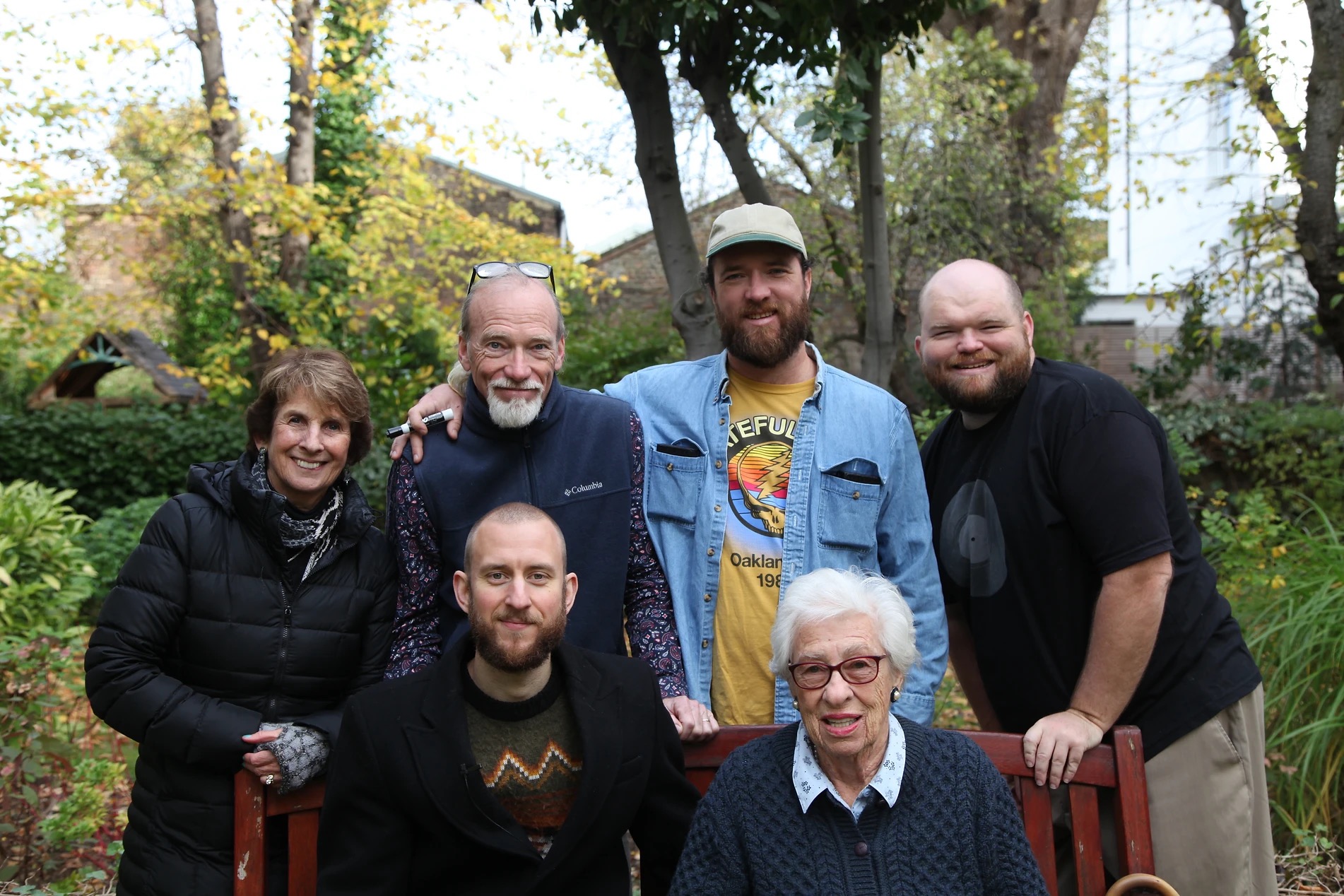
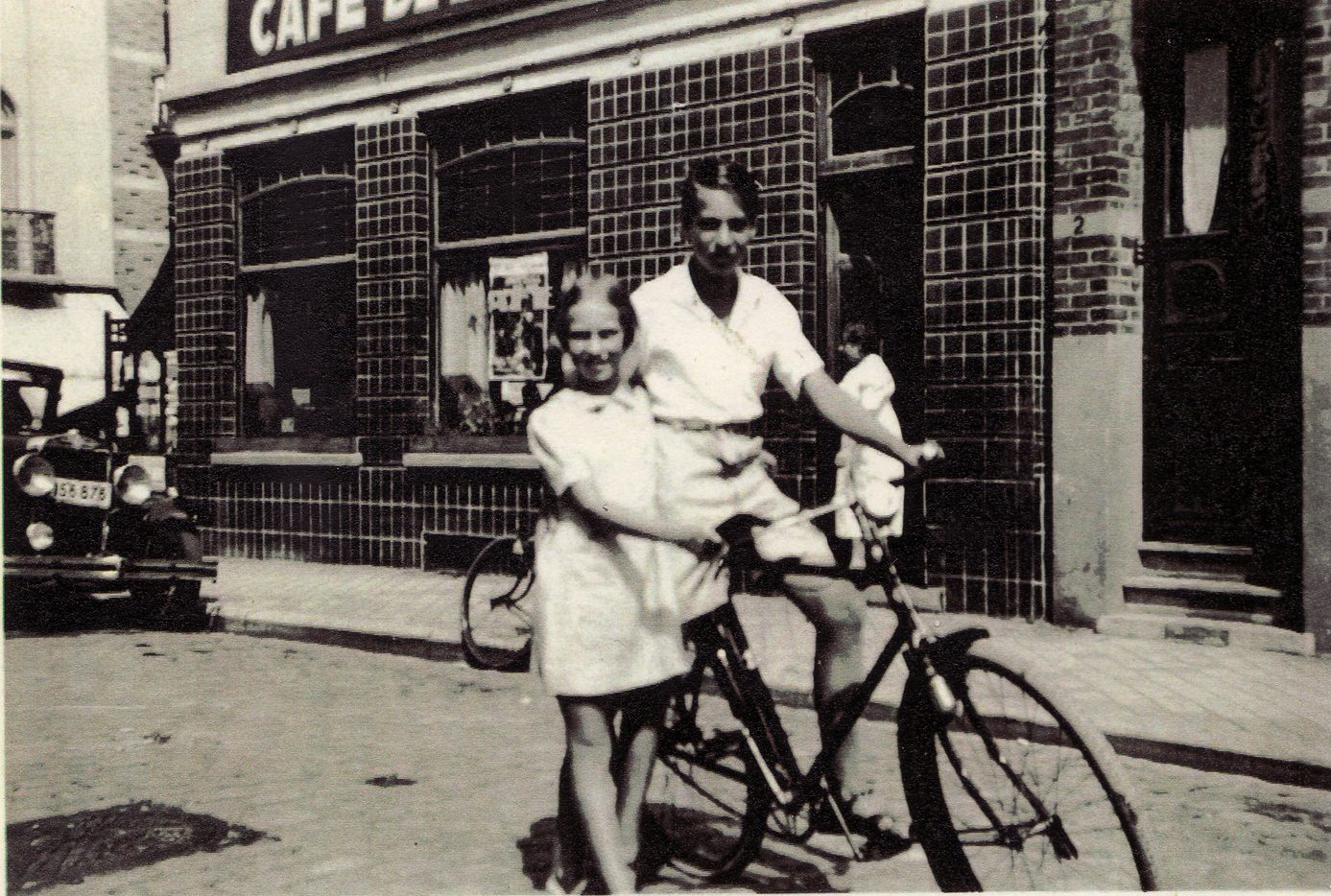
PHOTO CREDITS:
Photograph of production team and Eva and Heinz in Amsterdam courtesy of Susan Kerner and Eva Schloss.
Photograph of Eva Schloss : John Mathew Smith and http://www.celebrity-photos.com.“Colonel Zadok Magruder High School.” August 10, 2010. Creative Commons Attribution-Share Alike 2.0 Generic license. Wikimedia Commons. https://commons.wikimedia.org/wiki/File:Eva_Schloss_5.jpg
 There Goes My Heart

Thank you for this beautiful story, Marilyn. As usual, your storytelling is clear and very interesting! 💕🌸MarilynSent from my iPhone