Author Archives: Marilyn Shapiro

Unknown's avatar

About Marilyn Shapiro

After thirty five years in education, I have retired and am free to pursue my lifelong dream of becoming a freelance writer. Inspired by my mother, who was the family historian, I am writing down my family stories as well as publishing stories my mother wrote down throughout her life. Please feel free to comment and share.

College Dreams by Frances Cohen

As high schools and college students celebrate their graduations, I reflect back on my parents’ insistence that their children, unlike themselves, graduate from college.

My husband Bill and I always regretted that we did not have a college degree, but times were different in the 1930s during The Great Depression.

 When I graduated high school in 1935, there was no way that I could afford to go to college. Immediately after I finished school, I got a job as a bookkeeper. Most of my salary went to pay the rent of my parents’ apartment. 

Bill’s grandmother promised him that she would pay Bill’s tuition at the University of Vermont in Burlington. Those plans were crushed when his grandmother died after attending his high school graduation, and she left no provisions to pay for his education. Since he did not have the advantage of a college degree, he went into the retail business and spent many years associated with Pearls Department Store a family owned business in Keeseville, New York, that sold lower end merchandise. Things changed in the late 1960s when the Northway and the big box department stores in Plattsburgh opened. We found it difficult to compete. Fortunately, we had the opportunity to open the Village Bazaar, a very nice ladies’ store that catered to career women. It was successful, and we decided to close Pearl’s and concentrate on the Bazaar.  

While our children were growing up, we kept telling them, “You are going to college! You are going to college!” Beginning in 1964, our dreams of making sure our four children had college degrees became a reality. Our daughter Laura graduated from State University of New York at Geneseo with a degree in special education, a field in education that had just recently been created. Soon, our other children followed our oldest daughter’s footsteps. Our son Jay graduated Union College in 1968, Marilyn graduated from the University of  Albany in 1972, and our youngest Bobbie graduated from State University of New York at  Plattsburgh  in 1977. Two of the children completed masters degrees. Six of our  of our eight grandchildren have also received their undergraduate degrees and even completed advanced degrees. [Update: The seventh grandchild completed an undergraduate degree in 2015 (and is enrolled in a graduate program), and the eighth is currently attending undergraduate college full-time.]

At times, however, their education almost backfired on us. When Laura came home for Thanksgiving her first year, she began swearing up a storm, using four letter words that had never come into my home before. I decided to turn the tables on her and started using them myself. When Laura expressed surprise that I was swearing, I responded, “I’m paying $2000 a year to send you to college so that you can come home and swear like a sailor. I figured I could do it for free!” Laura never cursed in my presence again.

Jay also got a lesson in humility after his freshman year. He came home for the summer after he took, along with his other courses, a three-credit business class. He began criticizing the way Bill and I ran our businesses. He peppered us with questions. “Do you really know how to run a store? Do you understand what it takes to determine what to buy? What styles to order? How to deal with the bank?” I answered, ‘Sonny-Boy, your father and I have been running a business since before you were even born. We hired a buying office from New York City to inform us of the latest fashions. We learned that in Keeseville we sell more size 14 and 16’s. We learned that we needed to buy three pair of pants and five blouses to every blazer. We learned how to best deal with our customers. We learned this by the seat of our pants, which is better than any business course they teach at your fancy school.” 

There is an old saying that states:  I was amazed at how little my parents knew when I was 17 and how much they learned by the time I was 21.” Our son Jay learned that lesson that day.

Bill and I take pride in our children and grandchildren’s education, but we also take pride in the fact that we were self-taught, sometimes the best kind of education a person can have!

A version of this article originally appeared in the August 18, 2016, Jewish World News, a bi-weekly subscription-based newspaper in upstate New York.

Four children, four college graduates, seven degrees.

Conversing with strangers? Yes or No?

When I was in junior high school, our class had a dance. Times were very different, and most of us eighth graders were very naive, young, and shy. When our two teacher chaperones saw that no one was on the dance floor, they suggested the following: Why don’t the boys ask the girls to take a walk outside around our 1930s WPA-funded building? 

The boys got into a huddle, and we girls nearby heard this conversation:


“I’ll take Marilyn, and you can take Ellen.”

“No, I’’ll; ask Marilyn and you can ask Ellen.”

I had no idea what was happening until, after my third walk around the building with another of my male classmates, Mike offered an explanation.

“Marilyn, you probably heard us arguing about you, but it was for a good reason, “ he said. “We all know that you are the easiest to talk to.” 

Fifty-seven  years later, I still smile when I remember that heartfelt compliment from a 13 year old boy. During the years that followed in both high school and college, I may not have been the most popular, but my reputation as a person with whom one could speak with comfortably remained.

I am kiddingly said about myself that I could have a conversation with a doorknob. Since I was a child, I never had difficulty introducing myself and carrying on a lively discussion with anyone—whether they be my classmates or my friends or even strangers.

This “talent” has often been to the embarrassment of Larry and my children, especially when I make the mistake of seeing someone I think I know. On Mount Rainier, I walked up to a woman and asked her if she was from Clifton Park. No, she wasn’t and had no idea who I was. My family cringed in embarrassment.

And one of my more classic moments came in college, when I saw a young man in the dinner line at the Eastman Quad cafeteria sporting a Peru jacket, the name of the high school one town over from mine.

“Wow!” I said. “You are from Peru? I am from Keeseville!”

The young man looked confused and responded in broken English? “Keeseville? I don’t know a ‘Keeseville.” Whoops. Wrong country. Wrong continent. Oh well!

Fortunately, my overtures are sometimes successful. While on a beach at a Jamaican resort  I spotted a couple sitting by themselves. I said hello and learned that this was their first time in Jamaica; they were a farmer and nurse from North Dakota.

My initial reaction? “Do I have anything in common with these people?” When I told them I was from Albany, New York, however, they lit up. 

“Our son lives in Albany. He got his doctorate at UAlbany and teaches at St. Rose. Do you know where that is?”

“Drove past St. Rose three days ago and I graduated UAlbany,” I said.

That random hello over eight years ago has resulted in a close friendship. We have shared several more Jamaican trips, a cruise, and time together in the Capital District as well as Florida. They are one of our dearest friends. 

What often prompts these conversations is my life-long interest in learning about and from others. Each person has a story to tell, an usual line of work, an intriguing hobby, a shared passion for books or movies or travel, a perspective on life that is worth knowing. And, no matter how different we first may appear, we can always find something in common. I feel honored and grateful for these encounters.

This is especially true since I began writing my articles for the Jewish papers. Recently I met a couple in the swimming pool, he with a thick accent. 

“Where is your lovely accent from?” I asked. 

“Bulgaria and Israel,” he responded. Encouraged by my questions, he shared with me that he had been shipped to Israel by his parents as Hitler was coming to power. He had lived in Israel most of his live before moving to the United States. He and his wife told me more about their fascinating backstory.

“I’m a writer,” I explained. “Would you be interested in sharing your story with me?” 

“My daughter is writing a book about me,”  he said. “But my late mother also has a wonderful story that no one has ever recorded. Would you be willing to write about her?”

And so a chance conversation gave me the opportunity to meet a Holocaust survivor and hopefully share his family’s story with others.

No, I am not one of those people that you hate to sit next to on a plane. I can read the signals that indicate people do NOT want to talk. But I have had such lively and interesting  conversations with total strangers at 35,000 feet that they remain Facebook friends for years after our plane has landed. An artist from Pennsylvania, a woman visiting her daughter in Ecuador, a fellow writer—all keep in touch with me based on a short conversation.

That is not as impressive as what happened to my friend Susie. While waiting for two hours for a Disney special event, she struck up a conversation with a couple from Newfoundland. By the time the parade started, they had shared contact information. The Canadian couple had dinner with them next time they came to Disney and invited them for a visit. What started as a planned one day meeting resulted in a three day stay in their home and an additional week traveling together through the Eastern provinces of our northern neighbors. “I was initially concerned that their traveling with us would be awkward,” said Susie, “but we had a wonderful time.”

I feel grateful that my ability to communicate with people is not limited to strangers. I love long conversations with friends and relatives—both in person and on the phone—in which we share news, history, thoughts, and concerns. In a couple of case,  my iPhone has almost run out of battery power before we hang up. 

Of course, conversations with strangers can backfire. Larry and I recently were on a flight where he sat next to another gentleman named Larry. That bit of commonality resulted in my husband having to listen to the man’s non-stop chatter from San Francisco to Denver. “He was a nice enough man,” Larry told me. “But we woke up at 4 am to catch the plane, and I was hoping just to sleep.”

For him, the alternative was worst. When our connecting flight to Orlando got cancelled because of an early Colorado snow storm, Larry and I got the last two seats on an alternative flight. Larry got stuck next to a couple making out passionately the entire trip. Looking back, having an albeit one-sided conversation with a stranger named Larry was easier for him to handle than trying to avoid the flailing hands in seats B and C.  Meanwhile, reading the signals of the people sitting next to me, from my aisle seat, I put on my noise-cancelling earphones and slept. Yes, talk is nice, but sometimes silence IS golden. 

A version of this article originally appeared in the Jewish World News, a bi-weekly subscription-based newspaper in upstate New York.

There Goes My Heart Blog News

For all of you who have been following my blog, There Goes My Heart, thank you so very much. For all of you who haven’t signed up yet, please give it a try. Just go to my website, theregoesmyheart.me, scroll down to where it says FOLLOW. Click on that link and enter your email address! Voila! You will now receive my posts directly to your email box! Easy Peezy!

My blog not only contains all my posts, dating back to March 2014, when my blog went live. It will also give you places to comment on my posts, links to my articles published in the media, and direct links to where you can buy my books in either paperback or Kindle on Amazon. Please consider joining my 440 followers who are enjoying my articles.

Please be patient with me! Blog is being updated!!

First of all, I realized that I never posted several of my stories, including many that I co-wrote with my mother. I am rectifying that mistake. Those articles are being developed into blog posts and scheduled to drop into your mailbox in between my usual twice a month postings.

Secondly, I have been listing all my posts on the Marilyn’s Blog Articles on the Internet. Recently, I realized that many of the links to The Jewish World have disappeared. I am in the process of going through each link and correcting them. If you get a “This is embarrassing!” note, please know I am working on fixing all the broken links.

Book Four is coming soon!

My fourth book, Keep Calm and Bake Challah: How I Survived the Pandemic, Politics, Pratfalls, and Life’s Other Problems, is undergoing its final edits. I hope to have it on Amazon in both paperback and Kindle format in June.

Again, thanks to all of my followers! If you like my blog and stories, please share the link with friends and family. If you have any suggestions or comments on how to improve my blog,, please feel free to email me at shapcomp18@gmail.com.

Throughout the pandemic, I kept calm by baking hundreds of challahs for my family and those who needed a warm, delicious bread to either get through hard times or celebrate happy one. That became my mantra to get me through COVID19. Keep Calm and Bake Challah is a collection of articles I wrote during the time, from the first days of lockdown to the joyous day when Larry and I could re-unite with our far-flung family and friends. Look for the publication date on this website.

Guess Who Got Covid?

Note: As I post this article, Larry and I had just finished up our Special Olympics Florida state meet with our track and field team. We had a wonderful, exhausting, and incredibly rewarding two days with all of our “stars.” In this article, I reflect back on last year’s 2022 SOFL State Games and its aftermath.

Guess who contracted COVID?

After months and months of being careful, I had pressed my luck. As Special Olympics Track and Field coaches, Larry and I attended the Florida State Special Olympics game with eleven athletes from Osceola County on May 20 and 21, 2022. All of our events, which took place in the ESPN Wide World of Sports Complex in Orlando, were supposed to be outdoors. Plans changed quickly when torrential rains and strong winds swept in moments after we had parked our car. Our team, along with several other teams from a variety of sports, spent the first two hours sheltering in the Advent Health Building lobby. The “close encounters of the super-spreading kind” happened again that night when rain delayed and then finally resulted in the cancellation of opening ceremonies. Although Larry opted not to wear a mask, I made sure I had my KN95 covering my face whenever I was inside. Outside, however, I eschewed protection, hoping for the best. 

Fortunately, the weather improved the second day of competition. By Saturday afternoon, however, I was exhausted. I tried to hydrate, but I was totally wiped. “Maybe I’m getting too old for this,” I thought to myself. Or maybe I was just feeling the effects of two sleep-deprived nights, two mornings of 6 a.m. alarms, and my putting on at least eight miles corralling our athletes to various venues in 90 degree heat and 90% humidity.

By the time our last athlete had claimed his second place medal in the 400 meter walk, even Larry, who had shown no signs of slowing down, was ready to get out of the heat and go home. We stopped for a late lunch, drove home and collapsed on our couch. After a slow walk on Sunday morning, we went to Publix for our second booster shot. Then we spent the rest of Sunday with a repeat performance on the couch.

On Monday, I attempted my usual walk but felt as if I were plowing through mud. By Tuesday afternoon, exhaustion was accompanied by congestion and a runny nose. “Just a head cold,” I thought. It took me until Wednesday to administer the home test.

You know how it usually takes 15 minutes to see the results? Forget that. Within thirty-seconds of putting the disgusting drops into the assigned spot on the test strip, the “positive” line showed up.

“I have COVID,” I texted my husband, who was at a ROMEO [Retired Old Men Eating Out] luncheon. Unfortunately, he didn’t read the text and only learned the news on a phone call when he was driving home. His passenger quickly put on a mask. Sorry Rich! That is the proverbial “Shutting the barn door after the horse has bolted.” Fortunately Larry and he didn’t come down with it.

I never have been a good “patient” in that I have no patience for being sick. When Larry came home from his outing, he found me on the computer, a box of Kleenex and a cup of tea by my side, interviewing someone for my Holocaust Torah story while typing away. “Get off the damn computer, put on a mask, and go lie down,” he told me.

Exhausted, congested, and realizing that I couldn’t leave the house anyway, I gave up. I spent the next three days sacked out on the couch catching up on Outlander. Note: There is no better way to veg out than spending twenty hours with Jamie and Claire as they romped their way through pre-Revolutionary War America.

Later than evening, Larry made dinner for both of us, something he did every night for the next eight nights. And to top it off, he made me an ice cream sundae every night to help “soothe your scratchy throat.” At least that is the way we justified 350 calories of pure bliss. Larry, meanwhile, was earning enough “Best Husband in the World” points for a lifetime.

By Sunday, I was feeling well enough to resume my work on the Holocaust Torah story. I even had enough energy to take a short (masked) walk and to water my drooping houseplants. As was the case for so many others who contracted “the plague,” however, it took me another two weeks to get over the fatigue. 

Do I have any regrets about going to the Special Olympics State meet? Not one bit. Seeing our athletes competing in their events, coming down off the awards platform, finding their way to their parents, and beaming with pride, brings so much joy it was worth spending the two days in a sure fired “petri dish.”And how could I not hug my athletes when they finished a great race or threw the softball farther than they ever had or showed me their medal?

So where do we go from here? Yes, I may get COVID again, but having it may have helped me build up some immunity. Larry was spared this round but will he contract it in the future? Only time will tell.

On March 25, 2020, Jewish World published my first “pandemic” story. “As I write this, we are in the second week of our own national crisis,” I stated. “Larry and I worry about our friends and family—especially our own children.” Over the ensuing months, I wrote about how COVID and its forced locked-down impacted us: our first sad Passover seder for two; our hours and hours on Zoom; our trimmed down wardrobe (on my not slimming down body); our hopes for a more sensible approach to COVID with a new president; our tentative steps back into the world with masks and bottles of hand sanitizer and vaccines and boosters; our joy in finally reuniting with our children and grandchildren, and, of course, my baking dozens of loaves of challahs I baked throughout the long months.

It is now time to put all these stories, published every two weeks in Jewish World, into a book. Keep Calm and Bake Challah: Surviving the Pandemic, Politics, Pratfalls, and Other of Life’s Problems will be finished and available on Amazon in June 2023.

And it is time to move on. Yes, we will test before visiting our children. Yes, we will mask when necessary, especially in unavoidable crowded venues including planes and other public transportation. Meanwhile, I will continue to keep calm, bake challah. and learn to live in the “new normal” in the Age of Covid.

A version of this article originally appeared in the Jewish World News, a bi-weekly subscription-based newspaper in upstate New York.

A pianist debuts her talents at Rosh HaShanah services

On a June morning in my tiny town in New York’s North Country, Mrs. Ryan’s kindergarten class was preparing for our upcoming graduation. Parents had gotten invitations; our caps and gowns were on order.We practiced the songs and poems we were to sing together. In my eyes, a few fortunate children had solos, which they had brought home to memorize. 

Eager, But For What?

Two days before the morning event, one of my classmates announced to Mrs. Ryan that she didn’t want to recite the poem to  which  she had been assigned. The teacher asked if anyone else would like to do it. My hand shot up like a rocket. “Me! Me!” I shouted from my tiny chair.

For the next two days, my mother patiently worked with me to memorize the piece. I honestly don’t remember the name of the poem or the words, but the short verse talked about being ‘little’ and ‘big’ and ‘growing up.’ (If any of you have a  copy of this poem, please send my way!)

Wrong Lesson

That graduation morning, our class, donned in white caps and gowns, marched into the Keeseville Central School auditorium proudly marched. We recited the pledge of allegiance and sang some songs. It was soon time my big moment.  I walked to the center of the stage, recited half the poem, and then  —gulp!— forgot the rest. The principal, Edward Long, gracefully ended my performance. But I never forgot my first time on stage and how I blew it.

Recently, I felt I was reliving my first public performance 66 years ago when I  volunteered again to fill in with a mere 48 hours to learn my part.

A few days before Rosh Hashanah, Larry and I had run into Susan and Jonathan Shopiro, fellow members of Congregation Shalom Aleichem. Both talented musicians,  they both had sung in both secular and synagogue choirs. Jonathan, a competent flute player,  had regularly played with our previous rabbi at temple services. Susan is an accomplished violinist who had recently inherited her grandfather’s fine century old violin. 

In the course of our conversation that afternoon, I shared with them how I had reconnected with my piano after almost a year of a shuttered keyboard. What didn’t feel right during the pandemic felt almost necessary for me now that we were in the New Normal. Despite several years of lessons and countless hours of practice on the Yamaha upright that we purchased in 1982, I never considered myself as an accomplished pianist.

As Larry and I were driving home from the beach the Friday night before Rosh Hashanah, we got a phone call from Jonathan. 

“Did you see the email about Rosh Hashanah services?” he asked. 

“No, we have been on the beach all day. What is happening?”

Our rabbi’s wife serves as our cantor. Sadly, her father had passed away the previous day, and she needed to fly to Long Island to be with her family. Marilyn Glaser, our shul’s president, asked the Shopiros to step in to provide the music in her place. Remembering our recent conversation but obviously ignoring my personal assessment of my skill level, Jonathan asked me if I would be interested in accompanying him on the piano. 

Ain’t No Stopping Her

Larry quickly weighed in. “I think she needs to pass on this,” he told Jonathan on our car’s speakerphone. “She doesn’t play in public.”

With the same bravado I had demonstrated at my kindergarten graduation, I ignored my husband’s words and expressions and plowed ahead. 

“Email the music to me,” I told Jonathan. “I’ll look it over and call you later this evening. “

Once we got home, I printed out familiar songs I recognized from my years of synagogue attendance: Ki Mitziyon, Rom’mu, Shalom Rav, Avinu Malkeinu,  and Debbie Friedman’s beautiful rendition of the Mi Shebeirach prayer. Most of the sheet music consisted of just the melody line. 

Pinch Hitter Again

Never mind that despite years of childhood lessons, I was not an accomplished musician. Never mind that I had never played in public, preferring an empty room with only a close family member near by. But with the help of Dan Coates, who had published many easy-to-intermediate level sheet music collections, I had been banging away on the ivories with happy abandon for years. Just a week before,  I had bravely played for a friend while she perused my ridiculously large stack of sheet music that dated back to my sister’s lessons in the 1950s. Her praise regarding my playing  gave me the needed boost of confidence. After a couple of run-through with the music on my piano, I called Jonathan back and told him I would give it the old congregational try.

The Way to Carnegie Hall

The next day, with a couple more of hours of practice under my belt, I met with the Shopiros and we practiced together.“Do you think we can do this?” I asked Jonathan and Susan.

“Yes, we can do this!”  they reassured me. 

As I was already having three people for Rosh Hashanah, I extended the invitation to the Shopiros as well. Over the next twenty-four hours before the scheduled 7 p.m. Sunday service, I practiced my parts in between preparing dinner: chicken, potatoes, green beans, fresh challah, and my chocolate chip cookies.

Larry stepped right up to the task as well, serving as  my last-minute sous chef, table setter, pot washer, and last minute supermarket runner

Larry and I met the Shopiros an hour before services for one last practice session.  Due to some health concerns, Susan was unable to play the violin, but she would be the lead vocalist as needed. Thanks to Jonathan’s expertise and great job of covering up my mistakes, we left that evening feeling that, while no one would mistake us for professionals, we had contributed to and enhanced the service. 

Monday morning’s “performance” went even smoother. I had gained confidence. I was—after all— not exactly playing Chopin’s “Etude in G Sharp minor.” I was playing a melody line in easy keys, Jonathan played harmony on the flute; the congregation readily sang along. It was—for this reluctant recitalist—pure joy. 

That afternoon, as seven of us sat around our dining room table, Larry made a toast to my “first and last” public piano performance. 

Or maybe not. Jonathan would love to continue contributing his talents to future services. I certainly won’t mind accompanying him  on a couple of songs, especially my personal favorite,  the Mi Shebeirach prayer. These fingers are itching for another congregational try. 

First published in (Capital Region, New York) The Jewish World November 11, 2022.

Profile of resilience — Shoah survivor Harry Lowenstein revisits hometown

Standing in front of the Bielefeld, Germany, railroad station in June 2018, Harry Lowenstein traced his fingers onto the all-too-familiar names etched into the Holocaust memorial. David, his father, Bernhardine, his mother, and his sister Klaere. Aunts and uncles and cousins. Friends and neighbors. During the Nazis’ terror, his family and hundreds of Jews from surrounding areas had stood on the station’s platform before being herded onto railroad cars for the journey to ghettos, concentration camps, forced labor camps, and for most, gas chambers and death.

The then 87-year- old Floridian— the last living Jew from an entire area who had survived the Nazis and WWII— had returned home to honor those whom he had lost, to thank those who risked their lives to help in his survival, and to present his message of tolerance and equality.

Surviving The Holocaust

Harry (nee Helmut) Lowenstein was born in 1931 in Fürstenau/Hoexter Germany, the second child of a cattle/horse trader and his wife. After years of mounting anti-Semitism, Kristallnacht, the “night of the breaking glass,” unleashed the Holocaust in November 1938. It demonstrated to Jews and others across Germany the brutality and determination of Hitler’s war agains the Jews. In their small rural village, the Lowensteins watched their synagogue burn and then experienced increasingly harsher restrictions. While most Christians in the town slammed the doors of their homes and businesses in the faces of their Jewish neighbors, the owners of one small bakery risked their lives by slipping Harry lifesaving loaves of bread. It was a kindness that Harry would never forget.

On Dec. 12, 1941, hundreds of Jews, including the 21 members of the Lowenstein’s extended family, were rounded up and brought to the Bielefeld train station. Hollering SS guards brandishing rifles herded the Jews into crowded rail cars, where they began the almost 1,000 mile journey to the Riga ghetto in Latvia. As it was the first night of Chanukah someone lit the traditional candles, said the traditional prayers and sang Ma’oz Tzur, Rock of Ages. The entire train soon joined in. That last sweet memory would help sustain Harry for the next six years. To this day, Harry tears up every time he hears the song.

The Next Day Comes

After several months in the crowded ghetto, groups of Jews were moved into the Riga-Kaiserwald concentration camp. Harry managed to escape the gas chambers by working in an auto repair shop housed in the complex. He still remembers the unrelenting, intentionally cruel actions by Nazi guards and the fear of beatings, punishment, and execution. “I thought to myself, I will somehow survive,” said Harry. “You learned to live minute to minute—not even hour by hour—to make sure the next day comes.”

In the fall of 1944, as the Russian army drew closer, the Nazis began to evacuate Riga-Kaiserwald. Thousands of Jewish prisoners, including Harry’s remaining family (his father had been murdered earlier) were shipped by boat to Danzig and then by barge to the Stutthof concentration camp in Poland. He lost touch with his family. On March 9,1945, as Harry remembers it, the camp was liberated by the Red Army. Harry’s “next day”—and freedom—had finally come.

The 14-year-old returned to Fürstenau in hopes of reuniting with family. The hopes were in vain. He was the lone survivor. First finding shelter for a short time with kind neighbors, Harry lived for a year with the family who had acquired the house of his family. In 1946, he was placed in a Jewish children’s home in Hamburg. In 1952, after arriving in the United States via Paris, the 21-year -old found his way to Kissimmee, Florida, where he joined his uncle’s apparel store. In 1956, he married Carol Sainker, had three children, and eventually operated his own apparel store. With fellow Jews, including many Holocaust survivors, the Lowensteins helped to found Congregation Shalom Aleichem and then build a synagogue in Kissimmee. “I saw one synagogue burn,” he said. “I wanted to build another.”

The Return

His wife Carol died in February 2017, just before their 60th anniversary. During Carol’s long illness and his year of mourning, Harry had begun to reappraise his past.

Fritz Ostkaemper, who had been a chairman of a Holocaust museum in Höxter, came across Lowenstein’s name as part of a research project tracking the Jewish families from the Westfalia area. Ostkaemper encouraged Harry to return to his childhood home. A previously planned trip to say Kaddish at his grandparents’ gravesite in Fürstenau evolved into a family trip through Europe with his daughters Karen Pridemore and Berna Lowenstein and her husband Greg Fitzgibbons.

After tours in Switzerland, the Netherlands, and Luxembourg, Harry and his family arrived in Germany and traveled to the Bielefeld railroad station. They stood silently in front of the “Each Person Has a Name” memorial. Dedicated in 1998, the monument displayed the names of the 1840 Jewish victims from Westfalia who had been murdered by the Nazis. A further inscription contains Psalm 78.6 in Hebrew and in German: So the next generation would know them, even the children yet to be born, and they in turn would tell their children.

Ostkaemper drove the visitors to Höxter in a limousine provided by the town’s mayor, Alexander Fischer. Harry, with the help of a translator, gave a 15-minute address. The evening ended with a dinner in a beer garden hosted by the community. “Most of the survivors never returned,” Fischer stated in follow-up article in a Westfalia newspaper. “Therefore it [is an] even greater honor to be able to welcome Harry Lowenstein in his former home. This way we set an example against intolerance and racism.”

The following morning, the group traveled to Fuerstenau, where Harry was born. The burned out synagogue had been repurposed into a garage/warehouse. Harry gave a tour pointing out where the bima had been and where the family pews had been located. Harry then sought out the bakery owners that had saved him from starvation. As a large crowd watched, media cameras flashed, and videotape whirled, Harry and the elderly couple hugged each other. Harry was finally able to thank them for their long-ago kindness. “Danke Schoen” he said repeatedly. “Thank you.”

Despite its modernity, the citizens of Fuerstenau had not forgotten its past. In front of each home or area previously inhabited by Jews, was a Stolperstein, a 3.9 inch cube bearing a brass plate inscribed with the name and life dates of victims of Nazi extermination or persecution. Harry found his plate:

Here lived Helmut Lowenstein. Born 1931. Deported 1941 to Riga. [Deported] 1944 to Stutthof. Rieben. February 1945: Death March. Freed. For all the rest of his family, in place of BEFREIT- freed– was the word ERMORDET– murdered.

Zachor

The Jewish cemetery was surprising well kept, according to Harry, and he recited the Kaddish at his grandparents’ graves. His final stop was in nearby Bredenborn to visit with the family with whom he had found shelter for the first year after his liberation. In speaking with local residents of Fuerstenau, Harry was told that a permanent memorial planned for a prominent spot in Fuerstenau had been stymied by uncertainty where it should be placed and by a lack of funds. Harry railed against their excuses. “After 70 years, you should have made a permanent memorial!”

Harry pledged 50% of the funds needed. The permanent bronze plaque was erected in 2021 near the foot of the church and in the middle of the town at a crossroads that everyone must use. He missed the unveiling of the memorial due to the pandemic.

What advice does Harry Lowenstein give as a Holocaust survivor? His message on parting: “Treat each human being equally, no matter who they are.That’s all.“

Sources:

Thank you to Wolfgang Mueller for translating the articles in the Westfalen-Blatt newspapers from German to English.

First published (Capital Region, New York) The Jewish World in its April 27, 2023, issue. 

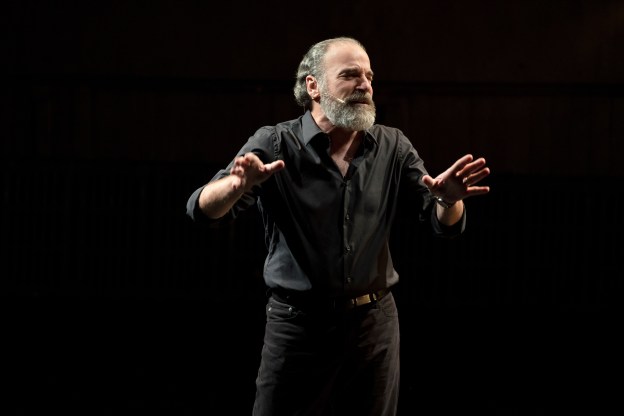
A Lie of Omission: Mandy Patinkin

I want my gravestone to read, ‘I tried to connect,’” Mandy Patinkin said

in a phone interview with me on January 6, 2023. This talented singer,

actor—and mensch!—brought his beautiful voice and compelling stories

to his 2023 eleven-city concert tour, Mandy Patinkin in Concert: Being Alive

with Adam Ben-David on Piano.

The show featured Patinkin’s favorite Broadway and classic American

tunes, including selections from Irving Berlin, Cole Porter, Stephen Sondheim,

and Harry Chapin. He had fun and wanted his audience to have fun as well.

“We are alive. Tell people to come, to have fun, to enjoy,” he shared. “And if

you don’t enjoy, eat a sandwich!”

While the Tony and Emmy award winner stressed that Being Alive cele-

brated the joy of life, he also expressed his lifelong concerns about truthfulness,

righting wrongs, maintaining the memory of grief, and learning from his own

experiences to do the right thing for the oppressed and refugees today.

Patinkin is known for his many Broadway, television, and film credits,

including Evita, Sunday in the Park with George, The Secret Garden, Chicago

Hope, and Criminal Minds. Patinkin is also known for imbuing his characters

with a Yiddish neshama (a Jewish soul). This gevalt (force) can be seen in his

iconic role in The Princess Bride (“Hello. My name is Inigo Montoya. You

killed my father. Be prepared to die!”); Avigdor, Barbra Streisand’s unrequited

love interest in Yentl; and Saul Berenson, the CIA operative in Homeland. In

Homeland, Berenson’s desk held a framed picture of the Talmudic dictum,

“Whoever saves a life, it is as if he saved an entire world.”

Patinkin sings in Yiddish, often in concert, and on one of his many albums,

Mamaloshen. An audience favorite is his Yiddish rendition of “Somewhere

Over the Rainbow.”

Mandel Bruce Patinkin was born in Chicago in 1952 to Doris and Lester

Patinkin. His parents raised him and his sister Marsha in a loving conservative

269Remembrance and Legacy

Jewish family. Patinkin attended both Hebrew and Sunday school, sang with

his synagogue’s choir, and attended Jewish summer camp. After attending the

University of Kansas and Juilliard, he found employment and then success on

the New York City stage.

When he was eighteen, his father was diagnosed with pancreatic cancer.

Doris and Marsha insisted that Lester not be told. Patinkin went along with

telling the dying man that he had hepatitis, a lie he regrets. “My father was a smart

man. He knew what was happening,” said Patinkin. As a result, many important

conversations did not occur before his death in 1972 at fifty-five years old.

Many years later, Patinkin channeled his loss into his role in The Princess

Bride. As his character slays the nemesis who had killed his father, the grief

of his own father’s death spilled out in the lines, “I want my father back, you

son of a bitch!”

In 2021, Patinkin encountered another family secret. While he felt a

connection to the Holocaust—“it was in my DNA,” Patinkin said in his inter-

view—he never knew of any family members that perished. In an episode of

PBS’ Finding Your Roots, host Henry Louis Gates revealed to Patinkin that in

November 1942, the Germans and their collaborators rounded up the entire

Jewish population of Brańsk, Poland, including twenty members of Patinkin’s

grandfather’s family. They were packed into trains, deported to Treblinka, and

immediately murdered in the concentration camp’s gas chambers. Patinkin,

devastated by the news, broke down during the filming. “I was never given this

information,” he sobbed. “I don’t have words.” It took him a while to compose

himself enough to complete the taping.

Patinkin is still wondering why his family never shared this terrible chapter

in their past. “Lies are nothing new until they hit you in the kishkes,” he said,

and the lies hit him hard. He reflects on how this “lie of omission” deprived

those who were murdered of having their stories told.

He said that this episode heightened his need for truth. “Much of what is

happening in this world is based in lies, and we can fight those lies by listening,

270A Lie of Omission: Mandy Patinkin

by connecting, and by showing kindness.” Those three principles shape his life

not only as a Jew but as a self-proclaimed “humanitician,” a person who cares

about all humankind and fights against any form of bigotry and hatred.

Though he knows little about the relatives he lost, Patinkin has shared

the stories of other Jews who lived under the shadow of fascism. Since 2022,

Patinkin has narrated a series of podcasts produced in collaboration with

the Leo Baeck Institute. The episodes share accounts that range from Albert

Einstein to an unknown hero, Florence Mendheim, a Jewish librarian who

spied on Nazis in New York City.

As a second-generation descendant of Russian Polish, immigrants, he feels

deep rachmones (compassion) for those who have fled their own countries to

escape persecution. Patinkin is thankful to those who let his ancestors into

the United States and works to make sure others can do the same. “The wheel

is always turning,” said Patinkin. “We must help everyone as we can be top of

the wheel one day and bottom of the wheel the next.”

A longtime social activist, Patinkin supports multiple social justice orga-

nizations. He has worked for the International Rescue Committee (IRC), an

organization that highlights the plight of refugees worldwide. He and his wife

Kathryn have traveled with IRC to Greece, Jordan, Uganda, Afghanistan, and

Serbia, and Phoenix, Arizona and Elizabeth, New Jersey.

With IRC and Exile, he honors the Jews who fled for their lives during

the Holocaust and sheds light on those escaping from similarly oppressive

regimes in the present day. Patinkin noted that, as antisemitism is raising its

ugly head, it is a good time in history for everyone to listen with kindness and

to share the refugees’ stories with others.

Originally published January 19, 2023.

Photograph of Mandy Patinkin

used with permission from Catherine Major, C Major Marketing.

Provided by Joan Marcus via Bond Group. https://www.

joanmarcusphotography.com.Mandy Patinkin

New ‘Fiddler’ as politics, money, torpedo our American shtetl

Over fifty years after its Broadway opening, Fiddler on the Roof returned to Broadway in 2015 with a fresh approach and a cast worthy of its long tradition of bringing smiles and tears to its audience.

Composer Jerry Bock and lyricist Sheldon Harnick’s triumphant musical is based on Tevye the Dairyman, a book by Yiddish writer Sholem Aleichem. Set in 1905 in Czarist Russia, Tevye struggles with the untraditional courtships of the three oldest of his five daughters while facing social and political changes that threaten his beliefs, community, and tradition. 

In 2015, Fiddler took on a new face as Tony-award winning director Bartlett Sher brought his own vision from the opening scene: A lone man in a red parka walks onto the stage, reading the iconic first lines from an unnamed book. “A fiddler on the roof? Sounds crazy, no?” He then sheds his 21st century garment. As the first violin notes sound, he transforms into Tevye the Dairyman. Through “Tradition,” the opening number, he introduced the audience to life in his tiny village of Anatevka.

The show offered stunning new movement and dance reimagined through Israeli choreographer Hofesh Shechter. Although Jerome Robbins’ stamp remained on the key numbers, including the famous bottle dance, the Israeli’s roots and background result in earthlier, rawer dance numbers which garnered him with a 2016 Tony. 

The show closed on Broadway in December 2016 but took on new life when a national tour was launched in the fall of 2018. In 2023, Fiddler played in Proctor’s, Schenectady, New York’s theater before the tour’s closing on May 17 of that year. As a writer for the Capital Region of New York’s Jewish World, I interviewed by phone the actors playing the irrepressible Bible-quoting Tevye and his loving but nagging wife Golde. Jonathan Hashmonay and Maite Uzal shared insight into the production as well as the impact the roles had on them.

Jonathan Hashmonay may have been one of the youngest actors to professionally play the role of Tevye, but he made up for his age with life experience and talent. The descendent of Polish Holocaust survivors, Jonathan grew up in Israel. Throughout his youth, he performed in many high school ensembles and bands as well as Yom HaZikaron (Day of Remembrance) and Yom Haatzmaut (Independence Day) ceremonies. Although his family moved to New Jersey when he was thirteen, he returned to his native country to serve in the Israeli Defense Force (IDF), where he was the lead singer in the IDF’s Ground Forces Band. The group performed for a wide range of audiences, from a small group of soldiers in the Negev to on a stage in front of the prime minister and world dignitaries. 

 Jonathan originally planned on following in the footsteps of his father, a doctor. Interest piqued by seeing musical productions, including The Book of Mormon, however, lead him to Penn State University, where he majored in musical theater. 

In 2021, Jonathan joined the Fiddler tour in the role of Avram the bookseller. He also was an understudy for Tevye, which gave him the opportunity to play the role five times. When the opportunity arose for him to step into the lead in 2022, he gladly accepted the offer.

Jonathan brought his own perspective to the iconic role. “I try my best to be very truthful Tevye,” he said. “I want to portray a sweet, loving family man whose life becomes increasingly difficult.” Jonathan felt it was important that the dairyman’s gait reflected the increasing weight of family responsibilities and of the tragedies that befall the Jewish Russian family.

As many of the Tevyes before him, Jonathan enjoyed performing the show-stopping “If I Were a Rich Man.” On the other hand, he found poignancy and pathos in a second-act scene where Chava, his third daughter, first reveals her love for Fyedke, a non-Jew. The two strong-willed people engage in a fierce battle of wits. Tevye tries desperately to warn her of the consequences: “A bird may love a fish, but where would they build a home together?” Chava just as passionately defends her choice. “The world is changing, Papa!”

When Tevye and Golde learn that their daughter and the Russian were married by a priest, it is one step too far for the besieged father. It is the biggest affront to the tradition that keeps Tevye, like the fiddler on the roof, balanced in a world that is crashing around him. “We have other children at home,” he tells his wife. “Chava is dead to us.” Jonathan said “Chavalah,” the song and ballet number in which Tevye relives the special moments in his now-lost child’s life that follows that touches the actor the most. 

Maite Uzal, a native of Madrid, Spain, continued in her role as Golde, which she had performed since the beginning of the 2018 tour. In order to understand her character, Maite diligently researched early twentieth century Eastern European Jewish life in which Fiddler is set. Maite grew to respect as well as pity the exhausting and sometimes back-breaking responsibilities of the women’s role keeping a “proper home, a quiet home, a kosher home.” 

Maite’s realization that Golde, like most Jewish women at the time, was illiterate, “hit me like a hammer in the head,” she said. “The way you process the world when you don’t read is so different,” Maite commented. “All her information came from her religion, her superstitions, and what she heard from others.”

As Maite herself has no children, being the “mother” of five daughters was also a learning experience, bringing her to the realization that parenthood is relentless, unconditional, and all-encompassing. “I am an even better daughter to my mother,” she said with a laugh.

Personally, Maite compared her life’s experiences to Hodel, the second daughter. Maite completed law school and served as a litigator in Spain. Twelve years ago, however, her passion for theater led her to leave law, abandon her home in Spain, and live, like Hodel,“far from the home I love.” “I defied my family, especially my father and left the people, and traditions I know to follow my heart,” she said. 

But her decision came at a steep price. “My father was initially very angry that I chose to leave my profession as a lawyer and my country,” Maite said. “In his eyes, I was not Golde, who followed tradition. I was Chava.” As Tevye comes around in the last moments of Fiddler, Maite and her father later reconciled. 

Maite applied to the highly competitive Musical Theatre Conservatory Program at the American Musical and Dramatic Academy in New York City. “I knew if I was accepted there, I would have the background to succeed.” She found that success upon her graduation, landing roles in Les Miz, In the Heights, and Lion King.

Both Jonathan and Maite spoke of the timeless universal themes of Fiddler. “Every culture wants to define themselves by their traditions,” said Maite, “and every culture’s children wants to defy them.” They also see the plight of modern day refugees—Syrians and most recently Ukrainian—reflected in Harnock and Bock’s classic. 

Jonathan praised Fiddler’s themes of love, family, resilience, and change created from the tides of outside forces. “Our world—just like Tevye’s—is changing drastically,” noted Jonathan. “Traditions that are so important are being pushed aside. How do we decide which of those changes to accept or not?” 

At the end of Act II, Tevye again dons the red coat, and he, Golde, and the cast address the audience in a heartfelt speech citing the struggle of the Ukrainians and the spike of antisemitism in the world today. 

“As much as The Diary of Anne Frank is not just a Jewish story, neither is Fiddler on the Roof,” wrote Barbara Isenberg in Tradition!, her chronicle of the making of the popular musical. “Fiddler’s strong themes of family, tradition, repression, prejudice, and diaspora continue to evoke common ground for its audiences wherever they are.”

L’Chaim!

Originally published April 13, 2023. Updated May 25, 2025.

Photo of Jonathan Hashamonay and Maite Uzel used with permission from Joan Marcus via Bond Theatrical Group (www.bondtheatrical.com)

A version of this article originally appeared in the Jewish World, a bi-w eekly subscription-based newspaper in upstate New York, in the April 13, 2023 issue.

Second generation, others strive to keep Shoah testimony alive

I listened to Trudi Wolfe-Larkin and Marilyn Wolfe tell the incredible story of their parents’ Holocaust survival. Then through the sisters’ efforts, I watched over six hours of interview that Yolie and Irving Wolfe, their parents, had recorded for Steven Speilberg’s Shoah Foundation.

I knew that their story must be written and preserved for the Wolfe family and posterity.

Trudi Wolfe-Larkin and Marilyn Wolfe learned at an early age that their parents, were Holocaust survivors.No, Irving and Yolie Wolfe did not have a number carved into their arms, but they had emotional and, for their father, physical scars of their lives under Nazi Germany. 

Through their childhood, the two siblings overheard conversations Yolie had with other survivors who were their parents’ close friends. As Trudie and Marilyn learned more about the Holocaust, they would ask questions. Although Irving brushed off any inquiries with “I don’t want to talk about it,” Yolie was more forthcoming and shared more details with her children when she felt they were old enough to absorb the horrors. In 1995, when they were in their sixties, Yolie and Irving finally shared the full extent of their experiences in ten hours of combined interviews that are part of the United States Holocaust Memorial and Museum. 

Irving Wolfe was born in Czestohowa, Poland, in 1926, the third of the four children of David and Gittel Wolfowicz. Although they celebrated the major Jewish holidays, they were not a religious family. David provided a comfortable life as the owner of successful women’s coat manufacturing company. When the family located to Sosnowiec, their large apartment housed their father’s business.

All of this changed in September 1, 1939, when Germany invaded Poland. Sosnowiec was one of the first towns to fall, and persecution of its 30,000 Jews was swift and brutal. The synagogue was burned, and beatings and arrests of its prominent leaders began immediately. Jews were forced to wear yellow stars and faced restrictions. Nazi round-ups ranging from small groups to thousands of Jews crammed into a local soccer stadium resulted in deportations to concentration camps. 

Thirteen-year-old Irving, who many thought had Aryan features, was drafted into delivering papers and messages for the Jewish underground. As the noose tightened, Jews were forced to move into smaller Jewish areas. By June 1942, the Wolfowicz family, along with the remaining population of Sosnowiec and Jews from surrounding communities were herded into the Środula district. Soon after, Irving was caught up in a round-up. As he had no identification papers, he was arrested and sent to a forced labor camp. 

Over the next three years, he and fellow prisoners dug ditches, cleaned cesspools and latrines, and built more barracks to house more Jews who would either be used for forced labor or would be sent to the gas chambers.

In all of his time in a variety of forced labor camps, Irving remembered no acts of kindness from his captors. Each day was a series of kicks, slaps, and beatings. He and fellow prisoners subsisted daily on an eighth of a loaf of bread and watery soup.Prisoners were awakened in the middle of the night and forced to run around the compounds in the bitter cold. And they were forced to watch fellow prisoners who committed even the smallest infraction executed by the Germans.

The lowest point in what were horrible circumstances came in the fall 1943. One night, an SS guard charged into the area, demanding to know who had stolen a potato. When Irving refused to name the guilty party, he was severely beaten in front of his fellow prisoners. The man he saved never forgot Irving’s kindness, and they remained fast friends throughout their lives. 

The remaining years passed in a blur of pain and hunger and disease, which included a bout with typhus that nearly killed him. His final stop was the Reichenbach, which he had “helped” build. On May 9, 1945, Irving and other survivors woke up to silence. All the Germans had left the camp, but those that were left behind were afraid to leave as they didn’t know if the electric barbed wire fences was still operational. The next day, Russian soldiers, led by a Jewish captain, liberated the camps.

Irving returned to Sustevich, his former home, where he learned that the ghetto had been liquidated in 1944, and Irving’s parents and sisters had been killed in Auschwitz. His older brother, who had been arrested earlier in the war, was never heard from again.

 The war had done little to curb the virulent anti-Semitism that had always existed in Sustevich, Irving reported, and he was greeted with taunts of “They should have killed you too.” He relocated to Krakow for job training, only to be witness to the first pogrom in post WWII. On August 9, 1945, false accusations of “blood libel” —Jews murdering Christian children for their religious rituals—resulted in attacks and beatings of Jews; the robbing and vandalism of their homes; the destruction of a synagogue, and the murder of a 56-year-old woman who was a Holocaust survivor.

Irving decided to find safety in the Wetzlar displacement camp in the Frankfort district of the American-occupied zone, After hospitalizations due to tuberculosis and skin infections at the site of his 1943 beating, Irving enrolled in a precision mechanics program at the Organization for Rehabilitation through Training (ORT), which provided rehabilitation for Holocaust survivors. While there, he filed the paperwork needed for his planned emigration to Israel. His plans changed, however, when he met another Holocaust survivor.

Yolie Goldstein was born in Sarospattak, Hungary, in 1927, the youngest of five children. Her father, a tailor, headed a religious family. He attended a minion each morning, and the family kept kosher. 

The Nazi’s “Final Solution” came to Hungry much later than it had to Poland as Hungary had originally aligned with the Axis Powers. Hungary, which had never followed the draconian measures against its Jewish population, attempted to establish an armistice with the Allies, but in March 1944, German forces occupied Hungary and began rounding up 800,00 Jews who had previously been protected by the previous government’s policies.In June 1944, the Goldstein family, including Yolie’s parents, her brother Jack, and her sisters Dawn and Rosalie, were packed with fellow Jews in packed train cars for the three day trip to Auschwitz.

Yolie’s mother was determined to keep Yolie, her youngest, close. But

Yolie’s mother was determined to keep Yolie, her youngest, close. But during the selection process, a German guard quietly told Yolie’s mother to let her join her sisters. The three sisters were processed, shaved, showered in ice cold water with lye soap, and given raggedy dresses. Hope of seeing their mother again disappeared like the smoke from the nearby chimney that towered over the camp. “Those first weeks were the worst,” Yolie said in her Shoah Foundation interview. “We were sitting around doing nothing and waiting to die.”Yolie clearly remembers seeing the ‘angel of death,’ Dr. Josef Mengele, several times during those first months in the concentration camp.

In September 1944, the three sisters were among the 300 women selected by the Nazis to work in a munitions factory, where they built airplane parts. The living situation was similar to what Irving had experienced: sleeping conditions in barracks overseen by the SS, a near-starvation level diet, and fears of beatings and execution. The only ray of hope were rumors of Germany’s pending defeat. 

In late winter, the surviving factory workers were forced to march to another munitions factory, only to find it had already been shuttered. They were then sent to Bergen-Belsen, where Yolie and others faced a nightmare many considered greater than Auschwitz. 

Yolie and her sisters joined the 60,000 starving and mortally ill people who were packed together without food, water or basic sanitation. They saw with horror thousands of unburied bodies lying in the open. The long-awaited end to their captivity came when British forces liberated the camp on April 15, 1945, only a few days after their arrival. 

While Yolie’s re-entry to post-imprisonment life was supported by the Red Cross, Dawn and Rosalie had contracted tuberculosis. When she visited her two hospitalized sisters a few weeks later, Yolie could barely recognize the pale skeletons under the white sheets any better than Dawn and Rosalie could recognize the young woman with the new clothes and the styled hair. 

The three siblings returned to Sarospattak, Hungary, where they were reunited with their brother Jack, who had survived the Javesno concentration camp. By 1946, Abraham, the oldest, returned from his imprisonment in Russia. It was confirmed that both parents had been murdered in concentration camps. Miraculously, however, all five siblings had survived.

Soon learning that such papers were difficult if not impossible to obtain in Hungary, the three refugees relocated to the Wetzlar DP camp in Frankfort Germany. While the DP camp provided food, Yolie cooked their meals in “pots” that were re-purposed cans. Yolie enrolled in sewing classes at the nearby ORT.

Yolie and Irving met and soon “became an item.” Despite their language differences—she spoke Hungarian; he spoke German—they communicated through “the language of love.” Irving originally planned to go to Israel. As their relationship blossomed, however, Yolie persuaded him to come with her to United States. They were married in 1949.

Through her aunt’s sponsorship, Yolie, who was three months pregnant, arrived in New York City at the end of December, in time to see the ball drop on New Year’s Eve in Times Square. Six months later, and shortly before the birth of their daughter Trudi, Irving joined his wife. After a brief time in an apartment in Asbury Park, New Jersey, they eventually bought a house in nearby Bradley Beach, New Jersey. Their second daughter, Marilyn, was born in 1954. After initial employment as a salesman in Army-Navy store, he opened up WOLCO Uniforms, which specialized in school jackets and embroidery. While Abraham remained in Israel and raised a large family, Jack, Dawn, and Rosalie came to the United States through the same aunt’s sponsorship. The siblings remained close throughout their lives. 

Trudi and Marilyn speak lovingly of their parents and the life they made for themselves for their daughters. They are proud that they not only survived but also provided a “normal” life free of the anger and guilt felt by many other Holocaust survivor families.

During the Shoah interview, Yolie was asked if she had ever given up and stopped believing in a future. “It was all we had,” said Yolie. “There has to be something at the other side.”

And why, after over fifty years, are the daughters willing to share their story for posterity? “It has to be told,” said Trudi, who joined in parents at the end of the Shoah interview. “By having your histories done, perhaps that will bring it into the future where the children—tomorrow’s future—can learn about it and did it exist.”

A version of this article originally appeared in the Jewish World News, a bi-weekly subscription-based newspaper in upstate New York, in the May 10, 2023 issue.

Irving and Yolie Wolfe

Interviewing Tevye and Golde? Sounds crazy, no? But I did it!

Recently I had the honor and privilege of interviewing “Tevye” and “Golde” to help promote Fiddler on the Roof’s United States National touring company. Speaking to Jonathan Hashamonay and Maite Uzel, who play, respectively, the irrepressible Bible-quoting dairyman and his loving but nagging wife, was one of the highlights of my writing adventures. The story was published in The Jewish World on Thursday, April 13, prior to Fiddler’s return to Proctors Theatre in Schenectady, New York, on April 26 and 27. Below is the link to the article! L’Chaim! Enjoy!

https://jewishworldnews.org/new-fiddler-as-politics-money-torpedo-our-american-shtetl/

Photo of Jonathan Hashamonay and Maite Uzel used with permission from Joan Marcus via Bond Theatrical Group (www.bondtheatrical.com)