Author Archives: Marilyn Shapiro

Unknown's avatar

About Marilyn Shapiro

After thirty five years in education, I have retired and am free to pursue my lifelong dream of becoming a freelance writer. Inspired by my mother, who was the family historian, I am writing down my family stories as well as publishing stories my mother wrote down throughout her life. Please feel free to comment and share.

Profile of resilience — Shoah survivor Harry Lowenstein revisits hometown

Standing in front of the Bielefeld, Germany, railroad station in June 2018, Harry Lowenstein traced his fingers onto the all-too-familiar names etched into the Holocaust memorial. David, his father, Bernhardine, his mother, and his sister Klaere. Aunts and uncles and cousins. Friends and neighbors. During the Nazis’ terror, his family and hundreds of Jews from surrounding areas had stood on the station’s platform before being herded onto railroad cars for the journey to ghettos, concentration camps, forced labor camps, and for most, gas chambers and death.

The then 87-year- old Floridian— the last living Jew from an entire area who had survived the Nazis and WWII— had returned home to honor those whom he had lost, to thank those who risked their lives to help in his survival, and to present his message of tolerance and equality.

Surviving The Holocaust

Harry (nee Helmut) Lowenstein was born in 1931 in Fürstenau/Hoexter Germany, the second child of a cattle/horse trader and his wife. After years of mounting anti-Semitism, Kristallnacht, the “night of the breaking glass,” unleashed the Holocaust in November 1938. It demonstrated to Jews and others across Germany the brutality and determination of Hitler’s war agains the Jews. In their small rural village, the Lowensteins watched their synagogue burn and then experienced increasingly harsher restrictions. While most Christians in the town slammed the doors of their homes and businesses in the faces of their Jewish neighbors, the owners of one small bakery risked their lives by slipping Harry lifesaving loaves of bread. It was a kindness that Harry would never forget.

On Dec. 12, 1941, hundreds of Jews, including the 21 members of the Lowenstein’s extended family, were rounded up and brought to the Bielefeld train station. Hollering SS guards brandishing rifles herded the Jews into crowded rail cars, where they began the almost 1,000 mile journey to the Riga ghetto in Latvia. As it was the first night of Chanukah someone lit the traditional candles, said the traditional prayers and sang Ma’oz Tzur, Rock of Ages. The entire train soon joined in. That last sweet memory would help sustain Harry for the next six years. To this day, Harry tears up every time he hears the song.

The Next Day Comes

After several months in the crowded ghetto, groups of Jews were moved into the Riga-Kaiserwald concentration camp. Harry managed to escape the gas chambers by working in an auto repair shop housed in the complex. He still remembers the unrelenting, intentionally cruel actions by Nazi guards and the fear of beatings, punishment, and execution. “I thought to myself, I will somehow survive,” said Harry. “You learned to live minute to minute—not even hour by hour—to make sure the next day comes.”

In the fall of 1944, as the Russian army drew closer, the Nazis began to evacuate Riga-Kaiserwald. Thousands of Jewish prisoners, including Harry’s remaining family (his father had been murdered earlier) were shipped by boat to Danzig and then by barge to the Stutthof concentration camp in Poland. He lost touch with his family. On March 9,1945, as Harry remembers it, the camp was liberated by the Red Army. Harry’s “next day”—and freedom—had finally come.

The 14-year-old returned to Fürstenau in hopes of reuniting with family. The hopes were in vain. He was the lone survivor. First finding shelter for a short time with kind neighbors, Harry lived for a year with the family who had acquired the house of his family. In 1946, he was placed in a Jewish children’s home in Hamburg. In 1952, after arriving in the United States via Paris, the 21-year -old found his way to Kissimmee, Florida, where he joined his uncle’s apparel store. In 1956, he married Carol Sainker, had three children, and eventually operated his own apparel store. With fellow Jews, including many Holocaust survivors, the Lowensteins helped to found Congregation Shalom Aleichem and then build a synagogue in Kissimmee. “I saw one synagogue burn,” he said. “I wanted to build another.”

The Return

His wife Carol died in February 2017, just before their 60th anniversary. During Carol’s long illness and his year of mourning, Harry had begun to reappraise his past.

Fritz Ostkaemper, who had been a chairman of a Holocaust museum in Höxter, came across Lowenstein’s name as part of a research project tracking the Jewish families from the Westfalia area. Ostkaemper encouraged Harry to return to his childhood home. A previously planned trip to say Kaddish at his grandparents’ gravesite in Fürstenau evolved into a family trip through Europe with his daughters Karen Pridemore and Berna Lowenstein and her husband Greg Fitzgibbons.

After tours in Switzerland, the Netherlands, and Luxembourg, Harry and his family arrived in Germany and traveled to the Bielefeld railroad station. They stood silently in front of the “Each Person Has a Name” memorial. Dedicated in 1998, the monument displayed the names of the 1840 Jewish victims from Westfalia who had been murdered by the Nazis. A further inscription contains Psalm 78.6 in Hebrew and in German: So the next generation would know them, even the children yet to be born, and they in turn would tell their children.

Ostkaemper drove the visitors to Höxter in a limousine provided by the town’s mayor, Alexander Fischer. Harry, with the help of a translator, gave a 15-minute address. The evening ended with a dinner in a beer garden hosted by the community. “Most of the survivors never returned,” Fischer stated in follow-up article in a Westfalia newspaper. “Therefore it [is an] even greater honor to be able to welcome Harry Lowenstein in his former home. This way we set an example against intolerance and racism.”

The following morning, the group traveled to Fuerstenau, where Harry was born. The burned out synagogue had been repurposed into a garage/warehouse. Harry gave a tour pointing out where the bima had been and where the family pews had been located. Harry then sought out the bakery owners that had saved him from starvation. As a large crowd watched, media cameras flashed, and videotape whirled, Harry and the elderly couple hugged each other. Harry was finally able to thank them for their long-ago kindness. “Danke Schoen” he said repeatedly. “Thank you.”

Despite its modernity, the citizens of Fuerstenau had not forgotten its past. In front of each home or area previously inhabited by Jews, was a Stolperstein, a 3.9 inch cube bearing a brass plate inscribed with the name and life dates of victims of Nazi extermination or persecution. Harry found his plate:

Here lived Helmut Lowenstein. Born 1931. Deported 1941 to Riga. [Deported] 1944 to Stutthof. Rieben. February 1945: Death March. Freed. For all the rest of his family, in place of BEFREIT- freed– was the word ERMORDET– murdered.

Zachor

The Jewish cemetery was surprising well kept, according to Harry, and he recited the Kaddish at his grandparents’ graves. His final stop was in nearby Bredenborn to visit with the family with whom he had found shelter for the first year after his liberation. In speaking with local residents of Fuerstenau, Harry was told that a permanent memorial planned for a prominent spot in Fuerstenau had been stymied by uncertainty where it should be placed and by a lack of funds. Harry railed against their excuses. “After 70 years, you should have made a permanent memorial!”

Harry pledged 50% of the funds needed. The permanent bronze plaque was erected in 2021 near the foot of the church and in the middle of the town at a crossroads that everyone must use. He missed the unveiling of the memorial due to the pandemic.

What advice does Harry Lowenstein give as a Holocaust survivor? His message on parting: “Treat each human being equally, no matter who they are.That’s all.“

Sources:

Thank you to Wolfgang Mueller for translating the articles in the Westfalen-Blatt newspapers from German to English.

First published (Capital Region, New York) The Jewish World in its April 27, 2023, issue. 

A Lie of Omission: Mandy Patinkin

I want my gravestone to read, ‘I tried to connect,’” Mandy Patinkin said

in a phone interview with me on January 6, 2023. This talented singer,

actor—and mensch!—brought his beautiful voice and compelling stories

to his 2023 eleven-city concert tour, Mandy Patinkin in Concert: Being Alive

with Adam Ben-David on Piano.

The show featured Patinkin’s favorite Broadway and classic American

tunes, including selections from Irving Berlin, Cole Porter, Stephen Sondheim,

and Harry Chapin. He had fun and wanted his audience to have fun as well.

“We are alive. Tell people to come, to have fun, to enjoy,” he shared. “And if

you don’t enjoy, eat a sandwich!”

While the Tony and Emmy award winner stressed that Being Alive cele-

brated the joy of life, he also expressed his lifelong concerns about truthfulness,

righting wrongs, maintaining the memory of grief, and learning from his own

experiences to do the right thing for the oppressed and refugees today.

Patinkin is known for his many Broadway, television, and film credits,

including Evita, Sunday in the Park with George, The Secret Garden, Chicago

Hope, and Criminal Minds. Patinkin is also known for imbuing his characters

with a Yiddish neshama (a Jewish soul). This gevalt (force) can be seen in his

iconic role in The Princess Bride (“Hello. My name is Inigo Montoya. You

killed my father. Be prepared to die!”); Avigdor, Barbra Streisand’s unrequited

love interest in Yentl; and Saul Berenson, the CIA operative in Homeland. In

Homeland, Berenson’s desk held a framed picture of the Talmudic dictum,

“Whoever saves a life, it is as if he saved an entire world.”

Patinkin sings in Yiddish, often in concert, and on one of his many albums,

Mamaloshen. An audience favorite is his Yiddish rendition of “Somewhere

Over the Rainbow.”

Mandel Bruce Patinkin was born in Chicago in 1952 to Doris and Lester

Patinkin. His parents raised him and his sister Marsha in a loving conservative

269Remembrance and Legacy

Jewish family. Patinkin attended both Hebrew and Sunday school, sang with

his synagogue’s choir, and attended Jewish summer camp. After attending the

University of Kansas and Juilliard, he found employment and then success on

the New York City stage.

When he was eighteen, his father was diagnosed with pancreatic cancer.

Doris and Marsha insisted that Lester not be told. Patinkin went along with

telling the dying man that he had hepatitis, a lie he regrets. “My father was a smart

man. He knew what was happening,” said Patinkin. As a result, many important

conversations did not occur before his death in 1972 at fifty-five years old.

Many years later, Patinkin channeled his loss into his role in The Princess

Bride. As his character slays the nemesis who had killed his father, the grief

of his own father’s death spilled out in the lines, “I want my father back, you

son of a bitch!”

In 2021, Patinkin encountered another family secret. While he felt a

connection to the Holocaust—“it was in my DNA,” Patinkin said in his inter-

view—he never knew of any family members that perished. In an episode of

PBS’ Finding Your Roots, host Henry Louis Gates revealed to Patinkin that in

November 1942, the Germans and their collaborators rounded up the entire

Jewish population of Brańsk, Poland, including twenty members of Patinkin’s

grandfather’s family. They were packed into trains, deported to Treblinka, and

immediately murdered in the concentration camp’s gas chambers. Patinkin,

devastated by the news, broke down during the filming. “I was never given this

information,” he sobbed. “I don’t have words.” It took him a while to compose

himself enough to complete the taping.

Patinkin is still wondering why his family never shared this terrible chapter

in their past. “Lies are nothing new until they hit you in the kishkes,” he said,

and the lies hit him hard. He reflects on how this “lie of omission” deprived

those who were murdered of having their stories told.

He said that this episode heightened his need for truth. “Much of what is

happening in this world is based in lies, and we can fight those lies by listening,

270A Lie of Omission: Mandy Patinkin

by connecting, and by showing kindness.” Those three principles shape his life

not only as a Jew but as a self-proclaimed “humanitician,” a person who cares

about all humankind and fights against any form of bigotry and hatred.

Though he knows little about the relatives he lost, Patinkin has shared

the stories of other Jews who lived under the shadow of fascism. Since 2022,

Patinkin has narrated a series of podcasts produced in collaboration with

the Leo Baeck Institute. The episodes share accounts that range from Albert

Einstein to an unknown hero, Florence Mendheim, a Jewish librarian who

spied on Nazis in New York City.

As a second-generation descendant of Russian Polish, immigrants, he feels

deep rachmones (compassion) for those who have fled their own countries to

escape persecution. Patinkin is thankful to those who let his ancestors into

the United States and works to make sure others can do the same. “The wheel

is always turning,” said Patinkin. “We must help everyone as we can be top of

the wheel one day and bottom of the wheel the next.”

A longtime social activist, Patinkin supports multiple social justice orga-

nizations. He has worked for the International Rescue Committee (IRC), an

organization that highlights the plight of refugees worldwide. He and his wife

Kathryn have traveled with IRC to Greece, Jordan, Uganda, Afghanistan, and

Serbia, and Phoenix, Arizona and Elizabeth, New Jersey.

With IRC and Exile, he honors the Jews who fled for their lives during

the Holocaust and sheds light on those escaping from similarly oppressive

regimes in the present day. Patinkin noted that, as antisemitism is raising its

ugly head, it is a good time in history for everyone to listen with kindness and

to share the refugees’ stories with others.

Originally published January 19, 2023.

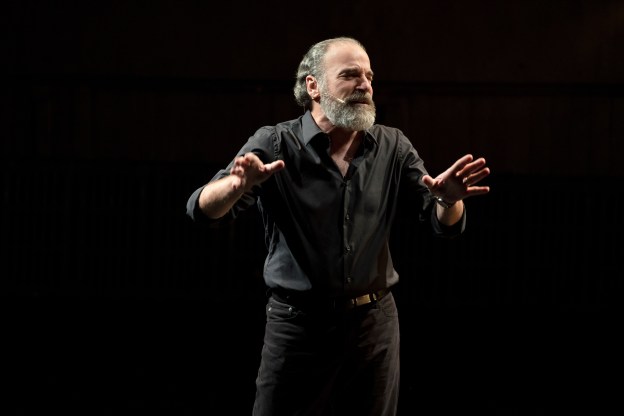
Photograph of Mandy Patinkin

used with permission from Catherine Major, C Major Marketing.

Provided by Joan Marcus via Bond Group. https://www.

joanmarcusphotography.com.Mandy Patinkin

New ‘Fiddler’ as politics, money, torpedo our American shtetl

Over fifty years after its Broadway opening, Fiddler on the Roof returned to Broadway in 2015 with a fresh approach and a cast worthy of its long tradition of bringing smiles and tears to its audience.

Composer Jerry Bock and lyricist Sheldon Harnick’s triumphant musical is based on Tevye the Dairyman, a book by Yiddish writer Sholem Aleichem. Set in 1905 in Czarist Russia, Tevye struggles with the untraditional courtships of the three oldest of his five daughters while facing social and political changes that threaten his beliefs, community, and tradition. 

In 2015, Fiddler took on a new face as Tony-award winning director Bartlett Sher brought his own vision from the opening scene: A lone man in a red parka walks onto the stage, reading the iconic first lines from an unnamed book. “A fiddler on the roof? Sounds crazy, no?” He then sheds his 21st century garment. As the first violin notes sound, he transforms into Tevye the Dairyman. Through “Tradition,” the opening number, he introduced the audience to life in his tiny village of Anatevka.

The show offered stunning new movement and dance reimagined through Israeli choreographer Hofesh Shechter. Although Jerome Robbins’ stamp remained on the key numbers, including the famous bottle dance, the Israeli’s roots and background result in earthlier, rawer dance numbers which garnered him with a 2016 Tony. 

The show closed on Broadway in December 2016 but took on new life when a national tour was launched in the fall of 2018. In 2023, Fiddler played in Proctor’s, Schenectady, New York’s theater before the tour’s closing on May 17 of that year. As a writer for the Capital Region of New York’s Jewish World, I interviewed by phone the actors playing the irrepressible Bible-quoting Tevye and his loving but nagging wife Golde. Jonathan Hashmonay and Maite Uzal shared insight into the production as well as the impact the roles had on them.

Jonathan Hashmonay may have been one of the youngest actors to professionally play the role of Tevye, but he made up for his age with life experience and talent. The descendent of Polish Holocaust survivors, Jonathan grew up in Israel. Throughout his youth, he performed in many high school ensembles and bands as well as Yom HaZikaron (Day of Remembrance) and Yom Haatzmaut (Independence Day) ceremonies. Although his family moved to New Jersey when he was thirteen, he returned to his native country to serve in the Israeli Defense Force (IDF), where he was the lead singer in the IDF’s Ground Forces Band. The group performed for a wide range of audiences, from a small group of soldiers in the Negev to on a stage in front of the prime minister and world dignitaries. 

 Jonathan originally planned on following in the footsteps of his father, a doctor. Interest piqued by seeing musical productions, including The Book of Mormon, however, lead him to Penn State University, where he majored in musical theater. 

In 2021, Jonathan joined the Fiddler tour in the role of Avram the bookseller. He also was an understudy for Tevye, which gave him the opportunity to play the role five times. When the opportunity arose for him to step into the lead in 2022, he gladly accepted the offer.

Jonathan brought his own perspective to the iconic role. “I try my best to be very truthful Tevye,” he said. “I want to portray a sweet, loving family man whose life becomes increasingly difficult.” Jonathan felt it was important that the dairyman’s gait reflected the increasing weight of family responsibilities and of the tragedies that befall the Jewish Russian family.

As many of the Tevyes before him, Jonathan enjoyed performing the show-stopping “If I Were a Rich Man.” On the other hand, he found poignancy and pathos in a second-act scene where Chava, his third daughter, first reveals her love for Fyedke, a non-Jew. The two strong-willed people engage in a fierce battle of wits. Tevye tries desperately to warn her of the consequences: “A bird may love a fish, but where would they build a home together?” Chava just as passionately defends her choice. “The world is changing, Papa!”

When Tevye and Golde learn that their daughter and the Russian were married by a priest, it is one step too far for the besieged father. It is the biggest affront to the tradition that keeps Tevye, like the fiddler on the roof, balanced in a world that is crashing around him. “We have other children at home,” he tells his wife. “Chava is dead to us.” Jonathan said “Chavalah,” the song and ballet number in which Tevye relives the special moments in his now-lost child’s life that follows that touches the actor the most. 

Maite Uzal, a native of Madrid, Spain, continued in her role as Golde, which she had performed since the beginning of the 2018 tour. In order to understand her character, Maite diligently researched early twentieth century Eastern European Jewish life in which Fiddler is set. Maite grew to respect as well as pity the exhausting and sometimes back-breaking responsibilities of the women’s role keeping a “proper home, a quiet home, a kosher home.” 

Maite’s realization that Golde, like most Jewish women at the time, was illiterate, “hit me like a hammer in the head,” she said. “The way you process the world when you don’t read is so different,” Maite commented. “All her information came from her religion, her superstitions, and what she heard from others.”

As Maite herself has no children, being the “mother” of five daughters was also a learning experience, bringing her to the realization that parenthood is relentless, unconditional, and all-encompassing. “I am an even better daughter to my mother,” she said with a laugh.

Personally, Maite compared her life’s experiences to Hodel, the second daughter. Maite completed law school and served as a litigator in Spain. Twelve years ago, however, her passion for theater led her to leave law, abandon her home in Spain, and live, like Hodel,“far from the home I love.” “I defied my family, especially my father and left the people, and traditions I know to follow my heart,” she said. 

But her decision came at a steep price. “My father was initially very angry that I chose to leave my profession as a lawyer and my country,” Maite said. “In his eyes, I was not Golde, who followed tradition. I was Chava.” As Tevye comes around in the last moments of Fiddler, Maite and her father later reconciled. 

Maite applied to the highly competitive Musical Theatre Conservatory Program at the American Musical and Dramatic Academy in New York City. “I knew if I was accepted there, I would have the background to succeed.” She found that success upon her graduation, landing roles in Les Miz, In the Heights, and Lion King.

Both Jonathan and Maite spoke of the timeless universal themes of Fiddler. “Every culture wants to define themselves by their traditions,” said Maite, “and every culture’s children wants to defy them.” They also see the plight of modern day refugees—Syrians and most recently Ukrainian—reflected in Harnock and Bock’s classic. 

Jonathan praised Fiddler’s themes of love, family, resilience, and change created from the tides of outside forces. “Our world—just like Tevye’s—is changing drastically,” noted Jonathan. “Traditions that are so important are being pushed aside. How do we decide which of those changes to accept or not?” 

At the end of Act II, Tevye again dons the red coat, and he, Golde, and the cast address the audience in a heartfelt speech citing the struggle of the Ukrainians and the spike of antisemitism in the world today. 

“As much as The Diary of Anne Frank is not just a Jewish story, neither is Fiddler on the Roof,” wrote Barbara Isenberg in Tradition!, her chronicle of the making of the popular musical. “Fiddler’s strong themes of family, tradition, repression, prejudice, and diaspora continue to evoke common ground for its audiences wherever they are.”

L’Chaim!

Originally published April 13, 2023. Updated May 25, 2025.

Photo of Jonathan Hashamonay and Maite Uzel used with permission from Joan Marcus via Bond Theatrical Group (www.bondtheatrical.com)

A version of this article originally appeared in the Jewish World, a bi-w eekly subscription-based newspaper in upstate New York, in the April 13, 2023 issue.

Second generation, others strive to keep Shoah testimony alive

I listened to Trudi Wolfe-Larkin and Marilyn Wolfe tell the incredible story of their parents’ Holocaust survival. Then through the sisters’ efforts, I watched over six hours of interview that Yolie and Irving Wolfe, their parents, had recorded for Steven Speilberg’s Shoah Foundation.

I knew that their story must be written and preserved for the Wolfe family and posterity.

Trudi Wolfe-Larkin and Marilyn Wolfe learned at an early age that their parents, were Holocaust survivors.No, Irving and Yolie Wolfe did not have a number carved into their arms, but they had emotional and, for their father, physical scars of their lives under Nazi Germany. 

Through their childhood, the two siblings overheard conversations Yolie had with other survivors who were their parents’ close friends. As Trudie and Marilyn learned more about the Holocaust, they would ask questions. Although Irving brushed off any inquiries with “I don’t want to talk about it,” Yolie was more forthcoming and shared more details with her children when she felt they were old enough to absorb the horrors. In 1995, when they were in their sixties, Yolie and Irving finally shared the full extent of their experiences in ten hours of combined interviews that are part of the United States Holocaust Memorial and Museum. 

Irving Wolfe was born in Czestohowa, Poland, in 1926, the third of the four children of David and Gittel Wolfowicz. Although they celebrated the major Jewish holidays, they were not a religious family. David provided a comfortable life as the owner of successful women’s coat manufacturing company. When the family located to Sosnowiec, their large apartment housed their father’s business.

All of this changed in September 1, 1939, when Germany invaded Poland. Sosnowiec was one of the first towns to fall, and persecution of its 30,000 Jews was swift and brutal. The synagogue was burned, and beatings and arrests of its prominent leaders began immediately. Jews were forced to wear yellow stars and faced restrictions. Nazi round-ups ranging from small groups to thousands of Jews crammed into a local soccer stadium resulted in deportations to concentration camps. 

Thirteen-year-old Irving, who many thought had Aryan features, was drafted into delivering papers and messages for the Jewish underground. As the noose tightened, Jews were forced to move into smaller Jewish areas. By June 1942, the Wolfowicz family, along with the remaining population of Sosnowiec and Jews from surrounding communities were herded into the Środula district. Soon after, Irving was caught up in a round-up. As he had no identification papers, he was arrested and sent to a forced labor camp. 

Over the next three years, he and fellow prisoners dug ditches, cleaned cesspools and latrines, and built more barracks to house more Jews who would either be used for forced labor or would be sent to the gas chambers.

In all of his time in a variety of forced labor camps, Irving remembered no acts of kindness from his captors. Each day was a series of kicks, slaps, and beatings. He and fellow prisoners subsisted daily on an eighth of a loaf of bread and watery soup.Prisoners were awakened in the middle of the night and forced to run around the compounds in the bitter cold. And they were forced to watch fellow prisoners who committed even the smallest infraction executed by the Germans.

The lowest point in what were horrible circumstances came in the fall 1943. One night, an SS guard charged into the area, demanding to know who had stolen a potato. When Irving refused to name the guilty party, he was severely beaten in front of his fellow prisoners. The man he saved never forgot Irving’s kindness, and they remained fast friends throughout their lives. 

The remaining years passed in a blur of pain and hunger and disease, which included a bout with typhus that nearly killed him. His final stop was the Reichenbach, which he had “helped” build. On May 9, 1945, Irving and other survivors woke up to silence. All the Germans had left the camp, but those that were left behind were afraid to leave as they didn’t know if the electric barbed wire fences was still operational. The next day, Russian soldiers, led by a Jewish captain, liberated the camps.

Irving returned to Sustevich, his former home, where he learned that the ghetto had been liquidated in 1944, and Irving’s parents and sisters had been killed in Auschwitz. His older brother, who had been arrested earlier in the war, was never heard from again.

 The war had done little to curb the virulent anti-Semitism that had always existed in Sustevich, Irving reported, and he was greeted with taunts of “They should have killed you too.” He relocated to Krakow for job training, only to be witness to the first pogrom in post WWII. On August 9, 1945, false accusations of “blood libel” —Jews murdering Christian children for their religious rituals—resulted in attacks and beatings of Jews; the robbing and vandalism of their homes; the destruction of a synagogue, and the murder of a 56-year-old woman who was a Holocaust survivor.

Irving decided to find safety in the Wetzlar displacement camp in the Frankfort district of the American-occupied zone, After hospitalizations due to tuberculosis and skin infections at the site of his 1943 beating, Irving enrolled in a precision mechanics program at the Organization for Rehabilitation through Training (ORT), which provided rehabilitation for Holocaust survivors. While there, he filed the paperwork needed for his planned emigration to Israel. His plans changed, however, when he met another Holocaust survivor.

Yolie Goldstein was born in Sarospattak, Hungary, in 1927, the youngest of five children. Her father, a tailor, headed a religious family. He attended a minion each morning, and the family kept kosher. 

The Nazi’s “Final Solution” came to Hungry much later than it had to Poland as Hungary had originally aligned with the Axis Powers. Hungary, which had never followed the draconian measures against its Jewish population, attempted to establish an armistice with the Allies, but in March 1944, German forces occupied Hungary and began rounding up 800,00 Jews who had previously been protected by the previous government’s policies.In June 1944, the Goldstein family, including Yolie’s parents, her brother Jack, and her sisters Dawn and Rosalie, were packed with fellow Jews in packed train cars for the three day trip to Auschwitz.

Yolie’s mother was determined to keep Yolie, her youngest, close. But

Yolie’s mother was determined to keep Yolie, her youngest, close. But during the selection process, a German guard quietly told Yolie’s mother to let her join her sisters. The three sisters were processed, shaved, showered in ice cold water with lye soap, and given raggedy dresses. Hope of seeing their mother again disappeared like the smoke from the nearby chimney that towered over the camp. “Those first weeks were the worst,” Yolie said in her Shoah Foundation interview. “We were sitting around doing nothing and waiting to die.”Yolie clearly remembers seeing the ‘angel of death,’ Dr. Josef Mengele, several times during those first months in the concentration camp.

In September 1944, the three sisters were among the 300 women selected by the Nazis to work in a munitions factory, where they built airplane parts. The living situation was similar to what Irving had experienced: sleeping conditions in barracks overseen by the SS, a near-starvation level diet, and fears of beatings and execution. The only ray of hope were rumors of Germany’s pending defeat. 

In late winter, the surviving factory workers were forced to march to another munitions factory, only to find it had already been shuttered. They were then sent to Bergen-Belsen, where Yolie and others faced a nightmare many considered greater than Auschwitz. 

Yolie and her sisters joined the 60,000 starving and mortally ill people who were packed together without food, water or basic sanitation. They saw with horror thousands of unburied bodies lying in the open. The long-awaited end to their captivity came when British forces liberated the camp on April 15, 1945, only a few days after their arrival. 

While Yolie’s re-entry to post-imprisonment life was supported by the Red Cross, Dawn and Rosalie had contracted tuberculosis. When she visited her two hospitalized sisters a few weeks later, Yolie could barely recognize the pale skeletons under the white sheets any better than Dawn and Rosalie could recognize the young woman with the new clothes and the styled hair. 

The three siblings returned to Sarospattak, Hungary, where they were reunited with their brother Jack, who had survived the Javesno concentration camp. By 1946, Abraham, the oldest, returned from his imprisonment in Russia. It was confirmed that both parents had been murdered in concentration camps. Miraculously, however, all five siblings had survived.

Soon learning that such papers were difficult if not impossible to obtain in Hungary, the three refugees relocated to the Wetzlar DP camp in Frankfort Germany. While the DP camp provided food, Yolie cooked their meals in “pots” that were re-purposed cans. Yolie enrolled in sewing classes at the nearby ORT.

Yolie and Irving met and soon “became an item.” Despite their language differences—she spoke Hungarian; he spoke German—they communicated through “the language of love.” Irving originally planned to go to Israel. As their relationship blossomed, however, Yolie persuaded him to come with her to United States. They were married in 1949.

Through her aunt’s sponsorship, Yolie, who was three months pregnant, arrived in New York City at the end of December, in time to see the ball drop on New Year’s Eve in Times Square. Six months later, and shortly before the birth of their daughter Trudi, Irving joined his wife. After a brief time in an apartment in Asbury Park, New Jersey, they eventually bought a house in nearby Bradley Beach, New Jersey. Their second daughter, Marilyn, was born in 1954. After initial employment as a salesman in Army-Navy store, he opened up WOLCO Uniforms, which specialized in school jackets and embroidery. While Abraham remained in Israel and raised a large family, Jack, Dawn, and Rosalie came to the United States through the same aunt’s sponsorship. The siblings remained close throughout their lives. 

Trudi and Marilyn speak lovingly of their parents and the life they made for themselves for their daughters. They are proud that they not only survived but also provided a “normal” life free of the anger and guilt felt by many other Holocaust survivor families.

During the Shoah interview, Yolie was asked if she had ever given up and stopped believing in a future. “It was all we had,” said Yolie. “There has to be something at the other side.”

And why, after over fifty years, are the daughters willing to share their story for posterity? “It has to be told,” said Trudi, who joined in parents at the end of the Shoah interview. “By having your histories done, perhaps that will bring it into the future where the children—tomorrow’s future—can learn about it and did it exist.”

A version of this article originally appeared in the Jewish World News, a bi-weekly subscription-based newspaper in upstate New York, in the May 10, 2023 issue.

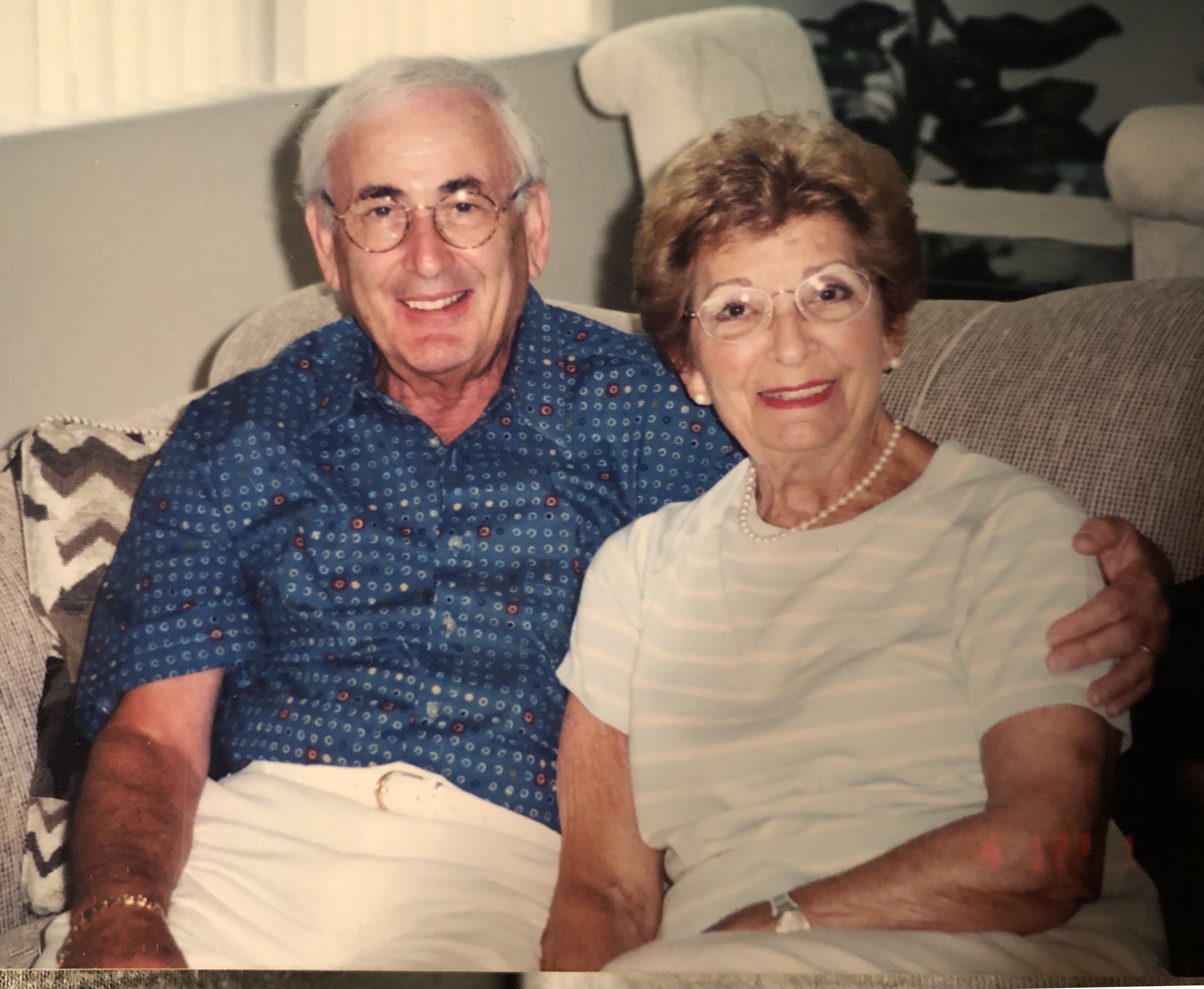
Irving and Yolie Wolfe

Interviewing Tevye and Golde? Sounds crazy, no? But I did it!

Recently I had the honor and privilege of interviewing “Tevye” and “Golde” to help promote Fiddler on the Roof’s United States National touring company. Speaking to Jonathan Hashamonay and Maite Uzel, who play, respectively, the irrepressible Bible-quoting dairyman and his loving but nagging wife, was one of the highlights of my writing adventures. The story was published in The Jewish World on Thursday, April 13, prior to Fiddler’s return to Proctors Theatre in Schenectady, New York, on April 26 and 27. Below is the link to the article! L’Chaim! Enjoy!

https://jewishworldnews.org/new-fiddler-as-politics-money-torpedo-our-american-shtetl/

Photo of Jonathan Hashamonay and Maite Uzel used with permission from Joan Marcus via Bond Theatrical Group (www.bondtheatrical.com)

Leaving the Narrow: A Passover Reflection

This past month, I was spending time with Julie and The Mountain Girl at their home at 9100 feet in Summit County, Colorado while Sam was away.

On one particularly beautiful morning, I dropped my second grader off at school. With the help of trekking poles, I started a hike on the bike path that runs through the county. After an invigorating, lovely hour work-out, I considered expanding my hike to include the more secluded trails up the mountain to Rainbow Lake. Did I dare go into the woods alone? I debated for a while and then took a right turn onto a trailhead. Hey! I could always turn back!

Rejoicing In The Day

It helped that I soon met up with Karen, a local resident, who was walking with her dog Dickens. When I mentioned my own hesitancy following the Peak Trail, she assuaged my concerns. “Dickens and I take an hour hike almost every day of the year.” That was the final push I needed. Heeding Lady MacBeth’s advice, “Screw your courage to the sticking place,” I pushed up the trail. 

As I navigated my way up the snow-packed path, I took in the Rocky Mountain scenery. The cloudless sky was a cerulean blue; the peaks above me were dressed in white, and the trail through the leafless aspens was pristine and quiet. I silently thanked Julie for living in such a beautiful location and God for providing such a beautiful day.

Ironically, when I reached my destination , I was not alone. The Mountain Girl and her entire second grade class were on a field trip. They dotted the frozen lake, throwing snow at each other and making snowmen and (as I later learned) snow ducks. The Mountain Girl gave me a hug before I navigated the last mile down to my daughter’s home. So much for my adventure being—well—an adventure!

Eye Of The Beholder

Still, judging from my multiple postings including photographs on Facebook and the comments that followed, many of my family and friends thought of my winter trek as irresponsible, strange, even insane. Hadn’t I gladly moved to Florida to get away from Upstate New York winters? More importantly, am I crazy for hiking by myself in the woods? Aren’t I afraid of falling on one of the more tricky trails? Attacked by a mountain man? Eaten by the moose, elk, and bear that inhabit the forested areas where I venture?

Time to fess up. Unlike Cheryl Strayed, who set off on a three month long solo journey the Pacific Crest Trail (PCT) to find herself and then wrote about it in Wild, it had taken me a few days to eschew the easier walks on Frisco’s sidewalks and head up snow-packed, slightly steep, less populous trail in the winter. As a matter a fact, it took me a while to hike alone during our six-week summer rental when the trails are filled with tourists from around the country and world taking advantage of the Summit County’s spectacular but short summer. But I swallowed my fear and took the leap of faith.

Family Dogma

Growing up as a Cohen did not equate with courage; it was closer to cowardliness. We were not an adventurous family, in terms of our choices, our vacations, and especially our testing of our physical limits. Although my brother Jay played football and wrestled, the rest of the family considered strenuous exercise to be taking a leisurely walk. Case in point: when I had broken from the mold after marrying Larry, I took a three-mile jog on the back roads near my parents’ Lake Champlain cottage. When I got home, my father said, “You shouldn’t run like that! You can have a heart attack!” My 25-year-old self just smiled and walked away. We won’t even get into what he said about Larry’s running races, which included some marathons. I can’t imagine what he would think about our son Adam’s 60-mile bike rides; Julie’s skinning (skiing up hills!) in zero degree temperatures; and Sam’s 200 mile once-in-a-lifetime rafting trip through the Grand Canyon. So yes, I had to invoke Shakespeare’s MacBeth to get the courage to take an easy winter hike!

Pesach And Risk-taking

I have been thinking of courage and risks and taking chances in relationship to the upcoming major Jewish holiday,Passover. Based on interpretations by the medieval biblical and Talmudic commentator Rashi, not every Hebrew followed Moses on his trek out of Egypt across the Red Sea. “According to the biblical account (Exodus 13:18b), Israel left Egypt chamushim, often translated as “armed,” wrote Rabbi Norman S. Lipson in a 3/26/1999 article in the Sun Sentinel. Rashi, however, translated the Hebrew word one-fifth, which meant only 20 percent of all Israel left with Moses.“80 percent stayed in Egyptian slavery!” Lipson wrote.

Had We Been There…

Wow! So if the Cohen family had lived in Egypt at the time of exodus, knowing my father, I bet we would have stayed home. “Better the devil you know than the devil you don’t know!” he would say. While a small group of neighbors started packing and baked matzah, he and Jay would have gone back to building more pyramids while my mother, two sisters, and I would have been kneading more leavened bread for dinner. 

Even if Rashi’s interpretation was wrong, and most Jews did leave, I am sure one of us (the Cohens) would not have emulated Nachshon ben Aminadav, the hero in a midrash. Standing at the shores of the Red Sea with the pharaoh and his army bearing down on the fleeing Hebrews, this brave man risked his life and jumped into the churning waters. At the last moment, God interfered and split the sea, saving Nachshon and providing the path to safety for all the rest who feared to take the leap of faith.

Taking The Chance

In a 4/22/2022 article in the Jerusalem Post by Nathan Lopes Cardozo, dean of the David Cardozo Academy in Jerusalem, praised the “ Nachshons of every generation.” “Those who were prepared to jump into the sea, taking huge risks, were responsible for magnificent scientific discoveries, space travel, grand business deals, daring political decisions and waging wars on evil.” Others may have considered them as strange, irresponsible, even insane. Cardozo commented, but their willingness to take risks based on hope moves the world forward.

Okay. My taking the “road less traveled” by turning right on a bike path and heading up a mountain trail certainly does not qualify as an epic, world-changing event. But I think of Adam, Julie, and Sam, who dare to live a more adventurous life than my birth family. And I think of Nashshon, Judah Maccabeus, Theodore Hertzl, David Ben Gurion, Hannah Szenes, Anne Frank, Steven Spielberg, and so many other Jews whose vision, heroism, and courage paved the way for those who tend to hang back on the shore, waiting to see what will happen.

A version of this article originally appeared in the Jewish World News, a bi-weekly subscription-based newspaper in upstate New York, in the March 30, 2023 issue.

Taking chances at 9100 feet.

My Romance by Frances Cohen

My mother Frances Cohen wrote down her memoirs in her late eighties. This story, how she met my father Bill Cohen, is one of our family favorites. More of her stories can be found on this blog as well as in Fradel’s Story, a collection of her articles co-written with me.

Since today is Valentine’s Day, I thought I’d write about my romances until I met my true love. The saying goes, “You have to kiss many frogs until you meet your true love.” Well, I knew many frogs.

I was a senior in high school when I experienced my first romance. I thought that Bernie had the bluest eyes and the curliest hair. I was completely infatuated. The economy wasn’t the best. So, our date consisted mostly of walking and holding hands. Bernie was my date for the Senior Prom. Although he wore a very shabby suit and I borrowed a gown, I thought I was lucky to have a date to the prom with the guy I adored. Things changed after I graduated high school. I got my first job in a toy store for $10 a week six days a week. Bernie didn’t have a job, so in the fall when the leaves died, so did our romance.

That New Year’s Eve was not a happy one for me. Instead of giving me a gift on Christmas Eve, my boss told me he did not need my services anymore. Worse yet, I did not have a date!

Time passed. Both my girlfriends were going steady. Their problem was that their boyfriends did not have a car. Charley, one of their friends, did, so my girlfriends urged me to date him. I was not especially fond of him, but we all were fond of his car. Conveniently, Charley was able to drive the three couples around. The six of us even went to the midnight show at the Apollo Theater.

Financially, things improved for me when I finally got a good bookkeeping job that I loved. When summer arrived, I was given a week’s vacation with pay. I decided to spend it in a hotel in the Catskill Mountains. The hotel had all the ingredients for romance, including swimming, boating, entertainment, and dancing. The first night at the hotel, I was seated next to a tall, handsome guy named Harry. We spent the whole week enjoying all the activities, and by the end of the week, I was completely infatuated with him. We continued dating after I got back from my vacation. I was having a great time as I was dating Charley on Saturday and Harry on Sundays. That situation ended a month later when Charley wanted to get engaged. How could I marry Charley when I was wild about Harry?

When Harry invited me to a formal dinner dance at the Astor Hotel that his firm was sponsoring, I was delighted. I purchased a new black taffeta gown with a matching purse and matching shoes. When Harry arrived to take me to the dinner dance, looking handsome in a tuxedo with a corsage in hand, I was ecstatic. But shortly after the dance, he stopped calling. I was really hurt. I guess I was wild about Harry, but Harry wasn’t wild about me.

I didn’t date anyone interesting for quite a while. Now that I was almost twenty-two years old, my mother was eager to see me settled with a handsome, rich, Jewish man. Cupid stepped in to help. My brother Eli, our cousin Elliot, and their friend Bill Cohen were all working for my Uncle Paul, who had a chain of department stores in Upstate New York. The three of them came home one weekend to visit each of their families. Bill, who had seen my picture at my Aunt Rose and Uncle Ruby’s house, asked Elliot and Eli to fix me up on a “blind” date.

That night I finally met my true love. Bill and I were attracted to each other immediately, and there was instant chemistry from the first moment we saw each other that was to last for a lifetime. My mother’s prayers were answered—almost! Bill was handsome and Jewish. Rich he wasn’t, but two out of three was not bad!

It was to be a long-distance romance. Bill made the eight-hour trip to see me as often as he could, but we only saw one another less than ten times before we married. We wrote every day—I still have his letters in a blue satin bag I keep in my dresser! We had so much in common: our love of reading, our respect for education, our desire for children, and our large, close-knit families. We soon realized that our family trees even had connecting branches as both our families came from small villages near to each other in Lithuania.

Even more astounding, we had actually “met” over twenty years earlier as children through those connections. In 1919, when I was two years old, I contracted the Spanish flu. When my lungs filled up with fluid, the doctor saved my life by cutting an incision into my back to drain them. It was recommended that I spend time away from our tiny apartment in Brooklyn and breathe country air. My mother Ethel quickly made arrangements for the two of us to visit her stepmother’s sister Ittel [Levinson] and her husband Archik Perelman, who lived on a farm in Burlington, Vermont. While there, Ethel and I were visited by Archik’s brother and sister-in-law, Itsik and Sarah Perelman; their daughter Annie [Perelman] Cohen, and her six-year- old son, Bill. There is an expression “My father married my mother. Why do I have to marry a stranger?” Well, Bill didn’t feel like a stranger to me.

On Valentine’s Day, 1940, Bill made a special trip in to see me. We went to the movies and then went out for sundaes at an ice cream parlor. After spending three hours watching Gone with the Wind, Bill must have thought I was Scarlett O’Hara, and so he asked me to marry him. I must have thought he was Rhett Butler, because I said yes. We were married that summer and have spent the last sixty-six years celebrating Valentine’s Days, our anniversary, and our love for each other.

This story, along with others my mother shared with her children, is found in Fradel’s Story, available on Amazon

Eighty-seven years later, a small victory against anti-Semititsm

Recently, the University of Southern California renamed the school track and field Allyson Felix Field in honor of the USC alumna and its illustrious 11-time Olympic medalist. Most media sources did not include in its coverage the previous name of the venue: Cromwell Field. What is the story behind the change?

Dean Cromwell, known as the “Maker of Champions” headed the USC track and field team from 1909 through 1948. During his tenure, he guided the team to 12 NCAA team national championships and 34 individual NCAA titles. A darker story exists: As assistant coach for the 1936 Berlin Olympics, Cromwell was one of the people responsible for the expulsion of the only two Jewish American athletes on the track and field team – Sam Stoller and Marty Glickman. 

The decision to erase Cromwell’s name follows USC’s recent policy to remove the names of well-known figures with dark pasts. In 2020, USC removed the name of its seventh president, Rufus von KleinSmid, from one of its most prominent buildings, citing his support of eugenics as well as his tolerance and support of pro-Nazi faculty. Soon after, the college removed a John Wayne exhibit at their School of Cinematic Arts following student protests against the actor’s history of racism and homophobia.

Cromwell’s words and actions deserved the same fate. In 1936, he spoke at a Nazi-organized German Day celebration in Los Angeles, California. According to the American Jewish World, the venue was filled with swastika flags and people dressed as storm troopers. In his remarks, Cromwell said, “Oh boy, if I could only be that handsome boy Adolf [Hitler] in New York for an hour.” He also effused that he did not see “a single colored man, woman or children [sic]” during his Olympics time in Germany, adding he did not object if they decided to leave.

As reported in a June 26, 2020, article by Larry Elder on runblogrun.com, Cromwell was also known for his racism and belief that Blacks were not equal to humans. An excerpt in Cromwell’s 1941 book Championship Techniques in Track and Field, he noted “the Negro athlete excels because he is closer to the primitive than the white athlete.” 

Cromwell’s racist rant continued: “It was not so long ago that his ability to sprint and jump was a life-and-death matter in the jungle. His muscles are pliable and his easygoing disposition is a valuable aid to the mental and physical relaxation a runner and jumper must have.” Despite outcries from the Los Angeles community, he not only remained as coach but was later honored by USC’s naming of the venue he oversaw for almost 40 years.

Calls to boycott the games began soon after the Nazi’s rise to power. Avery Brundage, head of the U.S. Olympic Committee, was determined that the United States accept the invitation to Berlin. Known as a Nazi sympathizer and an antisemite, he brusquely dismissed such concerns as the work of “a Jewish/communist conspiracy.” 

The outcry grew louder in 1935, when the Reichstag, the Nazi-controlled parliament, passed the harshly restrictive Nuremberg Laws, which deprived Germany’s Jews of citizenship, forbade intermarriage and decreed that no German girls work as servants for Jews. Many feared the games would be a Nazi propaganda tool where, as stated in an article about Glickman in wwwl.jewishvirtuallibrary.org, Hitler would extol the superiority of “pure Aryans over nations that allowed Jews, blacks and other ‘mongrel’ races to compete on their behalf.”

Brundage travelled to Germany to investigate the anti-Jewish claims that favored the boycott. He returned to the U.S. praising Hitler and dismissing reports of discrimination “In forty years of Olympic history,” Brundage said, “I doubt if the number of Jewish athletes competing from all nations totaled 1 per cent of all those in the games.” [According to a 2020 article in The Nation, Brundage’s number was a fabrication.] In the end, the United States decided to participate in the 1936 Summer Olympics. Both he and Cromwell later joined the isolationist America First Committee, which attracted Nazi sympathizers.

Brundage chose two U.S. college coaches to oversee the men’s U.S. track and field team: Lawson Robertson, University of Pennsylvania, would serve as head coach; USC’s Dean Cromwell was named assistant track coach. Several runners, including Jesse Owens and Ralph Metcalf qualified for individual events. A second group of men qualified for the relays, including two Jewish college athletes: Marty Glickman, Syracuse University, and Sam Stoller, University of Michigan. Each were to run a 100-meter leg on the 400 meter relay team.

As Glickman later wrote in his memoir The Fastest Kid on the Block, his suspicions about Cromwell and the fairness of the relay team selection process began at the American Olympic team trials in New York. After a very close finish, films showed that Glickman had placed third behind Owens and Metcalf in the 100-meter dash. Under pressure from Cromwell, the judges ruled that he placed fifth, thus losing his place on the team as an individual participant to USC’s Foy Draper, who was openly favored by Cromwell. 

When the athletes arrived in Berlin, there was little public display of the horrors that would soon follow. Hitler had promised there would be no antisemitic demonstrations, and his propaganda minister, Joseph Goebbels, ordered all anti-Jewish signs removed from Berlin streets. But the swastikas flew everywhere and the stiff-armed Heil Hitler salute was a constant presence. In a special Olympic edition of Der Stürmer, the virulently antisemitic German weekly recognized as a cog in Hitler’s Nazi propaganda machine, a cartoon was printed that reviled the Jews and said, “Jews are our misfortune.” Earlier, Julius Streicher, the paper’s editor and a Hitler favorite wrote: “We waste no words here…Jews are Jews. And there is no place for them in German sports…Germany is the Fatherland of Germans, not Jews.” 

Hitler’s dreams of a display of his master Aryan race were soon dashed by the accomplishments of the American Black athletes, who won many of the medals.

In the days leading up to their event, Glickman, Stoller, and their teammates practiced diligently for their 4X100 relay, which the United States’ team was highly favored to win. The morning before the scheduled preliminary heats, however, Robertson and Cromwell called a meeting and announced that there were rumors of hidden German “super runners” who were to step into the relay. As a result, Glickman and Stoller would be replaced with two other faster runners, Jesse Owens and Ralph Metcalfe. 

According to an article from the United States Holocaust Memorial Museum, Owens, to his credit, protested against the move. Citing his exhaustion and the three gold medals he had already won, Owens told Cromwell, ” Let Marty and Sam run, they deserve it,” Cromwell pointed his finger at him and said, “You’ll do as you’re told.” Glickman told the coaches there would be a ‘big stink’ if the only two Jews on the track and field team were pulled. Cromwell cut him off. “We’ll worry about that.”

On Aug. 9, 1936, Glickman and Stoller watched from the stands as the United States team of Jesse Owens and Ralph Metcalfe, and USC track stars Foy Draper and Frank Wykoff won the 4X100 meter relay in a world record time of 39.8 seconds. With Owens and Metcalfe running the first and second leg, Hitler was spared the embarrassment of another Black man first crossing the finish line. The German ‘super runners’ never materialized, and the German relay team placed third behind United States and Italy, 1.4 seconds slower than the winning time.

Time and history have uncovered the truth. Avery Brundage wanted to spare Hitler the embarrassment of seeing Jewish runners cross the finish line first. Cromwell, also known for his antisemitism and racism, supported Brundage and also wanted his USC athletes in the race. The change in the members of the relay was not a result of lack of speed. It was a result of Brundage and Cromwell’s antisemitism. “What is absolutely clear is that the move was made to spare Hitler and Nazi Germany the embarrassment of having Jews standing on the podium,” said Rabbi Abraham Cooper, director of the Simon Wiesenthal Center in a July 4, 2020, article in the LA Times. “And if that isn’t antisemitism, I don’t know what is.”

Years later, Glickman reflected on his disappointment in The Fastest Kid on the Block. “Watching the final the following day, I see Metcalfe passing runners down the back stretch, he ran the second leg, and [I thought] that should be me out there. That should be me. That’s me out there.” Hopes for a second chance were lost with the onset of WWII. Upon his graduation from Syracuse, he became famous for his broadcasts of the New York Knicks basketball games and the football games of the New York Giants and the New York Jets. But he never forgot the 1936 Olympics or forgave the men responsible for blocking his and Stoller’s participation.

In 1998, the U.S. Olympic Committee awarded its first Gen. Douglas MacArthur medals to Stoller (posthumously) and Glickman. Citing the injustice done, USOC chairman William Hybl said, “We are not only atoning for this, but are [also] recognizing two great individuals.” 

In Judaism, there is an expression that reads “midah k’neged midah,” -measure for measure. One’s actions and the way they affect the world will eventually come to that person in ways one might not necessarily expect. Eighty-seven years after Berlin, the past has caught up with Cromwell with the removal of his name at the field he coached. Unfortunately, neither Stoller nor Glickman lived to see this happen. 

A version of this article originally appeared in the Jewish World News, a bi-weekly subscription-based newspaper in upstate New York, in the February 16, 2023 issue.

A version of this article also appeared in the (Orlando) Heritage Florida Jewish News, in its February 10, 2023 issue.

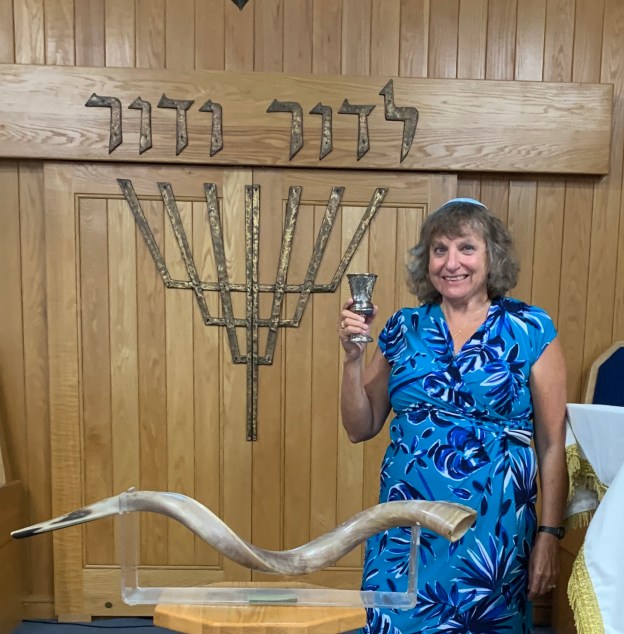
Today I am a woman: My adult bat mitzvah

I am publishing this on the thirtieth anniversary of my adult bat mitzvah, which was held at Congregation Beth Shalom, Clifton Park, NY.

My education at Congregation Beth Shalom in Plattsburg, New York, was strong in Jewish history and traditions, but it was very weak in Hebrew. If I wanted to learn the language needed to follow the service,  I either had to attend twice during the week, difficult with its one hour round trip, or I had to be preparing for a bat mitzvah, not something females did in the 1960’s in Upstate New York.

Our father had grown up in New York City in the Depression. His bar mitzvah ceremony was celebrated with several other boys in his Eastern Parkway synagogue, including the president of the shul’s son. The honor conferred on this golden boy was his reading most of the Torah portion and the haftorah and giving a  speech while the remaining b’na mitzvoth were left with very short prayers and shorter participation. The party consisted of some sponge cake and wine back at my father’s house followed by playing sandlot baseball.

As a result of my father’s experience, his son was to have everything denied the father. Jay’s bar mitzvah was a huge celebration. Over 120 people were invited to the service, including relatives we had never seen before and never saw again. Immediately following the service, my parents hosted a lovely reception at the Cumberland Hotel in Plattsburg. We all got new clothes for the party; I remember how special I felt in the “balloon” dress that was popular in 1961. 

As was the tradition in our reform synagogue, one’s Jewish education officially ended at sixteen years old with a Sunday morning confirmation service . My class consisted of three girls: Susan Singer, Andrea Siegel, and me, none of us who had had bat mitzvahs. We recited prayers and gave speeches. Mine was on anti-Semitism.  How in the world my teacher ever encouraged that topic and how I ever summarized its history in less than ten minutes I’ll never know, but I felt proud in my white robe and mortar board cap. A reception followed. What I remember most was how one of my teachers gave Susan and Andrea cards with cash gifts and completely ignored my presence. Not the sweetest memories to carry from my simchas.

Despite the snub,I loved learning about Jewish history and traditions. I attended classes with the grade behind me and even helped out in the primary grade classrooms. Once I left for college at Albany State, I attended services for Rosh Hosanna and Yom Kippur at Beth Emeth, but I was not involved in Hillel nor did I take any classes in Judaic Studies that were beginning to be offered.

It was not until my children were born that I began to be interested in studying Judaic topics again. Over the years, I took some basic Hebrew and playbook Hebrew classes so I could better follow the service. In the years I stayed home with my children, I seriously considered going back to school for a second master’s in Jewish Women’s Studies. When time constraints ruled out classes, I began a self-tutorial, reading books by Anzia Yezierska, Tillie Olsen,Cynthia Ozick, Grace Paley, and other noted Jewish female writers. This all went on the back burner when I returned to a full-time teaching position in 1986. 

In 1993, however, Flo Miller, one of  Congregation Beth Shalom’s teachers, suggested that I take a Haftorah trope class that summer with two other interested women. The four of us met each week around Flo’s kitchen table. By the end of the summer, each of us had chosen our own Haftorah for our adult bat mitzvah. I chose Mishpatim, the Torah portion whose  date for reading that year fell on the week of  my father’s ninetieth birthday to honor him and, coincidentally in the year of my forty-third birthday to reaffirm my link to Judaism on what would have been the thirtieth anniversary year of my own bat mitzvah. Over the next several months, my lunch hours at work consisted of a quick bite and at least two practice sessions with the Haftorah. Once a week, Flo would call me on the phone, and I would again read the Haftorah to show her how well I had progressed. By winter, Flo, Rabbi Harry Levin and I decided that I would also read two Torah portions at the service.

My bat mitzvah, which was held on February 4, 1993,  was not a huge affair. My parents and Larry’s parents could not come from Florida, and my siblings were too spread out across the country. Many members of the the synagogue attended, however, along with Larry’s sisters and brother-in-laws and a few close friends, I A Kiddish followed, and then my family and friends went to a Chinese restaurant for a celebratory meal.Meanwhile, I taped a full rendition of the Haftorah and Torah readings and sent it to my father for his birthday.

I would love to say that the experience resulted in many more Torah and Haftorah readings at Congregation Beth Shalom. Unfortunately, learning Hebrew did not come easy to me. It never flowed off my tongue, and even though I enjoyed the musicality of the tropes, I continued to stumble over the Hebrew letters and vowels. My next experience reciting Haftorah for a service proved to be even more difficult for me than the first, and I have not tried again. I continue to enjoy attending services and have high respect for the congregants who volunteer to read Haftorah and Torah portions. And through Jewish book clubs and my own independent reading, I will continue to study and appreciate my chosen faith.

A version of this article originally appeared in the Jewish World News, a bi-weekly subscription-based newspaper in upstate New York, in the August 20, 2015, issue.

Strategy for positive aging: Life choice to keep learning

“What are you going to do when you retire?” As many of us edge closer to the age where we can hang up our shingle, that question comes to us from family and friends. Our spouses, however, usually have something to add: “I don’t want you to sit home and do nothing! You need to find something to get you out of the house!”

For Jay Golden, finding something led him to a new passion for which he only had imagined: Playing a musical instrument. 

Jay was born in 1938 in Manhattan to first generation Jewish parents. Eschewing their Orthodox households, the couple moved their family to Chicago. 

In 1951, the Goldens purchased a 13 inch black and white set. Jay, now a teenager, loved watching the shows featured on at the dawn of the televisions age. His favorites included Flash Gordon (Syndication 1954-1955), The Lone Ranger (ABC, 1949-1957), and Don Winslow of the Navy, a series that originally shown in movie theaters.

As much as he loved the stories, Jay was even more fascinated by the classical music that accompanied the shows. Through his research and visits to local record stores, he learned that the superhero Flash Gordon vanquished his enemies to the music of  “Les Preludes” by Franz Liszt.  “Don Winslow of the Navy” buoyed his patriotic spirt to the music of Felix Mendelssohn’s Hebrides Overture (“Fingals Cave.”). And how could any who grew up in the 1940s and 1950s forget the stirring opening from The Lone Ranger, which was the overture to “William Tell” by Gioachino Rossini?

Using money he earned through his allowance and odd jobs, Jay began collecting vinyl records of the classics. He graduated from the University of Illinois in 1962 and the University of Chicago in 1968. When he married Ellen Lewis in 1977, his 200+ vinyl collection soon gave way to the newer technology—compact discs (CD’s). His knowledge and appreciation of the music, composers, and the performers continued to grow. 

Fortunately,Jay and Ellen’s home town, Rochester, New York, provides ample opportunities for classical music. The University of Rochester’s prestigious Eastman School of Music hosted concerts by the Rochester Philharmonic Orchestra as well as performances by their students. Nearby Nazareth College offered a strong undergraduate and graduate music education program.

While Ellen pursued her career in law, Jay used his urban planning degree in partnership with shopping center developers and then as developer of affordable housing of projects in NY, OH, PA, and Puerto Rico. During that time, Jay served on the house committees of Temple B’rith Kodesh and Temple Sinai in Rochester, sharing his extensive experience with building maintenance, affordable housing development and property management. 

By 2005, Jay was thinking ahead to his retirement. Wife Ellen encouraged him to find a productive way to spend his spare time, especially during Rochester’s long cold winters. Although he had always loved listening to classical music, he had never played a musical instrument. He considered the violin, but decided was too difficult to begin learning in his seventies. He thought briefly about playing a trumpet, but the idea of “tooting his own horn” quickly dissipated.

One day, while listening to “The Moldau” the second movement of a six-movement suite, Má vlast (My Country), by Czech composer Bedrich Smetana, Jay found himself imitating the finger movement on the flute, which is used prominently in the piece. It was a revelatory moment for Jay, leading him to decide to pursue learning to play the wind instrument. Although he was still working full time, his boss was very supportive of Jay’s new avocation, giving him the time off needed for his lessons. He rented a Yamaha student flute from a local music store and began lessons with a doctoral candidate from the Eastman School.

From the beginning, Jay was aware he faced a steep learning curve. “When I began with the flute,” recalled Jay, “I knew nothing about reading music, much less how to play it.” 

After a year of lessons, Jay attended a tryout session at the Eastman Music School’s New Horizons. The music program, which is part of wider umbrella of programs that are offered throughout in the United States and Canada, provides experience for seniors who played at any of three levels of proficiency: beginner, intermediate, and advanced. The person who was responsible for the tryout, however, was unwelcoming and dismissive the aspiring flutist. He pointed to a small room and told Jay, “That room is for the newbies. Go in there.” Jay walked out.

However, Jay did not give up on the flute. Although his first teacher was an accomplished musician, he realized that teaching was not her forte. He began taking one-hour lessons twice a month with an adjunct professor  of flute at Nazareth College.

Three years after his negative encounter, Jay tried out again for the New Horizons Music Program and was, as he said, “more politely invited to participate” as one of the 150 seniors involved the three levels of bands. Jay described the diversity in experience.”There are many who played their instrument in middle or high school, put it away until they retired and wanted to have something to do,” said Jay. “Then there were quite a few who, like myself, had zero instrumental musical experience.” Jay started in beginner band and gradually worked his way up to intermediate level band. The band practiced one hour a week and provided not only a musical but also a social experience. 

For several years, Jay played on his rented Yamaha student flute until he recognized that his teacher’s flute sounded so much warmer. She told Jay, “If you can distinguish the difference in how my flute and yours sounds, you’re ready for a better instrument.” So Jay purchased a Wm. A. Haines “Amadeus” flute, which he now plays every day. “It is an absolutely beautiful instrument and a thrill to hold and play,” he said, proudly adding that the first and second chair flutes of the Rochester Philharmonic play the Haines flutes. 

After seven years, Jay left in New Horizons November 2021. He explained that the program’s repertoire focuses on more popular music, including Broadway show tunes, movie themes, and songs by The Beatles and Billy Joel. As his first love is classical music, he made the decision to “play for myself.” He has continued his twice a month one-hour lessons. Although he never was able to master Smetana’s Moldau score—“it is quite beyond my ability,” Jay mused—he has enjoyed playing many other classical pieces including several sections of “The Seasons” by Antonio Vivaldi.

At 85, Jay is still learning. Along with his monthly one-hour flute lesson, he also is studying German thorough Oasis, an adult learning program. Every Thursday, he takes back to back classes in both intermediate and advanced German. Jay noted that the advanced class is especially difficult in that students are required to translate from sections of a German language biography of Alexander Von Humboldt, one of the most influential scientists and thinkers of the nineteenth century, into English. Students are also required to speak the passages out loud, a test of pronunciation and diction.

This past month, Jay and Ellen extended their time at a destination wedding in Puerto Vallarta, Mexico, by five days to celebrate their 46th anniversary. Even though they did not look forward to returning to snow and cold of Upstate New York, Jay is looking forward to continuing his musical journey. He is also adjusting to some of the challenges of an octogenarian musician. Jay stated that the most important element of playing the flute, beside knowing what fingers to put down for what note, is embouchure. “The older I get the more difficult it becomes to keep my lips supple,” Jay said. “Nobody said it would be easy, but at least I don’t have arthritis to slow me down.” 

Nor does much else slow Jay Golden down! He, like many others after their retirement, has found a wonderful “second act.” May he go from strength to strength!

A version of this article originally appeared in the Jewish World News, a bi-weekly subscription-based newspaper in upstate New York, in the February 2, 2023 issue.