Author Archives: Marilyn Shapiro

Unknown's avatar

About Marilyn Shapiro

After thirty five years in education, I have retired and am free to pursue my lifelong dream of becoming a freelance writer. Inspired by my mother, who was the family historian, I am writing down my family stories as well as publishing stories my mother wrote down throughout her life. Please feel free to comment and share.

Keep Calm and Bake Challah is on Amazon!!

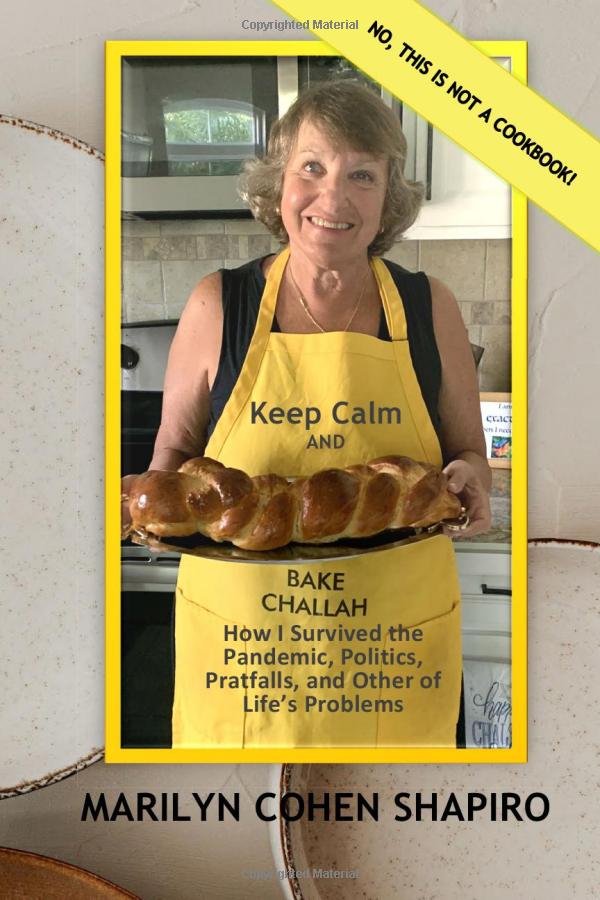
I am proud to announce that my fourth book, Keep Calm and Bake Challah: How I Survived the Pandemic, Politics, Pratfalls and Other of Life’s Problems,is out and available on Amazon in both Kindle and paperback formats.Hope you enjoy reading the the fifty-three articles I wrote during the pandemic as much as I enjoyed writing them! For those who have been following my blog for a while, you will now have many of those posts in one place for your reading pleasure.

Below are a sampling of the story topics:

A Survivor’s Tale: Dutch Nathan

Anne Frank, born on June 12, 1929, was the celebrated diarist who described her life while hiding with her family from the Nazis in an Amsterdam, Holland attic. After capture and deportation, she died in the Bergen-Belsen concentration camp in late winter 1945.The following story, first published in 2018, tells the story of another Jewish child who hid with his family in Holland during World War II and survived to share his story.

Anne Frank is one of the most well known figures from the Holocaust. But she and her family were not the only ones to go into hiding to avoid capture by the Nazis and their collaborators. While some Jews lived in the open with changed identities, others, like the Franks physically hid to avoid certain deportation and almost certain death. Dutch Nathan and his family were one of many who relied on others to help them. 

Gert “Dutch” Nathan was born on January 5, 1932, in Duren, Germany, the second son of Wilhelm (“Willy”)  and Hilde (nee  Friesem) Nathan. Willy had a cattle hauling business which extended throughout Europe. He did not have a formal education, but he was street smart—Dutch remembers that his father could “outcalculate a calculator.” The Nathans lived a mostly secular life in Germany, with observation of major Jewish holidays and his mothers’ lighting of Shabbat candles.

In 1938, after Hitler’s rise, the family moved sixty miles west to Valkenburg, The Netherlands. “Holland had proclaimed neutrality when war broke out in September 1939, as they had done in World I,” said Dutch, “so my father thought our family would be safe.”Willy took a job with the De Valk bus company, a former competitor, where he continued his cattle business.

On May 10, 1940, Hitler’s forces invaded the self-proclaimed “neutral” country. Five days later, after the bombing of Rotterdam, the Dutch forces surrendered. By 1942, the situation began to deteriorate for fellow Jews. Willy made the following arrangements with his friend, Johan Kengen, a member of the Dutch Underground:  If the Nathans were in danger of deportment. Willy would pay for the family to stay in the home of  Kengen’s fiancé’s aunt and uncle  for “a few days” until the Nathans could be spirited away to England. Willy also made arrangements for neighbors to move most of the furniture and bedding to the house next door. Whether the neighbors were paid or volunteered as an anti-Nazi action still remains a mystery to Dutch. 

The plan was put into effect a few month later. While walking from the bus station into the De Valk building, Willy was stopped by a friend and fellow employee:  Germans were waiting for him to arrest him and deport him and his family to the concentration camp.

Father quickly stole a bike and peddled the ten miles home. Dutch and his older brother Fredo were instructed to leave their house one hour apart to walk the two  miles to a house “located on the right hand side just before the road crossed the railroad tracks” with a warning to “not speak to a soul.” Willy and Hilde arrived later that evening, expecting to hear soon from the Underground of their clandestine trip to England. 

Unfortunately, the days turned into week, and the Nathans were still in hiding. Other people, including downed pilots, had priority in the Underground escape plan. To further cover the facts of extra activity in the “safe house,” an elaborate ruse was planned. Johan and the elderly couple’s niece Ann quickly arranged their wedding. At the reception, Johan picked a huge fight with Ann’s parents, who resolved that they would have no contact with the couple until Johan apologized. The newlyweds moved into the house by the railroad tracks, bringing the number to eight. 

As weeks turned into months, tensions grew. The Nathan’s spent most of their time in a small main floor bedroom. Ann was prone to hysterical outbursts, and Willy and Johan would have to physically restrain her to keep her from running outside and giving their situation away. Meanwhile, Hilde was anguishing over the fact that she had not been able bring her parents with them. She was haunted by their deaths in the concentration camp for the rest of her life.

Johan’s government job determining the number of animals that farmers could slaughtered provided a means to get extra meat and milk, but food was still scarce. Dutch and Fredo, 10 and 12 respectively, spent most of their days quietly reading books and avoiding the shaded windows so no shadows would be seen.

Along with possible discovery, the occupants lived in fear of the potential impact of living near the railroad track.The noise from the passing trains provided an extra buffer but also an extra danger:  Allies strafed German trains. They hoped that these attacks would not hit the house, either killing all of them or forcing the Nathans out into the open, thus exposing their dark secret. 

In the second half of 1944, the southern half of Holland was liberated by American troops. (The remaining areas of the Netherlands were not liberated until May 1945.) The Nathans stayed inside for a few more days to make sure they were safe. 

Once they realized they were actually free, the Nathans stepped into fresh  air for the first time in twenty-six months.  “I walked a few feet and collapsed,” remembered Dutch. When asked if he had been overcome with emotion, he said, “I hadn’t used my legs in 26 months and initially had no muscle tone to walk more than a few feet.

Before they could move back into their home, however, Americans bombed Valkenburg. One of the casualties was the Nathan’s home. “No one understood why the brick home next door burned so much,” said Dutch. “The furniture hidden in the attic acted like a tinderbox, and flames shot up in the air for hours.”

In May 1945, the remaining areas of the Netherlands were liberated. Free but homeless, the Nathan family moved into a neighbor’s home until 1946, when they obtained visas to move to United States, where several of Willy’s siblings lived. Willy built a crate the size of a truck and filled it with everything they had accumulated since the end of the war—including a piano. 

Dutch, now sixteen, enrolled in City College to learn English, adding to his previous background of German, French, and Dutch. At 18, he enlisted in the army and volunteered to go to South Korea. When he returned home, he found employment in whatever “made money.” 

In 1979, Dutch, who had been married twice before, met Sue Cohen. He proposed shortly after the meeting, but it took ten years for her to say yes. During this time, Dutch started the Stretch Lace, a Sharon Massachusetts-based company that manufactured and sold elastic shoe laces. (“Tie once, never Tie Again!”) Although his invention was successful, Dutch admitted that he didn’t know marketing and sales. He eventually sold the business, but Easy Laces are still available today and are worn by such celebrities as Brooke Shields. They lived in Sharon for most of their married life before retiring to Kissimmee, Florida, in 2007.

 In 1982, Sue and he were invited by residents of Duren, Germany, to return to the Nathan’s original home. They were treated royally and met with church members as well as school children. Sue’s main mantra to everyone she met was “Just remember! The Holocaust DID happen.” Although their visit was supposed to last a week, Dutch felt uncomfortable. He rented a car, and the two of them toured Europe, driving over 4000 miles before returning to Massachusetts 

Almost seventy-five years after his liberation, Dutch graciously shared the story that he spent most of his life trying to put those terrifying time behind him. “I try not to think about those things,” said Dutch. “It is over and cannot be undone.  His story, however, as those of the fewer and fewer remaining Holocaust survivors, must be told. As Sue Nathan told the people in Germany during the 1982 visit, “Remember. The Holocaust DID happen.” And we Jews and righteous people everywhere will never forget. 

A version of this article originally appeared in the November 8, 2018, issue of the Jewish World News, a bi-weekly subscription-based newspaper in upstate New York.

Unmoored

Originally published in Jewish World News on June 24, 2021, the following essay reflects my feelings after fifteen months of lockdown. This is one of the essays found in my fourth book, Keep Calm and Bake Challah: How I Survived the Pandemic, Politics, Pratfalls, and Other of Life’s Problems.

Since my husband Larry and I have had our second COVID shots, our pre-pandemic life and its commitments are slowly resuming. We have waded out into the unknown, first a toe into the water with outdoor concerts and patio-only dining, then walking up to our knees with visits and in-home dinners with vaccinated friends, then plunging in with indoor restaurant dining and non-virtual club meetings. Recently, I was in a restaurant with four friends when I realized I had walked in, sat down, ordered, and hadn’t thought of COVID or even masks for a full half hour. That, I say, is progress.

Then why am I feeling shaky? Uncertain? Unmoored? 

Since March 2020, when the world shut down, my husband Larry and I filled the empty hours that stretched in front of us with small gems. I finally put together Fradel’s Story, a collection of articles written by my mother and about my family. We took long walks and longer bike rides through unexplored areas of our community. We spent hours and hours on our lanai, reading, doing puzzles, eating leisurely dinners, and watching the wildlife in our pond. Each Friday, we celebrated Shabbat with candles and wine and homemade challah. And we spent hours and hours on video conferencing sessions with family, friends, our synagogue, and our clubs. 

Now our calendars is filling up and overflowing. We have not yet given up many of the activities that kept us going for sixteen months of isolation, but we are also adding more and more semblances of our previous life. And as what happens to me whenever I try to juggle too much I began dropping balls. I missed a planned luncheon, showed up an hour late for a book club, and completely forgot to call my brother and sister-in-law to wish them “Mazel tov” on their fiftieth anniversary. For goodness sakes, I even failed to send in an article to the Jewish World for its last issue, something I had not done for years. Had I learned nothing from the pandemic?

Jodi Rudoren captured many of my feelings in a March 5, 2021, editorial in the Forward where she admitted that she didn’t want to go back to the old “normal.” “This terrible, horrible very bad year of isolation has also had an abundance of silver linings,” she wrote, “and I worry we’ll snap back to our old ways without truly learning the lessons this crisis has brought.”

So now, like Ms. Rudoren and many others, I am finding my own “better normal.” I don’t want to give up some of the things I savored: the more leisurely life, our long dinners on the lanai with cold beer or coconut rum and (Diet) cokes or wine; the challah baking, the puzzles. On the other hand, I look forward to meeting friends for dinner and plays and indoor get-together, resuming exercise classes, and, most of all, traveling to see my family. 

I am not alone in my feelings, as I found out on a ZOOM with my SOL Writers group. Ginny said that she feels as if she was emerging from a long illness, where stepping back into the world in her weakened state is difficult. “I feel untethered,” she said. “It is as if I am floating around finding my center.” Gail shared that she felt as if she were in a “waiting room,” in between her old life and her “new normal.”

Along with the difficulty of finding one’s balance, there is still the specter of COVID-19 hanging over all of us. Although all of the SOL Writers have had both vaccines, each found that she still was a “little too vigilant,” “a little too cautious,” and most importantly, “a little distrustful.” When “accosted” by a fellow shopper who demanded to know why she was still wearing a mask, Ginny avoided confrontation by calmly saying, “You care as much about what I think as I care about what you think.” After ‘losing’ what she feels has been a year of her life, Mary Ann said she no longer has the energy or patience to squander what remains of her time for “idiots” who still think that the virus was a hoax. “These people are ‘energy vampires,’” commented Aya.

The reality of a resurgence has been felt by friends in England, who now are concerned of a virus variant from India that is more contagious. “Portugal opened up, and many people flew there for a vacation,” they  told us. “Then there was a spike in cases.”Portugal’s Covid rates increased enough for England to revoked their green status, resulting in vacationers scrambling to return home before they faced a 14-quarantine. Our friends are not optimistic about traveling for a long while. 

In the States, there is more confidence, and Larry and I are ready for our next big step. We will soon be flying out to see our son and daughter-in-law and meet our grandson, who was born one day before San Francisco closed down. Then we head to Colorado, to spend time our daughter, son-in-law, and beautiful granddaughter. Extra masks and hand sanitizer are already packed, along with gifts, warm layers for San Francisco “summers” and hiking clothes and boots for Rocky Mountain trails. 

We know that COVID and its aftermath will impact our visit. Outdoor concerts, farmers markets, and indoor plays and dinners are still “To Be Determined.”

No matter, Larry and I will just be happy to finally be with our family and return to at least that piece of normalcy. We will take long walks along the ocean in San Francisco and long hikes in the woods in Colorado. Each Friday, we will sit down with them for Shabbat dinners with wine, candles, and freshly baked challah. Larry will find quiet moments to do puzzles and read. I will put the final touches on Fradel’s Story [to be completed in time for what would have been my mother’s 104th birthday on September 1] and continue writing stories about living through the pandemic. And I will savor all that I learned as I move forward into our “new normal.”

Sources:

Demony, Catarina. “Portugal halts easing of COVID-19 rules in Lisbon as cases rise.” Yahoo News June 9, 2021.

Rudoren, Jodi. “Confessions of a Lockdown Addict.” Forward. March 5, 2021.

Rudoren, Jodi. “Small Talk and Other Skills I’m struggling to re-learn as we build a better normal.”  Forward. June 11, 2021

Photo courtesy of Nick Fewings on Unsplash.

A version of this article originally appeared in the June 24, 2021, Jewish World News, a bi-weekly subscription-based newspaper in upstate New York.

As hate crimes against Jews continue to rise, President Biden among others who are speaking out.

A shorter version of this story was published in the Orlando Sentinel on January 8, 2023. This is the full article as published in The Jewish World in its January 5 issue.

“In the end we will remember not the words of our enemies but the silence of our friends.” Martin Luther King, Jr.

On December 19, 2022, President Joe Biden used the White House’s Chanukah celebration to call out the rising anti-Semitism in  the United States. “Silence is complicity,” he stated. Biden joined Second Gentleman Doug Emhoff and other notable Jews in lighting the first ever official White House hanukkiah, which was created by the Executive Residence Carpentry Shop out of wood removed from the building in 1950 during a Truman-era renovation “Today, we must all say clearly and forcefully that anti-Semitism and all forms of hate and violence in this country have no safe harbor in America. Period,” Biden said.

This theme echoed the president’s tweet earlier in December.  The remarks came one day after Ye, the rapper, formerly known as Kanye West, announced “I like Hitler” during an anti-Semitic rant on right-wing conspiracy theorist Alex Jones’ InfoWars show and five days after Donald Trump dined with Ye and white supremacist Nick Fuentes. “The Holocaust happened. Hitler was a demonic figure,” stated Biden. “And instead of giving it a platform, our political leaders should be calling out and rejecting anti-Semitism wherever it hides. Silence is complicity.” Trump, meanwhile, has yet apologize  or to condemn the men he dined with at Mar-a-Lago. He has hidden behind an excuse of innocence, claiming he didn’t know who Fuentes was.

Condemnation

Some Republican leaders were swift of their condemnation of Trump’s actions.  “Trump was wrong to give a white nationalist, an anti-Semite and Holocaust denier a seat at the table,” stated former Vice President Michael Pence. “And I think he should apologize for it, and he should denounce those individuals and their hateful rhetoric without qualification.” Senate Minority Leader Mitch McConnell echoed Pence’s words. “There is no room in the Republican Party for anti-Semitism or white supremacy,” he said. “[A]nyone meeting with people advocating that point of view, in my judgment, are highly unlikely to ever be elected president of the United States.”

House Minority Leader Kevin McCarthy denounced Fuentes, stating that the white supremacist “has no place in this Republican Party,” but follow-up statement which supported Trump was blatantly untrue.  “I think President Trump came out four times and condemned him and didn’t know who he was.” According to CNN and other reputable news sources, Trump claimed four times that he didn’t know Fuentes but never denounced him or his views.

While condemning anti-Semitism, many other Republicans who spoke out condemned the ideology but avoided invoking the former president’s name. As a matter of fact, when PBS reached out to  57 Republican lawmakers to condemn the meeting, two-thirds never responded. Many, like McCarthy,  have put the blame on Ye and Fuentes for showing up.

The silence is also deafening in my own state of Florida .In January, a small band of white supremacists converged in Orlando, where they chanted “White power!” and roughed up a Jewish student. Governor Ron DeSantis’ press secretary suggested on Twitter that the white supremacists were actually “Democrats pretending to be Nazis.”The governor himself is yet to speak about the Trump/Ye/Fuentes debacle.  

In March 29, 2022, article in New York magazine, Jonathan Chait opined that DeSantis’ silence may be rooted in his own strategy  to obtain the 2024 Republican nod for the presidential candidate. Chait went soon to say that it may be even more deeply rooted in what Chait called the Republican presidential candidate hopeful’s  “unembarrassed courtship of right-wing extremists.”

Look Who Is Talking?

So who is speaking up? Certainly the Anti-Defamation League, whose response was immediate and unequivocal. “Former President Trump’s dinner with anti-Semites Ye and Nick Fuentes underscores the ugly normalization of extremist beliefs — including anti-Semitism, racism and other forms of bigotry,” said Jonathan Greenblatt, its National Director and CEO.  He went on to warn that the dinner further emboldened extremists. 

And thankfully, many others have refused to be silent. Government officials, religious leaders, journalists, athletes, entertainers, and many others have raised their voices against anti-Semitism.

In November, over 200 leaders of the entertainment industry, including Mila Kunis, Debra Messing and Mayim Bialik, released a letter through the non-profit entertainment industry organization Creative Community for Peace urging Amazon and Barnes and Noble to stop its sale of the highly inflammatory book and film, Hebrews to Negros: Wake Up Black America.  “At a time in America where there are more per capita hate crimes against Jews than any other minority, overwhelmingly more religious-based hate crimes against the Jewish people than any other religion, and more hate crimes against the Jewish people in New York than any other minority, where a majority of American Jews live,” the letter reads, “it is unacceptable to allow this type of hate to foment on your platforms.”

Survivors

There is another powerful but diminishing group that continues to bring the reality of the Holocaust and anti-Semitism to the forefront: Holocaust survivors. January 27, 2023, marks the 78th anniversary of the liberation of Auschwitz. Most of the survivors are in their eighties and beyond; the oldest known survivor, Yisrael Kristal, died at 113 in 2017. Through the efforts of Steven Spielberg , the Shoah Visual History Foundation has recorded over  55,000 stories Holocaust survivors in more than 50 countries and more than 30 languages. Events such as the International March for the Living and venues such as the United States Holocaust Memorial Museum and other Holocaust museums across the country and world also bear witness. 

“There are very few survivors left, and I want the world to know that there was a Holocaust,” Estelle Nadel, an 88-year-old Holocaust survivor who has talked to hundreds of groups for over forty years stated. “There’s so much denial, that every time I get a chance to tell my story, I feel like I’m doing something against it.”“Justice will not be served until those who are unaffected are as outraged as those who are,” wrote Benjamin Franklin. President Biden knows this, as should all who wish to push back agains hate.

Through the sands of time: A shul in St. Thomas?

Under a hot tropical sun, Larry and I wound our way first along the Caribbean Sea and then, in a couple of zigzags to the left, up a steep hill. We stood in front of a large stone edifice with its white plaster column and point-arch windows. Robert Kunkel, the docent/educator, opened up the black iron gate and led us up a set of stairs to the large point-arch entrance doors. After several trips to the Caribbean, Larry and I finally could visit the Hebrew Congregation of St. Thomas, the second oldest synagogue building in the western hemisphere and the oldest in continuous use under an American flag.

Stepping past the threshold, we immediately noticed a carpet of sand that covered the center of the room. We then took in the beautiful architecture. A domed ceiling holding the Eternal Light soared above us. The mahogany pews, finished by nineteenth century shipbuilders, were set up in on three sides to face the ark. A striking marble slab supported its base. Above the curtained doors, artisans had engraved two tablets representing the Ten Commandments into the native stone. More pointed-arch windows let in the bright light, while thick white plaster walls helped keep the interior cool. 

As we settled into the pews, Robert shared his vast knowledge of the synagogue and its important role in the history of St. Thomas, the largest of the three main islands that comprise the US Virgin Islands. But first he addresses our most pressing question: Why sand? He explained that the first Jews in the Caribbean were of Sephardic, or Spanish-Portuguese, descent. The unique floor, one of only five in the world, shows how the Spanish Inquisition (most active between 1480 and 1530) forced their Jewish ancestors in those two countries to practice their religion secretly in basements, covering the floors to muffle their footsteps and voices.

So how did these Iberian Jews land up in St. Thomas? Facing a choice of forced conversion or expulsion, victims of the Spanish Inquisition fled to European cities. Over the next four centuries, partially because of discrimination in other professions, Jews developed a mercantile trade which lead them to countries in both South America and the Caribbean, including St. Thomas. The number of Jews on this island remained small until the years after the American Revolution, when an influx of Sephardic Jews set up businesses in a climate of great tolerance and discrimination. In 1796, the Jews of St. Thomas founded B’racha V’shalom (Blessing and Peace). A fire destroyed the first structure along with several hundreds of building on the island. In 1812, the Jewish community purchased land and built a new synagogue. A growing population resulted in erecting a new expanded wooden structure with an expanded name: Congregation Beracha Veshalom Vegmiluth Hasadim, “Blessing and Peace and Loving Deeds.”

On December 31, 1831, another fire destroyed one quarter of the buildings on St. Thomas, including the shul. Not to be deterred, the Jewish community began an international fundraising effort to raise the $5000 needed to rebuild a house of worship made of stone, brick, and mortar. 

 The congregation and surrounding non-Jewish community had donated money, materials, and labor towards the project. In September 1833, the entire community celebrated the reconsecration of the building, which held the two Torahs and the Eternal Light that had been rescued from the fire. This was the building we were standing in almost 190 years later. 

As the synagogue grew, the congregation purchased a burial ground, established a Hebrew School, and began using the services of actual clergy. Like all synagogues, the following years brought the synagogue schisms over liturgy and rabbis, and fluctuating membership. Through it all, it remained a living, vibrant synagogue connected closely to its community. Most notably, two members of the congregation served as governors the Virgin Islands: Morris Fidanque De Castro (1950-1954) and Raphael Moses (Ralph) Paiewonsky (1961-1969).

As written in the museum’s online narrative, the St. Thomas Synagogue continues to follow in the footsteps of its ancestors, preserving their heritage and honoring their traditions. Part of this renewal was the congregation’s current search for a rabbi, as its most recent spiritual leader had moved to New Jersey to be closer to his family. 

After the narrative, the tour guide opened up the ark, which housed seven Torahs. The one Sephardic Torah was housed vertically in a beautiful wooden cylindrical case which followed the customs of the Spanish-Portuguese Jewry to both store and read the scrolls while standing in their cases. The six other Ashkenazi Torahs were dressed in the traditional Ashkenazi accessories each with a mantel (velvet covering); Atzei Chayim (wooden shafts) topped with keters (crowns); and a yad (pointer). They rested at an angle on the back of the ark. Because of my interest in the Shoah, my favorite was a Memorial Scrolls Trust Torah (MST #533) which was rescued from Budyně nad Ohří, a small town in Bohemia, Czech Republic. Jews had lived there from the 13th century. In 1942, the Nazis liquidated the town of its 50 Jews who still remained. 

With the guide’s approval, Larry and I took turns holding the Holocaust Torah before saying our goodbyes and thanks. We spent time in the museum gift shop, where we purchased a mezuzah, Through the Sands of Time: A History of the Jewish Community of St. Thomas, US Virgin Islands by Judah M. Cohen, and a T-shirt for Larry proclaiming “I Climbed Synagogue Hill.” We headed back to our cruise ship, thankfully a downhill journey, happy to know we finally got to see this living museum of Jewish sacrifice, survival, and strength. “The sands of time may pass over our shores again and again, changing our landscape, but the soul of our synagogue and its people remains eternal,” reads the synagogue’s website. “Our history does not end. Rather, with each generation, it begins anew.” 

On February 22, 2023, less than a week after our visit, the Hebrew Congregation of St. Thomas started a new chapter and welcomed Julia Margolis as its first female rabbi. Rabbi Margolis took a long, circuitous route to the shul. Born in Moscow, USSR, her family moved to Israel when she was 12. After graduating from high school and serving in the Israel Defense Forces, she completed undergraduate degrees in Jewish history, Islam, and art and a master’s degree in Jewish studies. Following in the footsteps of her mother, who was the first Russian-speaking female rabbi in Israel, Rabbi Margolis was ordained by the Abraham Geiger College in Germany. Closely connected to the Reform Movement, Rabbi Margolis was heading a synagogue in Johannesburg, South Africa, when she saw the synagogue was looking for a new leader. She submitted her application, but she was still surprised when the search committee contacted her. In the middle of their negotiations, her husband Greg tragically passed away. Following her heart, she made the move with her two children to St. Thomas, where she soon was “soaking in the beauty and the spirituality of this place.”

“God always has a plan,” Margolis shared in a March 21, 2023, article in the Virgin Islands Daily News. “It takes a lot of time sometimes to see that, but there is always a plan.”

Originally published May 25, 2023. Updated May 25, 2025.

Fun Trivia:

 The Mikvé Israel-Emanuel Synagogue in Curaçao is the oldest synagogue building in the Western Hemisphere. (1730)

The Touro Synagogue in Newport, Rhode Island, is the oldest synagogue building  in North America that is still standing. (1763)

The  Old New Synagogue of Prague in the Czech Republic is the oldest active synagogue in the world. (1270s)

The Ben Ezra Synagogue in Cairo, Egypt is the oldest synagogue in the world and also the longest serving. The original synagogue dates back to the ninth century. When Jews fled Egypt in the 1950s, it was turned into a museum. 

Temple Israel in Leadville, Colorado, holds the record for the highest synagogue in the world. Founded in 1884, the synagogue sits at an elevation of 10,152 above sea level. It is now a museum. 

A version of this article originally appeared in the May 25, 2023, issue of the Jewish World News, a bi-weekly subscription-based newspaper in upstate New York.

A version of this article originally appeared in the June 2, 2023 issue of the  Heritage Florida Jewish News, a weekly subscription-based newspaper in Central Florida.

College Dreams by Frances Cohen

As high schools and college students celebrate their graduations, I reflect back on my parents’ insistence that their children, unlike themselves, graduate from college.

My husband Bill and I always regretted that we did not have a college degree, but times were different in the 1930s during The Great Depression.

 When I graduated high school in 1935, there was no way that I could afford to go to college. Immediately after I finished school, I got a job as a bookkeeper. Most of my salary went to pay the rent of my parents’ apartment. 

Bill’s grandmother promised him that she would pay Bill’s tuition at the University of Vermont in Burlington. Those plans were crushed when his grandmother died after attending his high school graduation, and she left no provisions to pay for his education. Since he did not have the advantage of a college degree, he went into the retail business and spent many years associated with Pearls Department Store a family owned business in Keeseville, New York, that sold lower end merchandise. Things changed in the late 1960s when the Northway and the big box department stores in Plattsburgh opened. We found it difficult to compete. Fortunately, we had the opportunity to open the Village Bazaar, a very nice ladies’ store that catered to career women. It was successful, and we decided to close Pearl’s and concentrate on the Bazaar.  

While our children were growing up, we kept telling them, “You are going to college! You are going to college!” Beginning in 1964, our dreams of making sure our four children had college degrees became a reality. Our daughter Laura graduated from State University of New York at Geneseo with a degree in special education, a field in education that had just recently been created. Soon, our other children followed our oldest daughter’s footsteps. Our son Jay graduated Union College in 1968, Marilyn graduated from the University of  Albany in 1972, and our youngest Bobbie graduated from State University of New York at  Plattsburgh  in 1977. Two of the children completed masters degrees. Six of our  of our eight grandchildren have also received their undergraduate degrees and even completed advanced degrees. [Update: The seventh grandchild completed an undergraduate degree in 2015 (and is enrolled in a graduate program), and the eighth is currently attending undergraduate college full-time.]

At times, however, their education almost backfired on us. When Laura came home for Thanksgiving her first year, she began swearing up a storm, using four letter words that had never come into my home before. I decided to turn the tables on her and started using them myself. When Laura expressed surprise that I was swearing, I responded, “I’m paying $2000 a year to send you to college so that you can come home and swear like a sailor. I figured I could do it for free!” Laura never cursed in my presence again.

Jay also got a lesson in humility after his freshman year. He came home for the summer after he took, along with his other courses, a three-credit business class. He began criticizing the way Bill and I ran our businesses. He peppered us with questions. “Do you really know how to run a store? Do you understand what it takes to determine what to buy? What styles to order? How to deal with the bank?” I answered, ‘Sonny-Boy, your father and I have been running a business since before you were even born. We hired a buying office from New York City to inform us of the latest fashions. We learned that in Keeseville we sell more size 14 and 16’s. We learned that we needed to buy three pair of pants and five blouses to every blazer. We learned how to best deal with our customers. We learned this by the seat of our pants, which is better than any business course they teach at your fancy school.” 

There is an old saying that states:  I was amazed at how little my parents knew when I was 17 and how much they learned by the time I was 21.” Our son Jay learned that lesson that day.

Bill and I take pride in our children and grandchildren’s education, but we also take pride in the fact that we were self-taught, sometimes the best kind of education a person can have!

A version of this article originally appeared in the August 18, 2016, Jewish World News, a bi-weekly subscription-based newspaper in upstate New York.

Four children, four college graduates, seven degrees.

Conversing with strangers? Yes or No?

When I was in junior high school, our class had a dance. Times were very different, and most of us eighth graders were very naive, young, and shy. When our two teacher chaperones saw that no one was on the dance floor, they suggested the following: Why don’t the boys ask the girls to take a walk outside around our 1930s WPA-funded building? 

The boys got into a huddle, and we girls nearby heard this conversation:


“I’ll take Marilyn, and you can take Ellen.”

“No, I’’ll; ask Marilyn and you can ask Ellen.”

I had no idea what was happening until, after my third walk around the building with another of my male classmates, Mike offered an explanation.

“Marilyn, you probably heard us arguing about you, but it was for a good reason, “ he said. “We all know that you are the easiest to talk to.” 

Fifty-seven  years later, I still smile when I remember that heartfelt compliment from a 13 year old boy. During the years that followed in both high school and college, I may not have been the most popular, but my reputation as a person with whom one could speak with comfortably remained.

I am kiddingly said about myself that I could have a conversation with a doorknob. Since I was a child, I never had difficulty introducing myself and carrying on a lively discussion with anyone—whether they be my classmates or my friends or even strangers.

This “talent” has often been to the embarrassment of Larry and my children, especially when I make the mistake of seeing someone I think I know. On Mount Rainier, I walked up to a woman and asked her if she was from Clifton Park. No, she wasn’t and had no idea who I was. My family cringed in embarrassment.

And one of my more classic moments came in college, when I saw a young man in the dinner line at the Eastman Quad cafeteria sporting a Peru jacket, the name of the high school one town over from mine.

“Wow!” I said. “You are from Peru? I am from Keeseville!”

The young man looked confused and responded in broken English? “Keeseville? I don’t know a ‘Keeseville.” Whoops. Wrong country. Wrong continent. Oh well!

Fortunately, my overtures are sometimes successful. While on a beach at a Jamaican resort  I spotted a couple sitting by themselves. I said hello and learned that this was their first time in Jamaica; they were a farmer and nurse from North Dakota.

My initial reaction? “Do I have anything in common with these people?” When I told them I was from Albany, New York, however, they lit up. 

“Our son lives in Albany. He got his doctorate at UAlbany and teaches at St. Rose. Do you know where that is?”

“Drove past St. Rose three days ago and I graduated UAlbany,” I said.

That random hello over eight years ago has resulted in a close friendship. We have shared several more Jamaican trips, a cruise, and time together in the Capital District as well as Florida. They are one of our dearest friends. 

What often prompts these conversations is my life-long interest in learning about and from others. Each person has a story to tell, an usual line of work, an intriguing hobby, a shared passion for books or movies or travel, a perspective on life that is worth knowing. And, no matter how different we first may appear, we can always find something in common. I feel honored and grateful for these encounters.

This is especially true since I began writing my articles for the Jewish papers. Recently I met a couple in the swimming pool, he with a thick accent. 

“Where is your lovely accent from?” I asked. 

“Bulgaria and Israel,” he responded. Encouraged by my questions, he shared with me that he had been shipped to Israel by his parents as Hitler was coming to power. He had lived in Israel most of his live before moving to the United States. He and his wife told me more about their fascinating backstory.

“I’m a writer,” I explained. “Would you be interested in sharing your story with me?” 

“My daughter is writing a book about me,”  he said. “But my late mother also has a wonderful story that no one has ever recorded. Would you be willing to write about her?”

And so a chance conversation gave me the opportunity to meet a Holocaust survivor and hopefully share his family’s story with others.

No, I am not one of those people that you hate to sit next to on a plane. I can read the signals that indicate people do NOT want to talk. But I have had such lively and interesting  conversations with total strangers at 35,000 feet that they remain Facebook friends for years after our plane has landed. An artist from Pennsylvania, a woman visiting her daughter in Ecuador, a fellow writer—all keep in touch with me based on a short conversation.

That is not as impressive as what happened to my friend Susie. While waiting for two hours for a Disney special event, she struck up a conversation with a couple from Newfoundland. By the time the parade started, they had shared contact information. The Canadian couple had dinner with them next time they came to Disney and invited them for a visit. What started as a planned one day meeting resulted in a three day stay in their home and an additional week traveling together through the Eastern provinces of our northern neighbors. “I was initially concerned that their traveling with us would be awkward,” said Susie, “but we had a wonderful time.”

I feel grateful that my ability to communicate with people is not limited to strangers. I love long conversations with friends and relatives—both in person and on the phone—in which we share news, history, thoughts, and concerns. In a couple of case,  my iPhone has almost run out of battery power before we hang up. 

Of course, conversations with strangers can backfire. Larry and I recently were on a flight where he sat next to another gentleman named Larry. That bit of commonality resulted in my husband having to listen to the man’s non-stop chatter from San Francisco to Denver. “He was a nice enough man,” Larry told me. “But we woke up at 4 am to catch the plane, and I was hoping just to sleep.”

For him, the alternative was worst. When our connecting flight to Orlando got cancelled because of an early Colorado snow storm, Larry and I got the last two seats on an alternative flight. Larry got stuck next to a couple making out passionately the entire trip. Looking back, having an albeit one-sided conversation with a stranger named Larry was easier for him to handle than trying to avoid the flailing hands in seats B and C.  Meanwhile, reading the signals of the people sitting next to me, from my aisle seat, I put on my noise-cancelling earphones and slept. Yes, talk is nice, but sometimes silence IS golden. 

A version of this article originally appeared in the Jewish World News, a bi-weekly subscription-based newspaper in upstate New York.

There Goes My Heart Blog News

For all of you who have been following my blog, There Goes My Heart, thank you so very much. For all of you who haven’t signed up yet, please give it a try. Just go to my website, theregoesmyheart.me, scroll down to where it says FOLLOW. Click on that link and enter your email address! Voila! You will now receive my posts directly to your email box! Easy Peezy!

My blog not only contains all my posts, dating back to March 2014, when my blog went live. It will also give you places to comment on my posts, links to my articles published in the media, and direct links to where you can buy my books in either paperback or Kindle on Amazon. Please consider joining my 440 followers who are enjoying my articles.

Please be patient with me! Blog is being updated!!

First of all, I realized that I never posted several of my stories, including many that I co-wrote with my mother. I am rectifying that mistake. Those articles are being developed into blog posts and scheduled to drop into your mailbox in between my usual twice a month postings.

Secondly, I have been listing all my posts on the Marilyn’s Blog Articles on the Internet. Recently, I realized that many of the links to The Jewish World have disappeared. I am in the process of going through each link and correcting them. If you get a “This is embarrassing!” note, please know I am working on fixing all the broken links.

Book Four is coming soon!

My fourth book, Keep Calm and Bake Challah: How I Survived the Pandemic, Politics, Pratfalls, and Life’s Other Problems, is undergoing its final edits. I hope to have it on Amazon in both paperback and Kindle format in June.

Again, thanks to all of my followers! If you like my blog and stories, please share the link with friends and family. If you have any suggestions or comments on how to improve my blog,, please feel free to email me at shapcomp18@gmail.com.

Throughout the pandemic, I kept calm by baking hundreds of challahs for my family and those who needed a warm, delicious bread to either get through hard times or celebrate happy one. That became my mantra to get me through COVID19. Keep Calm and Bake Challah is a collection of articles I wrote during the time, from the first days of lockdown to the joyous day when Larry and I could re-unite with our far-flung family and friends. Look for the publication date on this website.

Guess Who Got Covid?

Note: As I post this article, Larry and I had just finished up our Special Olympics Florida state meet with our track and field team. We had a wonderful, exhausting, and incredibly rewarding two days with all of our “stars.” In this article, I reflect back on last year’s 2022 SOFL State Games and its aftermath.

Guess who contracted COVID?

After months and months of being careful, I had pressed my luck. As Special Olympics Track and Field coaches, Larry and I attended the Florida State Special Olympics game with eleven athletes from Osceola County on May 20 and 21, 2022. All of our events, which took place in the ESPN Wide World of Sports Complex in Orlando, were supposed to be outdoors. Plans changed quickly when torrential rains and strong winds swept in moments after we had parked our car. Our team, along with several other teams from a variety of sports, spent the first two hours sheltering in the Advent Health Building lobby. The “close encounters of the super-spreading kind” happened again that night when rain delayed and then finally resulted in the cancellation of opening ceremonies. Although Larry opted not to wear a mask, I made sure I had my KN95 covering my face whenever I was inside. Outside, however, I eschewed protection, hoping for the best. 

Fortunately, the weather improved the second day of competition. By Saturday afternoon, however, I was exhausted. I tried to hydrate, but I was totally wiped. “Maybe I’m getting too old for this,” I thought to myself. Or maybe I was just feeling the effects of two sleep-deprived nights, two mornings of 6 a.m. alarms, and my putting on at least eight miles corralling our athletes to various venues in 90 degree heat and 90% humidity.

By the time our last athlete had claimed his second place medal in the 400 meter walk, even Larry, who had shown no signs of slowing down, was ready to get out of the heat and go home. We stopped for a late lunch, drove home and collapsed on our couch. After a slow walk on Sunday morning, we went to Publix for our second booster shot. Then we spent the rest of Sunday with a repeat performance on the couch.

On Monday, I attempted my usual walk but felt as if I were plowing through mud. By Tuesday afternoon, exhaustion was accompanied by congestion and a runny nose. “Just a head cold,” I thought. It took me until Wednesday to administer the home test.

You know how it usually takes 15 minutes to see the results? Forget that. Within thirty-seconds of putting the disgusting drops into the assigned spot on the test strip, the “positive” line showed up.

“I have COVID,” I texted my husband, who was at a ROMEO [Retired Old Men Eating Out] luncheon. Unfortunately, he didn’t read the text and only learned the news on a phone call when he was driving home. His passenger quickly put on a mask. Sorry Rich! That is the proverbial “Shutting the barn door after the horse has bolted.” Fortunately Larry and he didn’t come down with it.

I never have been a good “patient” in that I have no patience for being sick. When Larry came home from his outing, he found me on the computer, a box of Kleenex and a cup of tea by my side, interviewing someone for my Holocaust Torah story while typing away. “Get off the damn computer, put on a mask, and go lie down,” he told me.

Exhausted, congested, and realizing that I couldn’t leave the house anyway, I gave up. I spent the next three days sacked out on the couch catching up on Outlander. Note: There is no better way to veg out than spending twenty hours with Jamie and Claire as they romped their way through pre-Revolutionary War America.

Later than evening, Larry made dinner for both of us, something he did every night for the next eight nights. And to top it off, he made me an ice cream sundae every night to help “soothe your scratchy throat.” At least that is the way we justified 350 calories of pure bliss. Larry, meanwhile, was earning enough “Best Husband in the World” points for a lifetime.

By Sunday, I was feeling well enough to resume my work on the Holocaust Torah story. I even had enough energy to take a short (masked) walk and to water my drooping houseplants. As was the case for so many others who contracted “the plague,” however, it took me another two weeks to get over the fatigue. 

Do I have any regrets about going to the Special Olympics State meet? Not one bit. Seeing our athletes competing in their events, coming down off the awards platform, finding their way to their parents, and beaming with pride, brings so much joy it was worth spending the two days in a sure fired “petri dish.”And how could I not hug my athletes when they finished a great race or threw the softball farther than they ever had or showed me their medal?

So where do we go from here? Yes, I may get COVID again, but having it may have helped me build up some immunity. Larry was spared this round but will he contract it in the future? Only time will tell.

On March 25, 2020, Jewish World published my first “pandemic” story. “As I write this, we are in the second week of our own national crisis,” I stated. “Larry and I worry about our friends and family—especially our own children.” Over the ensuing months, I wrote about how COVID and its forced locked-down impacted us: our first sad Passover seder for two; our hours and hours on Zoom; our trimmed down wardrobe (on my not slimming down body); our hopes for a more sensible approach to COVID with a new president; our tentative steps back into the world with masks and bottles of hand sanitizer and vaccines and boosters; our joy in finally reuniting with our children and grandchildren, and, of course, my baking dozens of loaves of challahs I baked throughout the long months.

It is now time to put all these stories, published every two weeks in Jewish World, into a book. Keep Calm and Bake Challah: Surviving the Pandemic, Politics, Pratfalls, and Other of Life’s Problems will be finished and available on Amazon in June 2023.

And it is time to move on. Yes, we will test before visiting our children. Yes, we will mask when necessary, especially in unavoidable crowded venues including planes and other public transportation. Meanwhile, I will continue to keep calm, bake challah. and learn to live in the “new normal” in the Age of Covid.

A version of this article originally appeared in the Jewish World News, a bi-weekly subscription-based newspaper in upstate New York.

A pianist debuts her talents at Rosh HaShanah services

On a June morning in my tiny town in New York’s North Country, Mrs. Ryan’s kindergarten class was preparing for our upcoming graduation. Parents had gotten invitations; our caps and gowns were on order.We practiced the songs and poems we were to sing together. In my eyes, a few fortunate children had solos, which they had brought home to memorize. 

Eager, But For What?

Two days before the morning event, one of my classmates announced to Mrs. Ryan that she didn’t want to recite the poem to  which  she had been assigned. The teacher asked if anyone else would like to do it. My hand shot up like a rocket. “Me! Me!” I shouted from my tiny chair.

For the next two days, my mother patiently worked with me to memorize the piece. I honestly don’t remember the name of the poem or the words, but the short verse talked about being ‘little’ and ‘big’ and ‘growing up.’ (If any of you have a  copy of this poem, please send my way!)

Wrong Lesson

That graduation morning, our class, donned in white caps and gowns, marched into the Keeseville Central School auditorium proudly marched. We recited the pledge of allegiance and sang some songs. It was soon time my big moment.  I walked to the center of the stage, recited half the poem, and then  —gulp!— forgot the rest. The principal, Edward Long, gracefully ended my performance. But I never forgot my first time on stage and how I blew it.

Recently, I felt I was reliving my first public performance 66 years ago when I  volunteered again to fill in with a mere 48 hours to learn my part.

A few days before Rosh Hashanah, Larry and I had run into Susan and Jonathan Shopiro, fellow members of Congregation Shalom Aleichem. Both talented musicians,  they both had sung in both secular and synagogue choirs. Jonathan, a competent flute player,  had regularly played with our previous rabbi at temple services. Susan is an accomplished violinist who had recently inherited her grandfather’s fine century old violin. 

In the course of our conversation that afternoon, I shared with them how I had reconnected with my piano after almost a year of a shuttered keyboard. What didn’t feel right during the pandemic felt almost necessary for me now that we were in the New Normal. Despite several years of lessons and countless hours of practice on the Yamaha upright that we purchased in 1982, I never considered myself as an accomplished pianist.

As Larry and I were driving home from the beach the Friday night before Rosh Hashanah, we got a phone call from Jonathan. 

“Did you see the email about Rosh Hashanah services?” he asked. 

“No, we have been on the beach all day. What is happening?”

Our rabbi’s wife serves as our cantor. Sadly, her father had passed away the previous day, and she needed to fly to Long Island to be with her family. Marilyn Glaser, our shul’s president, asked the Shopiros to step in to provide the music in her place. Remembering our recent conversation but obviously ignoring my personal assessment of my skill level, Jonathan asked me if I would be interested in accompanying him on the piano. 

Ain’t No Stopping Her

Larry quickly weighed in. “I think she needs to pass on this,” he told Jonathan on our car’s speakerphone. “She doesn’t play in public.”

With the same bravado I had demonstrated at my kindergarten graduation, I ignored my husband’s words and expressions and plowed ahead. 

“Email the music to me,” I told Jonathan. “I’ll look it over and call you later this evening. “

Once we got home, I printed out familiar songs I recognized from my years of synagogue attendance: Ki Mitziyon, Rom’mu, Shalom Rav, Avinu Malkeinu,  and Debbie Friedman’s beautiful rendition of the Mi Shebeirach prayer. Most of the sheet music consisted of just the melody line. 

Pinch Hitter Again

Never mind that despite years of childhood lessons, I was not an accomplished musician. Never mind that I had never played in public, preferring an empty room with only a close family member near by. But with the help of Dan Coates, who had published many easy-to-intermediate level sheet music collections, I had been banging away on the ivories with happy abandon for years. Just a week before,  I had bravely played for a friend while she perused my ridiculously large stack of sheet music that dated back to my sister’s lessons in the 1950s. Her praise regarding my playing  gave me the needed boost of confidence. After a couple of run-through with the music on my piano, I called Jonathan back and told him I would give it the old congregational try.

The Way to Carnegie Hall

The next day, with a couple more of hours of practice under my belt, I met with the Shopiros and we practiced together.“Do you think we can do this?” I asked Jonathan and Susan.

“Yes, we can do this!”  they reassured me. 

As I was already having three people for Rosh Hashanah, I extended the invitation to the Shopiros as well. Over the next twenty-four hours before the scheduled 7 p.m. Sunday service, I practiced my parts in between preparing dinner: chicken, potatoes, green beans, fresh challah, and my chocolate chip cookies.

Larry stepped right up to the task as well, serving as  my last-minute sous chef, table setter, pot washer, and last minute supermarket runner

Larry and I met the Shopiros an hour before services for one last practice session.  Due to some health concerns, Susan was unable to play the violin, but she would be the lead vocalist as needed. Thanks to Jonathan’s expertise and great job of covering up my mistakes, we left that evening feeling that, while no one would mistake us for professionals, we had contributed to and enhanced the service. 

Monday morning’s “performance” went even smoother. I had gained confidence. I was—after all— not exactly playing Chopin’s “Etude in G Sharp minor.” I was playing a melody line in easy keys, Jonathan played harmony on the flute; the congregation readily sang along. It was—for this reluctant recitalist—pure joy. 

That afternoon, as seven of us sat around our dining room table, Larry made a toast to my “first and last” public piano performance. 

Or maybe not. Jonathan would love to continue contributing his talents to future services. I certainly won’t mind accompanying him  on a couple of songs, especially my personal favorite,  the Mi Shebeirach prayer. These fingers are itching for another congregational try. 

First published in (Capital Region, New York) The Jewish World November 11, 2022.