Author Archives: Marilyn Shapiro

Unknown's avatar

About Marilyn Shapiro

After thirty five years in education, I have retired and am free to pursue my lifelong dream of becoming a freelance writer. Inspired by my mother, who was the family historian, I am writing down my family stories as well as publishing stories my mother wrote down throughout her life. Please feel free to comment and share.

Holocaust Stories Needed!

“You really need to talk to Harry.”

My friend Marilyn Glaser gave me this advice before one of our Friday night Shabbat services in our Florida synagogue. I was aware that Harry Lowenstein was a Holocaust survivor. But Marilyn, the shul president, knew I was a writer, and she knew his story needed to be preserved.

By this time, I had been writing for the (Capital Region, NY) Jewish World for over four years. The majority of my stories had been about my family: growing up in a small North Country town in New York; meeting my husband in 1973 to learning to live with him after our retirement in 2010; raising two children; moving to “The Sunshine State” in 2015. Up until that point, I had not tackled biographies. Fortunately, Harry was a willing story teller.

 As I sat at his kitchen table, I was riveted by his description of four years of hell, first in a ghetto and then in Nazi concentration camps. After liberation, Harry returned home to find that every one of his relatives had been murdered by the Nazis. He eventually made it to the United States, married Carol Sainker, raised three children, and owned and operated a clothing store in Kissimmee. Meanwhile, he was determined to carry on his family’s legacy. “I saw a synagogue burn,” said Harry, “and I was determined to build another one.” With the contributions from friends and fellow Holocaust survivors, the Lowensteins raised enough money to build our synagogue.

After Harry’s story was published, my writing became more diversified. I was still writing my sometimes funny, sometimes poignant family stories, but I also took pleasure from interviewing what I referred to as “ordinary people with extraordinary lives.” A woman who has raised over $150,000 for cancer research after losing her 32 year old daughter to leukemia. A man whose introduction to a doomed ship as a boy resulted in his becoming a “Titanic fanatic;” a group of former Catskill workers celebrating a reunion.

But the stories that moved me the most were about who lived through—or died in—World War II. Jewish soldiers. Concentration survivors who were haunted with their memories until their passing. Righteous gentiles who had rescued others from the horrors. 

I have never been shy about my retirement avocation and never fail to tell friends and strangers I am a writer. This summer, I shared this information with Eva Nozik, who was visiting Summit County, Colorado. 

“My aunt, Golda Goldin Gelfer, who recently passed away, was a Holocaust survivor,”Eva said.”You need to talk to her children.” 

She set up a Zoom call with Anna Livits and Sofia Zukerman, Golda’s two daughters, and other members of the Goldin family. The Nazis, they told me, invaded Glusk, Belarus, on June 22, 1942, Golda’s 14th birthday. Six months later, Germans and local supporters rounded up and murdered over 1000 Jews, including Golda’s mother Elke and her two sisters, Chaisoshe (19) and Malka (8). Golda and her father Meir escaped certain death by hiding in an attic and eventually finding their way into the forest. The two soon joined Soviet partisans in their efforts to sabotage the Nazi offensive until Belarussian liberation on July 4, 1944. Several revisions (and many nightmares about the Holocaust) later, it was finished and ready The Jewish World’s next issue.

Even before it was published,, Anna expressed her gratitude. “I don’t have enough words to thank you for the work you have done,”she wrote me in a December 13 email. “I had a dream today that my mom was smiling. It’s like  she was in peace that we remember her family, Elke, Chaisoshe, and Malka.”

The descendants of Meir and Elke Goldin have more stories to tell. They are eager to recount Golda’s time in the woods, her life in the Soviet Union after the war, her move with her children to the United States. They also want me to connect with the son of a cousin who survived “murder by bullets” by falling into the pit.And, by the way, they have a friend whose parents survived the Warsaw ghetto. 

Meanwhile, I have other stories on my “To Be Written” file. My cousin Eric (Z’L) Silverman came over on a stolen visa just before the war. Trudi Larkin Wolfe’s parents, both concentration camp survivors, recently passed away, but their oral history is preserved on video as part of Stephen Spielberg’s Shoah project, and she and her sister will fill in any gaps. Ruth Gruber, a brilliant Jewish woman who was appointed by the FDR administration to oversee the Oswego Project, a refuge for Jews that is the subject of a New York State Museum exhibit. And I made a promise to a friend that I would write an article about his father, who came to the United States in the early 1900s via, of all places, China.

After hearing Golda’s story at the most recent meeting of SOL Writers, my group of fellow writers said that I am “a woman on a mission.” “You make the unbearable bearable,” one said. “Keep writing.”

Despite my passion, I initially questioned about pursuing more stories about this terrible time in humankind’s history.The Holocaust has already been the subject of innumerable novels, memoirs, plays, movies, and, and even children’s books.

I found the answer in a teaching from Pirkei Avot, a compilation of the ethical teachings and maxims from Rabbinic Jewish tradition. It is not incumbent upon you to complete the work,” wrote Rabbi Tarfon (46 CE-117 CE), “but neither are you at liberty to desist from it.” (Pirkei Avot 2:21) When the Anti-Defamation League reports that Facebook, Instagram, and other social media platforms have “cracks in enforcement” that allow Holocaust deniers to disseminate hate speech; when a school administrator in Texas can tell a group of educators during a training session to “have an opposing view” when teaching the Holocaust; when 77 years after Soviets liberated Auschwitz, anti-semitism is on the rise; I must continue to tell the stories. My writing will certainly not “complete” the work of masters such as Elie Wiesel, Victor Frankel, and Steven Spielberg. But I cannot use that as an excuse.Whether my articles and, in the future, my book is widely read or languishes in an Amazon warehouse, at least I did not “desist.”

But I need help. If any of you have a Holocaust story you would like to be preserved in writing, please contact me via email at shapcomp18@gmail. com. Those who were lost as well as those who survive deserve to have their lives remembered and honored. Never again.

A version of this article originally appeared in the Jewish World News, a bi-weekly subscription-based newspaper in upstate New York.

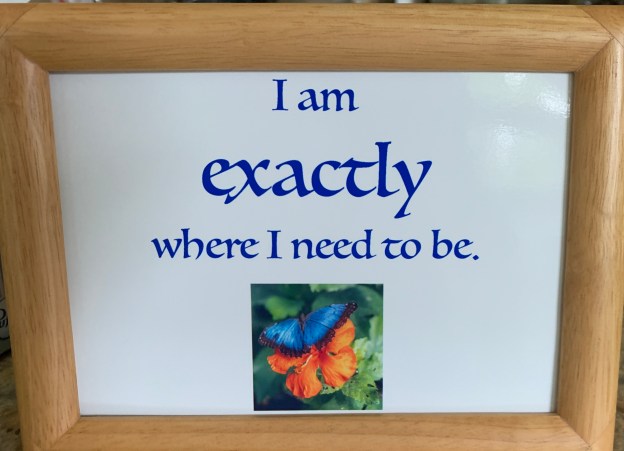
I am exactly where I need to be!

Happy Summer!  Have you kept your New Year’s resolution?

Odds are, you haven’t. Each year, Strava, the social network for athletes, predicts the exact day when most people are likely to ditch their annual commitment to themselves. Whether it be the goal to lose weight, exercise more, or stop smoking, the majority throw in the towel (or throw out the scale) on the second Friday in January. A full 80% will have given up on it by mid-February.

If you have made it to the last days of spring, Mazel tov!

Up until this year, my list of resolutions were endless, so reflective of the person I am. On top of my list (for at least six decades) was to lose weight. Along with that annual goal, I have promised myself in the past to exercise more; read more books, watch more movies, play more piano, see more of family and friends, and write more articles, for starters.

But as I head into a third year where pandemic still hangs over our heads like the sword of Damocles, I have made peace with myself, My one and only resolution is based on an affirmation I stumbled across this past winter. Drum roll please!

“I am exactly where I need to be.”

These eight words summarize an entire philosophy based on the idea that I can be happy where I am at this very moment. It has grounded me when I find my mind racing with what I need to do next: the challah that needs to be baked, the article I have to get to Laurie Clevenson by the Monday morning deadline; the book I have to finish before it disappears off my Kindle. 

Full disclosure: Knowing myself, I will still working on those same items I have listed in the past. (I am already looking forward to writing several biographies of Holocaust survivors.) But I understand that I can reach those milestones without the help and pressure of resolutions. I can be happy in the “now,” not the future. I have given myself permission to focus on the journey, not some numerical destination.

Since I made this resolution on November 17, I already have over two months of practice behind me. I made a copy of it which I keep on my kitchen window sill When I find myself “falling off the wagon,” I quietly recite it to myself and get grounded again. It has the making of a habit! And speaking of habits…

I cannot remember where I originally saw this quote. Facebook? A friend’s blog? A recent book? It took me a few weeks—and the help from my Catholic friend—to find out my first person quote actually came from a prayer from St. Teresa of Avila, a revered leader of the Discalced Carmelite Sisters in 16th century Spain. The opening lines of her original prayer read, “May today there be peace within you. Trust God that you are exactly where you are meant to be.”

It took a little more digging to find a Jewish connection (Yes! There IS a Jewish connection!) St. Teresa’s paternal grandfather, a wealthy tax collector, was a Jew who was forced to covert to Christianity. He was condemned by the Spanish Inquisition for allegedly returning to the Jewish faith and was punished by being forced to parade around Toledo for one day a week with other insincere converts. He was later able to assume a Catholic identity. 

St. Teresa, aware of her ancestry, did not acknowledge it publicly because of prejudice in Spain at the time against Jews and Jewish converts. It appeared, however, that her heritage impacted her career in the church. She was recognized for bring a mystical Jewish strain reminiscent of Kabbalah and for giving comfort to many converts from Judaism who struggled to maintain a connection to Jewish belief and practice. As a leader and “doctor,” she directed her convents not to comply with the “statutes of purity of blood” which excluded Jewish converts to Catholicism from most religious orders, from the military, higher education, civil and church offices. 

In the 2012 off-Broadway play, Teresa’s Ecstasy, starring the Columbian playwright Begonya Plaza as well as Linda Larkin and Shawn Elliott, the nun’s Jewish heritage was seen as a driving force in her life and work. Plaza’s character, who in the midst of a divorce, and Larkin’s character, her Jewish lesbian lover, realize how much Teresa has become their role model in her commitment to faith, compassion, and human dignity.Yes, St. Teresa is a nun with a Yiddishkeit neshome, a Jewish soul. 

So now an adaption of a prayer written by a Catholic saint is now part of this Jew’s daily routine. It is the one of last thing I tell myself each night. I follow that with Jewish prayers, positive affirmations, and reflections on things for which I a grateful. I fall back to sleep quickly, and I sleep in peace, knowing I am exactly where I need to be.

A version of this article originally appeared in the Jewish World News, a bi-weekly subscription-based newspaper in upstate New York.

SOURCES

https://en.wikipedia.org/wiki/Teresa_of_Ávila

https://finance.yahoo.com/news/quitter-day-coming-not-another-205100681.html?fr=yhssrp_catchall

https://jewishweek.timesofisrael.com/a-nun-with-a-jewish-touch/

https://news.yahoo.com/news/saint-still-changing-lives-teresas-ecstasy-002524863.html?fr=yhssrp_catchall

https://www.inc.com/jeff-haden/a-study-of-800-million-activities-predicts-most-new-years-resolutions-will-be-abandoned-on-january-19-how-you-cancreate-new-habits-that-actually-stick.html

Hat Tricks, or All’s Well That Ends Well

“I’m organized. I just can’t find anything.” Saying on CJ Bella Co. Tea Towel

Spending a good part of last summer in Colorado with our six-year-old granddaughter reaped incredibly wonderful moments for my husband Larry and me. The first hugs after a year of seeing her only on Zoom because of the pandemic. Reading her books and playing Candy Land and War and Pete’s Birthday Party. Having her knock on the door of our rental at 8 a.m. on a Sunday morning with a newspaper in her hand and her announcement, “I am here for breakfast.” Extending my stay so I was able to join my daughter Julie and son-in-law Sam in walking her to her first day of first grade. I made enough memories to almost sustain me until we can see her again.

What was not incredibly wonderful was keeping track of all the items our six-year-old dynamo left behind. Larry and I had rescued her baseball butterfly hat from the local recreational center’s lost and found. Julie found her lost raincoat at her Fun Club two weeks after my granddaughter had left it there. In the meantime, Julie had to buy another one in a larger size. It was a little big, but Summit County was getting above average rain in July, and there was no choice.

Both Julie and Sam dealt with the lost-and-found-problem quite calmly to a point. But when Julie realized that their daughter’s favorite hat was missing the day before they were to leave for their planned one-week rafting trip, well, Julie lost it—her cool that is!

The first we heard about the missing hat was on the Sunday morning before their trip.

“Come over for pancakes,” Julie’s text read. “And can you check your condo to see if you have the butterfly hat?” 

Yes, our granddaughter was wearing a hat on Friday. She had it in the car when we drove down to Main Street for some bubble tea at the Next Page Book Store. In the picture I had taken of her sitting on Zayde’s lap listening to a story in the town promenade, she was hatless. But I vaguely remember taking the floppy hat festooned with butterflies and dragon flies from her outstretched hand before she hung upside down from the ropes at the playground in Walter Byron Park. I thought I had stuffed it in my pocket and returned it safely when we drove her home.

But it wasn’t in their house. And it did not appear to be in our condo. Or in our car. Or at the condo’s pool area. When we arrived at their house that morning, Julie was flipping her oatmeal pancakes with obvious annoyance.

“I can’t believe that people don’t keep track of her things when they are responsible for watching her,” she said, digging her barbs into both her parents and poor Sam. “First one hat; then a raincoat, now another hat!.Doesn’t anyone ever check to see if she has left anything behind?”

Even though I was thinking, “Maybe the child needs to be responsible!” I kept my mouth closed. Besides, Julie’s guilt trip was working. After breakfast, I walked the two minutes back to our rental and did a second, more thorough search. I checked pockets and backpacks and drawers. I checked under the bed and under the couch and under the seats of our car. It was nowhere to be found. 

By the time I got back to their house, Julie and Sam were fully engaged in getting ready for their seven day trip. Having to limit myself to under fifty pounds of stuff for our nine weeks Out West, it actually looked easier than gathering everything they needed for camping and rafting. Larry and I entertained our granddaughter with books, puzzles, and games, trying to stay out of the way of the oars, coolers, rucksacks stuffed with clothing and towels, bottles of suntan lotion and bug spray, sleeping bags, a paddle board, and enough food and drink for a small army.

By the time we finished lunch, I needed a break and a possible chance at redemption. 

“I’m walking downtown to see if I can find the lost hat,” I said. “If that fails, I will see if I can find a replacement.”

I first checked the bookstore’s lost and found. Lots of sunglasses a set of keys, but no hat. I then walked through Walter Byron Park, Someone had hung up a slightly worn “Get high in Colorado” teeshirt on the park sign, but no hat. I then walked back to Main Street and began checking out the hat racks that were set up in front of many of the stores, another exercise in futility. Too big. Too small. Wrong print. Wrong color. I stuck on my mask and began checking out inside inventories. I finally saw a possibility. Right size. Pink (Her favorite color). No butterflies, but lots of bright flowers. I snapped a picture, texted it to Julie, and then followed it up with a phone call.

“The hat wasn’t in the bookstore or the park, so I decided to check the stores,” I said. “Look at the picture on your text. I think you will love it.”

“Mom,” Julie replied a few seconds later. “ The hat is adorable, but we are not missing the floppy dragonfly hat.We are missing the baseball butterfly cap!”

“She wasn’t wearing her baseball butterfly cap on Friday,” I said testily. “She was wearing her floppy butterfly hat.”

“That’s her dragonfly hat as it has dragonflies and butterflies,” Julie said. “We have that one!” Then she added sheepishly. “I guess you and Dad didn’t lose it after all.” Long pause. “Hey, at least you got your exercise in!”

She was right. By the time I got home, I had walked over three miles looking for a hat that we had never lost in the first place.

I also realized that we had seen a girl’s butterfly baseball cap the day before at the REI in the next town over. I called the outdoor retailer and asked the clerk to put it aside for my daughter. No longer feeling magnanimous or generous, I made no move to pick up either the hat or the cost. After realizing the Fun Club lost and found box was locked up because of a field trip, Julie drove over to Silverthorne and bought it herself.

The following Sunday night, Julie, Sam, and my granddaughter returned from their camping trip, First thing Monday morning, Mother and Daughter walked over to Fun Club, where the missing hat was waiting in the lost and found box. 

“This warrants a story, you realize,” I told her the next day while sitting at her kitchen table on my computer. Julie just shrugged. And I started typing away.

A version of this article originally appeared in the Jewish World News, a bi-weekly subscription-based newspaper in upstate New York.

Thank goodness they are only First World problems, OR That’s the way my cookie crumbles!

The last few weeks have been consumed with what my friend Judy refers to First World Problems.

First World Problems, according to the Urban Dictionary, are “problems from living in a wealthy, industrialized nation that third worlders would probably roll their eyes at.” So I give my readers my permission to roll their eyes at my recent series of First World woes.

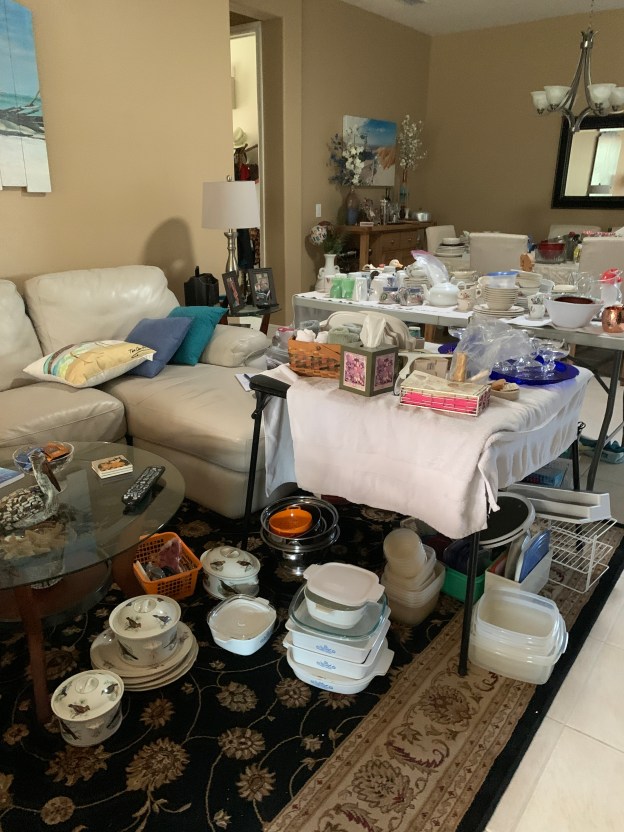
In all honesty, I actually brought some of this on myself. Tired of the original orangey-brown pseudo-oak cabinets in our kitchen, I convinced my husband Larry that refacing the cabinets in white would be worth the time and money. When the company’s time frame to do the work coincided with my planned trip to Colorado, Larry graciously turned down my suggestions to delay the work until I returned. He would handle the last couple of days of installation and most of the clean-up on his own.

The weekend before my departure, Larry and I emptied out the entire contents of our cabinets into our living/dining room. When I attempted to run one last load of dishes before we had to close up the kitchen for the next few days, the door on the machine fell down with a thud, almost taking out my knee. The door springs had unsprung.

My washing machine must have decided it would have sympathy pains. Less than an hour later, I attempted to run a load of laundry. In the middle of the cycle, the machine stopped, and all sorts of lights began flashing. A Google search informed us that it was either a lid latch ($) or motherboard ($$$) malfunction. We threw the soaked clothes into our fairly new dryer [the old one had died in November]. First thing Monday morning, as the crew descended on our kitchen to begin work, I made a phone call to an appliance repair company to repair the dishwasher door and washing machine latch. 

Unfortunately, the appliance people couldn’t help me with my crown on my back molar, that had fallen off that morning while I was flossing my teeth. And the dentist would have to wait, as I didn’t have time to get to his office before my trip. I stuck it back on and hoped for the best.

After driving me to the airport Wednesday, Larry returned to a torn-up kitchen sealed off in plastic and a house filled with the overwhelming smell of paint. Meanwhile, my attempt at self-dentistry only lasted until I bit into an ice cream cone I had grabbed at the airport while waiting for the shuttle to take me to my daughter’s house. An emergency trip to Ten Mile High Dentistry was for naught. After a valiant, 45-minute attempt to glue the sucker back on, the dentist gave up and recommended I think about pulling the remains of the tooth out when I returned home. 

Meanwhile, back in Florida, the appliance repairman was one for two: the dishwasher was an easy fix, but the washing machine’s motherboard was gone. Larry and I spent an hour on the phone choosing a new machine from a local hardware store’s website. While I was hiking with my family on a beautiful Saturday in the Rockies, Larry was waiting for the new machine to arrive. No worries. He had plenty to do in the meantime as the kitchen work was completed. Larry put most of the kitchenware back into the new cabinets, leaving the spice drawers and some other cabinets for me to organize to my liking. (Yes, I married a gem!) 

I returned Tuesday night, and by Wednesday afternoon, the kitchen was completely back in business—or maybe not. Our nine-year-old refrigerator was not only freezing the ice cream but also the eggs, milk, lettuce and grapes. We made another call to the appliance man, who said that repairs could run up to $500. Maybe we should consider just biting the bullet and getting a new one?Another run to the appliance store, another swish of the credit card, and we only had to live with frozen foods for six more days.

On Thursday day, I got a call saying the truck delivering our new side-by-side would be there in thirty minutes. This gave me just enough time to move the contents of the old refrigerator into laundry baskets and boxes commandeered for the project. When the deliverymen arrived, they pulled out their tape measures, stretched it across our front door, and shook their heads.“Sorry. Doesn’t look like your new frig will fit through the door.” Some quick problem-solving resulted in a “through-the-lanai-if-we-dislodge-the-screen-door” option. An hour later, the old frig was in the truck and the new one was sitting in the middle of a kitchen filled with warming and—worst yet—melting food. 

“The new hose for the ice maker doesn’t work. Wrong clamp.” Roy explained from the back of the machine. “I’ll attach the old one.”

“As long as it works, I’’m fine with that,” I said.

Ten minutes later, the refrigerator was ready for the final push into place.

“It’s too wide,” said Roy. “I can’t get it into the space.”

“Just remove the molding,” I suggested.

“We don’t do that,” Roy informed me

“You are not leaving here until that refrigerator installed,” I said between gritted-minus-one-uncapped-molar teeth. “If I have to, I will remove the damn molding!”

Roy shrugged and tried more push. Miraculously, it squeaked in with centimeters to spare.Whew! After two hours of work, these guys deserved a tip, which I gave willingly.

Now let me offer a tip. Before the appliance people leave you with your new refrigerator, check to see if the ice maker and water dispenser work. As I write this, I am still waiting for the callback from the store to arrange for someone to come back and properly attach the line.

All the fails joined the Mr. Coffee, microwave, Ninja blender, electric tea kettle, toaster oven, and aforementioned clothes dryer that had all died in a six-month period. How many appliances did I have left to replace? To add to the mix, I blew  out two electrical outlets when I saturated a power strip while washing down our the lanai floor with a hose. 

The following week, Larry and I welcomed Chris and Bernie, old friends whom we hadn’t seen since the beginning of the pandemic, The four of us celebrated our reunion by enjoying a delicious dinner at a local Asian restaurant. 

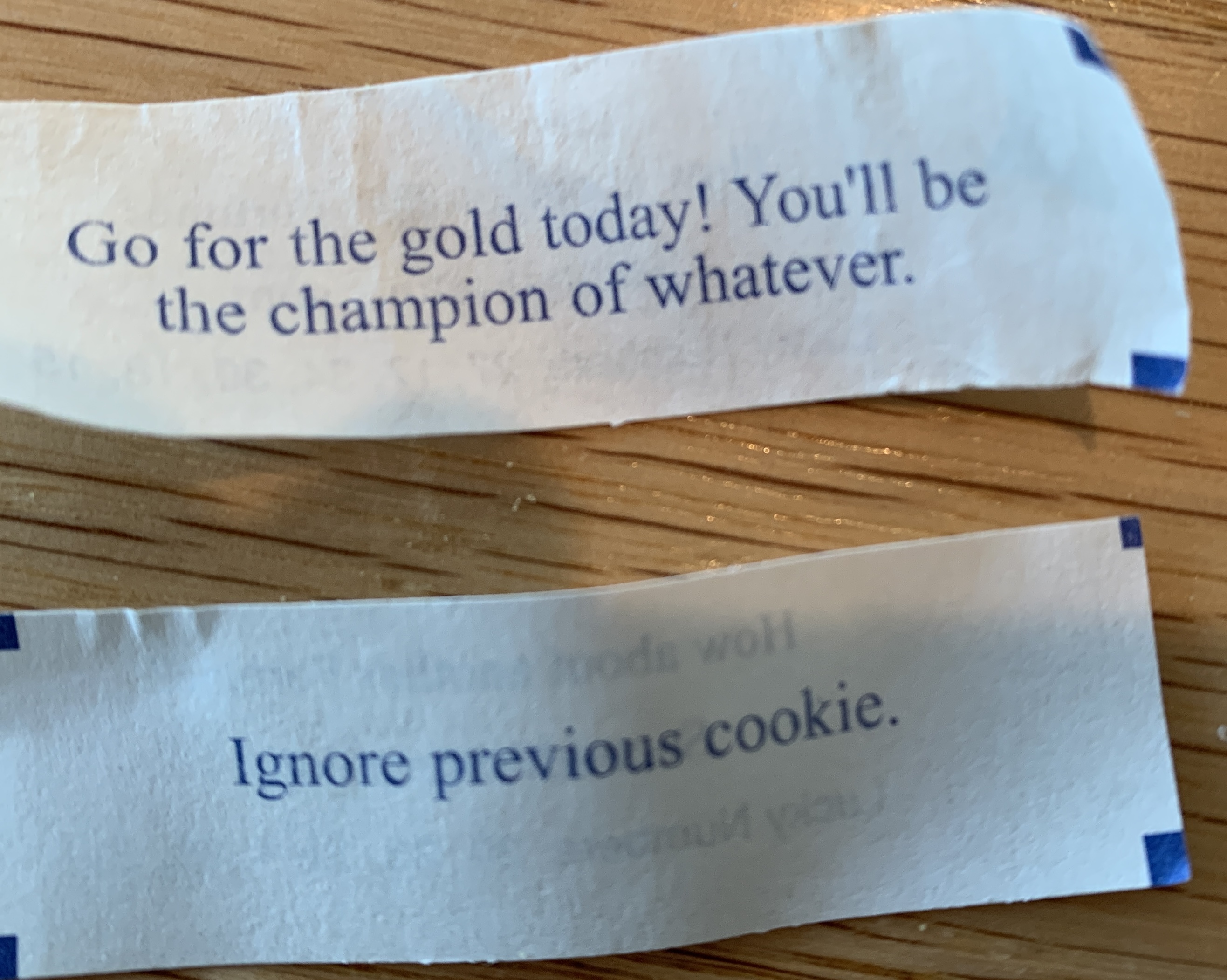
As we were waiting for our waiter to return with our receipts, Chris noted that we hadn’t gotten any fortune cookies. “No problem!” I said. I walked up to the basket of cookies next to the cash register, grabbed four at random, and dropped them on our table. Mine read “GO FOR THE GOLD TODAY! YOU’LL BE THE CHAMPION OF WHATEVER!”

After all that had happened to us over the previous couple of weeks, I was pretty happy to get this fortune. As I shared it with everyone, I proclaimed, “A sign! My luck is changing!” 

As I was saying this, our waiter came by with the receipt and four more fortune cookies. When he saw we already had them, he said maybe these would be even better! I opened up mine, only to read this: IGNORE PREVIOUS COOKIE

In the scheme of things, these are all First World Problems. I only need to hear about another friend’s illness or read the latest headlines or see another heart-wrenching picture from the Ukraine, to remind myself that our challenges, as Rick tells Ilsa in the last moments of Casablanca, “don’t amount to a hill of beans in this crazy world.” A wise woman once told me, “If it can be [legally] fixed with money, consider yourself lucky.” We are grateful that we only have had to deal for a short time with unwashed clothes, dangerous doors, frozen eggs, and unfortunate fortune cookies!

You cannot make this stuff up!!! My fortune cookies May 7, 2022.

A version of this article originally appeared in the Jewish World News, a bi-weekly subscription-based newspaper in upstate New York.

Keep calm and carry on? A return to tradition

Flashback to March 14, 2020. COVID-19 was the top news story. My daughter Julie and her family were leaving for the Orlando airport after a week’s stay. We had spent a few days on the beach and been delighted  by news of the birth of our grandson in a San Francisco hospital. We had cancelled our planned visit to Magic Kingdom the day before Disney announced it was closing the park that weekend. Instead, we spent hours in a community pool making sure we weren’t too close to anyone else. 

Julie’s last words as she got into her rental car were, “Mom and Dad, promise us you will stay safe!” She begged us to skip our plans to see Death Trap, which was being performed by our local theater group that evening. She must have called her brother, because Adam FaceTimed us an hour before we were to leave for the play. “If you stay home, I will keep the camera on your new grandson for the next hour.” Seeing our grandson won. We had no idea we would be feeling its effects—masks; sheltering in place; cancelled trips; cancelled events; hours of Netflix’s and puzzles; new variants; tragically, loss of friends to the virus—for the next two years.

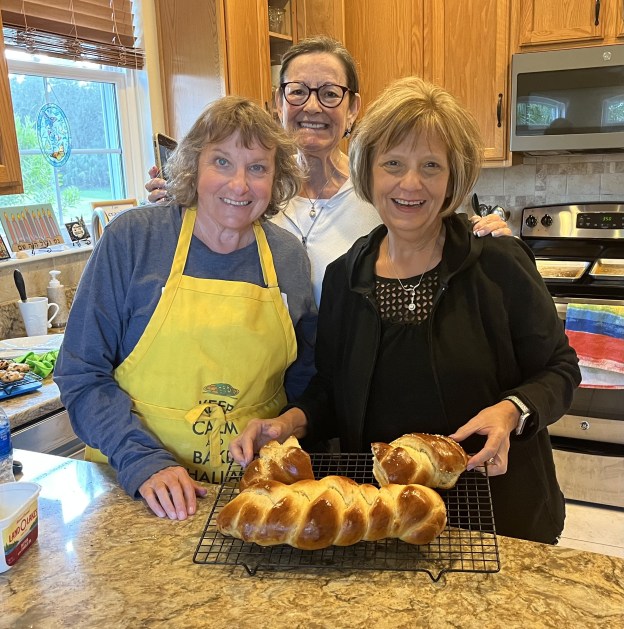
Within the first month of the pandemic, I decided that celebrating with a Sabbath dinner every Friday would bring some joy. I polished my grandparents’ candlesticks; bought a new Kiddish cup on ebay (I must have lost mine in our move); brought out my embroidered challah cover, and located a friend’s challah recipe I had always meant to try. With some difficulty—the whole world decided along with me to make bread—I purchased flour, yeast, and sugar to make the traditional Shabbat bread. And I mixed and kneaded and braided my first challahs. Delicious! 

The following Friday, I was a little more confident. I made four small ones, and shared one with president of our (closed down) shul and one with a friend whose wife had just been placed in memory care.By April, I had totally embraced not only the baking process but also the spiritual elements. I learned that it was appropriate to say prayers during the kneading process, a way of feeding the body and the soul. I initially prayed for my family as well as our country and for all impacted by the pandemic. But my prayers soon extended to the sick, the grieving, the lonely. I kept a Mi Shebeirach list on my phone as reminders and often played Debbie Friedman’s version of the beautiful prayer as I kneaded the pliant, soft dough.

We developed a rhythm: Every Friday afternoon I baked the challahs, and just before sunset, Larry would head off in our car, delivering two or three still warm fragrant loaves to needy people in our community. When I couldn’t physically share them, I attached pictures of the challah onto an email with a note. “I kneaded prayers of healing into this loaf of bread. Thinking of you. Love, Marilyn.”

By the time Larry and I were finally able to travel to see our children and grandchildren in June 2021, I was a seasoned challah maker—to a point. Baking bread in someone else’s kitchen proved to be a challenge. In San Francisco, I realized the sound of the mixmaster cranking out the initial steps of challah process woke my grandson from his nap. In Colorado, the 9100 foot elevation resulted in loaves that looked more like amoebas. I had to learn to work around nap time and altitude. 

Meanwhile, I was tweaking my technique. I replaced the butter in my friend’s recipe with canola oil, which meant less noise and more kneading time, my favorite party of the process. Rocky Mountain challahs, I learned, needed to go into the oven immediately after braiding to prevent over-rising. A straight egg yolk wash resulted in browner, shinier loaves, which Larry wholeheartedly approved “This is the way challah is supposed to look,” he said, biting into the harder crust.

Over the past two years, I have baked and shared dozens of challahs, many that were appearing on our shul’s Zoom services. As our world finally has begun opening up, however, finding the time to make the challahs on Friday has been more difficult. I “cheat”by making seven or eight loaves and freezing 2-4 braided unbaked challahs, to be defrosted and baked when needed. (I still feel Jewish guilt when I use that shortcut!)

Friends have asked me if they could buy my challahs or even sell them at our Farmer’s Market. I decline, telling them emphatically I am not starting a new career. Instead, I offer them my challah “recipe,” a nearly 3000 word tome with numerous tips. Recently, I even invited two friends over for a “challah workshop.” After we all enjoyed slices oof the warm loaves smothered with butter, they went home with a batch of the still-rising dough they had prepared. They sent me pictures of their finished creations, beautiful in their own right. I am just following an old Yiddish expression: “Give people a challah, and they eat for a day. Give them a recipe, and they become challah bakers!”

Initially, I was hopeful that this would be the last article I would be writing about the pandemic. Two vaccines and two boosters later, Larry and I have pretty much resumed our lives. But there are now disturbing numbers that show another upward trend. Will we have to resume mask wearing? Sheltering in place? Only time will tell. 

When I wrote this mid-April, I was on a challah hiatus. Instead, Larry was enjoying sponge cake, Passover popovers, and matzo brie. But Passover ended next Friday. I soon will be pulling out the ingredients for the challah and donning my special apron. Stay safe, my friends.Better yet, Keep Calm and Bake Challah.

A version of this article originally appeared in the Jewish World News, a bi-weekly subscription-based newspaper in upstate New York.

Lifetime Achievement Awards

For the past two years, Passover has—well—passed over us. In 2020, My husband Larry and I had a seder for two, a quiet affair to say the least. In 2021, thanks to Zoom, we were at least able to share a Haggadah and the holiday with members of our synagogue. 

Now we are back in the game. Our first night will not be that much different, in that our congregation has opted for a Zoom service for hopefully the last time. But on the second night, we will drive to Sarasota, where we will share a table with two of my siblings and their spouses. How lovely it will be to sip wine and eat matzah and charotzes with family!

And, as always, I am entering this holiday with the same feeling of gratitude I have managed to maintain since COVID closed down our world. True, Larry and I have missed much—especially a year away from our children and their families. We spent two years avoiding crowds, passing up on movies and plays, getting our boosters and wearing masks. But I feel that the worst parts of this pandemic have passed over us. It is as if our doorposts were marked with a blessing that prevented illness and sadness from touching so many that we love.

We may not have suffered all the effects of this scourge, but we have unfortunately not escaped from another inevitable issue: Aging! In a recent article in the New Yorker article, David Kemp suggests that his newly formed US Citizens for Age Forgiveness demand an “executive order that will degree the last two years do not count towards the age of an American.” 

Of course, Kemp’s essay is tongue in cheek, but I agree! Any setbacks that were caused by almost two years of hunkering down should somehow be erased, given back to us as a gift from God. This is especially true regarding what Larry has affectionally called “Lifetime Achievement Awards,” all those hopefully bearable “inconveniences” that are a result of surviving into our 60s and 70s. 

First example: Cataracts. I cannot turn around without bumping into someone who is in some stage of this common eye surgery. Conversations revolve around which doctor to use, which lens to be implanted (there seems to be a range from a no-frills basic version to the top-of-the line deluxe version); which drops therapy is used, how long between Eye One and Eye Two; and how long one can return to normal life. We have come to accept the fact that people are walking around with one lens popped out of their glasses, not exactly a “Lens Crafter” advertisement. 

Unlike other surgeries, there is a definite benefit. After years of dealing with glasses and contact lenses, we Baby Boomers are looking at the world through our own eyes. My own journey to cataract surgery goes back almost 20 years ago when I spoke to my eye doctor about getting Lasik surgery to repair my severe myopia. He suggested I wait. “Most people of a certain age [he kindly avoided the word ‘old’] require cataract surgery,” he told me. “I can almost promise you will get the vision you want without the expense if you just wait it out.” He was correct. I patiently waited until my cataracts, first imperceptible, then ripening, then, in my mid 60s, ready to fix. My glasses went to the Lion’s Club, and my contact lenses and all the required accessories went into the trash. It took me months to break myself of the habit of reaching for my glasses the minute I woke up. To this day, if I feel something in my eye, my first thought is that something is lurking under my contacts. 

Because I had been wearing contacts since I was in my 20s, my appearance didn’t change after surgery. Larry, however, had been wearing glasses for over 30 years until his recent surgery. I am still getting used to the “bare nakedness” of my un-bespectacled mate. So is my granddaughter, who burst into tears when she saw her Zayde for the first time without his usually dark frames. My sister-in-law was actually grateful that she still needs to wear glasses after cataract surgery. “I like myself better with glasses,” she told me. “They hide the lines.” (She doesn’t have wrinkles!)

Eyes are not the only body part that falls under the “Lifetime Achievement Award” category. Many of our teeth, which at one point held under the strain of hard candy and even carrots, seem to be crumblings, resulting in crowns, implants, and bridges. Hips, shoulders, and knees are being replaced at an alarming rate. Some  of us have so many fake parts we rival Lee Majors’ Bionic Man. 

Unfortunately, the standard devices do not imbue their owners with any super power, including super hearing. As a matter of fact, based on the number of ads for hearing aids found in AARP magazine, the inability to pick up normal conversations is one of the most prevalent signs of our aging bodies. Both Larry and I are on the cusp of needing some help. We no longer can have a conversation when we are in two different rooms. Heck, we have problems hearing each other when we are sitting next to each other on the couch doing crossword puzzles. “What did you get for 41 across?” Larry recently asked me 

“Heeded,” I answered. 

“Needed? It doesn’t fit. 33 down is OGH.” 

I said, ‘Heeded.’” 

“Seeded?” 

“No! Heeded. H as in Harry!” 

“As in ‘Larry?” 

No wonder it is taking us longer to do these puzzles 

A friend’s pilates instructor had a different, but still flattering,  spin on those of . She regards us as “classic cars,” older, still viable, very much appreciated, even if we are restored. 

Unfortunately, Lifetime Achievement Awards often come in more serious forms. Cancers. Heart problems. Diabetes. Cognitive issues. Family and friends are dealing with many of these issues, a result of living a long life or of just plain bad luck.

A recent broadcast on NPR stated that with key COVID metrics trending rapidly downward, the pandemic’s third spring is already looking very different. Passover 5782 will hopefully usher in a time of hope that COVID-19—if not conquered but at least controlled. I also wish that this be a time of a “refuah shlema,” a complete, speedy healing for those suffering from all those lifetime achievement awards: And as we gather at our more crowded Seder table, let us add Rabbi Naomi Allen’s pandemic-inspired prayer, “On this Passover Night/We pray to you, God/Let it Pass Over us/Hear us God/Heal us God. Amen.”

A version of this article originally appeared in the Jewish World News, a bi-weekly subscription-based newspaper in upstate New York.

Photo Credit: iStockphoto.com

From Bialystok to Brooklyn: Part Three

The Oshinsky Story Part Three: Making it to America

Simova, Poland ➡️ Bialystok, Poland ➡️ Minsk, Russia ➡️ Moscow ➡️ Viana, Russia ➡️ Erkutcsk ➡️ Chita, Siberia ➡️ Harbin, China ➡️ Chanzhou, China ➡️ Darien, China ➡️ Sent back to Harbin ➡️Yokohama➡️Hawaii➡️San Francisco➡️Chicago➡️Brooklyn!

Unlike most Eastern Europeans fleeing pogroms and poverty to America through ships sailing across the Atlantic Ocean, Harry “Chonie” Oshinsky took a journey over three continents. His trip took a dangerous turn in Darien, China, where he and his fellow travelers were arrested, accused of being part of a murderous gang. Here is the last installment of Harry’s incredible journey. 

 Harry and his two friends were thrown into a prison, where they sat on a stone floor, fed a diet of foul rice, and listened as the Chinese prisoners who shared their cell were beaten with a rope. An attempt at a hunger strike backfired, and the three hand-bound boys were taken by train back to Harbin. 

Miraculously, Der Forvertz carried a story of their arrest, which triggered a protest in the Yiddish newspaper. Harry’s sister, when she herself read in New York about the arrest of Chunya Oshinsky and two other boys, she realized for the first time that her little brother was alive. 

Soon after, authorities transferred Harry and the others from the Russian commandant’s office to a prison near the Jewish Committee House, a place Harry and Yankel had stayed at earlier in their journey. Although the bottom floor held hardened criminals, the three were taken to the second floor, where they joined approximately thirty other political refugees who were held. They experienced good conditions: they received food, decent beds, and daily morning access to fresh air. Ironically, some of the other prisoners were actually paying money to be there. “This was so much better than being on the front lines and risking one’s life in battle!” they told Harry. Again, Harry’s tailoring skills proved useful, as the overseer often called on him to do alterations for himself and others.

As the prison stay extended into its fourth month, Harry realized that his only chance of release was to have money sent to him from America. Not knowing the address of his four siblings, he sent a desperate plea to Yankel, whom he hoped had already made it to America. He mailed a letter to The Goldbergs, 22 Ludlow Street, New York. “Just as a bird gets lost from his home in a tree and gets caught and put in a birdcage,” Harry wrote, “so this has happened to me.”

A few weeks later, Harry again faced the Russian commandant. The officials in the consulate had never been able to confirm he was a murderer; however, they conscripted him into the army. Before reporting, he made one last trip to the Jewish Committee House. Fate shone on him again, as two hundred rubles had been sent from America for his release.

On a bitter cold winter’s night in March 1917, Harry and three other Jewish refugees began their three-day trek on foot back across China into Japan. Once over the border, they traveled by train and boat. 

They arrived at the Japanese seaport of Yokohama in time to hear the news that Czar Nicholas II had been overthrown. Three weeks later, on April 10, 1917, Harry and his companions boarded the Shino Maru.

When the ship stopped in Honolulu, Harry was filled with “sheer happiness and joy” when he touched American soil for the first time. His twenty-four-hour stopover was almost extended when a tour of the island resulted in a chance meeting with a Jewish men’s clothing store owner. After hearing Harry’s story, the owner offered him a job as a tailor and salesperson. “I thanked him for his goodness,” Harry later recalled, “but I was determined to go to New York to be with my family.”

The Shino Maru arrived in San Francisco on April 29, where all immigrants were processed through Angel Island. The next morning, a representative of HIAS met with Harry to arrange for his train trip across the United States.

 Harry arrived at Grand Central Station during the first week of May 1917. He heard his name being called; it was Yankel Goldberg, his friend with whom he had traveled until their separation in Yokohama. His siblings Zalman David and Leah did not recognize Harry until Yankel shouted to them, “Here! Here he is! This is your brother Chonie!” They fell into each other’s arms, kissing and crying. After a two and a half year journey, Harry was finally reunited with his siblings.

Settling in Brooklyn, Harry found employment in a factory that sewed soldiers’ uniforms. In a few weeks, he was making enough money not only to rent his own apartment but also to help support his siblings. He enrolled in night school to learn English and in dance school to improve his social life. In his spare time, he explored New York City and attended lectures about the ongoing war and politics. 

The November 11, 1918, armistice brought relief to Harry. knowing he would not have to return to Europe to fight in the war. He was able to send a letter home. “I am alive and living in America.” A few weeks later, he received an answer. “Everyone is alive!” His sister reunited with her fiancé, who had been a prisoner of war; Poland was an independent country.

Eventually, Harry earned enough money to bring his younger draft-eligible brother Yitzchak from Poland to America. With Harry’s help, Yitzchak found a job as a salesperson in a Lower East Side candy store. 

After Harry’s parents passed away, his sister, now married with her own family, remained in Poland. Tragically, she and her family were later killed in the Holocaust.

During the Depression, Harry supplemented his income by opening a candy store he opened with his brother Yitzchak. The business remained in the family throughout their lives.

 In 1927, Harry met Frieda, a young woman from his own area in Poland, and they were married that August. Harry and Frieda had two sons, Leonard and Robert, who both shortened their surname to Oshins. Both married and had children of their own. Robert and his wife Natalie settled in Schenectady, New York, and were active members of Congregation Agudat Achim. After a career working for the post office, Lenny and his wife Bobbe moved to Clifton Park, New York, to be closer to their daughter Cindy and her family and joined Congregation Beth Shalom.

 Harry passed away in 1976, but he left his legacy and his history in a 12,000 word autobiography that was originally published in Yiddish in Der Forverts in the late 1960s. Lenny Oshins gave me a copy of the document, which had been translated into English by Simon and Anne Paktor, friends of Robert and Natalie in Schenectady. 

Lenny (Z”L), it took me way too long to write your father’s story. I hope you, your parents, your wife, and brother are all reading this in heaven and kvelling over a life well-lived.

Originally published March 17, 2022. Updated May 26, 2025.

Lenny and Robert Oshins

From Bialystok to Brooklyn: Part Two

The Oshinsky Story Part Two: Harry’s Long Journey

Minsk, Russia ➡️ Moscow ➡️ Viana, Russia ➡️ Erkutcsk ➡️ Chita, Siberia ➡️ Harbin, China ➡️ Chanzhou, China ➡️ Darien, China ➡️ Sent back to Harbin 

Unlike most Eastern Europeans fleeing pogroms and poverty to America through ships sailing across the Atlantic Ocean, Harry “Chonie” Oshinsky took a journey over three continents. His family, fearing for his imminent conscription into the Polish army, encouraged him to leave for Russia by train in the early part of 1914. What follows is Part Two of Harry’s incredible story.

On their train ride from Bialystok, Poland, into Russia, Harry and his friend Yankel Goldberg saw the horrors of war firsthand. “Wounded people, those with missing arms or legs, bandaged heads,” he wrote later in his autobiography. “All in all, it was a frightening sight to behold.” Combined with the painful scenes at each railroad stop—tear-filled farewells to sons and husbands; wail-filled greetings of the families to those that returned—instilled a pacifism in Harry that he carried throughout his life.

When they arrived in Minsk, Harry and Yankel’s first stop was a bakery run fortuitously by a Jewish widow and her daughter, Sonya. The shopkeepers took the two refuges under their wing, helping them get a place to live and employment. After registering as required with the police, they initially both found work making gas masks, but Harry soon found a tailoring job. After several weeks, Sonya, through a local doctor, connected them with a Jewish welfare organization, who provided the two boys free tickets to Harbin, China, where a Jewish relief organization would handle the rest of their trip to San Francisco.

Armed with a huge salami, a teakettle, and students’ clothes to disguise them from potential arrest as traveling Jews—a final gift from their angel Sonya — Harry and Yankel hired a draska, a horse and carriage to take them to the chaotic railroad station. The train was hours late, causing their waiting in the station all night to board. A conductor took pity on the two “homeless” boys and encouraged them to sleep. They travelled first to Moscow, then to Viasna, where they would begin their journey deep into Siberia.

Near the end of their six-day journey, a fellow traveler overheard the two speaking in Yiddish. “Do not be afraid,” he said, “I am also a Jew.” He warned the two teenagers that they would be arrested and placed in the Russian army if they proceeded to their planned stop in Erkutcsk. Instead, he advised them to de-board the train in Chita, Siberia. He gave them the name of a Jewish man who ran a boarding house, who was known to help fellow fleeing refuges.

 Harry and Yankel followed the kind stranger’s advice. After debarking the train and taking a horse and buggy to the address provided, the inn-keeper welcomed the two poor, exhausted travelers with a hot meal, a good night’s sleep, and a referral to a man who owned a tailor shop in Chita.

Mr. Goldberg was delighted to hire two fellow Jews. Through his connections with local police, arranged for a six-month work permit. The Goldberg family embraced them like their own sons, providing room and board, along with a good salary. Every day, they encountered those political prisoners who were bound in chains and working in horrible conditions. It made them recognize their own good fortune—and their own fate if caught.

By July 1915, the work permits they had obtained when they had arrived in Chita, Siberia, were about to expire. It was time for them to continue their dangerous journey. Disguised as merchants, they boarded the Chinese Eastern Railway (CER) for Harbin, China.

 Harry and Yankel’s destination was in fact one chosen by many other Jewish refugees fleeing World War I, the Russian Revolution, and its ensuing famine. Despite White [Czarist] Russia’s attempt to spread antisemitism to Harbin to stations along the CER, the Chinese authorities prohibited any anti-Jewish persecutions in the areas it controlled. Harbin became one of the largest host cities for Eastern European Jews. Stepping in to fill the need, many American Jewish relief organizations operated in Harbin, the most efficient being the Hebrew Sheltering and Immigrant Aid Society of America (HIAS). Some Jews settled in the Chinese city, but for many others, it was a haven on their way to the United States. 

Arriving in Harbin in late summer, 1917, Harry and Yankel registered with HIAS and took residence in a building established by the organization. They shared the one large residential room with Jews of all ages, all awaiting the paperwork necessary to continue on to the western seaports in Japan. In the meantime, Harry earned money as a tailor, at one point making a suit for the then famous Russian-born Yiddish actor Aaron Lebidoff.

Although their journey had been very difficult, what lay ahead was even more challenging. Through HIAS, Harry, Yankel, and six other Jewish refugees hired an “agent” who, for 25 rubles per person, arranged for their being smuggled to their next stop, Changzhou, China. A journey that normally took eight hours took eight grueling days by foot, boat, and horse and wagon. They were hidden under blankets on boats, in wagon booths meant only for women, and once across the border to Japan, in rickshaws. 

The travelers made their way to Dalian, China, which was under Japanese control since their victory in the Russo-Japanese War. In Dalian, the group was introduced to Nikolai Pavlov, a Russian socialist who had escaped from a Siberian labor camp. Famous for his 1917 essay, “Why I Am an Anarchist,” he and his wife now lived in Darien, where they taught classes in socialism and promoted the teachings of Leo Tolstoy. Nikolai told the travelers not to worry, as he would make all the future arrangements to get them to Yokohama, where they would board a ship to the United States.

Because of space constraints, only five of the eight travelers could leave immediately for Yokohama, necessitating Harry and two others to remain behind. Harry and Yankel had a tearful farewell, hoping to reunite in New York City soon. Harry and his companions returned to a hotel in Darien for what they expected to be a brief wait. This was not to be.

A few days later, Harry and his two friends heard a commotion outside their hotel windows. Police and soldiers surrounded the building. After showing them their papers, the three were handcuffed. At that moment, Nikolai Pavlov rushed into the hotel. In an attempt to rescue them, he stated that the three Jews were political refuges who, according to a 1905 law, could not be arrested. The officials did not listen.

As they were herded to the Russian Consulate of the Czar for further questioning, Pavlov tried to comfort them. “Hold yourselves brave! Do not fear!” he shouted. “Just say you are followers of Tolstoy and against war!” Pavlov’s words only further angered the Czar’s consul. “Parchatey Yivray! (Repulsive Jews!)” he shouted, jumping out of his chair and grabbing a revolver, “A bullet in your head is what you’ll get!”

The terrified boys then were told of their “crime.” According to a telegram the consulate had received from Harbin, their group was identified as a gang of murderers. They were to be shipped back to Harbin, China, where now considered as fugitives of the law, they were to face imprisonment, conscription, or, at worst, death. Their journey was about to take a dangerous detour. 

Originally published March 10, 2022. Updated May 26, 2025.

From Bialystok to Brooklyn: An immigrant’s trek across three continents

The Oshinsky Story Part One: Harry’s Years in Poland

Simova, Poland ➡️ Bremen, Germany ➡️ Ostrów Mazowiecka, Poland➡️ Bialystok, Poland ➡️ Minsk, Russia

When reflecting on my family’s Jewish immigrant experience, I conjure up images of fleeing westward in hay wagons; crossing the Atlantic Ocean in crowded steerage; catching the first glimpse of the Stature of Liberty; and waiting and worrying in long lines at Ellis Island. The descendants of Harry Oshinsky, however, recall his much more circuitous—and grueling — trek. At age sixteen, Harry left his Eastern European home and traveled by train, boat, and foot through Russia/Siberia, China, Japan, Hawaii, and San Francisco before reuniting with his siblings in New York City. Harry’s amazing two year-long journey was originally published in Yiddish as a series of articles in The Forward (Der Forvertz) in the 1970s. In 2014, soon after I began writing for the Jewish World, Lenny Oshins, Harry’s son and my friend in Clifton Park, New York, handed me a 60-page manuscript—thankfully translated into English—in hopes I would shape it into a more succinct article. Although Lenny passed away in 2017, with the help of his daughter, Cindy Barnett, and his sister-in-law Natalie Oshins, I am finally fulfilling a son’s wish for his father’s story to be told to another generation.

Chonie “Harry” Oshinsky was born in 1898 in what was then known as Simova, a small Jewish community in the northeastern corner of Poland. Around 1904, Harry’s father, a hardworking but poor blacksmith, left his wife and children for more lucrative employment opportunities in New York City. He sent money and, over time, passage fare for the four oldest of seven children with plans to have the entire family reunited in theUnited States in the not-too-distant future. 

Soon after his father left, Harry began attending chedar (school)—the classroom consisted of tables and chairs set up in a barn—with several other Jewish boys in Simova. The six-year-old proved to be a bright, able student. Within a year, Harry was proficient enough in Yiddish to write the letters to be sent to America not only for his mother but also for other grateful wives who had been left behind. “I had to help keep up the romance,” Harry later wrote in his account. Relying on examples from Yiddish newspaper and texts, Harry composed missives such as, “My dear husband, I miss you so! When will you send for me?” 

As reports of pogroms in nearby villages began drifting into their town, the Oshinskys received a very welcome letter from their father “Get ready! You will be leaving soon for America!” Enclosed were instructions and tickets for their passage. 

After weeks of preparations, the mother and the three siblings piled into a horse-drawn wagon driven by a hired agent to make the trip across Poland to the seaport in Bremen, Germany. Unfortunately, Harry’s mother failed the required physical when she was diagnosed with trachoma, a contagious and potentially blinding infectious eye disease. The four, crushed with disappointment, returned to Poland, settling in Ostrów Mazowiecka, commonly called Ostroveh by Jewish residents, near the family of a maternal aunt. Despite efforts by eye specialists in the nearby city of Bialystok to stop the progression of the disease, the mother eventually lost her eyesight.

The family tried to adjust to the new normal. Harry’s older sister assumed all household responsibilities while six-year-old Yitzchak was enrolled in a yeshiva. Although their father continued to send money, Harry, now twelve years old, decided he needed to help support the family by learning a trade. After completing a six-month apprenticeship, he found work as a tailor boy, traveling with his employer to small villages where he sewed peltzes, heavy coats, in exchange for room, board, and the promise of clothing and shoes. He eventually returned to Ostroveh and found steady work sewing clothes for both civilians and the military. The skills he learned in the tailor trade and the knowledge he gained through the establishment of nascent local unions shaped both his career and his lifetime commitment to workers’ rights.

Although his “formal” education had ended, Harry used every opportunity to increase his knowledge. He read newspapers and devoured books he obtained from the town’s tiny attic library. His library card came with the commitment for him to provide community service through Bikur Cholim, a volunteer organization established to provide companionship and reading aloud to the sick, thereby strengthening his own literacy skills. He also frequently earned additional income as a scribe, writing letters and documents as needed in his community.

Just before Purim, 1914, Harry’s father wrote, “I am coming home!” Since the family could not America, he was returning to Poland. Within two weeks, Harry’s father began lecturing his son on the need for Harry to immigrate to America “where a person who sews with a needle and does tailoring can earn ten times as much as here.” At his father’s insistence, Harry found a job in Bialystok to get more tailoring experience in a larger city. Harry made a good salary and began dressing like an American with a fashionable “hat and walking stick in my hand.” By August 1914, Harry had developed enough confidence to make plans to travel to America via Bremen, Germany, to New York City, the same route he, his mother, and two siblings had tried to take over four years earlier.

Fate of global proportions interceded: “The War to End All Wars” erupted in Europe. Ostroveh was filled with “tumult and noise,” recalled Harry. German planes flew above them. Polish soldiers, followed by peasants with horse and wagons, marched through the streets on their way to the front. Harry’s younger sister’s fiancé, who had just returned after serving four years in the army, was forced to reenlist. Harry and his father were required to register to work as part of the home guard, which provided weak and ultimately ineffective attempts to stop the encroaching Germans.

As the Polish army fell and the Germans moved closer to Ostroveh, Harry, who had just turned sixteen, was in imminent danger of being drafted into the army. Harry’s father, insisting that his son find whatever way possible to the United States, to safety, gave him the family’s passport as an illicit form of identification With Europe engulfed in trench warfare and German u-boats lurking in the Atlantic Ocean, Harry and Yankel Goldberg, a friend also facing conscription, took an alternative but much more grueling route. Ellis Island was no longer their destination. Instead, the two would make their way across Russia/Siberia to China and Yokohama, a Japanese seaport, and first touch American soil on Angel Island Immigration Center in San Francisco. They boarded a train in Bialystok for Minsk, Russia, in late fall 1914. 

Although eventually reunited in New York City with Yitzchak, his youngest brother, Harry would never see his parents again, who died in Poland, or his younger sister and her family, who were murdered in the Holocaust. Harry and Yankel, the two refuges at least for the time being, were free—at least for the time—and on their way to America.

Originally published March 3, 2022. Updated May 26, 2025.

First published in (Capital Region NY) The Jewish World, February 17, 2022

So Many Books, So Little Time!

Shortly after my parents were married, their first argument was about reading. With an $18-a-week income as a sales clerk in Alburgh, Vermont, my father was spending up to $4 a week on magazines and books. My mother managed to curb his spending, but neither curbed their love for the written word.

My parents were first-generation Americans, with three out of four of my grandparents Jewish Lithuanian immigrants. Children of the Depression, economic reality squelched any hopes for education beyond high school. My parents compensated for their lack of opportunity with a legacy of literature: books, magazines, newspapers, and frequent trips to the libraries in the small towns in Vermont and upstate New York where they raised their four children.

As a result, my siblings and I grew up in a house full of books. Two rooms had floor-to-ceiling shelves loaded with novels, second-hand encyclopedias, and American Heritage anthologies. I remember sitting on my mother’s lap as she read Golden Books to me. Birthdays and holidays always meant new books: The Wizard of Oz, Shirley Temple’s Story Book, and, in later years, the latest Nancy Drew mystery which my father would purchase in New York City on his business trips.

When the books in our house weren’t enough, I walked to the small but well-stocked library around the corner from our house in Keeseville. An early reader, I soon graduated from the six-foot bookshelf stuffed with picture books like The Cat in the Hat and Curious George and moved onto the twelve-foot high shelves with more challenging books. Pippi Longstocking and Alice in Wonderland were followed by Helen Keller’s autobiography and The Good Earth.

It was no surprise, then, that my four years of college focused on literature. I spent hours reading, discussing, and analyzing Shakespeare, Milton, Melville, and Hemingway. My literature courses were not work. They were an academic extension of those leisurely afternoons in the green lounge chair.

When I met Larry, one of the first qualities we found that we had in common was our interest in reading. His first gift to me was a copy of Paul Gallico’s The Snow Goose; my first gift to him was Thoreau’s Cape Cod.

As our parents did before us, Larry and I passed this legacy on to our own children. Bedtime was always a time for us to introduce them to our childhood friends—Francis the Badger, Amelia Bedelia, and Ramona the Brave—and meet new ones, including the Berenstein Bears, Corduroy, and Sylvester and his magic pebble. Books filled their shelves, and they got library cards as soon as they could write their own names. Adam became immersed in Tolkien and C. S. Lewis; Julie in L. M. Montgomery’s Anne of Green Gables series and Jane Austen. Our conversations with our children still include discussions of books we are reading. Now that we are grandparents, our special times include reading to them–Ramona for our granddaughter; Go Dog Go and anything with trucks for our grandson–whether in person or on FaceTime.

Those conversations have also been with friends. For thirty-four years, I was a member of a monthly book club in Upstate New York. The members of the group changed over the years as people moved away or had other commitments. The format, however, remained the same. Taking turns meeting in each other’s homes, we spent the first half hour socializing in the living room. We then moved to the dining room, where we discussed future book recommendations and scheduling over beverages and too many desserts—at least one had to have chocolate— candy, nuts, and fruit. Then we began our discussion about the pre-determined book of the month. 

The fiction and non-fiction we read reflected the stages of our lives. Books on raising children gave way to those on balancing work and family to dealing with aging parents to our own retirements. We often chose best-selling and/or critically acclaimed fiction and non-fiction. With some help from discussion questions from Reading Group Guides, the group took time to weigh in on our opinion of the selection. We all loved Ann Patchett’s Bel Canto; we all struggled through Annie Proulx’s Shipping News

 Elizabeth Gilbert’s Eat, Pray, Love literally split the table: One side thought the author was an irresponsible witch; the other side admired her independence and courage. 

The means with which we read our selections also evolved over the years. The hardcover and paperback books were replaced with audio books and electronic readers. My personal favorite, a reflection of my aging eyes, was anything in large print. No matter what the selection or the means, the discussions were lively, the food was plentiful, and the pleasure of spending an evening with fellow readers was immeasurable. Once I retired, I doubled my pleasure by joining Clifton Park’s Hadassah Book Club.

Saying good-bye to my book clubs when I moved to Florida was one of my hardest tasks. Not surprisingly, I immediately joined a new book club. The women in Book Babes have helped make my transition to Florida easier, as I again enjoying the company of bright, articulate women who love to read and to discuss good literature. The pandemic has had its perks: thanks to Zoom, I have “rejoined” my Upstate New York Hadassah book club. Most recently, the group chose Fradel’s Story, a book I wrote with my mother. Having the chance to discuss questions I had written and getting feedback from my friends gave me–and hopefully them–so much pleasure!

Dr. Seuss wrote, “The more that you read, the more things you will know. The more that you learn, the more places you’ll go.” So hundreds, maybe thousands of books later, I continue to grow from the legacy that was given to me by my parents and that I have shared with my family and friends. So many books, so little time! But what a good time I am having!

A version of this article originally appeared in the Jewish World News, a bi-weekly subscription-based newspaper in upstate New York.