After thirty five years in education, I have retired and am free to pursue my lifelong dream of becoming a freelance writer. Inspired by my mother, who was the family historian, I am writing down my family stories as well as publishing stories my mother wrote down throughout her life. Please feel free to comment and share.
My friend Lazar Lowinger is a true polyglot. Born in Belgium, survived World War Two in Romania, lived briefly in France before emigrating to Cuba, then United States then Canada, Lazar picked up languages throughout his life. French, Romanian, French, Spanish, English, Yiddish, Portuguese, and some Hebrew.
I, however, am a monoglot and a half. I took five years of high school French and squeaked through the one required semester on French literature in college. When Larry developed a kidney stone on our Quebec City honeymoon, I the opportunity to speak francais while my poor husband languished in his hospital bed awaiting the passing of his calcul rénal. Once we returned from our ill-fated first vacation as a married couple, I rarely spoke another world of French—or any other language except English—for the several decades.
But then Larry and i moved to Central Florida, where many of the individuals surrounding our 55+ community spoke Spanish as their second—and even primary—language. Some transplants were not happy. “Thy live in America,” they would grumble. “They should learn English.”
My attitude, however, was that we were neighbors, and I needed to pick up some espanol. When Larry began coaching Special Olympics, I got help from one of the parents, Nelson Nieves, who took time from helping Larry with our athletes to tutor me in some basic phrases. Hola! Cómo estás! (Hello! How are you!) My accent wasn’t great, but those who heard me say the few words smiled. With additional help from Nelson and the internet, I added more basic Spanish words to my repertoire.
I tried out my new-found learning while shopping. On a visit to Walmarts, I heard two of the sales clerks speaking Spanish. “Hola! Cómo estás!” I said.They responded enthusiastically “Estoy bien!” One of the women asked me if I spoke Spanish, and I laughed. “Muy poco,” I said. “Very little. And my accent is terrible.” “You were trying,” she answered. “So many people look down on our speaking Spanish. We appreciate your trying.”
It was an AHA moment for me. My speaking Spanish was not only making me feel good, but it was a sign of good will for so many in my community. I was learning the power of hello, the power of language.
Now that I was comfortable in Spanish, I realized that I could expand my repertoire. In January 2016, Larry and I took a Caribbean cruise, our first in over fifteen years. Besides our memories of sun and beaches and too much food, I remembered that many of the staff were from countries around the world. The thought of so many people working long hours for months away from their families to make our vacation better had always bothered me. Maybe the power of language could work to brighten their day.
Whenever I saw a staff member—from the captain down to the busboy—I noted their name and, more importantly, their country of origin. Then I started asking them how to say thank you: In Indonesian, one said Terima kasih (Tir a ma KA see) ; in Filopino, salamat (Sa LA mat); in Thai khàawp-khun khâ., (khop khun mak kha). I wrote down each one I learned in a small notebook, which I carried with me as reference. And I used the appropriate thank you’s whenever I could, whether it be a man from India handing me my omelet or the young woman from Indonesia who collected our towels at the pool to the head waiter from Columbia who took our dinner order.
Not only did it make me feel good, but it also had the intended effect on the recipient. Many looked surprise before breaking into a huge smile and a “you’re welcome” in their own language. Some ask if I had been to their country. I had a standard response: “No, but I wanted to show my appreciation in your native tongue.” Some used the opportunity to segue into a description of their country, encouraging Larry and I to visit. One of the other perks for me is that many of the staff recognized me as “The Person Who Said Hello” and reserved a special smile.
After that first year, I came home and made a “cheat sheet” listing ways to say thank you in the languages that I learned. I brought that sheet with me the following year on a subsequent cruise and kicked myself for forgetting it this past January. Oh well! I still had a little notebook tucked away to start again.
Since that first cruise, Larry and I both have tried to learn some words before traveling to any part of the world. Areas that spoke French and Spanish were easier for us. This past summer, however, trips to Norway and Iceland expanded our vocabulary a little more, not only with our thank you’s (Tansa Takk and Takk, respectively) but also with our search for the bathrooms (toalett and snyrting)
I do have to say that Iceland, with its long words, proved more difficult. As a matter of fact, one of our fellow travelers shared the story of going into a shop. As he was checking out, the shop owner said that every foreign customer who could correctly pronounce the name of the volcano that erupted in 2014, causing major air traffic problems throughout Europe, would get a 10% discount. Rest assured. With a name like Eyjafjallajökull,* very few people get a discount.
No matter how we say it—Toda Rabah! Gracias! Merci beaucoup!—the power of thank you, the power of language, can open doors and hearts to everyone.
*According to the Icelandic embassy in Washington D.C., it is ay-yah-FYAH’-plah-yer-kuh-duh.
A few weeks ago, while Larry and I were at our synagogue for Friday night Shabbat services, a congregant asked our rabbi Karen Allen if the MiSheberach prayer was appropriate for a 101-year-old woman who had just been paralyzed by a stroke and wanted to “let go.” The rabbi said there were many forms of healing. Sometimes it is in the form of a complete recovery. And sometimes, what was appropriate was a prayer for spiritual healing and peace. So yes, we said a prayer for the centenarian.
The timing of the question was especially poignant for Larry and me. Earlier that day, we had learned that a dear friend, Mel Toub, had just been put in hospice care. As I write this, Mel and his wife Joyce are surrounded by their children and sharing stories and memories and—as always—their love.
In December 2017, we had said good-bye to a friend who had been diagnosed with pancreatic cancer five years earlier. Milt and his wife Kathy had moved from St. Louis to our community in Florida as Milt wanted his last years in sunshine and warmth. As the prognosis dimmed, they had moved back to Missouri. Soon after, Milt called me to ask if he and I could work together on writing his story, one that could be read at his memorial. More importantly, he wanted to finish it before he so that he could look back on his life with a sense of completeness.
Hearing that Mel was also approaching the end of his long battle with prostate cancer, I called Joyce and asked if I could do the same for Mel not only from my perspective but also through the voices of his loving family and friends. With Joyce’s blessings, I composed an email and sent it to as many family members and friends as I could. “All of us love Joyce and Mel and wish we could do something to help. The only thing I feel that I can do is to make sure we capture Mel’s life and spirit in story of his wonderful life. I am reaching out to you all to ask you to consider sending me stories and anecdotes about Mel that I can share with Mel as he takes this last journey.”
Within days, my inbox was filled with responses from around the country, all wishing to let Mel know NOW how much they love him.
In email after email, people spoke of Mel’s intellect, his love for Judaism, his musical artistry, his master carpentry skills, his gentle wit, his selflessness, and his quiet generosity. Marty Calderon, who regards his long time friend as the embodiment of a ’Renaissance man,’ said that Mel inspires those around him to “to live a fulfilling life, not to waste any time and to enjoy each day that is given to us.” Toby and Arnie Elman calls him simply—and perfectly— a ‘mensch.’
Mel was born January 6, 1949, in the Bronx, the second child of Joseph and Sonia Toub. Soon after, Joseph, Sonia, Arlene and Mel moved to Roosevelt, Long Island. They were neighbors with Howard Stern; family legend is that Mel even dated the radio personality’s sister. Arlene recalled that their parents forbade their having a cat or a dog, so they had to settle for turtles. As he viewed life in a bowl must be boring, Mel invented games to enliven the two reptiles’ lives. One consisted of transforming their record player turn-table into a turtle merry-go-round and giving each turtle a little spin around, a fairly successful adventure. The second game, Arlene recalled, didn’t end as well. Mel held the turtle by its tail and spun it around. The tail snapped off.
Upon completing Roosevelt High, Mel attended Rensselaer Polytechnic Institute (RPI) in Troy, New York, where he obtained a bachelor’s and master’s degree in materials engineering. After a short time in Rehoboth, Massachusetts, he joined GE Silicones (now Momentive Performance Materials) in Waterford.. He spent his illustrative career there, developing several patents and, through a series of promotions, attaining the position of director of Application Development and Product activities prior to his retirement in 2012.
Mel is a brilliant and respected scientist, but it is his personal life that exemplifies his status as a true mensch. In September 1971, his first week in grad school, Mel met Joyce Silverstein. an encounter that can only be described as love at first sight. Only six weeks later, he proposed. They got married in June 1972 soon after they both completed their graduate studies. Their son Josh was born in 1976, followed by Julia (1979) and David (1984) They settled in Clifton Park, and have become an integral part of both the secular and Jewish community. Long time friend Howie Vipler describes Mel’s relationship with his family as his greatest source of pride.
Fern Hayden, immediate past president of Congregation Beth Shalom, recalls forty years of Mel’s contributions to the Jewish community. He and Joyce have served on the board, most prominently as religious/ritual chairs. In the sanctuary, Mel crafted the ark doors, built the book cases that held the prayer books, and most recently, modified the bima to accommodate a congregant whose stroke impacted her ability to climb the step to help lead services.
It is Mel’s beautiful voice, however, that is most heralded by his fellow congregants. Nancy Cury, long-time friends, always angles to sit behind Mel and Joyce at services. “If we snag those seats, we are treated to their wonderful harmonies,” said Nancy. “They sway to the music, in their own little world, not realizing who is listening.”
Both Joyce and Mel have sung in the shul’s choir, and Mel has taken an active part in the service. He has chanted Haftorah for Shabbat and the High Holy Days, and his soaring rendition of Kol Nidre has provided the opening moments of almost every Yom Kippur for year after year, for many of his friends the highlight of the entire High Holy Day period.“If I close my eyes, I can hear his beautiful voice in my head right now,” said Nancy. “No matter who chants the Haftorah on the first day of Rosh Hashanah in the future, the voice I will be hearing for the rest of my life will be Mel’s.”
Fellow congregant and long time friend Barry Hamerling regards Mel as the shul’s most valuable male member, one who is always there when he is needed. Larry Fox recalled how Mel was there for him when Larry decided to celebrate the thirtieth anniversary of his bar mitzvah. Larry not only had not read Torah or Haftorah since he was thirteen but also was— errr-vocally challenged; “I can’t carry a tune in a bucket!” Larry admits. “Whether in sympathy for me or just trying to protect our Jewish traditions, Mel offered to be my tutor.” To help, Mel produced a cassette that enunciated every syllable, a tape that Larry played over and over until he was able to complete what Larry regarded as an acceptable performance. “Mel’s friendship, love of music and his belief in the value of our Jewish life enabled him to bring harmony, although far from perfect, to the melody of my life,” said Larry. “I still can’t thank him enough.”
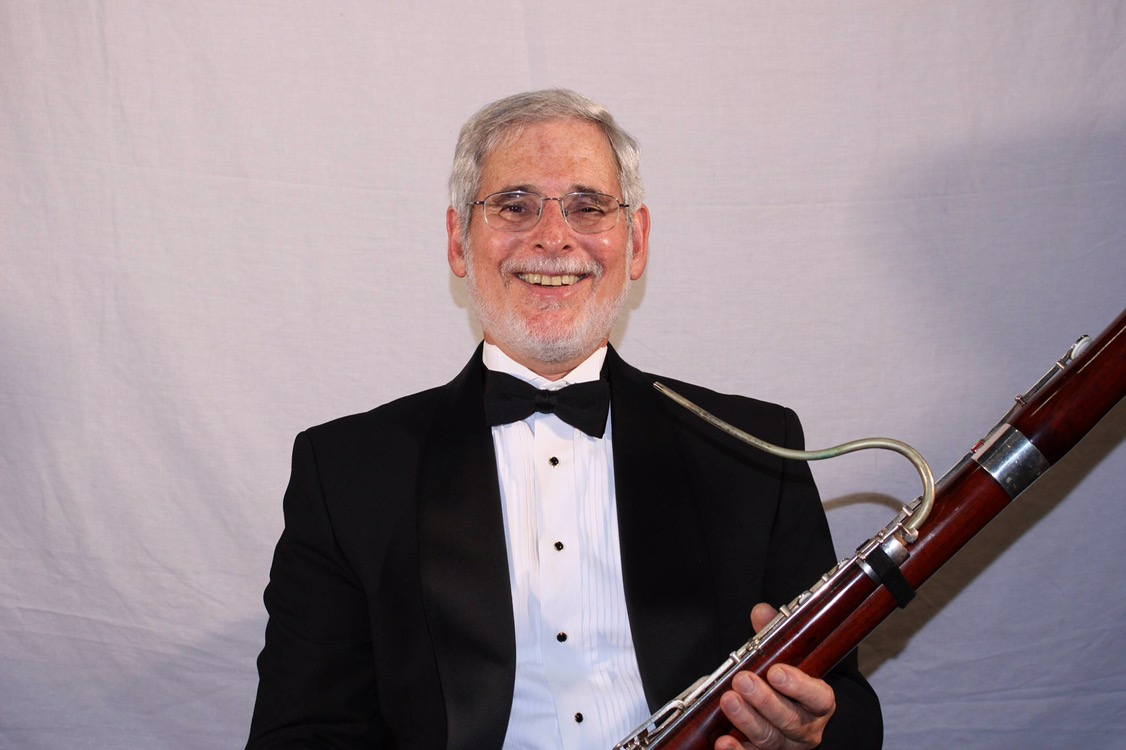
Along with his vocal talents, Mel is a serious bassoonist who has performed professionally in several orchestras and chamber groups in the Upstate New York area. Arlene recalls that they grew up in a home where music didn’t exist. “My parents never listened to music on the radio, and my only recollection of classical records in the house is that of an ‘Everbody’s-Favorite-Classics’ series that my parents must have felt obligated to buy—one each week—at the local super market.” Four years younger, Mel originally chose to follow Arlene’s choice of the clarinet. In high school, Mel switched to the bassoon, which became his passion and, with his professional musician’s license, his “second profession.”
When Charles Peltz took over as music director of the Glens Falls Symphony in 2000, Mel was already an experienced musician who had contributed much the orchestra. Peltz said that he knows few people who have retained a love for their instrument and who have consistently met the high standards in his performances. “That kind of devotion doesn’t come only from the ability to show off one’s technique skill or in anticipation of reward,” said Peltz. “Rather it comes from a person with a large heart for the deeper meaning of the things they do.”
Every summer, Mel has attended the Glickman Popkin Bassoon Camp in Little Switzerand, North Carolina. Furthermore, Mel’s love for bassoon resulted in many summer tours with an orchestra composed of fellow musicians from across the United States that has brought both him and Joyce much joy. Meris Ruzow, a longtime friend, loved hearing about the places they played and the people they meet in places as diverse as France, Austria, Germany, Switzerland, Italy , Czech Republic, Hungary, and Poland.
In 2016, Mel and Joyce decided to buy a second home in Florida. One of the main considerations was choosing a location in which Mel could continue to perform. Before they had even unpacked their boxes in their Naples villa, Mel had already begun practice with the Gulf Coast Symphony. Karen Gerhardt has fond memories of attending a performance there with Joyce and her husband Les, who died suddenly of pancreatic cancer soon after their visit in 2018.
Twelve years ago, Mel was diagnosed with prostate cancer. Marty Calderon said that Mel told him soon after hearing the news that he felt as if “someone one crapped on his plate of food.” That is the worst he has ever spoken about his cancer diagnosis. He continues to live his life with grace, dignity, and humor.
Mel had been an accomplished tennis and racquetball player in his youth. When he was in his sixties, he mixed those two sports with pickleball, finding the game offered a way to remain active without the physical demands of many other competitive sports. When Howie and Sandie Vipler visited the Toubs in November 2018, Mel played pickleball with them. The impact of his illness has curtailed further play.
In December, Larry and I, along with Bernie and Chris Grossman traveled to Naples to have what had become our annual ‘Jews-eating-Chinese-food-on-Christmas Day’ tradition. When Mel saw a menu description of a dish containing leeks, he wondered out loud whether they were “Wiki Leaks.” Despite his growing weakness and obvious pain, Mel kept us all laughing throughout our visit.
Soon after our December visit, Mel’s health began a precipitous decline. As Lew Morrison commented as the news spread of Mel’s worsening condition, “A cloud hangs over all of us.”
“My father has instilled in his children his menschism and created a legacy that will continue to inspire his friends and family long after his passing,” said his daughter Julia. “Although cancer will cruelly take his body from us far too soon, his spirit and soul will continue to flourish for generations.”
From left, Marilyn Sommer, Robin Kauffman, Roberta Greenberg, and Nina Scudieri, all worked as counselors at the Homowak Lodge Hotel. Kauffman is the coordinator of the planned May 4 Catskill hotel staff reunion.
In the classic movie “Dirty Dancing,” Jack Weston’s character Max Kellerman, the owner of the fictional Catskill resort, laments the changes down the road. “[I]t all seems to be ending. You think kids want to come with their parents and take fox-trot lessons? Trips to Europe, that’s what the kids want. .. It feels like it’s all slipping away.”
The heyday of the Catskills have ended, but the memories of those resorts remain with those who shared those summers as staff and guests. “This was our Camelot, a place that has vanished but still has a place in the hearts and minds by the thousands whose life were shaped by this shared experienced,” said Patty Beardley Roker. Roker shared this quote on the website for the upcoming reunion of Catskill staff members, which will be held on May 4, 2019, at the Villa Roma Resort in Callicoon, New York, a Catskill hotel dating from 1944.
Roker and others have many a story to share of their time in the Catskills, often called the Borscht Belt. Borscht, a soup associated with immigrants from Eastern Europe, was a colloquialism for Jewish. Famous hotels of the area included The Concord, Grossinger’s, and Kutshers. But there were many smaller resorts and cottages too.
The popularity of the Catskills starts at the beginning of the 20th century. Like many New York City dwellers before the advent of air conditioning, Jews looked for places that would provide a respite from the summer heat. Because of anti-Semitism, particularly in the 1940s, ’50s, and ’60s, such choices were few. Sullivan, Ulster, and nearby counties offered working class Jewish New Yorkers, mostly Ashkenazi Jewish immigrants, cheap land on which to build farms, bungalows, and hotels.
One such family were the Brickmans. Soon after emigrating from Russia in 1908, Abraham and Molly realized that New York City, with its tenements, crowded streets, and poor air, was not for them. As Abraham had worked on the farms for the czars, they purchased farm land in South Fallsburg. Soon friends and relatives were coming up to Brickmans to escape the city’s summers, and the farm took on boarders. The Brickmans’ daughter Anna and her husband Joseph Posner and their sons eventually took over the ownership.
Hotel Brickman had 300 rooms that accommodated over 600 adults and children. Along with adult activities, the hotel had a nursery, a day camp for children, and a teen program.
In 1965, 15-year old Patti Posner Daboosh began working in the resort’s office. When she was 26, she took over running the kitchen, supervising at times over 200 hundred staff members. Patti recalls fondly the diversity of the staff, which included college students and seasonal workers from the Southern states and from Central and South America.
One evening, Patti walked into the kitchen and realized that one of the kitchen staff was feeding a homeless man. When Patti told the employee that he had to leave, he responded, “When he is finishing eating, I will ask him to leave.” Patti said that that encounter taught her humility. “The compassion this man had for this poor person taught me how to be a better person.”
In 1986, Patti’s father Benjamin, was 72, and Hotel Brickmans like many other Catskill resorts, were dwindling in popularity. The SYDA Foundation, a not-for-profit tied to promoting Sidda Yoga ideas, purchased the resort and converted it into an ashram. Ben had no regrets. “We will make new traditions,” he told his family. Patti reports Ben spent the next 20 years telling stories of his life in the Catskills. Patti eventually went back to college to obtain a degree in sociology, a path connected to the lessons she had learned from working with the diverse Brickman community. Patti now lives in Weaverville, North Carolina.
Mark Silverman, who now lives in Connecticut, also had deep roots in theCatskills. His parents, Ben and Elsie Silverman opened up a bungalow colony in Glen Wild in 1947 with Joe Kartin, Ben’s partner in their Flatbush butcher shop. What started as two bungalows in 1947 expanded to 16. Ben and his partner would switch off summers, with one commuting back and forth to Flatbush while the other partner ran the resort and a seasonal meat market.
The bungalows were simple, with a kitchen/living room/dinette, one bedroom, and a screened porch. Entertainment was also low-key—bingo or a movie in the community room, which was called The Casino in the Catskills. Most of the renters came for the entire summer, with the men in the family often commuting on weekends.
Mark, like Patti, started helping his parents manage the resort as a teenager, keeping up the pool, mowing the lawn, maintaining the bungalows. Even after college, a stint in Vietnam, and his marriage to Diane Weissman, Mark continued to visit during the summers until his parents sold the resort in the 1990s.
“Spending my summers in the country gave me a great appreciation for the outdoors, farms and woodlands in the area,” said Mark. “I always knew that I couldn’t spend my life in an office, and this led to my career in agriculture and environmental science.”
Mina and Max Berjansky owned a bungalow colony in Monticello. In 1950, Susan Shapot Greenbaum, her parents, and her sister moved from the Bronx to join her grandparents. During the off-season, everyone shared the only heated home with only one small bathroom. In the summer, Mina and Max moved into the unfinished attic above the small grocery store, and the Shapots crowded into one bedroom and shared the bathroom with tenants. Max maintained the colony while Mina ran the grocery store, the only source of food during the week. Some of the guests shared a kokh-aleyn, the Yiddish name for self-catered bungalows, which was a large dormitory-styled house in which many families had a bedroom, a shared bathroom down the hall and one large shared kitchen, in which each family had its own stove, refrigerator and table. Other families had their own or one side of a two-family bungalow, complete with their own bedroom, kitchen and bathroom. Guests usually came up July 4th weekend and stayed through Labor Day. As in other Catskill resorts, the men frequently commuted back and forth to the city while the women and children remained all summer.
Susan said that her parents provided the low-key entertainment, including folk and square dancing, games, and masquerade parties for both the adults and the children. Every summer there was a “mock marriage” in which the tallest, biggest man was dressed as the bride and the smallest woman was dressed as the groom, with the entire wedding party following the “upside down” comedy act.
When New York State built the Route 17 expressway through the middle of their colony, the family moved into a house in Monticello. Later on, Susan tried working as a waitress at the Concord, one the Catskills largest resorts, but lasted only one week. “The regular staff were career people,” she said, “and they resented the college kids taking their tables and tips. I got pushed around often.” She also spent one summer working as a waitress at Kaplan’s Delicatessen, the most popular eating spot during the summer months.
“Monticello was a great place to grow up—a quiet small town from September through June.” said Susan. “It was a busy, bustling place in July and August, with lots to do between the hotels, bungalow colonies and crowds of people hanging out on Broadway. And it was always safe.”
Peter Vollweiler, who winters in Sarasota and summers in Upstate New York, saw the Northern Catskills through the eyes of his parents and relatives. The Breezy Hotel in Fleischmanns, Delaware County, one of the great hotels, drew many German Jewish Holocaust survivors, including Peter’s grandparents. Guests and older staff members generally didn’t talk about their war experiences but seeing the tattooed numbers on many arms showed their former plight.
Peter worked at The Mathes resort during his summer school breaks from 1958 to 1963. He had a variety of occupations: pool boy, grounds “picker upper,” baby sitter, children’s dining room busboy, bellhop and chauffeur. The working hours were long with low pay, but the staff was treated very well. The fine European meals and desserts made it all worthwhile. Working with so many other young people, many themselves also children and grandchildren of survivors, was important to Peter.
Marty Calderon, an Upstate New Yorker who retired in the Tampa area, worked two summers as a busboy and a waiter at the Pine Lodge near Monticello. Like Brickman’, the Pine Lodge was a mini-version of the larger resorts, “a small cruise ship on the ground.”
Like Peter, Marty remembered the long hours, which often extended from 6 a.m. to 11 p.m., seven days a week. For his efforts, he made $75 a week, money which he brought home to his parents in New York City.
Marty enjoyed the camaraderie with fellow staff members, and the food was plentiful—and delicious. For two years, he worked at the resort during Passover. “Before that experience, everything I had eaten during Pesach was dry and tasteless,” said Marty. “At Pine Hills, it was like a Viennese table at a wedding. I can still taste that sponge cake!
Joel Thaw, who lives in the Orlando area, spent every summer from birth to age 18 in the bungalow colonies. What he remembered the most was the freedom he had as children. “We left after breakfast and didn’t return until before dinner. Everybody knew everybody, and the parents watched out for each other’s children.” He also worked a concession stand the summer of Woodstock, which took place in nearby Bethel.Joel remembers putting a 16-year-old in charge of the stand while he and a friend drove to the music festival in time to see Jefferson Airplane before driving back.
Chair Robin Kaufman, who vacationed with her parents and later worked at the Homowack Hotel, stated that already close to 100 people signed up. “We are going to make history,” said Robin. “This will probably be the first time that many former Catskill bungalow and hotel staff will reunite together under one roof.”
She reports that among those committed to attend are former “tummler extraordinaire” Larry Strickler and MC Mel Simons, as well as some of the musician who accompanied the greats. In addition to the reunion’s evening event, programs are set for the entire weekend. (Strickler will present an interactive program on Saturday afternoon.
Kaufman by phone at (401) 487-9646 or by email at rmkauff100@cox.net can provide details.
This article was first published in (Capital Region New York’s) Jewish World on January 24, 2019.
In 2012, Rochelle and Bill Willner, attended services at Congregation Shalom Aleichem in Kissimmee, Florida. Former members, they were there for the first time in two years to check out the new rabbi. Before the mourner’s kaddish, Rabbi Karen Allen asked if anyone was observing sheloshim, the thirty day period of mourning. A woman whom they didn’t recognize announced that she had recently lost her aunt Yetta Weiner.
Immediately after services ended, Rochelle approached the mourner. “Excuse me,” said Rochelle, “ but Yetta Weiner is MY aunt!”
It didn’t take long for Rochelle and the “stranger” Marilyn Glaser to realize they were second cousins. Yetta was the wife of David Weiner, brother to both Rochelle ’s and Marilyn’s grandmothers.
The coincidences didn’t end there. Both Marilyn and the Willners lived on the same street in Solivita, a fifty-five plus adult community near the synagogue. Rochelle had attended Marilyn’s wedding over forty years earlier when she had gone as her father’s date. Her mother, the originally invited guest, had had surgery. Marilyn didn’t recall meeting her that day, but it was confirmed when the two of them found Rochelle’s picture in Marilyn’s old wedding album.
Since that night, Marilyn and Rochelle have become not only cousins but dear friends. “I speak to Rochelle at least four times a day,” said Marilyn.
How Did This Come About?
What would have happened if Rochelle and Bill hadn’t come that night to check out the rabbi? If the rabbi hadn’t asked for the first time if anyone was in period of mourning? If Marilyn hadn’t announced Yetta’s name? So many coincidences!
Or where they? According to some Jewish theologians, there is no such thing as coincidences. Hashgacha Pratit , or Divine Providence, is the concept that that G-d is actively involved in each of our lives. American author and inspirational speaker SQuire Bushnell calls it a godwink. “Every so-called coincidence or answered prayer is God’s way of giving you His small, silent, communication,” says Bushnell, “A little wink saying, ‘Hey kid! I’m thinking of you…right now!’
It even has been cited in both historical and scientific context. The German analytical psychologist Carl Jung coined the term synchronicity to describe meaningful coincidences—the “acausal connecting principle” that links mind and matter and supersedes cause and effect.
Rochelle choses to call her reunion, b’shert, a Jewish expression which means ‘meant to be.’ Whatever it is called, sometimes events align in such a way that it feels like God or some universal force is directing the action.
I believe strongly that some universal force was at play in our decision to move to the same community in which Marilyn and the Willners reside. In December, 2014, Larry and I were staying in a Central Florida resort in Kissimmee. A rainy day prompted a visit to Solivita, and the minute we drove through the gates, I felt that this was the place in which we would retire. After looking at new models, a realtor took us to a resale, and Larry and I fell in love with it. Never spontaneous people, we put a bid on it the day we were to fly home to Upstate New York.
Although the bid was turned down, Larry and I continued to lean towards buying a home in Solivita. S We had been looking at retirement homes ever since my sister Laura had purchased one in Arizona eight years before. Once we returned home, however, we both wondered if it was the right choice. I was always a “second guesser,” and tended to research every major decision ad nauseam and still rethink and sometimes regret my choices.
The day after we came back home, I headed to the library to research all Central Florida retirement options, including reading back issues of Where to Retire magazines. Usually there were at least ten copies, but on this day there was only one issue on the shelf: the May/June 2014 issue highlighting Kissimmee Florida with a cover picture of a happy couple from—yes—Solivita! Inside, Gabby and Joe Thomas recounted finding the “beautiful” community with the help of Gabby’s mother, who bought a house on an adjacent street. “It was all meant to be,” Joe was quoted as saying about their move.
I brought the magazine home and said to Larry, “This is a sign” By the following June, we had sold our house and moved to Solivita. Coincidentally, I met Gabby within the first week when we both attended a Weight Watcher’s meeting.
Did the Stars Align?
Fortunately, moving to Solivita is one decision in which I never looked back. We love it here. And like Joe Thomas, I feel that it was meant to be-b’shert.
Laurie Criden also felt it was b’shert at work when she met her second husband. In March, 2008, Laurie was still reeling from the recent loss of her father and the dissolution of her twenty-eight year marriage. Her active involvement in Temple Beth Zion, Buffalo, New York’s large reform synagogue, helped her “keep my balance.”
While meeting with the rabbi to discuss the shul’s Second Night Passover seder that she was chairing, he asked her how she was doing. Laurie jokingly said, “I guess I’m waiting for something better to come along.” At that exact moment, Mark Criden, the temple’s executive director ,tapped her on the shoulder to let her know that her meeting was about to begin. Although previous encounters had been “polite hellos,” by the time the two of them entered the meeting room, Mark had invited her to join him at a friend’s for the first night seder. They were married a year later and now share their time between Buffalo and Sarasota, Florida.
Was It Chance?
Julie Thompson Berman shared a story of a day filled with too many coincidences to be just chance. Just before she and her husband Bill moved from Maine to Texas, they decided to visit Endicott College, Julie’s alma mater in Beverly, Massachusetts. As they wandered around the campus, they came across Julie’s old dorm, which had been converted into an administration building.
As chance would have it (or was it chance?), all the doors in the building were unlocked. They climbed three flights of stairs to Julie’s old dorm room which was now a meeting room. There they met current students, who were thrilled to hear about Julie’s experiences forty years earlier.
The visit brought back a flood of memories for Julie, and she regretted not keeping up with her three college roommates. “I wanted to tell them where I was how I was thinking of them. Unfortunately, I had lost touch and no longer had their contact information,” Julie said.
The Berman’s next stop in their nostalgia tour was The Barnacle, a restaurant in nearby Marblehead, Massachusetts, where Julie and Bill had shared many special dinners during their college courtship. While waiting for their table, a woman who was already seated walked across the room and asked, “Are you Julie Thompson?”
When Julie answered yes, the woman hugged her. “I am Cherie, your roommate from Endicott!” Cherie and her husband, who lived across the state, were in Marblehead visiting family. The four of them shared a table talked for two hours after lunch and remain in touch. “I still think about that day and all the things that had to line up to make that reunion happen,” said Julie four years later.
The three stories above represent just three “b’shert” moments. I would love to hear more from my readers! Please share them with me by emailing me at shapcomp18@gmail.com.
Pickleball, Pickleball, how I love the game,/Pickleball, Pickleball, what a silly name/ When I play, every day, my body is in pain/ But you know, I can’t stop, unless it starts to rain!! (Parody sung to tune of O Chanukah!)
What? You haven’t heard of pickleball! Have you been living under a marinated mushroom?
Pickleball is the fastest growing sport in America. According to the USA Pickleball Association, there are over 3.2 million pickleball players in the United States alone, 5,000 indoor and outdoor courts in the United States; and at least one location in all 50 states.The game is being introduced to kids and teenagers in physical education classes in middle and high schools.
Pickleball was the brainchild of former Washington State representative Joel Pritchard. Summer, 1965, he and two friends came home from golf to three bored families. Their attempt to play badminton was thwarted by the fact that a shuttlecock was no where to be found. Undaunted, they retrieved a Whiffle ball, improvised some paddles with some plywood, and lowered the badminton net to compensate. His wife Joan dubbed the game “pickleball” after the “Pickle Boat” in crew where oarsmen were chosen from the leftovers of other boats
Although pickleball languished in obscurity for almost fifty years, that all changed when Baby Boomers began to retire. Many “seniors” still wanted to compete and win at a sport but lacked their youthful running abilities According to an article on the AARP website, pickleball, which combined elements of badminton, tennis, and table tennis, filled that need. Games usually last 10 to 15 minutes, so players can take frequent breathers. Since the court is small and most people play doubles, there’s no serious running — making it easier on the knees. The lightweight paddle and plastic ball reduces the chances of tennis elbow; having two people on the team reduces the area of play.
My husband Larry picked up the game when he turned 65 and joined Southern Saratoga YMCA in Clifton Park [New York]. Larry had been involved in sports his entire life—basketball, baseball, and track in his youth and running and cycling as an adult. In pickleball, he has found camaraderie as well as the ability—to quote Jimmy Buffet—“to grow older but not up.” He has participated in several tournaments but prefers to play for the exercise, the fun, and the socialization. During the summer, Larry plays with the Summit County pickleball league in Colorado. As the group plays at over 9100 feet, their tee shirts proudly proclaim, “We Play With An ALTITUDE!”
When we moved to Florida, one of Larry’s requirements was that the community had an active pickleball presence. Solivita, which is isted by www.55.com as one of the top five 55+ communities for pickleball, has seventeen outdoor courts. The Smashers, the largest sports club in Solivita, has over 1000 members and growing. Along with hosting the Polk Senior Games, the club also holds Sadie Hawkins, Halloween, and Yearling (new players) games.
Tom Leva, the Smasher’s president, first played the game in pickleball in 2007. After moving to Solivita in 2008, Tom, who had a history of heart problems, lost 40 pounds and was soon playing the game competitively and teaching new players. Although reoccurring cardiac issues has curtailed his game, he has remained on the board and has been behind the expansion and improvements of the pickleball courts.
When they moved to Solivita in 2015, Dave and Patti “Smith” were tennis players who were not going to ever play that silly game called pickleball. After their neighbors gave them paddles and took them out to play, they soon became self-professed pickleball addicts. They enjoy sharing their love of the game with others and meeting so many interesting people. Patti is looking forward to playing in the Florida Senior Games in December.
Sandie and Howie Vipler, fellow YMCA pickleballers, recognized soon after picking up the game in 2012 that Clifton Park lacked outdoor courts. Howie reached out to Phil Barrett, the town supervisor, who agreed to fund painting pickleball lines on some of the town tennis courts. They have moved themselves and their equipment to Virginia, where they continue to play almost every day.
Meanwhile, Sandie, who has a sports resume that includes downhill skiing, kayaking, cycling, and golfing, regards pickleball as her favorite. She plays pickleball 5 to 6 days a week for 2 to 3 hours a day. She revels in the compliments she gets from new competitors, including “You play tall for a short person” and “Wow, look at the wheels on her!” At 68 years old, Sandie vows that she will be playing until she can no longer walk.
That hasn’t stopped Brenda Taylor. Brenda had to have a leg amputated after a 1998 motorcycle accident and desperately wanted to find a way to get exercise while in her wheelchair. Except for an extra bounce before returning the serve, the rules are basically the same. Her proudest moment playing the game is when people compliment on her backhand shot.
Mel Toub had played tennis and racquetball in his youth. Now in his late sixties and facing health challenges, he has mixed those two sports with pickleball. “Pickleball has wide appeal to both folks who used to play racket sports in their youth and to seniors who wish to remain active but no longer have the stamina or physical ability to play more demanding sports like basketball, soccer, and tennis,” said Mel. “The learning curve to play pickleball at a socially acceptable level is fairly quick, so pickleball becomes a route to a new activity and new sets of friends.”
The game is growing internationally, with many European and Asian countries adding courts. Personal friends from England, Wales, and Canada have gotten hooked on the game after playing in Florida, Rob Harvey located an indoor pickleball facility near his home in Barhead, Alberta. “The game is great for eye-hand coordination. It keeps me limber and helps the joints.” Pickleball also helps him keep in shape for his summer baseball league.
Lynda and Steve Gorwill from Wales fell in love with the game after playing the game while on vacation in Florida. Last year, Lynda applied for and received a grant from Wales’ sports council to establish a pickleball league in her town. Although she has had roles in an English soap opera, Lynda still considers one of her proudest moments was winning a silver medal in her first pickleball tournament in Abingdon Oxforshire, England.
Margaret and Peter Hunter were “kitted” with paddles and balls while visiting Larry and me in Solivita last November. “Within two minutes we were captivated, line, hook and sinker.” They are looking to returning to our area for another American Thanksgiving and another month of pickleball and miss it when they are at home in England.
Not that pickleball doesn’t come with its hazards. Sharon and Rick McKelvey both ended up with torn meniscus surgery after a year of playing at Solivita. “That wasn’t fun,” said Sharon, another admitted addict, “but it didn’t stop us from returning to the game.” Debbie Pratt broke a vertebra in her back after she took a bad fall moving backwards to return one of Larry’s volleys. She no longer plays pickleball, but her injury certainly didn’t scare off other women in her RV resort on the West Coast of Florida, who are appropriately called “The Sweet Pickles.”
Marta Groess, a lifelong athlete and a member of Smashers, says that the most important feature of the game is that it is FUN! “I tell new players that if they aren’t laughing, they aren’t playing the game right.”
Linda Kuhn, the Smasher’s treasurer, hadn’t played a sport since high school but now she is addicted, sometimes playing 2 to 4 hours in the Florida heat. “Pickleball gives me such a sense of contentment,, Linda said. The game has reaffirmed my decision that as I age, I am going out with a roar!”
Is pickleball a Jewish game. Well, it certainly isn’t called “kosher pickle” ball! Until that happens, many people-Jews and non-Jews alike—can find America’s favorite new sport fun.
Originally published in The Jewish World. October 4, 2018
Two years ago, Peter and Margaret Hunter, friends from England, visited us in our home in Kissimmee, Florida. They brought two bottles of Moet Chandon Brut Champagne, which we tucked away for a future occasion.
This week, the Hunters were back in Florida, and Peter asked us if we had drunk the wine. When I told him it was still sitting in the box, he admonished me.
“That kind of wine doesn’t age well,” said Peter. “It doesn’t last unless refrigerated properly. We’ll pop it open next week before we head back to the other side of the pond!”
During Chanukah, we celebrate miracles: There was only enough oil in the Eternal Light to last for one day, but somehow, it lasted for eight. I was thinking about the Hunters and the wine in relationship to our upcoming holiday. Yes, Chandon Brut Champagne doesn’t last long, but our friendship with the Hunters, that began on a Jamaican beach, gets better with age. And I began to reflect on special friendships in my life that miraculously have stood the test of time and distance between us.
Betsy Odams Porter and I met in second grade and immediately became best friends. Betsy was beautiful, with thick red hair, and a single child.Wespent hours at her home, playing with her Madame Alexander dolls. In seventh grade, Betsy and her family moved to Texas, and I was devastated. She and her parents came back for a visit when we were sixteen. A few years later, my father got the phone call that Betsy’s father had died in a car accident. After that, Betsy and I shared an occasional letter.She reported that she had two sons, had divorced and gone back for her master’s in nursing, and then had remarried.And then came Facebook. We reconnected, and in 2011, Betsy and her second husband visited Larry and me in Clifton Park. She still was beautiful, still had her gorgeous red hair, and still loved me. “My best friend!” she cried as we shared our first hug in over forty years. She was the first friend to call me after to Pittsburgh tragedy to express her grief and outrange.
It took me a while to find a friend to be as close with as Betsy, but in high school, I met Chris Allen, who was a year behind me. Chris was brilliant and compassionate and a wonderful listener. We shared confidences and Simon and Garfunkel and lots of notes. She was the one who encouraged me to pursue writing, and she was the one who suggested we take a summerclass at Plattsburgh State in 1967. For my high school graduation, she gave me a blank black journal in which she inscribed “For your writing. “ She was my soulmate. Unfortunately, we lost touch while we were in college. I didn’t even invite her to my wedding, a decision I regret to this day. But two years ago, she came to visit me at my brother’s cottage on Lake Champlain. We walked and talked for an hour and a half, and we hadn’t missed a step. We still keep in touch with snail mail, and I will be in touch when I head north to visit family and friends.
I met my college roommate Denise Gorham Donato my first day of college, and we bonded immediately. Within a week, she nicknamed me ‘PTuke’, a moniker that stuck through college and beyond. We were so different: I was intense, organized, and feverish in my need to complete every assignment with a few days to spare. Deni was outgoing, spontaneous, and the queen of the all-nighter. She worked several jobs, including one at Dom’s sandwich shop on Central Avenue. When she came home around 11:30 pm, I would wake up and wewould catch up while munching on tuna subs she brought home in long white bags. Until this day, I can’t smell an onion without thinking of our midnight snacks.
A month after our graduation, Deni married Phil and settled near Syracuse. Larry and I would visit her when we went out to visit Larry’s Uncle Asher and Aunt Fran. The four of us went to a Syracuse University game in the snow and kept in touch with an occasional letter. After Asher passed away, Fran moved down to Murrells’ Inlet near Myrtle Beach, South Carolina.
When we moved to Florida,Deni and I lost touch for a while. Last September, I sent a note to Deni, telling her about the publication of my second book and checking in with her.Both of us were shocked when we realized that she owned a condo only one mile from Fran’s place in South Carolina. The four of us met for dinner this year when she and Phil came to Orlando for Phil’sreunion with college friends. We plan on meeting up in Murrell’s Inlet this winter when Larry and I visit Fran.
Judy Lynch and I met in 1984, when her daughter Katie and my son Adam were on the same tee-ball team. We met up again when our two younger daughters bonded when they were on the same swim team. It is a friendship that has lasted over twenty years, through our children’s high school years throughKatie’s death from leukemia in 2009 and through the Lynch’s part-time residence in Boston and our move to Florida. When we talk, we have to reserve one or two hours of free space. Our cell phones have often come close to losing battery power before we finish.
In 1987, a year after I had gone back to teaching at the Capital District EOC, Susan Hoff Haynes came on board as a new academic instructor. What started out as mutual hatred changed when Sue called to talk. We found out that our similarities were so much more than our differences. Along with our friend Melanie, we became ‘The Three Amigas.” Mel passed away from non-smoker’s lung cancer the month before Larry and I moved to Florida. Sue has come down to see us for the past two years on Martin Luther King’s Birthday and already made plans to make it three in a row this year. Each time she comes, she and I swim laps, attend a book club, talk politics, and share confidences, just like we have done since 1987. We don’t miss a beat.
In 2008, Larry and I spent a week in Jamaica, where we met up with the Bunny Bunch, several couples who had already met over Easter Week at the same resort for several years. It was through our many visits to that Caribbean Island that the friendships grew. When Larry and I moved to The Sunshine State, we curtailed our Jamaican trips. However, members of the Bunny Bunch, including the champagne-bearing Hunters, now come to see us at Thanksgiving. Larry and I share our American holiday with fellow American,British, and Canadian friends.
Since moving to Kissimmee, Larry and I are grateful to have met many people in our fifty-five plus community, in our synagogue, in our greater community. As we celebrate the Festival of Lights and share the joy of this holiday season and secular new year, I am grateful for the joy of establishing new friends.I am also grateful for themiracle of sustaining so many long-time friendships, including the ones I highlighted above. These ties,like the oil in that temple lamp, have lasted long and well.
The USA Pickleball Association, located in Surprise, Arizona, has picked up my recent article on America’s fastest growing game for its website. Thanks to family and friends from the United States, Canada, England, and Wales who contributed to my story with their personal accounts of the game.
“Pickleball makes a dink shot among sports lovers of all ages.” USA Pickleball Association website. October 26, 2018. Click here.
The world must contain not less than 36 righteous individuals in each generation who greet the Shekhinah’s presence each day. Jewish mythology
On Rosh Hashanah we celebrate the birthday of world, the beginning of a New Year full of possibilities. In the weeks leading up to our High Holy Days, however, I have encountered many events that make me doubt those possibilities.
Evidence of climate change impacted our summer travels. In Frisco, Colorado, we watched helicopters dump water and flame retardant on a mountain only six miles from my daughter’s home, one of many wildfires burning throughout the West.In July, Larry and I traveled with a group on land tours of Norway and Iceland. The first country was magical; the latter was other-worldly; both were beautiful. But Norway, like most of Europe, was experiencing the hottest summer in history, and farmers were facing withering crops and dry pastures for their domestic animals. Meanwhile, Iceland had weeks of record-breaking cold and rain that resulted in rotting crops.
We returned home to the news filled with stories of corruption and indictments at the highest levels of our government, our mailbox filled with contentious election with ads vilifying good people with lies, and, the television blasting information about the latest mass shooting, this time in Jacksonville, Florida. None of this made me feel hopeful for the coming year.
In the final scene in Fiddler on the Roof, Tevye and his neighbors are gathering their meager belongings to leave their “tumble-down, work-a-day Anatevka” after they are evicted by the Russian government. Motel the tailor suggests to the rabbi that this would be a good time for the Messiah to come. ”We’ll have to wait for him someplace else.” the rabbi replies. “Meanwhile, let’s start packing.” Yes, I agree with that wise rabbi: we could use a miracle.
I didn’t get a miracle, but thanks to Laurie Clevenson, editor of the Jewish World, I did get a heartfelt lesson in Jewish mythology that renewed my faith.
In the book of Genesis in the Tanakh, God concedes to Abraham that He would spare the city of Sodom if the patriarch could find just ten righteous men. We know how that ended: Not even one such man could be found. Sodom and its sister city Gomorrah were destroyed, and Lot’s wife turned into a pillar of salt.
The Biblical passage developed into a Talmudic legend. In every generation, says the sages,there are thirty-six righteous people upon whose merit the world is kept from entire destruction. The Lamed-Vavtzaddikim, as they are known in Yiddish, are“humble servants of their fellows,” states an eponymous website, “tirelessly working to dry tears, show compassion, and shoulder the burdens of those who suffer.”
The Righteous Among Us
Abraham desperately sought just ten such people five thousand years ago; in more modern times, the count is raised to the mythical Double Chai; the number 18 (meaning life) times two. These individuals are hidden, so hidden that no one knows who they are,not even the others of the 36. When one of them dies, another is secretly “crowned,” waiting anonymously, silently, humbly for his or her call to come forward and help repair the world.
I feel we have examples ofLamed-Vavtzaddikim in our own history. Abraham himself comes from obscurity to become the father ofthe Jewish people. Against all odds, David slays Goliath; Judah Maccabee leads a rebellion against those who want us destroyed. The Lamed Vav website also gives examples of women: Ruth, an ancestor to King David, preserved not only Naomi, but future generations by being faithful. Esther, through her selfless bravery, saved her Jewish brethren from from certain destruction. And Deborah, instrumental in delivering Israel from Canaanite bondage, later served as judge. Each of these individuals came from the shadows to keep Judaism alive.
And we have all known such people in our our lifetimes. I have been fortunate to meet what I consider Lamed-Vavtzaddikim through my writing. Claudia “Clyde” Lewis supported and advocated for her sister Andrea, who was born with intellectual disabilities, resulting in Andrea living a life never initially imagined by those who wanted her institutionalized.Tony Handler, 79-year-old seven time cancer survivor, has served as a beacon of hope for those who are diagnosed with the dread disease. The sole member of his family to survive theHolocaust, Harry Lowenstein immigrated to America to become a successful Florida, businessmen and the person behind the construction of the Kissimmee synagogue. “I saw a synagogue burn,” said Lowenstein, “and I was determined to build another one.”
I loved the entire process of writing each one of these stories: interviewing each person; researching background information; writing and re-writing draft after draft to make sure I captured their voice in a story in which they would be proud.More importantly, I loved learning about each of these tzadakim, these people who quietly have made their mark on the world to make it a better place.
Three Leave Positive Legacies
In the past month, I believe we have lost three of the 36. Aretha Franklin, the Queen of Soul, not only moved us with her songs and her voice but also was a leader in the civil rights movement. Senator John McCain, the maverick senator from Arizona, was lauded as a war hero, a public servant, and one of America’s great champions. Admired by both sides of the aisle, Senator Charles Schumer stated that his friend was“never afraid to speak truth to power in an era where that has become so rare.” Hours after McCain’s death, news of Neil Simon’s passing was announced. The Pulitzer prize-winning Jewish playwright had revolutionized Broadway with his funny but biting views of Jewish urban life. Each of them shaped our world with a positive, long-lasting legacy.
Hope and Mitvahs
In a 2010 Rosh Hashanah article, Rabbi Julie Hilton Danan spoke of “the thirty-six blessed humble souls whose merit keeps society from falling apart,” those individuals whose character and deeds are so exemplary that being around them raises those around them to a higher level.With billions of people on the planet, she suggests remembering the African saying, “It takes a village.” “If we could develop 36 lamed-vavnik communities,” Rabbi Danan suggested, “we could have the critical mass to tip the balance of human history in a new direction.”
No matter what the number, this beautiful myth offers hope that the morally outstanding individuals can somehow affect the whole world. What can we do? First we need to treat everyone as if he or she is a Lamed Vav, as we never know—despite anyone’s level in life—if that person is a chosen one. Secondly, each of us should strive to be kind, compassion, and a mensch. Maybe one of us is a hidden Lamed Vav Tzadik? And finally, we can each be doing whatever we can to be a positive force in making a difference in the lives of our family, our community, and our world.
I am thrilledto announce the release of my second book!
TIKKUN OLAM: STORIES OF REPAIRING AN UNKIND WORLD
About my book:
Tikkun Olam is a collection of essays that were originally published in the(Capital Region) Jewish Worldand more recently the (Orlando) Heritage Florida Jewish News. Many reflect my own life: growing up in a very close knit family in a small town on Lake Champlain in Upstate New York, getting married to Larry and raising our children Adam and Julie, spending my career in adult education, and volunteering in my community. Since retiring, I have the opportunity to not only to share my stories but also to capture the heartwarming accounts of others who, through their actions, are helping to make the world a better place. My first book, There Goes My Heart, was published in 2016. Feel free to share your commentsand your stories with me at shapcomp18@me.com.
From my Amazon page:
“Tikkun Olam is the Hebrew moral principle of “repairing the world,” that every individual should leave the world a better place than he or she found it. Marilyn Cohen Shapiro shares her journey to her “highest self” through thoughtful and often witty writings, which span a lifetime of experiences, from childhood, marriage, motherhood, and retirement. Throughout her journeys, she never loses her unwavering beliefs in truth, kindness, and community service—her insight colored with healthy doses of humor and compassion.”
To order Tikkun Olam:
Samuel Johnson wrote, “A writer only begins a book. A reader finishes it.” Please ‘complete’ my book by ordering a copy of my book from Amazon in either paperback or Kindle edition, click here. Online reviews are very much appreciated.
Shabbat in the Rockies with Synagogue of the Summit
My husband Larry and I were enjoying our annual stay in the Colorado Rockies. As we had done many years before, we were hiking, spending time with our family, and taking advantage of all a summer in Summit County has to offer. The world surrounding us, however, was filled with troubling news. Both of us—especially me—needed to find peace and comfort. Fortunately, we were able to find both when we joined Synagogue of the Summit (SOS) for Friday night Shabbat service at Sapphire Point on this past June.
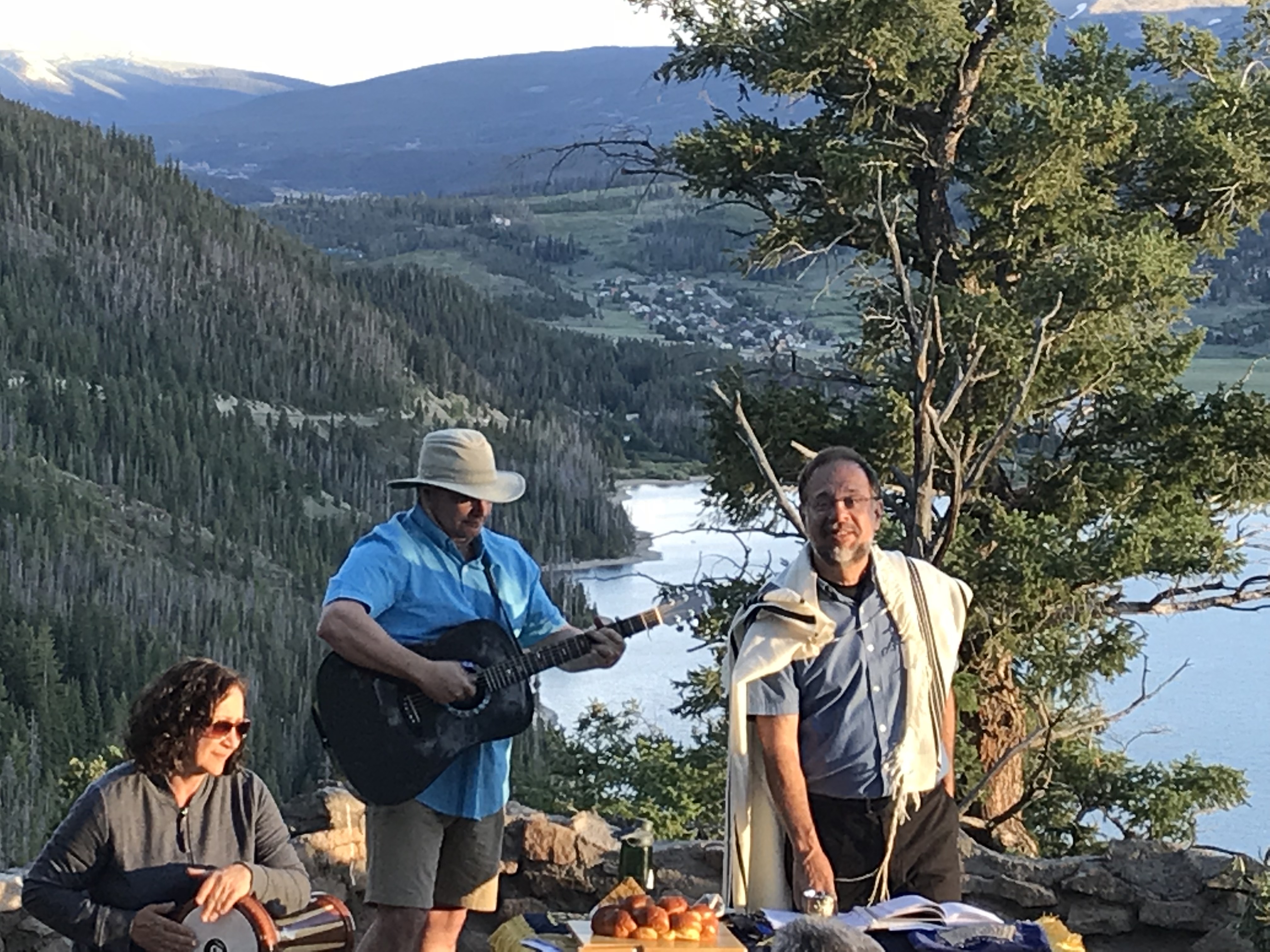
The overlook sits at 9,500 feet between Keystone and Breckenridge atop of Swan Mountain Road. We placed our potluck snacks onto the waiting tables and set up our lawn chairs in anticipation of the evening service. We joined several SOS congregants for an easy hike along the half mile Old Dillon Reservoir trail, offering spectacular views of the Ten Mile Range and the Continental Divide.
Barry Skolnick, SOS’s lay leader, began the service shortly after the hikers’ return. I will lift up mine eyes unto mountains from whence shall my help come, Skolnick said, quoting Psalm 121. My help shall come from the Lord, maker of heaven and earth. Barry swept his arms to point to a perfect blue summer sky etched with the Gore Mountain Range as Lake Dillon Reservoir sparkled below.
Skolnick’s beautiful voice and the guitar and percussion accompaniment of musicians Ron and Betsy Cytron immediately drew me into the Shabbat service. Some of the melodies and prayers were new, but others were familiar to me from our congregations in Upstate New York and Florida. Board members and congregants were called up to light the Shabbos candles (non-flammable, to conform to the fire ban in the mountains), and take part in readings throughout the service.
Just before the Kiddish, Leah Arnold gave a short dracha—sermon—on Parashat Balak, the Torah portion for the week, The passage from Numbers recounts the story of Balak, the king of Moab, who summons the prophet Balaam to curse the people of Israel. On the way to his mission, Balaam is berated by his donkey (Yes, the donkey talks!), who realizes that an angel of God is blocking their way. Whenever Balaam attempts to pronounce his curses, his mouth instead pours out blessings.
In a moment of pure synchronicity with my own feelings, Arnold reflected that this particular week seemed to be filled with curses raining down on those who were trying to make the world a better place. “The possibility of turning back curses lies not directly with God or magical donkeys or angels,” Arnold shared with me later, “but with us, and our ability to channel the Divine within ourselves by following the prophet Micah’s words: ‘to seek justice, love mercy, and to walk humbly with your God’”
Her closing poem was a reminder to all that calling out for God to help us do what He wants of usis more useful and effective than simply cursing our situation. “I meant to curse you.” Arnold said, reading from a poem by Stacey Robinson. “Instead, I called out Your name.”
After the closing prayers, everyone shared challah, wine, and the food attendees had brought. Larry and I were warmly greeted by many members of SOS. One had a daughter and son-in-law moving to Frisco, four blocks from my own daughter’s family. Another sported a shirt from a golf community near us in Florida. His wife and I, both writers, found we had been impacted by a collection of children’s drawings and poems discovered after the Holocaust and captured in the book, I Never Saw Another Butterfly. Another couple owned a condo in the building next to ours. As we made our way back to our car, I told Larry we had found our summer Jewish home in the Rockies.
Over the next few days, I learned more about the congregation through research on the SOS website and conversations with its synagogue board members.
Although Denver has had a significant Jewish presence—over 40,000 in the 1970s—the Jewish population of Summit and adjacent Eagle counties was small. Religious services were held in the Interfaith Chapel at Vail, requiring a ride over Vail Pass. A beautiful drive, but treacherous during the winter months in the Rockies.
Recognizing the need for a Jewish community in Summit County,Sandy Greenhut of Dillon organized the Summit County Jewish community and formed Synagogue of the Summit in 1990. The first years barely drew enough people for a minyan—the required ten adults over the age of thirteen. Meetings and High Holy Day services, as well as a Sunday School for children, were held in people’s homes for the diminutive but enthusiastic group.
By the mid-1990’s the population of Summit County grew, as more people discovered life in Colorado. The Jewish population increased. Many purchased second homes or moved permanently to the mountains. “SOS membership now ranges between 120 and 140 families. About half the congregation are permanent residents, while the other half spends two to six months in Summit County,” stated outgoing SOS president Jonathan Knopf.
Jackie Balyeat, the incoming president, is optimistic about the future of the synagogue. “As newer members move into the county, they bring their previous work experiences enabling the congregation to tap into a variety of talents allowing SOS to offer different programming as well.”
Although the majority of the congregants are retirees, young families are always welcome and SOS has several. The synagogue offers educational programming customized to the age of the children. There have been one or two Bar or Bat mitzvahs each year.
SOS has no permanent building, a situation supported by the congregation. “This gives the congregation the opportunity to hold services in places all over Summit County,” explained Knopf.Activities have been held in Breckenridge Library, the Frisco Senior Center and historic chapel, and the Silverthorne Municipal Building. Churches have also opened their doors to SOS, including Lord of the Mountains Lutheran Church and the Dillon Community Church, where High Holy Day services will be held this September. In August, Skolnick conducteda Shabbat Morning service at the historic Temple Israel in Leadville. The building dates back to the 1880’s when Jews were participating in the mining days.Although it is no longer an active synagogue, it is open for special events like those offered by SOS.
Rabbi Ruth Gelfarb, who lives in Boulder, Colorado, serves as the congregational rabbi six weekends a year. She also officiates at High Holy Day services, the annual Passover Seder, and special events. Whether run by “Rabbi Ruthie” or lay clergy, whenever possible, services and Torah studies are held at breathtaking outdoor locations throughout Summit County, including Sapphire Point, Keystone Mountain, and Lily Pad Lakes hiking trail.
Along with spiritual events, SOS offers many social, cultural and outdoor programing.Upcoming events this summer include potluck dinners, a hike to Shrine Pass near Vail, and a field trip to the Denver Museum of Nature and Science to see the Dead Sea Scrolls exhibit.
The congregation also is connected to the greater Denver Jewish community. Several members participated in the recent 22nd Annual Leadville Jewish Cemetery Cleanup Weekend sponsored by B’nai Brith. More than eighty people of all ages, are signed up to participate in the congregation’s first Annual Mitzvah Day on July 15th. The congregation will take on four service projects throughout Summit County, including trail clean-up in Breckinridge; landscaping of the Frisco-based safe house for Advocates for Victims of Assault; a path upgrade along Lake Dillon; and repair work at the Silverthorne Blue River Horse Center.




 There Goes My Heart