Author Archives: Marilyn Shapiro

Unknown's avatar

About Marilyn Shapiro

After thirty five years in education, I have retired and am free to pursue my lifelong dream of becoming a freelance writer. Inspired by my mother, who was the family historian, I am writing down my family stories as well as publishing stories my mother wrote down throughout her life. Please feel free to comment and share.

The Creature Calls…..

PRXBGa7eSq6ep+GCoQFwxg

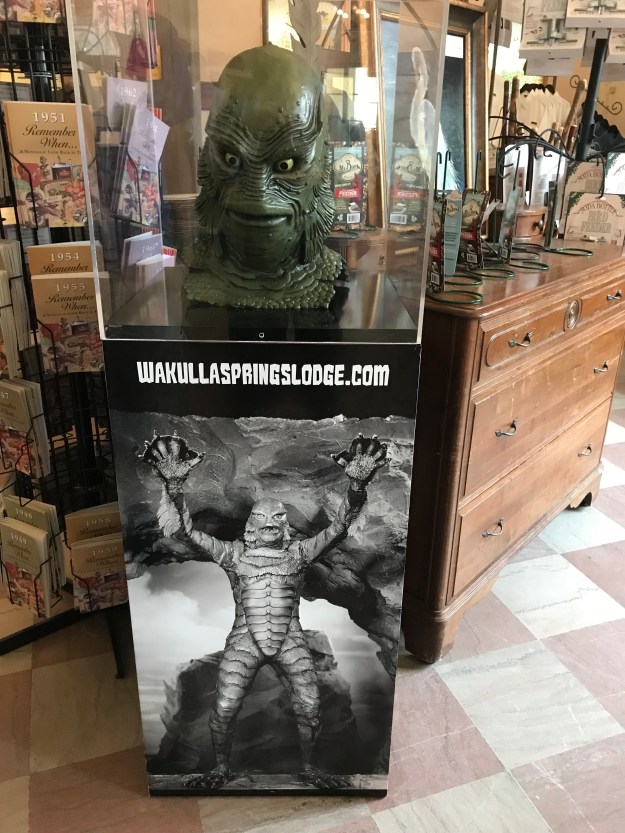
The Creature of the Black Lagoon display at Wakulla Springs State Park, Tallahassee, Florida.

While my husband Larry and I were visiting friends in Tallahassee, Florida, recently, the four of us went to Wakulla Springs State Park. The 6,000 acre wildlife sanctuary offers a magical forty-five minute boat ride that takes its passengers past cypress groves, lovely springs, and a plethora  of wildlife. Our tour guide, a woman named Connie, navigated the boat through a narrow, shaded section of the ride and announced that this was the area in which Creature of the Black Lagoon was filmed in 1954.

Fear, Shock, Disgust?

I was all too familiar with the Creature of the Black Lagoon. When the movie arrived in Keeseville, New York, in 1955, my nine-year-old brother Jay had made plans to see it with a group of his friends. My mother, busy with a newborn, insisted that Jay take me, his five-year-old sister, along. We walked around the corner to the old theater in our small Upstate New York town, my brother grumbling all the way. The first fifteen or so minutes were fine. The minute I saw the huge black amphibian-like creature emerge from the water, however, I became so frightened that I started screaming and crying. Jay had to leave his friends and popcorn behind to bring me home. “I told you I didn’t want to take her with me!” my brother loudly complained to my mother. It was years before he took me to the movies with him again. The next horror movie I saw in its entirety was Psycho, Alfred Hitchcock’s classic, when my college showed it on one of its movie nights.

Nightmares for Weeks!

I didn’t fare any better with scary television shows. On November 11, 1960, my parents hosted a party for a group of their friends. My sister Laura and my brother Jay were supposed to be watching me in the family room while the adults congregated in the living and dining rooms. I insisted on staying awake, even when the Twilight Zone came on. The episode Rod Serling introduced that night was “Eye of the Beholder.The now classic told the story of a young woman lying in a hospital bed, her head swathed in white bandages. She awaits the outcome of a surgical procedure performed by the State in a last-ditch attempt to make her look “normal”. In the end, the doctor and nurses, who are only heard but not seen, remove the bandages to reveal a beautiful woman. As the medical team gasp with disappointment and revulsion, the camera moves to their twisted, grotesque faces. Beauty, it seemed, was in the eye of the beholder. In a scene reminiscent of what happened five years before in the movie theater, I screamed in fear and went running into the living room. The guests all trickled out as my parents tried to calm down their hysterical ten year old. 

The end result was—well—“horror-able.” I had nightmares for weeks. Laura and Jay were grounded for months. And it took years for me to watch the complete episode—ten months short of forty years, to be exact. On New Year’s Eve, December 31, 1999, one of the cable stations offered a Twilight Zone marathon. The-episode-not-to be-named was shown between 11:30 pm and midnight. I watched it until the end, when the beautiful woman (played by Donna Douglas of later Beverly Hillbillies fame) was led out of the hospital by an equally handsome man to a place that accepted “ugly” people as their normal. It was only until the credits rolled did I turn the station to Dick Clark’s show and watch the ball drop at Times Square to mark the new millennium.

Avoidance Works

For my entire life, I have avoided scary movies unless they are very old (The original versions of Phantom of the Opera and Frankenstein), very funny (Little Shop of Horrors; Young Frankenstein), or very well acted. (Silence of the Lambs; The Sixth Sense).

However, let’s face it. Children’s movies can be scary. Larry was so traumatized by the Wicked Witch of the West when he first saw The Wizard of Oz as a four year old that he refused to watch the annual television broadcast for years. The evil queen in Disney’s Snow White was as frightening to me when I was a child as Hannibal Lecter was to me as an adult. And the sea witch Ursula in The Little Mermaid still chills me to the bone when she appeared in her plump purple presence both on film and on the stage. But these animated antagonists who provided the tension in the children’s classics didn’t scare me enough to turn them off.

Once I became a parent, I shared my love for fairy tales with all their heroes and heroines and scary villains with Adam and Julie. Thanks to Blockbuster and our VCR, we watched Dorothy, Snow White, Cinderella, Aladdin, and Ariel confront and conquer their demons again and again and again.

In 1991, when Adam and Julie were thirteen and ten respectively, Beauty and the Beast was released. It remains one of my favorite movies of all time, up there with Casablanca and Schindler’s List. I was drawn to Belle’s intelligence, her feminist streak, her strength. And I loved the Beast, with all his bluster and bellows, for his transformation into a loving, caring individual once he both received and gave the gift of love.

Monsters Everywhere

Julie told me this summer that my two-year-old granddaughter Sylvie loved the music from the movie, and I was more than willing to share my enthusiasm with her. Together Sylvie and I listened to the sound track, watched some clips on You Tube, danced to the title song across the living room floor, and sang the songs on the way to her daycare. By the end of the summer, I had purchased the movie and downloaded it to my laptop. Sylvie sat on my lap and watched mesmerized the entire length of the film.

When Larry and I returned to Colorado in October, however,  Sylvie’s attitude changed. Yes, “Little town, little quiet village…” was fine. But the minute the Beast arrived on the scene, Sylvie hid her face in her hands and said, “I no want to watch the Beast! I scared!” My showing her that short segment triggered a fear of all monsters, the ones in her closet, the ones under her bed, the ones hiding in the trees. 

So the movie is off the radar for a while. Maybe by next summer, she will realize that Gaston, the handsome but chauvinistic and selfish oaf, is much more frightening than the considerate, loving Beast. Maybe she will have to wait five or ten or even forty years to watch the movie in its entirety. And maybe, like Rod Serling’s classic, she will realize like my heroine Belle that beauty is in the eye of the beholder.

Originally published in The (Capital District) Jewish World, January 11, 2018

We’ll have a 27 with eggroll…… and a happy holiday to you.

On December 23, Larry and I traveled 400 miles to spend time with our friends, Chris and Bernie Grossman in their new home in Tallahassee, Florida, And on December 25, the Shapiros and Grossmans upheld tradition as steeped in Jewish culinary ritual  as brisket on Rosh Hashanah, potato latkes on Chanukah, and matzo ball soup on Passover. We ate Chinese food on Christmas Day.

Growing up in a small town in Upstate New York, my family  didn’t eat Chinese food on Christmas Day, or most other days of the year. If there was a Chinese restaurant in Plattsburg, the “big town” near us, I don’t remember ever going there.

Once or twice a year, my father would pile my mother and the four children into the station wagon and drive the ninety minutes to Montreal. We would weave our way into Chinatown and head to the Nanking Cafe. We would climb a set of steep stairs and crowd around a table in a booth. (Family lore tells of the time that my brother Jay drank the water in the finger bowl.) The wonton soup and noodles would be followed by chow mein (much better than the stuff we ate out of cans that we got at the local Grand Union). We would finish up with fortune cookies and vanilla ice cream and head back home. To be honest, that was the extent of our seeing Montreal until I visited the World’s Fair in 1968.

The Chinese food at Christmas tradition started for me after Larry and I married and bought a home in Saratoga County in 1976. Ling’s, near the corner of Routes 146 and 9 in Clifton Park, was the only restaurant open on December 25th. (It was also the only Chinese restaurant in a ten mile radius; there are now at least ten!) Larry and I met half the Jewish population of our community there.

By the next year, we were going to Ling’s with a group of friends. And by the time our children left home, we had a standing date for a December 25th dinner with the Grossmans and several  other couples in various Chinese restaurants throughout the Capital District. Wherever we chose to go, we could count on sharing the evening with tables of fellow Jews—including many rabbis and their families.

The tradition continued when we moved to Florida in 2015, when the Grossmans and another of our regulars, Joyce and Mel Toub joined us in Kissimmee for three days. Of course, we had reservations at the local Chinese restaurant on Christmas Day.

Last year, Chanukah started on December 24. Congregation Shalom Aleichem in Kissimmee held a community dinne. I was hoping we would be dining on huge metal pans filled with vegetarian or kosher style dishes  from one of the two Chinese restaurants close to our shul. To my disappointment, the committee planning the event opted for Italian. The next day, we joined my brother Jay, his wife Leslie, and their family for a traditional Chanukah meal in Sarasota.  This year, however, we are back on track for wonton and moo shu. This time we are doing the traveling—four hundred miles to Tallahassee—all to get into the Jewish ritual of eating Chinese food on December 25.

According to Mathew Goodman, author of Jewish Food: The World at Table, the Jews’ love dates back over one hundred years ago, where the Lower East Side of Manhattan was populated by Eastern European Jews, Italian, and Chinese. “Italian cuisine and especially Italian restaurants, with their Christian iconography, held little appeal for Jews,” Mark Tracy wrote in a 2011 Atlantic article. “But the Chinese restaurants had no Virgin Marys. And they prepared their food in the Cantonese culinary style, which utilized a sweet-and-sour flavor profile, overcooked vegetables, and heaps of garlic and onion”—all similar to Eastern European cuisine.

Another theory was included in a 1992 academic (seriously!) paper by Gayle Tuchman and Harry G. Levine in which they supported the idea that Chinese food was ‘Safe Treyf.’ True the dishes featured un-kosher foods including shellfish and pork. But it was chopped and minced and mixed with so many vegetables, it as disguised. As stated in a 2007 blog post Feed the Spirit, “If pork was in wontons (which looked very much like Jewish kreplach) or in tiny pieces in chop suey, it didn’t seem as bad as chowing down on a ham sandwich. And the Chinese typically don’t cook with dairy products, so no one had to worry about mixing milk and meat. “

The concept has made it to the highest court in our country. According to the Judaism 101 website, Justice Elana Kagen brought up the Jewish/Chinese food connection  up at her 2010 Supreme Court confirmation hearing. When a senator asked her where she was on Christmas, she said, “You know, like all Jews, I was probably at a Chinese restaurant.”

In 2009, Brandon Miller even penned a song: “I eat Chinese food on Christmas/Go to the movie theater, too/‘Cause there just ain’t much else to do on Christmas/When you’re a Jew.”

As you can tell by her undecidedly non-Jewish name, Chris was not born Jewish. She converted after she met Bernie at Grinnell College. Chris, whose Hebrew name is Chava, keeps kosher. So on December 15, in a Chinese restaurant in Tallahassee, she ordered the egg drop soup and a fish or vegetarian entree.

The rest of us, however, ate “Safe Treyf.” Larry ordered shrimp in garlic sauce. Bernie got the egg rolls and something with beef (“Bernie always eats something with beef, no matter what ethnic variety food we have,” quipped Chris).And I got my favorite—chicken moo shu chicken with wonton wrappers and plum sauce. After the main meal, we popped open our fortune cookies and shared the Chinese predictions for the upcoming year. Then we went back to the Grossmans and dined on my “world famous chocolate chip cookies,” another long-standing holiday tradition  for us friends. We raised a glass of wine, shout  L’Chaim (ToLife!) and anbei (sounds like: “gon bay”) the traditional Chinese toast which literally means ‘dry cup.’

The Hebrew year is 5778 and the Chinese year is 4715. That must mean, the old joke goes, that against all odds the Jews went without Chinese food for 1,064 years.As fortune (cookie) has it, however, this year we enjoyed Florida sunshine, friendships, and Chinese food.

(Capital District) Jewish World, December 28, 2017.

vsxbt0mfthmn21crtc79pq.jpg

The Grossman and Shapiros walking off our Chinese dinner.

Chanukah Gifts…giving and receiving


Larry and I have many “pets” in our home. A butterfly rests outside our front door, and two larger ones fly on our lanai wall. A two foot bear clutching his “Bear Feet Only” sign greets visitors on the front porch. Pedro the Parrot hangs on a curtain rod. And various bulldogs—stuffed, ceramic, and metal, are stationed around the house in honor of the nickname my boss gave me when I moved from the classroom to an administrative office.

However, I would have to say my favorite animals in our menagerie are three turtles and a pelican. These metal copper sculptures are the creative work of a talented  Albuquerque, New Mexico, artist who made last year’s Chanukah very special.

In July 2015, Larry and I were spending the summer in Frisco, Colorado, with our daughter Julie, her husband Sam, and their newborn daughter Sylvie Rose. We had arrived in the Rocky Mountains less than a month after we had moved into our new home in Florida. We had brought several pieces of art for our walls, but many other spaces were empty by choice. We knew that much of the art work that was on the walls from our Upstate New York—much of it reflective of the Adirondack Mountains fall scenes, Early American accents would not work in Florida, especially since we had purchased the very Florida furniture in our resale from the previous owners.

One area that was tricky for us to decorate was a shadow box effect in the living room. We needed to find something to fill a recessed space in a hallway that would reflect our now Southern address. In August, we were at an art show in downtown Frisco when we noticed some colorful, unique pieces in copper. Many of the objects were reflective of the Southwest: lizards, snakes, kokopellli. We introduced ourselves to Greg Gowen, the artist manning the outdoor booth.

Greg, a native of Texas, was born in 1968 and began welding at age eight under the guidance of his father and mother, Mike and Martha Gowen, both well known artists and gallery owners.“My daddy showed me how to sculpt,” he wrote on his webpage, “and my mother taught me to make it beautiful.” At the age of eighteen Greg turn to the art world for his career. He began participating in art shows around the Southwest. Galleries quickly became aware of his talent and began exhibiting and selling his work. Today, Greg’s sculptures are displayed in private collections, galleries, and museums throughout the United States and abroad.We were lucky to happen upon his beautiful copper sculptures. We were especially attracted to his turtle design.

After we emailed the the dimensions of the shadowbox when we returned home, Greg suggested we purchase three turtles, a “mother” and two “babies,” to fill the space.

The family of turtles arrived as ordered within the next few weeks. The colors, the size, the way they fit into the space-they were perfect. We named them—Mother Turtle Tessie and her two children Tommy and Tillie—and posted a picture on Facebook announcing their arrival. The three turtles were a conversation piece when we showed people our new home.

It was time to fill more walls. We found a photo of a beach scene mounted on wood that fit over our couch. We added a palm tree clock to the laundry room and a fish clock onto the lanai. In Key West, we found two signs for our guest bedroom: One read, “Honestly now. What’s Your Hurry? You’re here!” The second was a colorful road sign showing the mileage to Boston, New York City, and San Francisco.

What was missing was a piece for our guest bathroom. I was the butterfly lover and bulldog-moniker nickname bearer of the family, but Larry loved pelicans. I knew from his website that Greg had not done pelicans before, In May 2016, I contacted Greg via email to see if he could work his magic in creating a version of Larry’s favorite bird to hang over the toilet. Greg responded a couple of days later with his answer. Yes, he would love to create the figure. As I had already missed the deadline for Larry’s May birthday, he promised to have completed by Chanukah.

Greg and I were in touch over the summer. In late October, however, I realized I hadn’t heard from him, nor had any pelicans flown our way via UPS. When he failed to respond to an email, I sent him one more. If he couldn’t get it to us in time for Chanukah, I understood. I’d give it to Larry for his May birthday.

On December 24,Greg emailed me his apologies.  He wanted to surprise Larry and me with the pelican in time for Christmas but mailed it to the wrong address. He felt terrible as it won’t be under our Christmas tree.

I wrote him back immediately with the good news that we were Jewish. December 24 was not only Christmas Eve, but also the first night of Chanukah. Getting it on the third or fourth day of our holiday would be fine.

True to his word, the pelican arrived on the following Tuesday. “Peter the Pelican fits perfectly in our bathroom,” I wrote. “Larry and I are very happy with the newest member of our menagerie. How much do I owe you?”

“Nothing,” Greg wrote back. “I was late in getting it to you. It is my gift for the aggravation I caused.”

Larry and I were grateful for Greg’s generous offer, but we couldn’t accept. I wrote him a note thanking him but telling him we were very aware of the time he had taken to design and craft our pelican and ship Peter to his new home. I enclosed a check for $180. “The number 18 has special significance in Judaism,” I told Greg.”It signifies life. Use the money to  do something special for you or your grandchildren.”

A couple of months later, Greg emailed me to tell me that he had used our money to treat Greg, his wife Debbie, and Martha and Del Pettigrew, two fellow artists, to dinner at a lovely restaurant in Scottsdale, Arizona. The four of them raised their wine glasses in a toast to the Shapiro’s. “I love creating metal works for patrons like you!” wrote Greg in his thank you.  “May God richly bless you.”

I was happy to learn that our gift to him had created wonderful memories with his friends—memories that were more poignant when Del passed away a few months later. That special dinner was the last time they saw their dear friend.  “What a profound effect your generosity has had,” Greg wrote recently. “I will never forget!”

Greg continues to sculpt, drawing inspiration from all over. He carries around a sketch pad in case something sparks an idea. “My favorite part of my art is when I see a customer connect with a piece,” he wrote on another art gallery website. And through his turtles, his pelican, and mutual generosity, we have connected with Greg.

First published in The Jewish World, December 7, 2017.


Veterans Day: A WWII Jewish Sacrifice Remembered

A body of an American solider lying peacefully in the snow in a battlefield in Belgium. A Jewish boy in Brooklyn orphaned twice by World War II. And the  world-renowned photographer who connected the two. This is their story.

Samuel Tannenbaum was born on July 10, 1942, in Washington DC to Henry and Bertha Fiedel Tannenbaum. Less than two years later, Henry was drafted into the United States Army,  Bertha and Sam moved to  Williamsburg section of Brooklyn to be closer to their families. After training at Fort Meade, Maryland, Henry was assigned to the 331st Infantry regiment, 883rd division and was shipped to England. His rifle platoon subsequently fought in battles in France and Luxembourg, which garnered Henry several medals.

Between December 16, 1944, and January 25, 1945, on the border of Belgium and Luxembourg, Allied and German troops were engaged in what would later be known as The Battle of the Bulge, one of World War II’s deadliest fights. On January 11, Tannenbaum and his division were ambushed by German soldiers. Only one person—Platoon Sergeant Harry Shoemaker—survived.

When Shoemaker escaped and returned to regimental headquarters, he told the sentry, Corporal Tony Vaccaro, the details of the massacre. Vacarro and Shoemaker returned to the site the next morning . The two stared at the horrible carnage.If the soldiers had survived,  the Germans had murdered the wounded and had stripped the corpses of their watches and other valuables. Then the Germans had rolled their tanks over the dead and dying, crushing them into grotesque, mangled shapes.

Only one figure looked peaceful and untouched by death. The prone body of a lone soldier lay face down, his boots, backpack, helmet and rifle showing through the white snow that blanketed him.  Vacarro pulled out his Argus C vintage camera and captured the scene. Afterwards, Vaccaro and Shoemaker cleared away the snow to discover the dead soldier was their army friend, Private Henry Tannenbaum.

Henry Tannenbaum was buried in Henri-Chapelle Cemetery in Belgium with plans to bring his body home. Bertha Tannenbaum. his widow, falsely believed that the transfer would adversely affect her four-year old-son Sam’s war orphan benefits. She was against reinterment. Henry’s family fought Bertha’s decision and won. Henry’s remains were returned to New York in 1946. The disagreement caused the widow’s estrangement from the Tannenbaums, isolation from her family and her growing mental deterioration. In her mind, Bertha believed that Henry was still alive and working secretly for the FBI. Sam’s childhood was filled with his mother’s shouting at the ghost of her husband, several psychotic episodes, and even an attempt to kill her son and then commit suicide. “The bullet that killed my father also destroyed my mother’s mind and ended my childhood,” said Sam.

With “my father dead and my mother crazy,” Samuel was forced at a young age to raise himself. He took care of household chores, did the shopping, and, through conniving, even paid the bills. When he was thirteen, he arranged for his own bar mitzvah, fortuitously connecting with his father’s family through a Hebrew school classmate. Upon graduating high school, he moved into his own apartment and, supporting himself with a war orphan scholarship and odd jobs, graduated  from Brooklyn College.

While Sam was in college, Bertha was evicted from her apartment and was committed to a state mental institution. The eviction resulted in the destruction of the family’s belonging, including all artifacts of Sam’s family’s history. Outside of his name and the date of his death, Sam knew nothing about his father. Sam married (Bertha didn’t come; she thought it was another FBI plot), had a daughter Lisa, and divorced. Bertha met and fell in love with Sam’s fiancee Rachel, promising her that Henry would return in time for the wedding.

Meanwhile, with the help of the extended family, Sam was putting together pieces of his father’s past. Henry was regarded as intelligent with a great sense of humor. He had graduated from the same grade school, high school, and college as his son. Henry worked for the Office of Price Administration and taught Sunday school at a local synagogue. Henry had an inherited bleeding disorder which probably caused  the private’s  quick and peaceful death in Belgium on that bitter cold January day and that unfortunate disorder was passed on to his son.

In 1986, three years after his mother died, Sam invited his father’s family to his daughter Lisa’s bat mitzvah. His first cousin, Henry’s niece, gave Sam a victory mail correspondence that identified Private Henry Tannenbaum’s regiment. Sam now had the tool he needed to further research his father’s military history.

In 1995, he and his wife Rachel journeyed to Seattle to attend the first meeting of the American World War II Orphan Network, (AWON), an organization composed of the Gold Star children and others classified by the Veterans Administration as War Orphans.

At a second  AWON meeting in Washington DC in 1996,  Sam met several people from Luxembourg who came for the express purpose to meet and thank the children of their liberators. Sam invited several to his home. One of the guests, Renee Sclhoesser, a journalist, published the Tannenbaum story in a series of articles in a Luxembourg newspaper. Another attendee, Jim Schiltz, was also impressed with Sam’s search. When he returned to Luxembourg, Schiltz found a book of photographs of World War Two and specifically, of the 331 Regiment in Luxembourg taken by the sentry Tony Vacarro.

The picture taken on battlefield in Ottre was not the only one Tony Vaccaro had taken.  Michaelantonio Celestino Onofrio Vaccaro had carried his  Argus C with him when he, along with thousands of other Allied soldiers, stormed the beaches at Normandy on D-Day. Tony —at first surreptitiously and then with his superiors’ approval—went on to take thousands of pictures of Allied campaigns in Normandy and Germany.

After the war, Tony stayed in Europe through 1949 to document post-war life in Europe. When he returned to the States, Tony became a photo journalist for Life and Look magazine, photographing famous figures including John F. Kennedy, Frank Lloyd Wright, and Sophie Loren.  Throughout his career,  “White Death: Photo Requiem for a Dead Soldier, Private Henry I. Tannenbaum” had circled the world through multiple exhibits and books and had become the iconic image of the Battle of the Bulge.

Schiltz also found out that Tony was alive and living in New York City. In 1997, the orphan and the photographer met for the first time. Tony gave Sam a professional print of the photograph.Tony’s greatest joy besides meeting Sam and his family was taking a picture of Henry’s grave in Mount Hebron Cemetery, New York City. For Tony, that picture brought him closure after more than fifty years.

In 2002, Sam and Rachel Tannenbaum and Tony Vaccaro flew to Europe as guests of the grateful citizens of Luxembourg and Belgium. The Tannenbaums met with the countries’ war orphans. They visited the Henri-Chapelle American Cemetery where Henry was originally buried.In Ottre, Belgium, Sam and Tony placed a wreath at the AWON monument, dedicated to “PVT Henry Irving Tannenbaum and other members of the 83rd Infantry Division.” For Sam, it was a “trip of a lifetime.”

Fifty-seven years after Tony first shot “White Death,” Sam Tannenbaum and Tony Vaccaro visited a beautiful tree-filled spot in Ottre, Belgium. The former battle field is now a Christmas tree farm called Salm Sapin in French. And in German? Thanks to at the famous German folk song now identified with Christmas, it would be associated by many with “O Tannenbaum.”

Sam’s home in Kissimmee, Florida, is filled with artifacts from his family’s history—pictures, books, his father’s medals, and a replica of the bracelet Henry was wearing before it was stolen by the German soldiers. “I may not have had the opportunity to tell my parents that I love them,” said Sam. “Through telling their story, I believe I am honoring them. And that, is, after all, what the Fifth Commandment tells us to do.”

Samuel Tannenbaum next to his signed picture of “White Death,” photographed and signed by Tony Vacarro. Use of picture courtesy of Tony Vacarro/Tony Vacarro Archives.

Originally published in Capital Region, New York’s Jewish World, November 9, 2017.

Sources:

DeStafano, Anthony M.  newsday.com. June 7, 2017. https://www.newsday.com/news/new-york/at-94-tony-vaccaro-looks-back-at-his-brutal-images-of-wwii-1.13710291?view=print

“Finding Hope in the Depths of War.”  Before It’s News. June 28, 2011. http://beforeitsnews.com/international/2011/06/finding-hope-in-the-depths-of-war-photos-757981.html

Henry Irving Tannenbaum’s Story. http://www.indianamilitary.org/83RD/UnUsedItems/Henry%20I%20Tannenbaum%20story.txt

Mix, Ann Bennett. Lost in the Victory: Reflections of American War Orphans of World War II. University of North Texas Press.

Hadler, Susan Johnson and Ann Bennett Mix. Lost in the Victory: Reflections of American War Orphans of World War II.

http://www.awon.org/awfather.shtml

“Pvt. Henry I. Tannenbaum and 83rd Infantry Division Memorial.” American War Memorials Overseas. http://www.uswarmemorials.org/html/monument_details.php?SiteID=503&MemID=770

Roberts, Sam. “Viewing World War II Through a Soldier’s Camera Lens”. New York Times. March 4, 2013. https://cityroom.blogs.nytimes.com/2013/03/04/viewing-world-war-ii-through-a-soldiers-camera-lens/

Tannenbaum, Samuel. Interview. Sunday, October 29, 2017. Kissimmee, Florida.

Under Fire: The Untold Story of Pfc Tony Vaccaro. HBO http://tonyvaccarofilm.com

awtannen

Lost and Found: A Torah crown and family return to community


IMG_1715

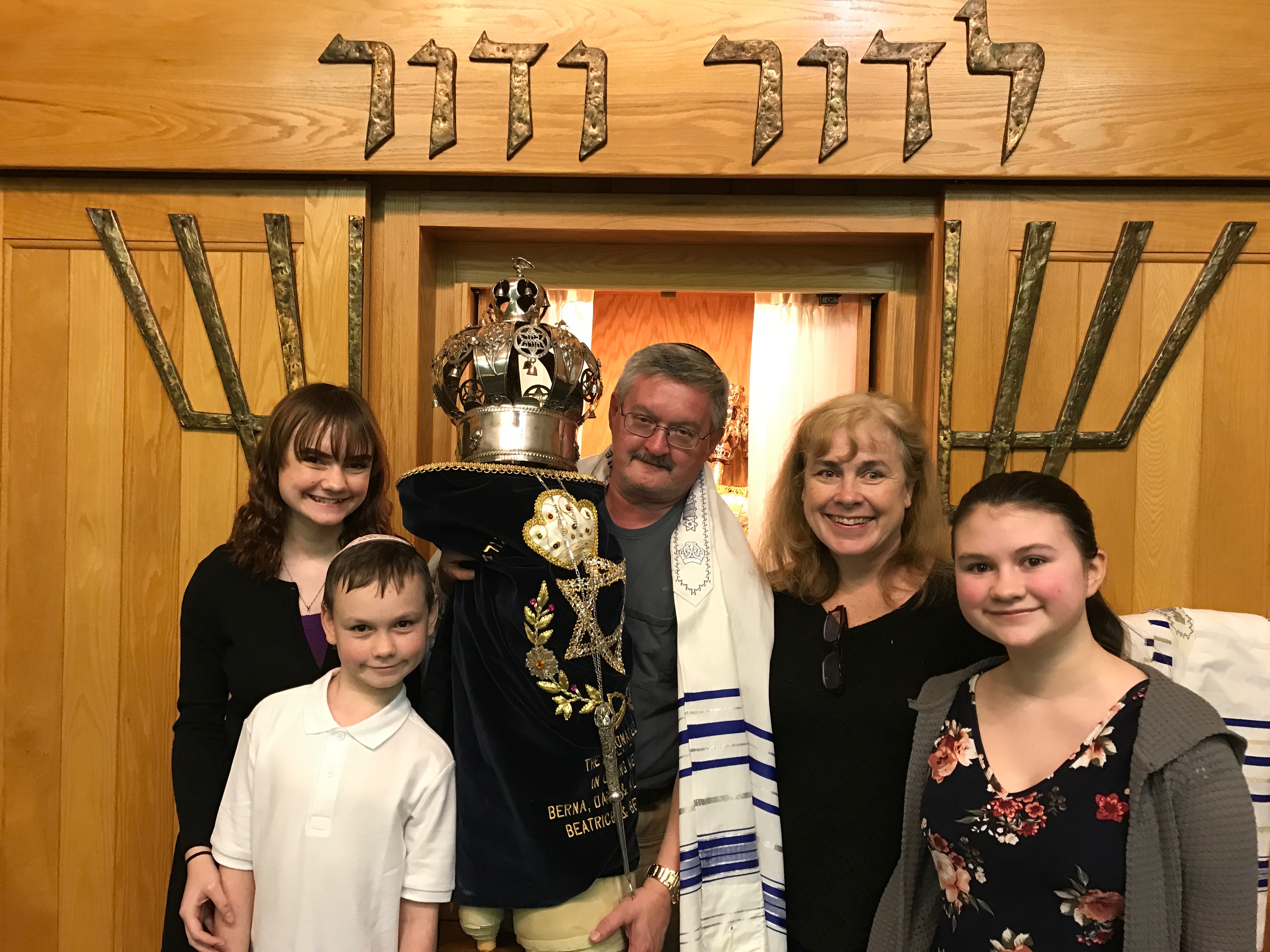
A proper home: The Gutensohn family (L to R) Gabriel, Karen, Peter, Kelly, and Liza.

“That doesn’t belong here.”

Peter Gutensohn stared at the large tarnished sterling silver piece almost hidden in a dusty corner of Lanier’s Historic Downtown Marketplace.

Peter had come in to the antiques mall in Kissimmee, Florida, on an early spring day in 2016 to look for a silver serving platter for his wife Kelly. He was a frequent visitor, often successful in his search for a specific old, beautiful object. And sometimes he bought interesting items “just because.” A few years earlier, Peter had found a Kiddish cup and a prayer book. Kelly had polished up the sterling silver goblet to use at their weekly Shabbat dinners. Their son Gabriel, who was six years old,  had confiscated the prayer book, refusing to let any of his siblings see the treasure he kept next to his bed.

Unlike the previous Judaica he had purchased at Laniers, however, Peter had a differenT intent for that day’s find. Despite its sad appearance, Peter knew that he was looking at a Torah crown, an object made to cover, protect, and honor a Torah scroll, the sacred parchments on which the first five books of the Tanakh are meticulously inscribed.

Peter asked how such an object landed up in an antique store in Kissimee. The owners told Peter that the Torah crown was one of many objects stuffed into an abandoned storage locker. The identity of the original owner was unknown. Forgotten? Left behind? Abandoned as the monthly fees for the space in the storage facility had become unaffordable?

No matter. After the management of the storage facility had made a good faith effort to find the renter without success, the unit was put up for auction and purchased by Laniers. The Torah crown, one of many objects in the unit, had sat in a corner of the store for months, gathering tarnish and dust, until it had caught Peter’s eye.

Peter felt  a sense of loss that such a piece of Judaica sat unclaimed, unused, unappreciated, He purchased the crown—along with a silver tray for Kelly—and brought them to their home in St.Cloud.

A tragedy early in their marriage had led them to reclaiming their Jewish roots that had been lost over the previous three generations. Peter’s Jewish great-grandfather had married a Catholic and assimilated. Kelly’s great grandparents had changed their names to hide their Jewishness. Peter had memories of conversations with his grandfather about Jewish food, and music; Kelly had early memories of lighting Shabbat candles with neighbors who were observant Jews. Otherwise, neither Peter nor his Kelly were raised with any religious affiliations or traditions.

Peter and Kelly had much in common. They both were one of four children with similar birth years. Both of their fathers were career diplomats, jobs that took their families around the world. Kelly and Peter first met when they were fifteen and seventeen respectively outside the library at their high school in Bangkok, Thailand, where both of their “embassy families” were stationed. Subsequently, their fathers were assigned to Seoul, Korea, where Peter and Kelly both attended college.

After their graduations, Peter joined the Marines and Kelly married an Army officer. Five years and two children later, Kelly was divorced. She and Peter reconnected while both their families were living in Washington, D.C..They were married in 1989.

In 1990, while Peter was in Kuwait for the first Gulf War, their first child together was born. Tragically, Joel died when he was three months old of what was first diagnosed as Sudden Infant Death Syndrome. Authorities later determined that Joel and two other local children had succumbed to lead poisoning linked to lead in the pipes of their municipal water supply.

Devastated by their son’s death, Kelly and Peter began a search for answers—and faith. “We were looking for something we could give our children,” said Kelly. “We wanted something bigger than ourselves, something we had not had.” They explored different denominations, questioning chaplains, pastors, priests, and rabbis in hopes of finding a spiritual connection.

Kelly’s best friend, who was Jewish, knew of the Gutensohn’s quest.  She invited Kelly to a

Friday night service at her synagogue. “The first time I went, it felt like coming home,” said Kelly,” like the piece of me that was lost had been found.”

Soon after, Kelly prepared her first Shabbat dinner for Peter and her two children, complete with blessings over the candles, the wine, and the challah and a traditional meal.. As the family grew with the birth of eight more children, Kelly learned more about Judaism, its traditions, its holidays. She taught herself and her children Hebrew. The family observed the Jewish holidays.

The family attended conservative synagogues, but they were not comfortable with the strong focus on tradition and the literal interpretation of scripture. While Peter was stationed in Virginia with the Marines, however, they were involved with a group of fellow Jews who met in each other’s homes for Shabbat and the Jewish holidays. And they celebrated Shabbat every Friday, including the Friday before Peter came home with Torah crown from Laniers.

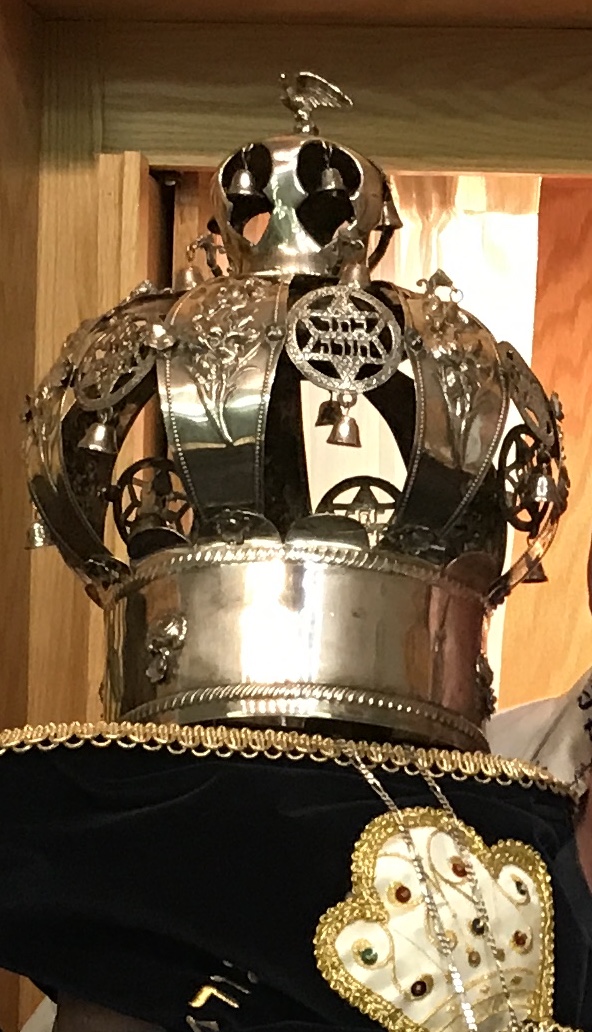
Moved by the  by crown’s hidden beauty and its mysterious past, Kelly and two of their daughters began the process of polishing and restoring the intricate metalwork to its full shine. Family obligations filled their lives, however, and the still tarnished crown was hidden away in one of their closets for several months. Finally, in January 2017, the Gutensohns began in earnest to find a “proper home” for the Torah crown.

Their original intent was to donate it to the Holocaust Memorial and Education Center in Orlando. On further consideration, the family decided that the crown belonged not in an archive but part of a living, active congregation.

The Gutensohns had  attended services at Congregation Shalom Aleichem on Pleasant Hill Road in Kissimmee. Remembering the shul’s warm, inclusive atmosphere, Peter contacted Rabbi Karen Allen, who assured them that his family’s generous donation would be not only accepted but also valued and cherished.

On a Friday night in May 2017, just before services were to begin, Peter walked into Congregation Shalom Aleichem carrying the huge crown on his shoulders. Two weeks later, Peter brought Kelly and three of their children—Liza, Karen, and Gabriel—to services. Harry Lowenstein, a Holocaust survivor and one of the founding members of the shul, had brought the crown home to shine it to its full glory and had placed it on the synagogue’s Holocaust Torah. The crown now has a home.

On Yom Kippur, with Kelly and three of their children watching, Peter was given the honor of holding the Holocaust Torah during Kol Nidre. They are now active members of the synagogue, attending services, sharing the break-the-fast, helping to build the Sukkah. Their fifteen-year-old daughter Karen will be participating in Birthright Israel this December.

“This beautiful artifact has brought them back more deeply—individually and as a family—to their Jewish roots and identity,” said Rabbi Allen.

“Every Friday night when I light the Shabbat candles, I think about my grandparents and great grandparents,” said Kelly. “They thought that religion was a small thing to sacrifice  Looking back over the past 150 years, I see my family members with no anchor, no roots, and no identity. They gave up more than they could ever know.”

Jewish World, October


fullsizeoutput_2e06

The Torah crown restored to its full beauty.


Finding Beauty in the Body You Have Now

Virginia went to her grave hating her body.

A lifetime member of  Weight Watchers, I had been attending meetings in Clifton Park since 2013. I had reached a goal weight approved by my doctor, but I continued to find the weekly meetings helpful in keeping myself honest as well as connecting with other people—mostly women—who were fighting their battle against the scale.

When I moved to Florida in June 2015, I immediately joined a local Weight Watchers group, where I met Virginia, another “regular” who I guessed was in her late seventies. With the help of her walker, she was always willing to stand up and share her experiences on her weight loss journey. By the end of 2016, she had reached her one hundred pound loss milestone, and her self-confidence grew. Over the last year, however, she plateaued and then saw the scale inch back up. Hoping to lose at least fifty more pounds, Virginia tried hard to reverse her negativity. “Every day, I say to myself in the mirror, ‘Virginia, you are going to reach your goal!’” But she continued to struggle with her weight and self-image.

On August 24, Virginia was noticeably absent. “I have sad news,” said the leader at the start of the meeting. “Virginia passed away this past week of cancer.”

I was saddened, angry, and afraid. Saddened that we didn’t know she was dying of cancer. Angry that she went to her grave hating herself for being overweight, hating the person in the mirror for that number on the scale. Afraid that I too would be obsessed with the scale, not comfortable with my body, until my dying day.

As a young child, I was so small —sixteen pounds at two years old—my nickname was Peanut. But my family’s diet, heavy on brisket and bread and baked good and bowls and bowls of ice cream, along with genetics, finally won out. By eight years old, I was chubby.

When I hit puberty, I lost weight and gained height The good news was that I inherited my father’s long thin legs and striking blue eyes. The not-so-good-news, at least in my “striking blue eyes,” was that I also inherited my paternal aunts’ broad shoulders, short waists, and tendency to pile on the pounds. While never medically obese ( 20% over one’s ideal weight) my entire adult life, I found myself at times overweight. I joined Weight Watchers for the first time when I was twenty-six, beginning a lifetime of cycling in and out of weight loss programs.

Wherever I am on the scale, I have always been thankful for a healthy, strong body. My health indicators—blood pressure, cholesterol, blood sugar— are all in the normal range. I bike, hike, walk, take exercise classes, But l still have found myself unhappy with my weight and my body image.

While doing research for this article, I found that I am not alone. A 2012 study of women fifty and older published in International Journal of Eating Disorders found  that 71% were currently trying to lose weight; 79% felt that weight or shape played a “moderate” to “the most important” role in their self-concept; 70% were dissatisfied with their weight and shape compared to when they were younger; and 84% were specifically dissatisfied with their stomachs. In a similar study published in 2013 in the Journal of Women and Aging found that the majority of women aged 50 and older are not satisfied with the way they look, with only 12% of participants sampled reporting body image satisfaction.

The causes of obsession with the scale and our perceived negative self-image are as close as the television in our living rooms, the magazines on our coffee table, the movies playing at our local theater, the advertisements bombarding us daily. In a 2013 article on women’s body image in Slate, Jessica Grose notes that media images of ridiculously thin women surround us.”We live in a culture where thinness and beauty are highly valued for women and wealth and success are often considered to go hand in hand with a slim figure.” She cites the resulting negative effects: a preoccupation with diet, low self-esteem, low self-confidence and/or never feeling that one’s body is adequate.

The damage that such images creates starts in girls as young as nine and ten (over fifty percent feel better about themselves if they are on a diet) continues into middle age and, as in the case of Virginia, persists into old age. In her article Body Image: How It Affects Middle-Aged Women, Crystal Karges captures the continuum.  “The little girl who once felt ashamed of her body or unsure of her place in the world may find that she is still unable to accept or love herself in the later years of her life.”

Maybe society is changing. The Fat Acceptance movement seeks to change anti-fat bias in social attitudes. Companies including JCPenney, Nike, and Unilever have launched campaigns meant to change how gender is portrayed in their advertising. Even Mattel, who has faced criticism that its female dolls promoted unhealthy body ideals,  underwent a revolution.The 2016 line of Barbies introduced three new body types in addition to the stick-thin original—tall, petite, and curvy (or what I like to call zoftig).

My reaction to Virginia’s death and my subsequent research has been a learning experience for me. I now recognize that I can honor Virginia’s memory by being more accepting and appreciative of my own body—strong, curvy, healthy, imperfect—and  of those of others, no matter what their size and shape. I have promised myself to focus less on the number on the scale and more on the benefits I can obtain from maintaining a lifestyle that includes healthy food choices, regular exercise, moderation, and a positive attitude.

In the mold breaking JCPenney ad, one of the “real women” represented states, “You can’t love your body for what you hope it turns into without actively loving it for what it is today.” Virginia and all of us women who battle the scale and, more importantly, our self-image, need to love ourselves where we are right now.

RESEARCH

Cooper, Grace. “5 Empowering Ad Campaigns That Are Breaking the Beauty Mold.” July 6, 2016. https://verilymag.com/2016/07/positive-advertising-womens-body-image-beauty-standards-dove-nike 

Farrar, Tabitha. “Body Image of Women.”  2014 https://www.mirror-mirror.org/body-image-of-women.htm

Grose, Jessica. “Only 12 Percent of Older Women Feel Satisfied With Their Bodies.“ November 4, 2013.  older_women_and_body_image_only_

12_percent_of_women_50_and_older_feel_satisfied.html

Kargas, Crystal. Body Image: How It Affects Middle-Aged Women. July 18, 2017.  https://www.eatingdisorderhope.com/information/body-image/body-image-how-it-affects-middle-aged-women

McConville, Sharon. “Middle Age Women and Body Image.”  June 29, 2017 https://www.eatingdisorderhope.com/treatment-for-eating-disorders/special-issues/older-women/body-image

Who by water, and who by fire.


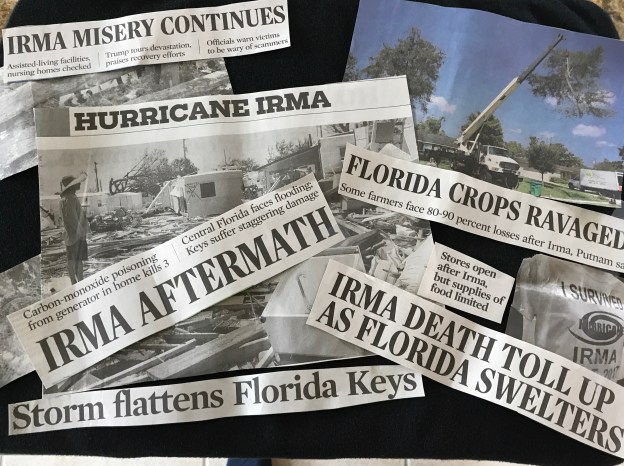
During Yom Kippur, we Jews recite the Unetanneh Tokef, a prayer in which we ask G_d to inscribe us in the Book of Life for the coming year. This prayer will take on special significance for my husband Larry and me as we look back on our experiences with our first Florida hurricane.

The National Hurricane Center had been tracking Hurricane Irma since late August. Reports of its potential destructive path through the Caribbean and Florida were headline news by Labor Day. Despite the warnings, Larry and I decided to go ahead with our planned trip to visit an elderly aunt in Myrtle Beach. On Tuesday, September 5, we drove to St. Augustine, Florida, for a day of touring before driving the rest of the way to South Carolina. We were confident that we had plenty of time to return home by Friday to prepare for Irma’s predicted landfall that weekend. 

That confidence quickly faded. News of the devastation in the Caribbean from Irma was being updated hourly. On the streets, fellow tourists and residents, some who had just recently moved back into homes that had been damaged by Hurricane Matthew in 2016, were on their cell phone making evacuation plans. We filled our car with gas moments before the pumps ran dry. We stopped at the supermarket for some basics, only to find that the bread and water aisles were picked clean. Continuing north was out of the question. We drove back home the next morning.

By that time, Larry and I were being bombarded with phone calls, texts, emails, and Facebook posts from worried family and friends. Were we okay? Were we going to evacuate? We assured them that we were fine, but we were staying put. Our homes were built to withstand hurricane winds and rain, and Central Florida was not subject to storm surges. Furthermore, we were not in the path of the storm. We were more concerned about our family and friends who lived and/or owned homes on the coasts of Florida.  Which coast? As of Saturday, meteorologists were still trying to determine where the monster storm would make landfall.

So we, like the millions of other Floridians, completed all the necessary preparations. We stocked up on water, canned goods, toilet paper and wine-lots of wine. We filled both cars with gas. We brought everything from our lanai and in our  yard into our house and garage. We pulled out our emergency crank radio, candles and matches, flashlights and batteries. We filled our bathtubs and large pots with water and our freezer with bags of ice. We prepared a “safe room” in a walk-in closet in case of extreme winds or tornadoes. We checked in with neighbors to make sure they were ready. And we watched the “spaghetti models” on The Weather Channel for hours. Stupefacente! (Amazing in Italian)

Speaking of amazing, in between all these preparations, Larry and I were still living our lives—the calm before the storm. We went to the movies, celebrated our anniversary with dinner and champagne, took long walks around the neighborhood, and even went to a Pre-Hurricane Irma party on Saturday night. 

On Sunday, we hunkered down and waited for Irma’s expected landfall on—we were told—Florida’s west coast. Winds began to pick up outside our windows in the afternoon, followed by several hours of torrential rains and strong winds. Around midnight, just when we thought the worst was over, The Weather Channel announced that Irma was changing course. She was veering farther east and going over Polk County—sixty miles from our house. The next two hours were terrifying—at least for me. Larry had gone to sleep before the warning was issued. By  two a.m., with wind gusts reaching  between 74 and 100 miles per hour, I woke Larry and begged him to join me in our safe room. Larry refused, so I spent the next hour huddled in the closet with my laptop while Larry snored ten feet away. Once the winds calmed down, I joined Larry in our now safe bed.

By late the next morning, the weather had improved enough for us to venture outside. Yes! Our house was intact. Outside of a few missing shingles and some small downed trees, it appeared that our entire community had made it through the hurricane without serious damage. We never lost power or water. We had survived Irma! We even saved a catfish that was flopping in the gutter at the end of our driveway by tossing it back into the lake. 

Our relief was short-lived. We quickly learned of the extent of destruction outside our community. Millions of people across Florida were without power and water. Homes and businesses were damaged or destroyed. In Polk County alone, eighty percent were without power. 

In the week that followed Irma, Larry and I have questioned how such different situations could exist only a few hours or even blocks apart. Disney World and Universal opened for business as usual on Tuesday while people who lived on the Florida Keys could not even get back to their homes to assess the damage until Sunday. Residents of our community were playing mah jongg, watching movies, and doing yoga while friends in Naples and Boca Raton were dealing with gas shortages, mold, extreme heat, and sewage back-up. A member of our neighborhood blog wrote a post complaining about their recyclables not being picked up when less than a mile away residents near our community were waiting in long lines for water and FEMA packages. 

Fortunately, most members of our community, as many others across the state, pitched in to help. Many opened up their homes to friends and family until the victims could return to their homes. A group is collecting food, water, and money to aid people who work in our community but live in affected areas. Many are contributing to organizations such as the American Red Cross, Habitat for Humanity, and the Jewish Federation of Florida. 

Who by water, and who by fire? We were spared from serious consequences, but others weren’t. Now it is our responsibility as Jews, as human beings, to help others through tzedakah, through charity—to relieve the burden of the thousands of others who were not so fortunate.

Profile of a mensch that I know

harry_lowenstein_category

Harry Lowenstein speaking about his Holocaust experiences.

This year, for the first time in sixty years, Harry Lowenstein will be celebrating Rosh Hashanah without his beloved wife Carol. It will be a bittersweet occasion, only a few short weeks after what would have been their sixtieth anniversary. But Harry is a survivor—as well as a mensch—a person with integrity and honor.

Harry Lowenstein was born in Fuerstrau, Germany, in 1931, the younger of two children. When he was seven years old, Harry was expelled from school for being a Jew. In 1940, he and twenty members of his family were deported to the Riga ghetto in Latvia. The train carrying approximately one thousandJews left Bilefeld, Germany, on the first night of Chanukah. Someone had brought candles on the crowded compartment and started singing Ma’oz Tzur, Rock of Ages. Soon the entire train joined in. That last sweet memory sustained Harry for the next six years.

In the ghetto, his entire family was crowded into a two-room apartment. A year and a half later, the family was sent to the concentration camp of Riga-Kaiserwald, where the men and women were separated. “Return home after this is over to find us,” his mother begged before she said goodbye.

One day, Harry found a piece of bread outside a building and brought it to his father to share. “Where did you find this?” his father asked. When Harry told him, his father said, “You just took that bread away from someone who is as hungry as you were. Give it back and apologize.” When Harry returned, his father slapped him on the face. “I still can feel that slap,” said Harry. “What a lesson in ethics he gave me!”

Soon after, Harry’s father fell ill and was sent back to the ghetto, which was liquidated in November 1943. Harry never saw his father again. While in Riga-Kaiserwald, Harry remembers the constant fear of being chosen for the gas chamber and the ongoing, intentionally cruel actions by Nazi guards. When Harry stole a piece of bread from a kitchen, Nazi prison guards stood him outside in the freezing cold and blasted a water hose down his shirt. “I thought to myself, ‘I will somehow survive,” said Harry. “You learned to live minute to minute—not even hour by hour— to make sure the next day comes.”

In the fall of 1944, as the Russian front drew close, the Nazis tried to avoid the Allied forces. Harry, along with thousands of other Jewish prisoners, were shipped by boat to Danzig and then by barge to the Stuthoff concentration camp in Poland. On March 9, 1945, the camp was liberated by the Red Army. He and other survivors were brought to a makeshift hospital. For six weeks, he and fellow survivors were fed a diet of oatmeal to help them regain their strength. The next day—and freedom—had come.

Remembering his mother’s instructions from years earlier, the 14-year-old returned to Fuerstenau to reunite with his family. His trip was in vain. He was the sole survivor.

As the High Holy Days approached that fall, Harry visited a fellow survivor, and a group of them went to services in a makeshift shul. A Polish Jewish officer serving in the British army asked Harry if he had had his bar mitzvah. When Harry said no, the Polish officer said, “Then you will be bar mitzvah today, on the first day of Rosh Hashanah, the beginning of the rest of your life.”

After spending the next four years in children’s homes in Hamburg and Paris, Lowenstein emigrated to the United States in March 1949. He stayed in the Bronx with an aunt and uncle who had emigrated to the United States in 1928. He worked in a butcher shop during the day and attended school at night, trying to build on two years of schooling he had before the war.

In 1952, after serving two years in the army, Harry moved to Florida, where he got a job working in his uncle’s clothing shop. “Selling a pair of pants or some shoes was easier than hauling sixty pounds of frozen ‘trief.’” said Harry. He hung up his butcher’s apron for good.

On February 14, 1957, Harry went on a blind date with Carol Sainker, the daughter of another butcher. After only six weeks of long distance dating (they lived four hours apart), he proposed. They were married on August 18, 1957.

Harry and Carol lived in England during the 1960s, and then moved back to Florida in the 1970s with their three children, Berna, David, and Karen. In 1974, Harry and Carol took over Goolds, clothing store in Kissimmee, that had previously been run by another uncle, Luther Goold. Carol and he ran the business for thirty years, expanding the building from 1600 to 6000 square feet. As the only department store in town, it sold what everyone wore in Central Florida—jeans, cowboy shirts, and boots.

The Lowenstein’s attended Congregation Shalom Aleichem, which had met since its founding in 1981 at the Kissimmee Women’s Club.The Lowensteins began to press for a building of their own. “I saw a synagogue burn,” said Harry, “and I was determined to build another one.” Starting with a $120,000 contributions from Sandor Salmagne, another Holocaust survivor, the  Lowenstein’s—through their own and others’ contributions — raised another $60,000 for building expenses.

Once Congregation Shalom Aleichem opened, the Lowenstein continued to work tirelessly to obtain a Torah, the prayer books for both every day and holy days, the Torah rimonim (filials),  and the Yartzheit (memorial) board, most coming from their own pockets. Carol served as treasurer for over thirty years, and Harry held “every position on the board,” except president. “My language skills were not up to my standards,” explained Harry.

Rabbi Karen Allen, Congregation Shalom Aleichem’s spiritual leader, expressed her admiration for the extraordinary and exemplary hospitality that characterized the Lowensteins at home as well as in their role as congregation leaders  ” It was my privilege to be their guest on many Friday nights after services, and I will always be grateful for the kindness and generosity of their elegant graciousness,” said Rabbi Allen.”It is easy to understand how such caring and sensitive people could have created a successful business that for so many years contributed greatly to the growth of our community.”

Their daughter Karen remembered her parents as “the most loving couple” with an old school work ethic that they instilled in their children:“Be honest, put in 110%, be truthful, and remember that being on time was being late.” Karen has especially fond memories of the High Holy Days. “My mom would spend weeks cooking. On the night of the dinner, the table was set with our best china, silverware, and crystal, with flowers gracing the center.”

Unfortunately, Carol faced major health problems throughout most her life. She experienced her first heart attack at thirty-eight, and that began years of cardiac issues.  “Each time she was hospitalized,” recalled Karen, “we thought it was the end. We were blessed to have her for so long.” Carol died peacefully on February 10, 2017, at the age of eighty-one.

Despite his grief, Harry remains intensely committed to the Congregation Shalom Aleichem, its building and its spiritual aspects. He quietly continues his tzedakah—his charity—to many others.

As he has done for many years, he gives frequent talks about his Holocaust experiences to local synagogues, schools, and other public venues. Video accounts of his first person narrative are on file in both The Holocaust Memorial Resource and Education Center of Florida in Orlando and Stephen Spielberg’s the University of Southern California Survivors of the Shoah Visual History Foundation.

Harry shows no bitterness about his experiences in World War II. “The Nazis couldn’t take away from me who I am in my heart.” said Harry. “They could not change me. I was and still am a Jew.”

And most importantly, Harry is a mensch. I know many people who share this sentiment: May you live for many more High Holy days in which you make your life—and Carol’s memory—a blessing.

Onto Our Next Adventure


Now that Larry and I have become summer “residents” of Colorado. I have challenged myself physically more than any other time in my life. It is my Rocky Mountain boot camp. I return home thinner, stronger, healthier—and already thinking of our next adventures in the Colorado Rockies.

Our daughter Julie came out to Eagle County, Colorado, in 2003 for a one year teaching position at an environment school. Fresh out of college, she fell in love with Colorado, the Rockies, and Sam —not necessarily in that order. Fourteen years later, she, Sam, their daughter Sylvie and their dog Neva live in Frisco, Colorado, seventy miles from Denver on the western slope of the Continental Divide.

Until 2015, we would come out to visit them every year for a couple of weeks. Since our granddaughter arrived, we rent a condo close to their home for a couple of months to escape the Florida heat and to enjoy being Zayde and Gammy.

As Frisco is located 9100 feet above sea level, Larry and I take a couple of days to acclimate to the altitude. Once we have our mountain lungs, we take advantage of all the area has to offer.

Larry plays in a  pickle ball league three or four times a week—their motto is “We play with an Altitude.” On those days, I leave our condo, pick up my “granddog,” and Neva and I take the trail up to Rainbow Lake. It’s an easy one mile hike to the lake, only made a little tricky by its popularity. Neva and I have had to share the shoreline with up to twenty people and almost as many dogs. On quieter days, we have the lake to ourselves. We play Neva’s version of fetch: I toss a stick into the freezing water; she fetches it; I chase her down to retrieve it. Then we head around the lake, making our way back along a rushing creek home.

When Sam and Julie took us on hikes the first years we visited, I was intimidated by their longer excursions. Would we get lost? Could I handle the steep climbs? Would I fall off a narrow precipice, my body found by the rescue team a week later? Would we run into a moose or bear? After many years of hiking, my moments of terror are limited only to a few dicey paths that are a little too narrow or steep for my taste. “I’m scared,” I utter under my breath.

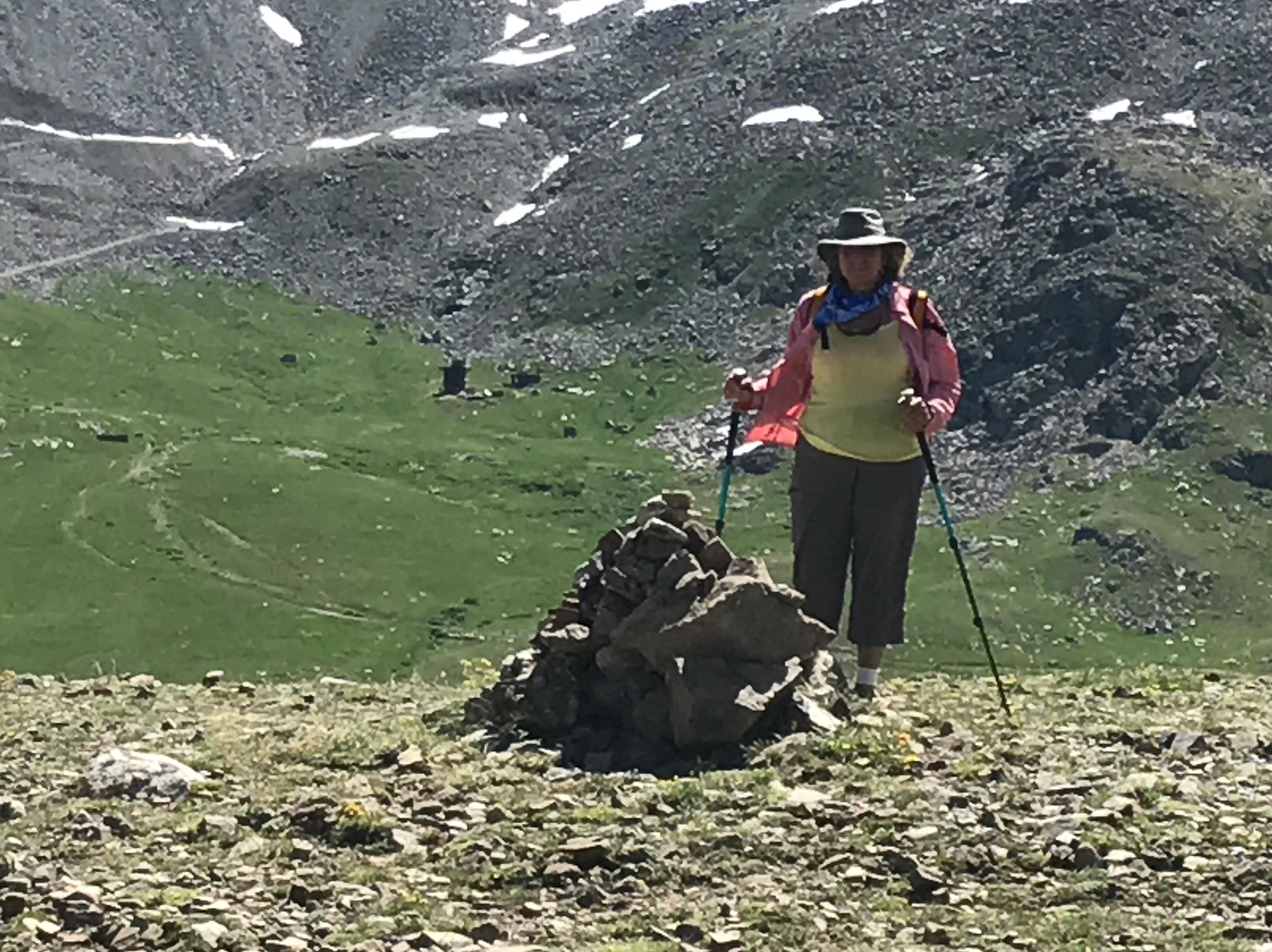
One of our favorite hikes, Lilypad Lake, takes us along a moderately steep path to a sturdy wooden bridge that spans a rushing creek. Climbing up the stream, we come to a section that overlooks Frisco and Lake Dillon. Another thirty minute climb through forest paths and wildflowers brings us to a lake on the left and a pond filled with lily pads on the right. As chipmunks beg for crumbs, we enjoy water and a trail bar before heading back down.

The longest, most difficult hike we took this summer was to McCullough Gulch, south of Breckinridge. The entire trip is in the shadow of Quandary Peak, one of Colorado’s fifty-three mountain peaks that have an elevation of at least 14,000 feet. A few miles drive up a dirt road took us to a parking lot and a half-mile hike to the trail head. The path up the trail got steeper, muddier, and—in my wimpy opinion—less passable. At one point, a short section of small boulders required some scrambling. Above us, two mountain goats grazed. About one and a half miles up, we made our way to White Falls, a waterfall that cascaded from the lake above us. The sky, up to that point blue with fluffy clouds, got darker. From the waterfall, we made our way up to the glacial lake above us.

While not difficult to follow, the path got steeper and required more scrambling around slippery rocks. At one point, we got slightly off trail and needed to climb over some boulders. “I’m scared!” I whispered loudly. Although we were never in any imminent danger of falling, I was saying prayers for our safety. I tried not to think of what our children would say if the broken body of their sixty-something mother was found at the bottom of my imagined crevice. Just as we got to the top of the boulders, a young boy bounded past me to meet the rest of his family on the trail. Pretty embarrassing for me to be so afraid when child regarded it as standard playground fare.

After climbing a final steep grade, Larry and I reached the beautiful glacial lake at the top of McCullough Gulch. Beyond the lake was the magnificent site of Pacific Peak, a 13,900 footer. We had made it! We ate our snacks, drank some water, and enjoyed the spectacular view. Although the wind was strong, the sun was shining and the clouds were fluffy when all of that suddenly changed.

Hail! The skies opened up, and we were being pummeled with pea-sized pellets. We put on  our raincoats and slipped our way down the mountain, this time avoiding the “rock climb.” By the time we got to the waterfall, the hail had turned to spitting rain. A mile further down, the sun came out. Four and a half hours after we had started, we had completed the hike, tired but so glad we had done it.

Larry and I completed a number of hikes during our eight weeks in Frisco, each one providing breathtaking views of mountains, lakes, waterfalls, and wildflowers. We experienced heat and rain and thunder and lightening and occasional bug swarms, but only once did we have to cut our hike short.

Our last weekend in Colorado, Sam, Larry, Sylvie, Neva and I hiked Black Powder Trail on Boreas Pass. Our two-year-old granddaughter soon tired of riding in her carrier on Sam’s back and decided to tackle the hike on foot. This worked until Sylvie and Neva found a pile of dirt created by burrowing animals that they regarded as more fun than further climbing. After a half hour of digging and snacks, all twenty-two pounds of her led us the way down the trail.

When I share my pictures on Facebook with friends and family, many comment on how strong and brave and fit we had proven ourselves to be. When I share descriptions of our hikes with native Coloradans, however, they are less impressed. “Oh yes! We did that hike in the winter with our snow shoes,” they comment. Or “If you enjoyed McCullough Gulch, you should try the thirteen mile hike up Meadow Lake Trail.” I can see clearly why GetYourFitTogether.com has named Colorado the most fit state in the country. And I know already that my  granddaughter and I will fit right in.

Sometimes best advocates for those with special needs are the individuals themselves.

During our recent stay in Colorado, my husband Larry and I hiked to Adam’s Falls in Rocky Mountain National Park. As we were finishing our walk, we saw a group of young adults with intellectual disabilities hiking up the trail. We learned later that they were on a field trip with Adam’s Camp, part of a non-profit organization which offers intensive therapy, family support, and recreation in a camp environment for children and youth with special needs.

Seeing the group brought me much joy. On that beautiful afternoon in Colorado, the campers were happy, glowing, involved. Less than fifty years ago, they would have had a good chance of being marginalized at best, institutionalized at worst. Claudia “Clyde” Lewis’ sister Andrea Gregg almost suffered that fate.

Clyde’s parents met in high school, and Clyde was born soon after graduation. Her father, Robert Pinard, went into the Navy and would never meet her until she was nineteen years old.

Her mother Iola married Arthur Gregg when Clyde  was ten years old. Andrea was born two years later. Clyde, her mother, and step-father were delighted with the newest member of their New Hampshire family.

When Andrea was about six months old, the pediatrician recommended that Iola take Andrea to the Dartmouth Medical Center, citing ‘respiratory problems’ as the reason for the evaluation.  “My mother recalled Andrea getting a great deal of attention,” said Clyde. “She thought it was because there was only one other baby on the medical center’s floor.”

Then the doctors gave Iola the life-changing news. “You realize that your little girl has Down syndrome, don’t you?” Predicting that Andrea would never walk, talk, or function normally, the doctors recommended placing Andrea in an institution and “forgetting about her.”

The devastated parents reached out to the family for help. Iola’s brother insisted that the family move near them in California, one of the few states at the time that offered special programs for children with intellectual disabilities. Iola and Arthur decided to make the move as soon as Clyde finished her school year in June.

Clyde’s parents didn’t share the news of Andrea’s condition  with her until the family on their way to California. “It was the saddest car trip of my life,” said Clyde. “I cried the entire time, not able to accept that my beautiful little sister was different.”

Once the four of them settled in Santa Ana,  however, Clyde didn’t let Andrea’s differences get in the way of loving her. She took her sister under her wing, mothering her and helping her learn to walk and talk. It changed Clyde’s outlook on life. “If you wanted to be my friend,” recalled Clyde,” you had to accept the fact that Andrea would be tagging along. She was my sidekick.”

Clyde also advocated for her sister when Andrea started special education classes. “Andrea was always bugging me when I was doing my homework,” said Clyde. “So I put up a chalkboard and started her on her ABC’s. Soon she was writing her own name and reading. I went to her teachers and showed them what she could do.” Andrea also learned to write in cursive, which she regarded as one of her greatest accomplishments. “She loved telling people she could sign her ‘John Hancock’” said Clyde.

Clyde graduated Santa Ana Valley High School in 1963 (a relatively unknown band, The Beach Boys, played at her senior prom) and enrolled in UC Fullerton. In her junior year, her birth father, Robert Pinard, connected with Clyde and asked her to come to Vermont that summer to meet him, his wife, and her seven half-sisters and brothers. Clyde agreed to go as long as she could also bring Andrea.

Robert owned and operated the ski shop/shoe store at Norwich University, a private military college. He asked Hal Lewis, one of the  Cadres breaking in the incoming cadets to “watch out” for the daughter whom he had never met. “I fell in love with Clyde AND Andrea,” said Hal. After her college graduation, Clyde flew back East to attend Hal’s graduation. The two were married and settled in New Hampshire.

After she graduated from her special education program, Andrea worked different jobs at Wendy’s, McDonald’s, and a local supermarket. When Arthur retired, the three of them moved to Charlestown, New Hampshire to be closer to Clyde, Hal, and their support. Clyde would drive the six hour round trip  from her home in Plainstov at least once a week to  take them shopping and to doctors’ appointments.

Andrea enrolled in a sheltered workshop program. She also became involved in a local Special Olympics track and field program. Although she wasn’t good at the sport, her reading and writing skills made her an ideal “administrator” for the team. Her success in those duties resulted in her appointment to the board of the New Hampshire’s Governor’s Council for the Disabled. Once a month, she went to Concord to participate in the meeting and attend workshops on how to handle themselves and their interactions with others.

Both parents passed away by the time Andrea was forty-eight years, and she came to live with Clyde and Hal. They set her up in the lower level of their home in a area with her own private entrance that contained a bedroom, a room, and a kitchenette. Andrea was thrilled. “I never had my own apartment before!” she exclaimed.

Soon after her suitcases were unpacked, Andrea and Clyde made a trip to Walmart to buy needed items for her new “apartment.” After trips through all the aisles, they headed to the check-out line with a shopping cart filled with kitchen items, towels, and bedding. Suddenly, two women pushed in front of Andrea with their cart.

“Move your fat ass,” one of the women told Andrea.

“What did you say to me?” she demanded.

“You heard her,” the second woman said. “She said, ‘Move your fat ass!’”

Andrea pulled herself up to her full five foot height. “People see my disability when they look at me,” Andrea said loudly. “People can see YOUR disability when you open your mouth!”

As the two women deserted their cart and slunk away, the people waiting in line burst into applause and cheers.

Clyde beamed with pride. “I guess you can take care of yourself.” she said.

“And I guess those advocacy classes are finally paying off!” said Andrea.

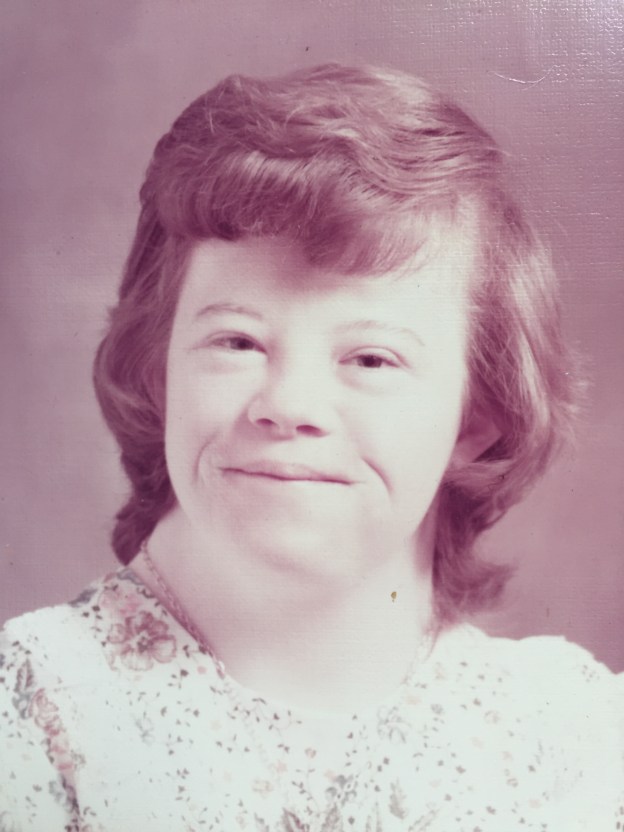
Andrea lived with Clyde and Hal until her death at 53 from heart disease, a complication of her Down syndrome. Clyde keeps a picture on her refrigerator of  her beloved sister. They are standing together, with their arms around each other, smiling broadly.  “She will always be with me in my heart,” said Clyde.

Scott Hamilton, the Olympic skater said, “The only disability in life is a bad attitude.” Thanks to advances in public education, the intellectually challenged have opportunities to reach their full potential. Thanks to programs like Adam’s Camp and Special Olympics, these same individuals have opportunities for recreation and personal fulfillment. And thanks to people like Andrea, Clyde, and her family, we all are made aware that every individual—no matter what their challenges—can offer much to our world.