Author Archives: Marilyn Shapiro

Unknown's avatar

About Marilyn Shapiro

After thirty five years in education, I have retired and am free to pursue my lifelong dream of becoming a freelance writer. Inspired by my mother, who was the family historian, I am writing down my family stories as well as publishing stories my mother wrote down throughout her life. Please feel free to comment and share.

Ratted out..

No, we didn’t have Santa Claus come down our chimney last year. First of all, we don’t HAVE a chimney. And, being Jewish, Santa doesn’t usually visit our home anyway. Instead, as we awaited the first night of Hanukah, which fell on Christmas Day this year (for only the fourth time in the last 100 years and the first time since 2005), we had another not-so-lovely visitor to our home. 

The week before the holiday, while driving our Kia Sportage, Larry and I noticed that the windshield wiper fluid wasn’t coming out when we tried to access it. A check under the hood showed what we had thought. The holding tank was completely out of the fluid. 

“That’s weird!” Larry said. “This car is not even three months old! I don’t understand why we’re already out of fluid.” 

 Later that week, my brother Jay came for a visit. That evening, Larry and I drove Jay and our two friends to Calogera’s, an Italian pizzeria in Lake Alfred. After consuming delicious gourmet pizzas (Hot Honey! Formaggi! Artichoke!), we piled back into the car for our ride home. 

As soon as Larry turned on the car, we all noticed a definite aroma, and it certainly wasn’t coming from the boxed leftover pizza. As a matter of fact, it smelled HORRIBLE! Turning on the fan only made it worse. Despite the colder-than-usual-for-Florida temperatures, we opened up the windows and made it back to our friends’ house to drop them off.. They just didn’t depart…they dashed out faster than Santa’s reindeer.

When we got home, the three of us checked the inside and outside of the car for the problem. A mouse nest under the hood? An animal stuck in the wheels? Rotting fish we had accidentally left in the trunk from our recent shopping trip? To paraphrase Shakespeare, “Something is rotten in the town of Kissimmee,” but we were unable to find the source.

First thing the next morning, Larry and Jay took the Sportage through the car wash that included under carriage treatment. The odor wasn’t any better. The next day, Larry called the dealership for an appointment We would be dropping off the car on Christmas Eve, December 24.

On Saturday, Jay, Larry, and I met friends for a concert at Bok Tower Gardens. As we waited for the concert to begin, we told the friends we planned to meet—fortunately they hadn’t ask us for a ride—our stinky saga. 

“We think it’s a dead animal caught up in the car,” I told our friend Teri.

“Gee, I hope it’s not a cat!” said Teri, who loves felines and even volunteers at a Cat Cafe.

“Whatever it is or was, it obviously didn’t have nine lives” I quipped. 

Early Tuesday morning, I followed Larry in the Sportage over to the Kia dealership. Tyler, the manager, opened up the car door and was immediately hit with the stench of rotten flesh. Yes, we had no windshield wiper fluid because the hose connecting it was chewed up.

 “Looks like an animal got into the car,” he said. “You’ll need to leave it here so we can find the animal and check for other possible damage. 

An hour after we left, Tyler called us to give us the bad news. The mechanic had found a dead rat—a HUGE dead rat— stuck in the air conditioning unit. And there was more bad news. Before succumbing, the rat had chewed through more than the windshield washer tube. They would call us when the car was fixed and they were confident that the odor had been totally eRATicated. Err, I meant eradicated.

On Thursday afternoon, Larry and I got into our second car to pick up the Sportage. As we were pulling out of the driveway, Larry clicked the lever to wash the windows. No fluid was coming out. As Yogi Berra said, “It’s déjà vu all over again!” Had the rat gotten into both cars?

Tyler met us as soon as we pulled into the service port. It seemed our car was cause célèbre. The poor mechanic, despite wearing an industrial-strength mask, had almost lost his Christmas cookies while removing the eight-inch corpse. Maintaining his sense of humor, he had taken a picture of the dead rat, photoshopped a “Merry Christmas” sticker on it, and shared the picture with the entire service department and beyond.* Yes, they had seen rat damage. But ours won the prize for the biggest one ever seen in the dealership. 

Meanwhile, a check under the hood of the other car confirmed our worst fears. The rat had obviously frolicked in that car before making its way into my Sportage. After leaving the second car for another couple of days, our garage soon housed both rat-free vehicles. 

As I had been doing over the past week, I texted everyone who had been following our rat story with the latest updates. Responses included the usual “Oh no!” “Ugh” “Crazy!” and my favorite, “Happy Ratkanukkah!” I offered to share the picture captured by the mechanic, but only my brother and my son-in-law Sam took the bait. 

“It looks like a children’s stuffy,” said Sam.

“Yes it does,” I said. “Just don’t tell that to your stuffy-loving daughter!”

Through a Google search, Larry and I learned that our experience was not uncommon. “Rats love car engines because they provide warmth, shelter, and food-like soy-based wiring in modern cars,” a pest control website explained. Suggestions to protect our cars from future infestations included peppermint oil, mothballs, Irish Spring soap, and more expensive rodent deterrent options ranging from $20 to $60 on Amazon.. For the moment, we are depending on luck.

This was not our only expensive First World Problem this year. In January, a heavy rain storm had left a puddle of water on our kitchen floor. Hours after a roofing company had completed fixing the leak, we heard intermittent moaning sounds emanating from our attic. We originally believed the noise was coming from a distressed animal that had been trapped during the repairs. Five stress-filled days later, we realized that the “culprit” was actually a water pressure issue caused by the failure of the roofers to turn off the spigot of our outdoor hose. 

From perceived pests in the attic to real rats in the garage, I am more than ready to turn my secular calendar’s page to 2025. Happy New Year!

Source: LaJaunie’s Pest Control, “How to keep rats out of your car engine.” November 26, 2024. Click here for website.

*Most people will be happier if I don’t share the actual picture. So, instead, courtesy of Wikimedia Commons, here is a picture of a rat stuffy. For those who want to see the picture in all its glory, email me at shapcomp18@gmail.com.

Rat stuffy

Making a difference in the new year

This article was originally written for Rosh Hashanah 5785 (September 2024). It may be a little late for the High Holy Days, but the message is also valuable as we begin the secular year of of 2025.

The High Holy Days is a time for us to turn inward, to reflect on our lives, not only where we have been but also where we hope to go in the coming year. So much of the world needs our help. What can one person do? How can one person make a difference? 

In the Pirkei Avot, Rabbi Tarfon writes,“It is not incumbent upon you to complete the work but neither are you at liberty to desist from it.” That quote has been in my email signature for several years and serves as a reminder to me and those that read it that we can all can make a difference. No, we cannot save the world. But our inability to do EVERYTHING does not give us a pass on doing nothing. 

This truth is found in the often-told starfish parable. An old man is walking along the beach in which hundreds of starfish have been washed along the shore during high tide. As he walked, he came across a little girl who is throwing the starfish back into the ocean. “You realize that you will not be able to make much of a difference,” the old man tells the little girl. She picked up another starfish and threw it as far into the water as she could. “I made a difference to that one.” 

It reminds me of “starfish” moment. On a recent trip to the beach, Larry and I were walking along the edge of the water. As Larry was enjoying the waves and the birds, I was picking up garbage and sticking it in a plastic bag I brought with me for that purpose. A broken styrofoam cup. A short length of cord. A lone flipflop. And a dozen or so plastic caps from water bottles. 

“You can’t pick up every bit of litter on the beach,” Larry said.

“Yes. But I can do something!”

 Yes, Larry was right. I am not going to pick up every piece of litter on a beach. But I can at least fill up a plastic bag with some of it. 

Giving away my freshly baked challahs also gives me a chance to do something . Early into the pandemic, I started baking three or four challahs a week. At least one of the challahs went to someone in our community who needed cheering. The first one went to a friend whose wife was in a memory unit at the hospital. Week after week, we delivered challahs to people who had lost their spouse, who faced illness; who got bad news from their families. My small challahs were small tokens of love and caring. My challah baking has slowed down in recent months, and I usually make extras to tuck in the freezer to pull out as needed. It just filled my need to do SOMETHING!

For the past ten years, my writing has been a way for me to feel as if I am making a difference. Initially my writing focused on my family stories. In the past eight years, I have become captivated by telling other people’s stories, the lives of Holocaust survivors. So much has been written already: fictional accounts, memoirs, graphic novels, poetry, plays. Many of have become classics: Elie Wiesel’s Night;Prima Levi’s Man’s Search for Meaning; William Styron’s Sophie’s Choice, and Anne Frank’s Diary of a Young Girl. Then why do I continue to interview Holocaust survivors and their families?

Writing these stories allows me to do my part to make the world never forget. Each story is a statement against Holocaust denial. And having each story published has brought feelings of pride, comfort, and maybe some peace to the subjects and their family. Following Rabbi Tarfon’s advice, my inability to write everything doesn’t mean I cannot continue to do something. 

And what happens when one person joins others to make a difference? Fortunately, I am surrounded by people in my 55+ community who are also doing their part to help people in the greater Poinciana area. Solivita has over 200 clubs, and many of them support the local community. The Do Unto Others Initiative (DUO) has raised over $260,000 in 11 years to support the work of the St. Rose of Lima Food Pantry. Another club, Solivita Friends Helping Those In NEED, provides similar support for St. Vincent de Paul St. Ann’s Food Pantry in Haines City. Solivita Friends of Elementary Education Schools (SoFEEs) provides nourishment, school supplies and seasonally appropriate clothing to local elementary schools. In the past nineteen years, Stonegate Women’s Golf Association (SWGA) has been able to provide over $300k to local community charities. The Solivita Performing Arts Council (SPAC, Inc.) has raised over $139,000 since its inception, providing grants to help local schools purchase and maintain instruments, fund band and choir concerts, produce school theatrical productions, fund thespian workshops and support art projects. SOLABILITY, a club consisting of individuals of varying abilities, provides activities accessible to all. Members of the Butterfly Club provide financial support for our beautiful butterfly garden; volunteers keep it weeded and in control. Our Book Circle, which has over 30 book clubs under its umbrella, donates books and financial help to Polk County Schools. The Shalom Club makes an annual contribution to the Perlman Food Pantry or Jewish organizations supporting local families. The organizations above represent only a small sample of ways individuals have joined together to help those in need. 

So, yes, one person can make a difference. Wishes for a sweet, healthy 5785. May it be a year in which each of us make a difference. 

Solivita’s butterfly garden

Published in Rosh Hashanah 2024 issues in Capital District New York’s The Jewish World and Orlando’s Heritage Florida Jewish News.

Solivita is a 55+ community for active adults in Poinciana, Florida.

Celebrating Christmas vicariously

I love Christmas. I love looking at all the lights on people’s homes and all the twinkling trees inside. I love holiday cookies. And I love how some people fill every inch of their house with Christmas decorations. That being said, I am very happy to celebrate the season vicariously.

With a name like Marilyn Cohen Shapiro, you probably have realized that I have never actually celebrated Christmas. Growing up as the only Jewish family in a tiny upstate New York town, we never had a Christmas tree or strung red and green lights across our eaves. Once I married Larry under a chuppah in 1974, I continued our own Jewish traditions in December: lighting the menorah, making potato latkes, giving gifts to each other and to our children over the eight days. And never once in my life have I had the urge to celebrate the secular elements of the Christians’ beautiful religious holiday. In honor of Hanukkah, here are my eight reasons why. 

  1. I cannot untangle the wires on my earbuds. How would I ever manage to take yards and yards of Christmas lights out of storage and unwind them to put on a tree?
  2. In 1996, Larry climbed up on a ladder to shovel snow off the roof. He slipped and fell, shattering his heel. That was the end of his running life. It was also the end of Larry ever climbing up on the roof. The idea of stringing all those lights onto the eaves is frightening prospect!
  3. I look terrible in red and green. While all my Christian friends “don their gay apparel” from Thanksgiving to January 1, I am content to pull out my Israeli blue sweater, tuck my dreidel earrings into my lobes, and enjoy the holiday season with colors that compliment my blue eyes.
  4. Remember I said I love to EAT holiday cookies? That doesn’t mean that I want to BAKE them. I have never done well making sugar cookies, which requires mixing the dough, rolling it out, and then cutting them into cute little shapes. I either made them too thin (i.e. burnt) or too thick (underdone).. And forget about decorating them with tubes of frosting. I can’t DRAW a straight line! How am I to master all those borders and curlicues? 
  5. Speaking of cookies, I gave up on cookie swaps years ago. I don’t need to start baking thirty kinds of cookies in October so I could share with friends whose cookies always looked prettier and tasted better than mine. I will stick to my yearlong custom of baking what are known as “Marilyn’s World Famous Chocolate Chip Cookies” and not share a single one. 
  6. I have friends that have bins and bins of Christmas decorations stored in their attic, garage, or expensive storage units. Every inch of their house becomes a winter wonderland. They have multiple trees, dozens of nutcrackers, Christmas towels, napkins, and even toilet paper. My friend Bonnie, who loves to decorate for every holiday,  even has a twinkling alligator holding a candy cane and sporting a Santa hat! While I love walking through their homes, I am so glad I am not responsible for putting out all the tchotchkes and then packing them up for storage in January. My single decoration—an electric menorah that sits in my window throughout the eight days of Hanukkah is just fine, thank you very much!
  7. As my readers know, I love Hallmark Christmas movies. I get to see everything I have written about above in various permutations of the standard rom-com: The setting: an idyllic small town in United States where everyone, no matter what their occupation, has thousands and thousands of dollars to spend on Christmas decorations. The Plot: either boy meets girl or or two high school sweethearts reconnect; boy and girl dance around a relationship (Think “Kiss the Girl” from The Little Mermaid;); 20 minutes before the end of the movie, boy and girl face a conflict; 20 seconds before the credits roll, boy and girl kiss as snow flakes gently fall on their perfect locks as Christmas music plays softly in the background. Perfect people. Perfect families. Perfect smiles.Why face the reality of a real family when you can kvell for a perfect one?
  8. And speaking about Christmas music, I only learned recently many of the most popular holiday tunes were written by Jews. The most famous is White Christmas by Irving Berlin [born Israel Beilin]. Here is just a sampling of my other favorites: “Chestnuts Roasting on an Open Fire” by Mel Torme [born Melvin Howard Torme]; “The Christmas Waltz” by Sammy Kahn [born Cohen] and Jule Styne; “Santa Baby” by Joan Javits and Phil Springer; “I’ll Be Home for Christmas” by Kim Gannon and Walter Kent [born Kaufman]; “It’s The Most Wonderful Time of the Year” by George Wyle [born Bernard Weissman] and Eddie Pola [born Sidney Edward Pollacsek]. Even “Rudolph the Red-Nosed Reindeer” got his shiny nose from two Jews from New York City’s suburbs. Johnny Marx, who also went on to write “Rocking Round the Christmas Tree” and Burl Ives’ classic “Have a Holly Jolly Christmas,” never—like me—actually celebrated the holiday. Marks’ co-writer Robert Louis May allegedly shared with multiple sources that the lyrics actually represented the ostracism May felt growing up as a Jew with a large nose. Hey, what better way for Jews to live vicariously through Christmas by realizing those songs you are hearing everywhere were written by members of The Tribe!

So, as Larry and I walk through the neighborhood during this surprisingly cold December in Florida, I will rejoice in the shining lights and lovely music and delicious smells of Christmas emanating from my Christian friends’ homes. Then we will go home, light our hanukkiah and enjoy some hot chocolate and chocolate chip cookies as the candles flicker and burn, content in knowing that, for the Shapiros, that is enough. Dayanu.

Source: Albert, Maddy. “11 Iconic Christmas Songs That Were Written By Jews.” Kveller. December 22, 2020.

My preferred way to celebrate! I look good in blue!

The Kindness of Strangers

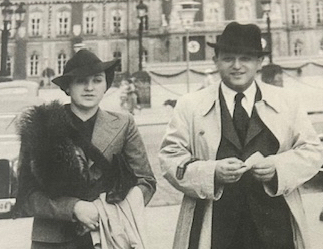
For newlyweds Erwin and Selma Diwald, getting out of Austria wasn’t a choice. It was a necessity. Thankfully, the kindness of strangers saved their lives. Their daughter, Frances “Francie” Mendelsohn, shared their fascinating story. 

Erwin Diwald was born in Vienna, Austria, in 1907, to Bettina and Sigmond, who was a successful importer of the ostrich and egret feathers used in the making of hats popular at that time. Erwin attended the University of Vienna, where he earned doctorates in both history and law. He launched a successful career in law and was sought after by many Catholic clients wishing to legally annul their marriages. 

Born in 1931, Selma Gehler was the second child of Maria and Victor Gehler. Victor, an engineer, was involved in the building of the Wiener Riesenrad ferris wheel in the Prater, still considered one of Vienna’s popular tourist attractions. Selma worked in her uncle Joel’s’ pharmacy while attending the University of Vienna’s pharmacy program, intending to step into her uncle’s business after graduation. 

Selma and Erwin met at a friend’s wedding and married in October 1937. Six months later, German troops invaded Austria. On March 15, 1938, the terrified Erwin found himself caught up in the enthusiastic crowds cheering and raising hands in the Nazi salute as a triumphant Hitler paraded through the streets of Vienna. Immediately, the Jews in Austria were in the crosshairs of the new regime. 

The newlyweds knew they had to leave their native country. Their first attempt to obtain visas took them to Stuttgart, Germany. On their first evening there, Selma and Erwin ate dinner in the hotel’s restaurant. The waiter brought over a huge tureen of soup. “Compliments of the Fuhrer,” they were told. They soon learned that their hotel was the site of the city’s Nazi headquarters. They quickly returned to Vienna to explore other options to leave Austria.

Help arrived through Erwin’s younger sister. Paula Diwald had been vocal in her dislike for the new regime. When notified that the Nazis were looking for her, she hastily made arrangements for a “ski trip” in France. As soon as she crossed the border, she ditched the skis and took up residence in Paris. 

Paula worked during the day as a salesclerk in a shop selling expensive handbags. To supplement her income, she worked as a tour guide, her ability to speak seven languages a definite asset. 

One evening, Paula overheard a couple requesting a guide who could speak English. She introduced herself and spent the next several days showing the Gregorys, a wealthy Greek Orthodox couple from Chicago, the highlights of the City of Light. At the end of their visit, they asked Paula what they could do to thank her for all she had done.

“What you can do is sponsor my brother and his wife,” Paula told them. “We have absolutely no family in the United States. Your providing them with visas is the only payment I want.” They promised to see if they could make the arrangements once they returned to Chicago. 

Paula immediately contacted Erwin. His education had included years studying classical Latin and Greek, and he decided to use this knowledge to further persuade the Gregorys.He wrote a long eloquent letter in classical Greek to plead his case. 

The Gregorys may have been Greek Orthodox but had no knowledge of its language; they brought the letter to their priest. Impressed by both the Erwin’s language and moved by their plight, the priest told the Gregorys, “You have to save these people.” The Americans complied and began the process of getting visa for the couple. They enlisted the aid of Lazarus Krinsley, a Jewish lawyer in Chicago, to obtain the paperwork. 

The Diwald flew to Paris to await the paperwork that, according to the officer in charge had not come through. It was only when the Diwalds checked in on a day the regular official was not at work. His substitute immediately “found” the missing documents.“Where have you been?” He said. “These visas have been here for months.” 

Knowing that they could not bring a great deal of money into the States, the Diwalds arranged first -class passage on the Paquebot Champlain. Built in 1932 and hailed as the first modern liner, the ship was pressed into evacuee work, transporting many Jews, like the Diwalds, who were fleeing Europe. 

Erwin remained in Paris with Paula before boarding the ship in Le Havre, France on August 29, 1938. Later that day, Selma, who had gone to England to say goodbye to her family, boarded in Southhampton. On August 31, 1938, Germany invaded Poland, marking the beginning of World War II. Erwin and Selma had made their escape just in time.The ship sailed in radio silence for the remainder of the voyage.

Meanwhile, he Diwalds found themselves in the company of many celebrities. Their travel mates included actor Helen Hayes, comedian Groucho Marx, composer Samuel Barber, Italian-American composer Gian Carlo Menotti, and Austrian-American actor/director Erich von Stroheim. It made for a very memorable voyage! 

An interesting side note: According to a Wikipedia article, the Champlain continued crossing the Atlantic Ocean for the next two years, transporting refugees, including many Jews, to safety. On June 17, 1940, on what was to be its last crossing, the Champlain hit a German air-laid mine, causing it to keel over on its side and killing 12 people. . A German torpedo finished its destruction a few days later. It was one of the largest boats sunk sunk in World War II. 

After debarking the ship in New York City, Selma and Erwin traveled to Chicago to meet their benefactors. Even though the Gregorys were responsible for getting the visas, they were not very welcoming. Lazarus Krinsley the lawyer, and his wife Rose, however, warmly embraced the couple, a friendship that was maintained throughout their lives. Upon the Krinsleys’ recommendation, the Diwalds settled in Milwaukee, Wisconsin, which had a fairly large Jewish population and offered more job opportunities.

Despite his educational background, Erwin lacked the credentials to practice law in his United States, During the war, he worked on an assembly line that polished propellers for B-29 planes. and drove trucks After the war, Erwin applied for a job as a tire salesman with Dayton Tire and Rubber Company. Initially, human resources failed to recommend him, saying he was “too intelligent.” He went on to become one of their top salesmen. 

Using the skills learned in Vienna, Selma worked in a pharmacy. She considered going to UW Madison to get certified as a pharmacist. After the birth of her two daughters Ann Frances [“Francie”) and Susan Jane, however, she gave up her dreams of further education. 

The Diwalds joined to Temple Emanuel, a reform congregation. In 1954, Francie became the first bat mitzvah in the congregation, with her sister Susan following in her footsteps three years later.

Fortunately, many of Selma and Erwin’s family were able to escape the fate of the many Jews imprisoned and murdered during the Holocaust. In 1938, the Nazis stormed into the Gehler home looking for Joel. When they could not find him, they arrested Selma’s father, Victor, who was deported to Dachau. Maria, through a possible bribe, was able to free him. They immediately fled for Haifa, in what then Palestine. They both passed away in Israel in 1951, three years after it had become the State of Israel. 

Erwin’s parents had also escaped Austrian 1940 by hiking over the Alps into France.  They emigrated to Milwaukee in 1942. Joel, who had narrowly missed arrest in 1938, fled to England, where he met the love of his life, Patricia. Joel passed away in 1986; Patricia passed in 2022. 

Selma died in 1996 at the age of 83 from cancer. Erwin died in 2008 at the age of 101, suffering from dementia in his last years. Despite all that the family had endured, Francie said that her parents were never bitter or angry. “I feel as if I been touched by God,” Erwin told his children. “We survived.”

SOURCES

Thanks to Francine Mendelsohn for sharing her parents’ story. 

“SS Champlain.” Wikipedia. https://en.wikipedia.org/wiki/SS_Champlain

A Hallmark Chanukah [Updated 12/24]

As we look forward to Hanukkah this year, which falls on Christmas Day, Larry and I are looking forward to our long-standing holiday traditions. Eating potato pancakes with applesauce. Lighting candles each night. “Betting” on which candle lasts the longest. Watching Hallmark Christmas movies.

Wait! Hallmark Christmas movies? When did that become a tradition?

For as long as I can remember, I have watched Hallmark movies. For many years, the famous card company aired shows specific to the holidays—Thanksgiving, Christmas, and of course Valentine’s Day. Each two-hour made-for television episode touched my heart. Many were based on classic novels, such as The Secret Garden or Sarah Big and Tall. Others were originals, such as What the Deaf Man Heard. And as much as I loved the shows themselves, I especially enjoyed the tear-jerking commercials (Did you know you can Google them? Watch them with a box of Kleenex next to you!)

In 2001, after the major networks dropped the specials, the company launched The Hallmark Channel. Building on its many fans during the holidays, Countdown to Christmas began in 2009, a promotion of 24/7-blast of cheer that is still running today. Cookie-cutter stories, many based loosely on more expensive big screen movies, have been churned out at an amazingly fast rate, with 136 to date. That is a great deal of Deck the Halls and Jingle Bells, their favorite songs as the movies are touted to be about the spirit of the season, not religion.

Even though Larry and I watched the movies frequently over the years, what sent me over the edge was November 2016, when the election results triggered such fear and anxiety that my doctor suggested Xanax. Dr. Larry suggested an additional remedy: Turnoff MSNBC and tune into Hallmark. I was off the anxiety medication less than three months, but I still have my weekly dose of sap and sugar.

If you have watched only one or two of the productions, you have pretty much seen them all. The Christmas plot fall into two categories. Plot One: A high powered business dynamo needs to learn the real meaning of life and that he/she  can only find in a small idyllic town inhabited by incredibly cheerful people who despite their low-paying occupations (cupcake bakers, store clerks, and staff at huge inn with no guests in sight except the small cast seem to be a favorite) still can afford enough Christmas decorations to cover EPCOT. Plot Two: A poor but kind woman finds out that the incredibly handsome mystery man she is dating is actually the king of a tiny but wealthy country named after a countertop (Cambria) or china pattern (Winshire). Just before the commercial twenty minutes before the show ends, a conflict based on a misunderstanding erupts. No worries! It will be resolved with a kiss one minute before the snow starts and two minutes before the credits roll.

Until recently, Hallmark was all about white heterosexual Christians. People of color were only  seen as the best friend or the minister who marries the happy couple. Gays and lesbians were never seen. This type casting was blown out of the water in  December  2021 when the channel first aired then immediately pulled an advertisement for an event planning site that featured two women kissing at the altar. Within hours of its removal, the incident was all over the news. Within days, the president resigned. Within weeks scriptwriters began churning out stories in which gay, lesbian, and interracial romances are highlighted. By Christmas 2021, diversity was fully integrated into the holiday story lines. 

And those holiday story lines included those about Jewish families celebrating   Hanukkah. Up until 2020, the channel’s attempts at representing a Jewish perspective were major fails for me. Holiday Date. one of three 2019 Hallmark movies with a Jewish twist, involved a Joel, a nice Jewish  boy who pretends to be the boyfriend of Brittany, a nice shiksa from an idyll small town in Pennsylvania. “Hilarity” ensues when Joel, who grew up in New York City surrounded by at least one or two Christians, has no idea how to decorate a tree or make a right-sided gingerbread house or sing “Deck the Halls.” (There is that song again!) My favorite moment is when, once the ruse is uncovered, Brittany’s mother comes out of the kitchen holding a tray full of potato latkes and wearing an “Oy Vey” apron that she managed to find on the first night of Chanukah in the town’s only store. The plots of the other two, both involving interfaith romances, made Holiday Date look like Casablanca. 

In recent years, Hallmark has redeemed itself with three great Hanukkah movies: Eight Gifts of Hanukkah (2021); Hanukkah on Rye (2022); and Round and Round (2023). These three fine movies contain with a (mostly) Jewish cast and great story lines. Sure, as are all of the channel’s movies, they are schmaltzy, but they will make you kvell with Yiddishkeit pride!

So why do I—along with many others who will not come out of the closet—love the shows? Simple. They are mindless, sweet, non-political, non-violent, and always guarantee to result in a happy ending. I still cry every time King Maximillian and Allie embrace at the end of A Crown for Christmas.(Take that, you wicked Countess!) What held true for me in 2016 holds true in 2024. I need a break from news about wars and politics and environmental disasters. Grab the dreidel shaped sugar cookies and hot chocolate. It’s time for a Hallmark Christmas movie!

Crunch: A Poem

Watch out for the acorns

Warns a fellow walker.

Watch out? I think.

I watch for them.

Love the crunch under my feet

My steps erratic  

As I weave my way through my walk.

Crunch one to the left

Two to the right

Three clustered ahead of me.

Thousands of acorns

Waiting to be decimated 

By my New Balance.

I can’t crunch them all.

After all, how many can I destroy 

In a two hour walk?

My life is filled with acorns, 

The crunchy ones.

But also the acorns that fill my wish list.

Write a story and a book. 

Plan a trip to see family

And a trip to see France.

Learn Fur Elise on the piano.

Find a framer for Sylvie’s crewel piece

Stitch cable cars for Sid

A  sampler for Frannie.

Read the 200+ books on my To Read list

Watch all the movies on my Netflix lis.

Pen gratitude letters to my family and friends.

So many acorns

Waiting to be accomplished.

I can’t complete them all.

After all, how many can I accomplish

In the years I have left?

But I still strive for them.

I love the joy in my heart

As I weave my way through my life. 

Seeing Italy through Grateful Jewish eyes

Mamma Mia!

Thanks to a wonderful tour director, a great itinerary, and perfect weather, our recent trip to Italy was all that we had hoped for and more. My husband Larry and I stayed in medieval buildings that had been converted to hotels, drove the stunning Amalfi coast, made our way through the Coliseum, tread over the ancient streets in Pompeii, enjoyed wine tasting in Umbria and Tuscany, climbed numerous stairs to churches and bell towers, and rode on a gondola in Venice. We enjoyed fabulous pasta dishes and ate gelato every day.

In each city we visited, we tried to connect with the Jewish elements of Italy, a history that dates back over two thousand years to the Roman Empire. We viewed one of the most famous reminders of the Judea-Roman connection at the Roman Forum, where we saw the Arch of Titus. I immediately recognized the seven branched menorah in the relief that depicted the Romans celebrating their 70 CE victory over the Jews as they carried their spoils of war from the gutted Second Temple. 

We arrived in Rome on Simchas Torah, preventing access to its synagogue We did, however dine at Nonna Betta’s, a kosher Italian restaurant in the Jewish Quarter. We feasted on carciofo alla Giudia, the fried artichokes (Their menu read “Life is too short to have the wrong Jewish-style artichoke!”) along with delicious pasta dishes. 

After lunch, I headed to the small Judaica shop adjoining the restaurant. As I paid for my purchases, I did my typical “Marilyn the Writer thing” and began asking questions. I learned that Francesca, the “cashier,” and her husband Umberto were owners of the shop and the restaurant. When I told her about my interest in Holocaust stories, Francesca told me that Nonno Betta, Umberto’s 93-year-old mother who lived above the shop and founded the restaurant, was herself a survivor. Although I was able to speak briefly to Umberto and share emails, further attempts to learn more of Nonna Betta’s individual story failed. Through the United States Holocaust Memorial Museum’s Holocaust Encyclopedia, I learned that when the Nazis occupied Rome in September 1943, they sought to include the city’s Jews in the Final Solution. As Italian police did not participate in these roundups and most Italians objected to the deportations, one out of ten Roman Jews were able to find refuge in the Vatican, which retained neutrality, or hide in Catholic homes, churches, and schools. Sadly, 1800 Roman Jews, with a total of 7600 Jews in Italy, were murdered in Auschwitz. 

With only one jam-packed day in Florence, we did not time to visit The Great Synagogue. But I fulfilled a dream I had since reading Irving Stone’s The Agony and the Ecstasy in 1966: I saw Michelangelo’s David in the Accademia in all his 17 feet, six ton plus glory. Along with some discussion among our tour group his anatomy (Was he circumcised or not?*), we took twenty-one photos, about four times more pictures than we took of each other throughout the trip. Mamma Mia! David was that impressive!

In Siena, we and four of our travel companions attempted to visit its synagogue and museum. Unfortunately, we found the building shuttered with an “In ristrutturazione” (under renovation) sign posted on the door. I slipped one of my business cards into the door with (little) hope of hearing from them.

 We were more successful in Venice. Our hotel was a five minute walk to the Ghetto Ebraico, and we strolled through at sunset on a Saturday evening as Orthodox Jews were ending Shabbat. I met Noa, a thirty-something very pregnant woman overseeing her other children playing soccer in the courtyard. She shared with me that she was born in Israel, but she and her husband had been part of the city’s Jewish community comprised of 400 mostly Orthodox Jews for several years.. She invited us to come to their Shabbat dinner, but hearing that the men and women sat in separate rooms, we opted for our pre-arranged dinner plans with friends later that evening. 

It was in Venice that we learned the etymology of the word ghetto. The rise of Catholicism under Empire Constantine (306 to 337 CE) lead to an increasing number of restrictions on the Jewish communities, culminating in 1555 when Pope Paul IV introduced laws forcing Jews to live in a walled quarter whose two gates were locked at night. The word ghetto, according to a Smithsonian article, came from the Italian word getto (foundry) because the first ghetto was established in 1516 on the site of a copper foundry in Venice. As Germany adapted the word for their own “Jewish Quarters,” which they originally called Juddengasse, their guttural pronunciation resulted in changing the spelling to ghetto. 

On our second stroll through the area on Sunday, we noticed that someone was looking down onto the sidewalk. I pulled Larry over where we saw one of the 207 pietres d’inciampo (In German Stolpersteine; in English: “stumbling stones”), the plaques commemorating victims of the Nazi regime, that are located in Italy. Now aware, we found several more that evening before we met our tour group for dinner. 

What moved Larry and me the most, however, was not even on our itinerary. Sara Basile, our guide, told us she had a surprise for us that could be pulled off if and only if we all met at our appointed meeting time in Florence. Another wine tasting? I wondered. Yet another church?

As our bus pulled off the highway onto a quiet road flanked by Tuscan cypress trees, we saw the entrance gates of the Florence American Cemetery and Memorial. 

“My Sicilian parents were always grateful to Americans for defeating Mussolini’s fascist government,” Sara told us. “Taking you here is my way of passing on our country’s gratitude.”

Sara introduced us to our American guide, who gave us the memorial’s history. After the liberation of Rome on June 5, 1944, the U.S. Fifth Army and British Army, supported by the Mediterranean Allied Air Forces, pushed northward. The long and bloody Allied campaign ended on May 2, 1945, when all German forces in Italy surrendered.

The 70 acre Florence memorial, the site of one of the battles, was dedicated on July 25, 1960. Next to a sculpture representing the spirit of peace is a tablet wall listing the 1409 persons missing in action. Larry and I wandered through the graves area, which contains the headstones of 4398 soldiers, of which 4322 are Latin crosses and 76 are Stars of David. As Larry and I followed the Jewish tradition of placing stones on the Jewish graves, I was overcome with gratitude to The Greatest Generation, who had fought in World War II to defeat the Nazis and their cohorts. 

The most moving moment was yet to come. At 4:45 PM, as our tour group and other visitors gathered around the flagpole, taps played from the visitors’ center. Blake, a member of the Coast Guard who was on the tour with his bride of 10 months, slowly lowered the flag into the waiting arms of several members of our group who, in turn, folded the flag. A picture of our group with Blake in the center holding the red, white, and blue parcel captured the solemnity.

We are now back in the United States looking forward to sharing Thanksgiving with a group of friends. As always, we will go around the table and share for what we are grateful. Family. Friendship. Good health. And, for Larry and me, gratitude that we were able to visit Italy. 

*The debate continues. Theories include a smaller form of circumcision; ignorance on the part of the Christian Michelangelo as to what it was; and attempts off the Catholic Church to erase David’s Jewishness. 

SOURCES

“History and Culture.” Jewish Venice. Click here for website.

“Jewish Ghetto.” Lonely Planet’s Ultimate Guide. Click here for website.

“Justice for Uncompensated Survivors Today (JUST) Act Report: Italy.” U.S. Department of State. Click here for website.

“Rome.” Holocaust Encyclopedia. USHMM. Click here for website

“The Centuries-Old History of Venice’s Jewish Ghetto.” Smithsonian Journeys Travel Quarterly. Click here for website.

.

Cocoon, A Poem

To my readers: Yes! I wrote a poem! Thanks to the encouragement of SOL Writers, I gave it a try.

She slides into the water

Gives one last pull on her cap

And a snap on the straps of her goggles.

The water stretches out in front of her

Clear and blue and shimmering.

Only two other people are in the pool

The sun is warm, the sky a bright blue

But a brisk  breeze shuffles the palm trees above her.

Did that deter the Sunday crowd?

She slides into the water

Adjusts to the familiar shock

Of the cool water on her warm skin.

One, two, three

Breathe to the right

One, two three

Breathe to the left.

Kick, kick, kick.

She gets into her rhythm. 

The body adjusts

She no longer feels cold.

The two other brave souls  leave,

And she is truly alone in her zone

Her cocoon.

On her turns, she hears 

The strains  of canned music 

The pop of pickleballs on the nearby court.

But during each length across the water

She only 

Hears the water flowing past her ears

Feels her heartbeat under her Speedo

Smells the chlorine

Sees the dapple of sunlight on the pool’s bottom.

One, two, three

Breathe to the right

One, two three

Breathe to the left.

Kick, kick, kick.

Is this what it felt like floating

In her mother’s womb?

Weightless, warm, loved?

The world is left behind.

One cannot check off items 

on a massive to-do list while swimming.

Even the Apple watch, which counts her laps,

was left behind on the bathroom counter

Next to a tube of sunscreen.

Breathe to the right.

One, two, three

Breathe to the left

One, two three.

Kick, kick, kick.

Clothes wait  in the dryer;

Dishes need to be put back on on their shelves

An unwritten story demands to be typed

Letters and postcards and emails need to be written.

But for now, she is free.

One, two, three

Breathe to the right

One, two three

Breathe to the left.

Kick, kick, kick.

Marilyn swimming!

“The Mother of Women’s Swimming:Charlotte “Eppy” Epstein

O mermaid bold, long may you hold/ The wreath you’ve won by swimming,/And spoil for gents their arguments/ Regarding Votes for Wimmen! “To a Lady Swimmer,” William F. Kirk 1914.

I love to swim. So it is no surprise that I spent much of the first week of the 2024 Paris Olympics watching the swim competition. I cheered on Team USA as they won twenty-five medals in the thirty-nine events in the Paris La Défense Arena. As I yelled “Go! Go! Go!” at the screen during the 1500 freestyle, Katie Ledecky’s last race, my granddaughter admonished me. “Your screaming isn’t going to make a difference,” she said. Hey! Maybe it did! Ledecky won the fourteenth medal she had earned over four Olympics. 

Ledecky, Torri Huske, Jenny Thompson, Dara Torres, Janet Evans, Donna de Varona, and every woman who dove into an Olympic pool has a Jewish woman to thank. Charlotte “Eppy” Epstein, considered the “Mother of Women’s Swimming in America,” was not an exceptional swimmer herself but believed that athletic competition was as important for women as it was for men. Her determination and leadership impacted not only the sport of swimming but also how women perceived their own bodies and their place in the world.

As Glenn Stout recounted in his 2009 book, Young Woman and the Sea, How Trudy Ederle Conquered the English Channel and Inspired the World, until Epstein transformed women’s swimming, societal norms discouraged women from swimming or, in fact, from “breaking a sweat” anywhere but in the kitchen. Social bias against women’s participation in sports was the norm. This was best represented by Olympic founder Baron Pierre de Coubertin of France, who thought women’s competition in athletics was “physically dangerous for such delicate flowers and morally offensive.” 

Even if they could get in the water, the standard female bathing costumes hindered women swimmers. Kristin Toussaint described them in a 2015 Boston Globe article: “black, knee-length, puffed-sleeved wool dresses worn over bloomers with long black stockings, bathing slippers, and even ribboned swim caps.” In 1907, Annette Kellerman, an Australian competitive swimmer and vaudeville star, was arrested for indecency by Massachusetts police for wearing a one-piece bathing suit that ended in shorts above her knees. “Kellerman may have been thoroughly covered,” Toussaint said, “but to her fellow bathers, she may as well have been naked.”

Epstein changed the narrative in 1914 when she founded the National Women’s Life Saving League, which offered the “delicate flowers” a place to swim and take lessons. Using negotiating skills she learned through her job as a court reporter, she convinced the Amateur Athletic Union (AAU) to permit women to register with their organization for the first time and to sponsor competitive women’s meets. According to Stout, Epstein worked “behind the scenes … extolling the advantages of having a women’s swim association managed by women while deftly praising the example set by the AAU as an organizing body without peer —essentially killing the organization and its male overseers with kindness.” 

In 1917, she struck out on her own, creating the New York City Women’s Swimming Association (WSA) to further advance the sport. She successfully battled the United States Olympic Committee, enabling American female swimmers and divers to compete in the Olympics in Antwerp, Belgium. Through her efforts, swimming dresses and bloomers were replaced with outfits closer in style to Annette Kellerman’s. The success of the American women’s swim team led to the inclusion of track and field and other sports for women in future Olympic Games. 

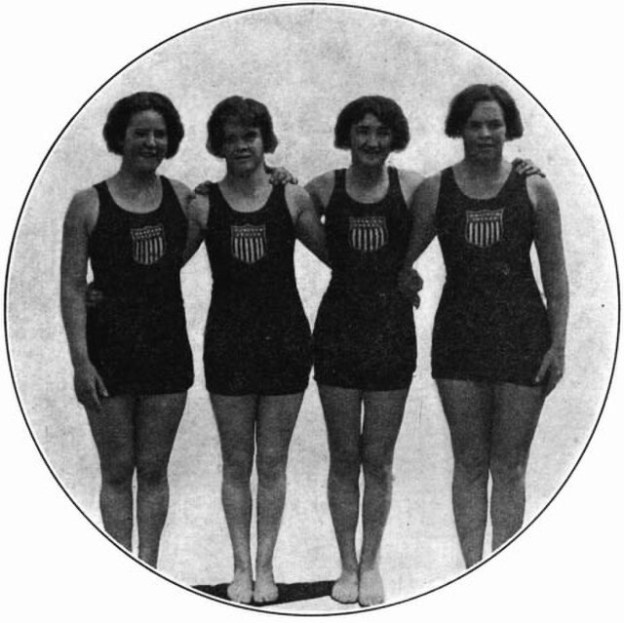
Epstein served as the women’s swimming team manager for the 1920, 1924, and 1932 Olympics. Her swimmers and divers dominated the games, holding fifty-one world records over the course of her twenty-two years of coaching. Her protégées included Eleanor Holm, Aileen Riggin, Helen Wainwright, and Gertrude Ederle. Epstein also served as chair of the national AAU women’s swimming committee.

Her Jewish roots became part of her legacy. The WSA team swam at the Young Women’s Hebrew Association of New York for national championship meets in the 1920s. In 1935, Epstein served as chair of the swimming committee of the Second Maccabiah Games. In 1936, she refused to attend the Berlin Olympic Games and withdrew from the American Olympic Committee in protest of the United States’ participation in the “Nazi Olympics.”

During her lifetime, Epstein also used her position to battle for women’s suffrage, staging “suffrage swim races” with her teammates, and fought for further bathing suit reform, distance swims, and additional competitive events for women. She continued to have a major influence on swimming until her death in 1938, just short of her fifty-fourth birthday. She was inducted into the International Swimming Hall of Fame and the International Jewish Sports Hall of Fame.

“By motivating young women to follow their passions in a sport that did not yet fully accept them, Epstein truly changed the way women thought about swimming,” according to Women in Swimming (Betsey Bennett. “Charlotte Epstein and the Swimming Suffragettes.” Women in Swimming. October 25, 2018). “And her impact did not end in the pool; once women gained freedom over their bodies in sports, they were better able to achieve liberation in other facets of society.”

On Wednesday, July 31, after binging on a morning of Olympic events being broadcast on NBC, I headed for the small pool in our Colorado rental complex. I swam 1500 meters in over an hour, approximately four times Ledecky’s time of 15:30.02 minutes in Paris earlier that day. I may not be setting any world records, but I too am a beneficiary of efforts of the small Jewish powerhouse from Brooklyn. I did not fear being arrested for wearing a TYR swimsuit, and no one feared that this “delicate flower” could not survive the multiple laps. I tip my Speedo swim cap to you, Eppy!

In 2024, Disney+ released the film Young Woman and the Sea based on Glenn Stout’s 2009 book. The movie tells the story of Epstein’s most well-known protégé, Gertrude Ederle, the first woman who swam the English Channel. Sian Clifford, who played Epstein, said the movie is “a beautiful, inspiring story that should have been told before.” 

“Charlotte Epstein serves as a symbol of the critical efforts of a Jewish sportswoman to improve the competitive opportunities and quest for physical emancipation of American women using their bodies in aquatic sports,” wrote Linda Borish in her 2004 paper. (“The Cradle of American Champions, Women Champions … Swim Champions’: Charlotte Epstein, Gender and Jewish Identity, and the Physical Emancipation of Women in Aquatic Sports.” The International Journal of the History of Sport_, Vol. 21, 2 (March 2004): 197-235.

All women swimmers—or all women athletes for that matter—have Eppy to thank. 

Originally published August 16, 2024. Updated July 2025.

Note: First Place Winner, 2025 Florida Press Association’s Sports Feature Story, Category C (Small newspapers).

SOURCES

Borish, Linda. “The Cradle of American Champions, Women Champions Swim Champions’: Charlotte Epstein, Gender and Jewish Identity, and the Physical Emancipation of Women in Aquatic Sports.” www.researchgate.net. March 2004.

“Charlotte ‘Eppy’ Epstein.” International Jewish Sports Hall of Fame.Website: http://www.jewishsports.net/BioPages/Ch

Charlotte Epstein. Jewish Virtual Library. Website: https://www.jewishvirtuallibrary.org/epstein-charlotte

“Sian Clifford Spills Secrets on ‘Young Woman and the Sea’ at Premiere.” Website: https://www.youtube.com/watch?v=F3sXvDepTr8

Stout, Glenn. Young Woman and the Sea, How Trudy Ederle Conquered the English Channel and Inspired the World. Houghton Mifflin Harcourt. 2009.

Toussaint, Kristin. “This woman’s one-piece bathing suit got her arrested in 1907.” July 2, 2015. https://www.boston.com/news/history/2015/07/02/this-womans-one-piece-bathing-suit-got-her-arrested-in-1907/

Charlotte Epstein. Photo Credit: Robert SlaterGreat Jews in Sports, (New York, Jonathan David Publishers, Inc., 1983), p. 65.

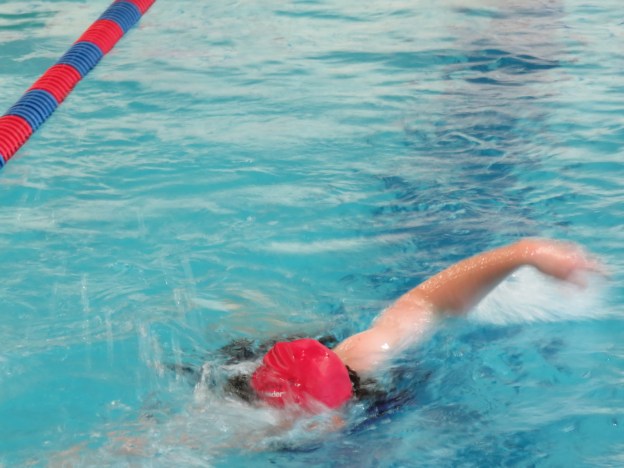
Thank you, Eppy! Here I am doing the American crawl in our pool in Solivita!

The Weather by Frances Cohen

This story was written by my mother, Frances Cohen, in ~2006, after she and my father, Bill Cohen, moved into Coburg Village, an independent living facility in Rexford, New York. A natural storyteller, my mother joined a writing group and wrote down many of her stories for posterity. It is a joy to share them with you!

The weather plays an important part of our life. At times, we wish that we could change the weather, but as we have learned it is one of the things in life we cannot change. 

Sometimes prayers help. On two occasions, our prayers were answered when we planned outdoor receptions. One was for the retirement party Bill and I planned at our cottage on Lake Champlain during the summer of 1983. The second was at the wedding reception for my granddaughter that was held on my daughter and son-in-law’s front lawn in Clifton Park in October 2007. At both parties, the weather was perfect: sunny, 72 degrees, with no wind. We considered it a miracle! 

Our prayers did not work when Bill, my daughter Marilyn and I had to travel from Keeseville to Rockland County for our son Jay and our future daughter-in-law Leslie’s engagement party in December 1970. A Nor’easter started the day we were supposed to leave, so we delayed the trip until the next morning in hopes the weather would improve. Unfortunately, the snow only got heavier. By the time we arrived in Albany, the New York Thruway was closed. Determined not t miss the party, we decided to take Route Nine for the rest of the trip. The roads and visibility were terrible. Atone point, Bill stopped at a railroad crossing as the gate was down and the lights were flashing. The snow was so thick that Marilyn, who was sitting in the back seat, thought we were actually on the tracks and began screaming in fear. When we all calmed down, we continued on the trip. We arrived in Pearl River at 11 o’clock at night, sixteen hours after leaving Keeseville for what should have been a four-to-five-hour trip. It was one of the most difficult trips we ever made. In 1980, the year before we retired, our cousins invited us to visit them in Florida. When the day of our flight arrived, we left our cottage on Lake Champlain to drive to Montreal, the closest airport. When we crossed the border to Montreal, the snow was piled so deep that drifts were at places two stories high. As we crossed over a bridge near the airport, Bill lost control of the car, and we did a complete 360-degree turn, landing in a soft snowbank. Fortunately, there was no damage, so we were able to continue the trip to the airport. When we arrived in Florida, it was 85 degrees, and our cousins welcomed us in summer attire. Bill and I looked at each other and said, “This is paradise!” We couldn’t change the weather, but we could change our location. Right then and there, we decided that before next winter, we would sell our business, have a going-out-of-business sale, and spend our winters in Florida and summer at our cottage by the lake. 

We were fortunate to be snowbirds for many years. It was the best of both worlds: Beautiful summers on Lake Champlain and warm, balmy winters in Florida. We thought we had it made—until Hurricane Wilma hit in 2005. 

At that point, Bill and I were living full time in a condominium in Wynmoor, an over-fifty housing complex in Coconut Creek, Florida. The Weather Channel and local officials had warned us in advance of the incoming hurricane, and we had made sure to purchase water, canned food, and extra batteries. The night the hurricane hit, we did a lot of praying. The winds and rain were very strong, and we were very frightened. We were so thankful that our building had been spared any serious damage. We woke up to no electricity and no air conditioning in the 85-degree heat. For the first few days, we stayed in our condominium, living on the canned goods that we had purchased before the hurricane. When the electricity finally came back in our condominium, we decided to go food shopping for milk, eggs, and other food to restock our pantry and refrigerator. At that point, we were able to see the actual extent of the damage in the area. We saw lots of fallen trees, some of which had crashed into parked cars. With all the wires down and traffic lights out, getting to even the supermarket was almost impossible. 

When we finally got to Publix, the store was dark and eerie as it was powered by back-up generators. We learned as the week went on that thousands of trees had been destroyed in our residential area. More tragically, a number of other residential areas, including Hawaiian Gardens, the original complex we had moved out of only four years before, were so badly damaged that they were unlivable and eventually had to be completely torn down. 

In the middle of all this stress, when I was getting in the car to take another trip to the supermarket a week after the hurricane hit, I caught my foot on the curb while trying to get out of our parked car and broke a bone in my leg. That was the final straw. Our children felt strongly that we needed to get out of Florida and its hurricanes and move back up north. By spring, 2006, we were settled in Coburg Village, four miles from my daughter and son-in-law. At Coburg, we don’t need to drive, as the shuttle takes us everywhere. Our children are close enough so they can go shopping for us if the weather is too bad. So, when bad weather comes, we are able to just look out the window and enjoy our cozy apartment. Now we can be thankful for the snow so that grandchildren can ski, the rain that makes our flowers and gardens grown, and the beautiful sun that makes us all happy. 

The photo of me with a rubber chicken was taken in Keesevile around 1954 after a bad snowstorm. No idea why I had a rubber chicken!