Author Archives: Marilyn Shapiro

Unknown's avatar

About Marilyn Shapiro

After thirty five years in education, I have retired and am free to pursue my lifelong dream of becoming a freelance writer. Inspired by my mother, who was the family historian, I am writing down my family stories as well as publishing stories my mother wrote down throughout her life. Please feel free to comment and share.

Contemplating Purim heroines in the #MeToo era

Fifty-one years ago this March, Larry and I met at Purim party held at in the upstairs floor of a restaurant in Albany, New York . In a corny, hastily put-together shpiel, Larry a.k.a. Ahasuerus chose me a.k.a. Esther bypassing my competitors, Libby the Lib and the sassy, insolent Vashti.

Would Larry have chosen me if I had played Vashti? After all, for most of Jewish history, she was portrayed as the headstrong, rash woman who incurred not only the wrath of King Ahasuerus, but also the condemnation of the other male leaders of Persia. “Not obey the king? Why, next thing you know, all the women in our kingdom will be disobeying the men in their lives!” they cried. “Banish the hussy! or even better yet, execute her to set an example!”

In Purim party after Purim party, most girls—and women— have preferred to dress up as the beautiful, passive replacement who obediently followed the edicts of her husband, King Ahasuerus, and the directions of her uncle Mordechai. Fearing the same fate as her predecessor, even when faced with the extermination of all the Jews in Persia, Esther took time approach her husband. She fasted for three days, threw one banquet, then another, and waited patiently and gracefully for the right moment to revel the evil machinations of the notorious Haman.

Esther finally came through for us, resulting in her always being viewed as the heroine of the story. With age, wisdom, and more feminist leanings, I have learned to cheer for Vashti, who refused to bow to her husband’ misogynistic demands to dance naked in front of a group of of inebriated male chauvinists. In a 2023 article in the [Harvard] Crimson, writer Arielle C. Frommer dates the history of feminist interpretations of the Purim story to as early as the mid-nineteenth century. Elizabeth Cady Stanton, a 19th century leader in the women’s rights movements, described Vashti as “a sublime representative of self-centered womanhood.” Harriet Beecher Stowe, abolitionist and author of Uncle Tom’s Cabin, praised Vashti’s resistance as a “first stand for women’s rights.” “We shall stand amazed that there was a woman found at the head of the Persian empire that dared to disobey the command even of a drunken monarch,” Stowe wrote.

The praise for Vashti continues into the present day. LaVerne McCain Gill, journalist and pastor, describe Vashti as a “model of rebellion against the patriarchy.” Christian Pentateuch scholar Alice L. Taffy views the disgraced first wife as a greater hero for her lack of dependence on any male figure to make her decision. As while many stories feature Jewish heroes vanquishing their persecutors, Frommer writes that the Purim story is “dependent on a female heroine taking a stand against a patriarchal monarchy, thus linking Jewish liberation directly to the feminist experience.”

So if Vashti was banished but not beheaded, I wonder what happened to her? Did she escape to another country that respected strong-willed women who stood their ground? And did King Ahasuerus and Esther live happily ever after, enjoying wine and challah on Shabbat? Did he give up excessive drinking and look at not only Esther but all women with more respect?

In this election year, it may be wise for all women to remember the story of Purim and the traits of these women. In 2022, the United States Supreme Court overturned Roe vs. Wade, ending the federal constitutional right to abortion in the United States.

According to Planned Parenthood, as a result, one in three women now live in states where abortion is not accessible. In the first few months after Roe was overturned, 18 states banned or severely restricted abortion. Today more states are working to pass bans. 

The resulting stories have been horrifying. In Florida, a woman was forced to carry her child to full term despite the doctors’ knowledge that he would die shortly after birth. In Texas, doctors in one hospital told a a 25-year-old woman whose ectopic pregnancy endangered her life to “go home and wait.” [She had emergency surgery 24 hours later in another hospital, where the doctor said she came close to losing her life. In Ohio, a 10-year-old child who had been raped by a family member had to travel to Indiana for an abortion. 

Conservatives may have rejoiced with the Supreme Court decision, but it has resulted in a voter backlash. According to a Reuters/Ipso poll taken in December 2023, it resulted in limited Republican gains in the 2022 congressional midterm elections, as well as propelling Democrats to victories in recent off-year elections. The same poll reported 70% of Americans said protecting abortion access in their state would be an important issue in determining their vote in November, including around two-thirds of independent voters. The poll also showed that half of Americans said they would support a law legalizing abortion nationwide, including close to one-third of Republicans.

Who is in the forefront of the battle? Women.For many women, protecting reproductive rights have become the number one factor in voting decisions. “I am a one-issue voter,” a friend told me recently. “I believe in a woman’s right to chose.”

Old white men in expensive suits and $300 haircuts are denying those rights. It is time for us women to take some lessons from Vashti. She believed that she had the right to choose what she did with her body. In 2015, my hero Ruth Bader Ginsburg said, The state controlling a woman’s body would mean denying her full autonomy and ultimately full equality.” Vashti would agree. 

Reproductive rights were center stage in President Biden’s State of the Union address earlier this month. “With all due respect, justices, women are not without electoral or political power,” Biden said. “You’re about to realize just how much.” 

Remember Vashti’s actions. Remember Biden’s words. And remember them when you vote in November. 

Larry and Marilyn, March 18, 1973  

The pest in the attic…

The Pest in the Attic

In October, 2023, on a miserable, windy, rainy day, Larry and I found a puddle on our kitchen floor. Looking up, we could see water coming from one of our recessed light. Damn!

We called a roofing company the next day. After spending an hour directing a hose onto spots on the roof, the roofer found nothing. “Just call us if it happens again.”

It did. On December 23, on another miserable, windy, rainy day, we had to again pull out the buckets to catch the water dripping from the same spot.

As promised, the roofer came back free of charge. This time, he found the problem. The flashing had not been installed properly when the house was built, resulting in a spot where water had gathered. The wood in the attic was mildewed and rotting. The roofer was honest: his company specialized in shingle roofs. He couldn’t guarantee they could fix it and recommended we contact another roofer.

We called another roofing company that had been recommended by a friend. The representative confirmed the problem and said his company had seen this several times in Solivita. We signed the contract, forked over half the payment, and waited for the repair, thankful for dry weather in the meantime.

On Wednesday, February 7, 2024, the roofers came as promised. Five hours later, the job was done. Of course, we could have taken a cruise on the money we paid, but the leak problem was solved.

Less than an hour after the roofing crew left, we heard a sad, moaning sound in our attic above our bathroom. Oh no! It sounded as if an animal had gotten into the attic when the roofers were working on the problem and had gotten trapped. 

We texted the roofing company.

“Oh no! So it sounds like something may have pushed through your soffit,” a representative wrote back. “I’d definitely walk the perimeter of the home and check to see if the soffit is pushed in or damaged anywhere.”

Then came the less helpful comment. 

“Unfortunately we cannot get any animals out from an attic, that is something a trapper or pest control would have to do.”

We called our pest guy on Friday. Meanwhile, I put out a recommendation request on Next Door. People wrote back suggesting DYI solutions—mothballs, noise, cats. Along with the names of companies, people shared frightening stories of rabid raccoons, slithering snakes, and aggressively agile alligators. 

Our bug guy finally texted us Monday. No, he didn’t do animals. Just bugs. He texted me the name of an animal control company. 

“We’ll come out for a free estimate on Thursday,” we were told

And if there is an animal?

“The cost will range from $500 to thousands of dollars, depending on the animal and the damage.”

I immediately texted the roofing company again.

“Considering we noticed the sounds literally an hour after work was completed, we can assume the animal was trapped during the work,” I responded. . It’s turning into what can be a very expensive follow-up to what was already a huge expense. Would it be possible for someone to come and at least crawl into the attic, maybe releasing the animal?”

I also contacted the concierge in our community, who gave us a name of a local person who trapped animals at a more reasonable cost. “Johnnie” could come Tuesday at 2:30.

Meanwhile, the general manager of the roofing company called Monday night. He said that animals usually don’t go in with all the banging and hammering, but he was willing to split the bill.

On Tuesday, “Johnnie”, albeit  three hours late, arrived at our home. Ninety minutes and $350 later, he found nothing. Nada. No animal. No droppings. No noise. No nothing. He left a trap and said he would be back the next day.

That night, while in the bathroom doing our nightly ablutions, we realized that the squeaking, moaning sounds were in synch with our turning our faucets off and on. Eureka! It wasn’t an alligator or armadillo or an anhinga in our attic. It was pressure in our pipes, Shoot! Did we now need to call a plumber?

The next morning, on a hunch, I went outside and checked the outside hoses. Yes, I had turned off the front hose when I watered the plants on Wednesday. Whew! Not my fault! Then I checked the back hose. Mystery solved! When the men were fixing the roof, they must have used the outside hose in the back of the house. Our hose attachment was in the “off” position, but the water had been left on. Because of that, there was pressure in the pipes. I turned off the water connected to the hose. Voila!! The sound stopped immediately. 

Six days and a huge chunk of money later, the roof was repaired and the noise that had been driving us crazy was gone. Thankfully we figured it out before we called a plumber. But we are hoping that the roofing people will step up to the plate and pick up the entire bill for the pest guy.* Hey! I don’t mean to be a pest! But I will be badgering (Raccooning? Squirreling?) them until we get this settled. 

PS: They didn’t.

The mess before the “pest.”

Heritage writer has a blog to appease her “inner geek”

This article was published in the Orlando Heritage Florida Jewish News on February 23, 2024. Thanks to Christine Sousa, Editor, for all her support!

This March, Marilyn Shapiro celebrated a milestone in her writing career: the tenth anniversary of her blog, There Goes My Heart.

Wait! You don’t know she has a blog? And if you knew, you have never typed www.theregoesmyheart.me into your browser? Well, you don’t know what you have been missing!

In 2014, with only about 10 stories published in the Capital Region, New York’s The Jewish World, Shapiro decided that she needed a blog as another way to share her stories and to appease her inner geek. After researching a few options, she chose WordPress, “a web content management systems that was user friendly for even newbies like me,” she shared. 

Along with home page and contact pages, Shapiro posted her first 10 blog posts. Leading the list was “There Goes My Heart,” her very first article that was published in August 2013. Fittingly, Shapiro chose it as the name for her blog. She was in business!

When Shapiro and her husband, Larry, moved to Florida in 2015, with over 20 articles under her belt, she met with a neighbor who taught computer classes in the Shapiro’s community. Working with her, Shapiro was able to add more bells and whistles, including a Home Page menu that provided access to her increasing list of articles. A “Follow” button encouraged readers to sign up to get my blog post delivered to their email accounts. 

By 2018, with two published books to her credit, she added a “Marilyn’s Book” page. Along with a summary of her essay collections, it offered the user the ability to click directly onto the Amazon website, where one could purchase a Kindle or paperback version. 

Shapiro now has four books listed: “There Goes My Heart” (2016), “Tikkun Olam: Stories of Repairing an Unkind World” (2018), “Fradel’s Story” (August 2021), and “Keep Calm and Bake Challah: How I Survived the Pandemic, Politics, Pratfalls, and Other of Life’s Problems” (2023). She even offers a preview of her fifth book, “Under the Shelter of Butterfly Wings: Stories of Jewish Sacrifice, Survival, and Strength.” 

Many of Shapiro’s articles are personal: her ancestors’ lives in the shtetl before immigrating to America; her childhood in a small town in Upstate New York; meeting Larry at a Purim party, their years raising two children; their retirement years, their travels and their growing family. Some are humorous: Their love affair sealed in (a kidney) stone. Her daughter’s not-so-welcoming attitude when Shapiro volunteered to chaperone her daughter’s school trip. Receiving the moniker “Bubbe Butt Paste” after the birth of their first grandchild. And some are more profound: Larry and Marilyn’s visit to a Holocaust memorial after the Pulse tragedy in Orlando; wintering through the pandemic; reflecting on the Israeli-Gaza war during the eight days of Chanukah. 

In 2017, Shapiro wrote an article about Harry Lowenstein, a Holocaust survivor (published in the Heritage, “A Holocaust survivor revisits his past,” May 19, 2023). 

“Its impact on me resulted in expanding my writing to include heartfelt stories about ordinary people with extraordinary stories to tell: other Holocaust survivors, righteous gentiles, Jewish immigrants, cancer survivors, and advocates for the less fortunate. The interviews and research necessary to write the articles have expanded my knowledge on many topics, which I have hopefully passed on to my readers,” Shapiro said. 

Ten years later, Shapiro’s blog continues to grow and flourish. She has approximately 220 articles, many with accompanying photos. She has 447 followers, a number that I hope will continue to grow. And thanks to hashtags such as #Jewishlife, #Holocaust, #Hanukkah, #neworleans, and even #pickleball, I get “Likes” from around the world. The page “Marilyn’s published articles from around the world” now includes those from Orlando’s Heritage Florida Jewish News, as well as websites as far away as Australia.

If you are a subscriber and are enjoying Shapiro’s blog, she would love to hear from you. You can type a note in the “Comment” section at the end of the blog, and she will respond. Shapiro also encourages readers to share her posts and even her blog address with friends and family who may enjoy them.

“And for those of you who still haven’t given my blog a try, take a look!” Shapiro added. 

Shapiro’s blog is at www.theregoesmyheart.me. Usually she posts every two weeks, so you will not be overwhelmed with emails from her. 

Who knew that one article in 2013 would lead to so much? For this writer and computer geek, Shapiro is having fun!

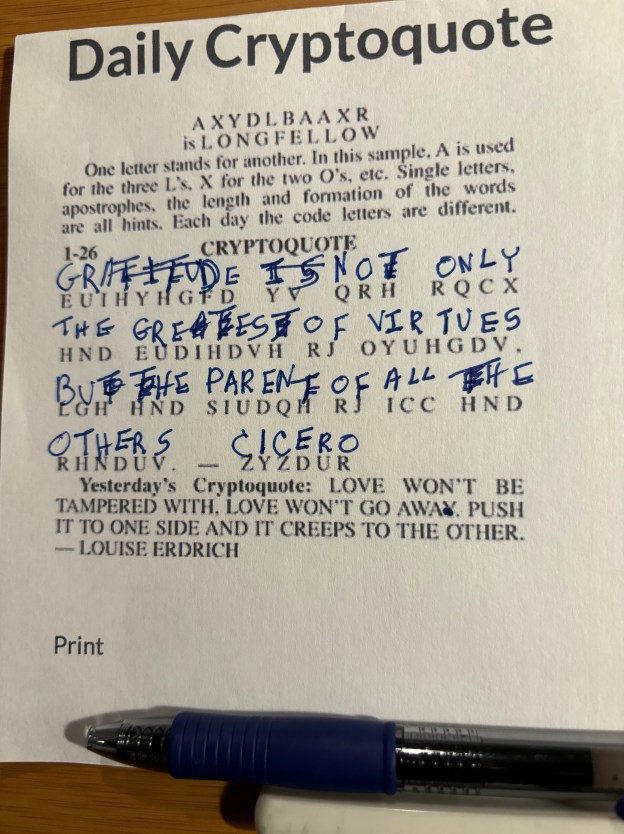
I am a Cryptoquote addict

Hello. My name is Marilyn, and I am a Cryptoquote addict. The addiction actually snuck up on me.

 For years I had done the daily crossword puzzle in Schenectady, New York’s, Daily Gazette,when I got to it before Larry. An English major in college and a reading and writing teacher as an adult, I have enjoyed a sense of satisfaction and contentment to find the exact word to fit into the correct boxes.

Crossword puzzles, however, had never become addictive. I have never dwelled upon the fact that I don’t know a Stanley Donen movie (“Deep in My Heart”), a phrase for being stuck (in a rut), a six-letter word for crown (diadem) or the 1967 and 1968 Super Bowl MVP (Starr). I am not ashamed of resorting to online crossword puzzle solvers if I can’t figure it out. I defer to Larry for most sports questions, as he defers to me for arts and literature. I have even quit and tossed them, unfinished, into the recycling bin.

But Cryptoquotes were/are different. After years of seeing Larry’s handwriting in black felt tip pen under the AXYDLBAAXR is LONGFELLOW hint, I decided around 1992 to find out the attraction of decoding a nonsensical jumble of letters into a meaningful statement. It was love at first attempt.

Not only did it satisfy the reading teacher in me (recognizing those two-and three-letter consonant blends such as “th,” “sh,” and “ght” often unlocked the puzzle), but I also was intrigued by the messages that the Cryptoquote revealed. Some needed explanation—Who is Morpheus, and why should I care about his hand?— but others were humorous or prophetic enough to type into my Favorite Quotes journal I keep on my computer. 

Larry graciously gave me full right to the Gazette until our move. As our Orlando paper doesn’t carry it, my dear husband found an on-line source that he prints out for me daily.

Unlike many crypto puzzles whose solutions are puns or, for me, just too simple, the King Features Syndicate Cryptoquote finds sometimes lengthy quotes from notable people, many whom I admire. I solved the following only two days after Ruth Bader Ginsberg’s death on September 18, 2020: “My mother told me to be a lady.  and for her, that meant be your own person, be independent.” Other solutions offered me insights that I continue to carry with me. Since decrypting Plato’s words, “Wise men talk because they have something to say; fools talk because they have to say something,” I have often thought twice before blurting out something just to fill the void. 

For twenty-two years I have been given words of wisdom —and some laughs—from individuals ranging from Abraham to Zachariah, from Chaucer to Cookie Monster, and from Shakespeare to Shakira, as well as the prolific Anonymous and Source Unknown. 

Larry and I have a routine. Sitting next to each other on the couch in the den, Larry hands me one of the two crossword puzzles he has printed out that morning. Sometimes we each finish it alone; other times, one of us asks, “Do you want to start working on it together?” 

 The minute I am finished—or have given up—I immediately dive into my Cryptoquote. Most of the time, I work through it quickly. There are nights when I don’t go to bed until I can figure it out. When I get desperate, I ask Larry for a hint. (“Is the third letter in the first word an ‘e’?). He consults the online solution and provides the clue.

And, yes, there are days that I cannot solve it. The next day, I usually have to kick myself for missing the obvious. Not figuring out the words Merry Christmas in a holiday greeting from “Your Cryptoquote Friends” on a December 24th puzzle embarrassed me as did not realizing the author was the Notorious RBG herself. I have worked on those with whom I cannot easily break the code on long car rides, in doctors’ offices and, admittedly, boring group ZOOM calls.

I knew I was truly addicted when, two years into my doing the puzzle, the Cryptoquote was not in its usual page in the Gazette. I began flipping rapidly through the classifieds and then through the entire D Section. Nothing. Frantically, I began searching through the entire paper, thinking . . . hoping . . . that maybe the powers that be had decided to move the heart of the paper to a more prominent section. On the Op-Ed page? Next to Ann Landers? In the obituaries?

“Larry,” I yelled to my husband. “I can’t find the Cryptoquote.”

“Are you sure?” he asked. He began a search, calmer, less hurried, but no more fruitful.

Not fooling around, I called the paper. to the source. Hi,” I said to the Gazette operator. “I don’t know if you guys are aware of this, but . . . The Cryptoquote is missing!”

On the other end of the line, there was a brief moment of silence. Then a tired voice said, “Yes, we are aware of the situation. We will publish two Cryptoquotes tomorrow, unless you want to come to Maxon Road for a copy today.”

I quickly calculated the time it would take for the round trip to Schenectady. Forty minutes; with GE traffic, maybe an hour. I declined the offer. I can wait until tomorrow, I thought. It will be hard, but I can wait.

There was something in the operator’s tone, however, that made me quickly realize that I was not the first to call.

“Have you gotten other complaints?” I asked.

“Dozens” she said wearily. “The phone began ringing off the hook at 6:30 a.m. and hasn’t stopped since.”

“Were most as nice as me?” I asked tentatively.

“No,” she said. “There were a lot of angry callers demanding to know why they hadn’t been published.”

I expressed my sympathies, thanked her for her help, and hung up, breathing a sigh of relief. Tomorrow . . . less than 16 hours from then, I would have two puzzles to solve. Furthermore, I could come out of the closet and join the ranks of those who are addicted.

My name is Marilyn, and I am a Cryptoquote addict.

Versions of this blog post were published in The Jewish World and the Heritage Florida Jewish News.

Our Family’s Business Pearl’s Department Stores Written by Frances Cohen

This story was written by Francis Cohen, my mother, soon after she and my father moved into Coburg Village in 2006 and my mother joined a writing group.

The story of Pearl’s Department Store is a very interesting one as it involves so many of my mother’s family, the Pearls.

Let’s start at the beginning. Uncle Paul, my mother’s twenty- year-old brother, was living on the lower East Side in New York City with his family in a crowded flat. With very little education and a short, skinny build, he was only able to get a job in a sweatshop making $7 a week. After seeing a doctor for a persistent cough, Paul was diagnosed with consumption, a direct result of poor working conditions and a poor diet. It was suggested that he leave the city.

My grandmother Vichna had a sister Ittel, and she, her husband Archik Perelman, and their family lived in Burlington Vermont. Lil encouraged him to pay them a visit. Paul liked the North Country, and his health improved in the country air near Lake Champlain. With Lil’s financial support, Paul started in the peddling business, learning the trade from Archik and initially following his routes.

Paul went door to door with a pack on his back peddling his wares throughout Vermont and Upstate New York. He soon expanded the business so that it would not compete with Archik’s territory. After saving enough money, Paul managed to get a horse and wagon. Since he was doing well, he asked his brother Joe to join him in his rounds.

As the two brothers peddled their way through Vermont, they realized that the farmers and families to whom they sold merchandise found it difficult to pronounce their last name, which was Ossovitz. The customers, who knew Paul and Joe as the nephews of the peddler Archik Perelman from Burlington, Vermont, referred the two of them as the “Perelman Boys.” For simplicity’s sake, my uncles gave their last name as Perelman.

A year after they started their partnership, Uncle Paul and Uncle Joe decided to open a store in the small village of Alburgh, Vermont. They bought a piece of land with a barn on it. While the store with its second- floor apartment was being built, Paul and Joe slept in the barn with the horse and wagon. Many years later, Paul related to me that they didn’t need an alarm clock as the horse would wake them. Simplifying their name even more, Paul and Joe named the new store “Pearl’s Department Store,” and the family legacy began. Three of the brothers, Joe, Paul, and Morris, eventually legally changed their name to Pearl. Sam, the oldest, was the only brother to keep the surname Ossovitz. Thereafter, however, all the relatives identified themselves as part of “the Pearl family.”

Paul and Joe soon established a second store in Swanton, Vermont. When war was declared in 1917, Uncle Paul was drafted into the Navy. Joe ran the store while Paul served his country. When the war was over, Paul was happy to come back to Alburgh. Soon after Paul’s return, Joe announced that he and his wife Leona wanted to go back to New York City.

In 1923, Paul married Bertha Leibesman, the second cousin born the year Lil came to America. They lived in the apartment over the store. “Birdie,” as she was known by her family, was very bright and was a big help in making Pearl’s Department Store a success. Within a few years, they were owners of a chain of twenty-two stores in upstate New York and in Vermont. They became very wealthy, the most successful of the nine Ossovitz children.

In the 1930s, the country was in the midst of The Great Depression. Many members of the family needed help, and Uncle Paul was in a position to do so. Uncle Paul’s philosophy was, “Helping someone with a handout only helps them temporarily. It’s more important to give a man a job.”

Over the years, many family members came to work for Pearl’s Department Store. Six of his siblings and/or their husbands worked for the chain, as did fourteen of the grandchildren. My husband Bill and I were one of the first grandchildren to work for Uncle Paul. Uncle Joe and his family also moved back up from New York City and resumed management of the Swanton, Vermont, store

All the stores were successful. The people in these small villages loved to shop at Pearl’s. The managers and their staff were friendly, and the store carried clothing and a great deal of other useful merchandise at prices the average family could afford. Stores were scattered throughout Vermont and New York. The central store and warehouse were in Glens Falls and were eventually run by Paul’s son Elliot and his family.

By the 1960s most of my aunts and uncles had retired.Most of the grandchildren had left Pearl’s to open their own businesses, and local people continued managing the stores. When Paul died in the 1990s, his son Elliot took over the management of the stores.

Time brings many changes. By the 1970s, many superhighways were completed, including the Northway. The small towns became bedroom communities. It brought an end to the small-town, family-owned stores. People now preferred to travel on the superhighways and shop in big malls.

The last Pearl’s Department Store went out of business in 1983, seventy years after who once was known as Pesach Israel Ossovitz had first started peddling with a pack on his back. But the Pearl family will always be grateful to our Uncle Paul for his setting up businesses for so many and supporting many others when they opened their own stores.

For more information about Pearls and similar businesses, check out #afamilyofstores.com. Managed by my brother, Jay Cohen, the website gives a detailed description of many of these stories, inlcuding those in Upstate New York and Vermont.

A version of this article originally appeared in the Jewish World News, a bi-weekly subscription-based newspaper in upstate New York.

Is help available? Decipherer happy in her addiction….

Hello. My name is Marilyn, and I am a Cryptoquote addict. The addiction actually snuck up on me.

 For years I had done the daily crossword puzzle in Schenectady, New York’s, Daily Gazette,when I got to it before Larry. An English major in college and a reading and writing teacher as an adult, I have enjoyed a sense of satisfaction and contentment to find the exact word to fit into the correct boxes.

Crossword puzzles, however, had never become addictive. I have never dwelled upon the fact that I don’t know a Stanley Donen movie (“Deep in My Heart”), a phrase for being stuck (in a rut), a six-letter word for crown (diadem) or the 1967 and 1968 Super Bowl MVP (Starr). I am not ashamed of resorting to online crossword puzzle solvers if I can’t figure it out. I defer to Larry for most sports questions, as he defers to me for arts and literature. I have even quit and tossed them, unfinished, into the recycling bin.

But Cryptoquotes were/are different. After years of seeing Larry’s handwriting in black felt tip pen under the AXYDLBAAXR is LONGFELLOW hint, I decided around 1992 to find out the attraction of decoding a nonsensical jumble of letters into a meaningful statement. It was love at first attempt.

Not only did it satisfy the reading teacher in me (recognizing those two-and three-letter consonant blends such as “th,” “sh,” and “ght” often unlocked the puzzle), but I also was intrigued by the messages that the Cryptoquote revealed. Some needed explanation—Who is Morpheus, and why should I care about his hand?— but others were humorous or prophetic enough to type into my Favorite Quotes journal I keep on my computer. 

Larry graciously gave me full right to the Gazette until our move. As our Orlando paper doesn’t carry it, my dear husband found an on-line source that he prints out for me daily.

Unlike many crypto puzzles whose solutions are puns or, for me, just too simple, the King Features Syndicate Cryptoquote finds sometimes lengthy quotes from notable people, many whom I admire. I solved the following only two days after Ruth Bader Ginsberg’s death on September 18, 2020: “My mother told me to be a lady.  and for her, that meant be your own person, be independent.” Other solutions offered me insights that I continue to carry with me. Since decrypting Plato’s words, “Wise men talk because they have something to say; fools talk because they have to say something,” I have often thought twice before blurting out something just to fill the void. 

For twenty-two years I have been given words of wisdom —and some laughs—from individuals ranging from Abraham to Zachariah, from Chaucer to Cookie Monster, and from Shakespeare to Shakira, as well as the prolific Anonymous and Source Unknown. 

Larry and I have a routine. Sitting next to each other on the couch in the den, Larry hands me one of the two crossword puzzles he has printed out that morning. Sometimes we each finish it alone; other times, one of us asks, “Do you want to start working on it together?” 

 The minute I am finished—or have given up—I immediately dive into my Cryptoquote. Most of the time, I work through it quickly. There are nights when I don’t go to bed until I can figure it out. When I get desperate, I ask Larry for a hint. (“Is the third letter in the first word an ‘e’?). He consults the online solution and provides the clue.

And, yes, there are days that I cannot solve it. The next day, I usually have to kick myself for missing the obvious. Not figuring out the words Merry Christmas in a holiday greeting from “Your Cryptoquote Friends” on a December 24th puzzle embarrassed me as did not realizing the author was the Notorious RBG herself. I have worked on those with whom I cannot easily break the code on long car rides, in doctors’ offices and, admittedly, boring group ZOOM calls.

I knew I was truly addicted when, two years into my doing the puzzle, the Cryptoquote was not in its usual page in the Gazette. I began flipping rapidly through the classifieds and then through the entire D Section. Nothing. Frantically, I began searching through the entire paper, thinking . . . hoping . . . that maybe the powers that be had decided to move the heart of the paper to a more prominent section. On the Op-Ed page? Next to Ann Landers? In the obituaries?

“Larry,” I yelled to my husband. “I can’t find the Cryptoquote.”

“Are you sure?” he asked. He began a search, calmer, less hurried, but no more fruitful.

Not fooling around, I called the paper. to the source. Hi,” I said to the Gazette operator. “I don’t know if you guys are aware of this, but . . . The Cryptoquote is missing!”

On the other end of the line, there was a brief moment of silence. Then a tired voice said, “Yes, we are aware of the situation. We will publish two Cryptoquotes tomorrow, unless you want to come to Maxon Road for a copy today.”

I quickly calculated the time it would take for the round trip to Schenectady. Forty minutes; with GE traffic, maybe an hour. I declined the offer. I can wait until tomorrow, I thought. It will be hard, but I can wait.

There was something in the operator’s tone, however, that made me quickly realize that I was not the first to call.

“Have you gotten other complaints?” I asked.

“Dozens” she said wearily. “The phone began ringing off the hook at 6:30 a.m. and hasn’t stopped since.”

“Were most as nice as me?” I asked tentatively.

“No,” she said. “There were a lot of angry callers demanding to know why they hadn’t been published.”

I expressed my sympathies, thanked her for her help, and hung up, breathing a sigh of relief. Tomorrow . . . less than 16 hours from then, I would have two puzzles to solve. Furthermore, I could come out of the closet and join the ranks of those who are addicted.

My name is Marilyn, and I am a Cryptoquote addict.

Versions of this blog post were published in The Jewish World and the Heritage Florida Jewish News.

Dr. Phibes May Live Forever!

Horror fans who were in or near Santa Monica, California, on October 26,2018,  had the wonderful opportunity to attend a Halloween Double Feature at the Aero Theater.  The Abominable Dr. Phibes, a cult classic with fans around the world, was one of two films showcased. And sitting in the audience was the film’s creator, an 86-year-old Troy native whose vivid dream inspired it.

William Goldstein was born on July 10, 1932, in Troy, NY. He and his family attended Temple Berith Sholom. After his bar mitzvah, Goldstein taught Hebrew school.

Upon his graduation from Troy High in 1950, Goldstein attended  Rensselaer Polytechnic Institute in Troy for two years before realizing that chemistry, not engineering, was his interest. He transferred to Columbia University. After his graduation he took a job in medical research at Albany Medical Center.

One year later, Goldstein moved to San Francisco, where he worked in cancer research at UC San Francisco. Goldstein married Barbara Ellen Lipp in 1955, and they had two sons, Adam and Damon.

Tragically, Barbara died in 1961, leaving a bereft widower and two young boys. Soon after her passing, Goldstein had a vivid dream about a man who brings his wife back to life. Goldstein developed the dream and its theme of revivification into The Abominable Dr. Phibes —a 1920s tale of a disfigured half-dead madman bent on retribution after his wife of two years dies in surgery. 

His victims— all members of the operating team—are horrifically, grotesquely murdered one by one through a bizarre ritual based on  the Ten Plagues of Pharaoh from the Book of Exodus. These included bats blood, frogs, biting insects, boils, rats, hail, locusts, death of the first born and darkness. “The G’tach is a device that perfectly fit the needs of the story,” said Goldstein. “A rabbi who explains the Biblical connection to the  detective trying to track the killer is  a key element in the plot.

During this period, Goldstein changed careers to become Manpower Director of San Diego’s Equal Opportunity Commission. There, he met up with his old friend and classmate from Troy, James “Jim” Whiton, who was living in Hollywood and had had some success as a television writer.   The Phibes story sparked Whiton’s interest, and the two men collaborated on the original Phibes screenplay

Whiton’s agent showed the script to Samuel Z. Arkoff, studio head of American International Pictures (AIP). Arkoff and his creative partner James H. Nicholson were known for their campy, “B” movies with titles like The Crypt of the Vampire, How to Stuff a Wild Bikini, and Dr. Goldfoot and the Girl Bombs. The Abominable Dr. Phibes was to make them A-listers.

The company filmed Goldstein and Whiton’s screenplay at Elstree Studios in London. Robert Fuest directed Vincent Price, an AIP regular, and a cast of other British actors, including Joseph Cotten, Terry-Thomas and Peter Jeffrey.

On May 18, 1971, Goldstein and his second wife, Mozella, flew in from San Diego for the film’s premiere. As they approached the Pantages Theater in their taxi from LAX, the Goldstein’s encountered a traffic jam. It was not until they got closer that they realized that the flashing marquee, the red carpet, the packed crowds, the searchlights probing the night sky were for his film’s opening. It was the first time he and Whiten were viewing their movie.

Even though AIP gave Dr. Phibes’ premiere the Red-Carpet treatment, all involved in the project were surprised and delighted when the film became a box office hit. Critics praised the horror film for its dark humor, art deco sets lush musical score, and nasty but inventive murder sequences. Gene Siskel gave the film three-and-a-half stars, calling it a “stylish, clever, shrieking winner,” though he disliked “the lack of zip” in the ending. Varietypraised the film for its “well-structured” screenplay, “outstanding” makeup for Vincent Price and “excellent work” on the set designs.

Goldstein and Whiton were commissioned to write a sequel, with plans in the works for several more Phibes movies starring Vincent Price. Goldstein moved to Los Angeles, where he continued to write Phibes novels as well as work in other fields. “With my wife and our blended family of four children at home, I followed the paycheck.” He found employment the federal government, in state colleges, and most recently, in rental real estate.

Unfortunately, 1972s Dr. Phibes Rises Again was put in the hands of different writers and lacked much of the humor and horror of the first. When Nicholson left AIP in 1972 to become an independent producer —he died soon after of a malignant brain tumor—the future of the series died as well. Goldstein experienced another tragedy when his son Adam died mysteriously in 1981 in Bombay (now Mumbai). Interpol has never solved the case.

By the 1980s, the Dr. Phibes movies, through their re-showing and availability on VHS, were becoming “phan phavorites,” The audience became international, expanding from the United States to other countries including Canada, Spain, France, Japan, and Australia. 

By the 2000s, the Internet introduced a new generation of readers and movie-goers to Dr. Phibes through YouTube and sales of books and DVD’s on Amazon. Movie critics continued to heap praise on the now cult classic. Christopher Null wrote of the film, “One of the ’70s juiciest entries into the horror genre, The Abominable Dr. Phibes is Vincent Price at his campy best.” Steve Biodrowski of cinefantastique.com  wrote that the movie was “the perfect combination of horror and humor.” Gerry Shamray of yourmovies.com called it a “deliciously dark and hammy horror flick.”  Alan Jones of the radiotimes.com wrote, “Full of gaudy Art Deco excess, surprise charm and sardonic violence, this deadpan send-up is a classy fright delight.” Vincent Price’s performance was called “deliriously appealing” (Dennis Schwartz ,Ozus’ World Movie Reviews) and one of his “signature roles.” (Tim Brayton, Antagony & Ecstasy)

In response to the international following, Goldstein completed two more books, In the Beginning (2010), a prequel which explained the origins of the “phantom-phantastic” and other characters in Books One and Two and Vulnavia’s Secret (2013). 

Goldstein’s son, Damon who had worked with his father on the Phibes’ characters’ design since the 1970s, has built the Phibes presence on Facebook, Pinterest, and Instagram. More recently, several fan-generated “Phibes Phan Clubs” have Facebook followers. 

Famous phans include Tim Burton, Ken Russell, Quentin Tarantino, Stephen King, and Andrew Muschietti, the director of the 2017 Stephen King-based movie, It. Kumail Nanjiani built a scene around it in his 2017 critically acclaimed movie, The Big Sick. “So many movies have stolen from it,” tweeted Nanjiani on May 27, 2018, “but it remains the strangest, coolest, funniest, and most gorgeous of them all!” Great Britain’s daily newspaper, The Telegraph ranked it among the fifty best horror films of all time, and The Museum of Modern Art in New York City screened it in February 2018.

Interest in the series also resulted in the 2017 publication of The Dr. Phibes Companion, by film historian Justin Humphreys, subtitled “The Morbidly Romantic History of the Classic Vincent Price Horror Film Series.” Humphreys, Goldstein, and Damon will all be at the Aero Theater on October 26 to discuss their books, reveal the future of Dr. Phibes, and answer questions from their “phans.”

Goldstein attributes the success of Dr. Phibes to people’s need to root for the underdog. For all his strangeness and brutality, the grotesque half-dead monster is on a quest to avenge the death of his beloved wife, whom he feels was murdered by incompetent physicians. As David Kehr, a Chicago-based critic stated, “Price’s performance suggests that, underlying the madness, there is a real and damaged human being who deserves your support.” Like Frankenstein, the Creature from the Black Lagoon, and The Incredible Hulk, the mad doctor is just another misunderstood monster trying to get the bad guys. Combine that with humor, an unforgettable score, and great performances. What more could horror movie lovers want?

Although Goldstein has no immediate family left in Troy, he keeps in touch with two nieces in Troy. The former Hebrew school teacher is now a member of Temple Emanuel, in  Beverly Hills,  California.

Is there another Dr. Phibes movie in the future? Goldstein confidently states “Yes!” In 2015, Goldstein and Damon had a chance meeting with Malcolm McDowell, the prolific English actor known most for his iconic role in A Clockwork Orange. McDowell expressed an interest in stepping into the late Vincent Prince’s shoes, fell in love with their Forever Phibes screenplay. Goldstein and his son are considering production offers.  Dr. Phibes may live again!

Trees sing to the heart as we note Tu B’Shvat

On a beautiful, chilly January morning, my family and I made our way up the path in Muir Woods National Monuments. As part of a planned family reunion, our children had made early morning reservations. A weak sun shone through the trees, a small creek caught the light, the redwoods soared above us. I was in the woods again—an absolutely pristine national monument that had survived fires and earthquakes to awe us with its beauty.

Muir Woods, managed by the National Park Service, is located on Mount Tamalpais near the Pacific coast in southwestern Marin County, California. It contains 240 acres of old growth coast  redwoods, formally known as Sequoia sempervirens. Although ancestors of these trees covered the United States millions of years ago, the Sequoia is now only found on a narrow, cool, damp strip of land on the California coast.. 

About halfway through our adventure, I stopped to observe unusual signage. With its large caption, “History Under Construction,” the board told the background of the Monument as it was first written and later updated to reflect not only the contributions of its original supporters but also the hereto unmentioned role of the Native Americans, whose stewardship had started thousands of years before the original timeline and ended when they were literally wiped out by disease and public policies. Updated information also included the role of the women who were critical in saving Muir Woods from commercialization and logging.

Most importantly, the updated board unblinkingly took an honest look at the complex legacies of the park’s founders, many who believed in white superiority that extended beyond the park’s borders. John Muir, for whom the park was named, used racist language when writing about Native Americans. William Kent, championed as a conservationist for donating the land to the federal government as well as authoring the legislation that established the United States National Park Service, also lead anti-Asian policy and rhetoric, He and the other “champions,” Gifford Pinchot, Madison Grant, and Theodore Roosevelt, were all proponents of eugenics, the set of beliefs and practices which aimed at improving the genetic quality of the human population, in part by forced sterilization the members of disfavored minority groups. 

“The role of the National Park Service is to preserve history – the good, the bad, the ugly, and everything in between,” stated in 2023 article on the US National Parks Service website, “History Under Construction.” “It’s not our job to judge what history is worth telling, but to share an accurate and comprehensive history.” I appreciated the way in which Muir Woods had not “cancelled” history but revised the way it was presented to show a more realistic, unbiased view of the park.

It was not until Larry and I were flying home from our California trip that I realized the timing of our visit was also significant on the Jewish calendar. Tu B’Shevat, known as Israel’s Arbor Day, is held on the 15th of the month of Shevat. This year, it occurs on January 25th.

The importance of trees and the environment dates back Biblical descriptions of the Garden of Eden and its reference to a tree of life. Post-biblically, Tu B’Shevat started out as an agricultural festival that helped farmers mark the passing seasons, one of four “birthdays” in the Jewish calendar. Based on, in my opinion, a fairly complicated connection to taxes and tithing, the holiday disappeared after the destruction of the Second Temple. In the 16th century, the Kabbalist Rabbi Yitzchak Luria of Safed and his disciples revived it by instituting a Tu B’Shevat seder in which the fruits and trees of the Land of Israel were given symbolic meaning, with the belief that prayers offered at the ritual meal would bring. humans and the world to spiritual perfection. 

On Tu BiShvat 1890, Rabbi Ze’ev Yavetz, one of the founders of the Mizrachi religious Zionist movement,and his students planted trees in the agricultural town of Zikhron Ya’akov in Israel. The Jewish Teachers Union adopted it in 1908. It was later taken over by theJewish National Fund (JNF) established in 1901 to oversee land reclamation and afforestation of the Land of Israel.

Modern Jews view the holiday as the opportunity make a Jewish connection to contemporary ecological issues, including responsible stewardship of our planet and ecological activism. This was most clearly pointed out to me in Hazon’s Tu B’Shevat Haggadah.  Along with the explanation and prayers for the four glasses of wine and four fruits, the booklet (available online here) offers way in which one can get involved in climate action, food sustainability, soil advocacy, and educational resources especially focusing on the environment. 

Meanwhile, we can continue the custom Rabbi Yavetz and his students started 133 years ago: planting trees. Since 1901, JNF has planted over 250 million trees, created and built over 240 reservoirs and dams, developed over 250,000 acres of land, and established more than 2,000 parks. As suggested on Clifton Park’s Congregation Beth Shalom website, trees can be planted in support of the hostages, in support of Israeli troops, in memory of a loved one, or just because you would like to plant a tree in Israel. In addition, JDF is provided extended services since the October 7 attack on Israel, both physical, medical, and emotional support as needed. Furthermore, the organization gives the communities devastated by the war “the promise of rebuilding for tomorrow.”

For those of us who care deeply about our planet’s future,  we need to continue to visit  beautiful places like Muir Woods and celebrate beautiful holidays like Tu B’Shevat. Chag Sameach!

A version of this story is found in the January 25 issues of The Jewish World and the Heritage Florida Jewish News.

The text in white was featured on the original timeline. Everything in yellow was added by the United States Park Service 

An explanation and an apology!

If you clicked on a link on my “Marilyn’s Published Articles From Around the World” and found yourself here, this explains it!

Dear Blog Subscribers,

For the past several months, I have been working on my blog, There Goes My Heart. I have been correcting several missing or defunct links, updating stories, and making sure each of the over 220 articles that I have posted have related pictures and images.

Most importantly, I have been adding in stories that I realized had never been published.While working on this, I have tried to set up later publishing dates. For example, the updated story of our Hallmark Hanukkah was supposed to be sent out on December 10, 2024, to coincide the the holiday. Unfortunately, my technical skills failed me, and within an instant, I had accidentally published the story. I will be working with WordPress, my platform, to make sure this doesn’t happen again. I also revised my “Marilyn’s Books” page, which lists books and provides a link to Amazon if you are interested in purchasing them.

If you feel overwhelmed by the number of articles you have found in your inbox recently, apologies! I try to send out one blog post every two weeks, maybe once a week if I am catching up. Going forward, please be assured that I will limit my posts to that number.

If you are enjoying my blog, I’d love to hear from you in the comments section. Please feel free to share my posts and even my blog address with friends and family who may enjoy them.

By the way, if you click MENU tab, you will see a link to “Marilyn’s Published Articles Around the World!” That page has a list of all my articles that have been published literally around the world going back to 2013 and even earlier. Each one (with a few exceptions which I am still working on) contains the link to the actual article or my blog post. You may enjoy browsing the page to dip further into my library.

Thanks so much for following my blog. I so appreciate your support. Keep reading! Keep commenting! Keep sharing!

Warmly,, Marilyn

Never mind the bucket list! Just live life!

Never Mind the Bucket List! Just Live It!

One winter afternoon while living in the Capital District, Larry and I had lunch at a Chinese restaurant with a former co-worker of his who was planning on retiring in a few more months.

“Can you two give me some guidelines as to what I should do when I leave the job?” she asked. She knew that she had to do something. She couldn’t picture herself just sitting home and having no structure to her life. “I certainly don’t want to be bored!” she explained.

Four years earlier, Larry and I were both in our last months of work after long careers in public service and education. People were continually asking us what we were going to do after we retired. Larry had a simple, straightforward plan: We would travel, and we spend more time volunteering for Special Olympics. 

I, however, fearing boredom, felt the need to line up more ducks to keep me happy. What would I do with my life once I did not fill my time with a forty plus hour a week job? I too sought advice from friends and relatives who had retired before me on how I could survive all the “free time.”

“What free time?” commented a former superintendent of schools, who has spent his retirement volunteering on numerous boards and organizations. “If you want to be in control of your time, keep on working.“ 

“You’ll never look back,” a former co-worker stated. “You will wonder how you ever worked as your days will be so full.”

I wasn’t convinced.

Larry retired in May 2010, but I still headed to the office for seven more months. I left the house at 7:30 each morning after kissing my sleeping husband’s head as he nestled under the covers. He made up for it by having dinner ready for me when I arrived home. However, my desire to join him pushed me into a pre-retirement blitz at work. I confirmed my retirement date with my boss, went to a New York State Education Teacher’s Retirement System seminar to line up the paperwork, and began cleaning out my files. Then I turned my attention to creating and implementing my retirement bucket list.

First on the list were all those hobbies that had been put on the back burner. The short list, in addition to travel and Special Olympics, included the following:

  1. Read all the books on my “Read Before I Die” list;
  2. Complete the crewel piece I started twenty years earlier;
  3. Learn how to knit;
  4. Update my fifty photo albums;
  5. Organize the two drawers in my file cabinet filled with my children’s artwork, report cards, and special projects; 
  6. Relearn French;
  7. Learn Spanish;
  8. Put together all of my stories and my mother’s stories into a book. 

Yes, this woman was going to be productive in her golden years!

Although I already had a number of unread books on my book shelves, I hit a couple of used book sales and downloaded numerous classics onto my Nook. I purchased orange and royal blue yarn and needles to knit Larry a Syracuse University scarf. On impulse I also bought Red Sox theme flannel to make him a throw to commemorate his favorite baseball team.

At the office supply store, I selected new photo albums to replace the ones that were falling apart as well as file folders, labels, and markers for my home organization project. I downloaded a language app for my français redux and purchased a Spanish for Dummies for my español. Mom’s files were piled six inches thick into a drawer, ready to polish and publish.

Throughout this entire process, Larry looked on with a mix of mild amusement to outright incredulity that I needed to prepare so much. And he feared all these projects and books and anticipated classes were going to fill my dance card so much we won’t have time to just be.

After all the planning and anticipation, my last day of work arrived. On December 17, 2010, I fought the traffic on the Northway and Route 7 one last time. I completed the required written instructions to my successor, signed my exiting papers, and said my final goodbyes. Then I drove my last rush hour trip home to Clifton Park. It was time to tackle that bucket list!

I reflected on all this planning over the dinner with Larry’s co-worker. I thought of the hundreds of unread books on my shelves that had been passed over for more current ones in the local library. An added bonus: I could get them in big print, a big advantage for my “golden years” eyes.

I tried to work on the Elsa Williams crewel piece. My eyes had changed since I started it, and I doubted it would ever be finished. 

The knitting? Abandoned after four unsuccessful attempts at learning how to cast on. The Red Sox throw? I pinned it together, but I never took out the sewing machine to stitch up the sides. 

The pictures were still in envelopes, the photo albums still unwrapped. This was 2014, the digital age, and I needed to think of tossing most of them, scanning the favorites, and putting them into a digital album. My children strongly encouraged me to toss—not organize—all the childhood memorabilia I had saved. I haven’t had time to refresh my French or learn Spanish; I needed time to work on my own English as I edited and re-edited my stories and my mother’s story for The Jewish World. At least I was working on one of those items on my bucket list. 

So what did we do those first four years since we retired? We traveled to Machu Picchu, the Galápagos Islands, the Danube, Bryce and Zion. When we were home, we spent time volunteering for Special Olympics—coaching track and field and bowling. Yes, in the end, Larry’s simple, straightforward approach to retirement was the most realistic.

Most importantly, the most satisfying activities of the retirement years in Clifton Park were in many cases activities that were never on my radar. Weekly visits to a couple of friends at Daughters of Sarah nursing home evolved into my volunteering at their memory enhancement unit. After taking Zumba at a local elementary school, I realized how much I loved exercise classes and joined the YMCA. 

Over dim sum on that cold winter afternoon, Larry and I offered this advice to our friend: Yes, you can speculate as to what you would like to do once you leave your job for the last time. However, you may never get to many of them. As a matter of fact, you should just kick the bucket—the bucket list that is. Let life take you where you had only dreamed of going. And that is actually the best retirement advice of all.

A version of this article originally appeared in the Jewish World News, a bi-weekly subscription-based newspaper in upstate New York.