Author Archives: Marilyn Shapiro

Unknown's avatar

About Marilyn Shapiro

After thirty five years in education, I have retired and am free to pursue my lifelong dream of becoming a freelance writer. Inspired by my mother, who was the family historian, I am writing down my family stories as well as publishing stories my mother wrote down throughout her life. Please feel free to comment and share.

Our Chanukah traditions: No, Santa did not  come down our chimney!

I love Chanukah. I love lighting the candles in our darkened dining room. I love potato pancakes served with applesauce. I love coming up with creative gifts for my children. What I don’t love about Chanukah is trying to make it more than it is.

Chanukah is a minor festival on the Jewish calendar that just happens to usually fall at the same time as the major holiday on the Christian calendar. While I was growing up in Keeseville, my parents never tried to compete with Christmas. However I think my friends felt sorry for me and tried to make it something it wasn’t. Their first response was often, “But you still have a Christmas tree, right?” No, we didn’t’ have a Christmas tree. And no, Santa did not come down our chimney. And no, we weren’t going to have a ham on December 25th, even if it was on sale at the local A & P for thirty nine cents a pound. 

The way we handled it was to share our holiday. We invited our friends to our house to help light our candles and eat potato pancakes, and we gladly went to their house to help decorate their Christmas trees. In that way, we all got to the best of both worlds, two holidays with two very different meanings, each of us maintaining our own identity. 

The yearly school challenge was the winter concert. I participated in both Keeseville High School’s band and chorus, and all the music for the December evolved revolved around Christmas carols and songs. Playing Silent Night on my clarinet was fine, but singing the lyrics with the chorus made me very uncomfortable. I would compromise by mouthing certain parts of the song, especially phrases that referred to Jesus as “Christ Our Savior.” As much as I felt overwhelmed by all the Christian songs, I felt even more uncomfortable with the token Chanukah song that was included in the program. The music teachers always chose Dredyl, Dreydl, Dreydl or some other lightweight piece of music that completely under-valued the meaning of our holiday. I think I would have been happier if the Chanukah song was left out entirely. It wasn’t a big holiday. And the fun came in the small things, the small traditions, traditions that Larry and I have carried down to our children. 

On top of the list is making potato pancakes. The first year we were married, I decided to make them in my new blender. The chunks of potatoes kept getting stuck on the bottom so I stopped the blender and scraped, then stopped the blender and scraped, then got lazy and just scraped. The moving blade picked up the spatula, flung it to the ceiling along with half the contents of the blender, and then dropped the mess on my head. My expletives brought Larry into the kitchen. He took one look at me, my face covered with potato pancake gook, and walked out. I took out the grater.

Potato latke making became easier when my mother-in-law gave me a food processor for Chanukah the following year. Even so, I’ve had a couple of missteps over the years in my attempts to making them healthy. I’ve made them in the oven to avoid the oil, but main reason they were healthy was that my family refused to eat them, much preferring the oil-laden version that makes the holiday. For them, and even for me, the taste of a crisp, oily potato pancake melting in the mouth is worth the calories, the mess preparing them, and the massive clean-up that usually involves scrubbing down all the cabinets to get the residue oil off them.

My children have fond memories of my sugar cookies that we cut out with the six-sided cookie cutter I had gotten in the Congregation Beth Shalom gift shop back in the early eighties. I always would start out with lots of enthusiasm, happily rolling out the dough and putting them on the aluminum baking sheets. This enthusiasm would last for about two baking sheets worth. Then the dough would start to tear, the thickness of the cookies would be inconsistent, the thin stem of the menorah would break, and the little tops of the dreydls would fall off. The children would settle for the stars and Torahs and scrolls as those shapes held up the best, holiday symbol be darned.

Another tradition has been the annual candle lighting race. Larry brought this tradition in from his home, and my children caught on very quickly. Each of us would choose a candle that we thought will win the “Burning the Longest” award. No jarring or poking was allowed, and the last wick to flicker out is the winner. As the days of the holiday and number of candles progressed, there was more to watch. By the final night, we usually sat around the candles to just savor the flickering lights and to cheer on the last one for that Chanukah season.

Gifts always have been part of our Chanukah tradition. When our children were very young, however, we realized quickly that a gift each night seemed forced, so we mixed it up with a dinner out, a movie, and a volunteer opportunity that worked especially well if Chanukah and Christmas fell around the same time. As our children now live in California and Colorado, managing long-distance gift giving is a challenge. Their presents have changed from Star Wars action figures to San Francisco Symphony gifts certificates for Adam and from Cabbage Patch dolls to Colorado photography for Julie. 

Larry and I decided a few years ago that Chanukah is more about candles and potato pancakes and time with friends, and we no longer exchange gifts. For the past few years, a group of us empty nesters have gathered around Toby and Arnie Elman’s dining room table, first to light the candles on our menorahs and then to share a dinner of dairy foods, potato pancakes, and Toby’s fantastic home-made plum laced applesauce. We top it off with fruit and my homemade chocolate chip cookies, a recipe that seems much more successful and crowd pleasing than my sugar cookies. 

This year, Thanksgiving and Chanukah will occur on the same day for the first time since 1888 and, according to one calculation, an event that won’t happen again for another 77,798 years, Larry and I will be celebrating Thanksgivukkah with over thirty people at our cousins’ annual get-together in Argyle. Our “traditional” meal has always been eclectic: the traditional turkey, stuffing, potatoes, squash, and cranberry sauce; the chapchae, an Asian noodle dish that our Korean cousin makes every year; the tofurkey for the vegetarians; the Asian pears brought in from New York City; my sister-in-law’s decadent broccoli casserole; the pies from Riverview Orchards; and the Krause’s chocolates from Schenectady. This year, our celebration will include, for the first time, potato pancakes and apple sauce. And maybe, just for the fun of it, I will make the sugar cookies. Dredyls and turkeys sound a good combination, at least for a once-in-a-lifetime Thanksgivukkah celebration!

A version of this article originally appeared in the November 21, 2013, Jewish World News, a bi-weekly subscription-based newspaper in upstate New York.

Reflections on Hanukkah, Israel, and Antisemitism

On Thursday, December 7, 2023, Jews around the world will begin celebrating Hanukkah, which commemorates a time in Jewish history where we faced the possibility of annihilation.Now, 2190 years later, Jews face yet another enemy whose covenant calls to obliterate the state of Israel and to carry its jihad against all Jews “until judgement day.” As I light my candles over the holiday’s eight days, I will reflect on the following. 

One: I stand with Israel. Absolutely. I am sad, afraid, angry and grieving for all the lives lost during this conflict. But Israel did not start this war. Hamas did. And the Israeli Defense Force (IDF), like the Maccabees, must fight with every ounce of their strength to root out the evil that is Hamas.

Two: The rise over the lawsuit and the proposed highway.of antisemitism around the around the world is terrifying, and it is hitting too close to home. Who would have thought that neo-Nazis would be marching outside the gates of Disney? That banners with swastikas would be hung on an I-4 overpass? That our Florida synagogue would have to hire a security guard so that we can attend services without fear of being mowed down like the members of Pittsburgh’s Tree of Life?

Shortly after the October 7 massacre by Hamas, Jewish community leaders and a representative from the AntiDefamation League met with Congressman Darren Soto.He opened our meeting by pledging his support for Israel and the Jewish community. “I have your back,” he said. “We must stand against all forms of hate.” He then turned the meeting over to his constituents, where we were able to voice our concerns. As the war continues, I will be in contact with my representatives on the state and national level to encourage them to continue their support.

Three: I am prouder than ever to be a Jew. For many years, I have worn a butterfly charm on a necklace, which represents to me the souls of the six million who died in the Holocaust. Soon after the war began, I dug out my Jewish star and added it to my necklace, displaying my connection to Judaism with pride and resolve.

Four: During this terrible time, attending services at my synagogue gives me a sense of community. At times it feels that it is the Jews against the world. Being in a room where I am not alone in our fears, sadness, and grief. gives me comfort. 

Five: I will continue to use my writing to bear witness to moments of Jewish sacrifice, survival, and strength.Since 2017, I have been writing down stories of Eastern European Jews escaping pogroms, Holocaust survivors, WWII Jewish soldiers, and Jews and Righteous Gentiles who fought and continue to fight against Jew-hatred and Holocaust denial. My writing has found a purpose: To make sure their stories are never forgotten.

Six: Israel needs more than hopes and prayers and words. It is in desperate need of funds to counteract the effects of this war on its economy and its citizens.The websites of the ADL and other Jewish organizations list recommended donation sites, including Magen David Adom (MDA), Israel’s national emergency medical response organization; Leket Israel, the country’s largest food bank; and Hadassah Hospital, which treats both Jews and Arabs.

Seven: I was overwhelmed by the outpouring of compassion and support from my non-Jewish friends. “My heart is broken in two,” wrote Ginny Campbell. “We all share one God. I can only believe His heart is broken too.Know my prayers are with you and all our brothers and sisters who are grieving tonight. Love can and must win out in the end.”

Eight: Following the lead of Israelis who have suffered such great loss, I will find joy and hope. “We are part of a people that sanctifies life,” Rabbi Doron Perez, reflecting on the October 23 wedding of his son, who suffered a leg injury on October 7, and another son has been declared missing “[The future] will be a new dawn and a much better time for the Jewish people”

“I am a Jew because at every time when despair cries out, the Jew hopes,” wrote French writer and thinker Edmond Fleg in 1927. Only time will tell what will happen in the future. Over eight evenings, our family will light our colorful Hanukkah candles. This year, we will add to the traditional blessings the Mi Sheberach, a prayer for physical and emotional healing for all human beings facing illness and pain; and Oseh Shalom, a prayer for peace, salaam, shalom. שָׁלוֹם

Originally published in the Orlando Sentinel, December 3, 2023.

Marilyn Shapiro, Kissimmee, is a retired educator and an author. Her blog is http://www.theregoesmyheart.me.

My Unforgettable Halloween

This story was written by my mother, Frances Cohen, in October 2010. What better day to publish than on Halloween!

By 1958, Bill and I were settled with our four children in our home in Keeseville.

Bill was very civic minded and president of the town’s Chamber of Commerce. That spring, he received a letter from a young optometrist who had just completed his time in the military. Dr. Jerome Resnick was interested in opening a practice in upstate New York and wanted to know what Keeseville had to offer.

Bill immediately wrote back a glowing letter about our small town. He stated that people in surrounding communities liked to shop in Keeseville as it was a thriving community with many retail stores and a large factory that manufactured television cabinets. Many doctors had practices in Keeseville, but there were no other eye doctors. Bill also said that Dr. Resnick would love living in Keeseville’s location. It was on beautiful Lake Champlain with its opportunities for boating, fishing, and swimming. There were three golf courses nearby, and if the doctor liked to ski, Lake Placid and Whiteface Mountain were less than an hour away. “Most importantly,” Bill stated, “half the population of Keeseville wore glasses and the other half needed them.” Bill ended the letter with an invitation for Dr. Resnick to visit Keeseville and stay as a guest of the chamber in a local hotel so the young doctor could learn more about the community.

Two weeks later, Dr. Resnick arrived, and as promised, Bill and other members of the chamber showed him around. The young doctor was impressed and asked if office space was available. Only one store on the main street of town was available to be converted into an office, but Bill gave him the name of a reasonable contractor. By the end of the summer, with Bill commandeering the construction, the office was completed, and Dr. Resnick was settled in an apartment and was ready for his new patients.

By this time, “Jerry” was a friend of the family. During one of his visits to our house, Jerry confided in us that his parents, who were from the New York City area, were very unhappy about his move to what they considered a small hick town in upstate New York. Jerry was encouraging them to come for a visit and see for themselves that he was happy, business was good, and the people in Keeseville, especially the Cohens, were wonderful, friendly, refined people.

Fall came, and with it came an invitation for Bill and me to attend a Halloween costume party at friends’ house the Saturday before October 31. Since parking was difficult at the hosts’ house, Bill and I arranged for neighbors to pick us up at 6:45 p.m.Everyone, including Bill and I, invited tothe party really enjoyed putting together the outfits for the costume party. The night of the party, the two of us were upstairs in our bedroom getting into our costumes. I had chosen to dress as Sadie Thompson, a “lady of the night,” who was a main character in a popular movie of the day. I was garbed in a very tight, low-cut sweater and a very short skirt. My hair was heavily teased, and I wore tons of eye make-up and lots of cheap jewelry. Bill was dressed as a hobo complete with size 52 pants tied with a rope, a ratty shirt covered with patches, a wig with a huge bald spot surrounded by lots of orange hair, and a clown nose that honked. An empty rum bottle finished the look.

At quarter of seven, our children called up to tell us that someone was at the door. Thinking it was our neighbors, we decided to make a grand entrance. I sashayed down the stairs, swinging my hips and twirling my pocketbook to beat the band. Bill stumbled behind me, taking swigs of his “rum” and honking his nose.

When we got to the bottom of the stairs, we were mortified to realize that the “someone at the door” was not our neighbors but Jerry and his parents, who stared with utter horror at the “wonderful, friendly, and refined” Cohens!

After a long moment of stunned silence, Jerry introduced us to his folks, and we hastily explained our appearance. Our neighbors, also costumed, soon arrived, and we were whisked off to the party, but not before we invited the Resnicks to dinner the next day to meet the real Cohens.

Jerry’s parents must have been somewhat appeased. Jerry kept his office for another 30 years until his retirement. When he married, he and his wife Lil remained our friends. But every Halloween, Bill and I remember our unforgettable Halloween almost fifty years ago.

A version of this article originally appeared in the Jewish World News, a bi-weekly subscription-based newspaper in upstate New York.

Picture of Bill and Fran Cohen “out of costume” is from Marilyn Cohen Shapiro’s photo library.

Photo below is movie poster of Gloria Thompson as Sadie Thompson. Courtesy of Wikimedia Commons.

Come hell or high water, the celebration goes on!

As we Floridians were waiting out Hurricane Matthew’s departure on a very rainy, windy Friday, I was thinking about those people up and down the East Coast who were more strongly impacted by the storm. Would their homes survive intact? Will family and friends be safe? Along with these worries, I thought of people who had had the misfortune to be celebrating a special event— a wedding, a bar mitzvah, a retirement party— in the middle of this major weather system. 

What do you do when bad weather creates chaos? Reflecting on our own experiences and the shared experiences of friends and relatives, I’ve learned that most people let their smile be their umbrella—or snow suit!

My brother Jay and his wife-to-be Leslie planned their engagement party on December 28, 1969, in Rockland County. My parents, my sister Bobbie, and I were scheduled to make the trip from Upstate New York the day before when a crippling snowstorm hit the Northeast.  With my father white knuckled at the wheel, we made it down the Northway to Albany only to find the Thruway was closed. Determined that the four of us would not miss the party, Dad continued the trip down Route 9.  What should have taken six hours took us twelve. The storm, which dumped over twenty-six inches of snow by the time it ended, is still recorded as the third greatest snowstorm in Albany’s history. The memories of our ride from hell were forgotten as we celebrated Jay and Leslie’s engagement the next day in sunshine and relatively warm temperatures. 

On  June 12, 1968, Betty Schoenberg was walking into Washington Square Park for   her NYU graduation when the skies opened up, and the rain fell in torrents.  Many attendees —including Betty— gave up and left, but a few hardy souls shivered under umbrellas. The storm made the front page of the next day’s New York Post:  “Soaked! “ the caption read. “The show did indeed go on despite the rain that pelted the assemblage without a letup.”

When Betty got home, she realized that the rain had soaked through her white dress, her black raincoat, and her purple graduation gown. Her clothes were ruined, and her skin had turned black from the raincoat’s dye run-off. She wrote a letter of complaint to the graduation committee, who offered to pay for her cleaning bills. She never did follow through, but almost fifty years later she still has the letter, the dry cleaning receipt, and  a clipping of the newspaper article in her memory box. 

My friend Lynn Urgenson recalls going to her daughter’s college graduation at CW Post on Long Island. The day before the event was warm and sunny, but by that morning, the temperature dropped into the low forties. Lynn wore several layers of clothing over her original outfit, but her only pair of shoes were her sandals. “ I wound up putting my feet into my purse,” said Lynn. “My teeth were still chattering hours after Caren had picked up her diploma.” 

In 2000, a spectacular mid 70-degree day preceded the largest snowfall of the entire winter season in the Capital Region and the second heaviest all time April snowstorm on record.  For the Huber family, it made Debi’s daughter Arielle’s bat mitzvah more memorable. “Some of my husband’s relatives from Florida definitely freaked out,” said Debi, “as they weren’t used to snow at that point in their lives with many years of living in the Sunshine State.” Fortunately, all of the guests had arrived before the freak storm, and the celebration went on as planned—once the parking lot of the synagogue was plowed out.

Not that the weather is always perfect in Florida. Rosanna and Norm Steele’s son and his bride were to be married on the beach near the Steele’s condo on Siesta Keys on September 25, 2004. The day before the wedding, Jeff called his parents to say that he and Julie were getting married that night as Hurricane Jeanne was bearing down on Florida the next day. Fortunately everyone— the caterer, the photographer, the florist, the violinist—worked with the wedding planner to pull the event off as planned. What was to be the rehearsal dinner became the “After Wedding Dinner,” safely held in a near-by clubhouse. The hurricane rolled in as Rosanna was bringing in the last of the food she had prepared. “Luckily, we didn’t lose power until the dinner was over,” Rosanna said. 

The Steele wedding story didn’t end there. With all flights cancelled, all of the out-of-town guests stayed longer than expected in the rented rooms—without power, cable, and air-conditioning. “ The good far outweighed the bad, “ recalled Rosanna.”   We got to spend some very valuable time together as a family.”

Jason  Freeman and Gretchen Walker’s  wedding day in the spring of 2008 was bright and sunny with one small glitch— fifty mile per hour wind gusts. The four chuppah holders  became flag bearers when the white traditional covering shredded in the wind. “The weather didn’t ruin the wedding at all,” recalled Jason, “as everyone relaxed and didn’t worry about the details.” 

Fortunately for us, Hurricane Matthew took a little hook to the right just in time for the Orlando area to miss the brunt of the storm. By Friday afternoon, I had baked a pumpkin bread and invited a group of women over to play mah jongg. Other areas of the coast were not so lucky. And some day, someone in those effected will be sharing the story of a special event in his/her life in which an unwanted guest named Matthew played a part. 

A version of this article originally appeared in the, October 20, 2016 issue of the Jewish World News, a bi-weekly subscription-based newspaper in upstate New York.

Photo: Weather hasn’t stopped me yet! Me and my rubber chicken, Winter 1953

I Am Enough

I was always looking outside myself for strength and confidence but it comes from within. It is there all the time. Anna Freud

Since 2015, Larry and I have spent six weeks in Frisco, Colorado, a beautiful mountain town nestled in the Rockies. Our rented condo is a two-minute walk to my daughter Julie and her family. We breathe in  the fresh mountain air and savor the beauty that surrounds us. We hike on miles of trail that take us under shimmering aspens, by flowing  streams, and  onto  the shores of blue mountain lakes that reflected the snow-topped mountains. 

Frisco has always been a place of peace and renewal, but this summer I carried with me an emotional burden. I had recently launched on Amazon Keep Calm and Bake Challah: How I Survived the Pandemic, Politics, Pratfalls, and Other of Life’s Problems. My fourth book had been met with much initial excitement and congratulatory praise from the family and friends I had notified, but I had sold only eleven copies. Book stores and businesses to whom I had sent copies had not responded, and  a planned ZOOM book club centered on my writing fell through. Since my post-retirement venture into writing and blogging, I had published over 300 articles and self-published three books in addition to Keep Calm,  but I was disappointed in my perceived lack of feedback and inability to grow my audience.

Larry tried to comfort me by sharing his pride in what I had accomplished, but to no avail. I reached out to a few close friends to share my hurt. One friend offered wise advice.  “You put yourself behind the eight ball  when you rely on others to make you feel successful,” she wrote in late-night text. “If you can internalize your completing and following  through on your passion, you are a success.” I ignored her as well. Two recommended counseling. I told them I’d think about it.

Instead, my doubts spread to every major decision I had made in my life. I questioned every choice I had ever made: my college, my major, my career, my houses, my retirement, even the color I had painted the walls inside of my house. 

Outside of entries into my daily journal, I stopped writing. “I’m taking a break,” I wrote to Laurie Clevenson, my editor at the Capital Region of New York’s  Jewish World. “Are you okay?” she, who had become accustomed to a submission every two weeks for the past ten years, wrote back immediately.  I initially drafted a long explanation of my emotional state then deleted it. “I just need time off,” I reiterated. “I want to enjoy my time in the mountains without deadlines.”

I finally shared with Julie my crushing disappointment I had experienced when sales—and the resulting praise—for my articles and my books—failed to meet up to my expectations. My daughter, as always, was compassionate and understanding. “I’m sorry I didn’t provide the external validation you needed for your writing,” she said.

WAIT! Wasn’t that what my friend had referenced when she tried to console me in June? I went back to read over her text. “You also cannot make others feel obligated to stroke your ego,” she had said, a comment that angered me at the time. “I have learned that it is unimportant what others think, you need to be proud of YOU.”

 For the first time in my life, I realized how much I had depended on external validation.This was not limited to my writing. Almost every aspect of my life, I had required the approval and thumbs-up from family, friends, and even strangers. Did I choose the right career path? Buy the right house? Wear the right clothes? Weigh the right amount on the bathroom scale? Choose the right doctor? Travel to the right places with the right cruise line/tour group or guide book? Plan our retirement the right way? My need for validation was obsessive, intrusive, and self-defeating.

 With this new insight, I finally began to heal. Walking outside, surrounded by mountains and aspens and waterfalls and creeks, I realized that I write because I simply love to write. I took pride in the fact that my articles had been published in media sources from as close as Orlando’s Heritage and as far away as Australia. I was grateful for the time I had taken to interview, research, and write stories about Jewish Holocaust survivors so their sacrifice, strength, and survival can be recognized. And yes, I had gotten positive feedback from many readers, including my blog followers. Even though my books may never be on the New York Times best seller list, I have given my children and grandchildren a gift of my stories that will be my legacy. 

Moreover, I extended this new-found self-acceptance to other areas of my life. I chose not to focus on  what Robert Frost called “The Road Not Taken,” Instead, I took pride and joy in all the decisions I had made alone or with Larry that led us to the life we have now, which is filled with love, joy, thankfully good health, and happiness. Rather than depending on others to validate my choices, I decided to trust myself.

The weight I had been carrying for my whole life began to slide off my shoulders. As the poet e.e. cummings wrote, “ “Once we believe in ourselves, we can risk curiosity, wonder, spontaneous delight, or any experience that reveals the human spirit.” Since the pandemic, my mantra had been “I am exactly where I need to be.”  I now have added the following:  “I am enough. I do enough. I have enough.” And I don’t need anyone but myself to affirm that fact. 

What a lovely way to start off the Jewish New Year! L’Shana Tova!

5784 Reading List: Marilyn Shapiro Releases New Anthology

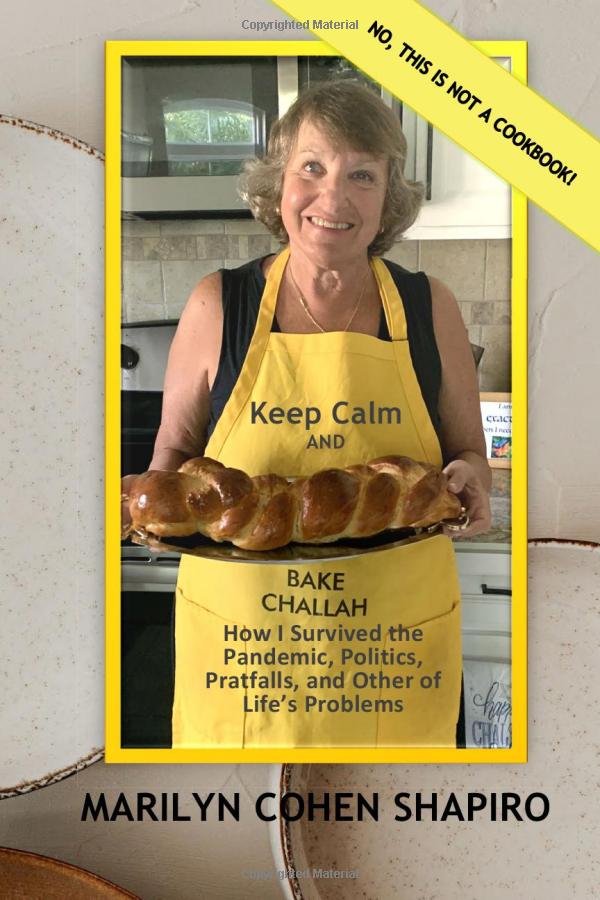
As Jews around the world herald in the Hebrew Year 5784, I am celebrating Rosh Hashanah with the release of my fourth book, Keep Calm and Bake Challah: How I Survived the Pandemic, Politics, Pratfalls, and Other of Life’s Problems.

Before you start getting out your baking pans, please be warned: No, this is NOT a cookbook! 

In March 2020, as the reality of COVID-19 hit home, I started baking challah, the delicious, braided egg bread that is typically eaten on the Sabbath and other important Jewish holidays. More importantly, I started WRITING about baking challah. Getting inspiration from England’s World War II rallying cry, I searched the internet and found Keep Calm Maker on Zazzle, an American on-line marketplace, could create an apron with a Keep Calm and Bake Challah logo embroidered on the top half. The yellow cotton pinafore arrived in June and my wearing it while baking the loaves became as necessary to the process as kneading the flour, sugar, salt, oil, and yeast. I knew that the mantra would be the title of my book. 

Over the next two and half years, I wrote about baking challah. I also wrote about adjusting to the “new normal.” Wearing masks. Zooming with family and friends. Missing in-person birthdays, bar and bat mitzvahs, graduations, weddings, and funerals. Following the news as the country was split apart. Emerging slowly back into life more closely resembling the pre-COVID years. Finally meeting my San Francisco grandson who was born days before California began its shelter-in-place orders. Resuming our summers at 9100 feet in Colorado. And dealing with our own COVID illnesses. 

In April 2023, my editor Mia Crews and I were putting the final touches on Keep Calm and Bake Challah before publication. We were going back and forth with necessary changes to the fifty-three stories as well as the cover, which featured a picture of me wearing my apron and holding a huge, braided loaf. Finally, Mia uploaded the first draft copy of the book. That Friday afternoon, I greeted the deliveryman as he handed me the brown envelope that held my new “baby.” 

“Thank you so much!” I told him. “It’s my book!” 

“That’s nice,” he said, as he turned around and started heading for his truck. 

“No, it’s not any book,” I said. “It’s my book! I wrote it. Do you want to see it?” 

Before he could answer, I tore open the envelope and showed him the proof copy. 

“That’s nice,” he said. “You wrote a cookbook.” 

“No, it’s NOT a cookbook,” I said. “It’s a collection of stories about my life during the pandemic.” 

As he left, however, I took a closer look at the cover. It DID look like a cookbook. That opinion was confirmed by several other people to whom I showed the proof. 

Over that weekend, I agonized over my dilemma. Did I need a new cover? A new title? Or did I need to throw out hundreds of hours of writing and editing, keep the cover and title, and just write a cookbook? I seriously considered a title change—Thankful? Finding a Silver Lining?—until a conversation with five of my cousins on our weekly Tuesday Zoom call. 

“Don’t change the title,” they said. “Just put a banner proclaiming, ‘No! This is NOT a cookbook!’” 

I gladly followed their advice. I had been working on this book since March 2020, and I knew that the chosen title best reflected all those months of dealing with the pandemic. More importantly, I loved the title. No matter how many people passed up on my book because it looks like a cookbook, at least the title and cover would be what I dreamt it would be from the beginning of this journey. 

So I proudly present Keep Calm and Bake Challah: How I Survived the Pandemic, Politics, Pratfalls, and Other of Life’s Problems. For all of you who hoped it was a cookbook, I hope you enjoy it anyway. And to make everyone happy, my challah recipe is included at the end of the book. Happy baking! 

Keep Calm and Bake Challah: How I Survived the Pandemic, Politics, Pratfalls, and Other of Life’s Problems is available on Amazon. Click here for more information.

Gammy making challah with her granddaughter

Torn between three places? Why we are comfortable where we are.

Larry and I have just returned from visits with our children in California and Colorado. While enjoying our time, it is nice to return to our own home in Florida. This article, which was originally published in 2019, explains why we are happy where we are.

There is always, always something to be thankful for Author unknown

When my daughter Julie headed out to Colorado in 2003, it was originally planned as a nine month adventure teaching environmental science. Soon, however, Julie fell in love with the mountains, Colorado, and Sam, not necessarily in that order. They built a life together, completed graduate degrees, got married, bought a house in Frisco, and had a child. They have  settled into the life at 9100 feet.

Meanwhile, our son Adam chose a different path in another Frisco…San Francisco. After completing a law degree, he moved into an apartment in the middle of the city. This past December, he met Sarah. In a whirlwind romance, they dated, got engaged, got married, and now are expecting their first child. They have settled into life at sea level.

In the middle of all this, my husband Larry and I decided to move from Upstate New York, to a fifty-five plus community in Florida, close to 2000 and 3000 miles from Frisco and San Francisco, respectfully. There are those who ask us when we are moving closer to our children. The answer, for now, is NOT NOW.

Feeling gratitude despite living so far away may be difficult to fathom. However, I am thankful. Both my children have chosen to settle in two of the most wonderful places we have ever visited. Recent experiences bear that out.

Frisco, Colorado is nestled in beautiful Summit County. Surrounded by mountains reaching over 14,000 feet, it is for us a summer wonderland. Trails beckon us on hikes that bring us next to flowing streams, stunning wildflowers, and expansive vista. Larry plays with Summit County pickleball league while I take long walks with my granddog. Free concerts are offered in most surrounding towns Thursdays through Sunday. 

Our favorite is the one on Main Street in Frisco every week. Hundreds of people congregate around the pavilion in the middle of Frisco Town Park. The adults settle into lawn chairs and on blankets, pulling dinners out of coolers, while their dog or dogs settle near by. Meanwhile, the children dart around the lawn and path around the pavilion. It is a slice of Americana that I hadn’t seen since growing up in our Upstate New York town. In addition to the free entertainment, the area has several theater groups and a summer residency for the National Repertory Orchestra. Because of all it offers, Larry and I have rented there for the past four summers.

One thousand miles away, San Francisco is one of the most beloved city in America. When we visited Adam, we have taken advantage of all its attractions. We have walked through Golden Gate Park and across the iconic bridge. We have visited Alcatraz, Muir Woods, Sausalito, and Point del Reyes. We have used the city as a starting point to attractions as far south as Monterey and as far north as Astoria, Oregon. 

With our children living in such wonderful places, why have we have not picked up and moved? This question has taken on new meaning now that we have The Frisco Kid in Colorado and a soon-to-be grandson in California. 

Let me start with Frisco. Everything I wrote about my favorite town in the world is during the summer. In 2019, its residents experienced snow through the end of June, enjoyed a beautiful summer, and had its first dusting of the 2019-2020 season on a nearby ski resort on August 22. By September 19, the mountains got enough to get skiers excited. 

When we visited Julie and Sam in mid-October, snow fell on five out of six days. An Upstate New York girl, I always loved the site of clean, white snow on lawns and trees and trails. Unfortunately, sidewalks are not immune. After dropping The Frisco Kid at pre-school the second full day we were there, the sun was shining everywhere, including on the black ice on the sidewalks. We had to leave for the airport a day early as a major storm was expected to bring hazardous conditions to Route 70. The Weather Channel advisory recommended travelers to pack food, water, and blankets in case one was stranded. Although the snowfall never amounted to more than 2 inches (Denver actually got more!), the temperature dipped to 16 degrees above zero, without windchill. We love Frisco but cannot see us living there through their long winters.

The weather in Adam and Sarah’s now established home town  is admittedly better. Even if you factor in the famous Mark Twain quote, “The coldest winter I ever spent was a summer in San Francisco,” we would never have to deal with snow. , The city, however, is known for its steep hills and even steeper housing prices. If we sold our home in Florida, we could maybe afford a bathroom. No, I am not talking about a one bedroom, one bath apartment. I am talking about a bathroom. No shower included. And to get to that bathroom, we would probably have to walk up four flights of stairs, as the natives seem to eschew elevators. 

There are two more reasons not to move. First of all, a number of friends have relocated to be close to their children, only to see them relocate one or two years later because of their careers. 

Finally, Larry and I love where we are. We are in a one floor home that is a perfect size for the two of us. We have activities that fit our needs: pickleball courts; fully equipped gyms, olympic sized pools, restaurants, and entertainment venues. To add to our pleasure, we have our choice of over 250 clubs and organizations with which to participate within our gates. 

Within a forty minute drive, we have all that Orlando has to offer, including world class entertainment. The Frisco Kid experienced Disneyland for the first time last year, and she is already on a campaign to make it a yearly visit. Hopefully, she will h persuade her new cousin to do the same!

So we are here to stay for as long as we can maintain our independent lifestyle. This Thanksgiving, we are grateful that both my children have chosen to settle in two of the most wonderful places we have ever experienced. We have planned visits as well as a promise to them that we can be on a plane in a moment’s notice if needed. Meanwhile, the guest room is ready for them anytime. 

A version of this article originally appeared in the November 14, 2019, Jewish World News, a bi-weekly subscription-based newspaper in upstate New York.

Marriage 1940’s Style

My mother, Frances Cohen, was the family story teller. She wrote this story while in a writing club at Coberg Village, Rexford, New York, sharing details of her marriage to my father, Bill Cohen, on August 20, 1940. It is one of the stories I captured in my 2021 book, Fradel’s Story.

On May 1940, Bill and I officially became engaged when Bill presented me with an Elgin wristwatch. We began planning our wedding. My brother Eli and his fiancé Zelda had planned a big Sunday afternoon wedding for August 18. To make it convenient for our out-of-town guests to attend both weddings, we planned a smaller event for two days later on Tuesday evening, August 20, 1940.

We had a difficult time writing the wedding invitation as both my maiden surname and Bill’s surname were Cohen. To make it even more complicated, thanks to the officials at Ellis Island, both my father’s and future father’s-in-law names were Joseph Cohen. Even our mothers’ names matched: My mother was Ethel Annie Cohen; Bill’s mother was Annie Ethel Cohen. To make it clearer, we used the first letter of our first names as the middle initials of their names, left our mothers’ first names completely off, and had the invitation printed as shown here.

Wedding Invitation

Our wedding was not elegant. However, Bill and I made a handsome couple under the chuppa (wedding canopy), me in my rented wedding gown and floor length veil ($8), Bill in his rented tuxedo ($7), and both of us so happy we glowed. (Priceless!)

After the religious ceremony, the guests were served tea sandwiches, fruit, and wedding cake. Unfortunately, by the time the photographer finished taking our wedding pictures, most of the guests had left and most of the food was gone. We did keep the bride and groom figure from the top of our cake, which we still have in our china cabinet today.

Bill and I had a two-day honeymoon at the Hotel New York in a bridal suite at $10 a night. On Thursday morning, my cousin Elliot and my Aunt Rose met us at the hotel in his car to drive us to Malone in upstate New York where we were to make our first home. As this was before the Thruway and the Northway, the trip was over ten hours long. Bill and I planned to take advantage of long trip on the road by cuddling contentedly in the back seat, but that was not to be. The back seat was filled with suitcases, wedding gifts, and home furnishings, including a huge table lamp. Aunt Rose was prone to carsickness and needed to sit next to the window in the front seat. And so, we started the first chapter of our life together as Mr. and Mrs. Wilfred Cohen with me in the front seat between Elliot and Aunt Rose and with poor Bill squeezed into the back seat, balancing the lamp on his lap for the entire trip.

By September 1940, Bill and I spent our first few weeks as happy newlyweds living in Malone, New York, a small village only a few miles from the Canadian border. Bill had been working there for two years in the North Country and loved it. Since it was a new way of life for me, there were many adjustments to be made.

Before I was married, my life was very different. I worked in a job I loved, a bookkeeper for a large firm called the Dixie Dress Shop in the heart of New York City. At the end of the day, I took the subway home to Brighton Beach for five cents. I arrived home to the apartment I shared with my parents, warmed by the steam heat and the delicious aroma of my mother’s homemade meals she prepared for us each evening.

After we married, I moved from New York City to a tiny town in Upstate New York to be with Bill. I left a job making $19 a week to live with a man who was making $18 a week. That was before Women’s Lib. We were convinced that two could live as cheaply as one. We quickly found out that that wasn’t true.

Please do not misunderstand me. I loved being a married stay-at-home housewife, but I had so much to learn. I was now expected to prepare three meals a day on an old kerosene stove. My mother and mother-in-law were not much help living 350 miles away. Besides, they never cooked from a recipe, as their measurements consisted of a bisl (little) of this and shtik (piece) of that. My mother-in-law sent me more detailed recipe books and a mix master, and Aunt Rose, who lived close by, also gave me lessons. I eventually learned to cook and bake, but not without much trial and error.

My first experience cooking rice was a disaster. I started out following the directions exactly, using one cup of rice to two cups of water. After ten minutes, I checked the pot, and it didn’t look like one cup of rice would be enough for my husband’s hearty appetite. So, I added more rice and then more water and then more rice and then more water. By the time Bill came home for dinner, there were three huge pots of cooked rice sitting on the stove. For the next two weeks, we lived on tomato rice soup for lunch, rice casseroles for dinner, and rice pudding for dessert.

Soon after we were married, Bill was transferred to a Pearl’s department store in Rouses Point, New York. We were now farther from our family, and I often felt lonely. In the winter, the temperatures were always at least thirty degrees lower than New York City. The natives always described the winter weather as “a February thaw is thirty below and a hell of a blow.”

As the months wore on, I found it very difficult to adjust to all the snow and cold. Besides, our three-room furnished apartment was not fully winterized. The big potbelly stove with its dirty ashes sat in our living room, and that room was always too hot. The kitchen was just right, but the bedroom was always only forty degrees. I felt like Goldilocks!

I missed all the good things that the Big Apple had to offer. I missed browsing and shopping in the big department stores. I missed eating in Italian and Chinese and Jewish restaurants and in the automats. I missed the theater, the big glamorous movies houses with vaudeville shows, and Radio City Music Hall and the Rockettes.

But with a loving husband who was an optimist, I gradually changed my attitude. I started to look at the beautiful scenery of the Adirondacks and Lake Champlain and all the advantages a small town had to offer.

A version of this article originally appeared in the November 13, 2014, issue of the Jewish World News, a bi-weekly subscription-based newspaper in upstate New York.

Weathering Tempest Ian; Marilyn expresses gratitude.

As hurricane season ramps up in Florida, I remember last year’s Hurricane Ian.

Five days before our community in Central Florida was predicted to feel the effects of Hurricane Ian, phone calls, texts, emails, and Facebook posts expressing concern for our safety began arriving  from around the country and the world. 

Arizona: “Is the hurricane going to Florida near you?”

South Carolina: “Thinking of you and this crazy hurricane path.” 

Vancouver: “Sounds like you guys could be getting some potentially nasty weather!!”

England: “Stay safe!  Bit of a bugger these hurricanes.”

Massachusetts: “You still have time to fly to our house in Boston.”

New York: “Where shall we send the flowers?”

When my husband  Larry and I left New York State, we were glad to leave snow and cold and blizzards behind. We also were fully aware that moving to Florida meant we would face the possibility of hurricanes. Therefore, when looking for a home, we decided to steer away from the Florida coasts, which historically took the brunt of these storms.

Not Our First

We immediately had fallen in love with 55+ active adult community south of Orlando because of what it offered. Furthermore, the homes were well-built, with underground electrical wires and excellent drainage.

Our first experience with Florida hurricanes was with Irma in 2017, and that had given us more confidence in our ability to withstand these mega-storms. This confidence was further boosted by experience of people who have lived in our community for over twenty years. In a text thread with fellow SOL Writers, one of the long-timers assured another member, who was experiencing her first Florida hurricane. “I’m one of those pioneers who have weathered several hurricanes here,” wrote Kathy Glascott. “Actually, that should be a selling point for Solivita – the community that survives hurricanes well! “As I learned later, all the homes were built in compliance with 2002 Florida Building Code(FBC), which mandated that new construction be able to withstand hurricane-force winds and feature shutters or impact-resistant glass in all openings.

Prep for the Storm

We also knew how to prepare for the storm. Immediately following Rosh Hashanah, we went into full “A-Hurricane-Is-Coming” mode. We made a quick run to the supermarket to add more canned food to our already full panty. We brought inside all potential flying projectiles: lanai furniture, plants, lawn ornaments, and hoses. We filled empty orange juice jugs saved just for this type of emergency with water. For extra measure, I filled the bathtub as well as several big pots. We even squeezed in our fourth COVID vaccine booster shots, figuring if we had any side effects we were already stuck inside. 

Then it was a waiting game as Ian was getting larger and more ominous by the hour. The Weather Channel (TWC) showed a cone that covered all of Florida. Larry kept track of the storm in the office, switching between The Weather Channel, the local news, and some mindless programming to ease the stress. I followed Ian’s path on the television set in our kitchen, where I was working on a Mixbook family album and the final edits for my upcoming book. (Yes, I really did this. Maybe I feared that the projects needed to be completed before we lost electricity for goodness knows how long.)

 Taking It In Stride

By 5 pm Wednesday, Hurricane Ian had touched down near Punta Gorda, about 120 miles away from our home, with 140 mph sustained winds.The scenes on the news in the hours that followed were terrifying to watch: massive flooding, destroyed buildings; boats piled on the shore. TWC meteorologists were in the middle of it. At one point, Jim Cantore was nearly hit in the head with flying debris. All I could think was, Is it worth losing your life to report on this? Thankfully one of the men in charge told him to find shelter. As faithinhumanity later tweeted: “I’m curious. When applying for this position of field weatherman was it the first line under job requirements or was it buried in the fine print ‘Must be Suicidal.’” (sic)

Meanwhile, our community was feeling the impact of Hurricane Ian. The rain was coming down in sheets, turning the small pond behind our house into a river. Fortunately, the water stayed well below our lanai, spreading north to south behind the homes on either side of us.

By eight p.m., darkness was closing in. We FaceTimed with our children, assuring them—especially our seven-year-old granddaughter— that we were fine and safe. Larry and I each finished off a big bowl of ice cream, reasoning that our half gallon of Breyer’s Vanilla Bean would melt if the power went off. On the last minute advice of our friends in England, we transferred a couple of bottles of white wine to the frig. We did a last minute check to ensure that all our other emergency gear—candles, matches, crank-up radios, smaller flashlights, cork screw, were in working order.

Oops

My only moment of concern was when I realized that almost every one of the ten D battery in the house was dead. Larry and I salvaged enough for our two larger flashlights and added D batteries to our shopping list.

As the wind and rain pummeled our house, we watched more television, grateful that we had not yet lost electricity. Exhausted, we went to sleep near midnight. Both of us woke up during the night for updates using both the twenty-first century method of checking the internet and the old-fashioned tried-and true-method of opening our front door. So far, so good. 

Minimal Impact

Larry and I woke up at 7 a.m. to the news hat  Ian had been downgraded to a tropical storm  but was still producing strong rains, heavy rains, and winds up to 65 mph. Later that morning, as the storm headed northeast to wreak more destruction, we realized that we were very fortunate.Our house and immediate property was undamaged. The power had remained on. The pond remained well below our lanai. By late Thursday afternoon, the rain and wind had stopped, and the sun was peaking through the remnant clouds. We spent the rest of the day restoring our house to pre-Ian condition.

Larry and I woke up Friday morning to beautiful sunshine. A long walk through our neighborhood showed little damage. Over the next few days, we learned that a few trees had been uprooted, some houses had sustained damage to their lanais, and low-lying roads had been flooded. Our initial assessment, however, proved to be correct. Our community had been minimally impacted by Hurricane Ian. 

Unfortunately, that is not true for so many others. Property data and analytics provider CoreLogic projected storm surge and flood losses from Hurricane Ian to run between $41 billion and $70 billion. As of October 17, over 117 Floridians had lost their lives. Half the deaths were attributed to individuals who chose not to leave their homes despite evacuation orders. Many others, however, lost their homes and lives in areas where experts called the flooding “unprecedented,” “historic,” and potentially ’a 500-year flood event.’

Gratitude

Exactly a week almost to the minute when we were completing final preparations for Hurricane Ian, Larry and I were observing Yom Kippur with fellow congregants of Congregation Shalom Alechiem. We recited the powerful U­netanah Tokef prayer which asks “Who shall live and who shall die, who shall perish by water and who by fire?” We had survived, and we are grateful. And we are grateful for all who were in touch with us throughout the storm.  Massachusetts, we hope to visit without a hurricane! Albany, I love roses, which I will place in my still-intact dining room.

In one of my zany, punch drunk moments before Hurricane Ian hit, I took this picture with my emergency provisions: a head lamp, a half gallon of ice cream, and a bottle of wine (which we saved for AFTER the hurricane passed us by.)