Category Archives: Education

Hate Ends Now

A seventeen-year-old’s powerful stand against hate

One million paper clips are piled high on black construction paper on the stage, lit by a spotlight. Above it, the flickering black and white film of Jews walking to their deaths in a Nazi concentration camp is being shown on a theater-sized screen. And standing in front of the stage is the seventeen-year-old Edgewater High School (EHS), Florida, senior who orchestrated this scene, along with several other exhibits that make a powerful stand against antisemitism and many hate. 

The first thing you notice about Adam Mendelsohn is his hair. Standing at six feet tall, Mendelsohn adds another two inches with his wild dark brown curls, complimented with a gray yarmulke perched in the back. As the organizer of the January 9, 2025, Hate Ends Nowcommunity event, Adam radiates a confidence and maturity that is unusual in such a young man.

The previous summer, Adam had attended a meeting of the local Jewish Student Union (JSU). Founded in 2002, the organization oversees 200 Jewish culture clubs on public high school campuses to provide Jewish teens with programs that strengthen their Jewish identity and connection to Israel. On that day, Rabbi Daniel Nabatian, the co-director of the Central Florida branch, encouraged the students to make an impact—no matter how small—to fight against the rising wave of antisemitism that had gripped the world since the Hamas attack on Israel on October 7, 2023. 

 Adam was determined to bring the JSU message to Edgewater High School students and staff. Following up on his memory of a similar exhibit, he contacted Hate Ends Now, a nonprofit whose mission is to combat hatred and indifference by educating people about the history of the Holocaust and all forms of bigotry. The organization offered not only artifacts from the Holocaust but also an exact replica of a World War Two-era cattle car that was used to transport Jews and other targeted groups to concentration and death camps. A twenty-minute, 360 degree immersive presentation offers an impactful educational experience. With the support of Dr. Alex Jackson, Edgewater’s principal, and his assistant, Valerie Lopez, Adam worked with Todd Cohn, the CEO of the nonprofit, schedule the event in Orlando for January 9, 2025. 

 Adam then started a fundraising campaign to pay for the cattle car and other expenses. Thanks to the generosity of many donors, including the Ginsberg Family Foundation and Massey Services, the seventeen-year-old raised over $30,000, enough to cover most of the expenses.

 Adam’s next step was to contact local organizations whose mission aligned with the core values of the event to sign on. Participants included the Jewish Student Union (JSU); Chabad C-Teen; Shalom Orlando, the Holocaust Memorial Resource and Education Center of Florida; the Anti-Defamation League, and Central Florida Pledge, a network of community members in Florida who stand up against discrimination and hate.

Adam now began the search for a Holocaust survivor. Jasmine Flores, the community relations manager for the Greater Orlando Massey Services, connected Adam with Ludwig (Lou) Ziemba, an 82-year-old Kissimmee resident, through her involvement in Maitland Rotary.  Ziemba was born in the Lodz Ghetto on September 9, 1942, one day before 13,000 children under ten were to be sent to an extermination camp. Arrangements were made for the infant to be hidden in a garbage truck and smuggled outside the Ghetto where a Christian Polish farmer retrieved him and took him home to be raised as his own. Miraculously, his parents survived and were able to retrieve their “hidden child” when they were freed three years later. 

The paper clip exhibit was a last-minute miraculous addition to the event. On Sunday, through a conversation with Beth Landa, Ziemba’s wife, Adam learned about Paper Clips, a documentary that highlighted the 1998 efforts of middle school students from Whitwell, Tennessee, to collect six million paper clips representing the six million Jews killed by the Nazis. According to Wikipedia, at last count, over 30 million paper clips had been received.

A preliminary research of the documentary compelled Adam to see if he could locate a low-cost source of paper clips. The manufacturing plant of Bulk Office Supplies was in Tampa, but was closed for the weekend. Undeterred, he located the name of the founder and owner of the company, Alex Minzer, on Facebook. Encouraged by Minzer’s “Never Again,” hat, Adam messaged him; Minzer answered almost immediately. Alex Minzer had sold the company to Levi Haller, who was currently in Jerusalem. Alex helped connect Adam with a wholesaler in Tampa who would provide the paper clips at cost – and later that same day Levi Haller reached out to Adam to say that decided that Bulk Office Supply would donate the 1 million paper clips, inspired as he was by the project’s mission and Adam’s passion.

Next problem: how would the paper clips get from Tampa to Edgewater in time? Fortunately, Adam’s father Jason was returning from a business trip on Florida’s west coast on Wednesday. Adam quickly did the math, his favorite subject, to confirm all the boxes would fit into his father’s car. All good! The clips were successfully delivered at one o’clock, only 28 hours before the event was scheduled to open.

Adam and a group of student volunteers began the tedious task of opening the 10,000 small boxes of 100 paper clips and piling them onto a 7X7 foot square of construction paper that had been placed on the stage in the school’s auditorium. When the school day ended at 2 pm, Adam stayed on, working alone and then with his father, until 8 pm. “When I left, I looked at the pile and despaired,” said Adam. “I had no idea how the project could be completed.” 

Adam returned to EHS the next morning at 5 am. By school opening, the whole student body was aware of the urgency to finish the job. “It was crazy!” Adam said. “Students were rotating in and out of the auditorium to provide help over the next several hours.” The pile was completed at 1 pm, twenty-four hours after the initial delivery. “I now hate paper clips,” Adam said with a laugh.

At five pm, the doors opened to the public. Over 500 people attended the three-hour event. They perused the display tables, munched sandwiches provided by Kosher Grill, listened intently to Ziemba, looked over the chilling artifacts on the Hate Ends Now tables, sat in the quiet auditorium to contemplate the million paper clips, and, at scheduled times, viewed the powerful immersive presentation in the cattle car parked just outside Edgewater’s entrance. 

Dignitaries included United States Representative Maxwell Frost, Florida State Representative Anna Eskamani, staffers sent on behalf of Senator Rick Scott and United States Representative Darren Soto, and members of the EHS school board. 

“This is an incredibly powerful experience,” said Frost. “I believe that every high school student should have the opportunity to witness the horrors of this tragic time in world history through such exhibits. This event serves as a reminder that when we lead with love, we can stop hate in all forms and make sure this type of history never repeats itself.” 

Todd Cohn also commented on Adam’s project. “It’s rare to see such a young individual take on such a meaningful project with this level of commitment,” the Hate Ends Now CEO. “He made a lasting impact not only on us but on everyone who experienced the exhibit. Adam is a shining example of how one person can make a big difference.

Ziemba found sharing his story with a large and diverse audience to be exhilarating. Despite his history, Ziemba still believes love will prevail. 

“Try to accept people,” Ziemba told Orlando’s Spectrum Cable News reporter Sasha Teman. “I know I grew up loving people, and I still love people.”

Adam is grateful to all involved in making the project a success. He also plans on sharing the message with him beyond high school “Barriers which prevent love and peace can be destroyed by understanding that we are all the same,” he said. “I plan on carrying the torch of compassion, acceptance and tolerance throughout my life.” And the one million paper clips? Plans are underway for the clips to be gathered in a lucite case with signage that will be placed in the Edgewater High School’s entrance hall. Adam’s hope to make a difference and to combat hate of all kinds will now be his lasting legacy.

Originally published January 25, 2025. Updated May 26, 2026

Those who wish to make a contribution to Hate Ends Now in honor of Adam Mendelsohn and his project, please click here. 

All photos provided courtesy of Cara Dezso

College Dreams by Frances Cohen

As high schools and college students celebrate their graduations, I reflect back on my parents’ insistence that their children, unlike themselves, graduate from college.

My husband Bill and I always regretted that we did not have a college degree, but times were different in the 1930s during The Great Depression.

 When I graduated high school in 1935, there was no way that I could afford to go to college. Immediately after I finished school, I got a job as a bookkeeper. Most of my salary went to pay the rent of my parents’ apartment. 

Bill’s grandmother promised him that she would pay Bill’s tuition at the University of Vermont in Burlington. Those plans were crushed when his grandmother died after attending his high school graduation, and she left no provisions to pay for his education. Since he did not have the advantage of a college degree, he went into the retail business and spent many years associated with Pearls Department Store a family owned business in Keeseville, New York, that sold lower end merchandise. Things changed in the late 1960s when the Northway and the big box department stores in Plattsburgh opened. We found it difficult to compete. Fortunately, we had the opportunity to open the Village Bazaar, a very nice ladies’ store that catered to career women. It was successful, and we decided to close Pearl’s and concentrate on the Bazaar.  

While our children were growing up, we kept telling them, “You are going to college! You are going to college!” Beginning in 1964, our dreams of making sure our four children had college degrees became a reality. Our daughter Laura graduated from State University of New York at Geneseo with a degree in special education, a field in education that had just recently been created. Soon, our other children followed our oldest daughter’s footsteps. Our son Jay graduated Union College in 1968, Marilyn graduated from the University of  Albany in 1972, and our youngest Bobbie graduated from State University of New York at  Plattsburgh  in 1977. Two of the children completed masters degrees. Six of our  of our eight grandchildren have also received their undergraduate degrees and even completed advanced degrees. [Update: The seventh grandchild completed an undergraduate degree in 2015 (and is enrolled in a graduate program), and the eighth is currently attending undergraduate college full-time.]

At times, however, their education almost backfired on us. When Laura came home for Thanksgiving her first year, she began swearing up a storm, using four letter words that had never come into my home before. I decided to turn the tables on her and started using them myself. When Laura expressed surprise that I was swearing, I responded, “I’m paying $2000 a year to send you to college so that you can come home and swear like a sailor. I figured I could do it for free!” Laura never cursed in my presence again.

Jay also got a lesson in humility after his freshman year. He came home for the summer after he took, along with his other courses, a three-credit business class. He began criticizing the way Bill and I ran our businesses. He peppered us with questions. “Do you really know how to run a store? Do you understand what it takes to determine what to buy? What styles to order? How to deal with the bank?” I answered, ‘Sonny-Boy, your father and I have been running a business since before you were even born. We hired a buying office from New York City to inform us of the latest fashions. We learned that in Keeseville we sell more size 14 and 16’s. We learned that we needed to buy three pair of pants and five blouses to every blazer. We learned how to best deal with our customers. We learned this by the seat of our pants, which is better than any business course they teach at your fancy school.” 

There is an old saying that states:  I was amazed at how little my parents knew when I was 17 and how much they learned by the time I was 21.” Our son Jay learned that lesson that day.

Bill and I take pride in our children and grandchildren’s education, but we also take pride in the fact that we were self-taught, sometimes the best kind of education a person can have!

A version of this article originally appeared in the August 18, 2016, Jewish World News, a bi-weekly subscription-based newspaper in upstate New York.

Four children, four college graduates, seven degrees.

My Sister: A Pioneer as a Teacher in Special Education

As a child, I was in awe of my big sister. Eight years my senior, Laura wore the best clothes (big skirts with tons of crinolines); listened to the best songs (No to Elvis; Yes to Pat Boone and Johnny Mathis); and exuded a confidence that I lacked. It wasn’t until I was an adult, working with Special Olympic athletes, that I gained a greater appreciation for her true gift-her career as a special education teacher. Through the efforts of pioneers like Laura Cohen Appel, the world has become more inclusive and more understanding towards the education of all. The improvements have been massive over many years, as can be seen by these global education statistics here.

A Career Choice
In 1958, Laura, a junior at Keeseville Central High School in upstate New York, was thinking about her future. She knew that she wanted to become a teacher, but she didn’t want to teach “regular” kids. Somehow she knew that she wanted to work with what was then called “the mentally retarded.”

Every April, selected 11th and 12th grade students were given the opportunity to participate in “Student Teacher Day.” She requested to be placed with Alice Benoit, who taught a life skill class for low functioning students. That experience and conversations with Benoit confirmed her career choice.

On the recommendation of Dan Meagan, the guidance counselor, she applied to Geneseo State, a small college located in the Finger Lakes region, and only one of two in the state system offering a degree in special education.

In addition, Geneseo was progressive. According to SUNY Geneseo: From Normal School to Public Ivy, 1871-2007,James V. Sturges, the principal of the Geneseo Normal School, created a special education program as early as 1922. A 1920 act of the New York State Legislature stated that “[e]very school with ten or more ‘subnormal’ or ‘unusually retarded’ children was to provide a specially prepared teacher.” As a result, Sturges included special education in his teacher training curriculum.

Father Uncomfortable
Reflecting his generation’s “unease” with the stigma of “special needs” children, our father Bill Cohen was uncomfortable about her decision. “Why do you want to teach those students?” he questioned. “Why don’t you just want to be a teacher of regular students? (Interestingly, our father later served on the local school board for many years, and he was a proponent of special education programs, thanks in part to his daughter’s work in that field.)

While Laura was junior in college, President John F. Kennedy, whose sister Rosemary had intellectual disabilities, created the President’s Panel on Mental Retardation, which heralded the beginning of federal involvement and fiscal aid to states. His sister, Eunice Shriver, founded the Special Olympics in honor of Rosemary, who had been hidden by her parents in private schools and, then after a lobotomy to “fix her,” placed in an institution for the remainder of her life.

Spring semester of her senior year, Laura was assigned to do her student teaching in Rochester, N.Y. Her first assignment was in a fourth grade “regular” classroom, an experience so horrible that Laura almost quit. My parents insisted she stick it out. Her second assignment in a special education class with a wonderful teacher and mentor again confirmed her career choice.

“A New World”
After she graduated in 1964, Laura took teaching position in Spring Valley, New York. During that first year of her teaching, special education classes were not held in regular school building. Instead, Laura taught classes in an activities building for a nearby summer camp. A second building held the classes for the physically handicapped as well as a food service program that made student and faculty lunches every day.

Laura and her fellow teachers, left very much on their own, made the decision to divide the classes not by ages, but by abilities, thereby allowing children with similar skills to progress together. For some children, education focused on basic life skills-eating, dressing and bathing, as well as other daily living skills like shopping, banking, phone use and housekeeping. Others showing greater ability were taught skills that were part of a more standard curriculum, including reading, math, history and science.

Teaching special education was a whole new world. Before 1961, the United States did not publicly educate any children with any disabilities. If a child had cognitive or emotional disabilities, deafness, blindness or needed speech therapy, parents had to educate their children at home or pay for private education.

Thankfully attitudes to special education have come a long way since those early days, and now, children can receive help and support to overcome various issues related to speech and communication. Some of these vital services can even be provided at the home of the child. For example, check out infinitetherapysolutions.org to learn more about in home speech therapy in NJ.

Ultimately, parents began the process of securing public education by creating advocacy groups for their children. They met with teachers and politicians. It was not until 1965, when Laura was in her first year of teaching, that President Lyndon B. Johnson began signing off on acts designed to expand public education and its funding purposes.

Changes
Laura continued teaching special education in New York and, after her marriage, in Connecticut. In 1971, she left the classroom to become a stay-at-home mom. Five years later, the family relocated to Phoenixville, Penn., a suburb of Philadelphia.

Changes, meanwhile, were happening in special education As late as 1970, United States schools educated only one in five children with disabilities, and many states had laws excluding certain students, including children who were deaf, blind, emotionally disturbed, or “mentally retarded.” In 1975, however, with the passage of the Education for All Handicapped Children Act, the United States voted to ensure that all children, regardless of their differences, should have access to free public school education. This act helped to bring federal funds into schools to help them create special education for children who did not learn the same way as general education students. The law also gave parents a right to have more of a say in their child’s education. The passage of the law opened the gates for more emphasis on special education.

Inclusion- The New Goal
In 1978, with both of her children in school full-time, Laura began teaching special education in the Phoenixville Area School District, first in the regional educational service agency and eventually in the middle school as a seventh grade resource room teacher.

Embracing new findings that special needs students did better when mainstreamed into classes with non-disabled students, Laura worked with teachers in her team and the administration to transition the students from her stand-alone classroom to general education classrooms during specific time periods based on their skills.

Laura said that children still experienced prejudice not only from the “regular” students but also from some of the old-school educators who believed that “retarded” children didn’t belong in their classroom. As the years progressed, however, Laura has been encouraged to see that many teachers fully embrace the idea of inclusion.

The Education of All Handicapped Children Act continually underwent change and grew into the more expansive Individuals with Disabilities Education Act of 2004. This has become the model of public education that continues today. By the time Laura retired in 2006, most children with intellectual disabilities had been placed in inclusive classrooms where children of all abilities could learn from and with each other. “As a result,” said Laura, “students with special needs feel much less stigma for being in a learning support class.”

The United States has come a long way from locking away students with special needs into institutions, private schools and isolated classrooms. “I feel a great sense of pride that I was part of the generation of educators who helped take students with intellectual disabilities out of the closets, institutions, and isolated classrooms, and put them alongside their non-disabled peers,” Laura said. She indicated that these changes have fostered greater understanding, tolerance, and compassion not only in the classroom but also in the greater society.

Marilyn Shapiro, formerly of Clifton Park, is now a resident of Kissimmee, Fla. A compilation of articles printed in The Jewish WorldThere Goes My Heart, is available. Marilyn Shapiro’s blog is theregoesmyheart.me.

A version of this article originally appeared in the Jewish World News, a bi-weekly subscription-based newspaper in upstate New York.

By Her Students She Was Taught….

The Parkland shootings, which took place in nearby Broward County, took place almost three months. I, along with many others, are trying to process this tragedy. Friends, family, former teachers, and current students are still sharing their thoughts with me, and those will be the topic of a future article. Meanwhile, I am sharing an article reflecting my own experience teaching a college preparation course almost twenty-five years ago:

May 28, 1993,  was graduation day at the Capital District Educational Opportunity Center, a division of Hudson Valley Community College which offers a wide range of programs and educationally  and economically disadvantaged adults.

During and after the ceremony, there were laughter, tears, and the inevitable thanks that we teachers receive from our students for the time we spent with them in the classroom. My college preparation students tanked me for guiding them through their term papers, helping them improve their study skills, and making sense out of difficult reading passages. What my students don’t realize is that I, as an adult educator, have learned as much from them as they learned from me.

I have learned about determination. Two and a half years ago, Michael was lying in a hospital bed, recovering from a construction accident that nearly killed him and ended his career. Rather than curing the powers that be, he decided, twenty years after finishing high school, to rebuild his life by pursuing a college degree.

“I’ve always believed that God never closes a door without opening a window,” Michael wrote in one of his essays. His window was going back to school. Despite the pain of his injuries, a long commute from Know to Albany, and family responsibilities, Michael came every day, motivated, determined, and optimistic that he would reach his goal. That same determination will serve him well at Hudson Valley Community College come September.

I have learned about courage. Sharon is a recovering agoraphobiac, a woman afraid to leave the shelter of her home. The first day of class, she learned that an oral presentation was a requirement of the course. She was terrified. Coming to school was enough of a challenge; speaking in front of a class was nearly impossible. The last week of class, however, her face white but determined, her hands gripping the podium for emotional and physical support, Sharon gave her speech to her supportive classmates. When she finished, the class broke into spontaneous applause.

I have learned about progress. Carmen was a D student at Colonie High School. Returning to our program at the age of thirty, he was convinced that he would barely complete my course. “I don’t think I deserve to pass,” he said. “I am not sure if I am smart enough to handle college.” His final essay belied his own belief. His piece on what was needed to succeed in college was nearly letter perfect and showcased the progress he had made this semester. “You deserved this A. You can succeed in college,” I wrote on his paper.

I have learned to be tough. Carol, a recovering addict who spent a friend time as a homeless person on the streets of Albany, a student who was repeating my course after failing in the fall, thanked me for taking off points every time she turned in a paper late. “It is important for me to take responsibility when I fail.” She also advised me to stop listening to the recovering addicts’ sob stories and start coming down hard on them for not completing assignments. “We know how to bulls**t you,Marilyn. Don’t listen,” she advised me.

I have learned about compassion. On the days that I was tired and ‘soul weary,’ as one of my  perceptive students said, the students cared about me. “Get some sleep Marilyn. We can wait for our papers.”

I also saw their compassion for each other: the student groups, the impromptu tutoring, the support that gave each other either in learning how to use the computer or in keeping up spirits when someone failed a test.

The students have given of themselves: a perspective comment, a good argument, a family story, and anecdote, a journal entry letting me know they are enjoying may class. I read essays about a very special Christmas, a child’s birth, a grandmother’s death, homeless families in bus depots, and numerous stories of recover.

I have been given much more. They have shared something of their lives. As a result, they have enriched me as both a teacher and a person. For this, I thank each one of them.

Skorts, skirts, and kitty cat shirts: What are you wearing to school this year?

Pic2

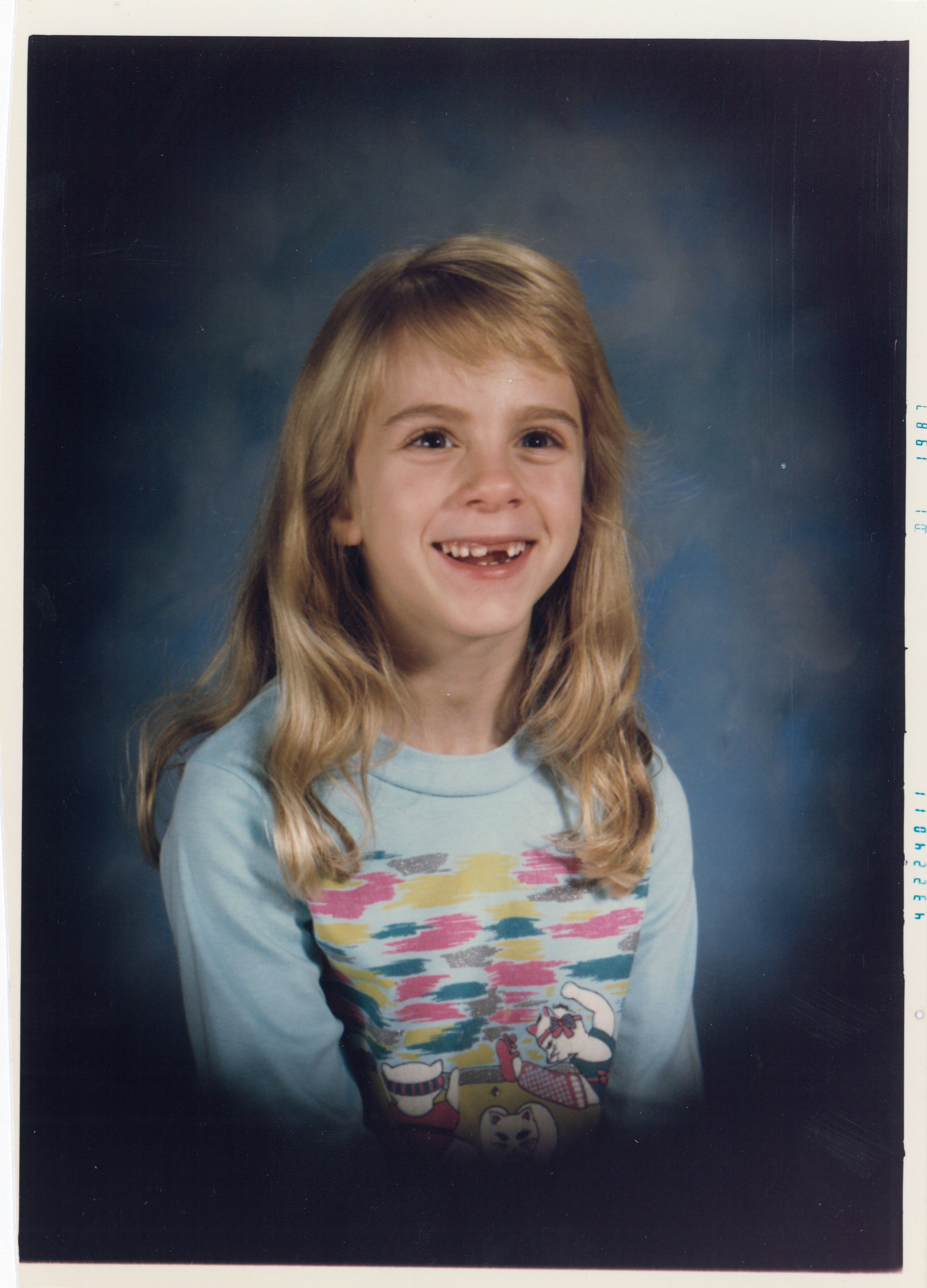
Julie’s famous kitty cat shirt, 1986.

Every August, newspapers are loaded with advertisements for back-to-school clothes. Viewing the options is an experience for me: lacy tight tops, skinny jeans, and leggings for the girls; t-shirts and jeans for the boys. The choices are a far cry from what I wore to school in the fifties and sixties.

I can still remember the smell and feel of new clothes that I put on for elementary school. I always got a couple of new dresses, sweet cotton prints with Peter Pan collars worn with white anklets and sturdy Mary Janes. Since my September birthday always fell close to school opening, new school clothes were included in my presents. I felt a little cheated, as my siblings and friends were getting new clothes, and it wasn’t even their birthday.

By the time I entered junior high, I became more interested in fashion and studied Seventeen magazine all summer, admiring the “mod” look popularized by Twiggy and Jean Shrimpton. Upstate New York was not exactly the fashion capital of the world, but I tried. My stand-by outfit in the mid-sixties was a solid a-line skirt with a ribbed or “poor boy” sweater; a jumper with a turtle neck, or a blouse and a pair of ‘skorts,’ a skirt/pant combination. However, my favorite outfit was a short sleeve wool ‘Mod’ dress, orange with a white hem and white stripes running horizontally down each side. When I wore it, I felt as if I were one of those beautiful, skinny models.

Skorts were the closest I got to pants, as girls were not allowed to wear slacks to our school. My sister Laura and a group of her friends were sent home in their senior year, 1960, when they all came dressed in pants. This all changed in 1966 when one of Larry’s classmates at Saratoga Springs High School was sent home for “improper attire” when she wore slacks to school on a cold winter’s day. The school’s Board of Education decision was overturned by New York State Commissioner of Education, James Allen, who ruled in the student’s favor, freeing female students across the state to forgo dresses and skirts for the comfort of pants. Of course, what we wore, the tailored solid or tweed woolen styles of the 1960s, is a far cry from the leggings and torn jeans that are so popular now.

Once I had children, my job was to shop for them. Dressing Adam for kindergarten was easy. I got a number of Healthtex polo shirts and pant sets from Larry’s parents’ store in Schuylerville, and Adam was perfectly happy. As he got older, Adam switched to jeans and superhero or Star Wars tee shirts.

Then came Julie. Getting her dressed for school became a major battle each morning, especially in first grade. Over the summer, I had taken her clothing shopping, and we had selected several new outfits. When school started, however, she complained that nothing felt comfortable. Her preferred but limited wardrobe came down to one turquoise tee shirt with an imprint of three dancing cats on the front; two pairs of leggings, white with silver metallic stars in the fabric; two pairs of frayed and graying white socks with holes in the toes; and one pair of worn pink sneakers with ratty shoelaces. We had major fights for several weeks. I finally gave in as it wasn’t worth the time and energy. Every night, once she went to bed, I would wash and dry her “kitty cat” outfit, and every morning she put it back on. She wore that shabby outfit almost every day for an entire year.

When Larry and I went in for a teacher’s conference in the spring, I felt I had to apologize. “Honestly, Julie has other clothes, but she chooses not to wear them,” I explained. “Julie wears the same outfit every day because she is comfortable in it. I wash them every night, so she is always clean.”Julie’s teacher smiled and said that was common with first and second graders. Julie also hated to be warm, and she wore an unzipped light winter coat, usually with no hat and gloves, down to the bus, even if it was bitter cold outside. I finally gave up on that battle as well, deciding that she was smart enough to figure out if she needed to add extra layers.

Because of my experience with Julie, I’ve learned to appreciate outfits worn by other young children. When I see, for example, a little girl wearing a flowered top, plaid pants, a pink tutu overskirt, polka dot rain boots, and a tiara for good measure, I ask her if she picked out her own clothes and then compliment her on her good taste. My favorite picture of my great nephew captured his three-year-old self sitting in his car seat on the way to swim practice with his swim suit, his Spiderman pajama top, and cowboy boots. Guess who picked out his outfit for that day?

To this day, Julie hates the heat. She lives in Colorado at 9000 feet, which only has three months of summer. Yes, she is happy as a big horn sheep living in the mountains. To her credit, however, she has become a sharp dresser. Now when I visit her, she takes me clothes shopping, and I am happy with her suggestions. And, thankfully, not one of her choices has included dancing kitties or white leggings with silver metallic stars.