Category Archives: Faith

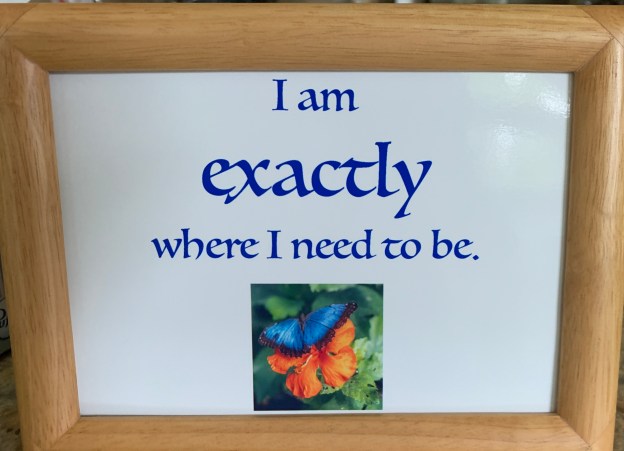
I am exactly where I need to be!

Happy Summer!  Have you kept your New Year’s resolution?

Odds are, you haven’t. Each year, Strava, the social network for athletes, predicts the exact day when most people are likely to ditch their annual commitment to themselves. Whether it be the goal to lose weight, exercise more, or stop smoking, the majority throw in the towel (or throw out the scale) on the second Friday in January. A full 80% will have given up on it by mid-February.

If you have made it to the last days of spring, Mazel tov!

Up until this year, my list of resolutions were endless, so reflective of the person I am. On top of my list (for at least six decades) was to lose weight. Along with that annual goal, I have promised myself in the past to exercise more; read more books, watch more movies, play more piano, see more of family and friends, and write more articles, for starters.

But as I head into a third year where pandemic still hangs over our heads like the sword of Damocles, I have made peace with myself, My one and only resolution is based on an affirmation I stumbled across this past winter. Drum roll please!

“I am exactly where I need to be.”

These eight words summarize an entire philosophy based on the idea that I can be happy where I am at this very moment. It has grounded me when I find my mind racing with what I need to do next: the challah that needs to be baked, the article I have to get to Laurie Clevenson by the Monday morning deadline; the book I have to finish before it disappears off my Kindle. 

Full disclosure: Knowing myself, I will still working on those same items I have listed in the past. (I am already looking forward to writing several biographies of Holocaust survivors.) But I understand that I can reach those milestones without the help and pressure of resolutions. I can be happy in the “now,” not the future. I have given myself permission to focus on the journey, not some numerical destination.

Since I made this resolution on November 17, I already have over two months of practice behind me. I made a copy of it which I keep on my kitchen window sill When I find myself “falling off the wagon,” I quietly recite it to myself and get grounded again. It has the making of a habit! And speaking of habits…

I cannot remember where I originally saw this quote. Facebook? A friend’s blog? A recent book? It took me a few weeks—and the help from my Catholic friend—to find out my first person quote actually came from a prayer from St. Teresa of Avila, a revered leader of the Discalced Carmelite Sisters in 16th century Spain. The opening lines of her original prayer read, “May today there be peace within you. Trust God that you are exactly where you are meant to be.”

It took a little more digging to find a Jewish connection (Yes! There IS a Jewish connection!) St. Teresa’s paternal grandfather, a wealthy tax collector, was a Jew who was forced to covert to Christianity. He was condemned by the Spanish Inquisition for allegedly returning to the Jewish faith and was punished by being forced to parade around Toledo for one day a week with other insincere converts. He was later able to assume a Catholic identity. 

St. Teresa, aware of her ancestry, did not acknowledge it publicly because of prejudice in Spain at the time against Jews and Jewish converts. It appeared, however, that her heritage impacted her career in the church. She was recognized for bring a mystical Jewish strain reminiscent of Kabbalah and for giving comfort to many converts from Judaism who struggled to maintain a connection to Jewish belief and practice. As a leader and “doctor,” she directed her convents not to comply with the “statutes of purity of blood” which excluded Jewish converts to Catholicism from most religious orders, from the military, higher education, civil and church offices. 

In the 2012 off-Broadway play, Teresa’s Ecstasy, starring the Columbian playwright Begonya Plaza as well as Linda Larkin and Shawn Elliott, the nun’s Jewish heritage was seen as a driving force in her life and work. Plaza’s character, who in the midst of a divorce, and Larkin’s character, her Jewish lesbian lover, realize how much Teresa has become their role model in her commitment to faith, compassion, and human dignity.Yes, St. Teresa is a nun with a Yiddishkeit neshome, a Jewish soul. 

So now an adaption of a prayer written by a Catholic saint is now part of this Jew’s daily routine. It is the one of last thing I tell myself each night. I follow that with Jewish prayers, positive affirmations, and reflections on things for which I a grateful. I fall back to sleep quickly, and I sleep in peace, knowing I am exactly where I need to be.

A version of this article originally appeared in the Jewish World News, a bi-weekly subscription-based newspaper in upstate New York.

SOURCES

https://en.wikipedia.org/wiki/Teresa_of_Ávila

https://finance.yahoo.com/news/quitter-day-coming-not-another-205100681.html?fr=yhssrp_catchall

https://jewishweek.timesofisrael.com/a-nun-with-a-jewish-touch/

https://news.yahoo.com/news/saint-still-changing-lives-teresas-ecstasy-002524863.html?fr=yhssrp_catchall

https://www.inc.com/jeff-haden/a-study-of-800-million-activities-predicts-most-new-years-resolutions-will-be-abandoned-on-january-19-how-you-cancreate-new-habits-that-actually-stick.html

Bye bye Boomer? Who shall live and who shall die?

Was it time for us to retire Boomer to that Stuffed Bear Den in the Sky?

A couple of days after our son was born, my husband Larry came to the hospital with a huge brown teddy bear, his first gift to Adam. We named the stuffy “Boomer,” the moniker we had given to my ever expanding stomach during my pregnancy as well as a salute to our Baby Boomer status. 

Boomer occupied a place in Adam’s room in our family home through nursery school and beyond When the shiny nose fell off, I sewed on another one with black yarn. When the paws got torn up after too many rides on Adam’s Big Wheels, I covered up the bear’s bare spots with yellow felt patches. On Adam’s first day of kindergarten, we took a picture of Adam holding on to his bear before boarding the school bus.

By his bar mitzvah, Adam relegated Boomer to the top shelf in his bedroom. When Adam headed off to the University of Rochester in 1996, he left his companion behind. [Three years later, our daughter Julie brought her lovey Rerun with her to college. It now has a place of honor on her daughter’s bed.]. We put the brown bear on the pillow on Adam’s bed in the quiet, empty, amazingly clean room. Boomer waited patiently through Adam’s grad school and first jobs and trips across country and to Israel and Belize and law school. Alas, Adam never sent for him. 

When we packed up to move to Florida, I sent texts to our children with pictures of the things they left behind with the simple request: “Toss or send to you?” Adam claimed his Star Wars action figures, Zayde Ernie’s World War II helmet, and a couple of framed pictures. Boomer got a thumbs down.

In the end, Larry and I loved Boomer more than Adam did. Larry and I didn’t have the heart to throw Boomer in the trash. After some discussion, we carted him to Kissimmee, where he earned a spot on a bookshelf with our other cherished tchotchkes: Larry’s Otto the Orange mascot, a plush toy I had given him one Chanukah that played the Syracuse University’s marching song when we squeezed his hand. My two 7 inch high dolls in Mexican attire my father had purchased for me at a gift shop in Montreal’s Chinatown after wontons and fortune cookies at the Nan King restaurant; Julie’s doll with the green dress and matching bonnet that had prompted our then-fourteen month old daughter’s first complete sentence on the way back from a shopping trip to buy her a bed: “Oh-oh! Left Baby Bobbie on mattress at Macy’s,” she cried behind me from her car seat. “Go Back!”

I thought Boomer would find his way back home to Adam when our son’s wife Sarah delivered their own little Boomer in 2020. My hopes that I could pack him up in a box and ship him to California were quickly dashed. “I really don’t want it,” Adam told me. “And after 42 years, goodness knows what germs live in that toy! Toss it!”

Taking a good look at Boomer, I almost had to agree with Adam. I took pride in the fact that the black nose and yellow felt paws and feet I had sewn on over forty years ago were still intact. After too many years dealing with Florida humidity, however, the poor stuffed animal was definitely worse for wear.His now graying stuffing was peeking out of his right leg and exploding out of a side seam. His head wobbled, held onto the body with unraveling brown thread. His “fur” had begun to resemble that of a mangy dog. Still, we put him back on the shelf.

Eighteen months later, Boomer’s future was again jeopardy. Larry and I had managed to fit all that was needed for a seven week trip to visit our children in California and Colorado in two medium sized suitcases. If we had survived all summer with so little, why were our closets and drawers still packed with all the clothes we hadn’t bothered to bring?

It wasn’t just the clothes. Despite our purge when we made the move to Florida from Upstate New York in 2015, we (especially me) had somehow again acquired too much stuff. A kitchen full of housewares. Closets filled with unworn clothing. Old books that I was finally going to read while sheltering in place. A two-foot stack of nearly untouched New Yorker magazines. I was ready for a “pandemic purge.” The day before Rosh HaShanah, while looking in my closet to find an outfit for services, I found two dresses that I had not worn in three years. I threw them onto the guest bed. I followed them up with more items to recycle—clothes, linens, books, heavy sweaters I had saved “just in case.” By Yom Kippur, the pile covered the entire double bed. It was a new year, a new start.

But some things were non-recyclable, including a tattered teddy. “Maybe it’s time to say goodbye to Boomer,” I said to Larry. 

“No way!” he cried. “Besides, we need to keep him at least until our grandson is able to come to Florida to visit. He has to meet Boomer.”

Larry was right. The idea of putting Boomer into the trash broke both our hearts. I took out my sewing kit, pushed the stuffing back into worn cloth, and stitched him up. We called Adam and Sarah and asked them to mail us a couple of our grandson’s outgrown tee-shirts to cover up all the stitches. And then  Boomer will resume his special place on our shelf. Yes, in the end, we couldn’t—forgive the pun—bear to part with him. 

Boomer at 43.

Fradel’s Story: Fulfilling a Daughter’s Promise

I am posting this blog on September 1, 2021, what would have been my beloved mother’s (“Z”L) 104th birthday. It is with pride and love I announce the publication of my third book, Fradel’s Story.

What better way to start off Rosh Hashanah, the Jewish New Year, than to publish a new book? Fradel’s Story, my third book since 2016, is especially sweet as it was co-written with my mother, Frances Cohen.

Ever since I could remember, my mother was the family storyteller. Give her an opening, and Fran, or “Fradel” as she was known to her close family, would regale any audience with family stories any audience with stories of her grandparents’ and parents’ lives in Russia, her early years of marriage to “My Bill” Cohen, their life in small towns in the North Country. She told of raising four children, watching them leave for college and for marriage, and their returning with her grandchildren to visit her and my father in their beloved cottage on Lake Champlain. 

As my parents got older, my mother realized that she needed to record these stories. We never were one for video cameras and tapes, so she began jotting them down on lined paper, usually the five by eight notepads. The writing was messy, with words misspelled and whole sections crossed out, but she began to keep a written history. 

In 2006, after a number of health setbacks, my three siblings, our spouses, and I insisted that my parents sell their condo in Florida and move back up north That May, they moved into Coburg Village, an independent living facility only four miles from our home. 

Soon after moving in, my mother called me to tell me she was joining Coburg’s monthly writing group to finally finish all those stories she carried in her head and on those scraps of paper. When she brought her first story to the group, her accounting of why she and my father moved to Coburg, she was surprised to find that the group enjoyed her writing style. “They loved my story, Marilyn!” she told me. “They said I have a real flair for storytelling!” After that, my mother’s voice in phone calls after the monthly Wednesday meetings was filled with pride. 

Mom rarely had difficulty finding a topic and writing it down with pen on paper. However, the group leader requested that the stories be typed so they could eventually be published in the semi-annual collection and distributed to Coburg residents. My mother asked me to type them. While I was at it, could I, “My daughter the English major,” do some proofing and minor revisions so that they would read more smoothly? 

Thus began our five-year collaboration. Every month, about a week before the group met, my mother would give me her hand-written story. I would do some editing, including spelling, grammar, and even some tightening of the narrative. Her oral stories evolved into polished narratives,— funny, poignant, sad, and sometimes painful, but always entertaining.

When my father passed away in November 2008, my mother’s contribution for December was an open letter to my father. She wrote that she was moving into a smaller apartment down the hall. “Wherever I go, you also go in spirit,” she wrote. Grieving quietly, she continued with her life at Coburg, going to the concerts, visiting with friends and family who were always stopping by to see her, and continuing with her writing. All the children asked her to write about our births and early childhood, but she always postponed those stories, focusing on the Old Country, her childhood, her Bill. 

On December 22, 2010, my mother had a heart attack. The doctors recommended hospice care and living her remaining time to the fullest. She complied, enjoying visits and calls from the children, grandchildren, her extended family, and the many friends she and my father had made in Coburg and in their lifetimes. She kept writing. 

In February 2011, with my sister Laura and me sitting close by, my mother shared her story, “The Birth of My First Child,” with her writing group. She described her joy in having a beautiful little girl and her fears that she would not be able to be a good mother. The last words, written in pencil on the bottom, were “To be continued….” She died four weeks later, the day of the club’s March meeting. 

I had made a promise to myself that one day I would gather her stories in a book. When COVID-19 shuttered so many of my activities, I decided that it was time. Over the past eighteen months, I have worked on editing, filling in the gaps, and finally ordering the stories in chronological order to make the book flow smoother.

I too had family stories, articles I had written over the years capturing memories of our old Victorian in Upstate New York, our cottage on Lake Champlain, my father’s obsession with boats, bugs, and bats; my mother’s words of wisdom; my siblings’ accomplishments. I decided to include those in the book.

By this March, I was ready to send my first draft to my editor, Mia Crew. She was responsible for formatting the book for paperback and Kindle format as well as inserting the 80+ photos, many of them family pictures that dated back to 1914. Fradel’s Story has been launched on Amazon, in time for my target, September 1, what would have been my mother’s 104th birthday. 

My parents were not wealthy people. They had little of material value: a wedding ring, my Grandmother Ethel’s engagement ring, two beautiful, framed pictures of my father at thirteen and my mother at six, a few nice dishes. As my siblings and I sadly dismantled Mom’s apartment, my daughter was surprised that I wanted so little. “It’s okay, Julie,” I said. “I have her stories.” 

And now, I can share them with my large close knit family, with an incredible network of friends who personally knew my parents or knew their legacy, and hopefully hundreds of others who may find their own lives reflected in this collection.

Marilyn and Fran at Coburg Village, Rexford, New York, October 2006.

A version of this article originally appeared in the Jewish World News, a bi-weekly subscription-based newspaper in upstate New York.

Bud Black, Interlocutor Extraordinaire

For the past five years,  people who came to services at Congregation Shalom Aleichem in Kissimmee, Florida, were met with an unusual but wonderful treat. They were greeted by a pair of musicians—Bud Black on the guitar (and occasionally the banjo) and Bill Willner on the snare drums. They played mostly songs from the 20s, 30s, and 40’s. Bud and Bill usually packed up their instruments about fifteen minutes before services began, but on occasion they would accompany Rabbi Karen Allen on songs from the Friday night service. 

John “Bud” Black career as a musician began in the 1930s as an 8 year old in bars near Pittsburgh, Pennsylvania. Bud’s grandfather Bert loved to drink even more than he loved the Pittsburgh Pirates. So he would tell his wife he was taking his daughter’s “little buddy”  to a game. Instead he took him to local taverns. Bud would play the ukulele that his grandfather had purchased for him.

While still in high school, Bud began playing the guitar professionally and performing on WKPA, Pittsburg’s hillbilly radio station. (Was this the station? It is now listed as a ministry station out of Lynchburg, VA) After graduating, Bud went into the US Air Force, where he worked on computers. After he completed his service, he took a job at RCA working on technology. Bud realized quickly that his first love was music and began working the nightclub circuit around Philadelphia and Atlantic City. 

By the age of ten, with a minimal training from one of his grandfather’s fellow barflies, Bud not only had added the guitar to his repertoire but also helped Bert make some money. Bud had an incredible ability to remember the name, lyrics, and artist of every song he played. As William Miller wrote in a 1997 article, Bert  took him from bar to bar, challenging anyone to name a tune his grandson couldn’t play. When they couldn’t “Stump the Musician”— which was often— Bert passed the hat.

Along the way, Bud married and had two sons, Scott and John. After his divorce, he had a relationship that resulted in the birth of  third son, Wes. .In 1986, the Delta Queen steamship company hired him as the ship’s “interlocutor,” where he would be able combine his talents as a musician, a comedian, and an entertainer. 

His fellow musicians regarded Bud as a walking music encyclopedia. His favorites were songs from the 1920s and 1930s,  but he also knew songs from “as far back as songs were recorded.”   And when he got bored singing the lyrics the “right way,” he would sing them backwards.  “Chattanooga Choo Choo” became “Agoonattahc, Oohc-Oohc;” “My Wild Irish Rose,” “Ym dliw hsiri esor.”

One of his friends remembered, “Bud was full of bull**, an entertainer and wonderful story teller. He took a 15 second story and turned it into an hour. But it was a stroll down memory lane.” 

“Bud had the largest record collection I’ve ever seen,” Howard Paul, a fellow musician on the Delta Queen, posted on Bud’s Facebook page. “He told an endless stream of jokes (clean and blue). For me, Bud was the missing link between vaudeville and nightclub lounge acts.”

Tim Aucoin, a fellow musician, stated on Facebook that he remembers afternoons playing together in the Texas Lounge on the Delta Queen. “Bud would say ‘Who wants to hear some country music? Great, how about a Lithuanian love ballad?’”

In 1989, Bud was performing on the second night of a three day cruise when Wendy Demby, a young woman on vacation from her job in New York City, approached him and expressed her admiration for his show. When she disembarked in New Orleans for the remainder of her week-long trip, Bud sought her out to share a few hours during a break in his job. Those few hours developed into a long distance relationship that resulted in Wendy moving down to The Big Easy. They were married in May 1990.

For the next ten years, Wendy maintained their home in New Orleans while Bud strummed his guitar and banjo up and down the Mississippi. Once a year, Wendy went along for the ride. In 1999, Bud retired from the riverboat but not from music. They moved to St. Cloud, Florida, when Bud took a job at Disney World, playing a various parks including in a roaming band in the Magic Kingdom.

Bud also entertained nursing home residents throughout the Orlando area. His music transported many to healthier, happier days. One time, after singing a song, a woman came up to him in tears. “My husband has dementia,” she said. “ But when you started singing that song, he started singing along. It is the first time he has spoken in years.” 

Wendy was Jewish and Bud was Christian, but they shared a mutual respect and appreciation for each other’s religion. They attended Sunday services at the Church of St. Luke and St. Peter in St. Cloud and Friday night services at Congregation Shalom Aleichem.  Initially, Bud played and sang with Norm Salinsky a former president, About five years ago, Bill Willner joined them. When Norm became ill, Bud and Bill began their routine before services. Bud had a collection of yarmulkes displaying  musical notes or Jewish holiday motifs—but his favorite was one embossed with his beloved Pittsburg Pirates’ logo. 

This past December,  Bud and Bill were planning to do some Irish songs for the March 15 service, which fell two days before St. Patrick’s Day. Unfortunately, Bud became ill in January and passed away on March 9, 2019, at the age of 88. 

At the memorial service at the Church of St. Luke and St. Peter, Reverend Longbottom played and sang some of Bud’s favorite songs, including many Irish tunes. The clergyman was joined by David Royer, who played Bud’s guitar. David was one of Bud’s first friends in the Orlando area, a friendship sealed by b’shert—David’s parents had sailed the Delta Queen and had spoken highly of a banjo player named Bud Black. In honor of Bud’s close connections to Judaism  and Congregation Shalom Aleichem, Wendy’s brother,Craig Demby said the Kaddish, the Jewish mourner’s prayer.

Bud’s son John passed away in 2011 from complications of diabetes.  His oldest son Scott, a talented musician in his own right, lives in China and was unable to attend the memorial service. His youngest son Wes, sharing news that his girlfriend Daniela was pregnant with what will be Bud’s first grandchild, were there to say goodbye, along with many other friends and family members.

One of Bud’s favorite songs, “Dusty Old Dust, written by Woody Guthrie in 1940, is a fitting epithet for this talented musician. “So long, it’s been good to know ya/What a long time since I’ve been home/And I’ve gotta be driftin’ along.” Drift gently, Bud!

A version of this article originally appeared in the Jewish World News, a bi-weekly subscription-based newspaper in upstate New York.

Sources:

Miller, William. “Buddy Black, The Delta Queen’s Colorful Interlocutor.” Vantage. March/April 1997. Pages 10-11.

Lind, Angus, “Life’s a song from way back for Bud Black.” (New Orleans)  Times Picayune. September 4, 1991. Pages E1,E5.

Storm lover wakes up to the realization that life is fragile

When I was six years old, I loved summer storms. As the sky turned dark, the thunder clapped, and the lighting shot across the sky, I would watch from the safety of our living room window. My mother assured me that the noise was just God bowling.

When I was sixteen, I loved summer storms. By that time, my parents had purchased a cottage on Willsboro Bay in Upstate New York  From the safety of our porch,  I would watch the rain come down in sheets and the waves rock our boat that was moored 200 yards off shore. 

When we moved to Florida, I still loved summer storms. But I soon learned to respect their intensity and duration. Our state has as many as 100 stormy days a year, and our climate means that these storms can happen any month of the year. Florida also has be dubious honor of being the lightning capital of the United States. I have been witness to their fury again and again from the safety of our lanai. And on several occasions, I have had to take shelter quickly as the weather changed too quickly for me to realize what was coming. 

But now, almost five years after our move, I now see these storms as a reminder as to how fragile our lives can be.

Last July, on what started out to be a beautiful July day a group of fellow residents were playing golf on the course in our 55+ community, Very suddenly, the sky darkened as huge black clouds moved in. The golfers, all seasoned Florida residents, knew what to do. They abandoned their game and headed for their golf carts and shelter. 

It was too late. A bolt of lightning struck two of the men. One was thrown to the ground, shaken but okay. The second person was struck full force, and the electric travelled through his body. By the time he was brought the the hospital, he was brain dead. The doctors kept him on life support long enough for his devastated wife and children to say their good byes. 

What are the chances of getting hit by lightning? According to Wikipedia, it is one in 700,000. For my neighbor, the odds were 1:1. 

What happened that fateful morning? Did they give each other a kiss before he headed out the door? And what were their last words to one another. “I love you! See you later.”Or was their conversation ordinary and mundane. “We need to pick up some milk” or “The Red Sox are playing the Yankees tonight.” Or were their last words those that she regretted? “You promised you would fix  that leaky faucet!”

I am 69, and my husband Larry is 71. The specter of death hangs over us a little more heavily than it did twenty—or even ten—years ago. Friends die suddenly from heart attacks or slowly from cancer. No matter, their loss is sad. 

Sad, but not tragic. To me,”tragic” is the death of a 31-year-old daughter to leukemia. Tragic is losing a nineteen year old granddaughter to a car accident on a rainy night one block from her home. Tragic is losing a sixteen year old grandson who had been severely disabled since he was a baby. And tragic is losing a husband from—literally— a bolt out of the blue. 

“Biz hundert un tzvantsig!” (May you live to 120!”) is  a popular Jewish blessing for a long healthy life. Each loss, whether the number of years were short or long, whether their death was sad or tragic, is my personal reminder to treat each moment with gratitude. “Life is so transient and ephemeral; we will not be here after a breath,” said Dr. Debasish Mridha,  an American physician and philosopher. “So think better, think deeply, think with kindness, and write it with love so that it may live a little longer.” 

Some of us are fortunate enough to live a great deal longer.My mother’s first cousin Eli Helfand passed away last April, three months after his 100th birthday. A World War II veteran and a graduate of Clarkson College, Eli spent almost all his working life in Richfield Springs, New York, where he owned and operated Ruby’s Department Store. He had two wonderful marriages, raised four strong, independent children, and got to enjoy his five grandchildren and two great-grandchildren. 

What I remember most about my cousin Eli are our strong family connections. During the Depression, when his parents were struggling to get their Upstate New York store afloat, Eli spent summers and school vacations with my mother and her family in New York City. He introduced my parents and served as best man at their wedding. Eli drove the car that the newlyweds took from the city to Alburgh, Vermont. Mom shared the front seat with Eli’s mother Rose while my father sat in the back seat with all the wedding presents, including a floor lamp that Bill had to hold for the eight hour trip. My parents remained close to Eli and Florence, who attended my parents’ 60th anniversary. When Florence passed away and Eli remarried, he and Marty became an integral part of not only my parents’ life but also of mine. We visited them at their homes in Otsego County in New York as well as their retirement home in in Englewood, Florida. 

Eli and I share another close connection. His daughter Marsha and I are only weeks apart in age.  We spent time with each other as children as well as our four years as students at University at Albany. We have attended each other’s weddings as well as those of our children. 

In August, 1962, I spent a week with Marsha and her family at their cottage on Canadarago Lake. We played and replayed Ray Steven’s (what now would be considered politically incorrect)song about Ahab, “the sheik in the golden sand.” We baked cookies. We went swimming and boating. And when the storm clouds moved in, we ran back inside. From the porch windows, we watched the lightning flash across the sky and listened to the thunder echo off the surrounding hills. We turned the Ray Stevens second back on and danced around the living room in our bare feet. We were safe in the childhood belief t that life would treat us kind and that we would  live forever—or at least for one hundred twenty years. 

A version of this article originally appeared in the Jewish World News, a bi-weekly subscription-based newspaper in upstate New York.

Eli Helfand (Z”L) 1919-2019

Remembering Mr. Rogers

The murder of eleven Jews while they were observing Shabbat occurred in the heart of  Mister Rogers’s Neighborhood.

The Reverend Fred Rogers and his wife Joanne owned a home and raised their two sons in Squirrel Hill, just two blocks from Tree of Life, the scene of the October 27, 2018, massacre.

Who was Fred Rogers? Why did his former neighbors in this predominantly Jewish section of Pittsburgh turn to Mister Rogers for comfort after the tragedy? And why, seventeen years after his death has he become everyone’s favorite neighbor?

For several months, I had been reading reviews and seeing the trailers for A Beautiful Day in the Neighborhood, the biopic starring Tom Hanks. I decided I wanted to learn more about Rogers before I headed to the multiplex.  I borrowed from our library Maxwell King’s biography The Good Neighbor: The Life and Works of Fred Rogers. I found the well-written, thorough account compelling and—well—fascinating. 

I was surprised. To be honest,I had not been a huge fan of the pleasant, bland man in the zippered knitted sweater and blue sneakers. My children frequently watched it when it aired on our local public broadcasting station (PBS). For me, the timing was perfect, as it acted as a calm, caring “baby sitter” as I prepared dinner. Years later, my children had only vague memories of watching the program.

But there was much to learn about the man behind the myth. I read about his difficult, lonely childhood in Latrobe, Pennsylvania; the taunts and bullying he endured (“Here comes Fat Freddy!”), and the respect he earned from his high school classmates through his music and leadership roles. I read about his meeting his wife Joanne at Rollins College, whose beautiful campus in Winter Park, less than an hour from us, has been a favorite place for us to visit.

I learned that Rogers originally planned on a career as a musician. After viewing television’s early programming, (“There were people throwing pies at one another!”) he decided that he wanted to find some “way of using this fabulous instrument to be of nurture to those who would watch and listen.” And who best to nurture than pre-schoolers?

I learned about his initial television experiences in New York and Toronto first behind the scenes as a puppeteer and later reluctantly as a person in front of the camera. I learned that his interest in public television and the promise of commercial-free programming lead to his move to Pittsburgh to join  the local National Educational Television (changed to Public Broadcasting Corporation [PBS] in 1970) WQED in 1953.

I learned that he had gone back to college in his thirties to complete a divinity degree and was an ordained Presbyterian minister. His lifelong interest in religion and theology expanded to his studying Catholic mysticism, Judaism, Buddhism, and other faiths. Most importantly, I learned that Fred Rogers values were those shared by all religions: civility, tolerance, sharing, and self-worth. Combined with his grandfather’s affirmation to his sickly, over-protected grandchild, “I like you just the way you are,” these principals shaped not only the person but the message he repeatedly emphasized in all 912 episodes of Mister Rogers Neighborhood. 

Despite his saintly, other-worldly demeanor, Rogers—as his wife repeatedly proclaimed—was NOT a saint. He had a temper, was prone to self-doubt and depression. In order to vent after a bad day, he would bang loudly on the piano. In one of my favorite passages in King’s book, Rogers stubbornly refused to give into the demands of PBS executives regarding a small element of the script, and angry words flew. “Tell me,” one of the executives said to the other, “how old do you have to be before Mister Rogers no longer likes you just the way you are?”

Armed with all this knowledge, I recently went to see A Beautiful Day in the Neighborhood. I was surprised that the script, based on a 1999 Esquire article by Tom Junod, focused less on Tom Hanks’ Fred Rogers character and more on the troubled angry reporter who is assigned to interview the television icon. But I loved the story, the acting, and the cinematography, which included miniature scenery that imitated the colors and scale of the original set.

In one of the tenderest moments in the movie (and based on a real life incident) Fred Rogers was riding on a New York City subway filled mostly African-American and Hispanic children on their way home from school. Rather than approaching him for an autograph, the children quietly began singing “Won’t You Be My Neighbor?” the program’s theme song. Soon, the entire car joined in. It brought tears to Mister Rogers’s eyes..and mine.

As noted in both the book and the movie, Rogers had never been afraid to tackle difficult topics for pre-schoolers—the death of a pet, sibling rivalry, divorce, and the assassination of Robert Kennedy. Whether through his well-worn puppets in the Neighborhood of Make-Believe or through his “field trips,” Mister Rogers reassured children that there was good in the world.

The last episode of Mister Rogers’ Neighborhood aired on August 31, 2001, but he came out of retirement to tape shows focused on the September 11 terrorist attacks. Rogers initially expressed concern that the specials would be of little value but then turned to a basic Jewish tenant to support his decision to go forward. “We all are called to be tikkun olam, repairers of creation,” he said.

On September 11, 2002, he shared his first anniversary message on prime-time.  “I’m just so proud of all of you,” Rogers told his viewers. “And I know how tough it is some days to look with hope and confidence on the months and years ahead.” Soon after, Fred Rogers was diagnosed with advanced stomach cancer and passed away in February 2003.

Mister Rogers’ Neighborhood continued on PBS as reruns. In 2006, Fred Rogers Productions began the development  Daniel Tiger’s Neighborhood, an animated children’s television series based on Rogers’s Neighborhood of Make Believe and premiered the show on PBS Kids on September 3, 2012.

On December 12, 2012, a 20-year-old  killed 26 people, including 20 children, at Sandy Hook Elementary School in Newtown, Connecticut. In the midst of parents trying to explain the inexplicable to their own children. 170 Million American for Public Broadcasting shared on the internet an image of a tiny boy cradling Mister Rogers’s face. It was accompanied a passage from his1983 book, Mister Rogers Talks to Parents: “When I was a boy and I would see scary things in the news, my mother would say to me, ‘Look for the helpers. You will always find people who are helping.’ To this day, especially in times of ‘disaster,’ I remember my mother’s words.” The image went viral on Facebook, and within three days was shared over 88,000 times.

The “helper” quote went viral again after the 2013 Boston Marathon bombing, the 2017 Manchester Arena bombing, and the 2018 Marjory Stoneman Douglas High School shooting in Parkland, Florida. As Aisha Harris wrote in a 2013 article for Slate, “[The message] serves not only as a comfort to kids, but to adults as well, a reminder to ourselves that there is still much good amid the bad.”

The message was especially poignant for his former neighbors after an anti-Semite gunned down Jewish worshippers on October 17, 2018. The Fred Rogers Center, established at St. Vincent’s College, Latrobe, Pennsylvania under Rogers’ guidance before his death, immediately posted on their Facebook page a message tying the tragedy to Squirrel Hill’s favorite neighbor. “We’re holding Squirrel Hill in our thoughts today. “While we always believe in ‘looking for the helpers,’ we long for a day when there is no more tragedy born from hatred.” 

In an article published soon after in Yahoo news, Karen Struble Meyers, spokesperson for the Center, reflected on the question of what would Mister Rogers say. “Despite the deep grief in neighborhoods across the country, he would encourage us, just as he did after 9/11, to be good neighbors and to help the children in our lives to feel safe. His affirming message about our inherent likability and worth would bring comfort to many.” 

Mister Rogers’s legacy lives on not only through his quotes but also through television, books, movies, DVD’s and the Internet. In October 2021, Rollins College unveiled unveiled a life-sized statue by British artist Paul Grey of its most beloved graduate.The front of the sculpture reveals Mister Rogers in his signature sweater and sneakers, holding Daniel Striped Tiger and surrounded by children.

When Larry and I finally left our COVID cocoon to visit the Winter Park campus to view the statue, I reflected upon my granddaughter’s love for the sometimes timid and sometimes brave striped tiger. As a preschooler, she spent hours watching Daniel videos and playing with miniatures of the Tiger family. “Daniel Tiger is always doing something new,” she announced after we had read together on FaceTime her copy of the book “A Busy Day in the Neighborhood on . “I just like him.” And then she sang. “It’s a beautiful day in the neighborhood, a beautiful day..” I happily joined in, wiping tears from my eyes.

A version of this article originally appeared in the Jewish World News, a bi-weekly subscription-based newspaper in upstate New York, in the December 26, 2019, issue.

Mr. Rogers’ statue at Rollins College, Winter Park, Florida