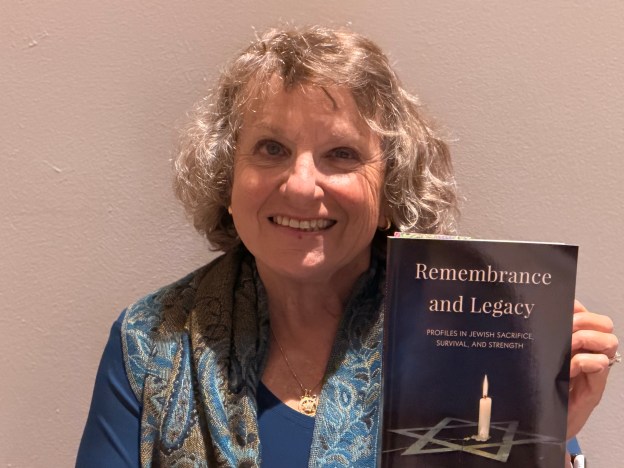
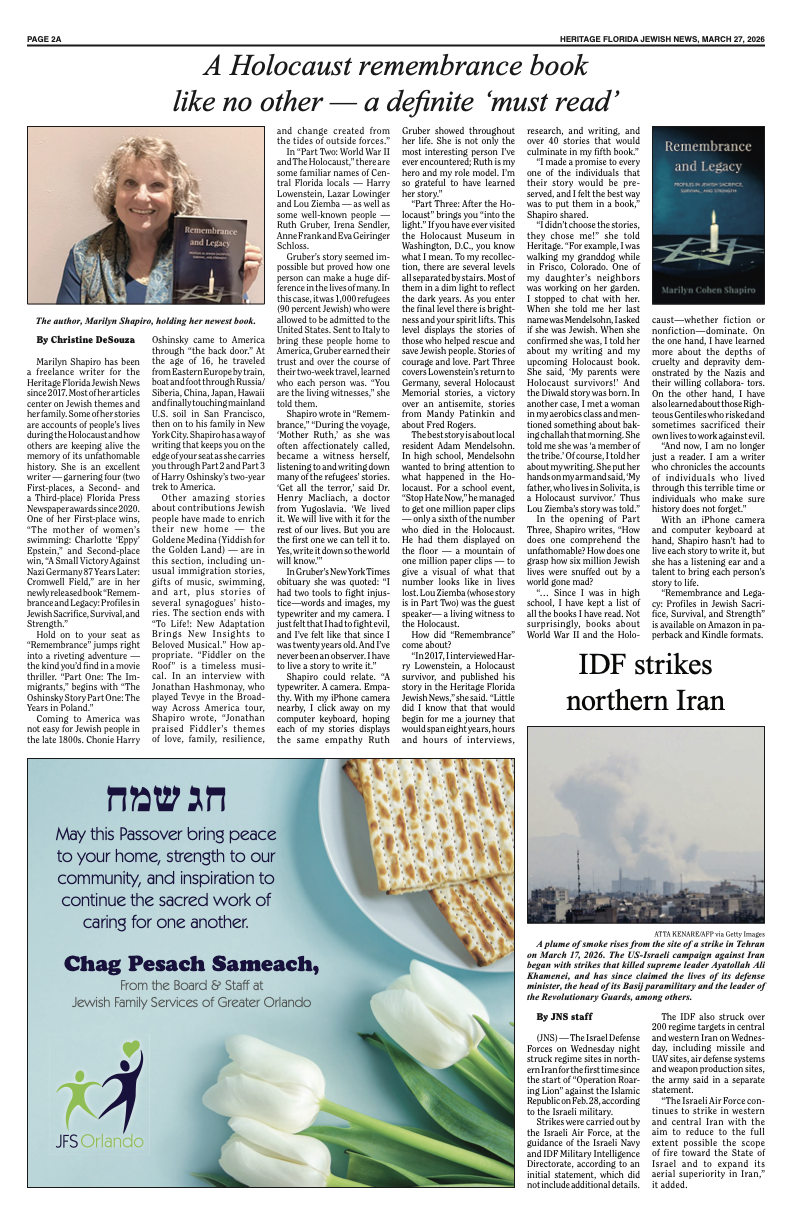
Christine DeSousa, my editor at the Heritage Florida Jewish News, wrote this article for the upcoming issue of the Orlando-based paper. Thanks so much, Christine! My book is available on Amazon in paperback and Kindle format as well as through IngramSpark.
In 2019, my husband Larry and I were browsing the shelves of Book Passages, an independent bookstore in San Francisco’s Ferry Building. Larry held up a book he had found in the history section: Haven–The Dramatic Story of 1,000 World War II Refugees and How They Came to America.
“Do you remember the exhibit at the New York State Museum regarding the only Jewish refugees brought to the United States during World War II?” he asked me.
“Yes,” I said. My mind flashed back to walking through the Albany museum’s exhibit with its pictures, displays, and sign boards depicting a group of refugees who were housed in Fort Ontario (Oswego, NY).
“This book is a first-hand account by the woman responsible for getting the refugees to the United States—Ruth Gruber,” he explained on his way to pay for the book.
Six years and much reading later, Larry and I agree: Ruth Gruber, American journalist, photographer, writer, humanitarian, and United States government official, is one of the most interesting people who ever lived.
Gruber was born in 1911 in Brooklyn, the fourth of five children of Russian-Jewish immigrants. She graduated from high school at 15 years old. After earning an undergraduate degree from New York University at 18, she won a fellowship at the University of Wisconsin, where she obtained a master’s degree in German and English literature. She subsequently received her doctorate from the University of Cologne in Germany at 21, making her at the time the youngest person with a doctorate.
After returning to the United States, Gruber became a correspondent for the New York Herald. The only reporter to be allowed to travel across the Soviet Arctic, she saw firsthand how people lived there and witnessed the Siberian Gulag.
During World War II, she worked for the Department of the Interior where, as a special assistant to U.S. Secretary Harold L. Ickes, she became its field representative in Alaska. In June 1944, she was to undertake what she later considered “the most important assignment” of her life.
Reading the Washington Post at breakfast, Gruber, then 33, learned that President Franklin D. Roosevelt had signed an executive order allowing 1,000 refugees gathered in Italy, 90% Jewish, to be admitted to the United States. After years of this country’s refusal to allow Jews to escape the Nazi horrors of World War II, this was the only government authorized attempt to bring European Jews to America under the protection of the U.S.
Rejoicing that something was finally being done, Gruber rushed into Ickes’ office to express her concern for their well-being.
“Mr. Secretary, these refugees are going to be terrified — traumatized,” Gruber recalled in a 2010 interview in the Sunday Telegraph of London. “Someone needs to fly over and hold their hand.”
“You’re right,” Ickes responded. “I’m going to send you.” The fact that she was young, Jewish, and could speak both German and Yiddish made her an ideal person for the job. Oswego was chosen as a location for housing he during World War II primarily because of the availability of Fort Ontario, a decommissioned military base, which was converted into a temporary refugee shelter.
After flying to Italy, Gruber boarded the Army troop transport USNS Henry Gibbins and greeted the refugees. “I would like … to know who you are, what kind of people you are. What you’ve gone through to survive,” she recounted in her 2000 book Haven: The Dramatic Story of 1,000 World War II Refugees and How They Came to America “You are the living witnesses.”
Throughout the two-week Atlantic crossing to the United States, Gruber proved to be a calming, empathetic listener and a communicator and advocate for the refugees who came from 18 countries. She intervened in disputes, taught English, cared for the seasick, and comforted the refugees, some who had miraculously escaped the Nazis and others who had spent time in concentration camps.
During the voyage, “Mother Ruth,” as she was often affectionately called, became a witness herself, listening to and writing down many of the refugees’ stories. “Get all the terror,” said Dr. Henry Macliach, a doctor from Yugoslavia. “We lived it. We will live with it for the rest of our lives. But you are the first one we can tell it to. Yes, write it down so the world will know.”
On Aug. 3, 1944, the ship arrived safely in New York City, and Gruber accompanied the refugees to Oswego. Initially, the site of the cold, desolate fort surrounded by barbed wire brought back memories and fears of what many had faced in Europe. Through Gruber’s guidance and the support of many others, including the residents of Oswego, government officials, and even Eleanor Roosevelt, the place became a “haven” from the ravages of war.
“Thus I became a witness and participant,” Gruber wrote. “I experienced their joys and pain, rejoicing in their marriages and love affairs, sharing pride in their children, mourning those who died by their own hand or by acts of God.”
FDR’s initial executive order stated that the refugees were “guests” of the United States under the condition that they must return to their origin countries after the war. In late 1945, the federal government changed its mind and allowed all who wished to stay to become U.S. citizens. The final chapter of Havenlists the successes of the new U.S. citizens, who would establish careers in many fields, including medicine, technology, education, law, business, and the arts.
In recent years, New York legislators in both the U.S. House and Senate have been working to designate Fort Ontario and its associated museum, Safe Haven, as a National Historical Park. In 2018, Senator Kirsten Gillibrand (D-NY) passed a bill directing the Secretary of the Interior to conduct a special resource study, the first step in the process to designate a site as a unit of the National Park System. In 2024, the SRS was finalized and concluded that the two-acre portion of Fort Ontario representing the fort’s use as a World-War II European refugee shelter meets all necessary criteria. The bill passed the Senate but failed to become law. In February 2025, Gillibrand, Senator Charles Schumer (D-NY), and Representative Claudia Tenney (R-NY) reintroduced the bipartisan bill.
“The Holocaust Refugee Shelter at Fort Ontario was a place of safety and hope during a dark moment in history, and it deserves recognition in the National Park System,” said Senator Gillibrand. “I am proud to once again be introducing this legislation to achieve this goal and am determined to work across the aisle to get it done.”
Gruber was profoundly impacted by her participation in the refugees’ “journey out of despair and death, to hope and life and light.” Although she was born a Jew, she became a Jew. “I knew my life would forever be inextricably interlocked with Jews,” she wrote in Haven.
The rest of her life was a testament to that commitment. After World War II, she witnessed the scene at the Port of Haifa where Jewish refugees on board the ship Exodus were not allowed to enter Palestine. She then followed them to France and Germany. While on a ship off the coast of France, the refugees conducted a hunger strike. The only reporter allowed on the ship to report firsthand on the unfolding story was Ruth Gruber. Her book, Exodus 1947, became the basis for the 1960 film Exodus. She later covered Israel’s war for independence. She became Ben-Gurion’s friend and conducted a first in-person interview when he became Israel’s first president.
In 1951, Gruber married, had two children, and continued her journalistic endeavors. In 1985, at 74 years old, she visited Jewish villages in Ethiopia and chronicled the rescue of the Ethiopian Jews to Israel. Throughout her life, she chronicled her adventures through her photography, articles, and 18 books. Gruber died at 105 on November 17, 2016.
“I had two tools to fight injustice — words and images, my typewriter and my camera,” she was quoted in her New York Times obituary. “I just felt that I had to fight evil, and I’ve felt like that since I was 20 years old. And I’ve never been an observer. I have to live a story to write it.”
A typewriter. A camera. Empathy. With my iPhone camera nearby, I click away on my computer keyboard, hoping each of my stories displays the same empathy Ruth Gruber showed throughout her life. She is not only the most interesting person I’ve ever encountered. Ruth is my hero and my role model. I’m so grateful to have learned her story.
Two Polish Holocaust survivors from Poland. United by shared tragedies and strengthened by the love for the children they raised. Here is their story.
Yakov “Jacob” Kazimierek was born in Mlawa, Poland, on December 10, 1926, one of the seven children of Abraham and Hannah (Granaska) Kazimierek. The family farmed and raised cattle, which they milked or slaughtered.
After Germany’s invasion of Poland in 1939, thousands of the country’s Jews were subjected to the Nazis’ persecution, terror, and exploitation. Through the Nazi’s newly established “protective detention” orders, the Kazimierek family, along with other Jews, were moved to a Jewish ghetto. In 1942, Nazis deported the family to Treblinka. Hannah and the four youngest children were immediately sent to the gas chambers.
Physically failing under the brutal demands of forced labor, Abraham was selected for murder in the gas chamber. Another brother, Hans, eventually succumbed to disease and malnutrition.
The two surviving brothers endured years of starvation diets, forced labor, and brutal beatings.“[Jacob] had to hide his food or others would take it and he would die,” his cousin Regina Markowicz wrote in an account of his life. “He worked very hard and was treated like an animal. He slept on a wood or cement slab and endured terrible winters without adequate clothing, bedding, or shoes.” Jacob bore the physical signs of his imprisonment—scars on his back from the metal slats in his bed, one finger permanently disfigured from a beating, and of course, the tattoo number “76341,” the number tattooed on his arm—on his body—for the rest of his life.
Shortly before the liberation of Auschwitz, Jacob managed to escape. Although the exact details vary in family lore—in one scenario, he escaped on a bicycle; in another telling, he and two friends escaped posing as Germans—Jacob spent the remainder of the war hiding in forests and cellars, subsisting on food foraged in the woods, stolen, or given by kind Polish Christian. After Auschwitz was freed, Jacob was reunited with his brother Aaron, leaving them as the only two of nine members of the Kazimierek family to survive.
Sweden, a neutral country during the war, took in about 15,000 refugees, and Jacob and Aaron were among them to be sent to a displaced person’s camp in Jönköping, Sweden. Remembering the skills learned at his family’s home in Poland, Jacob worked in a slaughterhouse. In 1948, fleeing from a girlfriend who was pressing him into getting engaged, Jacob moved to Israel and enlisted in Haganah, the Zionist paramilitary organization that fought for Israel’s independence. Four years later, he returned to Jönköping, where he met a twenty-three-year-old woman, a fellow Holocaust survivor whose story was as tragic and heartbreaking as Jacob’s.
The only child of a Jewish couple from Poland, Rachel Abromowitz Kazimierek was born on July 6, 1929. At the age of ten, she and her family were interred in the Lodz Ghetto. At the age of 13, she and her parents were among thousands of Jews deported to the concentration camps. After arriving at Auschwitz, she never saw her parents again. Rachel was placed in Bergen Belsen and assigned to work in the Wieliczka salt mines. Each day, she and other women were herded several miles each night, working in deplorable condition underground. She was freed on April 15, 1945. Her years of forced labor would have serious impacts on her visional health.
Jacob, newly returned from Israel, and Rachel met at a dance in the displaced person’s camp. According to their daughter Hannah Lewanowski, their match was not as much born of love as of necessity. As the United States gave preference to married refugees, the couple married in November 1952. Their first child, Hannah, was born thirteen months later. Jacob’s surviving brother, settled in Sweden, where he lived with his wife and three children until his death in 1979.
In 1954, Jacob, Rachel, and Hannah came to the United States, first settling in New Haven, Connecticut and then relocating to Waterbury. Initially working as a butcher at Bargain Food Center, he opened his own store, Brass City Beef in 1953, which he operated, with Rachel’s help, until his retirement in 1990.
In a March 15, 2015, article in the Hartford Courant (“Holocaust survivor built new life in Waterbury”), Jacob was praised for the store’s personal service and competitive prices. “He had a good following,” said Tony Nardella, a former Waterbury police officer and customer. “He was well liked and always had a smile and a joke.”
“He came to this country with no money,” said Hannah.“He had no English. He worked seven days a week. He made it.” The Kazimiereks developed a strong community with other Holocaust survivors. They socialized with each other, often sitting around a large table sharing schnapps and pastries while the children played together.
Meanwhile, Rachel continued to deal with eye infections, possibly a result of working in the mines. In 1961, she had her left eye surgically removed and was fitted with a prosthetic eye. In 1966, she had a detached retina, which resulted in vision loss in her right eye. From that time on, the children were cared for by a nanny. Determined, Rachel moved on with her life, using a cane to walk. Despite her initially limited English, Rachel volunteered at the local Easter Seals to help other visually impaired individuals and visited schools to share stories of her Holocaust experiences.
Jacob passed away in 2014. Rachel, 95, remains in the home she and Jacob originally purchased in Waterbury, Connecticut. She has 24-hour-care but still prides herself in her independence and cognitive abilities. “My brain, sweetheart, is very clear and very good,” she shared during a February 2025 interview. “I still remember birthdays and anniversaries,” she said, rattling off the important dates of her children and grandchildren. Freida Winnick, a daughter who lives near her in Connecticut, provides additional support and care.
Rachel attends monthly Holocaust survivor luncheons in West Hartford, Connecticut. She also attends presentations organized by “Voices of Hope,” a non-profit educational organization created by descendants of Holocaust survivors from across Connecticut to raise social awareness.
Rachel emphasizes that she holds no ill will despite her harrowing past. “I am not against anyone,” she said. I get along with everybody.”
Originally published May 15, 2025
Kazimierek Family Photos of Jacob and Rachel Kazimierek
For newlyweds Erwin and Selma Diwald, getting out of Austria wasn’t a choice. It was a necessity. Thankfully, the kindness of strangers saved their lives. Their daughter, Frances “Francie” Mendelsohn, shared their fascinating story.
Erwin Diwald was born in Vienna, Austria, in 1907, to Bettina and Sigmond, who was a successful importer of the ostrich and egret feathers used in the making of hats popular at that time. Erwin attended the University of Vienna, where he earned doctorates in both history and law. He launched a successful career in law and was sought after by many Catholic clients wishing to legally annul their marriages.
Born in 1931, Selma Gehler was the second child of Maria and Victor Gehler. Victor, an engineer, was involved in the building of the Wiener Riesenrad ferris wheel in the Prater, still considered one of Vienna’s popular tourist attractions. Selma worked in her uncle Joel’s’ pharmacy while attending the University of Vienna’s pharmacy program, intending to step into her uncle’s business after graduation.
Selma and Erwin met at a friend’s wedding and married in October 1937. Six months later, German troops invaded Austria. On March 15, 1938, the terrified Erwin found himself caught up in the enthusiastic crowds cheering and raising hands in the Nazi salute as a triumphant Hitler paraded through the streets of Vienna. Immediately, the Jews in Austria were in the crosshairs of the new regime.
The newlyweds knew they had to leave their native country. Their first attempt to obtain visas took them to Stuttgart, Germany. On their first evening there, Selma and Erwin ate dinner in the hotel’s restaurant. The waiter brought over a huge tureen of soup. “Compliments of the Fuhrer,” they were told. They soon learned that their hotel was the site of the city’s Nazi headquarters. They quickly returned to Vienna to explore other options to leave Austria.
Help arrived through Erwin’s younger sister. Paula Diwald had been vocal in her dislike for the new regime. When notified that the Nazis were looking for her, she hastily made arrangements for a “ski trip” in France. As soon as she crossed the border, she ditched the skis and took up residence in Paris.
Paula worked during the day as a salesclerk in a shop selling expensive handbags. To supplement her income, she worked as a tour guide, her ability to speak seven languages a definite asset.
One evening, Paula overheard a couple requesting a guide who could speak English. She introduced herself and spent the next several days showing the Gregorys, a wealthy Greek Orthodox couple from Chicago, the highlights of the City of Light. At the end of their visit, they asked Paula what they could do to thank her for all she had done.
“What you can do is sponsor my brother and his wife,” Paula told them. “We have absolutely no family in the United States. Your providing them with visas is the only payment I want.” They promised to see if they could make the arrangements once they returned to Chicago.
Paula immediately contacted Erwin. His education had included years studying classical Latin and Greek, and he decided to use this knowledge to further persuade the Gregorys.He wrote a long eloquent letter in classical Greek to plead his case.
The Gregorys may have been Greek Orthodox but had no knowledge of its language; they brought the letter to their priest. Impressed by both the Erwin’s language and moved by their plight, the priest told the Gregorys, “You have to save these people.” The Americans complied and began the process of getting visa for the couple. They enlisted the aid of Lazarus Krinsley, a Jewish lawyer in Chicago, to obtain the paperwork.
The Diwald flew to Paris to await the paperwork that, according to the officer in charge had not come through. It was only when the Diwalds checked in on a day the regular official was not at work. His substitute immediately “found” the missing documents.“Where have you been?” He said. “These visas have been here for months.”
Knowing that they could not bring a great deal of money into the States, the Diwalds arranged first -class passage on the Paquebot Champlain. Built in 1932 and hailed as the first modern liner, the ship was pressed into evacuee work, transporting many Jews, like the Diwalds, who were fleeing Europe.
Erwin remained in Paris with Paula before boarding the ship in Le Havre, France on August 29, 1938. Later that day, Selma, who had gone to England to say goodbye to her family, boarded in Southhampton. On August 31, 1938, Germany invaded Poland, marking the beginning of World War II. Erwin and Selma had made their escape just in time.The ship sailed in radio silence for the remainder of the voyage.
Meanwhile, he Diwalds found themselves in the company of many celebrities. Their travel mates included actor Helen Hayes, comedian Groucho Marx, composer Samuel Barber, Italian-American composer Gian Carlo Menotti, and Austrian-American actor/director Erich von Stroheim. It made for a very memorable voyage!
An interesting side note: According to a Wikipedia article, the Champlain continued crossing the Atlantic Ocean for the next two years, transporting refugees, including many Jews, to safety. On June 17, 1940, on what was to be its last crossing, the Champlain hit a German air-laid mine, causing it to keel over on its side and killing 12 people. . A German torpedo finished its destruction a few days later. It was one of the largest boats sunk sunk in World War II.
After debarking the ship in New York City, Selma and Erwin traveled to Chicago to meet their benefactors. Even though the Gregorys were responsible for getting the visas, they were not very welcoming. Lazarus Krinsley the lawyer, and his wife Rose, however, warmly embraced the couple, a friendship that was maintained throughout their lives. Upon the Krinsleys’ recommendation, the Diwalds settled in Milwaukee, Wisconsin, which had a fairly large Jewish population and offered more job opportunities.
Despite his educational background, Erwin lacked the credentials to practice law in his United States, During the war, he worked on an assembly line that polished propellers for B-29 planes. and drove trucks After the war, Erwin applied for a job as a tire salesman with Dayton Tire and Rubber Company. Initially, human resources failed to recommend him, saying he was “too intelligent.” He went on to become one of their top salesmen.
Using the skills learned in Vienna, Selma worked in a pharmacy. She considered going to UW Madison to get certified as a pharmacist. After the birth of her two daughters Ann Frances [“Francie”) and Susan Jane, however, she gave up her dreams of further education.
The Diwalds joined to Temple Emanuel, a reform congregation. In 1954, Francie became the first bat mitzvah in the congregation, with her sister Susan following in her footsteps three years later.
Fortunately, many of Selma and Erwin’s family were able to escape the fate of the many Jews imprisoned and murdered during the Holocaust. In 1938, the Nazis stormed into the Gehler home looking for Joel. When they could not find him, they arrested Selma’s father, Victor, who was deported to Dachau. Maria, through a possible bribe, was able to free him. They immediately fled for Haifa, in what then Palestine. They both passed away in Israel in 1951, three years after it had become the State of Israel.
Erwin’s parents had also escaped Austrian 1940 by hiking over the Alps into France. They emigrated to Milwaukee in 1942. Joel, who had narrowly missed arrest in 1938, fled to England, where he met the love of his life, Patricia. Joel passed away in 1986; Patricia passed in 2022.
Selma died in 1996 at the age of 83 from cancer. Erwin died in 2008 at the age of 101, suffering from dementia in his last years. Despite all that the family had endured, Francie said that her parents were never bitter or angry. “I feel as if I been touched by God,” Erwin told his children. “We survived.”
SOURCES
Thanks to Francine Mendelsohn for sharing her parents’ story.
As I continue to interview Holocaust survivors and their families, I have written the story below based on information supplied by the son of one of the innumerable Danes who, who with his father, helped rescue Jews in World War II. Marilyn
Much has been written about Righteous Gentiles, the men and women who risked their lives to help save the Jews in Europe during the Holocaust. One of the most successful rescues happened in Denmark, where Danish authority and innumerable private citizens worked with Jewish community leaders to rescue thousands of their fellow citizens from certain death.
Although the Nazis had occupied Denmark in 1939, initially there had been an uneasy peace. The Germans regarded the blond, blue-eyed Danes as “fellow Aryans.” With only 7500 Jews living in the Scandinavian country, the Nazis had not even required the Jews to wear yellow stars.
As the war progressed and Allied victory was in sight, however, the Danes’ initial limited resistance had progressed to massive labor strikes and sabotage. On August 29, 1943, the day after the Danish government had resigned rather than help the Germans arrest and try members of the Resistance, the country was under martial law.
A week later, the Danish government learned through German officials who feared the political ramifications of such an action that all of Denmark’s Jews, the 6000 citizens and 1500 refugees, were to face the same fate as millions of others in occupied Europe: On October 1, they were to be rounded up and sent to almost certain death in Nazi concentration camps. The Danes immediately began a massive operation to save their Jewish neighbors, hiding them in their homes until they could be spirited out of Denmark to Sweden in fishing boats.
For Dr. Eric Erslev,the Danish rescue of the Jews came close to home in a story orally passed down by his father Allan Jacob Erslev to him and Eric’s son Brett.
Although Aage Erslev was Christian, he had been married to Anita, a Jew who had passed away in June 1943. In late September, he had welcomed Anita’s relatives in his home, hiding them as they awaited word that the fishing boat was ready for departure.
Late one evening, he and his 18-year-old son Allan were awakened to the sound of Gestapo pounding on his front door. The oldest wearing a captain’s insignia, was flanked by two much younger men.
The Kapitän announced that they were there to arrest Anita Erslev. When Aage told him that she had passed away, the Nazi, having heard this excuse many times. demanded proof.
Aage began searching his desk for the death certificate. Meanwhile, the two younger soldiers were ordered to start searching the house. Aage’s attempt to find the paper became even more frantic when the two soldiers, having finished their search of the first floor, stomped up the stairs to the second floor. where the Jewish relatives were hiding under the bed and in the closet of one of the bedrooms. Frantically, Aage whipped through the papers as he heard the soldiers’ footsteps in bedroom over his head. He knew if the Gestapo found the fugitives, they would be killed and the father and son would be jailed. At that moment, Aage found the death certificate. The German, now satisfied, yelled to his two charges to come downstairs.
As the soldiers were leaving, Aage offered the soldiers apples from the bowl of fruit on the table. They grabbed the fruit and walked out.
As soon as the two men could no longer hear the boots on the street outside their home, they went upstairs. The relatives, who were seconds from being discovered, told their rescuers how they heard the sounds of the soldiers’ breathing and saw their boots from their hiding places, one under the bed and one in the closet. They all knew if the more experienced captain had been conducting the search, they would have been found. Thankfully, the refugees did make it to the boats and found safety in Sweden.
Allan was surprised that his father had given the Nazis the apples: These were the men who would have killed his mother and her relatives and were responsible for the death of untold others. As the son of a Jewish mother, he and others with “impure blood” were targeted by the Germans later during the occupation Allan went into hiding but survived the war. Maybe Agee, overcome with relief, that the Nazis had not found the hidden Jews, impulsively offered them the fruit. Maybe, despite the horrors of war, the Dane’s generous nature prompted him to share food with the enemy? The question remains lost to history.
In the conversation he had years later with Eric and Brett, Allan said he never forgot that moment and the terrible years of the German occupation of his homeland. Of the approximately 7500 Jews living in Denmark in September 1943, only 120 Danish Jews died during the Holocaust, either in the Theresienstadt concentration camp or during the flight from Denmark. According to the United States Holocaust Memorial Museum, this relatively small number represents one of the highest Jewish survival rates for any German-occupied European country.
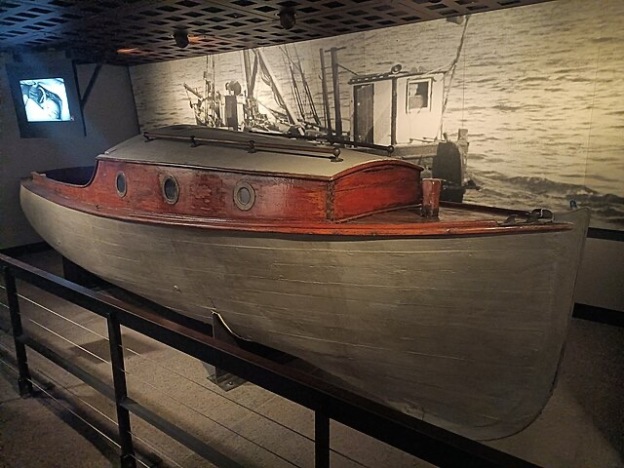
Photo: Danish rescue boat as displayed at Unitied States Holocaust Memorial and Museum, This particular example was used in the earliest operations for the evacuation of Danish jews organized by the Hilsingor Sew club know as the Kiaer Line. This boat carried 12 to 14 Jewish refugees on each trip to neutral Sweden. (USHMM; photo curtasy of Wikimedia Commons.)
SOURCES:
Thanks to Dr. Eric Erslev , professor emeritus, Warner College of Natural Resources, Colorado State University, for allowing me to share his family’s story.
Anne Frank, born on June 12, 1929, was the celebrated diarist who described her life while hiding with her family from the Nazis in an Amsterdam, Holland attic. After capture and deportation, she died in the Bergen-Belsen concentration camp in late winter 1945.The following story, first published in 2018, tells the story of another Jewish child who hid with his family in Holland during World War II and survived to share his story.
Anne Frank is one of the most well known figures from the Holocaust. But she and her family were not the only ones to go into hiding to avoid capture by the Nazis and their collaborators. While some Jews lived in the open with changed identities, others, like the Franks physically hid to avoid certain deportation and almost certain death. Dutch Nathan and his family were one of many who relied on others to help them.
Gert “Dutch” Nathan was born on January 5, 1932, in Duren, Germany, the second son of Wilhelm (“Willy”) and Hilde (nee Friesem) Nathan. Willy had a cattle hauling business which extended throughout Europe. He did not have a formal education, but he was street smart—Dutch remembers that his father could “outcalculate a calculator.” The Nathans lived a mostly secular life in Germany, with observation of major Jewish holidays and his mothers’ lighting of Shabbat candles.
In 1938, after Hitler’s rise, the family moved sixty miles west to Valkenburg, The Netherlands. “Holland had proclaimed neutrality when war broke out in September 1939, as they had done in World I,” said Dutch, “so my father thought our family would be safe.”Willy took a job with the De Valk bus company, a former competitor, where he continued his cattle business.
On May 10, 1940, Hitler’s forces invaded the self-proclaimed “neutral” country. Five days later, after the bombing of Rotterdam, the Dutch forces surrendered. By 1942, the situation began to deteriorate for fellow Jews. Willy made the following arrangements with his friend, Johan Kengen, a member of the Dutch Underground: If the Nathans were in danger of deportment. Willy would pay for the family to stay in the home of Kengen’s fiancé’s aunt and uncle for “a few days” until the Nathans could be spirited away to England. Willy also made arrangements for neighbors to move most of the furniture and bedding to the house next door. Whether the neighbors were paid or volunteered as an anti-Nazi action still remains a mystery to Dutch.
The plan was put into effect a few month later. While walking from the bus station into the De Valk building, Willy was stopped by a friend and fellow employee: Germans were waiting for him to arrest him and deport him and his family to the concentration camp.
Father quickly stole a bike and peddled the ten miles home. Dutch and his older brother Fredo were instructed to leave their house one hour apart to walk the two miles to a house “located on the right hand side just before the road crossed the railroad tracks” with a warning to “not speak to a soul.” Willy and Hilde arrived later that evening, expecting to hear soon from the Underground of their clandestine trip to England.
Unfortunately, the days turned into week, and the Nathans were still in hiding. Other people, including downed pilots, had priority in the Underground escape plan. To further cover the facts of extra activity in the “safe house,” an elaborate ruse was planned. Johan and the elderly couple’s niece Ann quickly arranged their wedding. At the reception, Johan picked a huge fight with Ann’s parents, who resolved that they would have no contact with the couple until Johan apologized. The newlyweds moved into the house by the railroad tracks, bringing the number to eight.
As weeks turned into months, tensions grew. The Nathan’s spent most of their time in a small main floor bedroom. Ann was prone to hysterical outbursts, and Willy and Johan would have to physically restrain her to keep her from running outside and giving their situation away. Meanwhile, Hilde was anguishing over the fact that she had not been able bring her parents with them. She was haunted by their deaths in the concentration camp for the rest of her life.
Johan’s government job determining the number of animals that farmers could slaughtered provided a means to get extra meat and milk, but food was still scarce. Dutch and Fredo, 10 and 12 respectively, spent most of their days quietly reading books and avoiding the shaded windows so no shadows would be seen.
Along with possible discovery, the occupants lived in fear of the potential impact of living near the railroad track.The noise from the passing trains provided an extra buffer but also an extra danger: Allies strafed German trains. They hoped that these attacks would not hit the house, either killing all of them or forcing the Nathans out into the open, thus exposing their dark secret.
In the second half of 1944, the southern half of Holland was liberated by American troops. (The remaining areas of the Netherlands were not liberated until May 1945.) The Nathans stayed inside for a few more days to make sure they were safe.
Once they realized they were actually free, the Nathans stepped into fresh air for the first time in twenty-six months. “I walked a few feet and collapsed,” remembered Dutch. When asked if he had been overcome with emotion, he said, “I hadn’t used my legs in 26 months and initially had no muscle tone to walk more than a few feet.
Before they could move back into their home, however, Americans bombed Valkenburg. One of the casualties was the Nathan’s home. “No one understood why the brick home next door burned so much,” said Dutch. “The furniture hidden in the attic acted like a tinderbox, and flames shot up in the air for hours.”
In May 1945, the remaining areas of the Netherlands were liberated. Free but homeless, the Nathan family moved into a neighbor’s home until 1946, when they obtained visas to move to United States, where several of Willy’s siblings lived. Willy built a crate the size of a truck and filled it with everything they had accumulated since the end of the war—including a piano.
Dutch, now sixteen, enrolled in City College to learn English, adding to his previous background of German, French, and Dutch. At 18, he enlisted in the army and volunteered to go to South Korea. When he returned home, he found employment in whatever “made money.”
In 1979, Dutch, who had been married twice before, met Sue Cohen. He proposed shortly after the meeting, but it took ten years for her to say yes. During this time, Dutch started the Stretch Lace, a Sharon Massachusetts-based company that manufactured and sold elastic shoe laces. (“Tie once, never Tie Again!”) Although his invention was successful, Dutch admitted that he didn’t know marketing and sales. He eventually sold the business, but Easy Laces are still available today and are worn by such celebrities as Brooke Shields. They lived in Sharon for most of their married life before retiring to Kissimmee, Florida, in 2007.
In 1982, Sue and he were invited by residents of Duren, Germany, to return to the Nathan’s original home. They were treated royally and met with church members as well as school children. Sue’s main mantra to everyone she met was “Just remember! The Holocaust DID happen.” Although their visit was supposed to last a week, Dutch felt uncomfortable. He rented a car, and the two of them toured Europe, driving over 4000 miles before returning to Massachusetts
Almost seventy-five years after his liberation, Dutch graciously shared the story that he spent most of his life trying to put those terrifying time behind him. “I try not to think about those things,” said Dutch. “It is over and cannot be undone. His story, however, as those of the fewer and fewer remaining Holocaust survivors, must be told. As Sue Nathan told the people in Germany during the 1982 visit, “Remember. The Holocaust DID happen.” And we Jews and righteous people everywhere will never forget.
A version of this article originally appeared in the November 8, 2018, issue of the Jewish World News, a bi-weekly subscription-based newspaper in upstate New York.
“Each Memorial Scroll is a memory of the past and a messenger for the future.” Memorial Scrolls Trust
They escaped destruction by the Nazis. They survived Communism, They found their ways to new homes around the world. This is a story of three Torahs that had their roots in vanished Czechoslovakian Jewish communities.
Up until World War II, Czechoslovakia had a thriving Jewish population that first reached the area over 1000 years ago. With the rise of Hitler came increased antisemitism and eventually The Final Solution. Throughout Europe, synagogues were burned and the vast majority of Jews were murdered. Almost all Jewish artifacts—Torahs, candlesticks, prayerbooks—were destroyed.
The one exception was Bohemia and Moravia with its population of 115,000 Jews. This area in Czechoslovakia was declared a “German protectorate.” Miraculously, except for the items in Sudetenland, most of the artifacts remained unscathed during the early years of the war.
In 1942, the Nazis ordered all Jewish synagogue possessions in the region to be sent to Prague. The Jewish communities of Prague, believing the Judaica would be safer if stored in one place, worked closely with the Nazis to collect and catalogue over 210,000 items. In the end, it took 40 warehouses to store the treasure. Unfortunately, nearly every Jew who worked on the project was sent to their deaths in the concentration camps.
The Czech Torahs survived the war but almost did not survive Communism. The Torah and other scrolls lay in a musty, damp warehouse until 1963. At that point, Czech government, in need of foreign currency, sold the scrolls to Ralph Yablon, a philanthropist and founder member of Westminster Synagogue in London. On February 5, 1964, 1564 Torahs and other scrolls arrived at the synagogue. They were divided into three categories: those in usable condition, those in need of some repair; and those deemed too far damaged to be restored.
The Memorial Scrolls Trust was then set up to preserve and restore the Czech scrolls. Each one had an identity plaque fixed to one of the etz chaim, the wooden shafts onto which the Torah is rolled. They were loaned out to Jewish communities and organizations around the world in need of a Torah, with the understanding that the congregation was responsible for the scroll’s upkeep. The Torahs, as per stipulations by the MST, were never sold or donated but allocated on loan on the understanding that they would only need to be returned if the synagogue no longer operated. According to Jeffrey Ohrenstein, Chair, MST, 1400 scrolls have been allocated on loan around the world. Approximately 150 scrolls remain in the Memorial Scrolls Trust museum, which also has some 500 binders and wimples.
At least six Czech scrolls are on loan in the Capital District of New York and surrounding areas: Beth Emeth, Congregation Ohav Shalom, Gates of Heaven, Temple Sinai, Congregation Beth Shalom, and Congregation Beth El.
I first had the honor of holding a Holocaust Torah as a member of Congregation Beth Shalom in Clifton Park, New York. In1981, the synagogue requested from MST a replacement for three that had been stolen. Abbey and Richard Green, CBS congregants, helped fund the costs of shipping the Czech Torah MST#293 (circa1870) from London. A tag, dating back to the dark days of the Shoah, read “The Elders of the Jewish Community in Prague.”
At the time, Beth Shalom was less than ten years old, an irony that was not lost on one of its congregant. Yetta Fox, herself the child of Holocaust survivors, stated that having the Torah at a new congregation was “almost like a second life.”“Having lost one community,” said Yetta, “there is now a new community that can nurture this Torah.”
Early in 2007, the congregation arranged to have needed repairs done on the parchment of the 137-year-old Torah. That June, the congregation held a rededication ceremony, which included a procession from the Clifton Park town hall to the synagogue five minutes up the road. During the march, the scrolls were passed from hand to hand under a chuppah that the children of the Hebrew school had decorated with Stars of David. Upon its arrival, the Torah was wrapped in a wimple, the cloth traditionally used to wrap a boy at his circumcision. “This is our baby,” said Fred Pineau, a former president, “so we’re wrapping it on our Torah.”
David Clayman, the president at the time of the story. , reported that the Torah is still in good condition. To preserve it, however, it is left rolled to Parasah Beshalach, which contains “The Song of the Sea,” gently unrolling it only once a year as prescribed by the MST. Every year, in the month of Shevat, the Torah is brought out and Beshalach is chanted. “The scroll is so fragile, we are afraid to roll it to other parashot [Torah portions].”said David. The congregation brings out the Holocaust scroll twice more each year to be ceremonially held: On Kol Nidre, the solemn service commemorated during the opening hours of Yom Kippur; and on Simchas Torah, a holiday that celebrates the completion of the reading of Deuteronomy, and the beginning of Genesis.
In 1982, Sharon and Barry Kaufman, now residents of Florida, obtained a Czech Torah in honor of their daughter Robin’s bat mitzvah for their Spring, Texas synagogue. While awaiting completion of their new building, Jewish Community North congregation was holding services at Christ the Good Shepherd Catholic Church. Their only torah was on temporary loan from another Houston-area synagogue. The Kaufmans worked with Rabbi Lawrence Jacofsky, the regional director of the United Association of Hebrew Congregations, to obtain Torah Scroll MST#20, written circa 1850.
When their precious cargo arrived at the Houston airport in February 1982, Barry and Sharon immediately brought the Torah to the church to show Father Ed Abell, Good Shepherd’s priest and their good friend. The three of them carefully unrolled the scroll where it had last been read: Yom Kippur. 1938. The tenth of Tishri 5699 or October 4 and 5, 1938. Shortly after that service, the Jews that had worshipped in the Kostelec/Orlici synagogue were rounded up and sent to concentration camps, most—maybe all— never to return.
To commemorate the moment, Father Abell, using the yad (pointer) from the loaner Torah, read from the scroll in flawless Hebrew. That evening, Sharon and Barry brought the Torah home to show Robin. As they slowly unrolled the entire scroll on their pool table to make sure is was undamaged, they found a cardboard tag that had been attached when the scroll was catalogued by Jewish librarians and curators when the scroll arrived at the Central Jewish Museum Prague during the Shoah. Aeltesternrat der Juden Prague, it read in German Elders of the Jews of Prague.
At Robin’s bat mitzvah in May 1982, the Torah was dressed in a cover sewn and embroidered by Barry’s mother. In a moving speech to the congregation held at Good Shepherd, Barry spoke eloquently about the Torah’s history.
“If this Torah could talk—might it share with us the heart-wrenching knowledge of a prosperous people whose world had suddenly been taken from them, whose home and synagogues were gutted and destroyed for the value of their belongings? Would it tell us of the helpless terror in the fragile hearts of old men and women forced to watch their children brutally slaughtered before their own end was to come?”
After Barry spoke, the Ark was opened, and the Czech Torah was passed from the rabbi to Barry to Sharon to Robin. Clutching it tightly, Robin walked through the congregation. For the first time in two generations, a B’nai Mitzvot carried it with joy and reverence throughout a tearful congregation.
When Larry and I moved to Florida, we joined Congregation Shalom Aleichem, which was founded in 1981, ironically the same year Congregation Beth Shalom had received its Czech Torah. Initially, congregants met at the Kissimmee Women’s Club. When Harry Lowenstein, a Holocaust survivor whose parents and sister numbered among the six million Jews killed during World War II, joined with his wife Carol, he began to press for a building of their own. “I saw a synagogue burn,” said Harry, “and I was determined to build another one.” Starting with a $120,000 contributions from Sandor Salmagne, another Holocaust survivor, the Lowensteins raised another $60,000 for building expenses, including donations from Harry and Carol.
As the synagogue on Pleasant Hill Road neared completion, the Lowensteins worked to obtain the prayer books for both every day and holy days, the Torah finials, and the Yartzheit (memorial) board. Most important to the congregation, however, was to obtain a Torah.
Harry and other members reached out to the Memorial Scrolls Trust, noting in the correspondence that four of its members were Holocaust survivors. “Our Temple will be dedicated to the memory of the victims of the Holocaust,” wrote then president Henry Langer. “We would therefore deem it an honor to have you lend us a Scroll for our Temple.” With the Lowensteins’ financial support, they were able to obtain Scroll MST#408. The Torah was from Pisek-Strakonice in what was then Czechoslovakia, about 60 miles south of Prague and dated back to circa 1775.
Once they received word that they would indeed be loaned a Czech Torah, the Lowensteins asked British friends who had a vacation home near the synagogue to be responsible for getting it from Heathrow to Orlando International airport. “[Our friend] sat on the plane with the Torah on his lap for 12 hours,” recalled Carol. “He would not let it out of his sight until he could hand the Torah to Harry.”
For those who had miraculously escaped hell, welcoming the Torah was like welcoming another Holocaust survivor. “It’s like holding a piece of history” said Phil Fuerst in a 1993 Orlando Sentinel article. “You feel like you own a piece of a world that survived.”
According to Marilyn Glaser, the congregation president, the atzei chayim, which were broken, were replaced in September 2022 in accordance of the terms of the loan agreement with MST.
In November 2024, the Jewish Federation of Sarasota-Manatee commemorated Kristallnacht by celebrating the Torah scrolls that survived the Holocaust with a gathering of 24 Florida-based scrolls from the MST. Jeffrey Ohrenstein, who travelled fromLondon for the event, said “These Torahs are messengers from destroyed communities that depend on their newer congregations to assure they are remembered and the Jewish heritage is cherished.” The program ended with a parade of the Torahs. Frank Gutworth, Congregation Shalom Aleichem’s treasurer, proudly carried Scroll #408.
Three Czech Torahs. Three congregations. Thankfully, in the end, the Nazi’s plan to eradicate the Jewish people failed. As Gloria Kupferman stated in her speech at the rededication of the Congregation Beth Shalom Torah in 2007, “We are by no means extinct. We are alive. We are thriving.”
Special thanks to Jeffrey Ohrenstein, Chair, Memorial Scrolls Trust, London, U.K. Thanks to David Clayman, Yetta Fox, Marilyn Glaser, Frank Gutworth, Harry Lowenstein, Flo Miller, and Sharon and Barry Kaufman for their inputfor the article.
Originally published June 10, 2022.Updated on blog November 2024.
Published in Jewish World (Capital Region NY), June 9, 2022 and Heritage Jewish News (Orlando, Fl) June 10, 2022
My friend Marilyn Glaser gave me this advice before one of our Friday night Shabbat services in our Florida synagogue. I was aware that Harry Lowenstein was a Holocaust survivor. But Marilyn, the shul president, knew I was a writer, and she knew his story needed to be preserved.
By this time, I had been writing for the (Capital Region, NY) Jewish World for over four years. The majority of my stories had been about my family: growing up in a small North Country town in New York; meeting my husband in 1973 to learning to live with him after our retirement in 2010; raising two children; moving to “The Sunshine State” in 2015. Up until that point, I had not tackled biographies. Fortunately, Harry was a willing story teller.
As I sat at his kitchen table, I was riveted by his description of four years of hell, first in a ghetto and then in Nazi concentration camps. After liberation, Harry returned home to find that every one of his relatives had been murdered by the Nazis. He eventually made it to the United States, married Carol Sainker, raised three children, and owned and operated a clothing store in Kissimmee. Meanwhile, he was determined to carry on his family’s legacy. “I saw a synagogue burn,” said Harry, “and I was determined to build another one.” With the contributions from friends and fellow Holocaust survivors, the Lowensteins raised enough money to build our synagogue.
After Harry’s story was published, my writing became more diversified. I was still writing my sometimes funny, sometimes poignant family stories, but I also took pleasure from interviewing what I referred to as “ordinary people with extraordinary lives.” A woman who has raised over $150,000 for cancer research after losing her 32 year old daughter to leukemia. A man whose introduction to a doomed ship as a boy resulted in his becoming a “Titanic fanatic;” a group of former Catskill workers celebrating a reunion.
But the stories that moved me the most were about who lived through—or died in—World War II. Jewish soldiers. Concentration survivors who were haunted with their memories until their passing. Righteous gentiles who had rescued others from the horrors.
I have never been shy about my retirement avocation and never fail to tell friends and strangers I am a writer. This summer, I shared this information with Eva Nozik, who was visiting Summit County, Colorado.
“My aunt, Golda Goldin Gelfer, who recently passed away, was a Holocaust survivor,”Eva said.”You need to talk to her children.”
She set up a Zoom call with Anna Livits and Sofia Zukerman, Golda’s two daughters, and other members of the Goldin family. The Nazis, they told me, invaded Glusk, Belarus, on June 22, 1942, Golda’s 14th birthday. Six months later, Germans and local supporters rounded up and murdered over 1000 Jews, including Golda’s mother Elke and her two sisters, Chaisoshe (19) and Malka (8). Golda and her father Meir escaped certain death by hiding in an attic and eventually finding their way into the forest. The two soon joined Soviet partisans in their efforts to sabotage the Nazi offensive until Belarussian liberation on July 4, 1944. Several revisions (and many nightmares about the Holocaust) later, it was finished and ready The Jewish World’s next issue.
Even before it was published,, Anna expressed her gratitude. “I don’t have enough words to thank you for the work you have done,”she wrote me in a December 13 email. “I had a dream today that my mom was smiling. It’s like she was in peace that we remember her family, Elke, Chaisoshe, and Malka.”
The descendants of Meir and Elke Goldin have more stories to tell. They are eager to recount Golda’s time in the woods, her life in the Soviet Union after the war, her move with her children to the United States. They also want me to connect with the son of a cousin who survived “murder by bullets” by falling into the pit.And, by the way, they have a friend whose parents survived the Warsaw ghetto.
Meanwhile, I have other stories on my “To Be Written” file. My cousin Eric (Z’L) Silverman came over on a stolen visa just before the war. Trudi Larkin Wolfe’s parents, both concentration camp survivors, recently passed away, but their oral history is preserved on video as part of Stephen Spielberg’s Shoah project, and she and her sister will fill in any gaps. Ruth Gruber, a brilliant Jewish woman who was appointed by the FDR administration to oversee the Oswego Project, a refuge for Jews that is the subject of a New York State Museum exhibit. And I made a promise to a friend that I would write an article about his father, who came to the United States in the early 1900s via, of all places, China.
After hearing Golda’s story at the most recent meeting of SOL Writers, my group of fellow writers said that I am “a woman on a mission.” “You make the unbearable bearable,” one said. “Keep writing.”
Despite my passion, I initially questioned about pursuing more stories about this terrible time in humankind’s history.The Holocaust has already been the subject of innumerable novels, memoirs, plays, movies, and, and even children’s books.
I found the answer in a teaching from Pirkei Avot, a compilation of the ethical teachings and maxims from Rabbinic Jewish tradition. “It is not incumbent upon you to complete the work,” wrote Rabbi Tarfon (46 CE-117 CE), “but neither are you at liberty to desist from it.” (Pirkei Avot 2:21) When the Anti-Defamation League reports that Facebook, Instagram, and other social media platforms have “cracks in enforcement” that allow Holocaust deniers to disseminate hate speech; when a school administrator in Texas can tell a group of educators during a training session to “have an opposing view” when teaching the Holocaust; when 77 years after Soviets liberated Auschwitz, anti-semitism is on the rise; I must continue to tell the stories. My writing will certainly not “complete” the work of masters such as Elie Wiesel, Victor Frankel, and Steven Spielberg. But I cannot use that as an excuse.Whether my articles and, in the future, my book is widely read or languishes in an Amazon warehouse, at least I did not “desist.”
But I need help. If any of you have a Holocaust story you would like to be preserved in writing, please contact me via email at shapcomp18@gmail. com. Those who were lost as well as those who survive deserve to have their lives remembered and honored. Never again.
A version of this article originally appeared in theJewish World News, a bi-weekly subscription-based newspaper in upstate New York.
“You make sure that if you have a book on the Holocaust that you have a book that has an opposing view,” a Carroll County,Texas, administrator recently told a group of educators during a training session on what books were allowed in their library. Fierce backlash resulted in an apology and an investigation, but to many it hammered home the fear, denial, and outright ignorance that surrounds the teaching as well as recognition of the reality of the systematic murder of six million Jews. For that reason, there will never be “too many stories” about the Holocaust, including that of Galina “Golda” Goldin Gelfer (Z’L).
On June 22, 1941, Golda woke up on her 14th birthday to a beautiful sunny day in Glusk [now known as Hlusk], Belarus. Despite her family’s status as Jews in a highly anti-Semitic country, she and her family—her father Meir, her mother Elke, her eight year old sister Malke, and a large extended family— were happy in their small shtetl. Then, their world changed when news that Germany had declared war on the Soviet Union. Five days later, Nazis marched into their town. Soon after, Golda’s older sister, Chaisoshe returned home to join her family after Minsk University was evacuated, walking the last 30 miles with a friend. With limited means of escape, the entire Jewish population was trapped.
All Jews were registered and forced to wear yellow stars on the clothes and post the yellow stars on their homes. A Judencrat (Jewish council of three men) was formed to organize labor. While Chaisoshe remained hidden in their homeMeir and Golda worked long hours in menial jobs: cleaning and plowing the streets, digging up bricks, and mucking out horse stalls. All other work by Jews was forbidden.“We performed useless task mainly to make us feel we were slaves,” Golda later wrote in an autobiographic essay in The Holocaust DID Happen. (Southern California Council for Soviet Jews, 2010)
For the next five months, as reports of mass executions of Jews in neighboring villages were reported, Golda and her family lived in absolute fear. On December 2, 1941, their worst nightmare was realized when they learned in the early morning hours that Nazis were beginning to round up all the Jews in Glusk for a “death march.” As the Goldin dressed in multiple layers of clothes and hastily packed bundles of food, they made plans to split up, run, and hide. Chaisoshe and a college friend were first to leave.“ You have some friends,” Elke told her husband. “Take a child. You may survive.” As Meir took Golda’s hand, Golda grabbed Malka’s. But Elke insisted that her youngest child hide with her in their shed.
Meir, Golda, and another relative they found in the street began frantically knocking on the doors of their Russian neighbors, begging for places to hide. But they were repeatedly turned away because of fear, ignorance, or indifference.The circle of Germans, politsaislocal collaborators, and dogs surrounding them grew tighter.
The three finally found refuge in the attic of an abandoned store on the main street. They climbed up to a loft filled with hay and silently watched the street below. The streets were soon filled with dushegubka, trucks modified to divert engine exhaust into a sealed internal gas chamber, As the Nazis forced women and children into the black-topped vans, Golda recalled in 2010 Yad V’Shem video, could hear a single woman screaming in agony as the van moved towards a former hospital that the Germans had converted into the slaughterhouse.
When these precursors to the gas chambers used in the concentration camps could no longer keep up with the number to be killed, the remaining Jews were herded together by Germans and the politsais. They were helped by local residents who joyfully made a game out of rounding up anyone trying to escape. “Jude! Jude,” they would yell to the Nazis, who would then shoot the “offender” and leave the corpse on the street. The numb, terrified victims could do little but march to their almost certain deaths.
Throughout the terrifying day, Meir, Golda, and the cousin heard the sounds of gunfire from Myslotino Hill, an area two and a half miles outside of Glusk. They learned later that over 1000 Jews men, women, and children were killed in a volley of bullets and then thrown in pits prepared earlier by the Germans.
At two a.m., all was quiet. Praying that somehow members of their family had survived, the three fugitives descended from the hideout and began walking to the town’s outskirts.They narrowly missed falling into the hands of a roving band of Russian murderers who were “drunk on blood and vodka” and bragging about the number of Jews they had killed.
The threesome began their trek through deep snow and bitter cold to Zhivun, a village 23 miles from Glusk. As Meir had been born, raised, and, as an adult, done business there, they hoped to find help. While in route, Meir and Golda hid in the forest while the relative attempted to enlist the aid of friends. The two heard a volley of bullets, and the cousin never returned.
Meir and Golda had better luck. For the next six months, Golda stayed with the local peasants helping with housework and, when necessary, being spirited from home to nearby forest to another home to escape discovery by the Nazis.Meanwhile, in between trips back to Zhivun, Meir worked with the partisans, members of the resistance movements who lived in the forest. The war had not lessened their anti-semitic feelings as they were initially reluctant to accept Meir into their circle. Meir, however, proved to be worthy comrades, helping the partisans to bomb railroads, ambush German convoys, and do whatever they could to fight the German forces.
During this time, two eleven year olds they encountered in Zhivun who had also escaped from Glusk gave Meir and Golda the bad news regarding the Goldin family. The two children initially had hidden with Elke and Malka until Elke told them to go back into the village where she correctly believed their blonde hair and blue eyes would help them blend in with the Gentile population. Two days later, a Belarussian neighbor and his son, with whom the Goldin had had a close relationship before the Nazi invasion, came to search for valuables and steal the cow. They found Elke and Malka hiding in the hay and turned them over the Nazis, who killed them. Chaisoshe and her friend met the same fate two days later when four local teenagers found their hiding place and turned them over to the Germans for bounty money. Meir and Golda later learned that 32 members of the Goldin family they had left behind had been killed.
Once he was established with the partisans Meir went back to Zhivun to get his daughter, who was at fifteen now old enough to participate in the guerrilla warfare. In addition, a Jewish doctor who joined the ragtag group enlisted the help of Golda and a 17-year-old Jewish refugee in providing needed medical assistance. (The two woman remained lifelong friends.)
Meir and Golda survived in the forest for the next two years, living as did the real-life partisans portrayed in the 2008 movie Defiance. They finally gained their “freedom” on July 4, 1944, when Belarus celebrated heir victory over the Germans (The Germans and Soviets continued fighting through May 1945).“Freedom,” however, still had its limitations. When they first met with Red Army soldier, their initial comment was, “I thought the Nazis killed all of you Jews!” Meir, Golda, and the new families they created after the war lived in the Soviet Union until the 1980s, when, upon Golda’s insistence, relocated to the United States.
Golda’s story has been saved for posterity in her two hour interview in Russian as part of Steven Speilberg’s Shoah project. In addition, her descendants continue to carry on her and the Goldin legacy through their family reunions, Zoom meetings throughout the pandemic, and through their sharing this story with me. No, Texas, there is no “opposing view to the Holocaust.” Just ask those, like Golda, who lived to tell their tale.
A version of this article originally appeared in theJewish World News, a bi-weekly subscription-based newspaper in upstate New York.
Looking steadily into the camera, Al Kitmacher recounted his personal story of the Holocaust for the Bay Area [California] Holocaust Oral History Project. He told of his early life in Poland, his year with his family in the Warsaw Ghetto, and his subsequent sometimes miraculous survival in work camps, in salt mines, and on a death march.
“You have great composure,” commented Rick Levine, the interviewer.
“I could never open up and tell my story before,” said Kitmacher. “But I am in the twilight of my life, and I have to tell the story to somebody.”
Kitmacher had had the last physical scar from his horrors—a tattoo with the initials KL (Koncentration Lager, German for concentration camp), removed in the 1970s. But Kitmacher could never remove the emotional scars. The memories, the survival guilt, the nightmares were only kept at bay with a lifetime reliance on medication. It was only at the urging of his son Ira that the 74-year-old Kitmacher finally shared the horrors he and his family had endured.
Albert Leon Kitmacher was born in Lublin, Poland in 1920, one of the four children of Miriam Naiman, a seamstress, and Gershon Kitmacher, a tailor. Gershon could not find work locally, he spent much of his time in Berlin.
Soon after Hitler was named German Chancellor in 1933, Gershon was forced to leave Berlin because he was Jewish. The Kitmachers left their predominately Jewish neighborhood and moved to Warsaw to find employment. Al Kitmacher’s formal education ended, and he joined his father to work as a tailor.
By 1938, as things were getting more precarious for Jews, many were fleeing Poland. Gershon, however, refused to leave. “All Germans were not bad people,” he assured his family. With great reluctance, Kitmacher decided to remain with his parents; his two older sisters, Sara and Freida; and his younger brother Yitzhak.
On September 1, 1939, Germany invaded Poland and Europe was at war. Kitmacher’s worst fears were realized when his immediate and extended family were forced to pack up whatever they could carry on pushcarts and move into the Warsaw ghetto.
Conditions in the ghetto were horrible. The family subsisted on one meager loaf of bread a day, shared a toilet with three other families, and sponge bathed only using a pot of heated water. Nights were especially frightening: they heard the sounds of German motorcycles and gunfire as people trying to escape were shot.
Kitmacher worked for the Germans outside the ghetto where he was fed minimal amounts of food. He searched each night to make sure he brought no extras home upon penalty of death.
After a year of increasingly untenable conditions, Al and Freida made the decision to risk everything to save their family. They executed a daring early morning escape from the ghetto. Once outside the gates, they rolled down their sleeves to hide their yellow stars and boarded a train-without tickets. In what Kitmacher would later remember as his first miracle, they managed through trickery and bribes to reach Chelm, Germany, where members of their extended family were living. A second cousin, who was also a tailor, arranged for papers to be sent to Warsaw stating the need for the rest of the family to join them to sew German uniforms. Kitmacher’s parents and Yitzhak were allowed to leave, but Sara was taken away. Even the official papers could not save her.
The remaining family rented a room on a farm owned by Jews until forced into another ghetto in Jenishoff. Here, Kitmacher worked ten hours a day digging an irrigation ditch until a combination of sunburn and illness resulted in Yitzhak, taking his place. When Yitzhak was caught smuggling food back to his family, he was beaten so badly that he also could not work. He was taken away and, like Sara, never seen again.
Soon after, Jenishoff was liquidated. Kitmacher’s parents and Freida were packed into a cattle car. His last memory of seeing them alive was watching as Gershon was struck down by a guard when he tried to follow his son.
Kitmacher, now alone, was sent to Buzzyn, a concentration work camp near Treblinka, where he and fellow prisoners spent 10 to 12 exhausting hours a day digging ditches subsisting on just enough food to survive. The Ukrainian guards were brutal, and people were killed daily for the slightest infraction.
It was at Buzzyn that Kitmacher experienced his second miracle. After a terrifying nightmare in which he struggled to overpower a large bird by pushing him out of what appeared to be his father’s Warsaw tailor shop. Kitmacher woke up bathed in sweat, feverish, and weak Despite these symptoms of typhus, he connected his dream to his survival and asked a fellow prisoner to help him get to that day’s work assignment—digging potatoes. While in the field, he shared his dream with a religious man. “That is a good sign,” Kitmacher was told. “You fought the devil and won.” That night, he returned to the barracks and learned that the over 100 men who had stayed behind had been shot and killed.
When Buzzyn was closed, Kitmacher was assigned to an underground armaments factory set up by Germans in the Wieliczka Salt Mine near Krakow, Poland.Over 1,700 prisoners worked in dark, dank conditions 1,072 feet below ground. Feeling as if he were buried alive, Kitmacher told his Polish captors that he was a sheet metal worker with hopes that a future assignment would be at least outdoors.
Based on this new “skill,” Kitmacher was assigned to the Flossenberg camp where he and fellow prisoners a mix of Jews, political prisoners or “undesirables,” produced Messerschmitt Bf 109 fighter planes and other armaments for Germany’s war effort. When a guard threatened to kill him if he did not give him his breakfast, Kitmacher escaped death again when the known bully and murderer was discovered making moonshine with another guard and taken away. It was Kitmacher’s third miracle.
By mid-1944, the prisoners learned through the guards that Russian troops were advancing. The prisoners were herded into a train, where Kitmacher found a spot in the lower bunk. Several miles into their journey, the train was blasted by the English Royal Air Force. People in the upper bunks were killed, but Kitmacher had again escaped. This was his fourth miracle.
The train was damaged beyond use, so the Germans gave the prisoners each a blanket and a daily ration of one small turnip and forced them to march in the rain and cold for what Kitmacher remembered as several weeks. The dead or near dead were left by the side of the road. Once, when Kitmacher could not gather the strength to move another inch, he heard a voice behind him yell,“Kitmacher, don’t stop now!” Motivated by that anonymous angel, he kept walking.
Out of the hundreds that had started the march, only fifty emaciated prisoners straggled into what was to be their final destination, Stamsried, Germany, near the Czech boarder.The mayor of the town gathered them in the village market place with plans to kill them. It was then that Kitmacher had one final miracle. At that moment, American troops rolled into town. The officials disappeared. Kitmacher, an 82-pound living skeleton, had survived the Warsaw Ghetto and four German concentration camps.
Kitmacher spent several weeks in a hospital. Over the next several months, while working on a farm, Kitmacher recovered physically but suffered emotional scars that never heal. He was put on anti-depressants, a prescription that he continued throughout his life.
Kitmacher searched fruitlessly for his immediate family, who tragically had all perished. His only remaining relative was a cousin, Rose, who had lost her husband and baby.
Kitmacher moved to a former Jewish ghetto in Munich, where he did tailoring work for Jewish people who were moving to Israel. He planned to move to Israel until another surviving cousin dissuaded him as Palestinians and Jews were in the midst of fighting for control from the British.
In 1949, Kitmacher obtained U.S. immigration papers through Jewish sponsors in Erie, Pennsylvania. In 1951 he met and married Pearl Harris, who had served as a WAVE in the U.S. Naval Reserve. They settled in Pearl’s home town of Pittsfield, Massachusetts, where they raised four children, Miriam, Lois, Gary, and Ira. Although he owned his own tailor shop for a short time, Al spent most of his career working at Besse-Clarke Men’s Store.
Although Kitmacher said that his wife and children “saved my life,” he continued to suffer from nightmares and insomnia. “I am fine all day,” he stated in his 1994 interview. “But every night when I lay down it comes back to me.” He also experienced survivor’s guilt. “Why am I the only one who survived?” he stated, “My family, my parents were nice people. Why did it happen to them? It is was not fair!”
Did Kitmacher hold anger? “After the liberation, if given a gun, I would have killed the bastards,” he said in the 1994 interview. “Today, I am too old and too tired to do anything.” He quickly aded, “I was not brought up to hate, but I will never forgive them.”
His daughter Lois Karhinen, a resident of Queensbury, NY, recalled that growing up in the home of a Holocaust survivor was not easy. She called him a sensitive, sometimes bitter man who could not communicate well emotionally. “My mother attended to my father and sacrificed her sense of self for him,” Lois said. “We children were an afterthought.”
Like all her siblings, Lois knew little about her father’s background until he shared his story on video, which is now part of the United States Holocaust Memorial Museum collection in Washington, DC. “I am glad that I was able to hear his story while he was still alive,” said Lois, “as it makes me understand so much about the way he was when I was growing up.”It has also given her a chance to forgive.
So much has been written about the Holocaust. Novels. Memoirs. Plays. And each echos the theme of “Never Again!” But have we really learned from the past? Millions of words later, we are facing a terrifying upswing in anti-Semitism. What can we do? We can keep writing, keep recording, keep remembering. And we can make sure that the voices of the those like Albert Kitmacher who survived and his family who perished are preserved.





 There Goes My Heart