Category Archives: Jewish Life

“A tiny person with a big heart:” Losing our Bubbe on Thanksgiving

Thanksgiving has always been our favorite holiday. When we lived in Clifton Park, we celebrated for many years by running the Troy Turkey Trot in the morning and then joining the family for dinner at Larry’s cousins’ home in Argyle, New York. Our most memorable Thanksgiving was also our saddest. In 1974, two and a half months after we married, Larry’s beloved grandmother passed away.

Bubbe Rose was the matriarch of Larry’s family. Her tiny stature — she was under five feet and weighed less than one hundred pounds — belied her powerful presence. Everyone loved her.

Bubbe Rose was instrumental in making sure Larry and I got married. We had been seeing each other for a little over two months, but Bubbe was getting impatient and decided to intercede.

“So what is your relationship with this woman?” Bubbe Rose asked her only grandson.

“We’re dating,” Larry responded. 

“You’ve dated long enough!” Bubbe said. “She’s a nice girl. Marry her.”

Fortunately for Bubbe, Larry and I didn’t waste much more time. We got engaged on Rosh Hashanah but waited to announce our plans after the Yom Kippur break-the-fast at the Shapiro’s Saratoga Springs home. As the holiday coincided that year with Larry’s father’s birthday, we held off until Ernie blew out the candles on his cake.

“I have a special present for you this year, Dad,” Larry said.

“Another stupid tie?” Larry’s sister Anita chimed in.

“No, I am giving you a daughter-in-law. Marilyn and I are engaged!” The family was thrilled, but no one was happier than Bubbe Rose. 

Rose [née Slominsky] Hurwitz was born in 1894 in what the family believes was Russia. At a young age, she emigrated to the United States and settled in Syracuse. There she met and married Mose Hurwitz, a coal merchant. Their daughter (and my future mother-in-law) Doris was born in 1920; their son Asher was born eight years later. Rose was a true balabusta, a competent and skilled homemaker, and her home became the gathering place for family and friends for the Jewish holidays. Doris and Ernie were married in the Hurwitz living room on June 20, 1942.

Bubbe’s home in Syracuse remained the heart of the family throughout the next two decades. Immediately following their wedding, Ernie reported for duty at his army assignment in Chapel Hill, North Carolina. Doris joined him but returned to Syracuse to deliver their first child, Anita, a year later. Five years later now living in Schuylerville, New York, Doris returned to Syracuse for the birth of their second child, Larry. Mose died less than a year later, and Asher took over the coal business. In 1950, Ernie’s mother Celia died, making Rose their only surviving grandmother.

When Ernie was called back to service during the Korean War, Doris, along with the two children, waited out his return at Bubbe’s home. Once Ernie was discharged, the family moved to Saratoga Springs, where Ernie resumed his pre-military career running Shapiro’s of Schuylerville. Every Rosh Hashanah and Yom Kippur was spent in Syracuse, along with frequent visits.

By the early sixties, Doris and Ernie had added two more children to their family: Marilyn in 1953 and Carole in 1959. Rather than Doris and Ernie packing up the six Shapiros for the drive to Syracuse, Bubbe Rose and Asher came to Saratoga Springs for most of the holidays and for at least one weekend a month. If the family couldn’t be in Syracuse, Bubbe and Asher brought Syracuse with them: baked goods from Snowflake Pastry Shoppe; white fish and cold cuts from one of the city’s kosher delis; and back issues of the Syracuse Herald-Journal so Doris could catch up with her hometown news.

Larry has two favorite stories about Bubbe’s legendary cooking skills. On March 29, 1959, Larry and Asher watched their beloved Syracuse Nationals defeat the Boston Celtics in the sixth game of the playoffs in the city’s War Memorial auditorium. (Unfortunately the Nats lost the critical seventh game, a loss Larry still remembers with regret.) The next day, Larry came down with the flu, necessitating his staying in Syracuse for the following week. Bubbe Rose believed that the only way to cure him was to feed him endlessly. 

In 1971, Larry was accepted to graduate school at Syracuse University, and he moved in with Bubbe Rose and Asher. He probably did not weigh more than 126 pounds when he arrived. Along with breakfast and dinner, Bubbe insisted on packing him elaborate lunches, which Larry shared with his envious fellow students. In less than two months, he had gained sixteen pounds, some of the weight taken off before he graduated. By the time we met at a Purim party in March 1973, he had settled into his adult weight..

We were married on September 8, 1974. Bubbe Rose attended the wedding, looking beautiful in a long pink gown. On November 23, she suffered a stroke. Doris immediately went to Syracuse to be with her. As the week progressed, her condition worsened; by Wednesday, she was unconscious and unresponsive. On Thanksgiving Day, November 28, Larry and I drove to Syracuse to see her for what we knew was the last time. We walked into the hospital room, quietly shared with her that we were there, and told her how much we loved her. To our surprise, she reached out and gently touched our hands. Moments later, she passed away. In a strange way, we got to spend one last holiday with her—a holiday we will always remember.

Was Rose Hurwitz a remarkable woman? She did not write any books. She did not make any scientific discoveries. She was not a movie star. To her children and their siblings, however, she was as remarkable as anyone who had ever lived.

How do you honor a person who meant so much to you? You pass her story onto your children and grandchildren. You have a daughter, a granddaughter, and niece who all have the middle name of Rose. And you always remember that Thanksgiving Day when she touched your hand for the last time.

Bubbe Rose front and center at our wedding

Everywhere a sign….

I am not a fan of the supernatural. Except for Ghost (I love the chemistry between Demi Moore and Patrick Swayze!) and Sixth Sense (What a great ending!), I shy away from any movie that smacks of the occult. And while I respect Stephen King as a writer, I rarely read his best-selling horror novels.But there is one area in which I AM a believer: signs from the other side. 

Several times in my life, I have felt that I have had “visits” from those I had loved and lost. Six weeks after my mother-in-law passed away in 1994, I strongly felt her presence at my daughter’s bat mitzvah six weeks later, literally seeing her sitting on the bima and smiling as Julie ran the service. Thirty-six years later, soon after my mother had passed away, I woke up in the middle of the night feeling someone stroke my shoulder and smelling the powerful scent of Bengay. No, Larry had not touched me, and we didn’t even have the topical analgesic heat rub that my father used in our house. I was convinced it was a sign from my parents that they were together and that they were okay.

So, it was not a surprise that I believe my beloved sister Laura, who passed away on August 29,2025, has sent messages to me in the past two months. Yes, many would write them off as coincidences. I know better. 

On September 6, 2025, I sponsored the oneg, refreshments served after the Friday night service, at Congregation Shalom Aleichem in my sister’s memory. I had spent the week baking cookies, brownies, and challah but waited until Friday morning to order the cake. When I called Publix, the bakery told me it was too late for a special order; I would have to use what they had in the store. The two choices were one with colorful balloons and one unadorned white sheet cake. White? How boring! I texted my niece/Laura’s daughter to ask what lettering I should use for the cake. “What’s her favorite color?” I asked.

“White,” Jen wrote back. 

“OMG!” I wrote back. “That’s the only cake they had left!”. Coincidence? Maybe? Or a sign??

The next “sign” occurred when Larry and I traveled Lake Champlain to spend time with my two surviving siblings and their spouses at my brother Jay and his wife Leslie’s home. Fortuitously, Laura had sold her fully furnished cottage, only a mile down the road, a month before her death, and my sister Bobbie was getting it ready for the October closing. I took one last walk-through and took a few items to bring home. A “Wine Down” towel (Laura LOVED her white Zinfandel). An apron our mother had sewn for Laura decades before. Her favorite flannel shirt. And a green floral tote bag. After throwing out some tissues and a plastic bag filled with Tylenol, I switched the essentials from my regular pocketbook to Laura’s tote.

The next day, I was rummaging through the tote to find my comb. Deep in a side pocket were two pictures: one of six-month-old Laura smiling from her baby carriage; the second, a formal shot of Laura and Will, her significant other, who had passed away 18 months earlier. “Look what I just found!” I said with tears in my eyes. “Laura is telling us that she is happily reunited with Will, the love of her life!”

One last sign: Soon after trip to New York, I called Dan Dembling, the architect and president of Capital District Jewish Holocaust Memorial, Inc, to ask if the governor had signed the bill to establish and create the New York State Holocaust Memorial. When he said it was still being reviewed and considered by the executive chamber team, I told him that I would knead prayers into my weekly challahs that the bill would be passed quickly, in part selfishly so that I could complete the story I wrote about the project this past spring. Dan then asked me a favor: Please knead in prayers for his mother, who had passed away Friday, August 18, at the age 87 years old.

“I’m sorry to hear this, Dan,” I said. “Was she sick?” 

“No,” Dan said. “She was doing great, but she came down with what appeared to be pneumonia and was gone ten days later.”

“Oh my God,” I said. “My sister passed away on Friday, August 29, with the same scenario! I promise I will knead prayers for her when I bake my challah! What was your mother’s name?”

“Frances,” Dan said.

I gasped. “That was my mother’s name! My three-year-old granddaughter was named after her…Frances June. We call her Frannie.”

“What a coincidence!” Dan said. “I have an interesting story as to how I got my name. When my grandmother was single, she was the secretary for her synagogue. During her time working there she also typed manuscripts for the rabbi’s wife, Sadie Rose Weilerstein, a prolific author who wrote several Jewish children’s books. One book was What Danny Did, a collection of short stories about how the protagonist celebrated each of the Jewish holidays. Growing up, that was my mother’s favorite book. When I was born, my mother named me Daniel after Weilerstein’s character. I have an original first edition of the book on my shelf, and I will text you a picture of the book and Sadie’s inscription to my grandmother that is on the first inside page.”

We said our goodbyes, and minutes later, Dan, as promised, sent me a picture of the old book and the inside leaf. It read:

To Miss Spieler

In sincere appreciation

from

Sadie Rose Weilerstein

March 25, 1928

 MARCH 25, 1928, exactly fourteen years to the day before Laura was born. Another message from heaven that Laura is okay? I don’t doubt it.

“While we may lose a person we love, their love is not lost to us,” Mary Louis Kelly writes in It. Goes. So. Fast. “It just simply finds its way in different channels.” Whether it be coincidences or “signs” or b’shert, the love we share has found a life of its own, its own channels. May Laura’s memory be a blessing. 

The oneg in Laura’s memory

Do Something! The Gift of Giving Back

For Jews, the High Holy Days is a time for us to turn inward, to reflect on our lives, not only where we have been but also where we hope to go in the coming year. So much of the world needs our help. What can one person do? How can one person make a difference? 

In the Pirkei Avot, Rabbi Tarfon writes,“It is not incumbent upon you to complete the work but neither are you at liberty to desist from it.” That quote has been in my email signature for several years and serves as a reminder to me and those that read it that we can all can make a difference. No, we cannot save the world. But our inability to do EVERYTHING does not give us a pass on doing nothing. 

This truth is found in the often-told starfish midrash. An old man is walking along the beach in which hundreds of starfish have been washed along the shore during high tide. As he walked, he came across a little girl who is throwing the starfish back into the ocean. “You realize that you will not be able to make much of a difference,” the old man tells the little girl. She picked up another starfish and threw it as far into the water as she could. “I made a difference to that one.” 

It reminds me of “starfish” moment. On a recent trip to the beach, Larry and I were walking along the edge of the water. As Larry was enjoying the waves and the birds, I was picking up garbage and sticking it in a plastic bag I brought with me for that purpose. A broken styrofoam cup. A short length of cord. A lone flipflop. And a dozen or so plastic caps from water bottles. 

“You can’t pick up every bit of litter on the beach,” Larry said.

“Yes. But can do something!”

 Yes, Larry was right. I am not going to pick up every piece of litter on a beach. But I can at least fill up a plastic bag with some of it. 

Giving away my freshly baked challahs also gives me a chance to do something Early into the pandemic, I started baking three or four challahs a week. At least one of the challahs went to someone in our community who needed cheering. The first one went to a friend whose wife was in a memory unit at the hospital. Week after week, we delivered challahs to people who had lost their spouse, who faced illness; who got bad news from their families. My small challahs were small tokens of love and caring. My challah baking has slowed down in recent months, and I usually make extras to tuck in the freezer to pull out as needed. It just filled my need to do SOMETHING!

For the past ten years, my writing has been a way for me to feel as if I am making a difference. Initially my writing focused on my family stories. In the past eight years, I have become captivated by telling other people’s stories, the lives of Holocaust survivors. So much has been written already: fictional accounts, memoirs, graphic novels, poetry, plays. Many of have become classics: Elie Wiesel’s Night;Prima Levi’s Man’s Search for Meaning; William Styron’s Sophie’s Choice, and Anne Frank’s Diary of a Young Girl. Then why do I continue to interview Holocaust survivors and their families?

Writing these stories allows me to do my part to make the world never forget. Each story is a statement against Holocaust denial. And having each story published has brought feelings of pride, comfort, and maybe some peace to the subjects and their family. Following Rabbi Tarfon’s advice, my inability to write everything doesn’t mean I cannot continue to do something. 

And what happens when one person joins others to make a difference? Fortunately, I am surrounded by people in my 55+ community who are also doing their part to help people in the greater Poinciana area. Solivita has over 200 clubs, and many of them support the local community. The Do Unto Others Initiative (DUO) has raised over $260,000 in 11 years to support the work of the St. Rose of Lima Food Pantry. Another club, Solivita Friends Helping Those In Need provides similar support for St. Vincent de Paul St. Ann’s Food Pantry in Haines City. Solivita Friends of Elementary Education Schools (SoFEEs) provides nourishment, school supplies and seasonally appropriate clothing to local elementary schools. In the past nineteen years, Stonegate Women’s Golf Association (SWGA) has been able to provide over $300k to local community charities. The Solivita Performing Arts Council (SPAC, Inc.) has raised over $139,000 since its inception, providing grants to help local schools purchase and maintain instruments, fund band and choir concerts, produce school theatrical productions, fund thespian workshops and support art projects. Since 2006, the Solivita African Cultural Club Education Fund, Inc. as given out approximately $225,000 in scholarships to local students. SOLABILITY, a club consisting of individuals of varying abilities, provides activities accessible to all. Members of the Butterfly Club provide financial support for our beautiful butterfly garden; volunteers keep it weeded and in control. Our Book Circle, which has over 30 book clubs under its umbrella, donates books and financial help to Polk County Schools. The Shalom Club makes an annual contribution to the Perlman Food Pantry or Jewish organizations supporting local families. The organizations above represent only a small sample of ways individuals have joined together to help those in need. 

So, yes, one person can make a difference. Wishes for a sweet, healthy 5785. May it be a year in which each of us make a difference. 

My wonderful community, Solivita

Thanks to the leadership of numerous Solivita clubs and organization for providing the information for this article.

Another meaning to “Through the glass darkly”!

In ancient times, Jewish brides may have brought into marriage a nedunyah, or dowry, “those assets of the wife which she of her own free will entrusts to her husband’s responsibility.” This could take the form of money, slaves, or cattle. As Larry and I look forward to our fiftieth anniversary this fall, I reflect back on the “dowry” I brought into our marriage: a collection of Warner Brothers Looney Tunes glasses. 

Larry and I announced our engagement to our families on October 6, 1973. Fresh out of graduate school, Larry was working at his parents’ store, Shapiro’s of Schuylerville, making an astounding $78 a week. Meanwhile, I was in my second year of teaching high school English in a suburb of Albany, with a starting salary of $5200

 We obviously were not coming into this marriage as “well off.” But we had a plan for starting our new household. Who needed a wedding registry, where we could list china and silverware that we could never use? I just needed to stock up on free glassware from the nearby hamburger joint. 

My apartment in Rensselaer, New York, was a short distance up Route 9 from a Carrols. The burger chain, which was founded in 1960 in Syracuse, New York, by Herbert N. Slotnik, was viewed as “incredibly popular as an alternative to 

McDonalds,” with over 150 outlets, mostly in upstate New York and Pennsylvania.

During our engagement, Carrols was running a promotion sponsored by the Pepsi Corporation. For the price of a large soda product, each customer received a Looney Tunes glass with Warner Brothers’ characters painted on the outside. Daffy Duck! Bugs Bunny! Elmer Fudd! And, over the course of several months, fifteen more glasses were released. My quest was to get all eighteen options, which was a great deal of Diet Pepsi. 

Each week, whatever day the newest one was up for sale, I would stop by, order a Diet Pepsi, slurp it up, and then bring the prize home. To be honest, I can’t even remember if I purchased the their signature Club Burger! Six glasses in, I wasn’t even bothering to drink the soda. I dumped it out, wash out the glass when I got home, and tucked it away in a cupboard.

After our September 1974 wedding, we moved into our tiny apartment in Guilderland. Thanks to a bridal shower and gifts, we had a kitchen stocked with a Corelle dinnerware set for eight, Oneida silverware, Farberware pots, and several pieces of the classical Corningware with the blue flowers. And, thanks to Carrols, we had over two dozen Looney Tunes glasses, many with duplicates. 

We did receive a lovely set of glassware from Tiffany’s, with an S engraved on each one. They went onto the top shelf of our apartment’s galley kitchen. Why would we use those when The Roadrunner and Wile E. Coyote could fight it out at our tiny kitchen table? Beep! Beep!

Bugs and the Gang came with us to our first home and, two years later, to our second. By the time he was five, Adam was old enough to graduate from sippy cups to Sylvester. Julie progressed to Petunia Pig three years later. Of course, a few met their untimely death on our kitchen floor, but we managed to hold on to many of them. About fifteen years ago, I found some replacements at a secondhand store. Again, more were lost to breakage, but we still had five remaining when we made the move to Florida in 2015. 

By then, the painted characters had faded, and the glasses were cloudy. The former owners of our Kissimmee home had left a set of glasses in the cupboard, and we opted to use those for every day use. Our Looney Tunes treasures only came out on special occasions, and we only lost one over eight years, until the college football playoff in January 2023.

We had met our friends Joel and JoAnn Knudson, from a tiny town in North Dakota, many years earlier at a Jamaican resort. That began a close friendship that we maintained through a few more trips to Jamaica, a visit they made to Albany just before Hurricane Sandy, and time together in Florida. We were thrilled when they purchased a home in our 55+ community. 

Soon after their move, the Knudsons, lifelong fans of North Dakota State University’s football team, were looking forward to the January 5, 2023, championship match between their beloved Bisons and their arch rivals, South Dakota State University. As their television set hadn’t arrived yet, we invited them over to watch the game on our big screen. 

At the end of the first quarter, the two teams were tied 7-7. By halftime, however, NDSU was behind 14-7. Time for refreshments! We replenished the chips and dip. I offered Joel a cold beer in one of our favorite Looney Tunes glasses, Bugs Bunny. 

“Get that @#?$ jack rabbit out of here!” Joel yelled. 

How was I supposed to know that the SDSU’s mascot was a jackrabbit??

I quickly transferred the Yuengling into a less threatening Elmer Fudd. According to Joel, however, the damage was done. The Bisons faced a blistering 45 to 21 defeat by the despised Jackrabbits. The Knudsons went home disappointed; both Bugs and Elmer went into my dishwasher to see another day. 

Two days later, I was reading the newspaper on my kitchen counter.. As I turned the page, my hand brushed against my glass of iced tea. Seconds later, our beloved Bugs Bunny met his demise on my tile floor. Larry and I refer to it as “The Knudson Curse.”

Recently, with our Looney Tunes supply down to four glasses and the former owners “gift” set of glasses etched with cloudiness that no amount of Cascade or vinegar would remove, I pulled down the Tiffany glasses we got for our wedding. “What are we saving them for?” I asked Larry. After fifty years, the beautiful set are being used for everything from an orange juice to an Old Fashioned.

In retrospect, using that now collector’s set of Looney Tunes was not such a great idea. According to Tamara Rubin’s Lead Safe Mama webpage, tests run on athe paint on a sample Looney Tunes glass revealed that it contained 71,800 parts per million of lead, 800 times more than the 90 ppm considered unsafe for use! “Please do NOT let children in your life use them,” Rubin wrote in her 2/19/2019 article “I personally would not use something like this in my home for any purpose!” Yikes! For fifty years, I had been exposing my family and friends to high contents of lead, caladium, and arsenic. To quote Sylvester, “Thufferin’ Thuccotash!”

What happened to Carrols? By the mid 1970’s, Slotnick saw the writing on the wall as competition by sheer numbers from McDonalds and Burger King dwarfed his company. “He figured if you can’t beat ’em, join ‘em,” Alan Morrell wrote in a 10/25/2021 article for the Democrat & Chronicle. Slotnick cut a deal with Burger King in which all his restaurants would be converted into the home of the “Big Whopper.”

But the Looney Tunes “vintage” glassware continue to thrive on internet, where collectors can pay anywhere from $16.99 for Porky Pig on Amazon to $300 for a complete set of 18 on Ebay. I say, I say, maybe my Foghorn Leghorn still has some life in him yet!

Sources:

Morell, Alan. “Rochester loved the Looney Tunes glasses and Club Burger. Whatever happened to Carrols?” Democrat and Chronicle. October 25, 2022.

Pacheco, George. “Top 10 Most Iconic Looney Tunes Catchphrases.” Watchmojo.[Date unknown]

Rubin, Tamera. “1973 Warner Brothers Pepsi Collector Series Daffy Duck Drinking Glass: 71,800 ppm Lead (90 ppm is unsafe for kids.)” Lead Safe Mama. February 19, 2019.

Larry and I on our wedding day in 1974.. Who needs fancy crystal when we have Looney Tunes glasses?

Aunt Rose and Uncle Ruby by Frances Cohen

The article below was written by my mother, Frances Cohen. It is part of Fradel’s Story, a collection of stories I edited and published in book form in September 2022.

I’m so lucky that my mother had lots of siblings. I was surrounded with lots of loving aunts, uncles, and cousins. Of all the relatives, I was closest to my Aunt Rose, Uncle Ruby, and their older son Elliot.

My first memories of my Aunt Rose were when I was very young as she spent a great deal of time with me. She made clothes for me and even sewed some of the clothes for my trousseau. After Bill and I were married, Aunt Rose taught me how to cook. As the mother of two sons, she treated me as the daughter she never had.

Aunt Rose and Uncle Ruby had a wonderful marriage that lasted almost a half a century. They met under very romantic circumstances. Rose worked in New York City in a factory. One rainy day, she was walking home from work and went into a restaurant on Delancey Street to get out of the downpour. As fate may have it, Uncle Ruby was her waiter. Visiting over coffee, Ruby told the poor girl, who was drenched and disheveled, that he was to be finished very soon for the day. Since he had an umbrella, he would be glad to walk her to her home, which was just across the near-by Williamsburg bridge.

When Aunt Rose arrived home, her mother saw how infatuated Aunt Rose was with this tall, handsome guy. Her mother invited Ruby to stay for dinner. That first dinner led to many other dinners. Vichna, ready to feed everyone, would serve herring, boiled potatoes with sauerkraut, and homemade cake and challah. The romance flourished, and they were married within the year.

Soon after they were married, Uncle Ruby lost his job as a waiter. It was the Great Depression, and restaurants did not need as much help. Aunt Rose and Uncle Ruby moved up north to join the family in working at one of the many Pearl’s Department Stores. Ruby eventually opened his own store, Ruby’s, in Brushton, New York

Everyone loved Ruby as he had a wonderful sense of humor. When one of his customers complained that the underpants she bought at his store had holes in them, Ruby said that those were for ventilation. Uncle Ruby hated the Yankees, and he rarely missed their game on the radio just to cheer on the opposite team. At family get-togethers in our home in Keeseville, he would often sneak out to his car, turn on the radio, chew on Chiclets gum, and curse out “those damn Yankees!”

Aunt Rose and Uncle Ruby lived happily in Upstate New York and, although the only Jews in the town, were beloved by everyone. When Aunt Rose died just before their planned fiftieth anniversary party, her funeral was held in Burlington, Vermont. Even though that was 100 miles from their hometown, all the stores in Brushton were closed for the day so that everyone, including the local priest and the minister with his family, could attend the funeral,

Ruby missed his Rose. When he got lonesome, he would put a sign in the window of his store that stated, “Closed for Jewish Holidays” and travel to visit his children and grandchildren.

Ruby lived until he was ninety years old. His funeral, which was held in Burlington, Vermont, was also hugely attended as he was beloved by all the family and the many friends he and Rose had made during their lifetimes. During his eulogy, the rabbi said, “Ruby was not a religious man, but he took more time off for the Jewish holidays than anyone else I ever knew.”

As I mentioned before, Ruby and Rose had two sons, Elliot and Sol. I was especially close to their elder son, Elliot. When things were bad during the Depression, Elliot would spend the summers with my family in New York City. I’m forever grateful to him for introducing me to my husband. Elliot was best man at our wedding, and he drove the car that we took from New York City up north after our honeymoon. It an unforgettable trip. I sat in the front seat with Elliot and Aunt Rose. Bill sat in the back seat with all the wedding presents, including a floor lamp that Bill had to hold for the eight hours. As adults, we remained very close and have spent much time together in Florida and up north. Elliot and his wife Florence were at our fiftieth wedding anniversary. After Florence passed away, Elliot remarried. We have remained very close to Elliot and his second wife Marty. In May 2010, I went down to Staten Island to celebrate his daughter’s sixtieth birthday. I sat with Elliot and visited as if we were still children.

I am very grateful for our relationship with Ruby, Rose, and their family. They very much enriched Bill’s and my life.

Photo of Fran’s aunts and uncles is from Marilyn Cohen Shapiro’s family photo collection. Both Ruby and Rose are standing in the back row. Ruby is second from left; Rose is third from left.

5784 Reading List: Marilyn Shapiro Releases New Anthology

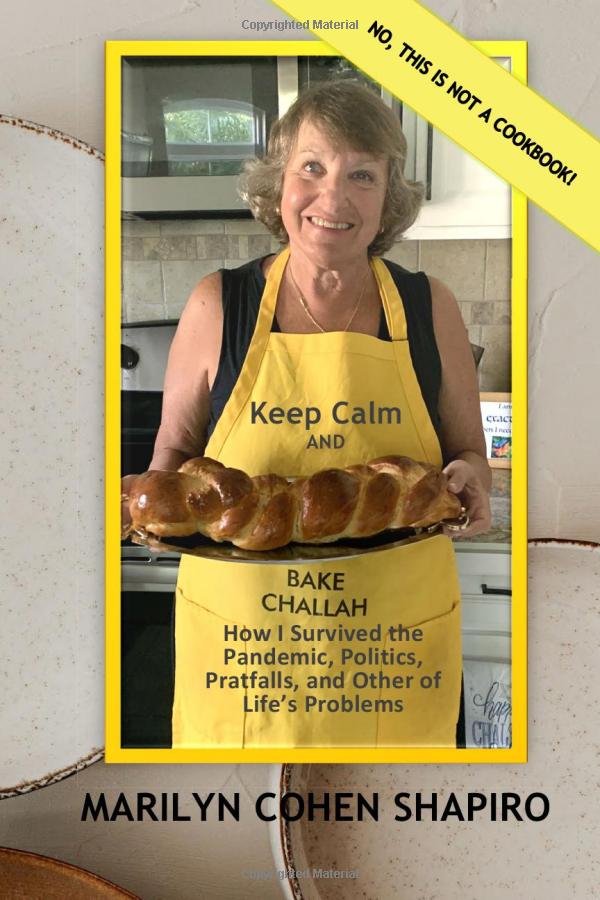
As Jews around the world herald in the Hebrew Year 5784, I am celebrating Rosh Hashanah with the release of my fourth book, Keep Calm and Bake Challah: How I Survived the Pandemic, Politics, Pratfalls, and Other of Life’s Problems.

Before you start getting out your baking pans, please be warned: No, this is NOT a cookbook! 

In March 2020, as the reality of COVID-19 hit home, I started baking challah, the delicious, braided egg bread that is typically eaten on the Sabbath and other important Jewish holidays. More importantly, I started WRITING about baking challah. Getting inspiration from England’s World War II rallying cry, I searched the internet and found Keep Calm Maker on Zazzle, an American on-line marketplace, could create an apron with a Keep Calm and Bake Challah logo embroidered on the top half. The yellow cotton pinafore arrived in June and my wearing it while baking the loaves became as necessary to the process as kneading the flour, sugar, salt, oil, and yeast. I knew that the mantra would be the title of my book. 

Over the next two and half years, I wrote about baking challah. I also wrote about adjusting to the “new normal.” Wearing masks. Zooming with family and friends. Missing in-person birthdays, bar and bat mitzvahs, graduations, weddings, and funerals. Following the news as the country was split apart. Emerging slowly back into life more closely resembling the pre-COVID years. Finally meeting my San Francisco grandson who was born days before California began its shelter-in-place orders. Resuming our summers at 9100 feet in Colorado. And dealing with our own COVID illnesses. 

In April 2023, my editor Mia Crews and I were putting the final touches on Keep Calm and Bake Challah before publication. We were going back and forth with necessary changes to the fifty-three stories as well as the cover, which featured a picture of me wearing my apron and holding a huge, braided loaf. Finally, Mia uploaded the first draft copy of the book. That Friday afternoon, I greeted the deliveryman as he handed me the brown envelope that held my new “baby.” 

“Thank you so much!” I told him. “It’s my book!” 

“That’s nice,” he said, as he turned around and started heading for his truck. 

“No, it’s not any book,” I said. “It’s my book! I wrote it. Do you want to see it?” 

Before he could answer, I tore open the envelope and showed him the proof copy. 

“That’s nice,” he said. “You wrote a cookbook.” 

“No, it’s NOT a cookbook,” I said. “It’s a collection of stories about my life during the pandemic.” 

As he left, however, I took a closer look at the cover. It DID look like a cookbook. That opinion was confirmed by several other people to whom I showed the proof. 

Over that weekend, I agonized over my dilemma. Did I need a new cover? A new title? Or did I need to throw out hundreds of hours of writing and editing, keep the cover and title, and just write a cookbook? I seriously considered a title change—Thankful? Finding a Silver Lining?—until a conversation with five of my cousins on our weekly Tuesday Zoom call. 

“Don’t change the title,” they said. “Just put a banner proclaiming, ‘No! This is NOT a cookbook!’” 

I gladly followed their advice. I had been working on this book since March 2020, and I knew that the chosen title best reflected all those months of dealing with the pandemic. More importantly, I loved the title. No matter how many people passed up on my book because it looks like a cookbook, at least the title and cover would be what I dreamt it would be from the beginning of this journey. 

So I proudly present Keep Calm and Bake Challah: How I Survived the Pandemic, Politics, Pratfalls, and Other of Life’s Problems. For all of you who hoped it was a cookbook, I hope you enjoy it anyway. And to make everyone happy, my challah recipe is included at the end of the book. Happy baking! 

Keep Calm and Bake Challah: How I Survived the Pandemic, Politics, Pratfalls, and Other of Life’s Problems is available on Amazon. Click here for more information.

Gammy making challah with her granddaughter

Today I am a woman: My adult bat mitzvah

I am publishing this on the thirtieth anniversary of my adult bat mitzvah, which was held at Congregation Beth Shalom, Clifton Park, NY.

My education at Congregation Beth Shalom in Plattsburg, New York, was strong in Jewish history and traditions, but it was very weak in Hebrew. If I wanted to learn the language needed to follow the service,  I either had to attend twice during the week, difficult with its one hour round trip, or I had to be preparing for a bat mitzvah, not something females did in the 1960’s in Upstate New York.

Our father had grown up in New York City in the Depression. His bar mitzvah ceremony was celebrated with several other boys in his Eastern Parkway synagogue, including the president of the shul’s son. The honor conferred on this golden boy was his reading most of the Torah portion and the haftorah and giving a  speech while the remaining b’na mitzvoth were left with very short prayers and shorter participation. The party consisted of some sponge cake and wine back at my father’s house followed by playing sandlot baseball.

As a result of my father’s experience, his son was to have everything denied the father. Jay’s bar mitzvah was a huge celebration. Over 120 people were invited to the service, including relatives we had never seen before and never saw again. Immediately following the service, my parents hosted a lovely reception at the Cumberland Hotel in Plattsburg. We all got new clothes for the party; I remember how special I felt in the “balloon” dress that was popular in 1961. 

As was the tradition in our reform synagogue, one’s Jewish education officially ended at sixteen years old with a Sunday morning confirmation service . My class consisted of three girls: Susan Singer, Andrea Siegel, and me, none of us who had had bat mitzvahs. We recited prayers and gave speeches. Mine was on anti-Semitism.  How in the world my teacher ever encouraged that topic and how I ever summarized its history in less than ten minutes I’ll never know, but I felt proud in my white robe and mortar board cap. A reception followed. What I remember most was how one of my teachers gave Susan and Andrea cards with cash gifts and completely ignored my presence. Not the sweetest memories to carry from my simchas.

Despite the snub,I loved learning about Jewish history and traditions. I attended classes with the grade behind me and even helped out in the primary grade classrooms. Once I left for college at Albany State, I attended services for Rosh Hosanna and Yom Kippur at Beth Emeth, but I was not involved in Hillel nor did I take any classes in Judaic Studies that were beginning to be offered.

It was not until my children were born that I began to be interested in studying Judaic topics again. Over the years, I took some basic Hebrew and playbook Hebrew classes so I could better follow the service. In the years I stayed home with my children, I seriously considered going back to school for a second master’s in Jewish Women’s Studies. When time constraints ruled out classes, I began a self-tutorial, reading books by Anzia Yezierska, Tillie Olsen,Cynthia Ozick, Grace Paley, and other noted Jewish female writers. This all went on the back burner when I returned to a full-time teaching position in 1986. 

In 1993, however, Flo Miller, one of  Congregation Beth Shalom’s teachers, suggested that I take a Haftorah trope class that summer with two other interested women. The four of us met each week around Flo’s kitchen table. By the end of the summer, each of us had chosen our own Haftorah for our adult bat mitzvah. I chose Mishpatim, the Torah portion whose  date for reading that year fell on the week of  my father’s ninetieth birthday to honor him and, coincidentally in the year of my forty-third birthday to reaffirm my link to Judaism on what would have been the thirtieth anniversary year of my own bat mitzvah. Over the next several months, my lunch hours at work consisted of a quick bite and at least two practice sessions with the Haftorah. Once a week, Flo would call me on the phone, and I would again read the Haftorah to show her how well I had progressed. By winter, Flo, Rabbi Harry Levin and I decided that I would also read two Torah portions at the service.

My bat mitzvah, which was held on February 4, 1993,  was not a huge affair. My parents and Larry’s parents could not come from Florida, and my siblings were too spread out across the country. Many members of the the synagogue attended, however, along with Larry’s sisters and brother-in-laws and a few close friends, I A Kiddish followed, and then my family and friends went to a Chinese restaurant for a celebratory meal.Meanwhile, I taped a full rendition of the Haftorah and Torah readings and sent it to my father for his birthday.

I would love to say that the experience resulted in many more Torah and Haftorah readings at Congregation Beth Shalom. Unfortunately, learning Hebrew did not come easy to me. It never flowed off my tongue, and even though I enjoyed the musicality of the tropes, I continued to stumble over the Hebrew letters and vowels. My next experience reciting Haftorah for a service proved to be even more difficult for me than the first, and I have not tried again. I continue to enjoy attending services and have high respect for the congregants who volunteer to read Haftorah and Torah portions. And through Jewish book clubs and my own independent reading, I will continue to study and appreciate my chosen faith.

A version of this article originally appeared in the Jewish World News, a bi-weekly subscription-based newspaper in upstate New York, in the August 20, 2015, issue.

Happy Japchae Day!

Thanksgiving is hands down my favorite holiday. I love celebrating with a large group of family and friends. I love reflecting on all for which I am thankful. And I love foods that we traditionally load onto our holiday table: the turkey (especially tasty when eaten while it is being carved), Ocean Spray whole cranberry sauce, my mother’s stuffing recipe, Marilyn’s World Famous Chocolate Chip Cookies, Anita’s rugelach, Adam’s vodka infused apple pie, and Hannah’s japchae.

Wait! Japchae? What is a Korean recipe that features translucent sweet potato noodles, thinly sliced beef, and vegetables doing on our Thanksgiving table?

For many years, Larry and I spent Thanksgiving with our cousins Freya and Randy. We literally had to travel over the river and through the woods to their Washington County home—which I referred to lovingly in Yiddish as in ekvelt— to share the day with at times over 30 family members and friends. Their daughter-in-law Hannah, a first-generation Korean-American, brought japchae every year, and I considered that to be as traditional as apple pie. In 2014, the holiday was especially sweet as our daughter Julie and her husband Sam had told us that they were expecting a baby in mid July. Larry and I were so grateful to harbor the secret throughout that memorable weekend. 

True, a few Thanksgivings were not exactly times of gratitude. Larry’s 78-year-old grandmother Bubbie Rose passed away on Thanksgiving morning in 1974, three and a half months after she beamed throughout our September wedding. My father passed away a week before the holiday in 2008, much to the annoyance of the congregant who was responsible for arranging for the food at the traditional Jewish gathering after the funeral. “I hope you realize this is a lousy time to ask people to help set up a shiva minyan,” she informed me. Fortunately, members of our Upstate New York shul gladly showed up. And despite our grief in both occasions, we were all grateful for their long lives and all the blessed memories we share.

In 1984 the day before our family’s planned departure to visit my Pennsylvania siblings for Thanksgiving, a section of our garage door hit Larry on the head when the spring snapped. Fortunately, Larry avoided what could have been a catastrophic injury by mere millimeters. Upon the advice of our doctor, however, we cancelled our traveling plans. A quick supermarket run to secure a turkey and all the fixings and a Blockbuster run (remember those?) for a stack of family friendly movies resulted in a quiet cozy long weekend. We were grateful for that unexpected intimate family time. 

The most sobering Thanksgiving came in 2016. As we were packing for our flight the next day to Colorado for a gathering with our son-in-law Sam’s family in Fort Collins, our daughter Julie called to tell us that our 15-month-old granddaughter was in the hospital with pneumonia in a hospital a mile from their Rocky Mountain home. By the time our plane had landed, she had been rushed to Denver’s Children’s Hospital. 

The next few days are still etched in my memory: Our wan granddaughter, connected to oxygen and IV’s, rushing to hug her Zayde. Julie and Sam holding their daughter as she watched endless repeats of Frozen on their iPad. Her wails every time a nurse entered the room. Our 120 mile round trips to the hospital while listening to the depressing news of the recent presidential elections. Adam rolling out a vodka-infused crust for the apple pie. Sharing a lovely Thanksgiving dinner with Sam’s family around a table missing three important people.

As Larry and Adam headed to the airport, I remained behind to provide needed help as Mountain Girl continued her recovery. Despite the circumstances, I have to say that week caring for my granddaughter, still connected to oxygen by a three foot hose because of the 9100 foot altitude, was precious. We sang and danced to “Wheels on the Bus” and “Rubber Duckie” and “The Alphabet Song.” We stacked toys and put together puzzles. She learned how to walk up and down the stair. I fed her so many blueberries, her favorite food, that she had numerous “blueberry blowouts,” for which Gammy was responsible. It was not the Thanksgiving we had planned. But we were thankful for modern medicine that saved her life and that provided the needed interventions, including a twice a day nebulizer, that resulted the healthy, thriving second grader she is today.

By the following year, Larry and I, who had moved to Florida that June, headed up north. Thanks to dear friends who let us “house sit” while they visited relatives for a week, we again shared a wonderful Thanksgiving with Larry’s huge extended family. Freya and Randy had passed the Thanksgiving reins to our niece Laura and her husband Paul, who had recently purchased a home in Guilderland, New York. The buffet table was laden with almost all the Shapiro traditional food except one. Hannah bypassed on making japchae. Oh well! We still had plenty to eat.

Maybe it was because airports were especially crowded on this holiday weekend. Maybe because we weren’t used to the cold. Or maybe it was because I no longer could depend on Hannah for japchae. In 2016, Larry and I decided to join a large group of friends from around the country and the world at a nearby resort. By the second year of shredded salty turkey over gluey mashed potatoes and subpar pies, our friend Peter declared that Larry and I should host a Thanksgiving potluck at our home. 

We happily agreed. Plans were going smoothly until we realized a few days before our scheduled Thursday feast that Peter and his wife Margaret were flying home on Thanksgiving Day. “I thought you Americans had all your holidays on Monday,” he said. No, Peter, I explained. Thanksgiving is ALWAYS on Thursday!

Fortunately, everyone was able to adjust their schedule, and we celebrated Thanksgiving on Ere of Yontiff—Wednesday. I prepared a 22-pound turkey, stuffing, mashed potatoes, and my World Famous Chocolate Chip Cookies. Everyone else filled in with their own favorites. I was hoping the Hunters would bring scones and clotted cream. Instead, their contribution of two bottles of Moet & Chandon champagne worked out, as did the orchid they brought that continues to bloom. Not surprisingly, no one brought japchae.

We got to celebrate our International Thanksgiving one more time before COVID shut down the world, necessitating that Larry and I share our 2020 meal with extended family on Zoom. By 2021, however, we were up and running with the understanding that everyone bring their favorite dishes and COVID-vaccine infused arm. 

What a joy it is to know that 2022 is ushering in what I hope to be a new string of large gatherings of friends and family!

You may be reading this the day after Thanksgiving when Larry and I will be eating leftover turkey, stuffing, and apple pie. Meanwhile, we will have had what we hope will have been a wonderful day with many of our “regulars” as well as several new friends. We hope the day will be joyful and uneventful. If not, I will find reasons to be grateful—no matter what challenges pop up and even if we don’t have japchae!

Remembering wonderful past Thanksgivings, including our 1979 gathering with our family in Pennsylvania!

Oshinsky Story Published in The Forward

I am proud to announce that my three part story about Harry Oshinsky, a World War I Jewish immigrant, was published in The Forward, one of the most influential American Jewish publications.

Over fifty years ago, the Forverts published a series of stories in Yiddish by Chonie “Harry” Oshinsky, describing his childhood in a shtetl in Lomza Gubernia, his two-year trek to Brooklyn and his life in “di goldene medine,” the golden land. 

Many years later, Oshinsky’s son, Lenny Oshins, brought an English translation of the story to me, his friend and  a writer, for a potential article. Using the manuscript as a basis, I retold his story in three chapters, including details I discovered during my own research that help shed light on the history surrounding Harry’s extraordinary life. 

The three articles were originally published in The Jewish World, a bi-weekly subscription based newspaper located in upstate New York. The original article may be found on the web at https://jewishworldnews.org. I appreciate all the support Laurie and Jim Clevenson of The Jewish World has given me and my writing over the years.I also appreciate the help of Rukhl Schaechter, the editor of the Yiddish Forverts, in preparing the story for publication in The Forward.

Here are the links to the article as published in The Forward:

To read Part One: “From Bialystok to Brooklyn: A Jewish immigrant’s trek across three continents,” click here.

To read Part Two: “Two Jewish teenagers escaping Bialystok arrive in Harbin, China,” click here.

To read Part Three: “A Jewish teen from Bialystok lands in a Chinese prison,”  click here.

More about Marilyn:  Since retiring from a career in adult education and relocating with my husband Larry from Upstate NewYork to Solivita, I is now writing down my own family stories as well as the accounts of ordinary people with extraordinary lives. I have been a regular contributor to the bi-weekly publication, The Jewish World (Capital Region, New York), since 2013. My articles have also been published in Heritage Florida Jewish News and several websites including the Union of Reform Judaism, Jewish War Veterans of the United States of America, Growing Bolder, the Memorial Scrolls Trust (England), and Jewish Women of Words (Australia). I am the author of two compilations of my stories,There Goes My Heart (2016), Tikkun Olam: Stories of Repairing an Unkind World.(2018), and Fradel’s Story, (2021) a collection of essays co-written with my late mother, Frances Cohen. All three books are available in paperback and e-book format on Amazon. My fourth book, which will be published in late 2022, is entitled Keep Calm and Bake Challah: Surviving the Pandemic, Politics, and Other Life’s Problems. I am also working on a fifth book, Under the Shelter of Butterfly Wings: Stories of Jewish Sacrifice, Survival, and Strength.

More about The Forward: Founded in 1897 as a Yiddish-language daily newspaper, The Forward is considered one of the most influential American Jewish publications. I, along with many of my friends and family with Jewish heritage, remember my own maternal grandparents reading Forverts, the original daily Yiddish paper, when I visited them in Coney Island in the 1950s and 1960s. In 1990, an English-language weekly offshoot began publication; in 2019, it became an online newspaper. A more detailed description of The Forward  may be found on Wikipedia.

Holocaust Stories Needed!

“You really need to talk to Harry.”

My friend Marilyn Glaser gave me this advice before one of our Friday night Shabbat services in our Florida synagogue. I was aware that Harry Lowenstein was a Holocaust survivor. But Marilyn, the shul president, knew I was a writer, and she knew his story needed to be preserved.

By this time, I had been writing for the (Capital Region, NY) Jewish World for over four years. The majority of my stories had been about my family: growing up in a small North Country town in New York; meeting my husband in 1973 to learning to live with him after our retirement in 2010; raising two children; moving to “The Sunshine State” in 2015. Up until that point, I had not tackled biographies. Fortunately, Harry was a willing story teller.

 As I sat at his kitchen table, I was riveted by his description of four years of hell, first in a ghetto and then in Nazi concentration camps. After liberation, Harry returned home to find that every one of his relatives had been murdered by the Nazis. He eventually made it to the United States, married Carol Sainker, raised three children, and owned and operated a clothing store in Kissimmee. Meanwhile, he was determined to carry on his family’s legacy. “I saw a synagogue burn,” said Harry, “and I was determined to build another one.” With the contributions from friends and fellow Holocaust survivors, the Lowensteins raised enough money to build our synagogue.

After Harry’s story was published, my writing became more diversified. I was still writing my sometimes funny, sometimes poignant family stories, but I also took pleasure from interviewing what I referred to as “ordinary people with extraordinary lives.” A woman who has raised over $150,000 for cancer research after losing her 32 year old daughter to leukemia. A man whose introduction to a doomed ship as a boy resulted in his becoming a “Titanic fanatic;” a group of former Catskill workers celebrating a reunion.

But the stories that moved me the most were about who lived through—or died in—World War II. Jewish soldiers. Concentration survivors who were haunted with their memories until their passing. Righteous gentiles who had rescued others from the horrors. 

I have never been shy about my retirement avocation and never fail to tell friends and strangers I am a writer. This summer, I shared this information with Eva Nozik, who was visiting Summit County, Colorado. 

“My aunt, Golda Goldin Gelfer, who recently passed away, was a Holocaust survivor,”Eva said.”You need to talk to her children.” 

She set up a Zoom call with Anna Livits and Sofia Zukerman, Golda’s two daughters, and other members of the Goldin family. The Nazis, they told me, invaded Glusk, Belarus, on June 22, 1942, Golda’s 14th birthday. Six months later, Germans and local supporters rounded up and murdered over 1000 Jews, including Golda’s mother Elke and her two sisters, Chaisoshe (19) and Malka (8). Golda and her father Meir escaped certain death by hiding in an attic and eventually finding their way into the forest. The two soon joined Soviet partisans in their efforts to sabotage the Nazi offensive until Belarussian liberation on July 4, 1944. Several revisions (and many nightmares about the Holocaust) later, it was finished and ready The Jewish World’s next issue.

Even before it was published,, Anna expressed her gratitude. “I don’t have enough words to thank you for the work you have done,”she wrote me in a December 13 email. “I had a dream today that my mom was smiling. It’s like  she was in peace that we remember her family, Elke, Chaisoshe, and Malka.”

The descendants of Meir and Elke Goldin have more stories to tell. They are eager to recount Golda’s time in the woods, her life in the Soviet Union after the war, her move with her children to the United States. They also want me to connect with the son of a cousin who survived “murder by bullets” by falling into the pit.And, by the way, they have a friend whose parents survived the Warsaw ghetto. 

Meanwhile, I have other stories on my “To Be Written” file. My cousin Eric (Z’L) Silverman came over on a stolen visa just before the war. Trudi Larkin Wolfe’s parents, both concentration camp survivors, recently passed away, but their oral history is preserved on video as part of Stephen Spielberg’s Shoah project, and she and her sister will fill in any gaps. Ruth Gruber, a brilliant Jewish woman who was appointed by the FDR administration to oversee the Oswego Project, a refuge for Jews that is the subject of a New York State Museum exhibit. And I made a promise to a friend that I would write an article about his father, who came to the United States in the early 1900s via, of all places, China.

After hearing Golda’s story at the most recent meeting of SOL Writers, my group of fellow writers said that I am “a woman on a mission.” “You make the unbearable bearable,” one said. “Keep writing.”

Despite my passion, I initially questioned about pursuing more stories about this terrible time in humankind’s history.The Holocaust has already been the subject of innumerable novels, memoirs, plays, movies, and, and even children’s books.

I found the answer in a teaching from Pirkei Avot, a compilation of the ethical teachings and maxims from Rabbinic Jewish tradition. It is not incumbent upon you to complete the work,” wrote Rabbi Tarfon (46 CE-117 CE), “but neither are you at liberty to desist from it.” (Pirkei Avot 2:21) When the Anti-Defamation League reports that Facebook, Instagram, and other social media platforms have “cracks in enforcement” that allow Holocaust deniers to disseminate hate speech; when a school administrator in Texas can tell a group of educators during a training session to “have an opposing view” when teaching the Holocaust; when 77 years after Soviets liberated Auschwitz, anti-semitism is on the rise; I must continue to tell the stories. My writing will certainly not “complete” the work of masters such as Elie Wiesel, Victor Frankel, and Steven Spielberg. But I cannot use that as an excuse.Whether my articles and, in the future, my book is widely read or languishes in an Amazon warehouse, at least I did not “desist.”

But I need help. If any of you have a Holocaust story you would like to be preserved in writing, please contact me via email at shapcomp18@gmail. com. Those who were lost as well as those who survive deserve to have their lives remembered and honored. Never again.

A version of this article originally appeared in the Jewish World News, a bi-weekly subscription-based newspaper in upstate New York.