Category Archives: Parenting

Are You Listening? Really?

When you talk, you are only repeating what you already know. But if you listen, you may learn something new. Dalai Lama XIV

So many stories if we just listen. Sitting next to someone on a plane, we often stick earbuds in our ears to make sure they don’t prattle on about nothing.  But sometimes there is much to be learned from hearing—and really listening—to what others have to say.

Some of us are experts at listening. Lou, a friend and former co-worker, not only hears what the person is saying but engages his entire body: he leans forward, plants his chin in his hands and his elbows on his knees,  and looks the speaker in the eye. He nods in agreement. You know he cares about what is being said.

I think of Lou, and I want to emulate him. I am as guilty as anyone, often not really paying attention.

How many times have I sat through a rabbi’s dracha —sermon— and spent too much of my time checking my watch? Even when I have signed up for a lecture sponsored by my community’s book circle, I often find myself thinking about what I need to do later that day rather than focusing on the topic being discussed. I have missed much by being not more mindful.

Our failure to focus often carries into our daily conversations. We often are not listening to what the person is saying but rather waiting for the moment to express our own “pearls of wisdom.” And, what is worse,  what we want to say takes the conversation in a different direction. “That’s great,” we comment. “That reminds me of the time I…..” Note the emphasis is on the word “I.” To quote John Wayne, we are “short on ears and long on mouth.”

We can learn from Lou and other good listeners. Young adult author Sarah Desson describes them well: “They don’t jump in on your sentences, saving you from actually finishing them, or talk over you, allowing what you do manage to get out to be lost or altered in transit. Instead, they wait, so you have to keep going.”

How much richer our lives could be if we allow the speaker to continue talking.

Larry and I recently spent time with a group of friends in in Key West, Florida.  Before the trip, Larry had played pickleball with several people in the group, and we both had shared time around the pool and eaten lunch together. But being together for a week gave us more time to learn about each other.

Stories abounded. One woman had contracted polio when she was six, just months before the polio vaccine had come out. A very attractive woman who was visiting from England had become an actress in her sixties and is a regular on a Welch soap opera. A couple’s son had left his career as a graphic designer behind and became a tattoo artist. Several in the group had served in the military and regaled us with their stories about their experiences in basic training, in fighter planes, in submarines. Again and again, I thought to myself, “Who knew?”

Four days into our trip, Larry said to me, “I love hearing everyone’s stories!” And so did I. So many stories, so much to learn. And as my friend Lynn tells me about her own life, “You can’t make this stuff up!”

In the months ahead, I will be sharing people’s stories with you.  My friend’s son, who we have known since childhood, is now a rabbi in New Orleans. A friend in our 55-plus active adult community has turned his lifelong interest in the Titanic into a post-retirement career, as he travels the world giving lectures on the infamous boat and its many passengers. A friend of mine, a thirty-eight year old resident Daughters of Sarah Nursing Home, was paralyzed from the neck down in a freak motorcycle accident when he was sixteen. Each has a story to tell, and we all can learn by listening.

At one of the recent meetings of my writer’s group, one of the members shared a poignant story she had written about woman she had met twenty years earlier on a train stuck outside of Washington, D.C.  The writer—who was not wearing earbuds to block out conversations with strangers—learned that the woman was recently married to her childhood sweetheart. A month before the wedding, he was in a terrible accident and had suffered traumatic brain injury. Despite warnings from friends and family to back out of the wedding, the young woman realized her vow to love one another through sickness and health was sealed before the ceremony. By the time she finished reading her story, many of us were in tears. “How did you learn so much about a complete stranger?” we asked. “I don’t know,” she answered. “She talked, I listened, and I remembered.” Good advice for all of us.
I Can See Clearly Now……

img_5617

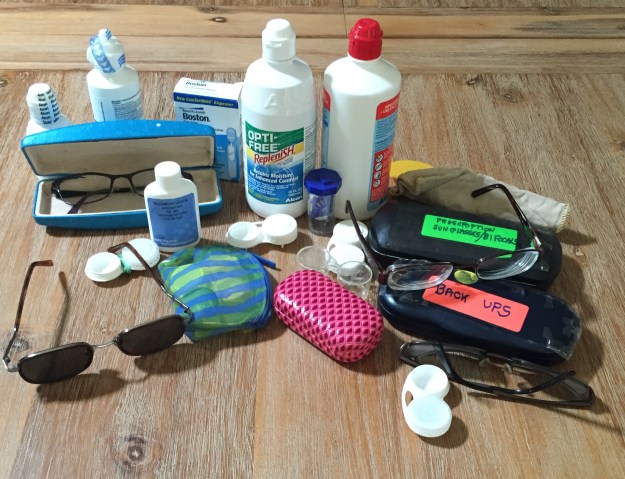
A lifetime of eye care is getting recycled!!

“Blessed are You, Adonai our God, Ruler of the universe, who opens the eyes of the blind.” Morning Blessings, Shacharit

As our congregation recited the prayer this Rosh Hashanah, this line of the traditional morning prayers took on much more meaning. After struggling with extremely poor vision since elementary school, I will no longer have to rely on corrective lenses. As Johnny Nash sang, “I can see clearly now. “

No one was surprised when I needed glasses when I was six years old. Near-sightedness was rampant in my family, and my parents and two older siblings were already wearing glasses. My vision, however, was complicated by amblyopia, a condition when the vision in one of the eyes is reduced because the eye and the brain are not working together properly. In my case, the right eye wandered towards the extreme right. In 1956, surgery was not an option. Instead, I was given a black patch to wear on my left eye to force the “lazy eye” to get stronger.

I wish my parents had been more persistent, but I was embarrassed and defiant and refused to wear the patch. The vision in my right eye continued to deteriorate, and my left eye also was very near-sighted. By the time I was in junior high school, my glasses were noticeably  thick, only adding to the self-consciousness of  teenager who also suffered from acne and what I perceived as a Jewish nose. When I was sixteen, I was fitted for a pair of glasses by an ophthalmologist who told me my vision was too bad for contact lens and predicted I would be blind by my twenties. When I brought the glasses home, they were so thick they looked like coke-bottles. I threw them across the room and cried myself to sleep.

By the time I was a senior in high school, I was able to get another pair of glasses with lighter material that were not as ugly. But in my yearbook picture, the thickness of the lenses were the dominant feature.

When I arrived at University at Albany, I was very self-conscious of my glasses,  and they proved to be a source of embarrassment. One time, my roommates thought it would be funny to hide my glasses when I was in the shower. I burst into tears and begged them to help me find them, as I didn’t have the sight to search for them. I hit my lowest moment was when my girlfriend’s cute  but clueless boyfriend didn’t respond to me when I was talking to him. “Gene,” Linda said, “ Marilyn asked you a question.” “How was I supposed to know?” he answered. “Her glasses are so thick you can’t see her eyes.”

At the end of my freshman year, I was experiencing very bad headaches. Doctors at the  University at Albany health center referred me to a local ophthalmologist. “You are extremely near-sighted,” the wonderful doctor stated. “Have you ever considered contact lenses?” I wasn’t going blind. I was a candidate for contacts!  I was measured, fitted, and scheduled to pick them up the first week of summer break.

I will never forget the day I first put those tiny hard lenses in my eyes. I walked outside and saw the leaves on the trees in all their beauty. For the first time in my life, my eyes were causing tears of joy.

The lenses not only improved my vision but also my self-confidence. Behind those coke bottles were my family’s “Pearlman-blue” eyes, eyes the deepest color blue. Helped a little by the blue tint on my lenses, my eyes became my best feature. “Has anyone ever told you that you have the most beautiful blue eyes?” strangers would tell me. “Yes, they have!” I would reply,””but you can tell me again.”

For the next fifty years, contact lens were an integral part of my life. I popped them in the minute I woke up in the morning, and I popped them out just before I went to sleep. I was literally blind without them, but the world was a bright, sharp 20/20 with them. I used eye glasses only when absolutely necessary. Regular eye appointments kept me on track.  “Lasik” surgery was not an option for many years because of the severity of my myopia. When the surgery was perfected, my doctor suggested I wait.  My family history, which had predicted corrective lenses, also predicted a high chance of the development of cataracts, a common eye problem seen in over fifty percent of the population by the age of eighty.

When I moved to Florida, I immediately established myself with a local eye doctor. Last fall, he told me that I had the beginning of cataracts. By this spring, the one in my right eye, which had been deemed as “insignificant” only months before, was growing fast and significantly impacting my vision. As soon as my husband Larry and I returned from our summer travels, I scheduled the surgery for the last week of September.

By Rosh Hashanah services less than a week later, I was able to greet fellow congregants, see the rabbi on the bima, and follow the entire service in our prayerbooks with no corrective lens in my right eye and my faithful contact lens in my left. The follow-up appointment has confirmed that my right eye is a nearly-perfect 20/25.  After surgery for the cataract in my left eye is completed, I will be free of corrective lenses for the first time in sixty years.

Because of my poor vision, I have  never felt confident climbing up the steps to the huge slides at water parks   As soon as I have medical clearance, however, a  friend and I are heading to Wet ’n Wild in Orlando.  Who knows what’s next? Sky diving?  Why not? I can see clearly now. Wheeeee!

Finding My Voice with Help from the Jewish World

img_5461

“It was a dark and stormy night. Suddenly shots rang out!” 

Poor Snoopy! For all his “dogged” attempts, Charles Schultz’s beloved beagle has not yet published his novel. Thanks to The Jewish World, however, I have been more successful. I have published a book.

Actually, it was a bright and sunny day in June 2013, when Josie Kivort, Hadassah Capital District’s Chapter Campaign Chair, and I paid a visit to The Jewish World’s office. For the past several months, we were serving on the committee to plan the organization’s annual Special Gifts event. Jim Clevenson, the publisher of the Schenectady-based biweekly, Josie, and I met to discuss the timeline future press releases and advertisements.

I had communicated  with  The Jewish World  mostly through press releases. For years, I had worked on publicity, first as a volunteer for several organizations in Clifton Park and later as part of my responsibilities at the Capital District Educational Opportunity Center in Troy. We had been in “virtual contact” as  I had been sending the newspaper  articles that I felt would be relevant to the Jewish community.

During our discussion, I mentioned to Jim that I had retired three years earlier. Jim asked if I would be  interested in doing reporting for the Jewish World.

“I have  done enough press releases for a lifetime,” I told Jim. “However, would you be interested in publishing some short non-fiction pieces about my life as a Jewish woman, wife, and mother in Upstate New York?”

Jim agreed to give the idea a try, and he told me that I should send the articles to Laurie Clevenson, his sister and the paper’s editor-in-chief.

My first article appeared in the August 27, 2013, school opening issue. “There Goes My Heart” recalled how saying goodbye to my children—whether putting them on the bus the first day of kindergarten or dropping off at their dorms their first day of college or waving them off as they got in their own cars and drove cross country to new jobs—always brought me to tears.

I had asked my mother if the farewells ever got easier. “Oh, Marilyn,” she said. “Every time any one of you gets into the car and drives away, I think to myself, ‘There goes my heart!’”

So started my regular contributions to The Jewish World. Every two weeks, I wrote a story and submitted it for the newspaper’s consideration. Growing up as the only Jewish family in a small Upstate New York town; experiencing anti-Semitism on my first teaching job in the Capital Region of New York; participating in a playgroup for our two-year-olds; adjusting to retirement; leaving the home we shared for thirty-six years to move to Florida—these many once-private moments became very public columns.

Initially, I was  afraid I would run out of ideas. As the months progressed, however, I found that even the smallest event— biking up a steep mountain in the Rockies, visiting the Portland Holocaust Memorial, changing my granddaughter’s diaper—could morph from an idea to a story. Family and friends shared their experiences, and, with their permission, wove them into my articles.

Not that the stories always flowed easily from my brain to the Mac laptop. “Writing is easy,” wrote sports writer Red Smith. “All you do is stare at a blank sheet of paper until drops of blood form on your forehead.” I often found myself up at midnight before a deadline trying to polish what I had written. But, like some people I knew who devoted hours to quilting or photography or golf, I devoted hours to my writing.

When I moved to Florida in 2015, I joined SOL Writers, a group of women who met twice a month to share their drafts or to participate in a free write. A few of the women were published authors; others, like me, had dreams of expanding their audience. I brought in pieces I had either completed or were working on for The Jewish World. The women were not afraid to criticize but they were also generous in their praise. “You seriously need to think about putting these essays into a book,” one of my writer friends suggested.

In March 2016, I got up enough courage to contact Mia Crews, a professional editor who would be responsible for formatting the manuscript, designing  the cover, and uploading the finished product to Amazon.

Nothing prepared me for the amount of work required to go from a collection of stories to a polished book. I started editing. And editing and editing. I thought I was close to finishing before we left for our summer trip out west. However, I worked on it on the plane to San Francisco, at nights in different hotels up the Oregon Coast, and during every spare minute during our six week stay in Colorado. I enlisted Larry’s help, and we sat together on the couch in our rented condo going over the manuscript with a fine tooth comb while  two political conventions and the Summer Olympics played on the television.

When we got back to Florida, Mia and I completed the final revisions, On September 3, my sixty-sixth birthday. There Goes My Heart was launched on Amazon. I had done it! I had written a real, live book with, as a friend commented, with a cover and pages and nouns and verbs and everything!

”A writer only starts a book,” wrote Samuel Johnson. “A reader finishes it.” Thanks to Laurie and Jim Clevenson for giving me the opportunity to publish my articles. Thanks to you, my readers, who have helped me reach the finish line of my lifelong dream.


Bubbe Butt Paste and Other Love Stories

Soon after my daughter Julie and my son-in-law Sam told us they were expecting our first grandchild, my husband Larry and I discussed what grandparent name by which we each hoped to be called. 

Larry determined quickly that he would be called Zayde, Yiddish for grandfather. It was a family tradition, he stated. His father’s father was Zayde Max, and his own father was Zayde Ernie to his seven grandchildren. 

Choosing my name didn’t come as easily. My friend Lynn, whose granddaughter lived in Israel, suggested the Hebrew moniker Saftah, but I didn’t think that would work for our future grandchild, who would be living in the Rocky Mountains of Colorado at 9100 feet above sea level. The paternal grandmother, who had a four-year-old granddaughter, already had dibs on Nana. Additional members of the Grandmother Club told me about their sometimes unusual titles: MeeMaw, GG, G-Ma, CiCi, NayNay, Gemmy, and even (Graham) Cracker. Although Bubbe went well with Zayde, I dismissed it as too old fashioned. I pondered the numerous options over the next few months. 

Larry and I were in Colorado the day Julie went into labor. While waiting for the Big Moment, we took a hike up to Rainbow Lake, a lovely spot a mile up the mountain near Julie and Sam’s home. On the trail, we ran into another couple who, noticing Larry’s Syracuse University hat, told us they were also from Central New York State. After chatting with them about the Orangemen’s basketball team and the amount of snow that fell the past winter, Larry and I told them about our grandchild’s imminent birth. They congratulated us, stating how much they themselves enjoyed being grandparents. 

“What do they call you?” I asked the woman, whose name was— ironically—Julie. 

“Grandma,” she said. “I waited a long time for grandchildren, and I am proud to go by the standard name.” 

That sealed it for me. Meeting a Julie from Syracuse on a hike the day my grandchild was born was b’shert—meant to be. I would stick with the classic “Grandma.” 

Larry and I were introduced to our granddaughter an hour after she was born. When I held her in my arms in the hospital room, I was in heaven. I was finally a grandma! I enjoyed every moment of that summer and the three visits over the next year. 

By the time we returned to a rented condo for another Rocky Mountain summer just before her first birthday, our granddaughter was talking. We secretly hoped that, along with her rapidly expanding vocabulary— Dada, Mama, dog, bear, boo (blueberries), yesh, and dough (no)—she would learn and say our names before we went back to Florida. 

Happily, over the next six weeks, we spent many hours with her, not only with her parents but also without them as exceptionally willing babysitters. As she sat in her high chair eating her meals and snacks, I determinedly coached her. 

“Dog,” I said, pointing to Neva, who was waiting patiently with her tail thumping for the next dropped morsel. “Grandma!” I said, pointing to my chest. My granddaughter would smile and laugh and offer me her smashed banana or mushed piece of challah. Nothing in her babbling, however, even came close to “Grandma.” 

Four days before we were to return to Florida, Larry and our granddaughter were playing on the floor with her blocks. “Zayde!” she suddenly stated emphatically. Larry’s face lit up like the Syracuse University scoreboard. She said it again—and again. From that moment, Zayde became her favorite word. She called out “Zayde!” the minute Larry walked into the room, and she yelled it out if he disappeared behind a closed door. Talk about melting a grandfather’s heart! 

As happy as I was for Zayde Larry, I was a little—well—make that extremely jealous. My efforts to hear Grandma—any version— intensified. “Grandma!” I said every chance I got. As the hour of our departure got closer, I became desperate and switched tactics. “Bubbe,” I tried, deciding an old sounding name was better than no name at all. 

The morning before we were to fly back to Florida, I babysat my granddaughter while Julie and Sam were at work and Larry was returning the rental car. After her morning nap, I lay my granddaughter on the dressing table to change her diaper. She looked into my eyes and clearly said, “Bubbe!” “Yes! Bubbe!” I cried. My granddaughter had spoken, and I was going to be Bubbe! I was over the moon! I immediately shared the news with Larry. Our granddaughter said the magic word again after lunch and after her afternoon nap. When Sam returned home from work that evening, this 

Bubbe was bursting with joy.
“And she repeated this every time you changed her diaper?” Sam asked somewhat hesitantly.
“Every time!” I said. “She clearly said Bubbe!”
“I don’t know how to tell you this, Marilyn,” Sam said. “But she wasn’t actually calling you Bubbe. It’s her word for butt paste. She has had some diaper rash this past week, and—well—she likes to hold the closed tube after we finish applying it.” 

“Butt Paste!” Larry chortled. “She is calling you Butt Paste.” 

The day after we returned to Florida, our Colorado family FaceTimed with us. The minute our granddaughter saw our faces on the computer screen, she yelled out, “Zayde!” 

“And look who is with me!” said Larry. “It’s Bubbe Butt Paste!” 

Sigh! 

It took another two months to realize that our now sixteen month old granddaughter  could not say the “gr” sound. “How about you call me ‘Gammy?’” I asked her.  She smiled broadly and said  “‘Gammy!’”

Six years and more grandchildren later, I am now a confirmed Gammy. But I will be happy to receive their smiles, their laughs, their hugs, and their unconditional love—no matter what I am called.

First published in The Jewish World, September 1, 2016

There Goes My Heart

The first week of September in Upstate New York is a time for new clothes, sharpened pencils, and bright yellow buses that reappear on neighborhood streets like clockwork two days after Labor Day. School opening is an important time for the children. It is also a bittersweet moment for the adults who are saying good-bye to them.

My first vivid memory was my first day of school. My mother walked me up the hill to the big brick building that housed all the grades for Keeseville Central. I quietly sat at a table stringing colored beads in Mrs. Ford’s kindergarten classroom. My mother wordlessly slipped out the door. I didn’t cry.

I was supposed to be the last of my parents’ three children going off to school, but that plan failed. My sister was born three months before I entered kindergarten. Bobbie was a shining example of the little “surprise” many pre-birth-control women in their mid to late thirties experienced just when they thought diapers and formula were behind them. I am not sure if my mother pushed Bobbie in the carriage into the classroom that morning. I am sure dropping me off only to return to a house still equipped with a crib, a high chair, and a playpen was an ironic moment in my mother’s life.

When it came time to send my son Adam off to kindergarten, I had mixed feelings. I was happy for him to be starting on his next adventure, but my mind was filled with concerns. Would his teacher, who had a reputation for being strict, be kind to my son? Would he overcome his shyness, make new friends? My fears were certainly not alleviated when within the first week he didn’t come up our driveway after the school bus pulled away. My phone call to the school triggered an alert to the driver, who found Adam fast asleep in the back the bus. Somehow, he did survive his first year. Life before school became a distant memory as Julie followed Adam up the school bus steps three years later.

What was so much more difficult for me was sending Adam off to college. The summer before, I shopped for comforters and dorm sized sheets and enough shampoo and soap to last him four years. The thought of his leaving the house and our no longer having four at the dinner table caused me to tear up all summer. A week before he was to leave, I was cutting up several pounds of chicken breast when I burst into tears. “I will never have to make this much chicken again!” I sobbed out loud to an empty kitchen.

The night before we drove him to the University of Rochester, most of the purchases were still in bags with the tags still on them. Unlike me who needed to be packed and ready days in advance, Adam was happy to just stuff things into suitcases and plastic bins at the last minute.

The four of us lugged his life in Rubbermaid containers up the five flights of stairs—why did my children always get the top floors of their dorms?—and Adam quickly settled in. My last memory of my son that day was his leaning back on his chair in front of his desk, proclaiming “I am going to like it here!”

Once Larry, Julie, and I got back into the car for our trip home, I felt such deep pain that I thought someone had wrenched my heart out of my body. I cried from Rochester to Syracuse. I finally stopped when Julie commented sarcastically from her perch in the back seat, “You have another child, you know!”

Sending Julie off to Williams College three years later was a little easier—maybe because she was the second child; maybe because she was only forty-five minutes away. We dropped her off in Williamstown and got her situated in her fourth floor—of course!-dorm room. By the time we pulled into our driveway, we were giddy with excitement over our new-found freedom. We knew that both children were happy in their college environment. That knowledge, coupled with the realization that we longer had to worry about the daily angst of their high school lives—homework, car pools, dates for a dance—made the transition into our now empty nest smoother.

Still, each time our children came home, I found their inevitable departure difficult. After sending Julie off to college for her final year, I asked my mother if she ever got used to saying goodbye. “Oh, Marilyn,” she said. “It never gets easier! Every time any one of you gets into the car and drives away, I think to myself, ‘There goes my heart!’”

So, each year on the first day of school, when I see the school bus filled with children with their new clothes, their sharpened pencils their bright back packs, I will be thinking of my first day, my children’s first days, and my aching heart.

The story that started it all! Published in The Jewish World on August 15, 2013 on Page 12. After moving to Florida, I compiled a number of my stories and published this on my birthday in 2016.

Moments in History: Educators, can you make history come alive?

In the early 1960s, The Rocky & Bullwinkle Show included segments entitled The Incredible Adventures of Mr. Peabody. With the help of a “way-back machine,” the dog genius and his adopted human son Sherman were whisked back to a moment in history, sometimes saving the day. As schools rev up to start the new year, I was thinking how much fun—and relevant—it would be if students could go back in time to a historic event, even as an observer. After I posted a request on Facebook, many shared with me of their own hypothetical adventures in time travel.

Steve Sconfienza, who has worked as both a pilot and a flight instructor, would take the way back machine to December 17, 1903, in Kitty Hawk, North Carolina.There he would see first hand the moment that Orville and Wilber Wright became the first people to accomplish powered flight. For centuries, many had always believed that human beings could find a way to fly. On that historic day, the two brothers, whose interest in flight had been sparked by a rubber band driven toy helicopter their father had given them twenty-five years earlier, flew the first successful airplane. “Although not the first to build and fly experimental aircraft,” states Wikipedia, “the Wright brothers were the first to invent aircraft controls that made fixed-wing powered flight possible.” Steve, a flier since he was sixteen years old, viewed the Wright Brothers’ accomplishment as “a real triumph of humanity’s reach for knowledge.”

Sherri Mackey, a woman whose deep faith has shaped her own strong voice regarding social issues, stated she would go back to the early twentieth century’s suffrage movement and be present for the certification of the ratification of the Nineteenth Amendment on August 26, 1920. Sherri reflects, “I can only imagine the joy for women that had fought hard for the right to vote.” Sherri continues to work to ensure that that right is not somehow diluted by folks with alternative agendas. “We must teach our daughters to embrace their equality,” she stated,”and to protect and defend their equal rights just as diligently.”

Sharon McLelland dreams of  being at Pimlico Race Course in Baltimore Maryland on November 1, 1938, to witness firsthand Seabiscuit’s victory over War Admiral At what was billed as the “Match of the Century, “Seabiscuit,  described in Wikipedia as “undersized, knobby kneed, and given to sleeping and eating for long periods” was the underdog who became an unlikely champion and regarded as a symbol of hope in a country that was fighting its way out of the Great Depression.  Sharon, who once lived near Pimlico, now happily lives near Saratoga Springs, “the queen of the tracks!”How fitting for a woman who as a child had pictures of Secretariat on her bedroom walls!

I would take Mr. Peabody’s machine to the debut of West Side Story on Broadway on September 26, 1957. Oh how I wish I were sitting third row center, when the world was introduced the this American classic! Seven years old and three hundred miles away, I listened to the cast recording my father had purchased for me the week Leonard Bernstein’s masterpiece debuted. For years, I played and replayed the 78 rpm— “Something’s Coming,” “Maria, “and the absolutely stunning duet “Tonight”—until I wore out the groves. If I could be Somewhere,  it would be at the Winter Gardens Theater that opening night.

After decades of speculation as to who would finally accomplish the track and field milestone, Roger Bannister became the first person to run the sub-four minute mile at the Iffley Road Track in Oxford, England, on May 6, 1954. Larry Shapiro became interested in track and field in junior high and  read numerous articles and accounts and the runner’s 1955 autobiographical account, The Four Minute Mile. As he has shared with me since we have know each other, Larry wished he had been there when Bannister crossed the finish line with a time of 3:59:4. For his efforts, Bannister was named the first-ever Sports Illustrated Sportsman of the Year. Just recently, Larry found on YouTube a grainy black and white video of the race with Dr. Bannister himself doing the voice-over. Larry was ecstatic. Fittingly, a copy of Bannister’s book still sits on our bookshelf.

Rabbi Beverly Magidson would be transported to Jerusalem after Israel’s victory during the 1967 Six-Day War. She would like to have stood at the  Kotel, when the Western Wall came under Israeli control. Late Prime Minister Yitzchak Rabin described it in a speech to Knesset in 1995. “Nobody staged that moment. Nobody planned it in advance. Nobody prepared it and nobody was prepared for it; it was as if Providence had directed the whole thing: the paratroopers weeping — loudly and in pain — over their comrades who had fallen along the way, the words of the Kaddish prayer heard by Western Wall’s stones after 19 years of silence, tears of mourning, shouts of joy, and the singing of ‘Hatikvah.’”At the time of the war, Rabbi Magidson was in high school and only vaguely aware of the Kotel’s significance. However, in 1969 she saw it for the first time at a quiet moment in the late evening, and it was a powerful spiritual experience.

When Woodstock, the iconic four-day rock/love fest, took place in August 1969, Barbara Peterson was a 29 year old stay at home mother with three young children. At the time, she was married to a controlling man who thought hippies were disgusting druggies, and she was a dutiful, strait-laced wife. This all changed in 1972, when Barbara divorced her husband, went to rock concerts, and became liberated.“That is when I really regretted missing that historic moment in cultural history.” said Barbara. She has thought about going back to the planned fiftieth anniversary event, but she said it wouldn’t be the same.

The Wright Brothers. Women’s right to vote. The first sub-four minute mile. West Side Story. The Western Wall. Woodstock. Historical moments that have resonated and remain important in individual lives. As the new school year begins, may our children’s teachers help students find their own iconic moments in history.

Oregon Holocaust Memorial

What Makes Us the Same? Trip to Shoah Museum Inspires Writer to Find Commonality

oregon-holocaust-memorial

On a recent visit to Portland, Oregon, Larry and I visited the Holocaust Memorial. A pathway strewn with bronze sculptures of unfinished lives—a violin, a teddy bear, a torn prayer book, —brought us to a curved wall. Two columns were engraved with the brief history of the events that led to Hitler’s rise and its unfathomable consequences on Europe and the world. Plaques etched with memories from survivors are placed on a wall representing barbed wire. One read “As I looked back, my mother turned her face to avoid mine and my little sister gave me a frail and knowing wave;” another, “The fear has never left me.”On the back of wall were carved the names of family members of Oregonians who were lost in the Shoah. Below the names was the following statement:

Our precious life rests not on our ability to see what makes us different, one from another, but rather on our ability to recognize what makes us the same. What ultimately defines us is the moral strength to believe in our common humanity, and to act on this belief.

These words struck me especially hard on that beautiful June afternoon. Larry and I had flown out of Florida just days after the Orlando Pulse tragedy. As I stood in front of the memorial, I was overwhelmed with grief for all those lost in the Shoah.  I also thought of those innocent lives lost to another madman who could only focus on differences and destroy so many lives with another act of senseless violence.  I began to reflect on my own live  and question as to whether I had done enough to focus on “what makes us the same.”

As a child, I knew I was different from most of the people in our small upstate New York town. Along with one other family, we were eleven Jews in a Christian town, an overwhelming .5% of the population. There were a few anti-Semitic instances: A teenage boy yelling “Heil Hitler!” and giving me the Nazi salute as the six-year-old me played innocently on my front yard; “lost” invitations to parties by those my parents tagged as anti-Semites; whispered jokes about my Jewish nose that went unnoticed by my teachers. For the most part, however, the people Keeseville embraced us, shared their Christmas trimming with us; came over for matzoh brie around our formica covered kitchen table. We focused on what we have in common.

Although exposed to diversity on our family’s visits to New York City , as a student at University at Albany, and through—as always— countries and cultures explored through reading, my everyday encounters rarely took me far from my white, Judeo-Christian environment. This changed, however,  when I took a teaching position with the Capital District Educational Opportunity Center

The EOC, a  division of Hudson Valley Community College, offers tuition-free academic and workforce development opportunities to disadvantaged and educationally under-prepared New York State residents sixteen years and older. Through my interactions with staff and students, I learned to appreciate many different cultures and backgrounds and their personal struggles. A Muslim pharmacist,  after being imprisoned in her native country for giving medicine to a Christian, disguised herself as a Bedouin to flee to Egypt then to Albany. A young man had escaped with his family as one of the Vietnamese boat people. Both completed our GED and College Preparation Program and  then graduated from Hudson Valley Community College. One of my fellow instructors had overcome a troubled background in Schenectady’s inner city to graduate from the cosmetology program, open his own salon, and then come back to the EOC to instruct hundreds of cosmetology students in the technical and life skills to succeed in his chosen field.  I may have taught my students essay writing and grammar and study skills, but the people I encountered at the EOC taught me about courage and dignity and overcoming incredible obstacles. Our differences were secondary to our common goal of creating a better life for ourselves and our families. We all believed in our common humanity and acted on those beliefs. Even when I moved out of the classroom and into an administrative position, my greatest joy was meeting with students, having them share their stories with me, and promote the EOC through its many different success stories.

In the past few weeks, our country has experienced numerous tragedies that resulted from actions by those who failed to believe in the common humanity. Orlando, Florida. St. Paul, Minnesota. Baton Rouge, Louisiana, Dallas,Texas. The list of cities where incidents of senseless violence continues to grow.

“There may be times when we are powerless to prevent injustice,” wrote the late Elie Wiesel, “but there must never be a time when we fail to protest.” My protests may not take me to the streets, but it will take me to the written word, where I hope I can make a difference.

But maybe, it must start with children. When we lived in Clifton Park, our next door neighbors were an interracial couple—he a Caucasian from Massachusetts and she a Whitney Houston look-alike from Jamaica. We shared our yards and our lives with them and their four children who had inherited their mother’s brown eyes, mocha skin, and curly hair. One day, Julie and Katie, who were the same age, were shopping for matching lockets.  When we brought the jewelry up to the counter, Julie, my blue eyed, blonde haired daughter, announced to the sales clerk, “I know we look like twin sisters. We’re not. We’re just best friends.”

Best friends. Or just friends or neighbors or fellow citizens. Whatever it takes, let us all strive to recognize what makes us the same, to prevent injustice, to repair the world. Tikkun Olam. Amen.

Originally published July 22, 2016. Revised April 2025. 

Photo of Oregon Holocaust Memorial courtesy of Wikimedia Commons.

My Dad, The Designated Driver

2016_06_Family Picture Scans 3-28

Bill Cohen, my father, in his best Errol Flynn imitation!

A Father’s Day memory: It is 1956. My father is sitting behind the steering wheel of an idling sedan in the driveway of our house in Keeseville. Laura, Jay, and I are squirming in the back seat. Dad is smoking a Kent and listening to a baseball game on the radio. He gives the horn an impatient tap to hurry along my mother, who is inside the house diapering Bobbie and pulling together last minute items for our car trip. He honks again, more loudly. “Where is that woman?” he asks. “We’re going to be late.”

For over sixty-five years, my father was our family’s self-appointed Designated Driver. Born and raised in Queens, my father learned how to drive when he was fifteen years old at his grandfather’s farm in Burlington, Vermont. In 1940, my mother took her place in the passenger seat. By 1955, four children were filling up the remaining space.

Out of financial necessity, our family usually owned “gently used” cars. No matter how pristine they were when purchased, each vehicle soon lost the ‘new-car’ feel once our huge family—with an occasional dog along for the ride—took ownership.

These were the days before cars had safety features. No one wore seat belts; babies sat on mothers’ laps; Dad’s extended right arm held us back when we were forced to a sudden stop.

As the family grew, sedans gave way to station wagons. One or two of us children happily climbed into the back, where we bounced our way to a school function or the beach or a relative’s house or even to visits to our grandparents in New York City, oblivious to any danger. Fortunately, Dad was an excellent driver. He was never involved in an accident. And his only speeding ticket was when—as he never let me forget—he was rushing home from a trip to Plattsburgh after I was car sick.

Not that he wasn’t guilty of “pedal to the metal.” In the 1960s, my father was elected coroner of Essex County, New York, a position he held for over twenty years. When he got the call from the state police that he was needed to investigate an unattended or suspicious death, Dad would rush out to his car, put the Essex County Coroner sign in his window, slap on his “Kojak” flasher on top of the roof, and drive to the scene like a bat out of hell. If the call came in the middle of the night, one of us would often ride with Dad to keep him company. I remember sitting in the passenger seat while Dad careened through the back roads of Reber or Willsboro or Port Kent, praying one of the other three coroners in the county wouldn’t have to investigate our untimely demise.

Soon after they retired in 1981, Dad and Mom began spending half the year in Florida. Each year in mid-October, they drove the 1500 miles to their condo in Lauderdale Lakes. The week before Memorial Day, they took the same route back. Although they eventually took the auto train to reduce driving time, Dad continued his reign as exclusive—and excellent—driver.

As he got into his eighties, however, his driving skills declined. His hearing was poor, his reaction times were slow, and he relied too often on cruise control so he wouldn’t have to regulate the gas pedal. Concrete car stop bumpers in parking lots saved many an eating place from becoming an impromptu drive-in restaurant. Still, Dad insisted on taking the wheel, promising to limit his trips to nearby restaurants and stores.

In 2005, while visiting Mom and Dad in Florida, Jay and his wife Leslie made plans for the four of them to go out to dinner. The usual fight ensued. “I’ll drive!” Jay offered. “Absolutely not,” Dad countered “You’re my guest. I’ll drive.”

The route to the restaurant included a section on a multi-lane expressway. Dad was in the far left lane when he suddenly crossed four lanes to get to the exit ramp. “We watched in horror from the back seat,” Jay said. “Fifteen years later, I can still remember how Leslie’s nails felt as she dug them into my arm until I bled.”

After that incident, we children insisted Dad give up the car. We arranged for Mom and Dad to move into Coburg Village, an independent living facility near Larry and me that offered, among other amenities transportation to stores and doctors’ offices. They flew up to their new home, and Laura and Jay drove Dad’s car to our house. Dad’s Toyota would stay safely in our driveway until Julie picked it up and drove it back to Colorado that summer.

For the next few months, Dad complained incessantly about how we had taken away his independence. The day Julie came home to claim the Toyota, however, Dad pulled out of his wallet the registration AND an extra car key.

“You could have walked down the driveway and driven that car anytime you wanted to!” I said.

“I know,” he said with a wink.

After that, Dad grudgingly accepted his place in the front passenger seat when either Larry or I drove. Six months before he passed away, Dad got a brand new shiny red mobility scooter. When I came over to have dinner that night in the Coburg dining room, Dad was already sitting on his new toy with a huge smile on his face. Mom and I followed him as he navigated his way down the long hallway to the open elevator door. Entering a little too fast, he gently hit the back wall. “I’m fine!” Dad said with a wink. “I got this!”

Of course he was fine! My father was finally in the driver’s seat again.

From Diaries to Blog Posts

When I was fifteen years old, a friend and I attended a writer’s institute at the State University of New York (SUNY) at Plattsburg. That week was to change my life. It only took me fifty years to see it through to fruition.

Chris was my closest friend. She was a year behind me in school, but we were soulmates. Chris was brilliant, insightful, and understood me. We spent innumerable hours listening to Simon and Garfunkel, taking walks near our homes in Keeseville, and talking about life and our future.

In the spring of 1966, we found out that SUNY Plattsburg was holding a one-week writer’s workshop on its campus. The college was offering scholarships to local high school students. We both applied and both were accepted.

Our parents took turns driving the fifteen miles each day up to the campus. We took classes in fiction, non-fiction, and poetry. Chris gravitated towards poetry. I was more interested in personal essays and fiction, similar to what I had written for many years.

Since I could remember, I had kept a diary or journal. My first was a little blue book with a lock and key where I kept my innermost thoughts. I am sure my family, especially my brother, read it while I wasn’t around. Our cat thought it was a great chew toy, as the ends were shredded with teeth marks. I doubt if I had many profound insights as a pre-teen. It must have been important to me, however, as I kept it tucked away in my night stand for decades. It finally got tossed when my husband Larry and I did “The Big Dump” in our 2015 move to Florida.

After the first diary was filled, I replaced it with a marbled composition book. Although my actual life in our small town was fairly tame, my narratives were filled will angst and passion. Directly across from my “No Trespassing!” warning on the inside cover, I wrote my first entry dated November 15, 1965. “Life can be cruel at times. It can be bitter, unhappy, and unstable. What you once enjoyed becomes boring; what you thought becomes childish and immature.” Many of the entries dealt with my poor body image. “I weigh 127. I have to weigh 115! Breakfast: 1 egg, 1 toast 1/2 orange.” (“Oh Marilyn,” my adult self says. “Why were you so hard on yourself?”)

A few pages later, the journal recorded one of my first crushes: “I met Jim on the white hills of Paleface Mountain when he was in my ski class.” His face, which I thought would “always burn brightly in my memory,” is a complete blur.

Along with the self-condemnations and the crushes were also attempts at short stories. Most of them revolved around adolescent self-discovery. A teen and her family deal with a sick grandparent. A young man finds the shadow of a mustache. A sensitive soul experiences hurt when a three-sided friendship becomes two-sided, and she becomes the outsider.

One of the longer works was a story about a girl who spends so much time on hair, make-up, and clothing for a dance she forgets the important things—like how to talk to a boy. “Maybe if I had worn the blue dress,” says the first-person narrator as she gets ready for bed after she comes home, “someone would have asked me to dance.”

This was the story I worked on during our week at the workshop. The day before it ended, I shared it with my instructor and the class. After I finished reading it aloud, there was silence follow by loud applause “Please meet our future writer,” said my instructor. “She has a great deal of talent for a fifteen-year-old.”

On the last day of the conference, all the attendees met on a beautiful green lawn on the campus. Awards were given to the adult attendees for best fiction, non-fiction, and poetry. I was given an award for best young writer.

Chris was thrilled for me, and she encouraged me to continue writing. That fall, I entered my junior year reassessing my future career goals. I had always wanted to be teacher, but this experience made me rethink that path and consider getting a degree in creative writing or journalism. My parents, however, strongly encouraged me to major in education. “Become an English teacher,” my mother told me. “You can still be involved with writing, but you will have your summers off. And when you have children, you will be off when they are on vacation.”

Feeling the pressure, I took the safer route and enrolled in the English education program at University at Albany. Chris was disappointed that I didn’t pursue creative writing. Her graduation gift to me was a large blank journal with a black cover. “For your writing,” she penned into the inside cover.

During my four years in college, I wrote innumerable essays for my coursework. For whatever reason, I never took one creative writing class the entire time. After I graduated, I taught high school for a short time. After I finished my masters in reading, I taught adult education classes, preparing people to take the exam for their GED or to have the reading, writing, and study skills needed for college. My favorite part was teaching how to write essays.

In the 1990s, I wrote a few articles for Schenectady, New York’s The Daily Gazette. It wasn’t until I retired that I started writing again. A chance meeting with the editor of the Jewish World led to the opportunity to spread my wings and write personal essays.

To my delight, Chris and I recently reconnected. We shared memories of the summer workshop, which for her provided a “long burning ember from the spark of the experience.” She journals, composes haiku, and develops resources for social workers. Meanwhile, she is thrilled that I am finally following the path we started together fifty years ago this summer.

Barbara Kingsolver, award-winning novelist, poet, and essayist, stated, “There’s no perfect time to write. There’s only now.” And now is perfect for me.

The Simcha That Almost Wasn’t

Emil and Bobbie.jpg

Bobbie and Emil at Marissa’s Bat Mitzvah November 2009


Every simcha is a cause for rejoicing. However, for the Cohen family, my niece’s bat mitzvah was an especially joyful occasion.

My sister Bobbie and her husband Emil started planning for their daughter Marissa’s bat mitzvah soon after their rabbi had given them the December 5, 2009, date. Since everything had worked out well at their son Michael’s bar mitzvah and party in 2005, they decided to have a similar service and a party at the same venue.

In May  2008, Bobbie received devastating news, Both her recent mammogram and ultrasound had come out normal, but Bobbie insisted of following up with a dermatologist to biopsy a small “cyst.” Everyone, including her doctors, were surprised at the diagnosis: she had breast cancer.

Bobbie called me on her way home from the doctor. She sobbed; I tried to console her; she asked me to be at our parent’s apartment that evening when she called them. My parents took the news especially hard. No one in our family had ever had breast cancer. How could this happen to their baby, their beautiful Bobbie? They told her that although  they were too old to be of much help, they promised that they would be there for emotional support and would pray for her recovery.

We all were sad that evening, but that was the last time I heard  my little sister cry. “There is a reason that everyone calls me Little Miss Sunshine,” Bobbie told me a few days later. “I refuse to be anything but positive. I will beat this.”

Over the next year, Bobbie underwent chemotherapy, a mastectomy, radiation and reconstruction, but she remained positive. She cheerfully went to her “chemo parties” and continued her exercise regiment. She embraced wearing wigs, declaring, “My hair now looks good all the time.”  A few hours after having her mastectomy, she was on the phone chatting with family and friends. The support of her husband, children, family and friends helped. It was Bobbie’s positive attitude, however, that got us all through this stressful time.  “I am on a road with a few bumps and turns, but it will straighten out again,” she said. “Meanwhile, I have a bat mitzvah to plan.”

In the middle of Bobbie’s ordeal, my father’s health began to deteriorate. Just before he died, Dad received a phone call from his oldest grandson and his wife to tell him that they were expecting their first child. “It will be a boy.” Dad said. “Name him after me, but call him William, not Wilfred.” He passed away a day later, November 20, 2008.

Now my mother was dealing with Bobbie’s illness and the loss of her husband of sixty-eight years. Mom was philosophical about being a widow. “Life is about change,” she said. “Bill and I had a wonderful marriage, and I have to accept that he is gone.” She spent more time with her friends and family. She drew strength from both Bobbie’s optimism and the positive reports from the cancer doctors.

By the following December, everyone was ready for the chance to celebrate. Friends and family came from New York, Arizona, Colorado, and California. The youngest guest was five-month-old William, or Will, my parents’ newest great-grandchild. Before Friday night services, we all gathered in the top floor of the hotel to enjoy a huge  Italian buffet set up by Bobbie and Emil.

The next morning, Marissa did a beautiful job leading the service and reading the Torah and haftorah. Bobbie, still sporting a wig, looked absolutely radiant, and Emil just beamed with pride for his family, and Michael cheered on his sister. The party was a joy. My mother, not looking at all like a ninety-one-year-old widow, danced every hora and electric slide and cha-cha-cha. We took pictures of the entire Cohen family, with the four children and their spouses, the eight grand-children, and the seven great grandchildren. I was not the only one to shed tears of joy. “We were not only celebrating Marissa’s bat mitzvah,” my mother later reflected.”We were also celebrating Bobbie’s good health.”

My mother passed away fourteen months later. For the last ten days, Bobbie came in from Boston and was there at her side. My little sister, who had never taken a medical class in her life, turned out to the best nurse in the family. Bobbie took command and guided us in tending to her needs until Mom joined her beloved Bill.

In September  2015, Marissa left for college. Bobbie and  Emil are enjoying their empty nest, often going into Boston on weekends to take advantage of all the city has to offer. They recently visited us in Florida. I pride myself in my energy and stamina, but I could barely  keep up with the two of them as we explored Spaceship Earth and the World Showcase at  Epcot, rode the Tower of Terror and watched fireworks at Hollywood Studios, and took pictures with ‘Albert Einstein’ and ‘Steve Jobs’ at Orlando’s wax museum.  And through it all, Bobbie sparkled and smiled. And I thank G-d everyday that my little sister is healthy, active, and still our Little Miss Sunshine.