Category Archives: Travel

We continue and they continue: The Czech Torah Scrolls

“Each Memorial Scroll is a memory of the past and a messenger for the future.” Memorial Scrolls Trust

They escaped destruction by the Nazis. They survived Communism, They found their ways to new homes around the world. This is a story of three Torahs that had their roots in vanished Czechoslovakian Jewish communities.

Up until World War II, Czechoslovakia had a thriving Jewish population that first reached the area over 1000 years ago. With the rise of Hitler came increased antisemitism and eventually The Final Solution. Throughout Europe, synagogues were burned and the vast majority of Jews were murdered. Almost all Jewish artifacts—Torahs, candlesticks, prayerbooks—were destroyed.

The one exception was Bohemia and Moravia with its population of 115,000 Jews. This area in Czechoslovakia was declared a “German protectorate.” Miraculously, except for the items in Sudetenland, most of the artifacts remained unscathed during the early years of the war.

In 1942, the Nazis ordered all Jewish synagogue possessions in the region to be sent to Prague. The Jewish communities of Prague, believing the Judaica would be safer if stored in one place, worked closely with the Nazis to collect and catalogue over 210,000 items. In the end, it took 40 warehouses to store the treasure. Unfortunately, nearly every Jew who worked on the project was sent to their deaths in the concentration camps. 

The Czech Torahs survived the war but almost did not survive Communism. The Torah and other scrolls lay in a musty, damp warehouse until 1963. At that point, Czech government, in need of foreign currency, sold the scrolls to Ralph Yablon, a philanthropist and founder member of Westminster Synagogue in London. On February 5, 1964, 1564 Torahs and other scrolls arrived at the synagogue. They were divided into three categories: those in usable condition, those in need of some repair; and those deemed too far damaged to be restored.

The Memorial Scrolls Trust was then set up to preserve and restore the Czech scrolls. Each one had an identity plaque fixed to  one of the etz chaim, the wooden shafts onto which the Torah is rolled. They were loaned out to Jewish communities and organizations around the world in need of a Torah, with the understanding that the congregation was responsible for the scroll’s upkeep. The Torahs, as per stipulations by the MST, were never sold or donated but allocated on loan on the understanding that they would only need to be returned if the synagogue no longer operated. According to Jeffrey Ohrenstein, Chair, MST, 1400 scrolls have been allocated on loan around the world. Approximately 150 scrolls remain in the Memorial Scrolls Trust museum, which also has some 500 binders and wimples.

At least six Czech scrolls are on loan in the Capital District of New York and surrounding areas: Beth Emeth, Congregation Ohav Shalom, Gates of Heaven, Temple Sinai, Congregation Beth Shalom, and Congregation Beth El.

I first had the honor of holding a Holocaust Torah as a member of Congregation Beth Shalom in Clifton Park, New York. In1981, the synagogue requested from MST a replacement for three that had been stolen. Abbey and Richard Green, CBS congregants, helped fund the costs of shipping the Czech Torah MST#293 (circa1870) from London. A tag, dating back to the dark days of the Shoah, read “The Elders of the Jewish Community in Prague.”

At the time, Beth Shalom was less than ten years old, an irony that was not lost on one of its congregant. Yetta Fox, herself the child of Holocaust survivors, stated that having the Torah at a new congregation was “almost like a second life.”“Having lost one community,” said Yetta, “there is now a new community that can nurture this Torah.”

Early in 2007, the congregation arranged to have needed repairs done on the parchment of the 137-year-old Torah. That June, the congregation held a rededication ceremony, which included a procession from the Clifton Park town hall to the synagogue five minutes up the road. During the march, the scrolls were passed from hand to hand under a chuppah that the children of the Hebrew school had decorated with Stars of David. Upon its arrival, the Torah was wrapped in a wimple, the cloth traditionally used to wrap a boy at his circumcision. “This is our baby,” said Fred Pineau, a former president, “so we’re wrapping it on our Torah.”

David Clayman, the president at the time of the story. , reported that the Torah is still in good condition. To preserve it, however, it is left rolled to Parasah Beshalach, which contains “The Song of the Sea,” gently unrolling it only once a year as prescribed by the MST. Every year, in the month of Shevat, the Torah is brought out and Beshalach is chanted. “The scroll is so fragile, we are afraid to roll it to other parashot [Torah portions].”said David. The congregation brings out the Holocaust scroll twice more each year to be ceremonially held: On Kol Nidre, the solemn service commemorated during the opening hours of Yom Kippur; and on Simchas Torah, a holiday that celebrates the completion of the reading of Deuteronomy, and the beginning of Genesis.

In 1982, Sharon and Barry Kaufman, now residents of Florida, obtained a Czech Torah in honor of their daughter Robin’s bat mitzvah for their Spring, Texas synagogue. While awaiting completion of their new building, Jewish Community North congregation was holding services at Christ the Good Shepherd Catholic Church. Their only torah was on temporary loan from another Houston-area synagogue. The Kaufmans worked with Rabbi Lawrence Jacofsky, the regional director of the United Association of Hebrew Congregations, to obtain Torah Scroll MST#20, written circa 1850.

When their precious cargo arrived at the Houston airport in February 1982, Barry and Sharon immediately brought the Torah to the church to show Father Ed Abell, Good Shepherd’s priest and their good friend. The three of them carefully unrolled the scroll where it had last been read: Yom Kippur. 1938. The tenth of Tishri 5699 or October 4 and 5, 1938. Shortly after that service, the Jews that had worshipped in the Kostelec/Orlici synagogue were rounded up and sent to concentration camps, most—maybe all— never to return. 

To commemorate the moment, Father Abell, using the yad (pointer) from the loaner Torah, read from the scroll in flawless Hebrew. That evening, Sharon and Barry brought the Torah home to show Robin. As they slowly unrolled the entire scroll on their pool table to make sure is was undamaged, they found a cardboard tag that had been attached when the scroll was catalogued by Jewish librarians and curators when the scroll arrived at the Central Jewish Museum Prague during the Shoah. Aeltesternrat der Juden Prague, it read in German Elders of the Jews of Prague

At Robin’s bat mitzvah in May 1982, the Torah was dressed in a cover sewn and embroidered by Barry’s mother. In a moving speech to the congregation held at Good Shepherd, Barry spoke eloquently about the Torah’s history.

“If this Torah could talk—might it share with us the heart-wrenching knowledge of a prosperous people whose world had suddenly been taken from them, whose home and synagogues were gutted and destroyed for the value of their belongings? Would it tell us of the helpless terror in the fragile hearts of old men and women forced to watch their children brutally slaughtered before their own end was to come?”

After Barry spoke, the Ark was opened, and the Czech Torah was passed from the rabbi to Barry to Sharon to Robin. Clutching it tightly, Robin walked through the congregation. For the first time in two generations, a B’nai Mitzvot carried it with joy and reverence throughout a tearful congregation.

When Larry and I moved to Florida, we joined Congregation Shalom Aleichem, which was founded in 1981, ironically the same year Congregation Beth Shalom had received its Czech Torah. Initially, congregants met at the Kissimmee Women’s Club. When Harry Lowenstein, a Holocaust survivor whose parents and sister numbered among the six million Jews killed during World War II, joined with his wife Carol, he began to press for a building of their own. “I saw a synagogue burn,” said Harry, “and I was determined to build another one.” Starting with a $120,000 contributions from Sandor Salmagne, another Holocaust survivor, the Lowensteins raised another $60,000 for building expenses, including donations from Harry and Carol.

As the synagogue on Pleasant Hill Road neared completion, the Lowensteins worked to obtain the prayer books for both every day and holy days, the Torah finials, and the Yartzheit (memorial) board. Most important to the congregation, however, was to obtain a Torah.

Harry and other members reached out to the Memorial Scrolls Trust, noting in the correspondence that four of its members were Holocaust survivors. “Our Temple will be dedicated to the memory of the victims of the Holocaust,” wrote then president Henry Langer. “We would therefore deem it an honor to have you lend us a Scroll for our Temple.” With the Lowensteins’ financial support, they were able to obtain Scroll MST#408. The Torah was from Pisek-Strakonice in what was then Czechoslovakia, about 60 miles south of Prague and dated back to circa 1775.

Once they received word that they would indeed be loaned a Czech Torah, the Lowensteins asked British friends who had a vacation home near the synagogue to be responsible for getting it from Heathrow to Orlando International airport. “[Our friend] sat on the plane with the Torah on his lap for 12 hours,” recalled Carol. “He would not let it out of his sight until he could hand the Torah to Harry.”

For those who had miraculously escaped hell, welcoming the Torah was like welcoming another Holocaust survivor. “It’s like holding a piece of history” said Phil Fuerst in a 1993 Orlando Sentinel article. “You feel like you own a piece of a world that survived.”

According to Marilyn Glaser, the congregation president, the atzei chayim, which were broken, were replaced in September 2022 in accordance of the terms of the loan agreement with MST.

In November 2024, the Jewish Federation of Sarasota-Manatee commemorated Kristallnacht by celebrating the Torah scrolls that survived the Holocaust with a gathering of 24 Florida-based scrolls from the MST. Jeffrey Ohrenstein, who travelled fromLondon for the event, said “These Torahs are messengers from destroyed communities that depend on their newer congregations to assure they are remembered and the Jewish heritage is cherished.” The program ended with a parade of the Torahs. Frank Gutworth, Congregation Shalom Aleichem’s treasurer, proudly carried Scroll #408. 

Three Czech Torahs. Three congregations. Thankfully, in the end, the Nazi’s plan to eradicate the Jewish people failed. As Gloria Kupferman stated in her speech at the rededication of the Congregation Beth Shalom Torah in 2007, “We are by no means extinct. We are alive. We are thriving.”

Special thanks to Jeffrey Ohrenstein, Chair, Memorial Scrolls Trust, London, U.K. Thanks to David Clayman, Yetta Fox, Marilyn Glaser, Frank Gutworth, Harry Lowenstein, Flo Miller, and Sharon and Barry Kaufman for their input for the article.

Originally published June 10, 2022. Updated on blog November 2024.

Frank Guttman holding Congregation Shalom Aleichem's Holocaust Torah
Frank Guttworth holding Congregation Shalom Aleichem’s Holocaust Torah

I am a pickleball putz

I am a proud pickleball dropout. After a brief attempt to learn the game from my husband Larry, I realized that being interested in something and having enough talent to play on the most basic level are two different things.

What? You haven’t heard of pickleball? Have you been living under a marinated mushroom? According to the 2022 Sports & Fitness Industry Association (SFIA), there are 4.8 million people who play the game in the United States alone. It is the fasting growing sport in the country. 

Until Larry and I retired, I myself had never heard about pickleball. Larry had been involved in sports his entire life—basketball, baseball, and track in his youth and running and cycling as an adult. When he turned 65, we both joined the local YMCA. While I took classes and swam laps in the Olympic-sized pool, Larry started playing the game with friends from Congregation Beth Shalom and other members of the Y. 

Both competitive and athletic, Larry fell in love with the game immediately. He found camaraderie as well as the ability—to quote Jimmy Buffet—“to grow older but not up.”

When we moved to Florida, one of the conditions for where we would live was contingent upon having aerobic classes and a lap pool for me and having pickleball courts for Larry. We both found what we were looking for in our 55+ active adult community. Larry joined the Smashers and found players at his level. To make his life even better, Larry found the Summit County Pickleball Club, (“We play with altitude”) near where we rent in Colorado every summer.

Pickleball not only provided Larry with a great form of exercise but it also provided a social outlet. In Florida, the Smashers had dances and breakfasts; in Colorado, the players had picnics and cocktail parties.

As a matter of fact, it was the social aspect of “pb’ing” at 9100 feet that got my interest. Larry was playing the game at least four mornings a week, and he was meeting lots of people. I, on the other hand, spent my mornings either hiking by myself or with my granddog or, occasionally, swimming lonely laps in a pool that accepted Silver Sneakers. Maybe learning the game would help me become part of a community.

So one day, at my request, I asked Larry to take me onto the Colorado courts during a time set aside for beginners interested in trying the game. After giving me some of the basic rules, Larry gently lobbed me a ball; I hit it. Hey! This wasn’t so bad! Slow lob, hit. Slow lob.”I got this!” I thought

When he started hitting the balls to me at the normal rate of speed, however, I could barely hit it. Only 30 minutes into my private lessons, a slim, athletic couple came onto the court.

“We’d love some lessons, too!” they said. Larry quickly repeated some of the basics, and the two of them took to it like “white on rice.” At that point, they told us they had been playing tennis their whole lives, so this was an easy transition.Larry then suggested the four of us play a game together. 

Now it was a completely different game. Fast lob, Marilyn miss. Fast lob, Marilyn miss. Soon Larry was covering both sides of our court to cover for me. 

You have to understand that I wasn’t even close to hitting the ball. My lifetime lack of hand-eye coordination, exacerbated by vision problems brought on by age, resulted in my swinging at lots of air. The ball was usually two feet above or two feet below my pathetic paddle.

So I did what any normal, mature adult would do in that situation. I told Larry I didn’t want to play anymore, went back to our car, sat in the front seat, and cried.

“I can’t do it,” I told Larry after he finished his session with the two tennis pros. “I hate it! I can’t see the ball. I can’t hit the ball. I can’t even move in time. I’m done.”

I was. And I am. I am in the eighth decade of my life. Up until now, I had proven myself lousy at tennis and baseball and racketball and squash, I have now proved myself to be lousy at pickleball. The benefits of being part of a large group—there are at least 1000 members of Smashers—are totally outweighed by how much I hate trying to hit a stupid ball with a stupid paddle that may result in my breaking a stupid bone.

“You should try playing with us,” some friends have told me. “None of us play that well, and we won’t care if you’re not great at it.”

“No thanks,” I tell them. “I’d rather walk or swim or bike or do an exercise class.” 

And after hearing about all my friends with pickleball-related injuries, I am happy to stick to what I am doing.None of them require hand/eye coordination. None of them are competitive, so I don’t have to always lose. Better yet, I won’t be the player that no one wants on their team. Yes, my short stint as a pickleball putz is over! From now on, my only pickle of choice is a Kosher one in a jar.

A version of this article originally appeared in the Jewish World News, a bi-weekly subscription-based newspaper in upstate New York.

Chasing the Elusive Georgia O’Keeffe

A friend of mine just posted on FaceBook that she and her husband were visiting the O’Keeffe Museum in Santa Fe, New Mexico. It brought back memories of Larry and I attempting to chase down this American legend’s paintings!

In January 2016, Larry and I attended a lecture on Georgia O’Keeffe, part of an artist series offered in our Florida community. It was a relief to drive only three miles to the lecture. You see, we have been chasing Georgia across the country for years.

Growing up in Keeseville, New York, I had little opportunity to visit museums and galleries, much less to develop art appreciation. In college, I avoided “killer” Art History 101 as I was too obsessed with my grade point average to venture out too far beyond my literature and education courses. 

Larry took some art courses at Northeastern University and spent time in Boston museums. One of our first dates was a trip to the Sterling Clark Museum in Williamstown, Massachusetts. Our interest in art grew along with our marriage. Fall leaf peeping trips included the Norman Rockwell and Grandma Moses museums. In New York City, we explored the Metropolitan, the Guggenheim, and the Museum of Modern Art. As our travels expanded, we visited museums in San Francisco, Lima, and London. We knew what we liked: We walked quickly past Renaissance art with its stiff and tortured religious images and headed for the Impressionists—Monet, Manet, Degas. 

Although we had seen and appreciated Georgia O’Keeffe’s work when we viewed her occasional pieces in major cities, our interest was heightened as a result of a college visit. One of our nephews was accepted to St. Johns’ College in Santa Fe, New Mexico. Larry offered to fly out with him to see the school and explore the area. When they returned, Larry could not stop talking about the Georgia O’Keeffe Museum and its collection of her paintings. He loved the colors and the creativity. He promised that we would travel to Santa Fe together so he could share his find with me.

Less than a year later, we made plans to visit Santa Fe as part of our annual summer visit with Julie and Sam in Colorado. We researched lodging, restaurants, the art district, the historic downtown. On top of the list was the O’Keeffe Museum and Ghost Ranch, O’Keeffe’s New Mexico residence for many years.

Fate intervened from the start. A series of wildfires had hit New Mexico. As we traveled south on the highway, an ominous cloud of smoke loomed above us. At one point, we considered completely abandoning our plans and going back to Colorado. As we learned more about the situation, we scaled down our expectations. We would skip Ghost Ranch, which was closer to the fires, and limit our visit to just the historic city.

Our destination on our first full day in Santa Fe was the O’Keeffe museum. As we walked the short distance from our bed and breakfast, Larry chatted about diverse subjects that O’Keeffe painted—the New York cityscapes, the flowers, the Northern New Mexican landscapes. When we got there, however, we saw a huge sign announcing that the majority of O’Keeffe paintings were on tour in Europe. Instead, the museum was proud to present an exhibit of Norman Rockwell sketches and paintings. We could not believe that we had traveled so far to see O’Keeffe only to view drawings by the popular New England artist. Yes, we liked Rockwell and his iconic Saturday Evening Post covers. But we experienced his work every fall as part of our annual leaf peeping tour of New England. We had to drive less than one hour across the New York border to go to the Rockwell Museum in Stockbridge, Massachusetts. Needless to say, I was disappointed. 

We soon had another chance. In 2014, the Hyde Museum in Glens Falls, less than an hour north of us, was sponsoring a special exhibit entitled “Modern Nature: Georgia O’Keeffe and Lake George.” The family of O’Keeffe’s husband Albert Stieglitz owned a place in Lake George, and O’Keeffe had spent summers there during their marriage. We knew we weren’t going to be seeing many flowers, but seeing her interpretations of Lake George would be interesting.

The exhibit opened in the summer. Friends reported back to us that lines were long and the place was jammed. We decided to postpone our visit until after Labor Day when the crowds thinned. Stymied again! Larry tore his Achilles tendon. He underwent surgery and sported a bulky cast on his leg for eight weeks. By the time Larry felt up to going, the exhibit was long gone. 

The following February, Larry and I flew out to San Francisco to visit our son Adam. On the plane, we met a couple from the Capital Region. She had been involved in art and served as a docent for the Hyde Museum. We shared with her our sad saga of thwarted attempts to see the O’Keeffe exhibit. “Did you know the DeYoung Museum in San Francisco currently is running the same exhibit?” she asked. No, we didn’t know. As soon as we arrived in Adam’s apartment, we suggested to him that we go to the DeYoung together. It was a surprisingly short walk from his apartment to the museum, and we actually got to see the exhibit. We lingered over the paintings and portraits and even listened to a lecture. Our chase was over.

Larry and I enjoyed the lecture down in Florida. Forty minutes into her talk, however, and the speaker was still focusing on Stieglitz and his work. Only the last fifteen minutes focused on O’Keeffe. Maybe we are just not meant to experience Georgia up close and personal. Or maybe, just maybe, we need another trip to Santa Fe.

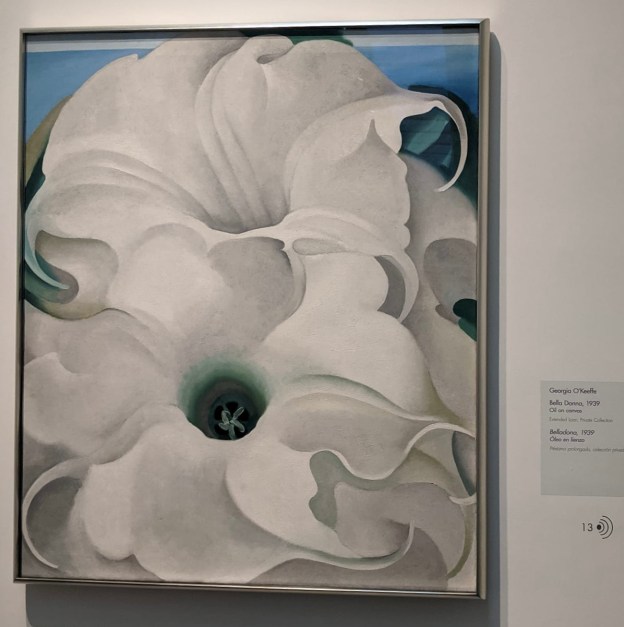
Photo of Georgia O’Keeffe painting taken by Christine Grossman at the Georgia O’Keeffe Museum in Santa Fe, New Mexico.

A version of this article originally appeared in the Jewish World News, a bi-weekly subscription-based newspaper in upstate New York.

Close Encounters of the Moose Kind

As 2021 comes to a close, I have much for which to be thankful. The armadillo that took up residency under our house decided that we charged too much rent and moved out on its own before we had to call in an exterminator. Despite inflation pushing up the cost 25%, I still had the means to buy a 23 pound turkey for Thanksgiving at the supermarket, not necessitating my shooting one of the wild ones that wander our yard. And I am grateful that our close encounters of the wild kind have ended well for both us and the animals.

As Upstate New Yorkers, Larry and I rarely encountered threatening animals. Yes, we watched out for rattlesnakes while hiking the eponymous trail in Lake George. And, yes, our cats’ frequent skirmishes with skunks showed us the stinky scent of nature. But the closest I had come for most of my life to seeing “animals gone wild” was when we woke up to the sight of a herd of cows that had somehow escaped from a nearby farm grazing on the lawn of my parents’ cottage on Lake Champlain. When we opened the door to take a closer look, our Irish setter ran out and started barking at them, triggering a mini-stampede. At that very moment, our neighbor opened up her drapes to see a bunch of berserk bovines charging towards her sliding glass door. Local lore is that her screams still can be heard echoing throughout Willsboro Bay.

My first encounter with more dangerous beasts came in a 2012 trip to Florida. While Larry and I were waiting for the guided tour tram to take us through the Shark River section of the Everglades, I spotted a huge alligator less than 10 feet away. Naive—make that stupid!—me insisted Larry take my picture while I was kneeling near its tail. When I proudly showed the picture to one of the guides a short time later, she warned me against a repeat performance. “Alligators may look slow, but they can move quickly,” she said. “You were lucky you weren’t bitten.” 

After that encounter combined with research and “alligators in the news” stories, I now have a much deeper appreciation of these ancient reptiles. We usually have at least one alligator in the pond in our backyard, either sunning itself on its bank or floating just below the surface. It is not unusual to see one crossing the road or even lounging in a doorway or an open garage. Just this morning, a neighbor posted on our Next “Please be careful. There is a large gator is crossing the road on its way to Glendora Lakes.” We have learned to live by side with them by maintaining a healthy distance when walking near water and encouraging our guests to do the same.

Ever since her move to Colorado in 2003, our daughter Julie has shared with us her frequent close encounters with Rocky Mountain wildlife. In her first month there, she had to detour to avoid a brown bear who was helping itself to an unlatched garbage bin. Stories of other unexpected meet-ups with more bears, as well as elk, moose, fox, and coyotes, have always been part of our conversations with our daughter, her husband Sam, and since she could talk, our granddaughter. 

Julie and her Sam are both experienced backpackers and outdoors people. When they are hiking, they can recognize the presence of animals by their hoof prints as well as their scat (poop).They also know what to do when they encounter an animal, whether it be on the trail or in their backyard. Like alligators, the best approach is to distance oneself from any wild animal to avoid a confrontation. And they are sharing that knowledge with their daughter. 

Despite all their experiences, Larry and I had only seen wildlife from a safe distance. That changed this summer. We hiked up a popular trail and made our usual left turn only to find a huge moose less than 25 feet away. We quickly and quietly turned around and headed down the same trail. 

I shared the news with several friends on social media, many whose first question was, “Did you get a picture?”

“No,” I responded. “We just got the hell out of there!”

After waiting 18 years for our “Close Encounter of the Wild Kind,” I was not expecting to see another moose until 2039. However, less than three months later, on an early November before-the-snow-falls trip, my granddog Neva and I took a hike up to Rainbow Lake, my favorite spot in the world. On the way down, with only a slight pull on Neva’s leash as a warning, I caught sight of the back end of a moose in the trees about 10 yards in front of us. Now the seasoned moose-avoider, I quickly got us “the hell out of there.”

 While winding our way down a longer but hopefully safer trail, Neva pulled hard on the leash, straining to run after something. “Oh no!” I thought. “not another moose!” No, it was just a squirrel, which our granddog obviously rated higher on the “wildlife-of-interest” scale than a unpredictable half ton mammal. So much for feeling safer when hiking with my granddog!

Moose sitings continued. Later that day, when Larry and I avoided stepping in the piles of moose scat that adorned awns and sidewalks in the neighborhood. We learned later that soon after trick or treaters had headed home with their junk food stash, the moose had moved in and devoured all the Halloween pumpkins. 

The next morning, we were woken up to the sounds of our granddaughter clambering down the steps to the guest bedroom and her yelling, “Moose alert! Moose alert! A mommy and her two calves are in our front yard!”

Larry and I are now back in Florida, but we need to remain on the lookout. Oh well. At least alligators don’t leave scat. 

A version of this article originally appeared in the Jewish World News, a bi-weekly subscription-based newspaper in upstate New York.

Wrestle with COVID leaves survivor a changed woman

“When you come out of the storm, you won’t be the same person who walked in. That’s what this storm’s all about.” Haruki Murakami

Ever since the first cases of COVID-19 were identified, America has been divided regarding wearing masks, gathering in large groups, or, most recently, getting one of the variants of the vaccine. Heated arguments have occurred in government institutions to sports venues to houses of worship to classrooms to local bridge groups. For Kathy Glascott, a COVID-19 survivor, such protocols are not a matter of personal choice but a matter of social responsibility.

A former elementary school teacher, from Buffalo New York, Kathy Glascott was the happiest she had been in many years.  She had retired to a 55-plus community near Orlando, Florida, and, as was her style, she showed up for life. She was involved in several activities including the British Isles Heritage  Club, the Western Upstate New York club, and SOL Writers. A widow, she met her significant other Mike through the community’s Singles group, and they were having fun, going to concerts and dances and traveling to places of which she had only dreamed.“It was like being a teenager again,” she said.

Then, in February 2020, the unsettling news of a virus later identified as COVID-19 began to emerge. Heeding the early advice of medical experts, Kathy sheltered in place and tried to avoid exposure. Short on groceries, she took a risk and went for a quick supermarket run. “I didn’t have a mask because you couldn’t get them” Kathy reflected months later. “Looking back, I wish if had the damn groceries delivered.”

Soon after, Kathy began to feel unwell..One evening, exhausted and exhibiting symptom of what she thought was bronchitis exacerbated by her asthma, she had Mike take her to the nearby hospital’s ER. She had no idea that it would be  5 1/2 months until she would see anyone except through a plate glass door.

Kathy was diagnosed with bilateral pneumonia and COVID-19 and almost immediately placed in an induced coma in the ICU. She has vague memories of anything from March 27 until she woke up from anesthesia on May 5. “During that time,” she wrote months later, “my body was assaulted by machines that were surrogates for bodily organs—a feeding tube, a respirator, and catheters.”

Meanwhile, her brother Brian Joyce, a Methodist pastor in New Jersey, kept her large family and many friends abreast of Kathy’s life and death struggle through posts on her popular FaceBook page. On three occasions, Brian gave the grim news that she had been intubated and was near death. Even when the medical staff removed her from her induced coma, she was not out of the woods. She remained hospitalized for another six weeks and later continued her recovery in a rehab center where she had to learn again to hold her head up, sit, stand, walk, and swallow.

Brian warned his FaceBook followers against what he called “COVID-19 fairytales.” “It would be nice if Kathy’s story demonstrated a victory over the virus,” he posted on August 1 as his sister entered her 19th week of fighting for her life.“In reality her recovery is a daily journey through pain, loneliness, separation, therapy, small victories, and moments of great success and rising hope.”

On September 6, 163 days after she had been admitted to the hospital, Kathy was finally released. For the first two months, she stayed with her neighbor and closest friend Susan Schulman.After Kathy moved back into her own home, she continued to rely on Susan,  Mike, and others to provide a much-needed network of support. 

Over a year later, Kathy is still trying to make sense of what happened and “to fix what’s broken.” She mourns the six months of her life she lost to the virus in which her only contacts were her ever-present, albeit, wonderful medical staff members. 

Although not confirmed by her doctors, Kathy considers herself as a “long hauler,” one of unfortunate 10% of COVID-19 survivors who experiences prolonged effects of the illness. In her case, she struggles with vision problems, a chronic cough, reoccurring bronchitis, neuropathy in her feet, frequent fatigue, and bouts of PTSD. “I’m better, but I’m not the me I was before Covid,” wrote Kathy on a post in her blog This and That:Musings on Being a Writer.“I have a new normal that makes me feel diminished, stressed, joyful, discouraged, and grateful all at the same time.”

Kathy also recognizes that COVID has affected not only herself but also those with whom she is involved. This is especially seen in the impact her illness had on her daughter, Brenda Glascott, a college administrator who lives with her wife in Portland, Oregon. “Ever since I woke her in the middle of the night on March 28 to say, ‘I love you’ before I was intubated for the first time,” said Kathy, “Brenda has had to make a number of hard decisions on my behalf. And she made each one with courage and love.” Kathy has said that the hope of seeing her daughter and others who sustained her and kept her fighting in her darkest hours.

As a survivor, Kathy feels a responsibility to protect herself and others.“I try to honor the concern and love shown me by not taking unnecessary chances and by practicing safe protocols.” Those measures include limiting her exposure to others and wearing a mask even though she is fully vaccinated.

She is an outspoken opponent of those who reject such measures on the pretext of personal freedom. “If you hate wearing a mask,” reads one of her FaceBook posts, “you’re really not going to like the ventilator.” In another post, she quotes George Takei, the American actor and activist. “Telling me you are proudly unvaccinated is like telling me you’re a drunk driver. You’re not a patriot. You’re not a freedom fighter. You’re a menace.”

A writer and author of three previous books, Kathy is working on a fourth that will recount in detail her own “harrowing dance” with COVID-19. “When I think about the many people who were affected by my struggle, I am humbled by their love and concern and grateful for the outpouring of prayer and support I received,” she said. “I hope to pay it forward by sharing my own experience and encouraging others to take the necessary steps to protect themselves and help curtail the spread and continuance of this terrible pandemic.” 

A version of this article originally appeared in the Jewish World News, a bi-weekly subscription-based newspaper in upstate New York.

Fradel’s Story: Fulfilling a Daughter’s Promise

I am posting this blog on September 1, 2021, what would have been my beloved mother’s (“Z”L) 104th birthday. It is with pride and love I announce the publication of my third book, Fradel’s Story.

What better way to start off Rosh Hashanah, the Jewish New Year, than to publish a new book? Fradel’s Story, my third book since 2016, is especially sweet as it was co-written with my mother, Frances Cohen.

Ever since I could remember, my mother was the family storyteller. Give her an opening, and Fran, or “Fradel” as she was known to her close family, would regale any audience with family stories any audience with stories of her grandparents’ and parents’ lives in Russia, her early years of marriage to “My Bill” Cohen, their life in small towns in the North Country. She told of raising four children, watching them leave for college and for marriage, and their returning with her grandchildren to visit her and my father in their beloved cottage on Lake Champlain. 

As my parents got older, my mother realized that she needed to record these stories. We never were one for video cameras and tapes, so she began jotting them down on lined paper, usually the five by eight notepads. The writing was messy, with words misspelled and whole sections crossed out, but she began to keep a written history. 

In 2006, after a number of health setbacks, my three siblings, our spouses, and I insisted that my parents sell their condo in Florida and move back up north That May, they moved into Coburg Village, an independent living facility only four miles from our home. 

Soon after moving in, my mother called me to tell me she was joining Coburg’s monthly writing group to finally finish all those stories she carried in her head and on those scraps of paper. When she brought her first story to the group, her accounting of why she and my father moved to Coburg, she was surprised to find that the group enjoyed her writing style. “They loved my story, Marilyn!” she told me. “They said I have a real flair for storytelling!” After that, my mother’s voice in phone calls after the monthly Wednesday meetings was filled with pride. 

Mom rarely had difficulty finding a topic and writing it down with pen on paper. However, the group leader requested that the stories be typed so they could eventually be published in the semi-annual collection and distributed to Coburg residents. My mother asked me to type them. While I was at it, could I, “My daughter the English major,” do some proofing and minor revisions so that they would read more smoothly? 

Thus began our five-year collaboration. Every month, about a week before the group met, my mother would give me her hand-written story. I would do some editing, including spelling, grammar, and even some tightening of the narrative. Her oral stories evolved into polished narratives,— funny, poignant, sad, and sometimes painful, but always entertaining.

When my father passed away in November 2008, my mother’s contribution for December was an open letter to my father. She wrote that she was moving into a smaller apartment down the hall. “Wherever I go, you also go in spirit,” she wrote. Grieving quietly, she continued with her life at Coburg, going to the concerts, visiting with friends and family who were always stopping by to see her, and continuing with her writing. All the children asked her to write about our births and early childhood, but she always postponed those stories, focusing on the Old Country, her childhood, her Bill. 

On December 22, 2010, my mother had a heart attack. The doctors recommended hospice care and living her remaining time to the fullest. She complied, enjoying visits and calls from the children, grandchildren, her extended family, and the many friends she and my father had made in Coburg and in their lifetimes. She kept writing. 

In February 2011, with my sister Laura and me sitting close by, my mother shared her story, “The Birth of My First Child,” with her writing group. She described her joy in having a beautiful little girl and her fears that she would not be able to be a good mother. The last words, written in pencil on the bottom, were “To be continued….” She died four weeks later, the day of the club’s March meeting. 

I had made a promise to myself that one day I would gather her stories in a book. When COVID-19 shuttered so many of my activities, I decided that it was time. Over the past eighteen months, I have worked on editing, filling in the gaps, and finally ordering the stories in chronological order to make the book flow smoother.

I too had family stories, articles I had written over the years capturing memories of our old Victorian in Upstate New York, our cottage on Lake Champlain, my father’s obsession with boats, bugs, and bats; my mother’s words of wisdom; my siblings’ accomplishments. I decided to include those in the book.

By this March, I was ready to send my first draft to my editor, Mia Crew. She was responsible for formatting the book for paperback and Kindle format as well as inserting the 80+ photos, many of them family pictures that dated back to 1914. Fradel’s Story has been launched on Amazon, in time for my target, September 1, what would have been my mother’s 104th birthday. 

My parents were not wealthy people. They had little of material value: a wedding ring, my Grandmother Ethel’s engagement ring, two beautiful, framed pictures of my father at thirteen and my mother at six, a few nice dishes. As my siblings and I sadly dismantled Mom’s apartment, my daughter was surprised that I wanted so little. “It’s okay, Julie,” I said. “I have her stories.” 

And now, I can share them with my large close knit family, with an incredible network of friends who personally knew my parents or knew their legacy, and hopefully hundreds of others who may find their own lives reflected in this collection.

Marilyn and Fran at Coburg Village, Rexford, New York, October 2006.

A version of this article originally appeared in the Jewish World News, a bi-weekly subscription-based newspaper in upstate New York.

Realizing What I Have Missed

Up until now, I thought that maybe I hadn’t missed that much in the past 16 months. My husband Larry and I had our health, had managed to keep a level of contentment throughout the pandemic. We missed our family terribly, but we had frequent Zoom calls with our children and grandchildren.

Even throughout our two weeks in California, I had felt pretty good. Larry and I had hugged our fifteen and a half month grandson, overwhelmed with emotion. I knew I had missed a huge chunk of his first year, but I took comfort again from the hours on Zoom and FaceTime. We were starting our in-person relationship late, but I didn’t dwell on what we had missed. He knew us. He came to us. We savored every minute with our visit with our son Adam, our daughter-in-law Sarah, and the beautiful little boy who had been named after two of his great grandfathers.

But then, after our flight to Denver and an easy drive  up to Summit County, we hugged our granddaughter. (She had been warned: We would be hugging her so hard that she would squeak!) But who was this taller, more beautiful, more poised person? Where was the little girl with whom we had last hugged goodbye in Florida in March 2020? The gap between her and this person who     poured her own tea, rode a two wheeler, swam underwater in her community pool was so great. Yes, we had missed time with her, with her new cousin, with all my children that we can never make up. 

And I hadn’t realized how much I had missed our time in the mountains. On our third day, I finally made the hike up to Rainbow Lake, a short distance from our daughter’s home and our summer rental. As I walked up the trail, I took in the columbines and the wild roses and the aspens. Then I reached the lake, my happy place, the spot in which I find peace and contentment. How could I forgotten how much I love this spot over 9100 feet above sea level in the Rockies? Had it been almost two full years since I had sat on the log and drank in the beauty that surrounded me?

Larry and I had spent the Fourth of July in Frisco for at least ten years. We watched the parade down Main Street with Sam and Julie, then, six years ago, Sam and a very pregnant Julie. The next few years, our granddaughter watched from her carriage, then her father’s arms, and then as a participant on a tricycle in the Cavalcade of Children. 

This year, however, we headed out of town and, by 11:30 a.m., five humans and one dog were floating down the Colorado River. Sam manned the raft while Julie completed the entire trip, including some level 1 and 2 rapids, on a paddle board. Larry, our granddaughter and I found spots on the raft and took in the beauty surrounding us. We spotted a bald eagle perched in a tree, Canadian geese gliding along the shore, red cliffs rising above us, the Rocky Mountaineer weaving its way on the train tracks above us, fellow travelers on rafts and kayaks and paddle boards and inner tubes catch the currents with us. It was a beautiful Fourth, made even more special in contrast to last year’s isolation in our Florida home. 

The day ended with our granddaughter reading Go Dog Go, one of our favorite children’s book, to Larry while sitting on his lap on a rocking chair in her bedroom. Behind them, the window gave us a view the sun set in the aspen tree. 

As we finish our time in the mountains, Larry and I  have also been able to connect with the friends and extended “mishpacha” (family) that we had not seen since August2019. We took in outdoor lunches and evening concerts with dear friends from North Carolina. We celebrated our granddaughter’s birthday with Sam’s family by riding the Georgetown Railroad, eating lunch along side Clear Creek, and singing “Happy Birthday” over cupcakes and a candle-that-refused-to-stay-lit in a breezy park. After two full years, we are again finding our Colorado rhythm. 

Mann Tracht, Un Gott Lacht is an old Yiddish expression meaning man plans and God laughs. Recent events have shown us how unpredictable life can be, whether exemplified in a terrible pandemic that has lasted for months or a catastrophic building collapse that happened in seconds. On a personal level, these past eight weeks of my reconnecting with family and friends has made me  realize how much I  have missed, how much time I have lost, and how important it is to never take what I cherish for granted. 

A version of this article originally appeared in the Jewish World News, a bi-weekly subscription-based newspaper in upstate New York, in July 2021.

Into the Woods—a place for contemplation and renewal

The mountains are calling, and I must go. John Muir

Across the street and behind the houses on the other side of my Upstate New York home was a wooded area. I remember it as a mountain . I am sure it would not look so imposing  if I viewed it now from my adult eyes 

On many a summer day I would take a path to the right of the Douglass’s home and head into the oaks and maples. I would sit on logs and imagine myself as Heidi or Lcittle Red Riding Hood.

This was a lone adventure. Although we were perfectly situated between the shores of Lake Champlain and Adirondack Mountains, our family never headed for the woods. 

When my parents purchased a cottage on Willsboro Bay, I replaced the trips to the woods with walks to The Point, an area about a quarter of a mile from our cottage that offered views of Lake Champlain and Burlington, Vermont. It was my get-away, my place to sit and think and deal with teenage angst.Even as a adult, I viewed The Point as one of my favorite places. I shared it with friends and, of course, Larry the first time he visited me in the summer of 1973. 

And then I finished college and married and started a family. Larry and I purchased a home with a private, wooded backyard. We biked along quiet country roads in Saratoga County. We took occasional short hikes into  the woods in Lake George or Vermont or Williamstown in the fall. But I felt that I had lost touch with the woods, with the mountains.

That all changed in 2003. Our daughter Julie moved out to Colorado after graduation  from college She took a “one-year” job as an environmental education teacher two hours west of Denver and in the middle of the Rockies. 

Julie soon fell in love with Colorado, the mountains, and Sam, not necessarily in that order. On our first visit in June 2004, she took us on easy hikes in Eagle and Summit Counties. By the following summer, Sam and she were trusting us to accompany them on longer, more challenging heights.

As our hikes became longer, so did the length and frequency of our visits to the mountains. Julie and Sam completed grad school degrees, got married, found jobs, and bought a house in Frisco, elevation 9096 or 9097 feet above sea level, depending on which tee shirt you purchased. In anticipation of the birth of our granddaughter in the summer 2015, we rented a place for several weeks, a tradition we have continued every year.

Frisco, located in Summit County, is amazing in the summer—once it stops snowing! This year a long hard winter gratefully came to an end June 21.Even my then three-year-old granddaughter had had enough. “I’m so over winter,” she said. “I am ready for summer and my birthday!”

When we arrived June 30, the still-snow topped mountains had already exploded in shades of green Our first hike was to Rainbow Lake, only a mile up an easy trail near Julie’s home. As we got more acclimated to the altitude, we hiked such colorfully named trails as Lily Pad Lake, Shrine Pass, McCulloughs’ Gulch, and Cataract Lake.  Creeks churned through meadows and fields. Columbines and wild roses and cone flowers peaked out between fallen logs and rocks on trails that led to waterfalls and lakes and vistas that took my breath away.

We often share the trails with both locals and others who have found, like us, that it doesn’t get much better than a beautiful summer’s day in the Rockies. We pack water and a snack and find a spot in the middle of the hike just to sit and take in our surroundings. 

Larry has found a pickleball league in Summit County (“We Play with an Altitude!”), and several days a week he heads out the courts. On those days, I get ready for my alone time to Rainbow Lake. 

I apply the only “make-up” I need, liberal amounts of sun screen. I put on my hiking clothes and lace up my boots, fill a small backpack with water, bug spray, dog treats and poop bags. I then pick up our granddog Neva, and we head up a trail to Rainbow Lake. Neva pauses frequently to sniff at her “pee mail” and to check out a squirrel or magpie. I savor the beauty surrounding me—the columbine growing from a dead trunk, the sunlight reflecting through the aspens, logs stretching over a small stream.

Once we get to Rainbow Lake, I let Neva off her leash and toss a stick into the lake. After a few dog paddles into the chilly water, Neva settles down next to me on my favorite rock. A beaver paddles away from its lodge and few ducks swim across the still water with its reflection of trees and mountains. A woodpecker hammers away on the bark of a pine tree. 

Images of Heidi have been replaced with images of Cheryl Strayed on the Pacific Ridge Trail or Bill Bryson on the Appalachian Trail. It is my time. I am grateful to G-d for the opportunities open to me in the mountains and for the health to enjoy it. I am at peace. I am back to my Adirondack roots.

Marilyn and Neva at Rainbow Lake July 2019

A version of this article originally appeared in the Jewish World News, a bi-weekly subscription-based newspaper in upstate New York, in the July 25, 2019, issue.

In Quest of the Elusive License Plates….

fullsizeoutput_36e9
Larry skipping to our car after finding a license plate from Chihuahua, Mexico

“Delaware!” my husband Larry yelled as we drove past a line of parked cars on Galena Street in Frisco, Colorado. “We got Delaware!”

In our life, “Getting Delaware” is a big deal. Within the first ten days of our five week search for license plates, we had gotten the license plate of the elusive Eastern seaboard state. Could Rhode Island be far behind?

Road Trip Entertainment

Today, while heading for their annual family vacation, children sit in the back seats of a SUV watching Toy Story or Frozen from a strategically placed rear-seat DVD system. When our children Adam and Julie were young,  high tech electronic baby sitters were not available.  We resorted to supplying them with books and food and some random toys to keep them busy.  

We also had aces up our sleeve. On long trips, I read them books—Superfudge and Tales of a Four Grade Nothing were the most popular. At night, we played P’Diddle. The first person to see a car with a missing headlights would yell the eponymous game’s name. The winner could punch his or her sibling in the shoulder. (Of course, Adam and Julie liked punching each other.) And if all else failed, we would pull out our old radio show cassette tapes and listen to Burns and Allen, Abbott and Costello, and the Lone Ranger. Not a Disney or Pixar movie to be found. Amazingly, we managed to get through our trips!

A New Game

For many years, our annual family vacation was spent at parents’ cottage on the New York side of Lake Champlain. The four of us would often take a day trip on the ferry from Port Kent to Burlington, Vermont. During those crossings, Larry encouraged us to check out the license plates. It became a game for us to see how many states we could find squeezed between bumpers. We could pick up ten or twelve states, mostly from the northeastern part of the country. “Dad would become pretty obsessed about our finding those license plates,” Julie recalled. 

Our game continued when our vacations expanded to Cape Cod. We would find an occasional Georgia or even California, but most people who headed to the Cape were from the New England and Mid-Atlantic states. A family vacation to Acadia National Park gave us a chance to expand our repertoire. I think that Larry was as excited to find that license plate from Alaska as he was to see Cadillac Mountain and Thunder Hole.

We Pursue the Plates

The children went along with their father’s fascination, but it wasn’t until Adam and Julie were out of the house and we began traveling out west to several national parks that his interest in tracking down all fifty-two plates intensified. and I became his mostly willing Pursuing the Plates Partner.

Fifty-two? That is part of “The Official Rules of the Game.” We are obligated  to find all fifty states, including both the yellow and turquoise New Mexico plates, and Washington, DC. We also track Canada’s ten provinces and three territories—including its newest Nunavut— as a bonus. (Bet many of you didn’t know all that information about Canada! See how much you can learn  plate pursuing!) Larry, the statistician, is in charge of keeping track of all our finds in his head and categorizing them by regions. I, the writer, am responsible for writing down each state as it is found and keeping the tally sheet with me at all times. 

Sightings Vary

No matter how complicated the rules, we are always able to pick off the big states—California, Texas, and Florida— quickly.  Non-contiguous Alaska and Hawaii are more difficult because of the distance—but we have found them almost every year.  Washington DC may be small in area, but anyone who has experienced the District of Columbia during the summer can understand why its 700,000 residents head out every July and August for cooler climes.  

The small states are the most problematic. As noted above, a license plate from Delaware is a coveted prize, as is West Virginia and New Hampshire. And Rhode Island? Legend says that Rhode Islanders consider any drive that takes more than twenty minutes a road trip. The probability of a “Little  Rhody” driving all the way to Colorado or Utah is slim. They usually are the last plates we find—if they are found at all.  

Many of the plates have been spotted while we are on the road, usually with Larry—the designated driver— behind the wheel.  Example: “Wait! Is that Maine in front of us?” Larry shouts.  He then speeds up the car and gets closer to targeted car to confirm. “Yes!  We got Maine!” We are lucky we haven’t yet “got”  a ticket for speeding or tailgating in the process.

And speaking of dangerous situations: Larry views every parking lot as a plethora of potential picks. He often takes circuitous routes through rows and rows of cars in search of an elusive New Jersey or West Virginia. I live in fear that my “Plate Patroller” will be so preoccupied in his hunt that he will get hit by a car backing out of a space. And sometimes, I am not afraid—just angry. As he usually has the keys to the rental car, I often find myself standing next to the locked passenger door, waiting in the rain or blazing heat or wind until Larry finishes his final scan and returns.  

Bounty Hunter in Action

At times, Larry has resorted to tracking down the actual drivers. While carrying groceries into our Colorado rental, Larry spotted a family sporting University of West Virginia sweatshirts walking into the condo next to us.  Larry tore after them to ask if they were from the Mountain State.

When they answered yes, Larry immediately followed up with the second, and more critical, question: “Did you drive your own car?”

”Sorry! It’s a rental!” 

Darn!

Hidden Treasures

A few times, our search has yielded hidden treasures. We were walking into a Kansas City Royals vs. San Francisco Giants spring training game in Surprise Stadium in Arizona when Larry saw a license plate from Canada’s Northwest Territories. Not only was it the first time we had ever spotted a plate from that far-flung Canadian region, but also it was shaped like a polar bear!

We had another exciting find at Bahai Honda Key in Southern Florida, when we spotted a license plate from Germany. The owners—a young couple from Munich—had shipped their old Volkswagen van over to United States. After time in the Keys, they were continuing their journey through Mexico and Central and South America.

Now that we have Delaware, we only have eight more plates to go: non-contiguous. Alaska and Hawaii; New England’s New Hampshire, Rhode Island, and Vermont; Washington, DC; and West Virginia. Luckily for us, we have three more weeks in Colorado to find them. Wish us luck!

Update: An hour before I was to send this out, Larry found New Hampshire AND Chihuahua, Mexico! Wow! Only seven more to go!

Onto Our Next Adventure


Now that Larry and I have become summer “residents” of Colorado. I have challenged myself physically more than any other time in my life. It is my Rocky Mountain boot camp. I return home thinner, stronger, healthier—and already thinking of our next adventures in the Colorado Rockies.

Our daughter Julie came out to Eagle County, Colorado, in 2003 for a one year teaching position at an environment school. Fresh out of college, she fell in love with Colorado, the Rockies, and Sam —not necessarily in that order. Fourteen years later, she, Sam, their daughter Sylvie and their dog Neva live in Frisco, Colorado, seventy miles from Denver on the western slope of the Continental Divide.

Until 2015, we would come out to visit them every year for a couple of weeks. Since our granddaughter arrived, we rent a condo close to their home for a couple of months to escape the Florida heat and to enjoy being Zayde and Gammy.

As Frisco is located 9100 feet above sea level, Larry and I take a couple of days to acclimate to the altitude. Once we have our mountain lungs, we take advantage of all the area has to offer.

Larry plays in a  pickle ball league three or four times a week—their motto is “We play with an Altitude.” On those days, I leave our condo, pick up my “granddog,” and Neva and I take the trail up to Rainbow Lake. It’s an easy one mile hike to the lake, only made a little tricky by its popularity. Neva and I have had to share the shoreline with up to twenty people and almost as many dogs. On quieter days, we have the lake to ourselves. We play Neva’s version of fetch: I toss a stick into the freezing water; she fetches it; I chase her down to retrieve it. Then we head around the lake, making our way back along a rushing creek home.

When Sam and Julie took us on hikes the first years we visited, I was intimidated by their longer excursions. Would we get lost? Could I handle the steep climbs? Would I fall off a narrow precipice, my body found by the rescue team a week later? Would we run into a moose or bear? After many years of hiking, my moments of terror are limited only to a few dicey paths that are a little too narrow or steep for my taste. “I’m scared,” I utter under my breath.

One of our favorite hikes, Lilypad Lake, takes us along a moderately steep path to a sturdy wooden bridge that spans a rushing creek. Climbing up the stream, we come to a section that overlooks Frisco and Lake Dillon. Another thirty minute climb through forest paths and wildflowers brings us to a lake on the left and a pond filled with lily pads on the right. As chipmunks beg for crumbs, we enjoy water and a trail bar before heading back down.

The longest, most difficult hike we took this summer was to McCullough Gulch, south of Breckinridge. The entire trip is in the shadow of Quandary Peak, one of Colorado’s fifty-three mountain peaks that have an elevation of at least 14,000 feet. A few miles drive up a dirt road took us to a parking lot and a half-mile hike to the trail head. The path up the trail got steeper, muddier, and—in my wimpy opinion—less passable. At one point, a short section of small boulders required some scrambling. Above us, two mountain goats grazed. About one and a half miles up, we made our way to White Falls, a waterfall that cascaded from the lake above us. The sky, up to that point blue with fluffy clouds, got darker. From the waterfall, we made our way up to the glacial lake above us.

While not difficult to follow, the path got steeper and required more scrambling around slippery rocks. At one point, we got slightly off trail and needed to climb over some boulders. “I’m scared!” I whispered loudly. Although we were never in any imminent danger of falling, I was saying prayers for our safety. I tried not to think of what our children would say if the broken body of their sixty-something mother was found at the bottom of my imagined crevice. Just as we got to the top of the boulders, a young boy bounded past me to meet the rest of his family on the trail. Pretty embarrassing for me to be so afraid when child regarded it as standard playground fare.

After climbing a final steep grade, Larry and I reached the beautiful glacial lake at the top of McCullough Gulch. Beyond the lake was the magnificent site of Pacific Peak, a 13,900 footer. We had made it! We ate our snacks, drank some water, and enjoyed the spectacular view. Although the wind was strong, the sun was shining and the clouds were fluffy when all of that suddenly changed.

Hail! The skies opened up, and we were being pummeled with pea-sized pellets. We put on  our raincoats and slipped our way down the mountain, this time avoiding the “rock climb.” By the time we got to the waterfall, the hail had turned to spitting rain. A mile further down, the sun came out. Four and a half hours after we had started, we had completed the hike, tired but so glad we had done it.

Larry and I completed a number of hikes during our eight weeks in Frisco, each one providing breathtaking views of mountains, lakes, waterfalls, and wildflowers. We experienced heat and rain and thunder and lightening and occasional bug swarms, but only once did we have to cut our hike short.

Our last weekend in Colorado, Sam, Larry, Sylvie, Neva and I hiked Black Powder Trail on Boreas Pass. Our two-year-old granddaughter soon tired of riding in her carrier on Sam’s back and decided to tackle the hike on foot. This worked until Sylvie and Neva found a pile of dirt created by burrowing animals that they regarded as more fun than further climbing. After a half hour of digging and snacks, all twenty-two pounds of her led us the way down the trail.

When I share my pictures on Facebook with friends and family, many comment on how strong and brave and fit we had proven ourselves to be. When I share descriptions of our hikes with native Coloradans, however, they are less impressed. “Oh yes! We did that hike in the winter with our snow shoes,” they comment. Or “If you enjoyed McCullough Gulch, you should try the thirteen mile hike up Meadow Lake Trail.” I can see clearly why GetYourFitTogether.com has named Colorado the most fit state in the country. And I know already that my  granddaughter and I will fit right in.