This story was written by my mother, Frances Cohen. A master storyteller, Mom joined a writing group when she was 87 years old. This is one of her many tales about her life captured in Fradel’s Story, available on Amazon in both Kindle and paperback format. Click here for the link. I have posted this on August 20, 2024, which would have been my parents’ 74th anniversary.
They say that all marriages are made in heaven. My parents also had help from my Grandma Vichna.
My mother Ethel was the oldest daughter of nine children, who all eventually immigrated to the United States from a small hamlet called Rogala, which was part of Lithuania.
Joining the wave of Jewish immigrants who came to the United States at that time, Ethel, only fourteen years old, arrived at Ellis Island in 1899. It was the era of horse and buggy. Garfield was president of the United States. It was quite an ordeal for a child to leave her parents, cross an ocean by steerage and then find a way to support herself. But with the help of her older brother Sam, who had come to America a few years earlier, Ethel settled in New York City, got a job, and lived with different relatives.
Two years after Ethel arrived in America, Ethel’s older brother Sam married and moved to Baltimore. My mother was really struggling, as she worked in a factory making umbrellas for only three dollars a week. So her brother and his wife invited her to come and live with them in Baltimore. While Ethel was living in Baltimore, four more of her siblings arrived in the United States.
In 1910, Ethel’s father passed away and the six children who had settled in the United States saved up $75 to pay for steerage for Grandma Vichna and the three youngest children. The four of them settled in the Lower East Side of Manhattan.
It was a very difficult time for Grandma. She was in a new country, not knowing the language or the customs. But Grandma was an amazing woman and kept her family afloat. And with all her problems, she was most worried that her Ethel was 27 years old and not married.
Every Sunday, all the friends from the Old Country would love to congregate at Grandma’s as she was an excellent cook. One day, a young man by the name of Joseph Cohen came to visit. He told Grandma that he had a job in a factory as a tailor making $13 a week, a good wage at that time, but was lonely and sleeping at his sister’s on a cot. Grandma said, “What you need is a wife, and I have just the girl for you….my Ethel!”
The problem was that Ethel was living in Baltimore, but that situation was soon solved when Joseph courted Ethel by writing letter and traveling the long way to visit. Ethel eventually returned to New York City to live with Grandma and be closer to Joseph.
And so the romance continued to blossom. Every Sunday, Joseph came to visit to see Ethel and to feast on Grandma’s cabbage soup and other goodies. Joseph bought Ethel a warm winter coat and other presents. (Later I would tease my mother that she was a kept woman!). After courting Ethel for several months, Joseph took Ethel to the jeweler and they picked out a diamond engagement ring. Wanting to make sure the price offered was fair, Joseph left Ethel for security so he could have the ring appraised, returned soon, and purchased the ring for $100.
Soon, Grandma Vichna was busy arranging a big wedding for her Ethel. In 1912, one could rent out a banquet hall for a big event. The host didn’t pay for the hall, but everyone who attended had to pay a 25-cent “hat check.” All the friends from the Old Country helped cook up a storm, and my parents were married in January 1912.
The week after my parents were married, my mother made a cabbage soup. My father said, “Ethel, please dot no make cabbage soup. I am tired of cabbage soup. I don’t even like cabbage soup!” My mother replied, “You always thanked my mother for her delicious soup.” My father replied, “It was the proper thing to do. I didn’t like the soup! It was my way of saying thank you for giving me a lovely bride!”
Ten months after the wedding, my brother Eli was born. I followed in 1917. My parents shared over fifty-four wonderful years together until my mother passed away in 1966 at the age of 82. Bereft, my father left New York City came North to live with my family until he joined his beloved Ethel in 1968.
A version of this article originally appeared in theJewish World News, a bi-weekly subscription-based newspaper in upstate New York.
Grandpa Joseph Cohen Circa 1912Ethel Ossovitz Cohen Circa 1912Grandma Ethel and Grandpa Joe ~1950. I love the love seen in my grandfather’s eyes.
In ancient times, Jewish brides may have brought into marriage a nedunyah, or dowry, “those assets of the wife which she of her own free will entrusts to her husband’s responsibility.” This could take the form of money, slaves, or cattle. As Larry and I look forward to our fiftieth anniversary this fall, I reflect back on the “dowry” I brought into our marriage: a collection of Warner Brothers Looney Tunes glasses.
Larry and I announced our engagement to our families on October 6, 1973. Fresh out of graduate school, Larry was working at his parents’ store, Shapiro’s of Schuylerville, making an astounding $78 a week. Meanwhile, I was in my second year of teaching high school English in a suburb of Albany, with a starting salary of $5200
We obviously were not coming into this marriage as “well off.” But we had a plan for starting our new household. Who needed a wedding registry, where we could list china and silverware that we could never use? I just needed to stock up on free glassware from the nearby hamburger joint.
My apartment in Rensselaer, New York, was a short distance up Route 9 from a Carrols. The burger chain, which was founded in 1960 in Syracuse, New York, by Herbert N. Slotnik, was viewed as “incredibly popular as an alternative to
McDonalds,” with over 150 outlets, mostly in upstate New York and Pennsylvania.
During our engagement, Carrols was running a promotion sponsored by the Pepsi Corporation. For the price of a large soda product, each customer received a Looney Tunes glass with Warner Brothers’ characters painted on the outside. Daffy Duck! Bugs Bunny! Elmer Fudd! And, over the course of several months, fifteen more glasses were released. My quest was to get all eighteen options, which was a great deal of Diet Pepsi.
Each week, whatever day the newest one was up for sale, I would stop by, order a Diet Pepsi, slurp it up, and then bring the prize home. To be honest, I can’t even remember if I purchased the their signature Club Burger! Six glasses in, I wasn’t even bothering to drink the soda. I dumped it out, wash out the glass when I got home, and tucked it away in a cupboard.
After our September 1974 wedding, we moved into our tiny apartment in Guilderland. Thanks to a bridal shower and gifts, we had a kitchen stocked with a Corelle dinnerware set for eight, Oneida silverware, Farberware pots, and several pieces of the classical Corningware with the blue flowers. And, thanks to Carrols, we had over two dozen Looney Tunes glasses, many with duplicates.
We did receive a lovely set of glassware from Tiffany’s, with an S engraved on each one. They went onto the top shelf of our apartment’s galley kitchen. Why would we use those when The Roadrunner and Wile E. Coyote could fight it out at our tiny kitchen table? Beep! Beep!
Bugs and the Gang came with us to our first home and, two years later, to our second. By the time he was five, Adam was old enough to graduate from sippy cups to Sylvester. Julie progressed to Petunia Pig three years later. Of course, a few met their untimely death on our kitchen floor, but we managed to hold on to many of them. About fifteen years ago, I found some replacements at a secondhand store. Again, more were lost to breakage, but we still had five remaining when we made the move to Florida in 2015.
By then, the painted characters had faded, and the glasses were cloudy. The former owners of our Kissimmee home had left a set of glasses in the cupboard, and we opted to use those for every day use. Our Looney Tunes treasures only came out on special occasions, and we only lost one over eight years, until the college football playoff in January 2023.
We had met our friends Joel and JoAnn Knudson, from a tiny town in North Dakota, many years earlier at a Jamaican resort. That began a close friendship that we maintained through a few more trips to Jamaica, a visit they made to Albany just before Hurricane Sandy, and time together in Florida. We were thrilled when they purchased a home in our 55+ community.
Soon after their move, the Knudsons, lifelong fans of North Dakota State University’s football team, were looking forward to the January 5, 2023, championship match between their beloved Bisons and their arch rivals, South Dakota State University. As their television set hadn’t arrived yet, we invited them over to watch the game on our big screen.
At the end of the first quarter, the two teams were tied 7-7. By halftime, however, NDSU was behind 14-7. Time for refreshments! We replenished the chips and dip. I offered Joel a cold beer in one of our favorite Looney Tunes glasses, Bugs Bunny.
“Get that @#?$ jack rabbit out of here!” Joel yelled.
How was I supposed to know that the SDSU’s mascot was a jackrabbit??
I quickly transferred the Yuengling into a less threatening Elmer Fudd. According to Joel, however, the damage was done. The Bisons faced a blistering 45 to 21 defeat by the despised Jackrabbits. The Knudsons went home disappointed; both Bugs and Elmer went into my dishwasher to see another day.
Two days later, I was reading the newspaper on my kitchen counter.. As I turned the page, my hand brushed against my glass of iced tea. Seconds later, our beloved Bugs Bunny met his demise on my tile floor. Larry and I refer to it as “The Knudson Curse.”
Recently, with our Looney Tunes supply down to four glasses and the former owners “gift” set of glasses etched with cloudiness that no amount of Cascade or vinegar would remove, I pulled down the Tiffany glasses we got for our wedding. “What are we saving them for?” I asked Larry. After fifty years, the beautiful set are being used for everything from an orange juice to an Old Fashioned.
In retrospect, using that now collector’s set of Looney Tunes was not such a great idea. According to Tamara Rubin’s Lead Safe Mama webpage, tests run on athe paint on a sample Looney Tunes glass revealed that it contained 71,800 parts per million of lead, 800 times more than the 90 ppm considered unsafe for use! “Please do NOT let children in your life use them,” Rubin wrote in her 2/19/2019 article “I personally would not use something like this in my home for any purpose!” Yikes! For fifty years, I had been exposing my family and friends to high contents of lead, caladium, and arsenic. To quote Sylvester, “Thufferin’ Thuccotash!”
What happened to Carrols? By the mid 1970’s, Slotnick saw the writing on the wall as competition by sheer numbers from McDonalds and Burger King dwarfed his company. “He figured if you can’t beat ’em, join ‘em,” Alan Morrell wrote in a 10/25/2021 article for the Democrat & Chronicle. Slotnick cut a deal with Burger King in which all his restaurants would be converted into the home of the “Big Whopper.”
But the Looney Tunes “vintage” glassware continue to thrive on internet, where collectors can pay anywhere from $16.99 for Porky Pig on Amazon to $300 for a complete set of 18 on Ebay. I say, I say, maybe my Foghorn Leghorn still has some life in him yet!
On June 12, 1942, Anne Frank was given a diary for her thirteenth birthday. Less than a month, she and her family went into hiding from the Nazis. To honor Anne and the six million Jews killed in the Holocaust, I am sharing the story of Anne’s classmate Eva Schloss Geriringer, she herself a Holocaust survivor and after Eva’s mother’s marriage to Otto Frank, Anne Frank’s posthumous stepsister.
“You see, Heinz, I haven’t forgotten you. You were frightened that you wouldn’t make your mark on the world – but you are still with us. You have made your debut.” Eva Geiringer Schloss, After Auschwitz: A story of heartbreak and survival by the stepsister of Anne Frank.
On a train to Auschwitz, 15-year-old Eva made a promise to her brother Heinz Geiringer. If he did not survive the camps, Eva promised to retrieve the paintings and poetry Heinz hid under the floorboards of his attic hiding place.
Heinz Geiringer’s story sits in the shadow of the better-known Diary of a Young Girl. After the war, Eva became the posthumous stepsister of Anne Frank when her mother married Anne’s father. While the world knows Anne’s story, this film introduces Heinz, his artistry, and his sister’s efforts to find and share his remarkable legacy. Eva’s Promise, an important addition to the annals of Jewish Holocaust history, is currently being shown on PBS stations throughout the United States.
Heinz Geiringer and Eva Geiringer Schloss’s Holocaust story is chillingly parallel to that of their classmates, Margot and Anne Frank. Faced with Hitler’s rise, Erich, Elfriede (“Fritzi”), and their two children, had fled from their home and comfortable life in Vienna, Austria, and settled in the Netherlands, hoping its history of neutrality would provide a safe haven. Their worst fears came to pass when Germany invaded Holland.
“As of 15 May 1940 we were living under Nazi occupation, and we had nowhere else to go,” Eva recalled in her 2013 memoir After Auschwitz: A Story of Heartbreak and Survival by the Stepsister of Anne Frank. Soon after, the Nazis implemented the increasingly harsh measures against the Jews that was part of their “Final Solution.” In May, 1942, Heinz received orders to report for a deportation to a Germany factory. That evening, the family made the decision to go into hiding. As no place was large enough for four people, they were forced to split up. Erich and Heinz in one apartment; Fritzi and Eva in another. For Eva, her time was to be “a mixture of two emotions – utter terror and mind-numbing boredom.”
Meanwhile, Heinz, having to give up his musical interests, spent his time painting and writing poetry. “I could hardly believe the detailed and impressive oil paintings that he showed me,” said Eva, recalling the furtive visits she and Fritzi made to the men’s apartment. “In one a young man, like himself, was leaning his head on desk in despair. In another a sailing boat was crossing the ocean in front of a shuttered window. “
On May 11, 1944, Eva’s 15th birthday, the Geiringer family was captured after being betrayed by a double agent in the Dutch underground. A train took them on an arduous three day trip across Europe, in what would be the last time they would be together as a family
During their ride. Heinz made Eva promise that if he didn’t survive, she would retrieve the paintings he had stashed under the floorboards of the house where he and his father had hidden them. “Please, Eva, please,” Heinz told his sister. “Go and pick it up and show it to the world what I achieved in my short life.” Eva reluctantly agreed.
When the trains reached the concentration camps, Erich and Heinz were sent to Auschwitz; Fritzi and Eva, to Birkinau. Through sheer luck and resourcefulness , Eva and Fritzi survived and were freed in 1945 by Soviet troops.”I never gave up hope, or the determination that I would outlast the Nazis and go on to live the full life that I, and all victims of the Holocaust, deserved.” Eva said
Tragically, Eva’s father and brother did not survive the ordeal, succumbing to exhaustion and illness in the last days of their captivity. Fritzi and Eva eventually returned to Amsterdam, and settled in their family’s apartment, which had remained untouched.
After the war, Otto Frank, their old neighbor, the only surviving member of his family and his “Annex” companions, took comfort in visits with Fritzi and Eva. In 1953, Otto and Fritzi married and dedicated the rest of their life to the publication and promotion of what would be the world’s most famous diary. In the meantime, Fritzi and Eva had retrieved Heinz’ work, which included paintings, a sketchbook, and poems, from his and Erich’s last hiding place. For many years, Eva and her mother kept the paintings and poems in the family.
Eva eventually moved to London, where she married Zvi Schloss, a German refugee, raised their three daughters, ran a successful antique store, and quietly moved on with her life despite her recurring nightmares. It was not until Otto Frank passed away that Eva, now in her late fifties, began publicly sharing her wartime experiences in person and through her memoir Eva’s Story. (1988). “As soon as I started talking, I became calmer and didn’t have nightmares anymore,” she said in Eva’s Promise. During one of her talks in Philadelphia, she shared Heinz’s work for the first time.
A chance meeting with Susan Kerner led Eva to further expand her audience. In 1994, Susan, the education director at the George Street Playhouse in New Brunswick, New Jersey, directed a production of The Diary of Anne Frank. Kerner reached out to Ed Silverberg, a friend of Anne Frank’s who had survived the war by successfully hiding, to talk to the cast about life in Amsterdam after the invasion.
Around the same time, Young Audiences of NJ reached out to Kerner with a request to work with a playwright to create a play about Anne Frank to tour schools. The Anne Frank Center in NYC suggested they create a piece about two hidden children who survived the Holocaust who had a connection to Anne Frank.
“I already knew Ed,” recounted Kerner in a 2023 article in the Jewish Standard Times of Israel. “I wanted a woman, and I wanted her to be a camp survivor.” The Anne Frank Center put her in touch with Eva Schloss. George Street Playhouse commissioned playwright James Still to write the play. The final product, And Then They Came For Me: Remembering the World of Anne Frank, is a gripping multimedia experience, which combines videotaped interviews with the two survivors playing behind the actors who portrayed scenes from their lives. Twenty-five years later, the play continues to tour around the world.
A lifelong friendship developed between Eva and Kerner, who met periodically despite the distances between them. As the success of the play grew, Eva sold her antique shop and became a full-time Holocaust educator, traveling in Europe, Asia, and United States and participating in talkbacks following performances of the play in many countries.
More importantly, Eva came to grips with the unfulfilled promise she had made to her older brother. In 2006, over sixty years after the Holocaust, Eva gave Heinz’s works to the newly established to Het Verzetsmuseum, the Dutch Resistance Museum in Amsterdam. Soon after, she published her second memoir, The Promise. (2006), followed by her final memoir After Auschwitz.(2013). She now focused on preserving Heinz’ legacy. “It became my task that people would remember who he was and what he achieved,” Eva said.
As the pandemic shut down the world, Eva realized that she wanted to do even more to preserve Heinz’s legacy. She reached out to Kerner, who suggested a documentary film. Kerner recruited Steve McCarthy, her Montclair State University colleague and an Emmy Award-winning film maker, to direct and co-produce what would become Eva’s Promise. Eva had only two requests: “Get it done. And hurry.”
Despite the pandemic, the team, which now included McCarthy’s two sons, flew to London to tape 12 hours of interviews with Eva. They also interviewed the staff of the Amsterdam museum that houses Heinz’s work. The film was completed in 2022.
Kerner and McCarthy have worked tirelessly —and without pay—to produce the film. Screenings have taken place across the United States, including a red carpet showing at the Ronald Reagan Presidential Library and Museum in Simi Valley, California.Kerner hopes that the documentary can be used as an educational tool to counteract the recent dramatic rise of antisemitism as a result of the Gaza-Israeli War. She and McCarthy recently tested the film in a school with 11-13 year old children. “The kids were very engaged and had lots of thoughtful comments and questions,” said Kerner. She also hopes that it will be shown in museums, theaters, and universities.
Until recently,Eva continued her active involvement in Holocaust education and advocacy. She has spoken around the world, with a special place in her heart with her meetings with school children. She was part of the 2018 campaign to convince Mark Zuckerberg to ban Holocaust deniers from Facebook, and she is prominently featured in the Ken Burns 2022 documentary, The U.S. and the Holocaust. In January 2023, Eva attended the screening of the film at JW3, a Jewish community center in London. Now 94, she has stepped back to rest and celebrate the birth of her first great-grandchild. Her grandson Eric, who is featured in the film, now shares her work.
Before they were forced into hiding, Eva’s father Erich gave his children the following advice: “I promise you this. Everything you do leaves something behind; nothing gets lost. All the good you have accomplished will continue in the lives of the people you have touched. It will make a difference to someone, somewhere, sometime, and your achievements will be carried on.”
Through her books, her films, and her tireless work in Holocaust education and advocacy, Eva Schloss has not only kept her promise to her brother Heinz but also has made the memory of the six million and all who have been subjected to hatred a blessing and an inspiration.
Please contact Susan Kerner at kerners@montclair.edu for information on showing Eva’s Promise in your community.
SOURCES
Photos courtesy of Eva Schloss
Thanks to Susan Kerner for providing valuable input to this article.
Schloss, Eva. After Auschwitz: A story of heartbreak and survival by the stepsister of Anne Frank.England: Hodder & Stoughton, a division of Hachette books, 2014.
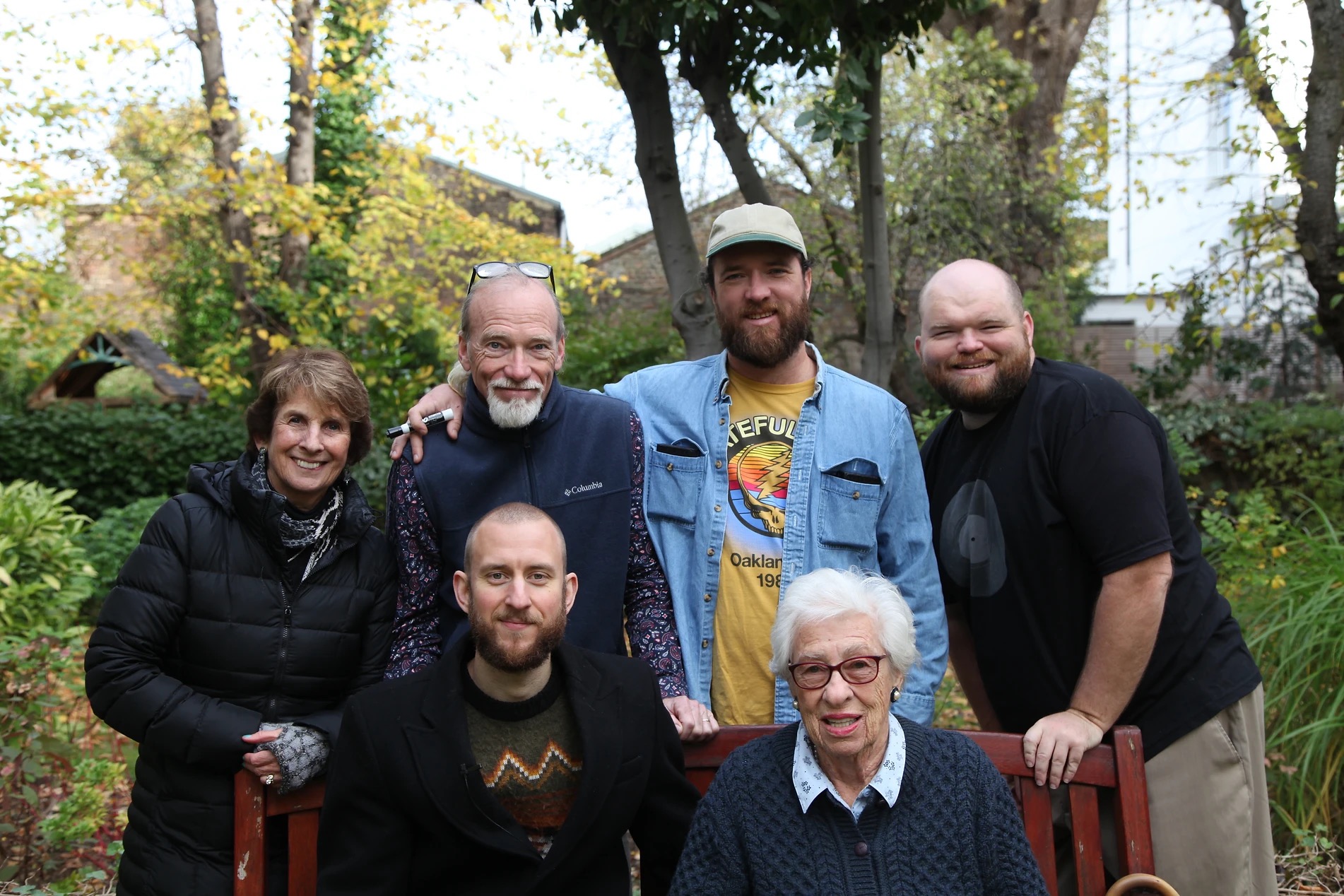
Filming Eva’s Promise in London. Seated: Eric Schloss, Eva Geiringer Schloss. Standing: Susan Kerner, Steve McCarthy, Justin McCarthy, and Ryan McCarthy.
As I continue to interview Holocaust survivors and their families, I have written the story below based on information supplied by the son of one of the innumerable Danes who, who with his father, helped rescue Jews in World War II. Marilyn
Much has been written about Righteous Gentiles, the men and women who risked their lives to help save the Jews in Europe during the Holocaust. One of the most successful rescues happened in Denmark, where Danish authority and innumerable private citizens worked with Jewish community leaders to rescue thousands of their fellow citizens from certain death.
Although the Nazis had occupied Denmark in 1939, initially there had been an uneasy peace. The Germans regarded the blond, blue-eyed Danes as “fellow Aryans.” With only 7500 Jews living in the Scandinavian country, the Nazis had not even required the Jews to wear yellow stars.
As the war progressed and Allied victory was in sight, however, the Danes’ initial limited resistance had progressed to massive labor strikes and sabotage. On August 29, 1943, the day after the Danish government had resigned rather than help the Germans arrest and try members of the Resistance, the country was under martial law.
A week later, the Danish government learned through German officials who feared the political ramifications of such an action that all of Denmark’s Jews, the 6000 citizens and 1500 refugees, were to face the same fate as millions of others in occupied Europe: On October 1, they were to be rounded up and sent to almost certain death in Nazi concentration camps. The Danes immediately began a massive operation to save their Jewish neighbors, hiding them in their homes until they could be spirited out of Denmark to Sweden in fishing boats.
For Dr. Eric Erslev,the Danish rescue of the Jews came close to home in a story orally passed down by his father Allan Jacob Erslev to him and Eric’s son Brett.
Although Aage Erslev was Christian, he had been married to Anita, a Jew who had passed away in June 1943. In late September, he had welcomed Anita’s relatives in his home, hiding them as they awaited word that the fishing boat was ready for departure.
Late one evening, he and his 18-year-old son Allan were awakened to the sound of Gestapo pounding on his front door. The oldest wearing a captain’s insignia, was flanked by two much younger men.
The Kapitän announced that they were there to arrest Anita Erslev. When Aage told him that she had passed away, the Nazi, having heard this excuse many times. demanded proof.
Aage began searching his desk for the death certificate. Meanwhile, the two younger soldiers were ordered to start searching the house. Aage’s attempt to find the paper became even more frantic when the two soldiers, having finished their search of the first floor, stomped up the stairs to the second floor. where the Jewish relatives were hiding under the bed and in the closet of one of the bedrooms. Frantically, Aage whipped through the papers as he heard the soldiers’ footsteps in bedroom over his head. He knew if the Gestapo found the fugitives, they would be killed and the father and son would be jailed. At that moment, Aage found the death certificate. The German, now satisfied, yelled to his two charges to come downstairs.
As the soldiers were leaving, Aage offered the soldiers apples from the bowl of fruit on the table. They grabbed the fruit and walked out.
As soon as the two men could no longer hear the boots on the street outside their home, they went upstairs. The relatives, who were seconds from being discovered, told their rescuers how they heard the sounds of the soldiers’ breathing and saw their boots from their hiding places, one under the bed and one in the closet. They all knew if the more experienced captain had been conducting the search, they would have been found. Thankfully, the refugees did make it to the boats and found safety in Sweden.
Allan was surprised that his father had given the Nazis the apples: These were the men who would have killed his mother and her relatives and were responsible for the death of untold others. As the son of a Jewish mother, he and others with “impure blood” were targeted by the Germans later during the occupation Allan went into hiding but survived the war. Maybe Agee, overcome with relief, that the Nazis had not found the hidden Jews, impulsively offered them the fruit. Maybe, despite the horrors of war, the Dane’s generous nature prompted him to share food with the enemy? The question remains lost to history.
In the conversation he had years later with Eric and Brett, Allan said he never forgot that moment and the terrible years of the German occupation of his homeland. Of the approximately 7500 Jews living in Denmark in September 1943, only 120 Danish Jews died during the Holocaust, either in the Theresienstadt concentration camp or during the flight from Denmark. According to the United States Holocaust Memorial Museum, this relatively small number represents one of the highest Jewish survival rates for any German-occupied European country.
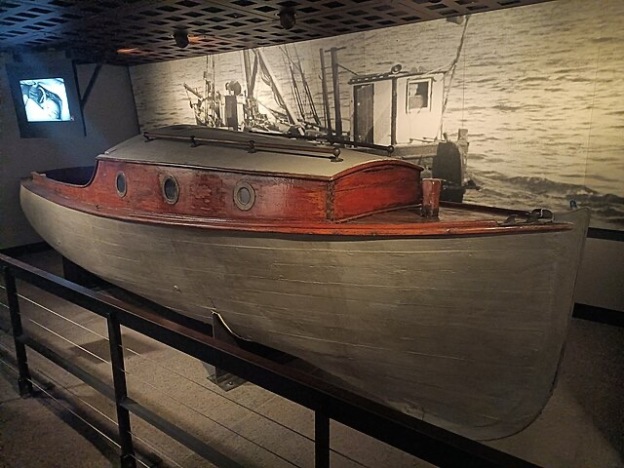
Photo: Danish rescue boat as displayed at Unitied States Holocaust Memorial and Museum, This particular example was used in the earliest operations for the evacuation of Danish jews organized by the Hilsingor Sew club know as the Kiaer Line. This boat carried 12 to 14 Jewish refugees on each trip to neutral Sweden. (USHMM; photo curtasy of Wikimedia Commons.)
SOURCES:
Thanks to Dr. Eric Erslev , professor emeritus, Warner College of Natural Resources, Colorado State University, for allowing me to share his family’s story.
A long-time fan of Jeopardy, I have even become more interested in recent months watching popular quiz show’s championship series that pits the best against the best.
Watching it with Larry, we enjoy playing along, supplying our own questions to the clues given in numerous categories. . As was true for the two of us in our Trivial Pursuit days, I do well in the arts and entertainment areas, especially literature. Larry does well in history, geography, and sports. We don’t do as well in the sciences.
I know that I will never be a Jeopardy champion. Nor do I even have hopes to come in second. My pressing that buzzer would be similar to my pressing a self-destruct button. It’s not only because I don’t have a head for all the trivia. I would also bomb out because of my misuse of words.
In response to the Jeopardy clue, “Company created by Steve Jobs that was sold to Disney in 1985,” I would offer “What was Pixie?” Another contestant would quickly supply the correct line. “What is Pixar.” I unfortunately would have no place to hide.
And Ken may completely lose it when my answer to “French singer famous for La Vin en Rosa” was “Who is Edith Pilaf?” Poor Ken would have to fight the urge to burst out laughing before getting the correct answer—“Who is Edith Piaf?”—from another contestant. “Yes,” Ken would comment, “We were looking for a name, not a rice dish that sings.”
I used to think my problem was mispronunciations. But it’s worse. I am guilty of using malapropisms. Malaprops, whose name come the eponymous character in Richard Brinsley Sheridan’s 1775 play The Rival, occur when one uses an incorrect word instead of another similar-sounding one, resulting in a nonsensical, often humorous sentence. An example of a malapropism is when someone says, “dance a flamingo” instead of “dance a flamenco.”
I come from a long line of “malapropists.” My father’s misuse of words bordered on Archie Bunker territory. And my poor mother was also guilty, The one that sticks with me was her using “orgasm” when she meant “organism.”
My own history of mispronunciations started young. In high school, my fiery rant about the radical “Storky” Carmichael. brought my fellow classmates to hysterics when I talked about that radical “I think you meant “Stokely,” suggested Mrs. Clute when the laughter died down. I was in college before I realized that Sigmund Freud and Sigmund “Froid”were one and the same Austrian psychologist.
My most embarrassing transgression came as an adult, when I walked into a garden shop in Upstate New York and asked for a well known pest spray.
“Can you tell me where I can find the Spermicide?” I asked the clerk.“Sorry, lady,” the clerk responded. “You won’t find any spermicide here, but I do have Spectricide.” I wonder if my request has become one of their favorite stories to retell again and again.
I join a long line of famous people whose malapropisms have become part of their history.Yogi Berra was so famous that his expressions ranked their own name, “Yogi-isims.” He once said, “He hits from both sides of the plate. He’s amphibious” instead of saying ambidextrous. In another instance, “Texas has a lot of electrical votes.” (electoral votes)
Yogi may have made such “errors” an art, but other legendary historical quotes were—well—hysterical.Australian Prime Minister Tony Abbott once stated that no one “is the suppository of all wisdom” instead of saying repository or depository. Chicago Mayor Richard J. Daley incorrectly referred to Alcoholics Anonymous as Alcoholics Unanimous and called tandem bicycles “tantrum” bicycles.
More recent American politicians have faced ridicule for their public gaffes. President George W. Bush famously stated “The law I sign today directs new funds… to the task of collecting vital intelligence… on weapons of mass production” (destruction). In 2022, Republican Senate candidate Herschel Walker was mocked online after claiming “this erection is about the people” (election), during an interview on Fox News. Congresswoman Marjorie Taylor Greene has also been excoriated for her misuse of words, including references to “peach tree dish”(petri dish) and “gazpacho police”(Gestapo), and “fragrantly violated. (flagrantly), among others.
President Joe Biden also has been mocked for his verbal missteps. On March 31, 2024, he asked all his guests at the annual Easter Egg Hunt say ‘hello’ to oyster bunnies.” He famously mixed up the names of world leaders with their (deceased) predecessor, referring to French President Emmanuel Macron as Francois Mitterrand and German Chancellor Angela Merkel as Helmut Kohl. But he knows it. ”I am a gaffe machine,” admitted Biden in a 2018 speech.
And then we have Donald J. Trump. In a a research paper published in 2020, Dr. Sajid Chaudhry examined 500 viral tweets posted on Twitter by the former president. Along with the hundreds of misspellings of common homonyms (waist/waste; boarder/border; taxis/taxes; eminent/imminent; Barrack/Barak), the paper cited numerous malapropisms, including references to a “Smocking Gun” and a claim that the media said that he wanted “a Moot stuffed with alligators and snake” at the Southern border. “The way he mangles words,” states Dr. Chaudhry at the end of his report, “ it looks like the ghost of Mrs. Malaprop haunts his vocabulary.”
So, it looks like I am not the only one who may experience major failures on Jeopardy. I take solace in my limited knowledge of Yiddish and Hebrew, which means I know not to call our Passover meal a “cedar,” our beautiful braided egg bread a “CHA-lah,”and our Day of Atonement “Yam KIP-per.”
My personal favorite malapropism was spoken by a non-Jewish friend when she asked how I met Larry.
“We met at a Purim party,” I said.
Dead silence. Long pause.
“I can’t believe you are so open about your meeting your husband at a PORN party,” my friend said incredulously.
This story was published on May 14, 2020, but didn’t make it to my blog. Four years later, here it is!
One of the advantages in living in our community in Florida is the abundance of wildlife that surrounds us. In one week, we have seen otters frolic near our pond, crows attack a red-tail hawk, and osprey dive into the pond to catch a fish.Often, we look out our window and see several deer munched grass near the pond.
In one of my more harrowing moments, I barely missed hitting a male deer who decided to dash across the road in front of my bike. I thankfully stopped in time and watched two adults and one fawn continue their stampede.None of this week’s wildlife scenes, however, can compare with our encounter with a not-so-wild animal that briefly came into our lives.
As Larry and I were finishing up one of our long walks around Solivita, we saw a friend of Larry’s from pickleball standing beside her bike and staring at the curb. As we got closer, a tiny ball of fur crossed the road, an animal so small that it took us a minute to realize that it was a kitten. We watched it dart behind some bushes in the front of a neighbor’s yard. After a few tries, I found it trembling under the shrubbery.
Larry and I knew that we couldn’t just leave the tiny animal on its own. He (we checked!) would die of starvation or become an alligator’s dinner. We also knew we couldn’t keep him. Although we had had cats while our children were home, we had come to the realization that all of us were allergic. We had to find him a home with another cat lover who didn’t rely on Zyrtec to survive..
I picked him up, wrapped him in the bandana that I had been using as an emergency face mask, and started walking the half mile home. It took me less than a minute to name him “Corny” for the coronavirus.
While I gently held Corny and tried to reassure him that he was safe, Larry called friends who we knew loved animals. Kerry the dog walker. Jane the dog sitter. Doug and Barb the cat lovers. Teri who volunteers at a “cat cafe” where one can have coffee and pastries while playing with adoptable cats. In between the calls, we asked everyone whom we passed if they would like to adopt a kitten. No luck—yet
When we got home, I placed a laundry basket with an old towel on the floor of the garage and sat next to him. I took a picture of Corny and posted it on the lost and found section of our community e-bulletin. My next call was to a local veterinarian, who was not encouraging. He said that the kitten was one of many who were dumped in Solivita by outsiders. He also warned me that he probably was carrying fleas, parasites, AIDS, and/or feline leukemia and told me to call the county animal control so the stray could be picked up and—probably—put down. The Polk County contact initially provided some optimism: the shelter would take him in and try to find him a home if and only if he was weaned as they did not provide bottle feeding.
After several more phone calls, we connected with Brenda and Marty, devoted cat lovers who spend part of each year working at Best Friends Animal Society in Kaleb, Utah. The organization is leading a national effort of “No Kill By 2025,” They directed us to a woman in our community who is involved in Helping Paws, a local network whose mission was to rescue cats and find them homes. She was willing to take Corny, and the organization would ensure the cat visited a veterinarian for a check-up, shots, and neutering.
I quickly called animal control to cancel, but I was too late as the truck pulled up to our house soon after I hung up. We explained the situation, and the person who was to take Corny away was happy we had found a home for him.
As Larry drove, I held Corny and told him that he was going to a safe place. Diane, the cat angel, took a quick look at our kitten. She estimated that Corny was less than six weeks old, had a few fleas and an eye issue but was in good shape. She already was fostering a female cat with four kittens and was hoping Corny would be adopted by the mother cat. We gave Diane a contribution to cover the cost of the vet and said goodby. The softie that I am, I shed a few tears as we drove home. From the time we first spotted the kitten until we returned home, only 90 minutes had passed.
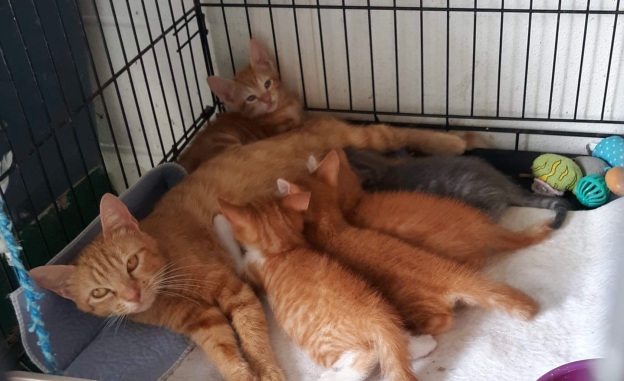
The next morning, Diane left a message on our voice mail: The mother had accepted Corny. Diane texted us a picture of all six cats. The mother was nursing three of her kittens and Corny. A fourth kitten looked on with an expression that said, “Hey! Who is this grey fur ball that took my place?”
On a check-in a week later, Corny, who Diane had renamed Snickers, was doing fine. “I overestimated his age,” said Diane. “Based on his weight, he was less than four weeks old.” While the other kittens were weaning themselves, Snickers had the mother cat all to himself.
Meanwhile, Diane shared with me her story as to how she became involved in Helping Paws. Like us, Diane and her family had a number of cats when they lived in their home outside of Boston and later outside of Orlando. When the last one passed away, Diane decided “No more pets!”
Soon after that, Diane was diagnosed with cancer. After she recovered, she decided that she needed to do something to give back to the community. One night, she dreamed that a black and white cat showed up at her doorstep. The next morning, she found a calendar with a similar looking cat in her mailbox. And that day, a black and white cat showed up on her doorstep. Fifteen years later, Max was the “old man” in her home with two other cats as well as a string of over two hundred cats she has fostered over the years. I thought to myself, Corny now has a bright future, and we had our happy ending.
As we celebrated Shavuot the following week, I could not help but think of the sixth commandment: Thou shall not murder. I learned that Polk County has a 50% kill rate for the animals brought to their shelter. That ranked them first in the state and tenth in the entire country. Corny wouldn’t have had a chance! In such worrisome, sad times as we encountered during the pandemic, it felt so good to be able to rescue this little fur ball.
Unfortunately as predicted by the veterinarian, Corny did not survive. Diane emailed us a couple of weeks later to say Corny had died of an infection brought about by parasites that had overwhelmed his tiny body.
Still, looking back on our brief encounter, I never regretted our short time helping that stray kitty. We tried to help. As a result, Corny knew love and companionship before he passed over to the “rainbow bridge.” And that gives us some peace.
On May 5, 2024, our community’s Shalom Club held its annual Holocaust Remembrance, or Yom Ha’Shoah, event. Lou Ziemba’s story was one of the highlights of a moving, unforgettable evening.
Born in wartime Poland, Ludwig“Lou” Ziemba is a retired successful businessman, a polyglot a descendent of “Jewish royalty’” and a Holocaust survivor.
Lou’s story begins in Poland. Rabbi Menachem Ziemba, was the chief rabbi of Warsaw, a renowned holy figure in the Ger sect of the Chassidic movement, and a key player in the 1943 Warsaw Ghetto Uprising through his pleas that urged inhabitants to fight against their captors.
“In the present we are faced by an arch foe, whose unparalleled ruthlessness and total annihilation purposes know no bounds,” Rabbi Ziemba told the Warsaw Ghetto inhabitants. “Halachah [Jewish law] demands that we fight and resist to the very end with unequaled determination and valor for the sake of Sanctification of the Divine Name.”
One of Rabbi Ziemba’s nephews was Henoch, son of his brother Moshe. Henoch was a bit of a non-conformist intellectual who spoke several languages and wandered around Europe. Henoch married a woman who was not approved of by his Chassidic family and thus he was no longer recognized by his large family in Warsaw.
As the Nazis rose to power, Henoch experienced both his wife and children being executed by the Nazis. Grief-stricken, Henoch returned to Poland and settled in the industrial city of Lodz, the second largest Jewish community in prewar Poland, after Warsaw.
With the outbreak of World War II and the German invasion of Poland, the life of Polish Jews deteriorated through a series of draconian laws imposed by the Nazis. In February 1940, after even more severe anti-Jewish measures were instituted, the Germans established a Jewish ghetto, initially trapping 164,000 Jews into a few city streets in a neglected northeastern section of Lodz. The widower Henoch Ziemba was one of those people.
Soon after his arrival in the Lodz Ghetto, Henoch met and married 20-year-old Golda Farber, almost two decades his junior. Golda may have been small in stature, but she was, in Lou’s words “a firecracker” and “a force of nature.” Almost immediately, Golda became pregnant. For reasons lost in the family lore, Golda turned for help to Mordechai Chaim Rumkowski, who Primo Levi later wrote “morally ambiguous and self-deluded.”
To organize the local population and maintain order, the German authorities established a Judenrat,” or Jewish Council in the ghetto. The Germans appointed Rumkowski as the “kapo” of the Lodz Ghetto, whose job it was to oversee the day-to-day living as well as to decide who would live and who would die. Rumkowski was responsible for sending untold numbers to their deaths.
Known mockingly as “King Chaim”, Rumkowski was granted unprecedented powers. Rumkowski transformed the ghetto into an industrial hub for the Nazis, producing uniforms, wood and metalwork, and electric equipment. Rumkowski felt that, as long as the ghetto served a purpose by supporting the Nazi effort, the workers would avoid deportation to the gas chambers. His methods, however, were brutal: He oversaw the slave labor of anyone over 12 years old to work 12-hour days despite abysmal living conditions and near-starvation rations.
In his biography of Rumkowski, Yehuda Leib Gerst described this complex man. “Toward his fellow Jews, he was an incomparable tyrant who behaved just like a Führer and cast deathly terror to anyone who dared to oppose his lowly ways. Toward the perpetrators, however, he was as tender as a lamb and there was no limit to his base submission to all their demands, even if their purpose was to wipe us out totally.”
Furthermore, Rumkowski used his position to his own benefit. He singled out his political enemies for death and deportation to the death camps, and also deported those who had the capacity to rise up against their capturers. In contrast, those whom he favored were showered with extra provisions, medicine, rations, and safety.
For reasons lost to history, one of those receiving his benevolence was Golda Ziemba. With Rumkowski’s help, Golda was able to hide her pregnancy. A son, Ludwig, was born on September 9, 1942.
In late summer, Rumkowski was given orders to select 24,000 for deportation. Believing that the inhabitants’ survival depended upon their employment, he made the decision to hand over their 13,000 children under ten and their 11,000 elderly over 65 years old. He addressed the parents of Łódź as follows. “In my old age, I must stretch out my hands and beg: Brothers and sisters! Hand them over to me! Fathers and mothers: Give me your children!”
Again, for unknown reasons, Rumkowski worked with the Ziembas to save their infant son. He and Golda arranged for baby Ludwig to be hidden in a garbage truck. Once outside the Ghetto, he would immediately taken by a Polish farmer, whose family would raise him as their own in their Christian home. “It’s a miracle,” said Lou. “There were very, very few children who survived the Lodz Ghetto.”
As the war continued, conditions in the ghetto deteriorated, marked by a growing number of inhabitants being sent to the extermination camps. By summer 1944, as the Soviets came closer, the Nazis rounded up every remaining Jew they could find, including Rumkowski and his family, for mass extermination in Auschwitz’s gas chambers.Before their deaths, however, a group of Jews beat Rumkowski to death, a fitting ending for a man who many Jews regarded as bad as Hitler and his Reich.
On January 19, 1945, the Soviets liberated the Lodz Ghetto. Over the course of last four previous years, over 220,000 had people passed through its gates. There were only 877 survivors, including Golda and Henoch Ziemba, who had managed to hide during all the deportations.
Golda and Henoch’s first stop after liberation was to reunite with their now three-year-old. son. Ludwig didn’t recognize or understand the emaciated but overjoyed strangers who spoke in Yiddish. Despite the Polish family’s reluctance to give up their “son,” his biological parents -against all odds- had returned.
The Ziembas were the only three members of the family to survive. Rabbi Menachem Ziemba and the four hundred members of the family who had been trapped in the Warsaw Ghetto were all murdered by the Nazis.
Relocated to a German Displaced Persons camp, the Ziembas were soon a family of four. Lou’s sister Esther was born while Lou was away recovering from tuberculous in a German convent, where he learned his third language, German.
So, to summarize Lou’s first 8 years of life, Lou was born a Jew during a period of extermination, hidden by a resourceful mother, taught Polish by a non-Jewish Polish family, taught German by nuns in a convent, recovered from TB, and taught Yiddish and right from wrong by his parents in a German DP camp. He never had to go to school, get circumcised, or even brush his teeth the entire time.
After a five year wait, the Ziembas immigrated to New York City in 1950. By the time he was nine years old, now known as “Lou,” was working alongside his mother at her small women’s shop in the Bronx that sold undergarments. His bar mitzvah was held in 1955, thus learning yet another language—Hebrew. Before Lou could be Bar Mitzvah’d, however, there was one order of business that had to be taken care of at the local hospital, “a small snip of the tip.” Lou was heard screaming from every floor of the hospital “I DON’T WANNA BE A JEW!!!
When he was twenty-one, Lou opened a men’s clothing store down the street from his mother’s shop. As his business grew, in part because of Slax and Jax’s inventory of the newly popularly “blue jeans,” he convinced his mother to sell her store and join him in business. They soon opened three more stores.
However, as shopping malls sprang up, Lou realized the negative effect on his businesses. He sold them and went into the home construction business. He, his wife Maxine (“Cookie”) Noble and their two children moved to “New City,” an affluent suburb of New York City.
In 1999, the long years of his dedication to work took a toll on his marriage, and the couple divorced. Soon after, Lou met and married Beth Landa who happened to be related to his son-in-law. After the couple’s retirement in 2015, they moved to Florida, settling in Solivita, a fifty-plus active adult community in Kissimmee in 2023.
“I’m aware of how lucky I am to be alive,” Lou says. “I live every day as if I’m a blessed person. I enjoy life too much not to do that.”
Sources
Thanks to Lou Ziemba and Beth Landa for providing the interviews and information for this article.
Cousins, Jill. “A Survivor’s Saga.” Lake Mary [Florida] Life.Winter 2017.
“There are only two ways to live your life. One is as though nothing is a miracle. The other is as though everything is a miracle.” Albert Einstein
The story of Passover, more than any other Jewish holiday, is all about miracles. A burning push. A staff that turns into a serpent. Ten plaques, each one worse than the previous one. The parting of the Red Sea. Manna coming down from heaven. Moses receiving the Torah.
I have experienced what I consider miracles in my own life. Meeting Larry at a Purim party over fifty years ago. Holding our son and, three years later, our daughter, in our arms. Seeing flashes of ourselves and our children in our three beautiful grandchildren.
Just this past month, I experienced my own mini-miracle. On my fiftieth birthday, Larry gave me a pair of diamond earringsOnce I had second holes pierced into my ears, I put them on and only took them off to clean them. About ten years ago, I lost one of them when the backing came off. Six months and one earring replacement later, Larry found it when he swept our garage. I happily chalked it off to an amazing stroke of good fortune.
I thought my luck ran out on Friday, March 31, 2024. While eating dinner at a restaurant with friends, I realized that I had lost one of my diamond earring again. I had no idea when and where. In the middle of the night? During an aerobic session at the Palms, our community’s recreation center? An hour later, while doing laps in the community pool? That evening, walking into the restaurant? Or anytime in the last week, the last time I remember feeling it on my earlobe?
I made a couple of phone calls to the appropriate places and did a thorough sweep of my house, car, and garage. I then resigned myself to ever seeing it again. I tried to be philosophical. It’s only stuff, I told myself. Friends had loss their entire house to a fire a year ago and were yet to even have a roof. Other friends had lost spouses and—worse yet—children to illness and accidents and suicide. I certainly was going to get past a lost earring.
Exactly a week to almost the moment that I felt that empty space on my earlobe, as we members of Congregation Shalom were settling into our seats for the Shabbat services, my phone rang. “Marilyn, this is Anita at the Palms. I want to let you know that we found your earring!” A cleaning person, who was ironically on her last night on the job before moving an hour away, found my earring stuck in her mop. When I picked it up the next day, the backing was obviously missing and the post was bent. But my diamond was still intact. Luck? No, I consider someone finding my earring—and turning it in to lost and found— a miracle.
More importantly, through my writing, I have been able to share stories of other people’s miracles. My great aunt Lillian Waldman was fired from her job at the Triangle shirtwaist factory a week before a tragic fire snuffed out the lives of 146 garment workers. Born and raised in Bialystok, Poland, Harry Oshinsky faced innumerable obstacles as he navigated a three year journey over three continents, arriving in Brooklyn, New York in 1916.
Along with immigrants’ stories, I also shared miraculous stories from World War II and the Holocaust. United States Army soldier Melvin Weissman survived a plane crash and the subsequent sixteen months in a German POW camp, using his knowledge of Yiddish to provide needed information to his fellow prisoners. Galina “Golda” Goldin Gelfer and her father spent two years hiding in a Russian forest with Soviet partisans, living as did the real-life Jews portrayed in the 2008 movie Defiance. Seven-year-old Estelle Feld Nadel, hours away from being deported to Auschwitz after being captured by Nazis, escaped from a prison cell and found shelter and refuge in the home of Righteous Gentiles. By his own account, Albert Kitmacher credited his survival during the Holocaust with five miracles that snatched him out of the jaws of death. Eva Geringer Schloss, along with her mother, survived Auschwitz/Birkenau and recently held her first great-grandchild.
As I write this, parts of the country are now experiencing a total eclipse. Scientists can provide a logical, calculated explanation, but even they were celebrating this once-in-a-lifetime moment. Dr. Charles Liu, Graduate College/Staten Island, called the totality of the April 8, 2024, event nothing short of a ridiculous coincidence of cosmic proportions. The astrophysicist, an award winning educator who hosts the LIUniverse podcast, offered up on YouTube his own rendition of a Cat Stevens song: “We are going to see a moon shadow, moon shadow, moon shadow. Looking and laughing in a moon shadow.”
Moses and the Israelites may have experienced a solar eclipse through the ninth plague. God tells Moses, “ Hold out your arm toward the sky that there my be a darkness upon the land of Egypt, a darkness that can be touched.” (Exodus 21) to stretch forth his hand that a darkness might be placed over Egypt, a darkness that could be felt.” The darkness encompassed the Egyptians for three days, but the Israels “enjoyed light in the dwellings.” In those circumstances, the eclipse must have been viewed it as a miracle, a message from God.
No matter what, this Passover, I will hope for miracles. I hope that my friends who have been diagnosed with terminal cancer will go into complete remission. I hope that scientists will find a way to deal with climate change and global warning. And most of all, I hope for the miracle of peace in the Middle East and the world. Shalom. Chag Sameach.
This essay was originally published in March 19. 2021, The Jewish World. It reflects how just before Passover, the deep connections with my family and the memories we made along the way helped me get through a low point in the pandemic. It can be found in my fourth book, Keep Calm and Bake Challah: How I Survived the Pandemic, Politics, Pratfalls, and Other of Life’s Problems.
Passover will not completely pass over us this year. When the spring holiday occurred last year, we were only three weeks into the reality of the pandemic. Larry and I had a small, quiet, seder for two. On March 27, we will have a virtual Zoom seder with our Kissimmee, Florida, synagogue.
My husband Larry and I have been fortunate. As were our Hebrew ancestors, our family and circle of friends have been spared the “angel of death” in that we lost no one to this (God willing) once in a lifetime scourge. Friends who contracted the illness have survived, albeit with some lingering effects that we hope and pray will result in a r’fuah sh’leimah, a ,complete recovery.
Despite my gratitude, too many times during this year of the pandemic felt that more than Passover had passed us by. I know I share the feelings of so many others that we have lost a year of our lives.It has not only been the life events—first birthday parties, bar mitzvahs, weddings, graduations, even funerals. It has also been the small things: a restaurant dinner with friends; a movie or play, a live sporting event, a simple hug from a friend.
This feeling of ennui especially hit me when February arrived. When we lived in Upstate New York, the second month of the year had always been difficult as I was tired of the cold, the snow, the bleakness of winter. Now that we were living in Florida, we were liberated from the end-of-winter blues. Larry and I still were able to enjoy long walks and long bike rides in the sunshine. Physically, I was doing fine. But emotionally, I felt sad and cold and dark. Would this pandemic ever end? Would our children and grandchildren be able to get vaccinated? Would we be able to travel to see them this summer?When would the world begin to turn to normal?
Getting on Zoom calls was a chore; if I did sign on, I remained quiet, content to work on my crewel piece or check my text messages.Telephone calls were even more difficult; it was just too much work to talk about our endless Groundhog Day routine: morning exercise; afternoon puzzles and projects; late afternoon dinners; and evenings on the couch watching Netflix or reading a book.
In the middle of all this, I was working on my third book. When completed, Fradel’s Stories will compilation of a number of essays my mother had written in the last five years of her long life as well as essays I had written about my parents and family, many which had been published in The Jewish World. My mother had passed away on March 2, 2011, and I was determined to get the first “run” to my editor to correspond with the tenth anniversary. I devoted hours to organizing, editing, and re-editing. What should have been a labor of love was turning into just labor. Of course, that put more pressure on me, something that I certainly didn’t need in my emotionally depleted state.
On the third Saturday in February, I opted out of my usual exercise-in-the-morning routine and continued editing the second hard copy of the manuscript. When I got to the chapter that Mom had called My Romance, I brightened “The saying goes, ‘You have to kiss many frogs until you meet your true love,’” my mom had written in one of my favorite stories. “Well, I knew many frogs.” She then went on to describe the Toms, Dicks, and Harrys she dated while living and working in New York City until she was introduced to Bill Cohen, her brother and her cousin’s co-worker in an Upstate New York clothing store.
After a whirlwind three month courtship, my father proposed over ice cream on February 14, 1940. “We had just seen Gone With the Wind,”Mom wrote. “Bill must have thought I was Scarlett O’Hara, and I must have thought he was Rhett Butler.” They were engaged!
Over the next six months, they carried on a long-distance romance. Separated by over 300 miles, they saw each other infrequently but wrote each other often. Mom had kept the letters in her dresser her entire life.“Where are they now?” I thought. Then I remembered that I had found them when my siblings and I were emptying her apartment soon after my mother had passed away. They were in a metal box that held all my treasured correspondences.
Even though I had been known about my parents’ love letters for at least sixty years, I had never actually read them until that Saturday morning. The first one I read, from my father, spoke of feeling “sad and cold and dark. “ Oh my goodness! He was describing me! His remaining letters expressed his love and excitement about their pending marriage. My mom’s letters shared some of his romantic sentiments, but the majority of them described wedding preparations and constant reminders for Bill to get his Wassermann test before the August 20 ceremony.
After reading them all, I called all three siblings to share the emotional news of my find. That triggered more memories, more family stories. Laura reminisced how her eight-year-old self had found our parents’ love letters and decided to play post office by delivering them to each of the mailboxes on Waverly Street. Jay remembered how, while living in that same Upstate New York house, he and a fellow five year old had called the fire department to report a “blaze” so the two of them could get a first hand look at the town’s new fire engine. Bobbie remembered another letter—the one my parents had written to her in 1977 when, as a recent college graduate, she was struggling to find a job—that she still has kept over 43 years later.
After my phone calls, I went back to the kitchen table to resume work on my book, but I was no longer alone. My siblings’ stories echoed in my mind. More strikingly, I felt my parents’ strong presence, surrounding me with encouragement to keep writing and with quiet assurance that “This too shall pass.” Recalling through their stories how they had survived the Spanish Flu, the Great Depression, World War II, and their own nine decades of ups and downs, I knew my family and I would survive COVID-19 and its resulting tsouris-troubles.
Ten days later, I felt confident enough to send my manuscript to my editor. We still have months of work ahead— more editing, picture placements, cover design. But I know that on September 1, what would have been my mother’s 104th birthday, Fradel’s Stories will be launched on Amazon.
Soon, I will give my house a thorough cleaning, make my chicken soup and matzoh balls, chop up my apples and nuts for the charotzes, set our table for our Zoom seder. With all the recent good news of the medical front, I have faith that next year’s seder will be a more crowded, joyous, affair. Meanwhile, Passover and spring are here. Thanks to the love and memories my parents and siblings have shared with me, I no longer was sad and cold and dark. I was happy and warm and filled with light.
A version of this article originally appeared in the Jewish World News, a bi-weekly subscription-based newspaper in upstate New York.
My parents, Frances and Bill Cohen, on their sixtieth anniversary, August 20, 2000.
Fifty-one years ago this March, Larry and I met at Purim party held at in the upstairs floor of a restaurant in Albany, New York . In a corny, hastily put-together shpiel, Larry a.k.a. Ahasuerus chose me a.k.a. Esther bypassing my competitors, Libby the Lib and the sassy, insolent Vashti.
Would Larry have chosen me if I had played Vashti? After all, for most of Jewish history, she was portrayed as the headstrong, rash woman who incurred not only the wrath of King Ahasuerus, but also the condemnation of the other male leaders of Persia. “Not obey the king? Why, next thing you know, all the women in our kingdom will be disobeying the men in their lives!” they cried. “Banish the hussy! or even better yet, execute her to set an example!”
In Purim party after Purim party, most girls—and women— have preferred to dress up as the beautiful, passive replacement who obediently followed the edicts of her husband, King Ahasuerus, and the directions of her uncle Mordechai. Fearing the same fate as her predecessor, even when faced with the extermination of all the Jews in Persia, Esther took time approach her husband. She fasted for three days, threw one banquet, then another, and waited patiently and gracefully for the right moment to revel the evil machinations of the notorious Haman.
Esther finally came through for us, resulting in her always being viewed as the heroine of the story. With age, wisdom, and more feminist leanings, I have learned to cheer for Vashti, who refused to bow to her husband’ misogynistic demands to dance naked in front of a group of of inebriated male chauvinists. In a 2023 article in the [Harvard] Crimson, writer Arielle C. Frommer dates the history of feminist interpretations of the Purim story to as early as the mid-nineteenth century. Elizabeth Cady Stanton, a 19th century leader in the women’s rights movements, described Vashti as “a sublime representative of self-centered womanhood.” Harriet Beecher Stowe, abolitionist and author of Uncle Tom’s Cabin, praised Vashti’s resistance as a “first stand for women’s rights.” “We shall stand amazed that there was a woman found at the head of the Persian empire that dared to disobey the command even of a drunken monarch,” Stowe wrote.
The praise for Vashti continues into the present day. LaVerne McCain Gill, journalist and pastor, describe Vashti as a “model of rebellion against the patriarchy.” Christian Pentateuch scholar Alice L. Taffy views the disgraced first wife as a greater hero for her lack of dependence on any male figure to make her decision. As while many stories feature Jewish heroes vanquishing their persecutors, Frommer writes that the Purim story is “dependent on a female heroine taking a stand against a patriarchal monarchy, thus linking Jewish liberation directly to the feminist experience.”
So if Vashti was banished but not beheaded, I wonder what happened to her? Did she escape to another country that respected strong-willed women who stood their ground? And did King Ahasuerus and Esther live happily ever after, enjoying wine and challah on Shabbat? Did he give up excessive drinking and look at not only Esther but all women with more respect?
In this election year, it may be wise for all women to remember the story of Purim and the traits of these women. In 2022, the United States Supreme Court overturned Roe vs. Wade, ending the federal constitutional right to abortion in the United States.
According to Planned Parenthood, as a result, one in three women now live in states where abortion is not accessible. In the first few months after Roe was overturned, 18 states banned or severely restricted abortion. Today more states are working to pass bans.
The resulting stories have been horrifying. In Florida, a woman was forced to carry her child to full term despite the doctors’ knowledge that he would die shortly after birth. In Texas, doctors in one hospital told a a 25-year-old woman whose ectopic pregnancy endangered her life to “go home and wait.” [She had emergency surgery 24 hours later in another hospital, where the doctor said she came close to losing her life. In Ohio, a 10-year-old child who had been raped by a family member had to travel to Indiana for an abortion.
Conservatives may have rejoiced with the Supreme Court decision, but it has resulted in a voter backlash. According to a Reuters/Ipso poll taken in December 2023, it resulted in limited Republican gains in the 2022 congressional midterm elections, as well as propelling Democrats to victories in recent off-year elections. The same poll reported 70% of Americans said protecting abortion access in their state would be an important issue in determining their vote in November, including around two-thirds of independent voters. The poll also showed that half of Americans said they would support a law legalizing abortion nationwide, including close to one-third of Republicans.
Who is in the forefront of the battle? Women.For many women, protecting reproductive rights have become the number one factor in voting decisions. “I am a one-issue voter,” a friend told me recently. “I believe in a woman’s right to chose.”
Old white men in expensive suits and $300 haircuts are denying those rights. It is time for us women to take some lessons from Vashti. She believed that she had the right to choose what she did with her body. In 2015, my hero Ruth Bader Ginsburg said, The state controlling a woman’s body would mean denying her full autonomy and ultimately full equality.” Vashti would agree.
Reproductive rights were center stage in President Biden’s State of the Union address earlier this month. “With all due respect, justices, women are not without electoral or political power,” Biden said. “You’re about to realize just how much.”
Remember Vashti’s actions. Remember Biden’s words. And remember them when you vote in November.








 There Goes My Heart