Tag Archives: #Jewish

Melanie Gall: The Canadian songbird

 Sweet and nostalgic, [Melanie Gall] is  like a Disney princess from the Lower East Side” Uptown Magazine (2012)

My mother loved Judy Garland and Deena Durbin. She would have loved Melanie Gall.

My husband Larry and I first became acquainted with Melanie, a Canadian chanteuse, in 2019, through our friends Mike and Teri Chaves. The three had met in a Cancun resort, where Melanie was on vacation the week before her performance at the Orlando International Fringe Festival. The Chaves, with whom we had already made plans to go to the event, insisted that we join the three of them for dinner.  

Over white wine and baked trout. I learned more about Melanie and about what we had in common. We both grew up Jewish in a small town. We both loved the Great American Songbook. We both loved Judy Garland, and in her Orlando Fringe show, Melanie was going to be performing several of Garland’s songs, including “Over the Rainbow” (my favorite song of all times). Melanie was the same age as my son, and she reminded me of Adam in her adventurous and independent spirit.

That evening, we joined our friends to see her one-woman show, Ingenue: Deanna Durbin andJudy Garland. One of 150 performances scheduled across Loch Haven Park and Lowndes Shakespeare Center. Melanie’s one-hour tour-de-force told the story of the friendship and the Hollywood-created rivalry between Judy Garland and Deanna Durbin, two 1940s superstars. 

We enjoyed her performance so much that we went back the next night to watch it again. Each time I heard Melanie sing Durbin and Garland songs, I kept thinking how my mother—whose iPod shuffle contained songs by only two artists, Judy Garland and Frank Sinatra—would have loved to be sitting in the audience.

Melanie’s show not only played to sell-out performances, but won top prize for Best Solo Show, Musical.  When we hugged goodbye, I promised to write a story about her before she returned in 2020 for next year’s Fringe. Of course, that didn’t happen. Nor did it happen in 2021. But two weeks ago, Mike emailed me: “Guess who is coming to Orlando! Melanie Gall!” This May, Melanie will be back in a new production at Orlando International Fringe Festival, A Toast to Prohibition, her fourth time at the festival. 

The four of us quickly bought tickets for both her shows. Soon after, I sent Melanie an email sharing news of our purchase and asking if she was still interested in the article I had promised before COVID. Within an hour, she wrote back, “I’m so excited to see you at my show, and of course I’d love an article!” 

After some background research, I learned that Fringe Festivals are arts festivals featuring alternative or experimental performances and exhibitions. The concept of Fringe Festivals began in Edinburgh, Scotland, when eight theatre companies turned up uninvited to the inaugural Edinburgh International Festival in 1947. With the International Festival using the city’s major venues, these companies took over smaller, alternative venues for their productions. The initial Fringe Festival in Scotland established the two elements of the event: the lack of official invitations to perform and the use of unconventional venues. 

There are now over 300 festivals held across Europe, Asia, Australia, New Zealand, and North America. Edinburgh remains the largest in the world with over 55,000 performances of 3,548 different shows in 317 venues. The second largest is held in Adelaide, Australia, and features more than 7,000 artists performing in 1,300 events. Edmonton Fringe, the first in North America, was held in 1982.

No matter where they are held, all fringe festivals have some common features. Acts invited to the event are not judged or juried, often chosen by lottery if size constraints are needed. The casts of the shows are small, with one-person shows common. Shows are typically one-hour, single-act productions, and the sets and other technical theater elements are also kept simple. The shortened time frame as well as the lower priced tickets allow audiences to attend multiple shows each day.

The Orlando International Fringe Theatre Festival, the oldest fringe festival in the United States, is a 14-day annual arts festival held during the month of May at various venues including Loch Haven Park, Lownde Shakespeare Center, and  Renaissance Theatre. Although a seasoned Fringe performer around the world, Melanie first performed in Orlando in 2011 with her show My Pal Izzy, based on the early life of Irving Berlin (another one of my mother’s favorites).Melanie grew up in  St. Alberts, Alberta, the oldest child of Karen and Gerald Gall. Melanie’s grandmothers were born in Canada and the States, but her paternal and material grandfathers were immigrants from Russia and Poland, refugees from anti-Semitism and the rise of Hitler. Her parents were founding members of Temple Beth Ora in Edmonton, where Melanie became a Bat Mitzvot. Ironically, I learned during the pandemic that my cousin, Rabbi David A. Kunin, had served in her synagogue and Karen had participated in some Torah studies with him before Rabbi Kunin relocated to the Syracuse, New York, area, my husband’s family’s home.

Growing up Jewish in St. Albert was, according to Melanie, “Dire.” She recalled that only two Jewish families lived in the city, and several of her teachers were overtly anti-Semitic. “There was no reference to any culture aside from Christian/Catholic culture,” said Melanie, “And my fellow students were taught in their churches on Sundays that Jews had killed their God.”

Melanie found joy and solace in her musical family. Her great-grandfather had been a cantor, and one of her grandfathers was the frontrunner for the Jack Young Orchestra, a big band in the 1940s. Melanie’s mother, Karen, spent years as a cantorial soloist in their synagogue. “Music has always been a part of my life,” Melanie recalled, “and I could sing before I could talk.”Although her brother is not involved in music, her sister Wendy is a bassoonist. 

Her small high school did not offer ways to use her musical talents. Melanie took private voice lessons, and after graduating high school, she pursued her passion with her bachelors in music from University of Alberta. Melanie continued her musical education with professional diplomas from the University of Western Ontario, and the Glenn Gould School (formerly the Royal Conservatory of Music) in Toronto. She holds a masters of music degree from Brooklyn College and an advanced Professional Studies Degree in Opera from Manhattan School of Music. She also studied at the Mozarteum in Salzburg, Austria. 

 An internationally acclaimed vocalist, Melanie has traveled to Africa, South America and the Caribbean for both solo recitals and opera performances. Between 2013 and 2018, she performed in both English and French in several countries that had been under-represented theatrically, including Zimbabwe, Algeria, Morocco, Chad, Sudan, and Zambia. While there, she led outreach programs for children and young artists in local schools and orphanages. In addition, Melanie has worked with First-Nations Communities in Northern Manitoba, fostering a love of music and building performance skills in youth. Melanie has sung at both Lincoln Center and Carnegie Hall, and performed her Vera Lynn cabaret in London’s Royal Albert Hall. Her voice and talent has led her to performances at fringe events in Australia and New Zealand. 

Melanie has written and internationally toured in several award-winning solo shows.  These include The Sparrow and The Mouse; Piaf and Brel: The Impossible Concert; In the Mood for Love, with songs from ‘American Songbook’s women composers; and Opera Mouse, a children’s introduction to opera; In 2014, she starred in  Red Hot Mama: A Sophie Tucker Cabaret, an off-Broadway one woman tour-de-force written and produced by Eric DeWaal 

During the pandemic, Melanie’s performances were curtailed, but it didn’t stop her creative talents. Melanie’s book: Deanna Durbin, Judy Garland and The Golden Age of Hollywood, the first-ever biography of 1930s superstar Deanna Durbin and her relationship with Judy Garland, was released in July 2022 by Lyons Press. She is now working on her second book, about the history of house sparrows in North America and the people who have adopted these “wild” birds as pets.

Melanie has never specifically built a show based on her Jewish background, but she references Jewish composers and artists in every one of her shows, including Irving Berlin and Sophie Tucker. She also was pleased to make a connection between Durbin and Anne Frank, a fact she includes in her book. “Deanna was Anne’s favorite star,” Melanie said. “Anne pasted her picture on the wall of the family’s hiding place, and it can still be seen today.”

Melanie is a leading expert in historic knitting music from WWI and WWII. Her interest led to her recording several albums on the topic, as well as two shows: More Power to Your Knitting, Nell!  and A Stitch in Time. For over twelve years, Melanie and her sister Debbie hosted the popular The Savvy Girls Podcast that offered “a playful and thoughtful look at knitting, travel, and life,” with a regular listenership of several thousand.

Melanie’s goal? “My long-term goal as a recording artist is to make ‘lost’ popular historic music available once more, she said, “And to ensure that the popular music tradition from the early 20th century is not forgotten.

Sadly, I didn’t get to go to see Melanie in 2022, as I came down with COVID earlier that week. Larry, COVID negative, got to go. Larry said the show was terrific. He came home with a small table Melanie had used as a prop, and we use it every night when we eat outside on our lanai. Just a “fringe” benefit of our knowing this lovely and talented woman.

More information on Melanie Gall can be found on her website at http://www.melainegall.com. More information on Orlando International Fringe festival, can be found at orlandofringe.org.

Versions of this story were published The Jewish World and the Heritage Florida Jewish News.

Melanie Gall’s book on two of her favorite Hollywood icons.

Russian-American artist finds comfort, purpose in his paintings

Israel Tsvaygenbaum views what is happening in Israel since October 7, 2023, as a painful reminder of his own family history. His father was 29 when he fled Poland in 1939 to escape the Nazis. The Nazis murdered his remaining family members in Auschwitz-Birkenau. “I have always reflected in my paintings the theme of the Holocaust and human tragedy, the loss of people close to us,” said the Russian-American artist, whose magic realism artwork is known worldwide.

Israel has worked to find comfort and purpose in his artwork. In our interview, he cited three works that were especially meaningful to him during this time of war. In The Holocaust, two white doves join blood-red angels on a darker red background. The Tree of Weeping depicts draped hooded figures with their arms outstretched in supplication. Prayers at the Tree of Life portrays an Orthodox Jewish man praying to a tree made of bright branches. “At some point in our lives, our prayers turn to a Tree of Life where each branch represents the prayers of a generation,” Israel said. “We all have our Tree of Life that hears our prayers.”

Immediately following the October 7, 2023, Hamas massacre, Israel began work on his latest piece. The Broken Jar features a fractured vase holding red roses on a background of yellow sunflowers. “Their yellow color represents the anxiety that the Israeli people are now experiencing while waiting for their kidnapping loved ones,” he said. “The hearts of the Israelis are now broken like the jar in my painting, but their souls, like those roses, have preserved their integrity, unity, and harmony.”

Israel was born in 1961 in Derbent, Dagestan, Russia, the youngest child of a Polish Holocaust survivor and a “Mountain Jew” a mother who was a descendent of Persian Jews from Iran. As a result, the Tsvaygenbaum children were raised in a uniquely Jewish household, a mixture of Ashkenazi (Eastern and Central European) and Sephardic (Spanish) traditions and customs. Although often struggling financially, the family kept a kosher home and observed Shabbat and all religious holidays. His father, respected for his erudition and prior religious education, served as a “spiritual bridge” to fellow survivors who had settled in Derbent.

Adding to young Israel‘s cultural experiences were his interactions with both Christian and Muslim neighbors. “The memory of these people prompted me to create some of my paintings,” he said. “They were sources of my inspiration.”

Israel chronicles these events in his 2023 memoir, My Secret Memory: The Memoir of the Artist, describing how the ideas for his paintings came to him. The book outlines key events in his childhood that shaped his paintings later in life, including frank and often graphic descriptions of violence and sexual encounters. These dramatic events and the tragedies of his own family members, especially the loneliness and sadness experienced by his father because of the Holocaust, are major themes of his writing. “I pour my soul into my painting,” Israel said in his YouTube video. Most importantly, his art represents universal themes of kindness, peace, and our shared humanity. 

Israel’s artistic interests and talents began at an early age. By eight years old, he was asking his parents to purchase painting supplies so he could capture important moments on canvas. He obtained both undergraduate and graduate fine art degrees from Russian art institutions. From 1983 to 1985, he pursued an acting career, which inspired him to paint pictures of fellow thespians. In 1986, Israel organized an artist’s group called Coloring, an association of artists based in Derbent. Museums and private collections throughout Russia showcased Israel’s art.

In 1994, Israel held two successful solo shows in Moscow. This was to be his last in his home country. The escalating conflict between Russia and Chechnya, which bordered Dagestan, made it too dangerous for Israel and his family to remain in the war-torn area. In 1994, he, his wife Katerina, their three daughters ranging in age from 14 months to nine years; his mother, and his maternal grandmother immigrated to New York State’s Capital District to be close to his brother, a Saratoga County resident. The family quickly settled in Albany, New York, as he felt the bigger city would provide more opportunities to build a new life for him and his family. 

“Time has shown that I was right,” he remarked. Israel has enjoyed a successful career in the state’s capital. Russia and the United States have exhibited his extensive collection of paintings, which are also part of private collections in nine countries, including Austria, Bulgaria, France, Israel, the Netherlands, Russia, the United Kingdom, and the US. Israel’s two ink on paper graphical works—The Sarcasm of Fate and The Grief of People—are in the Museum of Imitative Arts, Derbent, Dagestan, Russia.

In 2001, Israel began a collaboration with Judy Trupin, a choreographer and poet who created dance compositions based on nine of Israel’s paintings. Worlds in Our Eyes, created to elicit memories of Jewish life in Eastern Europe and Russia while touching on universal themes, was performed in several cities in New York State. Israel dedicated the performance to the people of his home city, Derbent.

Israel also has found success and pride in his family life, especially in seeing that his love for Judaism continues in his children and grandchildren. “I always wanted to pass the baton that I got from my parents,” he said in My Secret Memory. “I am happy to realize I made it.” He and Katerina’s three daughters, all graduates of Albany High School with professional careers, have instilled Jewish values and traditions in their own families. Six out of eight attend Jewish schools. 

“Everything in this world is interconnected,” Israel wrote in My Secret Memory. He hopes what he has created from his patience, his passion for the conceived idea, and his dedication to work will make the world a little kinder place. Just like the roses in The Broken Jar, he hopes his life and legacy will reflect integrity, unity, and harmony.

Originally published December 15, 2023.Updated May 26, 2025.

Versions of this story were published The Jewish World and the Heritage Florida Jewish News.

Israel Tsvaygenbaum’s memoir

Tsvaygenbaum, Israel. My Secret Memory: The Memoir of the Artist. (2023).

www.israelartgold.com

www.wikipedia.com

Aunt Rose and Uncle Ruby by Frances Cohen

The article below was written by my mother, Frances Cohen. It is part of Fradel’s Story, a collection of stories I edited and published in book form in September 2022.

I’m so lucky that my mother had lots of siblings. I was surrounded with lots of loving aunts, uncles, and cousins. Of all the relatives, I was closest to my Aunt Rose, Uncle Ruby, and their older son Elliot.

My first memories of my Aunt Rose were when I was very young as she spent a great deal of time with me. She made clothes for me and even sewed some of the clothes for my trousseau. After Bill and I were married, Aunt Rose taught me how to cook. As the mother of two sons, she treated me as the daughter she never had.

Aunt Rose and Uncle Ruby had a wonderful marriage that lasted almost a half a century. They met under very romantic circumstances. Rose worked in New York City in a factory. One rainy day, she was walking home from work and went into a restaurant on Delancey Street to get out of the downpour. As fate may have it, Uncle Ruby was her waiter. Visiting over coffee, Ruby told the poor girl, who was drenched and disheveled, that he was to be finished very soon for the day. Since he had an umbrella, he would be glad to walk her to her home, which was just across the near-by Williamsburg bridge.

When Aunt Rose arrived home, her mother saw how infatuated Aunt Rose was with this tall, handsome guy. Her mother invited Ruby to stay for dinner. That first dinner led to many other dinners. Vichna, ready to feed everyone, would serve herring, boiled potatoes with sauerkraut, and homemade cake and challah. The romance flourished, and they were married within the year.

Soon after they were married, Uncle Ruby lost his job as a waiter. It was the Great Depression, and restaurants did not need as much help. Aunt Rose and Uncle Ruby moved up north to join the family in working at one of the many Pearl’s Department Stores. Ruby eventually opened his own store, Ruby’s, in Brushton, New York

Everyone loved Ruby as he had a wonderful sense of humor. When one of his customers complained that the underpants she bought at his store had holes in them, Ruby said that those were for ventilation. Uncle Ruby hated the Yankees, and he rarely missed their game on the radio just to cheer on the opposite team. At family get-togethers in our home in Keeseville, he would often sneak out to his car, turn on the radio, chew on Chiclets gum, and curse out “those damn Yankees!”

Aunt Rose and Uncle Ruby lived happily in Upstate New York and, although the only Jews in the town, were beloved by everyone. When Aunt Rose died just before their planned fiftieth anniversary party, her funeral was held in Burlington, Vermont. Even though that was 100 miles from their hometown, all the stores in Brushton were closed for the day so that everyone, including the local priest and the minister with his family, could attend the funeral,

Ruby missed his Rose. When he got lonesome, he would put a sign in the window of his store that stated, “Closed for Jewish Holidays” and travel to visit his children and grandchildren.

Ruby lived until he was ninety years old. His funeral, which was held in Burlington, Vermont, was also hugely attended as he was beloved by all the family and the many friends he and Rose had made during their lifetimes. During his eulogy, the rabbi said, “Ruby was not a religious man, but he took more time off for the Jewish holidays than anyone else I ever knew.”

As I mentioned before, Ruby and Rose had two sons, Elliot and Sol. I was especially close to their elder son, Elliot. When things were bad during the Depression, Elliot would spend the summers with my family in New York City. I’m forever grateful to him for introducing me to my husband. Elliot was best man at our wedding, and he drove the car that we took from New York City up north after our honeymoon. It an unforgettable trip. I sat in the front seat with Elliot and Aunt Rose. Bill sat in the back seat with all the wedding presents, including a floor lamp that Bill had to hold for the eight hours. As adults, we remained very close and have spent much time together in Florida and up north. Elliot and his wife Florence were at our fiftieth wedding anniversary. After Florence passed away, Elliot remarried. We have remained very close to Elliot and his second wife Marty. In May 2010, I went down to Staten Island to celebrate his daughter’s sixtieth birthday. I sat with Elliot and visited as if we were still children.

I am very grateful for our relationship with Ruby, Rose, and their family. They very much enriched Bill’s and my life.

Photo of Fran’s aunts and uncles is from Marilyn Cohen Shapiro’s family photo collection. Both Ruby and Rose are standing in the back row. Ruby is second from left; Rose is third from left.

Our Chanukah traditions: No, Santa did not  come down our chimney!

I love Chanukah. I love lighting the candles in our darkened dining room. I love potato pancakes served with applesauce. I love coming up with creative gifts for my children. What I don’t love about Chanukah is trying to make it more than it is.

Chanukah is a minor festival on the Jewish calendar that just happens to usually fall at the same time as the major holiday on the Christian calendar. While I was growing up in Keeseville, my parents never tried to compete with Christmas. However I think my friends felt sorry for me and tried to make it something it wasn’t. Their first response was often, “But you still have a Christmas tree, right?” No, we didn’t’ have a Christmas tree. And no, Santa did not come down our chimney. And no, we weren’t going to have a ham on December 25th, even if it was on sale at the local A & P for thirty nine cents a pound. 

The way we handled it was to share our holiday. We invited our friends to our house to help light our candles and eat potato pancakes, and we gladly went to their house to help decorate their Christmas trees. In that way, we all got to the best of both worlds, two holidays with two very different meanings, each of us maintaining our own identity. 

The yearly school challenge was the winter concert. I participated in both Keeseville High School’s band and chorus, and all the music for the December evolved revolved around Christmas carols and songs. Playing Silent Night on my clarinet was fine, but singing the lyrics with the chorus made me very uncomfortable. I would compromise by mouthing certain parts of the song, especially phrases that referred to Jesus as “Christ Our Savior.” As much as I felt overwhelmed by all the Christian songs, I felt even more uncomfortable with the token Chanukah song that was included in the program. The music teachers always chose Dredyl, Dreydl, Dreydl or some other lightweight piece of music that completely under-valued the meaning of our holiday. I think I would have been happier if the Chanukah song was left out entirely. It wasn’t a big holiday. And the fun came in the small things, the small traditions, traditions that Larry and I have carried down to our children. 

On top of the list is making potato pancakes. The first year we were married, I decided to make them in my new blender. The chunks of potatoes kept getting stuck on the bottom so I stopped the blender and scraped, then stopped the blender and scraped, then got lazy and just scraped. The moving blade picked up the spatula, flung it to the ceiling along with half the contents of the blender, and then dropped the mess on my head. My expletives brought Larry into the kitchen. He took one look at me, my face covered with potato pancake gook, and walked out. I took out the grater.

Potato latke making became easier when my mother-in-law gave me a food processor for Chanukah the following year. Even so, I’ve had a couple of missteps over the years in my attempts to making them healthy. I’ve made them in the oven to avoid the oil, but main reason they were healthy was that my family refused to eat them, much preferring the oil-laden version that makes the holiday. For them, and even for me, the taste of a crisp, oily potato pancake melting in the mouth is worth the calories, the mess preparing them, and the massive clean-up that usually involves scrubbing down all the cabinets to get the residue oil off them.

My children have fond memories of my sugar cookies that we cut out with the six-sided cookie cutter I had gotten in the Congregation Beth Shalom gift shop back in the early eighties. I always would start out with lots of enthusiasm, happily rolling out the dough and putting them on the aluminum baking sheets. This enthusiasm would last for about two baking sheets worth. Then the dough would start to tear, the thickness of the cookies would be inconsistent, the thin stem of the menorah would break, and the little tops of the dreydls would fall off. The children would settle for the stars and Torahs and scrolls as those shapes held up the best, holiday symbol be darned.

Another tradition has been the annual candle lighting race. Larry brought this tradition in from his home, and my children caught on very quickly. Each of us would choose a candle that we thought will win the “Burning the Longest” award. No jarring or poking was allowed, and the last wick to flicker out is the winner. As the days of the holiday and number of candles progressed, there was more to watch. By the final night, we usually sat around the candles to just savor the flickering lights and to cheer on the last one for that Chanukah season.

Gifts always have been part of our Chanukah tradition. When our children were very young, however, we realized quickly that a gift each night seemed forced, so we mixed it up with a dinner out, a movie, and a volunteer opportunity that worked especially well if Chanukah and Christmas fell around the same time. As our children now live in California and Colorado, managing long-distance gift giving is a challenge. Their presents have changed from Star Wars action figures to San Francisco Symphony gifts certificates for Adam and from Cabbage Patch dolls to Colorado photography for Julie. 

Larry and I decided a few years ago that Chanukah is more about candles and potato pancakes and time with friends, and we no longer exchange gifts. For the past few years, a group of us empty nesters have gathered around Toby and Arnie Elman’s dining room table, first to light the candles on our menorahs and then to share a dinner of dairy foods, potato pancakes, and Toby’s fantastic home-made plum laced applesauce. We top it off with fruit and my homemade chocolate chip cookies, a recipe that seems much more successful and crowd pleasing than my sugar cookies. 

This year, Thanksgiving and Chanukah will occur on the same day for the first time since 1888 and, according to one calculation, an event that won’t happen again for another 77,798 years, Larry and I will be celebrating Thanksgivukkah with over thirty people at our cousins’ annual get-together in Argyle. Our “traditional” meal has always been eclectic: the traditional turkey, stuffing, potatoes, squash, and cranberry sauce; the chapchae, an Asian noodle dish that our Korean cousin makes every year; the tofurkey for the vegetarians; the Asian pears brought in from New York City; my sister-in-law’s decadent broccoli casserole; the pies from Riverview Orchards; and the Krause’s chocolates from Schenectady. This year, our celebration will include, for the first time, potato pancakes and apple sauce. And maybe, just for the fun of it, I will make the sugar cookies. Dredyls and turkeys sound a good combination, at least for a once-in-a-lifetime Thanksgivukkah celebration!

A version of this article originally appeared in the November 21, 2013, Jewish World News, a bi-weekly subscription-based newspaper in upstate New York.

I Am Enough

I was always looking outside myself for strength and confidence but it comes from within. It is there all the time. Anna Freud

Since 2015, Larry and I have spent six weeks in Frisco, Colorado, a beautiful mountain town nestled in the Rockies. Our rented condo is a two-minute walk to my daughter Julie and her family. We breathe in  the fresh mountain air and savor the beauty that surrounds us. We hike on miles of trail that take us under shimmering aspens, by flowing  streams, and  onto  the shores of blue mountain lakes that reflected the snow-topped mountains. 

Frisco has always been a place of peace and renewal, but this summer I carried with me an emotional burden. I had recently launched on Amazon Keep Calm and Bake Challah: How I Survived the Pandemic, Politics, Pratfalls, and Other of Life’s Problems. My fourth book had been met with much initial excitement and congratulatory praise from the family and friends I had notified, but I had sold only eleven copies. Book stores and businesses to whom I had sent copies had not responded, and  a planned ZOOM book club centered on my writing fell through. Since my post-retirement venture into writing and blogging, I had published over 300 articles and self-published three books in addition to Keep Calm,  but I was disappointed in my perceived lack of feedback and inability to grow my audience.

Larry tried to comfort me by sharing his pride in what I had accomplished, but to no avail. I reached out to a few close friends to share my hurt. One friend offered wise advice.  “You put yourself behind the eight ball  when you rely on others to make you feel successful,” she wrote in late-night text. “If you can internalize your completing and following  through on your passion, you are a success.” I ignored her as well. Two recommended counseling. I told them I’d think about it.

Instead, my doubts spread to every major decision I had made in my life. I questioned every choice I had ever made: my college, my major, my career, my houses, my retirement, even the color I had painted the walls inside of my house. 

Outside of entries into my daily journal, I stopped writing. “I’m taking a break,” I wrote to Laurie Clevenson, my editor at the Capital Region of New York’s  Jewish World. “Are you okay?” she, who had become accustomed to a submission every two weeks for the past ten years, wrote back immediately.  I initially drafted a long explanation of my emotional state then deleted it. “I just need time off,” I reiterated. “I want to enjoy my time in the mountains without deadlines.”

I finally shared with Julie my crushing disappointment I had experienced when sales—and the resulting praise—for my articles and my books—failed to meet up to my expectations. My daughter, as always, was compassionate and understanding. “I’m sorry I didn’t provide the external validation you needed for your writing,” she said.

WAIT! Wasn’t that what my friend had referenced when she tried to console me in June? I went back to read over her text. “You also cannot make others feel obligated to stroke your ego,” she had said, a comment that angered me at the time. “I have learned that it is unimportant what others think, you need to be proud of YOU.”

 For the first time in my life, I realized how much I had depended on external validation.This was not limited to my writing. Almost every aspect of my life, I had required the approval and thumbs-up from family, friends, and even strangers. Did I choose the right career path? Buy the right house? Wear the right clothes? Weigh the right amount on the bathroom scale? Choose the right doctor? Travel to the right places with the right cruise line/tour group or guide book? Plan our retirement the right way? My need for validation was obsessive, intrusive, and self-defeating.

 With this new insight, I finally began to heal. Walking outside, surrounded by mountains and aspens and waterfalls and creeks, I realized that I write because I simply love to write. I took pride in the fact that my articles had been published in media sources from as close as Orlando’s Heritage and as far away as Australia. I was grateful for the time I had taken to interview, research, and write stories about Jewish Holocaust survivors so their sacrifice, strength, and survival can be recognized. And yes, I had gotten positive feedback from many readers, including my blog followers. Even though my books may never be on the New York Times best seller list, I have given my children and grandchildren a gift of my stories that will be my legacy. 

Moreover, I extended this new-found self-acceptance to other areas of my life. I chose not to focus on  what Robert Frost called “The Road Not Taken,” Instead, I took pride and joy in all the decisions I had made alone or with Larry that led us to the life we have now, which is filled with love, joy, thankfully good health, and happiness. Rather than depending on others to validate my choices, I decided to trust myself.

The weight I had been carrying for my whole life began to slide off my shoulders. As the poet e.e. cummings wrote, “ “Once we believe in ourselves, we can risk curiosity, wonder, spontaneous delight, or any experience that reveals the human spirit.” Since the pandemic, my mantra had been “I am exactly where I need to be.”  I now have added the following:  “I am enough. I do enough. I have enough.” And I don’t need anyone but myself to affirm that fact. 

What a lovely way to start off the Jewish New Year! L’Shana Tova!

5784 Reading List: Marilyn Shapiro Releases New Anthology

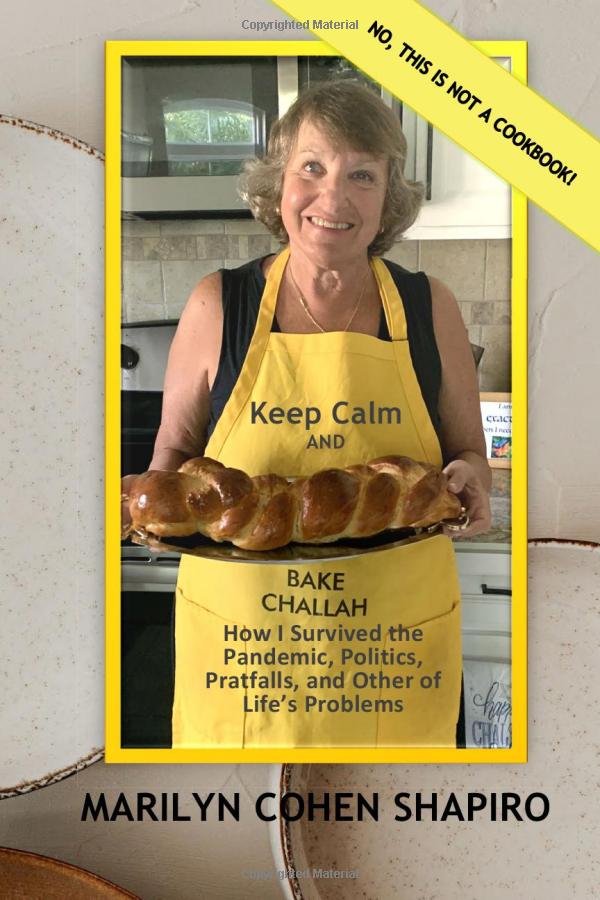
As Jews around the world herald in the Hebrew Year 5784, I am celebrating Rosh Hashanah with the release of my fourth book, Keep Calm and Bake Challah: How I Survived the Pandemic, Politics, Pratfalls, and Other of Life’s Problems.

Before you start getting out your baking pans, please be warned: No, this is NOT a cookbook! 

In March 2020, as the reality of COVID-19 hit home, I started baking challah, the delicious, braided egg bread that is typically eaten on the Sabbath and other important Jewish holidays. More importantly, I started WRITING about baking challah. Getting inspiration from England’s World War II rallying cry, I searched the internet and found Keep Calm Maker on Zazzle, an American on-line marketplace, could create an apron with a Keep Calm and Bake Challah logo embroidered on the top half. The yellow cotton pinafore arrived in June and my wearing it while baking the loaves became as necessary to the process as kneading the flour, sugar, salt, oil, and yeast. I knew that the mantra would be the title of my book. 

Over the next two and half years, I wrote about baking challah. I also wrote about adjusting to the “new normal.” Wearing masks. Zooming with family and friends. Missing in-person birthdays, bar and bat mitzvahs, graduations, weddings, and funerals. Following the news as the country was split apart. Emerging slowly back into life more closely resembling the pre-COVID years. Finally meeting my San Francisco grandson who was born days before California began its shelter-in-place orders. Resuming our summers at 9100 feet in Colorado. And dealing with our own COVID illnesses. 

In April 2023, my editor Mia Crews and I were putting the final touches on Keep Calm and Bake Challah before publication. We were going back and forth with necessary changes to the fifty-three stories as well as the cover, which featured a picture of me wearing my apron and holding a huge, braided loaf. Finally, Mia uploaded the first draft copy of the book. That Friday afternoon, I greeted the deliveryman as he handed me the brown envelope that held my new “baby.” 

“Thank you so much!” I told him. “It’s my book!” 

“That’s nice,” he said, as he turned around and started heading for his truck. 

“No, it’s not any book,” I said. “It’s my book! I wrote it. Do you want to see it?” 

Before he could answer, I tore open the envelope and showed him the proof copy. 

“That’s nice,” he said. “You wrote a cookbook.” 

“No, it’s NOT a cookbook,” I said. “It’s a collection of stories about my life during the pandemic.” 

As he left, however, I took a closer look at the cover. It DID look like a cookbook. That opinion was confirmed by several other people to whom I showed the proof. 

Over that weekend, I agonized over my dilemma. Did I need a new cover? A new title? Or did I need to throw out hundreds of hours of writing and editing, keep the cover and title, and just write a cookbook? I seriously considered a title change—Thankful? Finding a Silver Lining?—until a conversation with five of my cousins on our weekly Tuesday Zoom call. 

“Don’t change the title,” they said. “Just put a banner proclaiming, ‘No! This is NOT a cookbook!’” 

I gladly followed their advice. I had been working on this book since March 2020, and I knew that the chosen title best reflected all those months of dealing with the pandemic. More importantly, I loved the title. No matter how many people passed up on my book because it looks like a cookbook, at least the title and cover would be what I dreamt it would be from the beginning of this journey. 

So I proudly present Keep Calm and Bake Challah: How I Survived the Pandemic, Politics, Pratfalls, and Other of Life’s Problems. For all of you who hoped it was a cookbook, I hope you enjoy it anyway. And to make everyone happy, my challah recipe is included at the end of the book. Happy baking! 

Keep Calm and Bake Challah: How I Survived the Pandemic, Politics, Pratfalls, and Other of Life’s Problems is available on Amazon. Click here for more information.

Gammy making challah with her granddaughter

Marriage 1940’s Style

My mother, Frances Cohen, was the family story teller. She wrote this story while in a writing club at Coberg Village, Rexford, New York, sharing details of her marriage to my father, Bill Cohen, on August 20, 1940. It is one of the stories I captured in my 2021 book, Fradel’s Story.

On May 1940, Bill and I officially became engaged when Bill presented me with an Elgin wristwatch. We began planning our wedding. My brother Eli and his fiancé Zelda had planned a big Sunday afternoon wedding for August 18. To make it convenient for our out-of-town guests to attend both weddings, we planned a smaller event for two days later on Tuesday evening, August 20, 1940.

We had a difficult time writing the wedding invitation as both my maiden surname and Bill’s surname were Cohen. To make it even more complicated, thanks to the officials at Ellis Island, both my father’s and future father’s-in-law names were Joseph Cohen. Even our mothers’ names matched: My mother was Ethel Annie Cohen; Bill’s mother was Annie Ethel Cohen. To make it clearer, we used the first letter of our first names as the middle initials of their names, left our mothers’ first names completely off, and had the invitation printed as shown here.

Wedding Invitation

Our wedding was not elegant. However, Bill and I made a handsome couple under the chuppa (wedding canopy), me in my rented wedding gown and floor length veil ($8), Bill in his rented tuxedo ($7), and both of us so happy we glowed. (Priceless!)

After the religious ceremony, the guests were served tea sandwiches, fruit, and wedding cake. Unfortunately, by the time the photographer finished taking our wedding pictures, most of the guests had left and most of the food was gone. We did keep the bride and groom figure from the top of our cake, which we still have in our china cabinet today.

Bill and I had a two-day honeymoon at the Hotel New York in a bridal suite at $10 a night. On Thursday morning, my cousin Elliot and my Aunt Rose met us at the hotel in his car to drive us to Malone in upstate New York where we were to make our first home. As this was before the Thruway and the Northway, the trip was over ten hours long. Bill and I planned to take advantage of long trip on the road by cuddling contentedly in the back seat, but that was not to be. The back seat was filled with suitcases, wedding gifts, and home furnishings, including a huge table lamp. Aunt Rose was prone to carsickness and needed to sit next to the window in the front seat. And so, we started the first chapter of our life together as Mr. and Mrs. Wilfred Cohen with me in the front seat between Elliot and Aunt Rose and with poor Bill squeezed into the back seat, balancing the lamp on his lap for the entire trip.

By September 1940, Bill and I spent our first few weeks as happy newlyweds living in Malone, New York, a small village only a few miles from the Canadian border. Bill had been working there for two years in the North Country and loved it. Since it was a new way of life for me, there were many adjustments to be made.

Before I was married, my life was very different. I worked in a job I loved, a bookkeeper for a large firm called the Dixie Dress Shop in the heart of New York City. At the end of the day, I took the subway home to Brighton Beach for five cents. I arrived home to the apartment I shared with my parents, warmed by the steam heat and the delicious aroma of my mother’s homemade meals she prepared for us each evening.

After we married, I moved from New York City to a tiny town in Upstate New York to be with Bill. I left a job making $19 a week to live with a man who was making $18 a week. That was before Women’s Lib. We were convinced that two could live as cheaply as one. We quickly found out that that wasn’t true.

Please do not misunderstand me. I loved being a married stay-at-home housewife, but I had so much to learn. I was now expected to prepare three meals a day on an old kerosene stove. My mother and mother-in-law were not much help living 350 miles away. Besides, they never cooked from a recipe, as their measurements consisted of a bisl (little) of this and shtik (piece) of that. My mother-in-law sent me more detailed recipe books and a mix master, and Aunt Rose, who lived close by, also gave me lessons. I eventually learned to cook and bake, but not without much trial and error.

My first experience cooking rice was a disaster. I started out following the directions exactly, using one cup of rice to two cups of water. After ten minutes, I checked the pot, and it didn’t look like one cup of rice would be enough for my husband’s hearty appetite. So, I added more rice and then more water and then more rice and then more water. By the time Bill came home for dinner, there were three huge pots of cooked rice sitting on the stove. For the next two weeks, we lived on tomato rice soup for lunch, rice casseroles for dinner, and rice pudding for dessert.

Soon after we were married, Bill was transferred to a Pearl’s department store in Rouses Point, New York. We were now farther from our family, and I often felt lonely. In the winter, the temperatures were always at least thirty degrees lower than New York City. The natives always described the winter weather as “a February thaw is thirty below and a hell of a blow.”

As the months wore on, I found it very difficult to adjust to all the snow and cold. Besides, our three-room furnished apartment was not fully winterized. The big potbelly stove with its dirty ashes sat in our living room, and that room was always too hot. The kitchen was just right, but the bedroom was always only forty degrees. I felt like Goldilocks!

I missed all the good things that the Big Apple had to offer. I missed browsing and shopping in the big department stores. I missed eating in Italian and Chinese and Jewish restaurants and in the automats. I missed the theater, the big glamorous movies houses with vaudeville shows, and Radio City Music Hall and the Rockettes.

But with a loving husband who was an optimist, I gradually changed my attitude. I started to look at the beautiful scenery of the Adirondacks and Lake Champlain and all the advantages a small town had to offer.

A version of this article originally appeared in the November 13, 2014, issue of the Jewish World News, a bi-weekly subscription-based newspaper in upstate New York.

Keep Calm and Bake Challah is on Amazon!!

I am proud to announce that my fourth book, Keep Calm and Bake Challah: How I Survived the Pandemic, Politics, Pratfalls and Other of Life’s Problems,is out and available on Amazon in both Kindle and paperback formats.Hope you enjoy reading the the fifty-three articles I wrote during the pandemic as much as I enjoyed writing them! For those who have been following my blog for a while, you will now have many of those posts in one place for your reading pleasure.

Below are a sampling of the story topics:

A Survivor’s Tale: Dutch Nathan

Anne Frank, born on June 12, 1929, was the celebrated diarist who described her life while hiding with her family from the Nazis in an Amsterdam, Holland attic. After capture and deportation, she died in the Bergen-Belsen concentration camp in late winter 1945.The following story, first published in 2018, tells the story of another Jewish child who hid with his family in Holland during World War II and survived to share his story.

Anne Frank is one of the most well known figures from the Holocaust. But she and her family were not the only ones to go into hiding to avoid capture by the Nazis and their collaborators. While some Jews lived in the open with changed identities, others, like the Franks physically hid to avoid certain deportation and almost certain death. Dutch Nathan and his family were one of many who relied on others to help them. 

Gert “Dutch” Nathan was born on January 5, 1932, in Duren, Germany, the second son of Wilhelm (“Willy”)  and Hilde (nee  Friesem) Nathan. Willy had a cattle hauling business which extended throughout Europe. He did not have a formal education, but he was street smart—Dutch remembers that his father could “outcalculate a calculator.” The Nathans lived a mostly secular life in Germany, with observation of major Jewish holidays and his mothers’ lighting of Shabbat candles.

In 1938, after Hitler’s rise, the family moved sixty miles west to Valkenburg, The Netherlands. “Holland had proclaimed neutrality when war broke out in September 1939, as they had done in World I,” said Dutch, “so my father thought our family would be safe.”Willy took a job with the De Valk bus company, a former competitor, where he continued his cattle business.

On May 10, 1940, Hitler’s forces invaded the self-proclaimed “neutral” country. Five days later, after the bombing of Rotterdam, the Dutch forces surrendered. By 1942, the situation began to deteriorate for fellow Jews. Willy made the following arrangements with his friend, Johan Kengen, a member of the Dutch Underground:  If the Nathans were in danger of deportment. Willy would pay for the family to stay in the home of  Kengen’s fiancé’s aunt and uncle  for “a few days” until the Nathans could be spirited away to England. Willy also made arrangements for neighbors to move most of the furniture and bedding to the house next door. Whether the neighbors were paid or volunteered as an anti-Nazi action still remains a mystery to Dutch. 

The plan was put into effect a few month later. While walking from the bus station into the De Valk building, Willy was stopped by a friend and fellow employee:  Germans were waiting for him to arrest him and deport him and his family to the concentration camp.

Father quickly stole a bike and peddled the ten miles home. Dutch and his older brother Fredo were instructed to leave their house one hour apart to walk the two  miles to a house “located on the right hand side just before the road crossed the railroad tracks” with a warning to “not speak to a soul.” Willy and Hilde arrived later that evening, expecting to hear soon from the Underground of their clandestine trip to England. 

Unfortunately, the days turned into week, and the Nathans were still in hiding. Other people, including downed pilots, had priority in the Underground escape plan. To further cover the facts of extra activity in the “safe house,” an elaborate ruse was planned. Johan and the elderly couple’s niece Ann quickly arranged their wedding. At the reception, Johan picked a huge fight with Ann’s parents, who resolved that they would have no contact with the couple until Johan apologized. The newlyweds moved into the house by the railroad tracks, bringing the number to eight. 

As weeks turned into months, tensions grew. The Nathan’s spent most of their time in a small main floor bedroom. Ann was prone to hysterical outbursts, and Willy and Johan would have to physically restrain her to keep her from running outside and giving their situation away. Meanwhile, Hilde was anguishing over the fact that she had not been able bring her parents with them. She was haunted by their deaths in the concentration camp for the rest of her life.

Johan’s government job determining the number of animals that farmers could slaughtered provided a means to get extra meat and milk, but food was still scarce. Dutch and Fredo, 10 and 12 respectively, spent most of their days quietly reading books and avoiding the shaded windows so no shadows would be seen.

Along with possible discovery, the occupants lived in fear of the potential impact of living near the railroad track.The noise from the passing trains provided an extra buffer but also an extra danger:  Allies strafed German trains. They hoped that these attacks would not hit the house, either killing all of them or forcing the Nathans out into the open, thus exposing their dark secret. 

In the second half of 1944, the southern half of Holland was liberated by American troops. (The remaining areas of the Netherlands were not liberated until May 1945.) The Nathans stayed inside for a few more days to make sure they were safe. 

Once they realized they were actually free, the Nathans stepped into fresh  air for the first time in twenty-six months.  “I walked a few feet and collapsed,” remembered Dutch. When asked if he had been overcome with emotion, he said, “I hadn’t used my legs in 26 months and initially had no muscle tone to walk more than a few feet.

Before they could move back into their home, however, Americans bombed Valkenburg. One of the casualties was the Nathan’s home. “No one understood why the brick home next door burned so much,” said Dutch. “The furniture hidden in the attic acted like a tinderbox, and flames shot up in the air for hours.”

In May 1945, the remaining areas of the Netherlands were liberated. Free but homeless, the Nathan family moved into a neighbor’s home until 1946, when they obtained visas to move to United States, where several of Willy’s siblings lived. Willy built a crate the size of a truck and filled it with everything they had accumulated since the end of the war—including a piano. 

Dutch, now sixteen, enrolled in City College to learn English, adding to his previous background of German, French, and Dutch. At 18, he enlisted in the army and volunteered to go to South Korea. When he returned home, he found employment in whatever “made money.” 

In 1979, Dutch, who had been married twice before, met Sue Cohen. He proposed shortly after the meeting, but it took ten years for her to say yes. During this time, Dutch started the Stretch Lace, a Sharon Massachusetts-based company that manufactured and sold elastic shoe laces. (“Tie once, never Tie Again!”) Although his invention was successful, Dutch admitted that he didn’t know marketing and sales. He eventually sold the business, but Easy Laces are still available today and are worn by such celebrities as Brooke Shields. They lived in Sharon for most of their married life before retiring to Kissimmee, Florida, in 2007.

 In 1982, Sue and he were invited by residents of Duren, Germany, to return to the Nathan’s original home. They were treated royally and met with church members as well as school children. Sue’s main mantra to everyone she met was “Just remember! The Holocaust DID happen.” Although their visit was supposed to last a week, Dutch felt uncomfortable. He rented a car, and the two of them toured Europe, driving over 4000 miles before returning to Massachusetts 

Almost seventy-five years after his liberation, Dutch graciously shared the story that he spent most of his life trying to put those terrifying time behind him. “I try not to think about those things,” said Dutch. “It is over and cannot be undone.  His story, however, as those of the fewer and fewer remaining Holocaust survivors, must be told. As Sue Nathan told the people in Germany during the 1982 visit, “Remember. The Holocaust DID happen.” And we Jews and righteous people everywhere will never forget. 

A version of this article originally appeared in the November 8, 2018, issue of the Jewish World News, a bi-weekly subscription-based newspaper in upstate New York.