As we prepare to celebrate Passover, I contemplate my ancestors’ flight out of Egypt. If the Exodus happened today, I am not sure if I would ever make it out of Egypt.
According to the midrash, the Pharoh commanded the Israelites to leave immediately following the tenth plague. As we all know, they had so little time that the bread had no time to rise. As a woman who loves to bake challah, I could live with whipping up the dough and foregoing the rising process. As long as I had butter and raspberry preserves matzoh would work until the manna rained down. (Hopefully, mine would taste like vanilla ice cream.)
My first problem is that there is no way in the world I would have had time to pack.
Friends I know who pack the night before any trip would have done well that evening. Those carefree individuals would pull out their sachets, throw everything in, and figure they could pick up whatever else they needed at the closest desert oasis.
Unfortunately, I am not one of those people. I start filling my suitcase at least a week before scheduled departure, often packing and repacking several times. Too many shoes. Too few tops. Do I need a dress in the desert? And what about my denim jacket? I love pairing it with almost everything in my closet, but maybe a fleece would be more practical and take up less room. How in the world could I pull this off before we headed out?
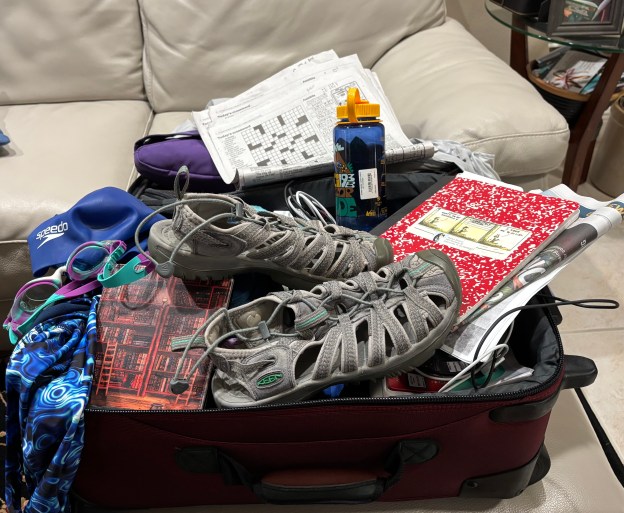
Full disclosure: I don’t even leave my house for a few hours without packing enough for an overnight stay. Along with my essentials—wallet, iPhone, sunglasses, lipstick—I need to cover all my bases. A book. My notebook and a pen in case I get hit with a writing inspiration. A phone charger. A sweater or fleece in case I get cold. Shorts in case I get hot. My water bottle. A Quest bar in case I get hungry. I stuff more into my oversized handbag for a simple errand than the Israelites grabbed in the middle of the night.
Even if I’d managed to pack my bags and prepare the challah that turned into crackers, I would have had to dash back home for the items I’d forgotten. My phone. My keys. My sunglasses. No matter my preparation, I always leave something behind when departing. The Red Sea would already close by the time I made it to the shore. I would wave to everyone while watching all of Pharoh’s soldiers being drowned.
And could I ever have left my home in the first place?
According to scholars’ interpretation of Rashi’s comment, only one-fifth of the Israelites left Egypt. Eighty percent stayed put, out of fear of the unknown or feeling comfortable despite their inferior status in the kingdom. Eighty percent! But thinking about it, would I have been in the majority? Would I have given up freedom to stay put? Could I have left my familiar life and my stuff behind?
As Dan Schur writes in an April 22, 2022, article for the Jewish Journal, “the overwhelming majority of the children of Israel chose a compromised but familiar existence over the potential dangers that more dramatic and assertive actions might have brought.”
Could I leave my piano? My lanai that overlooks a pond? A house that brings me so much joy?
So, maybe I wouldn’t have left in the first place. I would have packed Larry some matzoh and lots of water, given him a kiss, and would have waved goodbye. Who knows? Maybe those 40 years of wandering would have somehow led him back to me.
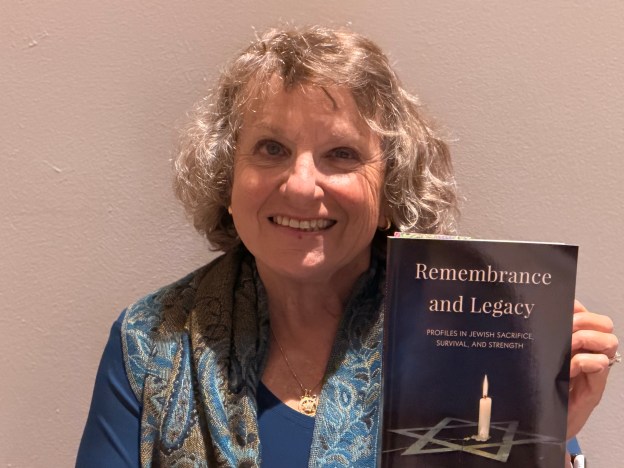
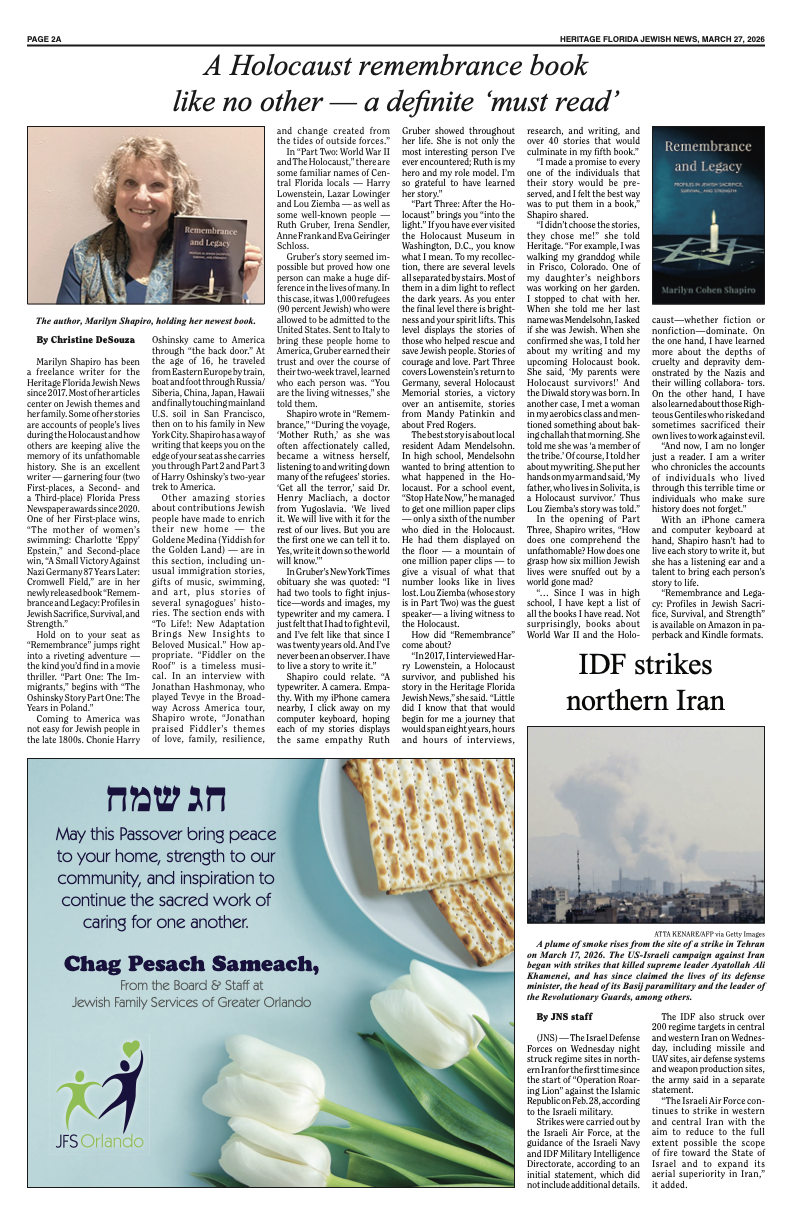
Christine DeSousa, my editor at the Heritage Florida Jewish News, wrote this article for the upcoming issue of the Orlando-based paper. Thanks so much, Christine! My book is available on Amazon in paperback and Kindle format as well as through IngramSpark.
Thanksgiving has always been our favorite holiday. When we lived in Clifton Park, we celebrated for many years by running the Troy Turkey Trot in the morning and then joining the family for dinner at Larry’s cousins’ home in Argyle, New York. Our most memorable Thanksgiving was also our saddest. In 1974, two and a half months after we married, Larry’s beloved grandmother passed away.
Bubbe Rose was the matriarch of Larry’s family. Her tiny stature — she was under five feet and weighed less than one hundred pounds — belied her powerful presence. Everyone loved her.
Bubbe Rose was instrumental in making sure Larry and I got married. We had been seeing each other for a little over two months, but Bubbe was getting impatient and decided to intercede.
“So what is your relationship with this woman?” Bubbe Rose asked her only grandson.
“We’re dating,” Larry responded.
“You’ve dated long enough!” Bubbe said. “She’s a nice girl. Marry her.”
Fortunately for Bubbe, Larry and I didn’t waste much more time. We got engaged on Rosh Hashanah but waited to announce our plans after the Yom Kippur break-the-fast at the Shapiro’s Saratoga Springs home. As the holiday coincided that year with Larry’s father’s birthday, we held off until Ernie blew out the candles on his cake.
“I have a special present for you this year, Dad,” Larry said.
“Another stupid tie?” Larry’s sister Anita chimed in.
“No, I am giving you a daughter-in-law. Marilyn and I are engaged!” The family was thrilled, but no one was happier than Bubbe Rose.
Rose [née Slominsky] Hurwitz was born in 1894 in what the family believes was Russia. At a young age, she emigrated to the United States and settled in Syracuse. There she met and married Mose Hurwitz, a coal merchant. Their daughter (and my future mother-in-law) Doris was born in 1920; their son Asher was born eight years later. Rose was a true balabusta, a competent and skilled homemaker, and her home became the gathering place for family and friends for the Jewish holidays. Doris and Ernie were married in the Hurwitz living room on June 20, 1942.
Bubbe’s home in Syracuse remained the heart of the family throughout the next two decades. Immediately following their wedding, Ernie reported for duty at his army assignment in Chapel Hill, North Carolina. Doris joined him but returned to Syracuse to deliver their first child, Anita, a year later. Five years later now living in Schuylerville, New York, Doris returned to Syracuse for the birth of their second child, Larry. Mose died less than a year later, and Asher took over the coal business. In 1950, Ernie’s mother Celia died, making Rose their only surviving grandmother.
When Ernie was called back to service during the Korean War, Doris, along with the two children, waited out his return at Bubbe’s home. Once Ernie was discharged, the family moved to Saratoga Springs, where Ernie resumed his pre-military career running Shapiro’s of Schuylerville. Every Rosh Hashanah and Yom Kippur was spent in Syracuse, along with frequent visits.
By the early sixties, Doris and Ernie had added two more children to their family: Marilyn in 1953 and Carole in 1959. Rather than Doris and Ernie packing up the six Shapiros for the drive to Syracuse, Bubbe Rose and Asher came to Saratoga Springs for most of the holidays and for at least one weekend a month. If the family couldn’t be in Syracuse, Bubbe and Asher brought Syracuse with them: baked goods from Snowflake Pastry Shoppe; white fish and cold cuts from one of the city’s kosher delis; and back issues of the Syracuse Herald-Journal so Doris could catch up with her hometown news.
Larry has two favorite stories about Bubbe’s legendary cooking skills. On March 29, 1959, Larry and Asher watched their beloved Syracuse Nationals defeat the Boston Celtics in the sixth game of the playoffs in the city’s War Memorial auditorium. (Unfortunately the Nats lost the critical seventh game, a loss Larry still remembers with regret.) The next day, Larry came down with the flu, necessitating his staying in Syracuse for the following week. Bubbe Rose believed that the only way to cure him was to feed him endlessly.
In 1971, Larry was accepted to graduate school at Syracuse University, and he moved in with Bubbe Rose and Asher. He probably did not weigh more than 126 pounds when he arrived. Along with breakfast and dinner, Bubbe insisted on packing him elaborate lunches, which Larry shared with his envious fellow students. In less than two months, he had gained sixteen pounds, some of the weight taken off before he graduated. By the time we met at a Purim party in March 1973, he had settled into his adult weight..
We were married on September 8, 1974. Bubbe Rose attended the wedding, looking beautiful in a long pink gown. On November 23, she suffered a stroke. Doris immediately went to Syracuse to be with her. As the week progressed, her condition worsened; by Wednesday, she was unconscious and unresponsive. On Thanksgiving Day, November 28, Larry and I drove to Syracuse to see her for what we knew was the last time. We walked into the hospital room, quietly shared with her that we were there, and told her how much we loved her. To our surprise, she reached out and gently touched our hands. Moments later, she passed away. In a strange way, we got to spend one last holiday with her—a holiday we will always remember.
Was Rose Hurwitz a remarkable woman? She did not write any books. She did not make any scientific discoveries. She was not a movie star. To her children and their siblings, however, she was as remarkable as anyone who had ever lived.
How do you honor a person who meant so much to you? You pass her story onto your children and grandchildren. You have a daughter, a granddaughter, and niece who all have the middle name of Rose. And you always remember that Thanksgiving Day when she touched your hand for the last time.
On September 3, 2016, , I launched my first book, There Goes My Heart. This article was published in the Jewish World News. Ten years later, I am about to publish Book Five: Never Forget: Stories of Jewish Sacrifice, Survival, and Strength. Who ever thought this girl from Keeseville, who wrote her first short story when she was 16, would ever be published??
Marilyn Cohen Shapiro of Poinciana has announced the publication of “There Goes My Heart,” a collection of personal memoirs. The collection of over 40 personal essays captures special moments in a lifetime spent in Upstate New York, Florida, Colorado, and beyond. Her Amazon author page states, “Readers will empathize with these true stories of dating, marriage, raising children, and caring for elderly parents through the author’s wit edged with appreciation and love of family and friends.” The book is available on Amazon in both paperback and Kindle e-reader format. A graduate of University of Albany, Shapiro was employed for over 25 years at the Capital District Educational Opportunity Center, a division of Hudson Valley Community College, Troy, New York, first as an adult educator and later as Coordinator of Program Development and Research. Since 2013, Shapiro has been a regular contributor to The Jewish World, a Schenectady, New York,-based bi-weekly newspaper. Shapiro and her husband Larry moved to Poinciana in 2015. They are members of Congregation Shalom Aleichem in Kissimmee. Shapiro is a lifetime member of Hadassah and a recipient of a Hadassah leadership award. She is a 2008 recipient of the State University of New York Chancellor’s Award for Public Service. This is Shapiro’s first book.
This article was originally written for Rosh Hashanah 5785 (September 2024). It may be a little late for the High Holy Days, but the message is also valuable as we begin the secular year of of 2025.
The High Holy Days is a time for us to turn inward, to reflect on our lives, not only where we have been but also where we hope to go in the coming year. So much of the world needs our help. What can one person do? How can one person make a difference?
In the Pirkei Avot, Rabbi Tarfon writes,“It is not incumbent upon you to complete the work but neither are you at liberty to desist from it.” That quote has been in my email signature for several years and serves as a reminder to me and those that read it that we can all can make a difference. No, we cannot save the world. But our inability to do EVERYTHING does not give us a pass on doing nothing.
This truth is found in the often-told starfish parable. An old man is walking along the beach in which hundreds of starfish have been washed along the shore during high tide. As he walked, he came across a little girl who is throwing the starfish back into the ocean. “You realize that you will not be able to make much of a difference,” the old man tells the little girl. She picked up another starfish and threw it as far into the water as she could. “I made a difference to that one.”
It reminds me of “starfish” moment. On a recent trip to the beach, Larry and I were walking along the edge of the water. As Larry was enjoying the waves and the birds, I was picking up garbage and sticking it in a plastic bag I brought with me for that purpose. A broken styrofoam cup. A short length of cord. A lone flipflop. And a dozen or so plastic caps from water bottles.
“You can’t pick up every bit of litter on the beach,” Larry said.
“Yes. But I can do something!”
Yes, Larry was right. I am not going to pick up every piece of litter on a beach. But I can at least fill up a plastic bag with some of it.
Giving away my freshly baked challahs also gives me a chance to do something . Early into the pandemic, I started baking three or four challahs a week. At least one of the challahs went to someone in our community who needed cheering. The first one went to a friend whose wife was in a memory unit at the hospital. Week after week, we delivered challahs to people who had lost their spouse, who faced illness; who got bad news from their families. My small challahs were small tokens of love and caring. My challah baking has slowed down in recent months, and I usually make extras to tuck in the freezer to pull out as needed. It just filled my need to do SOMETHING!
For the past ten years, my writing has been a way for me to feel as if I am making a difference. Initially my writing focused on my family stories. In the past eight years, I have become captivated by telling other people’s stories, the lives of Holocaust survivors. So much has been written already: fictional accounts, memoirs, graphic novels, poetry, plays. Many of have become classics: Elie Wiesel’s Night;Prima Levi’s Man’s Search for Meaning; William Styron’s Sophie’s Choice, and Anne Frank’s Diary of a Young Girl. Then why do I continue to interview Holocaust survivors and their families?
Writing these stories allows me to do my part to make the world never forget. Each story is a statement against Holocaust denial. And having each story published has brought feelings of pride, comfort, and maybe some peace to the subjects and their family. Following Rabbi Tarfon’s advice, my inability to write everything doesn’t mean I cannot continue to do something.
And what happens when one person joins others to make a difference? Fortunately, I am surrounded by people in my 55+ community who are also doing their part to help people in the greater Poinciana area. Solivita has over 200 clubs, and many of them support the local community. The Do Unto Others Initiative (DUO) has raised over $260,000 in 11 years to support the work of the St. Rose of Lima Food Pantry. Another club, Solivita Friends Helping Those In NEED, provides similar support for St. Vincent de Paul St. Ann’s Food Pantry in Haines City. Solivita Friends of Elementary Education Schools (SoFEEs) provides nourishment, school supplies and seasonally appropriate clothing to local elementary schools. In the past nineteen years, Stonegate Women’s Golf Association (SWGA) has been able to provide over $300k to local community charities. The Solivita Performing Arts Council (SPAC, Inc.) has raised over $139,000 since its inception, providing grants to help local schools purchase and maintain instruments, fund band and choir concerts, produce school theatrical productions, fund thespian workshops and support art projects. SOLABILITY, a club consisting of individuals of varying abilities, provides activities accessible to all. Members of the Butterfly Club provide financial support for our beautiful butterfly garden; volunteers keep it weeded and in control. Our Book Circle, which has over 30 book clubs under its umbrella, donates books and financial help to Polk County Schools. The Shalom Club makes an annual contribution to the Perlman Food Pantry or Jewish organizations supporting local families. The organizations above represent only a small sample of ways individuals have joined together to help those in need.
So, yes, one person can make a difference. Wishes for a sweet, healthy 5785. May it be a year in which each of us make a difference.
Solivita’s butterfly garden
Published in Rosh Hashanah 2024 issues in Capital District New York’s The Jewish World and Orlando’s Heritage Florida Jewish News.
Solivita is a 55+ community for active adults in Poinciana, Florida.
O mermaid bold, long may you hold/ The wreath you’ve won by swimming,/And spoil for gents their arguments/ Regarding Votes for Wimmen! “To a Lady Swimmer,” William F. Kirk 1914.
I love to swim. So it is no surprise that I spent much of the first week of the 2024 Paris Olympics watching the swim competition. I cheered on Team USA as they won twenty-five medals in the thirty-nine events in the Paris La Défense Arena. As I yelled “Go! Go! Go!” at the screen during the 1500 freestyle, Katie Ledecky’s last race, my granddaughter admonished me. “Your screaming isn’t going to make a difference,” she said. Hey! Maybe it did! Ledecky won the fourteenth medal she had earned over four Olympics.
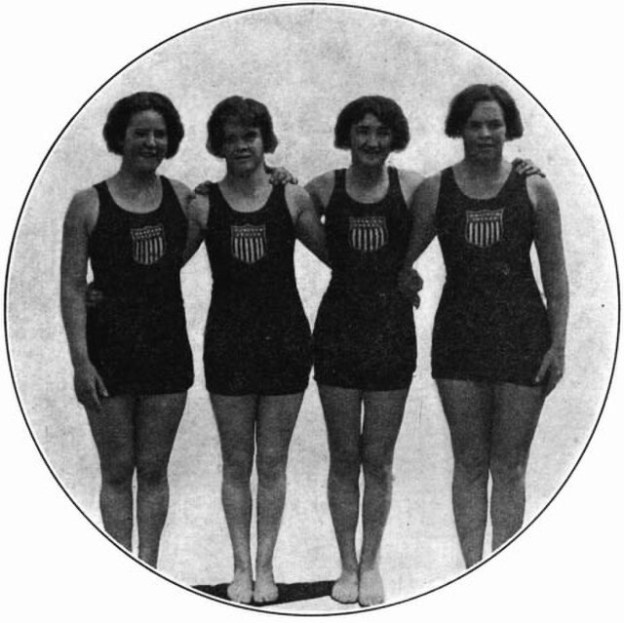
Ledecky, Torri Huske, Jenny Thompson, Dara Torres, Janet Evans, Donna de Varona, and every woman who dove into an Olympic pool has a Jewish woman to thank. Charlotte “Eppy” Epstein, considered the “Mother of Women’s Swimming in America,” was not an exceptional swimmer herself but believed that athletic competition was as important for women as it was for men. Her determination and leadership impacted not only the sport of swimming but also how women perceived their own bodies and their place in the world.
As Glenn Stout recounted in his 2009 book, Young Woman and the Sea, How Trudy Ederle Conquered the English Channel and Inspired the World, until Epstein transformed women’s swimming, societal norms discouraged women from swimming or, in fact, from “breaking a sweat” anywhere but in the kitchen. Social bias against women’s participation in sports was the norm. This was best represented by Olympic founder Baron Pierre de Coubertin of France, who thought women’s competition in athletics was “physically dangerous for such delicate flowers and morally offensive.”
Even if they could get in the water, the standard female bathing costumes hindered women swimmers. Kristin Toussaint described them in a 2015 Boston Globe article: “black, knee-length, puffed-sleeved wool dresses worn over bloomers with long black stockings, bathing slippers, and even ribboned swim caps.” In 1907, Annette Kellerman, an Australian competitive swimmer and vaudeville star, was arrested for indecency by Massachusetts police for wearing a one-piece bathing suit that ended in shorts above her knees. “Kellerman may have been thoroughly covered,” Toussaint said, “but to her fellow bathers, she may as well have been naked.”
Epstein changed the narrative in 1914 when she founded the National Women’s Life Saving League, which offered the “delicate flowers” a place to swim and take lessons. Using negotiating skills she learned through her job as a court reporter, she convinced the Amateur Athletic Union (AAU) to permit women to register with their organization for the first time and to sponsor competitive women’s meets. According to Stout, Epstein worked “behind the scenes … extolling the advantages of having a women’s swim association managed by women while deftly praising the example set by the AAU as an organizing body without peer —essentially killing the organization and its male overseers with kindness.”
In 1917, she struck out on her own, creating the New York City Women’s Swimming Association (WSA) to further advance the sport. She successfully battled the United States Olympic Committee, enabling American female swimmers and divers to compete in the Olympics in Antwerp, Belgium. Through her efforts, swimming dresses and bloomers were replaced with outfits closer in style to Annette Kellerman’s. The success of the American women’s swim team led to the inclusion of track and field and other sports for women in future Olympic Games.
Epstein served as the women’s swimming team manager for the 1920, 1924, and 1932 Olympics. Her swimmers and divers dominated the games, holding fifty-one world records over the course of her twenty-two years of coaching. Her protégées included Eleanor Holm, Aileen Riggin, Helen Wainwright, and Gertrude Ederle. Epstein also served as chair of the national AAU women’s swimming committee.
Her Jewish roots became part of her legacy. The WSA team swam at the Young Women’s Hebrew Association of New York for national championship meets in the 1920s. In 1935, Epstein served as chair of the swimming committee of the Second Maccabiah Games. In 1936, she refused to attend the Berlin Olympic Games and withdrew from the American Olympic Committee in protest of the United States’ participation in the “Nazi Olympics.”
During her lifetime, Epstein also used her position to battle for women’s suffrage, staging “suffrage swim races” with her teammates, and fought for further bathing suit reform, distance swims, and additional competitive events for women. She continued to have a major influence on swimming until her death in 1938, just short of her fifty-fourth birthday. She was inducted into the International Swimming Hall of Fame and the International Jewish Sports Hall of Fame.
“By motivating young women to follow their passions in a sport that did not yet fully accept them, Epstein truly changed the way women thought about swimming,” according to Women in Swimming (Betsey Bennett. “Charlotte Epstein and the Swimming Suffragettes.” Women in Swimming. October 25, 2018). “And her impact did not end in the pool; once women gained freedom over their bodies in sports, they were better able to achieve liberation in other facets of society.”
On Wednesday, July 31, after binging on a morning of Olympic events being broadcast on NBC, I headed for the small pool in our Colorado rental complex. I swam 1500 meters in over an hour, approximately four times Ledecky’s time of 15:30.02 minutes in Paris earlier that day. I may not be setting any world records, but I too am a beneficiary of efforts of the small Jewish powerhouse from Brooklyn. I did not fear being arrested for wearing a TYR swimsuit, and no one feared that this “delicate flower” could not survive the multiple laps. I tip my Speedo swim cap to you, Eppy!
In 2024, Disney+ released the film Young Woman and the Sea based on Glenn Stout’s 2009 book. The movie tells the story of Epstein’s most well-known protégé, Gertrude Ederle, the first woman who swam the English Channel. Sian Clifford, who played Epstein, said the movie is “a beautiful, inspiring story that should have been told before.”
“Charlotte Epstein serves as a symbol of the critical efforts of a Jewish sportswoman to improve the competitive opportunities and quest for physical emancipation of American women using their bodies in aquatic sports,” wrote Linda Borish in her 2004 paper. (“The Cradle of American Champions, Women Champions … Swim Champions’: Charlotte Epstein, Gender and Jewish Identity, and the Physical Emancipation of Women in Aquatic Sports.” The International Journal of the History of Sport_, Vol. 21, 2 (March 2004): 197-235.
All women swimmers—or all women athletes for that matter—have Eppy to thank.
Originally published August 16, 2024. Updated July 2025.
Note: First Place Winner, 2025 Florida Press Association’s Sports Feature Story, Category C (Small newspapers).
SOURCES
Borish, Linda. “The Cradle of American Champions, Women Champions Swim Champions’: Charlotte Epstein, Gender and Jewish Identity, and the Physical Emancipation of Women in Aquatic Sports.” www.researchgate.net. March 2004.
“I’m late / I’m late / For a very important date. / No time to say “Hello, Goodbye”. / I’m late, I’m late, I’m late.” White Rabbit in Alice in Wonderland, by Lewis Carroll
Lewis Carroll’s classic novel has always been one of my favorite children’s books, and I often dreamed of being Alice, falling down a rabbit hole, and meeting the Chesire Cat and the Mad Hatter.. I never realized until recently that I wasn’t Alice. I was the White Rabbit.
My epiphany came on Rosh Hashanah, while I dashed around getting ready to leave for shul. My husband, who was unable to attend services due to recent leg surgery, commented on the fact that I was still trying to leave at 10 am, an hour after services began. “You’re running late,” he commented. “You seem to be doing that a lot lately.”
Initially I was going to make some snide remark about how taking care of his needs as well as all the household responsibilities that he had not been able to do as a result of his surgery had contributed to my problem. I, being the good wife, bit my tongue and headed out to shul.
As I spent time in synagogue reflecting on my morning rush, however, I realized that my lateness was not limited to those last few weeks. Friends had been left waiting at restaurants, movie theaters, and book stores, with a quick telephone call from me saying, “I’m running a little late! I should be there in ten or fifteen minutes.” And this had been going on for a while.
The irony in this situation is that I have always been the Calendar Queen. For years, I lugged around a Franklin Planner, meticulously writing down every appointment and writing elaborate To-Do lists. I was always the person given responsibility for event planning and date tracking. For at least twenty years, I have been secretary of my book club. If anyone needs to know what book we are reading, or which member is hosting, or what date we are meeting, I am the person. Now that I have moved from the Franklin Planner to the electronic version, I drive Larry crazy with all the dings and beeps and twills that signal an upcoming event. It’s just that all these reminders don’t get me out the door when it is necessary. To paraphrase Marilyn Monroe, “I’ve been with a calendar, but I’ve never been on time!”
Lateness was not an issue for many years. For my twenty-five years of teaching, I was in my classroom on time, and I became impatient with the stragglers. It was when I moved out of the classroom into an administrative position that my ability to be on time became a question.
My new job required that I wear many hats: I was responsible for public relations, institutional research, grant writing, special events, as well as any “duties as assigned.” Although I enjoyed what I did, my job often required that I multi-task; as a matter of fact, my boss felt strongly that the ability to handle numerous balls in the air was a sign of a good administrator. As a result, I got into the habit of not only working on numerous projects at one time, but also switching quickly from one task to another. (Do you hear the sounds of balls bouncing?) In order to handle the myriad of responsibilities, I also found myself trying to complete just one more thing. As a result, I was always sweeping into a meeting a couple of minutes late. Of course, since everyone I worked with was also trying to multitask, I was not always the last one in conference room. Larry also noticed it on the home front, as my necessity to finish up something resulted in my coming home one or two hours late.
These bad habits carried into my personal life, and even when I retired, I still found myself trying to squeeze in “one more thing” before heading out the door. Whether it be making that one phone call or checking Facebook or finishing my Cryptoquote, I often was running late, just like that proverbial White Rabbit in Wonderland. Which was where I was on that Rosh Hashanah morning.
So I decided then and there that I would start the new year with the resolution to improve my track record for promptness. I would stop multi-tasking, No last minute phone calls. No checking emails. No last minute laundry folding. No, the new me would be showered, dressed, ready, and packed up ten minutes before any estimated time of departure.
Or not. Despite best intentions, it doesn’t always work out. I can try my best, but life does get in the way. Recently, I was heading out the door to the YMCA when my brother and sister-in-law called, and we chatted until I begged off, saying I had to get out the door. Pulling the car out of the garage, I realized it had started snowing, which meant it took twice as long to make the four-mile trip to the Y. Once I got there, I ran into Tim, who caught me up on his winter running woes, and Lily, who shared with me that she was celebrating the holidays with her children from Chicago.I finally got on to the elliptical, and it took me about five minutes to untangle the wires on my earbuds. I had to cut my ride short to make it to class, which, because of the snow, was comprised of the instructor and four brave souls. OK. I tried! And I did get to class on time, unlike the unfortunate woman who showed up at 11:55 (Friday start time) for our 11:30 am Tuesday class, a feat I had pulled myself on a few occasions.
One of the advantages-or maybe disadvantages-of being Jewish is that we have two opportunities a year to make resolutions: our sacred Rosh Hashanah and our secular New Year’s Day. So, for the secular New Year, my resolution is to continue working on the promise I made to myself this past September to be on time. Whoops! look at the clock! Need to cut this short to get to the Y for an 11 o’clock spinning clas……
A version of this article originally appeared in theJewish World News, a bi-weekly subscription-based newspaper in upstate New York.
I have published this blog on September 1, 2024, what would have been Frances Cohen, my mother’s 107 birthday.
I spent most of my early childhood in Coney Island. I loved living in that special section in the New York City borough of Brooklyn, especially during the summer.
We did not have many of the conveniences that we have today. Rather than a refrigerator, we had an icebox. The iceman delivered ice every other day. We had a pan under the ice box. When we forgot to empty the pan, there would be a huge puddle on the floor. There were no supermarkets, just local grocers. Milk,which was not homogenized, was purchased from the grocer. It was stored in a large metal buckets and ladled out. As the ladle was often left out with the milk uncovered, flies and roaches swarmed around the bucket. Mice licked the ladle until they were chased away by the store’s resident cat. When we brought the milk home, the cream was on the top, and my mother would make whipped cream with a hand beater. I grew up before radios, washing machines, dryers, and dishwashers. Even toilet paper was yet to be invented. We used orange wrappers and pages from the Sears catalog.
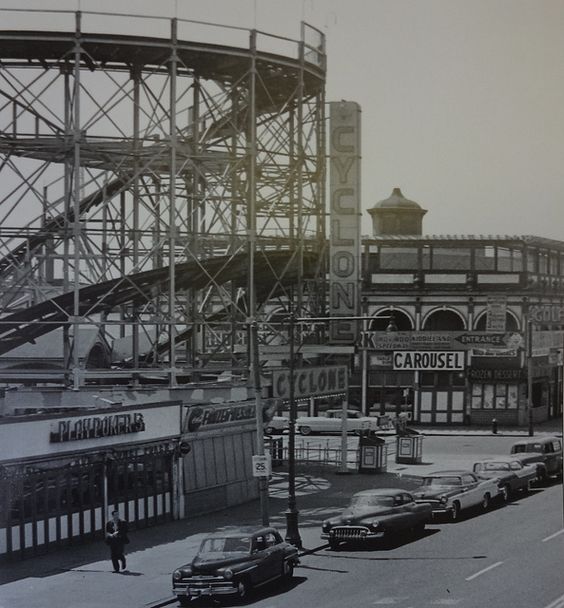
I lived two blocks from the beach and the boardwalk. I loved to go swimming in the ocean and walking the boardwalk. We had two big amusement parks within walking distance, Luna Park and Steeplechase. I preferred Luna Park as it had a circus. It was such fun watching the clowns, the animals, and especially the men and women on the trapeze. Nearby was the famous Nathan’s hot dog stand, where we could buy a hot dog with sauerkraut for five cents.
As there were no televisions, we went to the movies every Saturday. For ten cents, we saw a double feature along with newsreels, a serial, and cartoons. We bought a penny’s worth of candy and enjoyed the entertainment. On rainy days, we stayed indoors, drawing pictures with crayons and reading books from the library. We did not have as many toys as our grandchildren and great grandchildren have today, so we improvised. My brother made a train out of drawers from my father’s Singer sewing machine.
As all little girls, I loved to play with dolls. My mother had bought me a small celluloid doll with moving arms and feet that I could even bathe. I wanted a new doll carriage, but we were in the midst of the Great Depression, and my parents could not afford to buy me one from the store. So, we became creative. A shoebox became my doll carriage. My mother made a hole at the end of the shoebox and put a string through it so I could pull the carriage. The top of the box became the hood. She also gave me scraps of material which I made into a pillow, a carriage cover, and clothing for my doll. With a child’s imagination, I thought that my doll and doll carriage were the most beautiful in the world.
It was convenient to live near the beach, but my neighborhood was not the best. It was all pavement—no flowers and no lawns. One summer, my second-grade teacher thought it would be a good summer project to learn how things grow. The last week of school, she had us bring in a small wooden cheese box and a small potato. She helped us put the dirt that she supplied into the bottom of the box. We cut up the potato, placed it in the dirt, and then covered the potato with more dirt. I placed the potato plant on the fire escape and watered it every day. In July, I was happy to see some green leaves. My parents and teacher had never told me that potatoes grow underground. So, when August arrived, I got so angry that no potatoes had grown on the leaves, I just dumped the plant. I was so surprised to find four little potatoes!
Looking back, I had a very happy childhood. Although we did not have much money, I never felt deprived!
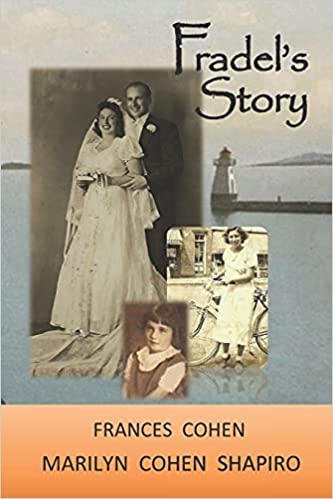
Ever since I could remember, my mother, Frances Cohen, was the family story teller. Give her an opening, and she would regal any audience with stories of her grandparents’ and parents’ lives in Russia, of her early years of marriage to “My Bill,” of their life in small towns and smaller apartments in the North Country, and of raising four children, watching them leave for college and for marriage, and their returning with her grandchildren to visit her and my father in their beloved cottage on Lake Champlain.
For many years, these stories were always told orally. Mom shared them when the family got together around the old oak table in the dining room, when she visited friends, and when her children’s friends came to visit. What was fascinating was that no one ever got tired of hearing them. As a matter of fact, she was highly regarded as the family historian. If anyone needed to know who was related to whom and how my father’s side was related to my mother’s side and what really happened between those two cousins—well, you just had to ask Fradyl, and the truth would be known.
As my parents got older, my mother realized that she needed to record these stories. We never were one for video cameras and tapes, so she began writing them down on lined paper, usually from the six by eight notepads. . The writing was messy, with words misspelled and whole sections crossed out, but she began to put them down on paper.
My parents retired in 1981 and spent the next nineteen years living six months in Florida and six months on a cottage on Lake Champlain. As it became too difficult to maintain two homes, they sold their cottage to my brother and sister-in-law, and my parents lived in Florida permanently. When I went to visit, my mother would tell me the stories as I transcribed them onto paper. Unfortunately, these scraps of paper remained in their original state for several years.
In 2007, after a number of health setbacks, we children insisted that my parents sell their condo in Florida and move back up North to be closer to the family. Everyone decided that the best location would be close to Larry and me, and on May 1, 2007, they moved into Coburg Village, an independent living facility only four miles from our home.
Initially uncertain about leaving Florida, their friends, and their independence, my parents soon realized that this was an ideal living arrangement that provided nightly five-course dinners in a lovely dining room, a shuttle service that brought them to grocery stores and doctor’s appointments, live entertainment and numerous clubs.
Soon after moving in, my mother called me to tell me she was joining Coburg’s monthly writing group to polish all those stories she carried in her head and on those scraps of paper. The night after her first meeting, however, she phoned to tell me she wasn’t sure she would fit in. “Most of them have college educations and write beautifully, Marilyn,” she lamented. “They will look down on my family stories as being silly and boring.” However, when she brought her first story to the group, her accounting of why she and my father moved to Coburg, she was surprised to find that the group enjoyed her writing style. “They loved my story, Marilyn! They said I have a real flair for story telling!” After that, my mother’s voice in phone calls after the monthly Wednesday meetings was filled with pride.
Mom rarely had difficulty finding a topic and writing it down with paper in pen. However, the group leader requested that the stories be typed so they could be published in the semi-annual collection and distributed to Coburg resident. My mother asked me, “my daughter the English major,” to type them, and, while I was at it, to do some proofing and minor revisions so that they would read more smoothly.
Thus began our five-year collaboration. Every month, about a week before the group met, my mother would give me her hand-written story, and I would bring over the typed version by Sunday afternoon. If I didn’t have it done by Sunday night, the phone calls would begin. “Marilyn, if you don’t have the time, just bring back my copy and I’ll read it from the original.” I would assure her that it would be delivered in time for her meeting, even resorting to sending the final copy to her via the Coburg fax machine.
The oral stories evolved into written documents, always original, always entertaining. She wrote about the Old Country: how her mother’s mother died in childbirth and how the two children were raised at first by an uncaring stepmother and then by a loving women who raised them and the seven others that followed; how my father’s father escaped from Russia in a cart filled with hay; what it was like living in Regalia and Vilna at the turn of the century with the fear of pogroms always on the Jewish population’s mind. She wrote about her mother’s family coming to America: how her Uncle Sam saved enough money to bring over his sister Ethel; how Aunt Lil turned down a job at the Triangle Shirt Factory a month before the fire because she thought it looked unsafe; how Grandpa Joe left his future bride at the jeweler’s as collateral until he got a second opinion of the diamond ring they were purchasing. And she wrote about our family: how she and Bill met on a blind date; how they raised four children in various small towns in the North Country, and, and how they came to buy their cottage on Lake Champlain. The stories were funny, sad, and painful, but they were always ready the first Wednesday of every month for her meeting.
When my father passed away in November, 2008, my mother’s contribution for December was an open letter to my father. She wrote that she was moving into a smaller apartment down the hall, but “Wherever I go, you also go in spirit.” Grieving quietly, she continued with her life at Coburg, going to the concerts, visiting with friends and family who were always stopping by to see her, and continuing with her writing. All of the children asked her to write about our birth and early childhood, but she always postponed those stories, focusing on the Old Country, her childhood, her Bill.
On December 22, 2010, my mother had a heart attack. The doctors recommended Hospice and living her remaining time to the fullest. She complied, enjoying visits from the children, grandchildren, her cousins, and the many friends she had made in Coburg and Clifton Park. She kept writing, and in February, with my sister Laura and I sitting close by, she shared her story: “The Birth of My First Child,” in which she described her joy in having a beautiful little girl and her fears that she would not be able to be a good mother. The last words, written in pencil on the bottom, were “To be continued……” She died four weeks later, one day before the March meeting.
My parents were not wealthy people, and had little of material value: a wedding ring, two beautiful framed pictures of my father at thirteen and my mother at six, a few nice dishes. As my siblings and I sadly dismantled Mom’s apartment, my daughter was surprised that I wanted so little. “It’s ok, Julie,” I said, “We have her stories.”
And we do….Over one hundred typed pages as well as a file of her handwritten notes that she had kept over the years. What a gift to her family, her friends, and all who knew and loved this amazing woman!
Since the year that we met, my husband Larry and I have attended Rosh Hashanah—the Jewish New Year—services. We hear the shofar, listen to melodies that we only hear on the High Holy Days, and greet our friendswith L’Shana Tova—Have a good year!
Attending High Holy Day services as an adult is different from my experiences as a child growing up in Keeseville, a small upstate town of two thousand people about ninety minutes south of Montreal. My uncle Paul had opened Pearl’s, one of a chain of small department stores he had established in Vermont and Upstate New York. He hired my father to manage it. Although my parents had both grown up in New York City in Jewish neighborhoods, they had lived most of their married life in overwhelmingly Christian communities. In 1952, however, they found themselves in a town where they were the only Jewish family except for a childless couple, a lawyer and his wife. The next Jewish family didn’t move in until the mid-sixties.
To offset the effects of our non-Jewish environment, my parents immediately joined Congregation Beth Shalom, a Reform temple in Plattsburgh. We attended High Holy Day services and, depending on the weather conditions for the fifteen-mile drive, Shabbat services on Friday night. Saturday services were only held for the boys’ bar mitzvahs; all the girls were confirmed at age sixteen.
In addition to attending services, my parents were insistent on their children getting a Jewish education. For a span of twenty years, our father made the trip up Route 9 every Sunday with whatever number of his children between the ages of five to sixteen were taking religious school lessons. We would arrive in Plattsburgh a half hour early. Then Dad would take us to the newsstand across the street from the temple on Oak Street. He purchased the New York Times for himself and comic books for us, our perk for going to Sunday School. My brother Jay chose Superman; Laura and Bobbie, Archie and Richie Rich; and I, Classics Illustrated. Dad would then wait for us in his idling car —It got cold in that parking lot in the winter—reading the paper and smoking Kents. Over the years, all of us learned Jewish history, customs, and ethics. Jay learned Hebrew for his bar mitzvah. The three of us girls’ Hebrew education was limited to the six-word Shema and blessings over bread, candles and wine. When we got home from school, Mom would have an elaborate dinner waiting for us—brisket, roasted potatoes, candied carrots, pickles, and delicious spiced apples from a jar—another perk for our going to Sunday school.
As residents of Keeseville and members of a temple in Plattsburgh, we were caught between two worlds. As we did not live in Plattsburgh, we often viewed ourselves as outsiders at Temple Beth Israel. My mother, in particular, did not feel comfortable with many of the congregants. A daughter of poor Russian immigrants, she often felt inferior to those who were third or fourth generation German Jews who historically regarded themselves as more educated and refined than those from the shtetls—the small towns with large Jewish populations which existed in Central and Eastern Europe before the Holocaust.
The residents of Keeseville were generally welcoming to our family, and we rarely experienced anti-Semitism. There were moments, however, that are etched in my memory. My parents were usually included, but there were occasional “lost” invitations to events, and we knew some viewed us as different. On rare occasions, the insults were more direct. When I was around six years old, I was playing on my front lawn with my doll. A teenaged boy who lived up the street came by and, giving the Nazi goose salute, yelled “Heil Hitler!” I ran inside crying. Jay, four years older than I, ran out of the house to chase him down and punch him in the nose. When Jay was in high school, the local priest advised his young female parishioners that it was best not to date “Hebrews.” Obviously, this did not help Jay’s social life.
The High Holy Days emphasized this “otherness” even more strongly. We did not attend school on Rosh Hashanah and Yom Kippur. My father closed the store, an event worthy of coverage in the Essex County Republican. Jay, who played football for Keeseville Central, missed every game that fell on the two major fall holidays, again newsworthy enough to make the local paper.
Everyone in Keeseville knew that the Cohens celebrated their Jewish High Holy Days, but I was still sensitive to our being the only children missing school. One Rosh Hashanah, I was pushing my doll carriage in front of the house when I was overcome with embarrassment. What if someone saw me and wondered if I were playing hooky? I went inside to avoid the potential scrutiny and a visit from the truancy officer.
My feeling of “otherness” continued as the seasons changed. Beginning in November, I often had to explain that Chanukah was not the “Jewish Christmas,” and no, we didn’t have a Christmas tree or a Chanukah bush. As soon as we returned to school from the Thanksgiving break, the music classes I attended and, later, the choruses I joined in junior senior high, were filled with Christmas music. I could handle “Little Town of Bethlehem” and “Deck the Halls.” When it came to the line in “Silent Night” which stated “Christ the Savior is born,” however, I would just mouth the words. The token inclusion of the song “I Had a Little Dreidel” didn’t make me feel that the school was sensitive to my religion and culture
Other events brought their challenges. Passover often fell around Easter, and I watched my Christian friends devour bunny shaped chocolate eggs and jelly beans while I nibbled on my dry matzoh and butter. Once again, I felt different. In high school, my World History textbook reduced the Holocaust to the iconic 1943 picture from the Warsaw Ghetto of a German soldier pointing his machine gun at a little boy, clad in a coat with the yellow star, holding up his hands in terror. I can still remember looking down and crying silent tears while the teacher quietly and sympathetically moved on to the next topic. I understood clearly that the horror of the persecution of the Jews was diminished by this negligible treatment of the Holocaust in our textbook.
For many years, I saw other Jewish children mostly at Sunday School. As I got older, I joined a Jewish youth group and finally had Jewish friends. For the most part, however, our friends were our Christian classmates from Keeseville. We all dated in high school, but my parents pressed upon us their wish we would leave Keeseville after we graduated and make our lives in settings with more Jewish people.
In part because of my desire to be with other Jews, I enrolled in University of Albany in 1968. While at college, I attended High Holy Day services at Congregation Beth Emeth, but that was the extent of my Jewish participation until I met my future husband in 1973.
Larry and I attended High Holy Day services at Congregation Shaara TFille, the then-Orthodox shul—synagogue—in Saratoga to which his family belonged. What a dramatic difference for me! Men sat in the center pews, and the women, although not behind a mehitzah, (a curtain which separated the men from the women), sat in the back or on the sides. Most of the service was in Hebrew, and everyone prayed at what seemed to be lightning speed. Page numbers that were displayed on a chart on the bima provided my only means of following along with the prayer book. The services were much longer than those at Temple Beth Israel, and even the rabbis, with their black beards, payots (side curls), and yarmulkes (skull caps), were strange to me. In many ways, it was as foreign to me as the churches I had attended on occasion with my Christian friends.
After Larry and I were married, we bought a home in Clifton Park, a suburb of Albany, New York, in part because we knew that a synagogue had recently been built in the community. We joined in 1983, and we found that the Conservative service was a good compromise between Larry’s Orthodox shul and my Reform temple. Ten years later, I celebrated my own bat mitzvah on my father’s eightieth birthday, my way of honoring his commitment to our Jewish education.
Throughout my life, people assume that I, like many Jews, was brought up “downstate,” in New York City or Long Island. When I tell them about growing up in Keeseville, they comment, “That must have been hard!”
It had its challenges, but it also offered wonderful opportunities. I grew up in a loving, close knit family, developed lifelong friendships, and enjoyed the beauty of Lake Champlain and the Adirondacks. I proudly identify myself as an Upstate New Yorker, with roots still entwined in that tiny town an hour south of the Canadian border.
Because of my unique upbringing, rather than losing my Jewish identity, my faith grew stronger. I could never take being a Jew for granted. And having a faith I had to hold on so tightly to maintain makes each High Holy Day, each Jewish milestone, even sweeter.
A version of this story was published in The Jewish World, August 29, 2013. I am finally posting it on my blog eleven years later!
Marilyn and Larry Rosh Hashanah 1973 (Shh! We were engaged but didn’t tell anyone yet!)








 There Goes My Heart